The Guard Blocked The Old Man’s Service Cart Until The Red Phone Silenced The Room
Chapter 1: The Old Man With The Service Cart
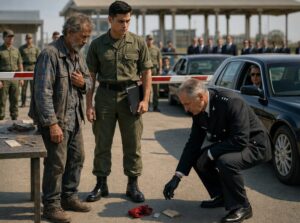
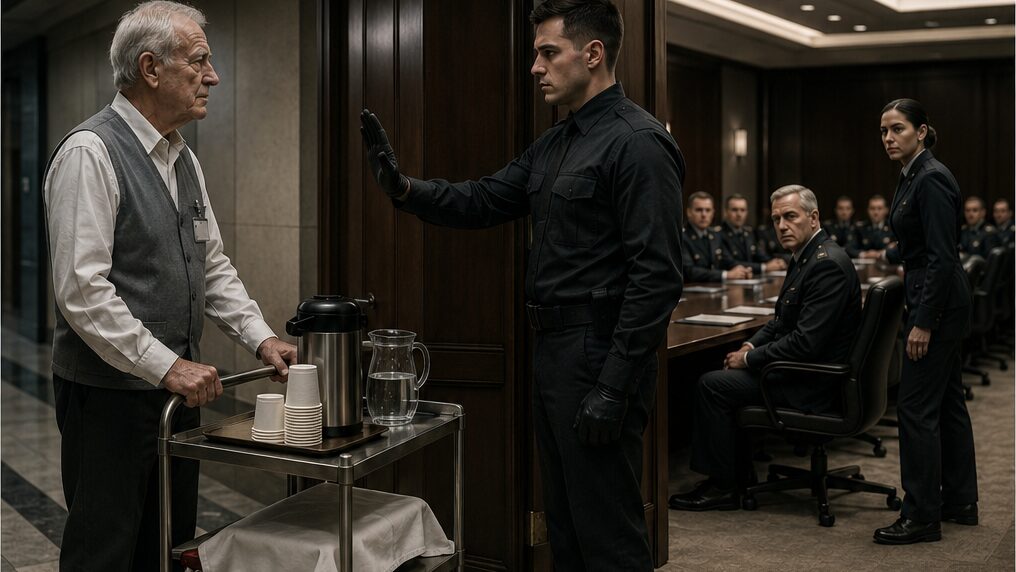
The young guard’s black glove stopped two inches from Robert Miller’s chest.
It did not touch him. It did not have to. In the polished hallway outside Conference Room Four, a raised palm carried more force than a shove.
Robert kept both hands on the handle of the service cart. The wheels hummed faintly beneath the silver trays, the stack of paper cups, the glass water pitcher beaded with condensation, and the dented coffee urn that gave off a bitter morning smell. Under a folded white cloth near the lower shelf, a square red shape showed only at one corner.
The guard looked first at Robert’s plain gray vest, then at the cart, then at Robert’s face with the quick impatience of a man who had already decided the answer.
“Service staff waits at the side station,” he said.
Robert’s fingers tightened once around the cart handle. The knuckles were wide, old, and pale, with a slight tremor from age or cold. He had dressed as he always did on volunteer mornings: pressed white shirt, gray service vest, dark trousers, black shoes buffed until the scuffs softened but did not disappear. His badge, clipped low near his pocket, read only: R. Miller — Facility Services Volunteer.
Beyond the guard’s shoulder, the conference room door stood half open. Robert could see the dark wood paneling, the long table, the flags in the corner, and uniformed shoulders turned toward folders. A closed review. A room built for careful language. A room where men and women could bury a thing by giving it a proper title.
He had known rooms like that before they installed the new locks.
“I was asked to come here,” Robert said.
His voice was quiet enough that the hallway clerk at the far desk did not look up. The guard did.
“You were asked to bring coffee,” the guard said. “Not to enter.”
Robert looked past him. On the wall beside the doorway was a plaque that listed old room names no one used anymore. Conference Room Four had once been Crisis Line Room B. The brass had been polished so often that the letters looked shallow, but Robert could still read them without leaning close.
He remembered the original door. Green paint. No window. Two locks that stuck in humid weather. A phone that rang without a bell, only a red light flashing in the corner until someone picked up.
The cart wheel drifted slightly against the carpet seam. Robert corrected it with a small movement of his left hand.
“I need the cart inside,” he said.
The guard’s nameplate read HILL. He was young, broad through the shoulders, clean-shaven, and too careful with his posture. His uniform still had the crispness of someone who measured himself against every reflective surface. He glanced toward the open door, where voices murmured behind him.
“This room is restricted.”
“I know.”
That seemed to annoy him more than any argument would have.
Robert watched him scan the badge again. R. Miller meant nothing to him. Not enough letters. No rank. No ribbon bars. No proof of importance.
A small draft moved along the corridor, lifting the edge of the white cloth on the cart. Robert rested two fingers on it before it could shift farther.
The red phone beneath it was not bright anymore. Its plastic had dulled to the color of old brick. One corner was nicked. A faded archive tag looped through the coiled cord, but Robert had tucked the tag inward. Not hidden. Protected.
“Sir,” Ryan Hill said, with the kind of politeness that already contained a warning, “I can’t have you blocking the entrance.”
Robert did not move.
At the far end of the hallway, a maintenance supervisor rolled a mop bucket toward the elevator, saw the exchange, and slowed. The hallway clerk finally lifted her eyes. Two officers passed behind the glass security partition and turned their heads just long enough to understand an old man was being held up.
Public, then. Not loud. But enough.
Robert had waited in worse places. In sand with no shade. In a bunker with three radios dead and one still breathing static. In a hospital corridor where a young officer’s mother had asked if her son had been afraid, and Robert had not known how to answer without lying.
The guard extended his hand a little farther.
“Move the cart to the service alcove.”
Robert looked at the half-open door again. Inside, a gray-haired officer sat at the head of the table, reading from a folder. Michael Garcia. Older now. He had been a captain once, thin-faced and sharp, standing beside a map board with his jaw set like he could hold an entire operation together by clenching his teeth.
Robert wondered if Michael would recognize him in the hallway.
He hoped not. Then he hoped he would.
That was the trouble with coming back.
From inside the room, a woman’s voice said, “Are we ready to begin the record review?”
Robert looked down at the cart. The coffee urn reflected his face in a warped curve: lined forehead, hollowed cheeks, white hair combed back but thinning near the temples. A service volunteer. An old man with careful shoes. No one who needed a room to stop and remember.
Ryan followed his gaze and frowned at the covered object on the lower shelf.
“What’s under there?”
Robert’s thumb pressed the cloth edge flat.
“Part of the delivery.”
“For coffee?”
“For the meeting.”
The guard gave a short breath through his nose. “Sir, I’m going to need you to step aside.”
Robert nodded once, as if the request were reasonable. Then he said, “You can check the name again.”
“I checked.”
“Check the handwritten addendum.”
Ryan’s expression changed by a fraction. Not doubt. Irritation that the old man knew there could be an addendum.
The hallway seemed to grow quieter. The mop bucket stopped squeaking. The clerk pretended to look down while continuing to listen.
Ryan reached to the stand beside the door and picked up the printed access sheet. His eyes moved down the names. Robert knew exactly where the mistake would be: typed list, formal names, ranks, departments. Then a note added late, because Michael had not wanted the request entered into the official attendee file until the morning of the review.
Ryan flipped the page once, then back again.
“No Robert Miller,” he said.
Robert’s shoulders dropped a little, not in defeat but in tired recognition. The full name was not there. Of course it was not. It had been years since institutions remembered full names before they needed them.
He looked at the door, at the room, at the table where men and women would discuss an emergency order as if the voice that gave it had vanished into paperwork.
“My initial is there,” he said.
Ryan turned the sheet toward himself, shielding it as though Robert might steal clearance with his eyes.
“There’s an R. Miller listed for service support.” He tapped the page. “That is not entry authorization. That is delivery authorization.”
Robert absorbed the words without flinching.
In the room, a chair scraped. Someone laughed softly, unaware of the hallway. The sound disappeared the moment Robert turned his head.
The red phone under the cloth seemed heavier than it had when he lifted it from the archive crate that morning. He had expected weight from the metal plate inside the base, from the old cord, from the years. He had not expected the weight to increase as he approached the room.
Ryan set the access sheet back on the stand.
“I’m sorry,” he said, though he did not sound sorry. “Your name is not on any list that gets you through this door.”
Robert looked at the gloved hand, the open room, the hidden corner of red beneath the cloth.
Then he waited.
Chapter 2: The Guard Who Would Not Check Twice
Ryan Hill stepped between the cart and the doorway as if he were stopping a threat, not an old man carrying coffee.
Robert saw the movement travel into the room. A shoulder turned. A pen paused. The legal observer near the far wall looked up from a tablet. Amy Rivera, seated two chairs down from the head of the table, leaned slightly to see past Ryan’s back.
Robert kept his eyes lowered to the cart handle.
The paper cups trembled faintly from the vibration of the building’s air system. He steadied them with two fingers. It gave his hands something ordinary to do.
“Sir,” Ryan said, louder now, “you need to move.”
Robert heard the shift in tone. It was no longer a private correction. It was performance for the room.
“I came because I was invited,” Robert said.
“You came because service support was scheduled. There’s a difference.”
“There usually is.”
Ryan glanced at him sharply, unsure whether he had been insulted. Robert’s face gave him nothing.
Inside, Michael Garcia lifted his head. He had silver now at both temples and a heavier face than Robert remembered, but his eyes were the same: quick, assessing, trained by years of rooms where every silence meant something. He looked first at Ryan, then at Robert, then at the cart.
Not recognition. Not yet.
Ryan reached for the cart.
Robert’s hand moved before the guard touched it. Not fast. Just final. His palm settled on the handle in a way that made the cart feel less like equipment and more like property entrusted to him.
“Please don’t,” Robert said.
The guard’s jaw tightened. He was too young to understand that a calm refusal could be firmer than anger.
“What is your issue?” Ryan asked.
The hallway clerk looked up fully now. The maintenance supervisor had stopped near the elevator. Two officers inside the conference room exchanged glances. Robert felt their attention collect on his vest, his badge, his age.
He had once commanded rooms by entering them. Now he was measured by whether his shoes looked expensive enough to cross a threshold.
No, he corrected himself. That was too easy. Ryan was not the whole disease. He was a symptom in polished boots.
“My issue,” Robert said, “is that the cart belongs in that room.”
Ryan gave a brief laugh. It was not cruel enough to be memorable, but it was dismissive enough to sting. “The coffee belongs in that room. You don’t.”
A silence followed, small but clean.
Amy Rivera looked down at the table. Michael did not.
Robert let the sentence pass through him. He had learned long ago that words sometimes showed more about the person using them than the person they were aimed at. Still, something in his chest tightened, not for himself only. For every man who had come home old. For every woman who had stood at a desk with a folder and been called confused. For every worker who had been useful until they asked to be seen.
He looked at Ryan’s nameplate.
“Mr. Hill,” he said, “you can check the name again.”
“I already told you—”
“The handwritten addendum.”
“There is no entry authorization on the addendum.”
“There is an initial.”
Ryan snatched the sheet again. This time he turned it enough that Robert could see the lower margin. There it was, in blue ink: R. Miller — bring archive item personally. No rank. No title. Michael’s handwriting, though rougher than Robert remembered.
Ryan tapped the line. “Service support. Archive item. Still not entry.”
Robert nodded. “Then ask the person who wrote it.”
Ryan’s face colored. He did not like being corrected by someone he had already placed beneath him.
Behind him, Michael stood halfway, one hand on the conference table.
“What’s the delay?” Michael asked.
Ryan turned just enough to answer without surrendering the doorway. “Service volunteer is trying to enter the room, sir. He says he has an archive item.”
Michael’s eyes moved to Robert again. “Name?”
Ryan looked at the sheet. “R. Miller.”
The air changed.
Not dramatically. No one gasped. No chair fell. But Michael’s face altered as if a light had gone out behind his eyes and another, older one had come on.
Robert saw it and wished, suddenly, that he had stayed home.
Michael stepped away from the table. “What archive item?”
Ryan looked back at the cart. “It’s covered.”
Robert did not move.
“Sir,” Ryan said to Michael, eager now to regain control, “I can have him take it to Records.”
“No,” Robert said.
The word was quiet, but it stopped Ryan more completely than any raised voice.
Ryan turned on him. “You don’t decide that.”
Robert held his gaze for the first time. “Not anymore.”
For a moment Ryan seemed unsure what to do with that answer. It did not sound like defiance. It sounded like memory.
He reached down and pulled at the white cloth.
Robert’s hand caught the fabric, but not before one corner slid away.
The red phone appeared beneath it.
The hallway clerk stood up without meaning to. Amy Rivera rose from her chair in the conference room. The legal observer frowned, recognizing importance before understanding it. The object sat low on the cart shelf, squat and old, its coiled cord bound with a yellowing tag. Against the white cups and silver urn, its faded red casing looked almost unreal.
Ryan stared at it. “What is that?”
Robert folded the cloth back neatly, no longer hiding the phone.
“A phone,” he said.
Ryan looked irritated again, relieved to have a simple answer to mock. “I can see that.”
Amy came closer to the doorway, her eyes fixed on the archive tag. “That’s not regular equipment.”
Michael had gone still.
Robert did not look at him. He looked at the red phone, and for a moment the hallway vanished. He saw the flash of a warning light. He heard static like rain on sheet metal. He saw a young officer standing beside him, waiting for an order no one should have had to give.
“Where did you get it?” Ryan asked.
“From where they put it when they stopped wanting to remember it.”
Ryan gave him a hard look. “Sir, that doesn’t answer my question.”
“It answers enough for now.”
Michael walked to the doorway. With each step the room behind him seemed to tighten. Officers watched him. The legal observer paused her tablet. Amy stood aside.
Michael stopped beside Ryan, close enough now to see the tag on the cord. His face had lost color.
“Rivera,” he said, without looking away from the cart. “Read the tag.”
Amy leaned toward it. She did not touch the phone. “Crisis Line B. Decommissioned. Restricted archive. Serial…” She hesitated. “Serial ending zero-seven.”
Michael closed his eyes briefly.
Ryan looked from Amy to Michael, then to Robert. The first crack of uncertainty appeared in him. “Sir?”
Michael opened his eyes. He looked at Robert’s badge. R. Miller. Service volunteer. Then at Robert’s hands, which rested on the cart as if on a rail in rough water.
“Mr. Miller,” Michael said carefully, “why is that phone here?”
Robert finally looked at him.
“You know why.”
Michael swallowed. The sound was small, but the room heard it.
Ryan straightened, sensing command shifting around him and not understanding why. “Sir, he still isn’t cleared.”
Michael did not answer immediately. His eyes remained on Robert. Something old passed between them, though Ryan could not name it.
Then Michael turned to the guard.
“Let him in,” he said.
Ryan blinked. “Sir?”
Michael’s voice dropped. “Let Mr. Miller and the cart inside.”
Robert did not smile. He only adjusted the white cloth so it lay beside the red phone instead of over it, and pushed the cart forward.
The wheels crossed the threshold.
Chapter 3: The Phone Nobody Wanted Returned
The conference room received Robert Miller the way a room receives bad weather: first with silence, then with small adjustments no one wanted to admit making.
Chairs shifted back from the table. A folder closed. The legal observer set her tablet flat and watched the cart as it rolled over the carpet. Ryan remained at the doorway, one hand still half raised from the command he had not expected to lose.
Robert pushed the cart to the side of the long table. The coffee urn gave one soft metallic tick as it settled. The red phone sat on the lower shelf, uncovered now, its dull casing absorbing the overhead light.
Michael Garcia stood at the head of the table but did not sit.
“Place it there,” he said.
Robert looked at him. “At the center.”
A few eyes moved toward Michael. The request sounded too certain for a service volunteer, too direct for a man who had just been stopped at the door.
Michael’s mouth tightened. “This is a closed administrative review.”
“Yes.”
“The table is prepared for documents.”
Robert lifted the red phone with both hands.
It was heavier than anyone expected. Amy took one quick step forward, perhaps to help, then stopped when she saw the care with which he held it. Not like equipment. Not like evidence. Like something that had once carried a living voice.
Robert placed it at the center of the table between a pitcher of water and a stack of sealed folders. The red casing looked almost indecent there, too old, too blunt, too unwilling to blend with the room’s new screens and polished microphones.
The legal observer leaned forward. “Colonel Garcia, should that item be entered into the record?”
Michael glanced at her. “Not yet.”
Robert’s eyes moved to him.
The words had come too quickly. Michael heard it too. His fingers curled once against the chair back.
One of the unnamed officers cleared his throat. “Sir, if that’s restricted archive equipment, Records should verify chain of custody before it remains in this room.”
“It can remain,” Robert said.
The officer looked at him as if reminded that the old man had not been asked.
Michael said, “Mr. Miller, perhaps we should have a private conversation before the review proceeds.”
“No.”
Again, the word was quiet. Again, it changed the room more than a raised voice would have.
Robert’s heart had begun to beat hard, not from the weight of the phone but from the smell of the room: wood polish, coffee, paper, wool uniforms warmed by bodies. Old command rooms had a smell. Every era changed the furniture and kept the air.
He rested one hand near the phone but did not touch it.
“This review is about Operation Northline,” he said.
The legal observer’s eyes sharpened. Amy’s did too. Ryan, still at the door, looked into the room as if the name meant nothing to him but the reaction meant enough.
Michael sat slowly. “The name of the operation is not for hallway discussion.”
“We’re not in the hallway anymore.”
The facility manager, seated near the wall with a binder on his lap, shifted uneasily. “Colonel, do we need to pause?”
Michael did not answer him. He looked at Robert. “You were asked to bring an archive item. Not to participate.”
Robert nodded. “That is what the note said.”
“And yet?”
“And yet the item participates whether I do or not.”
No one spoke.
The red phone sat in the middle of the table, mute and impossible.
Robert looked at the faces around him. Some were old enough to have heard the operation name in training courses. Others were young enough to know only summaries: severe weather, failed communications, convoy rerouting, disputed casualty report. An emergency decision made in darkness, later reduced to a question of who had authorized the call.
Official memory liked clean edges. Real memory bled through paper.
The legal observer lifted a pen. “For the record, who is this gentleman?”
Robert waited.
It would have been easy then. Easier than all the years before. He could have given the full name, the old rank, the title that still appeared in certain sealed indexes and on formal invitations sent to the wrong address. He could have watched the room rearrange itself around him.
But Ryan was still at the door, listening. Amy was watching with concern rather than calculation. Michael was sitting very still, trapped between duty and fear.
Robert had not come to win a posture contest.
“Robert Miller,” he said. “Facility Services Volunteer.”
The answer embarrassed the room because it was true and not true enough.
The legal observer wrote it down.
Michael’s eyes lowered to the phone. “This review concerns a procedural question, Mr. Miller.”
“No,” Robert said. “It concerns a man.”
The words landed harder than he meant them to. He felt the old pressure in his chest and folded his hands behind his back to keep them still.
Amy spoke before Michael could. “Which man?”
Robert looked at her. She had been the first to see the tag. The first to stand without being ordered. “A junior officer whose name has been used for thirty years because he could no longer object.”
Michael’s jaw moved. “That is not the scope of today’s review.”
“It should have been.”
The facility manager leaned toward Michael and whispered, not quietly enough, “This is getting outside the agenda.”
Robert almost smiled. Agenda. A word that made cowardice look organized.
One of the officers at the table reached toward the phone, perhaps to turn the tag. Robert’s hand came down beside it.
“Don’t.”
The officer froze.
Robert softened his tone. “Please.”
The officer withdrew.
Michael exhaled. “Mr. Miller, I understand this item has significance to you. But there are procedures for introducing historical material.”
Robert looked at him steadily. “There were procedures that night too. Most of them failed.”
That did what the phone had not fully done. It brought the operation into the room not as an archive topic but as weather, darkness, voices, consequence.
Michael’s face changed again. He had not been in the command chair that night. He had been young, somewhere near the edge of the operation, hearing fragments through static and learning later which version survived. Robert could see him remembering the version.
The legal observer asked, “Is the phone connected to the disputed order?”
Michael turned toward her too quickly. “We have not established that.”
Laura Campbell entered before anyone else could speak.
She carried a flat archive case against her side, dark blue with a white chain-of-custody label across the latch. Her uniform was neat, her expression controlled, but her eyes went immediately to the red phone. She stopped just inside the room.
“I was told the archive item had arrived,” she said.
“It has,” Michael answered.
Laura came forward. She did not look at Robert first. She looked at the phone, then the tag, then the base where the old serial plate was screwed into the plastic. Her professional calm held for three seconds.
Then she looked at Michael.
“Who authorized removal from sealed storage?”
“I did,” Michael said.
Laura’s eyebrows lifted slightly. “For display or verification?”
Robert answered, “For memory.”
Laura looked at him then. Her gaze took in the vest, the badge, the lined face, the stillness. She was too disciplined to show dismissal. She was also too trained not to wonder.
Michael gestured toward the archive case. “Can you verify whether this item is connected to the Northline review?”
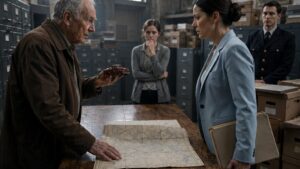
Laura set the case on the side table and opened a smaller folder from the outer pocket. “I can verify basic registry information without opening the sealed file.”
She approached the red phone. This time Robert did not stop her. Her gloved finger turned the tag enough to read the number.
The room waited.
Laura read from her folder, then back at the serial plate. A faint crease appeared between her brows.
“This item is not general communications equipment,” she said.
Michael was silent.
Laura continued, each word measured. “Serial zero-seven belongs to a restricted command instrument removed from Crisis Line Room B after Operation Northline. Its associated call log is sealed under command archive protection.”
The legal observer sat straighter. “Protected by whom?”
Laura looked at Michael, then at Robert, then back to the folder.
“I can’t answer that without opening the file.”
Robert’s eyes remained on the phone.
Michael said, “Then we don’t open it yet.”
Laura closed the folder halfway, but her hand paused. She had seen something else. Robert knew because he had seen that same pause in clerks, officers, and doctors over the years—the moment a record stopped being paper and started looking back.
“There is a serial cross-reference,” Laura said.
Michael’s voice sharpened. “Major Campbell.”
She ignored the warning only by a hair. “The phone’s number is linked to a sealed command code.”
The room seemed to shrink around the table.
Robert did not ask what code. He knew. He had written it once in grease pencil on a board during a night when the backup generator coughed and men waited for someone else to decide what grief would cost the least.
Laura looked down at the folder, then read the final line.
“The code belongs to R. Miller.”
Chapter 4: The Sealed Order In The Archive
Laura Campbell read the line again without speaking it.
The folder rested open in her hands, but her eyes had moved from the page to the old man standing beside the conference table. R. Miller. Facility Services Volunteer. The same initials attached to a sealed command code that had not appeared in an open review file for three decades.
Michael Garcia’s chair made a low sound as he stood.
“Major Campbell,” he said, “that material is restricted.”
Laura closed the folder halfway. “I haven’t opened the sealed file, sir.”
“You have said enough.”
“No,” Robert said. “She has said what was written.”
The room held itself still around him. No one wanted to look directly at the red phone now. It had changed from an object to a witness.
Laura’s training returned to her face. “If the command code is connected to the Northline order, the sealed record would need authorization from the review chair and legal observer before I can access it.”
The legal observer looked toward Michael. “If evidence exists that affects responsibility in the review, it should be examined.”
Michael did not answer at once.
Robert watched him wrestle with the kind of hesitation that could dress itself as caution. The kind that told a man he was protecting process when he was really protecting a version of the past that had become convenient.
Michael had been young during Northline, too young to have made the decisions, old enough to have learned which questions ended careers. Robert did not blame him for that. Institutions taught survival in small ways before they asked for courage in large ones.
“Colonel,” Laura said carefully, “the sealed archive is downstairs. I can verify chain of custody in person.”
Michael turned to Robert. “Mr. Miller, are you requesting the file be opened?”
The room waited for a claim, a title, a demand.
Robert looked at the red phone.
The coiled cord lay stiff beside the receiver. He could almost see it stretched across the old table in Crisis Line Room B, pulled taut by a young hand passing it to him while rain hammered the roof and the backup lights flickered.
“I am requesting,” Robert said, “that the order be read by someone who did not inherit the excuse.”
Michael’s expression tightened.
The legal observer capped her pen. “I will accompany Major Campbell.”
Michael gave a short nod. It was permission, not agreement.
Laura took the archive case from the side table. As she moved toward the door, Amy Rivera rose.
“Sir, should I go with them?”
Michael glanced at Amy, then at Robert. “Stay.”
Robert saw disappointment flicker in her face. Not because she wanted to escape the room, but because she had already understood that the truth was moving down the hall and she wanted to follow it.
Laura passed the doorway where Ryan still stood rigid. His eyes avoided Robert’s now. The guard had lost the certainty that made him tall.
When the door closed behind Laura and the legal observer, the conference room settled into a waiting silence.
Michael remained standing. “We will take a short recess.”
No one moved.
The facility manager opened his binder, closed it, then opened it again. “Should the item be removed during the recess?”
Robert’s hand rested near the phone. “No.”
The manager looked to Michael for rescue.
Michael said, “It stays.”
That was the first thing he had said all morning that did not sound like defense.
Robert stepped back from the table. Age pulled at his knees after the long stand. He did not sit. There were empty chairs, but none were offered, and he would not take one yet. Not because of pride. Because sitting there would make the room decide it had honored him before it had heard him.
Amy noticed. She slid a chair out with one hand. Not much. Just enough.
Robert looked at it, then at her.
“Thank you,” he said.
He sat slowly. The room watched the ordinary difficulty of an old body lowering itself into a chair. He disliked that more than Ryan’s hand at the door. Age had its own humiliations, quiet and repetitive. A man could accept them and still resent the audience.
Michael sat across from him.
“You knew the code would be there,” Michael said.
“Yes.”
“Why didn’t you contact me directly?”
“I did.”
Michael frowned.
“Three letters,” Robert said. “One through the archive office. One through the facility commander. One through your review clerk.”
The facility manager stopped moving his papers.
Michael looked toward him. “Did we receive letters from Mr. Miller?”
The manager’s face reddened. “There were several communications from service support personnel regarding Northline display material. I believed they were routine.”
Robert said nothing.
Michael’s gaze hardened, but not fully at the manager. Some of it turned inward.
Amy spoke softly. “Sir, the addendum this morning was your handwriting.”
Michael nodded. “After the archive office flagged the serial number. I thought Mr. Miller was delivering the item.”
“You were,” Robert said.
Michael looked at him.
“You just didn’t ask what else was being delivered.”
The words were not sharp. That made them worse.
Downstairs, the sealed archive would be behind two locks and a climate door. Robert had visited it once before dawn, accompanied by a clerk who had not been born when Northline happened. The clerk had slid the red phone toward him on a padded cart and said, “Careful, it’s heavier than it looks.”
Robert had almost laughed.
The room clock clicked toward eleven.
An unnamed officer near the end of the table cleared his throat. “Mr. Miller, were you attached to Northline in some support capacity?”
Michael’s eyes closed for half a second.
Robert turned to the officer. He was not offended. The question was almost kind in its ignorance.
“Yes,” Robert said.
“What capacity?”
Robert looked at the red phone again. “The kind that does not fit well in summaries.”
The officer lowered his eyes.
Minutes stretched. In the hallway beyond the closed door, footsteps passed, stopped, passed again. The building continued its day around them. Badges beeped at locks. Phones rang at desks. Somewhere, another service cart probably rolled along another corridor, unnoticed unless it was late.
Michael leaned forward, elbows near the folder he had not reopened.
“The review concerns whether Lieutenant Allen exceeded his authority in rerouting the convoy,” he said. “The standing record indicates he initiated the call after communications failure.”
Robert’s face did not change, but the name entered him like cold water.
Lieutenant Allen. A name preserved in blame because it was easier than preserving a man.
“He did not initiate it,” Robert said.
Michael’s hands folded. “That is not what the record says.”
“The record is incomplete.”
“The record was certified.”
Robert looked at him. “So were orders that sent men into places they did not come back from. Certification is not holiness.”
The room took that in without sound.
Michael looked older than he had an hour before. “If you knew this, why wait thirty years?”
There it was. Not accusation exactly. Worse: the question Robert asked himself every morning he signed in under Facility Services and wheeled coffee past photographs of men whose faces had become younger every year.
He looked at Amy, then at the manager, then at Ryan visible through the narrow window in the door.
“Because at first I believed the correction would happen without me,” he said. “Then I believed my silence protected people still serving. Then one day I understood I had only protected the institution from discomfort.”
Michael did not look away.
Before anyone could answer, the door opened.
Laura entered with the legal observer behind her. The archive case was now sealed with a red evidence band. Laura carried a second folder against her chest. Her professional calm had thinned; beneath it was something like apprehension.
She set the folder on the table but did not open it.
“Colonel Garcia,” she said, “the file is sealed under command archive protection. The legal observer agrees the review chair may authorize opening due to direct relevance.”
Michael’s gaze went to the red evidence band.
“And?”
Laura swallowed once.
“The phone serial number matches the sealed Northline call log. The associated order contains command code RM-Seven.”
Robert’s breathing slowed.
Michael’s voice was low. “Read the name attached.”
Laura looked at Robert before she answered.
“The file does not give a full name in the index. Only the code.”
Michael took the folder and opened it. His eyes moved across the first page, then stopped.
Color drained from his face.
Robert did not need to see the page. He remembered the handwriting. Not because it was beautiful, but because it was his under pressure: hard, narrow, slanted by exhaustion.
Michael turned one page, then another.
Laura said, “There is an attached authorization line.”
The legal observer looked at the document. “Colonel?”
Michael did not speak.
Robert closed his eyes. For a moment, he was back in the room with the red light flashing and the young lieutenant saying, “Sir, if we wait for confirmation, they’ll be trapped by morning.”
The phone on the table remained silent.
Laura read what Michael could not.
“The authorization line is signed with Robert Miller’s command code.”
Chapter 5: The Name The Room Finally Remembered
Michael Garcia had spent most of his adult life learning how to keep his face from becoming part of the record.
A commander did not wince when a casualty number was read. A review chair did not show alarm when an old file contradicted a certified summary. A senior officer did not let a room see the moment he realized the man he had allowed to stand in the hallway was the one name the room had been built to avoid.
But when Laura Campbell read the command code aloud, Michael felt discipline fail in small, visible ways.
His hand remained on the open file. The paper beneath it was thin, copied from an older sheet, the ink preserved in archive imaging. At the bottom, beside the order that had redirected Convoy Three through the eastern access road, was a line of authorization no one had included in the public training summary.
RM-Seven.
Below it, in handwriting Michael had seen only once before in an old academy case study, was a name written in full.
Robert Miller.
Not service support. Not volunteer. Not archive delivery.
General Robert Miller, Command Director, Emergency Joint Response Cell.
Michael looked up slowly.
The old man sat across from him, hands folded, gray vest buttoned neatly, volunteer badge still clipped crooked near his pocket. He looked tired. Not exposed. Not triumphant. Tired in a way that made Michael ashamed before he had words for it.
The legal observer leaned in. “Colonel Garcia?”
Michael heard the title like it came from across water.
Amy Rivera stood very still by the side table. Ryan Hill remained visible through the glass strip in the door, no longer pretending not to watch. The facility manager’s binder had slipped sideways on his knees.
Michael had heard stories about Robert Miller as a young captain, though never from Robert himself. A commander who kept three failing channels open during Northline. A general who took the last evacuation decision before the weather closed. A man whose order had saved two units and destroyed his own peace. In classrooms, the name had become clipped and formal. Miller Decision. Miller Line. Miller Exception.
Then the summaries changed. Names became roles. Responsibility diffused. A junior lieutenant remained in one footnote because the dead did not argue with institutional convenience.
And now the man from those lessons sat in a service vest at Michael’s table.
Michael stood.
Every chair seemed louder as people adjusted around him.
“Mr. Miller,” he began, then stopped.
Robert’s eyes lifted.
The correction was simple. It was also enormous.
“General Miller,” Michael said.
The room went silent in a way silence had not yet managed that morning. Not waiting silence. Not confused silence. Recognition silence.
Ryan’s face changed behind the glass. Amy lowered her eyes, then raised them again, as if respect required looking directly. Laura stood beside the file, shoulders squared, but her mouth trembled once before she controlled it.
Robert did not rise. He did not nod as if accepting tribute. He looked at Michael with a sadness that made the title feel less like honor than evidence.
“Retired,” Robert said.
Michael swallowed. “Yes, sir.”
Robert’s hand moved slightly toward the volunteer badge. He did not remove it.
The facility manager stood halfway and nearly dropped his binder. “General, I— We didn’t realize—”
Robert looked at him. The manager stopped.
Michael felt the room leaning toward the easiest version of the moment: apology, correction of address, perhaps a formal acknowledgment that would let everyone feel shaken and then safe. The machinery of regret was efficient when it did not have to change anything.
He looked down at the file again.
“The standing summary is wrong,” he said.
The legal observer reached for the document. “Please clarify.”
Michael read, his voice steadying because there was work to do. “The original call log shows Lieutenant Allen did not initiate the convoy reroute. He relayed field conditions and requested guidance. The authorization came from command code RM-Seven.”
All eyes moved to Robert.
He sat with his hands still folded. The skin over his knuckles looked thin. The fingers had once held a receiver just like the one in the center of the table and decided which road men would take into weather that did not care about rank.
Laura placed another page beside the phone. “The call log shows a time stamp three minutes before the route change.”
Michael read the line, though he already knew what it meant. “Emergency command directive issued by Command Director Robert Miller.”
The title hung there.
The phone sat beside it.
The red casing looked duller than before, almost modest. An object made to ring only when ordinary channels failed.
The legal observer’s pen moved quickly. “Why was this not included in the certified review record?”
No one answered.
The facility manager looked at the table. One unnamed officer pressed his thumb and forefinger against his brow. Amy’s face had gone pale.
Michael forced himself to look at Robert. “Sir, did you know Lieutenant Allen remained attached to the disputed action?”
“Yes.”
“Did you attempt to correct it?”
“Yes.”
The answers were not defensive. That made them harder.
Michael waited.
Robert looked toward the sealed folder. “Three times within the first five years. Twice through command channels. Once through a letter to the family that was never cleared for release.”
The legal observer looked up. “A letter exists?”
Laura checked the file index. “There is a withheld correspondence entry.”
Michael’s chest tightened. “Withheld by whom?”
Laura’s eyes moved over the page. “Command legal review. No named officer in the summary index.”
Robert gave a small, humorless breath. “No one ever names the room.”
That sentence settled over them more heavily than any accusation.
Michael remained standing. He could feel Ryan’s presence at the door without turning. The young guard had seen the beginning. He needed to hear this too.
“Open the door,” Michael said.
Amy looked at him.
“The door, Captain Rivera.”
Amy crossed the room and opened it.
Ryan straightened at once, but his face had lost its earlier hardness. The hallway clerk looked in from farther down, then quickly away.
Michael did not ask Ryan to enter. He did not need to. The opened door was enough. The same threshold that had kept Robert out now let the room’s shame breathe into the corridor.
Michael looked back at Robert.
“General Miller, would you like the room cleared?”
“No.”
“Would you like counsel present before making any statement?”
“No.”
“Would you like a chair at the head of the table?”
Robert’s eyes held his.
“No.”
Michael understood then that he had offered three forms of protection and all of them were too late.
Robert placed one hand on the red phone. The motion was slow, careful, almost reluctant. “I did not come for a chair.”
The legal observer folded her hands. “Then what did you come for, General?”
Robert looked at her, then at the others. His gaze paused on Amy, on Laura, on the unnamed officers, and finally on Michael.
“I came because your review was prepared to leave Lieutenant Allen’s name where it has been for thirty years.”
Michael looked at the file. “The corrected record can show the order came from you.”
“It must do more than show it.”
“What would you have it say?”
Robert’s fingers rested on the phone’s receiver, not gripping it. “That he reported what he saw clearly. That he did not exceed authority. That he asked for guidance from command. That command gave the order. That I gave the order.”
The room took in the last sentence.
Michael felt the familiar institutional reflex rise: context, conditions, limitations, fog, urgency. All true. All able to blur responsibility into a fog thick enough for everyone to escape through.
Robert did not allow it.
“The order saved the west station,” Robert said. “It also sent three vehicles onto a road that failed under them before dawn. Both things are true. I have carried both. Lieutenant Allen should not have carried either in the record.”
Amy’s eyes glistened, though she did not wipe them.
The legal observer asked quietly, “Why bring the phone?”
Robert looked at the red receiver. “Because paper can be explained away. This cannot. Not by anyone who knows what this line was.”
Michael’s memory supplied the academy lesson: Crisis Line B, isolated circuit, command-only instrument, all calls logged by serial tone, activated when ordinary channels collapsed.
Undeniable. Uncomfortable. Precisely why it had been sealed.
Michael turned to Laura. “Major Campbell, enter the phone, the call log, and the authorization line into today’s review record.”
“Yes, sir.”
“To the legal observer,” he added, “I recommend immediate correction of the Northline responsibility summary pending formal review.”
The legal observer nodded. “Entered.”
The room moved with sudden purpose, grateful for tasks because tasks were easier than shame.
The facility manager approached Robert, face strained. “General Miller, I deeply apologize for any misunderstanding caused by our staff procedures.”
Robert looked at him for a long moment.
“Procedures did not misunderstand me,” he said.
The manager stopped.
Michael felt the sentence turn toward the door where Ryan stood.
Robert did not look that way yet. He kept his attention on the file.
“There is another thing,” he said.
Michael braced himself.
Robert withdrew his hand from the phone and reached into the inner pocket of his vest. From it he took a folded envelope, softened at the creases, carried long enough that the paper had shaped itself to his body.
“I wrote this when the first correction was denied,” he said. “It was never sent.”
Laura’s voice was gentle. “To Lieutenant Allen’s family?”
Robert nodded once.
No one reached for it.
For the first time that morning, Robert’s composure thinned. Not broke. Thinned enough to show the grief behind it.
“I will sign whatever line you need,” he said. “I will answer the questions. I will let the record say what it should have said then.”
Michael nodded. “Yes, sir.”
Robert’s eyes hardened, not with anger but with resolve.
“But do not mistake this for a ceremony.”
Michael said nothing.
“The wrong man has been blamed for thirty years.”
Chapter 6: The Apology Rank Could Not Fix
The hallway outside Conference Room Four looked narrower when Robert stepped back into it.
The service cart stood where Amy had pushed it during the recess, tucked near the wall beneath the old brass plaque. The coffee had gone cold. The paper cups remained stacked in a neat white column. On the lower shelf, the folded cloth lay empty, shaped by the absence of the red phone.
Robert stopped beside it.
For most of the morning, the cart had been a disguise everyone believed and he had allowed. Now, without the phone, it looked like what it was: a volunteer’s cart, useful and unimportant, waiting for someone to wheel it away.
His knees ached. His right hand had stiffened from signing the preliminary statement. The old envelope to Lieutenant Allen’s family was in Laura’s custody now, entered into the record but not opened in the room. Robert had asked that the family see it first. Michael had agreed without argument.
Behind the closed door, voices moved in lower tones. The review had changed shape. People always became more precise when history stopped being abstract.
Robert placed both hands on the cart handle and breathed.
“Sir?”
Ryan Hill stood a few feet away.
He had removed one glove. The bare hand hung at his side, pale where the glove had pressed the skin. He looked younger without the doorway behind him.
Robert did not correct the “sir.”
Ryan took one step closer, then stopped. “General Miller.”
Robert looked at him.
The title sounded unnatural in Ryan’s mouth, not because it was false, but because he had not earned the ease of saying it yet.
“I owe you an apology,” Ryan said.
Robert waited.
Ryan swallowed. “I was out of line. I should have checked further. I didn’t know who you were.”
The hallway lights hummed above them. A printer clicked somewhere behind the clerk’s desk. Life in the building went on with small mechanical confidence.
Robert looked at the open doorway, then back at Ryan.
“That last part,” he said, “is the problem.”
Ryan’s face tightened with confusion. “Sir?”
“You didn’t know who I was.”
“No, sir.”
“And if I had been exactly what you thought?”
Ryan opened his mouth, then closed it.
Robert did not rescue him. He had done enough rescuing of men from silence, and sometimes silence had to complete its work.
“If I had been an old volunteer bringing coffee,” Robert said, “would your apology still be necessary?”
Ryan looked down.
The question did not strike him like an accusation. It settled on him like weight he had to choose whether to carry.
“I spoke poorly,” Ryan said at last.
“You did.”
“I made an assumption.”
“Yes.”
Ryan’s throat moved. “I thought I was protecting the room.”
Robert looked at the door. “You were protecting your idea of it.”
Ryan took that in. The red flush had returned to his neck, but the arrogance had not. Embarrassment, Robert knew, could go two ways. It could become resentment, or it could become instruction.
“I’m sorry,” Ryan said again, quieter. “Not because of your rank. Because I treated you like you didn’t matter.”
Robert studied him.
The first apology had been procedure. This one had begun to cost something.
He nodded once. “That is a better sentence.”
Ryan let out a breath that was almost relief and almost shame.
Robert turned the cart slightly away from the wall. One wheel stuck in the carpet seam. Ryan moved instinctively to help, then stopped himself, uncertain whether the gesture would insult.
Robert saw it and almost smiled.
“You can lift the front left corner,” he said.
Ryan stepped forward and did as asked. Together they freed the wheel. It was a small cooperation, awkward and exact.
As Robert rolled the cart a few feet down the hallway, they passed the brass plaque. Crisis Line Room B, the old letters said beneath the newer conference-room label. Ryan looked at it as if seeing it for the first time.
“How long have you been volunteering here?” he asked.
“Eight years.”
Ryan stared at him. “Here?”
“Mostly mornings.”
“In services?”
“In services.”
Ryan looked back toward the conference room. “Why?”
Robert guided the cart toward the service alcove. He could have answered simply. To keep busy. To avoid ceremonies. To drink bad coffee among people who did not ask him to remember aloud.
But the day had taken enough cover from him.
“There’s a wall downstairs,” Robert said. “Names from operations connected to this facility. Some people pass it once a year with wreaths. Some pass it for tours.” He looked at the cart. “I pass it with coffee.”
Ryan was quiet.
“Lieutenant Allen’s name is not on it,” Robert said. “Not in the right way.”
They reached the alcove. Robert set the cart brake with the toe of one old black shoe. The coffee urn clicked again as if making its own small complaint.
Ryan stood beside him, hands clasped behind his back now, not in performance but because he did not know what else to do with them.
“I heard some of what you said inside,” he admitted.
“Most people hear more through doors than they confess.”
Ryan almost smiled, then did not. “Did you know him well? Lieutenant Allen?”
Robert removed the cold coffee urn from the cart and set it on the counter. His hand paused on the metal lid.
“Well enough to know he was younger than you.”
Ryan’s eyes lowered.
“Well enough,” Robert continued, “to know he wanted someone else to make the decision because he understood what it would cost. That was not weakness. That was discipline.”
He rinsed nothing. Cleaned nothing. The service alcove was too small for the size of the memory that had entered it.
Ryan said, “And you made it.”
Robert nodded.
“Was it the right call?”
There was the question people wanted commanders to answer so the world would become simple.
Robert looked at the empty shelf where the phone had been.
“It was the call I made,” he said.
Ryan waited, perhaps expecting more.
Robert gave him only what was true.
“Some men lived because of it. Some did not. If a person tells you command is cleaner than that, they are selling something.”
Ryan’s shoulders shifted. “I used to think rank meant certainty.”
“Rank means people bring you uncertainty and expect your hands not to shake.”
Ryan looked at Robert’s hands. They did shake a little now from age, from fatigue, from the morning’s weight. Robert saw him notice and let him.
The door to Conference Room Four opened. Amy stepped into the hallway, carrying a folder.
“General Miller?”
Robert turned.
Amy’s expression softened at the cart, at Ryan standing beside it, at the empty cloth on the lower shelf. “Colonel Garcia is ready to reconvene. Major Campbell has entered the preliminary correction. The legal observer wants your confirmation on the responsibility line.”
Ryan stepped back at once, giving Robert the path he had denied him earlier.
This time Robert did not move immediately.
He looked at the cart. The service vest. The hallway. The young guard. The open door.
He had spent years near the building’s memory without asking it to speak his name. He had thought humility meant staying outside the room. Perhaps sometimes it did. Perhaps sometimes it was only fear in quieter clothing.
Amy held the folder against her chest. “Sir?”
Robert unclipped the volunteer badge from his vest.
Ryan watched, breath held.
Robert did not throw it away. He placed it carefully on the cart beside the folded cloth.
“I’ll need that when I’m done,” he said.
Ryan nodded. “Yes, sir.”
Robert looked at him once more. “Open the door for the next old man too.”
Ryan’s face changed. Not wounded. Marked.
“I will.”
Robert believed he meant it. Whether he would remember under pressure was another matter. People became better the same way records became corrected: not by one sentence, but by choosing the next line properly.
Robert turned back toward Conference Room Four.
Inside waited the red phone, the open file, the line that had carried the wrong man’s weight for thirty years.
He walked through the doorway without hurry and returned to the room to place his own name on the responsibility line.
Chapter 7: The Door Opened Differently Afterward
The following week, Robert Miller arrived before the ceremony staff had finished arranging the chairs.
He came through the east entrance with his gray service vest folded over one arm and his volunteer badge in his shirt pocket, not clipped where people could read it. The morning was bright through the high windows. The polished floor reflected the overhead lights in long pale strips, and the building smelled faintly of wax, paper, and coffee not yet brewed.
Conference Room Four stood open at the end of the hall.
No guard blocked it.
That unsettled him more than the raised glove had.
Robert slowed near the brass plaque. Someone had cleaned it since the review. Crisis Line Room B shone more clearly under the newer conference-room label, the old letters still shallow but no longer dull. A small temporary sign had been placed beneath it:
Northline Record Correction Review — Authorized Attendees Only.
He read the sign once, then looked away.
“General Miller?”
Amy Rivera approached from inside the room, carrying a folder against her chest. She stopped at a respectful distance, not too close, not too formal. He appreciated that. Respect could crowd a person when it tried too hard.
“Captain Rivera,” he said.
“The room is ready. Colonel Garcia asked me to bring you in when you arrived.”
Robert looked past her.
The long table had been cleared of unnecessary binders. Fewer people attended this time: Michael Garcia, Laura Campbell, the legal observer, two officers, the facility manager, and an empty chair that had been placed near the center rather than at the head. At the far side of the room, under a clear temporary cover, sat the red phone.
It was no longer in the middle of the table.
It rested on a small display stand beside a printed card, a copy of the corrected archive entry, and the old coiled cord arranged carefully beside it. The phone looked smaller there. Still important, but not worshiped. Not polished into a lie.
Robert’s throat tightened.
Amy saw where he was looking. “Major Campbell wrote the display text. She kept it plain.”
“Plain is best.”
“Yes, sir.”
He stepped into the room.
Everyone stood.
The movement was controlled, quiet, almost gentle. No applause. No dramatic scraping of chairs. Just the room acknowledging him in the only language it knew.
Robert stopped.
He wanted to tell them to sit. The words came to his tongue, then stayed there. Refusing every gesture could become its own kind of pride. He let the moment exist, then nodded once.
They sat.
Michael remained standing a second longer. “General Miller.”
“Retired,” Robert said, not sharply.
Michael nodded. “Retired. Thank you for coming.”
Robert took the chair near the center. His hands rested on the table. The wood was cool under his palms.
The legal observer opened the record. Laura sat beside the archive case, her posture formal, but her eyes softened when they met Robert’s. The facility manager sat at the far end with no binder on his lap this time. His hands were folded tightly.
Michael began without ceremony.
“This session concerns the formal correction of the Operation Northline responsibility summary and associated training record. The preliminary finding from last week has been reviewed against the sealed command archive, the Crisis Line B call log, and the authorization line attached to command code RM-Seven.”
Robert looked at the red phone.
He did not need the words read to remember the night. But the record did. Institutions had ears only when someone made them write things down.
Michael continued. “The corrected record will state that Lieutenant Allen did not exceed his authority in rerouting Convoy Three. He relayed field conditions and requested command guidance. The emergency directive was issued by Command Director Robert Miller under authorized crisis command procedure.”
No one moved.
“The record will further state,” Michael said, voice lower now, “that Lieutenant Allen’s prior attachment to the disputed action was incomplete and materially misleading.”
Robert closed his eyes for one breath.
Not enough. Never enough. But true.
The legal observer marked the line. “Entered.”
Laura slid a separate envelope across the table, sealed in a clear archive sleeve. Robert recognized it before she spoke.
“The withheld correspondence has been copied for release,” she said. “Pending final approval, Lieutenant Allen’s family will receive the corrected record and your original letter.”
Robert looked at the envelope through the clear sleeve. His younger handwriting crossed the front, harder and darker than the hand he had now.
He did not touch it.
“Thank you,” he said.
Michael looked toward him. “You have the right to add a personal statement to the corrected file.”
Robert had prepared no statement. He had considered it the night before, sitting at his kitchen table with the service vest on the chair beside him. Every sentence he wrote seemed to excuse too much or confess too little. In the end, he folded the blank paper and went to bed.
Now the room waited.
He looked at the phone, then at the people around it.
“Write that command made the decision,” he said. “Write that the lieutenant did his duty. Write that delay in correction caused harm.”
The legal observer wrote quickly.
Michael waited. “Anything else?”
Robert’s fingers shifted against the table.
“Yes,” he said. “Do not write that I came forward because of honor.”
Michael’s pen paused.
Robert looked at him. “I came because silence had become easier than truth. That is not honor. It is only a thing I stopped doing.”
The room received that without trying to soften it.
The facility manager lowered his eyes. Laura’s hand stilled on the archive case. Amy watched Robert with the expression of someone hearing a lesson she had not been ordered to learn.
Michael nodded slowly. “Entered as stated.”
Robert leaned back. The chair creaked beneath him.
For a moment, he was simply old. The weight of the morning sat in his shoulders. The title, the record, the display, the corrected line—all of it mattered, and none of it restored the years. But something had shifted from his chest into the room, and the room had not turned away.
Michael closed the folder.
“There is one additional administrative change,” he said.
Robert looked up.
Michael glanced toward the facility manager, who rose carefully.
The manager cleared his throat. “Effective immediately, access staff will receive revised guidance for visitors, volunteers, retired personnel, and service workers entering restricted administrative areas. Verification will be required before denial whenever a person presents a plausible invitation, assignment, or archive purpose.” He swallowed. “And all staff will be reminded that basic respect is not dependent on clearance level.”
Robert studied him. The man’s voice carried embarrassment, but also effort. Effort mattered, when it moved past words.
“Good,” Robert said.
The manager sat, looking relieved and chastened in equal measure.
No one asked Robert to speak to the staff. No one asked him to stand beside the phone for a photograph. For that, he was grateful.
When the session ended, chairs moved softly. Laura closed the archive case. Amy walked with Robert toward the display.
The red phone sat beneath its clear cover, faded casing facing the room.
The display card read:
Crisis Line B Command Phone
Used during Operation Northline emergency response.
Associated with the corrected command record of Convoy Three.
Preserved as a reminder that records must serve truth, not convenience.
Robert read it twice.
Amy stood beside him. “Is it all right?”
He did not answer immediately.
The phone had once been an instrument of urgency. Then a sealed object. Then a burden under a cloth on a service cart. Now it was a reminder, which was the most honest thing an object could become after it had outlived its original purpose.
“Yes,” he said. “It’s all right.”
In the hallway, someone rolled a cart over the carpet seam. The sound drew his attention.
An elderly maintenance worker was approaching the doorway with a tray of replacement water glasses. His shoulders were rounded. His shirt sleeves were too long. A visitor badge hung backward from his pocket.
Ryan Hill stood at the door.
Robert stopped walking.
Ryan saw the maintenance worker, then saw the backward badge. A week earlier, his hand might have risen first. His voice might have gone hard before his eyes did their work.
This time, he stepped forward and opened the door wider.
“Morning,” Ryan said. “Let me help you with that side.”
The maintenance worker looked surprised, then nodded. “Thank you.”
Ryan held the door until the cart crossed the threshold. Only then did he glance at the badge.
Robert watched from beside the brass plaque.
Ryan looked up and met his eyes.
There was no salute. No grand gesture. Just a young man remembering the next line.
Robert nodded once.
Then he clipped the volunteer badge back onto his vest, took hold of the empty service cart waiting near the alcove, and began rolling it down the hallway.
The story has ended.