They Laughed When The Old Veteran Dumped A Soldier’s Meal, Until The Whole Tent Got Quiet
Chapter 1: The Tray He Refused To Let Pass
“Don’t hand him that tray,” Edward Hall said.
The young NCO at the end of the serving line laughed before he even turned. It was a sharp, public sound, the kind meant to tell everyone nearby that the old man had spoken out of turn.
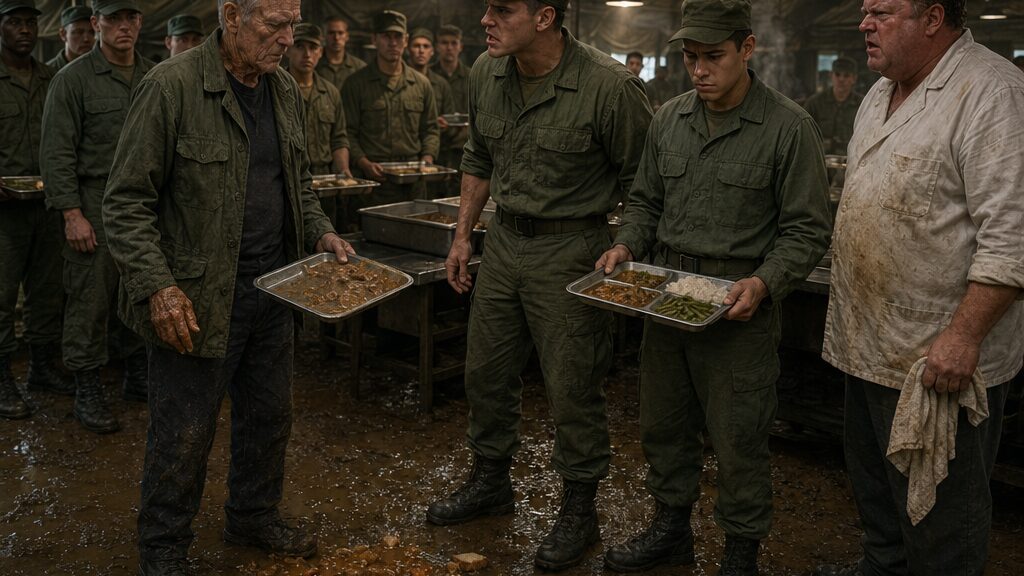
Private Jacob Garcia stood with both hands under a metal tray, waiting for permission to move. Steam lifted from the square compartment of brown stew, drifting across the scoop of white rice, the green beans, and the slice of bread tucked along the rim. Behind him, the line of soldiers shifted in the mud, boots sucking softly where rainwater had worked through the packed floor of the field mess tent.
Tyler Martinez looked Edward up and down. Worn green jacket. Plain shirt. Shoulders bent by age but not by fear. Hands corded, spotted, steady at his sides. No rank on his chest. No badge clipped to his collar. Just an old man standing too close to the food line as if memory gave him permission.
“Sir,” Tyler said, still smiling for the room, “we’ve got three hundred people to feed. Step back.”
Edward did not step back.
Jacob’s tray shook just enough for gravy to tremble against the metal divider. The soldier looked embarrassed already, though nobody had accused him of anything. He was young, hungry, and stuck between an old stranger and the NCO who controlled the line.
Edward kept his eyes on the stew.
“Don’t hand him that tray,” he repeated.
The soldiers behind Jacob turned their heads. A few looked at each other instead of Edward. That was the part Edward noticed. They didn’t look at the tray. They looked for permission to laugh.
Tyler gave it to them with a roll of his eyes.
“Old mess-hall tricks,” he said loudly enough for the first six soldiers to hear. “You retired guys always think you can smell a problem from ten feet away.”
A couple of soldiers breathed out through their noses. Not full laughter. Just enough.
Edward felt it land where it was meant to land.
He had been called old before. Slow. Careful. Stubborn. A man from another Army. Usually he let it pass. Most things passed if a man had lived long enough to outlast them. But the smell under the steam stayed where it was, sour and dull, buried beneath hot gravy and pepper.
He looked at Jacob. “Did you smell it?”
Jacob’s face tightened. “Smell what?”
Tyler stepped between them halfway, not enough to block Edward, just enough to show the line who had authority. “Private, move.”
Jacob started to turn.
Edward reached out.
His fingers went into the stew.
The tent changed.
Sound dropped so quickly the hiss of the steam table seemed louder than the soldiers. Edward pressed two fingers past the top layer of gravy, down through meat and potatoes, until the heat gave way to something cooler and thick. He did not stir. He did not sniff dramatically. He held still, feeling the drag of congealed fat under the surface heat.
Jacob stared at Edward’s hand in his food.
Tyler’s smile vanished. “What the hell are you doing?”
Edward withdrew his fingers. Brown gravy clung to his knuckles. He rubbed thumb against forefinger, slow and deliberate, then lifted his hand near his face. Not to perform. To confirm what his body had already told him.
Heat on top. Wrong underneath.
“Don’t eat this,” Edward said.
Tyler grabbed Jacob’s elbow and pulled the tray back level. “That’s enough. You don’t put your hands in a soldier’s food.”
Edward looked past Tyler, toward the row of pans under the lamps. The stew tray on the line bubbled at one corner but sat still at the other. The ladle rested in it, handle angled toward the aisle. The metal should have been hot near the base from sitting in that pan. It wasn’t. A detail so small a hungry line would never care.
William King came out from behind the prep flap in a stained white coat, wiping his hands on a towel. He was broad through the middle, red in the face from heat and irritation. “What’s going on?”
“This man just contaminated a tray,” Tyler said. “After I told him to step back.”
William’s eyes moved from Edward’s hand to Jacob’s tray. “You touched served food?”
Edward said nothing for a moment. He was watching the steam. It rose clean and convincing, a white curtain that made everything beneath it look safe.
“Pull that pan,” Edward said.
William’s jaw hardened. “Excuse me?”
“Pull the stew. Check your holding time. Check your cold storage.”
Tyler gave a short laugh again, but this one had no confidence in it. “You hear that? He’s running the kitchen now.”
The soldiers behind Jacob leaned closer, not with trust, but with appetite and annoyance. The line had stopped. Trays were stacking. Men and women with helmets clipped to their packs stood waiting under canvas while an old man with gravy on his hand told a kitchen supervisor how to do his job.
William stepped closer. “You don’t know my kitchen.”
Edward finally looked at him. “I know what old food feels like after someone heats the top and hides the bottom.”
That cut the air differently.
William’s towel stopped moving in his hands.
Tyler noticed it, but only for a second. Then he recovered. “Sir, I’m going to ask you one last time to step away from the line.”
Edward looked at Jacob again. The young soldier still held the tray out like evidence against himself. His cheeks had gone red. He looked as if he wished Edward would disappear, as if the food could become only food again if everyone stopped staring.
Edward knew that look. He had seen men choose silence in front of a line because being singled out felt worse than being unsafe. He had once let silence spread because the man in charge had a clipboard and he had only a bad feeling in his gut.
Not this time.
Edward took the tray from Jacob’s hands.
“Hey,” Tyler snapped.
Edward turned it over.
The stew slapped into the mud first, then the rice, then the green beans, then the bread folding into the brown mess at Edward’s boots. Gravy splashed across the black rubber mat and ran into a shallow footprint.
No one laughed then.
Jacob stared at the ruined meal. Tyler’s hand hovered near Edward’s shoulder, stopped by the fact that Edward had not moved aggressively. William’s face went dark with fury.
Edward held the empty tray at his side.
A single drop of gravy fell from its corner.
William pointed at the mud. “You think that proves something?”
“No,” Edward said. “It stops him from eating it.”
The words were quiet. They did not help him. They made him sound colder.
Tyler looked down the line, saw every soldier watching him, and straightened. Authority returned to him because anger gave it a place to stand. “Private Garcia, step aside. Nobody touches that spill.”
Jacob moved, humiliated, empty-handed.
William came close enough that Edward could smell onions and bleach on his coat. “You just wasted government food, disrupted service, contaminated my line, and embarrassed a soldier in front of his unit.”
Edward’s fingers curled around the rim of the tray. He should have explained first. He knew it even as William spoke. He should have asked for the thermometer, the log, the pan, the ladle. He should have made them see the path instead of forcing them to stare at the end of it.
But Jacob had been about to eat.
“I want the temperature log,” Edward said.
William’s eyes narrowed. “You don’t want anything from me.”
Tyler reached for the tray. “Give me that.”
Edward let him take it. The metal left a wet smear across Tyler’s glove.
The NCO held it away from himself like a dirty object, then looked toward William, waiting for the next correct move.
William jabbed a finger toward Edward and then toward the temporary command desk beyond the tent flap. “Report him. Right now. Interfering with meal service. Disorderly conduct. Whatever they want to call it.”
Tyler nodded once, too fast.
Edward looked past them to the pan still sitting on the steam table, still giving off its clean white lie.
William raised his voice for the whole tent. “Line keeps moving. Replace that tray.”
A kitchen aide reached for a fresh metal tray.
Edward did not move.
Tyler stepped in front of him with the empty tray tucked under one arm. “You heard him.”
Edward wiped his fingers slowly on a paper napkin Jacob had dropped near the table. His hand was steady, but inside his chest something old and sick was waking.
The first soldier behind Jacob came forward.
William picked up the ladle.
Edward watched the stew pour again.
Chapter 2: The Old Rule Nobody Wanted Checked
“Elderly civilian interfered with meal service,” Tyler Martinez wrote, pressing so hard the pen dented the page beneath the incident form.
The empty metal tray sat on the folding table beside him inside the temporary command tent, tagged with a strip of masking tape as if it were dangerous. Gravy had dried along one corner. A smear of rice clung to the underside. Someone had written contaminated on the tape in block letters.
Tyler did not like how the word looked.
Edward Hall stood six feet away, hands clasped behind his back, the way old soldiers stood when they had decided not to sit. He had been offered a folding chair by nobody. He had asked for one thing three times.
“The temperature log,” Edward said.
Tyler kept writing. “You’ll get to explain yourself when the commander asks.”
“I’m explaining now.”
“You stuck your hand into a private’s food and dumped it on the ground.”
Edward’s eyes moved to the tray. “I warned you first.”
Tyler’s pen stopped.
That was the part bothering him. Not enough to admit it, but enough to slow his hand. The old man had warned him before touching the food. Tyler had laughed before asking why. He could still hear the thin little laugh he had offered to the room, the one that made everyone know Edward could be dismissed.
William King pushed into the tent flap without knocking. He carried a clipboard and his towel, now folded so tightly it looked like a rope.
“Service is backed up twelve minutes,” William said. “We’ve got training lanes waiting on chow. Is this going to take long?”
Tyler looked grateful for the interruption. “I’m documenting it.”
“Good. Document that he contaminated food with his bare hand.”
Edward turned slightly. “And document that I asked you to pull the pan.”
William’s mouth tightened. “You’re not authorized to ask me to pull anything.”
A base medical officer came in behind him with a small black case in one hand. Laura Sanchez did not raise her voice, but the tent adjusted to her anyway. She looked at the tagged tray, then at Edward, then at Tyler’s half-finished report.
“What happened to the food that was dumped?” she asked.
“On the ground outside the line,” Tyler said. “I had soldiers keep clear of it.”
“Good.” Laura set the case down. “What happened to the pan it came from?”
William answered before Tyler could. “Still in service. The tray was contaminated by him, not by us.”
Edward took one slow breath. “That pan should be set aside.”
Laura looked at him. “On what basis?”
He pointed toward the serving tent through the open flap. “Steam table is hot. Ladle handle near the pan is cooler than it should be. Top layer was hot. Underneath was thick and cooler. Smelled sour beneath pepper and gravy.”
Tyler wanted the words to sound ridiculous. Instead, they came out specific.
William scoffed. “He put his fingers in it. Of course he can say anything now.”
Laura opened her case. “The touched tray can’t prove contamination by itself. Once he put his hand in it, that sample is compromised.”
Tyler saw Edward’s face change almost imperceptibly.
Not shame exactly. Something sharper because it was controlled.
“You understand that?” Laura asked him.
Edward looked at the tray. “Yes.”
“Then you understand you may have made your own concern harder to prove.”
“Yes.”
William spread both hands as if that settled it. “There. We’re done.”
“No,” Laura said. “We’re not done. I want the holding and cold-storage logs for the stew.”
William’s expression shifted. Only a fraction. Tyler saw it because he was already looking too closely.
“They’re in the kitchen binder,” William said.
“Bring them.”
William hesitated, then left.
Tyler looked back down at his report. The next blank line asked for witness names. He wrote Jacob Garcia because he had to, then stopped again.
Outside, the food line noise had returned: trays sliding, boots moving, clipped voices, the wet cough of a generator somewhere behind the tents. The whole operation sounded normal if a person wanted it to.
Edward’s gaze moved past Tyler to the service opening. “Why is the steam table hot but the ladle handle cool near the base?”
Tyler rubbed his forehead. “I don’t know.”
“You should.”
That stung. “I run movement and service timing. Contractors run kitchen operations.”
“You sign for service?”
Tyler did not answer.
Laura looked up from the tray. “Do you?”
Tyler capped his pen, uncapped it again. “For field feeding coordination. Not food prep.”
Edward said, “Coordination includes stopping the line when something is wrong.”
Tyler stood. “You don’t get to walk in here, humiliate one of my soldiers, and lecture me about responsibility.”
Edward’s eyes did not rise with the heat in Tyler’s voice. “Private Garcia was about to eat.”
“He was also standing there with everyone staring at him because of you.”
For the first time, Edward looked away.
It lasted only a second, but Tyler saw it. The old man knew that part had been wrong.
Jacob appeared at the tent entrance, helmet in his hands, eyes jumping from Tyler to Edward to the tagged tray.
“You wanted me, sergeant?”
Tyler had not sent for him. Laura must have.
“Private,” Laura said, “before Mr. Hall touched your food, did you notice anything unusual?”
Jacob swallowed. “No, ma’am.”
Edward said nothing.
Laura waited.
Jacob looked toward Tyler, and Tyler hated that the private was asking permission without saying so.
“Answer her,” Tyler said.
Jacob shifted his helmet against his chest. “It smelled… maybe a little off. But food out here always smells off.”
William returned with a binder before anyone could respond. He laid it on the folding table too heavily.
“There,” he said. “Temperatures logged. Product held hot. Product safe.”
Laura opened the binder. Tyler leaned in despite himself.
The columns were neat: time, item, cold storage, transfer, hot hold, initials. The kind of sheet that made a problem look solved before anyone understood it.
Edward did not reach for it. He only stepped closer and looked.
His eyes moved line by line, slower than Tyler wanted. Tyler felt an urge to tell him not to hover, not to act like inspection belonged to him. But Laura was watching the same page now, and William was watching Edward.
Edward tapped one entry with the back of his knuckle, careful not to touch the paper with dirty fingers.
“Different pen,” he said.
Tyler frowned. “What?”
Edward nodded toward the 0530 cold-storage entry. “Same initials. Different ink. Different pressure. Written after the lines above and below.”
William let out a hard breath. “That is what you’re going with now? Pen color?”
“No,” Edward said. “Time.”
Laura bent closer.
Tyler saw it then. The 0530 line was darker, slightly cramped, tucked into the space as if added after the 0600 transfer entry had already been written.
William reached for the binder. “This is absurd.”
Laura placed one hand flat on the page before he could move it. “Leave it.”
Tyler’s stomach tightened.
Edward turned toward the serving tent. The line outside kept moving, tray after tray, steam rising as if the paper on the table meant nothing.
Chapter 3: Steam Can Lie To A Hungry Line
Edward watched a kitchen aide pour fresh gravy into a pan that was already half full.
The aide did it quickly, shoulders hunched, eyes flicking toward the tent opening where William King was arguing with Laura Sanchez over the binder. New gravy slid glossy and dark over the older stew, smoothing the surface. Steam rose at once, clean and convincing.
Edward stood just outside the prep area line marked by two wooden crates and a strip of yellow cord. He had not crossed it. William had made the boundary clear. No unauthorized personnel behind the serving line. No old man wandering through his kitchen. No more contamination.
But Edward did not need to cross it to see enough.
The aide used the ladle to fold the new gravy across the top, not down to the bottom. A careful motion if the goal was appearance. A poor one if the goal was even heat.
Jacob Garcia stood several feet away, assigned there by Tyler to keep soldiers from stepping near the dumped food. He was trying not to look at Edward. He failed every few seconds.
Edward said, “Watch the corners.”
Jacob looked startled. “Sir?”
“The pan. Watch the corners.”
Jacob’s eyes moved to the stew tray. The middle steamed. The left corner barely moved.
William came through the flap and saw them both looking. “Private, you have duties somewhere else?”
Jacob straightened. “Sergeant told me to keep the spill area clear.”
“Then keep it clear with your eyes on the ground.”
Edward said, “He can look at a pan without damaging it.”
William’s face flushed. “And you can stand outside my prep line without coaching my soldiers.”
Laura came in behind William carrying the binder. Tyler followed, jaw tight, as if the pages had become heavier since leaving the command tent.
“We’re not shutting service down over a pen mark,” William said to Laura.
“I didn’t say we were,” Laura replied. “I said I want the refrigeration trailer checked.”
“It was checked.”
“By whom?”
William’s gaze flicked to Tyler.
Tyler said, “I signed the coordination sheet after morning setup.”
Edward looked at him.
Tyler looked away.
The generator behind the tent coughed twice, then settled into a rough drone. Edward had heard engines like that in heat, in rain, in places where a single bad sound could mean a night’s worth of spoiled rations by morning. Machinery always told on itself before people did.
“When did that generator restart?” Edward asked.
William snapped, “You don’t get to interrogate my staff.”
“I asked about the generator.”
“You ask too much.”
Laura turned to Tyler. “Do you know?”
Tyler rubbed the back of his neck. “It was running when I came through.”
“What time?”
“About 0600.”
Edward said, “Cold log says storage was checked at 0530.”
Tyler’s face hardened, but not at Edward this time.
William folded his arms. “Power flickered. It happens in field conditions. Product was temped. Product was reheated. Service continued.”
“Reheated from what temperature?” Edward asked.
“The logged temperature.”
“The added temperature.”
William took one step forward. “Careful.”
Edward felt the old heat rise in him. Not fear. Not anger alone. The dangerous mix of knowing and not being believed. He had lived long enough to know that certainty could become pride if a man held it too tightly. He had already made that mistake with the tray. He kept his hands open at his sides.
Laura seemed to notice.
She looked toward the prep area. “Open the refrigeration trailer.”
William’s mouth worked once before sound came. “We’re in the middle of service.”
“Then assign someone.”
“I don’t have spare hands.”
Edward nodded toward the kitchen aide. “You have enough hands to dress an old pan with new gravy.”
The aide froze.
William turned on him. “Keep stirring.”
Jacob had drifted closer to the prep boundary. His eyes were on a storage lid resting upside down on a crate. Clear beads of water clung to the inside of it, more than steam should have left, collecting and running in thin lines.
“Is that supposed to be wet like that?” Jacob asked.
Everyone looked at him.
Jacob immediately regretted speaking. “I mean—inside. Not outside.”
Edward followed his gaze. For the first time all day, he felt something like relief, but he kept it from his face.
“No,” he said softly. “Not if it came straight from hot hold.”
Laura stepped toward the lid. William moved to block her, then seemed to think better of it. She lifted it by the edge and examined the condensation.
Tyler stared at Jacob as if the private had stepped onto a live wire.
Edward said to Jacob, “Cold air hits warm food. Warm food sits too long. Moisture gathers where it shouldn’t. Steam can lie to a hungry line. Water marks don’t.”
Jacob’s eyes stayed on the lid. “So it was cold?”
“Maybe. Or held wrong. Or moved wrong. Enough to check before feeding more soldiers.”
William’s voice lowered. “You are harassing my staff and frightening soldiers over maybes.”
Edward looked at him. “Maybes are why checks exist.”
“Checks exist on paper,” William said, holding up the binder. “And mine are done.”
Laura closed the binder. “Then opening the trailer should clear it up.”
For a moment, no one moved.
Then a kitchen aide near the back said, too quietly, “The trailer latch sticks.”
William turned. “What?”
The aide’s face went pale. “Nothing.”
Edward saw William’s fear then, not just anger. It sat under his jaw, tight and human. A man trying to hold a wall upright with both hands while pretending there was no wall.
Tyler stepped toward the tent exit. “I’ll check the trailer.”
William caught his sleeve. “You don’t need to.”
Tyler looked down at William’s hand until he let go.
The NCO walked out into the glare beyond the canvas. Edward followed only to the entrance, staying where he could see the refrigeration trailer parked near the generator. Its metal door was streaked with mud. A cable ran from the generator box into the unit, looped badly across the ground.
Tyler stopped halfway there.
He did not turn around at first. When he did, his face had lost the clean shape of authority.
“I signed it,” he said.
Laura came to the flap. “Signed what?”
“The morning service sheet.” Tyler looked past Laura to Edward, not asking forgiveness, not yet. “Before I checked the trailer.”
William closed his eyes for one brief second.
The generator coughed again behind them, and the steam from the serving line kept rising.
Chapter 4: The Signature On The Wrong Morning
The base commander did not look at Edward first.
He looked at the stained tray.
It sat in the center of the operations table beneath a strip light, empty except for dried gravy along one seam and a few grains of rice hardened to the metal. Someone had carried it from the command tent into the temporary operations office as if the whole problem could be reduced to that one ruined meal.
“Before or after?” the commander asked.
Tyler Martinez stood at attention near the table, but the question landed on him like weight.
“Sir?”
“Did Mr. Hall touch the food before or after he warned you not to hand over the tray?”
The office was a rectangle of canvas, plywood flooring, folding chairs, radios, and clipboards. Outside, vehicles coughed through the evening mud. Inside, the air smelled of damp canvas and old coffee. William King stood near the entrance with his arms crossed, his clean replacement binder tucked under one elbow. Laura Sanchez stood beside the table with the first binder open in front of her.
Edward stood across from the tray. He had not asked to sit. He had stopped asking for anything except the log.
Tyler kept his eyes on the commander’s shoulder. “Before he touched it, sir.”
The commander waited.
Tyler swallowed. “He warned me first.”
William shifted. The floor creaked beneath him.
The commander turned one page in the incident packet. “Your written report starts with him interfering physically.”
“Yes, sir.”
“It does not mention the warning until the third paragraph.”
Tyler felt heat rise along the back of his neck. “I wrote it in order of the disruption.”
“No,” Laura said, quiet but firm. “You wrote it in order of blame.”
Tyler looked at her, then down at the tray. He wanted to object. He wanted to say he had been managing a line, a schedule, a contractor, a training day already slipping behind. He wanted to say an old man had shoved his bare hand into a private’s lunch in front of twenty soldiers and that any NCO would have reacted.
But he could still see Edward’s face before the tray hit the mud.
Not wild. Not confused.
Certain.
The commander tapped the binder Laura had brought in first. “Show me the timeline.”
Laura turned it toward him. “Cold storage check marked at 0530. Transfer to hot hold at 0600. Morning service coordination signed at 0615. But we have a generator issue reported informally sometime before 0600, possibly unresolved until after Tyler’s walk-through.”
William stepped forward. “Sir, with respect, that is speculation.”
Edward did not move.
The commander looked at William. “Then remove the speculation.”
William placed the clean replacement binder on the table. Its cover was not smudged with kitchen grease like the first one. The pages inside lay flat, crisp, recently inserted.
“This is the correct log,” William said. “The earlier one was a draft sheet. My aide grabbed the wrong binder under pressure.”
Tyler stared at the new page.
The entries were neat. Too neat. The 0530 cold-storage check matched the same pen as the rest of the morning. The generator issue was noted as a brief power fluctuation at 0505, corrected immediately. Every temperature sat inside the safe range. Every initial was clear.
For a moment, relief rose in Tyler so fast he almost trusted it.
Then he saw the line at the bottom.
Service approved: 0615. T. Martinez.
His own signature looked blacker than he remembered. Not copied, not forged, but scanned from the way he signed when rushing—sharp crossbar, shortened tail. The page made him look like the man who had confirmed everything.
Laura leaned closer. “Where was this binder when I requested logs?”
“In the prep desk,” William said. “The aide brought the draft first.”
Edward looked at the clean page, then at the tray.
“Drafts don’t usually have grease on the corners,” he said.
William’s eyes cut toward him. “You are not part of this review.”
The commander did not correct William. That bothered Tyler more than if he had.
The commander picked up both logs and held them side by side. “Mr. King, why would a draft have completed service initials?”
“Training week. We prefill formats. It saves time.”
Laura said, “Prefill temperatures?”
“No. I mean headings. Routine entries. Not temperatures.”
Edward’s voice came from across the table. “You can’t prefill a morning that hasn’t happened.”
William’s jaw tightened.
Tyler’s eyes moved between the two pages until the numbers stopped being lines and became times. 0505. 0530. 0600. 0615.
He had arrived at 0600. The generator had been running by then, rough but running. William had told him service was ready. A kitchen aide had been wiping condensation from the trailer latch. Tyler had seen it and thought only of delay, of the commander’s earlier warning that the training lanes could not fall behind again. He had signed because he had wanted the morning to be clean.
He had signed before looking inside the trailer.
He had not even touched the latch.
Edward said, “Ask him when he opened the trailer.”
The commander turned to Tyler.
Tyler felt the room narrow. William’s gaze found him and held there, not pleading exactly, but warning him how much weight his answer carried.
“Sergeant Martinez?”
Tyler’s mouth went dry. “I didn’t open it, sir.”
The words did not fall loudly. They fell completely.
Laura’s eyes closed for a fraction of a second.
William said, “Because my staff had already completed checks.”
Tyler kept going because stopping now would make the next lie easier. “I signed the service sheet after Mr. King said checks were complete. I did not personally inspect the refrigeration trailer.”
The commander set the pages down.
William exhaled sharply. “That is normal coordination practice.”
Edward’s gaze stayed on Tyler. There was no triumph in it. That made it harder to stand under.
Tyler looked at the first log again, the one with the darker 0530 entry. “The cold-storage line in the first binder… it looks added.”
William gave a bitter laugh. “Now everyone’s a handwriting expert.”
“No,” Tyler said. His voice shook once, then steadied. “But Mr. Hall asked for that document before any of us did.”
The room changed around that sentence.
Edward looked down.
Not away in shame this time. Down, as if the acknowledgment had arrived too early and he did not want to hold it.
William opened the clean binder again and pushed it toward the commander. “Sir, this is exactly why we use official records instead of letting some retired visitor read meaning into food texture and pen ink. The food was hot. It was in hot hold. Whatever he thought he smelled came after he put his hand in it.”
Laura touched the edge of the tray with one gloved finger. “The tray cannot prove contamination.”
William nodded. “Thank you.”
“But it can prove timing,” she continued. “Mr. Hall warned before he touched it. That matters.”
The commander leaned back. He was a tired man trying to keep a training rotation from becoming a reportable mess. Tyler could see it now. The pressure was not only William’s. It moved through every person in the office. Delay the line, delay the lanes. Delay the lanes, explain upward. Explain upward, admit the system had failed before lunch.
A radio crackled on the side desk. A soldier’s voice came through, low and clipped.
“Medical, this is lane support. We’ve got another soldier asking to be checked out. Stomach cramps. Same group as earlier chow.”
Laura reached for the handset. “How many total?”
A pause.
“Three confirmed from first serving group. Maybe four.”
The commander stood.
William’s face lost color.
Tyler looked at Edward, expecting the old man to say something that would make him feel smaller. Edward said nothing. He only stared at the empty tray on the table, as if it had finally become what he had failed to make it in the first place.
Not an insult.
A warning.
Chapter 5: Three Sick Soldiers And One Silent Memory
“The symptoms are not proof,” Laura Sanchez told Edward, “but they are enough to stop the next service if command agrees.”
Behind the canvas wall of the medical tent, someone retched into a basin.
Edward stood with a clean metal tray in both hands, though he could not remember picking it up. A kitchen aide must have left it near the supply crates. It was empty, cold, and light. Nothing like the tray Jacob had held under the steam. Nothing like the trays Edward remembered from another place, another line, another morning when men had trusted food because hunger had made them obedient.
Laura pulled the flap closed halfway to give the sick soldiers privacy. Her face was composed, but the set of her mouth had changed since the operations office.
“Three from the first group,” she said. “One more being evaluated. Could be heat, nerves, dehydration, bad luck. Could be foodborne. I won’t call it before I have enough.”
“You don’t need to call it to stop feeding it.”
“No.” She looked at him carefully. “I need command to accept the cost of stopping it.”
Edward’s fingers tightened around the tray rim. The metal edge pressed into the old callus beneath his thumb.
Outside, the mess tent still glowed under work lights. The line had slowed but not died. Soldiers talked in shorter bursts now. News moved faster than orders in any camp. A tray dumped in the mud had become a story. Sick soldiers made it something else.
Laura followed his gaze. “You should also understand something. If this turns into an official review, your action will be part of it.”
“I know.”
“You touched food with your bare hand. You destroyed the cleanest immediate sample. You gave William an argument.”
Edward nodded once.
“Why?” she asked.
The question was not accusation. That made it worse.
Edward looked down at the clean tray. In the metal, the lights overhead bent into pale lines.
“Because the private was about to eat,” he said.
“That’s the answer you give them.” Laura stepped closer. “I’m asking why you didn’t explain first.”
For a moment, the medical tent became too small.
The coughing behind the curtain folded into another sound, thinner and younger, a line of soldiers outside a sick-call tent decades ago. Men bent over in heat. A pot of rice held too long. A field kitchen chief waving off complaints because the convoy had to move. Edward younger then, not young but young enough to still believe that if he wrote the concern in the margin, if he mentioned it to the right sergeant, if he waited for the officer to make the call, the system would correct itself.
It hadn’t.
Men had gone down by afternoon. Not dead. That was the mercy people used to make silence feel smaller. Not dead, only sick. Not dead, only evacuated. Not dead, only one man whose fever turned into something worse before nightfall.
Edward had carried trays away from those men. He had remembered the smell for thirty years.
“I explained once,” he said.
Laura waited.
He shook his head. “Not enough.”
She did not press. A good officer knew when a wound had opened and when sticking a finger into it would not clean it.
A shadow crossed the tent entrance. William King stood there, no towel in his hands now. Without it, he looked less like a supervisor and more like a man who had misplaced the one object that helped him perform certainty.
Laura’s expression hardened. “This is a medical area.”
“I’m not here to argue.” William looked at Edward. “Not with you.”
Edward did not answer.
William stepped just inside. His voice dropped. “The generator failed.”
Laura went still.
Edward kept the tray level.
William looked toward the closed flap where the sick soldiers were. “It failed sometime after four. Maybe earlier. My night aide tried to restart it. It kicked, died, kicked again. He didn’t wake me until five.”
Laura said, “Why wasn’t that in the log?”
“Because by the time I got there, it was running again.”
Edward looked at him. “Running doesn’t make time disappear.”
William flinched as if the words had touched a bruise.
“You think I don’t know that?” he said. “You think I wanted to serve bad food? I’ve got twelve staff, half of them temporary, two trailers of product, one generator that should’ve been replaced last season, and a contract rep who counts late service like it’s theft. If I shut down the line without a confirmed temperature failure, they call it mismanagement. They don’t blame the generator. They blame me.”
Laura’s voice stayed flat. “So you added the 0530 entry.”
William looked at the floor.
“Did you?” she asked.
“I told the aide to clean up the sheet.”
Edward closed his eyes briefly.
There it was. Not poison. Not malice. Not some grand evil. Just fear with a pen in its hand.
“Nobody was supposed to get hurt,” William said.
The sentence hung there, familiar enough to make Edward’s chest ache.
He had heard versions of it from men who cut corners on water. From officers who pushed schedules through heat. From himself, in quieter words, when he once told himself that a note in a margin was enough.
Laura took one step toward William. “You need to tell command that.”
William’s mouth twisted. “If I do, my crew is finished.”
“If you don’t, more soldiers may get sick.”
“My crew didn’t buy that generator.”
“No,” Edward said. “But you served from it.”
William’s eyes snapped up. “And you made sure the whole camp saw it. Old man dumps a tray, now everyone wants a villain.”
Edward felt anger rise, then shame beside it. William was wrong, but not entirely. Edward had made the first moment a spectacle because fear had gotten ahead of discipline. He had protected Jacob and damaged the proof at the same time.
“I should have spoken clearer,” Edward said.
William seemed thrown by that.
“But you should have stopped the line,” Edward added.
The flap opened behind them, and Tyler stepped in. He had mud up one pant leg and a paper in his hand. “Commander wants a quiet hold on stew service. Replace with packaged rations until medical finishes preliminary checks.”
Laura stared at him. “Quiet hold?”
“That’s what he said.”
Edward heard the words beneath the words. Quiet meant no formation. No public correction. No explanation to the soldiers who had laughed, watched, eaten, doubted. Quiet meant a new pan, a new log, a private adjustment. Quiet meant the system would step around the hole and leave it for someone else.
Tyler avoided Edward’s eyes. “He doesn’t want panic.”
William looked relieved and sick at once.
Laura took the paper. “A hold is not enough if the process failed.”
“It’s what we have right now,” Tyler said.
Edward looked at the clean tray in his hands. Empty, it reflected nothing clearly.
He thought of Jacob’s face in the line. Not only embarrassed. Trusting everyone above him to know what he did not. He thought of the men from years ago bending outside sick call while he told himself he had followed channels.
Not dead, only sick. Not dead, only one.
He set the clean tray on a crate.
“Ask the commander for morning formation,” Edward said.
Tyler looked up. “For what?”
“For the men and women who watched me dump that tray.”
William’s face tightened. “You want to make it bigger?”
“No,” Edward said. “I want to make it honest.”
Laura studied him. “You understand that means explaining your part too.”
Edward looked toward the medical curtain as another soldier groaned softly behind it.
“Yes,” he said. “That’s why I’m asking.”
Chapter 6: The Lesson He Should Have Given First
Edward stood before the same soldiers who had watched him ruin Jacob Garcia’s meal.
Morning formation had been pulled beside the mess tent, close enough that everyone could see the food line standing still behind him. The steam tables were cold. The pans were empty. A clean metal tray rested on a folding table at Edward’s side, along with a ladle, a storage lid, and both binders.
Nobody laughed now.
That did not comfort him.
Silence could mean respect. It could also mean waiting for an old man to be embarrassed properly.
The commander stood off to Edward’s right with Laura Sanchez, Tyler Martinez, and William King. William’s white coat had been replaced by a plain work shirt, as if losing the coat might make him less visible. Tyler stood stiffly, hands clasped behind his back, eyes forward, not hiding but not easy inside his skin.
Edward looked at the rows of faces. Some young. Some bored because soldiers learned to look bored when they were uncomfortable. Some pale from having eaten from the first service. Jacob stood in the front rank, shoulders squared too tightly.
Edward touched the clean tray.
“Yesterday,” he said, “Private Garcia was handed a tray from that line. I told Sergeant Martinez not to let him eat it.”
A few eyes moved toward Tyler.
“Then I put my fingers in the food.”
Edward let that sit.
“I should not have done that.”
The silence sharpened.
He heard William shift behind him.
“I made it harder to prove because I was angry before I was clear.”
Jacob’s eyes lifted.
Edward took the ladle and laid it across the tray. “That does not mean I was wrong.”
No one moved.
Edward picked up the storage lid. The inside had dried overnight, but Laura had marked it and set it aside. “Food can look safe when the top is hot. Steam tells you what is happening now. It does not tell you what happened while the pan sat cold, or how long it took to heat, or whether the bottom ever caught up with the surface.”
He set the lid down.
“The tray yesterday had stew over rice, green beans, bread. The top steamed. Underneath, the stew was thick in a way it should not have been, cooler than it should have been, and sour under the seasoning. The ladle handle near the pan base was cooler than the pan claimed it should be. The lid had condensation where it did not belong. The log had a time entry written after the fact.”
A low murmur moved through the formation.
The commander said nothing.
Edward turned slightly toward Tyler. He could have left it there. He could have let the young sergeant carry the weight alone. Part of him wanted to. Pride was not loud in old men; sometimes it came dressed as restraint.
Instead, Edward looked back at the soldiers.
“A good warning delivered badly can still fail,” he said. “Yesterday, mine almost did.”
Tyler’s face changed.
William stepped forward before Edward could continue. “This is getting presented like one man saw everything and everyone else failed. That’s not what happened.”
The commander looked at him. “Mr. King.”
“No, sir. With respect.” William’s voice shook, but he pushed on. “We had a generator problem. We had pressure to feed on schedule. We had logs, checks, procedures. Mr. Hall didn’t know all that when he dumped a soldier’s meal in the mud. He guessed.”
Edward looked at him.
William’s eyes were red at the edges. “And now my whole crew is standing under suspicion while he gets to be the man who knew.”
The formation stayed silent, but the accusation had found air. Edward could feel it. William had given shape to the resentment many of them might have been carrying. The old man had guessed. The old man had made a scene. The old man was lucky.
Tyler stepped out of line beside the commander.
“No,” he said.
William turned on him. “Sergeant—”
“No,” Tyler repeated, louder. “He didn’t guess. He asked for the temperature log before medical did. He asked about the trailer before I did. He asked why the ladle didn’t match the pan. I signed the morning service sheet before I opened the refrigeration trailer.”
The words hit the formation harder than Edward’s had.
Tyler’s jaw worked once. “That was my mistake.”
The commander did not rescue him from it.
Tyler faced the soldiers. “I wanted service on time. I wanted the line moving. I thought looking decisive was the same thing as being responsible.”
Edward looked down at the tray.
Jacob stepped forward half a pace before catching himself. “I smelled it too.”
Every head turned toward him.
He swallowed but did not step back. “The stew. Before Mr. Hall touched it. It smelled wrong. I didn’t say anything because…” He looked briefly at Tyler, then at Edward. “Because everybody was waiting, and I didn’t want to be the private who made a problem.”
Edward felt the old pain in that sentence.
There it was. The system was not only binders and generators and contracts. It was the moment a young soldier doubted his own senses because the line behind him wanted lunch.
Laura came forward with the first binder. “Preliminary medical findings do not identify a final cause yet. But the sequence is enough to stop service and review the process. The generator failure was not logged correctly. The cold-storage entry was altered. Several soldiers from the first serving group developed symptoms consistent with unsafe holding risk.”
William lowered his head.
The commander looked at the formation. “Effective immediately, the field mess line is shut down pending inspection. Packaged rations will be issued. No one eats from a hot line until the revised check procedure is in place.”
A ripple moved through the soldiers, not protest exactly. Discomfort. Relief. Hunger. Recognition arriving without ceremony.
The commander turned to Edward. “Mr. Hall, I’d like your assistance writing that procedure.”
Edward heard what the offer was and what it was not. Not a medal. Not a public apology wrapped in theater. Work. Trust made practical.
He nodded. “Yes, sir.”
The commander stepped back, but Edward did not leave the front.
He picked up the clean tray once more and held it where the front rank could see.
“This is not proof that you should distrust every cook,” he said. “Most people feeding you are working harder than you know.”
William looked up at that, surprised.
Edward continued. “This is proof that hunger can make you hurry, steam can make you comfortable, and rank can make you quiet. So you check before you trust. Not because you know better than everyone. Because somebody behind you may be too tired, too young, or too embarrassed to speak first.”
He set the tray down.
The sound of metal on folding table was small, but it carried.
Formation dismissed without applause. Soldiers broke slowly, talking in low voices. Some glanced at Edward. None came rushing to shake his hand. That suited him.
Jacob passed close enough to speak, but he only nodded once, a private still learning what kind of courage did not require volume.
Tyler remained beside the table after the others moved off. He looked at the tray, then at Edward.
“I laughed,” he said.
Edward did not make it easier for him. “Yes.”
“I shouldn’t have.”
“No.”
Tyler took that without flinching. “Will you show us how you want the checks written?”
Edward looked toward the mess tent. The food line was empty now, steam gone, pans pulled, mud still stained where Jacob’s meal had fallen.
The commander returned with a blank field form and placed it beside the tray.
“Start with the step everyone can see,” he said.
Edward picked up the pen, then paused. For a moment, the whole morning seemed to balance on the clean white page: what had been hidden, what had been laughed at, what had been nearly swallowed.
Then he wrote the first line.
Chapter 7: When The Line Opened Again
Jacob Garcia stopped with a tray in his hands at the same place where his first meal had hit the mud.
The field mess tent looked different after three days of inspection, replacement cables, scrubbed pans, and new signs taped above the serving tables. But the ground remembered. A darker stain still marked the rubber mat near the edge of the line, faded now beneath boot prints and bleach water.
The kitchen aide held the ladle above a fresh pan of stew and waited.
Jacob did not move his tray forward.
Behind him, the line paused.
Not long. Just long enough for the old habit to rise in the air again: hungry soldiers, moving line, hot steam, no one wanting to be the reason everyone waited.
The aide frowned. “You good?”
Jacob looked down at the tray. Empty metal. Clean compartments. A place waiting to be trusted.
“Hold on,” he said.
A few soldiers behind him shifted. One breathed out impatiently. Jacob felt it between his shoulder blades and almost stepped forward on reflex.
Then Tyler Martinez’s voice came from the side of the line.
“Let him check.”
The aide turned, surprised. Tyler stood near the new inspection board with a clipboard tucked under one arm. He was still the NCO. Same uniform, same authority, same sharp way of watching a room. But his voice had changed around this procedure. It did not rush ahead of the facts.
The aide lowered the ladle.
Jacob leaned closer, not theatrically. He did what Edward Hall had shown them the morning after the shutdown: look first at the corners, not the center; notice whether the steam rose evenly; check the ladle handle near the pan; watch for water where water did not belong; smell before hunger explained the smell away.
The stew steamed across the whole surface. The pan corners moved when the aide stirred from the bottom. The ladle handle was warm near the metal, not cool. The storage lid rested upright and dry.
Jacob nodded once.
“Go ahead.”
The aide served the stew, then rice, then green beans, then bread. The food landed in its compartments with small, ordinary sounds. It should have felt like nothing. Instead, Jacob felt the weight of the tray settle into his palms like a returned responsibility.
He moved down the line.
Near the prep opening, a different kitchen supervisor watched quietly while William King’s former staff worked under the new checklist. William had not vanished from the base, but he no longer stood at the front of the line in a white coat. Jacob had seen him that morning near the supply truck, carrying boxes instead of a clipboard. His face looked older without anger holding it tight.
Some soldiers wanted him gone entirely. Others said he had been under pressure. Jacob did not know what punishment should look like for a man who had been afraid and wrong at the same time. He only knew the line felt safer with the new checks pinned where everyone could see them.
At the inspection board, a young kitchen aide reached for the marker and started to initial the sheet before checking the hot-hold temperature.
Tyler’s hand came down over the blank box.
The aide froze.
“Not yet,” Tyler said.
“I was just getting it ready, sergeant.”
“That’s how bad paper starts.” Tyler pointed to the thermometer. “Check first. Write second.”
The aide flushed, then picked up the thermometer.
Jacob watched Tyler stand there while the reading settled. No joke. No eye roll. No glance at the line for approval. Just waiting.
Across the tent, Edward Hall sat at the end of a folding bench with a cup of coffee he had barely touched. His worn green jacket hung open over his plain shirt. He was not posted like an inspector. He was not in front of the formation. He was just there, quiet enough that a person could miss him if they only looked for rank.
But soldiers noticed him now.
Not all at once. Not with speeches. A private carrying bread slowed enough to ask whether the covered pan looked right. A kitchen aide brought over a lid without being told. Tyler checked a reading, then glanced toward Edward, not for permission, but for the kind of confirmation a younger man gave himself when he was learning to trust the right things.
Edward gave only a small nod.
Jacob carried his tray to the far end of the tent and set it on the table across from him.
“Mind if I sit?”
Edward looked at the tray first, then at Jacob. “You already checked it?”
“Yes, sir.”
“Then sit.”
Jacob sat. The bench rocked under him. For a moment he only looked at the food. Three days ago, he had wanted to disappear when the old man took his tray. He had thought Edward had embarrassed him. Now the memory felt different, but not simple. He could still feel all those eyes on him. He could still see the stew sliding into the mud. Being protected had not felt like being protected at the time.
“I hated you for about ten minutes,” Jacob said.
Edward’s mouth moved slightly, not quite a smile. “That long?”
“Maybe fifteen.”
“Fair.”
Jacob picked at the bread without eating it yet. “I should have said something when I smelled it.”
Edward watched the line. “Maybe.”
Jacob looked up, surprised by the answer.
Edward turned the coffee cup between both hands. “You were a private in a line full of hungry soldiers with a sergeant telling you to move. Speaking up sounds easy after the moment has passed.”
“You did.”
“I dumped your lunch in the mud.”
Jacob looked at the tray between them. “You also stopped me from eating it.”
Edward’s eyes dropped to the metal compartments. The stew steamed gently now, not hiding anything, just food doing what food did when handled right.
“I should have taught first,” Edward said. “I remembered too late that fear can look like certainty.”
Jacob did not know what to say to that. It was the closest Edward had come to explaining the old shadow that moved behind his eyes whenever someone mentioned sick soldiers. Laura had told no stories. Tyler had repeated no rumors. But Jacob understood enough. The old man had not been fighting yesterday’s tray only.
A quiet passed between them, filled by ladles, boots, and the hum of the replaced generator outside.
Then Tyler approached the table with a folded field form.
“Mr. Hall,” he said, and the title sounded less like distance now. “Commander approved the revised routine. Soldier-level sensory check before first serving, supervisor temperature verification, no prefilled service initials, and any generator failure triggers automatic hold until medical clears it.”
Edward took the form and read it slowly.
Tyler waited through every line.
At the bottom, Edward’s handwritten first step had been typed exactly as he had written it:
Check before you trust the tray.
Edward handed it back. “Good.”
Tyler nodded, but did not leave. “I’m running the check again before dinner. Jacob will lead the first pass.”
Jacob’s hand tightened on his fork. “I will?”
“You saw what everybody else missed and said it out loud the second time,” Tyler said. “That counts.”
Jacob looked at Edward.
Edward did not rescue him from the responsibility. He only lifted his cup.
Tyler returned to the line.
Jacob finally took a bite of stew. It was hot all the way through. Ordinary. Safe. The kind of thing a man should be able to trust after a long morning.
When he finished, he picked up his tray and carried it to the return station. Edward walked beside him, slower but steady.
At the opening of the line, the next group of soldiers waited for service. A few glanced at Edward, then at the posted checklist, then at their trays. Nobody laughed.
Jacob held his empty tray out over the stack, but Edward touched the rim lightly before he let it go.
The old man looked at the clean metal, then at Jacob.
“You check it before you trust it,” Edward said.
Jacob nodded, and this time, he knew the words were not only about food.
The story has ended.