The Room Went Quiet
Part I — The Question She Would Not Answer
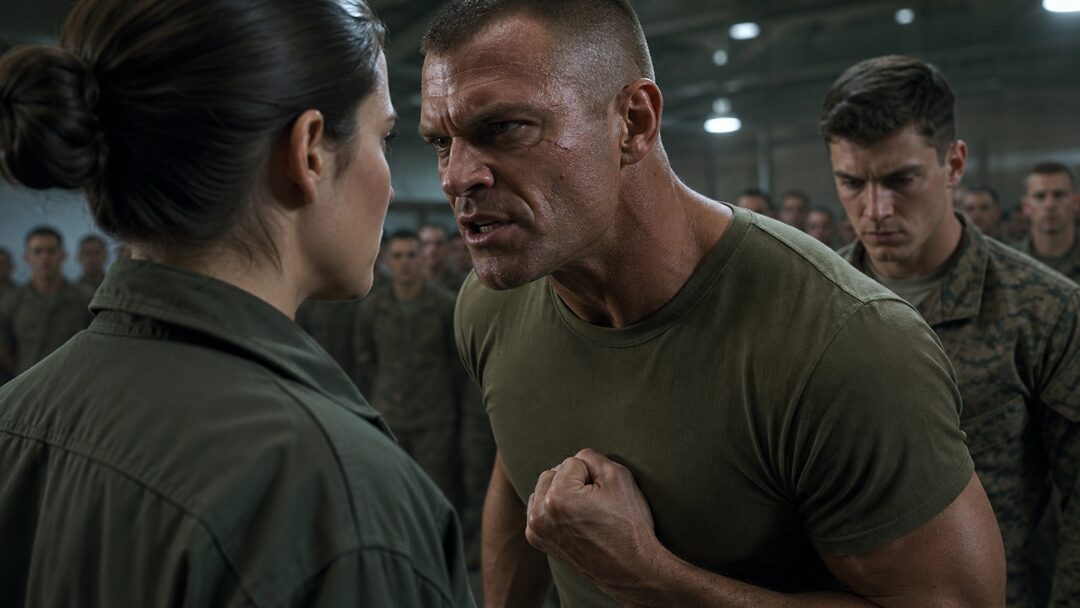
Sergeant Mark Reynolds stood so close to Emily Carter that she could smell the coffee on his breath.
His fists were clenched near his chest. Not raised. Not touching her. Just close enough to make the threat feel like it had a body.
Behind him, two rows of trainees stood silent on the concrete floor of the training hall. Their boots formed a line so straight it looked measured. Their faces were blank in the way people’s faces became blank when they were afraid to be seen choosing a side.
Emily did not look at them.
She looked at Reynolds.
He was wider than she was, older, built like the kind of man rooms made space for before he asked. His olive shirt pulled tight across his shoulders. A white scar sat under his jaw, thin and uneven, disappearing when he clenched his teeth.
“Say it, Carter.”
His voice hit the walls and came back harder.
Emily’s field jacket hung loose on her frame. It had been issued a size too large, and no matter how she rolled the sleeves, it made her look younger than twenty-four. Smaller. Like a person wearing someone else’s shape.
Reynolds leaned closer.
“Say you don’t belong here.”
No one moved.
Emily kept her hands at her sides. Her right thumb pressed into the seam of her sleeve. She knew Reynolds saw it. He saw everything people tried to hide.
She made herself stop.
“I’m not saying that,” she said.
A muscle jumped in Reynolds’ jaw.
“You froze in a convoy assessment and got your people boxed in.”
Emily heard the words move through the formation without anyone speaking them. Froze. Boxed in. Failed.
Reynolds turned his head just enough for the room to hear him.
“This is what hesitation looks like when you dress it up as discipline.”
A few trainees stared straight ahead. One blinked too fast. Another swallowed.
Brian Walker stood three places down from Emily’s left shoulder.
He did not look at her.
That was the first thing that hurt.
Not Reynolds’ voice. Not the heat in the room. Not the whole unit watching her be taken apart piece by piece.
Brian’s silence.
He had been beside her on the table map less than an hour ago, sleeves pushed up, pencil tapping fast, speaking with the clean confidence everyone trusted before they checked if it was earned.
Now his eyes were fixed on the wall above Reynolds’ shoulder.
Emily said, “That’s not what happened.”
The room shifted without moving.
Reynolds smiled.
It was not a kind smile. It was the smile of a man who had been waiting for the first crack in a locked door.
“Then explain it.”
Emily held his stare.
She could have done it.
She could have turned her head and said Brian misread the signal pattern. She could have said she saw the inconsistency before the route was approved. She could have said she tried once, quietly, and then let herself be overrun by the louder voice at the table.
She could have said the truth.
But the truth had names attached.
Brian’s name.
Her name.
A classified detail from the assessment packet that Reynolds had warned them not to repeat outside the evaluation room.
And beneath all of that, the thing she did not want the formation to see: she had known enough to object and not enough courage to insist.
“I was the route analyst,” Emily said. “The recommendation was mine to verify.”
Reynolds stepped back half an inch.
Somehow that felt worse.
“So now we’re hiding behind job titles.”
“No, Sergeant.”
“Then what are we doing?”
Emily felt every face in the room turn sharper.
She did not answer.
Reynolds circled her once. Slow. Deliberate. He did not need to touch her to make the room feel smaller.
“You think calm is command?” he asked. “You think if your voice never shakes, people will follow you?”
Emily kept her eyes forward.
“They might,” Reynolds said. “Right up until your silence gets them carried home.”
Something flickered at the edge of Emily’s vision.
Brian.
A slight movement. A flinch. There and gone.
Reynolds saw it too.
Of course he did.
He stopped in front of Emily again, closer than before.
“You want command, Carter? Then answer when challenged.”
Emily’s breath shortened once before she caught it.
Reynolds lowered his voice.
“You can survive me shouting at you. I already know that. What I don’t know is whether you can survive the truth.”
That line found something under her ribs.
Not because it was loud.
Because it was accurate.
Part II — The Route Everyone Wanted
Three hours earlier, Emily had been cold enough to lose feeling in her fingertips.
The field exercise had started before sunrise in a mock village built behind the main training compound: plywood walls, gravel roads, broken windows, old tires, and painted doors that opened into empty rooms. Speakers hidden in the corners played distant engine noise and static. Evaluators watched from behind dark glass and drone feeds.
It was fake in every way that mattered to the body.
It was not fake to the mind.
Emily’s squad had been assigned a moving problem: a civilian interpreter had been injured during a simulated extraction, and the team had to decide whether to move him through a narrow southern route or wait for armored support that might not arrive before the scenario clock ran out.
The table map was set up inside a low concrete room that smelled like dust and old rain.
Brian stood across from Emily, pencil in hand, confidence already warming his voice.
“Southern route is open,” he said. “Pattern shows hostile contact shifting east.”
Emily looked down at the signal board.
Three red marks. Two delayed pings. One missing confirmation.
“Not clean,” she said.
Brian tapped the map. “It’s clean enough.”
“Delayed contact doesn’t mean movement. It could mean waiting.”
He glanced at the clock. “Waiting gets the interpreter coded out.”
The word coded made the situation feel bloodless. That was how the program liked it. Nobody died. Nobody bled. A screen changed color. A trainer called time. A lesson was logged.
But Emily had grown up around men who went quiet when the news used careful words.
Casualty. Incident. Loss.
Clean words did not make consequences clean.
She leaned over the map. “If the third signal dropped because of terrain interference, the route is exposed.”
Brian’s voice sharpened, not cruelly, but with the impatience of a man who expected the room to move at his speed.
“We need a recommendation.”
The others looked between them.
Emily felt it then: the thin social wire pulled tight across the table. Brian was liked. Brian was quick. Brian made uncertainty sound like delay. Emily made certainty uncomfortable.
Reynolds stood in the back of the room with his arms folded, saying nothing.
He had been saying nothing all morning.
That made every decision feel like it was being weighed by a locked door.
Brian looked at the squad leader. “Move him now. Southern route.”
Emily said, “Hold.”
But she said it too quietly.
Brian was already speaking over her.
“We lose the window if we wait.”
The squad leader asked, “Carter?”
Every face turned.
Emily saw the red marks. The missing confirmation. Brian’s jaw set in the way men’s jaws set when correction started to feel like insult.
She said, “If we move, we move slow.”
It was not agreement.
It was not objection.
It was the kind of compromise that let everyone pretend the hard choice had been made.
Reynolds’ eyes lifted from the back of the room.
Emily noticed.
She noticed and still said nothing else.
The convoy moved.
Seven minutes later, the speakers erupted with contact reports. A flare popped red over the southern road. The instructor acting as the interpreter was marked lost in the scenario, along with two escorts.
Reynolds’ voice cut through the static.
“Freeze.”
Everyone stopped.
Even the dust seemed to stop moving.
Reynolds walked into the road, looked at the map board, then at Emily.
“Who cleared the route?”
Brian opened his mouth.
Emily got there first.
“I was assigned to verify it.”
Brian looked at her then.
Only then.
His expression carried gratitude and fear so close together they looked like the same thing.
Reynolds’ eyes stayed on Emily.
“Not what I asked.”
“I should have stopped the recommendation.”
The sentence came out clean.
Too clean.
Reynolds stared at her for a long moment.
Then he said, “Formation hall. Ten minutes.”
No one asked why.
No one had to.
By the time they returned to the training hall, the whole group understood there would be a lesson.
They just didn’t know yet who it would belong to.
Part III — The Shape of Silence
In the hall, Reynolds did not ask about the red marks first.
He asked about Emily’s father.
Not directly.
That would have been too easy.
He said, “You ever hear people call silence noble, Carter?”
Emily’s stomach tightened.
The formation was still behind him. Brian was still three places down. The lights above hummed with a sound that made the silence feel electric.
Emily said, “Sometimes.”
“People love a quiet hero.” Reynolds stepped closer. “Easy to honor. Harder to question.”
Emily’s face did not change.
Inside, something old moved.
Her father had been quiet in every photograph people liked to show her.
Captain Thomas Carter standing beside a truck, one hand tucked into his vest. Thomas Carter kneeling in dust beside children whose names Emily never learned. Thomas Carter looking past the camera with an expression everyone called calm.
At memorials, people had described him as steady.
They said it like steady meant painless.
They said it like steady men did not leave daughters behind to grow up around folded flags and careful adults.
Reynolds watched her eyes.
There it was again: the awful precision of him.
“You think I’m here to make you cry?” he asked.
“No, Sergeant.”
“You think I care if you cry?”
“No, Sergeant.”
“Good. Because tears aren’t the problem.” He pointed one finger toward her chest, not touching. “This is.”
Emily said nothing.
Reynolds’ voice lowered.
“The room could be burning down, and you’d still be deciding whether raising your voice was impolite.”
Brian’s eyes dropped.
Emily saw it.
This time she could not pretend not to.
Reynolds saw her see it.
He turned toward Brian so fast the room seemed to stiffen.
“Walker.”
Brian’s chin lifted. “Sergeant.”
“Anything you want to add?”
Brian’s mouth opened.
Nothing came out.
The silence was small.
Then it grew teeth.
Reynolds looked back at Emily.
“You see that?” he said. “That’s what a room does when everyone waits for someone else to carry the cost.”
Emily felt heat climb her throat.
She had been angry at Reynolds when he started. Angry enough to make stillness easy. But anger was clean compared to what she felt now.
Now she felt exposed.
Because Reynolds was not wrong.
Not entirely.
That was the part she hated.
He moved closer again.
“You saw the bad read before the convoy moved.”
The room seemed to inhale.
Emily’s eyes sharpened.
Reynolds nodded once, almost satisfied.
“There she is.”
Brian finally looked at her.
His face had gone pale.
Reynolds continued, “You saw the inconsistency. You saw Walker push the route. You knew there was risk.”
Emily’s jaw tightened.
“Yes.”
“And you still let it move.”
“I objected.”
“No.” Reynolds’ voice snapped. “You murmured. There’s a difference.”
The words hit harder than shouting.
Emily could feel the formation listening differently now. Not with the hungry discomfort of public discipline, but with a quieter unease.
They had thought they were watching someone get blamed.
Now they were watching blame split open.
Reynolds asked, “Why didn’t you override him?”
Emily’s answer was ready.
Because I wasn’t squad lead.
Because the data was incomplete.
Because the scenario clock was running.
Because he spoke first.
Because no one likes the person who makes the room stop.
All of those were true.
None of them were the truth.
Emily looked at Brian.
This time, he did not look away.
“I didn’t want to make him look reckless in front of the squad,” she said.
The room went still.
Reynolds stared at her for one hard second.
Then he said, “So you let the squad drive into a bad route politely.”
The sentence landed flat and brutal.
Emily did blink then.
Once.
Reynolds saw that too.
“Discipline is not the same as fear,” he said. “And loyalty is not letting someone be wrong because correcting them feels ugly.”
Brian’s shoulders shifted.
Emily could hear her own heartbeat.
She had thought the test was whether she could stand still while Reynolds tried to break her.
Now she understood.
Standing still had never been enough.
Part IV — The Thing He Carried
Reynolds walked away from Emily for the first time.
The space he left in front of her felt cold.
He stopped near the metal table by the wall, where their assessment packets lay stacked in brown folders. He rested one hand on the edge, head slightly bowed.
For a second, he looked older than forty-two.
Then he looked back at her.
“Your father was quiet,” he said.
Nobody in the formation moved.
Emily’s mouth went dry.
Reynolds did not say Captain Carter. He did not say hero. He did not use the polished language strangers used when they wanted grief to stay well-behaved.
He just said your father.
Emily’s voice came out low. “You served with him.”
“I did.”
“You never said anything.”
“You never asked.”
The answer was hard, but not cruel.
Emily almost hated him more for that.
Reynolds came back toward her, slower now.
“He had a way of making a pause feel like an answer. Men trusted it. I trusted it.” His eyes did not leave hers. “Most of the time, he earned that trust.”
Most of the time.
Emily felt the words like a hand closing.
Reynolds’ scar pulled as he swallowed.
“Last operation I ran with him, we had a stranded team and bad visibility. Support wasn’t where it was supposed to be. Comms were breaking apart. Everyone wanted to move.”
The room stayed silent, but the silence changed again.
No one was watching for humiliation now.
They were listening to something Reynolds clearly did not enjoy giving away.
“He stopped us,” Reynolds said. “Made us wait twelve minutes longer than any of us wanted. Saved half the column by doing it.”
Emily knew this story.
Not from Reynolds.
From men at memorial dinners. From old commanders who touched her shoulder with heavy hands. From her mother’s face when someone said, Your father knew when to hold.
Reynolds’ voice went rough at the edge.
“Then he went back for the team that didn’t make the window.”
Emily looked at the floor for the first time.
Only for a second.
When she looked up, Reynolds’ expression had hardened again, as if the softness had embarrassed him.
“He gave me an order before he went. Told me to hold the line.”
Emily could feel the shape of the next words before he said them.
“I obeyed.”
The hall did not move.
“He didn’t come back,” Reynolds said.
Emily’s face stayed controlled.
That control cost more now.
Reynolds stepped close enough again that the whole room remembered the beginning.
“For years, people have told that story like it was about calm.” His voice dropped. “It wasn’t. It was about choosing when to stop everyone and when to move, even if both choices cost you.”
Emily’s hands wanted to curl.
She let them stay open.
“You think I’m trying to punish you because of your name,” Reynolds said.
Emily said nothing.
“That’s part of it,” he admitted.
The honesty struck harder than denial would have.
His eyes cut briefly toward the formation, then back to her.
“I see Carter on a roster, I look twice. I see Carter hesitate, I hear a door closing.”
Emily’s throat tightened.
Reynolds leaned in.
“But you are not him. And if you try to become him by being silent in all the places he was steady, you won’t honor him. You’ll disappear behind him.”
The words did not break her.
They did something worse.
They made her want to answer.
Not defend. Not explain.
Answer.
Brian moved before she could.
“Sergeant.”
Reynolds turned.
Brian had stepped half a boot out of formation.
It was barely anything.
In that room, it was enormous.
Reynolds’ voice sharpened. “Back in line, Walker.”
Brian did not move back.
“It was my read,” he said.
No one breathed.
Brian looked at Emily, then at Reynolds.
“I pushed the southern route. Carter caught the inconsistency. I overrode her.”
Reynolds’ face did not change.
“Generous timing.”
Brian flinched.
“I should have said it before.”
“Yes,” Reynolds said. “You should have.”
The words were cold enough to make Brian straighten.
Then Reynolds turned back to Emily.
“Did his hand touch the map first?”
Emily frowned.
“Yes.”
“Did his mouth move faster?”
“Yes.”
“Did either of those things make the route safe?”
“No.”
Reynolds’ voice rose, not in volume but in force.
“This exercise was never about whose pencil hit the paper. It was about whether anyone in this room had the courage to stop a bad decision before it became irreversible.”
Brian looked down.
Reynolds pointed toward him without taking his eyes off Emily.
“Walker failed by performing certainty.”
Then the finger shifted.
“You failed by respecting it.”
Emily absorbed the sentence.
It was the cleanest cut he had made all day.
Part V — The Answer That Cost Something
Reynolds stepped into Emily’s space one last time.
The room seemed to close around them.
His face was inches from hers now. The scar under his jaw disappeared as he clenched his teeth. His voice dropped so low the formation leaned toward it without meaning to.
“Last time, Carter.”
Emily felt the air move between them.
“What do you do?”
The answer she had trained to give rose automatically.
Assess route integrity. Challenge incomplete signal correlation. Recommend delayed movement pending confirmation.
It was correct.
It was dead.
Reynolds would have torn it apart.
Worse, he would have been right to.
Emily looked past him for one second.
At Brian.
His shame was plain now. It had stripped the confidence from his face and left something younger underneath. He nodded once.
It was permission.
It was not rescue.
Emily looked back at Reynolds.
Her father’s face came to her the way it always did: not moving, not speaking, trapped in a photograph other people had turned into a standard.
For years, Emily had thought calm meant never asking anyone to carry her weight.
So she carried too much.
She carried grief quietly.
She carried doubt quietly.
She carried Brian’s mistake quietly.
And in the quiet, something had almost become untrue.
Reynolds waited.
The formation waited.
Emily drew one breath.
Then she answered loudly enough for the whole room.
“I stop the convoy.”
Reynolds’ eyes did not move.
“I challenge Walker’s readout. I take the heat before my people take fire. And if I’m wrong, I answer for it after they’re alive.”
The room changed.
Not with sound.
With attention.
A few trainees straightened. Someone behind Reynolds let out a breath that had been trapped too long. Brian’s head dropped.
Reynolds stayed close.
“And if they hate you for it?” he asked.
Emily did not step back.
“Then they hate me in one piece.”
The line held.
It did not echo.
It did not need to.
For the first time all day, Reynolds had no immediate answer.
His face hardened. Then stilled.
Something moved behind his eyes—not softness, not approval exactly. Recognition, maybe. Pain wearing discipline.
Emily realized then that he had wanted this answer.
And that wanting it had hurt him.
Because it sounded like her father.
But not entirely.
Her father had gone back.
Emily had said alive.
Reynolds stepped away.
The distance between them felt larger than it was.
He turned to the formation.
“Assessment complete.”
No one cheered.
No one smiled.
That would have ruined it.
The room simply stood in a different silence than before.
Reynolds looked at Brian.
“Walker. You will write the route review. You will include your error, Carter’s objection, and the point where leadership failed twice.”
Brian swallowed.
“Yes, Sergeant.”
Reynolds looked at Emily.
“Carter.”
“Yes, Sergeant.”
“You will sign it.”
Emily’s chin lifted.
“Yes, Sergeant.”
Something like approval almost crossed his face.
Almost.
“Dismissed.”
Boots moved. Shoulders lowered. The formation broke into controlled motion, but nobody spoke loudly. People passed Emily without touching her. A few glanced at her differently.
Not kindly.
Not warmly.
But with the wary respect people gave to something they had underestimated and did not want to underestimate again.
Brian paused near her.
His mouth opened.
Emily shook her head once.
Not yet.
He closed it.
For once, he understood.
Part VI — What She Carried Out
The hall emptied until only Emily and Reynolds remained.
Outside, voices started low and scattered in the corridor. The scrape of boots faded. Somewhere a metal door shut.
Emily stood where she had stood through all of it.
Only now, her legs felt the effort.
Reynolds went to the metal table and picked up something small from beside the assessment folders.
Emily had not noticed it before.
A brass compass.
Old. Scratched. Dented along one edge. The glass face was cloudy, but the needle still moved when Reynolds turned it in his palm.
Emily knew it before he said anything.
Not because she remembered seeing it.
Because grief sometimes recognized objects before memory did.
Reynolds came back, but not close this time.
He held it out.
Emily looked at the compass.
Then at him.
“Your father carried it,” Reynolds said.
Her hand did not move.
Reynolds kept his arm extended.
“They recovered it after the evacuation.”
Emily’s voice was careful. “You had it.”
“Yes.”
“For how long?”
Reynolds’ expression did not ask forgiveness.
“Too long.”
That answer did more than an apology would have.
Emily took the compass.
It was heavier than she expected.
Cold at first. Then warming against her palm.
Reynolds looked toward the open doorway. “He used to check it even when the digital systems worked. Drove everyone crazy.”
Emily’s thumb brushed the dented edge.
“He didn’t trust the equipment?”
“He trusted pauses,” Reynolds said. “Anything that made him stop long enough to choose instead of react.”
Emily closed her fingers around it.
For a moment, she was eight years old again, sitting on the stairs while adults in pressed clothes spoke softly in the living room. She remembered shoes by the door. A glass of water untouched on the table. Her mother’s hand on the wall, steadying a body that had not yet learned how to stand in a world with one less person in it.
She did not let the memory take her knees.
Reynolds watched her refuse collapse.
This time, he did not attack it.
Emily slipped the compass into the pocket of her oversized jacket. The fabric sagged slightly with its weight.
“Were you trying to break me?” she asked.
Reynolds held her gaze.
The old answer would have been easy. The hard answer took longer.
“Both would’ve looked the same from where you were standing.”
Emily almost smiled.
Almost.
“That’s a terrible answer.”
“It’s the only honest one I’ve got.”
She nodded once.
Then she turned toward the door.
“Carter,” Reynolds said.
She stopped.
He did not move closer. He did not raise his voice.
“You don’t have to become him.”
Emily looked back.
Reynolds’ face had returned to its usual hardness, but now she knew hardness was not the whole shape of him.
She said, “I know.”
Then, after a second, she added, “I think that’s what scares people.”
She left him standing there.
Brian was waiting in the corridor.
He pushed himself off the wall as soon as he saw her. His confidence was gone, but not all of him was. That mattered.
“Emily.”
She kept walking.
He fell into step beside her.
“I’m sorry.”
The words came fast, like he was afraid she would disappear before he got them out.
She did not answer immediately.
They passed the windows that looked out toward the training yard. The sky had gone pale and flat. Everything outside looked washed clean in a way nothing inside felt.
Brian said, “I should have spoken up before he pushed you.”
“Yes,” Emily said.
He winced, but he nodded.
“I let you carry it.”
“Yes.”
“I didn’t mean to.”
That made her stop.
She looked at him then, fully.
Brian’s face tightened because he knew what she was about to say before she said it.
“Meaning to is not the line,” Emily told him.
He looked down.
For once, she let the silence do its work without hiding inside it.
Then she said, “Next time, speak faster.”
Brian nodded.
“I will.”
Emily touched the compass through her pocket.
Its weight was small.
Its meaning was not.
She started walking again.
After a moment, she added, “So will I.”
Brian did not answer.
He did not need to.
At the end of the corridor, the exit door waited with a rectangle of white daylight around its frame. Emily pushed it open and stepped outside.
The cold air hit her face.
Behind her, the hall remained what it was: harsh, watchful, unchanged in all the ways institutions rarely changed because one person found her voice.
But Emily had changed.
Not into her father.
Not into Reynolds.
Not into the kind of leader who never shook, never doubted, never cost anyone anything.
She walked across the yard with the compass in her pocket, heavy enough to feel with every step, and understood something she had not known when Reynolds first stood in her face and demanded she confess she did not belong.
Belonging was not the same as being welcomed.
Sometimes it was the moment you stopped asking the room to make space and chose where to stand.
Emily kept walking.
This time, if the room went quiet, she knew what to do with it.