The Morning She Let Her Name Return to the Room
Part I — The Old Carafe
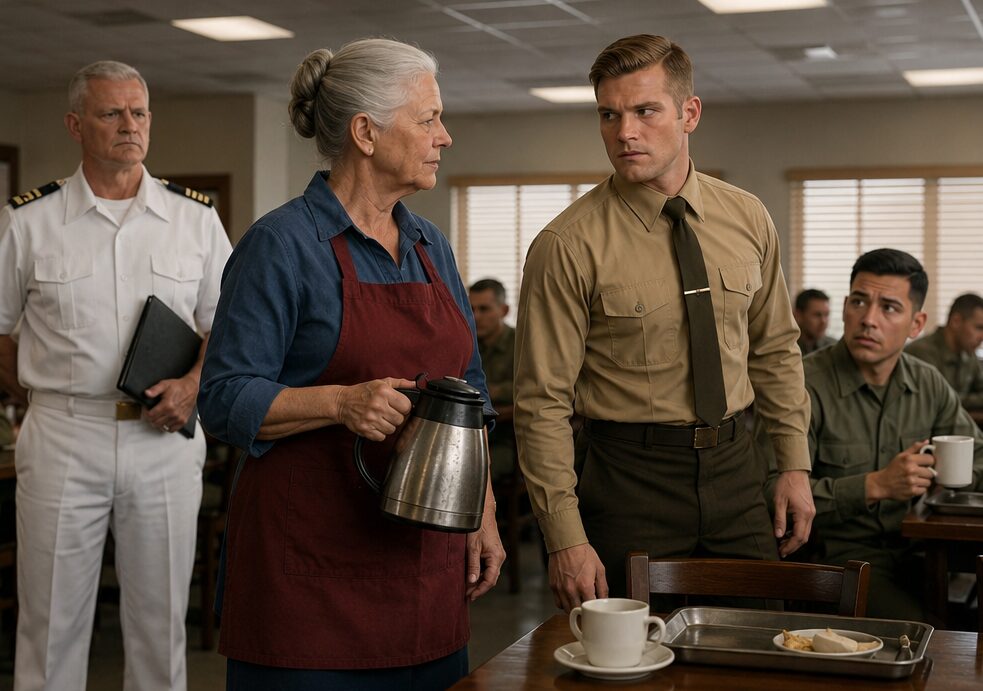
At six in the morning, when the dining hall still smelled of floor wax and burnt toast, Janet poured coffee into a white ceramic mug for a young man who thought kindness was something you performed for witnesses.
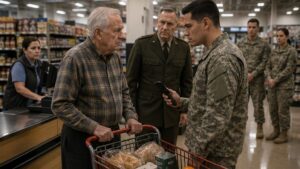
He sat with three others near the window, tan uniform sharp, hair cut clean, boots polished bright enough to catch the overhead lights. His name tag read Tyler, though Janet did not need to know his name to know his type. She had served hundreds like him. Young men who had been praised so often for becoming important that they had started acting as if they already were.
He watched the stream of coffee fall from the dented metal carafe.
Then he smiled.
“Careful, ma’am,” he said, loud enough for the table. “That pot’s probably older than half the fleet.”
The boys around him laughed.
Not loudly. Not cruelly enough to be called cruelty if someone reported it. Just enough to make the joke belong to the room.
Janet kept pouring.
Her hand tightened once around the black handle of the carafe, then loosened. The coffee rose in the mug, dark and steady, and stopped exactly below the rim.
She had learned, a long time ago, that a shaking hand wasted more than coffee.
“There you are,” she said.
Tyler leaned back. “Thank you, ma’am.”
The words were polite. His face was not.
Janet moved to the next mug. The dining hall hummed around her with trays, chairs, steam, and young voices trying to sound older than they were. On the far wall, a row of framed photographs watched over breakfast: commanders, ceremonies, flags, old faces pressed into official importance.
Janet never looked at the third frame from the left.
Not anymore.
Tyler noticed the small pin on her apron when she reached across him for the sugar dispenser. It was half-hidden under the red strap, tarnished at the edges. Most people missed it. Most people saw the apron first and stopped there.
“What’s that?” he asked.
Janet glanced down. “Old base pin.”
“Souvenir?”
“No.”
“Family thing?”
She set the sugar down.
His smile widened. “My grandfather had a whole drawer of those. Surplus shops sell them by the box. Civilians love feeling like they were part of the mission.”
The laughter this time came slower, because even the boys at his table seemed to understand he had stepped closer to something.
Janet looked at him.
For the first time that morning, she let him see her eyes fully. They were pale, steady, and tired in a way that did not ask for pity.
“Some of us were there,” she said, “before the mission had a name.”
The table went quiet.
Not for long. Only a second. The kind of second a room gives to a sentence it does not understand yet.
Tyler’s smile twitched. His pride had been touched in front of others, and pride, in young men like him, often mistook embarrassment for injury.
“Is that right?” he said.
Janet lifted the carafe.
“It is.”
She turned to go.
But Tyler had not finished making himself feel taller.
“So you served coffee back then too?”
The words landed neatly. Cleanly. Practiced enough to sound casual.
A fork stopped halfway to a mouth at the next table.
Janet did not turn around immediately. She looked down at the carafe instead. At the dent near the base. At the thin scratch along the side where someone, years ago, had dragged it too quickly across a metal table during a night when no one had time to be careful.
Then she set it down beside Tyler’s mug.
Softly.
That was what made the room listen.
Not anger.
Not noise.
The softness.
“Have you studied Operation Lantern?” she asked.
Tyler blinked.
Now he had an audience. He straightened.
“Everyone has.”
“Tell me about it.”
His friends shifted in their seats. One of them smiled like this might become entertaining again.
Tyler took the invitation exactly the wrong way.
“Failed extraction turned rescue,” he said. “Bad intelligence, trapped convoy, command confusion. Commander Steven made the decisive call and redirected the route before the unit got boxed in. Saved dozens. It’s in every leadership module.”
Janet’s face did not change.
“Every module,” she repeated.
Tyler tapped his mug. “That’s why we study it. Command under pressure.”
“Is that what they call it now?”
Before Tyler could answer, the side doors opened.
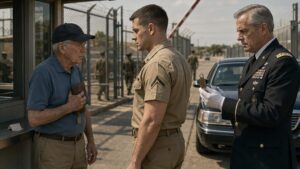
A senior officer in a white uniform stepped into the dining hall carrying a dark folder under one arm.
The room adjusted around him without being told. Shoulders squared. Conversations thinned. Chairs stopped scraping.
Janet did not look at him at first.
The officer stopped anyway.
His eyes went to the carafe.
Not to Janet’s face. Not to Tyler. Not to the table.
The carafe.
Only after that did he look at the woman holding it.
Something moved through his expression and disappeared almost before anyone else could catch it.
But Janet caught it.
She gave him the smallest shake of her head.
No.
The officer remained where he was.
Tyler noticed the pause. He looked between them, confused, irritated, still unaware that the floor beneath his morning had begun to give way.
The officer walked closer.
“Candidate,” he said.
Tyler stood halfway, then fully. “Sir.”
The officer did not return the greeting.
His eyes stayed on Janet.
“Mrs.—”
“Janet,” she said.
Just that.
The officer accepted the correction, though not easily.
“Janet,” he said, quieter.
The dining hall had become so still that the coffee machine behind the counter sounded too loud.
Tyler looked annoyed now. Not frightened. Not yet.
He thought he had been interrupted by rank.
He did not understand he had been interrupted by memory.
Part II — The Name Beneath the Apron
The officer’s name was Paul, and Janet remembered him as a boy with hollow cheeks, too much courage, and a bandage wrapped around his left hand.
He had been twenty-three the last time she saw him before the medals and promotions and white uniform. He had stood outside a communications room at 0300, asking if anyone knew whether the east road was still open.
Nobody had answered him then.
Not at first.
The men with bars on their collars had been arguing over maps. The radio operators had been shouting over static. A cook had carried in coffee with both hands because the tray kept shaking.
Janet had been the operations clerk no one looked at twice.
She had also been the only person in the room who had copied every supply route for six months.
But that was not a story she told before breakfast.
Paul stood beside Tyler’s table with the folder under his arm.
“Is there a problem here?” he asked.
Tyler answered too quickly. “No, sir. Just conversation.”
Janet reached for the carafe.
Paul saw the movement and, for one moment, looked as if he might stop her from lifting it. Then he let his hand fall.
Tyler noticed.
His confidence cracked at the edge.
“Candidate,” Paul said, “what was the conversation?”
Tyler swallowed. “I was asking about Operation Lantern, sir.”
“Were you?”
“Yes, sir.”
“And what did you learn?”
Tyler glanced at Janet. She had gone back to filling cups at his table, as if she were not the center of the room.
He tried a small laugh. “That the staff here has strong opinions about history.”
Nobody laughed with him.
At the next table, a broad-shouldered serviceman in a green uniform lifted a white cup to his mouth and paused. His name was Benjamin. He had been quiet all morning, the kind of man who listened because speaking had not often helped him.
He stared at Janet’s apron pin.
Then at her face.
Then at the third framed photograph on the wall.
He lowered the cup slightly.
Tyler saw the attention shifting away from him and pushed back against it.
“With respect, sir,” he said, though there was not much respect in it, “I just don’t think every old story needs a personal correction from the lunch line.”
Janet stopped pouring.
The carafe hovered above the mug.
A single drop fell.
Paul’s jaw tightened.
Benjamin’s face changed first. Not in anger. In recognition.
He whispered something under his breath. It might have been a name.
Then his fingers loosened.
The white cup slipped from his hand.
It hit the floor and shattered.
The sound cut through the dining hall like a command no one had given.
Coffee spread between the broken pieces.
For several seconds, nobody moved.
Tyler looked down at the mess, then back up. “What is going on?”
Benjamin stood slowly.
“Sir,” he said to Paul, but his eyes stayed on Janet. “Is that…?”
Janet set the carafe on the table.
“Don’t,” she said.
It was not loud.
It stopped him anyway.
Paul turned to Tyler. “Stand properly.”
Tyler snapped upright.
Now the confidence was gone. Not replaced by humility yet. Only fear of being seen by the wrong person.
“Sir, I apologize,” Tyler said. “I didn’t mean any disrespect.”
“To me?” Paul asked.
Tyler hesitated.
That hesitation did more damage than the apology could repair.
Janet looked at him.
“Don’t apologize upward,” she said. “That’s not where you aimed.”
The room seemed to breathe in and not breathe out.
Tyler’s face flushed.
He turned toward Janet, but words did not come. He had been trained to address rank, to salute rank, to fear rank, to impress rank. Standing in front of an old woman in a red apron, he seemed suddenly without instruction.
Paul placed the dark folder on the table.
The sound was small.
Everyone heard it.
“This morning,” Paul said, “this dining hall was scheduled for a memorial review.”
Janet closed her eyes for half a second.
“Paul,” she said.
He did not continue until she opened them.
“We were preparing a dedication.”
Tyler looked relieved for one foolish instant, as if ceremony might offer him safer ground.
Paul opened the folder.
“To Commander Steven,” he said.
At the name, Janet’s hand moved toward her apron pocket and stopped.
Tyler looked from Paul to Janet.
“Your husband?” he asked.
Janet said nothing.
There it was, in Tyler’s face: the first easy explanation. He had insulted the widow of an important man. That was bad. That could be understood. That could be apologized for. That could be tucked neatly under respect for rank, family, sacrifice, all the proper words.
Paul saw the thought pass across his face.
“No,” Paul said.
Tyler looked startled.
“No, sir?”
Paul pulled a thin copy of a log from the folder. The paper had been handled too many times. Its creases had softened.
“Not only that.”
Janet’s voice came low. “You said you wouldn’t do this in the dining hall.”
“I said I wouldn’t do it without you.”
“That’s worse.”
“Yes,” Paul said. “It may be.”
His honesty made her look at him.
For the first time that morning, Janet seemed older. Not weaker. Just closer to something that had waited too long.
Paul turned the paper so Tyler could see, though Tyler did not yet know what he was looking at.
“Operation Lantern was not saved by one decisive command,” Paul said. “That is the version we made easy enough to teach.”
No one moved.
“The first warning came from a civilian operations clerk who noticed that three supply updates had been sent in the wrong sequence. The routes were correct. The timing was not. She marked the pattern, challenged the report, and stayed through the night forcing that warning up the chain after two officers dismissed it.”
Tyler stared at the paper.
Paul’s voice stayed controlled.
“That clerk was Janet.”
The name did not echo.
It sank.
Tyler looked at Janet then, really looked, and whatever he saw on her face made him drop his eyes.
But Janet was not watching Tyler.
She was watching the coffee spreading around the broken cup on the floor.
Part III — The Incomplete Story
There had been coffee that night too.
Not good coffee. Not hot by the end. But it had kept men awake who were too frightened to admit they were frightened.
Janet remembered the communications room as a series of hands.
Hands on dials.
Hands flattening maps.
Hands wiping sweat from upper lips.
Her own hand circling three times on a route sheet that should not have repeated.
The field carafe had sat near her elbow, dented already, passed from desk to desk by whoever needed it most. Steven had come in once near midnight, touched two fingers to the back of her chair, and said, “Go home when this clears.”
She had not looked up.
“It isn’t clearing.”
He had leaned over her shoulder.
That was the last ordinary moment she remembered with him. His sleeve brushing hers. His breath catching when he saw the pattern. The room changing around the shape of a truth no one wanted.
Years later, they called it command under pressure.
At the time, it had looked more like men realizing a clerk had been right.
Paul slid the log back into the folder.
Tyler still stood. His shoulders were stiff, but the stiffness had changed. It no longer looked proud. It looked like a frame holding up shame.
“I didn’t know,” he said.
Janet looked at him.
“No,” she said. “You didn’t.”
It would have been kinder if she had said more.
She did not.
Paul closed the folder. “Candidate Tyler, you will attend the memorial review at thirteen hundred.”
“Yes, sir.”
“You will listen before you speak.”
“Yes, sir.”
“And until then, you will report to facilities and clean what broke here.”
Benjamin bent down at once to gather the pieces.
Paul stopped him. “Not you.”
Tyler looked at the broken cup.
For the first time that morning, no clever line came to rescue him.
“Yes, sir.”
Janet picked up the carafe.
“I need to get back to work.”
Paul stepped aside, but his voice followed her. “Janet.”
She did not turn.
“We need to talk.”
“No,” she said.
“Please.”
The word did not belong easily in his mouth. That was why she stopped.
Around them, breakfast resumed in careful fragments. Forks moved quietly. Chairs scraped softly. Nobody wanted to be the first to sound normal.
Janet walked behind the serving counter and set the carafe on the warmer, though it was empty.
Paul came to the other side.
For a moment, the counter between them looked like the only thing keeping the past from stepping fully into the room.
“I told them no,” Janet said.
“I know.”
“I told you no twice.”
“I know.”
“Then why is there a folder?”
Paul rested his hand on it. “Because the record changed.”
“The record didn’t change. Somebody finally read it.”
He accepted that.
“There are recovered operator notes. Dispatch copies. Your initials on the route correction.”
“My initials were on a thousand things.”
“Not like this.”
Janet looked past him to the wall of framed photographs.
Her husband’s face was not in the third frame. Not directly. The third frame showed a ceremony years after Operation Lantern, men standing in rows, medals catching sunlight. Steven’s name appeared beneath it as if a name could hold a whole person still.
“They want to rename the hall,” Paul said.
“I heard.”
“After him.”
“I heard that too.”
“Janet—”
“The dead do not need speeches from the living to remain dead.”
Paul went quiet.
It was the first sentence of hers that seemed to wound him.
She wiped the counter though it was already clean.
“I am not coming up there to be made into a story,” she said.
“No one wants to use you.”
She gave him a look.
Paul corrected himself. “I don’t want to use you.”
“That’s not the same thing.”
“No.”
His eyes dropped.
He had earned rank by learning when not to argue.
Janet appreciated that. It did not make her forgive him.
“Steven made the call,” she said.
“Yes.”
“He listened.”
“Too late,” Paul said softly. “But he listened.”
That nearly broke her.
Not because it was cruel.
Because it was true.
She turned away, gripping the edge of the counter. In the reflection of the stainless steel behind the coffee urns, she saw herself as the room saw her: small, gray-haired, red apron, old hands. A woman people stepped around with trays.
She had chosen that, hadn’t she?
After the operation, after the folded flag, after the visitors stopped bringing casseroles, after the first ceremony where they spoke of Steven as if he had been born in uniform and died without ever loving anyone, Janet had stayed at the base because leaving felt like surrender.
Then staying became habit.
Then habit became invisibility.
Invisibility, she learned, was safe.
If no one saw her, no one asked her to explain why she lived.
Paul’s voice came carefully.
“If people say you saved lives,” he said, “you think they’ll ask why you couldn’t save him.”
Janet closed her eyes.
There were some things rank should not be allowed to notice.
When she opened them, Tyler was across the room on one knee, picking up porcelain shards with a dustpan. His face was red. Benjamin stood near him, not helping, not leaving either.
“Look at him,” Janet said.
Paul did.
“That boy didn’t invent disrespect this morning. He inherited it.”
Paul had no answer.
Janet lifted the empty carafe.
“This was on the table that night,” she said. “Do you know why I kept it?”
Paul waited.
“Because everyone kept medals, flags, orders, photographs. I kept what people touched when they were scared.”
She set it down again.
The metal made a dull sound.
“I won’t let them turn him into marble,” she said. “And I won’t let them turn me into a correction.”
Paul’s face tightened with the effort not to ask too quickly.
“What will you let them do?”
Janet looked at the old carafe, at the dent, at the scratch, at the dark mouth where coffee had gone in and out for longer than some of the young men had been alive.
“I don’t know yet.”
It was the most honest answer she had given him.
And it frightened her more than no.
Part IV — The Line on the Page
At thirteen hundred, the dining hall did not look like a dining hall anymore.
The tables had been rearranged. The framed photographs had been polished. A small podium stood near the wall, beside a covered plaque resting on an easel. The room smelled faintly of lemon cleaner and coffee that had been brewed too early.
Janet watched from the kitchen doorway.
She had not changed clothes.
Blue shirt. Red apron. Practical shoes.
Paul had asked if she wanted time.
She had said, “Time is what made this mess.”
So there she stood, with the old carafe in both hands.
Tyler stood near the podium with a sheet of prepared remarks. His tan uniform looked just as crisp as it had that morning, but he no longer seemed to know where to put his face.
Benjamin stood at the back.
When he saw Janet, he straightened.
Not theatrically. Not like a salute.
Just enough.
The small movement moved through the room. One man noticed, then another. A few rose halfway before deciding whether they were supposed to. The uncertainty itself made Janet tired.
Paul approached her.
“You don’t have to do anything,” he said.
“I know.”
“We can postpone.”
“No.”
She looked at the covered plaque.
“Are you asking me to speak?”
“I’m asking what you want.”
It was the right question.
It came decades late.
Janet held the carafe tighter.
“I want him remembered as a man,” she said.
Paul did not ask who.
He knew.
“Not a statue. Not a module. Not a clean sentence boys memorize so they can admire themselves for understanding pressure.”
Her gaze moved to Tyler.
He heard. She could tell by the way his throat worked.
Paul said, “Then say that.”
Janet almost laughed.
It would have been sharp if it had escaped.
Instead she walked past him.
The room went quiet before she reached the front.
Paul stepped to the side, giving her the path completely. That mattered. Not as much as it should have, but it mattered.
Tyler stood at the podium.
His prepared page shook once.
Paul said, “Candidate Tyler will read the dedication under review.”
Tyler’s eyes flicked to Janet.
She gave him nothing.
He began.
“This dining hall is proposed for dedication in honor of Commander Steven, whose decisive leadership during Operation Lantern—”
“No.”
Janet did not raise her voice.
Tyler stopped as if the word had touched his chest.
The room held still.
Janet walked to the table beside the podium and placed the dented carafe on it.
Not as proof.
As witness.
She looked at the page in Tyler’s hands.
“He did not stand alone.”
Tyler lowered the paper.
No one corrected her.
No one breathed loudly enough to be noticed.
Janet rested one hand on the carafe.
“Steven made a call that night,” she said. “It mattered. He knew it might cost him. He made it anyway.”
Her voice stayed level.
“But before a call can be made, someone has to hear what others missed. Someone has to copy numbers nobody thanks them for copying. Someone has to stay at a radio after their shift ends. Someone has to bring coffee to a room where no one wants to admit they’re afraid. Someone has to say, ‘This is wrong,’ while people with more authority tell them to sit down.”
Paul looked at the floor.
Tyler did not.
He looked at Janet now.
Fully.
“There were radio operators who kept speaking through static,” she said. “Drivers who waited in the dark. Cooks who carried messages because the runners were gone. Clerks who knew the route sheets better than the men signing them. Boys who did not feel brave and stayed anyway.”
Her fingers slid over the dent in the carafe.
“And one commander who listened too late, but still listened.”
That was the line that changed the room.
Not because it accused him.
Because it loved him without lying.
Janet had not known until she said it that this was what she had been protecting all these years. Not Steven’s glory. Not her own silence.
His humanity.
The fact that he had been good and flawed and frightened and brave, all in the same hour.
The fact that love did not require a clean story.
Tyler looked down at his page.
Then, slowly, he folded it.
Paul watched him.
Everyone watched him.
Tyler stepped away from the podium.
For a moment, Janet thought he might leave.
Instead he turned to her.
“Ma’am,” he said, and the word sounded different now because he had stopped using it as decoration. “Would you read the line?”
Janet looked at the paper.
Then at the covered plaque.
Then at the carafe.
“No,” she said.
Tyler’s face fell.
Janet took the folded page from him and placed it beside the carafe.
“Write a better one.”
It was not forgiveness.
It was a chance.
Tyler understood enough not to thank her too quickly.
He picked up the pen from the podium.
His hand hovered over the page.
“What should it say?” he asked.
Janet looked around the room.
At Paul, who had waited too long.
At Benjamin, who had dropped a cup because memory had struck him faster than speech.
At the young men who had laughed before they understood what they were laughing at.
At the photograph on the wall.
At the space beside it where another plaque would go, whether she liked it or not.
“Start with the truth,” she said.
Tyler bent over the page.
For a few seconds, the only sound was the pen moving.
Part V — What the Room Remembered
The new dedication was shorter than the old one.
That was Janet’s doing.
Long sentences made people trust themselves too much.
Paul read it once, quietly, before handing it to her.
She did not read it aloud. She did not need to. Her eyes found the phrase that mattered.
The Night Watch.
Not one man.
Not one myth.
A watch.
People awake while others slept. People holding a line that history later tried to straighten.
Her name appeared near the bottom.
Janet stared at it longer than she meant to.
Not because it looked grand.
Because it looked ordinary.
Five letters. Then space. Then the surname she had carried before and after Steven. A name that had signed route sheets, payroll forms, grocery receipts, condolence cards, and decades of silence.
Paul stood beside her.
“We can remove it,” he said.
Janet kept looking.
“No.”
The word surprised them both.
Across the room, Tyler was on one knee again.
The broken cup from the morning had been swept into a small pile near the baseboard, but he had gone back for the pieces that had slid under the table. He picked them up carefully, one by one, as if the room had taught him that small things could matter.
Benjamin stood near the door.
This time, when Janet looked at him, he did not look away.
“Ma’am,” he said softly.
She nodded once.
It was enough.
The review ended without applause. Paul made sure of that. Or perhaps the room did. There are moments when clapping would only prove people were trying to escape what they had just felt.
The men filed out in quiet lines.
Some looked at Janet. Some could not.
Tyler remained.
In his hands was a clean white mug.
Not new, exactly. The dining hall had hundreds like it. But this one had no coffee in it, no crack, no stain, no history yet.
He approached the counter where Janet had returned the carafe to its place.
He did not smile.
He did not perform regret.
He set the mug down between them.
“I found the rest of the pieces,” he said.
Janet looked at the mug.
Then at him.
He swallowed.
“Ma’am, I apologize to you.”
The words stood alone.
No explanation after them.
No excuse.
No “if.”
No “but.”
Janet let the silence test him.
He endured it.
That mattered more than the sentence.
Finally, she said, “All right.”
His shoulders lowered, but she did not soften the moment for him.
Acceptance was not comfort.
He seemed to understand that too.
“I thought knowing the story meant I respected it,” he said.
Janet reached for the carafe.
“No,” she said. “Knowing a story is easy.”
She poured coffee into the mug.
The old carafe made its familiar low sound as the liquid moved inside it. Her hand did not shake.
Tyler reached for the mug while seated on the edge of the bench, then stopped.
Slowly, he stood.
Only then did he take it.
Janet noticed.
So did Paul from across the room.
No one said anything.
That was why it stayed whole.
Tyler held the mug with both hands. “Thank you.”
This time, the words had weight.
Janet nodded and turned toward the warmer.
Behind her, Paul uncovered the plaque.
The room did not change.
The ceiling lights still buzzed. The floor still needed mopping near the east entrance. Someone had left a tray by the trash cans. The coffee would be bitter by fourteen hundred if no one brewed another pot.
Ordinary things remained ordinary.
That was the mercy of them.
Janet glanced once at the new plaque on the wall.
The Night Watch.
Steven’s name was there.
So was hers.
So were others who had spent years reduced to footnotes, job titles, roles without faces.
It did not bring him back.
It did not return the years in which boys became men studying a clean version of a night that had been anything but clean.
It did not make Paul innocent of waiting.
It did not make Tyler wise.
But it made the room less false.
Janet picked up the carafe and crossed to the table by the window, where morning light had begun to thin into afternoon.
For years, she had thought silence was the only honest offering she had left.
Now she understood there were two kinds of silence.
One erased you.
The other let you choose when to speak.
At the table, Tyler stood before she reached him.
Janet poured his coffee.
This time, no one laughed.