The Old Veteran They Left in the Office Chair Carried One Folder They Refused to Read
Chapter 1: The Chair Beside the File Cabinets
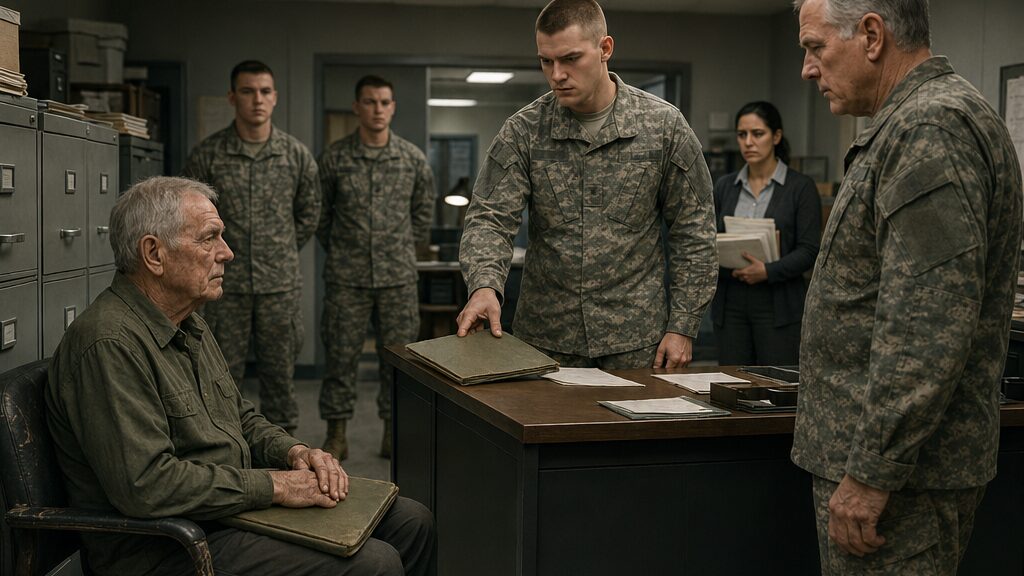
The folder slid back across the government-gray desk and stopped against Raymond Carter’s knuckles.
For a moment, nobody in the records office spoke. The fluorescent lights hummed overhead. A printer coughed somewhere behind a row of file cabinets. Two young soldiers waiting near the wall glanced over, then pretended they had not. Raymond kept his hand where it was, flat on the worn olive-green folder, feeling the softened cardboard bend under his fingers.
The young soldier behind the desk did not look at the folder again.
“You need an appointment,” Daniel Adams said.
Raymond looked up slowly. At seventy-four, he had learned not to rush his face toward people who had already decided what they were seeing. He saw Daniel’s neat uniform, the clean line of his buzzed hair, the impatience he was trying to make sound like procedure. A plastic nameplate sat on the desk near the keyboard. The top of it was dusty.
“I called last week,” Raymond said. “They said morning walk-ins were taken before eleven.”
Daniel tapped two keys on his computer without reading anything on the screen. “For current personnel records.”
Raymond’s hand remained on the folder. “This is a personnel record.”
“Sir,” Daniel said, and the word had the shape of politeness without the weight of it, “active personnel come first. Retired records go through archives, and archives require an appointment. You can call the number on the website.”
“I don’t use the website much.”
Daniel leaned back slightly, as if that proved something. “Then the receptionist can give you a printed instruction sheet.”
Raymond heard one of the waiting soldiers shift his boots. Across the office, a civilian clerk carried a stack of forms past a bulletin board crowded with official notices, unit schedules, and neatly printed names. The clerk did not stop. Everyone in the room knew the sound of a small embarrassment and how to avoid standing too close to it.
Raymond lowered his eyes to the folder. It had once been a stronger green, close to the color of field canvas after rain. Now the edges had gone pale from years of thumbprints. The tab was reinforced with tape yellowed at the corners. He had written three words across it in block letters years ago, then written them again when the ink faded.
ROBINSON — SERVICE RECORD.
He had not planned to sit down. He had planned to walk in, show the first page, and ask for the next step. But the receptionist had pointed him toward the chair beside the file cabinets and told him someone would call him. Forty minutes later, Daniel had called him without looking up, then frowned when Raymond took too long rising from the low chair.
Now the chair waited behind him, pressed against the metal cabinets like an afterthought.
“I’m not asking you to fix it today,” Raymond said. “I’m asking you to read the first page.”
Daniel’s mouth tightened. “I can’t process incomplete paperwork.”
“You don’t know if it’s incomplete.”
“I know the intake requirements.”
Raymond nodded once, not in agreement, but because old habits had trained him to acknowledge a man before disagreeing with him. “Then look at what I brought.”
Daniel looked over Raymond’s shoulder toward the waiting area. “Sir, we have people on duty who need travel corrections, pay updates, assignment documents. I can’t hold the line for personal history.”
Personal history.
The words landed quietly. Not hard enough to make a sound, but enough to press the air out of Raymond’s chest.
On the wall behind Daniel, a clock clicked toward ten. Raymond had arrived at eight-fifty in a pressed olive shirt and dark trousers because he still believed certain offices deserved clean clothes. He had brought a black pen, reading glasses, two copies of his identification, and the folder he had kept on the top shelf of his bedroom closet for almost seventeen years. He had driven before sunrise to avoid traffic near the gate. He had practiced the sentence he would say when someone asked why the matter had waited so long.
No one had asked.
Daniel pushed the folder another inch toward Raymond. “You can wait outside if you want the instruction sheet. There are seats in the hall.”
The office did not stop, but it changed. The civilian clerk slowed near the copy machine. One of the young soldiers near the wall looked down at his phone without turning it on. The receptionist, visible through the glass partition near the entry, looked toward Raymond and then away.
Raymond drew his folder back. His fingers did not tremble until he closed them around the edge.
He wanted, for one sharp second, to tell Daniel that records were not just paper. That a wrong line in a file could follow a family longer than grief. That a man’s name could be carried in a box, on a form, in the mouth of a sister who had stopped asking questions because every answer came stamped and unsigned. He wanted to say that he had worn a uniform before Daniel’s father had likely worn boots.
Instead he took the folder into his lap and sat back down in the chair beside the file cabinets.
It was a low chair, vinyl cracked across the front edge, one leg slightly shorter than the others. When Raymond lowered himself into it, his knees rose higher than they should have, and the folder rested at an angle on his thighs. From the desk, Daniel looked taller than he was.
Raymond let the room continue around him. Phones rang. Forms shuffled. A printer beeped for paper. Behind the desk, Daniel spoke to the next soldier with a different voice, quick and useful and nearly warm.
Raymond watched the young soldier receive help in less than three minutes.
He was not angry yet. Anger would have been easier. Anger gave a man something to hold that did not feel like shame. What moved through him instead was older and more private. He had been turned away from offices before. He had been told that files were missing, that signatures were required, that the person who knew the process had transferred, retired, or died. But he had not expected the first dismissal to happen before the folder opened.
A shadow crossed the floor near the entrance.
The office tone changed before Raymond looked up. It was a small military adjustment, almost invisible to anyone who had not lived inside it: backs straightened, voices lowered, hands left pockets. Daniel stopped mid-sentence and stood a little taller.
An older officer had entered through the glass door, gray at the temples, uniform pressed without vanity. His face carried the settled severity of a man who did not need to raise his voice to be heard. He paused near the receptionist, listened to something she said, then looked across the room.
His eyes found Raymond first.
Then they dropped to the folder on Raymond’s knees.
Daniel stepped from behind the desk. “Colonel Mitchell, sir. We’re handling morning intake. There was just a walk-in issue with retired archives.”
Raymond placed one palm over the folder’s tab, not hiding it, only holding it still.
The officer looked from Daniel to the chair, then back to Raymond.
“What kind of issue?” Mark Mitchell asked.
Daniel turned toward Raymond with the careful confidence of someone repeating a rule. “Sir, I told him retired records need an appointment. I asked him to wait outside so we could keep active personnel moving.”
Raymond did not speak.
Mark Mitchell took one step farther into the office. His gaze remained on the folder, and the room seemed to narrow around the space between the chair and the desk.
“Mr. Carter,” he said quietly, reading the visitor badge clipped to Raymond’s shirt, “may I see what you brought?”
Raymond lifted the folder with both hands.
Daniel reached for it first.
Raymond did not let go.
Chapter 2: The Folder Daniel Would Not Touch
The silence around Raymond’s hands lasted no more than a second, but it was long enough for Daniel Adams to notice that the old man could still refuse.
Daniel’s fingers hovered above the folder, then withdrew. His ears had reddened beneath the short line of his hair. Colonel Mark Mitchell stood beside the desk, waiting, not reaching, not ordering. That was the first respectful thing that had happened since Raymond entered the office.
Raymond lifted the folder toward him.
Mark took it carefully, supporting the bottom as if the folder might separate at the spine. He did not open it right away. He looked at the tab, at the faded block letters, at the tape across the corner, then turned the folder slightly toward the light.
“Robinson,” he read.
Raymond kept his eyes on the folder, not on Daniel.
Mark opened the cover. The first page had been protected in a plastic sleeve, though the sleeve itself was scratched and cloudy. A photocopied form sat inside, its type uneven from an old machine. Halfway down the page, near a unit designation and a date, Mark’s eyes stopped.
Something changed in his jaw.
Daniel saw it too. “Sir?”
Mark did not answer him. He read one more line, then another. He turned the page just enough to see what was behind it, and Raymond could tell from the angle of the officer’s shoulders that he had recognized the difference between an old man’s nostalgia and a record that had not been handled correctly.
“Specialist Adams,” Mark said.
Daniel came fully to attention. “Sir.”
“Did you read the first page?”
Daniel’s lips parted. “No, sir. Based on intake procedure, retired archive requests—”
“That wasn’t my question.”
The office became very still.
Raymond felt the attention settle on him like heat. The two waiting soldiers near the wall were no longer pretending not to watch. The civilian clerk had stopped with a stack of forms against her chest. The receptionist behind the glass partition stood in the doorway now, one hand resting on the frame.
Daniel swallowed. “No, sir.”
Mark held the folder at his side and turned toward him. “You pushed this back across your desk without reading the first page?”
“Sir, I was trying to keep the line moving.”
Mark’s face did not sharpen all at once. It hardened slowly, as if each word Daniel had spoken had found its place in him and made the next one heavier.
“You asked him to wait outside.”
“Yes, sir.”
“Beside civilians and delivery personnel, with a service record you had not opened.”
Daniel’s eyes flicked toward Raymond. They did not stay there.
“Sir, I didn’t know—”
Mark lifted one hand and pointed toward the folder. Not at Daniel’s chest, not at his rank, but at the thing Daniel had refused to touch. “That is exactly the problem.”
The words struck harder because they were not shouted.
Raymond stared at the floor between his shoes. The tiles were scuffed near the chair legs, gray worn to a dull shine. He had spent enough years around officers to know when a correction was becoming a display. It could happen even when the correction was deserved. A room could shift from ignoring a man to using him as evidence.
Daniel stood rigid, jaw tight, eyes bright with a mixture of fear and shame. He was young enough to believe one mistake in front of the wrong person might define him. Raymond knew that look. He had seen it on men much farther from home.
Mark continued, “You saw an older man with a folder and decided the document mattered less because he moved slowly.”
“Sir, I didn’t intend disrespect.”
“Disrespect does not require intent. It requires neglect.”
The clerk, still standing near the copy machine, lowered the forms against the counter. Someone in the hallway paused outside the open door.
Raymond’s hand closed around the arm of the chair.
He had wanted the folder read. He had wanted someone in this office to understand that the first page mattered. But he had not come to watch a young soldier get stripped down in front of everyone. Shame was a blunt instrument. It bruised beyond its target.
“Colonel,” Raymond said.
Mark turned at once. “Mr. Carter?”
Raymond pushed himself up from the low chair. His knee stiffened halfway, and for an instant he had to press his palm against the file cabinet beside him. Nobody moved to help. He was grateful for that. When he stood, he looked first at Mark, then at Daniel.
“I asked him to read the first page,” Raymond said. “That’s still all I’m asking.”
Mark studied him. “You’re within your rights to make a complaint.”
“I know.”
Daniel’s eyes dropped.
Raymond took the folder back from Mark. He held it against his chest, the way he had held it when walking in from the parking lot. “But I didn’t drive here to put trouble in another man’s file.”
The sentence seemed to unsettle Daniel more than the reprimand had. His shoulders loosened only enough to show that he was no longer hiding behind posture.
Mark’s voice lowered. “Mr. Carter, this office failed you this morning.”
Raymond looked around the room. At the waiting soldiers. At the clerk. At the receptionist. At the printer blinking red because it still needed paper. “This morning isn’t old enough to be the whole failure.”
No one answered.
Daniel looked at him then, really looked at him, and Raymond saw the first crack in the assumption. The young soldier’s face no longer said confused old man. It said there is a story here, and I stepped on it.
Mark gestured toward the desk. “We’ll review the document now.”
Raymond did not move toward the chair. “Not in the middle of the room.”
The colonel nodded once. He turned toward the civilian clerk. “Ms. Garcia, open the back review room.”
Nicole Garcia straightened. “Yes, sir.”
She moved quickly now, setting down her stack of forms and crossing to a door beside the bulletin board. Raymond noticed the way she avoided his eyes, not unkindly, but with the embarrassment of someone who had also decided not to intervene. The key ring in her hand clicked against the knob.
Daniel remained by the desk. His hands were flat against his trouser seams.
Mark looked at him. “You will join us.”
Daniel’s throat moved. “Yes, sir.”
Raymond heard the words and felt tiredness move through him like cold water. Not because Daniel would be there, but because the folder would have to open farther now. Once a thing like this opened inside an office, it did not belong only to memory anymore. It became evidence, process, signature, route number, case note.
Nicole opened the review room. Inside was a small table, four chairs, a computer station, and another cabinet with old pull handles. The air smelled faintly of toner and dust.
Raymond stepped toward it, but stopped beside Daniel.
The young soldier looked straight ahead.
“You don’t have to be afraid of the folder,” Raymond said.
Daniel turned his head slightly, startled by the quietness of the remark.
Raymond looked down at the tab under his hand. “It has been refused before.”
The color drained from Daniel’s face in a different way now.
Mark heard it. Nicole heard it. The whole room seemed to understand that they had not reached the beginning of the matter yet.
Daniel said, barely above a whisper, “Whose record is it?”
Raymond held the folder closer.
“A man whose name is still wrong,” he said.
Chapter 3: The Name Missing From the Board
The back review room had no window.
Raymond noticed that first, before the computer, before the metal cabinet, before the chairs arranged around the small rectangular table. There was only a vent in the ceiling and a fluorescent light with one dim corner. It was the kind of room where papers went to become decisions.
Nicole Garcia placed a yellow intake form on the table, then set a pen beside it. “Mr. Carter, I’ll need to see identification before we review anything.”
Raymond reached into his shirt pocket and removed his wallet. His fingers found the laminated card by touch. He had placed it there that morning behind his driver’s license so he would not have to search under pressure. Nicole took it gently, more gently than Daniel had touched anything so far.
“Thank you,” she said.
Daniel stood near the door until Mark looked at one of the chairs. “Sit down, Specialist.”
Daniel sat.
Raymond took the chair nearest the table’s corner. It was higher than the one outside, and that small mercy almost undid him. He set the folder before him but did not open it. Mark remained standing for another moment, then chose the chair across from him rather than the head of the table.
Nicole typed Raymond’s information into the computer. The keys made small, efficient sounds. “You served under the name Raymond Carter?”
“Yes.”
“Army?”
“Yes.”
“Records support and logistics?”
Raymond looked up.
Nicole glanced at the screen. “It shows a personnel specialty code here from an old scanned index.”
Daniel looked at him quickly.
Raymond did not smile. “I knew how forms moved.”
The room accepted the sentence without comment. That was something.
Nicole turned back to the computer. “And this request concerns Timothy Robinson?”
Raymond’s hand went to the folder tab. “Yes.”
Mark folded his hands on the table. “Tell us what needs correcting.”
Raymond opened the folder.
He did it slowly, not because he wanted drama, but because the pages had their own order. The first sheet was the photocopied form Mark had seen. Behind it were envelopes, duplicate requests, two letters with official stamps, and a brittle copy of a transport roster so faded it looked like smoke pressed into paper. At the back was a small handwritten note Raymond did not remove.
He took out the first page and turned it toward Nicole.
“His middle initial is wrong in the record,” Raymond said. “His unit attachment is wrong in one line. And the board outside has him listed under a group he was not with.”
Nicole’s brow tightened. “The board?”
Raymond looked toward the wall beyond the review room, though he could not see through it. “The memorial display by your front office.”
Mark’s expression changed slightly. He knew the board. Everyone who worked in that building knew it, though some passed it so often they stopped reading the names.
Daniel shifted in his chair.
Nicole clicked through several screens. “The hallway board is being updated for the audit. It pulls from a local reference file, not the national archive.”
“That local file is wrong.”
Nicole looked from the photocopy to her monitor. “I see Timothy Robinson here. But the file has him attached to a different convoy support unit for the date listed.”
Raymond’s voice stayed even. “That is the error.”
Mark leaned closer. “You have documentation?”
“Some.”
“Some may not be enough,” Nicole said, then immediately seemed to regret the bluntness. “I’m sorry. I mean, for a formal correction, the system requires either certified records, a command verification, or a sworn statement supported by secondary documents.”
“I brought what they sent back to me.”
Raymond opened one of the envelopes. The paper inside had fold lines soft from being opened and closed many times. Nicole accepted it and read in silence. Daniel tried not to look, then looked anyway.
The letter was short. It said the previous request could not be processed due to insufficient supporting material. It thanked Raymond for his patience in a tone that had no memory of him.
“When was this?” Mark asked.
“Seventeen years ago.”
Daniel looked at him sharply. “You waited seventeen years?”
The question came out before he could soften it. Mark’s eyes moved toward him, but Raymond lifted a hand slightly.
“It’s a fair question,” Raymond said.
Daniel closed his mouth.
Raymond looked at the folder. “I didn’t wait all at once. At first, I wrote back. Then I called. Then I drove to a different office. Then someone said the file had been transferred. Then someone said only family could request that part. Then his sister asked me to let it be because every letter opened it again.” He paused. “So I put it away.”
Nicole’s typing stopped.
Raymond touched the edge of the folder. “But the board in the hall brought it back out.”
No one asked how he had seen the board. The answer was simple: he had passed it while looking for the office, and there, under glass, among clean printed strips and updated unit headings, was Timothy Robinson’s name placed neatly in the wrong line. A small error to anyone else. A second burial to Raymond.
Mark sat back slowly. “You knew him.”
Raymond looked at the photocopy, not at Mark. “Yes.”
Daniel’s voice was quieter. “Was he family?”
“No.”
The answer had more weight than if he had explained.
Nicole turned the monitor slightly toward Mark. “The audit team is reviewing the display this week. If the local file is wrong, we can flag it, but without the supporting correction, they may leave the current listing in place until the next cycle.”
“When is the next cycle?” Mark asked.
“Could be a year.”
Raymond’s fingers tightened once, then released.
A year was not long to an office. A year was a tab, a pending request, a later review. To Raymond, it was another season in which Timothy’s sister might walk past a printed name and wonder whether memory or paper had failed her.
“What do you need?” Mark asked Nicole.
Nicole looked uncomfortable. “A stronger chain. The roster copy helps, but it’s incomplete. The old attachment line conflicts with the scanned index. If Mr. Carter served in records support, his statement may help establish how the movement was recorded, but he would need to sign under penalty of false statement. And if there was a prior rejection, we need that file too.”
Daniel stared at the folder. The red in his ears had faded into a dull paleness. “Can’t we just correct the board while it’s pending?”
Nicole shook her head. “Not officially.”
“Then unofficially?”
Mark gave him a look. Daniel fell silent.
Raymond almost pitied him. The young man wanted now to repair with speed what he had damaged with speed. It was the same mistake turned in a kinder direction.
“No,” Raymond said.
All three looked at him.
“If it goes up right, it goes up clean,” he said. “Not taped over because somebody felt bad.”
Mark nodded faintly, as if that answer told him more about Raymond than the file did.
Nicole gathered the pages into a careful stack. “There may be a way to reopen the prior request. But I’ll have to pull the old rejection record, and that might take time.”
“How much time?” Raymond asked.
“Maybe today. Maybe longer.”
Raymond looked toward the closed door. Beyond it, the records office continued with its phones, forms, and people who needed things done before lunch. He had thought the worst part would be getting someone to read the first page. Now the first page had been read, and it had opened onto a hallway of locked cabinets.
Nicole hesitated. “There’s something else.”
Raymond knew before she said it. He had known since she placed the yellow form on the table.
“For the statement,” she said, “we would need you to explain why you believe the record is wrong, what you personally handled, and why the original correction attempt stopped.”
Raymond’s eyes lowered to the small handwritten note still tucked at the back of the folder.
Mark’s voice was careful. “Is that a problem?”
Raymond closed the folder halfway, leaving his hand inside as a marker.
“It is not a problem,” he said. “It is just not a sentence I have wanted to write.”
Chapter 4: The Pages Nobody Wanted to Handle
The archive room smelled like metal, dust, and old glue.
Raymond had known rooms like it before. Different building, different years, different faces behind the desks, but the same quiet pressure lived in the drawers. Paper did not accuse anyone. It simply waited until a living person had to decide whether the mark on it mattered.
Nicole Garcia unlocked the archive cabinet with a small silver key. The drawer stuck halfway out, then gave with a tired scrape that made Daniel Adams flinch.
Raymond stood beside the table with his folder tucked under one arm. He had slept poorly after the first visit. The sentence Nicole wanted from him had followed him home, sat at his kitchen table, stood beside him while he rinsed one coffee cup in the sink. Why the original correction attempt stopped. It sounded simple when spoken by a clerk. It was less simple when the answer had spent seventeen years behind a closed closet door.
Daniel stood across from him now, a tablet in one hand and a stack of blank request slips in the other. He looked younger in the archive room, without the desk between them. His uniform was as neat as before, but the certainty had gone out of him. He kept watching the folder as if it might bruise if he looked too hard.
Nicole pulled several hanging files forward. “The scanned index gives us a reference number, but not the original attachment packet. If the transport roster exists locally, it would be in overflow storage or misfiled under the movement date.”
Daniel unlocked his tablet. “I can search by last name.”
“You can,” Nicole said. “But if it was entered wrong, the search may faithfully fail.”
Raymond glanced at her. It was the first thing she had said that sounded like she had lived long enough among records to distrust them.
Daniel typed. The tablet screen reflected pale light across his face. “Robinson, Timothy. I’m getting the same local display entry.”
“That is the wrong one,” Raymond said.
Daniel paused. “I know.”
The words were plain, but they changed the air slightly.
Nicole pointed toward the open drawer. “Mr. Carter, if you remember the approximate movement window, it will help.”
Raymond set his folder on the table and opened it to the roster copy. “Late October. The convoy support attachment was logged before the weather delay, not after.”
Daniel looked up. “You remember the weather?”
Raymond kept his eyes on the page. “Weather delayed paper faster than it delayed trucks. People remember the trucks. Records remember the delay.”
Daniel did not answer. He came closer, and this time he did not reach for the paper until Raymond slid it toward him.
The roster copy was poor. Names leaned into darkness near the edge. Some lines were ghosted from the reverse side. Raymond had circled nothing. He had not wanted to mark the page. Instead, he tapped one spot with his forefinger.
“Here.”
Daniel bent over it. “That line is nearly gone.”
“Yes.”
“How did you know that was him?”
Raymond took a breath through his nose. “Because I wrote the clean copy.”
Nicole stopped moving behind the drawer.
Daniel looked at him again. Not sharply this time. Carefully.
“You worked these?” he asked.
“I worked movement packets, roster corrections, attachment logs, casualty-related routing when it came through my desk. Not all of it. Enough.”
Daniel’s eyes moved from Raymond’s face to his hands. Those hands, wrinkled and broad-knuckled, rested on either side of the folder as if holding a door open.
“You should have said that yesterday,” Daniel said.
Raymond looked at him.
Daniel’s mouth tightened with regret. “I mean—if I had known—”
“That I understood your desk?”
Daniel lowered his gaze.
Raymond closed the folder halfway. “You should not need my old job title to read one page.”
Nicole removed one file and placed it on the table before Daniel could answer. “Here’s the overflow list for October movements. It may not be complete.”
Daniel accepted the file with both hands. He opened it more gently than he had handled anything in Raymond’s presence the day before. The sound of paper filled the small room. Outside the archive door, the records office continued its morning rhythm, but muffled now, as if the walls had decided this work needed quiet.
For nearly an hour, they searched.
Nicole worked through cabinet numbers and old reference codes. Daniel checked local scans, then compared them against paper lists Raymond identified by memory. Mark Mitchell came in once, asked if they had what they needed, and left when Raymond said, “Not yet.” No one tried to take over.
Raymond’s knees began to ache, but he refused the chair until Nicole pulled it closer without comment and turned away before he sat. He appreciated that more than help.
Daniel found three Robinsons, none of them Timothy. He found one Timothy with no middle initial in an unrelated training file. He found a roster page where the corner had been torn away exactly where the attachment column should have been.
Each failed page made him work faster at first, then slower. Raymond watched him learn the weight of missing things.
“Sir,” Daniel said, then stopped.
Raymond looked up.
Daniel’s face colored. “Mr. Carter,” he corrected. “When you made clean copies, did you keep duplicates?”
“Sometimes.”
“For yourself?”
“No.”
“Then how did this one survive?”
Raymond touched the plastic sleeve inside his folder. “It was returned to me after the first request. Someone copied a copy and sent back the wrong page with the rejection. It was the only useful mistake they made.”
Nicole gave a small, humorless exhale. “That happens more than we admit.”
Daniel looked toward the rows of cabinets. “So the system had proof, copied it badly, rejected the request, then kept the cleaner version somewhere else?”
“Maybe,” Nicole said. “Or the cleaner version was destroyed under retention rules. Or transferred. Or mislabeled.”
Raymond did not move. “Mislabeled is what I’m hoping for.”
Daniel stared at him. “You’re hoping for mislabeled?”
“At least mislabeled means it still exists.”
That quieted him.
They moved to the lower drawers. Daniel crouched and began reading tabs. His boots squeaked against the floor. Nicole gave him file ranges. Raymond sat with his folder in his lap, listening to the young man pronounce old codes with increasing care. Every so often Daniel would look back before moving a page, silently asking whether he should continue. Raymond answered with a nod.
Near noon, Daniel pulled a thin file from the back of a drawer that had been packed too tight.
“This one’s out of sequence,” he said.
Nicole crossed to him. “What number?”
Daniel read it.
Raymond’s fingers closed around the folder.
Nicole took the file to the table. The tab label had been typed, peeled off, and typed again. A strip of glue remained under the second label. Nicole opened it, and inside were six pages clipped together with a rusted paper clip.
The top page was a supply routing memo.
Daniel’s shoulders dropped. “Wrong packet.”
“Wait,” Raymond said.
Nicole stopped before turning the page.
Raymond leaned forward. The memo date was not the right one, but the handwriting in the bottom corner was familiar in a way that made his chest tighten. Not because he remembered the person, but because he remembered the habit: initials, slash, transfer notation, written too close to the margin.
“Second page,” he said.
Nicole turned it.
A transport roster appeared, cleaner than Raymond’s copy but incomplete. The attachment column was visible. Timothy Robinson’s name was not on the visible lines.
Daniel’s disappointment was immediate. “It’s still not—”
“Third page,” Raymond said.
Nicole turned it.
This one was a correction sheet. Half the page had been stamped as superseded. A line near the middle listed three names moved from one support attachment to another before final filing.
Timothy Robinson was there.
But beside his name, in the margin, someone had written a reference to another roster.
Nicole bent close. “This points to a transport roster we don’t have.”
Daniel frowned. “So it confirms the conflict but not the final correction?”
“It confirms there was a correction trail,” Nicole said.
Raymond stared at the page. The room narrowed around the ink in the margin. That small handwritten reference had survived when cleaner answers had not.
Daniel read the note again. “Why would the final roster be missing but the correction sheet be in a supply routing file?”
Nicole did not answer right away.
Raymond did.
“Because someone did not want to handle the pages twice.”
Daniel looked at him.
Raymond held his gaze. “So they put them where they were easiest to move.”
Nicole’s expression had gone still. “That could mean the original error was carried forward from a convenience copy.”
“Convenience becomes truth if nobody checks it,” Raymond said.
Daniel looked down at the correction sheet. His voice was low. “And I almost did the same thing.”
No one corrected him.
Nicole carefully placed the sheet beside Raymond’s folder. “This is enough to reopen the case. Not enough to finish it.”
Raymond nodded. He had not expected enough. Enough was a word offices used when they wanted a man to stop asking.
Daniel touched the margin note without pressing on the paper. “Where would the missing roster be?”
Nicole looked toward the deepest row of cabinets, then back to the page. “If it exists, it may be under the transport reference. Or it may have been pulled during the prior request.”
Raymond felt the old dread rise before she said the rest.
Daniel said it for her. “The request from seventeen years ago.”
Nicole closed the thin file. “We need that rejection packet.”
Raymond looked at the worn folder in his lap. For the first time since entering the archive room, it felt lighter and heavier at once.
Daniel turned toward him. “Mr. Carter, do you still have every letter they sent you?”
Raymond thought of the handwritten note at the back. He thought of Timothy Robinson’s sister saying, Please, Raymond, no more envelopes. He thought of himself placing the folder on the closet shelf and telling himself he was honoring her by letting it rest.
“I have what I could keep,” he said.
Nicole slid the correction sheet into a protective sleeve. “Then we’ll need to compare it with the prior rejection.”
Daniel looked back down at the file in his hands. “And if the missing roster was pulled back then?”
Nicole’s face tightened.
Raymond answered before she could.
“Then somebody saw the right page and still sent me home.”
Chapter 5: The Audit Wanted a Clean Story
Two days later, the chair beside the file cabinets was empty.
Raymond noticed it as soon as he entered the records office. It stood in the same place, low and cracked and slightly tilted, but no one had placed a waiting form on it or pushed it back against the wall. That morning, it looked less like a place to put an inconvenience and more like something the room had forgotten how to use.
Daniel saw him from the desk and stood.
Raymond did not want that either.
He gave the young soldier the smallest nod that would let him sit back down, but Daniel remained standing until Raymond crossed the room. Behind him, Nicole appeared at the review room door with a folder of her own. Mark Mitchell stood near the bulletin board, reading the printed display that had started all of this.
The board was neat. Too neat, Raymond thought. Names aligned in clean rows under headings that made history look managed. He found Timothy Robinson’s name without meaning to. There it was, still under the wrong unit attachment, still spelled with the wrong middle initial. Nothing about it looked cruel. That was what made it hard to bear. The error had the calm face of an official thing.
Mark turned. “Mr. Carter.”
“Colonel.”
“We have the audit team arriving tomorrow afternoon.”
Raymond looked at the board. “That soon?”
“It was moved up.”
Nicole came forward with the new folder pressed to her ribs. “We found the prior rejection file.”
Raymond’s hand tightened around the olive-green folder he had brought again from home. The night before, he had removed everything from it and put it back in order twice. He had almost left the handwritten note behind, then slid it into the rear pocket before closing the cover.
“Was the missing roster there?” he asked.
Nicole hesitated.
Daniel answered from behind the desk. “No. But there was a note referencing it.”
Raymond turned toward him.
Daniel’s face had not slept well. There were faint shadows beneath his eyes. “The rejection packet says supporting documentation was insufficient because the final transport roster was unavailable at time of review.”
“At time of review,” Raymond repeated.
Nicole nodded. “That phrase matters. It means someone knew a final roster existed or should have existed.”
Mark’s jaw worked once. “It also means the correction should not have been closed as incomplete.”
Daniel looked toward the bulletin board. “So why was it?”
No one in the room hurried to answer.
A printer started behind the partition, spitting out clean pages for clean business. Raymond listened to it, each page sliding into the tray with soft authority.
Nicole opened the review room door wider. “We should talk inside.”
Raymond followed them in. The table had changed since his last visit. Nicole had arranged three stacks of documents: his copies, the newly found correction trail, and the prior rejection file. Beside them sat a blank intake form and a statement form with Raymond’s name already typed at the top. Seeing it there made him stop before sitting.
His name looked official in a way he did not feel.
Mark closed the door after Daniel entered. “We have two issues. First, correcting Timothy Robinson’s local display entry. Second, whether the old handling of the request needs internal review.”
Raymond set his folder beside the blank intake form. “Those sound like office words for different troubles.”
“They are,” Mark said.
Nicole pulled out a chair for herself. “The audit team wants the display finalized. If we flag the Robinson entry as disputed without full correction, they may leave the current version and add a pending notation in the internal file. If we push a correction too fast without the proper statement, it can be challenged later.”
Daniel stood near the wall until Mark gestured sharply at the chair. He sat.
“Can the board be left blank?” Raymond asked.
Nicole blinked. “Blank?”
“Until you know where his name belongs.”
Mark considered it. “The auditors won’t like a blank line.”
Raymond looked at him. “The wrong line is cleaner.”
Mark did not answer.
That was the trouble with offices, Raymond thought. They could tolerate absence if it had a form attached. They could tolerate error if it had been printed neatly enough. But they hated a blank space because a blank space admitted someone had stopped and refused to pretend.
Nicole folded her hands. “Mr. Carter, there is another concern.”
Raymond sat slowly. “Go ahead.”
“The prior rejection was signed by a review clerk who no longer works here. But the routing approval came from this office. If we reopen it formally, it may show the office had a chance to correct the error years ago and closed it improperly.”
Daniel stared at the table.
Mark said, “That should not affect whether we do the correction now.”
“No,” Nicole said. “But it affects how people react to it.”
Raymond looked at the stacks of paper. “People.”
Nicole’s voice softened. “Supervisors. Audit staff. Anyone who does not want an old mistake attached to a current inspection.”
Daniel looked up. “Sir, with respect, that can’t be the reason we leave it wrong.”
Mark’s eyes moved to him. “No, it cannot.”
Raymond watched Daniel say it. There was urgency in him now, but also something untested. He wanted the world to become simple because he had chosen the better side. Raymond did not begrudge him that. Most men began there.
Nicole turned one page toward Raymond. “Your statement can give us a path. If you state what you handled and why you believe the prior correction was improperly closed, I can attach the correction sheet and rejection packet. It may be enough to remove the wrong display entry while the final archive review continues.”
Raymond did not touch the paper.
Daniel leaned forward. “Would that fix it?”
“Partly,” Nicole said. “It would stop repeating the wrong attachment on the board.”
“But not fully correct the record.”
“Not yet.”
Mark looked at Raymond. “It would be a start.”
Raymond’s gaze lowered to the blank lines waiting beneath his typed name. He had spent years believing that a start was better than silence. Then he had learned that some starts led only to more envelopes, more stamped apologies, more official phrases that sounded kind because no one had to say them aloud.
He opened his olive-green folder and removed the handwritten note from the back pocket.
The paper was small, folded once. It had been written in a careful hand, the letters slightly slanted. He did not unfold it immediately. He placed it on top of the statement form.
Daniel looked at it, then looked away.
“Timothy’s sister wrote that after the second letter came back,” Raymond said.
Nicole’s voice was barely above the vent hum. “Does she know you’re here?”
“No.”
Mark’s expression tightened, not in judgment, but in recognition that the matter had now left procedure and entered a place rank could not manage.
Raymond unfolded the note.
He did not offer it across the table. He read it himself, though he knew every word.
Raymond, please stop asking them. Every answer makes him disappear in a new way. I know you tried. Let my brother rest if they will not let him be right.
The room stayed still.
Raymond folded the note again. His thumb pressed the crease.
“I obeyed that for a long time,” he said. “Maybe too long. Maybe not long enough.”
Daniel’s voice was rough. “Mr. Carter, I’m sorry.”
Raymond looked at him. “For yesterday?”
Daniel’s mouth opened, then closed. “For yesterday. And for thinking this was just paper.”
Raymond studied him. The apology was real, but it was young. It had not yet been asked to become action when action became inconvenient.
“Paper is how offices remember,” Raymond said. “That’s why carelessness in a records room lasts.”
Daniel lowered his eyes.
Mark tapped the edge of the prior rejection packet. “I can order the display corrected pending review.”
Nicole’s face showed immediate worry. “Colonel, if audit asks for the supporting chain—”
“I’ll answer.”
Raymond shook his head.
Mark stopped. “Mr. Carter?”
“That puts your name over the blank space instead of Timothy’s.”
Mark frowned slightly.
Raymond slid the statement form back toward Nicole. “If his name is removed from the wrong line, I want it done because the record is being corrected, not because a colonel wants the room cleaned before visitors arrive.”
Daniel looked at him with something close to confusion. “But the result would be the same.”
“No,” Raymond said. “It would look the same.”
The words settled harder than he expected.
Nicole drew the statement form back toward herself. “Then we need the full statement.”
Raymond nodded once.
Daniel glanced at the olive-green folder. “Do you want me to leave?”
Raymond almost said yes. It would be easier to write shame without the young man present. Easier to admit that he had stopped because a sister asked him to, because he was tired, because the first rejection had made him feel foolish for believing paper could be persuaded by grief.
But Daniel had been part of the harm. Not the old harm, but the new one. If he left before understanding the shape of it, he might carry only guilt, and guilt could sour into defensiveness.
“No,” Raymond said. “You can stay.”
Nicole placed a pen beside the form. “Take whatever time you need.”
Raymond looked at the first blank line. The room blurred slightly around the edges, not from tears exactly, but from the strain of making old memory behave like a statement.
He wrote slowly.
I, Raymond Carter, served in records support and logistics. I handled movement and attachment paperwork during the period in question. I believe the current local entry for Timothy Robinson is incorrect.
The pen stopped.
Mark, Nicole, and Daniel waited.
Raymond kept his hand on the page, but the next sentence would not come. Behind the door, the office phone rang once, twice, then stopped. Somewhere in the hall, a group of people passed laughing softly, unaware that a man’s name was balanced on a line of ink.
Raymond set the pen down.
Nicole leaned forward. “Mr. Carter?”
He closed his folder.
“Not today,” he said.
Daniel looked stricken. “Did we do something wrong?”
Raymond stood, slower than he wanted to. “No. That’s the trouble.”
Mark rose as well. “The audit is tomorrow.”
“I know.”
“If we wait—”
“I know that too.”
Raymond picked up the olive-green folder, but the handwritten note remained on the table, folded beside the unfinished statement. He saw it there and made himself leave it.
At the door, he looked back.
Daniel was staring at the note as if it had accused him personally. Nicole’s hand rested near the statement form but did not touch it. Mark stood very still, a man forced to learn the difference between authority and permission.
Raymond opened the door.
Before he stepped out, Daniel said, “Mr. Carter.”
Raymond turned.
Daniel had picked up another page from the prior rejection packet. His face had gone pale again, but this time not from shame. “There’s an internal note in here. From the first review.”
Nicole reached for it. Daniel handed it to her, eyes fixed on Raymond.
She read the note and did not speak.
Mark crossed the room. “What does it say?”
Nicole looked up slowly.
Raymond already knew that whatever came next would bring him back to the table.
“It says applicant appeared in person,” she said. “Correction not pursued after applicant was advised insufficient proof existed.”
Raymond felt the floor tilt beneath the clean official words.
Daniel’s voice was low. “They turned you away before they mailed the rejection.”
Chapter 6: The Statement Raymond Chose to Sign
By Friday afternoon, the review room had learned Raymond’s silence.
No one filled it too quickly anymore. Nicole did not rush the papers into order when he sat down. Daniel did not stand stiffly by the wall unless Mark told him to sit. Mark did not begin with what the office could do. They waited until Raymond placed the olive-green folder on the table and opened it himself.
The old internal note lay in the center of the table inside a clear sleeve.
Applicant appeared in person. Correction not pursued after applicant was advised insufficient proof existed.
Raymond had read it twelve times since Daniel found it. He had read it until the words no longer looked like language, only the shape of a door closing.
“I remember the chair,” he said.
No one moved.
“It was not this chair. Different office. Same height. They put me low, with my knees up, and spoke over me to each other.” His thumb rubbed the edge of the folder. “I had the roster copy then. Cleaner than this one. I had the returned packet number. I had Timothy’s sister’s letter giving permission. The clerk told me it was not enough to reopen the file. Said there was no point upsetting the family with uncertain claims.”
Daniel stared at the table.
Raymond continued before anyone could apologize. “I believed her for half an hour. That was long enough.”
Nicole’s eyes lifted. “Long enough for what?”
“For me to walk out.”
The vent clicked overhead. A paper shifted under Mark’s hand.
Raymond looked toward the closed door, beyond which the records office kept working because offices always worked. “I told myself I was respecting Timothy’s sister when I stopped. Some days that was true. Some days I was just ashamed.”
Daniel looked as if the words had struck him. Not because they accused him, but because they did not.
Mark cleared his throat softly. “Mr. Carter, the prior handling was wrong.”
“Yes.”
“You have grounds to file a formal complaint regarding that office and what happened here this week.”
Raymond looked at him.
Mark had two forms in front of him. One was the sworn statement Nicole needed. The other was a complaint form with Daniel’s name in the incident line, already typed. Seeing it there did not please Raymond. It did not anger him either. It made him tired.
Daniel saw it too. His face tightened, but he did not protest.
Nicole spoke carefully. “The correction statement and the complaint are separate. You can sign either, both, or neither.”
Raymond reached for his glasses and put them on. The room sharpened. The blank lines. Daniel’s hands clasped too tightly in his lap. Mark’s controlled expression. Nicole’s pen aligned parallel to the page. The olive-green folder open at the center like something that had survived weather.
“Read me the correction form,” Raymond said.
Nicole did.
Her voice was steady. It stated that Raymond Carter had served in records support and logistics, that he had handled movement and attachment paperwork during the relevant period, that the current local entry for Timothy Robinson conflicted with surviving correction material, prior rejection references, and Raymond’s direct knowledge of the paperwork trail. It did not make Raymond famous. It did not make him heroic. It did not make the office innocent. It simply told the truth in a shape the system could carry.
When she finished, Raymond nodded. “That one.”
Nicole placed it before him.
Mark touched the second form. “And this?”
Raymond looked at Daniel.
The young soldier met his eyes this time. There was fear there, but he did not hide behind it. “Mr. Carter, I deserve whatever you decide.”
Raymond heard sincerity. He also heard the faint hope that punishment might be easier than obligation. A punished man could say he had paid. A changed man had to keep paying attention.
“What did you do after I left yesterday?” Raymond asked.
Daniel blinked. “Sir?”
“Mr. Carter,” Mark corrected quietly.
Daniel swallowed. “Mr. Carter. I reviewed the walk-in intake guidance. I checked what we give retired personnel and older veterans when they come in without appointments. It’s confusing. Some of it is wrong.”
Raymond waited.
“I also checked the hall seating,” Daniel said. “There’s no clear sign for records help. The instruction sheet sends people to a website first, even if they came in person. And the retired records number printed by reception is outdated.”
Nicole looked surprised. “It is?”
Daniel nodded. “It routes to a general line.”
Mark’s eyes narrowed, but he let Daniel continue.
“I drafted a correction for the sheet,” Daniel said. “I didn’t submit it yet. I didn’t know if that was overstepping.”
Raymond leaned back slightly. “Yesterday you did not worry about overstepping.”
Daniel accepted it without flinching. “No, sir.”
Raymond removed his glasses and cleaned them with the edge of his shirt. His hands were not as steady as he wanted. “What did you think when you saw me?”
Daniel’s answer did not come quickly. That mattered.
“I thought you were going to take time I didn’t have,” he said.
“Because I was old.”
Daniel’s jaw tightened. “Yes.”
“Because I moved slowly.”
“Yes.”
“Because my folder looked old.”
Daniel’s eyes lowered. “Yes.”
Raymond put his glasses back on. “And now?”
Daniel looked at the folder. “Now I think old folders get old because someone keeps carrying them.”
Raymond felt the sentence settle in him, imperfect but honest.
Mark slid the complaint form a little closer. “Mr. Carter, accountability matters. I don’t want you to feel pressured to spare him.”
“I don’t.”
Daniel’s shoulders stiffened.
Raymond looked at Mark. “And I don’t want you using my hurt to make discipline look clean.”
Mark’s face changed, not much, but enough.
Raymond picked up the pen. “I will write what happened in the statement. All of it. That your office refused to read the first page. That Specialist Adams sent me toward the hallway. That the old rejection shows this happened before. That this was not one young man having a bad morning.”
Daniel closed his eyes briefly.
Raymond touched the complaint form with two fingers and pushed it back toward Mark. “But I am not signing that.”
Mark held his gaze. “May I ask why?”
“Because the lesson is not for his file first.”
Daniel looked up.
Raymond turned to him. “It is for his desk.”
No one spoke.
“You want to make it right?” Raymond asked.
“Yes,” Daniel said.
“Then read the first page from now on. Not just mine. Not just veterans who look like somebody told you to respect them. Everyone. Especially the ones who cannot explain themselves fast.”
Daniel’s mouth tightened, and for a moment Raymond thought the young man might break. But Daniel nodded once. “I will.”
“That is not an apology,” Raymond said. “That is work.”
“I know.”
“Not for a week.”
“I know.”
Raymond studied him. “Do you?”
Daniel looked toward the office beyond the door. “I think I’m starting to.”
It was not enough. Raymond knew that. But enough had never been the right word for this story.
He pulled the correction statement closer. Nicole handed him the pen. This time, when he began to write, the sentence came.
I appeared in person years ago with supporting material and was advised that the proof was insufficient. I left without pursuing the correction further. I now believe that decision allowed an error to remain in the local record and public display.
His hand slowed, but it did not stop.
The current correction is requested not for recognition of myself, but so Timothy Robinson’s name and attachment may be recorded as accurately as surviving evidence allows.
Raymond signed at the bottom.
The room seemed to exhale only after he set the pen down.
Nicole took the form with both hands. “I’ll scan it now and attach the supporting pages.”
“Will the board be changed?” Raymond asked.
Mark answered. “The wrong entry will be removed today. The corrected entry will go up when the review clears.”
Raymond looked at the olive-green folder. “So there will be a blank space.”
“For now,” Mark said.
Raymond nodded. “A blank space tells less of a lie.”
Daniel stood suddenly, then caught himself. “Mr. Carter, may I—” He stopped, embarrassed by his own urgency. “May I be the one to update the intake sheet?”
Mark looked at Nicole.
Nicole nodded slowly. “I’ll review it.”
Daniel turned back to Raymond. “And the letter. When the corrected packet is ready. May I mail it?”
Raymond’s first instinct was to refuse. The letter belonged to Timothy’s sister. It belonged to the promise he had failed and carried and returned to. Handing any part of it to Daniel felt too generous.
Then he looked at the complaint form lying unsigned near Mark’s elbow.
Mercy, he had learned, was not pretending harm had not happened. It was deciding that harm would not have the final word if work could.
“When the correction is ready,” Raymond said, “you can mail it.”
Daniel’s eyes shone, but he held himself still. “Yes, sir.”
“Mr. Carter,” Raymond said.
Daniel nodded. “Yes, Mr. Carter.”
Nicole gathered the statement, correction sheet, rejection note, and roster copy. She did not rush. Each page went into the scanner as if order had become a form of apology.
The machine warmed, clicked, and pulled the pages through one by one.
Raymond sat back. For the first time all week, the olive-green folder lay open without feeling like it was guarding him. It was still worn. Still faded. Still full of holes paper could not fill. But it had done what he brought it to do. It had made the room stop moving long enough to see what had been pushed aside.
Mark picked up the unsigned complaint form and placed it facedown.
“You understand,” he said quietly, “I may still have to address Specialist Adams’s conduct.”
Raymond nodded. “That is your desk.”
Daniel did not argue.
Raymond closed the folder. The sound was soft, almost final.
“No,” he said after a moment. “Not final.”
Nicole turned from the scanner.
Raymond held the folder against his chest and looked at Daniel.
“When that letter is ready,” he said, “do not hand it to the mailroom clerk like a task you finished.”
Daniel stood straighter, but not defensively. “How should I send it?”
Raymond looked at the blank space on the table where the statement had been.
“With both hands,” he said.
Chapter 7: The Chair Was Waiting This Time
The chair had been moved.
Raymond noticed before anyone spoke to him. It was no longer tucked beside the file cabinets where the metal drawers made a wall around it. Someone had brought it closer to the desk, angled it toward the counter, and placed a small clipboard on the seat with a pen clipped to the top. The vinyl was still cracked. One leg still sat a little unevenly on the tile. But it was not hidden anymore.
Raymond stood just inside the records office with the olive-green folder under his arm and let himself look at it.
A week ago, that chair had made him feel small.
Now it looked like an answer nobody had announced.
The office was busy, but not frantic. Two soldiers waited near the wall. A delivery driver stood by the glass partition with a box of envelopes. Near the front counter, an older man in a faded ball cap held a folded form in both hands while Daniel Adams leaned over the desk to read it.
Raymond stopped walking.
Daniel did not wave the man away. He did not point toward the hallway or reach for an instruction sheet before seeing what had been brought. He took the folded form carefully, opened it, and read the first page.
Raymond watched him turn it over.
The older man said something too low for Raymond to hear. Daniel nodded, asked one short question, then walked to the printer and copied the page himself. When he came back, he placed the original in front of the man with both hands.
“We can start this here,” Daniel said. “It may need another office later, but we’ll start it right.”
The man in the cap looked surprised enough to become cautious. “You sure?”
“Yes, sir,” Daniel said. “Please take the chair while I check the reference number.”
He did not say it loudly. He did not look around to see whether anyone had heard. That was what made Raymond keep standing where he was.
Nicole Garcia came out of the review room carrying a slim packet. She saw Raymond and paused. A small smile began and stopped before it became too much.
“Mr. Carter,” she said.
Daniel turned.
For a moment, his face held the old reflex—straightening, bracing, preparing for judgment. Then it eased into something steadier. Not comfort. Not yet. Respect with work still inside it.
“Mr. Carter,” he said.
Raymond nodded. “Specialist Adams.”
Daniel’s eyes dropped to the folder under Raymond’s arm. “Colonel Mitchell is expecting you. The packet came back this morning.”
Nicole crossed to him. “We have the corrected local entry, the archive review note, and the mailed copy confirmation.”
Raymond looked at the packet in her hands.
He had imagined this moment as heavier. During the week, he had woken twice before dawn and listened to the house settle around him, thinking of Timothy Robinson’s sister receiving an envelope she had once asked him not to send. He had wondered if he had done right by reopening the wound. He had wondered whether accuracy was kindness when it arrived late.
Now, in the office, the packet looked ordinary. White paper. A paper clip. A yellow routing slip. The kind of thing someone might lose under a coffee cup if no one cared.
Nicole seemed to understand, because she did not hand it to him in the open room.
“Review room?” she asked.
Raymond looked once more at the chair near the desk. The older man in the cap was sitting in it now, clipboard balanced on his knee while Daniel checked something on the computer. The chair still sat low, but Daniel had lowered himself onto a rolling stool so their eyes were nearer level.
Raymond followed Nicole.
Mark Mitchell was waiting inside the review room, standing by the table rather than sitting at the head of it. The blinds were still closed over a window that did not exist; the same vent clicked overhead. But the table had been cleared except for one packet, one pen, and a copy of the corrected display entry.
Mark held out his hand. Raymond took it. The grip was firm but not ceremonial.
“Mr. Carter,” Mark said, “the local record has been corrected pending national archive synchronization. The public display will reflect the corrected attachment today. The prior rejection has been reopened for internal review.”
Raymond heard the words. He waited for his body to respond, but it did not know how. No great relief came. No triumph. Only a loosening around the old place in his chest where the folder had lived.
Nicole placed the corrected entry before him.
Timothy Robinson’s name was there with the proper middle initial. The unit attachment line had been changed. A small notation at the bottom referenced supporting correction material, not uncertainty, not denial, not insufficient proof.
Raymond touched the paper near Timothy’s name, careful not to cover it.
“Will his sister understand this?” he asked.
Nicole sat across from him. “I wrote the cover letter plainly. No office phrases unless they were required.”
Raymond looked at Daniel, who had entered quietly and remained near the door with a sealed envelope in his hands.
Daniel stepped forward. “I mailed the certified packet yesterday afternoon. With both hands.”
Raymond looked at the envelope he carried now.
Daniel understood the question before it was asked. “This is your copy.”
He held it out.
Raymond took it. The envelope was not heavy. That surprised him too.
“I did not read the family letter after Ms. Garcia sealed it,” Daniel said. “Only the address, to confirm it.”
“Good,” Raymond said.
Daniel nodded once, accepting both the approval and the boundary.
Mark pulled out a chair, then stopped himself before making Raymond feel handled. Raymond saw the hesitation and chose to sit. The chair in this room was steady. He placed the olive-green folder on the table and opened it for the last time in that office.
Inside, the old pages waited in their cloudy sleeves. The rejected letter. The roster copy. Timothy’s sister’s note, folded again in the back. Raymond added his corrected copy to the front, then closed the folder.
It was still the same folder. Worn edges, yellowed tape, faded tab.
But it no longer felt like it was holding its breath.
Nicole slid another paper toward him. “We updated the intake sheet. Daniel drafted it. I reviewed it. Colonel Mitchell approved it.”
Raymond read it.
The instructions were simpler now. Walk-in records questions would begin with document review before referral. Older or retired personnel would not be sent away solely for lacking online access. The first page of any brought document would be read before the person was redirected.
Raymond looked up. “Any person?”
Daniel answered. “Any person.”
The office phone rang outside. Someone laughed softly near the front desk. A printer started and stopped. Life, Raymond thought, had no respect for meaningful moments. It moved around them until someone chose to carry them properly.
Mark said, “I owe you an apology too.”
Raymond looked at him.
“I thought correcting Specialist Adams would correct the situation,” Mark said. “It was easier to see one soldier’s mistake than the room that allowed it.”
Daniel did not look away from that.
Raymond rested both hands on the folder. “Rooms learn slowly.”
“Yes,” Mark said. “But they can learn.”
Raymond believed that less than Mark did, but more than he had a week ago.
Daniel moved closer to the table. “Mr. Carter, I’m sorry for how I treated you when you came in. Not just because I was wrong about the folder. Because I made you prove you deserved ordinary attention.”
The apology did not ask to be admired. It did not come wrapped in rank or punishment. It stood there plainly, as uncomfortable as honest things often were.
Raymond nodded. “Then remember the discomfort.”
Daniel’s brow tightened.
“Not forever as shame,” Raymond said. “As warning.”
Daniel swallowed. “I will.”
Raymond stood and tucked the olive-green folder under his arm. Nicole opened the door for him, then seemed to think better of it and let him pass first without making a gesture of it. He appreciated that.
In the front office, the older man in the cap was leaving with a copied form and a clear instruction sheet. Daniel stepped aside to let him pass, then returned to the desk without rushing the next person forward.
Raymond stopped by the bulletin board.
The strip with Timothy Robinson’s corrected name had not yet been placed under the glass. It sat on the desk below the board, ready. Nicole picked it up, looked to Raymond once, and waited.
He gave a small nod.
She slid the glass panel open and removed the old strip. For one brief second, there was a blank space in the row.
Raymond looked at it until Nicole placed the corrected name where the wrong one had been.
No one applauded. No one called the room to attention. The phones kept ringing. The printer asked for paper. The delivery driver shifted his box from one arm to the other.
That was all right.
Timothy’s name sat straight.
Raymond turned toward the exit. At the front desk, Daniel was reading the first page of another folder while the person in front of him waited. He did not look up for praise.
The chair near the desk was empty now.
Raymond paused beside it and rested his hand on the back. The vinyl was cool beneath his palm. A week ago, he had wanted to get out of it as soon as he could. Today, he adjusted it slightly so it faced the desk more squarely.
Then he left it there for the next old veteran who might need someone to read the first page.
The story has ended.