The Night the Train Car Learned What Silence Had Missed
Part I — The Phone Was Already Recording
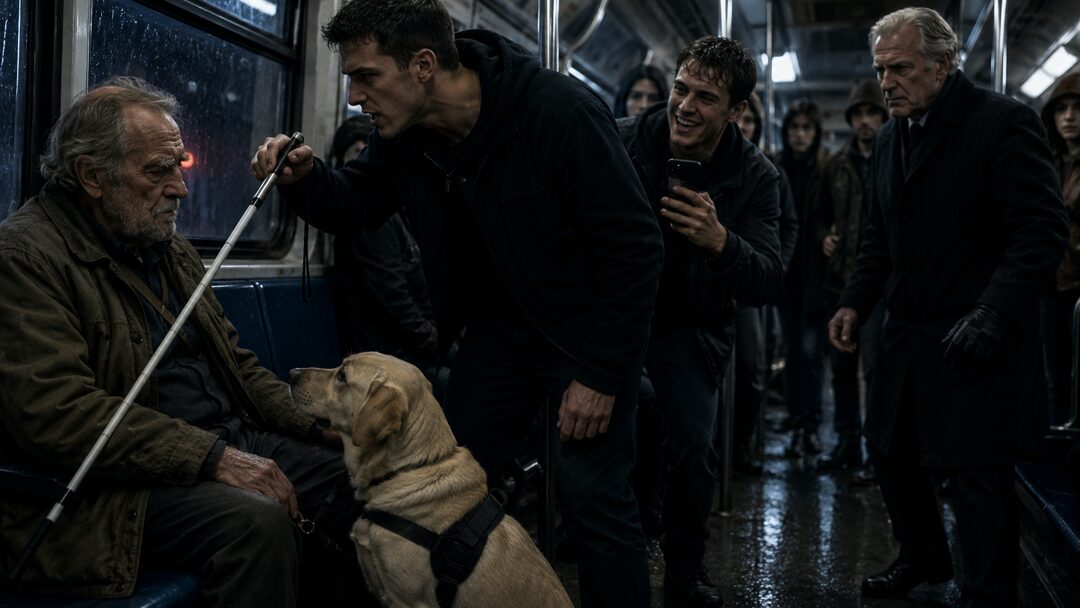
The train stopped hard enough to make the blind man’s white cane slide two inches from his boot, and one of the young men laughed like the whole car had been waiting for his permission.
“Yo, the dog handled that better than he did,” the young man said.
His friend already had a phone up.
Rain ran down the black windows in silver lines. The train lights flickered once, then steadied into the tired yellow glow of a late-night commuter line. Nobody moved toward the doors because there was nowhere to go. The train was between stations, sealed in the tunnel, every passenger trapped close enough to hear cruelty and far enough away to pretend it belonged to someone else.
The older man sat near the doors with his shoulders slightly bowed, one hand resting on the leather harness of the service dog tucked beneath his knees. The dog wore a red vest and had the stillness of an animal trained not to react to fools.
The man’s face was weathered, his eyes pale and unfocused beneath gray brows. A field jacket hung loose over his plaid shirt. His boots looked older than the three boys standing over him.
The one in the black hoodie leaned forward.
“Hey, sir. Your dog got an account? Because I’m pretty sure he’s carrying the whole brand.”
The phone-holder laughed and angled the camera lower, catching the dog, the man’s boots, the folded cane.
“Late-night content,” he said to the screen. “We got a legend on the train.”
At the far end of the car, Paul stood with one gloved hand around a pole.
He had silver hair, a dark overcoat, and the rigid posture of a man who had spent most of his life standing in rooms where panic was not allowed. He had boarded two stops earlier with a paper bag of groceries and a headache he’d earned from too many anniversary speeches at the veterans’ hall.
He had not expected the past to be sitting by the doors.
At first, he only saw the outline: old field jacket, service dog, white cane, canvas bag. Then the train jolted, the older man shifted, and a faded patch showed beneath the strap of his bag.
Paul’s hand came up before he knew he had moved it.
Half a salute.
Then he stopped himself.
Across the car, the young man with the phone noticed.
“Oh, we got backup,” he said. “Grandpa security is activated.”
A few passengers looked up. A nurse in blue scrubs tightened her grip on her tote. A man in a suit pretended to read an email on a dead signal. A mother pulled her child closer without speaking.
The blind man did not turn his head.
He stroked the dog once between the ears.
“Leave him out of it,” he said.
His voice was low, dry, and controlled.
The young man in the black hoodie smiled wider.
“Oh, he talks.”
The train speaker crackled.
“Attention passengers,” a tired voice announced. “We are being held momentarily due to signal conditions ahead. We apologize for the inconvenience.”
The lights flickered again.
The boys grew louder.
Because now the whole train belonged to them.
Part II — The Cane Beside His Boot
The boy with the phone was Matthew. He narrated everything like life had no value until an audience arrived.
“Signal delay,” Matthew told his viewers. “So we’re stuck here with this man and his emotional support wolf.”
The third boy, Thomas, gave a weak laugh. He wore a green jacket soaked at the shoulders from the rain. He stood close to the others but not as comfortably. His eyes kept moving from the old man to the passengers to the dog.
Brian, in the black hoodie, was the one who liked the center of a room.
He had restless hands and expensive sneakers, and he moved the way certain young men move when they have confused attention with respect. He bent slightly toward the older man.
“You really blind,” Brian asked, “or is this like a sympathy hustle?”
A few people shifted.
Nobody spoke.
The old man’s hand remained on the harness.
“I’m not selling you anything,” he said.
“That’s not what I asked.”
“No,” the old man said. “It wasn’t.”
The line landed quietly, but it landed. Thomas looked down. Matthew’s grin tightened as he checked the phone screen for comments, for approval, for proof that discomfort was actually entertainment.
Brian saw the cane.
It was folded beside the old man’s right boot, white with red near the end, worn at the grip. Not decorative. Not symbolic to the man who owned it. Necessary.
Brian nudged it with his sneaker.
The old man’s face changed by almost nothing.
Only his hand tightened on the harness.
“Don’t touch that,” he said.
Brian looked at Matthew’s phone and lifted his eyebrows.
“Don’t touch that,” he repeated in a high, brittle imitation.
Matthew laughed too loudly.
At the far end of the car, Paul let go of the pole.
One step.
Then another.
He told himself he was moving because an old man was being bothered. That would have been enough. It should have been enough.
But his eyes were on the canvas bag.
The faded patch showed a winged stretcher stitched over a dark blue field. Most people would have seen nothing but a worn emblem. Paul saw a checkpoint road under gray smoke. He saw orange light against cracked glass. He heard a voice cutting through panic.
Stay with me, sir. Breathe when I tell you.
Paul stopped.
The train seemed to narrow.
Brian bent down and picked up the cane.
The dog lifted its head.
Not growling. Not lunging. Just watching.
The old man’s chin rose slightly toward the sound.
“Put it back,” he said.
Brian turned the cane in his hands like he was inspecting something from a museum.
“Relax. I’m just checking the equipment.”
“It isn’t yours.”
“Man, I’m not stealing it.”
“You already took it.”
The words were plain. That made them worse.
The nurse in scrubs opened her mouth, then closed it.
The man in the suit stared at his phone harder.
Paul moved again.
Matthew swung the camera toward him.
“Look, look, look,” he said. “Grandpa security coming in hot.”
Paul did not look at the phone.
He looked at the blind man.
There was a scar near the man’s left eye, pale and uneven, disappearing into the gray at his temple.
Paul’s breath shortened.
That scar had not been there the last time he saw him.
Or maybe it had been covered in bandages.
Maybe everything had been covered in bandages.
Part III — The Voice From the Road
“Sir,” Paul said.
The blind man did not answer him.
Brian held the cane above his own head.
“You want it back?” he said. “Tell the camera what it’s like being a hero dog’s assistant.”
Thomas’s smile vanished.
Matthew laughed, but his eyes flicked to the passengers. The car had gone quieter than before. Not brave quiet. Not yet. Just the silence of people realizing the joke had crossed a line and deciding whether they could live with watching it.
The old man lifted his face toward Brian’s voice.
He did not plead.
He did not reach.
“That cane has taken me farther than your mouth ever will,” he said.
The train held its breath.
For one second, Brian looked exactly as small as he was.
Then embarrassment rescued itself as cruelty.
He dropped the cane.
It struck the floor with a hollow clatter and skidded toward the aisle.
The sound went through Paul like metal against bone.
And suddenly he was not in the train.
He was twenty-eight years younger, upside down in a convoy vehicle with smoke in his mouth and his left leg pinned beneath twisted steel. He was young enough to believe rank could organize chaos. Young enough to think an order became right if it was delivered clearly.
The road outside the village had been blocked.
He had pushed forward anyway.
Night Bridge, they called it later, as if naming a mistake made it noble.
Someone had been yelling that the second vehicle was burning. Someone else was screaming for a medic. Paul had been trying to unclip his harness with fingers that would not obey.
Then a man’s voice cut through everything.
“Sir, look at me. No, don’t close your eyes. Breathe when I tell you.”
Not begging. Commanding.
A medic had crawled through smoke and glass and dragged him out by the straps of his vest. Paul remembered the man going back. Once. Twice.
On the third time, the road turned white.
Years of speeches had softened that moment into service, sacrifice, honor, words polished smooth enough to pass around banquet tables.
But memory had edges.
Paul saw the patch again.
The winged stretcher.
The scar.
The hands resting calmly on the dog’s harness.
And the name came back so hard he nearly said it aloud.
Anthony.
Staff Sergeant Anthony Carter.
The man who had pulled Paul from a burning vehicle because Paul had given a bad order and Anthony had refused to let other men pay for it alone.
Paul reached the cane first, but he did not pick it up.
Not yet.
Brian saw him standing there and laughed, too high.
“What, you his lawyer?”
Matthew raised the phone again.
“This is getting good.”
Paul looked at the cane on the floor.
Then at Anthony.
“Sergeant Carter,” he said quietly.
The old man’s face shifted.
Not surprise.
Recognition.
He turned his head toward Paul’s voice.
For the first time, the old man looked older than he had a moment before.
“Colonel,” he said.
One word. No warmth in it.
Paul swallowed.
“I didn’t know it was you.”
Anthony’s mouth moved into something too tired to be called a smile.
“Still good at arriving after the damage.”
The line was soft enough that only Paul and the nearest passengers heard it.
It struck harder than Brian’s laughter.
Paul stood there with the cane at his feet and the past open between them.
He remembered the report.
Signal failure. Unstable route conditions. Commendable response under pressure.
Clean words.
Useful words.
Words that left out how he had ignored the warning from the advance team. Words that left out how Anthony had contradicted him once, then obeyed anyway because chain of command had weight even when judgment failed. Words that left out how the medal pinned to Paul’s chest had felt heavier than the hand that pinned it there.
He had written a letter after.
Dear Sergeant Carter.
No.
Dear Anthony.
No.
There was no version of the first line that did not sound like a man asking to be forgiven before he had earned the right to ask.
So he had never sent it.
Now Anthony sat six feet away while boys used his blindness for a livestream.
And Paul still had not picked up the cane.
Part IV — What the Camera Could Not Hold
Brian looked from Paul to Anthony.
“Hold up,” he said. “You two know each other?”
Matthew leaned in, excited again.
“Oh, this has lore.”
Paul removed his right glove slowly.
It was not dramatic. It was almost old-fashioned. A controlled act by a man trying not to let his hands shake.
“Pick up the cane,” Paul said.
Brian blinked.
“What?”
“Pick it up.”
Brian scoffed.
“Man, sit down.”
Paul’s voice did not rise.
“You took it. You dropped it. Pick it up.”
The car changed then.
Not loudly. No one stood. No one cheered. But heads lifted. Screens lowered. The mother’s hand tightened around her child’s shoulder. The nurse in scrubs looked directly at Brian now.
Matthew turned the phone toward Paul.
“Grandpa security giving commands,” he said, but the joke had gone thin.
Brian spread his hands.
“I didn’t do anything. He’s fine.”
Anthony’s dog shifted once, then settled.
Anthony said nothing.
That silence made Brian more nervous than any argument would have.
Paul looked at Matthew’s phone.
“Keep recording,” he said.
Matthew hesitated.
That was the first time fear touched his face.
Paul turned back to Brian.
“That man crossed a kill zone three times because I gave a bad order and he would not leave my soldiers behind.”
The words did not come out loud.
They did not need to.
They moved through the train car with the force of something too heavy to laugh away.
Brian stared at him.
Matthew’s phone dipped, then rose again out of habit.
Thomas looked at Anthony as if seeing him for the first time.
Paul continued, each word controlled because if he loosened even one, the rest might break.
“He dragged me out first. Then he went back for two more. The blast took his sight before morning.”
The nurse covered her mouth.
The man in the suit finally lowered his phone.
Anthony’s jaw tightened.
“Don’t,” he said.
Paul stopped.
The warning in Anthony’s voice was not weakness. It was a boundary.
Brian seized on it.
“See?” he said. “Even he thinks you’re doing too much.”
But nobody laughed.
Not even Matthew.
Paul turned slightly toward Anthony.
“I’m sorry.”
Anthony’s hand moved once over the harness. The dog leaned against his leg.
“Don’t turn this train into a memorial,” Anthony said.
The words cut the air clean.
Paul looked down.
Anthony’s voice stayed low, but now more of the car heard him.
“I’m tired of people needing me to be a symbol before they can treat me like a man.”
That was the sentence that changed the passengers more than Paul’s confession had.
Because the truth in it did not belong only to battlefields or old reports or medals packed in drawers. It belonged to the last five minutes. It belonged to every person who had waited to learn whether the blind man was important enough to defend.
The cane lay between them.
Still on the floor.
White against dirty gray.
Brian looked at it, then away.
Matthew’s phone kept recording, but his arm had lowered to his chest.
Thomas took half a step forward, stopped, and looked at Brian.
Brian saw it.
“Don’t,” he said.
One word. Not a command exactly. A plea disguised as one.
Thomas froze.
Paul understood that moment too well. The terrible gravity of a group. The cost of disobeying the person everyone had allowed to lead. The way cowardice could dress itself as loyalty.
Paul had lived most of his life with a worse version of that.
He looked at Anthony.
Then at the cane.
Then at his own hand.
A speech would be easier. Speeches had saved him for years. Speeches could turn guilt into polished sound. Speeches made other people nod.
Anthony did not need a speech.
He needed his cane.
Part V — The Salute
Paul stepped into the aisle.
He turned fully toward Anthony.
His heels came together.
His back straightened.
The train hummed around him, stuck in the dark, rain ticking faintly somewhere above, every face turned toward the old blind man and the silver-haired stranger who had stopped pretending he did not owe him anything.
Paul raised his right hand.
This time, he did not stop halfway.
He saluted.
Not for the phone.
Not for the passengers.
Not for the version of himself that had once stood in dress uniform while other men clapped.
He saluted Anthony.
The old man did not move.
For several seconds, the whole train existed inside that held gesture.
Brian’s mouth opened, but nothing came out.
Matthew’s phone was still pointed at them, only now it looked foolish in his hand, small and weak and late to understand what it had captured.
Thomas stared at Paul’s salute like it had taken a language he thought he knew and returned it with meaning.
Then Paul lowered his hand.
He bent down.
Slowly, because age had made bending less graceful. Carefully, because the cane deserved more care than the boys had given it. He picked it up from the floor and held it by the shaft for only a second before turning it around.
Handle-first.
Offered, not presented.
Returned, not displayed.
Thomas moved before Brian could stop him.
He stepped forward and reached out, not touching Anthony, not crowding him. He placed his own hand lightly under the cane near the grip, guiding it the last few inches toward Anthony’s waiting fingers.
Anthony accepted it.
No blessing passed through the car. No applause. No sudden rescue of everyone’s conscience.
Just the quiet sound of Anthony’s hand closing around what was his.
The dog rose.
Anthony did not stand immediately.
He sat with the cane in one hand and the harness in the other, letting the silence answer for itself.
Then he said, “Thank you.”
The words were not soft.
They were not warm.
But they were real.
Thomas stepped back, face flushed.
Brian looked away first.
That was his defeat.
Not punishment. Not a lesson neatly delivered. Just the loss of the room he thought he owned.
The train jolted.
The lights flickered.
The speaker crackled again.
“We are now moving. Next stop, East Market. Thank you for your patience.”
The train began to roll.
Nobody thanked the speaker.
Anthony stood.
It took effort, but he did not hurry. The dog rose with him, close and steady. Anthony unfolded the cane with a clean snap of the wrist. The sound was small, but it had more authority than anything Brian had said all night.
Paul stepped aside to give him room.
Anthony faced forward, eyes unfocused, chin level.
Matthew lowered his phone completely.
Brian muttered something under his breath, but it died before becoming words.
Thomas looked at Anthony.
“I’m sorry, sir,” he said.
Not to Paul.
Not to the car.
To Anthony.
Anthony turned his head toward him.
The train slowed into the station, metal whining against metal. Light from the platform slid across the windows and turned the rain into bright threads.
“Then remember it,” Anthony said, “before somebody has to teach you twice.”
Thomas nodded once.
Brian shoved past him as soon as the doors opened. Matthew followed, phone down at his side now, his face pale beneath the station lights. They left quickly, not running, because running would admit too much.
Thomas stayed one second longer.
Then he stepped off too, smaller than he had looked when he boarded.
Part VI — What Walked Beside Him
The doors stayed open longer than usual.
Cold wet air entered the car. The smell of rain and concrete replaced the trapped heat of bodies and shame.
Passengers began to move, but quietly. The nurse in scrubs shifted her bag higher on her shoulder and looked as if she wanted to say something. She did not. Maybe she understood that words now would ask Anthony to receive more than he had agreed to carry.
The mother guided her child off the train.
The man in the suit waited.
No one clapped.
That was a mercy.
Paul stood near the door with his glove in one hand and no idea what to do with the rest of his life.
Anthony tapped the cane once against the platform edge.
The dog waited.
Paul said, “May I walk with you?”
Anthony’s head tilted slightly.
The old bitterness was still there. It had earned its place.
“You can walk near me,” he said.
Paul accepted the difference.
They stepped onto the platform together, not side by side exactly. Anthony walked with the dog at his left and the cane in his right hand. Paul walked a pace away, close enough to be present, far enough not to claim anything.
Behind them, the train car remained full of people who had seen too much to return cleanly to their phones.
Paul wanted to say the letter had existed.
He wanted to say he had carried the name for years.
He wanted to say the report was wrong, the medal was heavy, the speeches had never sounded true.
But all of that still began with him.
So he said nothing.
They moved through the wet station light. Rain tapped on the roof above the platform. Somewhere down the stairs, a bus hissed at the curb. The city continued, indifferent and enormous.
At the elevator, Anthony stopped.
Paul stopped too.
For a moment, neither man spoke.
Then Anthony said, “I knew your voice before you said my name.”
Paul closed his eyes briefly.
“I thought you might.”
“I wondered if you would.”
That was worse.
Paul looked at the floor.
“I should have come sooner.”
“Yes,” Anthony said.
No cruelty. No comfort.
Just the truth.
The elevator doors opened.
Anthony stepped inside with the dog. Paul remained outside until Anthony angled his head slightly toward him.
“I said near me,” Anthony said. “Not back there.”
Paul entered.
The doors closed.
In the mirrored wall, Paul saw them both: one man upright with a white cane and an old field jacket; one man silver-haired in a dark overcoat, holding a glove like it could tell him what to do with his hands.
The elevator hummed downward.
Anthony’s dog leaned calmly against his leg.
Paul looked at the cane.
Clean white. Scuffed near the bottom. Back where it belonged.
He understood then that the train had not given Anthony dignity. It had only been forced to notice what was already there.
The doors opened to the street.
Rain waited beyond the station awning.
Anthony lifted his face slightly, listening.
Paul did not offer his arm.
He did not ask for forgiveness.
He only walked near him when Anthony stepped into the rain, close enough to be useful if asked, far enough to understand he had not been invited any closer.
Behind them, the train doors closed.
Ahead of them, the sidewalk shone under the city lights.
Anthony’s cane touched the ground once, then again, steady and certain.
And Paul followed at the distance a debt requires.