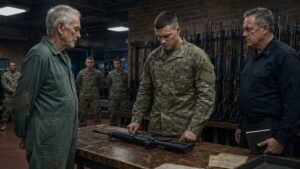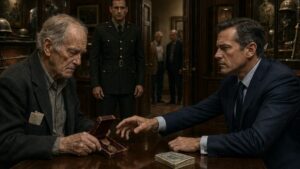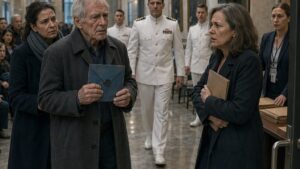
The Colonel Moved The Old Man From The Front Table, Then Learned He Wrote The Doctrine
Chapter 1: The Old Man At The Wrong Table
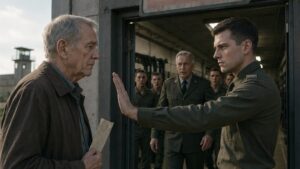
The young security guard looked at Joseph Carter’s folded program, then at Joseph’s plain gray coat, and his hand settled across the velvet rope as if age itself were a reason to stop someone.
“Sir,” he said, not unkindly, “this entrance is for registered guests.”
Joseph stood beneath the bright lobby lights of the banquet hall, his shoulders slightly rounded, his polished shoes close together on the marble floor. Behind the rope, officers in dress uniforms moved through the wide doors into the main room, their ribbons and polished buttons catching the chandelier glow. Their voices carried the clipped confidence of people who knew exactly where they belonged.
Joseph looked down at the program in his hands.
It had been folded twice and opened many times. The crease down the center had softened from his thumb. On the cover, embossed in blue and silver, were the words: Fortieth Anniversary Doctrine Banquet. Beneath that, smaller letters named the evening’s theme, the same phrase Joseph had avoided reading in full since the invitation arrived.
He held the program with both hands, not because he was afraid of dropping it, but because he had learned long ago that a man could keep his face steady if his hands had somewhere to go.
“I believe I am registered,” Joseph said.
The guard glanced over his shoulder toward the check-in table. “You’ll need to speak with Ms. Ramirez.”
Joseph gave a small nod. “Thank you.”
He did not move until the guard lifted the rope.
Inside the lobby, a long table had been arranged with name cards, small flags, and a stack of glossy programs that looked newer than the one Joseph carried. Behind the table, Maria Ramirez stood with a tablet in one hand and a headset tucked against one ear. She was young enough to move quickly and experienced enough to look calm while doing it. Her eyes flicked from one guest to the next, reading uniforms, titles, spouses, seating assignments, last-minute changes.
When Joseph reached the table, she gave him the professional smile of someone already solving three problems.
“Good evening, sir. Last name?”
“Carter.”
Her finger moved across the tablet. “First name?”
“Joseph.”
She typed. The smile stayed in place, but her eyes narrowed slightly.
Joseph watched the guests pass around him. A pair of War College cadets stepped aside to avoid brushing his elbow. A decorated officer laughed softly near the coat check. Somewhere inside the hall, glassware chimed as staff finished setting tables.
Maria typed again. “I’m sorry, sir. I have a Joseph Carter listed under general guests, but I don’t have a front-table assignment.”
Joseph lowered his eyes to the program. “The invitation said table one.”
Maria looked at the folded paper, then back at her tablet. “May I see that?”
He handed it to her carefully.
She unfolded it with the quickness of someone used to handling paper as an object, not a keepsake. Joseph felt the loss of it in his fingers the moment it left him.
Maria scanned the inside panel. “This is an earlier print.”
“Yes.”
“The seating was revised this afternoon.” She turned slightly, comparing his paper with the stack beside her. “Some names moved after the final confirmation.”
Joseph nodded once. “That happens.”
Her smile softened, perhaps because he had not protested. “Let me check the master list. You may have been shifted.”
Debra Wilson stepped closer from Joseph’s left. She had been quiet since the lobby doors, letting him enter first as if the evening belonged to him even though he had never wanted it to. Her hand hovered near his sleeve but did not touch him.
“Dad,” she murmured, “we can wait over there.”
Joseph looked toward the side wall, where a framed photograph showed a line of young officers from decades earlier. Their faces had faded slightly under museum glass. He recognized the posture before the men: shoulders straight because grief had not yet taught them to bend.
“We’ll wait here,” he said.
Maria made a call through her headset, lowering her voice. “I need confirmation on Joseph Carter. Possible table one discrepancy. Yes, Carter. No rank listed on this copy.”
No rank listed.
Joseph heard that more clearly than anything else in the lobby.
For most of his life, rank had entered rooms before he did. It had opened doors, stiffened backs, turned conversations formal. It had made young officers listen and older officers measure their words. He had worn it because the uniform required it, not because he enjoyed the way people changed when they saw it.
Now, without it, he was only an old man holding up a line.
Behind him, someone cleared his throat.
Maria looked past Joseph and straightened. “Colonel Green, good evening.”
Joseph turned.
Colonel Scott Green stood a few feet away in a dark blue dress uniform, shoulders squared, jaw cleanly set, expression sharpened by impatience. He carried himself like a man aware of every eye near him. The silver at his chest and the polish of his shoes spoke of preparation. His gaze touched Joseph only briefly before returning to Maria.
“Is there a problem with the entrance flow?” Scott asked.
“Just a seating question, Colonel,” Maria said.
Scott’s eyes moved to Joseph again, longer this time. He saw the gray coat, the plain tie, the careful stance, Debra waiting beside him. Whatever calculation he made, it finished quickly.
“The opening procession begins in six minutes,” Scott said. “We need the front clear.”
Maria nodded. “I’m checking now.”
Joseph did not interrupt. He had commanded operations with less information than this and more consequence. A misplaced seat was not a battle. A colonel’s impatience was not a wound unless he allowed it to become one.
Scott looked at him. “Sir, if your assignment is general guest seating, staff can direct you to the rear section.”
Debra’s face tightened. “His invitation says table one.”
Scott’s expression did not change. “Many guests misunderstand honorary language on invitations.”
Joseph placed his empty hands together, thumb over thumb, the way they had rested on the program. He looked at Scott’s nameplate, then at his face.
“You can check the name again,” he said.
Scott gave a short breath that was almost a laugh but not quite. “I’m sure Ms. Ramirez is doing everything she can.”
Maria’s tablet chimed. She looked down, frowned, and swiped to another page. “Colonel, I’m seeing two entries. One says Joseph Carter, civilian guest. The other—”
The headset crackled. She touched it and turned slightly away. “Yes? Say that again.”
Scott’s attention moved toward the open banquet doors. Inside, the front table was visible beneath the chandeliers, set with white linen, gold-edged plates, and small cards placed with military precision. One chair near the center remained empty.
Joseph saw it.
Debra saw it too.
She whispered, “Dad.”
Joseph shook his head gently.
Maria lowered her hand from the headset. “There’s still a mismatch. I’m sorry, Mr. Carter. We may need a few more minutes.”
Scott’s patience ended quietly. “A few more minutes is exactly what we do not have.”
He stepped closer, not enough to threaten, only enough to make his authority occupy the space between them.
“Sir,” Scott said to Joseph, “I respect that you may have received an outdated program. But the front table is reserved for command staff, honored speakers, and invited senior personnel. It is not for misplaced guests.”
The words did not echo. They did not need to.
Joseph’s hands remained clasped.
For a moment, he felt the old paper against his palms even though Maria still held it.
Chapter 2: The Colonel Takes The Program
The chandeliers above the front aisle were too bright.
Joseph noticed that first as Colonel Scott Green guided him away from the check-in table and toward the edge of the banquet room. Not pushed. Not grabbed. Nothing so crude. Scott merely angled his body in a way that made refusal look disruptive.
Guests turned their heads, then turned them back. A few watched through the polite corners of their eyes. The kind of watching people did when they did not yet know whether they were seeing a mistake or an embarrassment.
Joseph walked slowly because his knees asked him to, not because he wanted sympathy. Debra stayed close at his side, her face held still with effort.
“Colonel,” she said, “we can wait for Ms. Ramirez to finish checking.”
Scott did not slow. “Ma’am, the ceremony has a schedule. If there’s been a clerical confusion, we’ll correct it after the opening remarks.”
“After he’s been moved to the back?”
Scott glanced at her. “After everyone is seated appropriately.”
Joseph heard the word appropriately and felt, unexpectedly, tired.
The main hall opened before them in warm gold and deep blue. Round tables filled the room, each with a small standing card. Along the far wall hung enlarged photographs of field exercises, command briefings, and old training rooms. Young cadets stood near the side in pressed uniforms, hands folded behind their backs. Staff moved like shadows between chairs, adjusting water glasses and whispering into sleeves.
At the front, table one waited beneath a low wash of light.
Joseph could see the card on the empty place setting. It was angled away, but he knew where it was. Maria had not imagined the mistake. Somebody had printed his name twice and understood it once.
Scott stopped beside the front aisle, turned, and held out his hand.
“May I see the program again?”
Maria had followed with the folded copy, still trying to manage her tablet. “Colonel, I don’t think—”
Scott took the program before she finished.
Joseph’s hands closed once around nothing.
Scott opened the paper and scanned it. The soft fold resisted him; he flattened it with his palm against the air as if the crease itself offended him.
“This version is outdated,” he said.
Joseph looked at the paper in Scott’s hand. “It is the one I was sent.”
“Invitations go through multiple drafts.” Scott glanced at the inside panel. “There are donors, family members, former instructors, civilian guests. Mistakes happen.”
“Yes,” Joseph said. “They do.”
A small pause followed.
Scott looked up, trying to decide whether the old man had agreed with him or corrected him.
Debra stepped forward. “His name is Joseph Carter. Please look at the dedication page.”
Scott’s patience thinned visibly. “Ma’am, I have read the name.”
“No,” Debra said, voice low. “Read where it appears.”
Maria, pale now under the warm lights, leaned closer. “Colonel, there is a line on the doctrine history page. It says—”
Scott folded the program halfway. “Ms. Ramirez, if we stop the room over every duplicate name, the general’s remarks will begin in the hallway.”
Joseph’s eyes moved to the front stage.
A lectern stood there with the branch seal and two microphones. Behind it, a projection screen displayed the evening’s title: Forty Years of Adaptive Command Doctrine. Beneath the title was a quote, one Joseph had not known they would use.
The line was incomplete from where he stood, but he knew every word.
Hold the field only if holding it preserves the men.
He had written it in pencil first. Not in a war room, not under a flag, not with history watching. In a tent that smelled of rain, metal, and burned coffee, after a night when three names had been spoken into a radio and not answered.
Scott followed Joseph’s gaze toward the screen.
“Sir,” Scott said, “I’m going to ask you to take a seat with the general guests until we resolve this.”
Joseph looked back at him. “I came because I was invited.”
“I understand that.”
“No,” Joseph said softly. “You understand the list in your hand.”
The words were not loud. They carried only as far as the people nearest them. But they carried enough.
A cadet near the aisle looked over. One of the veterans at a side table stopped adjusting his napkin. Maria’s eyes dropped to the program again.
Scott’s face tightened, not from shame yet, but from the threat of losing control in public.
“Sir,” he said, each word clipped clean, “this is a formal military event. Seating reflects protocol.”
Joseph nodded. “It often does.”
“And protocol requires accuracy.”
“It should.”
Scott stared at him. “Then help us maintain it.”
Debra’s voice trembled once. “He is trying to.”
Joseph lifted one hand slightly, and Debra fell silent. He did not look at her. He kept his gaze on Scott, not challenging, not yielding.
“I can stand here,” Joseph said, “or I can sit where you place me. I have waited in worse places.”
The sentence changed the air around him.
Scott heard it but did not understand what had moved beneath it. Maria heard it and looked down at the program again as if the paper had become heavier. A junior aide, barely older than the cadets, stepped closer from the side of the stage with a stack of updated schedules in his hands.
The aide glanced at Joseph, then at the projection screen, then at the folded program Scott still held.
“Ms. Ramirez?” he whispered.
Scott turned on him. “Not now.”
The aide shrank back, but his eyes remained on the program.
Scott refolded the paper along the old crease and held it out to Joseph. “Rear left section. Staff will find you a place until this is sorted.”
Joseph accepted the program.
His fingers closed over the crease. For the first time that evening, his hand was not entirely steady.
Debra saw it. Her anger left her face all at once, replaced by something much older and more frightened.
“Dad,” she said quietly, “we should go.”
Joseph did not answer at first. He looked toward the side tables, where several older veterans sat outside the light meant for honored guests. Some wore uniform jackets that no longer fit their shoulders. Some wore suits that had gone shiny at the elbows. One man lifted his water glass with both hands.
Joseph knew that kind of grip.
“No,” he said.
Debra turned toward him. “You don’t owe them this.”
Joseph’s thumb pressed into the program. “I did not come for them.”
Scott, hearing only the refusal, mistook it for stubbornness. “Sir, this is becoming disruptive.”
Joseph looked at him then, and something in Scott’s face flickered. Not recognition. Not yet. Only the discomfort of being seen by someone who did not appear afraid of him.
Maria stepped aside to answer another headset call. The junior aide moved with her, bent close, and spoke quickly.
Joseph could not hear the first words.
He heard only the last.
“His name is printed somewhere else.”
Chapter 3: A Name Printed In The Margins
Maria Ramirez had built her career on preventing small errors from becoming public ones.
A missing place card, a delayed entrée, a microphone that failed during a toast—those were ordinary fires. She knew how to smother them with a smile and a quiet hand signal. A ceremony was not a living thing, but it could panic like one if mishandled.
This was different.
She stood in the service corridor outside the banquet room with Joseph Carter’s folded program in one hand and the master binder open on a narrow catering table. The corridor smelled of coffee urns, polished metal, and warm bread. Staff passed behind her with trays held high, lowering their voices as they sensed the tension around the binder.
The junior aide hovered at her shoulder, holding the updated schedule.
“I’m not saying it’s him,” the aide whispered. “I’m saying the name appears in the doctrine notes.”
Maria kept her finger on the guest list. “There are a lot of Carters.”
“Not Joseph Carter.”
She looked at him.
The aide swallowed. “Not with that quote.”
From inside the hall came the first swell of introductory music. Guests were seated now. The front tables had settled into ceremonial stillness. At the rear left, Joseph sat with Debra near the side aisle, his folded program resting beneath his clasped hands. He had accepted the temporary seat without argument. That was what made Maria more uneasy, not less.
People who were wronged loudly gave staff somewhere to put the problem. A complaint. A demand. A raised voice. A threat to call someone.
Joseph had only gone quiet.
Maria turned a page in the binder. The master program had been printed on heavy paper, each section tabbed with blue labels. Opening Remarks. Dinner Service. Doctrine History. Recognition Segment. Fallen Names.
She stopped at Doctrine History.
There it was, halfway down the page, in a paragraph the emcee would summarize before the archival slides.
The original field memoranda credited to then-Brigadier General Joseph Carter laid the foundation for what later became Adaptive Command Doctrine.
Maria read the sentence twice.
The corridor seemed to narrow around it.
“That can’t be the same guest,” she said, but her own voice did not believe her.
The aide looked toward the hall. “His program is an early print. Maybe they sent it before the title was finalized.”
Maria turned back to the guest list. Joseph Carter appeared near the bottom under civilian guest, no rank, no honorific, no seating priority. Someone had typed his name into the wrong field. Or imported it from an older donor list. Or stripped the title to simplify the display.
She could imagine exactly how it happened.
A spreadsheet. A late-night revision. A volunteer assistant copying names from different tabs. One Joseph Carter treated as a person to seat, another as a historical reference to print. The event had split him in two: the living man in the rear section, the important name on the page.
Maria closed her eyes for half a second.
“Where is General Hill?” she asked.
“Not in the hall yet,” the aide said. “His car arrived. He’s in the side reception room with the command party.”
Maria touched her headset. “I need someone to confirm the final recognition sequence with General Hill’s aide. Quietly.”
The audio technician, standing near the equipment case at the end of the corridor, looked up. “Do we have a slide issue?”
“Maybe.”
“That’s a bad maybe.”
Maria took the updated schedule from the junior aide and moved to the audio booth door. Through the small glass panel, she could see the main room from the rear: blue carpet, white tablecloths, the stage glowing beneath the screen. Scott Green stood near the front, speaking with another officer. He looked composed again. In his world, the disruption had been managed.
Maria watched Joseph at the side table.
He had not opened the program. He did not look angry. He looked like a man listening for something no one else could hear.
Debra leaned toward him once, said something, then sat back when he shook his head.
The opening remarks began.
“Ladies and gentlemen,” the emcee said from the stage, “welcome to this fortieth anniversary recognition of Adaptive Command Doctrine, a framework that has shaped generations of officers in the field, in the classroom, and in command.”
Polite attention settled across the room.
Maria felt the binder under her palm.
The emcee continued, “Tonight we honor not only a doctrine, but the difficult lessons that produced it.”
The phrase pricked the back of Maria’s neck.
Difficult lessons. Printed words. Clean font. Easy to say under chandeliers.
Her headset crackled. “Ms. Ramirez, General Hill’s aide says the recognition segment is locked. Why?”
Maria lowered her voice. “Ask whether Joseph Carter is expected at table one.”
A pause.
Inside the hall, the emcee moved into the history introduction. On the screen, an old black-and-white image appeared: a field command tent, a line of officers, a map pinned unevenly behind them. The image was grainy, faces half lost in shadow.
Maria looked down at the binder again.
The recognition sequence listed Gregory Hill as speaker. Beneath his name, in smaller type, was the sentence: Formal acknowledgment of founding author, if present and willing.
If present and willing.
Maria’s mouth went dry.
The headset crackled again.
“General Hill’s aide says Carter was invited privately. He was not supposed to be handled through standard guest check-in. His seat should be held at table one unless he declines.”
Maria looked through the booth window toward the rear left section.
Joseph Carter’s hands rested over the folded program.
The emcee’s voice carried through the room: “Many of you studied these principles at War College without knowing the circumstances in which they were first written.”
Maria slowly turned back to the guest list.
There, in the neat, careless column that had caused the evening’s mistake, Joseph Carter remained marked as civilian guest.
Chapter 4: The Doctrine He Would Not Claim
Joseph heard his own words from the screen before the emcee finished reading them.
Hold the field only if holding it preserves the men.
The sentence came through the speakers with a clean ceremonial weight it had never possessed in the place where it was written. In the banquet hall, it sounded wise. In Joseph’s memory, it sounded like mud sucking at boot soles, a radio hissing through static, and a young captain saying, “Sir, we still have two teams forward,” while the map in front of them turned useless under the rain.
He sat at the rear left table with the folded program beneath his hands.
Debra sat beside him, too straight in her chair. She did not touch the food placed before them. Neither did he. The salad leaves glistened under a small pool of dressing. A server set down bread, then hesitated, perhaps sensing that nothing at the table had room for ordinary manners.
“Dad,” Debra whispered, “we can still leave.”
Joseph looked toward the front of the room.
Colonel Scott Green stood near the stage with his back to them, one hand resting lightly against the side of his jacket, head angled toward another officer. He had resumed his place in the evening as if the old man at the rear had been handled. Not forgotten, exactly. Filed.
Joseph had once filed men that way.
Fit for movement. Unfit for movement. Missing. Returned. Killed in action. He had learned the cruelty of clean categories, and later he had spent years trying to teach younger officers that no line on a chart was ever only a line.
Debra leaned closer. “You don’t have to sit through this.”
Joseph kept his hands on the program. “I know.”
“They embarrassed you.”
“They were mistaken.”
“That isn’t the same as innocent.”
He turned his head then. Debra had her mother’s eyes when she was angry: steady, dark, refusing to blink first. She had been a child when Joseph’s name still arrived home on official envelopes, when the phone rang after midnight and her mother stopped breathing until she knew whether it was routine or terrible. Debra had seen enough of service to distrust any room that dressed pain in ceremony.
Joseph looked at her with a tenderness he did not know how to show fully.
“You came because I asked you,” he said.
“I came because I knew you wouldn’t ask twice.”
A brief smile touched his mouth and left. “That too.”
On stage, the emcee moved through the doctrine’s history. Dates. Revisions. Training applications. Joseph heard the language of institutions smoothing the rough edges of memory.
Forty years ago, in response to operational lessons learned under severe conditions…
Severe conditions.
He could see the tent again.
Not the whole field, only the parts memory had kept sharp: the dripping canvas seam above the map table, the black grease pencil rolling toward the edge, the cold cup of coffee near his hand. Captain Ramirez—no relation to Maria, only another name carried from another year—had stood with water running down the side of his face, waiting for Joseph to decide whether to hold position until the stranded teams returned or pull the main line back before daylight exposed them all.
No option had been merciful.
Joseph had chosen withdrawal.
Two teams came back after dawn with half their men.
The memoranda began three days later, not from brilliance, but from the refusal to let the language of command hide what command cost. A doctrine grew from them over years. Schools taught it. Officers quoted it. Young men and women under pressure found, he hoped, a little more room to think before mistaking ground for duty.
But the names of the first dead did not appear in doctrine.
Their names appeared tonight in the recognition segment.
That was why he had come.
Debra knew part of it. Not enough. Perhaps no daughter should have had to know all of it.
“I watched him take that program from you,” she said.
Joseph looked down. The crease was visible under his fingers. “He took paper.”
“He took more than that.”
Joseph did not answer.
The room applauded politely after a historical slide faded into another. The sound rolled backward and thinned by the time it reached their table.
Debra pushed her chair back slightly. “I’m going to get your coat.”
“No.”
Her face changed. “Dad.”
“I am staying.”
“For what? For them to remember you when it’s useful and misplace you when it isn’t?”
Joseph unfolded the program slowly. The paper had been handled too much now. One corner had bent where Scott’s thumb had pressed it flat.
He found the recognition section. There, after the keynote remarks, was a block of text titled Fallen Names. The list was not printed in full, only referenced.
He touched that line with one finger.
“For this,” he said.
Debra looked at the page. Her anger did not vanish; it altered, losing its edge and becoming pain.
“You never told me the names were part of tonight.”
“I didn’t know until the final notice.”
“And you still almost didn’t come.”
Joseph folded the program along its old crease. “I almost didn’t.”
“Because of the doctrine?”
Because of the faces, he thought. Because men become easier to praise when they can no longer contradict you. Because rooms like this remember command better than consequence.
Aloud he said, “Because some things are clearer in silence.”
Debra’s voice softened. “And some things rot there.”
He looked at her. She had not meant to wound him. That made it worse.
A server approached to clear untouched plates, but Debra shook her head and the server retreated. The music shifted, covering movement near the side doors. Guests turned toward the stage as the emcee introduced a video segment.
Joseph rose carefully.
Debra moved at once. “Where are you going?”
“Out for a minute.”
“You shouldn’t be alone.”
“I won’t be far.”
He took the folded program with him.
The side corridor was quieter, lit by sconces and the spill of service lights. The sound from the hall came through the walls muted and softened, as if the ceremony were underwater. Joseph walked until he found a narrow place near a framed unit photograph. He stopped there, one hand against the wall only after he was sure no one from the room could see it.
He unfolded the program again.
The paper trembled slightly. He disliked that more than he disliked Scott’s words.
Not because trembling was weakness. He had known too many strong men whose hands shook after battle. He disliked it because his body had begun revealing things before he chose to.
Debra came into the corridor a moment later.
She did not say she told him so. She stood beside him and looked at the framed photograph.
“Is that from then?” she asked.
Joseph followed her gaze.
The photograph showed a row of officers outside a temporary command shelter. The print was not the same one from the banquet screen, but close. Younger men, harsher light. Joseph found himself immediately and wished he had not. His younger face looked carved from certainty. He remembered feeling no certainty at all.
“Yes,” he said.
Debra stepped closer to the glass. “Which one are you?”
Joseph lifted his hand, then stopped before touching the frame.
“The one who had not yet learned enough.”
She looked at him. “That’s not an answer.”
“It is the truest one I have.”
From the hall came a swell of sound as the video ended. Chairs shifted. The dinner service resumed, plates and silverware returning the room to ordinary ritual.
Debra folded her arms. “When Colonel Green moved you, why didn’t you say it?”
“Say what?”
“Your rank. Your name. Anything.”
Joseph looked at the program in his hands.
“Because if respect arrives only after a title, it is not respect. It is reaction.”
“He still should know.”
“Yes.”
“Then let him know.”
Joseph closed the program. “He will.”
Debra waited.
Joseph breathed in slowly. The corridor smelled faintly of waxed wood and coffee from the service station around the corner.
“I did not come here to be praised for writing doctrine,” he said. “Doctrine is what people call a lesson after the cost is far enough away. I came because they said they would read the names. Men who were reduced, in other rooms, to lessons learned.”
Debra’s anger broke then, not loudly. Her mouth tightened; her eyes shone.
“You could have told me.”
“I have spent forty years failing to tell you.”
She looked away.
Joseph reached for her hand, stopped, then let his own settle back on the folded paper. Too many years of restraint had made even comfort feel like a decision he might mishandle.
At the end of the corridor, a door opened.
A senior officer stepped out from the side reception room, adjusting a white glove at his wrist. He was tall, broad-shouldered, older than the officers in the hall but not as old as Joseph. His dress uniform was dark and immaculate. Two aides moved behind him, then halted when he stopped.
General Gregory Hill stared down the corridor.
For one suspended second, his ceremonial expression vanished entirely.
He was no longer a speaker preparing to enter a banquet. He was a younger officer again, seeing a man he had once followed through maps, weather, argument, and aftermath.
Joseph Carter stood with a folded program in both hands.
Gregory Hill went still.
Chapter 5: The Room Learns Who Stood There
Scott Green saw General Gregory Hill enter the banquet hall and felt the room align around him.
It was not dramatic. No one rose. No one shouted. But attention shifted the way a compass needle found north. Conversations lowered. Officers straightened slightly in their chairs. The cadets along the wall pulled their shoulders back. Even the staff seemed to move with more care as Gregory crossed toward the front.
Scott felt steadier watching it.
This was the order he understood. Rank made itself visible. Responsibility had shape. A room should know where to look.
Gregory reached the front, but instead of stepping directly to the lectern, he paused beside the empty chair at table one. Scott noticed the pause because he had been watching that chair all evening, irritated by the unnecessary confusion attached to it.
Maria Ramirez approached Gregory from the side with the master binder held tight against her chest. Her face had lost the composed brightness she wore at check-in.
Scott moved toward them. “General Hill, we had a minor seating issue earlier. It’s being handled.”
Gregory did not look at him.
“Where is he?” Gregory asked.
Scott felt the first cold touch of uncertainty. “Sir?”
Gregory turned then. His eyes settled on Scott with a weight that made the younger officer’s back stiffen.
“Joseph Carter,” Gregory said. “Where is he seated?”
The question carried no anger yet. That made it worse.
Scott glanced toward Maria.
Maria’s lips parted, but no sound came at first. Then she said, “Rear left section, sir. Temporarily. There was a duplicate listing, and we—”
Gregory’s face changed.
Only slightly. A tightening around the mouth. A stillness in the eyes.
Scott had seen senior officers angry before. He had been corrected, challenged, dressed down in private. This was not that. This was something quieter and far more dangerous: disappointment so deep it had not yet decided what shape to take.
“He was placed in the rear?” Gregory asked.
Scott stepped in before Maria could answer. “Sir, the front-table assignment was unclear. The guest presented an outdated program. I instructed him to wait in general seating until verification.”
“The guest,” Gregory repeated.
Scott heard it then: the mistake inside his own word.
The emcee at the lectern looked toward Gregory, uncertain whether to begin the recognition segment. The audio technician waited behind the screen controls. The room, sensing delay, started to quiet.
Gregory took the binder from Maria and opened it. He did not flip pages. It had already been marked for him.
Scott stood close enough to see the line.
Formal acknowledgment of founding author, if present and willing.
His eyes moved down.
Joseph Carter.
The name seemed ordinary on the page. That was the terrible part. Scott had read the same name in a guest list and seen nothing in it.
Gregory closed the binder.
“Colonel Green,” he said, voice low.
Scott’s throat tightened. “Sir.”
“Did Mr. Carter tell you to check the name again?”
The words moved through Scott with unpleasant precision.
“Yes, sir.”
“And did you?”
Scott did not answer quickly enough.
Gregory’s gaze held him.
“I reviewed the list available at the time,” Scott said.
“That is not what I asked.”
“No, sir.”
The room had gone nearly silent now. Heads turned. The emcee stepped back from the microphone. Scott became aware of his hands, of where they hung, of the fact that he had taken the old man’s program and flattened it like an inconvenience.
Gregory turned toward the rear left section.
Scott followed his gaze.
Joseph Carter sat beside Debra Wilson, his hands folded over the program. He did not look toward the stage. He seemed to be studying the table in front of him, or perhaps listening to something beneath the room’s silence. Under the chandelier light, he looked smaller than he had in the aisle.
Gregory stepped to the microphone.
Scott expected him to continue the ceremony smoothly, to conceal the error for the dignity of the event. Senior officers were trained to preserve rooms from disorder.
Instead, Gregory stood still until every whisper disappeared.
“Ladies and gentlemen,” he said, “before we proceed with the recognition segment, we will correct an error.”
No one moved.
Scott felt heat climb the back of his neck.
Gregory’s voice remained controlled. “The error is not in tonight’s doctrine history. It is not in the archival material. The error happened in this room, in how a man was received.”
Scott looked at the floor for one second, then forced his eyes up.
Gregory turned slightly toward the screen. “Bring up slide twelve.”
The audio technician, startled, looked to Maria. Maria nodded quickly.
The screen changed.
A black-and-white photograph appeared, grainy and weather-worn: a command tent, a map pinned against the rear canvas, a line of officers standing in mud-streaked boots. At first it was only another historical image. Then the technician adjusted the focus and a red circle appeared around one face.
A younger Joseph Carter looked out from the screen.
Not old. Not stooped. Not invisible. His jaw was set, his eyes narrowed against light, one hand holding a folded field map at his side. He looked like a man being photographed in the small pause between decisions.
Scott stared.
The room seemed to hold its breath.
Gregory did not turn from the microphone.
“Many officers in this room studied Adaptive Command Doctrine at War College,” he said. “Some of you quoted it in staff exercises. Some of you used it in field planning. Some of you taught younger officers that command is not the act of holding ground at any cost, but of understanding what the cost is before giving the order.”
On the screen, the quote appeared beneath the photograph.
Hold the field only if holding it preserves the men.
Scott remembered copying that line into a notebook years ago. He remembered an instructor tapping the board and saying, If you understand this sentence, you understand the difference between command and pride.
Gregory’s voice deepened.
“The field memoranda that became that doctrine were written by then-Brigadier General Joseph Carter.”
A small sound moved through the hall. Not applause. Not a gasp. A collective intake, quickly smothered by shame and surprise.
Scott looked toward the rear table.
Joseph had lifted his eyes to the screen. His expression was unreadable, but his hands remained on the folded program as if holding himself in place.
Gregory continued. “General Carter was invited tonight privately and seated at table one at my request. He asked for no announcement upon arrival. He asked for no escort. He asked only that the fallen names remain in the program.”
Scott felt the room around him rearrange.
Every ribbon on his chest became suddenly heavier. Every polished surface in the hall seemed to reflect not his service, but his assumption.
He had not moved a confused guest.
He had moved the man the evening had been built to honor.
Maria stood near the stage with tears held rigidly behind her eyes. The junior aide stared at his shoes. The veterans at the side tables looked toward Joseph, some with recognition, some with the solemn attention older soldiers gave a name they had heard before in rooms where younger people had not been listening.
Gregory stepped back from the lectern.
For a moment, Scott thought he would walk to Joseph.
Instead, Gregory looked directly at him.
“Colonel,” he said.
The single word moved through the microphone and landed in the room with unmistakable force.
Scott straightened. “Sir.”
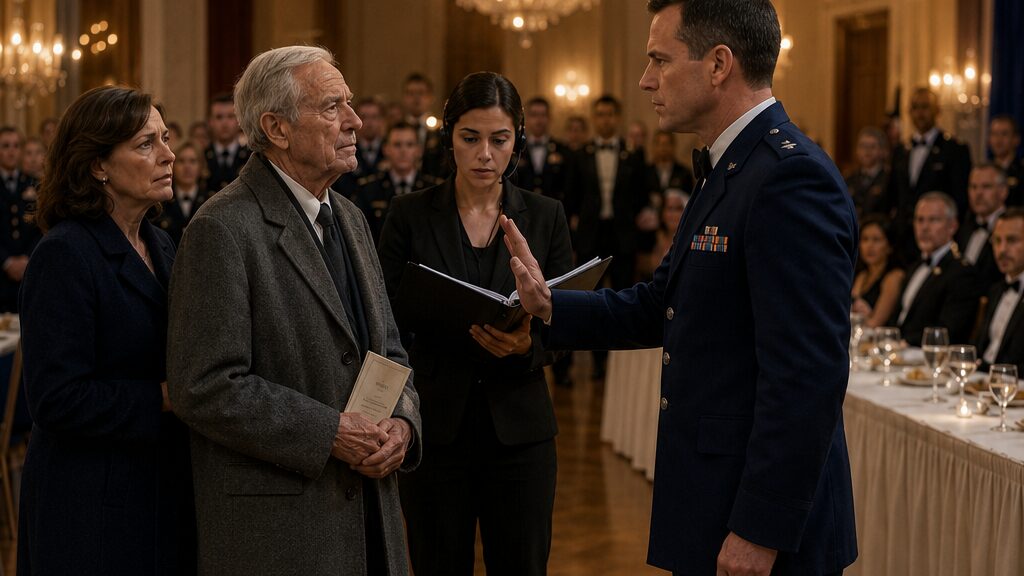
Gregory did not raise his voice. “You are standing in the presence of a living monument to the institution you serve. Do you honestly not know this old man?”
Scott’s mouth opened, but the first answer died before it became sound.
He knew the doctrine. He knew the quote. He knew the field exercise built from Carter’s memoranda, the case study, the lecture, the diagram of decision thresholds under uncertainty. He knew everything except the man.
“No, sir,” Scott said, and the words scraped. “I did not.”
Gregory’s gaze did not soften. “Then look now.”
Scott turned.
Every eye seemed to turn with him.
Joseph Carter sat in the rear left section in a plain gray coat, beneath a chandelier that had not been meant to honor him. His program was folded under his hands. His daughter sat beside him, chin lifted, grief and anger held in equal measure.
Gregory left the lectern and walked down from the stage.
The room watched him cross the aisle. Scott remained where he was, unable to decide whether moving would worsen what he had done. Gregory passed him without a word.
When Gregory reached Joseph’s table, he stopped.
For the first time that evening, Joseph looked up fully.
The two men regarded each other across forty years of doctrine, command, silence, and debt.
Gregory’s right hand rose slowly to a formal salute.
No one else moved. Perhaps they understood that copying it would make the moment cheap. Perhaps they were simply frozen.
Joseph looked at the salute for a heartbeat longer than protocol required. Then, with effort, he released the folded program from one hand and returned it.
His hand trembled only at the end.
Gregory lowered his salute.
“Sir,” he said quietly, though the microphone no longer carried him, “your seat is waiting.”
Joseph looked toward the front table, then at the program beneath his hand, then at Debra.
Scott watched from the front of the room, no longer certain what he wanted Joseph to do. If Joseph took the seat, Scott would be exposed. If he left, Scott would be worse than exposed; he would be the reason the man being honored had walked out before the names were read.
Gregory turned slightly, enough that his next words carried to the nearest tables and then through the silence.
“General Carter,” he said, “will you take the honored seat, or leave this room as you were treated?”
Chapter 6: Do Not Apologize For My Rank
Joseph looked at the empty front chair and felt no pull toward it.
That surprised him.
For years, chairs had mattered. Where a man sat told a room what authority he carried, who answered to him, who waited for him to speak. At briefings, Joseph had watched chairs become battlegrounds before the maps even opened. At memorials, he had watched empty chairs speak more honestly than men.
Now one waited beneath the chandeliers, and all he could think of was the rear table where older veterans sat beyond the wash of light.
Gregory Hill stood beside him, still and formal. The room waited with him.
Debra’s hand touched Joseph’s sleeve at last. Lightly. Not to guide him. Only to remind him that he was not standing alone, even before he rose.
Joseph pushed his chair back.
The sound of its legs against the floor carried too far.
He stood slowly. His knees tightened, then steadied. Gregory reached as if to help, but Joseph gave the smallest shake of his head. Gregory understood and let his hand fall.
Joseph took the folded program from the table.
He did not walk toward the front immediately. Instead, he turned to Debra.
“Stay close,” he said.
She nodded.
Together they moved into the aisle.
No one applauded. Joseph was grateful for that. Applause would have turned the moment into something finished, and nothing about it felt finished to him. The room’s silence was harder to bear but more honest.
At the front, Scott Green stood near the lectern, face drained of its earlier confidence. His hands were at his sides, fingers straight, a posture too controlled to be calm.
Joseph stopped before him.
Scott swallowed. “General Carter—”
Joseph lifted one hand, not sharply, but enough.
Scott stopped.
The room seemed to lean toward them.
Joseph looked at the colonel’s uniform. The ribbons were real. The years behind them were real. He did not doubt Scott had served. That was what made the mistake worth correcting carefully. Cruel men were easy to dismiss. Proud men with a record of service were more dangerous, because they could mistake their service for permission.
Joseph held out the folded program.
Scott looked at it as if it were heavier than paper.
After a moment, he took it.
Joseph watched his fingers close around the crease.
“You took this from my hands earlier,” Joseph said.
Scott’s jaw worked once. “Sir, I was wrong.”
“Yes.”
“I apologize.”
Joseph waited.
The apology hung there, polished and insufficient.
Scott seemed to feel it. His eyes flicked toward Gregory, then back to Joseph. “I apologize for failing to recognize you.”
Joseph’s face did not change. “That is not where the apology begins.”
Scott went still.
Joseph’s voice remained low. He did not use the microphone, yet the room was quiet enough to carry him.
“If I had been only what you believed I was,” he said, “an old man with the wrong paper, a guest who moved slowly, a civilian who could not explain himself quickly enough—would your conduct have been correct?”
Scott’s eyes lowered.
No one rescued him.
Joseph let the question remain in the air until it did its work.
“No, sir,” Scott said at last.
Joseph nodded once. “Then do not apologize for my rank.”
Scott looked up, and this time the shame in his face was different. Less fear of consequence. More recognition.
Joseph continued. “Rank can expose a mistake. It cannot repair the habit that made it.”
The words cost him more than he expected. Not because they were difficult to say, but because he heard himself speaking to more than Scott. To rooms, to systems, to himself at younger ages when he had moved too fast past men whose names he should have learned.
Gregory stood nearby, silent.
Maria Ramirez had come to the edge of the front aisle with the master binder against her chest. Her headset hung loose now, forgotten. The junior aide stood behind her, pale and attentive. At the side tables, the older veterans watched without triumph.
Scott looked toward them, then back at Joseph.
“I apologize,” he said, voice rougher now, “for deciding what you were before I knew who you were. And for treating what I decided as enough.”
Joseph studied him.
It was not perfect. It did not erase the aisle, the taken program, Debra’s face in the corridor. But it had moved from title to person.
“That is nearer,” Joseph said.
Scott’s shoulders lowered slightly, not in relief, but in acceptance of a weight that belonged to him.
Joseph turned to the lectern.
Gregory stepped aside.
A microphone waited there. Joseph had no desire to use it. He had used enough microphones in his life to know how easily they changed ordinary sentences into declarations. But the room had already made him into a symbol. Silence now would leave others to decide what he meant.
He placed one hand on the lectern and kept the folded program in the other.
For a moment, he looked at the projected photograph of his younger self. The man on the screen seemed almost a stranger: upright, hard-eyed, still believing that if he wrote the right lessons clearly enough, fewer fathers would send apologies home in sealed envelopes.
Joseph looked away from the photograph and toward the side tables.
“There are men and women in this room,” he said, “who have served without ever sitting at table one.”
No one moved.
“There are staff tonight who carried chairs, checked names, poured water, and made this room appear orderly. There are cadets standing along the walls who think they are learning what honor looks like by watching the front.”
His eyes returned to Scott briefly.
“They should not learn that honor begins where status is visible.”
Debra stood near the first row, one hand pressed against the back of an empty chair. Joseph saw tears on her face, but she did not wipe them away.
“I was invited tonight because of a doctrine,” Joseph said. “That doctrine began as failure. Do not let the clean language fool you. It began because men died while men like me learned the limits of our own certainty.”
The room had grown impossibly still.
He glanced toward Gregory. “General Hill intended to honor me. I know that. I am grateful for his regard. But I will accept no honored seat until the names in the program are read, and until the veterans seated outside the light are asked whether they wish to move forward.”
A stir moved through the room, not applause, but adjustment—people turning, seeing the side tables as if they had appeared only then.
Joseph looked at Maria.
“And Ms. Ramirez,” he said, not unkindly, “the staff should remain for that reading if their duties allow. They have heard enough orders tonight. Let them hear names.”
Maria nodded quickly, her face breaking for a moment before she steadied it. “Yes, sir.”
Joseph looked back at Scott.
“You will help her.”
Scott straightened. “Yes, sir.”
“No,” Joseph said.
Scott stopped.
Joseph’s expression softened, but only slightly. “Not because I ordered you.”
Scott understood. The understanding showed in the way his eyes moved from Joseph’s face to the folded program in his own hands.
“Because it should be done,” Scott said.
Joseph nodded.
Only then did he turn toward the empty front chair.
Gregory leaned close, voice low enough that only Joseph could hear. “You don’t have to carry the whole room.”
Joseph looked at him.
“I know,” he said.
But he thought of the names not yet spoken, and of the men who had waited in worse places, and of the old program worn soft beneath too many hands.
He stepped away from the lectern and gestured toward the side tables.
“Bring them forward first,” he said.
Chapter 7: The Same Coat Leaving The Hall
Debra Wilson watched the room rearrange itself around her father and understood, with a sadness that surprised her, how quickly people could learn to see.
Chairs were moved without command. Staff came forward from the walls. Older veterans who had been seated beyond the warm center light were invited closer, not with ceremony at first, but with hands on chair backs, quiet questions, careful attention to knees and canes and hearing aids. The same cadets who had stood stiffly at the edges now helped make space near the front.
Joseph did not sit until they did.
He remained beside the lectern in his plain gray coat, the one Debra had asked him not to wear because it made him look tired and cold. She had said it gently that afternoon, smoothing the collar of a better jacket across the bed.
“You have the navy one,” she had told him.
“The gray one is warm,” he had said.
“It’s a formal dinner.”
“I am not the dinner.”
Now the coat hung from his narrow shoulders beneath chandeliers, and no uniform in the room could make him look more himself.
Scott Green moved first because Joseph had told him to, but after the first minute, something changed in him. His posture lost the brittle performance Debra had hated on sight. He no longer seemed to be managing damage. He bent beside an older veteran at the side table and asked whether he would prefer to move forward or remain where he was. When the man shook his head and tapped the chair beside him, Scott nodded and stayed long enough to listen.
Debra could not hear the whole exchange.
She heard only Scott say, “You should have been asked before.”
The veteran looked at him for a long moment. Then he gave a small, tired nod.
Nearby, Maria Ramirez stood with the master binder open against the check-in list that had caused the mistake. She had found a pen and was writing directly on the printed page, hard enough that the paper wrinkled. Debra saw her cross out civilian guest beside Joseph Carter’s name. Then Maria turned to a staff member and spoke in a low, urgent voice.
“No title gets stripped from a private invitation again,” Maria said. “And no guest gets moved from a front assignment without command confirmation. Not tonight. Not after tonight.”
The staff member nodded, eyes wide.
Maria looked toward Joseph once, then back to the binder. She did not ask for forgiveness with her face. Debra respected her more for that. There would be time for apologies later, or there would not. For now, she was repairing what she had touched.
Gregory Hill returned to the lectern only after Joseph gave him permission with a glance.
The fallen names were read without music underneath.
Debra stood beside her father through all of them.
Some names meant nothing to her. Some she had heard once when she was too young to understand why her mother went quiet afterward. One name made Joseph’s breath stop for so brief a moment that only Debra, holding his sleeve, felt it. She did not ask. She did not need to. His hand, resting near hers, closed once around empty air before settling open again.
When the last name was spoken, the room remained silent.
It was not the silence from the reveal. That silence had been shock, embarrassment, a public room caught in its own failure. This silence was different. It had weight, but no panic. It allowed the names to stay alive for a few seconds longer before the evening tried to move past them.
Joseph lowered his head.
Debra lowered hers too.
Afterward, Gregory offered Joseph the front chair again. This time Joseph accepted, but only after two older veterans were seated near him and the staff had been invited to stand inside the room for the remainder of the recognition. He did not take the place at the center. He chose the chair one seat away, leaving the exact middle empty until Gregory quietly removed its card.
Dinner resumed, but not as before.
Voices were lower. Laughter returned only gradually. A server poured coffee with red eyes. A cadet at the wall stared at the projection screen as if trying to memorize a lesson that had not been on any schedule.
Debra sat beside Joseph and noticed that his hands no longer gripped the program. It lay folded near his plate, the old crease visible, the corner bent where Scott had pressed it. Joseph had placed one palm flat on the tablecloth, fingers relaxed.
For the first time all evening, his hand was still.
Scott approached near the end, after the official remarks had been shortened and the planned tribute video left unplayed. He stopped a respectful distance away, not at attention, not performing for Gregory or the room.
“General Carter,” he said.
Joseph looked up.
Scott glanced once at Debra, as if acknowledging she had witnessed what he could not undo. Then he looked back at Joseph.
“I spoke with the gentleman from the side table,” Scott said. “The one I should have noticed earlier. He served two tours and has been coming to these dinners for years. He told me no one ever asks where he wants to sit. They just put him where there’s space.”
Joseph waited.
Scott’s voice tightened. “I apologized to him.”
Joseph nodded. “Did he accept?”
“He said he’d think about it.”
A faint breath moved through Joseph, almost a laugh, almost pain. “That is his right.”
“Yes, sir.”
Joseph studied him for another moment. “Then remember that feeling before your next correction, Colonel. The one where you still have time to choose differently.”
Scott accepted the words without defense. “I will.”
Debra believed, cautiously, that he meant it.
The evening ended without a grand finish. No one demanded Joseph speak again. Gregory thanked the room, named the staff, named the veterans who had allowed their presence to be recognized, and said only that doctrine was useless if it did not make people more careful with one another.
When guests began to leave, many wanted to stop at Joseph’s table. Some did. A few offered formal words. One cadet only said, “Thank you, sir,” and looked as if he had more questions than language. Joseph answered each person with patience, but Debra saw the fatigue gathering in him, layer by layer.
At last, she touched his shoulder. “Time to go.”
This time he did not resist.
She helped him stand, though he pretended she was only handing him his coat. The gray fabric slid over his arms. Under the chandeliers, it looked exactly as it had in the lobby: plain, worn at the cuffs, stubbornly ordinary.
Maria met them near the exit.
“General Carter,” she said, then stopped. Her eyes moved to Debra, then back to Joseph. “Mr. Carter. I am sorry for my part in what happened.”
Joseph held her gaze kindly. “You checked.”
“Too late.”
“Yes,” he said. “But you checked.”
Maria swallowed. “It will be different next time.”
Joseph looked toward the check-in table visible beyond the doors, with its scattered cards and closed tablet. “Make it different for someone whose name is not in the program.”
Maria nodded. “I will.”
Outside, the night air was cool against Debra’s face. The sidewalk had been washed earlier, and the streetlights shimmered faintly in the damp pavement. Behind them, through the glass doors, the banquet hall still glowed gold and blue. People moved inside like figures in an aquarium, softened by distance.
Joseph stood at the curb, breathing slowly.
Debra kept her hand near his elbow, not touching unless he needed her.
“You stayed,” she said.
He looked at the folded program in his hand. “So did you.”
“I wanted to leave.”
“I know.”
“I still think part of you did too.”
Joseph’s mouth curved faintly. “More than part.”
A car moved past, tires whispering on wet pavement.
Debra looked back through the doors. Scott Green stood inside near the check-in table, speaking with the security guard who had first stopped Joseph. Maria was beside them, the binder open again. No one looked comfortable. That seemed right to Debra. Comfort had helped cause the mistake.
Joseph unfolded the program one last time.
He looked not at the doctrine title, nor at the photograph, nor at the line that named him. He looked at the section where the fallen names had been scheduled, then folded the paper carefully along the old crease.
“Would you keep this?” he asked.
Debra turned to him.
He held it out.
For a second she saw his hands as they had been all evening: clasped, restrained, protecting paper that protected memory. Then his fingers opened. The program rested between them, no longer a shield.
She took it with both hands.
The paper was warm from his grip.
“What do you want me to do with it?” she asked.
Joseph looked through the glass at the room that had finally seen him and then back at the quiet street.
“Remember the names first,” he said. “The rest only if it helps.”
Debra held the program against her chest.
He stepped away from the banquet hall in the same gray coat, moving slowly under the streetlights. He did not look more powerful than he had when he arrived. He looked older, perhaps. Tired. Human. But behind the glass doors, people watched him leave differently than they had watched him enter.
Debra walked beside him, close enough now that when his hand lowered between them, she took it.
This time, he let her.
The story has ended.