She Put The Letter On A White Cloth After Sixty Years Of Knocking
Chapter 1: The Door Opened Only Wide Enough To Refuse Her
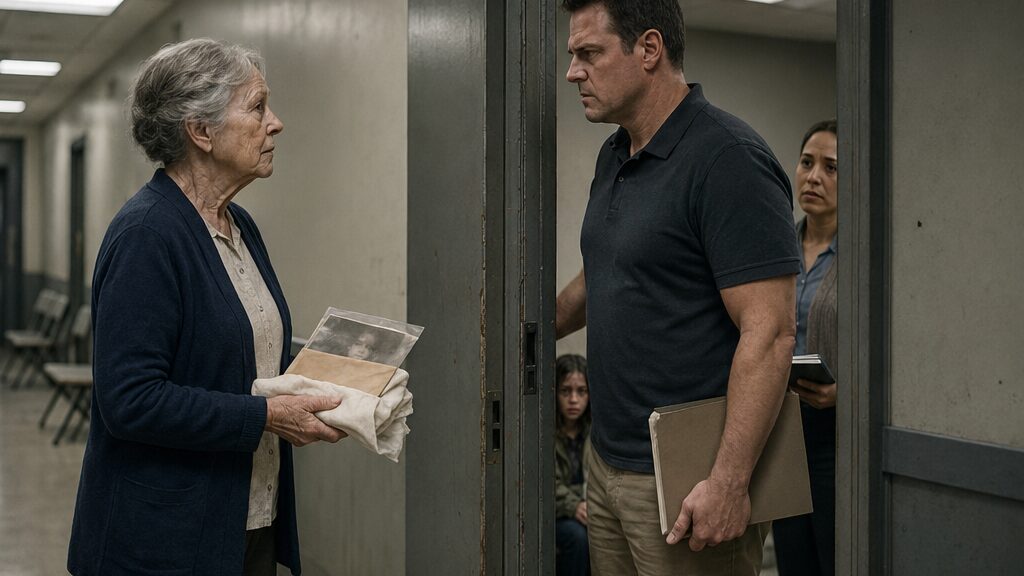
The child was crying behind the heavy gray door, and Donna Miller had both hands around a letter that had been sealed before the man blocking her was born.
The sound was not loud. It came thin through the door’s metal edge, broken into small breaths, the kind a child tried to swallow before adults could call it a scene. Donna knew that effort. She had heard grown men do it in tents with canvas walls, on transport floors, in fields where noise could bring worse things than shame.
She stood in the hallway of the county family-services office with her purse strap cutting into the soft part of her shoulder. In her left hand was the envelope, brown with age, its corners softened by decades of cloth wrapping. In her right hand was a black-and-white photograph inside a flat sleeve. The photograph showed a young man with tired eyes and a smile that had been forced for the camera. On the back, in faded pencil, was one name.
Anthony Carter.
Donna had written the address on a note card that morning, though she had already memorized it. She had checked it in her kitchen, then outside her apartment door, then in the parking lot before the driver came. She had told herself she would not lose her courage after keeping the letter this long.
Now the door had opened six inches, and Daniel Hill filled the gap.
He was younger than she had expected. Forties, maybe. Dark polo shirt, khaki pants, a folder under one arm, phone in hand. He had the look of a man who had spent too many hours in official rooms and learned to hate every chair in them.
“You’re Donna Miller?” he asked.
“Yes.”
“You need to leave.”
The child behind the door made a sound, then stopped.
Donna looked past Daniel’s shoulder, but he shifted his body, closing the opening further.
“I was told I could speak with Sandra Ramirez.”
“You already spoke to her. She told me.” Daniel’s mouth tightened when he looked at the envelope. “Whatever this is, it isn’t happening.”
Donna kept the photograph against her coat, not hiding it, not offering it yet. “I came because of Kathleen.”
“You don’t know Kathleen.”
“No,” Donna said. “I know who she comes from.”
His expression changed at that. Not softened. Changed. A guarded flicker passed across his face, as if she had reached for a drawer in his house without asking.
“You’re not family,” he said.
“No.”
“Then you’re not going in that room.”
Inside, a chair scraped. A woman’s low voice said something Donna could not make out. The child answered, sharper now, one word cut off by the door.
Donna stood very still. She had worn her good navy cardigan, the one with a repaired cuff. Beneath it, her blouse buttoned crooked at the collar because her fingers had stiffened before sunrise. She had meant to fix it in the restroom, but the receptionist had called her name too quickly.
“I was with Anthony Carter when he died,” she said.
Daniel’s jaw set.
The name did not confuse him. That was the first answer Donna received.
He looked down the hallway, toward the receptionist’s glass window, then back at her. “Who told you that name?”
“He did.”
“My grandfather has been dead for over sixty years.”
“Yes.”
“So you decided today was the day to come here with a story?”
“It took me too long to find you.”
Daniel’s laugh was almost nothing. “That’s convenient.”
“It is not convenient,” Donna said. “It has been the opposite of convenient for most of my life.”
The door opened another inch behind him. A woman with dark hair and a notebook appeared in the gap.
“Mr. Hill,” Sandra Ramirez said, “I need you to lower your voice.”
“My voice isn’t the problem.” He pointed at Donna without turning away from her. “She’s the problem. You let a stranger bring old war nonsense into a custody meeting.”
Donna’s fingers tightened around the envelope. Not enough to bend it. Never enough to bend it.
Sandra’s eyes moved from Donna’s face to the worn paper. Her professional expression faltered only briefly. “Mrs. Miller came through the records office. She gave us documentation that she served with Anthony Carter.”
“She gave you enough to get in the building,” Daniel said. “That doesn’t mean she gets near Kathleen.”
“I don’t need to be near her,” Donna said. “I need her to know this exists.”
Daniel turned fully then, putting his back to the room. “She’s eleven. Her mother just died. She’s been moved out of the only house she remembers. She does not need some elderly woman telling her a dead man loved her when nobody can prove what he did or didn’t do.”
“Patricia was her grandmother,” Donna said quietly.
Daniel froze.
Donna saw the second answer in his face. Patricia Clark was not just a name in a file. Patricia was still present enough to hurt him.
“She was my mother,” he said.
Donna nodded once. “Then I am too late for her.”
The words came out steadier than she felt. For a moment, the hallway’s fluorescent lights seemed to flatten everything: Daniel’s guarded face, Sandra’s hand on the door, the scuffed baseboards, Donna’s own shoes planted together like she was waiting for inspection. She had prepared herself for refusal. She had not prepared herself for Patricia to be gone.
Daniel watched her, suspicion sharpening again. “You didn’t know she died?”
“I found the notice last month.”
“Then why are you here?”
“Because Kathleen is still here.”
“My mother wanted nothing from Anthony Carter.”
Donna lowered her eyes to the envelope. The old paper had a darkened oval where Anthony’s thumb had pressed against it before giving it to her. She had never cleaned it. She could not have explained why, except that some marks were not dirt.
“Your mother was called Button when she was small,” Donna said.
Daniel looked as if she had slapped him.
Sandra’s head turned toward him.
Donna went on, because if she stopped now the door would close and sixty years would close with it. “He said she hated peas, liked to sleep with one sock off, and cried when the neighbor cut down a mulberry tree because she believed birds would have nowhere to sit.”
Daniel’s hand moved on the folder. “Where did you hear that?”
“From Anthony. He had her picture in his shirt pocket.”
“He left her.”
“He was nineteen.”
“He left her,” Daniel repeated, but the second time the words sounded less like accusation than something memorized from childhood.
Donna lifted the photograph slightly. “He asked me to bring this back with the letter.”
Daniel looked at it despite himself. The young soldier in the photograph stared out from the sleeve, a face from before Daniel’s own face had existed. Donna knew what people expected from pictures of the dead. Nobility. Peace. Something finished. Anthony’s photo gave none of that. He looked young, stubborn, frightened of being forgotten.
The child inside cried out, “Uncle Daniel?”
The title landed in the hallway. Daniel turned his head, and the protective part of him came back harder than before.
“It’s okay, Kathleen,” he called through the gap. “I’m handling it.”
Donna heard the chair scrape again.
“Is she the lady with the picture?” Kathleen asked.
Daniel’s eyes closed briefly. When he opened them, he stepped into the hallway and pulled the door closer behind him.
“She’s not coming in,” he said.
Sandra slipped out just enough to stand beside him. “Mr. Hill, Kathleen saw the photograph when the intake bag was opened. She has been asking about it since morning. Avoiding it may not be—”
“Don’t tell me how to protect my niece.”
Donna said, “She is asking because something in her knows.”
Daniel turned on her. “Don’t do that.”
“I am not trying to take anything from her.”
“You already are. You’re taking a dead man nobody asked for and putting him in the middle of her worst day.”
Donna absorbed that. She could not deny all of it. The child was having the worst day. The man in the photograph was dead. Donna had brought him anyway.
“He asked me to bring it,” she said. “I told him I would. That is why I am still here.”
For the first time, Daniel looked directly at the envelope, not at Donna’s age, not at her cardigan, not at the tremor she was trying to hide in her right thumb.
“How much?” he asked.
Sandra said his name under her breath.
Donna did not move. “He did not ask me to sell it.”
Daniel’s face colored. Shame crossed it, but anger arrived faster and covered it.
“You don’t get to make me the bad person in this hallway,” he said. “You don’t get to show up after sixty years and act like we failed some test.”
“No,” Donna said. “I failed one.”
That stopped him, but only for a second.
Inside the room, Kathleen’s crying had quieted into listening. That was worse. A crying child could be comforted. A listening child might remember every word.
Daniel seemed to realize it too. He backed into the doorway.
“Sandra, this meeting is over until legal reviews whatever she brought.” He looked at Donna. “My mother is dead. Whatever you have, she didn’t want it. Kathleen doesn’t need it.”
Donna stepped forward only half an inch. Her knees would not allow more, but she hoped he saw decision instead of weakness.
“Patricia may not have known what it was.”
“She knew enough.”
“She was a child when he wrote it.”
Daniel’s hand gripped the door.
Donna lifted the envelope, not toward him, not yet, but into the space between them. The paper made a small dry sound against her fingers.
“He died asking for her.”
Daniel shut the door.
The latch clicked with a final, ordinary sound.
Donna stood facing the gray paint, the photograph pressed flat to her chest, the envelope still raised in one hand as if the closed door might remember what the living refused to hear.
Chapter 2: The Address That Took Sixty Years To Find
The voicemail was waiting before dawn, and Donna knew from the first breath in Sandra Ramirez’s voice that the child had not forgotten the photograph.
She sat on the edge of her bed with the phone pressed to her ear, one hand braced on the nightstand until the room stopped tilting. Her pills stood in a plastic organizer beside a glass of water, Monday through Sunday in letters large enough for her not to mistake them. The envelope lay wrapped in white cloth beneath the lamp. Anthony’s photograph rested on top of it, face up, as if he had been listening all night.
“Mrs. Miller,” Sandra’s recorded voice said, careful and tired, “this is Sandra Ramirez from county family services. Kathleen asked again about the man in the old photograph. She said you knew his name. I can’t promise anything, but please call me when you get this.”
Donna played it twice.
On the second time, she closed her eyes at Kathleen’s name and heard another child’s name beneath it.
Button.
Anthony had said it with blood at the corner of his mouth and embarrassment in his eyes, as if death itself might tease him for tenderness. Tell Button I kept her close. That had been after the letter. After he had sealed it with hands that would not stop shaking. After he had asked Donna if pencil lasted longer than ink in wet weather, and Donna had lied because there had been no gentler answer.
She called Sandra at 6:14.
“I’m sorry if I woke you,” Donna said.
“You didn’t.” Papers shifted on Sandra’s end. “I was already at my desk.”
“That is too early for a desk.”
A small silence passed, almost a laugh but not quite. “I need to ask you something plainly. Is there anything in that envelope that could harm Kathleen emotionally or legally?”
Donna looked at the wrapped letter. “Yes.”
Sandra exhaled.
“The truth can harm,” Donna said. “So can withholding it.”
“That isn’t an answer the court likes.”
“It is the only honest one I have.”
Sandra was quiet again. Donna pictured her in the gray building, cardigan over office clothes, coffee gone cold beside a stack of lives reduced to folders. A woman trained to write down what people said, not what their hands did when they said it.
“Mr. Hill filed an objection late last night,” Sandra said. “He says you’re not family, that the item is unverified, and that Kathleen is already emotionally distressed.”
“He is correct on all three.”
“That does not help me.”
“It may help you trust me.”
Sandra made a sound like she had set her pen down. “Can you bring proof that the letter is connected to Anthony Carter without opening it?”
Donna looked toward the closet. Inside a metal box under folded towels were copies of her service records, old correspondence, obituary clippings, return-to-sender envelopes, addresses crossed out in different inks. The paper trail of a woman who had spent years looking and years being afraid to look harder.
“Yes,” she said. “Some.”
By eight-thirty, she was at the county records office with her cloth-wrapped bundle inside her purse and a folder in her lap. The clerk behind the counter wore reading glasses on a chain and handled old documents with the brisk indifference of someone who saw grief five days a week.
“You’re looking for Patricia Clark?” the clerk asked.
“I found her death notice. I need confirmation of next of kin.”
The clerk glanced at Sandra, who had met Donna there instead of making her navigate alone. “This is for an open family-services matter?”
Sandra nodded. “Related inquiry.”
The clerk typed. Donna watched her own hands.
Age had made them strange to her. Not useless, but less obedient. The fingers that had once found veins in darkness and tied pressure bandages under fire now trembled when receipts were too thin. She pressed her palms flat on the folder until they steadied.
The clerk’s printer began its rough mechanical chatter.
“Patricia Ann Clark,” the clerk said. “Deceased six weeks ago. Surviving adult child, Daniel Hill. Minor relative in temporary county placement pending guardianship review, Kathleen Carter.”
Donna’s throat tightened at the last name.
“Carter,” she said.
The clerk looked up. “That’s what it says.”
Sandra’s eyes moved to Donna. “You didn’t know Kathleen used his name?”
“No.”
The small payoff should have comforted her. Instead it pressed the promise deeper. Somewhere in the family, despite anger and silence, Anthony’s name had survived long enough to reach the child.
Sandra accepted the printout. “Anything else on Patricia?”
The clerk scrolled. “Previous address tied to an estate hold. House is not cleared yet. There are notes from probate. Personal effects pending review.”
Donna knew the address before the clerk finished reading it aloud.
The street name entered the air, and the county office fell away.
For one breath she was forty-two again, standing on a cracked sidewalk in a different pair of shoes, holding the same envelope under her coat while a woman behind a screen door told her Patricia wanted nothing from the man who had ruined her mother’s life.
Donna had believed the woman because she had wanted to.
“Mrs. Miller?” Sandra said.
Donna blinked. The clerk was waiting. The printer had gone silent.
“I know that street,” Donna said.
“From your search?”
“Yes.”
“When?”
Donna slid the folder closer to herself. “A long time ago.”
Sandra did not push. That was merciful, and mercy could be dangerous. It let old cowardice keep its shape.
They moved to a small side table near a wall of public notices. Donna opened her folder and laid out what she had allowed herself to bring: a copy of a unit roster with Anthony Carter’s name; an old letter from a veterans’ archive volunteer saying no direct family contact had been found; two returned envelopes addressed to Patricia Clark in different cities; a photocopy of Donna’s own discharge record; and a note card with Anthony’s last known family address as he had spoken it.
Sandra read without touching the sealed letter.
“You kept all of this?”
“I kept more.”
“For sixty years?”
“Not every day was searching,” Donna said. “Some years were only keeping.”
Sandra looked at her then, not unkindly. “That distinction may matter to you. It won’t matter to Daniel.”
“I know.”
“And the court will ask why you didn’t turn the letter over to the military, or a records office, or a veterans’ organization.”
“I tried once.” Donna tapped the archive letter. “They wanted to open it.”
Sandra’s brows drew together. “And you refused.”
“It was not addressed to them.”
“It isn’t addressed to Kathleen either.”
“No,” Donna said. “That is what frightens me.”
By noon, the envelope had a temporary description in Sandra’s case notes: unverified personal property, aged sealed envelope, possible connection to deceased family member.
Donna read the phrase upside down from across Sandra’s desk and felt something inside her recoil.
Unverified personal property.
Anthony had held the paper against his chest because the wind kept trying to take it. He had asked Donna to make sure Patricia got the photograph too, not just the letter. He had said a child believed photographs more than words. He had been nineteen, and he had thought like a father in the last ten minutes he was given.
Now the promise had become a line item.
Sandra capped her pen. “I can authorize one supervised meeting.”
Donna looked up.
“Not because Daniel agrees. He doesn’t. Because Kathleen is asking, and because withholding an object she already saw may increase distress.”
Donna nodded slowly.
“The letter stays sealed unless Daniel consents or the court authorizes opening it,” Sandra said. “You can show the photograph. You can explain who Anthony was in general terms. No battlefield details. No graphic content. No pressure on Kathleen.”
“I would never pressure her.”
Sandra’s look was level. “Everyone thinks that.”
Donna accepted the rebuke. “When?”
“Tomorrow morning.”
Tomorrow. After sixty years, tomorrow felt cruelly fast.
Sandra gathered the papers. “There’s one more condition. Daniel will be present.”
Donna’s hand went to the purse in her lap, to the place where the envelope rested inside white cloth.
Sandra’s voice softened by a degree. “And if the letter is opened, it will not be opened without him in the room.”
The office sounds continued around them: printer, phone, chair legs, a child laughing somewhere too far down the hall to belong to this story. Donna sat very still while the promise moved from her hands into rules she did not control.
Chapter 3: The White Cloth Between A Child And A Ghost
Kathleen Carter grabbed the envelope before Sandra finished saying nobody was allowed to touch it.
It was not a graceful movement. She lunged across the worn wooden table, sleeve sliding over the edge, wet hair falling into her face. Her fingers closed around the old paper with a desperation that made Donna’s breath catch. The envelope crinkled once, softly, and every adult in the room froze as if the sound had been glass breaking.
“Kathleen,” Sandra said.
The girl pulled the envelope to her chest.
Donna did not reach for it.
Daniel’s chair scraped backward. “Give that to me.”
Kathleen shook her head, eyes red, chin tucked down. She wore an oversized green jacket with one cuff covering half her hand. Someone had given her a dry shirt, but her hair still looked damp at the ends, as if the morning had not finished with her.
“It has my name,” she said.
“It has a dead man’s name,” Daniel replied.
“It says Carter.”
Daniel stopped.
The envelope did not say Kathleen. It did not say Carter in the place she meant. Anthony’s handwriting, faded but still legible, marked the front with Patricia Clark’s name and an address that belonged to another century. But in the upper left corner, pressed almost into the fold, was Anthony Carter, written small, as if he had needed to remind the world who was sending his last words.
Donna sat opposite the child. Between them lay the white cloth she had brought folded in her purse. She had spread it on the table before taking anything out, and Sandra had watched her do it with cautious confusion.
“For the paper,” Donna had said.
But that was not the whole truth. The cloth was not for cleanliness. It was for witness. It made the table less like a county surface and more like a place where something could be laid down without being claimed.
The photograph rested near the center: Anthony in uniform, young face turned slightly to one side, eyes narrowed against light. Kathleen had stared at it when Donna first placed it there, then looked away as if the picture had stared back.
Now she held the envelope so tightly the edges bowed.
Donna kept her hands folded. The tremor in her thumb had returned. She pressed it beneath her other palm.
“You don’t have to give it to me,” she said.
Daniel looked at her sharply. “She absolutely does.”
“No,” Donna said. “She has to stop bending it. That is all.”
Kathleen’s grip loosened by a fraction. Her eyes stayed on Donna.
Sandra sat at the table’s end with a yellow pad in front of her, pen poised but not moving. The room had gray walls, a heavy door, three extra folding chairs stacked in the corner, and a window that did not open. Every sound seemed to remain inside it.
“Who is he?” Kathleen asked.
Donna looked at Anthony’s photograph.
“His name was Anthony Carter.”
“I know that.”
“He was your great-grandfather.”
Daniel made a hard sound. “Biologically.”
Kathleen flinched.
Donna did not look at him. “He was Patricia Clark’s father.”
“My grandma.”
“Yes.”
“She never talked about him.”
“I know.”
“You don’t know that.”
Donna accepted the strike. “No. I know only that she had reason not to.”
Kathleen’s mouth tightened, but confusion moved through the anger. Children knew when adults stepped around holes in the floor.
Daniel leaned forward. “This is exactly what I was talking about. She’s already upset.”
“She was upset before I entered,” Donna said.
“That doesn’t give you the right to add to it.”
“No.”
Kathleen looked between them. “Were you his wife?”
“No.”
“His sister?”
“No.”
“Then why do you have his stuff?”
The question was blunt enough to steady the room.
Donna lifted the photograph with two fingers and turned it so Kathleen could see the back through the sleeve. She did not hand it over yet.
“He gave me this with the letter.”
“Why?”
“Because I was there when he could not carry them anymore.”
Sandra’s pen finally moved once, then stopped.
Kathleen stared at Donna’s face. “You mean when he died.”
Donna let the silence answer first.
“Yes,” she said.
The girl’s hand tightened around the envelope again, but more carefully now. “Did it hurt?”
Daniel stood. “That’s enough.”
Sandra rose halfway. “Mr. Hill—”
“No. She is not doing this.” Daniel pulled a set of papers from his folder. “I have temporary guardianship authority pending review, and I am telling you this meeting is over.”
Kathleen recoiled into her chair.
Donna saw it then: Daniel’s protection landing like another locked door.
He moved toward the table, papers in hand, eyes fixed on the envelope. Not cruel. Afraid. Afraid of the child asking questions he could not answer. Afraid of the old soldier’s face returning to the family with more power than his own living efforts.
Donna lifted one hand.
Not high. Not dramatic. Her palm rose between Daniel and the cloth, fingers slightly bent with age, the same hand that had once pressed bandages against wounds and held Anthony’s letter while he tried to breathe.
Daniel stopped because the gesture expected him to.
“Not before she hears why he kept her picture,” Donna said.
Sandra’s eyes went to the photograph. Kathleen’s did too.
Daniel remained standing. “What picture?”
Donna slid the photograph closer to Kathleen, still inside its sleeve. “This one was taken before he shipped out. But the picture he carried was not of himself.”
Kathleen’s lips parted.
Donna reached into her purse and removed a second sleeve, smaller, more fragile, clouded with age. She laid it on the white cloth beside Anthony’s portrait.
Inside was a faded image of a little girl on a porch chair. The child’s hair was tied unevenly. One shoe was missing. On the back, in Anthony’s hand, were two words: Button, laughing.
Kathleen did not move.
Daniel’s face had lost color.
“My mother hated that nickname,” he said.
Donna looked up at him. “Did she?”
His jaw worked. “She said only one person ever called her that.”
“Anthony.”
Kathleen reached for the small photograph, then stopped before touching it. “He had this when he died?”
“Yes.”
“Where?”
Donna’s mouth went dry. Sandra was watching her now, not as an official, but as someone deciding whether silence was still kindness.
“In his shirt pocket,” Donna said.
Kathleen looked down at her own jacket, at the pocket near her heart.
Daniel sat slowly, the papers bending in his hand.
For one minute, nobody spoke. The room held the old photograph, the sealed envelope, the child’s guarded breathing, and the fact that Anthony Carter had carried his daughter’s face into the last place he would ever go.
Then Kathleen looked up, and whatever softness had almost come into her face hardened into something sharper.
“If he had her picture,” she said, “why didn’t he come home?”
Donna had answered this question in her head for decades, but never to the person who had the right to ask it.
“He couldn’t.”
“That’s what everyone says when they’re gone.”
Daniel’s eyes flicked toward Kathleen. He heard Patricia in her. Donna could see it.
Kathleen pushed the envelope back onto the cloth, not giving it up, only setting it where everyone could see her hand still rested on top of it.
“My grandma said people leave and then other people make stories so you don’t hate them.”
Donna bowed her head once. “She may have believed that.”
“Did you tell her?”
The question came so quietly that Sandra’s pen stopped above the page.
Donna looked at the envelope. There were many true answers. I tried. I was turned away. I was ashamed. I was tired. I thought a sealed letter was safer than my voice. None of them was clean enough to hand a child.
“I did not tell her in time,” Donna said.
Kathleen’s eyes filled again, but the tears did not fall. “You had it?”
“Yes.”
“All this time?”
“Yes.”
Daniel closed his eyes briefly, as if the answer had struck him too.
Kathleen’s fingers slid off the envelope. She stared at Donna now with an expression more painful than distrust. It was accusation with a wound beneath it.
“If he loved us,” she asked, “why did you keep him?”
Chapter 4: The Record That Made A Dead Man Look Guilty
The line on the photocopy said Anthony Carter had been absent from his assigned unit for four days before he died.
Daniel read it once in the records office, then again under the buzzing light above the counter, his thumb holding the page so hard the corner bent. The words were small, uneven from the copy machine, surrounded by stamps and abbreviations he did not fully understand. But he understood enough.
Detached from unit status pending clarification.
He stared at the phrase until it became exactly what he needed it to be.
“There,” he said.
Sandra stood beside him with her arms folded, her notebook tucked beneath one elbow. “That does not say what you think it says.”
“It says he disappeared.”
“It says his status was pending clarification.”
“That is a dressed-up way of saying disappeared.”
The records clerk behind the counter glanced over, then looked down again. The county office was quiet except for printers and low voices. Daniel hated the quiet most. It made everything sound official. It made a bad line on old paper feel like a verdict.
Sandra lowered her voice. “Military records from that period can be incomplete. Especially when units were moved, casualties happened, or paperwork was reconstructed later.”
“My family didn’t need reconstructed paperwork to know he didn’t come back.”
“No one is arguing that he came back.”
Daniel looked at her. “You’re doing what she did.”
“Who?”
“That old woman.” He tapped the photocopy. “You’re making him tragic instead of responsible.”
Sandra’s expression tightened, not in anger, but in the careful way people tightened when they wanted to stay professional. “I am saying a record can protect an institution better than it protects a family.”
Daniel let out a short laugh. “That’s convenient too.”
The clerk returned with another sheet. “This is the service summary we could access through the public request. Anything more detailed would need federal channels or next-of-kin authorization.”
“I’m next of kin,” Daniel said.
“For some purposes,” the clerk replied, not unkindly. “For others, you may need proof of lineage and a formal request.”
Daniel took the paper. Another form. Another delay. Another adult telling him patience was protection.
He had been patient when the hospital called about his mother. Patient when the funeral home asked if he wanted the cheapest urn or the second cheapest. Patient when Kathleen stood in Patricia’s bedroom with a trash bag in her hand and asked whether dead people still owned their socks. Patient when family services explained temporary placement as if the word temporary could make a child less frightened.
He was done being patient with a stranger holding a dead man’s letter.
“What about handwriting?” he asked.
Sandra looked at him. “What about it?”
“The envelope. His name is written on it. You saw it.”
“I did.”
“Do we have anything he wrote?”
The clerk hesitated. “There may be a digitized enlistment card. Signature line only.”
“Print it.”
Sandra said, “Daniel.”
“What? Isn’t this what you want? Proof?”
“I want care.”
“I want the truth before she puts something poisonous in Kathleen’s head.”
The clerk printed the card.
Daniel told himself he wanted the handwriting not to match. He wanted clean proof that Donna Miller had collected names from records, copied a photograph from somewhere, and built a story around a child too wounded to resist it. It would be ugly, but it would be simple. He could keep Kathleen away from Donna. He could tell the court a stranger had tried to interfere. He could bury Anthony Carter again where his mother had left him.
The enlistment card came warm from the printer.
Daniel took it and held it beside the photocopy Sandra had made of the envelope’s front. Anthony Carter’s small return-name slanted upward near the fold. The enlistment card held a larger signature: Anthony J. Carter. The A leaned the same way. The t crossed too low. The r at the end barely closed.
Daniel felt irritation first, then something worse.
Sandra saw it. “They look similar.”
“They look old,” he said.
“Yes.”
“Lots of people write alike.”
“Some do.”
He hated her for not pushing. If she had pushed, he could have fought. Instead she let the two scraps of handwriting sit between them like a fact that did not care what either of them wanted.
Daniel stacked the pages and forced them into his folder. “This proves nothing.”
“It proves enough that we should not dismiss her outright.”
“It proves she has an envelope that may be old.”
“And a photograph your mother apparently recognized enough to hide from her own family.”
He turned sharply. “You don’t know that.”
“I know Kathleen recognized the nickname.”
“Because Donna said it in front of her.”
“Kathleen said Carter before anyone prompted her.”
Daniel shut the folder. “She heard us talking.”
Sandra’s eyes softened, and that was worse too. “Daniel, I understand you are trying to protect her.”
“You don’t.”
“I understand the impulse.”
“No. You understand procedure.” He stepped closer, lowering his voice because the clerk was still there and because anger felt different in government rooms. “My mother spent her whole life carrying that man like a bruise. She raised me on what not to trust. Men who leave. Uniforms that make excuses. Stories that show up after the damage is done. Now Kathleen is sitting in there looking at his picture like it might explain everything, and that woman is feeding it.”
“She has not opened the letter.”
“Not yet.”
Sandra held his gaze. “You are afraid of what it says.”
Daniel almost denied it. The words rose automatically, but he stopped them because denial would have sounded too much like fear.
“I’m afraid Kathleen will believe one piece of paper over the woman who raised me,” he said.
Sandra nodded slowly. “That is a real fear.”
It disarmed him for half a second.
Then she added, “But it may not be Kathleen’s job to protect Patricia’s version of pain.”
Daniel looked away.
Outside the records office, the sky had gone the dull color of aluminum. In the parking lot, Daniel stood beside his car with the folder open across the hood. He spread the copies out: service summary, enlistment card, envelope photocopy, Patricia’s death notice, Kathleen’s temporary placement page. Wind lifted a corner, and he pinned it with his palm.
His mother had never kept many pictures. The few she had were of Daniel as a boy, school photos, holiday snapshots, none of her own childhood except one blurred porch image she kept behind a frame and never explained. Once, when Daniel was ten, he had found it and asked who the little girl was.
Nobody, Patricia had said, taking it from him.
But she had not thrown it away.
Daniel pulled out his phone and photographed the line from Anthony’s record.
Detached from unit status pending clarification.
He enlarged it until the words filled the screen.
There, he thought again, but the certainty felt thinner now.
His phone rang. Sandra’s name appeared. He almost let it go, then answered.
“I just spoke with the county attorney,” she said. “Because the envelope is sealed and addressed to Patricia, and because Kathleen is a minor, we need consent before opening it.”
“You have my answer.”
“I know. But there is another option. The envelope can be placed in temporary evidence hold until review.”
“Good.”
Sandra paused. “That would mean Kathleen cannot touch it either.”
Daniel looked across the parking lot toward the family-services building, where his niece was probably in some temporary room with plastic chairs and donated books, waiting for adults to decide which truths were safe.
“Fine,” he said.
“Daniel.”
“She’s been through enough.”
“I agree.”
“Then seal it.”
He heard Sandra inhale. “You are turning an emotional question into a legal object.”
“No,” Daniel said. “Donna Miller did that when she brought it here.”
He ended the call before Sandra could answer.
An hour later, he found Donna sitting alone on a bench outside the building, the cloth-wrapped bundle in her lap, both hands resting on it. She looked smaller there than she had in the hallway. Not harmless. Just old in a way he had refused to see because oldness invited mercy.
He walked up with the folder under his arm.
“I found his record,” he said.
Donna looked up. Her face did not change, but he saw her hands still.
“It has a gap,” Daniel said. “Four days. Nobody can explain where he was before he died.”
Donna closed her eyes once.
“That means something to you,” he said.
“It means the paperwork was confused.”
“It means he was missing.”
“He was not missing to me.”
Daniel’s voice sharpened. “Then explain it.”
Donna’s mouth opened, then closed.
There it was: the silence.
Daniel seized it because it hurt less than doubt. “You want us to trust you, but every time there is a real question, you go quiet.”
Some tiredness moved through her face. “There are things I am trying not to give Kathleen all at once.”
“This isn’t about kindness. It’s about control.”
Donna looked down at the bundle. “Perhaps.”
The answer unsettled him.
He pulled the evidence-hold request from his folder and held it out. “If that letter hurts her, I will make sure she never sees you again.”
Donna took the paper, read the first line, and her hand trembled just enough for him to notice.
Chapter 5: The Photograph Matched What Nobody Told Her
Donna knew the chair before anyone turned on the lights.
It sat near the front window of Patricia Clark’s emptied house, half-covered by a sheet, its wooden arms worn pale where small hands might once have gripped them. The rest of the room smelled of closed air, cardboard, dust, and the faint sourness of old flowers left too long in water. But the chair held Donna still at the threshold.
She had seen it before.
Not in this room. Not with sheets over the furniture and county tags on boxes. She had seen it in a photograph Anthony had carried against his heart: a little girl laughing on a porch chair, one shoe missing, hair tied crookedly, mouth open in a joy no adult had yet taught her to hide.
Button, laughing.
Sandra stepped in behind Donna and noticed her stopping. “Are you all right?”
Donna nodded, but her eyes stayed on the chair.
Daniel came through after them, carrying a key ring and an expression that warned every object not to surprise him. Kathleen followed close to him, arms wrapped around herself inside the green jacket. She had been allowed to come only because Sandra said some personal effects required family identification and because Kathleen had refused to stay in the county car.
The envelope was not with them. It had been left locked in Sandra’s office, sealed inside a clear evidence sleeve Daniel had insisted on signing. Donna had watched Sandra place it in the cabinet. The white cloth had stayed in Donna’s purse, folded and useless.
Without the letter against her body, Donna felt improperly dressed.
“We are not digging through my mother’s life for entertainment,” Daniel said.
Sandra answered with practiced calm. “We are identifying family items relevant to Kathleen’s placement and history.”
“Same thing, softer words.”
Kathleen walked past them toward a row of boxes. “Grandma kept the picture.”
Daniel turned. “What picture?”
“The old man.”
Donna did not move.
Kathleen crouched beside a cardboard box marked bedroom dresser. “I saw it once. She said not to touch it.”
Daniel’s face tightened. “Kathleen, don’t start pulling things out.”
But the girl already had.
The box held scarves, two pill bottles, a cracked hand mirror, church bulletins, a stack of greeting cards tied with ribbon, and a small framed print of a lake. Kathleen lifted each item quickly at first, then slowed as the dead woman became less a problem and more a person in her hands.
Donna stood near the chair. Her knee ached from the ride, but the pain felt deserved. She looked at the walls where pictures had been removed and saw pale rectangles left behind. A life’s outline, stripped for review.
Sandra began checking inventory tags with the role-only efficiency of someone trying not to intrude.
Daniel opened a drawer in a side table and found old receipts, batteries, a pair of reading glasses. “There’s nothing here.”
Donna said, “People hide what they cannot throw away.”
He looked at her. “You would know.”
She accepted that without answer.
Kathleen had moved to a narrow dresser against the wall. One drawer stuck. Daniel told her to leave it, but she pulled harder, and something inside shifted with a dry scrape. The drawer came free too fast, spilling folded slips and sewing thread onto the floor.
“Careful,” Daniel snapped.
Kathleen flinched, then bent to gather the things. As she did, her fingers touched the loose lining at the bottom of the drawer.
“There’s paper under here.”
Daniel crossed the room. “Don’t tear it.”
“I’m not.”
Sandra came closer. Donna stayed where she was because some discoveries belonged first to blood.
Kathleen lifted the warped cardboard lining. Beneath it lay a flat envelope, not sealed, only tucked away. Inside was a photograph.
The room went still.
Kathleen held it with both hands. Even from across the room, Donna knew the image. Not the same physical print Anthony had carried, but the same moment: Patricia on the porch chair, laughing, one shoe gone. This copy had been handled often. Its edges were soft. A crease crossed one corner. On the back, in older, harsher handwriting, someone had written: Don’t ask.
Kathleen turned it over and frowned. “Why would Grandma hide this?”
Daniel did not answer.
Donna came forward slowly. “May I see?”
Daniel almost refused. It was in the movement of his shoulders, the way his hand rose and stopped. Then Kathleen handed the photograph to Donna herself.
Donna received it as if the paper might feel pain.
This was not Anthony’s print. That mattered. Anthony had died with one copy in his shirt pocket, but another had lived here, in this house, under a drawer lining, close enough for Patricia to keep and far enough to deny.
“She had it,” Kathleen said.
“Yes.”
“But she said he was nobody.”
Donna looked at the chair by the window. “Sometimes nobody is the name people give what hurts too much to say.”
Daniel made a rough sound. “Do not turn my mother into one of your stories.”
Donna looked at him then. “I am trying not to.”
Sandra held out her hand. “We should document where it was found.”
Kathleen did not give up the photograph this time. She took it back from Donna and held it against her jacket, just below the pocket.
A small, strange sound came from the hallway. Not words. A child’s startled intake.
Kathleen had wandered toward a closet near the back room. On the floor inside was a shallow storage bin filled with school papers, old calendars, and envelopes of photographs. She pulled out a thin notebook with a faded cover and opened it.
“Look,” she said.
Daniel stepped toward her. “What is that?”
“My old drawing book.”
She turned it around.
The drawing was made in thick pencil and uneven crayon. A tall stick figure in a square hat stood beside a smaller girl with long hair. Between them was a big round sun. Under the man, written in a child’s careful letters, were four words.
the one nobody says
Donna felt the words enter her like cold water.
“How old were you?” Sandra asked softly.
Kathleen stared at the page. “Little.”
Daniel took the notebook carefully, as if force had left him. “You drew this?”
“I used to ask Grandma who was in the hidden picture.” Kathleen looked at him. “She cried once. Then she got mad. So I stopped.”
Daniel’s face changed in a way Donna wished she had not seen. He was remembering, perhaps, every time Patricia had ended a conversation too sharply, every drawer she had closed, every name she had refused to explain. He was seeing not proof against his mother, but proof of her wound.
“That doesn’t mean she wanted him back,” he said, but the words were quieter now.
“No,” Donna said. “It means he never fully left.”
He turned on her, the softness gone because softness had exposed too much. “You don’t get to say that in her house.”
Donna nodded. “You are right.”
“No, I don’t think you understand. My mother died believing whatever she believed. You show up after the funeral, after Kathleen’s whole life breaks open, and now every box in this house becomes evidence for a man who wasn’t here.”
Donna looked at the photograph in Kathleen’s hands, then at the chair by the window. “I came too late.”
Daniel’s voice dropped. “Then why come at all?”
“Because the promise did not end when Patricia did.”
“You keep saying that word like it cleans anything.”
“It does not.”
“Then say what it was really about.” He stepped closer. “Was it about him? Or was it about you needing to feel forgiven before you die?”
Sandra said, “Daniel.”
Donna lifted one hand slightly, not to stop him this time, but to stop Sandra.
The question deserved its place in the room.
“I do not know anymore where one ends and the other begins,” Donna said.
Kathleen looked up from the drawing.
Daniel seemed ready to answer, but Donna turned toward the window and the covered chair. The street outside was narrow, lined with older houses and low porches. A place a person could find once and lose for years in memory.
“I came to this street before,” she said.
Daniel went still.
Sandra’s pen lowered.
Donna kept her eyes on the chair because she could not yet look at Anthony’s family. “A long time ago. I had the letter with me.”
Daniel’s voice was careful now, dangerous in its quiet. “Whose door did you knock on?”
Chapter 6: The Knock She Never Forgave Herself For
“I knocked once before,” Donna said, and Daniel’s face told her he understood the shape of the damage before she had confessed the act.
They had returned to the county interview room because Sandra said the house was no longer neutral. The word neutral had sounded foolish to Donna. Nothing was neutral now. Not the table, not the gray walls, not the heavy door, not the white cloth she unfolded with both hands while Daniel stood watching as if she were laying out a charge against herself.
The sealed envelope sat inside its clear sleeve on Sandra’s side of the table. Official now. Protected now. Farther from its purpose than it had been in Donna’s kitchen drawer.
Kathleen sat across from Donna again. The hidden photograph from Patricia’s dresser lay beside Anthony’s portrait. Two copies of the same child laughing. One carried into war. One hidden in a house for decades. Between them was the envelope that had failed both.
“Tell me,” Daniel said.
Sandra remained near the door, notebook closed. For once, she did not write.
Donna placed her palms flat on the table’s edge. The white cloth did not cover the whole surface. Its corners were uneven. She had folded and unfolded it so many times that a permanent crease ran down the center.
“It was 1984,” she said. “I had come through three wrong addresses by then. One woman in Ohio told me Patricia had moved west. A veterans’ archive volunteer found a forwarding record. I saved for the trip.”
Daniel’s mouth tightened at the detail of saving. He did not want poverty to make her sympathetic. Donna did not want it either.
“I found this street,” she continued. “The house number matched what I had. I had the envelope in my coat. I had the photograph in my purse.”
Patricia’s chair waited in her memory on the porch, uncovered then, sunlight on one arm. The screen door had rattled when Donna knocked. She could still hear a television inside. A dog barking two houses down. Her own heart, too loud for a woman who had survived louder things.
“A woman answered,” Donna said. “Older than Patricia would have been. I asked for Patricia Clark.”
“Who?” Daniel asked.
“I never knew her name.”
“What did she say?”
“That Patricia did not want anything from Anthony Carter.”
Kathleen’s hand moved toward the envelope, then stopped at the edge of the cloth.
Daniel leaned forward. “And you believed her?”
Donna looked at him. “I wanted to.”
His face hardened. “That’s not an answer.”
“It is the truest one I have.”
The room held the words.
Donna swallowed. “The woman said Anthony had brought enough shame into that family. She said Patricia had a child and a life and no room for old lies. She said if I cared about Patricia, I would leave the dead where they were.”
“My mother was alive then,” Daniel said.
“Yes.”
“You were at her house.”
“I may have been.”
“You didn’t ask to see her?”
“No.”
“Why?”
Donna looked at Anthony’s photograph. He seemed impossibly young under the fluorescent light.
“Because I was afraid the woman was telling the truth,” she said. “And because if Patricia looked me in the eye and refused him, I did not know what I would do with the letter after that.”
Kathleen whispered, “So Grandma might have been inside?”
Donna closed her eyes. “Yes.”
The word did not break loudly. It sank.
Daniel pushed away from the table and walked to the wall. He put both hands on his hips, head bowed. When he turned back, his anger had changed color.
“My mother died thinking he never tried.”
Donna did not defend Anthony. Not yet. Not with the letter still sealed. “She may have.”
“And you let that happen.”
“Yes.”
Sandra looked down.
Kathleen’s face had gone pale and watchful. “Did she die thinking I was asking about someone bad?”
Daniel turned toward her. “Kathleen—”
“No.” The girl’s voice trembled, but she kept going. “When I asked about the picture, she got scared. Not just mad. Scared. Was she scared because he was bad or because nobody told her?”
Donna felt the final part of the promise moving closer, the part that had no paper around it. She had kept Anthony’s last spoken words locked behind the sealed letter, as if both belonged to the same envelope. But they did not. The letter was his. The words had been entrusted to Donna’s living mouth.
“I cannot answer for Patricia,” Donna said.
Kathleen stared at her. “Can you answer for him?”
Donna’s hands curled against the table.
Daniel noticed. “You know something else.”
Donna remained silent.
He laughed once, without humor. “There it is again.”
Sandra said, “Mrs. Miller?”
Donna reached into her purse and pulled out a small cloth handkerchief. She did not need it. She only needed something to hold that was not the letter. “Anthony wrote what he could write. After he sealed it, he said something more.”
Kathleen leaned forward. “What?”
Donna’s throat closed.
Daniel stepped back to the table. “No. You don’t get to hold that back too.”
“I am trying to do this in order.”
“In order?” His voice rose. “You had forty years to knock again. You had my mother’s lifetime. You had six weeks since she died. Now you want order?”
Donna accepted each sentence. They had weight because they were not entirely wrong.
“I was a medic,” she said quietly. “I learned to stop bleeding before asking names. I learned to do the next necessary thing. After Anthony died, the next necessary thing was the letter. Then finding Patricia. Then keeping it sealed. I made each step smaller because the whole of it was too large.”
“That sounds like an excuse.”
“It is one.”
The room went still again.
Donna slid the clear sleeve toward herself, stopping before she touched the envelope inside. “I have been called honorable for keeping this. I let people think that. It was easier than saying I kept it because every time I tried to deliver it, I was back with him, promising a boy something no person should promise unless she can do it.”
Kathleen’s eyes filled. “Was he scared?”
Donna looked at her. “Yes.”
Daniel’s expression shifted despite himself.
“He was brave,” Donna said. “But he was scared. Both are allowed.”
Kathleen nodded once, as if that answer mattered.
Donna turned to Daniel. “You are right to be angry with me. If Patricia was in that house, if she wanted the letter and never received it because I accepted another person’s refusal, then I helped leave the wound open.”
Daniel’s hands rested on the back of a chair. “Then why should we trust you now?”
“You should not trust me because I am old. You should not trust me because I served. You should not trust me because I carried this a long time.” Donna pushed the sleeve gently toward the center of the cloth. “Trust only what can bear being seen. The handwriting. The photograph. The details he gave me. And if those are not enough, trust Kathleen to know whether silence has helped her.”
Kathleen looked at Daniel.
He looked away first.
Sandra moved to the file cabinet and returned with a small form. “I can document consent for the envelope to be opened in the presence of the guardian, Kathleen, Mrs. Miller, and myself. Or I can return it to hold.”
Daniel stared at the form.
Kathleen’s voice was small. “Uncle Daniel.”
He did not answer.
“She’s dead,” Kathleen said. “Grandma’s dead. I can’t ask her. I can only ask this.”
The words seemed to pull something out of him. He sat down slowly, elbows on his knees, the anger collapsing into exhaustion.
“If it hurts you,” he said.
“It already does.”
Donna bowed her head.
Sandra placed the form in front of Daniel. He signed with hard, uneven strokes. Then Sandra turned it toward Kathleen, explaining softly that she did not have to sign, that agreement did not mean she had to read aloud, that she could stop.
Kathleen signed anyway.
The envelope came out of the plastic sleeve with a dry whisper.
Donna took it last. For one moment, the old paper lay in her hand without any barrier. The thumbprint was still there. The flap still sealed. Anthony’s name still small in the corner.
She set it on the white cloth and took her hand away.
“This belongs to you,” she said to Kathleen. “Not to me.”
Daniel’s voice was low. “And the words he said after?”
Donna looked at him, then at Kathleen. “If you still want them after the letter, I will give them.”
Kathleen reached across the cloth.
Her fingers were careful now. She lifted the envelope as if it were not fragile paper but something sleeping. With Sandra watching and Daniel motionless beside her, she slid one finger beneath the old flap.
The seal broke.
Chapter 7: The Last Words Were Not Inside The Letter
Kathleen unfolded the first page, and Daniel made a sound before she reached the end of the first line.
Not a sob. Not a word. A small breath pulled through his teeth, sharp enough to make Kathleen look up. His eyes were fixed on the paper, not on the old handwriting itself, but on the phrase at the top.
For my Button, when she is old enough to know the song.
Kathleen looked from the letter to him. “What song?”
Daniel’s hand moved toward the page, then stopped above the table. He did not take it from her. That mattered. Donna watched him learn, in the space of one second, how not to protect by grabbing.
“My mother used to hum something,” he said. “When she thought nobody heard.”
Kathleen looked back down.
Donna already knew the line. Not because she had opened the letter. She never had. She knew because Anthony had spoken it once, embarrassed, while pressing the photograph against his shirt. She sings it wrong, he had said. Like a little drunk bird. Then he had laughed, and the laugh had broken into coughing.
Kathleen read silently at first. Her lips moved around words written by a nineteen-year-old who had tried to become a father on paper before death arrived. Her brow tightened. Once, her finger traced a line down the page and stopped. She did not cry immediately. That was the hardest part to watch. The letter entered her slowly, as if her body did not yet trust it.
Daniel sat beside her, rigid, one hand closed around the edge of the table. Sandra stood near the wall with her notebook unopened. Donna sat across from them, the white cloth between her and the family, her hands empty in her lap.
The letter was no longer hers to guard.
Kathleen swallowed. “He says he was sorry he left before she could remember his face.”
Daniel closed his eyes.
“He says he didn’t know how to be brave about being a father.” Kathleen’s voice wavered, then steadied with anger. “He says he was better at following orders than writing letters.”
Donna looked at Anthony’s photograph. “That sounds like him.”
Daniel opened his eyes. They were wet, but his voice came controlled. “Keep reading if you want.”
Kathleen did.
She read the next lines to herself, then the next. The old paper trembled in her hands. At one point she glanced toward Donna with a question forming, but she returned to the letter before asking it, as if afraid the answer would change if she waited.
Finally she said, “He doesn’t say where he was those four days.”
Daniel looked at Donna.
The missing record sat in the room with them though no one had brought the photocopy to the table.
Donna held his gaze. “No.”
“Why not?” Kathleen asked.
“Because he did not know the paperwork would make him look absent,” Donna said. “He only knew he might not have another chance to write.”
Daniel’s mouth tightened. “Then where was he?”
“With us,” Donna said. “With the wounded who could still be moved. The unit had split in confusion. Some names were recorded late. Some wrong. Some not at all.”
“You can prove that?”
“No.”
The answer was plain enough to hurt.
Daniel’s face hardened by habit, but the hardness did not settle the way it had before. “So we still have only your word.”
“You have the letter,” Donna said. “You have his hand. You have the photograph he carried. And you have my word for the part no paper kept.”
Kathleen lifted her head. “What part?”
Donna’s body felt suddenly too old for the chair. The room narrowed to the cloth, the open envelope, Anthony’s face, Patricia’s hidden photograph, Kathleen’s red eyes, Daniel’s guarded silence.
She had thought, across the years, that speaking the words would free her. Now she understood that was too clean a hope. Some burdens did not leave. They only changed hands less cruelly.
“When he finished writing,” Donna said, “he asked me to seal it. His hands were not steady. I did that for him.”
Kathleen looked at the envelope flap, torn now but still holding the shape of its seal.
“He asked if the photograph was still in his pocket. I told him yes. He made me take it out and put it with the letter. Then he changed his mind and asked me to leave it against his chest until the last minute.”
Daniel’s face shifted.
“He said Patricia should know he had been carrying her picture. Not in his pack. Not with his papers. Here.” Donna touched two fingers to the left side of her cardigan. “He wanted her to know that when he was most afraid, he did not reach for a prayer card or a weapon or a lucky coin. He reached for her.”
Kathleen bent over the letter. One tear fell onto the table, missing the paper by less than an inch.
Donna continued before fear could close her throat again.
“His last words were not inside the letter because he did not have breath left to write them.” She looked at Kathleen first, then Daniel. “He said, ‘Tell Button I was still carrying her picture.’ Then he said, ‘Tell her I was trying to come home as her father, not just as a soldier.’”
Daniel covered his mouth.
The room held no easy comfort after that. No one rushed to make the words beautiful. No one said it fixed anything. Patricia had died without hearing them. Anthony had died without knowing whether they would arrive. Donna had lived long enough to bring them one generation late.
Kathleen folded the page once, then stopped as if folding it away felt wrong. She laid it open on the white cloth beside Anthony’s portrait. Then she picked up Patricia’s hidden photograph and placed it next to the letter, lining the edges carefully. The two pictures sat together: the father who had not returned, the child who had grown old without him, the message that had crossed too many years to be whole.
Daniel reached toward the hidden photograph. His finger hovered over the words on the back.
Don’t ask.
He turned it face up instead.
Kathleen looked at him. “Grandma should’ve known.”
“Yes,” Daniel said.
The word seemed to cost him more than any apology would have.
He looked at Donna across the table. For a moment she saw all the things he might say: that he had been wrong, that she had been wrong too, that his mother had been wronged by more than one person, that anger had protected him until it started protecting nothing.
What he said was quieter.
“She used to hum that song when she washed dishes.”
Donna nodded once.
“She would stop if I came in.”
Kathleen touched the letter. “Can we keep it?”
Daniel looked at Sandra, but only briefly. Then he looked back at Kathleen. “Yes.”
Sandra finally opened her notebook, not to take the letter, only to mark what had been decided.
Donna placed both hands on the arms of her chair and stood carefully. Her knees protested. No one moved to help her at first, and she was grateful. Then Kathleen rose too.
The girl held the torn envelope against her chest for one second, the same way she had clutched it when she feared everyone would take it from her. Then she lowered it back to the cloth, beside the letter and photographs.
“Thank you,” Kathleen said.
Donna looked at the objects, not the child. “I am sorry it took so long.”
Kathleen did not absolve her. Daniel did not either. That, too, was right.
At the door, Daniel stepped aside before Donna reached it. The heavy door opened wide this time. No one blocked the gap.
In the hallway, the fluorescent lights hummed overhead. The receptionist’s phone rang somewhere beyond the glass. Ordinary life had continued rudely while the dead were being delivered.
Donna walked slowly toward the exit with her purse light against her side. No envelope. No photograph. No cloth; she had left it under the letter because Kathleen had asked without words by not moving anything from it.
At the outer doors, she paused and looked back once.
Through the narrow window of the interview room, she could see Kathleen seated at the table, Daniel beside her, both bent over Anthony’s letter. Sandra stood near the wall, giving them the small privacy a public room allowed.
Donna pushed the exit door open.
Outside, the evening air touched her empty hands. For a moment, she did not know what to do with them.
Then she let them hang at her sides and walked away carrying nothing that belonged to Anthony Carter.
The story has ended.