The Young Sailor Mocked the Cafeteria Woman Until the Admiral Recognized Her Coffee Pot
Chapter 1: The Coffee Pot Stopped the Admiral Cold
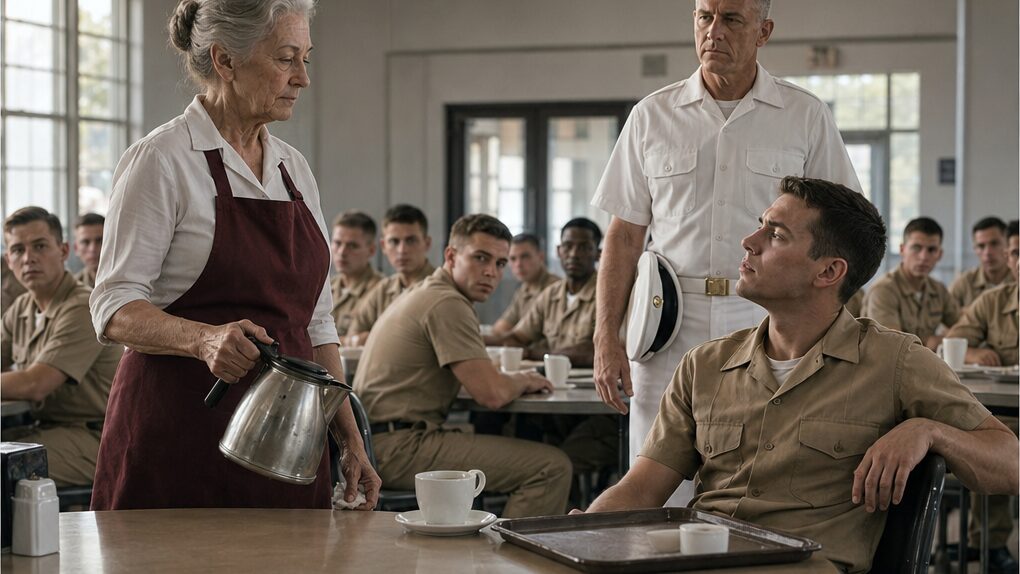
The coffee pot slipped half an inch in Stephanie Mitchell’s hand when the young sailor said, loud enough for the next table to hear, “Ma’am, you don’t have to hover. Some of us are actually on duty today.”
The cup beneath the spout was white porcelain, Navy issue, with a hairline crack near the handle. Steam curled from the black coffee and disappeared under the bright cafeteria lights. Stephanie steadied the pot before a single drop reached the saucer.
The young man sitting at the table looked barely old enough to have learned the weight of the uniform he wore. His tan shirt was pressed sharp, his sleeves creased, his hair cut close to regulation. The name tape on his chest read HALL. He had one hand around his cup and the other resting near a phone he kept glancing at, as if breakfast service had interrupted matters larger than hunger.
Two other sailors at his table went quiet. One looked down at his tray. The other smiled in the weak way people smiled when they did not want to be involved.
Stephanie had heard worse in the cafeteria.
She had heard complaints about slow toast, cold eggs, weak coffee, missing hot sauce, tables wiped too early, tables wiped too late, and old women who moved like the morning belonged to them. Most of it passed through her without landing. She had learned long ago that not every sound deserved a response.
But something about the phrase “actually on duty” touched a place she kept folded and stored, like a letter too old to throw away.
She did not look at him first. She finished pouring. She lifted the pot, wiped the single drop that clung to the rim with the small cloth tucked through her apron string, and placed the cup closer to him with two fingers on the saucer.
“There you are,” she said.
The sailor leaned back. “I just don’t need the extra service. That’s all.”
Stephanie nodded once. “Coffee’s part of breakfast.”
“Standing over people isn’t.”
The words were not shouted. That made them worse. They were casual, tossed out between bites, carried by the easy confidence of someone who had never needed to measure how deeply a small thing could cut. Stephanie saw his tablemates shift. She saw the older veteran in the corner stop buttering his toast. She saw Rebecca Green at the service counter glance over and then turn quickly back to the warming trays because there was always a line, always a problem, always a clock.
Stephanie’s hand remained on the handle of the coffee pot.
It was an old stainless pot, heavier than the newer insulated carafes Rebecca preferred. Its black handle had been worn smooth by years of hands. Near the spout was a dent small enough to miss if you had not spent years looking at things other people ignored. Stephanie kept that pot for the officers’ dining side because it poured clean, held heat, and reminded her where the weight sat when a room was moving too fast.
“Would you like cream?” she asked.
The young sailor gave a short laugh. “No, ma’am. I can manage that myself.”
One of the sailors at his table muttered, “James.”
James Hall ignored him.
Stephanie moved the pot to her left hand, the way her wrists preferred now. She felt the familiar pinch beneath her thumb. Arthritis, the doctor had called it, as if naming the ache made it less stubborn. She turned slightly toward the next table.
Behind James, near the double doors that led from the main corridor, a man in a white uniform had stopped.
Stephanie did not need to look long to know he was senior. Some men wore authority like brass; some wore it like a burden. This one stood with his shoulders square, cap tucked under one arm, his expression neither angry nor polite. The cafeteria noise seemed to bend around him. Chairs scraped softer. Conversations thinned.
Rebecca saw him and stiffened.
Stephanie lowered her eyes.
The Admiral, someone whispered near the coffee urns.
Stephanie had seen admirals before. She had fed some who thanked every worker by name and some who forgot workers existed the moment their cups were filled. The rank did not tell the whole man. It rarely did.
She stepped toward the next table, where a young sailor had already lifted his cup in quiet request.
James spoke again, not quite to her this time, more to his table. “They ought to switch to self-serve on this side. Save everybody time.”
The coffee pot seemed suddenly louder in Stephanie’s hand. The old lid clicked once as she tilted it. She poured for the next sailor, then another. The line by the counter moved. Forks touched plates. Somewhere in the kitchen, a tray slid into the warming rack with a metal cough.
She wiped the side of the pot.
“Keep the line warm,” she said softly.
She had not meant to say it.
The words left her the way a breath leaves someone after a long climb. Quiet, automatic, carrying more years than anyone in the room could see. She turned to move back toward the service station.
“Ma’am.”
The voice came from behind James.
Stephanie stopped.
The senior officer in white had taken three steps into the dining room. He was looking not at James, not at the table, not at the rows of cups, but at Stephanie’s hand on the pot.
“Where did you hear that line?” he asked.
The room settled into a silence so complete that Stephanie heard the coffee shifting inside the pot.
James turned in his chair. His expression changed first to annoyance, then recognition of rank, then discomfort. He started to rise too late and too quickly, bumping his knee against the table.
“Sir,” James said.
The Admiral did not answer him. His eyes stayed on Stephanie.
Stephanie felt the old instinct to disappear rise in her throat. Smile. Step back. Say it was nothing. Return to the kitchen. Let the young ones keep their morning intact.
Instead, she stood with the pot held at her side.
“It’s just something people used to say,” she said.
The Admiral’s face altered, not dramatically, not for the room, but enough that Stephanie saw it. The sternness loosened. Something careful entered his eyes.
“No,” he said quietly. “Not people.”
Rebecca had come halfway out from behind the counter, one hand still holding a stack of clean saucers.
James stood now, rigid beside his chair. His friends had gone pale with secondhand dread. The older veteran in the corner had turned fully toward them.
The Admiral took one more step.
“Stephanie Mitchell,” he said.
Her name moved through the cafeteria differently from the order numbers and menu calls. It did not belong to the apron, or the gray hair pulled back at her neck, or the black shoes with kitchen-safe soles. It belonged to another woman, one who had stood straighter because she had not yet learned how much a body could remember.
Stephanie did not correct him. She did not smile.
James looked from the Admiral to her. “You know her, sir?”
The Admiral finally looked at him.
“I know the name,” he said.
It would have been easy then for Stephanie to let him say more. Easy, perhaps, to stand still and let the room rearrange itself around her. But she saw the line at the counter, the young sailor waiting with his empty cup, the kitchen worker trying not to stare, Rebecca frozen with the saucers.
Breakfast did not pause because memory had arrived.
“Sir,” Stephanie said, her voice low, “the coffee’s getting cold.”
The Admiral looked back at her, and for the first time since he entered, something like respect overcame surprise.
“Yes, ma’am,” he said.
It was not loud. It did not need to be.
James’s eyes dropped to the coffee cup Stephanie had placed before him. His fingers moved away from it as though he had touched something that was not his.
Stephanie turned to the next table and poured. The pot felt heavier now, though it was no fuller than before.
The Admiral waited until she finished serving the row. He did not interrupt. He did not make a speech. He stood with his cap under his arm and let the silence teach what his rank did not need to say.
When she returned to the service station, Rebecca found her voice.
“Stephanie,” she said softly, “do you need a minute?”
“No.”
“You sure?”
Stephanie set the pot on the warmer ring. The metal bottom met the heat with a small, ordinary tick.
“I need more cups.”
Rebecca blinked, then reached for the shelf.
The Admiral approached only after the next round of coffee was ready. James remained standing by his chair. His breakfast had gone untouched.
“Mrs. Mitchell,” the Admiral said.
“Stephanie is fine.”
The corner of his mouth moved, not quite a smile. “Raymond Davis.”
She looked at him then, really looked. He was older than the officers who usually came through at breakfast, though not old enough to belong to the memories his question had stirred. His face carried command, but his eyes carried a search.
“I served under men who knew your name,” he said.
Stephanie folded the cloth over the handle of the pot. “A lot of people had names.”
“Not all of them were written beside that line.”
Rebecca’s hands stopped moving behind them.
Stephanie looked toward the dining room windows. Outside, the flag moved in a mild morning wind. The base looked clean from there, all straight paths and trimmed grass and painted curbs. The past did not show itself unless somebody opened the wrong drawer.
“Admiral,” she said, “whatever you think you remember, it was a long time ago.”
“I don’t think memory gets to retire just because paperwork does.”
That almost made her laugh. Almost.
James shifted behind them. “Sir, I didn’t realize—”
Raymond turned slightly. He did not raise his voice. “That is already clear.”
The words landed without cruelty. Somehow that made James look smaller.
Stephanie picked up the pot again. “He wanted coffee. I gave him coffee.”
Raymond studied her. “And he gave you less than courtesy.”
“He gave me a morning,” she said. “I’ve had worse.”
The Admiral accepted the correction with a small dip of his head. Then he asked the question that made Stephanie’s hand tighten around the handle.
“Is the old evacuation roster still on this base?”
The cafeteria seemed to tilt around her.
The warmer hummed. A spoon clinked in a cup. Rebecca whispered something under her breath that did not become a word.
Stephanie looked at the dent near the spout, then at the rows of young faces pretending not to listen.
“I wouldn’t know,” she said.
But she did know.
And from the way Raymond Davis kept looking at her, he knew she did too.
Chapter 2: The Roster Nobody Wanted to Keep
Raymond Davis had learned long ago that a military base remembered ships better than people.
Ships had plaques, decommissioning ceremonies, framed photographs in corridors, and names spoken with clean reverence. People had records in boxes, signatures fading on duty sheets, and someone younger deciding whether a storage room needed clearing.
By Monday afternoon, he stood in the cafeteria office with his cap on the corner of Rebecca Green’s desk and the smell of coffee still threaded through the walls.
The office was hardly large enough for three adults and a file cabinet. A dry-erase board listed delivery dates, staffing gaps, and inspection notes in Rebecca’s firm block handwriting. On a shelf above the desk sat three binders labeled MENUS, SAFETY, and EQUIPMENT LOG. A small fan pushed warm air from one side of the room to the other without improving it.
Rebecca stood with her arms crossed, trying to look cooperative while every part of her posture said the lunch rush was coming and admirals did not understand dish schedules.
“I’m not saying there aren’t old boxes,” she said. “I’m saying I don’t know what’s in them. The previous supervisor left me a storage hallway full of things nobody wanted to claim.”
Raymond looked through the open office door.
Stephanie was visible at the far end of the service area, rinsing the old coffee pot by hand. She did not use the machine sprayer. She filled it with hot water, swirled once, emptied it, and wiped the spout with the corner of a white cloth. The movement was practiced, economical, almost private.
“She has worked here how long?” he asked.
Rebecca followed his gaze. “Twelve years on this base. Before that, I think she worked at the hospital cafeteria for a while. She doesn’t talk much about before.”
“Did she list prior service when she was hired?”
Rebecca hesitated. “Civilian food-service paperwork doesn’t always ask in a way people answer.”
“That is not an answer.”
“No, sir. It’s the honest version of one.”
Raymond accepted that. He had grown tired of clean answers that concealed lazy truth.
A kitchen worker passed the office carrying a crate of onions. Rebecca stepped aside to let him through, then reached into the top drawer for a ring of keys.
“There are storage shelves behind dry goods,” she said. “Old manuals, retired equipment tags, holiday decorations, some framed photographs nobody hung back up after renovation. If there’s a roster, it would be there or in base records.”
“May I see?”
Rebecca looked toward Stephanie again. “Does she want you to?”
That question stopped him more sharply than refusal would have.
Raymond had spent his career inside systems that could summon records with a signature. He had not always asked whether the living person attached to the record wanted the door opened.
“I asked where the roster was,” he said. “Not whether I should use it.”
Rebecca’s expression softened a little, though not enough to become warmth. “Then ask her.”
They found Stephanie in the narrow space between the coffee station and the dish return. The lunch trays had not yet come out, and for a brief interval the cafeteria belonged to preparation rather than appetite. She had returned the stainless pot to the warmer shelf. Its dented spout faced outward.
Raymond stopped at a respectful distance.
“Mrs. Mitchell.”
“Stephanie,” she said without turning.
“Stephanie. I owe you the courtesy of asking directly. There may be an old evacuation roster on base. I would like permission to look for it.”
She folded the cloth once, then again. “Permission isn’t mine to give. Navy owns its paper.”
“That depends on what one believes paper contains.”
She looked at him then. Her eyes were pale gray, tired but not weak. “Paper contains whatever survives the people.”
Rebecca stepped closer, keys in hand, but said nothing.
Raymond lowered his voice. “I heard that phrase when I was a lieutenant. From a commander who said half the people on his ship owed their steadiness to a galley line that never broke. He said there was a woman who kept coffee going through a night when every other system was failing.”
Stephanie wiped a spot from the counter that was already clean.
“Men say things after bad nights,” she said.
“He said your name.”
“Then he had a better memory than most.”
“Is the roster here?”
Her hand paused.
In that pause, Raymond heard more than refusal. He heard a door being held shut by someone standing with both shoulders against it.
Rebecca spoke gently. “Stephanie, if there’s something that protects your job—”
“My job is protected by showing up,” Stephanie said.
Rebecca flushed. “I didn’t mean—”
“I know what you meant.” Stephanie’s tone held no anger. “And I know what happens when people find a story they think is useful. They put it where visitors can see it. They point. They lower their voices. Then they stop seeing the person who still has to mop the coffee under table six.”
Raymond let the words stand.
From the dining room came the scrape of chairs. The first early lunch sailors were drifting in, laughing too loudly, hungry before the line opened. Stephanie glanced toward them with the instinct of someone who heard a room’s needs before others saw them.
“I have chicken trays to check,” she said.
“Will you tell me not to look?” Raymond asked.
She picked up the pot, though there was no one yet to serve. “No.”
It was not permission, but it was not refusal.
Rebecca led Raymond into the storage hallway after lunch service began. The hallway ran behind the kitchen wall, narrow and cool, stacked with dry goods, folded tables, old chair legs, and plastic bins marked in fading ink. The fluorescent light at the far end flickered with a tired rhythm.
Rebecca scanned the shelves. “Holiday things. Old vendor files. Broken urns we’re supposed to discard but never do. Those boxes up there came from before renovation.”
Raymond reached for the nearest one, but Rebecca stopped him.
“Not that one. It’s cups.”
He looked at her.
She shrugged. “I know my clutter.”
They worked through six boxes. Menus from years past. A stack of photographs from a base picnic. Equipment warranties for machines long replaced. An old framed print of a ship’s galley, glass cracked across one corner. Raymond turned each item carefully, aware of Rebecca watching him as if measuring whether his interest was respect or appetite.
At the back of the highest shelf, half-hidden behind two unused coffee urns, was a gray archive box with no lid.
Rebecca pulled it down with a grunt. Dust lifted into the light.
The label on the side had peeled at the edges. Most of the writing had faded. Raymond made out only three words.
GALLEY SUPPORT — EVA—
The rest was torn away.
Rebecca rubbed the label with her thumb. “Evacuation?”
Raymond did not answer at once.
Inside were folders, a few curled photographs, a laminated emergency feeding schedule, and a clipboard with no paper attached. On top lay a brown envelope sealed with brittle tape.
Rebecca’s practical expression changed. “I didn’t know that was there.”
“No reason you would.”
Raymond lifted one folder. Empty. Another held supply requisitions. The third contained a list of names, but not the one he wanted.
At the bottom of the box was a space where something flat and wide had once rested. Dust marked its absence.
Rebecca saw it too. “Something’s missing.”
Raymond looked at the torn label again. Galley Support. Eva—
“Where would removed records go?”
“Base records, maybe. Or admin. Or trash, depending on who cleaned this shelf last.”
“Who ordered the renovation?”
“Nicholas Thompson handled the administrative side.” Rebecca’s mouth tightened. “He’s handling this week’s inspection too.”
As if summoned by the name, a voice carried from the kitchen entrance.
“Rebecca? Do you have a minute?”
Nicholas Thompson appeared at the end of the hallway in a navy suit too crisp for the heat near the kitchen. He was not in uniform, but he carried authority in a clipboard and a clipped tone. His eyes moved from Rebecca to Raymond, then to the open archive box.
“Admiral Davis,” he said. “I wasn’t told you’d be reviewing cafeteria storage.”
“I wasn’t aware I needed to be announced to old cardboard.”
Nicholas smiled without showing amusement. “Of course not, sir. But we are preparing for a staffing and efficiency evaluation. I’d hate for historical clutter to distract from current needs.”
Rebecca’s hand tightened around the keys.
Raymond closed the folder and set it back with care. “History often explains current needs.”
“Sometimes,” Nicholas said. “Sometimes it keeps us attached to inefficient habits.”
From the dining room came Stephanie’s voice, calm and clear over the rising lunch noise.
“Cups on the left. Keep the line moving.”
Raymond looked toward the sound.
Nicholas followed his glance. “That’s part of what we’ll be discussing. Legacy routines. Manual service. Redundant labor. Nothing personal, naturally.”
Naturally, Raymond thought, was the word people used when they were about to make something deeply personal and deny responsibility for it.
Rebecca stepped in front of the open box. “We’re still serving lunch.”
Nicholas nodded. “After service, then. The cafeteria will be evaluated for staffing cuts by Friday.”
He turned and left the hallway as neatly as he had entered it.
Raymond looked back into the box with the missing space at the bottom.
Whatever had once been there had not disappeared by accident.
In the dining room, Stephanie was still serving, still moving cup to cup, table to table, as if no paper, no officer, no administrative evaluation had anything to do with her.
But when Raymond returned the box to the shelf, he saw the old coffee pot resting on its warmer, dented spout aimed toward the room like a small piece of evidence waiting for someone brave enough to name it.
Chapter 3: The Young Sailor’s Apology Was Too Easy
James Hall spent Tuesday morning deciding that an apology would fix the problem.
He rehearsed it while shaving. He rehearsed it while buttoning his uniform. He rehearsed it again outside the cafeteria doors, where the smell of eggs and coffee moved into the corridor and made his stomach twist. The words sounded proper in his head.
Ma’am, I apologize for how I spoke yesterday.
Clean. Respectful. Finished.
He had apologized before. Apologies were part of training if you misstepped in a visible enough way. Say the words, keep your back straight, do not argue, move on. Instructors liked accountability. Senior officers liked accountability. Everyone liked a mistake once it was packaged neatly and handed over.
But when James stepped into the cafeteria, the room looked too much like yesterday.
The same round tables. The same white cups. The same bright windows. The same coffee station near the officers’ side. Stephanie Mitchell stood behind it with a stack of warm cups and the stainless pot at her right hand.
She looked ordinary again.
That unsettled him.
After Admiral Davis had spoken her full name, James had expected something to change around her. A sign, maybe. People whispering. Some visible proof that explained why an admiral had looked at an old cafeteria worker as though she belonged to a page James had never read.
Instead, she wore the same burgundy apron. Her gray-white hair was pinned the same way. She served coffee with the same small economy of movement.
Only James had changed, and he disliked that most of all.
He collected a tray because arriving without one seemed strange. Eggs, toast, fruit he did not want. He chose a table near the coffee station and sat alone. His friends had found reasons to sit elsewhere. That was fine. He did not need witnesses.
Except he did. Some part of him wanted people to see him do the right thing.
Stephanie approached with the pot.
“Coffee?” she asked.
James stood too quickly. His chair legs scraped the floor. Several heads turned.
“Yes, ma’am. Please.” He cleared his throat. “Actually, before that, I wanted to say something.”
Stephanie held the pot steady. “Breakfast line is moving.”
“This will only take a second.”
Her face did not change, but her eyes moved once toward the line forming at the counter.
James felt heat crawl up his neck. He had planned for her gratitude, or at least acceptance. He had not planned for her schedule.
“I apologize for how I spoke yesterday,” he said, keeping his voice low but clear. “It was disrespectful.”
“Yes,” she said.
The word landed without decoration.
James waited. He was not sure for what. Maybe for her to say it was all right. Maybe for her to say she understood. Maybe for her to make his discomfort smaller.
She poured coffee into his cup.
“I didn’t know,” he added.
“That I was old?” she asked.
His mouth opened, then closed.
A sailor at the next table coughed into his fist. James felt the embarrassment sharpen.
“No, ma’am. I meant I didn’t know Admiral Davis knew you.”
Stephanie set the pot back upright. “That was not the part you were apologizing for.”
The sentence was quiet enough that only he heard it clearly. It cut through him more cleanly than if she had raised her voice.
James looked down at his cup. Coffee trembled near the rim.
“You’re right,” he said.
She studied him for a moment, not unkindly, but without offering escape. “Then drink it while it’s hot.”
She moved to the next table.
James sat slowly.
His apology had not been rejected. That was the trouble. She had accepted it the way she accepted a cup to be washed or a spill to be wiped. It had gone into the work of the morning. It had not restored him to the person he had been before he spoke.
He watched her from his table.
Stephanie took three cups from the warmer before pouring into them. She did not pour coffee into cold porcelain if she could help it. She turned each cup once in her hand, letting steam touch the inside before filling it. It was not slow. It was precise. The movement had a rhythm James had not noticed before: cup, warmth, pour, place; cup, warmth, pour, place.
At another table, a young sailor said, “Thank you, ma’am,” with unusual care.
Stephanie nodded and continued.
James tried to eat. The toast had gone hard at the edges. Across the room, Admiral Davis entered with no announcement and took a seat near the windows. He did not look at James. Somehow that was worse than being watched.
Rebecca Green moved through the room with a clipboard, checking service times. She looked more tired than James had realized cafeteria supervisors could look. He had thought of the place as background, like lighting or floor polish. But everything here had hands behind it. Someone filled the cups. Someone warmed the trays. Someone remembered who took decaf and which table wobbled and when the lunch rush would break like weather.
James pushed eggs around his plate.
He had joined the Navy because he wanted shape. That was how he explained it when people asked. A better answer was that he wanted to become the kind of man no one could laugh at. His father had worked two jobs and still apologized to landlords. His mother had clipped coupons with the focus of a surgeon. James had grown up watching people in uniforms move through town with an ease he mistook for invulnerability.
Now he had the uniform, and yesterday he had used it on a woman carrying coffee.
He stood with his tray and brought it to the dish return. Stephanie was there, sorting cups from plates because the kitchen worker had been called to unload supplies.
“May I help?” James asked.
She looked at his tray, then at him. “You have training.”
“Not for twenty minutes.”
“There are better ways to spend twenty minutes.”
“I’m trying to find one.”
For the first time, something like amusement touched her eyes. It vanished quickly.
“Cups go there,” she said, pointing with her chin. “Handles all one way.”
James set down his tray and began lining cups in the gray rack. The work was simple until he tried doing it at her pace. Handles turned wrong. Saucers stuck together. One cup nearly slipped, and Stephanie’s hand came in fast, catching it before it hit the counter.
“Don’t grab from the top,” she said.
“Yes, ma’am.”
“See the weight before you move it.”
He nodded, though he was not sure they were only talking about cups.
For ten minutes they worked without conversation. James found himself listening for the sounds she listened to: the change in line noise when a tray ran low, the clatter that meant someone had stacked plates badly, the hollow tap of an empty coffee pot.
When the stainless pot gave that hollow sound, Stephanie reached for it.
“I can refill it,” James said.
She paused. “Can you?”
“Yes, ma’am.”
She handed it to him.
He nearly took it by the lid. Her eyes stopped him. He shifted his hand to the black handle.
The dent near the spout caught the light.
For no reason he understood, he held it more carefully.
As he moved toward the coffee urn, voices drifted from the hallway behind the office. Nicholas Thompson was speaking with someone, his tone polished and impatient.
“Sentiment can’t drive staffing,” Nicholas said. “We have to identify nonessential legacy labor before the inspection team arrives. The older server is exactly the sort of redundancy the report is meant to address.”
James stopped with the empty pot in his hand.
The older server.
Not Mrs. Mitchell. Not Stephanie. Not even cafeteria staff.
Legacy labor.
Through the office doorway, James saw Rebecca standing stiffly, her clipboard held against her chest. Admiral Davis was beside her, silent in a way James had learned to fear.
Stephanie was at the dish counter, her back to the hallway. James could not tell whether she had heard. Her hands continued moving, cup after cup, handle after handle, all turned the same way.
Nicholas continued, “We can respect people without preserving outdated positions.”
James looked down at the dented coffee pot.
Yesterday, he would have agreed without thinking.
Today, he stood there long enough for the urn to hiss impatiently, and for the first time since putting on his uniform, James Hall understood that silence could also be a decision.
Chapter 4: The Box Marked Galley Support, Evacuation Night
Stephanie Mitchell had not been inside the base records room in twelve years, and the first thing she noticed was that it smelled nothing like memory.
It smelled of dust, old carpet, cardboard glue, and the sour bite of a machine that had been running too long. A wall unit pushed cold air across shelves packed with labeled boxes. Fluorescent lights hummed overhead. Somewhere beyond the closed door, a copier warmed itself with a faint electrical whine.
Raymond Davis stood beside the records-room attendant at the counter, his white uniform almost too bright for the dim room. Rebecca Green lingered behind Stephanie, holding the visitor log against her chest as though it might become useful if things went wrong.
Stephanie wished she had stayed in the cafeteria.
Lunch service would be setting up now. The soup trays would need checking. The young sailors always took more rolls than they needed on Wednesdays, and the new kitchen worker would forget to rotate the first pan of chicken unless someone reminded him. Ordinary problems. Clean problems. Problems that ended when the tray was empty or the floor was mopped.
The records room had no such mercy.
The attendant slid a box across the counter. “This is everything under the old galley support transfer code. Some of it was moved during renovation. Some was misfiled with medical logistics.”
Raymond placed one hand on the box, but did not open it. He looked at Stephanie.
“We can stop here.”
Rebecca turned slightly toward her too.
Stephanie felt both of them waiting for her to choose, which was almost worse than being pushed. Choice carried its own burden. If she said no, the past stayed in the box, but so did whatever use it might have for the workers Nicholas Thompson wanted to trim from the cafeteria. If she said yes, the past would breathe again, and people always acted surprised when old things still had teeth.
She reached for the box flap.
“Open it,” she said.
Raymond did.
The first folders held nothing dangerous. Supply lists. Meal counts. A water-use report. A handwritten maintenance note about a broken warming cabinet. Rebecca leaned closer, her brow drawn, perhaps disappointed by how ordinary history could look.
Then Raymond lifted a folder with a brown stain across one corner.
Stephanie knew the stain before she read a single word.
Coffee dried dark on paper. It traveled into fibers and stayed there, turning official forms into something almost human.
Raymond laid the folder flat. Inside was a roster, folded twice and worn soft at the creases. Names ran in columns down the page. Some had ranks. Some had only initials where a clerk had run out of time or certainty. A line near the middle had been marked with a pencil so hard it had nearly cut the paper.
MITCHELL, STEPHANIE — GALLEY SUPPORT / EVAC COORD.
Beside it, in handwriting that was not hers, someone had written: KEEP THE LINE WARM.
Rebecca inhaled, just slightly.
Stephanie looked at the words until the letters separated from meaning. Mitchell. Stephanie. Galley. Support. Evac. The handwriting beside her name slanted uphill. She remembered the man who had written that way. He had worn his watch inside his wrist and tapped the face twice when he was lying about how much time they had.
Raymond’s voice came softly. “This is the one.”
The records-room attendant shifted his weight, suddenly aware that the box had become something more than a request. “There are after-action notes behind it, sir.”
“No,” Stephanie said.
Everyone looked at her.
The word had come too quickly. She folded her hands at her waist, fingers pressing into the fabric of her apron. She had meant to leave the apron in the cafeteria, but Rebecca had called her just as she was wiping down the counter, and Stephanie had followed without thinking. Now she stood among records of another life dressed for coffee service.
Raymond closed the folder halfway. “No notes, then.”
Rebecca looked from him to Stephanie. “We don’t have to read anything more.”
Stephanie almost thanked her. Instead she said, “The roster is enough.”
“For what?” Rebecca asked.
Stephanie had no answer.
The roster proved she had been there. It did not prove what the room had sounded like. It did not hold the heat of bodies crowded too close in passageways, the metallic taste of fear, the way coffee had turned into an order because warm hands followed cups and cups followed lines and lines meant people had not scattered.
It did not show the young sailor sitting on the floor near the galley door, holding his side with both hands and apologizing because he had spilled coffee on her shoe.
Stephanie looked away from the paper.
Raymond saw too much. He always had, she suspected. Men who rose high in command often missed small things, but Raymond Davis watched pauses.
“I don’t intend to use this against your wishes,” he said.
“It isn’t against my wishes that worries me,” Stephanie said. “It’s with them.”
Rebecca’s clipboard lowered. “What does that mean?”
“It means people hear a story like this and start deciding what it should mean.” Stephanie touched the edge of the folder, not the writing. “They decide it’s inspiring. They decide it’s good for morale. They decide it belongs on a wall. Then someone brings visitors through and says, ‘There she is.’”
Rebecca’s face tightened with embarrassment, not for herself exactly, but for recognizing something she might have done if rushed and grateful and afraid.
Raymond nodded once. “Then we won’t do that.”
“You don’t know that.”
“No,” he said. “I don’t. But I can know what I will not do.”
The attendant cleared his throat. “Sir, if this is connected to an administrative review, copies would need to go through records release.”
Stephanie stepped back.
There it was. The machinery waking up. Forms, copies, release, review. Once a thing entered the system, everyone got to handle it with clean hands.
Raymond turned to the attendant. “No copies without my authorization and Mrs. Mitchell’s consent.”
The attendant blinked. “Sir, standard procedure—”
“Can wait.”
The room stilled.
Stephanie did not enjoy watching rank settle a matter. It solved too quickly what still had to be lived with. Yet there was relief in the folder remaining whole on the counter.
Rebecca came closer to the roster. “Stephanie,” she said, almost whispering, “you never said you served.”
Stephanie folded the cloth she still carried. She had brought it from the coffee station without noticing. “You never asked.”
The answer was plain. It hurt Rebecca anyway.
“I should have.”
“Maybe.” Stephanie softened it by reaching for the folder and closing it herself. “Or maybe I should have told you. People can miss each other from both sides.”
Raymond watched the folder disappear under her hand. “May I ask one thing?”
“You may ask.”
“Was the coffee pot from that night?”
“No.” She looked toward the closed door. “The original went overboard with half the broken equipment when they cleared the deck.”
Rebecca looked confused, but Raymond did not.
Stephanie continued, surprising herself. “The one in the cafeteria is just the same kind. Same weight. Same handle. Same stubborn lid.”
“And the dent?”
Her thumb pressed into the cloth. “Different dent.”
No one spoke.
That was the trouble with fragments. Give one, and people leaned toward the rest.
The records-room door opened before anyone could ask more. Nicholas Thompson stepped in with a folder under one arm and a phone in his hand. He stopped when he saw the open box.
“Admiral Davis,” he said, too pleasantly. “I heard you found something.”
Raymond closed the box flap. “A roster.”
Nicholas’s eyes flicked to Stephanie, then Rebecca, then the box. “Helpful, I’m sure, for historical interest.”
Rebecca’s chin lifted. “It confirms Stephanie’s prior service.”
“I don’t doubt Mrs. Mitchell has a history worth honoring.” Nicholas’s voice was smooth enough to hide the blade from a distance. “But the inspection concerns present staffing needs. Old records cannot determine current operational efficiency.”
Stephanie almost smiled. He said old records the way James had said some of us are actually on duty. Different uniform, same room.
Raymond placed the folder back inside the box with care. “History can clarify value.”
“Value, yes. Staffing, no.” Nicholas turned to Stephanie. “Unless Mrs. Mitchell wishes to make a formal statement explaining how her prior experience directly affects current cafeteria operations.”
Rebecca frowned. “That’s unnecessary.”
“On the contrary. If service history is being introduced into an efficiency review, it needs to be documented in the present tense.” Nicholas offered a thin, administrative smile. “Otherwise, it’s sentiment.”
Stephanie felt the old room flicker behind the records shelves: steam, shouting, the watch tapping twice, the young sailor apologizing for her shoe.
Raymond said, “Mr. Thompson.”
Stephanie raised a hand, not high, only enough to stop him.
Nicholas looked pleased, as if he had drawn her into the open.
Stephanie met his eyes. “I have lunch trays to check.”
“That is, of course, your choice.”
“Yes,” she said. “It is.”
She turned toward the door. Rebecca moved as if to follow, then hesitated by the box.
Raymond remained beside the counter, one hand resting on the cardboard flap. Stephanie could feel his question without seeing his face.
Outside the records room, the hallway smelled faintly of floor wax and rain tracked in from the morning. Stephanie walked back toward the cafeteria with her apron still tied and the cloth clenched in one hand.
The roster had survived.
So had the line beside her name.
But Nicholas was right about one thing, though not in the way he meant.
Paper could not speak for her unless she let it.
And there were parts of that night Stephanie Mitchell had not spoken aloud in fifty years.
Chapter 5: The Cafeteria Line Became a Test of Respect
By Thursday noon, Rebecca Green had stopped trusting the clock.
The cafeteria clock said 11:47, which should have meant thirteen minutes before the lunch rush. The serving trays should have been full, the cups stacked, the salad pans cold, the coffee stations ready, and every worker in place. Instead, the delivery truck had arrived late, one warming cabinet had tripped a breaker, and the inspection team had shown up early with Nicholas Thompson smiling as if broken timing proved his point.
Rebecca stood near the service line with her clipboard pressed to her ribs and watched three problems become one.
The chicken tray was half-filled. The rice pan was drying at the edges. The young kitchen worker had set the rolls too far from the trays, forcing each sailor to step sideways and break the flow. At the dining-room entrance, sailors gathered in clusters, hungry and impatient, while the inspection team murmured near Nicholas.
Stephanie Mitchell stood by the coffee station, filling cups before anyone asked.
Rebecca almost told her to leave the cups and help with the tray line. The words rose by habit. Then she saw Stephanie’s eyes moving over the room.
Not worried. Counting.
Stephanie set three warm cups on the counter, touched the handle of the dented coffee pot, and looked at Rebecca. “Move the rolls.”
Rebecca blinked. “What?”
“Rolls go after rice, not before. They’re reaching across and stopping the line.”
Rebecca turned. Stephanie was right. A sailor had just paused with tray in hand, reaching around another man for bread, and the whole line stalled behind him.
Rebecca snapped her fingers toward the kitchen worker. “Rolls after rice. Now.”
The worker grabbed the basket.
Stephanie had already moved.
She took two steps to the coffee urn, filled the old pot, then placed it not on the officers’ side warmer but on the center station between the two main lines.
“Coffee there?” Rebecca asked.
“For now.”
“That’s not where we keep it.”
“That’s where they’ll need it.”
Before Rebecca could ask who they were, the first wave entered. Young sailors in uniform, civilian staff, two older veterans from the base office, and the inspection team pretending not to inspect while inspecting everything. Noise rose against the tiled walls.
Nicholas appeared beside Rebecca. “This is exactly the type of congestion we discussed.”
Rebecca kept her eyes on the line. “We had a breaker issue.”
“Systems should account for predictable disruptions.”
Stephanie looked over her shoulder. “Open the second tray slot.”
Rebecca’s mouth tightened. She was the supervisor. She gave the line orders. But the rice pan was slowing everything, and Stephanie had already lifted a clean serving spoon.
“Do it,” Rebecca told the kitchen worker.
The second slot opened. Stephanie shifted the rice pan, split the serving direction, and tapped the counter twice.
“Two lines,” she said, not loudly.
The sailors nearest her obeyed before Rebecca repeated it. There was something in Stephanie’s voice that did not ask a room to agree. It gave the room somewhere to go.
Nicholas watched with his clipboard angled against his sleeve. “Improvisation can look effective while concealing poor design.”
Rebecca wanted to say something sharp. She did not, because Stephanie had moved again.
A young sailor near the front of the line frowned at the coffee station. “Are we supposed to serve ourselves now or wait for somebody?”
Stephanie reached for the pot.
The sailor glanced at the inspection team and smirked. “Never mind. Don’t want to slow the legacy system.”
Rebecca felt heat flash through her. She turned, but Stephanie was already beside him.
The old woman did not scold. She did not shame him. She poured coffee into the cup he had taken, leaving just enough room at the top.
“Cream is to your left,” Stephanie said.
The sailor looked disappointed, as if he had offered a hook and she had refused to bite.
Behind him, James Hall stood with a tray in both hands.
Rebecca saw him recognize the moment. His shoulders tightened. His eyes went to Stephanie, then to the sailor, then to Nicholas. His mouth opened slightly, then closed.
Not yet, Rebecca thought, though she did not know whether she meant it as hope or warning.
The line kept moving.
Stephanie returned to the center station. “Cups forward,” she told Rebecca.
Rebecca obeyed.
That was the moment she understood the shape of what Stephanie was doing. She was not merely serving coffee. She was using coffee to prevent hesitation. Warm cups moved into hands before people reached the bottleneck. The pot anchored attention. Sailors who might have drifted into clumps followed the small offering, then moved cleanly to trays. The line stopped behaving like a crowd and began behaving like a sequence.
“Keep them looking where they go next,” Stephanie said.
Rebecca heard the sentence as instruction. Then, beneath it, she heard something older.
The inspection team member nearest Nicholas stopped writing for a moment and watched Stephanie guide a tray around a spill before anyone stepped in it. Stephanie signaled with two fingers for the kitchen worker to replace the rice pan before it emptied. She shifted the older veteran diner toward a side opening so he would not be jostled by the second wave. She caught the hollow sound of the coffee pot before it ran dry and had another ready.
Rebecca had worked with her for years and had mistaken this for fussiness.
Warm the cups. Turn the handles. Keep the pot on the right warmer. Don’t let the line break near the rolls. Watch the left side when the young ones come in fast.
Rules, Rebecca had thought. Old habits.
Now she saw the room obeying them.
The breaker clicked back on. The warming cabinet light glowed. The kitchen worker gave Rebecca a relieved thumbs-up.
Nicholas leaned closer. “One good recovery does not justify excess labor.”
Rebecca looked at him then. “Excess?”
He lowered his voice. “We are evaluating positions, not personalities.”
Across the line, Stephanie lifted the dented pot and poured for the older veteran diner, who had been waiting without complaint. He nodded to her with a solemnity Rebecca had never noticed before.
“Thank you, Mrs. Mitchell,” he said.
Stephanie’s face softened. “You take sugar.”
“Trying to quit.”
“You said that last month.”
He smiled faintly and took one packet.
Rebecca watched them and felt a small shame settle in her stomach. She had known Stephanie remembered orders, preferences, delivery mistakes, allergies, cracked cups, and which sailors came in quiet after bad calls home. She had valued it when it made her own work easier. She had not named it skill.
A tray slipped at the end of the line.
Stephanie turned before it fell. “Hands under.”
The young sailor caught it against his chest, startled.
James, who stood beside him, moved at the same time but stopped when he saw Stephanie had already prevented the crash. He looked at her with something more complicated than embarrassment now. Not admiration exactly. Admiration was still too easy. It was the expression of a man beginning to understand that he had been looking at a language he could not read.
The rush crested at 12:22. Rebecca knew because she looked at the clock only after the line had thinned. The trays were still warm. The spill had been cleaned before anyone tracked it. The inspection team had eaten without delay, which meant they had seen the recovery but not the panic that came before it.
Stephanie returned the coffee pot to the officers’ side warmer.
Rebecca followed her. “How did you know where to put it?”
“The pot?”
“The whole line.”
Stephanie wiped the handle. “People move better when their hands know what’s next.”
Rebecca waited.
Stephanie kept wiping, though the handle was clean. “Hungry people bunch up. Frightened people scatter. Tired people stop where they shouldn’t. Same problem, different room.”
The words opened a narrow space, then closed.
Rebecca swallowed. “I called some of your routines sentimental.”
“You called them inefficient.”
“That too.”
Stephanie looked at her, and Rebecca wished she would make it easier by being angry.
Instead, Stephanie said, “You were trying to keep the place open.”
“That doesn’t make me right.”
“No.”
Rebecca nodded once, accepting the small discipline of the word.
Near the entrance, Nicholas gathered the inspection team. James stood a few feet away, holding his empty tray. He watched Nicholas point toward the service area, then toward Stephanie.
Rebecca could not hear every word, but she heard enough.
“Isolated adaptation,” Nicholas said. “Not a staffing model.”
One of the inspectors looked unconvinced. Another glanced back at the line.
Then Nicholas’s voice carried more clearly.
“We cannot build a modern operation around one elderly worker’s habits.”
The cafeteria noise had dropped just enough for the sentence to travel.
Stephanie stood very still.
Rebecca stepped forward, but James Hall moved first. He stopped near the coffee station, tray in hand, not speaking yet.
Nicholas turned and saw him. “Can I help you, sailor?”
James looked at Stephanie.
Then he looked at the dented pot.
Rebecca saw the decision arrive and frighten him.
Chapter 6: James Hall Finally Stood Before He Spoke
James Hall had imagined courage as something loud.
A command. A charge. A clean answer delivered in front of men who would remember it later. Even after Monday, some part of him had still believed doing the right thing would arrive with a feeling strong enough to carry him.
Instead, on Friday morning, courage felt like a dry mouth and a coffee pot warming under his palm.
The officers’ dining room had been arranged for the final inspection meeting. Tables had been pushed into a loose rectangle. White cups sat at each place, handles turned the same direction. The dented stainless pot rested near the center station because Stephanie had placed it there before anyone arrived.
James had watched her do it. She had tested the weight, adjusted the spout away from the table edge, and stepped back as if the pot belonged to the room more than to her.
Nicholas Thompson stood at the front with a folder of printed recommendations. Rebecca Green sat beside the kitchen entrance, shoulders squared, her clipboard closed for once. Admiral Raymond Davis stood near the windows with his cap tucked under his arm. Stephanie remained at the service station, not seated, not displayed, wearing her burgundy apron over a white shirt.
James had no assigned reason to be there. He had been sent to deliver updated training attendance sheets to the admin office and had taken the long way past the cafeteria. Then he had seen Nicholas enter with the inspection team and had stopped.
Now he stood near the wall, unnoticed by most of the room, and listened as Nicholas made replacement sound like progress.
“Centralized beverage stations reduce labor overlap,” Nicholas said. “Self-service will improve flow during peak meal windows. Contract rotation can cover current manual service roles at lower cost.”
One inspection team member flipped a page. “And current staff?”
“Reassigned where possible,” Nicholas said. “Reduced where practical.”
Rebecca’s jaw tightened.
Nicholas turned a page. “The concern, of course, is not individual dedication. Mrs. Mitchell, for example, has clearly built rapport here. But rapport is not a staffing category.”
James looked at Stephanie.
She stood with both hands folded at her waist. Her face gave almost nothing away. Yet James had spent the past three days noticing what he had once ignored. The slight pressure of her thumb against her knuckle. The way she kept her shoulders still when someone spoke as if she were not present. The way her eyes went first to the cups, then the door, then the people who might need something and not ask.
Nicholas continued. “Nor can prior service, however admirable, be used to preserve an otherwise redundant position.”
Raymond’s head turned slightly. “You are speaking of a person in the room.”
Nicholas inclined his head. “Respectfully, sir, I am speaking of the position.”
Stephanie moved then. Not much. She reached for the coffee pot.
“I can pour while you finish,” she said.
The room shifted. A few people looked uncomfortable, but Stephanie did not. She lifted the pot and began moving along the table, filling cups with the same care she gave young sailors and old veterans and anyone else who sat hungry before her.
Nicholas paused, then smiled thinly. “Thank you, Mrs. Mitchell.”
She poured his cup first.
James felt something hot and unpleasant move through his chest. It was not anger alone. It was recognition with nowhere to hide.
Stephanie came to Raymond next. He stood when she approached. Not abruptly, not theatrically. He simply rose before accepting coffee from her hand.
“Thank you, Stephanie,” he said.
The difference between thank you, Mrs. Mitchell and thank you, Stephanie was small enough to miss and large enough to fill the room.
Stephanie’s eyes met his for one breath. She poured.
When she reached the inspection team, one member stood too, awkwardly. Another followed. Chairs moved softly against the floor. No one saluted. No one applauded. It was only standing, but it changed the air.
Nicholas remained seated.
James watched Stephanie pour his second cup as if nothing had happened. The old pot was nearly empty when she returned to the center station. She set it down, and the hollow sound inside it struck James like a signal.
Nicholas closed his folder. “As I was saying, symbolic attachment can cloud practical judgment. If Mrs. Mitchell wishes to make a formal statement, we can include it as an appendix, but I would caution against allowing personal memory to override measurable need.”
Stephanie turned from the pot.
“No,” she said.
The room went quiet.
Nicholas blinked. “No?”
“No formal statement.”
Raymond watched her carefully.
Stephanie rested one hand beside the coffee pot, not touching it. “I won’t argue that I should keep a job because of what I did before. That would make every worker here less than what they do now.”
Rebecca’s eyes glistened, though her face remained composed.
Nicholas adjusted his folder. “Then I’m not sure what relevance—”
“The relevance,” Stephanie said, still calm, “is that you keep calling people redundant when you haven’t learned what they carry.”
James looked down.
Stephanie’s gaze moved across the room, not accusing, not pleading. “The cafeteria works because people see what is about to go wrong before it does. A tray too low. A sailor too pale. A cup shaking in someone’s hand. A line about to bunch near the door. You can measure portions. You can count labor hours. You cannot count care if you refuse to recognize it as work.”
Nicholas opened his mouth.
Stephanie spoke before he could fill the room again. “That is all I want recorded.”
Raymond’s expression changed with quiet approval, but he did not rescue her from the silence. He let her words stand alone.
An inspection team member wrote something down.
Nicholas’s face had cooled. “Care is admirable. But procedure requires specificity.”
James saw Stephanie’s hand curl, just slightly, near the pot. He saw Monday morning again—his own cup, his own careless voice, the way she had not defended herself because breakfast still had to move.
He stepped forward.
Every eye turned.
James wished immediately that he had planned what to say. His throat tightened. He looked at Raymond, then Rebecca, then Stephanie. She did not encourage him. She did not need him to be brave for her. That made the choice cleaner and harder.
He reached for the coffee pot.
For a second, he saw Stephanie’s eyes flick to his hand. Not fear. Measurement.
He took it by the black handle, not the lid. He kept the spout turned inward and supported the bottom with his other hand because he had learned, after nearly dropping it Tuesday, that the old pot carried its weight unevenly.
Then he stood straight.
“Sir,” he said to Nicholas, though Nicholas was not military. The word came out by habit, and James corrected himself. “Mr. Thompson. I was the one who spoke to Mrs. Mitchell like she was in my way.”
Nicholas frowned. “This is not a disciplinary hearing.”
“No,” James said. “That’s the problem. I thought apologizing would make it over because I was embarrassed. But yesterday, when the line jammed, she saw everything before the rest of us did. Not because she’s old. Not because she has a story. Because she knows how to keep people moving when they’re tired and hungry and not thinking clearly.”
His hands tightened around the pot. He forced them to relax.
“I don’t know what happened on the evacuation night,” he said. “I know I don’t have a right to all of it. But I know this: when I carried this pot, I understood I had treated something as ordinary because I didn’t know how to read it.”
Stephanie looked at him then. Fully.
The room held its breath.
James turned toward her, lowering his voice. “Ma’am, I’m not asking you to accept another apology in front of people. I’m saying I was wrong in front of people.”
Stephanie’s face did not soften quickly. He was grateful for that. Quick forgiveness would have let him leave unchanged.
Nicholas set his folder down. “Sailor, your personal regret is noted, but—”
“No,” Raymond said.
The word was not loud. It ended the sentence anyway.
Nicholas stopped.
Raymond stepped away from the window. “Let him finish.”
James felt the room return to him. His pulse beat in his wrists against the pot handle.
He looked at the inspection team. “If this place changes, I don’t get to decide that. But don’t write down that her work is extra because it looks old-fashioned from a clipboard. I watched her turn a line that was about to fall apart into something steady. I watched people follow her because she knew what they needed next.”
He placed the coffee pot back on the warmer with care.
“And I watched myself almost stay quiet when somebody called that legacy labor.”
Rebecca lowered her eyes.
Stephanie’s hand moved to the edge of the table. For a moment James thought she might sit. She did not.
Raymond turned to her. “Stephanie, you decide what comes next.”
Nicholas looked uneasy. “Admiral, procedure—”
“Procedure will survive listening.”
Stephanie let out a slow breath.
“There was a sailor,” she said.
No one moved.
She looked at the coffee pot, but James knew she was seeing something else.
“He was young. Younger than most of you. He kept apologizing because he spilled coffee when we were moving people through the galley passage. He thought I cared about my shoe.” Her mouth tightened, not enough to break. “I told him to keep the line warm. I told him I’d be back.”
Raymond’s face lowered.
Stephanie’s voice stayed even. “I wasn’t.”
The sentence settled over the room without needing explanation.
James felt the shame of Monday become something deeper, less centered on himself.
Stephanie lifted her eyes. “I kept hundreds moving that night. That is true. I also remember the one who didn’t make it back to the line. That is true too. So if you write anything down, write that cafeteria work is not small because it feeds people before they know how close they are to breaking.”
No one wrote for several seconds.
Then the inspection team member who had been quiet all morning picked up a pen.
Nicholas did not stop him.
Raymond approached Stephanie, but slowly, leaving space. “What do you want recorded,” he asked, “not what the Navy wants to display?”
Stephanie looked toward the serving line, where cups waited in clean rows.
James stood beside the warmer, hands empty now.
At last she said, “No photograph on a wall. No speech. No case with a pot in it.”
Rebecca nodded as if receiving an order.
Stephanie touched the handle of the dented pot once. “Record the routine. Why the cups are warmed. Why the line doesn’t break at the rolls. Why no one eats alone near the door if they look lost.”
Raymond’s voice was quiet. “And your name?”
Stephanie was silent long enough that James thought she might refuse.
Then she said, “Small.”
Chapter 7: Keep the Line Warm Was Not an Order Anymore
On Saturday morning, Stephanie Mitchell unlocked the cafeteria before the lights had finished warming.
The room came awake in pieces. First the low hum from the coolers. Then the click of the coffee urn. Then the thin buzz of fluorescent tubes over the officers’ dining side. The tables stood clean and empty, their chairs tucked in, their white cups stacked in quiet rows near the service station.
No one had placed a photograph on the wall.
No framed certificate waited by the entrance. No polished case held the old coffee pot. No typed paragraph had been hung where visitors could stop and lower their voices over a woman who still had floors to cross and trays to watch.
Stephanie stood just inside the doorway for a moment, holding the keys in her left hand, and let herself believe it.
The dented stainless pot sat on the shelf where she had left it Friday afternoon. Rebecca had washed it herself after the meeting, awkwardly at first, then carefully, asking only once whether the handle should be dried before the spout. Stephanie had said yes. Rebecca had nodded as if that were a lesson worth keeping.
Now Stephanie crossed the room and touched the pot with two fingers.
Cold metal. Ordinary weight. Same stubborn lid.
She filled it from the urn, waited for the first steam to rise, and set it on the warmer ring.
Behind her, the kitchen door opened.
Rebecca Green came in carrying a small folder instead of her clipboard. She paused when she saw Stephanie already at work.
“I thought I’d beat you here,” Rebecca said.
“You thought wrong.”
Rebecca smiled faintly. “Usually do before coffee.”
Stephanie reached for the cups. “Inspection report came?”
“Draft came.” Rebecca held up the folder. “No staffing cuts pending further review. Manual service procedures to be retained during peak periods. Beverage station placement to remain under cafeteria supervisor discretion.”
“Sounds like they used a lot of words to say maybe.”
“They did.” Rebecca set the folder on the counter. “But it’s a useful maybe.”
Stephanie took down six cups and turned them handle-out. “Useful maybes keep kitchens open.”
Rebecca watched her for a moment. “There’s one more page.”
Stephanie did not look over.
“It’s not a display,” Rebecca said quickly. “It’s an internal routine note. Raymond wrote the first draft, but he said it didn’t go in unless you approved every word.”
Stephanie’s hand rested on the top cup.
Rebecca opened the folder and laid one sheet on the counter.
The paragraph was short. Smaller than Stephanie had expected. No grand language. No heroic title. No decoration.
Cafeteria line-warming procedures originated in prior Navy evacuation support practice and are preserved as part of this facility’s service discipline. Staff are trained to maintain cup readiness, line flow, table observation, and quiet intervention for personnel under fatigue or stress. Procedure note credited with permission to Stephanie Mitchell, former Navy galley support and evacuation coordination personnel.
Stephanie read it twice.
Her name was there, but it did not shout.
Former Navy galley support and evacuation coordination personnel.
Not hero. Not legend. Not symbol. Personnel. It was almost too plain, and for that reason her throat tightened.
Rebecca stood still beside her. “Too much?”
Stephanie touched the edge of the paper. “No.”
“Too little?”
“No.”
Rebecca let out a breath. “Good.”
Stephanie folded the page once along the center line. Rebecca made a small sound, but did not stop her. Stephanie slid the folded paper into the plastic sleeve taped inside the service-station cabinet, the place where workers checked opening procedure, allergy reminders, and emergency shutoff notes.
A person could miss it if they were not working.
That suited her.
The outside door opened at 6:12.
James Hall stepped in wearing his uniform and the expression of someone who had arrived early enough to be useful but not early enough to know where to stand. He stopped near the entrance when he saw both women looking at him.
“Morning,” he said.
Rebecca crossed her arms. “Breakfast doesn’t start for forty-eight minutes.”
“Yes, ma’am.”
Stephanie reached for another stack of cups. “Then you’re early.”
“Yes, ma’am.”
He seemed to have no next sentence. That was new. James Hall had once filled silence too quickly.
Rebecca looked at Stephanie, then moved toward the kitchen. “I’ll check the trays.”
The door swung shut behind her.
James stayed where he was. “Admiral Davis said I could come by before training.”
“Did he.”
“Yes, ma’am. He said I should ask you, not him.”
Stephanie slid the cups into place. “Ask me what?”
James straightened, but not stiffly. “If I could learn the opening routine.”
Stephanie looked at him.
His face colored, but he did not look away.
“Not for punishment,” he added. “And not so you have to forgive me. I just thought if I’m going to keep eating here, I should know what happens before I sit down.”
That was better than an apology. Less polished. Harder to hand back.
Stephanie picked up one white cup and held it out.
James came forward and took it carefully.
“Warm it first,” she said.
He turned to the urn.
“Not there.”
He stopped.
Stephanie pointed with her chin to the shallow tray of hot water beside the station. “Quick dip. Empty it fully. Handle stays dry if you can manage it.”
He did as told, slowly enough that she almost corrected him and fast enough that she did not need to.
“Why warm them?” he asked.
“So coffee doesn’t lose heat before it reaches the table.”
He nodded.
“And because cold cups make tired hands hold tighter than they should,” she added.
James looked at the cup in his hand as if it had become heavier.
The door opened again before he answered. Raymond Davis entered without escort, cap under his arm. He wore his white uniform, but the room did not change around him the way it had on Monday. Or perhaps it did, and Stephanie had simply stopped measuring herself by it.
“Good morning,” Raymond said.
Rebecca’s voice called from the kitchen. “Morning, Admiral.”
James stood straighter.
Raymond noticed the cup in his hand. “Learning?”
“Trying, sir.”
“Good. Trying is quieter than performing.”
James accepted that with a small nod.
Stephanie poured the first coffee into the warmed cup and set it on a saucer. Raymond did not reach for it until she slid it toward him.
“Thank you, Stephanie,” he said.
She heard the care in his voice. Not careful like fragile. Careful like exact.
“You read the note?” she asked.
“I did.”
“You made it small.”
“You asked for small.”
“No,” she said. “I asked for my name small. You made the whole thing useful.”
Raymond looked toward the service-station cabinet. “That seemed more respectful than making it beautiful.”
Stephanie almost smiled. “Careful, Admiral. You’ll start sounding like cafeteria staff.”
“Promotion at last.”
James looked between them, uncertain whether he was allowed to smile. Stephanie let him wait a second before she handed him the pot.
“Officers’ side,” she said. “Three cups. Don’t hover.”
His mouth twitched. “No, ma’am.”
He carried the pot with both hands, spout inward, handle firm. At the first table, he placed a cup, poured, and stepped back far enough to give space. He did not rush the pour. He did not make the cup a performance. When he returned, Stephanie saw that his shoulders had eased.
The morning line began forming at 6:43.
Sailors came in sleepy and hungry, some talking too loudly, some not talking at all. An older veteran diner took his usual seat near the corner. Rebecca opened the trays. The kitchen worker moved the rolls after rice without being told.
Stephanie stood at the coffee station with James to her left and Raymond near the window. The old pot warmed under her hand.
A young sailor at the front of the line reached for a cup, hesitated, and looked lost in the way people looked when home had called too early or too late. Stephanie saw James notice him too.
James picked up a warmed cup and set it within the sailor’s reach.
“Coffee’s ready,” James said, lowering his voice. “Keep the line warm.”
The words came gently.
Not as an order. Not as borrowed glory. Not as proof that he understood everything.
Only as care offered before it was requested.
Stephanie looked at him. He did not look proud of himself. He looked attentive.
That was enough.
Raymond, by the window, lowered his voice when a kitchen worker asked him where to sit. Rebecca opened the second line before it crowded. The older veteran diner accepted one sugar packet instead of two and pretended Stephanie had not noticed.
The room filled with the ordinary sounds of breakfast: trays sliding, cups setting down, chairs shifting, coffee pouring.
Stephanie lifted the dented pot and filled the first white cup of the rush.
No one hurried her.
No one stood over her.
No one needed to announce what had changed.
The coffee moved from pot to cup, from hand to table, from one person’s attention to another’s need. The line held. The room warmed. And Stephanie Mitchell, who had once believed silence was the only safe place for memory, let her name rest inside the cabinet where workers would find it when they needed to learn how to care for a room before it broke.
The story has ended.