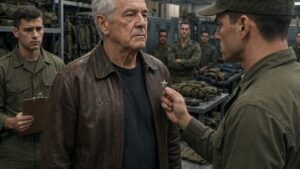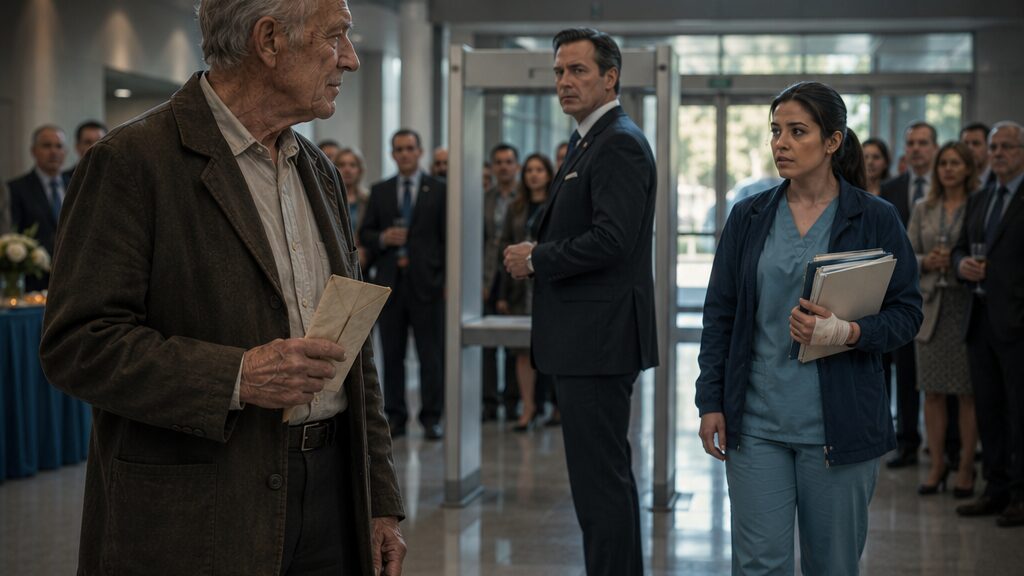
The Hospital Administrator Turned Away an Old Man Until a Nurse’s Scar Revealed Who He Once Commanded
Chapter 1: The Old Invitation No One Wanted to Read
The folded invitation slipped from Robert Baker’s hand just as the glass doors began to close.
A young volunteer caught it before it touched the floor.
“Sir.”
Robert accepted it with a nod.
“Thank you.”
The volunteer smiled politely and hurried away toward a group of donors entering the hospital.
Nobody looked at Robert twice.
He stood for a moment beneath the large banner stretched across the entrance.
FORTY YEARS OF SERVICE
MEMORIAL WING ANNIVERSARY CELEBRATION
The wind tugged lightly at the collar of his old brown coat.
The coat had been repaired twice at the elbows. The leather shoes beneath it had lost most of their shine years ago.
Robert looked exactly like what people saw.
An old man.
Nothing more.
The invitation crackled softly as he unfolded it.
The paper had yellowed around the edges.
He had received it nearly six months earlier.
Most people would have thrown it away.
Robert had folded it carefully and placed it in his coat pocket.
The same pocket where it had remained every day since.
A security officer stood beside a registration table.
Guests flowed inside.
Doctors.
Administrators.
Board members.
Military officers in dress uniforms.
Robert waited until the line shortened.
Then he approached.
The receptionist behind the table barely glanced up.
“Name?”
“Robert Baker.”
Her fingers moved across a keyboard.
Pause.
Then another pause.
She frowned.
“I’m not seeing you.”
Robert offered the invitation.
“I was asked to attend.”
She accepted it.
Looked at it.
Turned it over.
Her expression changed slightly.
Not recognition.
Confusion.
“This invitation is very old.”
“Yes.”
“The event registration was updated.”
“I understand.”
She looked uncertain.
The security officer stepped closer.
Not threatening.
Just watchful.
“Sir, do you have a current confirmation?”
“No.”
The receptionist looked relieved.
As if the answer simplified her job.
“I’m sorry, but you’ll need to speak with administration.”
Robert nodded.
“I can wait.”
He stepped aside.
No argument.
No complaint.
The receptionist was already helping someone else.
For a few minutes he stood quietly near the lobby windows.
The hospital had changed.
The old brick building he remembered had vanished decades ago.
Now there were glass towers.
Modern wings.
Digital screens.
Bright corridors.
But certain things remained.
The smell.
The sound.
The rhythm of urgency.
Hospitals never completely changed.
Pain made sure of that.
A man in a tailored suit appeared from a nearby hallway.
Jeffrey Clark.
Hospital administrator.
Forty years old.
Perfect tie.
Perfect posture.
Perfect schedule.
The receptionist immediately waved him over.
She pointed toward Robert.
Jeffrey listened.
His eyes moved across the room.
Stopped on the old coat.
The worn shoes.
The folded paper.
Robert saw the assessment happen in seconds.
Jeffrey approached.
“Good morning, sir.”
“Morning.”
“I understand there’s an issue with registration.”
Robert handed him the invitation.
Jeffrey scanned it.
“Where did you get this?”
“It was mailed to me.”
“When?”
“Several months ago.”
Jeffrey sighed.
Not dramatically.
The sigh of a man already dealing with too many problems.
“This event is invitation-only.”
Robert almost smiled.
“I know.”
Jeffrey handed the paper back.
“Unfortunately, this invitation appears outdated.”
“I was invited.”
“Even so, the guest list has changed.”
Robert folded the paper again.
Carefully.
The way someone handles something that matters.
Jeffrey noticed.
But not enough to reconsider.
“Sir, perhaps there’s another event you’re thinking of.”
“No.”
“I don’t mean to be rude.”
The sentence usually arrived right before rudeness.
Jeffrey continued.
“We have donors arriving. Military representatives. Speakers.”
“I understand.”
“You understand?”
“Yes.”
Jeffrey seemed briefly irritated by Robert’s calmness.
Most people argued.
Most people demanded.
Most people gave him something to push against.
Robert simply stood there.
Quiet.
Patient.
Present.
“Then you understand why I can’t let people wander into a restricted event.”
People.
Not guests.
Not visitors.
People.
Robert looked at him.
Not angry.
Just tired.
The administrator mistook that look for confusion.
“I can have someone help you find transportation home.”
Robert’s eyes shifted toward the hospital lobby.
Toward the memorial wing beyond the glass corridor.
“I came because I was invited.”
Jeffrey crossed his arms.
“And I need verification.”
“You can check the name again.”
Jeffrey glanced toward the receptionist.
“Sir, we’ve already done that.”
Then he turned away.
Conversation finished.
Decision made.
Robert remained standing alone.
Invisible again.
A cart rattled through the lobby.
Nurses moved between departments.
Doctors hurried past.
Life continued.
An hour passed.
Then another.
Nobody asked why the old man stayed.
Nobody asked why he kept looking toward the memorial wing.
Near noon, a nurse emerged from a side corridor.
Her dark hair was tied back.
A fresh bandage wrapped part of her left wrist.
She balanced a tablet beneath one arm while reading patient notes.
Someone called her name.
“Maria.”
She turned.
The movement shifted the bandage.
Just slightly.
Enough.
Robert froze.
The symbol appeared for less than a second.
A faded mark beneath the edge of the dressing.
A small circle crossed by three lines.
Old.
Almost hidden by scar tissue.
Robert’s breath caught.
The invitation slipped from his fingers.
Again.
This time nobody caught it.
The paper landed on the polished floor.
Maria glanced over.
Their eyes met briefly.
Then she looked down.
At the invitation.
At the old man.
At the expression on his face.
Not confusion.
Not anger.
Recognition.
Deep.
Painful.
Impossible recognition.
Robert bent slowly to retrieve the paper.
His hand trembled.
Only once.
When he looked up again, Maria was still staring at him.
And for the first time all morning, Robert Baker looked shaken.
Chapter 2: A Mark Hidden Beneath Fresh Bandages
Maria Garcia spent most of her days moving too fast to think.
Patients arrived.
Patients left.
Alarms sounded.
Phones rang.
Doctors needed charts.
Families needed answers.
There was always another task waiting.
The pace protected her.
It kept old questions buried.
Today felt different.
She noticed the old man because he looked at her as if he knew her.
Not recognized her.
Knew her.
There was a difference.
When their eyes met in the lobby, something passed across his face that she couldn’t explain.
Shock.
Grief.
Hope.
All at once.
By the time she returned from delivering medication, he was gone from the entrance.
Still, she found herself thinking about him.
The image stayed with her.
The worn coat.
The folded invitation.
The strange expression.
“Maria.”
A fellow nurse touched her shoulder.
“You okay?”
“Yeah.”
“You looked distracted.”
Maria smiled.
“Just tired.”
The nurse laughed.
“Weren’t we all?”
She returned to work.
Maria headed toward the trauma wing.
The bandage on her wrist itched.
She stepped into a supply room and carefully adjusted it.
The injury itself was recent.
A deep cut from shattered glass during an emergency response.
Nothing serious.
The scar beneath it was older.
Much older.
The faded symbol that most people never noticed.
A circle crossed by three lines.
She traced it absentmindedly.
Her father had carried the same mark.
So had several photographs stored in a box at home.
She had asked about it once when she was twelve.
He had smiled.
Then changed the subject.
Years later she asked again.
Same response.
Eventually she stopped asking.
After his death, the answers disappeared with him.
Or so she thought.
A voice interrupted her thoughts.
“Excuse me.”
Maria turned.
The old man stood in the doorway.
Robert.
Though she didn’t yet know his name.
For a second she wondered how he had found the trauma wing.
Then she noticed the visitor badge hanging from his coat.
Someone had finally allowed him inside.
“Can I help you?” she asked.
He seemed uncertain.
As though he had rehearsed a sentence and forgotten it.
Then his eyes dropped to her wrist.
Again.
The same symbol.
The same reaction.
Maria folded her arms instinctively.
Protective.
Suspicious.
“Sir?”
Robert blinked.
“I’m sorry.”
His voice was softer than she expected.
“I didn’t mean to stare.”
“Do I know you?”
“No.”
The answer came too quickly.
Not a lie.
But not the whole truth either.
Maria studied him.
His posture was military.
Not active duty.
Something older.
Something ingrained.
“What is it?” she asked.
“What?”
“My wrist.”
For several seconds he said nothing.
The silence felt heavy.
Finally he asked, “Where did you get that mark?”
Maria’s heartbeat quickened.
“You know what it is?”
He didn’t answer.
“Do you?”
His eyes remained fixed on the scar.
Not the fresh injury.
The old symbol beneath it.
“My father had one,” she said.
The words seemed to strike him physically.
“What was his name?”
Maria hesitated.
Why did this matter?
Who was this man?
“Michael Garcia.”
Robert closed his eyes.
Only briefly.
But she saw it.
Saw something break through the calm.
When he opened them again, they looked older.
Far older.
“Michael,” he repeated quietly.
“You knew him.”
Not a question.
A realization.
Robert looked away.
Toward the hallway.
Toward memories nobody else could see.
“I knew many people.”
“Did you know my father?”
The silence returned.
Longer this time.
A doctor entered the corridor.
A patient called from a nearby room.
Life continued around them.
Yet the conversation seemed isolated from everything else.
Finally Robert spoke.
“Your father was a medic.”
Maria stared.
Nobody knew that.
Not anymore.
The records listed him simply as military support personnel.
Even she knew little beyond that.
“How do you know that?”
“He carried the symbol.”
Her pulse quickened.
“What symbol?”
Again silence.
Then:
“It meant that if things went wrong, those wearing it stayed behind until everyone else got out.”
Maria felt cold.
Her father had never told her that.
Nobody had.
The words sounded too specific to be guessed.
Too personal.
“Who are you?”
Before Robert could answer, a voice echoed from the hallway.
“Maria.”
A supervisor.
She was needed immediately.
The moment shattered.
Robert stepped back.
“I’m sorry.”
“No.”
She moved toward him.
“Wait.”
But he was already retreating.
Not fleeing.
Simply leaving.
As though he had said more than intended.
Maria looked at his face one final time.
There was grief there.
And guilt.
The kind carried for decades.
Not the kind people invented.
The real kind.
The kind that survived wars.
As he turned away, she called after him.
“What happened to my father?”
Robert stopped.
His shoulders stiffened.
For a long moment he remained facing the opposite direction.
Then he asked a question instead.
One that left her standing motionless.
“Did he ever tell you about Operation Lantern?”
And without waiting for an answer, he walked away.
Chapter 3: The Mission Never Mentioned in Public
Operation Lantern.
The words followed Robert through the corridor like a ghost.
He hadn’t spoken them aloud in nearly thirty years.
Not because they were classified anymore.
Because remembering hurt.
The hospital was louder now.
Preparations for the evening celebration filled every hallway.
Staff moved equipment.
Volunteers arranged displays.
Veterans gathered near conference rooms.
Robert passed among them unnoticed.
Just another elderly visitor.
Exactly as he preferred.
Most days.
Today was different.
Today Michael Garcia’s daughter stood inside the same building.
Wearing the same symbol.
Carrying the same questions.
Robert stopped near a quiet alcove overlooking the memorial wing.
A display case occupied one wall.
Old photographs.
Construction images.
Historical records.
A timeline documenting the hospital’s growth.
Visitors passed without studying them.
Robert did.
His eyes settled on a black-and-white photograph.
Young soldiers.
Field tents.
Dust.
Heat.
Fear.
A different world.
A different life.
He remembered the night Operation Lantern began.
The helicopters.
The radio failures.
The flooding.
The impossible evacuation order.
He remembered young medics refusing to leave wounded soldiers behind.
Michael among them.
The symbol had never been official.
No government approved it.
No commander authorized it.
The medics painted it themselves.
Three lines crossing a circle.
Their promise.
Stay until the last person leaves.
Robert had hated it.
Because brave promises often demanded terrible payments.
A shadow appeared beside him.
Elizabeth Johnson.
Hospital director.
Though Robert didn’t know her name yet.
She studied the photograph.
“Most people walk past these.”
Robert nodded.
“They shouldn’t.”
She smiled faintly.
“You knew someone here?”
“Several.”
Her eyes moved across the display.
“Many didn’t come home.”
“No.”
The answer emerged quietly.
Too quietly.
Elizabeth glanced toward him.
Something about his voice made her look more carefully.
Not recognition.
Curiosity.
Before she could speak again, Jeffrey Clark appeared.
His expression tightened immediately.
There he is.
The old man again.
Still here.
Still causing complications.
“Sir.”
Robert turned.
Jeffrey forced a professional smile.
“We spoke earlier.”
“Yes.”
“You really shouldn’t be wandering through restricted areas.”
Elizabeth frowned.
“This area isn’t restricted.”
Jeffrey ignored her.
“The event begins soon.”
Robert looked at him calmly.
“I know.”
Jeffrey’s patience was thinning.
“You never checked out with reception.”
“I wasn’t aware I needed permission to look at photographs.”
Elizabeth’s eyebrows rose.
Jeffrey cleared his throat.
“The issue is that nobody can verify why you’re here.”
Robert touched the folded invitation inside his pocket.
Still there.
Still ignored.
Jeffrey noticed.
“That invitation isn’t valid proof.”
Robert said nothing.
A volunteer hurried toward them carrying event folders.
One slipped from her hands.
Papers scattered.
Robert bent to help gather them.
Among the pages was a printed program.
A list of honored contributors.
Guest speakers.
Historical acknowledgments.
Robert handed the papers back without reading further.
But Elizabeth noticed something.
The volunteer noticed too.
A name.
Near the bottom.
Partially visible before the folder closed.
Robert Baker.
The volunteer looked from the paper to the old man.
Then back again.
Confusion crossed her face.
Jeffrey missed it completely.
“Sir,” he said, “I’m going to ask security to escort you to the visitor lounge until we sort this out.”
Not a threat.
Not yet.
Just another dismissal.
Robert nodded.
“I’ve waited in worse places.”
The sentence landed strangely.
Jeffrey frowned.
Elizabeth looked at Robert more carefully than before.
A memory stirred.
A name.
A photograph.
Something she couldn’t quite place.
Then a nearby phone rang.
A staff member answered.
Listened.
Suddenly looked alarmed.
“Administrator Clark?”
Jeffrey turned.
The staff member approached quickly.
“There’s a call for you.”
“What is it?”
The employee lowered his voice.
“Someone from Washington.”
Jeffrey frowned.
“About what?”
The employee glanced toward Robert.
Then back at Jeffrey.
“They’re asking whether a Mr. Robert Baker has arrived.”
Silence.
A very small silence.
But enough.
Enough for Elizabeth to look sharply at Robert.
Enough for Jeffrey’s confidence to falter for the first time all day.
Enough for Robert to realize the evening was about to become much more complicated than he had hoped.
Chapter 4: The Administrator Who Refused to Verify
Jeffrey Clark disliked surprises.
Hospitals produced enough of them already.
Equipment failures.
Staff shortages.
Last-minute donor requests.
Unexpected media attention.
The anniversary celebration had taken months to organize, and he intended for everything to unfold exactly as planned.
The phone call disrupted that plan.
“Who is this?” Jeffrey asked, taking the receiver from the staff member.
The answer came immediately.
A calm voice.
Professional.
Official.
Jeffrey’s posture straightened without conscious thought.
The caller asked a simple question.
Had Robert Baker arrived?
Jeffrey glanced across the corridor.
The old man remained beside the historical display.
Looking at photographs.
Nothing about him suggested someone important enough to receive calls from Washington.
“May I ask why?” Jeffrey said carefully.
“I’m calling regarding his attendance this evening.”
The response revealed nothing else.
When the call ended, Jeffrey stood silently for several seconds.
Elizabeth Johnson watched him.
“Problem?”
“No.”
The answer came too quickly.
Which meant yes.
Jeffrey looked again toward Robert.
The old man had already resumed studying the photographs.
Not watching.
Not listening.
Not demanding attention.
If this was some attempt to gain access through connections, it was a strange one.
Most people would have mentioned the call.
Used it as leverage.
Robert did neither.
Jeffrey walked toward him.
“Mr. Baker.”
Robert turned.
“Yes?”
“I received a call.”
Robert nodded slightly.
“As expected.”
The answer irritated Jeffrey.
“As expected?”
“I told a friend where I would be.”
“A friend in Washington?”
“Something like that.”
Jeffrey folded his arms.
The response felt evasive.
Everything about Robert felt evasive.
Not dishonest.
Simply incomplete.
“Why are you really here?”
Robert’s eyes drifted toward the memorial wing.
The answer seemed obvious to him.
Less so to everyone else.
“I came because I was invited.”
Jeffrey exhaled.
There it was again.
The same answer.
The same folded invitation.
The same refusal to explain himself.
Most people eventually revealed what they wanted.
Special treatment.
Recognition.
Access.
Money.
Robert wanted none of those things.
Which somehow made him harder to understand.
“The guest list has been reviewed multiple times.”
“I’m sure it has.”
“Your name isn’t on it.”
For the first time Robert looked directly at him.
“Did you check every list?”
Jeffrey frowned.
“What does that mean?”
“It means exactly what it sounds like.”
The old man returned his attention to the photographs.
Conversation over.
Jeffrey disliked being dismissed.
Especially by someone he considered a problem.
A volunteer approached carrying additional event materials.
“Administrator Clark?”
Jeffrey stepped away.
The work resumed.
Schedules.
Guest seating.
Security arrangements.
Yet the question lingered.
Did you check every list?
Late in the afternoon, Jeffrey entered a conference room being prepared for the evening ceremony.
Historical displays lined the walls.
Photographs.
Letters.
Documents.
Hospital milestones.
One display had not yet been fully assembled.
Boxes remained open nearby.
Jeffrey barely noticed them until a volunteer called out.
“Can someone help me with this archive panel?”
He walked over.
The display contained photographs from the hospital’s earliest years.
Images taken before the modern expansion.
Before donor campaigns.
Before national recognition.
One photograph had fallen loose from its frame.
Jeffrey picked it up.
Several military personnel stood outside a temporary medical facility.
A much younger hospital.
A much younger world.
Nothing remarkable.
He placed it back.
Then paused.
One face looked familiar.
Not because he recognized the man.
Because he had seen him today.
Older.
Wearing a worn brown coat.
Jeffrey stared.
The resemblance unsettled him.
The photograph caption had partially faded.
Only fragments remained visible.
“…special advisory board…”
“…medical transition initiative…”
“…Robert B…”
A volunteer reached for the frame.
“We still need the replacement plaque.”
Jeffrey handed it over.
His discomfort deepened.
Coincidences happened.
Old photographs existed everywhere.
That did not mean anything.
Still, he found himself returning to the registration system.
Searching again.
Robert Baker.
Nothing.
Searching archived records.
A longer pause.
Several results appeared.
Most were incomplete.
One file was restricted.
Another had been transferred to historical archives.
Jeffrey clicked again.
Access denied.
He leaned back.
The old man was becoming increasingly inconvenient.
Not because of what he knew.
Because of what nobody seemed willing to explain.
Hours later the event guests began arriving.
Military officers.
Hospital trustees.
Community leaders.
Jeffrey moved through the lobby greeting everyone.
Smiling.
Managing.
Controlling.
Then he saw Robert again.
Seated alone near a window.
The same coat.
The same invitation.
The same patience.
The image irritated him more than it should have.
People who belonged at important events usually acted as though they belonged.
Robert acted as though he expected nothing.
That somehow made Jeffrey feel judged.
The sensation worsened when Elizabeth approached.
“You’ve spent a lot of time worrying about him.”
“I’m not worried.”
“You keep checking on him.”
Jeffrey looked away.
“He doesn’t make sense.”
Elizabeth studied Robert across the room.
“Maybe that’s because you’re asking the wrong question.”
“What question should I ask?”
She considered.
Then shrugged.
“Not who he is.”
Jeffrey frowned.
Before he could respond, a staff member hurried toward him.
“Administrator Clark.”
“What now?”
“The call came back.”
Jeffrey’s stomach tightened.
“The call?”
“Yes.”
The employee lowered his voice.
“The caller asked whether Mr. Baker had been treated appropriately.”
Silence.
A much longer silence this time.
Jeffrey looked toward Robert.
The old man remained seated.
Hands folded.
Watching evening sunlight spread across the hospital courtyard.
Completely unaware.
Or pretending to be.
The staff member swallowed.
“There’s something else.”
“What?”
“The caller said General Patrick Hill is on his way.”
Jeffrey blinked.
One of the evening’s most distinguished guests.
An active-duty general.
A scheduled speaker.
“Why?”
The employee hesitated.
Then answered softly.
“He said he needs to see Robert Baker immediately.”
Chapter 5: The Name Hanging in the Archive Hall
Maria should have gone home hours ago.
Instead she found herself walking toward the hospital archives.
Operation Lantern.
The name refused to leave her thoughts.
Neither did Robert Baker.
Every spare moment during her shift had been consumed by questions.
Questions her father had never answered.
Questions nobody else seemed able to answer.
The archive hall occupied a quiet section of the hospital rarely visited by patients.
Historical displays stretched along the walls.
Photographs.
Newspaper articles.
Construction records.
Military partnerships.
Maria wandered slowly through them.
At first she searched for the symbol.
The circle crossed by three lines.
Eventually she found it.
Small.
Nearly hidden.
Painted onto the sleeve of a medic standing beside a transport helicopter.
Her pulse quickened.
She stepped closer.
The image had been taken decades earlier.
Several faces were difficult to identify.
Others remained surprisingly clear.
One stood out immediately.
Her father.
Young.
Smiling.
Alive.
Maria touched the edge of the frame.
The sight hit harder than expected.
Most photographs at home showed him as a parent.
This showed someone else.
Someone carrying responsibilities she had never understood.
She continued reading.
Operation Lantern.
Emergency evacuation.
Medical extraction.
Flooded combat zone.
Heavy casualties.
Limited resources.
Many details remained intentionally vague.
Still, the outline emerged.
A mission that nearly collapsed.
A mission saved by medics who refused to abandon wounded personnel.
A mission few people discussed publicly afterward.
Maria stared at her father’s photograph.
Then at another figure standing beside him.
Tall.
Serious.
Wearing field gear.
The face looked familiar.
Her breath caught.
Robert.
Much younger.
But unmistakably Robert.
The same eyes.
The same posture.
The same quiet expression.
For several seconds she simply stared.
Then she noticed the caption.
FIELD COMMAND TEAM
Operation Lantern
Among the listed names:
Robert Baker.
Maria stepped backward.
The hallway suddenly felt smaller.
She looked again.
And again.
The old man from the lobby.
The man who recognized the symbol.
The man who knew her father had been a medic.
He had stood beside him.
Maybe commanded him.
Maybe known him better than she ever would.
A voice interrupted her thoughts.
“You’re not the first person who’s stood there all afternoon.”
Maria turned.
Elizabeth Johnson approached carrying several folders.
“You knew him,” Maria said immediately.
“Robert Baker?”
Elizabeth nodded.
“Not personally.”
“You know who he is.”
A small smile crossed Elizabeth’s face.
“I know enough.”
Maria looked back at the photograph.
“Why didn’t anyone tell me?”
“Tell you what?”
“That he was part of this.”
Elizabeth studied the image.
“Because most people stopped asking.”
Maria felt frustration rising.
“My father never talked about it.”
“Many of them didn’t.”
“Why?”
Elizabeth took her time answering.
“When people survive something difficult, they don’t always spend the rest of their lives revisiting it.”
Maria looked again at Robert’s younger face.
“He recognized the symbol immediately.”
“That doesn’t surprise me.”
The hospital director opened one of the folders.
Inside were copies of historical records.
Meeting notes.
Planning documents.
Funding approvals.
Partnership agreements.
Maria’s eyes moved across the pages.
One name appeared repeatedly.
Robert Baker.
Not as a donor.
Not as a guest.
As a decision-maker.
A founder.
A planner.
A person involved long before the hospital became what it was today.
“This can’t be right.”
“It is.”
Elizabeth sounded almost amused.
“The memorial wing wouldn’t exist in its current form without him.”
Maria stared.
The old man had spent half the day being treated like an unwanted visitor.
Meanwhile his name appeared throughout the hospital’s history.
“Does Jeffrey know?”
Elizabeth laughed softly.
“No.”
The answer explained everything.
A distant commotion echoed through the lobby.
Voices.
Movement.
The arrival of an important guest.
Several staff members hurried past the archive entrance.
One paused long enough to speak.
“General Hill just arrived.”
Elizabeth closed the folder.
“That should make the evening interesting.”
Maria looked toward the hallway.
Something told her Robert Baker would not remain anonymous much longer.
Chapter 6: When the Entire Lobby Went Silent
By evening the hospital lobby glowed with soft light.
Tables had been arranged.
Guests filled the reception area.
Conversations blended into a steady murmur.
Robert remained near the edge of the room.
Away from the center.
Away from attention.
Exactly where he preferred to be.
He watched people gather around displays celebrating decades of service.
Doctors posed for photographs.
Former patients reunited with staff.
Veterans exchanged stories.
The hospital felt alive.
That mattered more to him than any ceremony.
The memorial wing existed.
People were being helped.
That was enough.
Or it should have been.
Jeffrey Clark spotted him almost immediately.
The administrator moved across the room.
Determined.
Uneasy.
“Mr. Baker.”
Robert looked up.
“Good evening.”
Jeffrey hesitated.
The confidence that had carried him through the day seemed thinner now.
“I understand General Hill is asking for you.”
Robert sighed quietly.
“I was afraid of that.”
Jeffrey blinked.
Afraid?
Most people would have sounded proud.
Not Robert.
“I need an explanation.”
“I know.”
“Then give me one.”
Before Robert could answer, movement near the entrance drew everyone’s attention.
Conversations faded.
A group of military personnel entered.
At their center walked Patrick Hill.
Tall.
Composed.
Still carrying the unmistakable bearing of command.
Guests immediately recognized him.
Several approached.
Patrick acknowledged them politely.
Then continued walking.
Straight through the crowd.
Past donors.
Past trustees.
Past hospital executives.
Toward the old man standing beside the window.
The room gradually noticed.
Voices lowered.
Heads turned.
Jeffrey stood frozen.
Patrick stopped in front of Robert.
For a brief moment neither man spoke.
Then Patrick smiled.
Not the smile of a public official.
The smile of someone seeing a mentor.
A friend.
Someone long respected.
“Sir.”
Robert looked mildly annoyed.
“You weren’t supposed to come.”
Patrick laughed.
“I know.”
Then, before anyone could process what was happening, Patrick straightened.
The room watched.
Silence spread.
And Patrick addressed him clearly enough for everyone nearby to hear.
“General Baker.”
The lobby went completely still.
No applause.
No dramatic reaction.
Just silence.
Pure silence.
Jeffrey felt the blood drain from his face.
Elizabeth closed her eyes briefly as if she had expected exactly this.
Maria stared from across the room.
General.
The word echoed through her thoughts.
Patrick continued.
“The Pentagon office called twice. You never answered.”
“I was busy.”
“Apparently.”
Robert glanced toward Jeffrey.
Not accusingly.
Simply acknowledging reality.
Patrick followed the look.
His expression changed.
Not anger.
Understanding.
He understood exactly what had happened.
Jeffrey wished he didn’t.
Guests began whispering.
Questions moved through the crowd.
General Baker?
That General Baker?
Robert seemed uncomfortable with the attention.
Patrick noticed.
As always.
“Sorry, sir.”
“You always were.”
Patrick laughed again.
Then Elizabeth stepped forward.
She carried a framed photograph.
The same image Maria had seen in the archive hall.
Operation Lantern.
Young faces.
Young sacrifices.
Elizabeth positioned it carefully beside the memorial display.
“Perhaps,” she said quietly, “everyone should know why he’s here.”
The room settled.
Listening.
Robert looked at the photograph.
Then at Maria.
The scar on her wrist was visible again.
For the first time all day she stood close enough to see his eyes clearly.
There was grief there.
And affection.
And something unfinished.
Patrick spoke softly.
“Tell them.”
Robert remained silent.
The old weight returned.
The memories.
The names.
The promises.
For years he had avoided speaking about Operation Lantern.
Not because he forgot.
Because he remembered too well.
Maria took one step forward.
“My father was Michael Garcia.”
The room disappeared.
Only that sentence remained.
Robert nodded.
“I know.”
“You served with him.”
Another nod.
“He saved lives.”
Robert’s voice roughened slightly.
“Many.”
Maria swallowed.
“Then tell me what happened.”
The request hung in the air.
No rank could answer it.
No title could avoid it.
For the first time that evening Robert understood why he had truly come.
Not for the ceremony.
Not for recognition.
For this.
For her.
For the question he had carried for decades.
And slowly, before an utterly silent room, Robert Baker prepared to speak.
Chapter 7: The Lesson That Had Nothing to Do With Rank
No one moved.
The lobby remained silent as Robert Baker looked at Maria Garcia.
The photograph stood between them.
A younger version of her father frozen in time.
A younger version of Robert standing beside him.
For years Robert had imagined this conversation.
Sometimes in airports.
Sometimes in hotel rooms.
Sometimes in the middle of the night when old memories refused to stay buried.
In every version he had prepared.
In every version he had rehearsed.
None had felt real until now.
He took a slow breath.
“Your father saved my life.”
Maria’s eyes widened.
The room seemed to lean closer.
Robert looked at the photograph.
“Operation Lantern was supposed to be an evacuation.”
His voice remained calm.
Measured.
The voice of someone who had spent decades controlling difficult memories.
“We were moving wounded personnel out of a flooded area. Weather conditions changed. Communications failed. Several transport routes disappeared.”
Nobody interrupted.
Even Jeffrey stood motionless.
“We had more wounded than aircraft capacity. More danger than time.”
Robert glanced at Patrick.
The active-duty general lowered his eyes.
He had heard portions of the story before.
Not all of it.
Almost no one had.
“We were losing people.”
Robert’s gaze returned to Maria.
“Your father was one of the medics who refused to leave.”
Maria looked down at the symbol on her wrist.
The faded mark that suddenly felt heavier than it had that morning.
“He believed nobody should be abandoned.”
Robert nodded.
“Yes.”
The word carried enormous weight.
“That symbol wasn’t official. They made it themselves. A promise among the medics.”
Several people looked toward Maria’s scar.
For the first time she understood why Robert had frozen when he saw it.
“It meant they stayed until the last person got out.”
A long silence followed.
Then Maria asked the question she had carried all day.
“Did he die there?”
Robert closed his eyes briefly.
“No.”
Relief crossed her face.
Then vanished when she saw the sadness in his expression.
“He survived the mission.”
The room waited.
Robert continued.
“He came home. Built a family. Worked. Lived.”
Maria swallowed.
“My mother never told me any of this.”
“Many families never heard everything.”
His eyes drifted across the lobby.
Across veterans.
Doctors.
Administrators.
People who benefited from sacrifices they never witnessed.
“When people survive difficult things, they often leave pieces of those stories behind.”
Maria nodded slowly.
That sounded like her father.
A man who rarely talked about himself.
A man who changed the subject whenever old military service appeared in conversation.
Robert reached into his coat pocket.
The same pocket that had carried the invitation all day.
Carefully he removed a small envelope.
Aged.
Worn.
Protected for years.
He held it for a moment before offering it to her.
Maria accepted it cautiously.
“What is this?”
“Something your father gave me.”
The lobby grew even quieter.
“He told me to keep it unless I met someone carrying that symbol.”
Maria stared at the envelope.
Her hands trembled.
Inside was a folded note.
A photograph.
And a patch bearing the faded emblem.
The same circle crossed by three lines.
Tears filled her eyes before she realized it.
The photograph showed her father beside several medics.
Laughing.
Covered in mud.
Alive.
Young.
Proud.
The note contained only a few lines.
If this reaches my family, tell them I was exactly where I wanted to be.
Tell them nobody was left behind.
Maria pressed her lips together.
For several seconds she couldn’t speak.
Robert looked away.
Giving her privacy despite standing before hundreds of people.
That small kindness somehow made the moment more emotional.
Patrick stepped forward quietly.
“There are things this hospital should know as well.”
Elizabeth nodded.
She carried another folder to the front of the room.
Historical documents.
Planning records.
Original agreements.
Pages that had spent decades in archives.
“The memorial wing everyone is celebrating tonight,” she said, “exists because of a medical transition initiative proposed after Operation Lantern.”
Murmurs spread through the crowd.
Elizabeth continued.
“The proposal came from Robert Baker.”
Heads turned toward him again.
Robert looked mildly uncomfortable.
The attention clearly annoyed him.
“The initiative expanded emergency trauma capacity across multiple facilities.”
Elizabeth held up a document.
His signature appeared at the bottom.
“Years later that initiative became the foundation for this wing.”
Silence returned.
Not shocked silence now.
Thoughtful silence.
The kind that follows understanding.
Jeffrey felt something sink inside him.
All day he had treated Robert as a nuisance.
An obstacle.
An elderly man carrying an outdated invitation.
Meanwhile the building around them contained traces of his decisions.
His work.
His sacrifices.
Not because he was famous.
Because he had spent years helping create something that outlived him.
Jeffrey stepped forward.
The movement felt awkward.
Uncertain.
For perhaps the first time that day, he wasn’t sure how to manage a situation.
“General Baker.”
Robert looked at him.
Jeffrey hesitated.
The title felt strange now.
Not because it was wrong.
Because it suddenly seemed irrelevant.
The real problem wasn’t failing to recognize a general.
The real problem was everything that came before.
“I owe you an apology.”
Robert said nothing.
Jeffrey continued.
“I judged you without knowing who you were.”
The older man regarded him quietly.
Then shook his head.
“That’s not the mistake.”
Jeffrey frowned.
Robert’s voice remained gentle.
“You shouldn’t have needed to know.”
The words landed harder than any public rebuke.
Around them several people lowered their eyes.
Including Jeffrey.
Robert continued.
“If I had been exactly who you thought I was, you still should have treated me with respect.”
No anger.
No accusation.
Only truth.
Jeffrey looked down.
For the first time all day, he had no defense.
“No excuse,” he said softly.
“No.”
Robert nodded.
“But there’s a difference between an excuse and a lesson.”
The administrator swallowed.
Then managed a small nod.
Across the room Maria carefully folded her father’s note and placed it back inside the envelope.
Her eyes remained wet.
Yet she smiled.
Not because every question had been answered.
Because one important question finally had.
Her father mattered.
His service mattered.
His silence had hidden courage rather than emptiness.
Robert approached her.
The crowd parted naturally.
Not because of rank.
Because people sensed the moment belonged to them.
Maria looked up.
“Thank you.”
Robert shook his head.
“Your father earned that.”
For a moment neither spoke.
Then Maria held up the patch.
“I think he wanted someone to remember.”
Robert smiled sadly.
“I think he did.”
The ceremony eventually continued.
Speeches were given.
Acknowledgments made.
Photographs taken.
Yet the atmosphere had changed.
The official program no longer felt like the center of the evening.
Something more important had happened.
Later, after most guests departed, Jeffrey stood with Elizabeth reviewing final details.
“I’ve already spoken with reception.”
Elizabeth glanced at him.
“About?”
“A new policy.”
She waited.
“No visitor gets dismissed without proper verification.”
A faint smile crossed her face.
“Good.”
“It should have existed already.”
“Yes.”
Jeffrey watched Robert across the lobby.
The old man stood near the exit.
Still wearing the same worn coat.
Still carrying himself exactly as he had that morning.
Nothing about him looked different.
Only people’s understanding had changed.
Maria approached Robert one last time.
“Will I see you again?”
“I hope so.”
“You have more stories.”
A hint of amusement appeared in his eyes.
“Probably.”
She laughed softly.
Then surprised herself by hugging him.
Robert hesitated.
Then returned it gently.
For a brief moment he felt a burden lift.
Not disappear.
Just become lighter.
When they separated, Maria touched the symbol on her wrist.
The mark no longer felt mysterious.
It felt connected.
To her father.
To sacrifice.
To service.
To memory.
Robert nodded toward it.
“Keep asking questions.”
“I will.”
Then he turned toward the doors.
Patrick moved to accompany him.
Robert stopped him.
“You don’t need to escort me.”
Patrick smiled.
“I know.”
Outside, the night air felt cool.
The hospital lights glowed behind him.
A living monument.
Not to him.
To everyone who had served.
Everyone who had healed.
Everyone who had stayed behind so others could leave.
Robert slipped his hands into the pockets of his old coat and began walking toward the parking lot.
No crowd followed.
No grand farewell arrived.
Exactly as he preferred.
Behind him, inside the hospital, people continued their work.
Patients still needed care.
Nurses still moved through hallways.
Life continued.
As it should.
Robert looked back only once.
The memorial wing windows reflected the evening sky.
For the first time in many years, the memory of Operation Lantern hurt a little less.
Then he turned and walked on.
The story has ended.