The Elderly Man Everyone Thought Was Lost Until He Read the Soldier’s Chart and Changed the Night
Chapter 1: The Helicopter Nobody Expected After Midnight
The helicopter lights flashed across the hospital windows before anyone heard the rotors.
Robert Hill looked up from the paper cup of coffee in his hands.
The waiting room had been nearly empty a moment earlier. A veteran patient slept beneath a television tuned to a late-night weather report. A receptionist was finishing paperwork. Somewhere down the hallway, a floor buffer hummed.
Then everything changed.
A trauma alert sounded.
People began moving.
Doors opened. Phones rang. Nurses hurried toward the emergency entrance.
Robert watched the reflection of red and white lights sweep across the polished floor.
Military transport.
Not civilian.
His fingers tightened around the coffee cup.
For a second he was no longer seventy-two years old.
He was twenty-three.
Mud.
Rain.
Rotors.
Stretchers.
The smell of fuel.
A young soldier screaming for someone named Eddie.
The memory vanished as quickly as it came.
A nurse rushed past him.
“Sir, we’re going to need this area clear.”
Robert nodded and stood.
“Military transport?” he asked.
The nurse barely slowed.
“Looks like it.”
Then she was gone.
Robert folded the discharge paperwork from his routine cardiology appointment and slipped it into his jacket pocket.
He should have been heading home.
Carolyn would probably be asleep already.
Instead he found himself drifting toward the emergency department doors.
Not because he wanted excitement.
Because old habits were stubborn things.
The corridor beyond the waiting area was alive with motion.
Staff gathered equipment.
A trauma resident checked supplies.
Someone pushed a cart loaded with blood products toward a treatment room.
The helicopter noise finally reached the building.
A low vibration.
Familiar.
Uncomfortable.
Robert stopped near a glass partition.
Outside, flashing lights illuminated the landing area.
The helicopter settled onto the pad.
A security guard noticed him.
“Sir, family waiting area is back there.”
Robert pointed toward the landing zone.
“How many?”
The guard frowned.
“How many what?”
“Casualties.”
The guard looked annoyed.
“I don’t know.”
Robert nodded.
He knew the expression.
Old man asking unnecessary questions.
The guard returned his attention to the doors.
The helicopter engines slowed.
Moments later the emergency entrance burst open.
A flight medic rushed inside.
Behind him came stretchers.
One.
Two.
Three.
The pace of the room changed instantly.
The first patient disappeared into Trauma One.
The second into Trauma Two.
The third remained in the hallway for several seconds while staff coordinated assignments.
Robert watched carefully.
Training never really left.
You stopped using it.
You forgot details.
But your eyes never stopped seeing.
The third soldier looked young.
Maybe late twenties.
Blood stained the front of his uniform.
His face was pale beneath the emergency lights.
Something about him made Robert pause.
Not recognition.
Similarity.
The shape of the jaw.
The dark hair.
The stubborn expression visible even through pain.
For a heartbeat Robert saw another face.
A soldier from decades ago.
One of the names he still remembered.
The stretcher rolled away.
Robert found himself following.
Not closely.
Not enough to interfere.
Just close enough to see.
A doctor emerged from Trauma Three.
Stephanie Davis.
Her name tag identified her before her voice did.
She moved fast and spoke faster.
“What do we have?”
The flight medic answered while walking.
“Blast exposure. Significant blood loss. Stable airway. Possible thoracic injury.”
Stephanie nodded.
“Get him inside.”
Everyone listened immediately.
Robert respected that.
Competence had a way of cutting through noise.
The doors swung closed behind them.
He remained outside.
A visitor.
Nothing more.
A nurse approached.
“Sir, you can’t stand here.”
“I know.”
“Then I’ll need you to move back to the waiting area.”
Robert smiled slightly.
Not angry.
Not offended.
Just familiar with the situation.
“Of course.”
He stepped away.
The nurse relaxed.
Problem solved.
She never noticed that Robert had already seen something bothering him.
A detail.
A small one.
Easy to miss.
The wounded soldier’s breathing pattern.
The way his left shoulder moved.
The uneven rise of his chest.
Not proof.
Only concern.
Still, concern had kept people alive before.
Robert returned to the waiting room.
The television continued talking about rain.
The veteran patient still slept.
The world outside the trauma department continued normally.
Inside, lives were changing.
An hour passed.
Then another.
Robert should have left.
Instead he sat with his coffee growing cold.
Every so often staff rushed by.
Every so often someone called for equipment.
The rhythm felt painfully familiar.
Finally a chart slipped from a transport cart as a nurse hurried around a corner.
Pages scattered across the floor.
Without thinking, Robert bent to help.
The nurse looked relieved.
“Thank you.”
He gathered papers.
One page caught his attention.
Only for a second.
Name.
Age.
Injury summary.
James Anderson.
Twenty-nine.
Robert handed the papers back immediately.
But the name stayed with him.
James Anderson.
The soldier from the stretcher.
The nurse hurried away.
Robert remained standing.
Something about the case felt wrong.
Not dramatic.
Not obvious.
Just wrong.
He reached into his jacket and touched a small notebook resting in the inner pocket.
Old leather.
Worn edges.
A faded stain darkened one corner.
He carried it everywhere.
Not because he needed it.
Because some things became part of you.
A loud voice echoed from down the hall.
Someone calling for additional blood.
Robert closed his eyes briefly.
Then he heard it.
Not the voice.
Not the equipment.
A memory.
A young medic saying exactly the same words fifty years earlier.
When Robert opened his eyes again, the helicopter lights were gone.
But the unease remained.
And somewhere beyond the swinging trauma room doors, a soldier named James Anderson was still fighting for his life.
Chapter 2: The Old Notebook on the Floor
Stephanie Davis hated uncertainty.
Trauma medicine offered plenty of it.
She simply refused to surrender to it.
The wounded soldier had arrived eighty-three minutes earlier, and nothing about the case behaved the way it should.
She studied the latest scans.
Blood pressure unstable.
Internal damage worse than initial assessment suggested.
Yet the numbers still failed to tell a complete story.
A resident stepped beside her.
“Lab results.”
Stephanie took the report.
Read it.
Read it again.
Something still didn’t fit.
“Repeat the panel.”
The resident hurried away.
Stephanie rubbed her eyes.
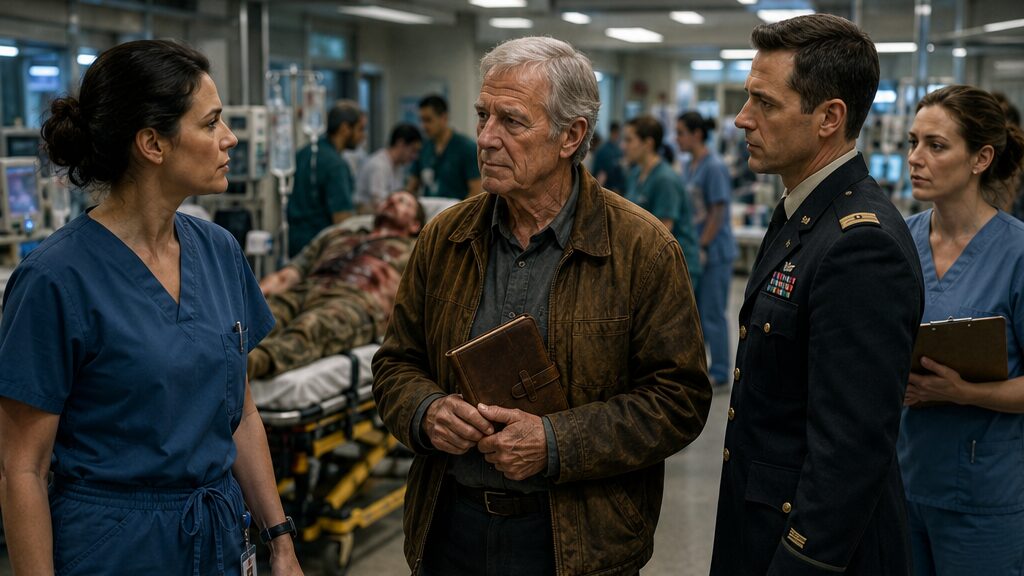
She had not noticed the elderly man standing near the observation window until a nurse approached him.
Again.
The same man.
Gray hair.
Calm expression.
Patient bracelet still attached to his wrist.
The nurse guided him away from the trauma area.
Stephanie returned to work.
Ten minutes later she saw him again.
This time he stood near a transport station examining a whiteboard.
The nurse looked frustrated.
“Sir, you can’t be here.”
“I understand.”
“Then please go back to the waiting area.”
“I will.”
He said it politely.
Not argumentative.
Yet somehow he kept returning.
Stephanie walked over.
“What’s your name?”
The man looked at her.
“Robert Hill.”
“Mr. Hill, are you waiting for family?”
“No.”
“Then I really need you away from the trauma zone.”
His eyes shifted briefly toward James’s room.
“That soldier came from a blast injury?”
Stephanie frowned.
“Why?”
“Just asking.”
She folded her arms.
“Mr. Hill.”
He nodded.
“I know.”
Then he walked away.
No argument.
No complaint.
Which somehow annoyed her more.
An hour later the situation worsened.
James’s condition fluctuated unexpectedly.
The trauma team worked continuously.
A nurse rushed through intake carrying supplies.
Someone collided with her.
The clipboard she carried struck Robert’s shoulder.
His jacket slipped.
Something dropped onto the floor.
A small notebook.
The nurse crouched immediately.
“I’m sorry.”
Robert bent to retrieve it.
The notebook opened before he reached it.
Pages spread across the floor.
Stephanie happened to glance down.
At first she saw only old handwriting.
Then she stopped.
The pages were filled with treatment notes.
Field sketches.
Triage markings.
Dates.
Military abbreviations.
A faded brown stain marked several pages.
Not dirt.
Not coffee.
Something older.
Something harder to ignore.
The nurse stared.
“What is this?”
Robert closed the notebook.
“Just notes.”
Stephanie extended a hand.
“May I?”
For a moment she thought he might refuse.
Instead he handed it over.
She opened the cover.
Inside was a name.
Robert Hill.
Combat Medic.
The year beneath it was decades old.
The pages contained injury observations written under impossible conditions.
Quick assessments.
Improvised treatments.
Names.
Lots of names.
The notebook felt less like a journal and more like evidence.
Evidence of a life she had never imagined belonged to the quiet old man wandering her hallway.
A voice interrupted.
“Doctor.”
Christopher Lee approached from the corridor.
Still in uniform.
Still carrying the exhaustion of a long transport mission.
His eyes landed on the notebook.
Then on Robert.
Recognition flickered across his face.
“You’re Robert Hill?”
Robert seemed uncomfortable.
“Yes.”
Christopher straightened unconsciously.
Not a formal salute.
Not exactly.
But something changed.
His posture.
His tone.
His attention.
“I’ve heard your name.”
Stephanie looked between them.
Robert sighed softly.
“That usually means somebody’s telling old stories.”
Christopher smiled.
“Some stories deserve telling.”
Robert took the notebook back.
“Not tonight.”
The conversation ended there.
No dramatic reveal.
No explanation.
Yet the atmosphere shifted.
Stephanie noticed it immediately.
The nurses noticed too.
Nobody suddenly treated Robert like a celebrity.
But they stopped treating him like an inconvenience.
A few minutes later Stephanie found him standing quietly near a chart station.
Not interfering.
Watching.
Thinking.
She walked over.
“What did you do?”
Robert looked surprised.
“In life?”
“In the military.”
His eyes settled on the trauma room doors.
“I tried to get people home.”
The answer carried no pride.
Only weight.
Stephanie waited.
He offered nothing else.
Before she could continue, a monitor alarm sounded inside James’s room.
Staff rushed past.
Robert’s gaze followed them.
Then he looked toward the chart briefly visible on the workstation screen.
His expression changed.
Slightly.
Enough for Stephanie to notice.
“What is it?”
He hesitated.
“Probably nothing.”
“What?”
Robert studied the screen.
Then the trauma room.
Then Stephanie.
“You’re looking at the chest injuries.”
“Of course.”
“Good.”
He paused.
“I’d take another look at the vascular damage.”
Stephanie stared.
“Why?”
Robert’s eyes returned to the room.
“Because if I’m right, you’re about to find a problem nobody’s looking for.”
Chapter 3: A Warning Nobody Wants to Hear
The room grew quieter around Robert.
Not literally.
Machines still beeped.
Phones still rang.
Stretchers still rolled through hallways.
But inside his head, everything narrowed.
The chart.
The breathing pattern.
The shoulder movement.
The blood loss.
Pieces.
Pieces that didn’t belong together.
Stephanie stood beside him.
“What problem?”
Robert kept his voice low.
“I could be wrong.”
“Tell me anyway.”
He looked toward James’s room.
Years ago he would have spoken immediately.
Experience had taught him caution.
Not because he doubted himself.
Because certainty could kill.
“I saw injuries like that overseas.”
Stephanie listened.
No interruption.
No impatience.
That alone felt strange.
“The obvious wound pulls everyone’s attention,” Robert said. “Then something hidden finishes the job.”
Stephanie’s eyes sharpened.
“What hidden injury?”
“An arterial tear.”
She considered it.
“We scanned him.”
“I know.”
“Nothing showed.”
Robert nodded.
“Sometimes it doesn’t.”
A resident approached.
Stephanie turned.
“Review the vascular imaging again.”
The resident looked confused.
“Again?”
“Again.”
He hurried away.
Stephanie looked back at Robert.
“You’ve seen this before?”
Robert smiled faintly.
“More than I wanted to.”
He didn’t elaborate.
She didn’t press.
Not yet.
Hours earlier she would have.
Now curiosity had replaced irritation.
The change surprised her.
Nearby, Christopher Lee completed paperwork with military representatives.
His gaze occasionally drifted toward Robert.
The same respect remained.
Not exaggerated.
Just present.
Robert disliked being watched that way.
He had spent most of his life trying to focus attention on patients instead of himself.
A nurse approached.
“Mr. Hill?”
He turned.
“We found a quieter waiting room if you’d like somewhere more comfortable.”
Comfortable.
The word almost made him laugh.
Instead he thanked her.
Another small change.
Earlier nobody cared where he waited.
Now they did.
Not because of who he had been.
Because they were beginning to suspect he might still matter.
That thought unsettled him.
The resident returned suddenly.
Fast.
Too fast.
“Doctor.”
Stephanie looked up.
“What is it?”
The resident handed her a tablet.
She read silently.
Then again.
The color drained slightly from her face.
“What?”
Robert asked.
Stephanie looked at him.
“There is a vascular abnormality.”
Nobody spoke.
The resident broke the silence.
“It wasn’t obvious on the first review.”
Robert closed his eyes briefly.
Not satisfaction.
Relief.
For a moment.
Only a moment.
Because relief vanished when alarms erupted from James’s room.
Every head turned.
A nurse rushed through the doors.
“Pressure’s dropping.”
Another alarm followed.
Then another.
The room exploded into motion.
Stephanie was already moving.
The resident followed.
Staff flooded toward the trauma bay.
Robert remained where he stood.
Watching.
Listening.
Remembering.
The sound of alarms blended with memories he spent years trying not to revisit.
Different building.
Different decade.
Same urgency.
Same race against time.
Christopher stepped beside him.
“You’re worried.”
Robert didn’t answer immediately.
“I’ve heard those alarms before.”
Christopher nodded.
Neither man spoke further.
Through the partially open trauma doors, Robert caught a glimpse of James Anderson.
Young.
Pale.
Surrounded by people fighting to keep him alive.
For an instant another face appeared over the soldier’s.
A young man named Tyler.
Another casualty.
Another night.
Another name written long ago.
Robert touched the notebook inside his jacket.
Not for comfort.
For accountability.
The names inside had never left him.
And now another name was trying to join them.
Inside the trauma room, voices rose.
Orders.
Measurements.
Requests.
Stephanie’s voice cut through the chaos.
Clear.
Controlled.
Determined.
Robert listened.
Then he heard something that made his stomach tighten.
A number.
A reading.
One he didn’t like.
Not at all.
His eyes fixed on the closed doors.
Something was still wrong.
Something deeper.
And if he was right, James Anderson was running out of time.
Chapter 4: The Names He Still Remembers
The alarms eventually quieted.
Not because the danger had passed.
Only because the staff had stabilized James Anderson enough to buy time.
At nearly four in the morning, the hospital seemed suspended between exhaustion and determination.
Robert sat alone near a corridor window overlooking the dark parking lot.
The notebook rested in his hands.
He had not opened it.
Not yet.
The cover alone carried enough memories.
The leather had cracked years ago. The stain on the corner had faded from dark brown to rust-colored shadow. Every crease reminded him of places he rarely allowed himself to revisit.
Footsteps approached.
Carolyn appeared around the corner.
Her coat hung loosely over her shoulders, and her expression carried equal parts concern and irritation.
“There you are.”
Robert looked up.
“You should be sleeping.”
“So should you.”
She sat beside him.
A long silence settled between them.
Carolyn glanced toward the emergency department.
“The hospital called me.”
Robert sighed.
“That explains why you’re here.”
“They said you refused to leave.”
“I didn’t refuse.”
“You stayed for six hours.”
He considered that.
“Maybe seven.”
Carolyn shook her head.
“Dad.”
The word carried years of familiar frustration.
Since retiring, Robert had developed a habit of finding reasons to remain near hospitals.
Volunteer programs.
Veteran visits.
Medical fundraisers.
Community events.
Anything connected to the work he once knew.
Carolyn often worried he couldn’t let go.
Sometimes Robert worried she was right.
“They needed people tonight,” he said quietly.
“They have hundreds of people working.”
Robert looked toward the trauma rooms.
“Not always the right ones.”
Carolyn followed his gaze.
“What happened?”
He hesitated.
“A soldier.”
She waited.
“Young.”
Still she waited.
Robert rarely volunteered details.
When he did, they mattered.
Finally he said, “He reminds me of someone.”
Carolyn’s expression softened.
“One of yours?”
Robert nodded.
The answer required no explanation.
One of yours.
The phrase belonged to military medicine.
Soldiers who passed through your hands.
Soldiers you remembered.
Soldiers you lost.
Carolyn looked at the notebook.
“I haven’t seen that thing in years.”
Robert brushed his thumb across the cover.
“It’s always around.”
“You never throw anything away.”
A faint smile appeared.
“Not true.”
“Then why keep that?”
The question lingered.
He opened the notebook slowly.
Pages filled with names.
Dates.
Observations.
Locations.
Brief notes written during moments when lives depended on seconds.
Carolyn leaned closer.
She had seen the notebook before but never truly examined it.
The names stretched across decades-old paper.
Some had checkmarks beside them.
Others did not.
A few pages held nothing except a name and a date.
No outcome.
No closure.
Robert turned to one page.
Tyler.
The name sat alone beneath a short description.
Chest trauma.
Delayed evacuation.
Twenty-one years old.
Carolyn noticed his hand pause.
“You still remember him?”
Robert looked surprised.
“Of course.”
“Dad, that was decades ago.”
“Not for him.”
The words escaped before he could stop them.
Carolyn fell silent.
Robert closed the notebook.
“I know that sounds foolish.”
“It doesn’t.”
He stared toward the dark hallway.
“Everybody thinks the hard part is the injuries.”
Carolyn listened.
“The hard part is the names.”
She had never heard him say that before.
Not once.
For years she had viewed his military stories as pieces of history.
Distant.
Finished.
Tonight she suddenly understood something different.
The stories had never ended.
The people inside them remained.
A nurse approached.
“Mr. Hill?”
Robert stood immediately.
“Yes?”
“The surgeon would like to speak with you.”
Carolyn watched surprise cross her father’s face.
“Me?”
The nurse nodded.
“In Trauma Three.”
The nurse walked away.
Carolyn looked amused.
“Well. That’s new.”
Robert slipped the notebook back into his jacket.
“It is.”
They walked together toward the trauma area.
As they approached, Robert noticed a chart resting on an unattended workstation.
A detail caught his eye.
Just one line.
One notation.
Easy to miss.
Most people would have.
His pace slowed.
The notation connected unexpectedly with something he had seen earlier.
A symptom.
A scan.
A pressure reading.
The pieces aligned.
Cold unease spread through him.
Stephanie emerged from the trauma room.
“Mr. Hill.”
She stopped when she saw his expression.
“What is it?”
Robert pointed toward the chart.
“I think you’ve been looking at the wrong problem.”
Stephanie’s eyes narrowed.
Robert stared at the notation again.
And suddenly knew exactly what everyone had overlooked.
Chapter 5: What the Chart Could Not Explain
Stephanie followed Robert into a consultation room.
The hallway outside remained crowded with activity, but the small room felt strangely quiet.
The chart sat between them.
“What did you see?” she asked.
Robert didn’t answer immediately.
He studied the records.
Scans.
Lab values.
Nursing observations.
Procedure notes.
Everything looked thorough.
Competent.
Careful.
Yet something still bothered him.
Finally he tapped a line on the page.
“This.”
Stephanie leaned closer.
A nursing note.
Minor temperature difference between limbs.
Nothing dramatic.
Nothing urgent.
Certainly not the type of detail most physicians would prioritize during a trauma emergency.
“You think that’s important?”
“I think it doesn’t belong.”
Stephanie folded her arms.
“Explain.”
Robert pointed toward several other entries.
“The chest injury.”
“The blood loss.”
“The pressure fluctuations.”
He tapped the temperature notation again.
“Together they suggest something else.”
Stephanie felt the familiar tension of uncertainty.
The uncomfortable moment when medicine became detective work.
“What exactly?”
Robert hesitated.
The answer sounded unlikely.
Rare.
Difficult.
The kind of thing physicians hated chasing because it often led nowhere.
But his instincts refused to let it go.
“I saw this pattern once.”
“Where?”
He glanced at the notebook.
Then away.
“Long time ago.”
Stephanie waited.
“A convoy attack.”
The room grew quiet.
Not because of the military reference.
Because of the way he said it.
No drama.
No nostalgia.
Only memory.
“We lost three men before we understood what was happening.”
Stephanie looked back at the chart.
“And the fourth?”
Robert’s eyes remained on the page.
“The fourth survived because someone noticed what didn’t fit.”
A silence followed.
Then Stephanie made a decision.
She picked up the chart.
“I’m ordering another review.”
Minutes later the hospital became a whirlwind again.
Radiology revisited the images.
Specialists joined discussions.
Additional testing began.
Linda Garcia appeared near the nurses’ station.
The administrator looked exhausted.
She had spent most of the night balancing staffing shortages, military coordination, and emergency logistics.
Now she found Stephanie issuing another round of orders.
“What’s going on?”
Stephanie explained quickly.
Linda looked skeptical.
“Based on what?”
Stephanie glanced toward Robert.
The administrator followed her gaze.
The elderly man standing quietly near the window.
Notebook tucked beneath his arm.
Linda lowered her voice.
“The visitor?”
“He isn’t just a visitor.”
Linda’s expression suggested she still wasn’t convinced.
Yet she said nothing.
The hospital had reached the point where certainty no longer existed.
An hour later the new imaging results arrived.
Stephanie reviewed them with growing disbelief.
Then she reviewed them again.
Robert had been right.
A rare vascular complication had hidden behind the more obvious injuries.
The condition explained nearly everything.
The fluctuating readings.
The unexplained instability.
The symptoms that refused to fit.
Stephanie exhaled slowly.
Without the additional review, they might not have discovered it until too late.
Christopher arrived moments later.
“Any change?”
Stephanie nodded.
“We found it.”
The Army officer looked toward Robert immediately.
As if he already knew.
Word spread quietly through the department.
Not gossip.
Recognition.
The subtle shift continued.
A nurse who previously guided Robert away now stopped to ask his opinion about an observation.
A resident introduced himself instead of dismissing him.
Even Linda’s tone softened.
Nobody treated him like a hero.
They simply treated him like someone worth hearing.
The difference mattered.
Late that morning Stephanie found Robert studying the notebook again.
The pages lay open on a table.
Names.
Rows of names.
The handwriting changed slightly across the years.
Younger.
Older.
Steadier.
Shakier.
Human.
Stephanie sat across from him.
“You kept records of all of them?”
Robert closed the notebook gently.
“Not all.”
“Why keep any?”
He considered the question.
“Because forgetting felt worse.”
Stephanie nodded.
For the first time she noticed how tired he looked.
Not physically.
Emotionally.
Like a man carrying invisible weight for decades.
She pointed toward the trauma wing.
“You saved him.”
Robert shook his head.
“No.”
“You found the problem.”
“We haven’t fixed it yet.”
The answer carried no false modesty.
Only caution.
Experience.
The kind earned by seeing outcomes change in a single heartbeat.
A nurse suddenly appeared in the doorway.
“Doctor.”
Stephanie stood.
“What happened?”
“The surgical team wants you now.”
Her expression tightened.
“Why?”
The nurse looked from Stephanie to Robert.
“The complication is worsening.”
Stephanie moved immediately.
Robert rose more slowly.
He already knew what the words meant.
Time had just become their enemy again.
Chapter 6: The Choice That Still Belonged to Him
The conference room outside surgery filled quickly.
Specialists reviewed scans.
Monitors displayed images across multiple screens.
Conversations overlapped.
The atmosphere carried a different kind of urgency now.
Less chaos.
More calculation.
The dangerous stage where decisions mattered as much as speed.
Robert remained near the back wall.
Nobody had asked him to participate.
Nobody had asked him to leave either.
That alone represented a remarkable change.
Stephanie stood beside the surgical team.
The complication they had discovered now threatened to undo every hour of progress.
The lead surgeon outlined options.
None sounded promising.
Each carried significant risk.
When the discussion ended, uncertainty lingered.
Robert watched quietly.
Then he saw something familiar.
Not on the screen.
In the disagreement itself.
Different experts examining the same problem from different angles.
He had witnessed it before.
Field hospitals.
Aid stations.
Temporary surgical tents.
Different places.
Same struggle.
The question was never who possessed the most authority.
The question was who saw what others missed.
Stephanie approached him afterward.
“You’ve been thinking.”
Robert almost smiled.
“Is it that obvious?”
“Usually.”
She glanced toward the scans.
“If you have something to say, now would be a good time.”
Robert looked at the images.
Then at the notebook in his hand.
The pages seemed heavier than usual.
Years ago he had written a case summary inside.
One patient.
One unusual injury.
One desperate solution attempted under impossible circumstances.
Most people would dismiss it immediately.
Medicine had changed.
Technology had changed.
Everything had changed.
Except the human body.
Slowly he opened the notebook.
Stephanie watched.
Several loose pages slipped forward.
Old field notes.
A sketch.
Measurements.
Treatment observations.
She frowned.
“What is that?”
Robert turned the notebook toward her.
“A man who should have died.”
The words landed softly.
No drama.
Just fact.
Stephanie studied the page.
The notes described an injury remarkably similar to James’s condition.
Not identical.
Close enough.
“Did he survive?”
Robert nodded.
“Barely.”
She looked up.
“How?”
Robert stared at the handwriting.
For a moment he wasn’t in a conference room.
He was kneeling beside a wounded soldier while rain soaked through his uniform.
A young medic stood beside him.
Terrified.
Waiting for instructions.
The memory returned with unusual clarity.
Not because of the injury.
Because of the name.
Gary.
Twenty years old.
Always carrying photographs of his sisters.
Always talking too much.
Robert had not thought about him in years.
Yet the page carried him back instantly.
“He survived because we stopped treating the obvious injury and treated the hidden one.”
Stephanie’s eyes sharpened.
“You think we’re making the same mistake?”
“I think you’re running out of time to find out.”
An hour later additional reviews confirmed the possibility.
Not certainty.
Possibility.
Enough to justify action.
Enough to change the surgical plan.
Inside the operating suite, preparations accelerated.
Outside, Robert sat alone.
For the first time all night, there was nothing left for him to do.
The realization felt strangely uncomfortable.
For decades he had measured his worth through action.
Assess.
Treat.
Move.
Decide.
Now the decision belonged to others.
As it should.
Still, waiting felt harder.
Carolyn found him there.
She carried two cups of coffee.
He accepted one.
“How’s the soldier?”
“We don’t know yet.”
She sat beside him.
A long silence followed.
Then she said, “I heard people talking.”
Robert groaned quietly.
“That’s never good.”
“They weren’t gossiping.”
He looked at her.
“They were thanking you.”
Robert stared into his coffee.
“I didn’t do anything special.”
Carolyn smiled sadly.
“You really believe that.”
Before he could answer, Christopher approached.
The Army officer stopped in front of him.
For several seconds he said nothing.
Then he spoke carefully.
“My grandfather served with medics.”
Robert looked up.
Christopher continued.
“He always said the people who saved lives got remembered less than the people who took risks.”
Robert didn’t know what to say.
Christopher nodded toward the operating rooms.
“Tonight proves he was wrong.”
The compliment settled awkwardly between them.
Robert never learned how to receive such things.
Fortunately he was spared a response when the surgical doors opened.
Stephanie emerged.
Her scrubs carried fresh signs of the long battle inside.
Exhaustion lined her face.
Everyone stood.
No one spoke.
Stephanie looked directly at Robert.
Then at the notebook still resting in his hands.
The answer was written on her expression.
But before she could say a word, another alarm sounded somewhere deeper in the surgical wing.
And uncertainty returned once again.
Chapter 7: The Way They Said His Name Afterwards
The second alarm had nothing to do with James Anderson.
A patient two rooms away had triggered it.
The tension that gripped the hallway released so suddenly that several people laughed from sheer exhaustion.
Stephanie pressed a hand against her forehead.
Then she looked directly at Robert.
“We got him through.”
Nobody cheered.
Nobody clapped.
The words landed too heavily for that.
Robert let out a breath he hadn’t realized he was holding.
“Through surgery?”
Stephanie nodded.
“The complication was worse than we expected.”
For a moment neither of them spoke.
The operating room doors remained closed.
Machines continued humming.
Staff moved between departments.
Life inside the hospital continued exactly as before.
Yet something had changed.
Not only for James.
For everyone standing there.
Christopher smiled quietly.
Carolyn closed her eyes in relief.
Even Linda Garcia seemed lighter.
Robert looked toward the operating suite.
“Good.”
It was the only word he could manage.
Stephanie studied him.
Most people would have wanted details immediately.
They would have asked about outcomes, recovery percentages, next steps.
Robert simply stood there.
As if the knowledge that the young soldier still had a chance was enough.
The surgeon noticed something then.
All night people had spoken about Robert’s expertise.
His experience.
His service.
But none of that seemed important to him.
Only the patient did.
That realization altered something in her.
The sun was beginning to rise when Stephanie finally convinced Robert to sit down.
A nurse brought coffee.
Not because hospital policy required it.
Because she wanted to.
The gesture was small.
Robert noticed anyway.
Hours earlier she had treated him like someone in the way.
Now she set the cup carefully beside him.
“Mr. Hill.”
He looked up.
The nurse smiled.
“Thank you.”
Then she walked away before he could answer.
Robert stared at the coffee.
Carolyn sat beside him.
“You see that?”
“What?”
“People keep thanking you.”
Robert shook his head.
“They’re thanking the outcome.”
“No.”
Carolyn watched the busy hallway.
“They’re thanking you.”
He said nothing.
Across the room, Linda Garcia approached.
The administrator seemed uncomfortable.
Not her usual state.
She was a woman who generally preferred certainty.
Today she carried hesitation.
“Mr. Hill.”
Robert stood automatically.
Linda immediately shook her head.
“No, please.”
He stopped.
The small correction did not go unnoticed.
Earlier she had spoken to him the way administrators often addressed visitors.
Now her tone held genuine respect.
Not because she had learned he was a veteran.
Because she had witnessed what he contributed.
“I owe you an apology,” she said.
Robert looked surprised.
“For what?”
Linda almost laughed.
“For several things.”
The answer lingered between them.
Then she added, “I assumed you were wandering into places you shouldn’t be.”
Robert smiled faintly.
“I was wandering into places I shouldn’t be.”
“Maybe.”
Her expression softened.
“But you were also seeing things the rest of us missed.”
Robert shrugged.
“Experience.”
Linda nodded.
“Exactly.”
There was no dramatic reconciliation.
No emotional speech.
Only acknowledgment.
For some reason that felt more meaningful.
Later that afternoon Stephanie escorted Robert toward the intensive care unit.
James remained unconscious.
Recovery would take time.
But he was alive.
The room was quiet when they entered.
Machines tracked vital signs.
Sunlight filtered through partially opened blinds.
The young soldier looked smaller now.
Less like a casualty.
More like a person.
Stephanie stood beside the bed.
“He won’t remember any of this.”
Robert nodded.
“Most patients don’t.”
She glanced toward him.
“But his family will.”
Robert studied James’s chart clipped at the foot of the bed.
Names covered the paperwork.
Doctors.
Nurses.
Specialists.
Consultants.
People who had spent the night fighting for one life.
The sight reminded him of his notebook.
Names mattered.
Always.
Stephanie noticed where he was looking.
Without saying anything, she removed a pen from her pocket.
She signed the chart.
Not medically.
Not officially.
Just her name beside a small note for the next shift.
Then she handed the pen to Christopher.
The Army officer signed beneath it.
Soon a nurse added hers.
Then another.
Simple acknowledgments.
People connected by a long night.
Finally Stephanie offered the pen to Robert.
He hesitated.
“That’s not for me.”
“Why not?”
He looked at James.
Because survivors belonged to themselves.
Because no one person saved anyone.
Because medicine never worked that way.
Yet Stephanie waited.
So did Christopher.
So did the nurse.
Robert accepted the pen.
He didn’t sign as a hero.
He didn’t sign with rank.
He simply wrote:
Robert Hill.
Nothing more.
Nothing less.
The notebook remained tucked beneath his arm.
For the first time in years it felt lighter.
As evening approached, Carolyn drove him home.
The hospital disappeared behind them.
Traffic moved slowly.
Neither spoke much.
Eventually Carolyn broke the silence.
“When I was younger, I used to think you missed the Army.”
Robert looked out the window.
“I did.”
“I don’t think that’s what it was.”
He turned toward her.
“No?”
She shook her head.
“You missed helping.”
The observation settled quietly between them.
Robert considered arguing.
Instead he realized she was right.
The uniform had mattered.
The service had mattered.
But helping people had always mattered more.
At a red light Carolyn glanced at him.
“You know something?”
“What?”
“I understand the notebook now.”
Robert looked down at his hands.
“So do I.”
The answer surprised both of them.
Days later James regained consciousness.
Robert was not there.
He never visited.
Never introduced himself.
Never explained what had happened.
The hospital informed him that recovery was progressing.
That was enough.
A week later he returned to the same medical center for a follow-up appointment.
The lobby looked exactly the same.
The television still played daytime programming.
The receptionist still typed steadily.
People came and went.
Ordinary.
Unremarkable.
Robert preferred it that way.
As he approached the cardiology desk, a young employee looked up.
“Good morning, Mr. Hill.”
Robert paused.
The employee smiled.
Not because of military records.
Not because of stories.
Simply because she recognized him.
The interaction lasted only seconds.
Yet something about it stayed with him.
He was no longer invisible.
Not entirely.
After the appointment he passed the trauma wing.
A nurse spotted him from across the corridor.
She straightened immediately.
Not dramatically.
Not ceremonially.
Just respectfully.
“Morning, Mr. Hill.”
Another nurse echoed the greeting.
A resident held a door open.
Small things.
Behavior.
Exactly the kind that mattered.
Robert nodded to each of them.
Then continued walking.
No speeches.
No ceremony.
No crowd.
Only people who now listened a little more carefully than before.
Outside, the afternoon sun warmed the pavement.
Robert stopped beside his car.
The notebook emerged from his jacket one final time.
He opened it.
Names filled the pages.
Old names.
New names.
People remembered.
People lost.
People saved.
Near the back, on a blank page, he wrote one more.
James Anderson.
Then he closed the notebook gently.
Not because the story was finished.
Because it wasn’t.
James still had a life to live.
The hospital still had patients to save.
And Robert still had years ahead of him.
He looked toward the building.
For the first time in a long while, the memories felt less like burdens and more like companions.
Then he slipped the notebook back into his jacket and headed home.
The story has ended.