The Quiet Man Who Asked for Five Minutes at Lane Seven
Part I — The Man With the Case
“Sir, visitors stay behind the red line.”
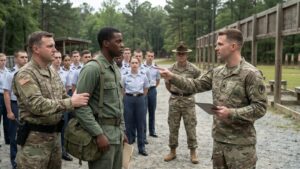
Staff Sergeant Christopher said it loudly enough for the recruits to hear, because the old man had already crossed the line twice in ways that bothered him.
Not physically.
Worse.
He had crossed it with calm.
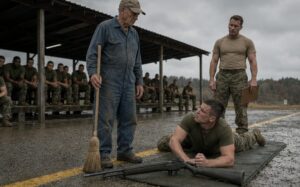
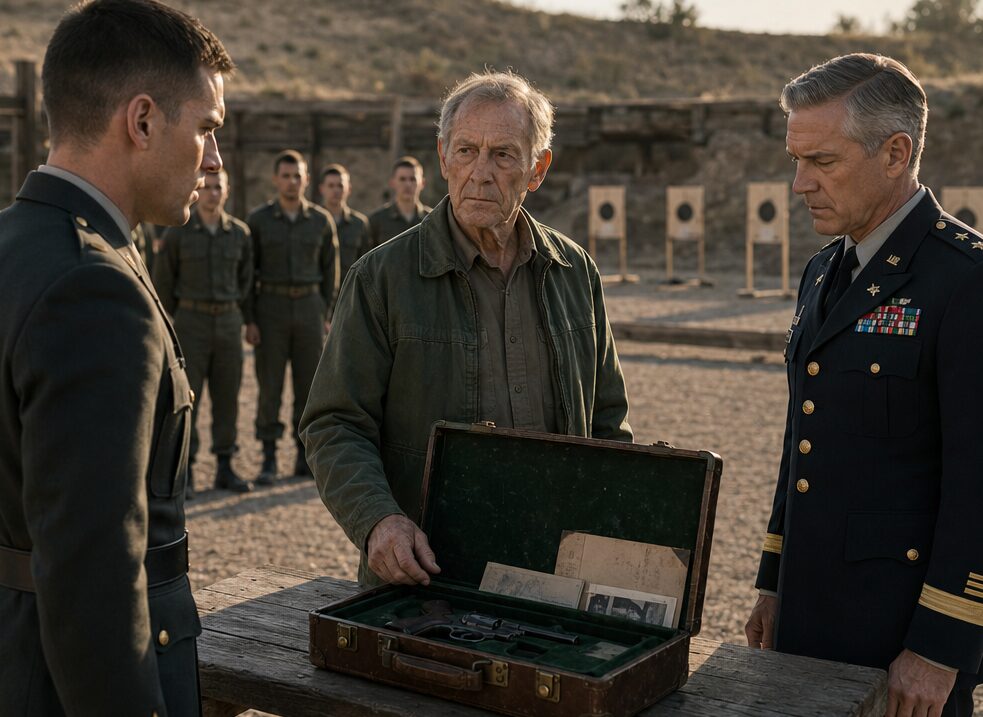
The old man stood beside the firing lanes in a faded green field jacket, one hand resting on a worn brown leather case pressed against his hip. His hair was gray, his face narrow and weathered, and his boots were clean in the careful way old men kept things clean when they had outlived almost everything else.
The recruits had just finished their qualification drill. Their targets hung in the distance. Their rifles were cleared. Their bodies still held the nervous energy of being watched and judged.
Now they were watching someone else be judged.
Christopher stepped closer.
“Sir,” he said again, slower this time, “this area is restricted.”
The old man turned his head. His eyes were pale and steady.
“I was told I could have five minutes at Lane Seven.”
A couple of recruits glanced at one another.
Christopher looked at the case.
“What’s in there?”
The old man’s hand tightened once around the handle.
“Something that belongs here.”
Christopher gave a short laugh before he could stop himself. It was not cruel enough to be called cruelty. It was worse in some ways. It was casual.
“Sir, this isn’t a museum.”
The recruits heard it.
One of them smiled. Another looked down fast, pretending he hadn’t.
The old man did not blink.
For a second, the range seemed to hold its breath under the hard afternoon light. Targets shifted faintly in the breeze. The gravel under Christopher’s boots made a dry sound when he squared himself.
The old man looked past him, toward Lane Seven.
Then he said, “I know what it is.”
That should have been the end of it. Christopher should have called range control, moved the old man back, checked whatever paperwork had let him through the gate, and kept the day clean.
But the old man’s calm irritated him.
Christopher was twenty-nine and good at his job. He knew his safety rules, his commands, his weapons, his recruits. He knew what belonged on a range and what didn’t. What didn’t belong was an old civilian with shaky fingers and a locked case standing too close to a firing line, speaking like the land remembered him.
“Who gave you permission?” Christopher asked.
The old man reached inside his jacket pocket.
Christopher lifted one hand. “Slowly.”
The old man paused. Not offended. Not surprised. Just paused.
Then he drew out a folded paper and offered it.
Christopher took it and read the signature. It was legitimate. Temporary access. Authorized. Supervised. Lane Seven.
That made him angrier, though he would not have named it that.
Permission did not mean sense.
“You can wait in the office,” Christopher said. “I’ll call this in.”
“I’ve waited long enough.”
The words were quiet.
They changed something.
Not enough for Christopher to yield. Enough for the recruits to stop smiling.
The old man looked at Lane Seven again. Its sign was bolted to a post near the bench. INACTIVE. The paint had faded, but the word still had the finality of an order.
Christopher noticed where the old man was looking.
“That lane’s closed.”
“I know.”
“Then you know you can’t use it.”
The old man’s thumb moved over the brass latch of the leather case. The movement was small. Almost tender.
“It belongs here more than I do,” he said.
Christopher stared at him.
The sentence was strange enough to feel like a challenge. It also felt rehearsed, not because it was false, but because the old man had maybe been saying it in his head for years.
Behind Christopher, a recruit whispered, “What’s in the case?”
Christopher turned his head just enough to silence him.
Then he faced the old man again.
“Open it.”
The old man did not move.
Christopher’s voice sharpened. “If you brought something unauthorized onto my range, you’re opening it now.”
For the first time, the old man’s expression changed.
Not fear.
Something closer to pain.
He set the case on the rough wooden bench at Lane Seven, though he had not been given permission to step there. His fingers hovered above the latches. They trembled faintly.
Christopher saw the tremor.
So did the recruits.
Christopher softened his voice, but not his meaning.
“Sir, maybe this isn’t the place for you today.”
The old man looked down at his hands.
Then he opened the case.
Part II — Green Velvet
The inside was lined with dark green velvet, worn thin in the corners.
Resting in the center was an old revolver, polished but not decorative. Beside it lay a yellowed range card, a faded photograph, and a small paper sleeve with six rounds arranged carefully inside.
The recruits leaned without meaning to.
Christopher saw the revolver first. Then the rounds.
“Absolutely not,” he said.
The old man did not touch the weapon. He only looked at it.
Christopher stepped closer, his body blocking the recruits’ view. “You thought you were going to walk onto a modern range with that?”
The old man said nothing.
Christopher nodded toward the revolver. “That thing is older than half the buildings on this base.”
“Older than some,” the old man said.
The recruit who had smiled earlier gave a nervous laugh.
Christopher did not stop him this time.
The old man lifted his eyes. Not to the laughing recruit. To Christopher.
“Would you like to see whether old things still work?”
The laugh disappeared.
Christopher felt the moment tilt. He had meant to control it, contain it, move it along. Now the old man had offered him a choice in front of everyone.
Refuse, and the recruits would wonder why.
Accept, and the old man would likely embarrass himself.
Christopher told himself he was thinking about safety. Procedure. Authority. He told himself the decision was practical.
“Fine,” he said. “One controlled demonstration. Under my commands. You deviate once, we stop.”
The old man nodded.
Christopher gave instructions slowly. Too slowly. The way people speak to someone they think might forget.
The old man followed every command exactly.
Not approximately. Exactly.
He opened the cylinder when told. He waited when told. He loaded only when told. He did not fumble. He did not ask for clarification. His hands trembled when empty, but when his fingers closed around the revolver, the tremor vanished.
That was the first thing the recruits noticed.
It was also the first thing Christopher wished they hadn’t.
The old man stood at Lane Six, because Christopher still refused Lane Seven. His shoulders settled. His breathing slowed. Something in him arranged itself around the weapon, not with excitement but with recognition.
Christopher had seen good shooters before.
He had seen natural talent, overconfidence, panic, discipline.
This was different.
This was not a man performing a skill.
This was a man returning to a room inside himself where nothing had moved.
“Target at standard distance,” Christopher called.
The old man raised the revolver.
The range fell quiet.
Even the wind seemed to lower itself.
Christopher watched the muzzle, the old man’s hands, the angle of his wrists. He waited for a wobble. A jerk. Some proof that time had taken what time usually took.
The old man fired once.
The sound cracked against the berm.
The paper target shivered in the distance.
The recruits looked toward it. Christopher kept his face still.
“Bring it in,” he ordered.
The target carrier hummed back along the line.
The hole sat almost exactly at center.
A recruit whispered, “No way.”
Christopher heard him and hated that he had.
“Luck,” he said, though no one had asked.
The old man did not respond.
Christopher reset the target.
“Again.”
The old man fired again.
Then again.
Not fast. Not flashy. Each shot came after the same quiet pause, as if the old man were listening for permission from somewhere no one else could hear.
When the target returned, the grouping was tight enough to make the recruits go still.
Not impressed still.
Shamed still.
Christopher felt heat rise up the back of his neck. The old man had not smiled. That made it worse. If he had smirked, Christopher could have disliked him. If he had celebrated, Christopher could have called him arrogant.
But the old man only lowered the revolver and waited.
Christopher looked at the target.
Then at him.
“Where did you train?”
The old man’s eyes went to Lane Seven.
“Here.”
Christopher followed the look.
The inactive sign hung crookedly on the post.
The old man said, “Move the target to the old marker.”
Christopher’s jaw tightened. “No.”
“I only need one.”
“You’ve had your demonstration.”
“It wasn’t a demonstration.”
The words landed harder than the shots had.
Christopher stepped closer, lowering his voice enough that the recruits would have to strain.
“What exactly are you trying to do here?”
The old man looked at him for a long moment.
“I told you. Five minutes at Lane Seven.”
“That lane is closed.”
“To you.”
Christopher’s mouth tightened.
Behind him, the recruits were not laughing anymore. Their attention had shifted away from him and toward the old man, and that was the part he could not forgive quickly.
He had spent months building authority with them. The old man had unsettled it in minutes.
Christopher heard himself say, “Is this what you came for? To make a point? Embarrass the young guy in front of his recruits?”
For the first time, something inside the old man’s face cracked.
Only a little.
But enough.
Christopher pushed again, because pride rarely knows when it has already lost.
“You one of those old vets who thinks the Corps owes him applause?”
The range went silent in a different way.
The old man looked down at the revolver.
Then he closed the cylinder gently.
“No,” he said. “It owes me nothing.”
He looked up.
“I owe someone.”
Part III — The Name He Would Not Say
No one moved.
Christopher felt, too late, that he had stepped into a room without knowing who was already inside it.
The old man placed the revolver back in the case but did not close the lid. The faded photograph lay beside the range card, half tucked under the velvet lip. Christopher had noticed it before only as clutter.
Now he saw two young men in the photograph.
One was the old man, impossibly young, sleeves rolled, face lean and serious. The other stood beside him grinning wide, one hand lifted as if he had been caught mid-joke. Behind them was a lane marker.
Seven.
Christopher looked away before the old man could see him looking.
Too late.
The old man touched the photograph with two fingers.
“His hand shook the first time too,” he said.
Christopher did not ask whose.
He wanted to. He didn’t.
A vehicle stopped beyond the range building. A door closed.
The recruits straightened almost by instinct.
Colonel Gregory walked toward them in dress greens, silver at the temples, face composed in the way senior officers learned to compose themselves before anyone could read the weather inside them.
Christopher felt relief.
Authority had arrived.
Now this could be corrected.
He stepped forward. “Sir, I was just about to—”
Gregory did not look at him.
He was looking at the leather case.
All the color had gone out of his face.
The old man stood very still.
Gregory stopped three paces from the bench.
For a moment he looked not like a colonel, but like a much younger man who had just seen a door open that he thought had been sealed.
Then he said, quietly, “Sergeant Samuel.”
The title moved through the recruits like a command they had not been taught.
Christopher turned toward the old man.
Sergeant.
The old man’s jaw shifted once.
“Colonel.”
Gregory looked at the case again. “I was told you might come.”
“I asked for five minutes.”
“I know.”
“Then you know I don’t want a ceremony.”
Gregory’s eyes flicked toward the recruits, then Christopher, then Lane Seven.
“No,” he said. “You never did.”
Christopher stood rigid, shame beginning its slow climb through him. He had insulted civilians before by accident. He had corrected officers without recognizing them from behind. Those things happened.
This was different.
He had looked at an old man and seen only inconvenience.
Gregory turned to him.
“Staff Sergeant.”
“Sir.”
“Do you know who this man is?”
Christopher’s throat tightened.
“No, sir.”
The old man said, “That’s not necessary.”
Gregory kept looking at Christopher. “It is now.”
The old man’s face hardened. Not angry. Warning.
Gregory lowered his voice. “He was an instructor here before most of this range was rebuilt. There are Marines alive because of him.”
The recruits stared.
Christopher did not.
He kept his eyes forward because he deserved the discomfort of not looking away.
Gregory continued, careful now. “There was an incident on this range. A long time ago. Sergeant Samuel kept it from becoming worse.”
The old man’s hand closed over the edge of the case.
“That’s enough.”
Gregory stopped.
It was the first time Christopher had seen a colonel obey a civilian.
Not officially. Not visibly.
But he stopped.
The silence that followed carried more weight than explanation.
The old man looked at Lane Seven again.
“I didn’t come for that.”
Gregory’s mouth tightened. “I know why you came.”
“Then give me the lane.”
Gregory did not answer immediately.
That delay told Christopher more than any story could have.
Whatever Lane Seven was, it was not simply closed.
It was being avoided.
Part IV — The Seventh Round
Christopher tried to apologize badly.
That was the only way he knew how to do it at first: formally, stiffly, with rank in his spine and shame in his mouth.
“Sergeant Samuel,” he said, “I was unaware of your service record. My remarks were inappropriate.”
The old man looked at him without cruelty.
“This isn’t about your remarks.”
That landed harder than if he had accepted the apology.
Christopher had wanted punishment or forgiveness. Either would have made the moment about him.
The old man denied him both.
Gregory stepped closer to the bench.
“Samuel,” he said, quieter now, “the lane was decommissioned for a reason.”
“It was covered for a reason.”
Gregory’s face changed.
Not much. Enough.
Christopher saw it.
The old man picked up the yellowed range card. The paper had softened with age. Its edges were darkened where fingers had held it across years.
A name was written at the top.
Corporal Scott.
Christopher read it before he could stop himself.
The old man saw.
“He was twenty-two,” Samuel said.
No one spoke.
The recruits, who had spent the morning competing over tight groupings and clean scores, now stood in the presence of a score that had never been completed.
Samuel looked at the range card, not at them.
“He missed his sixth. Cursed under his breath. Said he’d make the seventh so clean I’d have to buy him coffee for a month.”
A small breath left Gregory.
Samuel folded the card once, along an old crease.
“He never took it.”
The range seemed suddenly too open.
Christopher wanted details and feared them. He wanted to know what had happened here, and he understood, at the same time, that knowing would not make him better.
Gregory spoke first.
“The official record says training incident.”
Samuel’s eyes lifted.
“The official record says many things.”
Gregory absorbed that.
Christopher watched the two men, one old and one older than his posture admitted, stand on opposite sides of memory. One had carried it in silence. One had kept it in order.
Both looked tired.
Gregory said, “Reopening it helps no one.”
Samuel’s voice stayed low. “I’m not reopening it.”
“Then what are you doing?”
Samuel placed the range card beside the revolver.
“Finishing it.”
Christopher looked at the paper sleeve.
Six rounds had been there when the case opened.
Five were gone.
One remained.
Gregory saw it too.
His face tightened. “Samuel.”
“I waited forty-six years,” the old man said.
The words did not rise. They did not need to.
“I waited while the range changed names. While the sign came down. While the report got cleaner every time someone summarized it. I waited while people thanked me for a thing I survived.”
He touched the photograph.
“No one thanked him for trusting me.”
Gregory closed his eyes briefly.
Christopher had heard men speak of guilt before. Usually they dressed it up. They said burden. Memory. Cost. They made it bearable with words that sounded official.
Samuel did not.
He made guilt sound like a promise with no expiration date.
Gregory looked toward the range office, then at the recruits. His authority had become a cage around him.
“If I allow this,” he said, “it becomes visible.”
Samuel nodded. “Good.”
“The record—”
“Can stay as ugly as it needs to be.”
Gregory looked at him for a long time.
Then he turned to Christopher.
“Staff Sergeant.”
“Sir.”
“Clear Lane Seven.”
Christopher did not hesitate.
He moved.
The recruits moved with him, but slower, chastened by the sudden understanding that they were no longer watching a test.
They were witnessing something they had not earned the right to interrupt.
Christopher removed the inactive sign from the post. The bolts resisted at first. He had to put force into it, and the metal gave with a groan that sounded embarrassingly loud.
When the sign came free, he held it in both hands.
He did not know where to put it.
Samuel said, “Beside the bench.”
Christopher obeyed.
Not because of rank.
Because the old man had become the only person on the range who knew what the moment required.
Part V — The Mark That Waited
Lane Seven looked almost ordinary once cleared.
That was the terrible part.
No shadow lay across it. No visible line marked where one version of the past had ended and another had been written over it. The bench was rough wood. The gravel was pale. The target waited downrange, blank and indifferent.
Samuel stood behind the bench and opened the paper sleeve.
The last round rolled into his palm.
His hand trembled again.
No one mistook it for weakness now.
Christopher stood at his side, not too close.
“Range is clear,” he said.
Samuel nodded but did not lift the revolver yet.
Gregory watched from behind them, hands clasped behind his back. His eyes were not on Samuel. They were on the target, as if he could see another young man standing somewhere beyond it.
Samuel loaded the final round.
The cylinder closed with a small, clean sound.
Christopher found himself watching the old man’s face instead of his hands.
There was no triumph there.
No anger.
Only a concentration so deep it seemed to have hollowed out everything unnecessary.
Samuel raised the revolver.
Christopher saw the tremor disappear.
The recruits stood silent behind the line.
No one whispered.
Samuel aimed, but not at the center.
Christopher noticed that. He almost corrected him by reflex, then stopped.
The old man was aiming at a small mark near the edge of the scoring area, a point that meant nothing to anyone else.
To him, it meant forty-six years.
Gregory’s voice came softly from behind them.
“That was his correction.”
Samuel did not lower the revolver.
“He always pulled left when he was tired,” he said.
Christopher swallowed.
The line was so ordinary it hurt.
Not a heroic line. Not a ceremonial line. Just the kind of thing one man remembered about another because love, in places like this, often disguised itself as correction.
Samuel breathed in.
Held.
Fired.
The sound struck the range and vanished into the berm.
The target shivered.
No one moved until Christopher realized everyone was waiting for him.
He brought the target in.
It came slowly, the carrier humming like an old machine reluctant to disturb the air.
When the paper reached them, Christopher saw the hole.
Exactly on the small mark.
Not close.
There.
Gregory exhaled once.
The recruits remained still.
Samuel lowered the revolver and opened the cylinder. Empty.
For a moment he looked smaller than he had before. Not weaker. Emptier, as if something that had lived inside him for nearly half a century had finally stepped away.
Christopher wanted to say something.
He had no right words.
Samuel placed the revolver back into the green velvet. He set the empty paper sleeve beside it. Then he picked up the yellowed range card and the photograph.
He held them out to Gregory.
Gregory did not take them at first.
Samuel’s voice was steady.
“Put his name where people can find it.”
Gregory looked at the card.
Then at Samuel.
“And yours?”
Samuel’s answer came at once.
“He was the one waiting.”
Gregory took the card and photograph with both hands.
That small gesture broke something in Christopher.
Not loudly. Not visibly.
But he felt it: the collapse of the story he had told himself about control, competence, age, authority. He had thought respect moved downward through rank. Now he saw it could rise from the ground beneath a man’s boots and make rank look temporary.
Gregory turned to the recruits.
“Attention.”
They snapped into place.
Samuel’s head turned slightly.
“No.”
Gregory looked at him.
Samuel closed the leather case.
“Not for me.”
The colonel understood after a second. He nodded once.
The recruits remained at attention anyway, but the meaning changed. They were not saluting a legend. They were standing still because a name they had never heard had entered the range.
Christopher bent and picked up the inactive sign.
Its faded letters looked foolish in his hands.
He carried it to the bench and set it beside the leather case, exactly where Samuel had told him to place it.
Then he stepped back.
Samuel looked at him.
Christopher expected correction. Maybe dismissal. Maybe nothing.
The old man lifted the leather case by its handle, then paused. His fingers were tired now. The strength had gone out of them in a way that made Christopher ashamed of every assumption he had made.
“Carry it to the gate,” Samuel said.
Christopher looked at him.
The old man’s eyes were clear.
“Carefully.”
Christopher took the case.
It was heavier than he expected.
Not because of what was inside.
Because he understood, finally, that some things grew heavier after they were explained.
Part VI — What the Range Remembered
They walked without ceremony.
Samuel first, slow but upright. Christopher beside him, carrying the leather case with both hands. Gregory followed a few steps behind with the range card and photograph tucked against his chest.
The recruits stayed where they were until the three men passed.
No one spoke.
At the edge of the range, Samuel stopped and turned back.
Lane Seven stood open.
The inactive sign lay on the bench, no longer an order. Just an object that had lost its authority.
Christopher held out the case.
Samuel took it, but not immediately. For a second, both their hands were on the handle.
“I’m sorry,” Christopher said.
This time he did not add rank. He did not dress the apology in formality. He did not try to make it clean.
Samuel looked at him.
“You were guarding the range,” he said.
Christopher almost felt relief.
Then Samuel finished.
“You forgot to look at who it was guarding.”
Christopher nodded once.
There was nothing else to do with truth except receive it.
Gregory stepped forward.
“I’ll see that the record is amended.”
Samuel looked at the card in Gregory’s hand.
“Not amended,” he said. “Completed.”
Gregory held his gaze.
“Completed,” he said.
That was the closest thing to a promise the afternoon allowed.
Samuel took the leather case fully and rested it against his hip, the same way he had carried it when he arrived. But the shape of him seemed different now. Not younger. Not healed.
Seen.
Before he left, one recruit near the end of the line spoke without permission.
“Sir?”
Christopher turned sharply, but Samuel lifted a hand.
The recruit swallowed. “Who was Corporal Scott?”
Samuel looked past him, toward Lane Seven.
For a long moment, Christopher thought he would not answer.
Then Samuel said, “Someone who trusted me.”
The recruit waited, perhaps hoping for more.
There was no more.
There did not need to be.
Samuel walked toward the gate.
No applause followed him. No grand salute. No speech. Just the quiet scrape of his old boots on gravel and the strange, full silence of men who had learned too late that silence could either erase a person or honor him.
At the gate, Samuel paused once.
Christopher thought he might turn back again.
He didn’t.
He only adjusted his grip on the case and kept walking, leaving the range behind him and not leaving it at all.
Behind him, Gregory returned to Lane Seven with the card and photograph.
Christopher watched him place them on the bench for a moment, as if the wood itself needed to see them before they went into any file.
Then Christopher picked up the inactive sign.
He carried it away from the lane.
Not far.
Just enough.
That evening, when the recruits cleaned the range, none of them touched Lane Seven until Christopher told them how.
Not with superstition.
With care.
And the next morning, before the first drill, a small temporary marker stood where the old sign had been.
It had no grand language.
Only a name.
And beneath it, in smaller letters, two words that did not explain the past, but refused to let it disappear.
Completed here.