The Man Sitting Alone Behind the Flags Was the Reason the Memorial Still Existed
Chapter 1: The Empty Chair Behind the Flags
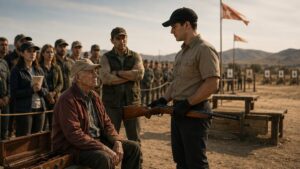
The folding chair sat alone behind the rows of flags.
That was the first thing Edward Roberts noticed when he arrived.
Every year, someone moved it.
Every year, he moved it back.
The chair wasn’t part of the ceremony. It wasn’t listed on any layout map. It wasn’t reserved for a speaker or a guest. It sat behind the final row of small American flags that lined the memorial lawn, half-hidden from the audience.
Most people never saw it.
Edward always did.
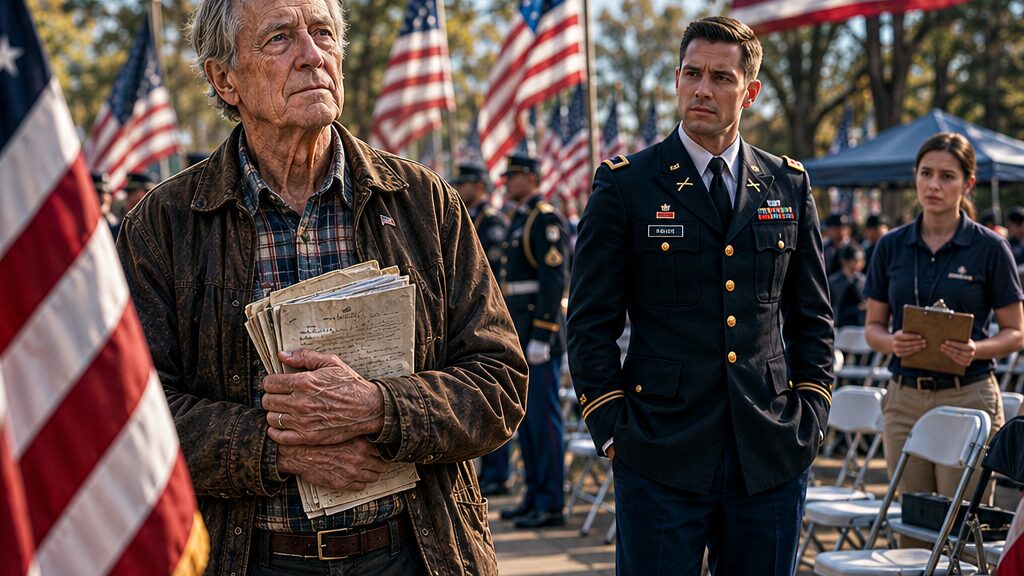
At seventy-four, he moved slower than he once had. The early spring air carried a chill that settled into his knees before sunrise. He crossed the grass carefully, holding a weathered program booklet folded beneath his arm.
The booklet looked ordinary from a distance.
Up close, it wasn’t.
The edges were softened from years of handling. Notes crowded the margins. Dates. Names. Tiny reminders written in fading blue ink.
Some pages contained entire lists.
Edward lowered himself into the chair with a quiet sigh.
The memorial grounds were already busy.
Volunteers carried boxes.
Workers adjusted speakers.
Members of the honor guard stood near the stage.
The annual remembrance ceremony had grown larger every year.
Television cameras had even started showing up.
Edward preferred arriving before everyone else.
It gave him time.
He opened the booklet.
His finger stopped beside a name.
Thomas Keller.
A date beside it.
Then another.
William Reese.
Another date.
He paused.
For a moment the sounds of the grounds faded.
Not forgotten, he thought.
Not yet.
A voice interrupted him.
“Sir?”
Edward looked up.
A young volunteer wearing a bright event shirt stood nearby.
The young man smiled politely.
“I think those chairs are supposed to stay empty.”
Edward glanced around.
“Are they?”
The volunteer checked a clipboard.
“I’m pretty sure.”
Edward nodded.
“Then I’ll move.”
The volunteer seemed surprised by the lack of resistance.
“Oh. Thank you.”
Edward stood.
His knees protested.
The young man hurried away before Edward had completely risen.
Edward picked up the chair and carried it several feet farther back.
Far enough.
Invisible again.
He sat down.
A few minutes later another volunteer approached.
A woman this time.
“You can’t block that walkway, sir.”
Edward looked behind him.
There wasn’t a walkway.
Not really.
Just grass.
Still, he nodded.
“Sorry.”
He stood again.
Moved the chair again.
Sat again.
The woman thanked him without making eye contact.
The memorial grounds continued waking around him.
Nobody asked his name.
Nobody asked why he came before sunrise.
Nobody asked why his program booklet looked older than some of the volunteers.
That was fine.
It had been that way for years.
A truck arrived carrying additional flags.
Workers unloaded them.
Edward watched quietly.
He remembered when there had only been a few dozen.
Back then, most people attending had known at least one of the names on the monument.
Now many visitors came because it felt important.
Not because they knew anyone.
Time changed things.
The names stayed.
A city vehicle pulled into the lot.
John Jackson climbed out.
Edward recognized him immediately.
The city council representative had spent the last three years discussing budgets whenever memorial improvements were proposed.
Numbers.
Maintenance.
Liability.
Permits.
Always something.
Never the names.
John began speaking with organizers near the stage.
Edward looked away.
He wasn’t interested.
The booklet rested open on his lap.
He turned another page.
More names.
Some had stars beside them.
Some had notes.
Favorite fishing spot.
Loved bad coffee.
Could never sing in tune.
Tiny details.
The things that disappeared first.
A gust of wind flipped several pages.
Edward steadied them with one hand.
A shadow fell across him.
“Sir?”
He looked up again.
A different volunteer.
“You need to move farther back.”
Edward blinked.
“Further?”
“The audience will be sitting here.”
Edward glanced at the mostly empty field.
“Of course.”
The volunteer pointed toward the edge of the grounds.
“Maybe over there.”
Edward smiled faintly.
“All right.”
The volunteer hurried off before seeing the effort it took Edward to stand.
He picked up the chair.
Picked up the booklet.
Moved again.
This time all the way near a line of oak trees.
Far from the stage.
Far from the cameras.
Far from attention.
The chair settled unevenly into the grass.
Edward sat.
A bird called somewhere overhead.
The flags rippled softly.
For a while nobody bothered him.
He preferred it.
The memorial itself stood near the center of the grounds.
Black stone.
Names etched into polished surfaces.
People often touched the stone when they first arrived.
Edward never did.
He already carried the names with him.
Hours later, more guests arrived.
Families.
Veterans.
Students.
Reporters.
The grounds slowly filled.
No one noticed the elderly man sitting alone behind the flags.
No one except a woman carrying three folders and a radio.
She paused while walking past.
Looked at Edward.
Looked at the booklet.
Then continued moving.
Edward didn’t know her name.
He would learn it soon enough.
As the crowd thickened, he opened the booklet again.
Another page.
Another list.
Dozens of names written in careful handwriting.
Names that never appeared in the printed program.
Names nobody announced anymore.
He ran his thumb over the faded ink.
A promise lived inside those pages.
A promise older than some of the people organizing the ceremony.
The radio on the woman’s belt crackled as she disappeared toward the stage.
Edward watched her go.
Then he looked back down at the booklet.
One of the pages had begun separating from the binding.
He carefully smoothed it flat.
The page contained thirty-seven names.
Every one written by hand.
Every one connected to the monument.
Every one carrying a story.
And suddenly a question returned to him.
The same question that returned every year.
How much longer could one person remember them all?
Chapter 2: The Names No One Asked About
Emily Garcia had been awake since four in the morning.
By eight-thirty she was already behind schedule.
The microphone contractor was late.
The city representative wanted changes to the seating arrangement.
Two volunteers had called in sick.
A local reporter kept asking whether anyone famous would attend.
Emily answered questions while walking.
Checked lists while talking.
Signed forms while listening.
The annual remembrance ceremony consumed months of planning every year.
Most people only saw two hours of speeches.
They never saw the chaos behind them.
As she crossed the grounds carrying another stack of papers, she noticed the elderly man again.
The one who kept getting moved.
He sat near the oak trees now.
Still holding the same worn booklet.
Still alone.
Emily vaguely remembered seeing him last year.
And the year before that.
Maybe.
The memorial attracted many returning visitors.
She pushed the thought aside.
There were more urgent problems.
An hour later she found herself standing beside the monument reviewing speaker order.
Something looked wrong.
One of the small display signs contained an incorrect date.
Emily frowned.
“Who printed this?”
A volunteer shrugged.
“No idea.”
The date belonged to one of the soldiers listed on the monument.
It was off by three years.
Emily sighed.
“I’ll fix it.”
The volunteer handed her a marker.
She stared at the stone.
The correct date refused to come.
She knew she had seen it somewhere.
Then a voice behind her spoke quietly.
“Nineteen seventy-one.”
Emily turned.
The elderly man stood several feet away.
Holding the booklet.
“The date should be nineteen seventy-one,” he repeated.
Emily looked at him.
“Are you sure?”
He nodded.
“April seventeenth.”
She checked her notes.
The old man was right.
Exactly right.
Emily corrected the sign.
“Thank you.”
“You’re welcome.”
He started walking away.
“Wait.”
He stopped.
“How did you know that?”
The man looked mildly surprised.
“I remembered.”
Then he continued toward his chair.
Emily stared after him.
Remembered?
The monument contained more than a hundred names.
Most visitors couldn’t identify one.
Yet he knew a specific date immediately.
Strange.
She returned to work.
But the question lingered.
Throughout the morning she noticed him repeatedly.
People approached the monument.
They searched for names.
Sometimes they looked confused.
The elderly man quietly helped.
Never inserting himself.
Never staying long.
Just answering questions.
A family searching for a relative.
A student working on a school project.
A veteran trying to remember a year.
The old man always seemed to know.
And then he disappeared back to his chair.
By noon Emily’s curiosity outweighed her schedule.
She walked toward him.
“Mind if I sit?”
The man looked up.
“Your chair.”
She laughed.
“I think you’ve been moved enough today.”
That earned a small smile.
She sat.
Up close the booklet looked even older.
Pages bulged unevenly.
Notes filled nearly every margin.
Emily pointed carefully.
“Can I ask what that is?”
The man’s hand rested on the cover.
For a moment she thought he might refuse.
Instead he opened it.
Not fully.
Just enough.
Names.
Dozens of them.
Handwritten.
Some with dates.
Some with tiny notes.
Emily recognized many from the monument.
Others she didn’t recognize at all.
“You wrote these?”
“Most of them.”
“Why?”
The old man studied the flags.
“So I don’t forget.”
His answer arrived so simply that Emily wasn’t sure how to respond.
A radio call interrupted her.
She stood reluctantly.
“Sorry. Work.”
He nodded.
“Of course.”
Emily started away.
Then stopped.
“What was your name?”
“Edward.”
“Edward what?”
“Roberts.”
The name seemed familiar.
She couldn’t place it.
By late afternoon preparations finally stabilized.
The crowd continued growing.
Emily found herself thinking about Edward Roberts more than she expected.
Eventually she sought out an old volunteer who had worked the ceremony for years.
“Do you know an Edward Roberts?”
The volunteer frowned.
“The gentleman with the notebook?”
“Booklet.”
“Whatever it is.”
The volunteer thought for a moment.
“He comes every year.”
“Who is he?”
A shrug.
“No idea.”
“Nobody knows?”
“I guess not.”
Emily stared toward the oak trees.
Edward sat exactly where she had left him.
Watching.
Listening.
Waiting.
Not asking for anything.
As if attendance itself mattered more than participation.
The answer should have satisfied her.
Instead it made her more curious.
That evening, while reviewing archived planning documents stored in a temporary office trailer, she noticed a familiar name.
Roberts.
The folder was old.
Much older than the rest.
The paper had yellowed.
A handwritten note clipped to the front caught her eye.
Original memorial committee.
Below it appeared several names.
One of them was Edward Roberts.
Emily froze.
She opened the folder.
Inside were meeting notes from decades earlier.
Fundraising records.
Community letters.
Early sketches of the monument.
And Edward Roberts’ signature appeared again.
And again.
And again.
The ceremony existed because people had built it.
Someone had raised money.
Someone had gathered names.
Someone had persuaded families.
Someone had fought city bureaucracy.
Someone had made sure the memorial happened.
Edward’s name was everywhere.
Yet nobody organizing the event seemed to know who he was.
Emily slowly closed the folder.
Then looked toward the darkening memorial grounds outside the trailer window.
The elderly man sitting quietly behind the flags suddenly seemed much harder to explain.
Who taught him all those names?
Or had he been there from the very beginning?
Chapter 3: The Salute That Was Not Planned
Captain Ryan Adams hated standing still.
Ceremonies required it.
That was part of the job.
So he stood beside the honor guard, uniform pressed, shoulders straight, eyes scanning the growing crowd.
Most people saw ceremonies as moments.
Ryan saw logistics.
Timing.
Coordination.
Potential problems.
An elderly man sitting inside a restricted setup zone qualified as a potential problem.
He noticed Edward shortly after arriving.
The old man sat near a staging area where volunteers would soon direct guests.
Nothing serious.
Just inconvenient.
Ryan made a mental note to address it later.
The ceremony schedule tightened.
Guests arrived.
Flags moved in the wind.
The memorial grounds filled with conversation.
Then Emily Garcia approached him.
“You know that older gentleman over there?”
Ryan followed her gaze.
“The one with the booklet?”
“That’s him.”
“What’s wrong?”
“Nothing.”
Emily hesitated.
“Actually, I don’t know.”
Ryan raised an eyebrow.
That wasn’t helpful.
She quickly explained what she had discovered.
The dates.
The names.
The old records.
The original memorial committee.
Ryan listened.
Interesting.
But not enough to change anything.
Eventually duty reclaimed his attention.
The ceremony was beginning.
A volunteer hurried over.
“Captain, we need that area cleared before the color guard comes through.”
Ryan looked.
The path led directly past Edward.
“Got it.”
He walked across the grass.
The old man looked up before Ryan spoke.
Perhaps he had been expecting another request.
“Sir,” Ryan said politely, “I’m afraid we’re going to need this area open.”
Edward nodded immediately.
“All right.”
No complaint.
No argument.
No explanation.
He simply began gathering his belongings.
Ryan felt slightly guilty.
The man moved carefully.
One hand on the chair.
One hand holding the booklet.
The booklet slipped.
Several loose pages slid free.
They scattered across the grass.
Ryan crouched automatically.
“Let me help.”
Edward started to object.
Too late.
Ryan already had one of the pages in his hand.
At first glance it looked like a list.
Then he saw the names.
Every name matched the monument.
Not just names.
Dates.
Locations.
Small notes.
Personal details.
Ryan picked up another page.
And another.
The handwriting remained consistent.
Years of records.
Maybe decades.
One line caught his attention.
Thomas Keller.
Loved fishing at Lake Mercer.
Killed two weeks before coming home.
Ryan looked up.
Edward had gone very still.
Not defensive.
Just waiting.
As though this moment had happened before.
“You knew these men?” Ryan asked.
A pause.
Then:
“Some of them.”
The answer felt incomplete.
Ryan handed the pages back.
His eyes moved to the monument.
Then back to the names.
Then to Edward.
A small detail suddenly surfaced.
The way Edward folded the pages.
The way he carried himself.
The way he stood despite age and pain.
The habits felt familiar.
Military familiar.
“Did you serve with them?”
Another pause.
Longer this time.
“With several.”
Ryan’s expression changed.
Not dramatically.
Just enough.
The noise around them seemed to soften.
Edward noticed it.
He had seen that look before.
Recognition beginning.
Not of rank.
Not of status.
Of shared understanding.
Ryan lowered his voice slightly.
“Army?”
“Yes.”
“What years?”
Edward told him.
Ryan glanced again at the names.
Many of the dates suddenly carried different weight.
These weren’t historical records to Edward.
These were people.
Friends.
Memories.
Losses.
The volunteer who had requested the area hurried over.
“Captain, we still need—”
Ryan held up a hand.
The volunteer stopped talking.
Ryan looked back at Edward.
“Sir, would you mind waiting a moment?”
The wording had changed.
Edward noticed.
So did the volunteer.
Ryan carefully collected the remaining pages himself.
Not because Edward couldn’t.
Because suddenly the papers felt important.
He returned them one at a time.
Straightened the stack.
Handled them carefully.
The volunteer looked confused.
Ryan ignored him.
One page contained nearly forty names.
Several carried small marks beside them.
Stars.
Circles.
Questions.
Ryan wanted to ask about all of them.
Instead he asked only one.
“How long have you been keeping these?”
Edward looked toward the monument.
“A long time.”
Again, not the whole answer.
But enough.
Ryan handed back the final page.
For a moment neither man spoke.
Then Ryan stepped back.
Instinct.
Training.
Respect.
Not yet a salute.
Not yet.
Something else came first.
“Thank you for your service, Mr. Roberts.”
Edward’s face barely changed.
Yet something moved behind his eyes.
Something tired.
Something grateful.
Something uncomfortable with attention.
“Thank you,” he said quietly.
Ryan noticed the response.
Not pride.
Not satisfaction.
Almost relief.
As though the acknowledgment belonged to someone else.
The volunteer shifted awkwardly.
“What should we do?”
Ryan looked at the chair.
Then at the route.
Then back at Edward.
“We’ll adjust the route.”
The volunteer blinked.
“The route?”
“Yes.”
“But—”
“We’ll adjust it.”
The conversation ended there.
The volunteer hurried away.
Ryan remained standing for a moment.
Edward seemed uncertain what to do with the sudden change.
Finally he settled back into his chair.
Booklet resting on his lap.
Flags moving behind him.
The image stayed with Ryan.
An old man everyone had spent the morning relocating.
An old man who knew every name on the monument.
An old man connected somehow to dozens of stories nobody else remembered.
Ryan looked toward Emily.
She was watching from across the grounds.
He nodded once.
Emily immediately understood.
She wasn’t imagining it.
There was more here.
Much more.
The ceremony began minutes later.
Yet Ryan found his attention drifting repeatedly toward the chair behind the flags.
Toward Edward Roberts.
Toward the questions hidden inside that worn booklet.
Who were all those men to him?
Why had he spent decades carrying their names?
And why did it feel as though the memorial itself might be hiding part of the answer?
Chapter 4: The Promise Hidden in the Archive
The ceremony ended, but Emily Garcia couldn’t stop thinking about Edward Roberts.
Most years, the day after the memorial felt like recovery.
Boxes were packed.
Chairs were returned.
Receipts were filed.
Volunteers disappeared until next spring.
This year felt different.
By nine o’clock the next morning, Emily stood inside the local historical society building.
The structure occupied an old brick library that smelled faintly of paper and dust.
Margaret Lee met her at the front desk.
“You sound like you’ve discovered buried treasure,” Margaret said.
“I’m not sure what I’ve discovered.”
Margaret smiled.
“That’s usually how it starts.”
Emily placed copies of several documents on the desk.
The old committee records.
Edward’s signatures.
Meeting notes.
Margaret adjusted her glasses.
For several moments she said nothing.
Then she frowned.
“Interesting.”
“You know him?”
“Not personally.”
Margaret pulled one folder from a shelf.
Then another.
Soon three boxes sat open across the table.
Emily watched as the older woman began searching.
Minutes passed.
Finally Margaret removed a faded photograph.
It showed a group of people standing on an empty patch of grass.
No monument.
No stage.
No flags.
Just dirt.
Several people held papers.
One held a shovel.
Emily leaned closer.
“There.”
Margaret pointed.
Edward.
Much younger.
Perhaps forty.
His hair darker.
His shoulders broader.
Yet unmistakably Edward.
“That’s the groundbreaking ceremony,” Margaret said.
“For the memorial?”
Margaret nodded.
“The very beginning.”
Emily studied the image.
Edward stood near the center.
Not in front.
Not posing.
Just present.
As though he belonged there.
Margaret continued searching.
Soon more photographs emerged.
Fundraisers.
Planning meetings.
Community events.
Edward appeared repeatedly.
Sometimes carrying boxes.
Sometimes speaking with families.
Sometimes standing beside unfinished construction.
Never at the center of attention.
Always there.
“Why isn’t anyone talking about him?” Emily asked.
Margaret looked thoughtful.
“That’s a good question.”
Another folder appeared.
Inside were newspaper clippings.
The earliest articles mentioned volunteers who organized the memorial effort.
Edward’s name appeared several times.
Then suddenly disappeared.
The monument itself continued receiving coverage.
Edward vanished from the records.
Emily noticed it immediately.
“Right there.”
Margaret nodded.
“I see it.”
“He just… disappears.”
“He does.”
The silence that followed felt strange.
Not because information was missing.
Because someone seemed to have stopped collecting it.
Margaret located one final box.
This one older than the others.
The cardboard had softened with age.
Inside lay handwritten meeting notes.
Letters.
Funding requests.
Community surveys.
At the bottom rested a thin folder.
No title.
No label.
Margaret opened it carefully.
The contents were sparse.
A few pages.
Several names.
One typed memorandum.
Margaret read quietly.
Then read it again.
“What is it?” Emily asked.
Margaret handed over the page.
The memorandum concerned the memorial’s final design phase.
One sentence stood out.
Community member Edward Roberts requests additional names be verified before dedication.
Below it appeared a handwritten note.
Verification incomplete.
Proceeding without additions.
Emily looked up.
“What does that mean?”
Margaret shook her head.
“I don’t know.”
“Additional names?”
“The monument was finalized before dedication.”
Emily glanced toward the list attached to the memorandum.
Several names appeared there.
Not many.
Only a handful.
Yet none existed on the current monument.
A strange feeling settled over her.
The names looked familiar.
She had seen some of them before.
Then she realized where.
Edward’s booklet.
The handwritten pages.
The names he carried.
Margaret saw the recognition on her face.
“You’ve seen those names.”
“Yes.”
“Where?”
“In Edward’s notes.”
Neither woman spoke for a moment.
The room seemed suddenly smaller.
More personal.
As though they had stopped studying history and begun approaching someone’s wound.
Margaret carefully placed the folder down.
“I think Edward spent years trying to preserve something.”
“What?”
“I don’t know.”
Emily stared at the missing names.
Three decades.
Maybe longer.
And he was still carrying them.
Why?
The answer remained hidden.
But the shape of the mystery had changed.
This was no longer simply a veteran attending a ceremony.
Edward had helped build the memorial.
He had fought to include names that never appeared.
And somehow, somewhere along the way, he had stepped back while everyone else forgot.
Margaret closed the folder.
“People don’t spend thirty years carrying names without a reason.”
Emily nodded slowly.
Outside the archive windows, afternoon sunlight crossed the lawn.
For the first time, she wondered whether the memorial itself was incomplete.
And whether Edward Roberts had been sitting quietly behind the flags all these years because he could still see the empty spaces no one else noticed.
Chapter 5: What Edward Never Put on the Monument
Edward kept the booklet in the same drawer every night.
Second drawer.
Right side of the desk.
Nothing else occupied that space.
The habit had survived decades.
He returned home after visiting the cemetery on the edge of town.
The house was small.
Quiet.
The sort of place where clocks sounded louder than they should.
He placed the booklet on the kitchen table instead of returning it to the drawer.
That alone felt unusual.
For several minutes he stood beside it.
Looking.
Not touching.
Outside, evening shadows stretched across the yard.
Inside, memories moved more easily than he liked.
A knock interrupted him.
Edward opened the door.
Emily stood on the porch.
Holding a folder.
Looking slightly uncertain.
“Sorry to bother you.”
“You aren’t.”
She seemed relieved.
“Can I come in?”
Edward stepped aside.
The house carried traces of a life lived carefully.
Bookshelves.
Old photographs.
A worn armchair.
Nothing extravagant.
Nothing displayed for effect.
Emily noticed the booklet immediately.
Resting on the table.
Open.
Edward saw her eyes settle on it.
“You found something,” he said.
She smiled faintly.
“You already know.”
“Maybe.”
Emily placed the archive folder on the table.
For a long moment neither mentioned the names.
Eventually she opened the folder.
The memorandum.
The missing list.
The same documents Margaret had found.
Edward looked at them quietly.
No surprise.
No denial.
Only recognition.
“You tried to add them.”
“Yes.”
“You never told anyone.”
Edward pulled out a chair.
Sat slowly.
“It wasn’t about me.”
Emily sat across from him.
“Then what was it about?”
The answer took time.
Not because Edward didn’t know.
Because he did.
Too well.
His eyes drifted toward the window.
Toward years that still felt close.
“There was a man named Justin.”
The name hung between them.
Different from the names she had heard before.
Different from the names on the monument.
Edward folded his hands.
“We enlisted together.”
He stopped.
Started again.
“We weren’t alike.”
A small smile touched his face.
“He could make friends anywhere.”
Emily listened without interruption.
“He used to carry a notebook.”
Edward glanced at the booklet.
“Always writing things down.”
Another pause.
“When we got overseas, he kept doing it.”
The room remained still.
Edward’s voice never rose.
Never dramatized.
That somehow made it harder to look away.
“Names. Places. Little details.”
His fingers rested on the booklet’s cover.
“He said people disappear twice.”
Emily waited.
“The first time when they die.”
Silence.
“The second time when nobody remembers them.”
The sentence settled heavily in the room.
Edward looked down.
“Justin believed names mattered.”
The memory softened his expression.
“He remembered everybody.”
Emily finally understood why the booklet felt less like a record and more like a responsibility.
“What happened to him?”
Edward didn’t answer immediately.
Outside, a car passed somewhere down the street.
Then quiet returned.
“He didn’t come home.”
The words arrived simply.
No decoration.
No attempt to lessen them.
Emily looked at the booklet.
The pages.
The notes.
The decades of handwriting.
Edward followed her gaze.
“Afterward I kept finding names.”
“Names?”
“People nobody talked about anymore.”
He opened the booklet.
One page.
Then another.
Then another.
The handwriting changed over the years.
The purpose never did.
“Families moved away.”
A page turned.
“Records got lost.”
Another page.
“Stories disappeared.”
His hand stopped.
“I started writing them down.”
Emily swallowed.
The room suddenly felt full of unseen people.
“What about the names missing from the monument?”
Edward stared at them for several moments.
When he spoke again, his voice was quieter.
“We couldn’t verify them.”
“You knew them.”
“I knew them.”
“Then why not fight harder?”
The question escaped before she could stop it.
Edward didn’t seem offended.
Only tired.
“A monument lasts a long time.”
He looked toward the old folder.
“If I couldn’t prove it, I wasn’t willing to ask others to take my word.”
Emily understood.
And yet she didn’t.
Because she could see what that decision had cost.
Decades carrying uncertainty.
Decades carrying names.
Alone.
Edward closed the booklet.
“Those men deserved certainty.”
“What if they deserved someone remembering them too?”
The question surprised both of them.
Edward looked away.
His jaw tightened slightly.
The silence stretched.
Then he said something Emily suspected he had never said aloud.
“I don’t know if remembering is enough.”
The vulnerability in those words felt larger than any dramatic confession.
Years of effort.
Years of doubt.
Years wondering whether he had fulfilled a promise or merely delayed forgetting.
Emily glanced toward the booklet again.
The pages seemed less like records now.
More like unfinished conversations.
Before leaving, she stopped beside the door.
“Captain Adams is asking questions too.”
Edward sighed softly.
“I was afraid of that.”
“Why?”
A faint smile appeared.
“Because curious people are difficult to stop.”
Emily laughed.
The first genuine laugh of the evening.
But after she left, Edward remained standing beside the table.
The house felt quieter than before.
The booklet lay open beneath the lamp.
One page remained turned farther back than the others.
A page containing a name.
Justin.
No date beside it.
No note.
Just the name.
Edward stared at it for a long time.
The promise had shaped half his life.
The ceremony was over.
The questions were growing.
And for the first time in many years, he wondered whether he might finally have to tell someone the entire story.
Chapter 6: The Story Missing From the Ceremony
Three days later, Edward received a phone call.
Emily asked if he would attend a special meeting at the memorial grounds.
Nothing formal.
Nothing public.
Just a conversation.
Edward almost declined.
Then he heard uncertainty in her voice.
Hope too.
So he agreed.
The afternoon sky hung gray above the memorial.
Flags moved gently in the wind.
Workers had already removed most of the event equipment.
Only the monument remained unchanged.
Edward arrived carrying the booklet.
As always.
Emily waited near the stone.
Ryan Adams stood nearby.
Margaret Lee was there as well.
Even John Jackson had come.
The city representative looked uncomfortable.
As though he suspected the meeting might involve work.
Perhaps it did.
Nobody spoke immediately.
Edward understood why.
The conversation had been building for days.
Now someone needed to begin.
Emily finally stepped forward.
“We found more records.”
Edward nodded.
“I figured you might.”
Margaret handed him several photocopies.
Additional committee notes.
Letters.
Verification requests.
Names.
The same names.
Still unresolved.
Still unfinished.
Ryan looked toward the monument.
“Those men aren’t listed.”
“No,” Edward said.
“They aren’t.”
The captain hesitated.
Then asked the question everyone had been circling.
“Why?”
Edward stared at the stone.
For years he had carried the answer privately.
Now it stood waiting in front of him.
The monument.
The flags.
The people willing to listen.
He took a slow breath.
“When the memorial was being built, we gathered names from every source we could find.”
No one interrupted.
“Military records. Families. Local archives.”
His hand rested on the booklet.
“We found gaps.”
He looked at Ryan.
“Records disappear.”
The younger man nodded.
He knew that much.
“Some of those men fell through the cracks.”
Edward’s eyes moved to the missing list.
“We knew they belonged.”
A pause.
“We just couldn’t prove it.”
John shifted slightly.
The city representative seemed ready to speak.
Then thought better of it.
Edward continued.
“Justin wanted every name preserved.”
Ryan recognized the name immediately.
Emily had shared parts of their conversation.
Edward looked toward the horizon.
“He believed being forgotten was its own loss.”
The wind tugged gently at the flags.
For several moments only their movement filled the silence.
Then Edward did something he had not planned to do.
He opened the booklet.
Not a few pages.
All of it.
Years of handwriting revealed themselves.
Names.
Dates.
Memories.
Corrections.
Questions.
Entire lives compressed into margins.
“I kept collecting them.”
His voice remained steady.
“I kept hoping someday someone would find what I couldn’t.”
Emily watched the pages carefully.
Not because of the information.
Because of the wear.
The booklet had been carried for decades.
Touched thousands of times.
Protected.
Updated.
Maintained.
It looked less like a notebook and more like a responsibility.
Edward turned to one particular page.
Justin’s name.
Nothing else.
Just the name.
The others noticed immediately.
Ryan stepped closer.
“Why is there no note?” he asked quietly.
Edward smiled sadly.
“Because I remember him.”
Chapter 6: The Story Missing From the Ceremony
“Because I remember him.”
No one spoke.
The answer seemed too small for the weight it carried.
Edward looked down at the page.
The paper had yellowed over the years. The ink had faded slightly.
Justin’s name remained clear.
“He didn’t need notes,” Edward said quietly. “Not from me.”
Ryan stood beside him, hands clasped behind his back.
Emily noticed the captain was listening differently now. Not as an officer. Not even as a veteran.
As a student.
As someone being entrusted with something.
Edward closed the booklet halfway.
“When the memorial was being planned, families brought records. Letters. Photographs. Anything they had.”
He looked toward the monument.
“Some families had everything.”
A pause.
“Some had almost nothing.”
The wind shifted.
Flags rustled softly across the grounds.
Edward continued.
“There were several names we couldn’t verify through official channels.”
John Jackson finally spoke.
“But you believed they belonged.”
Edward nodded.
“Yes.”
“Then why weren’t they included?”
The question wasn’t hostile.
Just honest.
Edward looked at the city representative.
“Because belief isn’t evidence.”
John slowly lowered his eyes.
The answer carried no accusation.
That somehow made it harder to hear.
Margaret stepped forward.
“We found correspondence.”
Edward smiled faintly.
“I know.”
“You never challenged the final decision.”
“No.”
Emily frowned.
“Why not?”
Edward studied the monument.
The black stone reflected pieces of the afternoon sky.
“Because the memorial wasn’t supposed to belong to me.”
The sentence lingered.
“The names that could be proven deserved to be there.”
“And the others?” Ryan asked.
Edward rested his hand on the booklet.
“I carried them myself.”
Silence settled over the group.
For the first time, Emily truly understood what the booklet represented.
Not a hobby.
Not research.
Not nostalgia.
A second memorial.
Private.
Portable.
Carried through decades.
Ryan looked at the worn pages.
“How many names are in there?”
Edward considered the question.
“I stopped counting years ago.”
The answer seemed to affect everyone differently.
Margaret looked saddened.
Emily looked stunned.
John looked ashamed.
Ryan looked thoughtful.
The captain stepped closer to the monument.
“Those missing names.”
Edward waited.
“What would you want done now?”
The question surprised him.
For a moment he didn’t answer.
Because he had spent so many years expecting nothing.
The possibility of being asked felt unfamiliar.
Edward looked at the stone.
At the rows of names.
At the empty spaces only he seemed able to see.
Finally he spoke.
“I don’t know.”
It was the truth.
The years had taught him how to carry uncertainty.
Not how to resolve it.
Emily moved beside him.
“What if the ceremony included them?”
Edward looked at her.
“Included them how?”
“The names.”
She hesitated.
“The ones still waiting.”
John frowned slightly.
“We can’t officially add names without verification.”
“No,” Emily said. “But we can acknowledge them.”
Margaret nodded immediately.
“A remembrance list.”
Ryan understood.
A different approach.
Not rewriting history.
Not claiming certainty.
Recognizing effort.
Recognizing memory.
Edward stared at the monument.
For decades he had imagined arguments.
Resistance.
Dismissal.
Not this.
Not people trying to help.
The feeling unsettled him.
In a good way.
And in a painful one.
Because it forced him to confront something he had avoided.
He wasn’t carrying the burden alone anymore.
The realization arrived quietly.
Then Emily asked the question nobody had asked before.
“Edward… why did you stop talking about it?”
His gaze drifted beyond the monument.
Past the flags.
Past the memorial grounds.
Toward years he rarely visited.
“When the dedication happened, everyone was relieved.”
His voice softened.
“The monument existed.”
A small smile touched his face.
“We had done what we could.”
The smile faded.
“I didn’t want the ceremony to become about what was missing.”
Emily listened carefully.
“So you stepped away.”
“Yes.”
“And kept carrying it.”
“Yes.”
No dramatic confession followed.
No emotional speech.
Just truth.
Simple and heavy.
Ryan looked at the booklet again.
Then at the monument.
Then back at Edward.
The captain’s posture changed almost imperceptibly.
Straighter.
More deliberate.
Respect becoming behavior.
Exactly as the old veteran had earned it.
Ryan reached out.
“May I?”
Edward glanced at the booklet.
Then handed it over.
The captain accepted it carefully.
Not like paperwork.
Not like evidence.
Like something entrusted.
He opened a page.
Then another.
Then another.
Lives.
Memories.
Promises.
Entire histories preserved in margins.
When Ryan finally closed it, he did so gently.
Both hands.
Careful not to bend the cover.
He returned it.
“Thank you for carrying them.”
Edward looked away.
The words struck deeper than he expected.
Because nobody had ever thanked him for that.
Not once.
The ceremony.
The monument.
The fundraising.
Those things had been recognized.
The carrying had not.
His throat tightened slightly.
He nodded.
Nothing more.
It was enough.
The afternoon meeting lasted another hour.
Plans were discussed.
Ideas explored.
Questions recorded.
Yet when everyone eventually began leaving, the most important thing had already happened.
People were listening.
Not to a veteran.
Not to a symbol.
To Edward.
The man.
The keeper of names.
The guardian of a promise.
As the group dispersed, Ryan remained behind.
The captain stood facing the monument.
Edward prepared to leave.
Then Ryan spoke.
“Mr. Roberts.”
Edward stopped.
Ryan turned.
For a moment neither man moved.
Then, slowly and without ceremony, Ryan raised his hand.
The salute was private.
No audience.
No cameras.
No speeches.
Only gratitude.
Only understanding.
Edward stood still.
The flags moved behind him.
The monument reflected fading light.
And for the first time in many years, he accepted the gesture without trying to move away from it.
When Ryan lowered his hand, neither spoke.
They didn’t need to.
The question that remained was no longer whether Edward’s story mattered.
It was what the community would do with it now.
Chapter 7: After the Salute Was Over
The following spring arrived with clear skies and a steady breeze.
Edward reached the memorial grounds before sunrise.
Just as he always had.
His truck parked in the same place.
His steps followed the same path.
His hands carried the same weathered booklet.
At least for the last time.
The grounds looked familiar.
Yet different.
Subtle changes appeared everywhere.
New display panels stood beside the memorial walk.
Historical photographs lined a temporary exhibit.
Several plaques explained how the monument had been built.
And for the first time, visitors could read about the volunteers who had spent years gathering names.
Edward disliked seeing his photograph among them.
Emily had ignored his objections.
Gently.
Successfully.
The chair behind the flags was still there.
Waiting.
Edward smiled when he saw it.
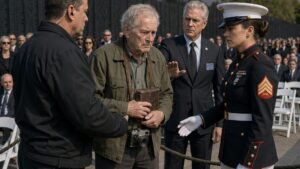
This year nobody moved it.
He sat.
Opened the booklet.
The pages felt thinner than he remembered.
Or perhaps his hands had grown older.
Families began arriving.
Students.
Veterans.
Children carrying small paper flags.
The ceremony had changed.
Not dramatically.
No spectacle.
No grand unveiling.
Only a few additions.
The kind that mattered.
Emily crossed the lawn carrying a folder.
She stopped beside Edward.
“You came.”
“I always do.”
“I know.”
She sat beside him.
For a moment they simply watched the sunrise.
Then she handed him the folder.
Edward opened it.
Inside was a draft of the new remembrance section.
Every year, before official names were read from the monument, another list would be acknowledged.
Names still being researched.
Names carried by families.
Names preserved through memory.
Not declared.
Not assumed.
Remembered.
Edward read silently.
His eyes lingered on several familiar entries.
Emily waited.
Finally he closed the folder.
“It’s good.”
Relief crossed her face.
“That’s all?”
“Did you want a speech?”
She laughed.
“No.”
“Then it’s good.”
The ceremony began an hour later.
This year, something unexpected happened.
People approached Edward before the event started.
Not crowds.
Not lines.
Individuals.
A veteran thanked him for helping preserve local history.
A student asked about one of the photographs.
A family member brought an old letter hoping it might help identify a missing name.
The interactions were brief.
Respectful.
Normal.
Exactly the way Edward preferred.
Nobody treated him like a monument.
They treated him like a person worth asking.
The distinction mattered.
When the ceremony officially started, Ryan stood near the stage.
Emily managed logistics.
Margaret organized the historical display.
Even John Jackson had changed.
The city representative spent part of the morning helping visitors navigate the exhibits.
Not because anyone ordered him to.
Because he understood something now.
Memory required work.
The ceremony unfolded quietly.
Speeches.
Music.
Moments of reflection.
Then came the new section.
Emily stepped to the microphone.
Her voice carried across the grounds.
She explained the purpose carefully.
Not certainty.
Not correction.
Remembrance.
Acknowledgment.
The names read aloud belonged to people still being researched.
People whose stories remained incomplete.
People who deserved not to vanish while the search continued.
Edward listened.
The booklet rested closed in his lap.
Several names were familiar.
Others had been added recently by families.
The list was growing.
Shared now.
No longer his alone.
The realization brought unexpected peace.
After the ceremony ended, visitors remained on the grounds.
Talking.
Reading exhibits.
Studying photographs.
A group of students gathered around one display.
The display contained a digital archive project.
People could contribute records.
Letters.
Photographs.
Stories.
Future generations would continue the work.
Edward stood before it for a long time.
Emily eventually joined him.
“What do you think?”
He looked at the screen.
At the volunteers helping visitors upload memories.
At families sharing documents.
At names finding new caretakers.
“I think Justin would’ve liked it.”
Emily smiled.
“So do I.”
The sun drifted lower.
Shadows stretched across the memorial lawn.
One final task remained.
Margaret approached carrying a small archival box.
Acid-free paper.
Protective sleeves.
Professional preservation materials.
Edward immediately knew what it was for.
The booklet.
His hand rested on the worn cover.
For decades it had traveled everywhere with him.
Truck seats.
Meeting rooms.
Kitchen tables.
Memorial ceremonies.
Rain.
Heat.
Years.
Margaret spoke softly.
“We can preserve it.”
Edward looked down.
The pages had earned rest.
The thought felt strange.
Almost uncomfortable.
Yet not wrong.
Ryan joined them.
Then Emily.
Then several others.
No pressure.
No expectations.
Simply people standing nearby.
Waiting.
Edward opened the booklet one final time.
The familiar names greeted him.
Justin.
Thomas.
William.
Dozens more.
Some remembered.
Some still waiting.
All carried.
He closed it carefully.
Then placed it inside the archival box.
The gesture felt less like surrender and more like trust.
Margaret sealed the lid.
Not permanently.
Just safely.
The booklet would remain accessible.
Protected.
Shared.
Continued.
Edward looked toward the memorial.
The flags moved in the evening wind.
The chair behind them sat empty now.
For years he had worried about forgetting.
About names disappearing.
About promises ending.
Standing there, he finally understood something.
The promise had changed hands.
Not abandoned.
Shared.
The burden no longer belonged to one aging veteran sitting alone behind the flags.
It belonged to a community willing to remember.
Ryan stepped beside him.
Neither man mentioned the salute from the previous year.
They didn’t need to.
The respect remained visible in smaller things.
Listening.
Asking.
Preserving.
Carrying forward.
Edward watched families move among the exhibits.
Students reading names.
Volunteers collecting stories.
Life continuing around memory.
And for the first time in decades, the empty spaces no longer felt quite so empty.
The story has ended.