The Airline Employee Reached for His Dog’s Leash—Then the Whole Terminal Saw Why He Couldn’t Let Go
Chapter 1: The Dog Who Waited for Two Fingers
Samuel struck Raymond’s left knee with his shoulder hard enough to stop him mid-step.
Raymond looked down, startled, just as a baggage cart shot past behind him. Its driver’s mouth was open in what might have been a warning. The cart missed the back of Raymond’s coat by inches, rattling toward the terminal doors with suitcases stacked above the driver’s head.
Raymond had heard none of it.
Samuel watched the cart until it cleared them, then lifted his scarred muzzle toward Raymond. The old shepherd’s ears remained forward. His leash hung loose between them.
Raymond touched two fingers to Samuel’s neck—not the release signal, only acknowledgment.
I saw you.
Samuel’s shoulders eased.
The supermarket occupied the wide space between the parking structure and the regional terminal, serving travelers who wanted coffee, bottled water, or food that cost less than anything beyond security. Its aisles were too narrow for luggage. Fluorescent light flattened every face. Overhead announcements moved people in sudden waves Raymond could never predict.
He kept his eyes on reflections in freezer doors and polished metal displays. Samuel watched everything else.
They needed one bottle of water before check-in. Nothing more. Raymond had arrived early so he would not have to hurry, ask for help, or stand trapped in a crowd while strangers repeated themselves louder and louder.
The folded reunion notice rested in his inside pocket.
Beneath it, wrapped in a handkerchief, was Samuel’s retired identification tag.
Raymond steered them past a family blocking the first aisle. A little boy stared at the pale line running through the fur along Samuel’s neck. His mother noticed and pulled him closer.
Samuel did not look at them.
At the refrigerated case, Raymond took a bottle and checked the nearest wall clock. His flight was still more than an hour away. Enough time to pay, cross the concourse, and present the folder tucked under his arm.
He had checked the documents three times that morning.
Veterinary record.
Current training assessment.
Harness identification.
Airline approval confirmation.
He had not checked the page he had left unfinished.
Samuel tugged once.
Raymond turned.
A supermarket employee in a green apron stood several feet away holding a shallow paper bowl. Her expression was careful, uncertain. She pointed to Samuel, then to the water dispenser near the café counter.
Raymond read her lips when she faced him.
“Can he have some?”
He nodded. “Set it down. Please don’t touch him.”
She placed the bowl near Samuel’s front paws and stepped back. Her name tag read CHRISTINE FLORES.
Samuel glanced at the water. His tongue showed briefly, but he remained standing.
Christine waited.
“He’s thirsty,” she said.
Raymond nodded again.
Samuel looked at Raymond’s right hand.
The leash still hung in a soft curve. Raymond let the moment last one second longer than necessary, reassured by the dog’s focus despite rolling suitcases, children, carts, and the movement pouring through the terminal doors.
Then he raised two fingers.
Samuel lowered his head and drank once. He stopped before Raymond lowered his hand.
Christine’s guarded expression changed.
“That’s something,” she said.
Raymond caught only the shape of the words. “Training.”
Samuel sat beside him without being told.
Christine glanced toward the faded patches sewn into the dog’s harness. “Military?”
“Retired.”
Raymond regretted the answer as soon as he gave it.
It was true, but incomplete in the way incomplete truths often became dangerous.
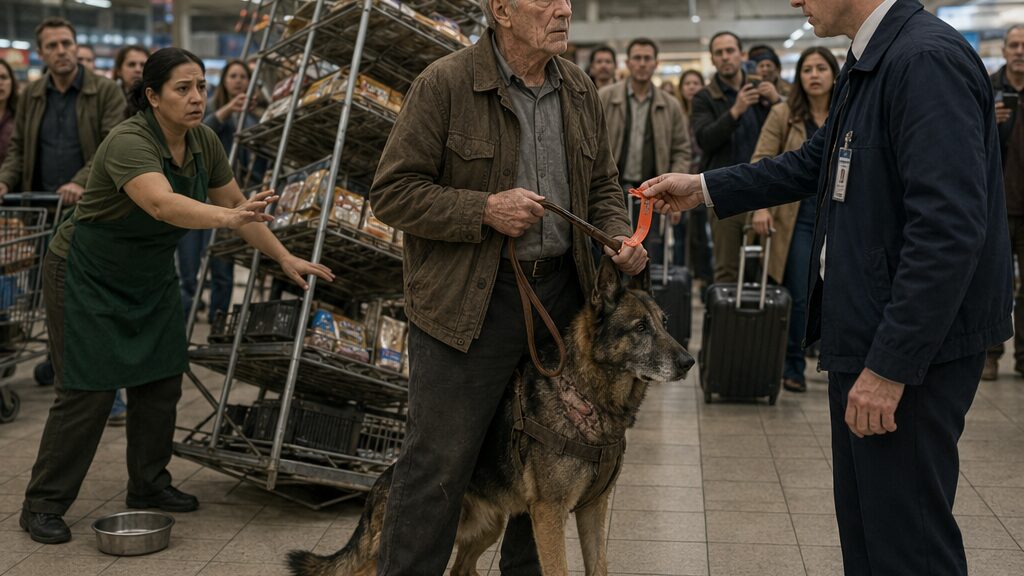
A man in a navy airline jacket had stopped near the service counter at the edge of the supermarket. He watched Samuel over the top of a tablet. His narrow tie was slightly crooked, as though he had tightened it while walking. A plastic badge identified him as PAUL ADAMS.
Paul approached with the quick, clipped movement of someone already certain the conversation would end his way.
“Sir.”
Raymond did not turn until Samuel touched his shin.
Paul’s mouth was moving. Raymond faced him fully.
“Sorry,” Raymond said. “I need to see you.”
Paul paused, then spoke again with exaggerated precision.
“Is that animal traveling today?”
“Yes.”
“In the cabin?”
“Yes.”
Paul’s gaze moved over Samuel’s harness, scars, leash, and large frame. “You’ll need to check him through special handling.”
“No.”
The word came out more sharply than Raymond intended.
Several people near the café looked over.
Paul’s jaw tightened. “Animals of that size travel in cargo unless there’s an approved accommodation.”
Raymond lifted the document folder. “There is.”
Paul extended his hand.
Raymond gave him the folder but kept the leash in his other hand. Samuel remained seated, eyes moving between the two men.
Paul opened the papers on a narrow counter. He scanned the vaccination record, then the airline confirmation. His finger stopped on the old military harness certificate.
“This says retired.”
“He is.”
“Then he’s not an active working animal.”
“He works for me.”
Paul looked up. “That is not what this says.”
Raymond felt the first tightening in his wrist. Samuel noticed it before Raymond did. The dog leaned lightly against his leg.
“He alerts me,” Raymond said. “I’m deaf.”
Paul’s eyes flicked toward Raymond’s ears as if expecting visible proof.
“How are we having this conversation?”
“I read lips. He tells me when someone is behind me. Alarms. Vehicles. Announcements when we’re moving.”
Paul returned to the forms.
Raymond saw the moment he found the blank field. The employee’s eyebrows rose, and some of the uncertainty left his face.
“The assistance section wasn’t completed.”
“The cabin approval is there.”
“The approval is conditional.”
“It was accepted.”
“For an animal matching the completed information.”
Samuel shifted his weight but did not rise.
Paul tapped the blank line. “You indicated he was retired. You did not request terminal assistance. You did not verify that you require an animal for navigation.”
“I don’t require a person to guide me through a building.”
“That isn’t what I asked.”
Raymond stared at him.
The crowd moved behind Paul in broken reflections—arms, bright luggage, mouths forming words Raymond could not catch. Samuel’s ears tracked sounds one after another.
Raymond tightened his grip until the leash lost its curve.
Paul noticed.
“I’m trying to prevent a problem on the aircraft,” he said. “We had an animal incident last month. A passenger was injured, and my employee took the blame for allowing it onboard. I’m not repeating that.”
Samuel’s gaze remained steady.
“He won’t cause a problem.”
“You can’t guarantee that.”
“I can.”
Paul looked at Samuel, then at the people maneuvering around his broad body. “He goes through special handling. We can make sure he’s loaded safely.”
A cold pressure opened beneath Raymond’s ribs.
He saw metal mesh.
A narrow transport cage.
Samuel’s paws braced against a floor that moved without him.
Raymond stepped between Paul and the dog before he knew he had moved.
Paul drew back half a step.
“No,” Raymond said.
“Sir, this is an airport safety decision.”
“No cage.”
“I said special handling.”
“I know what you mean.”
The paper bowl remained beside Samuel, still half full. The dog did not look at it. His eyes stayed on Raymond’s hand.
Paul returned the documents to the folder, but he did not give it back. Instead, he reached beneath the counter and removed a bright cargo tag attached to a plastic loop.
The loop snapped open between his fingers.
“The dog goes underneath,” Paul said, “or neither of you flies.”
Chapter 2: The Tag Paul Fastened Without Permission
Paul reached across the counter before Raymond could move and looped the cargo tag around Samuel’s leash.
The plastic closure clicked shut.
Raymond tore it free so quickly the paper strip ripped across the printed barcode. The broken tag fell against Paul’s shoes.
Samuel rose, not lunging, not growling—only placing his body against Raymond’s thigh.
Paul’s face flushed. “Do not destroy airline property.”
“Do not touch his leash.”
“I did not touch the dog.”
“You touched the line between us.”
The words came out before Raymond could stop them.
Paul glanced toward the gathering faces. A woman near the café held her phone chest-high. Two travelers stood beside their rolling bags without moving. Christine remained near the water dispenser, watching Samuel instead of either man.
Paul bent and picked up the torn tag.
“I’m responsible for passenger safety,” he said. “You arrived with a large retired military animal and incomplete assistance information. When I try to follow procedure, you become confrontational.”
Raymond saw only part of it. Paul had turned his head toward the witnesses while speaking.
“Face me.”
Paul stopped.
“If you expect an answer,” Raymond said, “face me.”
A trace of embarrassment crossed Paul’s expression, quickly replaced by annoyance. He squared himself toward Raymond.
“I said you are making this harder than necessary.”
“Then give me my papers.”
Paul held the folder against his chest.
“When I know how the animal is traveling.”
“Samuel.”
“What?”
“His name is Samuel.”
Paul looked down at the dog. “Samuel is retired.”
“From the military.”
“Which means he is no longer performing military duties.”
Raymond could have explained everything then.
The alarms Samuel translated with a touch.
The nights he woke Raymond before smoke from a faulty heater filled the bedroom.
The way he blocked Raymond at crosswalks when an unseen car approached from behind.
The pressure of his body during the moments when the room stopped being a room and became dust, white light, and bodies Raymond could not reach.
But the crowd was watching. Paul had already examined Raymond as if disability should be visible, measurable, and entered into the correct box.
Raymond would not put his worst moments on the counter beside the torn tag.
“He assists me,” he said.
“With what specific trained tasks?”
“You don’t need my medical history.”
“I need enough information to determine whether he belongs in the cabin.”
“He belongs with me.”
Paul’s lips tightened. “That is an emotional statement, not a safety qualification.”
The leash twitched.
Samuel turned toward the terminal entrance.
Raymond followed the dog’s gaze. Nothing seemed wrong. Travelers continued moving between the doors and the check-in counters.
Then Samuel touched Raymond’s knee and looked sharply toward a baggage carousel near the wall.
A yellow light began flashing.
A worker waved people away from the belt as a suitcase jammed beneath the metal edge. Raymond saw the warning light a moment later. He saw mouths open, heads turn, hands rise to ears.
He heard nothing.
Samuel touched his knee again, then guided Raymond two steps away from the aisle as a maintenance cart hurried past.
The people nearest them had seen it.
Christine’s eyes moved from the flashing light to Samuel.
The woman with the phone slowly lowered it.
Paul looked too, but his expression did not soften.
“He reacted to an alarm,” Raymond said.
“He turned his head.”
“He alerted me before the light came on.”
“Or he heard a sound, like any dog.”
Raymond felt heat climb his neck.
“Exactly.”
Paul blinked.
“He hears it,” Raymond said. “Then he tells me.”
The worker freed the jammed suitcase. The flashing light stopped. Travelers began moving again, their attention already draining from the moment.
Samuel sat.
Paul looked down at him. For a few seconds, doubt entered his face. Then a man in a business coat pushed a suitcase around Samuel and muttered something Paul heard but Raymond did not.
Paul’s shoulders stiffened.
“People are already being forced into the aisle,” he said. “On the aircraft, that becomes a serious issue.”
“He fits under the seat space assigned to us.”
“That has not been confirmed.”
“It’s in the folder you won’t return.”
Paul placed the documents on the counter but kept one hand on them. “Last month, a passenger claimed an untrained animal was necessary for anxiety. It snapped at a child during boarding. The complaint named my desk. My supervisor told me that the next questionable animal gets verified before it reaches the gate.”
Samuel’s ears shifted toward the little boy from earlier. The child was peering around his mother’s coat. His mother drew him back again.
Raymond understood Paul’s fear.
He did not forgive what Paul had done with it.
“Samuel has not moved toward anyone,” Raymond said.
“You pulled away when I tagged the leash.”
“You put your hand where it didn’t belong.”
“And he stood up.”
“Because I moved.”
Paul looked at the witnesses again. He wanted them to see reason standing on his side. Raymond knew that posture. He had seen young officers use it when uncertainty frightened them more than being wrong.
“Let me see the completed task certification,” Paul said.
Raymond opened the folder himself. He found Samuel’s current assessment, signed less than six months earlier, and placed it on the counter.
Paul read silently.
Raymond watched his eyes.
Alert to environmental sound.
Physical interruption.
Crowd buffering.
Handler orientation.
The words were there.
Paul’s finger stopped beside the service history. “Retired.”
“From military duty.”
“But still wearing military equipment.”
“It fits him.”
“It also creates an impression that may not reflect his present legal status.”
Raymond stared at him. “You think I dressed him up to get on an airplane?”
“I think people sometimes misunderstand what documentation means.”
“And sometimes employees decide what they want it to mean.”
Paul’s face hardened.
The leash was no longer loose. Raymond had wound it once around his palm without noticing. Samuel leaned closer, his breathing slow and visible along his ribs.
Christine approached carefully, keeping her hands in front of her.
“He didn’t go for anyone,” she told Paul. “Not even when you reached over.”
Paul faced her. Raymond lost the words.
He touched Samuel’s shoulder.
The dog turned toward Paul, then back to Raymond, tracking the conversation for him.
Christine pointed toward the water bowl. “He wouldn’t even drink until this man signaled.”
Paul answered her while still half turned away.
Raymond caught only the final words.
“…doesn’t establish cabin eligibility.”
“Face me,” Raymond said again.
Paul did, irritation now plain. “I said obedience does not establish eligibility.”
“No. But it establishes control.”
Paul pulled the tablet closer and entered Raymond’s booking number. The screen reflected in his glasses. His expression shifted, first to concentration, then to vindication.
“There,” he said.
Raymond could not see the screen from where he stood.
Paul rotated it.
The itinerary showed Raymond’s name, Samuel’s travel note, and a yellow warning symbol beside a blank section.
“Cabin transport approval pending disability-assistance verification,” Paul read.
Raymond felt Samuel press more firmly against his leg.
Paul enlarged the unfinished form.
“You were asked whether you could navigate the terminal without personal assistance,” he said. “You left the answer blank.”
The crowd no longer seemed curious.
It seemed expectant.
Paul pointed to the empty field.
“You never completed the disability-assistance section.”
Chapter 3: The Form Raymond Refused to Finish
“Mr. Carter, did you hear what I asked?”
The woman’s voice came from behind Raymond.
He did not turn.
Paul folded his arms. “This is what I’ve been dealing with.”
Samuel touched Raymond’s calf, then angled his head toward the woman standing near the counter. Raymond followed the movement and found a dark-haired supervisor in the same navy uniform as Paul. Her badge read ANGELA LEE.
She looked from Raymond to Samuel, then to the broken cargo tag on the floor.
“I’m Angela Lee, shift supervisor,” she said.
Raymond lifted one hand. “Stand where I can see you.”
Angela’s expression changed. She stepped into his line of sight.
“I apologize. Paul said you refused to answer.”
“I didn’t know you were there.”
Angela glanced at Paul.
“He says he told you the passenger is deaf,” Christine said from the edge of the aisle.
Paul’s mouth tightened. “He also says he does not require assistance.”
Raymond wrapped the leash once around his wrist.
Samuel’s eyes dropped to the shortening line.
Angela noticed. “Let’s move away from the counter.”
“I’m not going anywhere without my documents.”
Paul slid the folder across.
Raymond checked it before taking a step. Nothing appeared missing. Angela led them toward a seating area beside the supermarket café, where a row of plastic chairs faced a boarding monitor.
Paul followed with the tablet.
Christine hovered near the water dispenser, uncertain whether she was permitted to remain. Angela gave her a brief nod.
“Tell me what happened,” Angela said.
Paul began first.
He described an oversized retired military dog, incomplete forms, a passenger unwilling to follow instructions, and a reaction when the cargo tag had been attached. His account was not entirely false. That made it worse.
Raymond waited until Paul faced away from him.
Then he said, “I can’t answer what I can’t see.”
Angela raised a hand. Paul stopped and turned.
“Mr. Carter,” she said, “did you complete the accessibility form when you booked?”
“No.”
Paul made a small sound through his nose.
Angela ignored it. “Why not?”
Raymond looked at the boarding monitor. The letters were too far away to read clearly.
“The flight was approved.”
“The animal notation was conditionally accepted,” Angela said. “The accessibility section helps us determine what services you need in the terminal and on the aircraft.”
“I don’t need someone assigned to me.”
“That wasn’t my question.”
It was nearly the same thing Paul had said, but Angela kept her face toward him and her voice even.
Raymond looked down at Samuel.
The old shepherd sat with his front paws aligned, scarred neck exposed above the harness. He had not tried to return to the water.
“The form asked whether I could navigate without personal assistance,” Raymond said.
“And?”
“I can.”
Paul gestured toward Samuel. “Not according to his own explanation.”
Raymond’s hand tightened inside the looped leash.
Samuel shifted closer.
Angela watched both of them. “Does Samuel alert you to sounds?”
“Yes.”
“Which sounds?”
“Vehicles. Alarms. People approaching from behind.”
“Announcements?”
“When there’s movement attached to them. Boarding lines. Gate changes if people start leaving.”
“Does he interrupt medical episodes?”
Raymond went still.
Paul looked at him.
Angela did not repeat the question. She waited.
Samuel’s gaze remained fixed on Raymond’s hand.
“Sometimes,” Raymond said.
“What kind?”
“That is private.”
“It can remain private. I need the task, not the diagnosis.”
Raymond rubbed his thumb over the worn leather of the leash. “He redirects me. Creates space. Brings me back to him.”
Paul looked down at the dog as if reassessing his size.
Angela asked, “Is that listed on his current training assessment?”
Raymond handed her the page.
She read it slowly, then turned it so Paul could see.
“Retirement from military service does not mean the dog cannot perform trained disability-related tasks,” she said.
Paul’s face changed, but only slightly. “The booking still wasn’t completed.”
“No,” Angela said. “It wasn’t.”
The small relief Raymond had felt vanished.
Angela returned the page. “Why did you leave it blank?”
Raymond remembered the online form glowing on his kitchen table three weeks earlier.
Can you navigate the airport without personal assistance?
Yes.
No.
Describe required support.
He had selected yes, then deleted it because Samuel lay beneath the table with one ear raised. He had selected no, then deleted that too.
No meant a stranger waiting with a wheelchair he had not requested. A bright label on his itinerary. Someone taking his elbow. Someone speaking to Samuel instead of him. Someone deciding that silence meant confusion.
In the end, he had closed the page.
“I didn’t want an escort,” he said.
“You could have declined an escort while documenting Samuel’s tasks.”
“I didn’t know that.”
“The instructions explain it.”
“The instructions were six pages long and written for someone who thinks assistance only counts when another person provides it.”
Angela absorbed that without arguing.
Paul did not.
“You chose not to complete the process,” he said. “Now you’re accusing me of discrimination for noticing.”
“I accused you of touching his leash.”
“You tore up a cargo tag and caused a scene.”
“You attached it without permission.”
Angela stepped between their sightlines.
“This is not helping.”
She took the tablet from Paul and reviewed the booking. The boarding monitor above her changed. A block of amber text appeared beside Raymond’s flight number.
Raymond rose slightly from the chair.
Samuel rose with him.
Angela followed his gaze. “Boarding begins soon.”
“How soon?”
She checked the screen. “The gate closes in forty minutes.”
Raymond looked toward the corridor beyond security. Even without sound, he could feel the terminal shifting around the deadline. Travelers checked watches. A family gathered bags. A line at the checkpoint lengthened.
“Then correct the form,” he said.
“I can correct the accessibility record,” Angela replied. “I cannot ignore a safety objection once an employee files one.”
Raymond turned to Paul.
Paul held his gaze. “Samuel reacted physically when I handled the tag.”
“He stood.”
“He moved between us.”
“He was following me.”
“He is trained to block crowds,” Paul said, tapping the assessment. “That may be useful in an open space. In an aircraft cabin, it could trap a passenger or interfere with crew.”
Angela looked again at the page. Raymond saw the problem take shape in her expression.
“Has Samuel ever bitten anyone?” she asked.
“No.”
“Growled at a civilian?”
“No.”
“Blocked someone from approaching you?”
Raymond hesitated.
Paul saw it.
“He has,” Paul said.
“When I need him to.”
“That is exactly the concern.”
Christine stepped nearer. “The dog hasn’t done anything here.”
Paul turned toward her. “He physically inserted himself when Mr. Carter became agitated.”
Christine’s confidence faltered.
Raymond saw how quickly the words changed the room. Samuel was no longer the dog who had warned him about an alarm. He was a large animal trained to prevent access to his handler.
Angela looked toward the security checkpoint, then back at Raymond.
“I’m not denying boarding,” she said. “But I cannot authorize it until the objection is resolved.”
“How?”
“I need to determine whether Samuel remains under your control in this environment and whether the cabin placement is safe.”
“You’ve watched him sit here.”
“I have also watched you shorten the leash every time the conversation becomes difficult.”
Raymond looked down.
The leather was wrapped tightly around his wrist. Samuel’s head had lowered, his eyes tracking the trapped line between them.
Raymond unwound it once.
The leash loosened, but not completely.
Angela’s expression softened only a fraction. “You should have told us before today what he does for you.”
Raymond looked at the blank field on the tablet.
He had believed silence would protect him from being reduced to a problem someone else needed to manage.
Instead, silence had given Paul the empty space to define Samuel as one.
On the monitor, the amber boarding notice began counting down.
Angela locked the tablet and held it against her side.
“Forty minutes,” she said. “Until we resolve the objection, neither of you can proceed to the gate.”
Chapter 4: What the Scars Cost Both of Them
The kennel appeared before Raymond understood why Angela had looked toward the terminal corridor.
A worker rolled it toward the seating area on four small wheels. The metal door rattled against its frame. A folded airline blanket lay inside, and a laminated tag hung from the handle.
Raymond stood so fast the chair legs scraped beneath him.
He stepped in front of Samuel.
“No.”
The worker stopped. Angela moved into Raymond’s line of sight.
“It is only a temporary holding option while we finish the review.”
“No.”
“Samuel would remain inside the terminal.”
“No cage.”
Paul stood behind Angela with the tablet against his chest. “No one said he was being sent to cargo yet.”
Raymond looked at the kennel’s low roof and narrow door. Samuel could enter it, but only with his head lowered. The thought of the door closing behind him tightened something old and hard inside Raymond’s chest.
“He stays with me.”
Angela kept her hands visible. “This would reduce the crowding and let us assess the paperwork without further escalation.”
“You want to assess whether he’s under my control by taking him away from me?”
“That isn’t what I said.”
“It’s what the kennel says.”
Samuel had risen beside him. The leash crossed the pale scar at the base of his neck, the leather resting over a place where fur had never grown back evenly.
Raymond saw another lead there.
Nylon darkened with dirt.
Pulled so tight it had cut through fur while Samuel dragged weight that should have been impossible for him to move.
Raymond pressed his thumb against the present leash until the memory receded.
Angela signaled the worker to hold the kennel farther back.
“We are trying to find a safe interim solution.”
“For whom?”
“For everyone.”
Paul shifted closer. “If the dog is as disciplined as you say, a few minutes in a secure enclosure should not be a problem.”
Raymond faced him.
“You put him in there,” he said, “and I leave.”
“That is your choice.”
Angela turned sharply toward Paul. “That is not helping.”
“It is the practical reality.”
Raymond looked at the monitor. Thirty-six minutes remained before the gate closed.
He could walk out now.
The parking structure was beyond the supermarket doors. His truck sat on the second level. He could be home before the flight left, the reunion notice still folded in his pocket, Samuel sleeping safely on the rug beside his chair.
No cage. No crowd. No questions.
Samuel nudged Raymond’s wrist.
The leash had tightened again.
Raymond loosened it, but his hand did not release the leather.
Christine approached carrying the paper bowl and a sealed packet of dog food from the supermarket shelf. She stopped several feet away.
“He hasn’t had much water,” she said.
Raymond read the words and looked down.
Samuel’s mouth was open slightly. His breathing was controlled, but the tip of his tongue showed. The bowl Christine had offered earlier remained almost full.
She set the food beside it.
Samuel glanced at both, then back at Raymond’s hand.
Raymond did not raise his fingers.
The kennel stood behind Angela. Its metal frame filled the edge of his vision.
Samuel remained still.
“He’s waiting,” Christine said.
“I know.”
“You can tell him it’s okay.”
Raymond looked at her.
Christine lowered her eyes, uncertain whether she had crossed a line. “I mean the water.”
Raymond knew what she meant.
He could give the signal. Two fingers, palm angled down. Samuel would drink and eat because Raymond had told him the space was safe.
But the space was not safe.
Paul still held the authority to separate them. Angela still had not approved the flight. The kennel waited with its door open.
Raymond kept his hand closed.
Samuel turned his body slightly, placing himself between Raymond and the rolling enclosure.
The dog’s ears moved constantly now. His gaze shifted from Paul to Angela, from the crowd to Raymond, then back to the kennel. The leash no longer hung loose.
Christine watched him. “He isn’t refusing because he’s upset with you.”
Raymond said nothing.
“He’s waiting because he trusts you.”
The words landed harder than Paul’s accusations had.
Raymond looked at the scar beneath Samuel’s collar.
The artillery strike had not sounded like anything to him, not after the first instant. It had become pressure, white dust, and a silence so complete he had believed the world had ended.
He had been pinned beneath part of a collapsed wall. Samuel had stood several yards away, bleeding from the shoulder and neck, waiting for direction.
Raymond had pointed away.
Go.
Samuel had taken two steps.
Then he had turned back.
The dog seized Raymond’s vest and dragged until the damaged lead cut into his own neck. Every pull opened the wound farther. Raymond remembered seeing the blood and trying to push him away.
Samuel had ignored him.
Later, a medic had called it remarkable.
Raymond had called it a debt.
He had carried it through surgeries, retirement papers, and the long months when Samuel woke at every vibration in the floor. He had promised the dog there would be no more cages, no more aircraft holds, no more orders into places he could not follow.
And now Samuel stood thirsty because Raymond would not move two fingers.
Raymond had thought he was protecting him.
The dog’s rigid shoulders suggested something else.
Angela stepped closer, remaining directly in front of Raymond. “The holding room is optional. I won’t authorize the kennel over your objection.”
Paul looked at her. “Then how are we supposed to reduce the risk?”
“We stop adding to it.”
For the first time, Paul appeared uncertain.
Angela gestured toward the kennel worker, who began rolling the enclosure away.
Samuel watched until it disappeared behind a display of travel pillows.
His body did not relax.
Raymond raised his hand halfway.
Samuel’s eyes locked onto it.
Two fingers. That was all.
Instead, Raymond lowered his hand again.
The old guilt said the command would be another demand. Another use of loyalty Samuel had already paid for.
Samuel remained standing over untouched water.
Christine crouched near the folding metal display beside the café, adjusting one of its supports so travelers could pass. She glanced back at Raymond.
“He wants you to tell him what comes next.”
Raymond looked at Samuel.
The dog was not pleading for release from duty.
He was waiting to be included in it.
Before Raymond could lift his hand, a suitcase clipped the corner of Christine’s display. One hinged leg folded inward.
Christine grabbed for the frame.
The metal structure tilted toward the aisle directly behind Raymond.
Chapter 5: The Crash Raymond Never Heard Coming
Samuel hit Raymond across the legs.
Raymond stumbled sideways as the display collapsed into the space where he had been standing. Metal bars struck tile. Packaged snacks and plastic signs scattered beneath the chairs.
He did not hear the crash.
He felt it through the soles of his shoes.
The floor jumped once, then trembled beneath rolling pieces of metal. Fluorescent light flashed across silver frames. People’s mouths opened. Hands rose. A child disappeared behind a coat.
Samuel stood braced against Raymond’s knees, body turned toward the wreckage.
The leash had gone rigid.
For one clean second, Raymond understood everything.
Samuel had seen the fall.
Samuel had moved him.
No one had been hurt.
Then a light above the café began to pulse.
White.
Dark.
White.
The concourse broke into fragments.
A bent metal leg became a collapsed support beam.
A shopping cart wheel spinning on its side became a tire turning in dust.
A man reaching for his suitcase became someone crawling through smoke.
Raymond’s breath stopped halfway into his chest.
Christine stepped around the wreckage. Her face formed words too quickly to read. She pointed to Samuel, then Raymond, then the display.
Paul appeared at the edge of Raymond’s vision.
“What did the dog do?”
Christine faced him. “He moved him out of the way.”
Raymond caught only pieces. Samuel. Way.
Paul raised one hand toward the terminal. His other went to the radio clipped near his shoulder.
Samuel looked at Raymond.
The dog’s mouth closed.
Raymond knew that look.
Present yourself.
Find the hand.
Find the signal.
But Raymond’s fingers would not move.
The leash slipped against his palm.
Someone behind him touched his shoulder.
Samuel spun and placed his body between them.
The stranger retreated immediately.
Paul pointed. “There. That’s exactly the behavior I reported.”
Christine stepped into his line of sight. “The man came up behind him.”
“He blocked physical access.”
“He’s deaf.”
“That doesn’t make this safe.”
Paul lifted the radio and spoke into it. Raymond saw the movement but heard nothing. The crowd’s attention shifted toward them, drawn by the fallen display and Paul’s uniform.
Phones appeared.
A woman pulled a suitcase out of Samuel’s path. Another person pushed forward to see.
Raymond searched for Angela.
Faces crossed one another. Mouths moved. The pulsing light continued above them.
White.
Dust.
Dark.
Samuel’s shoulder was bleeding.
No. Not now.
The scar was old.
Raymond knew that, but the concourse would not stay fixed long enough for him to believe it.
The dog in front of him was young again, harness torn, fur dark along the neck.
Raymond saw his own hand point away.
Go.
Samuel’s ears had flattened.
Go.
Raymond’s lungs pulled in air too quickly. Nothing left them. His fingers tingled. The leash slid farther through his hand.
Samuel touched his muzzle to Raymond’s wrist.
Raymond looked down but could not connect the pressure to the dog standing there.
The tile beneath them vibrated as travelers dragged luggage away from the fallen display. Each jolt traveled through his legs.
Angela pushed through the crowd and came directly into view.
Her lips moved slowly.
“Raymond. Look at me.”
He saw the instruction. He could not obey it.
Samuel nudged his wrist again.
Angela turned toward the people around them and raised both arms, telling them to move back. Some did. Others leaned around one another, curious and uncertain.
Paul caught Angela’s sleeve.
“He knocked the passenger aside and blocked another person. Security is coming.”
Angela looked at the collapsed display, then at Christine.
Christine shook her head hard. “The display fell. Samuel saved him.”
“He used force.”
“He used his body.”
“He is a large dog trained to control space.”
Raymond saw Paul’s lips clearly now because the man had stepped closer.
Control space.
The phrase belonged to another place.
A narrow road.
A damaged wall.
Men shouting instructions Raymond could no longer hear.
Samuel had been sent ahead to hold a passage open while the unit moved the wounded. Then the artillery landed. Raymond remembered the blast only as a white tearing motion at the edge of his vision.
Afterward, he had found Samuel standing in the dust, waiting.
Raymond had ordered him away because another strike was coming.
The dog returned anyway.
The memory closed over the supermarket.
Raymond’s knees weakened.
Samuel moved beneath him before he fell, taking part of his weight against his shoulders. The leash went slack between Raymond’s hand and the harness.
That frightened Samuel more than the crowd had.
The dog turned in a tight half circle, scanning every approach. He touched Raymond’s thigh, then his wrist, then pressed against his knees.
Raymond’s hand hung uselessly at his side.
Christine stepped forward with the water bowl.
Samuel blocked her path without touching her.
She stopped at once.
“He isn’t attacking,” she said. “He’s keeping us away.”
Paul lifted an arm toward someone beyond the crowd.
Raymond followed the gesture and saw two security workers moving quickly through the concourse.
Their mouths were set. One carried a looped restraint lead.
Samuel saw them too.
His posture changed.
Not aggression.
Decision.
He moved around Raymond’s left side, shoulder brushing Raymond’s leg, then crossed in front of him. A cart stood too close. Samuel drove his chest against its lower frame and pushed it backward until its owner stepped away.
The movement widened the space by two feet.
Then Samuel continued around Raymond.
A complete circle.
His body became a moving boundary.
Every pass pressed Raymond inward, away from reaching hands and shifting luggage. Every turn forced the crowd back without teeth, bark, or raised hackles.
Angela saw the pattern.
“Stop approaching him,” she told the security workers.
Paul stepped beside her. “We need to restrain the dog before he corners someone.”
“He is not cornering anyone.”
“He is driving people back.”
“He is creating space.”
The security workers slowed but did not leave.
Raymond tried to lift his hand.
His fingers twitched once.
Samuel glanced at them and made another circle.
The leash traced the floor around Raymond’s shoes, loose enough not to bind, close enough to define the shrinking world.
A suitcase rolled into the circle.
Samuel pushed it away.
A man reached down, perhaps to help, perhaps to grab the leash.
Samuel stepped between the hand and Raymond.
The man recoiled.
Fear moved through the crowd faster than truth.
Someone near the back pointed at Samuel. Someone else raised a phone higher. Raymond saw mouths form the same word in different shapes.
Dangerous.
Paul raised his radio again.
“Everyone stay clear,” he said. “Security, prepare to contain the animal.”
Samuel completed another circle and pressed his scarred shoulder against Raymond’s legs.
The pressure should have meant safety.
Instead, Raymond saw blood beneath the fur.
He saw the dog dragging him while the world shook.
He saw himself ordering Samuel away.
The leash slid almost completely from his hand.
Samuel caught it beneath one paw and began to circle again.
Chapter 6: The Circle No Stranger Could Cross
Samuel struck the side of a shopping cart with his shoulder and drove it away from Raymond.
The cart rolled backward into Paul’s path. Paul caught the handle before it tipped, his face tightening as Samuel planted himself between him and Raymond.
The dog did not growl.
He did not show his teeth.
He simply stood there until Paul took one step back.
Then Samuel resumed the circle.
Raymond remained in the middle, breathing in short, useless pulls. The concourse fractured around him—faces without sound, hands without intention, lights flashing over polished tile.
Samuel passed in front of him again.
Scar.
Harness.
Eyes.
Raymond knew those things belonged together. He could not yet make them mean now.
Angela moved into the open space beyond the dog’s path. She crouched so Raymond could see her without looking through the crowd.
“Samuel is waiting for you,” she said slowly.
Raymond watched her mouth.
Waiting.
Samuel crossed behind him, close enough that the leash brushed Raymond’s coat.
Angela pointed toward Raymond’s right hand.
The fingers were curled against his palm.
Every time Samuel passed, he looked at that hand.
Not at Paul.
Not at security.
At Raymond.
Angela turned to the security workers and held up one palm. “Do not use the restraint lead.”
Paul stood beside the displaced cart. “If we wait until he reacts, it will be too late.”
“He is reacting,” Angela said. “He is following training.”
“He physically moved property and blocked three people.”
“He has not pursued anyone who stepped back.”
Paul’s jaw worked. He looked past Samuel toward Raymond, who remained unable to answer.
“This is exactly why the cabin objection exists.”
Christine appeared at the edge of the crowd holding the paper water bowl. She looked toward Raymond before moving.
Earlier, he had told her where to set it and not to touch Samuel.
She remembered.
Christine lowered herself carefully and slid the bowl across the tile. It stopped inside the moving circle, several feet from Raymond.
Samuel passed it without drinking.
His eyes returned to Raymond’s hand.
Christine rose. “He’s still waiting for permission.”
The words reached Raymond only through their shape, but something inside him shifted.
Waiting for permission.
Not trapped by duty.
Not forced to serve.
Waiting for him to return to the language they shared.
Samuel pressed his body along Raymond’s legs on the next pass. The dog’s breathing was deep and deliberate. Raymond felt each exhale through the leather leash and the contact at his knees.
In.
Out.
In.
Out.
He tried to match it.
The first breath caught.
The second reached lower.
Tile returned beneath his shoes.
The white flashes became a faulty café light rather than artillery.
The metal on the floor became a collapsed display.
Samuel became old again.
Scarred, gray around the muzzle, alive.
Raymond lifted his thumb from his palm.
Samuel saw it instantly.
The dog slowed but did not stop circling.
Paul stepped forward.
Perhaps he mistook Samuel’s hesitation for an opening. Perhaps the watching crowd made retreat feel like surrender. He moved around the cart and reached down toward the loose section of leash.
Angela rose. “Paul, don’t.”
His fingers closed around the leather.
Samuel pivoted.
He placed his body between Paul and Raymond so quickly that Paul stumbled backward. No bite. No bark. Only a hard block of muscle and training.
The crowd recoiled as one.
A phone struck the floor.
One of the security workers raised the restraint lead.
Paul pointed at Samuel. “You saw that.”
“I saw you cross the boundary,” Angela said.
“He prevented me from reaching a passenger in distress.”
“You reached for the leash after being told not to.”
“I was trying to gain control.”
“You were trying to take control from the handler.”
Paul looked at Raymond.
For the first time, fear showed beneath his certainty. Not fear of Samuel alone. Fear of being seen as the person who had made the scene worse.
Raymond understood that fear.
He had lived inside a version of it for years.
If he admitted he needed Samuel, people might see only weakness.
If Paul admitted he had misjudged Samuel, everyone might see only failure.
Both men had mistaken control for safety.
Samuel resumed his circle, but tighter now. His body trembled once as he passed Raymond’s knees.
Raymond saw it.
The dog was carrying too much.
Not because he had been asked to help.
Because Raymond had given him no direction.
The memory changed shape.
In the dust years ago, Raymond had pointed Samuel away. He had believed the dog disobeyed because loyalty overrode training.
But Samuel had not been confused.
He had seen Raymond trapped and chosen the task that mattered.
Now Raymond had spent years treating that choice like a wound he had inflicted.
Samuel pressed against him again.
Raymond put one hand on the dog’s back.
The movement stopped the circle for half a second.
Samuel looked up.
Raymond felt the old scar beneath his palm, but he did not see blood this time. He felt warm fur and the slow rise of Samuel’s ribs.
“I’m here,” Raymond said.
He could not hear his own voice. He saw Angela’s face change, so he knew the words had come out.
Samuel leaned into him.
Raymond drew one full breath.
Then another.
Around them, the security workers lowered the restraint lead. Christine kept the water bowl where she had placed it. The crowd remained beyond the space Samuel had made.
The leash lay across the floor in a broad curve.
Not a chain.
A line.
Raymond gathered it carefully, not wrapping it around his wrist. Samuel watched every movement.
Angela spoke slowly. “Can you signal him?”
Raymond nodded once.
His hand still trembled.
He raised it to chest height.
Samuel’s eyes fixed on his fingers.
Raymond extended one finger.
Then the second.
The familiar release signal took shape between them.
Samuel’s shoulders lowered.
The crowd exhaled in a motion Raymond could see.
But Raymond did not point toward the water.
Not yet.
He turned his hand toward Paul.
The torn cargo tag still hung from the portion of leash Paul had fastened earlier, its barcode folded and creased near Samuel’s harness.
Paul followed Raymond’s gaze.
Raymond pointed directly at the tag.
“Take it off him.”
Paul did not move.
Samuel remained beside Raymond, no longer circling but still alert. The two-finger signal stayed raised, unfinished until Raymond chose what came next.
Angela faced Paul. She said nothing.
That silence left the decision entirely his.
Paul looked at the security workers, the collapsed display, Christine, the phones, and finally Samuel.
Then he looked at Raymond.
The hand he had used to seize the leash hung motionless at his side.
Chapter 7: Both Ends of the Leash Went Home
Paul’s hand hovered above the torn cargo tag.
To remove it, he would have to step back into the circle he had tried to cross by force.
Samuel stood beside Raymond now, his flank pressed against Raymond’s knee. The dog watched Paul without lowering his head, but the hard line through his shoulders had eased. Raymond’s two raised fingers remained visible at chest height.
Permission had not yet been given.
Paul looked toward Angela.
She did not rescue him from the decision.
“Ask,” she said.
Paul swallowed. Then he lowered himself slowly, stopping several feet from Samuel. For the first time since the argument began, he positioned his face where Raymond could see it clearly.
“May I approach?”
Raymond studied him.
The crowd had gone still beyond the fallen display. One security worker held the restraint lead at his side. Christine stood near the water bowl. The little boy watched from beside his mother, no longer hidden behind her coat.
Raymond lowered one finger.
Samuel’s eyes followed the movement.
“Slowly,” Raymond said.
Paul shifted forward on one knee.
Samuel remained in place.
Paul stopped within reach of the damaged tag but did not touch it. He looked at Raymond again.
Raymond gave a small nod.
Paul took the plastic loop between two fingers. It had twisted beneath the edge of Samuel’s harness. His first pull tightened it against the leather.
Samuel’s ears moved forward.
Paul froze.
“Lift the buckle,” Raymond said. “Don’t pull.”
Paul did as he was told. The loop loosened, and the bright paper tag slipped free.
For a second, it hung from Paul’s hand exactly as it had when he first threatened to send Samuel below the aircraft.
Now it looked flimsy.
Too small to have carried so much fear.
Paul stood and folded the tag once, then again. “I acted before I understood.”
Raymond kept his hand on Samuel’s back.
“Yes.”
“I thought the incomplete form meant you were trying to avoid verification.”
“I was avoiding something.”
Paul waited, but Raymond did not explain.
The confession belonged to Raymond, not to the crowd.
Paul glanced at Samuel. “I should not have attached the tag or reached for the leash.”
“No.”
The answer was not forgiveness. It was not punishment either. It was simply the truth left where both men could see it.
Angela took the tablet from beneath her arm and faced Raymond.
“The safety objection is being withdrawn,” she said.
Paul looked at her, then nodded once. “Withdraw it.”
Angela opened the booking record. “I can update the assistance information now. Samuel will remain with you through security, boarding, and the flight. I can also arrange visual alerts and preboarding.”
Raymond looked past her.
At the end of the concourse, the boarding door stood open.
The sight of it hollowed him.
Beyond that door waited a narrow aircraft aisle, rows of strangers, locked exits, vibration beneath his feet, and hours when every movement would have to be read through Samuel’s body.
He imagined the cabin door closing.
He imagined failing to breathe again where there was no room for Samuel to make a circle.
Raymond bent and gathered the leash.
Samuel looked toward the gate, then back at him.
“We’re leaving,” Raymond said.
Angela’s expression shifted. “Leaving the airport?”
“Yes.”
Paul lowered his eyes.
No one argued. That almost made the decision easier.
Raymond turned toward the supermarket doors. The parking structure lay beyond them. His truck would be quiet. Samuel could stretch across the back seat. The reunion could happen without them, as so many things had happened without them over the years.
Samuel did not follow.
The leash tightened gently—not a warning pull, only resistance.
Raymond stopped.
Samuel faced the boarding corridor.
Then he looked up at Raymond.
The dog’s mouth remained closed. His ears were forward. He was waiting for direction, but not asking to retreat.
Raymond reached into his coat for the reunion notice. The folded paper caught against the handkerchief beneath it, and something metal pressed into his fingers.
He drew out Samuel’s retired identification tag.
Its edges had been polished smooth by years in a drawer and the morning spent in Raymond’s pocket. The old number was still visible.
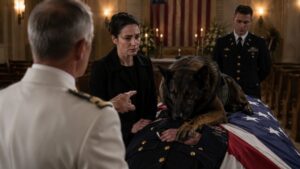
At the reunion, the unit planned to place two identification tags beside photographs of the handlers who had not returned from their final deployment.
Samuel’s was not meant for the memorial table.
Raymond had carried it because he had never decided whether retirement meant the last piece of their service belonged with the dead or with the living.
Paul saw the tag but said nothing.
Angela waited.
Raymond looked down at Samuel’s scarred neck.
For years, he had believed the scar meant the dog had given too much.
But when Raymond had tried to leave, Samuel had stopped him with the same quiet certainty he used at a curb or an unheard alarm.
Not trapped by Raymond.
Choosing him.
Raymond returned the metal tag to his pocket.
“We’re not leaving,” he said.
Angela stepped closer, careful to remain in view. “What do you need?”
The question did not carry pity. It required an answer.
Raymond looked at the tablet.
“Visual gate changes. Face me when instructions change. No one takes the leash.”
Angela entered each item.
“And preboarding?”
Raymond glanced at the open door again. “Yes.”
Paul retrieved the document folder from the counter and handed it to him without holding on to one edge.
Raymond accepted it. “Samuel isn’t a burden I carry.”
Paul looked at the dog.
“He carries you?”
“Sometimes.”
Raymond rested his hand against Samuel’s neck.
“And sometimes I carry him.”
Angela turned the tablet so Raymond could review the completed form. Every field that had been blank was filled. He read the final acknowledgment twice, then signed with one finger.
The boarding monitor changed from amber to green beside his name.
Christine approached the edge of the space Samuel had created. She did not step inside until Raymond looked at her.
“The water,” she said, pointing toward the bowl.
Samuel had still not touched it.
Raymond’s hand rose.
This time his fingers did not tremble.
Two fingers.
Palm angled down.
Samuel crossed to the bowl and drank deeply. He stopped once to look back at Raymond, saw that the signal remained, and continued until the water was gone.
Christine smiled but did not reach for him.
“That’s something,” she said again.
Raymond understood the words this time.
“Yes,” he replied. “It is.”
The security workers moved away first. Then the travelers began collecting their bags. No one applauded. No one asked Raymond to explain what had happened. The crowd simply opened a path toward the boarding corridor.
Paul remained beside the counter with the folded cargo tag in his hand.
Raymond loosened the leash completely.
It fell into a soft curve between him and Samuel.
They passed the fallen metal display, now stacked safely against the café wall. The pulsing light had been switched off. Raymond felt the ordinary vibration of suitcase wheels beneath the floor, but each one remained what it was.
At the corridor entrance, the little boy stepped half a pace forward.
His mother did not pull him back.
He pointed toward Raymond and Samuel.
“Look, Mom,” he said. “Two heroes.”
Raymond could not hear him.
Samuel did.
The dog’s ears turned toward the child, and he looked up at Raymond.
Raymond followed his gaze and saw the boy’s small hand, his mother’s softened face, and the shape of the last two words on the child’s lips.
Two heroes.
Raymond did not salute or wave.
He rested his hand on Samuel’s scarred neck, and together they walked through the open boarding door, the leash loose and unbroken between them.
The story has ended.