The TSA Supervisor Thought Raymond Hayes Was Just Another Difficult Old Man Traveling With A Dog
Chapter 1: The Dog Would Not Move Away From Raymond Hayes
Raymond Hayes stopped just inside the sliding airport doors and let the crowd move around him.
Cold morning air still clung to the shoulders of his dark coat. Beyond the entrance, Dallas/Fort Worth International Airport glowed with polished floors, overhead lights, and giant screens flashing departures in silent blue rows. Rolling suitcases clicked over tile. Coffee steamed from paper cups. Somewhere farther inside, a child cried for exactly three seconds before being distracted.
Beside Raymond, the dog pressed close against his left leg.
The Belgian Malinois was older now. Gray had crept into the fur around his muzzle, but his posture still carried military precision. The black tactical harness fit tightly across his chest. No unnecessary movement. No wandering eyes.
Raymond loosened his grip on the leash slightly.
“You’re alright,” he said quietly.
The dog looked up once, then returned his attention to the crowd.
Raymond stood there longer than necessary. People moved around him in irritated arcs. A businessman clipped his shoulder with a rolling bag and muttered something under his breath. Raymond didn’t react.
He hadn’t flown in eleven years.
Not since Atlanta.
Not since waking on the terminal floor with paramedics kneeling over him and strangers staring like he had become an inconvenience instead of a man.
His fingers tightened unconsciously around the leash.
The dog shifted immediately, leaning harder against him.
Raymond breathed through his nose and started walking.
The departures board reflected faintly in the polished floor as he approached the TSA checkpoint. Security lines curled back and forth between retractable belts. Families shuffled forward. A young couple argued quietly over passports. A tired mother bounced a sleeping toddler against her shoulder.
Raymond took his place near the back.
The dog sat automatically beside him.
A teenager several spots ahead pulled out his phone and angled it subtly toward the animal.
“Cool dog,” he whispered to his girlfriend.
Raymond kept his eyes ahead.
The line moved in slow bursts. Every few minutes came another overhead announcement.
Final boarding call.
Unattended baggage.
Gate change.
The same calm female voice repeating itself like weather.
Raymond adjusted the folded envelope inside his coat pocket. The paper had softened at the edges from how many times he had checked it during the drive to the airport.
John Bennett.
Memorial Service.
Tomorrow. 2:00 p.m.
He stared at the words again without removing the paper fully.
The dog’s ears twitched.
“You can’t bring that dog through unless he’s declared,” a TSA officer called suddenly.
Raymond looked up.
The officer wasn’t speaking to him yet. A younger woman several lines over held a small barking terrier in a purse.
The noise bounced sharply off the terminal walls.
Raymond felt the dog’s muscles tighten once against his leg.
“It’s alright,” he murmured.
The dog settled.
The line moved again.
By the time Raymond reached the front section near the ID check podium, sweat had gathered beneath his collar despite the cold morning. He kept his breathing steady. In through the nose. Hold. Out slowly.
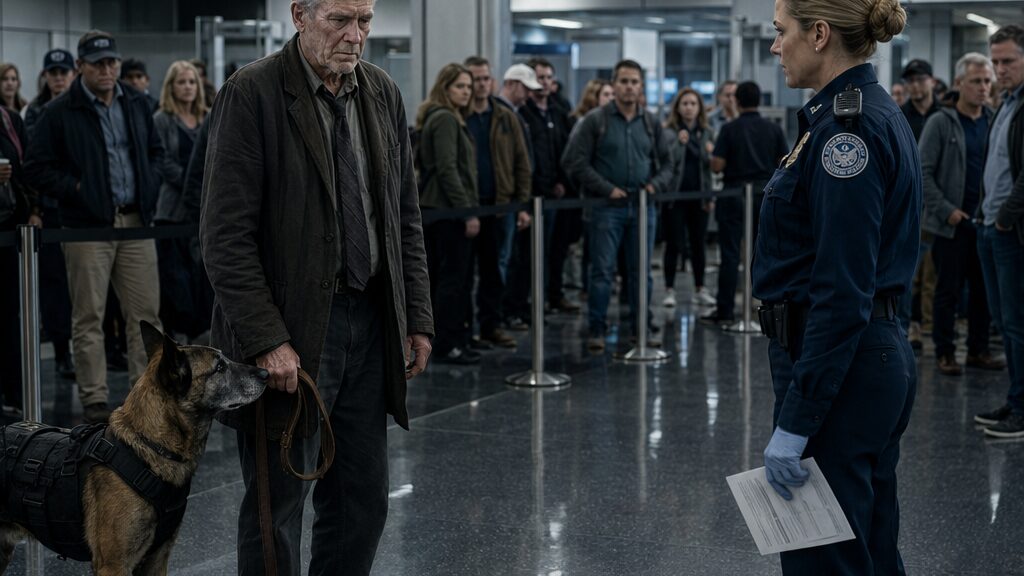
A female TSA supervisor stood near the scanners speaking to another officer. Blonde hair pulled tightly back. Dark navy uniform pressed sharp enough to cut paper. She moved with quick efficiency, scanning the checkpoint constantly while answering questions without looking fully at people.
Michelle Collins.
Raymond read the name on her badge when she turned.
One of the younger officers pointed discreetly toward the dog.
Michelle glanced over.
Not hostile. Not yet. Just assessing.
Raymond handed his ID to the document checker.
“Morning, sir.”
Raymond nodded once.
The checker looked down at the dog. “Service animal paperwork?”
Raymond reached slowly into his coat pocket and produced a folded packet.
The dog never moved from his leg.
The officer scanned the pages quickly, then frowned slightly.
“You traveling for personal or medical reasons today?”
“Personal.”
The officer hesitated.
The dog’s eyes stayed fixed on Raymond’s face.
Michelle noticed that.
She stepped closer.
“Problem?” she asked.
“Just verifying the animal paperwork.”
Michelle held out her hand for the documents. The younger officer passed them over immediately.
Raymond watched her scan the pages.
Retired military working dog.
Behavior support certification.
Veterinary clearance.
Travel authorization.
Michelle looked down at the dog again.
“He’s retired military?”
“Yes.”
“What’s his current function?”
Raymond paused a second too long.
“Support.”
Michelle’s eyes narrowed slightly. Not aggressive. Professional. But skeptical.
“Support for what exactly, Mr. Hayes?”
The line behind him shifted impatiently.
Raymond heard someone sigh loudly.
He swallowed once.
The overhead announcements suddenly seemed much louder.
The fluorescent lights brighter.
The space narrower.
The dog rose slowly from his seated position without command.
Michelle noticed immediately.
“Sir, I need the animal to remain seated.”
“He’s fine.”
“He needs to remain under control.”
Raymond’s hand trembled once against the leash.
The dog pressed harder against his leg.
A nearby traveler stopped reorganizing his backpack and glanced over. Then another.
Michelle’s tone sharpened slightly.
“Mr. Hayes, I need you to direct the dog back down.”
Raymond looked at the dog but didn’t speak.
Because he knew.
The dog wasn’t watching the crowd anymore.
He was watching Raymond.
“Sir?”
Raymond finally answered quietly. “He won’t.”
Michelle blinked. “Excuse me?”
“He won’t sit right now.”
The words sounded calm, but Raymond felt his pulse beginning to hammer beneath his ribs.
Atlanta.
Tile floor.
Hands grabbing his shoulders.
Noise everywhere.
The dog shifted closer until his body touched Raymond’s knee completely.
Michelle folded the paperwork.
“Then we may need to step aside for additional screening.”
Several people behind Raymond visibly leaned to look around him now.
The teenager with the phone raised it again briefly before lowering it when Michelle glanced his way.
Raymond nodded once.
“Alright.”
No argument. No anger.
That unsettled Michelle more than resistance would have.
Most difficult passengers talked too much.
This man barely spoke at all.
The younger officer gestured toward a secondary screening area near the side wall.
“Right this way, sir.”
Raymond started forward.
The dog moved instantly with him, staying so close their bodies nearly touched.
Halfway there, Raymond’s steps slowed.
The sounds around him blurred together into one dense mechanical roar.
The dog stopped walking.
Completely.
Raymond tugged lightly once on the leash.
Nothing.
The dog planted himself beside Raymond’s leg and looked upward sharply, alert now in a way that changed the entire feeling of the checkpoint.
Michelle straightened.
“Sir?”
Raymond stared ahead at nothing.
The dog moved closer still.
Then gently pushed his shoulder against Raymond’s thigh.
A pressure response.
Intentional.
Not aggression.
Not disobedience.
Something else.
People nearby had gone quiet.
Raymond closed his eyes briefly.
When he opened them again, Michelle was watching him differently now. Still cautious. But uncertain.
“What’s wrong with the dog?” she asked.
Raymond swallowed.
“Nothing,” he said softly.
But the dog still would not move away from him.
Chapter 2: Michelle Collins Decides Raymond Is Hiding Something
Michelle Collins had worked airport security long enough to recognize patterns.
Nervous travelers talked too much.
Angry travelers demanded managers.
Smug travelers treated everyone like furniture.
But the quiet ones were harder.
The quiet ones forced you to guess.
She watched Raymond Hayes from across the secondary screening area while another officer checked his bag. The old man stood beside a gray wall beneath a mounted television no one was watching. His dog remained pressed against his leg with unnatural focus.
Not aggressive.
Not distracted.
Focused.
Michelle disliked not understanding things inside her checkpoint.
She glanced again at the paperwork in her hand.
Retired military working dog.
Marine Corps history attached to the animal’s file.
Behavior support classification.
Travel clearance approved.
Everything technically valid.
Still, something felt off.
Raymond hadn’t looked directly at her more than twice since entering the checkpoint. His answers came clipped and careful, as though every extra word cost effort. And now the dog refused separation positioning.
Michelle had seen fake service animals before. Hundreds.
Usually loud owners. Defensive behavior. Sloppy paperwork.
This was different.
That bothered her more.
“Sir,” she called, stepping closer again, “I’m going to need you to place the leash on the table for a moment.”
Raymond looked at her.
Not angry. Just tired.
“He needs to stay with me.”
“That’s not how screening works.”
“He’s staying.”
Still calm.
Still polite.
The refusal irritated her more because it forced her into escalation.
A nearby traveler slowed while collecting shoes from a plastic bin. Another passenger openly stared now.
Michelle lowered her voice slightly.
“Mr. Hayes, I’m trying to work with you here.”
Raymond nodded once as if he believed her.
Then said nothing else.
The dog never took his eyes off Raymond’s hands.
Michelle crossed her arms. “Why exactly is the animal reacting like this?”
Raymond’s jaw tightened slightly.
“He reads stress.”
“What kind of stress?”
No answer.
Michelle exhaled slowly through her nose.
“You understand from our perspective this behavior can look concerning.”
Still nothing.
A younger officer finished inspecting Raymond’s carry-on and quietly handed Michelle a small envelope found inside an outer pocket.
“Personal documents,” he said.
Michelle glanced down automatically.
Funeral Home.
Kansas City.
The edge of a folded obituary card slipped partially into view before she tucked it back without reading further.
Raymond saw the motion immediately.
For the first time since arriving, something flickered visibly across his face.
Not anger.
Something closer to embarrassment.
Michelle handed the envelope back.
“Sorry.”
Raymond took it carefully and placed it inside his coat.
The dog finally shifted slightly, though he still remained pressed close.
Michelle noticed the old man’s hand trembling again.
Not dramatically.
Just enough.
She studied him more carefully now.
Gray hair trimmed short. Deep lines around the eyes. Clean coat but worn at the cuffs. Not homeless. Not unstable. Just exhausted.
The dog suddenly lifted his head toward Raymond’s face.
Then nudged his wrist once.
Firm.
Intentional.
Raymond inhaled sharply through his nose.
Michelle’s attention narrowed immediately.
The dog nudged him again.
A nearby passenger frowned. “Is that normal?”
Nobody answered.
Raymond’s breathing had changed.
Small. Controlled. Too controlled.
Michelle stepped forward instinctively. “Sir, are you alright?”
“I’m fine.”
The words came too fast.
The dog leaned harder against him.
Michelle looked down at the harness.
Years of airport work had made her observant about details. The straps were worn smooth in specific places from long-term use. Tiny scratches marked the metal buckle. One faded patch remained stitched near the side.
MARINE K9 UNIT.
Old stitching. Nearly frayed away.
A man several feet away suddenly spoke.
“That dog military?”
Everyone turned.
The speaker was broad-shouldered, middle sixties maybe, holding a boarding pass and coffee cup. Calm face. Watchful eyes.
Paul Carter.
Michelle recognized him vaguely from earlier in line.
Raymond glanced toward him once.
Paul nodded toward the dog. “Looks trained for interruption response.”
Michelle frowned slightly. “Interruption response?”
Paul shifted his coffee to the other hand. “Stress detection. Panic prevention sometimes.”
The checkpoint quieted further.
Michelle looked back at Raymond.
“You should’ve said that earlier.”
Raymond’s eyes stayed fixed somewhere past her shoulder.
“I didn’t want a scene.”
The sentence landed harder than Michelle expected.
Because now there already was one.
People were watching openly.
A child stared at the dog with fascinated silence.
An older woman lowered her phone after clearly recording part of the interaction.
Michelle suddenly became aware of how this looked.
An old veteran-looking man cornered beside security barriers while his dog refused to leave him.
The image unsettled her.
But procedure still mattered.
“Mr. Hayes,” she said more carefully now, “if you’re having a medical issue, we can call airport medical personnel.”
“No.”
Quick. Immediate.
The strongest reaction he’d shown yet.
Paul watched Raymond closely now.
“You fly often?” he asked gently.
Raymond shook his head once.
“No.”
“When’s the last time?”
Raymond didn’t answer.
The dog nudged his hand again.
Michelle saw it clearly this time.
Not random behavior.
Monitoring.
Responding.
The realization created a small uncomfortable shift inside her chest.
She looked around at the checkpoint. Travelers pretending not to stare. Officers waiting for instructions. Conveyor belts moving steadily beneath fluorescent lights.
Everything suddenly felt too public.
“Let’s move him somewhere quieter,” Amy Foster said softly from nearby.
Michelle turned. She hadn’t realized Amy had been standing there listening.
Amy worked airport operations, not TSA, but often coordinated during delays and security overflow. Younger than Michelle by maybe ten years. Calm voice. Good with nervous travelers.
Michelle hesitated.
Raymond remained completely still.
Then the overhead announcement system crackled alive again.
Attention passengers. Flight 214 to Kansas City now delayed thirty-five minutes.
Raymond closed his eyes.
Only for a second.
But it was enough.
Enough for Michelle to notice the exhaustion underneath all the restraint.
Enough for Paul to quietly say, “He’s not hiding something. He’s trying not to fall apart in public.”
Raymond opened his eyes immediately after that.
And for the first time, Michelle realized the old man looked ashamed.
Not dangerous.
Ashamed.
The dog rested his head briefly against Raymond’s hip.
Michelle stared at the animal.
Then at the leash in Raymond’s trembling hand.
And suddenly the checkpoint no longer felt like a security issue.
It felt like witnessing something private happen in the worst possible place.
Chapter 3: The Dog Reacted Before Raymond Did
Amy Foster led Raymond down a quieter corridor near the airport tram station where the sound of rolling luggage softened into distant echoes.
The dog stayed so close to Raymond that their steps almost matched.
Amy walked slightly ahead, pretending not to watch him too carefully. Years working around travelers had taught her that embarrassed people hated being observed when they were trying to regain control.
Especially older men.
Especially proud ones.
“There’s a seating area around the corner,” she said gently. “Usually empty this time of day.”
Raymond nodded once.
The dog glanced up at Amy briefly, then returned his attention to Raymond.
The hallway lights reflected faintly off the polished tile. Airport announcements echoed from farther away now, blurred and softened by distance.
Amy heard Raymond’s breathing before she looked back at him.
Too shallow.
Too measured.
The dog heard it first.
The animal suddenly slowed and pressed harder against Raymond’s leg again.
Raymond stopped walking.
Amy turned immediately.
“You okay?”
“I’m alright.”
But his face had gone pale beneath the airport lighting.
The dog moved directly in front of him now, blocking his path with trained precision.
Amy stared.
Raymond lowered one hand automatically toward the dog’s shoulder.
“Easy.”
The word came quieter this time.
The dog didn’t move.
Instead he nudged Raymond backward slightly toward the wall.
Not aggression.
Positioning.
Amy felt a strange tightness in her own chest watching it happen.
The old man finally leaned back against the wall with visible reluctance, as if his body had betrayed him publicly.
Only then did the dog settle halfway, though he remained alert.
Amy spoke carefully. “Do you need water?”
Raymond shook his head.
“You sure?”
Another nod.
His hand still rested against the dog’s neck. Amy noticed the trembling again. Worse now without the pressure of the checkpoint forcing him upright.
“You served together?” she asked quietly.
Raymond looked down at the dog before answering.
“Yeah.”
The dog’s ears twitched at his voice.
“What’s his name?”
Raymond hesitated.
“Cooper.”
Amy smiled faintly. “Good name.”
Raymond didn’t smile back, but something in his expression softened slightly.
The seating area ahead sat mostly empty except for a businessman asleep across three chairs and a woman typing furiously on a laptop. Amy guided Raymond toward the far corner near a window overlooking the runway.
Cooper stayed pressed close until Raymond sat down.
Then the dog lowered himself heavily beside the chair without taking his eyes off him.
Amy remained standing awkwardly for a moment.
“You don’t have to stay,” Raymond said.
“I know.”
But she stayed anyway.
Outside the windows, planes moved slowly through pale morning fog. Ground crews signaled beneath blinking lights. Everything beyond the glass looked mechanical and distant.
Inside, Raymond stared at nothing.
Amy noticed his left hand gripping the leash too tightly again.
The leather strap looked old. Not expensive. Worn smooth from years of use.
“You military too?” Raymond asked suddenly.
Amy blinked. “No.”
He nodded once.
“Sorry.”
“For what?”
“Habit.”
Silence settled again.
Amy finally sat across from him.
“You don’t like airports much.”
Raymond let out a breath through his nose that almost sounded like a laugh.
“No.”
“Bad experience?”
Cooper lifted his head before Raymond answered.
That caught Amy’s attention immediately.
The dog reacted before the man did.
Raymond stared out the window.
“Atlanta,” he said quietly after a moment. “Long time ago.”
He stopped there.
Amy waited.
Nothing else came.
The overhead speakers crackled faintly with another boarding announcement.
Raymond’s jaw tightened at the sound.
Cooper rose instantly and placed his head against Raymond’s knee.
Amy watched the motion carefully now.
The dog wasn’t simply comforting him.
He was anticipating him.
“You trained him yourself?” she asked softly.
“Partly.”
“Military dog?”
“Retired.”
The answers kept arriving in fragments. Amy realized it wasn’t secrecy exactly. It was exhaustion. Every sentence seemed to require him to cross some invisible distance first.
A shadow moved near the corridor entrance.
Michelle Collins.
She stopped when she saw them.
Raymond noticed too, but said nothing.
Michelle approached more slowly than before.
Not supervisory now. Careful.
“I wanted to make sure everything was alright.”
Raymond gave a small nod without looking fully at her.
Michelle glanced at Cooper. “He always does that?”
“Sometimes.”
“When?”
Raymond looked down at the leash in his hands.
“When he thinks I’m going somewhere.”
The sentence hung strangely in the quiet seating area.
Amy saw Michelle’s expression shift slightly.
Not confusion anymore.
Something heavier.
Michelle sat down across from them carefully. “Mr. Hayes… I didn’t realize—”
“It’s alright.”
He said it immediately.
Too quickly.
Like he’d spent years preventing other people from apologizing to him.
Michelle folded her hands together. “The officers said you’re headed to Kansas City.”
Raymond nodded.
“For family?”
A long silence followed.
Then Raymond reached into his coat pocket and removed the folded funeral card.
He looked at it before handing it over.
Michelle read the name quietly.
John Bennett.
Below it sat an old photograph of two younger Marines standing beside a military working dog overseas somewhere dusty and bright.
One of them was Raymond.
Younger. Harder. Smiling slightly.
Michelle looked up slowly.
“My friend,” Raymond said.
Not was.
Is.
The distinction caught Amy immediately.
Michelle handed the card back carefully.
“I’m sorry.”
Raymond shrugged once.
“He hated funerals.”
That nearly sounded like humor.
Nearly.
Cooper rested his chin on Raymond’s boot.
Amy studied the photograph again in her mind. Two men. One dog. Heat. War probably. Years ago.
And now this old man sitting in an airport trying not to come apart beside a coffee stain on commercial carpet while strangers watched him like a possible problem.
The unfairness of it settled into her chest slowly.
Michelle looked down for a moment before speaking again.
“You could’ve told us.”
Raymond smiled faintly for the first time since arriving.
Small. Tired.
“Most people get uncomfortable once they know too much.”
Nobody answered that.
Far outside the windows, a plane lifted slowly into the gray morning sky.
Raymond watched it disappear.
Then, so quietly Amy almost missed it, he said:
“John was the last person who remembered everything.”
Chapter 4: John Bennett Was The Last Person Who Remembered Everything
The flight delay stretched into the afternoon.
Passengers drifted around the boarding gate with the slow irritation unique to airports. Some paced while talking into phones. Others slept sitting upright beneath television screens silently showing weather maps and daytime talk shows with subtitles no one read.
Raymond sat near the windows with Cooper resting beside his chair.
The dog slept lightly. One ear still alert.
Every few minutes another boarding announcement rolled through the terminal, followed by the soft electronic chime that made Raymond’s shoulders tense before he could stop himself.
Kansas City delayed another forty minutes.
Then another twenty.
He hadn’t expected the waiting to be this hard.
Travel itself was manageable when movement kept his mind occupied. But sitting still in crowds gave memory too much room.
Cooper sensed it every time.
The leash rested across Raymond’s knee. His fingers moved unconsciously along the worn leather edge again and again until the texture felt warmer than his own skin.
Amy had left nearly an hour earlier after making sure he had water and a quiet corner away from most travelers. Michelle returned to work at the checkpoint, though Raymond noticed her twice from a distance walking slower than before whenever she passed the gate area.
Neither of them pressed him anymore.
That helped.
Paul Carter sat two rows away reading a paperback novel without turning many pages. Every now and then he glanced up at Cooper with the calm recognition of someone who understood working dogs.
Eventually Paul closed the book.
“Marine Corps?” he asked quietly.
Raymond nodded once.
“What years?”
Raymond answered without looking away from the runway. “Late seventies into the nineties.”
Paul whistled softly. “Long stretch.”
“Felt longer.”
That earned the smallest smile from Paul.
“You and the dog deployed together?”
“Not this one.”
Paul glanced at Cooper. “Still works like he did.”
“Doesn’t know how not to.”
Outside the window, baggage carts moved through light rain beneath the gray sky. Ground crew workers hunched inside reflective jackets while fuel trucks crawled across the tarmac.
Raymond stared at the movement without really seeing it.
John would have complained about the airport coffee by now.
Would have started talking to strangers.
Would have made up fake biographies just to see how long people believed him.
Raymond rubbed his thumb harder along the leash.
Paul noticed.
“You headed to family?” he asked.
Raymond stayed silent long enough that Paul nearly apologized for asking.
Then Raymond spoke quietly.
“Friend’s funeral.”
Paul nodded once.
“That’s rough.”
Raymond looked down at Cooper.
“He was the last one.”
“The last what?”
“The last person alive who remembered me before everything changed.”
Paul leaned back slowly in his chair.
Raymond regretted saying it almost immediately. Not because it wasn’t true. Because speaking thoughts aloud made them harder to contain afterward.
The overhead speaker crackled again.
Another delay.
Groans rose around the gate.
A child began crying near the vending machines.
Cooper lifted his head instantly and looked at Raymond.
“I’m alright,” Raymond murmured.
The dog settled halfway but didn’t fully relax.
Paul watched the exchange carefully.
“He did that in the checkpoint too,” he said quietly.
Raymond nodded.
“Stress interruption.”
“He trained for it?”
“Yeah.”
Paul hesitated. “You?”
“Some of it.”
Then silence again.
Raymond rarely spoke about the dogs anymore. Not after retirement. Not after Atlanta. Not after waking up one morning realizing the military had become a story everyone else wanted simplified into pride or trauma depending on what made them comfortable.
Most people didn’t know what to do with the in-between parts.
Neither did he.
A woman across the gate smiled cautiously toward Cooper. “Is he friendly?”
Raymond nodded once.
The woman’s little boy approached carefully, clutching a toy airplane.
“Can I pet him?”
Raymond looked down at Cooper. “If he comes to you.”
The boy held out a tiny hand uncertainly.
Cooper remained beside Raymond at first.
Then, slowly, he stood and stepped toward the child. Gentle. Controlled.
The boy giggled softly when the dog nudged his palm.
“His fur’s scratchy,” the child whispered.
Raymond almost smiled.
“Yeah.”
The mother thanked him before leading her son away again.
Paul watched Raymond closely after that.
“You’ve got that look,” he said.
“What look?”
“Like you’re somewhere else.”
Raymond stared out at the rain again.
“John used to say airports felt like hospitals with better restaurants.”
Paul laughed quietly.
The sound caught Raymond off guard because for a second he heard John’s laugh underneath it. Deep. Uneven. Impossible to shut off once it started.
Memory hit harder than expected.
Dust.
Heat.
Kennel cages rattling in desert wind.
John sitting shirtless outside a tent cleaning sand from a rifle while arguing about baseball statistics nobody cared about.
Raymond closed his eyes briefly.
Cooper stood immediately and pushed his nose against Raymond’s wrist.
The movement was so automatic it hurt to watch.
Paul lowered his voice. “You alright?”
Raymond nodded even while his throat tightened.
“Yeah.”
Lie.
But manageable.
The gate television switched suddenly to local weather coverage. Thunderstorms across Kansas City.
Another possible delay.
Passengers groaned again.
Raymond leaned forward slightly, elbows resting on his knees.
“I almost didn’t come.”
Paul stayed quiet.
“I had the suit out. Packed everything.” Raymond stared at the floor. “Then I put it all back in the closet.”
“What changed your mind?”
Raymond looked down at Cooper.
“Him.”
Paul nodded slowly as if that answer made perfect sense.
“John and I used to joke,” Raymond said quietly, “that dogs know before people do.”
“What?”
“When you’re in trouble.”
He rubbed a hand slowly along Cooper’s neck.
“People wait for words. Dogs don’t.”
Paul sat with that for a while.
Across the terminal, Michelle Collins appeared near a customer service counter speaking with an airline employee. She looked over briefly toward the gate area.
Toward Raymond.
Their eyes met for half a second before she looked away again.
Raymond noticed she wasn’t moving with the same sharp urgency as before.
No clipped gestures.
No defensive posture.
Just tiredness.
Interesting.
“She with TSA?” Paul asked quietly.
Raymond nodded.
“She gave you a hard time?”
“No.”
Paul looked skeptical.
Raymond shrugged once. “She did her job.”
“That’s generous.”
Raymond watched Cooper sleeping again.
“People make decisions fast in places like this,” he said quietly. “Sometimes they gotta.”
Paul studied him carefully. “And sometimes they get it wrong.”
Raymond didn’t answer.
Because the truth was more complicated.
Michelle had gotten some things wrong.
But not the important part.
The important part was that Raymond really had become difficult.
Not angry. Not unstable. Just harder to move through the world with. Louder places exhausted him. Delays unsettled him. Crowds pressed too close. Even grief itself had become logistical now.
Tickets.
Suit.
Funeral.
Return flight.
A whole life reduced into arrangements.
The rain outside thickened against the windows.
Cooper suddenly lifted his head again before Raymond heard the approaching footsteps.
Michelle.
She stopped beside the seating row awkwardly.
“Mr. Hayes.”
Raymond looked up.
She held a fresh paper cup carefully in one hand.
“The coffee shop downstairs said this was their least terrible coffee.”
Raymond blinked once in surprise.
Paul hid a faint smile behind his hand.
Michelle looked almost uncomfortable offering it.
“You don’t have to—”
“I know,” she interrupted gently. “I just figured the airport’s already making your day harder.”
Raymond accepted the cup carefully.
Warmth spread through his cold fingers immediately.
“Thank you.”
Michelle nodded once.
Then she glanced down at Cooper.
“He doesn’t stop watching you.”
Raymond looked at the dog quietly.
“No,” he said. “He doesn’t.”
Michelle hesitated another second before speaking again.
“My father used to get like that after crowds.”
Raymond looked up.
She seemed surprised she’d said it aloud.
“He was police,” she explained quickly. “Different thing. But…” She shrugged slightly. “Sometimes he’d just leave grocery carts in the middle of stores and walk outside.”
Raymond understood more than she realized from that one sentence alone.
Michelle shifted awkwardly again.
“I shouldn’t have cornered you at the checkpoint.”
Raymond shook his head immediately.
“You didn’t know.”
“That’s still not the same thing.”
For a moment neither of them spoke.
Then another boarding announcement echoed overhead.
Delayed again.
Raymond let out a tired breath through his nose.
Michelle glanced toward the runway windows. “Storm system moved in.”
“Seems about right.”
That almost sounded like humor too.
Michelle smiled faintly before stepping back.
“If you need anything while you’re here, let somebody know.”
Raymond nodded once.
She turned to leave, then paused.
“I’m sorry about your friend.”
This time Raymond didn’t answer immediately.
He stared at the coffee cup warming his hands.
Then quietly said, “Me too.”
Michelle walked away slowly after that.
Paul watched her disappear into the crowd before looking back at Raymond.
“She’s trying.”
Raymond nodded.
“Yeah.”
But his eyes stayed fixed on the rain outside the terminal.
Because somewhere beyond those clouds waited a funeral chapel full of people who knew John Bennett in pieces.
Only Raymond still carried the whole man.
And soon there would be no one left alive to confirm the memories were real.
Chapter 5: Michelle Collins Finally Stops Talking Like Raymond Is A Problem
Michelle Collins spent the next hour pretending to review staffing schedules.
In reality, she reread the same email three times while thinking about the old man sitting near Gate 14 with a retired military dog pressed against his leg like a living brace.
Airports trained people to classify quickly.
Threat.
Delay.
Medical issue.
Noncompliance.
Efficiency depended on sorting strangers before emotion complicated the process.
Usually Michelle was good at it.
Today something about Raymond Hayes stayed with her in an uncomfortable way.
Not because he’d caused trouble.
Because he hadn’t.
That was the part bothering her now.
She remembered the exact moment his face changed when the officer handled the funeral envelope. A flash of embarrassment so fast most people would’ve missed it.
As if grief itself had become something he needed to apologize for publicly.
Michelle closed the staffing spreadsheet.
Outside her office window, passengers moved endlessly through the terminal beneath fluorescent lights. Rolling bags. Half-finished coffees. Families drifting between gates like temporary weather systems.
Somewhere among them sat Raymond and that dog.
Cooper.
She’d looked up the name in the airport incident notes after returning from the gate.
No formal complaint filed. No violation recorded.
Just observations.
Retired military working dog.
Passenger displayed signs of acute stress response.
Situation de-escalated voluntarily.
Clinical language flattened everything.
Michelle leaned back in her chair and rubbed her forehead.
Her father used to hate airports too.
Not because of flying. Because of exits.
Crowded parking garages. stadium tunnels. packed elevators. Anywhere movement depended on strangers behaving predictably.
When Michelle was younger, she thought he was impatient.
Later she understood it was fear wearing work clothes.
A knock interrupted her thoughts.
Amy Foster stepped halfway inside. “You busy?”
Michelle gestured vaguely toward the empty screen. “Not really.”
Amy closed the door behind her.
“You alright?”
Michelle laughed softly. “You asking as a friend or because I looked like a terrible supervisor today?”
Amy sat across from the desk.
“You weren’t terrible.”
Michelle raised an eyebrow.
“I cornered an old man at a checkpoint while half the terminal watched.”
“You thought something was wrong.”
“Something was wrong.” Michelle stared down at her hands. “Just not what I thought.”
Amy nodded slowly.
For a moment both women sat listening to the muffled sounds of the terminal beyond the office walls.
Then Amy said quietly, “He looked ashamed.”
Michelle looked up sharply.
“Yeah.”
“That bothered me.”
Michelle leaned back again.
“People lie to us all day,” she said. “Or hide things. Or try to push through rules because they think their situation matters more than everybody else’s.” She paused. “After a while you stop looking for pain and start looking for problems.”
Amy didn’t argue.
Because it was true.
Michelle stared through the office window again.
“When that dog wouldn’t leave him…” She shook her head slightly. “I thought he was refusing control commands.”
“He wasn’t.”
“I know that now.”
Amy studied her carefully. “You know what actually got me?”
“What?”
“The way he kept trying to make things easier for everyone else.”
Michelle looked down.
Yeah.
That part too.
Most frightened people wanted attention.
Raymond wanted invisibility.
And somehow that made the whole thing sadder.
Another boarding delay announcement echoed faintly through the terminal speakers.
Amy sighed. “Storm’s getting worse.”
Michelle stood. “I should check the gate.”
They walked together through the terminal. Evening light had faded into dull gray shadows beyond the massive runway windows. Travelers sprawled across charging stations and gate seats with the exhausted patience of people surrendering control over their day.
Gate 14 looked calmer now.
Raymond sat alone.
Paul Carter was gone.
Cooper rested beside the chair with his chin over Raymond’s boot.
The leash lay loose across Raymond’s lap instead of tightly wrapped around his hand.
Michelle noticed that immediately.
A tiny change.
But important somehow.
Raymond looked up as they approached.
“Mr. Hayes.”
“Supervisor.”
The word carried no bitterness.
That made Michelle feel worse.
“We’ve got another delay,” she said unnecessarily.
Raymond nodded toward the departure screen. “Figured.”
Amy noticed an untouched sandwich beside Raymond’s chair.
“You haven’t eaten?”
“Not hungry.”
Cooper lifted his head slightly at the sound of voices but stayed calm.
Michelle glanced at the dog.
“He finally relaxed a little.”
Raymond rubbed one hand slowly along Cooper’s neck.
“He watches until he decides I’m staying put.”
Michelle hesitated.
Then sat down in the empty seat nearby.
“I owe you an apology.”
Raymond looked uncomfortable immediately.
“You don’t.”
“I do.”
He shook his head once. “You were doing your job.”
“That’s not an excuse for talking to people like they’re already guilty.”
The sentence hung quietly between them.
Raymond looked down at the leash.
Michelle noticed how worn the leather looked up close. Years of handling had darkened certain sections almost black.
“He’s old too,” she said softly.
“Ten.”
“That old for his breed?”
“Older than he should’ve gotten.”
Raymond said it matter-of-factly.
No performance.
No dramatic weight.
Which somehow made it heavier.
Amy sat across from them quietly listening.
Michelle finally asked the question she’d been circling around all afternoon.
“When did you stop flying?”
Raymond stayed silent long enough she thought he might ignore it.
Then he answered.
“About eleven years ago.”
“What happened?”
The overhead speakers crackled softly in the pause before he replied.
“Atlanta.”
Nothing else.
Michelle waited carefully.
Raymond stared toward the runway lights.
“I passed out in a terminal.” His voice remained calm. “Crowded day. Loud.” He shrugged once. “Woke up with people filming me.”
Amy winced slightly.
Raymond noticed and gave a tired half-smile.
“Guess they thought an old man collapsing was interesting.”
Michelle felt something twist painfully in her chest.
“What about family?” Amy asked gently. “Anybody traveling with you?”
Raymond shook his head.
“No kids?”
“No.”
The answer carried finality.
Michelle realized suddenly how alone he must have felt walking into the airport that morning carrying funeral papers and a dog everyone immediately questioned.
No family buffer.
No companion explaining things for him.
Just procedure.
Rules.
Crowds.
Cooper suddenly lifted his head sharply and nudged Raymond’s hand once.
Raymond inhaled slowly.
Michelle saw it immediately now—the pattern between them.
The dog reacting before Raymond visibly did.
Not obedience.
Protection.
“You said your friend was the last person who remembered everything,” Michelle said quietly.
Raymond’s eyes stayed fixed on the runway.
“John knew me before I learned how to disappear.”
The words settled over all three of them.
No one spoke for several seconds.
Passengers moved around the gate in blurred background motion while airport announcements continued overhead in their endless calm voice.
Michelle thought about how many people crossed her checkpoint every day carrying invisible things.
Grief.
Fear.
Medication.
Divorce papers.
Ashes in urns.
Military dogs trained to keep old men anchored to the present.
And how easy it was to reduce all of them into processing problems.
Raymond slowly loosened his grip on the leash again.
Cooper rested his head back on Raymond’s boot.
“He’ll get you there,” Michelle said quietly.
Raymond looked down at the dog.
“Yeah,” he said. “He always does.”
Chapter 6: The Funeral Was Smaller Than Raymond Expected
The funeral chapel sat three blocks from a closed hardware store and a diner with faded curtains in the windows.
Rainwater clung to the sidewalks from the overnight storm. Small-town traffic moved quietly through the gray Kansas City morning while Raymond stood beside the rental car for several seconds before going inside.
Cooper waited patiently at his side.
The chapel looked smaller than Raymond remembered from the photograph on the funeral pamphlet. Brick exterior. Narrow windows. White wooden doors scratched near the handles from decades of use.
He adjusted his tie once.
Then stopped.
John would’ve laughed himself sick watching him fuss over a tie.
“Looks like a hostage negotiation,” he used to say anytime Raymond wore formal clothes.
Raymond swallowed hard and opened the chapel door.
Warm air and the smell of flowers met him immediately.
Soft organ music drifted through the hallway.
About twenty people sat scattered across the pews.
That was all.
Raymond paused near the entrance longer than necessary.
Twenty people for John Bennett.
Twenty people for a man who once carried another Marine two miles through dust after a convoy strike because evacuation helicopters couldn’t land.
Twenty people for a man who never remembered birthdays but somehow always remembered when someone was hurting.
Raymond felt Cooper press gently against his leg.
“I know,” he murmured.
A woman near the front looked up from a folded program.
“You Raymond?”
He nodded once.
Her expression softened immediately. “John talked about you all the time.”
Raymond almost asked which version.
The reckless young Marine version.
The angry version.
The silent version afterward.
Instead he simply said, “You family?”
“Cousin.”
She reached out and squeezed his arm gently before returning to the front pew.
Raymond stood there another moment.
Then finally walked toward the casket.
Closed.
Simple wood.
No dramatic displays. No military spectacle. Just flowers and photographs arranged nearby on folding tables.
John grinning beside a fishing boat.
John holding a burnt-looking birthday cake.
John younger in Marine fatigues beside a kennel fence.
And one photograph Raymond had forgotten existed.
Two younger men sitting against a military transport crate overseas while a working dog slept between them.
John laughing openly at the camera.
Raymond half-turned away from it even back then.
Cooper stopped beside the photograph and stared.
Raymond felt his throat tighten unexpectedly.
“You remember him too, huh?”
The dog sat quietly.
People glanced toward Cooper now and then during the service but nobody complained. A few older veterans nodded toward Raymond respectfully before returning their attention forward.
The pastor spoke gently. Stories. Community service. Fishing habits. Terrible jokes.
Fragments of a man.
But Raymond kept noticing the spaces between the stories. The missing years nobody in the room fully understood.
The years only he carried intact now.
Halfway through the service, the pastor invited anyone who wished to speak.
Silence followed.
Long enough to become uncomfortable.
Raymond stared down at his hands.
He hadn’t planned to stand.
Hadn’t prepared words.
But suddenly remaining seated felt wrong in a way he couldn’t explain.
Cooper rose immediately as Raymond stood.
Every head in the chapel turned slightly.
Raymond walked slowly toward the front.
The leash hung loose from his hand.
At the podium, he stared down at the folded funeral program for several seconds before speaking.
“John Bennett was…” He stopped.
Too many versions available.
He tried again.
“John never knew how to leave people alone.”
Soft laughter moved through the chapel.
Raymond nodded faintly.
“He talked too much. Lied about fish sizes. Couldn’t cook.” Another pause. “And if he thought somebody was hurting, he’d sit next to them until they admitted it.”
More quiet laughter.
Raymond glanced once toward the photographs beside the casket.
“We served together a long time ago.” His voice remained steady, though barely. “There are parts of my life I only remember clearly because John was standing there too.”
The chapel fell completely silent.
Raymond looked down briefly.
“When people get older,” he said quietly, “you start losing witnesses.”
No dramatic tears.
No shaking voice.
Just truth laid carefully into the room.
“He remembered who I was before…” Raymond stopped again.
Before what?
Before panic attacks.
Before funerals.
Before airports became battlefields disguised as carpet and fluorescent lighting.
He exhaled slowly.
“Before life got smaller.”
Several people lowered their eyes.
Raymond rested one hand briefly against the podium.
“And he never treated anybody like they were a burden for surviving.”
The sentence lingered.
Because suddenly he wasn’t speaking only about John anymore.
He thought about the checkpoint.
Michelle.
The phones aimed toward him in Atlanta years ago.
The exhaustion of constantly trying not to inconvenience strangers with pain they didn’t ask to witness.
Cooper moved closer beside him.
Raymond looked down at the dog once.
Then back toward the room.
“I’m glad he doesn’t have to go first anymore.”
Confused silence followed that statement for a heartbeat.
Then soft understanding.
Raymond stepped away from the podium before emotion could turn public.
Back in the pew, Cooper rested heavily against his leg again.
The service ended quietly.
No dramatic procession.
No military honors beyond a folded flag presented gently to John’s cousin afterward.
People approached Raymond one by one after the chapel emptied.
Stories.
Handshakes.
Awkward condolences.
Several recognized the photograph of him and John overseas.
One older veteran paused beside Cooper.
“Good dog,” he said simply.
Raymond nodded.
“The best.”
Eventually the chapel grew quiet.
Only Raymond, Cooper, and the funeral director remained.
“You can stay as long as you need,” the director said softly before stepping outside.
Raymond sat alone facing the casket.
Rain tapped lightly against the chapel windows.
Cooper rested beside the pew.
For the first time all day, Raymond let himself fully look at the folded letter resting on the seat beside him.
John’s cousin had handed it over after the service.
Said John left instructions specifically for Raymond to receive it privately.
The envelope looked old already from handling.
Raymond stared at his name written across the front in John’s uneven handwriting.
He didn’t open it yet.
Couldn’t.
Not while the room still smelled like flowers and polished wood and goodbye.
Instead he sat quietly beside Cooper while rain traced slow lines down the chapel windows.
And for the first time since arriving at the airport, Raymond allowed himself to admit the truth.
He was tired of surviving people one funeral at a time.
Chapter 7: Raymond Hayes Loosened His Grip On The Leash Before Boarding Home
The return flight left two days later.
Raymond arrived at the airport before sunrise because old habits still trusted extra time more than optimism. The rental car smelled faintly of rain and stale coffee as he parked near Terminal C and sat behind the wheel longer than necessary.
Cooper rested quietly in the passenger seat.
For once, neither of them seemed eager to move.
The funeral clothes hung folded in the garment bag across the back seat. John’s letter remained tucked safely inside Raymond’s coat pocket, softened now at the folds from rereading.
He finally stepped out into the cold morning air.
The airport looked different at dawn. Less frantic. More honest somehow. Cleaning crews moved through half-empty corridors while gate televisions flickered awake one by one. Coffee shops rolled open metal shutters. Travelers spoke in softer voices before the day fully hardened around them.
Cooper walked calmly beside him.
Not pressed tightly against his leg this time.
Close, but breathing easier.
Raymond noticed that immediately.
Inside the terminal, the overhead announcements echoed through mostly empty hallways. The sound still tightened something inside his chest, but less sharply than before.
Or maybe he was simply too tired to fight every noise now.
He approached the TSA checkpoint slowly.
Same polished floors.
Same retractable belts.
Same conveyor belts humming beneath fluorescent lights.
But not the same feeling.
A younger officer glanced at Cooper, then at Raymond’s paperwork.
Before he could say anything, another voice called from farther down the checkpoint.
“He’s cleared. Send him through.”
Michelle Collins stepped away from a monitor station and walked toward them.
She looked surprised to see him and unsurprised at the same time.
“Morning, Mr. Hayes.”
“Morning.”
Cooper glanced at her briefly but stayed relaxed.
Michelle crouched slightly to check the harness tags without touching the dog.
Then she stood again.
“We updated the notation system for retired working animals yesterday.”
Raymond blinked once.
Michelle shrugged lightly. “Nothing dramatic. Just…” She searched for the right words. “Different handling instructions.”
Raymond understood immediately.
Not special treatment.
Context.
He nodded once. “That’s good.”
Michelle looked at him carefully.
“You make it to the service?”
“Yeah.”
“How was it?”
Raymond considered the question longer than most people would.
“Smaller than he deserved.”
Michelle’s expression softened.
“I’m sorry.”
Raymond gave a small shrug.
“He would’ve complained if it got too serious anyway.”
That earned a quiet laugh from her.
The checkpoint line moved steadily around them. Travelers stepped through scanners carrying backpacks, neck pillows, coffee cups, ordinary exhaustion.
No one stared this time.
No one filmed.
Michelle gestured toward the screening lane. “You can keep him beside you.”
“Appreciate it.”
Raymond stepped forward.
Cooper matched him easily.
No hesitation.
No planted paws.
No pressure against Raymond’s leg.
Michelle watched them move through the scanner area with an attention that surprised even herself.
The old man still looked tired. Still moved carefully. But something had shifted.
Not cured.
Not healed.
Just less alone inside himself.
After screening, Raymond gathered his bag slowly from the conveyor belt. The leash rested loosely in his hand now instead of wrapped tight around his wrist.
Michelle noticed that too.
“You got time before boarding?” she asked.
“Little while.”
“There’s a quieter seating area near Gate 11 now.” She hesitated. “Less crowded in the mornings.”
Raymond understood what she was really offering.
Not instructions.
Care.
He nodded once. “Thank you.”
Michelle looked down briefly before speaking again.
“My father died three years ago.”
Raymond waited quietly.
“He never talked much either,” she said. “Not about work. Not about bad days.” She gave a faint smile. “Thought silence was somehow polite.”
Raymond looked at Cooper.
“Sometimes it feels easier than explaining.”
“Yeah.”
Another pause settled between them.
Not uncomfortable this time.
Michelle finally said, “I’m glad you came back through this airport.”
The sentence caught Raymond off guard slightly.
He looked at her.
“You could’ve avoided it after last time.”
He thought about Atlanta.
About years spent organizing his life around avoidance.
Different stores.
Different routes.
Different excuses.
John’s letter had unsettled all of that.
Especially one line.
You spent years surviving things that already ended.
Raymond rubbed his thumb once across the worn leash.
Then looked back at Michelle.
“Maybe I got tired of letting places keep winning.”
Michelle smiled faintly at that.
An overhead announcement interrupted them.
Boarding beginning soon.
Raymond adjusted the strap of his carry-on.
“Well,” he said quietly, “guess that’s me.”
Michelle nodded.
Then, after a brief hesitation, held out her hand.
Not formal.
Not performative.
Just human.
Raymond looked at it a second before shaking it carefully.
Her grip was firm and warm.
“Take care of yourself, Mr. Hayes.”
“You too.”
Cooper stood smoothly beside Raymond as they turned toward the gates.
Halfway down the terminal, Raymond glanced back once.
Michelle still stood near the checkpoint watching travelers pass through.
But now, every time an older passenger hesitated or looked overwhelmed, she slowed down before speaking to them.
Not dramatically.
Just enough.
Raymond continued toward Gate 11.
Morning sunlight had finally begun breaking through the clouds outside the runway windows. Thin gold light stretched across the terminal floor in long reflections.
Cooper walked calmly at his side.
At the quieter seating area near the gate, Raymond sat near the windows and pulled John’s letter from his coat one last time.
The paper trembled slightly in his hands.
Not from panic now.
Age.
Fatigue.
Grief.
Normal things.
He unfolded the letter carefully.
Ray—
If you’re reading this, then one of us finally got out of going to another funeral.
Sorry it was mine.
I know you. You’re probably sitting somewhere uncomfortable pretending you’re fine because you don’t want strangers looking at you too long.
He let out a rough breath that almost sounded like a laugh.
Cooper lifted his head.
“I’m alright,” Raymond murmured.
He kept reading.
You always thought surviving meant becoming smaller. Quieter. Harder to notice.
That’s not survival. That’s hiding.
And for the record, that dog adores you more than any human ever managed to.
Raymond rubbed one hand slowly over his eyes.
Passengers drifted around the gate area while boarding groups formed nearby. Ordinary life continuing forward with unbearable consistency.
He folded the letter carefully again.
Outside the windows, another plane lifted slowly into the brightening morning sky.
Cooper rested his head against Raymond’s knee.
Raymond looked down at him.
“Alright,” he said softly. “Let’s go home.”
When boarding finally began, Raymond stood without rushing.
The leash hung loose from his hand.
Cooper walked beside him easily through the boarding lane.
Near the aircraft door, a tired businessman stepping aside with his suitcase glanced at the dog, then at Raymond.
Instead of suspicion or curiosity, the man simply gave a small respectful nod.
Nothing dramatic.
No applause.
No speeches.
Just recognition.
Raymond nodded back once and stepped onto the plane.
The story has ended.