The Old Veteran Put a Yellow Envelope Beside the Child’s Medicine and Said Nothing
Chapter 1: The Medicine Box Stayed on the Counter
Jack Bennett had learned, over many years, that most people looked past an old man until he was in their way.
At seventy-two, he no longer filled doorways the way he once had. His shoulders had narrowed. His left knee came along a half-second after the rest of him. His hands, when he did not keep them busy, gave away a fine tremor that made strangers speak louder, slower, kinder in the wrong way, or not at all.
That afternoon, he stood in line at Reed Family Pharmacy with a yellow envelope pressed flat against the inside of his leather vest.
The pharmacy smelled of floor polish, paper bags, and the faint sharpness of antiseptic. The fluorescent lights made everyone look a little tired. Behind the counter, rows of white bottles stood in perfect ranks on gray shelves. A bell over the door had rung three times since Jack came in, but the line had hardly moved.
He was there for his blood pressure refill. Nothing dramatic. Nothing a man needed witnesses for.
He kept one hand on the envelope through the leather, thumb resting over the place where the paper had softened from being handled too many times. The envelope had once been bright yellow. Now its corners were rounded, its flap creased, its surface dulled by years in glove compartments, kitchen drawers, coat pockets, and finally against Jack’s chest.
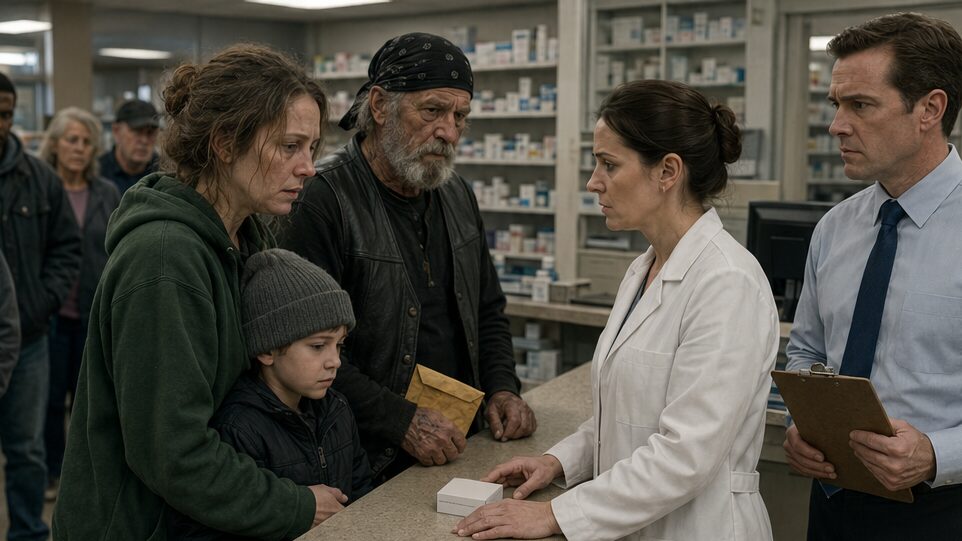
A mother stood at the counter with a little boy beside her.
Jack had noticed them before he noticed the delay.
The woman wore a green hoodie with the sleeves stretched over her palms. Her hair was pulled back carelessly, not for fashion but because the day had not left her room for a mirror. She kept leaning toward the pharmacist and then pulling herself back, like someone afraid of becoming too loud. The boy stood close enough to touch her leg. He wore a gray knit beanie pulled low and a black jacket zipped up to his chin.
The child’s stillness bothered Jack.
Children did not stand still in pharmacies unless they were asleep, afraid, or sick enough that moving cost too much.
On the counter between the woman and the pharmacist sat one small white-and-blue medicine box. It was close enough to the woman that she could have put her hand over it. Close enough that the boy stared at it as if staring might move it into his mother’s purse.
Nancy Reed, the pharmacist, stood on the other side in a white coat. Jack knew her by sight, not by conversation. She had filled prescriptions for him for years and had never been unkind. Efficient, mostly. A woman who carried too many names in her head and too many rules in her pockets.
“I understand that,” Nancy said, her voice low but firm. “But the insurance is rejecting it.”
The woman swallowed. “They told me it was active.”
“I’m telling you what the system says.”
“Can you run it again?”
“I already did.”
The boy coughed into his sleeve.
Jack’s fingers tightened against the envelope.
The cough was not terrible by itself. Plenty of children coughed. But Jack had spent too many nights listening to lungs in places where there were no clean counters, no pharmacy lights, no neat white boxes. He knew the difference between a cough a child forgot after making it and one that left him smaller afterward.
The woman looked down at her son. “Stephen, baby, don’t hold it in.”
“I’m okay,” the boy whispered.
He was not okay. Even a tired old man in the back of a line could see that.
Nancy picked up the medicine box, turned it slightly, and set it down again. “Jennifer, I can’t release it without payment or approval. I’m sorry.”
Jennifer. Jack put the name where he could find it again.
“How much?” Jennifer asked.
Nancy hesitated. That hesitation said enough before the number came. “One hundred and eighty-six.”
Jennifer’s face changed by only a fraction, but Jack saw it. The way the mouth went still. The way shame arrived before tears and worked harder to stay hidden.
“I can pay some,” she said. “I get paid Friday. I just need enough for tonight.”
“It’s sealed as dispensed. I can’t split this one.”
“There has to be something.”
Nancy looked behind her toward the shelves, toward the computer, toward all the places people looked when they wanted another answer and knew there wasn’t one. “I can call the doctor’s office, but it’s after four. I can also give you the discount card price, but that’s the price I just gave you.”
Jennifer’s hand moved toward the medicine box, then stopped before touching it.
The boy’s eyes followed her hand.
Behind Jack, someone sighed too loudly. A man in a work shirt shifted his basket from one arm to the other. Near the greeting cards, an older woman pretended not to listen and listened with her whole body.
Jack looked down at his boots.
Old habit. Do not step into another person’s humiliation unless you can carry some of it out with you. That was a rule he had never written anywhere, but it had governed him for years.
The envelope warmed under his palm.
He had come for his own medicine. He had a twenty-dollar bill in his wallet, three quarters in his truck, and the yellow envelope. The envelope was not for him. It had not been for him since the day Angela slid it across their kitchen table and told him, in a voice thinned by pain but still bossy enough to be hers, not to use it just because he felt sorry for somebody.
“You’ll know,” she had said.
He hated that she had trusted him with knowing.
At the counter, Jennifer tried to smile at Stephen and failed. “We’re going to figure it out.”
Stephen nodded, solemnly obedient in the way sick children sometimes were when they had already learned to make themselves less trouble.
Nancy moved the medicine box back by two inches.
It was a small motion. No cruelty in it. Just procedure. Just policy. Just a white box traveling out of reach.
Jack felt the old battlefield part of him wake, not with drama, not with noise, but with a cold, exact attention.
Stephen’s breathing was shallow. Jennifer was standing like a woman who had already asked everyone she could ask. Nancy was trapped behind a counter full of rules. And the medicine box sat there, paid for by no one, needed by someone, belonging to a system before it belonged to a child.
Jack took one step forward.
The man behind him muttered, “Finally.”
Jack turned his head just enough to look at him.
The man looked away.
Jack faced the counter again. He did not speak yet. He only moved close enough that Jennifer became aware of him behind her shoulder. She stiffened. He could not blame her. He knew what he looked like: black bandana, gray beard, leather vest, old jeans, hands like broken tools. Not the kind of stranger a worried mother wanted leaning in.
So he stopped at a respectful distance.
Nancy saw him over Jennifer’s shoulder. “Sir, I’ll be with you as soon as I can.”
Jack nodded.
Jennifer said, “Please, there must be an emergency supply or something. He had a fever all night.”
“I’m not saying he doesn’t need it,” Nancy said, and for the first time there was strain in her voice. “I’m saying I can’t release it like this.”
Stephen coughed again, then pressed his face into the sleeve of Jennifer’s hoodie.
Jack’s hand slid inside his vest.
The yellow envelope came out slowly, as if speed would make it less respectful. He held it against his chest for one more second, his thumb on the worn flap.
On the other side of the counter, the medicine box waited.
Chapter 2: The Old Man Who Would Not Step Back
Jennifer noticed the envelope first.
Her eyes flicked toward it and away, quick as fear. Jack had seen that look before from people who had been offered help with strings attached. It told him to move carefully.
“This doesn’t need to be your business,” she said, barely above a whisper.
“No, ma’am,” Jack said. “It doesn’t.”
His voice came out rough from disuse. He cleared his throat once, not to make himself louder, but to make himself plain.
Nancy’s gaze dropped to the envelope. “Sir, I need you to wait your turn.”
Jack placed the envelope on the counter without opening it. Not near Jennifer’s hand. Not near Nancy’s register. Beside the medicine box, corner to corner, yellow against white and blue.
The line behind him became quiet in that sudden way public places become quiet when people sense a story forming.
“I’m not cutting in,” Jack said.
Nancy’s mouth tightened. “Then please step back.”
Stephen looked at the envelope with the same seriousness he had given the medicine box.
Jack looked at the boy. “How old are you?”
Jennifer’s shoulders lifted. “Sir—”
“It’s all right,” Jack said. “He doesn’t have to answer.”
Stephen answered anyway. “Seven.”
Jack nodded as if seven were a rank, a responsibility. “That’s a hard age to feel poorly.”
The boy blinked at him.
Nancy reached toward the medicine box. “I need to keep this behind the counter until the payment issue is resolved.”
Jack laid two fingers gently on the yellow envelope. “What’s the issue?”
Jennifer’s face flushed. “I said I’d figure it out.”
“I heard you.”
“I don’t need—”
“I know.”
That stopped her, because he did not say it like a man correcting her. He said it like a man agreeing with something sacred.
Nancy looked past him. “Gregory?”
The shift manager appeared from the side office carrying a clipboard. Gregory Walker was in his forties, trim, neat, and already wearing the expression of someone who had been summoned to prevent a problem before understanding it. His tie had tiny blue dots on it. His name tag sat perfectly straight.
“What’s going on?” he asked.
Nancy kept her voice controlled. “This gentleman is interfering with a patient transaction.”
Jack almost smiled at that. Gentleman. Interfering. Patient transaction. Three words that had stripped every human being at the counter down to roles.
Gregory turned to Jack. His eyes moved over the bandana, the leather vest, the old hands, the envelope. He did not see slowly. He saw quickly and decided quicker.
“Sir, I’m going to ask you to step back from the counter.”
Jack nodded once. “You can ask.”
“I am asking.”
“I heard you.”
Jennifer whispered, “Please don’t make this worse.”
That one reached him. Not because she was wrong, but because she had said please to everyone now and received nothing but answers shaped like walls.
Jack lifted his hand from the envelope. “Ma’am, I won’t make it worse.”
Gregory moved closer to the counter opening. “Sir, this does not concern you.”
A woman near the greeting cards stopped pretending not to listen. The man behind Jack let out a short breath through his nose, the kind that carried judgment without words. The pharmacy technician paused with a bottle in her hand.
Jack felt heat crawl up the back of his neck.
He had been spoken to sharply before. By officers, by doctors, by frightened boys with rifles, by men dying badly and angry about it. He had been called worse for less. But age changed the shape of insult. When people disrespected a young man, they expected a fight. When they disrespected an old man, they expected him to disappear.
Jack looked at Gregory’s polished name tag.
Then he looked at Stephen.
The boy was watching him now. Not the envelope. Him.
Jack took a breath and held it for one count, two, three. It was an old trick. Keep your voice below the room. Make everyone lean toward the truth if they want to hear it.
“I was a medic,” Jack said.
Nancy’s eyes sharpened slightly. Gregory’s did not.
“That doesn’t change store policy,” Gregory said.
“No,” Jack said. “It changes why I’m still standing here.”
Jennifer’s hand tightened around Stephen’s shoulder.
Jack opened the envelope.
Inside were folded papers, a few receipts, and a smaller paper band holding cash. He did not pull everything out. He removed only the bills, counted them once on the counter with a finger that trembled just enough to make Gregory glance at it, then placed them beside the box.
“For the medicine,” Jack said. “Not for an argument.”
No one moved.
Nancy looked at the money, then at Jennifer. “I can’t just—”
“It’s cash,” Jack said. “You said one hundred eighty-six.”
Gregory folded his arms. “Sir, the way you’re approaching this is making my staff uncomfortable.”
Jack looked at him then, fully.
He did not raise his chin. He did not harden his voice. He did not perform anger for the customers. He only let Gregory see the whole of his attention, steady and unblinking.
“A sick child at a medicine counter ought to make everyone uncomfortable,” Jack said.
The words landed softly, which made them worse.
Jennifer covered her mouth. Stephen leaned against her side, eyes half closed now.
Nancy’s face changed. Not softened exactly. But something in her professional stillness cracked enough for worry to show through.
“Stephen,” she said, leaning slightly over the counter, “are you having trouble breathing?”
Jennifer answered too fast. “He’s just tired.”
Jack did not look away from the boy. “Can you take a full breath for your mama?”
Stephen tried.
It was not dramatic. It was small and frightening. His shoulders lifted too high. The breath did not go deep enough. He tried to hide the effort, as if being good could make air easier.
Nancy picked up the medicine box again, but this time she held it differently.
“I’m going to ring it up,” she said.
Gregory turned toward her. “Nancy—”
“I’m ringing it up.”
There was no triumph in Jennifer’s face. Relief arrived mixed with humiliation, and Jack hated that part most. The money had solved the counter, not the wound.
Nancy processed the transaction with quick, clipped motions. The register drawer opened. The receipt printed. She put the medicine into a small white pharmacy bag and set it on the counter, closer to Jennifer this time.
Jennifer reached for it with both hands.
“Thank you,” she said, but she did not seem to know which person she was saying it to.
Jack slid the remaining cash back toward the envelope. One of the folded papers slipped halfway out.
Nancy saw the top line before Jack tucked it back in.
Angela Bennett.
Her eyes moved to Jack’s face, suddenly uncertain.
Jack saw the recognition begin, not of him, but of a name written on paper. He closed the envelope and pressed it flat with his palm.
Gregory cleared his throat. “Sir, in the future, we ask that you let staff handle these matters.”
Jack picked up the receipt and folded it once. His hands shook more now. He hated that too.
“In the future,” Jack said, “handle them.”
The customers stayed silent.
No applause came. Jack would have left if it had. Applause turned pain into theater, and there had already been too many witnesses.
Jennifer knelt in front of Stephen, opening the pharmacy bag, reading the label with frantic care. Nancy leaned over the counter and explained the dosage more gently than before.
Jack stepped back.
This time no one told him to.
Chapter 3: The Receipt With No Name on It
Outside, the late afternoon had gone gray around the edges.
Jack stopped under the pharmacy awning and put the yellow envelope back inside his vest. The automatic doors opened behind him, breathed warm pharmacy air into the cold, and slid shut again.
His truck sat at the far end of the lot because he always parked where he could pull through. Old habit. Leave clean. Do not trap yourself. Angela used to tease him for it, especially at grocery stores.
“You expecting an ambush by the shopping carts, Jack?”
He reached the truck and rested one hand on the door handle until the ache in his knee quieted. The parking lot smelled of rain on pavement and exhaust from cars idling near the curb.
He had almost made it into the driver’s seat when Jennifer called after him.
“Sir?”
He closed his eyes for one second.
Not because he was annoyed. Because gratitude was sometimes harder to stand under than insult.
He turned.
Jennifer came toward him with Stephen beside her, the white pharmacy bag gripped in one hand. Stephen’s beanie had slipped back, showing damp hair at his forehead. The boy looked smaller outside, away from the counter and lights.
Jennifer stopped several feet from Jack, as if afraid that coming too close would make the debt larger.
“I don’t know what to say,” she said.
“Nothing you have to.”
“I’ll pay you back.”
Jack shook his head.
“I will,” she insisted. “I don’t have it today, but I work breakfast shifts at the diner on Foster, and I can—”
“No.”
The word came too sharp. Stephen flinched.
Jack hated himself for that.
He lowered his voice. “No, ma’am. That money wasn’t lent.”
Jennifer’s face tightened. Pride, shame, exhaustion—each took its turn. “I don’t take charity from strangers.”
“Didn’t offer charity.”
“What do you call it?”
Jack looked toward the pharmacy windows. Through the glass, he could see Nancy behind the counter, head bent over the register area. Gregory stood near her, speaking with one hand on his hip.
“I call it medicine,” Jack said.
Jennifer looked down at the bag.
Stephen coughed again, softer this time, then leaned into his mother. She put an arm around him automatically, her argument interrupted by love.
Jack crouched as much as his knee allowed, which was not much. He braced one hand on the truck door and brought himself closer to Stephen’s eye level without looming.
“You take that exactly how she told you,” he said.
Stephen nodded. “It tastes bad?”
“Most useful things do.”
That earned the smallest movement at the corner of the boy’s mouth. Not quite a smile. Enough.
Jennifer watched them, her expression changing into something less guarded. “You knew what to ask him. About breathing.”
“I knew a little.”
“You said you were a medic.”
Jack stood slowly. His knee clicked loud enough for all three of them to hear. “Long time ago.”
“Army?”
He looked at her.
She regretted asking before he answered. “Sorry. You don’t have to tell me.”
“No,” he said. “I don’t.”
The automatic doors opened again. A customer came out carrying a paper sack and gave Jack a quick look, then gave Jennifer a longer one. The kind of look that tried to gather the story without paying for it.
Jennifer’s shoulders folded inward.
Jack shifted so his body blocked the line of sight. It was a small thing. The customer kept walking.
“You got a way home?” Jack asked.
Jennifer nodded toward an older sedan parked two spaces over. “Yes.”
“Anyone with you tonight?”
“My sister’s out of town. My landlord’s downstairs if I need something.” She tried to laugh, but it had no sound in it. “He mostly complains about noise.”
Jack reached into his vest before he thought better of it. Not for the yellow envelope this time. For the receipt.
Nancy had handed it to him because he had paid. The paper was still warm from the printer when he folded it. Now it had cooled into a thin white proof of something Jennifer did not want proved.
He held it out.
She stared at it. “I don’t want—”
“It has the dosage time printed at the bottom.”
That made her take it.
Their fingers did not touch.
Jennifer opened the receipt and looked. The pharmacy had printed the prescription name, the price, the time, and beneath it, a generic reminder about calling the doctor if symptoms worsened. No name of the person who paid. No explanation. No kindness visible in the ink.
Just a transaction.
Her eyes moved over the total, then down to a smaller handwritten line that must have transferred faintly from where the paper had brushed against the yellow envelope flap. Jack saw the moment she noticed it.
Only when there is no one else.
She looked up.
Jack reached for the receipt, but she folded it before he could ask.
“What does that mean?” she said.
His throat closed around the answer.
Rain began in small dark spots on the pavement.
“It means you should get him home,” Jack said.
Jennifer held his gaze longer than he expected. She was young enough to be his daughter and tired enough to look older than she was. He could see the fight in her—the kind that kept a person upright long after help would have been reasonable.
“My name is Jennifer Carter,” she said. “This is Stephen.”
“I heard.”
“And you are?”
He could have said just Jack. He almost did.
“Jack Bennett.”
Stephen looked up. “Thank you, Mr. Jack.”
The words hit a place Jack had not guarded because he had not known it still needed guarding.
He nodded once. “You get better, Stephen Carter.”
Jennifer opened the back door of her sedan and helped Stephen in. She moved quickly now, purpose returning because there was something to do: seat belt, medicine, home, water, clock, dose. The practical steps of caring for someone could hold a person together when emotions could not.
Jack climbed into his truck before she drove away.
He sat with both hands on the steering wheel. The cab smelled faintly of old vinyl, coffee, and the wintergreen mints Angela used to keep in the glove box. He did not start the engine.
Through the windshield, he watched Jennifer’s sedan pull out of the lot. At the exit, she paused longer than traffic required. Her brake lights glowed red in the gray rain. Then she turned right and was gone.
Jack took out the yellow envelope.
The flap had opened slightly. Inside, the folded papers had shifted. On top was the page Angela had written on near the end, when her handwriting had lost its old confidence but none of its command.
He did not unfold it.
He already knew every line.
He put the envelope back inside his vest and started the truck.
As he pulled out of the lot, his phone buzzed once on the passenger seat. He ignored it until the next red light.
The screen showed a voicemail from Reed Family Pharmacy.
Jack stared at the number while rain ticked softly against the glass.
Chapter 4: Angela’s Rule for the Last Money
Jack did not play the voicemail until he reached home.
The house sat at the end of a narrow street where the maple trees had gone bare and the porch lights came on before sunset. It was small, one story, white paint weathered at the corners, with a wheelchair ramp Angela had hated until the first winter it kept her from slipping on the steps.
Jack parked in the driveway and sat until the rain softened from tapping to mist.
The phone buzzed again in his jacket pocket.
He took it out, looked at the pharmacy number, and put it on the passenger seat.
Inside, the house held the kind of silence that came after years of another person’s sounds. No kettle clicking off. No television murmuring from the living room. No voice from the bedroom asking whether he remembered to buy milk. The furnace breathed through the vents. The refrigerator hummed. A clock Angela had chosen at a yard sale ticked too loudly over the kitchen doorway.
Jack hung his leather vest on the chair, then took the yellow envelope out and set it on the kitchen table.
For a while, he stood over it.
The envelope looked smaller in the house than it had at the pharmacy counter. Less like a weapon. Less like an answer. Just paper, bent at the corners, carrying the weight two people had put into it because they did not know where else to put it.
Jack washed his hands at the sink. He used dish soap because Angela had always said it cut through everything. Then he dried them on the towel folded over the oven handle, though it had been folded wrong for months because he still had not learned to fold it the way she had.
The phone buzzed a third time.
He pressed play.
“Mr. Bennett, this is Reed Family Pharmacy.” It was Nancy’s voice, formal and careful. “I’m calling regarding an incident that occurred at our counter today. Our manager has asked that you contact us before returning to the store. There are concerns about staff safety and customer interference. Please call us at your convenience.”
The message ended.
Jack kept the phone to his ear long after it went silent.
Staff safety.
Customer interference.
He set the phone down with more care than it deserved.
The old anger rose slowly. That was the dangerous kind. Hot anger burned itself out; slow anger became useful and therefore tempting. He could call Gregory Walker. He could say what kind of places he had stood in when boys were bleeding and nobody had a policy ready. He could ask whether a trembling old man with a yellow envelope frightened him more than a child who could not draw a full breath.
He could make the younger man feel small.
Jack sat at the kitchen table.
The yellow envelope waited.
He opened it.
The cash left inside was thinner now. The receipts were folded around it, each one dated, each one tied to some small private rescue Angela had planned before she died. A twenty-dollar copay for a neighbor who thought Jack never knew. A prescription antibiotic for a man from the veterans’ clinic who had tried to pay them back in tomatoes. A refill for a woman who had cried in their driveway because her husband’s pain medicine was not ready and she had no gas left.
Angela had kept records because Angela had kept everything that mattered.
Beneath the receipts lay the page.
Jack unfolded it.
Her handwriting slanted downhill by then. The letters were larger than they used to be, as if each word had needed more room because her hand could not be trusted to make it small. At the top, she had written his name.
Jack,
If you are reading this again, it means you are arguing with me, and I am not there to argue back.
He let out a breath that was almost a laugh and almost something else.
He read the rest though he knew it.
This money is not for guilt. You have carried enough of that for two lifetimes. It is not for every sad face. It is not for proving you are good. You do not have to prove that to me.
Use it only when there is no one else.
Not when someone is careless. Not when someone is too proud to ask. Not when you want to feel useful. Only when the person is standing where we once stood, with the medicine close enough to see and too far away to carry home.
Do not make a show of it. Do not let them make a show of you.
And, Jack, do not keep the last of me in an envelope forever.
Angela
The last line had always been the worst.
He touched the paper where her name bent upward at the end, the old stubborn lift of her signature surviving even that final month.
Angela had known pharmacies better than anyone should have to. She had known the little humiliations: being asked loudly whether she understood the cost, being told the discount card would not work this time, being watched by strangers while Jack counted bills twice because he had missed one under his thumb. She had known the way illness made a person public.
The first time they had stood in Reed Family Pharmacy with not enough money, Jack had wanted to leave. Not because Angela did not need the medicine, but because his pride had been louder than pain. Angela had put her hand over his and said, “Stand still. Shame can wait. Breathing can’t.”
He had stood still.
A stranger had paid twenty-eight dollars and never given a name.
Angela spent years trying to become that stranger for someone else.
Jack folded the page again.
On the table beside the envelope sat his own white pharmacy bag, unopened. He had forgotten his refill in the truck. Or maybe he had left it there on purpose, some mean little punishment against a body that needed maintenance.
He rose slowly, went back out through the mist, and retrieved the bag from the passenger seat. His knee complained all the way. He took his pill with tap water and stood at the sink until the room steadied.
The next morning, he drove to the veterans’ clinic.
Not because he needed an appointment. Because the waiting room had coffee that tasted burnt in the same familiar way every week, and because there were men there who understood sitting without talking as a complete form of conversation.
The receptionist looked up. “Morning, Mr. Bennett.”
“Morning.”
“You here for labs?”
“No.”
She waited. People often waited Jack out and discovered he could outwait most of them.
Finally, he said, “Need to ask about a boy.”
Her eyebrows lifted. “A boy?”
“Sick. Seven. Mother’s having trouble with pharmacy coverage. I don’t need private information.”
“Good, because I can’t give it.”
“I know that.”
The receptionist softened a little. “What are you asking, then?”
Jack took the yellow envelope from inside his vest and placed it on the counter, not fully letting go. “If a family needs help with medicine, who still does that? Quietly.”
She looked at the envelope, then at him. “Depends on the medicine. Depends on the county. Depends on whether the doctor fills out the form right.”
“Always depends.”
“That’s the system.”
He nodded.
She reached for a pamphlet from a plastic holder. “There’s an emergency assistance program, but it’s slow. There’s also a church fund, but they’re out until next month. If the child is in urgent condition, they need urgent care.”
“He got the medicine.”
“Then why are you here?”
Jack looked down at the envelope.
Because a complaint had been written.
Because Angela had told him not to keep the last of her in paper forever.
Because the boy’s breath had sounded like memory.
Because he had solved one afternoon and nothing else.
“I don’t know yet,” he said.
The receptionist did not press him. She wrote a number on the pamphlet and slid it over.
“Then start here.”
Jack took the paper and tucked it into the envelope with Angela’s note.
When he got home, the red light on his landline was blinking.
He pressed the button.
“Mr. Bennett, this is Gregory Walker, shift manager at Reed Family Pharmacy. We attempted to reach you yesterday. We need to discuss your conduct in the store. Please contact us before entering the premises again.”
Jack stood in the kitchen with the envelope in his hand.
Outside, the rain had stopped. Water dripped steadily from the porch roof, each drop striking the same dark place on the step.
He thought of Angela’s last line.
Do not keep the last of me in an envelope forever.
Then he thought of Gregory’s voice saying before entering the premises again, as if an old man picking up heart pills had become a threat that needed managing.
Jack put the envelope back on the table.
For the first time since Angela died, it looked less like a promise kept and more like a promise waiting.
Chapter 5: A Complaint Written in Polite Words
The complaint was printed on clean paper.
That bothered Nancy Reed more than it should have.
Gregory had typed it before opening the store, standing at the back-office computer with his sleeves rolled to the forearm and his coffee going cold beside the keyboard. The words were neat and bloodless. Customer inserted himself into private patient transaction. Customer refused repeated direction to step away. Customer created discomfort for staff and customers. Customer implied negligence in care procedures.
Nancy stood in the doorway reading over his shoulder.
“You make him sound like he threatened us,” she said.
Gregory did not turn around. “He was warned.”
“He paid for a child’s medicine.”
“He interfered.”
“He stood still.”
“He refused to step back when asked.”
Nancy folded her arms across her white coat. The pharmacy had not opened yet, but already the day pressed on her temples. Three voicemail requests waited in the queue. A doctor’s office had sent the same prescription twice with two different dosage instructions. Corporate had sent another reminder about audit compliance, red font and all.
“He said he was a medic,” she said.
Gregory clicked into another field on the form. “A lot of people say a lot of things when they want their way.”
“That boy was breathing badly.”
“Then you should have told the mother to go to urgent care.”
“I did tell her what to watch for.”
“After he pushed in.”
Nancy heard the edge in his voice and understood part of it. Gregory was not cruel. He was afraid of disorder. He liked policies because policies gave him something to hold between himself and blame. Last year another branch had been fined after an emergency override went wrong. Since then, every manager carried the story like a warning bell.
Still, Nancy saw again the old man’s hand placing the yellow envelope beside the box.
For the medicine. Not for an argument.
The words had not left her.
Gregory printed the complaint and signed it. “I’m not banning him. I’m documenting the incident.”
“Documentation has a way of becoming truth,” Nancy said.
Gregory looked at her then. “So does letting customers think they can pressure you.”
She had no answer ready.
By nine, the pharmacy filled with its usual small miseries. Refill questions. Insurance rejections. A man angry that his doctor had not called back. A woman embarrassed to ask the price of something she needed every month. Nancy moved through them with practiced calm, but her eyes kept drifting toward the place on the counter where the envelope had rested.
A faint mark remained there, not from the envelope, probably from tape or old wear in the laminate. Still, she saw yellow.
Near noon, during the first lull, she pulled up the transaction from the day before.
Stephen Carter. Seven years old. Antibiotic. Insurance rejection. Cash payment. No customer account attached to payment.
She should have left it there.
Instead, she opened the patient contact information and dialed the number listed for Jennifer Carter.
Jennifer answered on the fifth ring, voice cautious. “Hello?”
“This is Nancy Reed from Reed Family Pharmacy.”
Silence.
Nancy closed her eyes briefly. “I’m calling to check whether Stephen was able to start his medication.”
“He took it last night and this morning.”
“How’s his breathing?”
“Better than yesterday. Fever’s still there, but lower.”
In the background, a child coughed, then said something too faint to make out. Jennifer covered the phone and murmured to him. Her voice changed completely when she spoke to her son: softer, steadier, a rope tied around panic.
When she came back, the caution had returned. “Is there a problem?”
“No. Not with the prescription.”
“Then why are you calling?”
Nancy looked toward the office where Gregory’s complaint lay on the desk. “There was some concern about what happened yesterday.”
Jennifer’s breathing shifted. “With the man who helped us?”
“With Mr. Bennett, yes.”
“He didn’t do anything wrong.”
“I didn’t say he did.”
“You’re calling because someone thinks he did.”
Nancy had spent years listening to customers jump to conclusions. This time, the conclusion was accurate enough to hurt.
Jennifer continued, quieter now. “He didn’t touch me. He didn’t yell. He didn’t ask for anything. He just paid when nobody else would help.”
Nancy sat down on the stool behind the counter. “I know.”
“Do you?”
The question came without cruelty. That made it harder.
Nancy glanced at the front of the store. A customer stood comparing cough syrups, turning boxes over as if the right one would confess. The pharmacy technician counted pills by the tray, click, click, click.
Jennifer said, “My son asked me if the medicine was too expensive because he was bad.”
Nancy’s fingers tightened around the phone.
“He said that?”
“He’s seven. He hears more than people think.”
Nancy looked at the shelf where Stephen’s medication had been the day before. “I’m sorry.”
“I’m not asking you to be sorry. I’m asking you not to make trouble for the only person in that store who looked at my child like he was a child.”
Nancy did not speak.
In the background, Stephen coughed again, less harshly this time. Jennifer said, “Drink some water, baby.”
Nancy heard a cup set down. A small thank-you.
When Jennifer returned, her voice was tired. “I don’t know Mr. Bennett. I don’t know why he had that envelope. But whatever you write down about him, write down that he helped.”
The call ended a few seconds later.
Nancy sat with the phone in her hand until the dial tone became a warning.
That afternoon, she took the complaint from Gregory’s desk and read it again.
Customer inserted himself.
Customer refused.
Customer created discomfort.
There were no lies in it, not exactly. That was the trouble with polite words. They could build a false room out of true bricks.
She added a note beneath Gregory’s report.
Customer paid the full cash price for minor patient’s medication after insurance rejection. Customer did not raise voice, threaten staff, or touch patient/family. Patient’s mother reports medication was needed urgently and child has begun treatment.
She hesitated, then wrote one more line.
Staff should review emergency access options for pediatric prescriptions when payment failure delays care.
Gregory found her before closing.
“You amended the report,” he said.
“I added context.”
“You made it sound like we mishandled it.”
Nancy capped a bottle and placed it into a paper bag. “Maybe we did.”
His jaw worked once. “You know what happens if we start making exceptions?”
“Yes,” she said. “Do you know what happens if we stop seeing people?”
He looked away first.
The next morning, Jack Bennett appeared in the veterans’ clinic waiting room again, though Nancy did not know that yet. He sat beneath a faded poster about blood pressure and waited for an appointment he had not made. The receptionist offered him coffee. He took it black, though he hated it that way.
When his phone rang, he looked at the screen.
Reed Family Pharmacy.
He let it ring twice before answering.
“This is Bennett.”
“Mr. Bennett,” Nancy said. “This is Nancy Reed.”
Jack looked down into the coffee. A thin film had formed on top. “Yes, ma’am.”
“I wanted to let you know there was a report made about yesterday.”
“I figured.”
“It says you interfered with a transaction.”
“Did.”
Nancy paused. “It also says you made staff uncomfortable.”
“Probably did that too.”
“That isn’t what I mean.”
Jack waited.
She exhaled. “I spoke with Jennifer Carter.”
His hand tightened around the phone.
“Stephen is doing better,” Nancy said.
Some of the air left him.
He nodded though she could not see it. “Good.”
“There’s still a report,” she continued. “But I added my own note.”
“You didn’t need to.”
“I did.”
Jack looked across the waiting room at an old man asleep with his cap in his lap. Beside him, a woman filled out forms with a pen that kept skipping.
Nancy said, “Mr. Bennett, can I ask what was in the envelope?”
“No.”
The answer came before courtesy could soften it.
“I’m sorry,” she said. “I shouldn’t have asked.”
“No,” Jack said after a moment. “You shouldn’t have.”
The line stayed quiet.
Then Nancy said, “If you need to return to the pharmacy, you can. No one is preventing you from entering.”
“Your manager said otherwise.”
“He was wrong to phrase it that way.”
“That what he was wrong about?”
Nancy did not answer quickly. Jack respected that more than a fast apology.
“I don’t know yet,” she said.
The honesty surprised him.
Jack looked at the pamphlet sticking out of the yellow envelope on his lap, the veterans’ clinic receptionist’s number written across the top.
“Then figure it out,” he said, and ended the call.
He sat for another minute with the phone in his hand.
Across the waiting room, the receptionist called his name even though he had not signed in for anything. When he looked up, she lifted one eyebrow as if to ask whether he was done pretending he had come for coffee.
Jack rose, the yellow envelope under his arm.
Chapter 6: The Name He Did Not Want Spoken
Nancy did not go looking for Angela Bennett.
That was what she told herself at first.
She was updating old assistance resources in the pharmacy computer, trying to gather phone numbers that might help the next Jennifer Carter before the next medicine box sat trapped on the counter. Most of the numbers were outdated. One program had closed. One church fund accepted applications only on Tuesdays. The county assistance line sent her through seven recorded options and then disconnected.
By midafternoon, she had a headache behind her right eye and a page of notes that looked like a map to nowhere.
Then she found the old file.
Not in the active system. In a scanned folder from years ago, attached to miscellaneous patient support payments. The folder name was dull enough to hide anything: community credits, prior years.
Angela Bennett appeared three times.
Not as a patient receiving help.
As the person who had left small cash credits for others.
Nancy stared at the screen.
The entries were from before Nancy became lead pharmacist, back when the previous owner still ran the place and Reed Family Pharmacy was less polished and more forgiving. Each note was brief.
Cash left by A. Bennett for patient unable to cover antibiotic balance.
Cash left by A. Bennett for veteran copay.
Cash left by A. Bennett, anonymous per request.
Nancy leaned back from the computer.
The pharmacy noise seemed to move farther away: pill tray clicks, register beeps, the low murmur of customers choosing greeting cards or vitamins. She saw again the name on the paper inside Jack’s envelope. Angela Bennett. Not a random note. Not a receipt. A continuation.
Gregory came into the office with a stack of delivery forms. “You look like you found a billing error.”
“Something like that.”
He dropped the forms into the tray. “Please tell me it isn’t related to Mr. Bennett.”
Nancy did not answer.
Gregory sighed. “Nancy.”
“Angela Bennett used to leave money here for people who couldn’t pay.”
His expression shifted from impatience to caution. “Who?”
“Jack Bennett’s wife, I think.”
Gregory came around to look at the screen. He read the entries once, then again. “This is old.”
“Yes.”
“It doesn’t change what happened.”
“It changes what we understood.”
He straightened. “We can’t run a pharmacy on sentimental history.”
Nancy turned in her chair. “No. But we can stop treating every desperate person like a possible audit.”
“That is not fair.”
“Neither was telling an old man he couldn’t come back because he paid for medicine.”
Gregory’s face flushed. “I was protecting staff.”
“From what?”
He opened his mouth, then closed it.
Nancy knew he had answers: escalation, liability, customer boundaries, workplace safety. Some of them mattered. None of them fit perfectly over Jack Bennett standing quiet with shaking hands.
The bell at the front door rang.
Nancy looked through the office window and saw Jack.
He stood just inside the entrance, removing his black bandana and folding it once before putting it in his vest pocket. Rain had darkened the shoulders of his jacket. The yellow envelope was under one arm.
For a moment, he looked like he might turn around.
Nancy left the office before Gregory could say anything.
“Mr. Bennett,” she called.
Customers looked up. Jack noticed them noticing. His face closed slightly.
“I’m here for my refill,” he said.
“Of course.”
He approached the counter with measured steps. Not slow enough to invite help. Not fast enough to hide pain. He placed his prescription slip on the counter and kept the yellow envelope tucked against his side.
Nancy processed the refill herself.
Neither mentioned the complaint. Neither mentioned Jennifer. The ordinary sounds between them became almost formal: scanner beep, bottle placed in bag, label checked, register drawer.
When Nancy set the bag down, she did not let go immediately.
“May I speak with you privately?” she asked.
Jack’s eyes flicked to the office. Then to Gregory standing behind the glass.
“No.”
Nancy accepted that. “Then here is fine.”
“That usually means it isn’t.”
She lowered her voice. “I found Angela’s name in our old records.”
The change in Jack was almost invisible. His fingers flattened on the counter. His eyes went still.
Nancy regretted it instantly.
“I wasn’t searching her personal file,” she said. “I was reviewing old assistance notes, and her name came up. She helped people here.”
Jack took the pharmacy bag. “She did a lot of things people didn’t need to discuss at counters.”
The rebuke landed exactly where it was aimed.
“You’re right,” Nancy said.
That surprised him enough that he stayed.
Nancy glanced toward the waiting customers. A man near the blood pressure machine pretended not to listen. The pharmacy technician slowed her counting.
Nancy lowered her voice further. “Mr. Bennett, I am sorry for how we treated you.”
Jack looked at the bag in his hand. “You got the boy his medicine.”
“After you pushed us to see him.”
“I paid.”
“You noticed him.”
Jack’s jaw tightened.
Gregory came out of the office then, perhaps because he saw the conversation happening without him. He stopped behind Nancy, professional face in place.
“Mr. Bennett,” he said. “We wanted to clear the air.”
Jack looked at him. “Air’s clear enough.”
Gregory clasped his hands in front of him. “I understand there may have been some history with your wife and this pharmacy.”
Nancy’s stomach dropped.
Jack did not move.
The line behind him had grown by two customers. The woman near the greeting cards had returned from two days earlier, or maybe Nancy only imagined the same curiosity in a different face. Public places had a way of making private things stand under lights.
Gregory continued, “We appreciate community support. But we still need procedures for everyone’s protection.”
Jack slid the pharmacy bag into his vest pocket.
“You don’t know anything about my wife,” he said.
Gregory’s expression faltered. “I didn’t mean—”
“No.”
The word was quiet. It stopped him.
Jack took the yellow envelope from under his arm and held it in both hands. For one terrible second, Nancy thought he might open it there, spill Angela onto the counter because they had cornered him into proof.
Instead, he tucked it back against his chest.
“I came for pills,” he said. “Not a meeting.”
Nancy turned to Gregory. “Let’s not do this here.”
Gregory, to his credit, looked ashamed. Not enough to fix it, but enough to know he had stepped wrong.
Jack started to leave.
Nancy moved around the counter and met him near the end, keeping space between them. “Mr. Bennett.”
He stopped without turning.
“I shouldn’t have said her name where people could hear it.”
For a moment, only the store music filled the aisle, something soft and forgettable from overhead speakers.
Then Jack said, “She hated being made into a lesson.”
Nancy nodded. “I’ll remember that.”
He turned then. The anger in his face had cooled into something heavier.
“Remember the boy instead,” he said.
He walked out.
Gregory stood at the counter, looking after him.
Nancy returned to the office, opened a blank form, and typed Emergency Medication Access Review at the top. Her hands moved before she knew exactly what she was making. A place for patient name. Medication. Insurance failure reason. Pharmacist review. Community assistance contact. Manager approval only when legally required, not as a barrier. Notes for urgent pediatric cases.
Gregory appeared in the doorway. “What is that?”
“A start.”
“We can’t just create a fund.”
“I didn’t say fund.”
“Then what?”
Nancy looked at the old records still open on the screen, Angela Bennett’s name small and steady in the scanned notes.
“A way not to stand there useless next time,” she said.
Gregory rubbed a hand over his mouth. “He won’t come in for some public apology.”
“No,” Nancy said. “And if we try to give him one, we’ll be making the same mistake again.”
That evening, after closing, she called Jack.
He did not answer.
She left no message.
The next morning, Jennifer Carter came into the pharmacy without Stephen. Her hair was still pulled back, but her face had color again. She carried the receipt folded in her wallet.
“I need to ask you something,” she said to Nancy.
Nancy braced herself.
Jennifer placed the receipt on the counter, unfolded to the faint line transferred from the envelope flap.
Only when there is no one else.
“Who was Angela?” Jennifer asked
Chapter 7: For the Medicine, Not for Applause
Jack saw Jennifer’s car in the pharmacy lot before he saw the sign taped to the glass.
It was the end of the week, late enough for the store lights to look too bright against the blue evening. The same automatic doors slid open and shut for customers carrying paper bags, cough drops, greeting cards, prescriptions, ordinary things that had not become trials. Jack sat in his truck two rows away and watched the entrance for longer than he needed to.
The yellow envelope lay on the passenger seat.
He had put it there instead of inside his vest. That had been a choice, though he had not named it as one when he left the house. All week he had carried it against his chest like a bandage. Tonight it sat separate from him, visible and thin, with Angela’s note folded inside and the remaining cash tucked beneath it.
Not much remained.
Enough to matter.
On the pharmacy door, a white sheet of paper had been taped at eye level.
Emergency Medication Access Review Meeting
Friday, 5:30 p.m.
Patients may ask pharmacy staff about assistance options.
Jack stared at the word meeting until it became meaningless.
He should have driven away.
He had not agreed to this. He had told Nancy he did not want his wife’s name spoken where strangers could make faces over it. He had told himself he would not stand under the lights and let Gregory Walker polish an apology in front of customers.
Then Stephen Carter came out of the store holding Jennifer’s hand.
The boy looked better. Not well, exactly, but more present inside his own body. His beanie was gone, his hair combed flat on one side and wild on the other. He carried a small paper cup of water with both hands, serious as a soldier carrying something breakable.
Jennifer saw Jack’s truck and stopped.
Jack looked down, too late to pretend he had not seen them.
Stephen lifted one hand.
It was not a wave meant for a hero. It was the shy acknowledgment of a child who remembered someone and did not know what else to do with that remembering.
Jack lifted two fingers from the steering wheel.
Jennifer spoke to Stephen, then guided him toward her car. She did not come over. Jack appreciated that more than another thank-you.
A minute later, Nancy stepped out of the pharmacy. She wore her white coat, but her hair was looser than usual, a strand fallen near her cheek. She stood under the awning and looked toward Jack’s truck without approaching.
She had learned something, then.
Jack picked up the yellow envelope and got out.
His knee stiffened when he stood. He let it. Some pains were just weather. He crossed the lot slowly, hearing tires hiss on damp pavement behind him. The envelope hung at his side, not hidden, not displayed.
Nancy opened the door before he reached it.
“Mr. Bennett,” she said.
He looked at the sign. “That your idea?”
“Some of it.”
“Which part?”
“The useful part, I hope.”
Inside, the pharmacy seemed too clean. A few folding chairs had been set near the blood pressure machine, but only two were occupied. Jennifer sat in one with Stephen beside her, the boy’s feet not reaching the floor. An older customer stood near the vitamin aisle with a basket on her arm, pretending she had stopped to compare labels. The pharmacy technician arranged papers at the counter.
Gregory stood beside the consultation window in a blue tie with smaller dots than the other one. His posture had the careful stiffness of a man prepared to be watched.
Jack stopped just inside the pharmacy.
Nancy spoke softly. “This does not have to be public.”
“It already is.”
“I know.”
He looked at her then. There was no defense in her face. That made the anger in him lose some of its shape.
Jennifer rose from the chair. “Mr. Bennett, I didn’t ask them to make anything out of this.”
“I know.”
Stephen stayed seated, watching.
Gregory stepped forward. “Mr. Bennett, thank you for coming.”
“Didn’t come for thanks.”
The words landed harder than Jack intended. Gregory accepted them with a small nod.
Nancy moved behind the counter and picked up a single sheet of paper. “We asked a few people to come in because we’re changing how we handle urgent medication access problems. Especially for children, but not only children.”
Jack’s eyes moved to Jennifer.
She held the folded receipt in both hands. The crease had grown soft from being opened and closed.
Nancy continued, not loudly, not for the whole store. “The policy still has limits. We can’t ignore law, insurance, or safety. But we can do more than stare at a rejected claim and call it the end of the conversation.”
Gregory’s mouth tightened at that, but he did not interrupt.
Nancy placed the paper on the counter and turned it so Jack could see.
Emergency Medication Assistance Review
Patient need. Available discounts. Emergency contacts. Pharmacist judgment. Follow-up options.
No logo. No polished slogan. Just boxes to check and blank space for human beings to write in.
Jack did not touch it.
Gregory cleared his throat. “I owe you an apology.”
Jack’s gaze stayed on the form.
Gregory tried again. “I made an assumption about you. About why you were standing there. I thought you were escalating a situation, and I handled you like a disturbance instead of a person.”
The pharmacy went still in that listening way again.
Jack hated it.
He turned his head slightly. “Don’t do that.”
Gregory blinked. “Do what?”
“Make me the center.”
Nancy lowered her eyes.
Jack set the yellow envelope on the counter. The sound was almost nothing, paper touching laminate, but Jennifer drew in a breath as if she recognized it by sound alone.
“This,” Jack said, “is not a story about me.”
Stephen’s eyes went to the envelope.
Jack looked at him and softened his voice. “Not even about you, son. Though you did your part.”
Stephen sat up a little, unsure whether he had been praised.
Jack slid the envelope toward Nancy.
She did not take it. “Mr. Bennett—”
“My wife kept this.”
At Angela’s mention, Gregory looked down. Nancy stood very still.
Jack placed one finger on the envelope flap. “She got sick a long time. Long enough for us to learn what counters can do to people. Not the people behind them, always. The counter itself. Makes one side stand there needing, and the other side stand there deciding.”
Jennifer’s lips pressed together.
Jack breathed once, slow. “Somebody helped us once. Didn’t give a name. Didn’t ask for one. Angela never forgot it.”
His hand trembled against the envelope. He let it tremble.
“She saved what she could after that. Five dollars here. Twenty there. Sometimes more. She said it was for when there was no one else.”
Nancy’s face changed at the phrase.
Jennifer unfolded the receipt.
Jack saw it but kept going. “I’ve carried it longer than I should have. Yesterday, last week, whenever it was—” He stopped. Time had blurred around the counter and the child’s breath. “When Stephen needed medicine, I used some. That was right. But keeping the rest in my drawer so I can decide who deserves help? I don’t think that’s what she meant.”
He pushed the envelope another inch.
“I want what’s left to start something here.”
Gregory looked startled. “A fund?”
“A small one.”
Nancy shook her head once, not rejecting him, thinking. “We’d need a way to handle it properly. Records. Privacy. Boundaries.”
“Then make them.”
Gregory glanced at Nancy. “Corporate may not allow us to hold cash.”
“Then don’t hold cash,” Jack said. “Make it a store credit. A voucher. A phone number that works. A list that isn’t dead. I don’t know your business.”
Nancy touched the edge of the form. “We can work with the community clinic. Maybe a restricted assistance account through them, with pharmacy coordination.”
Jack nodded. “Fine.”
Gregory said, “That could take time.”
“Then start before the next child is standing here.”
The words were not loud. They did not need to be.
A woman near the vitamin aisle set her basket down quietly and left it there.
Jennifer stepped forward. “I can add to it.”
Jack turned. “No.”
Her face tightened in the old way.
He caught himself. “Not today.”
She looked at him for a long second, then nodded.
Nancy opened the envelope carefully, like it was not hers to open though it had been given. Inside lay the remaining cash, the folded receipts, the veterans’ clinic pamphlet, and Angela’s note. Nancy did not unfold the note. She looked at Jack first.
He shook his head.
“Not that.”
Nancy closed the flap again.
“Keep the note,” she said.
Jack almost said no.
For days he had thought the point was to let go of the envelope, all of it, every piece. But looking at the yellow paper under Nancy’s hand, he understood that Angela had not asked him to throw her away. She had asked him not to make grief the locked room where kindness went to sit still.
He opened the envelope once more and removed the note.
The paper had softened at the folds. He put it inside his vest, over his heart, and left the rest on the counter.
Nancy wrote something on the emergency review form. Her handwriting was neat, practical.
Initial assistance source: A. Bennett community medicine credit.
Jack saw the A and looked away.
“Use her full name only where you have to,” he said.
“I will.”
Gregory moved closer, but not too close. “Mr. Bennett, I am sorry for saying you couldn’t come back.”
Jack looked at him.
The younger man’s face had no performance in it now. No meeting posture. Just discomfort, accepted rather than hidden.
“I was wrong,” Gregory said. “Not just in phrasing.”
Jack studied him long enough for Gregory to feel it.
Then Jack said, “Next time you’re scared of a customer, ask what you’re scared of before you decide what they are.”
Gregory swallowed. “I can do that.”
“Good.”
That was all Jack gave him.
Jennifer came to the counter with Stephen at her side. She laid the folded receipt next to the envelope, then seemed unsure whether to leave it.
Jack picked it up and looked at the faint transferred line.
Only when there is no one else.
He handed it back to her. “You keep that.”
“I don’t want to remember that day.”
“You might want to remember you got through it.”
Her eyes filled, but she did not cry. Jack respected the effort.
Stephen tugged at her sleeve. She bent, and he whispered something. She shook her head, but he insisted with the grave stubbornness of the recently ill.
She let him step forward.
“Thank you, Mr. Jack,” Stephen said.
The pharmacy seemed to hold its breath again, waiting for a moment bigger than the boy had offered.
Jack refused to give it one.
“Take your medicine first,” he said.
Stephen smiled then, small and real.
Nancy turned away under the pretense of reaching for a pen. Gregory looked at the floor. Jennifer laughed once through her nose, the sound half relief and half ache.
Jack picked up his own pharmacy bag from where Nancy had set it aside. Blood pressure refill. Ordinary white paper. His name printed cleanly on the label.
He tucked it under his arm.
At the door, he paused and looked back.
The envelope remained on the counter beside Nancy’s new form. No longer hidden against his chest. No longer a mystery object strangers had to guess at. Just a beginning, thin and imperfect, in a place where people ran out of options under fluorescent lights.
Nancy was already writing down the veterans’ clinic number from the pamphlet. Gregory stood beside her, reading instead of correcting. Jennifer zipped Stephen’s jacket and smoothed his hair. Stephen made a face at the taste of medicine still lingering in his mouth.
Life, Jack thought, mostly asked people to do the next decent thing without making a monument out of it.
Outside, the air had turned cold and clear. The rain had washed the pavement dark. Jack crossed the lot to his truck, one step at a time, his knee complaining, his hand steady enough.
He sat behind the wheel and took Angela’s note from his vest.
For once, he did not read the whole thing.
He only looked at her name.
Then he folded the paper carefully and placed it in the glove compartment beside the wintergreen mints she had left there, the ones he had never thrown away.
When he started the engine, the pharmacy windows glowed behind him.
No one came running after him. No one clapped. No one called him a hero.
Jack drove home through the quiet streets, past houses where porch lights waited for people who were late, past the diner on Foster where Jennifer would probably work breakfast again when Stephen was well enough, past the clinic sign shining faintly blue at the corner.
At a red light, he rested his hand over his chest and felt only cloth, no envelope.
The absence hurt.
Then, slowly, it made room.
The story has ended.