The Old Man in the Apron Was the Reason the Navy Left One Seat Empty
Chapter 1: The Apron Beside the Reserved Row
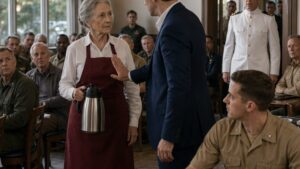
The front row had twelve chairs, but Stephen Carter laid out only eleven name cards.
He moved slowly, not because he was careless, but because every chair in the first row seemed to know more than the people who would fill it. The auditorium was still empty except for the low hum of the lights and the occasional thud from the stage crew testing the microphone stands. Rows of polished wooden seats climbed upward behind him, each row catching a strip of morning light from the high side windows. The Navy flags on the stage stood motionless. The brass bell on its small stand waited near the lectern under a dark cloth.
Stephen paused with one hand on the back of the unmarked chair.
The chair was not different from the others. Same wood. Same dark cushion. Same straight back polished for the event. But it had no name card, no folded program, no small printed ribbon marking rank or guest status. He had moved it half an inch back from the line, so a person looking closely would know it was meant to remain empty.
Most people would not look closely.
Most people looked at uniforms, name tags, shoulder boards, silver hair under officer caps, the flash of polished shoes. They looked at what announced itself. Stephen had learned a long time ago that the quiet things carried more weight. A secured hatch. A checked valve. A hand on a shoulder in smoke. A name not spoken too quickly.
His apron caught on the edge of the reserved-row sign when he turned.
He felt the tug at his waist and stopped. The apron was light cotton, pale from many washings, tied over his blue work shirt. Gary Perez had ordered a box of them for the maintenance crew years ago, mostly to keep dust off their clothes when they polished railings or wiped old varnish from seat arms. Stephen wore his because it had pockets large enough for a cloth, a screwdriver, a pencil, and the small folded cards nobody trusted him to arrange but everybody asked him to fix when the layout was wrong.
He freed the apron gently from the sign before the corner bent.
“Mr. Carter?”
Gary’s voice came from the side aisle, low and hurried. He had a stack of programs tucked under one arm and a roll of blue tape around his wrist. “You all right over there?”
Stephen slipped the loose card into his apron pocket. “Fine.”
“You sure? They moved rehearsal up again.”
“I heard.”
Gary looked toward the stage, where a young sailor was adjusting the lectern height and pretending not to watch the old man near the reserved seats. “They want the front row cleared. Officers coming through in twenty.”
Stephen nodded. “Then it will be cleared.”
Gary stepped closer and lowered his voice. “They sent me the final seating chart last night. You’re on it this time.”
Stephen kept his eyes on the empty chair. “Charts change.”
“Not that one.”
Stephen picked up a program from the seat beside it and aligned it with the cushion seam. His thumb pressed the edge flat, smoothing a curl in the paper. The program cover showed the auditorium in a cleaner photograph than life ever allowed: the stage glowing, the flags sharp, the bell centered like an answer.
“They spelled my middle initial wrong last year,” Stephen said.
Gary exhaled, half laugh and half defeat. “That’s not the point.”
“It usually is, with printed paper.”
Gary shifted the programs from one arm to the other. He was not a Navy man, but he had worked around enough Navy buildings to know when not to press too hard. “They’re calling it a memorial lecture and dedication observance. Academy administrator wants it tight. No surprises.”
Stephen looked at the row of seats, then at the bell under its cloth. “There are always surprises.”
A door opened at the back of the auditorium. Voices entered before the people did—young, official, clipped with the confidence of those who had a schedule in hand and believed time would obey. Stephen stayed where he was, one hand on the back of the empty chair.
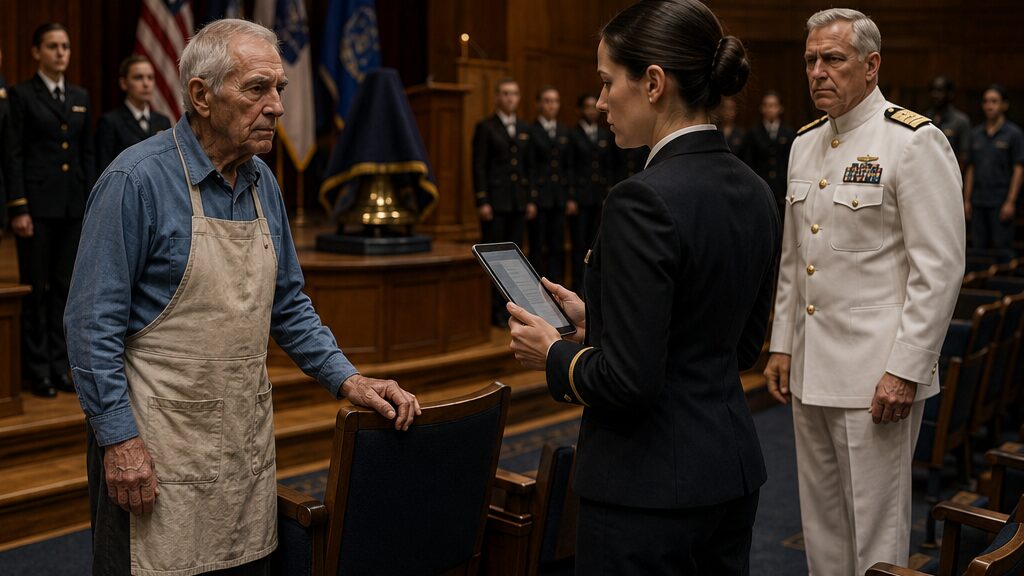
Several cadets came in first, carrying music stands and cases. Behind them, a security officer checked a list near the rear doors. A woman in a dark Navy uniform crossed down the center aisle with a tablet against her chest. She walked fast enough that the rows seemed to part for her. Her hair was pinned tightly, her posture straight, her expression already measuring what did not match the plan.
Stephen turned slightly, not to face her, but to give her room.
The auditorium always changed before ceremonies. It stopped belonging to those who knew where the floor creaked and which stage light warmed too slowly. It became a diagram. A flow pattern. A series of reserved spaces and restricted zones. Stephen understood that. Ships worked the same way before inspection. Men who had ignored a ladderwell for six months suddenly wanted it painted.
The woman glanced at him, then at the sign, then at her tablet. She did not slow.
“Maintenance crew should be finished before rehearsal,” she said, not unkindly, but without looking fully at him. “We need the honored section clear.”
Stephen looked down at his apron. A bit of lint clung near the pocket seam. He brushed it away.
Gary moved as if to answer for him, but Stephen spoke first.
“Yes, ma’am.”
Her thumb moved across the tablet. “And that chair?”
Stephen followed her gaze to the empty one. “It stays.”
Now she looked at him.
Only for a second, but enough.
Her face tightened the way faces did when an object had been placed where no object belonged. She did not see grief. She did not see a ritual repeated carefully enough to leave no trace. She saw an old man in an apron standing in a reserved row before a ceremony that had already been rearranged three times.
“I’m sorry,” she said, though her voice had no room for apology. “All seating is assigned through the event office.”
Stephen nodded once. “Then they assigned that one empty.”
Her eyes dropped again to the tablet. “There are no empty seats in the honored section.”
Stephen’s fingers rested on the chair back. His knuckles were thin, the skin marked by old burns that had healed into pale, uneven lines. He could still feel heat sometimes when a room became too quiet. Not on the skin. Deeper. Behind the ribs, where memory kept its own weather.
A band member tested a note. The brass sound rose, faltered, and died.
Gary said, “Officer Roberts, maybe we can—”
She lifted a hand without turning toward him. “One moment.”
Stephen noticed then that her name tag read Roberts. Pamela Roberts, if the program drafts in the side office had been accurate. Junior enough to be given impossible tasks, senior enough to take the blame when they went wrong. She was not cruel. Stephen could tell that. Cruel people enjoyed the space they occupied. Pamela Roberts looked like someone holding a room together with both hands.
That made it worse in a quieter way.
She stepped closer to the reserved-row sign. The apron brushed the chair again as Stephen shifted back. The fabric snagged, tugged, and held.
Pamela saw it.
For the first time, her attention fixed on the apron not as clothing, but as evidence. Maintenance. Staff. Someone outside the ceremony’s meaning.
“We cannot have tools or cleaning supplies in the front row once guests arrive,” she said. “Please move behind the side curtain until facilities is called.”
Stephen freed the apron from the sign a second time. He did not hurry. He folded the caught corner between his thumb and forefinger until it lay flat against him.
“Yes, ma’am,” he said.
But he did not leave the chair.
Pamela’s tablet chimed softly. She looked down. Her jaw tightened at whatever new message had arrived. Onstage, the microphone gave a quick shriek of feedback, and half the cadets turned toward it. The morning, which had felt only busy a minute before, now felt brittle.
Stephen stepped out from the row at last.
He moved into the aisle and placed both hands low in front of him, one wrist resting lightly over the other. It was an old habit from waiting outside offices, outside wardrooms, outside sick bays where the news had not yet decided what shape it would take.
Pamela looked from him to the empty chair.
“Before I go,” Stephen said quietly, “will that seat stay empty?”
She blinked once, as if the question had come from a direction she had not planned for.
“Why,” she asked, “is maintenance standing in the honored section?”
Chapter 2: The Name Pamela Missed on the Tablet
Pamela Roberts had been awake since 0430, and by 0715 she had already corrected a misspelled donor name, rerouted two late-arriving guests from the east entrance to the rear doors, approved a new flag placement, and explained for the third time that the bell was not decorative and therefore could not be moved six feet left for camera balance.
By the time she found the old man in the apron standing in the front row, she had no patience left for mysteries.
She had built the ceremony from fragments handed down by people who cared deeply and communicated poorly. A memorial lecture. A dedication observance. A bell ritual. A list of honored guests. A last-minute request from the academy administrator that the event feel “personal but efficient.” Pamela had translated all of that into tabs on her tablet: seating, arrival order, speaking order, family guests, stage cues, security notes, emergency weather plan, press line, maintenance checklist.
The old man belonged to maintenance.
At least, everything visible about him said he did.
His shirt was clean but faded. His apron had a pencil in one pocket and a folded cloth in the other. His shoes were the kind men wore when they knew they would stand on hard floors all day. He was very old—older than Pamela’s grandfather would have been, if her grandfather had lived long enough to shrink into his shoulders that way.
She did not dislike him. That was not the issue.
The issue was that the front row was reserved, the senior officers would arrive within minutes, and one unassigned chair had somehow appeared in a section where every inch had been argued over.
“Sir,” she said, because she had been raised properly even when rushed, “I need you to clear this row.”
The old man nodded.
Then he looked at the empty chair again.
Pamela followed his gaze and felt the familiar flare of irritation that came when a simple instruction turned into an explanation. “If facilities needs a staging seat, it can go behind the side curtain.”
“It is not a staging seat,” he said.
His voice was soft. Not weak, exactly. Soft the way a door sounded when someone closed it carefully at night.
Pamela checked the tablet. Front Row A: Academy administrator. Guest speaker. Senior Navy representative. Two family guests. Chaplain. Archives coordinator. Honored witness. Reserved. Reserved. Reserved. Band liaison. There should have been twelve filled positions, though three final names were hidden behind a collapsed field she had not expanded since the latest sync.
“Who placed it?” she asked.
“I did.”
“For whom?”
He did not answer immediately.
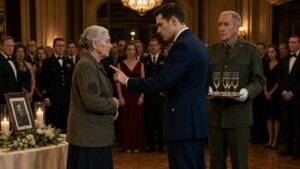
Behind Pamela, footsteps entered the aisle. She heard the slight shift in the room before she turned: cadets straightening, stage crew lowering their voices, the security officer at the back becoming still. Brian Lewis had entered in white dress uniform, his cap under one arm, ribbons precise across his chest. His presence had the clean weight of rank without theatrical force. People adjusted around him without being told.
Pamela felt both relief and pressure. If she could solve the seating issue before he reached the front, the morning might still recover.
“Sir,” she said to the old man, lowering her voice, “I understand you may have been told to help with setup. But the honored section cannot be used for storage, rest, or maintenance overflow.”
The old man looked at her fully then.
His eyes were gray, but not faded. That was the first thing she noticed that did not fit the easy category she had built for him. They were tired, yes. Deeply tired. But there was a steadiness there she had seen in senior enlisted personnel when junior officers made avoidable mistakes and everybody had to live through the correction.
“I am not storing anything,” he said.
Pamela swallowed the retort that came too quickly.
“Then please tell me why this chair cannot be removed.”
He placed one hand on the back of the empty seat. His fingers curled around the wood, and she saw old scars across the knuckles, pale and uneven.
“Because some men should not have to be replaced just to make a row look full.”
The sentence landed strangely. It did not fit ceremony logistics. It belonged to another room, another year.
Pamela looked down at the tablet to ground herself in something measurable. She expanded the field she had ignored. The screen refreshed too slowly. A small spinning circle appeared beside the seating chart, then vanished.
Front Row A, Seat 7: Stephen Carter — Honored Witness.
For a moment, Pamela thought the tablet had jumped to a different section.
She looked at the old man. Apron. Blue work shirt. Scarred hand. Quiet posture.
Stephen Carter.
Her thumb hovered over the screen.
The name was followed by a note in smaller text: Ret. Navy Damage Controlman. Auditorium Dedication Witness. Confirm seating with senior representative before changes.
Pamela’s face warmed so quickly she felt it under her collar.
She had read that note sometime after midnight. She remembered the words now, or the shape of them. Honored witness. Confirm seating. She had been looking for conflicts, not people. She had seen the title as a scheduling problem, not a man standing in front of her with a cloth in his apron pocket and a question about an empty chair.
Brian Lewis reached them before Pamela found her voice.
“Mr. Carter,” he said.
It was not loud. It did not need to be. The way he said the name changed the posture of the nearest cadets. They looked toward Stephen, then away, suddenly aware they had been watching a private correction unfold in public.
Stephen turned toward Brian. “Captain.”
Pamela heard herself inhale.
Not because Stephen had said the title, but because he had said it without reaching for importance. There was no triumph in it. No satisfaction that she had been caught. He simply acknowledged the man as if they had both arrived at a difficult appointment neither of them had requested.
Brian’s eyes moved once to the empty chair, then to Pamela’s tablet.
Pamela held it lower. Too late. He had seen enough.
“Officer Roberts,” Brian said.
“Sir.” Her voice came out smaller than she intended.
“Did the seating chart not update?”
“It updated, sir. I missed the note.”
The admission cost less than the shame of defending herself would have. She knew that. Still, her throat tightened.
Brian looked at Stephen. “Were you asked to move?”
Stephen’s hand remained on the chair back. “She asked for the row to be cleared.”
Pamela wanted, absurdly, to thank him for making it sound gentler than it had been.
Brian turned to her, and the room seemed to narrow around the three of them: the decorated officer, the junior officer with her tablet, and the old man in the apron who should not have needed anyone to explain him.
“This row,” Brian said, “is not clear until Mr. Carter says it is.”
Pamela nodded. “Yes, sir.”
Brian’s voice did not rise. That made it worse and better at the same time. “And the empty seat?”
Pamela looked at Stephen. This time she did not ask the tablet first.
“Mr. Carter,” she said, and the name felt different in her mouth, heavier because it belonged to someone she had nearly moved out of his own story, “do you want this seat left empty?”
Stephen’s gaze lowered to the chair.
For a second Pamela thought he might answer. Instead, he removed his hand from the chair back and folded it over his other wrist.
“I want it not filled by mistake,” he said.
Pamela nodded again, slower this time. She bent to the tablet and marked the seat blocked. Not available. Do not assign. Confirm with Stephen Carter.
Her fingers trembled just enough that she had to tap twice.
“I apologize,” she said.
Stephen looked at her then, not coldly. Almost kindly, which made her feel worse.
“Plenty of people miss things on a busy morning,” he said.
Brian’s expression shifted at that, a brief tightening near the mouth. He understood, Pamela realized, what she was only beginning to understand: Stephen had given her a way out, even after she had given him none.
The microphone shrieked again from the stage. A cadet muttered an apology. The auditorium resumed movement, but softly now, as if the air had been lowered by a hand.
Pamela stepped back from the row.
“Mr. Carter,” she said, “would you like me to escort you to the green room before rehearsal?”
“No,” Stephen said. “I need to check the aisle lights.”
Brian glanced at the apron, then at the cloth in Stephen’s pocket. He did not smile. He did not salute. He simply moved half a step aside, clearing the way without making a display of it.
Stephen passed between them slowly.
Pamela watched him go toward the side aisle, his apron strings hanging unevenly against his back. The seat behind him remained empty, suddenly louder than any chair in the room.
Brian waited until Stephen was far enough away not to be trapped inside the correction.
Then he said, quietly enough that only Pamela heard, “Ask him before you move that seat again.”
Chapter 3: The Officer Who Corrected the Room
Brian Lewis had watched rooms turn against quiet men before.
Not always cruelly. Cruelty was easy to identify and, in some ways, easy to confront. The more dangerous thing was efficiency without attention. A schedule that erased a person. A uniform that saw only another uniform. A ceremony that remembered sacrifice so neatly it forgot the one man in the room who still carried it in his hands.
When he saw Stephen Carter standing in the front row with an apron over his shirt and Pamela Roberts holding a tablet like a shield, Brian understood most of the situation before anyone spoke.
He did not understand all of it.
That was the part that troubled him.
Stephen had never been simple to place. The academy knew him as a caretaker, though Gary Perez called him more than that when anyone bothered to ask. The archives knew him as a witness, though Anna Taylor’s files had never held the whole account. The older Navy families remembered his name in pieces, usually attached to a shipboard fire, a bell, and a story told carefully around children. The ceremony office had placed him in the front row twice before, and twice Stephen had found reasons to be near the back by the time the program began.
Brian had decided this year would be different.
He saw now the mistake in that decision. He had told the academy administrator that Stephen should be honored. He had insisted the name remain on the seating chart. He had ordered the empty chair left untouched after a late planning meeting where someone suggested it looked “unfinished.”
But he had not asked Stephen what honor would feel like inside that room.
After Pamela stepped away, Brian watched Stephen cross to the side aisle and crouch stiffly near a row light. The old man’s knee resisted the motion. He braced one hand against the end seat before lowering himself the rest of the way. Then he took a small screwdriver from his apron pocket and adjusted the metal rim around the light with the same care a younger man might reserve for delicate equipment at sea.
Pamela remained near the front row. Her tablet was pressed against her side now, no longer held in front of her. She kept looking toward Stephen, then at the empty chair, then back to the screen.
Brian recognized that look too. The first moment after a person learned respect could not be performed backward.
A cadet approached the lectern. “Sir, we’re ready for the senior representative sound check.”
“In a moment,” Brian said.
The cadet vanished with relief.
Brian walked down the side aisle, avoiding the center so he would not draw the room’s attention to Stephen again. When he reached the row light, Stephen was tightening the rim.
“You do know we have people for that,” Brian said.
Stephen did not look up. “Then they should have fixed it yesterday.”
Brian watched the screwdriver turn once more.
“That was unpleasant,” he said.
Stephen set the screwdriver in his palm, closed his fingers around it, and pushed himself carefully upright. “Busy morning.”
“You keep saying that.”
“Because it is.”
Brian almost smiled. Almost. “She should have read the note.”
“Yes.”
“You could have told her.”
Stephen slid the screwdriver into his apron pocket. “Told her what?”
“That you were the honored witness.”
Stephen’s eyes moved toward the front row. “I have never cared for that phrase.”
“It is accurate.”
“It is half accurate.” Stephen untied the apron at his back with fingers that moved slower than they once had. “The bad half.”
Brian said nothing.
Stephen pulled the apron over his head and folded it once, then once again, until the stained front was hidden inside. Without it, he looked less like maintenance and no more comfortable. His blue shirt hung loose at the shoulders. His wrists seemed too narrow beneath the cuffs. The absence of the apron did not make him look official. It only removed the thing that had explained why he was there.
He held it over one arm.
“Damage-controlman,” Brian said quietly. “That is what the record says.”
Stephen looked at him, and for a second the auditorium seemed very far from its polished wood and flags. “Records like neat words.”
“What word would you use?”
Stephen’s hand tightened around the folded apron. “Useful, if lucky.”
Brian let the answer sit.
Onstage, the band began a short passage and stopped halfway through. The notes scattered against the walls. Pamela spoke to the security officer near the aisle, her voice lower than before. She pointed to the front row, then turned the tablet so he could see the blocked seat. Not available. Do not assign.
A small change. A real one.
Brian should have felt satisfied.
Instead, he felt the discomfort of having done the correct thing too loudly.
“When I corrected Officer Roberts,” he said, “I may have put you in a difficult position.”
Stephen looked down at the apron. “You put her in one.”
“She needed correction.”
“Maybe.” Stephen turned the folded cloth in his hands, aligning the corners. “But now every person in this room is trying not to stare.”
Brian glanced back.
Stephen was right. Nobody stared directly. That was the proof. The cadets adjusted music stands with great interest. The stage crew studied cables that had already been taped down. Pamela consulted her tablet without touching it. The room had learned Stephen mattered, but not yet how to treat him.
That middle place could bruise a man worse than open insult.
“I did not intend to make you a display,” Brian said.
Stephen’s voice stayed even. “People rarely intend the hardest parts.”
The words were not accusation. That made them harder to answer.
Brian folded his hands behind his back. He had spent decades in rooms where the correct posture could carry a man through uncertainty. It did little for him now. “The academy wants today to mean something.”
“It already means something.”
“To the guests, I mean.”
Stephen gave a faint nod. “Guests like meaning printed.”
Brian looked toward the program covers stacked near the stage. “You think the ceremony is wrong.”
“I think ceremonies get hungry.”
“For what?”
“For clean endings.”
Brian felt that in his chest. He had seen enough memorials to know the hunger Stephen named. A good script could make grief stand straight, sing on cue, and leave by the north doors before lunch. It was not always false. Sometimes order was the only mercy people could manage. But order could also smooth a name until it no longer hurt, and if it no longer hurt, nobody had to ask why.
“What do you want from today?” Brian asked.
Stephen took a long breath through his nose. The overhead lights brightened a fraction as if the room had drawn one too.
“I want the bell rung properly,” he said. “I want that chair left alone. I want the young ones not to trip over the aisle lighting when they come down in formation.”
“That is all?”
Stephen looked at him, and Brian knew the answer was no.
But Stephen only said, “That is enough work for a morning.”
A door opened at the side of the auditorium, and Anna Taylor entered with a file box held against her hip. She wore civilian clothes and the expression of someone who had discovered that paper could cause trouble after all. Pamela met her halfway down the aisle.
Brian saw Anna glance toward Stephen, then lower her voice. Pamela’s face changed. Not dramatically. Just enough.
Brian excused himself with a nod and crossed toward them.
Anna shifted the box in her arms. “Captain Lewis, do you have a minute?”
“Not a generous one.”
“This may need more than that.”
Pamela looked at the empty chair before she spoke. “It’s about the dedication packet.”
Brian waited.
Anna opened the top folder. Inside were old programs, photocopied rosters, and a brittle sheet marked with the academy archive stamp. One corner had been repaired with clear tape long ago.
“The current program summary does not match the original file,” Anna said.
Brian felt Stephen watching from the side aisle without turning toward them.
“What is missing?” Brian asked.
Anna looked uncomfortable now, not because she lacked facts, but because facts had led her to the edge of something human.
“That’s the problem,” she said. “The original dedication file is incomplete.”
Chapter 4: The Empty Seat Was Not a Mistake
Anna Taylor had spent half her working life telling officers that archives did not lose things, people did.
Files were misnamed, borrowed, copied without the last page, returned to the wrong drawer, digitized under titles that sounded right to someone who had never attended the event. Records carried the fingerprints of every hurried hand that had handled them. The academy liked to imagine its history sat in clean boxes, waiting to be opened. Anna knew better. History hid behind old tape, coffee rings, missing staples, and the places where someone had chosen not to write a thing down.
The dedication file for the auditorium was worse than most.
She set the box on the long table in the archives office, where the afternoon light made every speck of dust visible. Pamela stood on the opposite side with her tablet held in both hands, quieter than she had been that morning. Brian Lewis remained near the door, cap tucked under one arm, watching the files with the patience of a man who had learned that paper could wound late.
Stephen Carter did not come in at first.
Anna had seen him through the open doorway, standing in the hallway beside a metal storage cart. The folded apron lay over his left arm. Without it tied around him, he seemed even older, as if some ordinary explanation had been taken away and nothing had been put in its place.
“This is the current dedication summary,” Anna said, sliding a printed page toward Brian. “It says the hall’s bell ritual commemorates emergency response training reforms after a shipboard casualty. That language appears in every program after the first five years.”
Pamela looked up. “That sounds official.”
“It is official. It is also very careful.”
Brian did not pick up the page. “And the original?”
Anna opened a folder with both hands. The paper inside had yellowed along the edges, the old type uneven where ink had struck harder in some places than others. “The original program names the ritual differently. Not training reforms. Not emergency response. It calls it ‘the first bell for those who came through smoke and those who did not.’”
Pamela’s thumb shifted against the edge of her tablet.
Anna placed a photocopied roster beside the program. Several names appeared under a ship designation, followed by dates and duty stations. One line had been marked in pencil. Not erased. Not highlighted. Just a narrow, deliberate line beside the name Stephen Carter.
“There are witness statements referenced here,” Anna said. “Three of them. Only two are in the packet.”
Brian’s gaze moved toward the doorway.
Stephen was still there.
Pamela followed his eyes, then lowered her voice. “Is his statement missing?”
Anna hesitated. “No. His is one of the two we have.”
“Then whose?”
Anna touched the blank space where a third statement should have been filed. “That’s what I don’t know.”
The silence in the archives office seemed different from the auditorium’s silence. The auditorium was made for voices. This room was made for what remained after voices stopped.
Stephen entered without being invited. He did not ask what they had found. He crossed to a metal shelf near the back, where spare programs from previous years were tied in bundles with cotton string. The apron over his arm brushed against one bundle, and he steadied it before it could fall.
Anna watched him look at the old programs, not fondly. Carefully.
“Mr. Carter,” she said, “do you remember why the wording changed?”
Stephen ran one thumb along the edge of a program bundle. “People got tired of explaining smoke.”
Pamela’s tablet went dark in her hands. She did not wake it.
Brian said, “The bell ritual came from that night.”
Stephen looked at the table. His face did not change much, but Anna saw the effort it took him not to look at the chair that was not in this room.
“The bell was already there,” Stephen said. “Brass ship’s bell. Cracked along the rim. Somebody thought it looked handsome enough for a hall.”
“And you objected?” Anna asked.
“No.” He gave the faintest shake of his head. “I asked them not to polish out the crack.”
Pamela looked toward the auditorium through the wall, as if she could see the bell waiting under its cloth. “Why?”
Stephen did not answer.
Anna chose the next paper from the folder. A maintenance memo from the hall’s first year. She had nearly passed over it that morning because it seemed unrelated: aisle lighting inspection, evacuation route markings, emergency bell placement. Then she had noticed the signature at the bottom.
S. Carter.
“You helped design the evacuation procedure for this hall,” she said.
Stephen’s gaze came to her at last.
“I made suggestions.”
“You signed the original aisle-light inspection. And the bell placement.”
“The old placement was wrong.”
“How?”
“In smoke,” Stephen said, and the word entered the room like a smell, “people reach for sound before signs. If the lights fail, if the aisle fills, if someone freezes, they move toward what they can hear. You put the bell where the sound can travel under panic.”
No one spoke.
The academy’s auditorium had never felt dangerous to Anna. It had always been polished wood, flags, lectures, guest programs, school shoes clicking down aisles. But Stephen spoke of it as if he had once seen the room in another shape: dark, crowded, breathing wrong.
Pamela looked at the paper again. “That’s why the bell is rung before the lecture?”
Stephen nodded.
“And why the aisle lights are checked by hand,” Gary Perez said from the doorway.
Anna had not heard him arrive. He stood just outside the office, a coil of cable in one hand, looking at Stephen rather than the files.
Gary cleared his throat. “He does it every year. Says the sensors lie if nobody bothers to bend down.”
Stephen’s face tightened with embarrassment, not anger. “Sensors do lie.”
Pamela turned toward him. “You checked them this morning after I told you to move.”
Stephen’s eyes lowered.
Anna understood then with a clarity that made her chest ache: he had not stayed in the honored section for recognition. He had stayed because the room had a ritual, and rituals became hollow when no one protected the practical truth beneath them.
Brian stepped closer to the table. “Stephen, the missing statement. Do you know whose it was?”
The old man folded the apron once more over his arm, smoothing a crease that had already been smoothed. “A man who did not like statements.”
“Was he the reason for the empty seat?”
Stephen’s mouth pressed into a thin line.
Anna saw Pamela nearly speak, then stop herself. The restraint was new. Not polished yet, but real.
Stephen looked at the old program bundle and said, “Some names get printed enough. Some don’t get heard at all.”
He turned to leave.
Pamela moved aside before he had to ask. It was a small movement. A quiet correction of the morning.
After Stephen was gone, Anna untied the oldest bundle of programs. The cotton string had left a pale groove in the paper. She lifted the first program, then the second.
Pamela came around the table to help.
The old pages smelled of dust and dry glue. Their covers showed the auditorium from years ago, the wood darker, the bell less polished. Inside, the speaker lists changed, the dedication language shifted, the wording softened year by year.
Then Pamela stopped.
Her hand rested on a program from the first observance. Near the witness section, beside Stephen Carter’s printed name, another name had been marked out by hand. Not fully erased. Not crossed away in anger. A single line had been drawn through it with the care of someone who could not bear to remove it completely.
Pamela looked at Anna.
Anna looked toward the hallway where Stephen had gone.
The missing name remained readable beneath the line.
Chapter 5: The Ceremony They Wanted to Use
By evening, the auditorium had begun to look ready enough for people who did not know where to look.
The flags stood clean and equal behind the lectern. The front row held its programs in straight white rectangles. The microphones had stopped shrieking. The aisle lights glowed in small, disciplined pools along the carpet, each one checked by hand. The bell remained under its cloth, the outline of it visible in the shape the fabric made over brass and crack.
Stephen Carter stood at the edge of the stage and listened to the room settle.
Empty rooms had sounds of their own. Wood easing after a day of footsteps. Air moving through vents. The faint click of cooling lights. Somewhere behind the curtain, a music stand shifted and tapped once against another. He had spent years learning which sounds mattered and which did not. A loose hinge. A bad wire. A chair leg beginning to split. Men at sea learned the same lesson faster. A ship was never silent. Silence meant you had missed something.
Gary Perez came from the side door with a box of fresh programs. “Administrator wants a photo test in ten.”
Stephen picked up his apron from the storage hook and tied it around his waist.
Gary stopped. “You sure you want that on?”
“No.”
Gary waited.
Stephen slipped the pencil into the pocket. “But the stage rail still needs wiping where they moved the lectern.”
Gary looked toward the stage rail, which already shone. “That rail is cleaner than the academy administrator’s conscience.”
Stephen gave him a look.
Gary held up one hand. “Sorry.”
“Don’t be. Just be accurate.”
That earned a small laugh from Gary, but it faded quickly. “They’re looking for you.”
“I am visible.”
“You know what I mean.”
Stephen did.
The administrator had been in the building for less than an hour and had already discovered what everyone else had spent the day learning in pieces: the old man in the apron was not background. That kind of discovery made people nervous. Nervous people wanted control. They wanted language. They wanted a paragraph in the script that put the feeling where it belonged and ended it before it spilled.
Stephen took a cloth from his apron pocket and wiped a place on the rail that did not need wiping.
Pamela entered from the aisle carrying the tablet and a paper folder. She moved more slowly than she had that morning. Not timidly. Carefully, as if the room had acquired edges she had not noticed before.
“Mr. Carter,” she said.
He looked up.
She held the folder out, but not toward him yet. “May I ask you about something before the administrator comes in?”
May I.
Stephen noticed the words because she had not used them that morning.
“You may ask,” he said.
Pamela opened the folder and removed the old program. “Anna found this in the first observance packet.”
Stephen saw the page before she turned it. He knew the size of the paper. The aging at the edges. The exact place where the line crossed the name.
His hand stopped moving on the rail.
Pamela did not push the paper closer. “The name is still readable.”
“Then you do not need me to read it.”
“No,” she said. “But I need to know whether it belongs in tomorrow’s program.”
Stephen folded the cloth once, slowly. “It belonged there before tomorrow.”
Pamela’s mouth tightened, and for the first time since the morning, he saw that her shame had become something useful. Not a display. Not tears. Attention.
“Who crossed it out?” she asked.
Stephen looked at the bell beneath the cloth. “I did.”
Gary, who had been pretending to organize programs at the side, went still.
Pamela lowered the folder slightly. “Why?”
Stephen did not answer at once. He could feel the room behind him as it had been and as it had not. The auditorium faded at the edges. For a breath, the aisle lights became low emergency lamps along a narrow passage. The polished wood became wet metal. The brass bell beneath the cloth became an alarm he could not stop hearing.
He placed the cleaning cloth on the rail.
“Because they wanted him introduced as part of a rescue story,” Stephen said. “And he did not make it to the end of the rescue.”
Pamela’s eyes stayed on him, not the paper. “Was he the shipmate?”
Stephen’s hands rested flat on the rail. The old burn scars showed against the wood.
“He pulled me out last,” he said.
Gary looked down.
No one asked out of where. No one asked how badly. Stephen was grateful for that, though gratitude did not make the telling easier.
“He had already gone back twice,” Stephen said. “Third time, the passage was wrong. Heat does things to steel. Does things to men too.” His fingers shifted against the rail. “I remember his hand on my collar. I remember being angry with him because he kept saying my name like I was hard of hearing. Then I remember air. Cold air. Too much of it.”
Pamela’s voice was quiet. “And he?”
Stephen looked at the empty chair in the front row.
“He stayed where the smoke was.”
The administrator entered through the rear doors with two staff members and a photographer. Their voices carried too brightly into the hall. Brian followed behind them, already watching Stephen’s face instead of the schedule.
“There he is,” the administrator called, smiling with the cautious enthusiasm of someone approaching an emotional asset. “Mr. Carter. We were hoping to discuss tomorrow’s recognition moment.”
Stephen picked up the cloth again.
Pamela closed the folder. Not loudly, but firmly enough that the sound cut through the approaching footsteps.
The administrator paused. “Officer Roberts?”
Pamela held the folder against her chest. “Sir, the program language may need revision before the photo test.”
“We have already cleared the final script.”
“Yes, sir. That is the issue.”
The administrator’s smile thinned. “Captain Lewis?”
Brian came down the aisle with measured steps. “Let’s hear her.”
The photographer lowered the camera.
The administrator looked from Brian to Pamela, then to Stephen’s apron. “Mr. Carter, first, let me say what an honor it is. We would like tomorrow’s audience to understand who you are. A brief introduction, perhaps a standing acknowledgment, then the bell. Nothing uncomfortable.”
Stephen almost smiled at that. Nothing uncomfortable. As if comfort had ever kept faith with the dead.
“No,” he said.
The administrator blinked. “No to which part?”
Stephen folded the cloth and placed it in his apron pocket. “To being used to warm the room before the bell.”
A staff member looked down at a clipboard.
The administrator recovered his public voice. “I’m sure that’s not how anyone intends it.”
“People rarely intend the hardest parts,” Brian said.
Stephen glanced at him. The line had returned, but not as theft. As understanding.
The administrator shifted. “We cannot add a missing name without verification.”
Anna entered from the side aisle with another folder. “We have verification that the name was in the first program.”
“That does not explain why it was removed.”
“I removed it,” Stephen said.
The room settled around him.
He did not raise his voice. He did not step forward. Yet every person in the auditorium seemed to lean toward the words.
“I thought I was protecting him from a neat story,” Stephen said. “Maybe I was protecting myself from hearing his name in a room where nobody knew what it cost.”
Pamela looked at the folder in her hands. “What do you want the room to remember?”
Stephen turned his head toward her.
It was the first question all day that had not tried to place him somewhere.
He looked from Pamela to Brian, then to the empty chair. The answer had waited years, and still it came out small.
“Not me first,” he said.
Pamela nodded once. “Then who?”
Stephen’s throat worked.
The room held still.
“Joshua,” he said.
Chapter 6: Permission Before the First Bell
The next morning, Pamela carried Stephen Carter’s apron as if it were part of the ceremony.
She had found it folded on the storage room chair before dawn, washed by someone from the maintenance crew and still faintly warm from the dryer. One pocket had been turned out and pressed flat. The pencil was gone. The cloth was gone. Without those ordinary things, the apron looked almost too clean, as if someone had tried to make it respectable by removing the evidence of work.
Pamela stood with it in the side hallway while guests entered the auditorium.
She did not put it on a table. She did not drape it over a chair back. She held it over both forearms, the way she had once seen a flag handled before it was passed to family, though she knew enough not to confuse the two. It was not sacred. It was cotton. It had ties, pockets, a faint repair near the seam.
But yesterday she had used it to decide who Stephen was.
Today she would not let it be handled carelessly.
Through the open door, the auditorium filled with controlled sound: low greetings, program pages turning, shoes in the aisles, the muted tuning of the Navy band. The empty seat in the front row remained slightly back from the others. Pamela had checked it herself three times. Not available. Do not assign. Confirm with Stephen Carter.
Now there was nothing left to confirm except whether Stephen would come.
Brian Lewis stood near the stage in white dress uniform, speaking quietly with the chaplain. The administrator hovered near the front with a revised program in hand, his face arranged into solemn cooperation. Anna sat two rows behind the honored section, archive folder on her lap. Gary stayed near the side aisle with the maintenance crew, dressed in a clean work shirt that looked uncomfortable on him.
Stephen was not in the front row.
Pamela found him where she should have looked first: beside the aisle lights, just inside the rear entrance, bent slightly as he checked the last metal rim with his thumb.
“Mr. Carter,” she said.
He looked up.
He wore the blue shirt from yesterday, buttoned carefully, sleeves down. Without the apron, he seemed unfinished in a way Pamela would not have understood before. Not less dignified. Less shielded.
“I believe this belongs to you,” she said.
She offered the folded apron, but stopped halfway. “May I?”
Stephen looked at the apron for a long moment.
“May you what?”
“Carry it to the front,” Pamela said. “Unless you would rather wear it.”
A small change passed through his face. Not surprise exactly. Something quieter, and more painful.
“I do not need it for sitting,” he said.
“No, sir.”
He looked at the front row. “And I am not sure I need the chair.”
Pamela felt the old impulse rise: to solve, to arrange, to produce an answer before the room noticed uncertainty. She let it pass.
“The chair will stay as you decide,” she said. “Both of them.”
His eyes came back to her.
“The empty one,” she said, “and yours.”
From the auditorium, the band finished tuning. A staff member gestured anxiously from the stage entrance. Pamela did not move.
Stephen took the apron from her, then after a moment gave it back.
“Carry it,” he said.
She nodded.
When they entered, several heads turned. Pamela felt the attention and hated that Stephen had to feel it too. But the room did not break into applause. Brian had seen to that. No one stood. No one forced emotion into spectacle. The guests watched an elderly man in a blue shirt walk slowly down the center aisle beside a younger officer who carried a folded apron with both hands.
At the front row, Pamela stopped.
“Mr. Carter,” she said quietly, “before I speak your name in the program, do I have your permission?”
The question reached only him, but Brian heard it from the stage. Pamela saw his posture change, not with command, but with relief.
Stephen looked at the empty seat. Then at the chair beside it, the one with his name card corrected and centered.
His name was spelled plainly.
Stephen Carter.
No rank before it. No decoration after it. Beneath, in smaller print: Retired Navy Damage-Controlman. Dedication Witness.
He touched the card once with two fingers.
“Permission,” he said.
Pamela stepped to the lectern only long enough to adjust the order of papers. Her voice, when she spoke, did not carry the bright edge it had held the morning before. It was steady and lower.
“Before the first bell, Captain Lewis has asked that we correct the record of this hall.”
She stepped back.
Not her moment. Not anymore.
Brian came forward. He looked across the full auditorium, then down to Stephen, who remained standing beside the front row rather than sitting.
“This auditorium has hosted lectures, commissions, farewells, and memorials,” Brian said. “Its bell is rung each year to remind us that procedures are not paperwork. They are promises made before panic arrives.”
Pamela watched Stephen’s hands.
They were folded low in front of him, one wrist over the other. The same posture as yesterday. But the room was different around it.
Brian continued. “For years, one witness to the origin of that ritual has maintained this hall quietly. He checked the aisle lights. He protected the bell’s placement. He asked that one seat remain empty when others tried to make the row look complete.”
The administrator shifted, but said nothing.
Brian turned slightly toward Stephen. “Mr. Carter, may I continue?”
The auditorium seemed to hold its breath.
Stephen gave a small nod.
Brian looked back to the room. “The empty seat is for Joshua, a sailor whose name appeared in the first observance and disappeared from later programs. That removal was not careless. It came from grief. Today, with Mr. Carter’s permission, the name returns.”
Pamela saw Stephen close his eyes for half a second.
Not long enough for most people to notice. Long enough for her to understand that permission was not the same as ease.
The revised programs rustled in the hands of guests who had not yet found the inserted page. Anna opened hers. Gary lowered his head.
Brian stepped back from the lectern. He did not finish the story for Stephen. He did not turn him into a polished lesson. He simply left the space open.
For a moment, Stephen did not move.
Pamela thought he might sit. Or leave. Or let the silence be all he could give.
Then he took one step forward.
The walk to the lectern was short. It seemed to cost him anyway. Pamela stayed near the front row, holding the folded apron. When Stephen reached the microphone, he did not adjust it. Brian did that for him with one careful movement, then stepped away.
Stephen looked at the room.
He had worked in that auditorium for years while people passed him carrying speeches. Now the room waited for his few words, and he looked as if he would rather be checking a faulty light.
“My name is Stephen Carter,” he said.
No one moved.
“I was not the best man in that passageway.”
Pamela felt the words before she understood their shape.
Stephen’s hands rested on either side of the lectern. The burn scars stood pale against the wood.
“I was the one who got out.”
A program slipped in someone’s hands and settled against a knee. No one bent to retrieve it.
“Joshua went back because he heard me,” Stephen said. “That is the part I can say. There are other parts I do not say in rooms like this.”
His gaze moved to the empty seat.
“For a long time, I thought leaving his name out kept it from becoming too clean. Maybe it only made the silence easier for everyone else.”
He looked down. Pamela thought of the crossed-out name, the line drawn carefully enough not to erase.
“The bell should ring for him first,” Stephen said. “And for the people who check the lights before anyone important arrives. Because if the room ever goes dark, titles will not guide you out. Work will. Memory will. Someone who knows where the sound should be will.”
He stopped.
That was all.
No story of flames. No dramatic account. No claim of heroism. He stepped back from the microphone before anyone could decide what kind of response he deserved.
Brian did not lead applause.
Instead, he lifted the cloth from the bell.
The crack along the rim caught the stage light.
Pamela carried the apron to the small table beside the empty seat and laid it there, folded, not hidden. The tablet rested beside it with the revised seating chart still open. Cotton and glass. Work and record. The things she had used to mistake him, now placed where they could not be mistaken again.
Brian gestured to Stephen. “Would you like to ring it?”
Stephen looked at the bell.
Then he shook his head.
“Gary knows where the sound carries,” he said.
Gary stared at him from the side aisle, startled enough to look almost angry for a second. Then he wiped one hand against his trousers and came forward.
No one announced him. No title appeared beside his name. He stood at the bell, looked once at Stephen for confirmation, and lifted the striker.
The first note rang through the auditorium, low and imperfect. The crack in the brass roughened the sound. It traveled under the seats, along the aisle lights, into the corners where maintenance ladders and old dust waited after ceremonies were done.
Stephen remained standing beside the empty chair.
When the sound faded, Brian stepped back from the front row.
He did not gesture to the seat. He did not guide Stephen by the elbow. He did not decide what came next.
The chair with Stephen’s name waited.
The empty chair waited beside it.
The room waited too, but differently now. Not hungry. Listening.
Stephen looked at both seats for a long time. Then he turned slightly toward Brian, toward Pamela, toward Gary still holding the striker.
“Leave the empty one as it is,” he said.
Brian nodded.
Stephen’s hand hovered over the back of his own chair.
Pamela did not move to help until he looked at her. Only then did she step forward, not touching his arm, only drawing the chair back enough to make space.
Stephen sat down beside the empty seat.
The ceremony continued, but it no longer belonged to the script alone.
Chapter 7: One Seat Left Empty After Everyone Stood
After the last guest left, the auditorium did not become empty all at once.
It emptied in layers.
First went the formal voices, the polished greetings, the careful condolences spoken by people who wanted to mean them well. Then the cadets filed out in pairs, their shoes softer on the aisle carpet than they had been when the ceremony began. The band packed its instruments behind the curtain, brass disappearing into black cases, music stands folded into narrow metal lines. The academy administrator left with two staff members and a revised program tucked under his arm, no longer smiling as if the day belonged to him.
For a while, paper remained.
Programs lay on seats, some folded open to the inserted page. One had slipped beneath the front row, half-hidden in shadow. Another rested on the chair beside Stephen, its corner touching the empty seat as if it had tried to cross the space and stopped.
Stephen stayed seated until the room stopped pretending to be ceremonial.
The empty chair beside him held nothing. No program. No name card. No ribbon. Pamela had removed the card holder after the bell, not because anyone told her to, but because she had understood that absence could be mishandled too.
The bell sat uncovered on its stand. The crack along its rim looked less dramatic now that the lights were cooling. Just a flaw in brass. Just the place where sound came out rough.
Gary returned from the side aisle carrying the striker in both hands.
He did not know what to do with it. Stephen could see that from the way he held it, too carefully for a tool, not formally enough for a relic. Gary had rung the bell once and had looked shaken afterward, as if the sound had found a room in him he had not labeled.
“You want this back on the stand?” Gary asked.
Stephen looked at the striker. “That is where it lives.”
Gary nodded and placed it beside the bell. The wood made a soft sound against the stand. “Did I hit it right?”
“There is no right way to hit a cracked bell.”
Gary frowned. “That sounds like something that means more than I want it to.”
“It means you struck it clean.”
Gary glanced at the empty chair, then at Stephen. “Then I’m going to take that and leave the rest alone.”
Stephen’s mouth moved almost into a smile.
Pamela stood a few rows back with the folded apron over her arms. She had been waiting, not hovering, which was different. Brian had taught her nothing about that. The day had. She walked down the aisle only after Stephen looked her way.
“Mr. Carter,” she said.
The title still sat carefully in her mouth. Not stiff. Not easy either.
She held out the apron.
Stephen saw at once that it had been washed. The pale cotton was cleaner than he preferred, the old stains softened but not gone. The repaired seam near the pocket had been pressed flat. Whoever had folded it had lined the ties together and tucked them inside so they would not drag.
“I asked the maintenance crew before touching it,” Pamela said. “Gary said it was all right if I brought it to you.”
Stephen took it.
The cotton felt warm from her hands, not the dryer now. He looked at the pocket where the pencil usually sat. Empty. Clean. Waiting.
“You did not have to wash it,” he said.
“I didn’t.” Pamela looked toward the side aisle. “They did.”
Gary, pretending not to listen near the bell, lifted one hand without turning around.
Stephen ran his thumb over the apron’s edge. Yesterday it had been proof against him. This morning it had been carried like a question. Now it was only itself again—work cloth, pocket cloth, old man’s habit.
That was a relief deeper than praise.
Brian came from the stage, cap in hand. He had removed his gloves. Without them, his hands looked older.
“The academy administrator wants to keep the revised language for next year,” Brian said.
Stephen kept his eyes on the apron. “Administrators want many things after a room goes quiet.”
“This one put it in writing.”
“That is dangerous.”
Brian accepted the correction with a small nod. “Anna will keep the original program with the restored file. The crossed-out copy too, if you allow it.”
Stephen looked toward Anna, who was gathering folders near the second row. She held them against her chest, not like proof, not like victory. Like something borrowed.
“She may keep it,” Stephen said. “But not behind glass.”
Anna heard him and looked up.
“Then where?” she asked.
“With the maintenance records.”
Pamela blinked.
Brian looked at Stephen for a long moment, then seemed to understand before the others did. “Because of the bell placement.”
“And the aisle lights,” Stephen said. “And the evacuation maps nobody reads until they need them.” He folded the apron over his knees. “If they put the old program with the speeches, people will come looking for words. Let them find it where the work is.”
Anna’s face changed softly. “I can do that.”
Pamela looked down at her tablet. The screen had gone dark again. She did not wake it. “I changed the event checklist,” she said. “Next year, the front row cannot be reset until facilities signs off on the aisle lights and the bell. Not event staff. Facilities.”
Gary turned around. “You did what?”
Pamela met his surprise without defensiveness. “You know where the sound carries.”
Gary looked at Stephen, then at Brian, as if expecting someone to make it a joke. No one did.
“Oh,” Gary said. “Well. Good.”
Stephen watched the three of them stand in the fading light of the auditorium, each holding some changed piece of the day. Pamela with her lowered voice and dark tablet. Brian with his cap against his side and no need to command the room. Anna with the rescued papers. Gary with his startled place inside a ritual he had helped protect without knowing it.
Respect, Stephen thought, was quieter than people expected when it finally arrived.
It did not fix the empty chair.
It did not return Joshua’s hand to his collar, or make smoke less clever, or turn survival into a clean thing. It did not make Stephen younger. It did not make ceremonies safe from hunger. Tomorrow someone would track dust near the entrance. A chair would wobble. A microphone would fail. A young officer somewhere would mistake a person for a problem because the schedule was tight and the person was quiet.
But perhaps one of them would stop.
Perhaps one of them would ask permission before moving what they did not understand.
The thought did not comfort him exactly. It gave him something to do.
Brian stepped closer. “Will you stay on here?”
Stephen looked at the auditorium: the high walls, the rows, the bell, the empty seat. “The hall still needs checking.”
“That is not what I asked.”
“I know.”
Brian waited.
Stephen stood slowly. Pamela moved half a step, then stopped before helping without being asked. Stephen noticed. He appreciated the stopping more than he would have appreciated the hand.
He tied the apron around his waist.
The knot took him longer than it once had. His fingers did not like small work after a long day. Gary looked ready to help and managed not to. Pamela looked down, giving him the privacy of not watching. Brian studied the stage lights. Anna closed a folder softly.
When the knot finally held, Stephen smoothed the front of the apron.
“There,” he said.
Gary cleared his throat. “Rail’s already clean.”
“Then it will be easy.”
One by one, they left him the room.
Not abandoned him. Left him. There was a difference. Brian paused at the rear doors and gave a small nod, not a salute. Pamela stopped beside the front row and touched the back of Stephen’s chair—not the empty one, his—then continued up the aisle. Anna carried the files out through the side entrance. Gary was last, turning off the backstage work lights before he went.
“You want me to lock up?” Gary asked.
Stephen shook his head. “I will.”
Gary nodded and disappeared through the side door.
The auditorium settled into its own breathing again.
Stephen began with the front row. He picked up the program that had fallen beneath the seat and placed it on the chair that had held his name. He did not touch the empty chair. He collected two paper cups from the rear row, straightened a crooked aisle sign, and checked the bell cloth for dust before draping it over the brass. The crack vanished beneath the dark fabric, but the shape remained.
At the aisle lights, he bent carefully and tested the nearest rim with his thumb.
Secure.
He moved down the row, one light at a time.
At the last one, he stayed crouched longer than necessary. His knee ached. His back complained. His hand rested on the seat beside him, and for a moment he was simply an old man in an empty auditorium wearing a clean apron no one had mistaken this time.
When he stood, the room seemed larger.
He walked to the front row and looked at the two chairs: one with his program resting on it, one empty and untouched.
“Good night, Joshua,” he said.
The words did not echo. The room kept them.
Stephen went to the rear wall and began turning off the lights. The stage dimmed first, then the side aisles, then the warm overhead rows fading section by section until only the small aisle lights remained, low and steady along the carpet.
He opened the rear door, then looked back once.
In the soft path of the aisle lights, the empty seat remained where it was, half an inch behind the line, not forgotten, not filled, not explained away.
Stephen switched off the final light and left it undisturbed.
The story has ended.