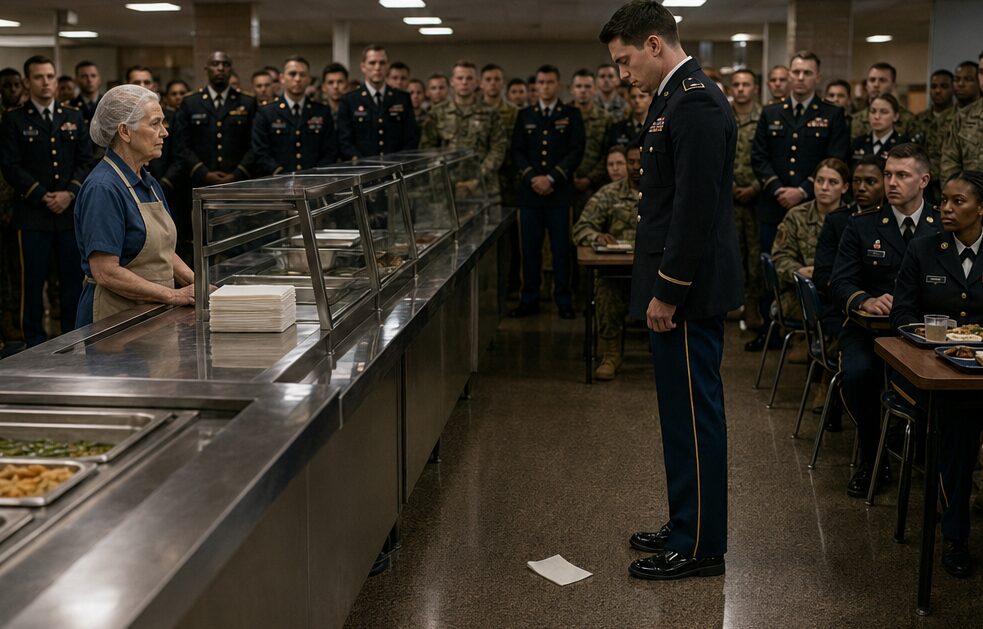
The Day the Lunch Line Remembered Who Had Been Waiting
Part I — The Counter
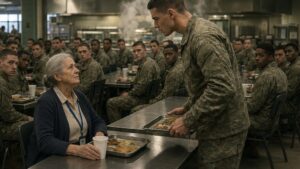
Lieutenant Eric slammed his tray so hard against the stainless-steel rail that the little metal cup beside the napkins jumped, rolled once, and clattered to the floor.
The whole dining hall heard it.
Laura stood behind the glass, one hand still resting on the serving spoon, the other near the tray of roast chicken she had already told him was reserved. She wore the same blue shirt she wore every weekday, the same beige apron, the same hairnet pinned over silver hair she kept wound tight at the back of her head.
Eric leaned over the counter until his polished buttons nearly touched the glass.
“I said I want that plate.”
Laura looked at him the way she looked at overboiled coffee, broken tongs, and young men who thought volume counted as authority.
“No,” she said.
The word was small.
The room made it large.
The soldiers at the nearest tables stopped moving. Forks hovered. Plastic cups paused halfway to mouths. The lunch line bunched behind Eric, bodies in camouflage and boots waiting for the young officer to either move on or make the moment worse.
He chose worse.
“That food is for the field group coming in at twelve-thirty,” Laura said. “They’ve been out since before sunrise.”
Eric’s jaw tightened. He was twenty-seven, clean-cut, broad-shouldered, and freshly promoted enough to still shine under his rank. His dress uniform fit him like proof.
“I have a schedule,” he said.
“So do they.”
A few men behind him looked down at their trays.
Eric’s face changed. Not much. Just enough for Laura to see the boy underneath the officer, the one who could not stand being refused in front of anyone.
He swept his hand sideways.
A stack of white napkins spilled across the floor. The metal condiment cup skidded under the rail and stopped near his shoe.
Laura did not flinch.
She looked at the napkins. Then at the cup. Then at him.
“Pick those up, please.”
Eric laughed once. It was not amusement. It was a warning.
He turned to the private behind him, a skinny young man holding an empty tray.
“You heard her,” Eric said. “Clean it up.”
The private froze.
Laura’s voice did not rise.
“I asked you.”
The dining hall went so still that the hum of the drink machine seemed rude.
At a table near the back, Captain Robert lifted his eyes from his coffee. He had the worn face of a man who had learned to listen before acting. He watched Eric leaning over the serving rail. He watched Laura standing behind it, small, straight-backed, her burned hands resting where everyone could see them.
Eric leaned closer.
“You’re not in uniform,” he said, loud enough for three rows of tables to hear. “Don’t lecture me about discipline.”
Something shifted in Laura’s face then.
Not fear.
Not surprise.
For one second, it looked like an old door had opened inside her and she was holding it shut with both hands.
Then she nodded toward the next tray.
“Step aside,” she said. “You’re holding the line.”
The private bent quickly and grabbed the napkins before anyone told him not to. His ears were red. His hands shook.
Eric did not move at first.
Laura held his gaze.
Behind him, men and women in uniform looked anywhere but at the counter.
Finally Eric took the plain meal she handed him, turned sharply, and walked away with the metal cup still on the floor.
Captain Robert saw it.
Laura saw that he saw it.
Neither of them said a word.
Part II — What People Learn to Swallow
By two o’clock, the story had already changed.
By three, Laura had supposedly shouted at an officer.
By four, she had “refused service.”
By five, a typed complaint sat in the dining supervisor’s office, neat and official, with Eric’s name at the bottom and Laura’s reduced to “civilian cafeteria employee.”
Brenda read it twice with one hand pressed against her forehead.
Laura stood across from the desk, still in her apron. She had finished wiping down the lunch line before coming in. Even when called to answer for herself, she did not leave spills for other people.
Brenda took off her glasses.
“Laura.”
“That’s me.”
“This says you interfered with meal priority.”
Laura gave her a dry look.
“The boy wanted chicken.”
“He’s an officer.”
“He still wanted chicken.”
Brenda almost smiled, then remembered she was afraid.
Her office was smaller than the pantry and twice as airless. A clipboard hung beside the door. On the desk sat three inventory forms, two pens, and a mug that said KEEP CALM AND SERVE ON. The mug had been a joke once. Now it looked like policy.
“He says you embarrassed him.”
“He dropped napkins on the floor and told a private to pick them up.”
Brenda looked toward the closed door.
“Keep your voice down.”
“My voice is down.”
“That’s not what I mean.”
Laura knew what she meant. She had known it before Brenda said anything. There were people in every institution who carried the fear for everyone below them. Brenda had been carrying it so long it had bent her shoulders.
“If you apologize,” Brenda said carefully, “this can calm down.”
Laura looked at her.
“For what?”
“For the tone. For the misunderstanding. We don’t have to make it bigger.”
Laura’s hands rested at her sides. The skin across her knuckles had gone shiny with old burns. One thin white line crossed the back of her right hand and disappeared beneath her sleeve.
“I won’t lie to make a man comfortable.”
Brenda’s mouth tightened.
“I’m trying to protect you.”
“I know.”
“And the rest of the staff.”
“I know that too.”
“Then help me.”
Laura looked past her, through the little interior window that faced the hallway. Two young soldiers passed by, saw her, whispered something, and kept walking.
When the door shut behind them, she said, “I know what a hungry soldier looks like. He wasn’t one.”
Brenda stared at her for a moment, confused by the weight of it.
Then she sighed.
“That line won’t help in a meeting.”
“No,” Laura said. “Truth usually comes badly dressed.”
The next morning, the nickname started.
Not loudly. Not to her face at first.
“The lunch lady who thinks she outranks lieutenants.”
Laura heard it near the soda machine. Near the tray return. Near the condiments. She heard a young woman repeat it and then stop when Laura looked over. She heard two men laugh and cough into their cups.
She kept serving.
She placed eggs on trays. She corrected portions. She saved the heel of every bread loaf in a wrapped bundle under the counter. When the line thinned, she counted the remaining trays without moving her lips.
Captain Robert noticed.
He came through at breakfast, then again at lunch. He never stared long enough to be rude, but his attention was there: quiet, patient, inconvenient.
Laura disliked attention that pretended not to be attention.
“What can I get you, Captain?” she asked on Thursday.
“Coffee.”
“Machine’s behind you.”
“I know.”
She waited.
He looked at the wrapped bread beneath the counter.
“Expecting extra?”
“Always.”
“For who?”
“For whoever arrives after the forms say nobody should.”
Robert’s expression changed, but he only nodded.
Across the room, Eric watched them speak. He wore the satisfaction of a man whose complaint had traveled farther than the truth.
When he passed the counter, he did not look at Laura.
But he slowed just enough to say, “Careful, Captain. She’ll start giving orders if you let her.”
Robert looked at him then.
Laura did not.
She kept wiping the rail.
Some stains needed pressure.
Some people did too.
Part III — Hot First
The storm broke over Fort Bellamy on Friday at 11:18.
By 11:23, the lights flickered.
By 11:26, the electronic inventory system died with a soft little click that made Brenda say a word she never used in front of staff.
By noon, rain battered the high windows so hard the dining hall looked underwater.
Then the call came.
A training bus was coming in early.
No, two buses.
No, one bus and three transport vans.
The field exercise had been cut short. The roads were flooding. The trainees were soaked, cold, and running on whatever they had eaten before dawn.
Brenda stood in the kitchen doorway, clipboard useless in her hand.
“We don’t have the hot count,” she said. “The system’s down. I don’t know what’s been logged.”
A younger cook opened the warmer and swore.
“We don’t have enough portions ready.”
Laura was already moving.
“Turn the backup burners on.”
“Backup burners haven’t been checked this week,” someone said.
“They worked Tuesday.”
“How do you know?”
“I checked them Tuesday.”
The kitchen turned toward her.
Rain hit the roof like thrown gravel.
Laura pointed with the serving spoon.
“Chicken gets cut smaller. Rice goes under everything. Soup gets stretched with broth, not water. Bread comes out now. Not later. Now.”
Brenda blinked. “Laura—”
“Hot first,” Laura said. “Names later.”
Captain Robert, who had entered through the side door to escape the rain, stopped so suddenly that a trainee nearly walked into his back.
Laura did not notice him.
Or pretended not to.
She tied a second apron over the first and moved down the line with a speed that made her age seem like a rumor. She shifted pans, relabeled trays with strips of tape, sent one cook for dry towels and another to the storage room. When a young server started stacking plates too full, Laura touched her wrist.
“Half that. They need warm, not pretty.”
The first trainees came in shivering.
Boots squeaked. Wet sleeves clung to arms. Someone’s teeth chattered loud enough to hear over the rain.
“Line one for soup,” Laura called. “Line two for rice and chicken. If you’ve got shaking hands, take soup first and sit near the wall. Don’t argue. Move.”
They moved.
No one asked who had put her in charge.
That was the first thing Eric noticed when he entered with the second group.
He stood near the door, damp at the shoulders, watching privates, sergeants, and kitchen staff obey a seventy-two-year-old woman in a hairnet.
Laura saw him but did not stop.
“You,” she said to him.
Eric stiffened.
“Take those towels to the end table.”
He looked as if she had slapped him.
Around him, trainees dripped water onto the floor and reached for hot bowls with blue fingers.
“Lieutenant,” Laura added, not as an apology, but as a reminder that titles could carry work too.
For a second, pride held him in place.
Then Captain Robert said quietly, “Do it.”
Eric took the towels.
Laura turned away before he moved, already trusting the job would be done because the job had to be done.
The dining hall filled with steam and rain smell and wet wool. The power stayed out. The old backup burners hissed. The food held.
When the last trainee sat with both hands around a bowl, Brenda leaned against the wall and looked at Laura as if seeing her through a window that had just been cleaned.
Robert approached the counter after the rush.
His voice was low.
“Where did you hear that phrase?”
Laura wiped broth from the rail.
“What phrase?”
“Hot first. Names later.”
Her hand paused.
Only for a second.
Long enough.
Robert stepped closer, but not as Eric had. He kept the counter between them like a line he had no right to cross.
“My father used to say that,” he said. “He never told me where he learned it.”
Laura rinsed the cloth, wrung it once, and folded it.
“Then maybe he had his reasons.”
“Were you at Gray Lantern?”
The kitchen noise seemed to fall away from her.
Behind her eyes, for one sharp instant, there was heat. Not kitchen heat. Not soup steam. A different place. A field truck. White tape on sleeves. Someone calling for water. Someone else calling a name no one answered.
Laura put the cloth down.
“Captain,” she said, “your food is getting cold.”
He knew a closed door when he heard one.
From the tray return, Eric watched.
He had missed the silence, but not the shape of it. The captain asking. The old woman refusing. A phrase that turned everyone serious.
Later, as he passed two lieutenants near the coffee machine, he said, “Now she’s got the captain buying into it.”
“Into what?”
Eric smiled without warmth.
“Whatever story she’s selling.”
Laura heard him.
This time, her hand tightened around the spoon.
Then she let go.
Part IV — The Photograph
Captain Robert did not start with the archives.
He started with his father’s old footlocker.
It sat in his quarters beneath a folded blanket, smelling faintly of dust and cedar. Robert had opened it only twice since the funeral. Both times he had shut it again before touching much.
His father had been a quiet man. Not gentle exactly. Quiet in the way locked rooms are quiet.
Inside were paper maps, a cracked compass, three letters never mailed, and a photograph folded into the back of a field notebook.
The photo showed a line of people in front of a kitchen truck. Some in uniform. Some not. A temporary aid station stood behind them, canvas torn at one corner. On the far left was a younger version of Laura.
No hairnet. No apron.
Same straight posture.
Same eyes.
On the back, in his father’s blocky handwriting, were four words:
She kept us moving.
Robert sat with the photograph in his hand until the room darkened.
The next day, he went to the base records office.
The clerk was young enough to think old files were neutral things. She brought him two boxes from storage and left him under fluorescent lights with dust, faded labels, and the kind of paperwork that made suffering look organized.
Operation Gray Lantern appeared first as a logistics note.
Then as a casualty transfer list.
Then as a commendation recommendation marked incomplete.
Robert read the page three times.
Civilian-contracted field support team. Emergency ration distribution. Casualty evacuation assistance. Sustained operations under siege conditions for seventy-two hours. Formal recognition pending review.
Pending.
The word sat on the page like a closed fist.
The review had never finished. Not because Laura had done nothing. Because the command investigation that followed Gray Lantern had buried anything connected to the failed evacuation timeline.
Robert found another photo.
Laura beside the same truck, one hand gripping a crate, the other holding a tin cup. Behind her, soldiers sat on the ground eating from metal bowls. Some looked too young to shave.
At the edge of the image stood Robert’s father.
Alive.
Robert folded his hands over the file and bowed his head.
Not in prayer.
In shame.
When he found Laura behind the dining hall that afternoon, she was sitting on an overturned crate, peeling apples into a metal bowl. The peels came off in long red ribbons.
He held the photograph but did not offer it yet.
“You knew my father.”
Laura kept peeling.
“I knew a lot of boys.”
“He was George.”
The knife paused.
There it was. Not enough to break her. Enough to reach her.
“He had a cough he lied about,” she said. “And he traded coffee for canned peaches.”
Robert swallowed.
“He never told me.”
“Most don’t.”
“Why didn’t your commendation go through?”
Laura dropped an apple peel into the bowl.
“Because men with desks needed missing papers more than they needed living witnesses.”
He had expected bitterness.
He heard exhaustion.
“I can reopen it,” he said.
“No.”
“It should have been done.”
“Lots of things should have been done.”
“Laura—”
She looked at him then, and for the first time since the counter, he saw anger.
Not hot anger.
Older than that.
“You want to make it right because you found a picture,” she said. “I had to keep working without one.”
Robert had no answer.
Good, she thought. Sometimes silence was the only honest rank.
He lowered the photograph.
“Eric has been ordered to apologize.”
“Privately?”
Robert looked away.
“That was the recommendation.”
Laura laughed once, softly.
“It was not private when he taught the room how to treat me.”
“I know.”
“No,” she said. “You watched. That’s different from knowing.”
The words landed where he deserved.
Robert accepted them.
“What do you want?”
Laura looked toward the dining hall doors. Through them, she could hear trays, voices, the daily machinery of hunger and schedule. The building did not know it had held her younger self all week like a secret.
“I want the line open,” she said.
He frowned.
“For what?”
“For lunch. For whoever comes in wet, late, tired, proud, ashamed, or too hungry to speak. If your people need a ceremony, they can stand around the work. The work doesn’t stop for their feelings.”
Robert studied her.
Then he nodded.
“I’ll tell them.”
“And Captain?”
“Yes.”
“No speeches about heroes.”
He looked at the old photograph in his hand.
“What should I call it then?”
Laura picked up another apple.
“A correction.”
Part V — The Napkin
The luncheon was scheduled for noon, which meant the base wanted it to look natural and everyone knew it wasn’t.
Tables were cleared straighter than usual. The commander arrived with a folder. Brenda stood near the kitchen entrance, wearing her best black cardigan over her work shirt and a face that warned everyone not to test her.
Laura stayed behind the counter.
Blue shirt. Beige apron. Hairnet. Plain black shoes.
The same place. The same rail. The same glass.
Only now, more people were watching.
Eric stood near the center aisle in dress uniform. His jaw had the tight look of someone who had rehearsed humility as if it were a foreign language.
Captain Robert stood off to one side, holding the old file and the newly completed commendation paperwork.
Laura had told him not to begin with it.
He had listened.
That was new for both of them.
The commander said a few careful words about respect, professionalism, and community standards. They were not bad words. They were just too clean.
Then Eric stepped forward.
He did not look at Laura at first.
He looked over the room, at the trainees, at the officers, at the people who had heard him make himself big by making someone else small.
“I want to address what happened here last week,” he began.
Laura watched his hands.
They were steady because he had ordered them to be.
“My conduct during lunch service was inappropriate,” he said. “There was a misunderstanding regarding meal priority, and I regret that my tone may have—”
“No.”
The room stopped.
Eric turned.
Laura had not raised her voice. She had not needed to.
“No?” he said.
Laura reached beneath the counter and took one white napkin from the stack. She held it for a moment, flat against her palm.
Then she let it fall.
It drifted down beside the rail and landed near Eric’s polished shoe.
Nobody moved.
Rain had not sounded as loud as that silence.
Laura looked at him.
“Pick it up.”
Eric’s face went pale with anger first.
Then red with shame.
A week earlier, the private behind him had bent to do what he would not. A week earlier, the room had pretended not to understand. A week earlier, Laura had swallowed the insult because no one else had found the courage to name it.
Now there was nowhere to send the task.
No private close enough.
No joke sharp enough.
No rank tall enough to reach the floor.
Eric looked toward Robert.
Robert did not rescue him.
He looked toward the commander.
The commander looked at the napkin.
Brenda folded her arms.
Laura waited.
The room waited with her.
Slowly, Eric bent down.
The movement was small. That was why it hurt him. There was no drama to hide inside. No danger. No noble sacrifice. Just a young officer lowering himself to pick up what he had allowed someone beneath him to clean before.
He placed the napkin in the trash.
When he turned back, Laura was still watching him.
“Start again,” she said.
Eric swallowed.
This time, when he spoke, his voice changed.
“I dropped what I should have picked up,” he said.
A few heads lifted.
“I used rank to make someone else carry my disrespect. I did it because I could.”
Laura did not blink.
Eric looked at her then. Not over her. Not through her.
“At lunch last week, I spoke to you as if your work made you small. I was wrong.”
The room held still.
Laura’s face gave him nothing easy.
He continued, quieter.
“I apologize.”
Laura let the silence stretch long enough to make everyone feel its shape.
Then she said, “Discipline starts where nobody thinks rank is watching.”
The line moved through the room without applause.
That was better.
Applause would have let them feel finished.
Robert stepped forward only after Laura turned slightly toward him.
He opened the folder.
“This record should have been completed years ago,” he said. “It recognizes civilian field support during Operation Gray Lantern, including emergency meal service and evacuation assistance sustained under conditions that allowed this unit’s predecessors to keep moving.”
He did not say hero.
He did not say sacrifice.
He did not say anything that tried to decorate the silence.
He handed Laura the papers.
For a second, she did not take them.
Her eyes went to the file. Then to Robert. Then to the room full of people who finally understood there had been another room once, another line, another hunger, another version of her standing where everyone had needed her but few had remembered her name.
She took the papers.
Not proudly.
Not trembling.
Simply.
As if accepting something that had arrived late and could not be made early by ceremony.
Then she folded the document once and set it beside the register, near the battered metal condiment cup she had kept from the day Eric knocked it down.
Robert saw it and looked away.
Eric saw it and did not.
Laura turned back to the trays.
“Line’s open,” she said.
For a moment, nobody moved.
Then Brenda picked up a plate and handed it to the first trainee.
That broke the spell.
The room became a dining hall again.
Only not the same one.
Part VI — Closing Time
The next evening, Eric returned after the dinner rush.
He was not in dress uniform.
His sleeves were rolled to the forearm. His shoes were still too polished, but he had left the shine of authority somewhere else.
Laura was stacking trays near the return window. Brenda had already gone to inventory. The big room was mostly empty, chairs turned at odd angles, the smell of coffee and detergent settling into the corners.
Eric stopped at the edge of the counter.
Laura did not look up.
“Kitchen’s closed.”
“I know.”
She stacked another tray.
“Then you’re lost.”
“I came to help.”
That made her look at him.
He stood there with nothing in his hands. No folder. No audience. No apology prepared for witnesses.
Just himself, which was often the least comfortable thing a person could bring.
Laura studied him long enough that he shifted his weight.
“I’m not here to make you feel better,” he said.
“Good,” she replied. “That would be a poor use of both our time.”
A little air left him. Not quite a laugh.
“What needs doing?”
She nodded toward the tray return.
“Scrape. Stack. Rinse. Don’t mix the silverware with the trash unless you want Brenda to educate you.”
He moved behind the return station and began.
Badly at first.
Too fast. Too loud. Trying to prove that he could work instead of simply working.
Laura let him fumble.
After ten minutes, she said, “Slow down. You’re making the same job twice.”
He slowed.
After twenty, she handed him a towel.
“Dry before you stack. Wet trays sour overnight.”
He nodded.
They worked in the kind of silence that did not forgive and did not punish. It simply required presence.
Near the register, the folded commendation remained beside the metal cup.
Eric glanced at it once.
Laura saw.
“Don’t ask me about it.”
“I wasn’t going to.”
“Yes, you were.”
He accepted that.
They kept working.
At closing, Eric carried the last bin to the back. When he returned, Laura was standing by the counter with the metal cup in her hand.
It was dented along one side from the day it hit the floor.
She turned it once between her fingers.
“People think big moments change them,” she said. “Mostly it’s small ones. What you pick up. What you leave for someone else.”
Eric looked down.
“I don’t know how to make up for it.”
“You don’t.”
The answer hurt him. She did not soften it.
“Then what do I do?”
Laura placed the cup back by the register.
“You start by not needing a witness.”
He nodded once.
Outside, the last light had gone blue over the base. Somewhere beyond the dining hall, boots crossed pavement. Engines turned over. Orders were given. Young people hurried toward whatever the day had left for them.
Inside, Laura untied her apron.
The room was clean.
Not perfect.
Clean enough to begin again.
Eric reached for the stack of chairs.
Laura stopped him.
“Those stay down,” she said.
He looked confused.
“Why?”
She picked up the wrapped heel of bread from under the counter and set it beside the coffee machine.
“Someone always comes in late.”
Eric looked at the bread.
Then at her.
This time, he did not ask who.
He only pulled one chair back from the table and left it waiting.
Laura saw it.
She said nothing.
That was how he knew it mattered.