The Envelope He Carried to the Gate Before Anyone Believed Him
Part I — The Gate
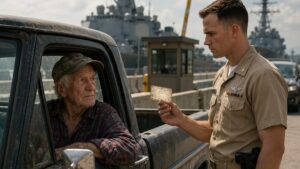
The young guard looked at the old man in the wheelchair and decided, before the old man even spoke, that he was going to be a problem.
It was not cruelty. That was what Ryan would tell himself later.
It was the heat on the pavement. The ceremony starting in twenty minutes. The brass arriving in polished cars. The clean white chairs lined in rows beyond the gate. The guests in dark clothes holding printed programs. The flags snapping over Fort Hawthorne like nothing in the world had ever been forgotten there.
And then this old man had rolled up to the restricted entrance in a faded field jacket with a yellow envelope tucked flat beneath one arm.
“I need to see the base commander,” the old man said.
His voice was dry, but steady.
Ryan kept one hand near the radio clipped high on his vest. “Sir, visitor parking is down the road. This entrance is for authorized personnel.”
“I know what entrance this is.”
“Then you know I can’t let you through.”
The old man looked past him, through the gate, toward the memorial wall draped in blue cloth.
“I need to deliver this before they unveil that.”
Ryan glanced at the envelope. It was battered at the corners, the paper softened from years of being handled. On the front, stamped so faintly it looked almost accidental, was the black outline of a wolf’s head.
It meant nothing to him.
It meant something to the old man. That was obvious. His curled right hand rested on it like it was the last warm thing left in the world.
“Sir,” Ryan said carefully, “are you here with family?”
The old man’s eyes came back to him.
“No.”
“Were you invited?”
“No.”
Ryan exhaled through his nose. Behind him, a staff car slowed near the inner checkpoint. He could already feel the day slipping out of order.
“Do you have identification?”
The old man gave him a driver’s license. Dennis Miller. Seventy-eight. A face on the card from ten years ago, already old then, but less hollow than the face in front of him now.
Ryan ran the name.
Nothing.
No guest list. No veteran registry flag. No appointment. No clearance note. No archived ceremony invitation.
“Mr. Miller,” Ryan said, using the patient voice he had heard senior guards use with confused retirees and lost tourists, “there’s no record of you here today.”
Dennis smiled faintly.
“That’s the problem.”
Ryan did not know what to do with that.
He pressed the radio. “Gate Three to Command. I have an elderly civilian refusing to move from the restricted entrance. Says he needs the commander.”
A pause.
Then a clipped voice: “Hold him there.”
Dennis looked up at the flags again.
“I have been held long enough,” he said.
Ryan pretended not to hear.
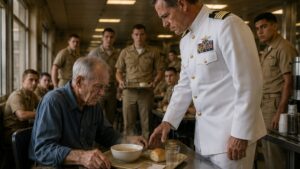
Captain James arrived three minutes later in white dress uniform so sharp the sunlight seemed to break against it. He was tall, composed, and already irritated in the controlled way of men who cannot afford to look irritated.
He took in Ryan, the wheelchair, the envelope, the line of cars building near the outer drive.
Then he bent toward Dennis.
Not enough to kneel. Not enough to meet him.
Just enough to make clear who had to look up.
“Sir,” James said, “this gate is not for walk-ins.”
Dennis looked at him for a long second.
“I did not walk here.”
Ryan’s eyes dropped.
James’ expression barely changed, but something tightened in his jaw.
“What do you need?”
“I need that envelope placed before the ceremony begins.”
“With whom?”
“With whoever is about to put Nicholas’ name in bronze.”
James went very still.
The ceremony that morning was for Colonel Nicholas, whose portrait stood near the memorial wall inside the base. Nicholas had led men out of Operation Night Orchard forty-six years earlier. That was what the printed programs said. That was what the speeches would say. That was what the bronze plaque, still hidden beneath cloth, had been made to say forever.
James looked down at the envelope again.
This time, he saw the wolf.
Not clearly. Not enough to believe. But enough to pause.
“Where did you get that mark?” he asked.
Dennis’ hand tightened over the paper.
“I earned the right to carry it.”
Ryan looked between them. The air had changed. Nothing visible had happened, but the gate no longer felt like a gate. It felt like a line someone had stepped on without permission.
James straightened.
“Ryan, run his name again. Full veteran database.”
“I already did, sir.”
“Again.”
Ryan obeyed.
Dennis watched the memorial wall.
The result came back the same. No relevant service record. No unit attachment. No Wolf Section. No Operation Night Orchard.
James let the silence sit for a moment before he spoke.
“Mr. Miller, there is no record of your service with any unit connected to today’s ceremony.”
Dennis did not flinch.
“I know.”
“That makes your claim difficult to accept.”
“Not for me.”
A staff car rolled closer. A driver leaned out, impatient. Beyond the gate, music began to rise from the parade ground, soft and ceremonial.
James lowered his voice.
“You are obstructing a secured entrance during a formal event. If you refuse to move, I will have you removed.”
Ryan felt the words land.
Dennis heard them too. He looked smaller for one moment, not in fear, but in the way an old person looks when the world repeats a sentence it has been saying for years.
Then he lifted the yellow envelope with both hands.
His right hand trembled. His left hand steadied it.
“I brought it all this way,” Dennis said. “You can at least be the man who opens it.”
Part II — The Black Emblem
James took the envelope like he was taking evidence from someone he did not trust.
He did not open it immediately.
That was the part Ryan remembered later—the pause. The commander turning the envelope over. The sun shining on the cracked paper. The black wolf-head insignia, nearly rubbed away, sitting in the corner like a mark that had survived by refusing to be noticed.
“Where did you say you served?” James asked.
“I didn’t.”
James looked at him.
Dennis looked back.
For the first time, Ryan wondered if the old man was not confused at all.
James slipped a finger under the envelope flap.
Inside were three things.
A folded field report on paper so thin it had yellowed almost transparent.
A photograph of three young men standing shoulder to shoulder in mud-dark uniforms, their faces thin with exhaustion and youth.
And a sealed page stamped with the same wolf’s head.
James unfolded the report.
Ryan did not read it. He only watched James’ face.
At first, nothing happened. James had the trained expression of an officer reading something he intended to dismiss.
Then his eyes stopped moving.
His thumb shifted on the paper.
His mouth tightened, not with anger. With recognition.
“Sir?” Ryan asked.
James did not answer.
Dennis watched him without blinking.
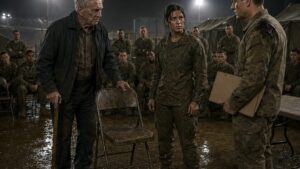
The music inside the base grew louder. Guests were being seated. A woman in a navy dress crossed the parade ground holding a folded program to her chest. She had pearls at her ears and the kind of composure people put on when grief will be photographed.
James folded the report halfway, then opened it again.
“Mr. Miller,” he said, but the voice had lost its edge. “You’re going to come with me.”
Dennis’ gaze moved to the gate.
“Through?”
“To the security alcove.”
“That is not through.”
“It is inside the perimeter.”
“It is beside the gate.”
James glanced at Ryan. “Move him out of view.”
Ryan stepped behind the wheelchair, then stopped.
“Sir,” he said softly to Dennis, “may I?”
Dennis did not look at him.
“Now you ask.”
Ryan swallowed.
“Yes, sir.”
After a moment, Dennis lifted his hands from the wheels.
Ryan pushed him into the shaded alcove beside the guard post. It was cooler there, but not by much. Concrete walls. A bench. A security monitor showing the ceremony lawn from three angles. On one screen, the covered plaque waited at the center of the memorial wall.
James stood with the field report in his hands.
“Wolf Section was disbanded,” he said. “Its records were sealed.”
“Most of them,” Dennis said.
“This document shouldn’t be outside an archive.”
“It isn’t outside an archive. It is the archive.”
James looked sharply at him.
Dennis nodded at his own chest.
“What do you want?” James asked.
“For the names to be said before the metal hardens around the wrong story.”
Ryan’s fingers rested lightly on the wheelchair handles. He could feel the old man breathing through the chair frame, shallow but controlled.
James opened the report again.
“Operation Night Orchard,” he read. “Field extraction. Northern Ridge relay outpost. Weather condition black. Communications failure at 0210.”
Dennis closed his eyes.
Not long. Just one second.
“Wind came from the east,” he said. “Snow by midnight. Rain by dawn. The generator died twice. Timothy kept kicking it like that would shame it into working.”
Ryan looked down at him.
James read further.
“You were attached as courier?”
Dennis said nothing.
“Courier number redacted,” James said.
“Numbers were easier to erase than names.”
James turned to the photograph.
Three young men.
One was unmistakably Colonel Nicholas as a younger man: straight-backed, handsome, his arm around the shoulders of another officer. The third man was thinner, almost boyish, holding something close to his chest.
James turned the photo toward Dennis.
“Which one are you?”
Dennis did not point.
“The one still here.”
That answer moved through the little alcove like cold air.
Ryan found himself leaning closer before he realized it.
James moved to the sealed page.
Dennis’ hand came up.
“Not if you’re looking for a medal.”
James paused.
“I am looking for a reason not to remove you from my gate.”
Dennis laughed once. It had no humor in it.
“Then read slowly.”
Part III — The Missing Name
The sealed page opened with a crackle so small it should not have sounded final.
James read in silence.
Ryan watched him change by inches.
The commander who had leaned over Dennis at the gate began to disappear. In his place stood a man trying to hold up a wall that had shifted behind him.
“Who wrote this?” James asked.
“Lieutenant Timothy.”
“The record says Timothy was lost before the extraction.”
“He was alive when Nicholas gave the order.”
James looked at him.
Dennis’ face had gone still, but his left hand was no longer resting on the envelope. It was curled against his knee, the fingers pressing into cloth.
“What order?” James asked.
Dennis did not answer quickly.
On the monitor, guests rose for the opening hymn.
“The outpost was collapsing,” Dennis said. “Men were pinned in the lower rooms. Wounded. Trapped behind a jammed service door. Nicholas had forty-two men above ground and a route out that would not stay open. He made the call most officers would have made.”
James’ voice was low. “Evacuate the mobile personnel.”
“Leave the trapped.”
Ryan felt his stomach tighten.
Dennis looked at the monitor, not at them.
“Timothy countermanded him.”
“He didn’t have authority.”
“No.”
“And you carried his statement?”
“I carried the map first. That was my order.”
His voice did not break. That made it worse.
“Then Timothy gave me the statement. He said if the door held another ten minutes, they might cut through. If it didn’t, the families should know they did not die waiting for rescue that no one tried to give.”
James read again. “This says Colonel Nicholas’ evacuation order was incomplete.”
“Incomplete is a polite word.”
“You’re accusing a man being honored today of abandoning wounded personnel.”
Dennis turned to him.
“I am saying Nicholas brought many men home. I am also saying Timothy held the line long enough for some of the others to be pulled out. One truth should not have eaten the other.”
Ryan stared at the photograph again.
The young man holding something close to his chest.
Not a weapon. A folded cap, maybe. Or a small notebook.
Timothy.
James rubbed the bridge of his nose.
“This should have gone to command forty-six years ago.”
“It did.”
The words were quiet.
James looked up.
Dennis’ eyes were clear.
“I delivered the map. I delivered the first report. I delivered Timothy’s statement to the acting command officer at the field hospital. He told me the report would be reviewed after the dead were counted. Two weeks later, I was told the file was sealed. Three months later, Nicholas was promoted. A year later, Timothy’s name was a line on a private casualty list. No citation. No correction. No family notice beyond ‘lost during extraction.’”
“Why wait until now?” James asked.
Dennis’ mouth pulled tight.
“Because I was ordered to.”
“By whom?”
“By everyone who ever said later.”
On the monitor, a woman in navy approached the front row.
James saw her too.
“Katherine is already here,” he said.
Dennis looked at the screen. Something changed in his face—not surprise. Recognition with a wound inside it.
“She was smaller in the photo.”
James frowned. “You know her?”
“Timothy carried her picture.”
“That’s not possible.”
Dennis’ eyes remained on the screen.
“Nicholas and Timothy were friends before the ridge. Brothers in everything but name, Timothy used to say. He had Katherine’s picture tucked into his notebook because Nicholas was proud of her and showed everyone. She was missing two front teeth. Holding a red kite.”
Ryan felt the hairs rise on his arms.
On the monitor, Katherine touched the covered plaque.
She looked composed.
She looked alone.
James folded the document.
“We need to verify this through records.”
Dennis’ gaze snapped back.
“You won’t find what you need in records that were written to forget me.”
“I can’t interrupt a public ceremony with an unverified document.”
“You can interrupt a lie before it becomes permanent.”
James’ face hardened—not like before, not out of impatience. Out of fear.
“Be careful, Mr. Miller.”
Dennis leaned back in the chair. Suddenly he looked very tired.
“I have been careful for forty-six years. It did not save anyone.”
The door opened before James could respond.
Katherine stood there in navy, pearls catching the light, program folded in her hand.
“Captain,” she said, “they’re asking for you.”
Then she saw Dennis.
Her eyes moved from his wheelchair to the envelope to James’ face.
Something in the room told her this was not a routine delay.
“What is this?” she asked.
James started to answer, but Dennis spoke first.
“I came about your father.”
The softness left her face at once.
“My father carried enough ghosts,” Katherine said. “Please don’t bring yours here today.”
No one moved.
Ryan looked down.
James shut his eyes for half a second.
Dennis only nodded, as if she had handed him something heavy and familiar.
“I understand,” he said.
But his hand moved over the envelope again, and this time it looked less like protection than pain.
Part IV — The Last Hour
Katherine read the first page standing up.
Then she sat down.
No one told her to. The chair was there, and suddenly her legs seemed to need it.
James stood by the door with his arms folded, watching the ceremony clock on the wall. Ryan stayed near the corner, uncertain whether he was guarding Dennis or guarding the room from what Dennis had brought into it.
The music outside shifted. A speaker was introduced. Applause rose faintly through the glass.
Katherine held Timothy’s statement in both hands.
“This can’t be right,” she said.
Dennis did not answer.
She looked at James. “Can it?”
James chose his words with care.
“There are inconsistencies with the official account.”
“Inconsistencies?”
Her laugh was small and sharp.
“My father’s name is on that plaque.”
“Yes.”
“My mother is buried under that story. I grew up under that story.”
Dennis looked at her then.
“Stories can shelter people,” he said. “They can also lock doors.”
Katherine’s eyes flashed.
“You think I don’t know my own father?”
“No,” Dennis said. “I think you knew the father who came home.”
That landed harder than accusation would have.
Katherine looked back at the page.
Outside, another round of applause rose.
James checked his watch. “We can review this properly after the ceremony.”
Dennis’ head turned slowly toward him.
“No.”
“Mr. Miller—”
“No.”
“We can secure the document. I can contact archives, request classified review, get this handled with the care it requires.”
Dennis held out his hand.
“Give it back.”
James did not move.
“It’s in my custody now.”
Dennis’ eyes sharpened.
“It was in your custody forty-six years ago too.”
Ryan’s throat tightened.
James said, “I’m trying to prevent damage.”
Dennis’ voice changed then. Not louder. Not wild. Just stripped of the patience everyone had mistaken for weakness.
“You already took forty-six years. You don’t get the last hour too.”
The room went silent.
Even the ceremony outside seemed to dim behind the glass.
Ryan felt something split inside him: training on one side, truth on the other.
He had first seen an old man blocking a gate.
Now he saw a man who had been standing at one for nearly half a century, waiting for someone to stop checking the wrong list.
Ryan reached for his radio.
James saw him. “Corporal.”
Ryan froze.
Then he pressed the button.
“Gate Three to Command Office,” he said, voice tight. “We have a classified Wolf Section document requiring immediate command review before plaque unveiling.”
James stared at him.
Ryan kept his eyes forward.
A burst of static answered, then a voice: “Repeat?”
Ryan swallowed.
“Classified Wolf Section document. Operation Night Orchard. Elderly courier on site with original field materials. Requesting command review now.”
Dennis closed his eyes.
Not in relief. In exhaustion.
James stepped close to Ryan, anger controlled under his breath. “Do you understand what you just did?”
Ryan looked at Dennis.
Then at the envelope.
“No, sir,” he said. “But I think someone should have done it before me.”
Katherine put a hand over her mouth.
The reply came through the radio three minutes later.
Bring all parties to the west office.
No public movement yet.
No ceremony interruption yet.
Yet.
The word followed them down the corridor.
Ryan pushed Dennis this time with permission unspoken but understood. James walked ahead. Katherine walked beside them, the statement pressed to her chest now instead of the printed program.
The west office overlooked the parade ground.
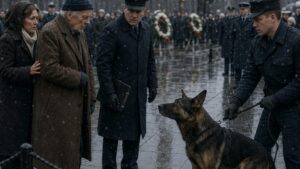
Below, rows of guests sat facing the covered plaque. An officer at the podium was speaking about service, sacrifice, and names that endure.
Dennis looked out the window.
His face did not change until the speaker said Nicholas’ name.
Then his eyes lowered.
A call came through on the office phone. James answered.
He listened.
“Yes, sir.”
Listened again.
His face went pale in a way even discipline could not hide.
He hung up.
“Records confirms Wolf Section files were sealed and partially destroyed,” he said. “There is a courier number matching the redaction on Mr. Miller’s page.”
Katherine whispered, “His name?”
James looked at Dennis.
“No name. Just the number.”
Dennis nodded once.
“That was me.”
Katherine looked at the photograph again. Three young men in mud. Nicholas. Timothy. The third one half-turned, younger than seemed possible now, one hand lifted as if waving someone away from the camera.
“You were there,” she said.
Dennis did not say yes.
He said, “I left.”
That was the first time his voice broke.
Only slightly.
Only enough.
Part V — The Sentence
They were supposed to unveil the plaque at eleven.
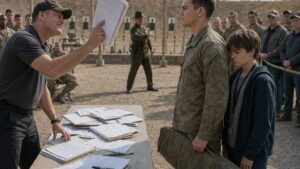
At ten fifty-eight, James walked onto the parade ground with Dennis beside him in the wheelchair.
Conversation moved through the crowd like wind through dry grass.
Ryan followed two steps behind, feeling every eye land on the old field jacket, the yellow envelope now in a clear protective folder on Dennis’ lap, and the commander’s white uniform beside him.
Katherine walked on Dennis’ other side.
She had not forgiven anyone. Not her father. Not the institution. Not Dennis for arriving at the worst possible minute with the worst possible truth.
But she had stopped standing between him and the wall.
That was enough for the moment.
James stepped to the microphone.
The officer who had been speaking moved aside, confused.
James looked out over the crowd. Veterans. families. officials. reporters. Old friends of Nicholas. People who had come to hear a clean story and go home carrying it.
His voice did not shake.
“Before we unveil this memorial, there is a witness present whose name is not in today’s program.”
A murmur passed through the chairs.
James turned slightly.
“Sergeant Dennis. Courier, Wolf Section.”
Dennis shut his eyes.
For one breath, he looked as if the name itself had struck him.
Not because it was grand.
Because it had been returned.
James continued. “He has brought original material connected to Operation Night Orchard. The base will conduct a formal review. But there is one request from the field record that cannot wait for a review process.”
He stepped back.
Dennis looked at Katherine.
Not James. Not the crowd.
Katherine’s face was pale. Her program had been folded so tightly it had split at the crease.
Dennis asked, “May I?”
She pressed her lips together.
Then she nodded.
Ryan moved the microphone lower. This time he did not assume. He looked at Dennis first.
Dennis gave the smallest nod.
The crowd quieted.
Dennis unfolded Timothy’s statement with his left hand. His right hand could not do it anymore.
The paper trembled, but his voice did not.
“‘If any record of this night survives, let it say that the men below did not stop being ours because the door would not open.’”
No one moved.
Dennis lowered the page.
“That sentence was written by Lieutenant Timothy, who stayed at Northern Ridge when others were ordered out. Colonel Nicholas brought many men home. That is true.”
Katherine flinched at her father’s name, but she did not interrupt.
Dennis looked at the covered plaque.
“But he did not bring them home alone. Some names became easier to leave out because they complicated the story. Timothy’s was one. There were others.”
He paused.
The silence had weight now.
Not confusion. Weight.
“I did not come to take honor from anyone,” Dennis said. “I came because honor that cannot share the truth is not honor. It is decoration.”
A few people looked down.
An older man in the front row removed his glasses.
James stood perfectly still behind the wheelchair.
Dennis turned the page over, as if there might be more, but there was not.
“Timothy asked that every man who held the line be named. Including the ones whose actions were inconvenient to command.”
He folded the paper.
“That is all.”
It was not all.
Everyone knew it.
But it was all he would take from the moment.
Katherine rose.
The movement startled the crowd more than Dennis’ words had.
She walked to the covered plaque. For a second, Ryan thought she was going to unveil it anyway, force the ceremony back onto its track through sheer grief.
Instead, she took hold of the blue cloth and pulled it aside.
The bronze plaque shone in the morning light.
Colonel Nicholas at the top.
Operation Night Orchard beneath.
A list of names below that, too short for what had just been spoken.
Katherine stared at it.
Then she turned the plaque toward the crowd as if showing them an unfinished page.
“My father’s name is here,” she said.
Her voice was not strong at first. Then it found itself.
“But if this is not the whole truth, then it is not ready to stand.”
No one applauded.
That would have been too easy.
No one saluted.
That would have been too simple.
The silence did what applause could not. It made room.
Dennis sat in the wheelchair with the envelope on his lap and looked at the bronze as if it belonged to someone else’s life.
James stepped down from the platform and came beside him.
This time, he lowered himself to one knee.
Not for display.
Not for the crowd.
So Dennis would not have to look up.
“I should have listened at the gate,” James said.
Dennis looked at him for a long moment.
“Yes,” he said.
James accepted it.
Then Dennis added, “Now you are.”
Part VI — Through
Near sunset, the gate looked different from the inside.
Dennis noticed that first.
The same guard post. The same barrier arm. The same strip of road leading out toward the public lot. But from this side, the place did not look like a wall. It looked like a line someone could cross if another person finally chose to open it.
Ryan brought him coffee in a paper cup.
“I didn’t know how you take it,” Ryan said.
Dennis accepted it with both hands. “At my age, warm is a flavor.”
Ryan smiled, then looked away.
His shame had been quiet all afternoon. It sat in him more heavily than his gear.
“I’m sorry,” he said.
Dennis looked at the coffee.
“For what?”
“For thinking you were confused.”
“You had a gate to guard.”
“That doesn’t make it right.”
“No,” Dennis said. “It just makes it common.”
Ryan absorbed that like a lesson he had not asked for but needed anyway.
James came out of the command building carrying the yellow envelope inside a protective sleeve. The folder made it look official now. Safer. Colder.
He held it out.
“The document will go into secured archive if you consent,” James said. “Copies will be made for review.”
Dennis did not take it immediately.
“One copy to each family whose name was missing.”
James nodded. “I’ll make that request.”
Dennis looked at him.
“No. You will make that order.”
James held his gaze.
Then he nodded again.
“I will make that order.”
Only then did Dennis touch the sleeve.
He did not clutch it this time.
He let it rest.
Katherine came last.
She had removed the pearls. Without them, she looked younger and more tired. In one hand, she held a small unit pin that had belonged to her father. She did not offer it to Dennis. She only carried it, as if unsure whether it was evidence, inheritance, or weight.
She stopped in front of him.
For a moment, neither spoke.
Then she knelt.
Not gracefully. Not ceremonially. Her dress pulled tight at one knee and she had to steady herself with a hand on the pavement.
But when she was done, her eyes were level with his.
“I hated you for about an hour,” she said.
Dennis nodded. “That is a fair beginning.”
A fragile laugh moved through her and disappeared.
“I don’t know what to do with him now,” she said.
“Your father?”
She nodded.
Dennis looked toward the memorial wall, hidden now behind the buildings.
“Keep the parts that were true,” he said. “Make room for the parts that were not.”
Her eyes filled, but she did not cry.
“Tell me what he was like before the story got smaller.”
Dennis looked at the pin in her hand.
For the first time all day, his face softened without pain leading it.
“He sang badly,” he said.
Katherine blinked.
“What?”
“Nicholas. Terrible voice. Knew only half the words to anything and supplied the rest with confidence. Timothy said that was how he commanded too.”
Katherine covered her mouth, but this time not from shock.
Dennis continued.
“He carried your picture in his breast pocket. The one with the red kite. Showed it to men who had no business knowing how proud he was. Timothy used to tell him, ‘Put that child away before the whole ridge asks to be invited to her birthday.’”
Katherine looked down at the pin.
“He never told me that.”
“No,” Dennis said. “Men came home with strange ideas about what had to stay buried.”
The sun lowered behind the flagpoles. Shadows stretched across the pavement.
Ryan stepped behind the wheelchair. “Can I take you out to the car, sir?”
Dennis looked at the gate.
The barrier arm was raised.
Beyond it, the public road waited. The world looked ordinary out there. Too ordinary for what had shifted.
“No,” Dennis said.
Ryan’s hands paused on the handles.
Dennis lifted his chin toward the open entrance.
“Through.”
Ryan understood.
He pushed slowly.
James stood beside the guard post. Katherine walked a few steps behind, holding her father’s pin and Timothy’s statement copy against her chest.
Dennis passed under the gate arm in the opposite direction from the way he had arrived.
In the morning, he had been a problem to move aside.
By evening, no one moved him aside.
At the threshold, he touched the yellow envelope once more, not to protect it, but to say goodbye.
The dead were still dead. The missing years did not return. The bronze would take time to change, and some men would argue over every word.
But the last hour had not been taken from him.
And for the first time in forty-six years, Dennis left the gate lighter than he had come.