She Called 911 At The Lake Dock With The Will That Left His Name Out
Chapter 1: The Papers Arrived Before The Boat Lights
“Your name isn’t in it, Michael.”
Nancy Moore’s voice crossed the water before the wind did. It hit him from the end of the dock, sharp enough to make him look up from the loose board he had been prying free with his boot.
For a second, he thought he had misheard her.
The lake was too quiet for that. The mountains held every sound in place. The old boathouse creaked behind him, the same way it had when he was twelve and Katherine Hall would call from the cabin porch for him to stop jumping from the railing. A crow moved through the pines. Somewhere under the dock, water tapped against the posts.
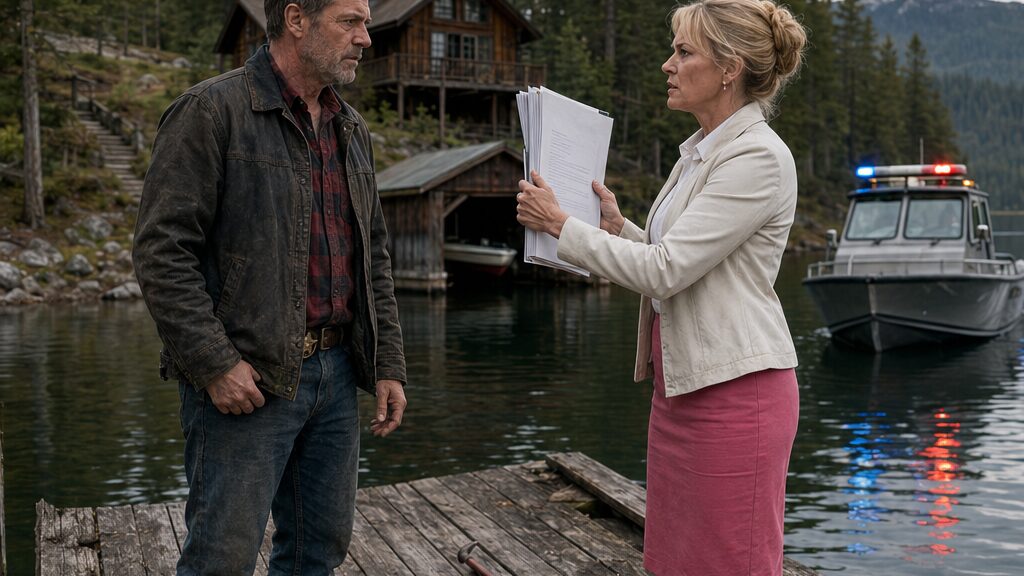
Nancy stood where the gravel path met the planks, wearing a white blouse too thin for the mountain air and holding a thick packet in one hand. A bright pink skirt snapped around her knees. She looked like she had dressed for an office and then driven herself into a memory she did not want to touch.
Michael kept his hand on the pry bar.
“What are you talking about?”
“The will.” Nancy lifted the packet. “Mom’s will. The updated one.”
Updated. The word bothered him before the meaning fully landed.
Katherine had been buried seven days ago. The flowers were probably still fresh on the grave. Her coffee mug still sat turned upside down in the cabin sink because Michael had not been able to put it away. He had come out that morning to fix the dock board because he had promised her he would before summer storms loosened the rest of it.
Nancy walked onto the dock like she owned the boards beneath her feet. “Raymond filed it yesterday. I thought you should hear it from me before you started making assumptions.”
Michael looked past the papers to his sister’s face. She was holding herself too still. That was how Nancy had always prepared for a fight, with her shoulders squared and her mouth pressed flat, as if steadiness could pass for innocence.
“I haven’t made any assumptions.”
“You’re here with tools.”
“It’s a loose board.”
“It’s not your board anymore.”
The pry bar felt heavier in his hand.
Michael lowered it slowly and set it on the dock beside his boot. He did not trust his first answer. Years as sheriff had taught him that the first words out of an angry man’s mouth usually became the words everyone remembered later. He looked at the lake instead, at the thin white line of ripples moving toward the far shore.
Nancy mistook the silence for weakness. She stepped closer and opened the packet.
“Everything at the lake goes to me. Cabin, boathouse, dock, shoreline parcel, furnishings. The checking account for maintenance, too. You’re not named as beneficiary on the account. You’re not named in the cabin transfer. You’re not named in the personal property section.”
The sentences fell clean and legal, each one cutting through something messier.
Michael saw his mother’s hands, not as they had been in the last month, curled and restless against the blanket, but as they had been for years: pushing lake maps flat on the kitchen table, pointing with one bent finger toward the old boathouse.
You know where everything is, Michael. Nancy never liked this place the way you do.
He heard the words and hated himself for never asking her to write them down.
“When was it signed?” he asked.
Nancy’s eyes narrowed, just slightly. “That’s your first question?”
“It’s the one I asked.”
She looked down at the top page as if she had not already read it enough times to know. “April eighteenth.”
Michael felt the wind leave the dock.
April eighteenth.
Katherine had been sitting in the passenger seat of his truck that morning, crying because she did not know why they had left the house. He had driven her to the clinic for the memory screening she had failed before the nurse had even closed the door. On the way back, she had pointed toward the marina road and asked whether that was the way to the lake.
She had asked it three times.
Nancy snapped the packet shut. “Mom changed her mind. That was her right.”
Michael looked at her then. “Six weeks before she died, she couldn’t remember the lake road.”
His sister’s face flushed, but only for a moment. “She had good days.”
“She had hours. Not days.”
“You weren’t with her every hour.”
“No,” he said. “I was with her enough.”
Nancy gave a short laugh with no humor in it. “That’s exactly the problem, isn’t it? You think being here makes you the only one who mattered.”
The accusation was old. Older than the will. Older than Katherine’s illness. Nancy had moved away after college, first two counties over, then across the state, then wherever her husband’s work had taken her before the marriage ended and the calls home became less frequent but more urgent. Michael had stayed. He had not called it sacrifice. He had called it Tuesday.
He picked up the pry bar again, not to use it, only because his hand needed something to do. “I’m not having this conversation on the dock.”
“You don’t get to decide where we have it.” Nancy’s voice rose. “You don’t get to walk around here like you’re still in charge.”
“I’m not in charge.”
“You sure act like it.”
“I came to fix a board.”
“You came onto property that is now part of an estate I administer.”
The word administer sounded borrowed from someone else’s mouth.
Michael looked toward the cabin. The curtains were closed. Nancy must have done that. Katherine always kept the lake-facing windows open during daylight, even in winter. She said a closed curtain made the house feel like it was keeping secrets.
“Raymond should have called us both in,” Michael said.
“He did what the document required.”
“Did he read it with you?”
Nancy did not answer quickly enough.
The lake shifted. A small aluminum boat moved near the far channel, too far off to matter. Michael heard the dock board groan under Nancy’s heel.
“I’m asking you to leave,” she said.
“You’re asking wrong.”
Her eyes flashed. “Excuse me?”
“This is civil. It’s probate. You know that.”
“What I know is that you have a badge, a gun, and a habit of making people in this county do what you want.”
The words struck harder because he had feared them before she said them.
Michael glanced down, not at the gun on his belt but at the brass star beside it, half-covered by his work jacket. He had not worn the badge to make a point. He had come from an early call about a missing fisherman and stopped at the cabin because the dock board had been on his mind all week. But Nancy had seen what she wanted to see, and maybe everyone else would too.
He opened his hand and let the pry bar rest flat on the boards again.
“I’ll leave after I secure that board. Someone could put a foot through it.”
“No.” Nancy pulled her phone from her pocket. “You’ll leave now.”
“Nancy.”
She backed away as if he had moved toward her, though he had not. “I’m calling it in.”
For one stunned second, Michael thought she meant Raymond. Then he saw her thumb move.
“Nancy, don’t do that.”
She lifted the phone to her ear and turned partly toward the lake, making sure he could hear. “I need an officer at the Hall lake property. My brother is trespassing and refusing to leave.”
Michael closed his eyes once.
There were calls that could be undone, reports corrected, tempers explained. And then there were calls that became paper. Time stamped. Logged. Repeated. A family’s worst moment turned into an official line.
Nancy gave the address. Her voice steadied as she spoke. She had always been good once an audience arrived.
“No, he’s not threatening me,” she said, then looked at him. “But he is armed.”
Michael’s jaw tightened.
She listened, nodded, then said, “Yes. He’s the sheriff.”
The words hung between them like a dare.
He heard the dispatcher’s voice only as a faint murmur from the phone. Nancy turned away, giving short answers. Michael could have taken his own radio from his shoulder. He could have called the station, explained, stopped the embarrassment before it crossed the water.
He did not.
Instead, he unfastened the small leather strap over his sidearm, then refastened it more deliberately. He stepped back from the loose board and placed both hands where they could be seen.
Nancy watched him like she had won something.
A few minutes later, the sound came from beyond the bend: a patrol motor cutting across open water. Red and blue lights flickered against the gray surface of the lake, small at first, then brighter as the boat rounded the point.
Michael recognized the hull. Lake patrol. Not his direct unit, but close enough that the men aboard would know him. Close enough that by evening, half the county would know some version of it.
Nancy held the estate packet against her chest.
“You should have just left,” she said.
Michael looked at the papers. “You should have called me before April eighteenth.”
Her mouth tightened. “Mom didn’t want you there.”
That was the first sentence that sounded rehearsed.
The boat slowed at the dock. Two lake patrol officers stepped onto the planks, eyes moving from Nancy to Michael to the badge at his belt. The younger one looked uncomfortable. The older one kept his face still.
“Sheriff Hall,” the older officer said carefully.
Michael shook his head once. “Not on this call. I’m recusing myself. Treat me as Michael Hall, private citizen. Ms. Moore called it in. Take her statement first.”
Nancy blinked. She had expected anger. Maybe she had expected him to pull rank. Maybe she had expected exactly the kind of scene that would make the estate packet look like protection instead of attack.
The older officer nodded and turned to her. “Ma’am, tell me what happened.”
Nancy opened the packet again, eager now. “This is my mother’s will. It leaves this property to me. My brother has no legal right to be here.”
Michael listened without interrupting. He watched the top page tremble slightly in her grip. When she turned it toward the officer, the signature page shifted into view.
There it was.
April 18.
A clean black date beside Katherine Hall’s name.
Not the careful signature she had used on birthday cards and church checks. Not quite. This one was smaller, cramped, as if every letter had been pulled through a narrow place.
Michael stared at it until the dock, the boat lights, Nancy’s voice, even the lake itself seemed to recede.
April 18.
That morning at the clinic, Katherine had looked at the nurse and smiled politely when asked the year.
“Nineteen…” she had begun, then laughed in embarrassment and looked to Michael for help.
He had not helped her. The nurse had told him not to.
Now his mother’s name sat under a document that gave away the place she could no longer find by road.
The older officer asked Nancy, “And you’re requesting he leave today?”
“Yes.”
Michael lifted his eyes from the page. “Put in your report that Ms. Moore states the will was signed April eighteenth and that she is relying on that document to claim exclusive control of the lake property.”
Nancy turned toward him. “Why does that matter?”
He looked at his sister, and for the first time since she had stepped onto the dock, she seemed less certain.
“Because that was the week Mom forgot how to get here.”
Chapter 2: The Date On The Will Would Not Sit Still
“The will is clear, Michael. Your mother left the lake property to Nancy.”
Raymond Davis did not say it unkindly. That made it worse.
His office sat above the pharmacy on Main Street, with framed certificates on one wall and a window that looked down on angled parking spots and people carrying paper bags of prescriptions they did not want to need. Michael sat across from him two days after the dock call, the estate packet lying between them like a third person.
Raymond had always looked older than he was, mostly because he dressed like he expected every conversation to become part of a file. Gray suit. Blue tie. Pen aligned with the edge of his legal pad. He had handled Katherine’s property taxes for years, a boundary survey once, and the first will after Michael’s father died. Back then, Katherine had brought lemon cookies to his office in a tin.
Now her name was in his file as decedent.
Michael kept his hands folded. “I’m not asking what the will says. I’m asking how it happened.”
Raymond took off his glasses and rubbed the bridge of his nose. “I understand this is painful.”
“No, you understand it’s inconvenient.”
The attorney looked up.
Michael regretted the sentence almost before it was finished. It sounded like accusation without evidence, exactly the thing he had promised himself he would not do. He drew a breath and looked at the packet.
“Sorry,” he said. “Start with the date.”
“April eighteenth.”
“I know the date. Who scheduled the appointment?”
Raymond paused.
There it was again. Not guilt. Not confession. Just a small delay where a clean answer should have been.
“Nancy contacted my office,” Raymond said.
“Did Mom contact you?”
“No.”
“Did you speak to Mom before April eighteenth?”
“Briefly.”
“How briefly?”
Raymond folded his glasses. “Michael, estate planning often involves assistance from family members, especially when the client is ill or not driving.”
“That wasn’t my question.”
“No. She did not initiate the appointment.”
Michael looked at the signature page. The copy Raymond had given him was cleaner than the one Nancy waved on the dock. Katherine’s signature sat above the typed line: Katherine Hall. Beneath it were two witness names Michael did not recognize and the seal of a mobile notary.
“Who explained the changes to her?”
“I reviewed the summary.”
“With her alone?”
Raymond shifted in his chair. “Nancy brought her in.”
“That isn’t what I asked.”
“Michael.”
“Was Nancy in the room?”
“For part of it.”
“For the part where you explained that the lake property no longer went the way it had before?”
Raymond’s jaw worked once. “The prior will did not specifically devise the lake property to you.”
“No. It kept the estate split evenly, and Mom had a separate deed memo in progress.”
“That memo was never executed.”
“Because she got sick.”
“Because it was never executed,” Raymond said, more firmly.
The room went quiet.
Michael looked at the diploma on the wall behind him, at the gold seal under Raymond’s name. He knew how men protected themselves when they had followed procedure and still sensed something human had slipped through it. He had done it himself after bad calls. Stand on the rule. Repeat the rule. Let the rule take the weight.
“Tell me the order,” Michael said.
Raymond leaned back. “Order?”
“Who arrived first? How long was Mom there? When did the witnesses come in? When was the notary present? Exact signing time.”
Raymond put his glasses back on, opened the file, and began turning pages. Receipts. Draft notes. A printed email from Nancy. A calendar entry. Michael watched his fingers move past each sheet.
“It was a late morning appointment,” Raymond said.
“What time?”
“Eleven.”
“And signing?”
Another pause.
Michael waited.
Raymond found a page and held it down with two fingers. “The notary’s acknowledgment is timestamped 12:42 p.m.”
“An hour and forty-two minutes later.”
“Approximately.”
“Why?”
“There were revisions to confirm.”
“What revisions?”
“Clarifying the transfer of the lake property, personal property, and maintenance account.”
“To Nancy.”
“Yes.”
“And Mom understood that?”
Raymond closed the file halfway. “I believed she did.”
The word believed did not belong in a sentence that had cost Michael the cabin.
“You believed she did,” Michael repeated.
“She was tired. She asked for a break. Nancy said mornings were better for her, but the appointment ran long.”
“Nancy said.”
Raymond’s face tightened. “I am not your opposing counsel, Michael.”
“No. But you drafted the document.”
“And you are the county sheriff.”
The title struck the desk harder than Raymond intended. He glanced toward the closed office door and lowered his voice.
“That matters,” Raymond said. “You know it does. If you start questioning witnesses, requesting records, visiting offices in uniform—”
“I’m not here in uniform.”
“You carry the office whether you wear the jacket or not.”
Michael looked down at his hands. Clean nails, rough knuckles, a small scrape from the dock board. On the drive over, he had left his badge locked in his truck. He had thought that would be enough. It wasn’t. Raymond was right about that, and being right made the warning harder to resent.
“You’re telling me not to ask questions.”
“I’m telling you to ask them through counsel.”
“I’m asking as her son.”
“And Nancy will say you are pressuring people as sheriff.”
Michael let the truth sit there because it was useful, even if it cut against him.
“She already said it,” he said.
Raymond’s expression softened for the first time. “The dock call?”
“You heard.”
“This town hears everything.”
Michael almost smiled. Almost.
Raymond slid a copy of the will toward him. “The documents are legal. The signatures are verified.”
“Then tell me why no one can say who explained the cabin deed to her.”
“That is not a fair characterization.”
“It’s a simple question.”
“The will is not a deed.”
“Don’t do that.”
Raymond stopped.
Michael leaned forward, not raising his voice. “You know what I’m asking. Mom had talked for years about keeping that cabin tied to me because I maintained it and because she wanted Nancy to have other assets. You knew there was a deed memo.”
“I knew there had been discussion.”
“And then six weeks before she died, after a failed memory screen, Nancy brings her here, stays in the room part of the time, and somehow Mom signs a will that gives Nancy the whole lake place and cuts me out.”
“It does not cut you out of everything.”
Michael’s eyes moved to Raymond’s.
The attorney glanced down.
“What did she leave me?” Michael asked.
Raymond turned one page. His voice thinned. “Certain personal items, if Nancy as executor determines they are not otherwise necessary to the estate sale or distribution.”
Michael sat back.
Certain personal items.
If Nancy determines.
Katherine’s life had been reduced to someone else’s discretion.
“Did she ask about me?” Michael said.
Raymond looked tired now. “I don’t recall.”
“That means yes or no?”
“That means I don’t recall.”
Michael stood and walked to the window. Below, a woman helped an older man step down from the pharmacy curb. The man held the car door with one hand and a white prescription bag with the other. He looked embarrassed by the help. The woman pretended not to notice. Michael watched them until the old man was safely seated.
He had spent three years doing that for Katherine. Car doors. Pill boxes. Towels warmed in the dryer because cold cloth made her angry. Clinic drives where she would ask if they were going home and then, two minutes later, ask again.
He had not asked for receipts.
He turned back. “Who were the witnesses?”
“Two employees from a neighboring office. Standard practice.”
“They knew Mom?”
“No.”
“Had they ever spoken to her before?”
“Not to my knowledge.”
“Did anyone from a medical office confirm capacity that day?”
“No formal medical capacity evaluation is required for a will signing unless there is reason—”
“Raymond.”
The attorney stopped again.
Michael picked up the copy of the signature page. “There was reason.”
Raymond did not answer.
“Who was the notary?”
“The acknowledgment was handled by a mobile notary.”
“Name?”
Raymond hesitated a third time, and this one changed the room.
“What?” Michael asked.
“It was not the notary I usually use.”
“Who arranged it?”
“Nancy had already arranged for one because your mother’s hand was unsteady and she was concerned about timing.”
“Timing.”
“She was worried Katherine might decline further before the documents were completed.”
Michael stared at him.
Raymond seemed to realize what he had said only after the words were out. He reached for his pen, aligned it with the legal pad again, then abandoned the gesture.
“I’m not saying that suggests improper conduct.”
“No,” Michael said. “You’re saying my sister knew Mom was declining and rushed the papers anyway.”
“That is your interpretation.”
“It’s the first interpretation that fits.”
Raymond closed the file. “If you intend to contest, get counsel. Do not approach the witnesses as sheriff. Do not imply criminal conduct without evidence. Do not make this harder than it already is.”
Michael picked up the copy of the will. “It got harder on April eighteenth.”
At the door, Raymond said, “Michael.”
He stopped but did not turn.
“There was a mobile notary log. If your attorney requests it properly, it may show the travel location and time.”
Michael looked back then. “Travel location?”
Raymond’s mouth tightened. “The final acknowledgment may not have been completed here.”
“You said the appointment was here.”
“It began here.”
Michael felt the old controlled silence rising in him, the kind that looked calm from the outside and locked every question behind his teeth. He forced one of them out.
“Where did it end?”
Raymond did not answer directly.
He opened the file once more, wrote a name and a business number on a slip of paper, and turned it facedown before sliding it across the desk.
“Ask through the right channels,” he said.
Michael turned the slip over.
A mobile notary service. One he had never heard of.
And beneath the name, in Raymond’s careful handwriting, one word:
Cabin.
Chapter 3: The Cabin Remembered Who Was There
The new key jammed in the cabin lock before it turned, and that was how Michael learned Nancy had changed the house before probate had changed anything else.
He stood on the porch with the copied will folded in his jacket pocket and the old brass key useless in his palm. Katherine’s wind chimes hung above him, silent in the still air. A strip of blue painter’s tape clung to the edge of the doorframe where someone had marked the new hardware. Fresh screws. New cylinder. Work done fast, not carefully.
The cabin looked the same from a distance: cedar siding silvered by weather, green roof, porch chairs facing the lake, a stack of split wood beneath a tarp. But up close, Nancy’s presence showed in small interruptions. Curtains pulled tight. Planter boxes moved. The ceramic loon Katherine kept by the door turned sideways, as if it had been bumped and not set right.
Michael tried the key again, though he knew.
Nothing.
He had legal reasons not to force the door. He also had personal reasons not to stand there like a stranger. The two sets of reasons pressed against each other until he stepped back and walked around the cabin toward the boathouse.
The old boathouse lock had not been changed.
That hurt in a different way.
Nancy had remembered the house but not the smaller door down by the water, the one Katherine had always said stuck because Michael hung it crooked when he was nineteen and too proud to redo it. He slipped the brass key in. The lock turned with a scrape.
Inside, the air smelled of rope, dust, old varnish, and lake damp. A canoe hung upside down from rafters. Fishing poles leaned in a barrel. On the pegboard, outlines showed where missing tools had lived for years. Michael noticed his father’s hand plane gone, then told himself not to make that the wound. There were larger ones now.
He set the estate packet copy on the workbench beside a rusted tin of screws.
He had come for two things: the maintenance folder Katherine kept near the breaker panel and the wall calendar she used because phone reminders confused her. The folder was there, stuffed with receipts for dock stain, pump repairs, roof patches, septic inspections. Michael’s handwriting appeared on half the notes. Katherine’s appeared on the older ones, looped and firm.
The calendar hung on a nail by the side door.
January, February, March, May.
April was missing.
Michael stared at the gap where the page had been torn clean from the spiral.
He checked the floor under the bench, the trash barrel, the shelf with paint cans. Nothing. Someone had removed exactly the month that mattered.
A sound came from outside.
Gravel under cautious shoes.
Michael closed the folder, not because he was hiding anything, but because the habit was stronger than thought. He stepped to the boathouse door.
Virginia Campbell stood ten feet away with a grocery sack in one hand and an expression that said she had already decided to apologize before he asked anything. She was in her late sixties, wrapped in a gray cardigan, her hair pinned loosely in a way the wind had partly undone. She had owned the cabin two lots down since before Michael could swim.
“I brought muffins,” she said.
He looked at the sack.
She gave a helpless little shrug. “People bring casseroles after funerals. I never know when that stops.”
“For some people, it doesn’t.”
Virginia nodded at the boathouse. “I saw your truck.”
“Did Nancy send you?”
“No.” Too quick. Then she sighed. “She called yesterday. Told me not to get pulled into anything.”
“That sounds like Nancy.”
“She said you might come asking questions that would only hurt everyone.”
Michael stepped out and pulled the door mostly closed behind him. “Would they?”
Virginia’s mouth moved as if several answers tried to leave at once. She chose none of them. Instead, she looked toward the cabin.
“She changed the locks.”
“I noticed.”
“I told her it was early.”
“What did she say?”
“That she was executor and had to secure the property.”
It was a sensible phrase. Sensible phrases had become weapons this week.
Michael took the grocery sack from Virginia and set it on the porch rail. “Were you here on April eighteenth?”
Virginia’s eyes dropped.
The answer moved through him before she said anything.
“I was home,” she said.
“Did you see Mom?”
“Not that day.”
“Did you see Nancy?”
Virginia looked toward the gravel road. “I saw her car.”
“What time?”
“Late morning. Then again after lunch.”
“Again?”
“She left, came back. Or maybe someone else left. I wasn’t watching like that.”
“Virginia.”
“I wasn’t.” Her voice sharpened, then softened. “I wish I had been.”
Michael waited.
She folded her arms, then unfolded them. “Nancy was here a lot those last months.”
“How often?”
“Thursdays mostly. Some Mondays. She brought groceries sometimes. Took papers out sometimes. Sat with Katherine on the porch.”
Michael looked at the cabin windows, all covered.
“Nancy told Raymond she was here every week.”
“She was.”
“Mom never told me.”
Virginia gave him a sad look. “Your mother didn’t always remember who had been there by supper.”
The sentence landed without cruelty. That made it harder.
Michael turned away and looked into the boathouse, at the empty space where the hand plane had been. “Did Nancy ask you not to tell me?”
“Not exactly.”
“That usually means yes.”
Virginia pressed her lips together. “She said bringing up old promises confused Katherine. She said if I talked about the cabin going to you, it would upset her.”
Michael’s head turned slowly.
“What old promises?”
Virginia looked miserable now. “Michael.”
“What old promises?”
“She talked about it. Your mother. Not every day, but enough. She’d say, ‘Michael knows the dock. Michael knows the pump. Nancy should have something easier, something she can sell if she needs to, but the lake needs hands.’”
He swallowed once.
Virginia kept going because stopping would have been worse. “She asked me in March whether you still had the dock map.”
“The what?”
“You know, the old survey map. The one she kept rolled up in the boathouse after your father marked the shoreline repairs.”
Michael looked back toward the shelves. “I haven’t seen that in years.”
“She worried you’d need it.”
“For what?”
Virginia’s eyes filled, but no tears fell. “I don’t know. She’d start to say something and then lose it. Once she asked if Nancy knew. Then she said, ‘No, no, not now. The girls will fight.’”
“The girls?”
“She called Nancy a girl when she was upset. Sometimes she called me one too.”
A faint memory rose: Katherine standing at the kitchen sink, looking out at the dock, muttering that she should have fixed things when the children were still children. Michael had been replacing a faucet. He had let the comment pass because his mother’s regrets had become background noise by then, small weather systems moving through the house.
He wondered how much truth he had mistaken for confusion because listening closely would have required him to act.
“Did Nancy know about the dock map?” he asked.
“I don’t know.”
Michael went back into the boathouse. Virginia followed only to the doorway, as if entering would make her testimony official. He checked the shelf above the workbench, the drawer beneath the old radio, the cabinet where life jackets were kept. No map tube.
On the wall by the side door, the empty place where April should have hung seemed brighter than the wood around it.
“Calendar page is gone,” he said.
Virginia nodded like she already knew.
“You saw it missing?”
“After Katherine died. Nancy asked me to help clear expired food from the fridge. I noticed then.”
“And you didn’t say anything.”
The words came out flat, but Virginia flinched anyway.
“I didn’t know it mattered.”
“That’s not true.”
Her face tightened. “No. It isn’t.”
Michael regretted the wound he had opened, but he did not take it back. His own silence had been costly enough. He could not afford everyone else’s.
Virginia stepped away from the doorway and looked at the path between the cabin and the road. “There was a car here that week.”
“Nancy’s.”
“No. A small dark sedan. Decal on the door. I thought it was a home health service at first.”
Michael went still.
“When?”
Virginia closed her eyes, trying to place it. “The week Nancy told me Katherine wasn’t taking visitors.”
“She told you that?”
“She said Katherine was too tired. Said even familiar faces were agitating her.” Virginia opened her eyes. “But the sedan came anyway.”
“What day?”
“I can’t swear.”
“Try.”
“The day before trash pickup. I remember because I had the bins halfway down and stopped when I saw the car turn in here.” She looked toward the road. “Wednesday, maybe. No—Thursday. It was Thursday because Nancy came later with that blue tote bag.”
Michael pictured April eighteenth on the missing calendar page. A Thursday.
“What was on the decal?”
Virginia rubbed her forehead. “I couldn’t read it from my porch. Something about notary. Mobile something. I remember thinking it was odd because Katherine wasn’t signing packages anymore. Her hand shook too badly.”
Michael felt the estate packet in his jacket pocket as if it had gained weight.
Behind him, the cabin stayed locked. The missing calendar page left its pale rectangle on the wall. The boathouse held its breath around old tools and absent maps.
Virginia’s voice dropped.
“Michael, why would a notary come here during a week Nancy said your mother couldn’t have visitors?”
Chapter 4: The Small Offer That Sounded Like A Warning
Nancy slid the envelope across Raymond’s conference table before Michael had even taken off his jacket.
It stopped near the edge, cream paper against polished wood, his name written on the front in Nancy’s tight, upright handwriting. Not Michael. Not Mike. Michael Hall, as if she were sending notice to someone she had never known barefoot on a dock.
Raymond sat at the head of the table with the estate packet open in front of him. He did not touch the envelope. That told Michael enough.
“What is this?” Michael asked.
Nancy folded her hands. She wore a gray blazer now, no bright skirt, no wind in her hair, no papers shaking in her grip. The dock had made her look angry. The office made her look prepared.
“A way to stop this before it gets worse,” she said.
Michael remained standing. “Before what gets worse?”
“This.” Her eyes flicked toward Raymond, then back. “You going around town asking people questions. Virginia calling me like I’m supposed to explain every visit I made to my own mother. People whispering about the dock.”
“You called 911.”
“You refused to leave property that didn’t belong to you.”
Raymond shifted slightly. “Let’s keep this focused.”
Michael looked at the envelope again. “How much?”
Nancy’s chin lifted, as if the question proved something ugly about him. “Twenty-five thousand.”
He gave a short breath, not quite a laugh. “For the cabin?”
“For peace.”
“For my signature.”
“For a release,” Raymond said.
Michael finally sat down, leaving the envelope where it was. “A release of what?”
Raymond turned a page. “Any present or future claim against the estate, the executor, the revised will, the lake property, and related beneficiary decisions.”
“Related beneficiary decisions,” Michael repeated.
Nancy looked down.
There were phrases that hid rooms behind them. Michael had learned to listen for those phrases in reports, in domestic calls, in statements made too neatly. Related beneficiary decisions was one of them.
“What else changed?” he asked.
Raymond’s hand stilled over the file.
Nancy answered first. “Nothing that concerns you.”
“Then it won’t hurt to say it.”
Raymond closed the file halfway, his fingers resting on the cover. “Michael, this meeting was requested to discuss a possible resolution.”
“Resolution usually comes after disclosure.”
Nancy leaned forward. “You were left out of the lake property. I’m offering you money anyway. That’s more than the document requires.”
“The document that was signed when Mom couldn’t find the road?”
Her mouth tightened. “Don’t keep saying that like it settles everything.”
“It settles where the questions start.”
“No, it gives you a line to repeat so everyone thinks I dragged her somewhere half-conscious and put a pen in her hand.” Her voice shook once, then hardened. “That is not what happened.”
“Then tell me what happened.”
“I already did. She changed her mind.”
Raymond lifted a hand. “Nancy.”
“No, he wants to hear it.” She turned fully toward Michael. “She changed her mind because she realized you already had what you wanted. You had the lake every weekend. You had the keys. You had the neighbors treating you like the only child who existed. You had Mom calling you for every little thing until nobody else could get near her without feeling like a visitor.”
Michael stared at her.
That was the first time she had sounded less like a beneficiary and more like a daughter.
He should have answered carefully. Instead, silence came, hard and familiar. He let it sit too long.
Nancy saw the opening and took it. “See? You won’t even deny it.”
“Deny what?”
“That you liked being needed.”
The sentence struck the one place he had not protected.
Raymond looked between them. “This is exactly why—”
“I didn’t ask to watch her forget the stove was on,” Michael said.
His voice had gone low enough that Raymond stopped.
“I didn’t ask to take her car keys. I didn’t ask to sit outside the bathroom door because she fell once and wouldn’t let the hospice nurse help. I didn’t ask to become the person she called when she thought Dad was still alive and late for supper.”
Nancy’s face changed, but not enough.
Michael looked at the envelope. “And I didn’t ask her to pay me for it.”
“No,” Nancy said. “You just expected the lake.”
He could have said no. He could have said the lake was never payment. He could have said Katherine made promises when her mind was clear and the cabin was not a prize but a responsibility. But the truth was tangled with hurt, and he had spent too long making his hurt invisible.
So he asked the question that mattered more than defending himself.
“What else changed?”
Raymond opened the file again, slower this time. “There was a maintenance account associated with the lake property.”
“I know. Mom kept it for taxes, dock work, winterization.”
“It passed by beneficiary designation, not through the will.”
“To Nancy.”
“Yes.”
“When?”
Raymond scanned a page. “April twenty-first.”
Michael felt his body go still.
Three days after the will.
Nancy looked toward the window.
“Who signed that?” he asked.
Raymond said, “Katherine did.”
“Where?”
“The bank representative handled it remotely with forms delivered through Nancy under power of attorney.”
Michael turned to Nancy. “You had power of attorney?”
“For finances,” she said quickly. “Limited. Mom asked me to help because you were busy.”
“She asked you?”
“She didn’t want every bill going through your hands.”
That did not sound like Katherine. Or maybe it sounded like Katherine when filtered through Nancy, through old resentments and new fear. Michael could not tell anymore, and that uncertainty angered him more than a simple lie would have.
Raymond said, “Power of attorney does not permit changing beneficiary designations for personal benefit unless specifically authorized. The form indicates Katherine signed the change herself.”
“Delivered through Nancy,” Michael said.
“Yes.”
“And witnessed by whom?”
Raymond looked down. “The bank representative verified by phone.”
“With Mom?”
“The notation says confirmation was received.”
“What did she confirm?”
“That she wished Nancy Moore to be named sole beneficiary.”
Michael pushed his chair back. The legs scraped the floor.
Nancy flinched at the sound. “You’re doing it again.”
“What?”
“Making it sound sinister because you don’t like the result.”
“I don’t like the timing.”
“You don’t like that she trusted me with something.”
Michael leaned forward, hands flat on the table. “I’m asking who sat beside her when she signed.”
Nancy’s eyes flashed wet, but she did not let tears fall. “I did.”
The room seemed to narrow around the answer.
“And you didn’t call me.”
“No.”
“Why?”
“Because she didn’t want you there.”
He looked at Raymond. “Did Mom say that to you?”
Raymond did not answer.
Nancy’s chair shifted back. “I’m not doing this.”
“You brought the release.”
“I brought a chance for you not to turn grief into a county investigation.”
“I’m not investigating as sheriff.”
“You think people can separate that?” Nancy’s voice rose. “You show up at offices, and everyone knows exactly who you are. You ask questions, and they answer because they’re afraid not to.”
Michael’s jaw tightened because Raymond had warned him of the same thing. Because part of it could become true if he was not careful. Because power did not stop being power just because he felt wronged.
He took the envelope and pushed it back across the table.
“No.”
Nancy looked at it as if it had insulted her.
“I won’t sign a release,” he said. “Not until I know who arranged the notary, who explained the will, who removed April from Mom’s calendar, and why the bank paperwork changed three days later.”
Raymond’s gaze sharpened at the missing calendar page, but he said nothing.
Nancy stood. “There it is.”
“What?”
“You always needed a case. Even with family.”
“No,” Michael said. “I needed a sister who called me before she put paper in front of Mom.”
Nancy’s face went pale.
For a moment, the office held them as children would have known them: him too quiet, her too quick to strike first, both waiting for Katherine’s voice to come from another room and tell them to stop before they said what could not be taken back.
But Katherine was gone.
Nancy picked up her purse. “You weren’t there every week. I was.”
The words were not a defense anymore. They were a door slamming shut.
She left the envelope on the table and walked out.
Raymond waited until the outer office door closed before he spoke.
“Michael, if you pursue this, get counsel. And be prepared for the possibility that the evidence does not say what your memory says.”
Michael looked at the estate packet, now thicker with account forms, releases, copies, acknowledgments, and all the cold instruments of a family translated into signatures.
“My memory says April eighteenth wasn’t a day for decisions.”
Raymond tapped one page, not quite offering it, not quite hiding it. “Then the medical record from that week matters more than anything either of you said today.”
Michael looked at him.
Raymond closed the file.
“And the bank form,” he added quietly, “means the will was not the only thing changed.”
Chapter 5: The Witness Who Helped For The Wrong Reason
“Your sister told me your mother had good days and bad days.”
The mobile notary said it with the practiced softness of someone who had said difficult things before and wanted credit for gentleness. She sat across from Michael at a narrow table in a storefront office between a tax preparer and a nail salon, her hands wrapped around a paper cup of coffee that had gone untouched.
Michael had left his badge locked in the truck again. He had also left his sidearm at home. He had spent the drive reminding himself that this was not an interview, not a call, not a suspect across a table.
It still felt like one.
“Did you meet Katherine before April eighteenth?” he asked.
“No.”
“Did you know she had memory problems?”
The notary looked down at her cup. “I knew she was ill.”
“That wasn’t my question.”
“No,” she said. “I did not know the extent.”
“Who told you she had good days and bad days?”
“Nancy Moore.”
“Before you arrived?”
“Yes.”
“Arrived where?”
The notary hesitated.
Michael waited, pen still over his notebook.
“The cabin,” she said.
The word landed exactly where Raymond’s slip of paper had pointed.
“Not Raymond’s office.”
“I went to Mr. Davis’s office first. The documents were there. Mrs. Hall was tired after the review. Nancy said it would be easier to finish at the cabin after lunch.”
“Did Raymond go?”
“No.”
“Did the witnesses go?”
“No. The witnesses signed at the office.”
Michael looked up. “Before Mom signed?”
“That isn’t uncommon when parties are moving between locations and the witnesses have observed—”
“Did they see her sign?”
The notary’s mouth closed.
Michael set the pen down before his grip cracked it. “Did they see my mother sign the will?”
“They observed her acknowledge the document at the office.”
“But the signature was completed at the cabin.”
“She had difficulty holding the pen. Nancy said her hand steadied better at home.”
There were rules for wills. Rules that could bend around convenience and still look straight to people who needed them to. Michael knew enough to be dangerous and not enough to be careless. He forced his next question through his teeth slowly.
“When you were at the cabin, was Nancy in the room?”
“Yes.”
“The whole time?”
“Mostly.”
“Did Mom ask questions?”
The notary looked toward the front window, where traffic moved past in bright flashes. “She asked whether Michael knew.”
He stopped breathing for a moment.
“How many times?”
The notary’s hands tightened around the cup. “I remember three.”
“What exactly did she say?”
“I can’t swear to exact wording.”
“Close.”
The notary swallowed. “She said, ‘Does Michael know about the lake?’ Then later, ‘Did Michael see this?’ And near the end, ‘Michael has the map, doesn’t he?’”
The room seemed to tip toward him.
He saw Katherine at the kitchen table, pushing an imaginary paper flat with her palm. He saw her embarrassed smile at the clinic. He saw the signature, cramped and narrow, under a decision she could not hold in her mind.
“What did Nancy say?” he asked.
“That she had discussed everything with you.”
Michael stared at her.
The notary’s face reddened. “I had no reason to believe otherwise.”
“You had a woman asking three times whether her son knew.”
“She seemed reassured when Nancy answered.”
“Did she read the document?”
“Mr. Davis had reviewed the summary with her.”
“Did you read it to her?”
“No.”
“Did Nancy?”
The notary did not answer quickly enough.
Michael picked up his pen again. He wrote one line because if he did not write, he would say something that turned the conversation into exactly what Nancy had accused him of.
Nancy answered for Mom.
The notary watched him write. “Sheriff Hall—”
“Michael.”
“I did not force your mother’s hand. I did not see Nancy force her hand.”
“I didn’t say you did.”
“But you’re asking like someone did.”
He looked at her then. “I’m asking because everyone keeps telling me the signature is clean, and every answer makes the room around it dirtier.”
Her eyes dropped.
For the first time, she seemed less defensive than afraid of her own memory.
“She was confused,” the notary said softly. “Not constantly. She knew her name. She knew she was at the lake. She knew Nancy. But she lost the thread. Nancy would bring her back.”
“How?”
“By touching her shoulder. By saying, ‘Mom, we talked about this. This keeps everything simple.’”
Simple.
Michael wrote that too.
Before he left, the notary gave him a copy of her log through a proper written request his attorney had prepared. No kindness. No confession. Just a page with a time, address, and notation: client fatigued, family present.
It was not enough.
It was more than he had.
Virginia was waiting at the diner near the lake when he arrived that afternoon. She had chosen the booth farthest from the door and had already ordered coffee she was not drinking. When Michael slid into the seat opposite her, she pushed a folded paper napkin toward him.
“I wrote down what I remember,” she said.
He did not touch it. “Why now?”
Her face tightened. “Because I should have then.”
“That’s not the whole answer.”
“No.” She looked out at the parking lot. “Nancy came by my place after the funeral. Before the dock. She said there were going to be hard feelings. She said Katherine had made decisions that might upset you, and the kindest thing I could do was not feed old misunderstandings.”
“Old promises,” Michael said.
Virginia nodded.
He unfolded the napkin. The writing was shaky but clear: Thursdays. Blue tote. Dark sedan. Katherine asking about the map. Nancy saying not now.
“You depended on Nancy for access,” he said.
Virginia looked back at him, startled.
“You told me she said Mom wasn’t taking visitors. But you still wanted to see her.”
“She controlled the door,” Virginia said. “Not officially. Not like a nurse. But if Nancy said Katherine was too tired, I believed her. Or I told myself I believed her.”
“Why?”
Virginia’s mouth trembled. “Because I was afraid if I pushed, I wouldn’t see your mother at all.”
The answer was small and human and not clean enough to be useful in a courtroom. It was exactly the kind of truth that allowed harm to grow in quiet rooms.
“She asked if I knew whether you had the dock map,” Virginia said. “The last time I saw her awake enough to talk about it. She said, ‘Michael will need it when the girls start fighting.’ I thought she meant me and Nancy. Or Nancy and some woman from church. I didn’t understand.”
“She called you girls,” Michael said.
Virginia smiled sadly. “When she was scared.”
Michael looked at the napkin again. “Did she seem scared of Nancy?”
“No. That’s what bothers me.” Virginia leaned closer. “She trusted Nancy. She also seemed confused by what Nancy said. Both can be true, can’t they?”
Michael folded the napkin along its crease.
Both could be true. That was what made this harder than anger wanted it to be.
At the county records room later, he asked the clerk for old property filings under Katherine Hall’s name and kept his voice so even that it sounded unfamiliar to him. The clerk brought out folders, microfilm printouts, scanned index cards, and a cardboard box with brittle tabs.
He found the older will. He found the equal split. He found a tax parcel correction from years earlier.
Then the clerk placed a thin folder on the counter.
“This one was never recorded,” the clerk said. “It’s just a draft memo attached to a deed inquiry.”
Michael saw Katherine’s name at the top. Raymond’s office letterhead. Ten years old.
His fingers paused before touching it.
The memo was not a deed. It did not transfer anything. It did not solve the will. It was a note about possible future conveyance of the lake cabin interest, with maintenance obligations and right of family use. In the margin, in Katherine’s handwriting, were three words.
Michael keeps dock.
The clerk watched his face. “Do you need a copy?”
He nodded because speaking would have made the room too small.
While the machine warmed, he read the memo again. At the bottom was a reference to an attachment not in the folder: shoreline map retained by owner.
The clerk handed him the copy.
“Anything else?”
Michael looked at the margin note one more time. It did not give him the cabin. It did not prove fraud. It did not overturn April eighteenth.
But it proved his mother had not invented the promise only in his memory.
He folded the copy carefully and put it in the estate packet with the notary log, Virginia’s napkin, and the will signed on the day Katherine forgot the road.
By the time he reached his truck, his phone showed one missed call from Nancy.
No message.
Then a text appeared.
Stay out of the boathouse. You have no right to remove anything from estate property.
Michael looked at the words, then at the copied memo on the seat beside him.
For the first time since the dock, he knew exactly where to look next.
Chapter 6: The Letter Under The Boathouse Map
The map tube was wedged behind the canoe rack where no one would have seen it unless they already knew how Katherine hid things she did not want thrown away.
Michael found it by touch first: a cardboard cylinder softened by years of damp, tucked between a cracked oar and the back wall of the boathouse. Dust came loose when he eased it free. The faded label on the end had been written in his father’s block letters, but the newer strip of masking tape across the middle was Katherine’s.
Dock line. Do not toss.
His throat tightened at the plainness of it.
Outside, evening light flattened the lake into pewter. The cabin above him remained locked. Nancy’s text sat unanswered on his phone. He had no court order, no executor permission, no desire to give her an easy accusation. So he had brought a witness: Virginia stood in the boathouse doorway with her hands folded around the strap of her purse, watching as if the tube might speak in Katherine’s voice.
“I can leave,” she said.
“No,” Michael answered. “Stay.”
He set the tube on the workbench beside the estate packet. For a moment, he did not open either one. The packet looked too clean now, copied pages squared and clipped, every signature pretending to be enough. The map tube looked like the past: stained, frayed, useful.
He worked the cap loose.
The survey map slid out first, curled tight. When he unrolled it, old pencil marks spread across the bench: shoreline, dock posts, boathouse corner, pump line, septic setback, notes in his father’s hand. Then Katherine’s writing appeared in blue ink along the lower edge.
Michael knows repairs. Nancy gets cash assets. Both can use lake by agreement. Do before summer.
Virginia made a soft sound.
Michael held the map flat with both hands.
Under it, still inside the tube, was a folded sheet of yellow legal paper.
He pulled it free carefully.
It was not a formal letter. No envelope. No date at the top, only Katherine’s handwriting, shakier than the margin note but clearer than the April signature.
Michael,
If I put this off again, remind me I was a coward about my own children.
The first line undid him more than any legal document had.
He turned away from Virginia, but there was nowhere to put his face that did not belong to his mother. The bench. The tools. The lake through the open door. The place was full of her avoidance and love.
He read on.
I want Nancy protected too. She thinks I do not see how hard her life got after the divorce. I see it. I also see she hates this place because it made her feel second. That is my doing as much as hers.
The cabin should not be sold out from under Michael. He kept it alive. But I do not want him using silence as a wall either. He must let Nancy have fair value somewhere else. I will ask Raymond how to make it plain.
There was no signature, only a line that trailed off after Katherine began to write the word Thursday and stopped.
Virginia whispered, “She knew.”
Michael folded the paper along its old crease and unfolded it again, not trusting his hands to put it away.
“She knew enough to be afraid we’d fight,” he said.
A step sounded on the gravel outside.
Virginia stiffened.
Nancy appeared in the doorway, breathing hard, her car keys in one hand and her phone in the other. Her gaze went first to Michael, then to the estate packet, then to the map spread across the bench.
“I told you to stay out of here.”
Michael did not move. “You changed the house lock. Not this one.”
“That is not permission to dig through estate property.”
Virginia stepped back, but Nancy saw her.
“Oh, of course.” Nancy gave a short laugh. “You brought a witness.”
Michael looked at his sister. “I brought someone who knew Mom.”
“I knew Mom.”
The words came out with such force that the boathouse seemed to shrink around them.
Nancy stepped inside. Her face was flushed from the walk down the slope, but her eyes were fixed on the yellow paper. “What is that?”
“A note.”
“From where?”
“The map tube.”
“You had no right.”
“You keep saying that like it answers what it says.”
Nancy reached for the paper. Michael lifted it out of reach, not sharply, just enough.
Her mouth opened, then closed. “So that’s how this is going to be? You’ll take scraps and pretend they beat a signed will?”
“No.”
“Then what?”
“I’m asking why you needed me gone before probate was finished.”
Nancy stared at him.
Outside, a small wave hit the dock post. The sound repeated, steady and patient.
“You got Virginia to say things. You got a notary nervous. Now you find some old note Mom never signed, and you think that makes you noble?”
“I didn’t say noble.”
“You never have to. You just stand there and let everyone else feel smaller.”
Virginia flinched as if the sentence had brushed her too.
Michael set the yellow paper beside the map and placed one hand over it. “Nancy, did Mom ask whether I knew what she was signing?”
Nancy’s face went still.
“She asked the notary three times.”
“You talked to the notary?”
“Through a proper request.”
“You mean through a request with your name on it.”
“With my attorney’s.”
“You don’t even hear yourself.” Nancy stepped closer. “Every door opens for you here. Every clerk, every neighbor, every patrol officer. You think that isn’t power because you lower your voice.”
The accusation landed because it had truth at the edges. Michael had tried to move carefully, but people did know him. Doors did open. Virginia had come to him because he was Michael, but also because he was Sheriff Hall. He could not untangle that as cleanly as he wanted.
So he did the only thing he could.
He took his badge from his belt.
Nancy watched him, startled.
Michael set it on the workbench, away from the estate packet, away from the map. The brass star looked suddenly small among the tools.
“There,” he said. “Talk to your brother.”
For a moment, Nancy seemed younger. Not softer. Just less armored.
Then she looked at the note. “Mom was sentimental.”
“She was clear.”
“She was both.”
Michael did not answer.
Nancy’s voice dropped. “Do you know what it was like to come here after being gone? Every drawer had something of yours. Every neighbor asked when you were stopping by. Mom would say, ‘Michael fixed that,’ ‘Michael knows where that is,’ ‘Ask Michael.’ I was her daughter too, but this place had already chosen you.”
Michael looked toward the open door, the lake beyond it.
“You could have told me that.”
“When? Between your calls? Between Mom needing you? Between everyone praising you for staying?”
“I didn’t ask for praise.”
“No. That made it worse.”
Virginia moved as if to leave, but Michael shook his head slightly. She stayed.
Nancy’s eyes shone now, but her voice hardened around the tears. “When Mom started slipping, I thought maybe she could finally see it. That I was the one handling papers. Bills. Insurance. Raymond. The bank. Things you didn’t want to touch because you got to be the good son with a toolbox.”
Michael absorbed it. The unfairness in it. The truth in it. The harm wrapped in both.
“Did you explain the will to her?” he asked.
Nancy looked away.
“Nancy.”
“I explained that things needed to be simple.”
“Did you tell her my name was out?”
“She knew you would still come here.”
“That isn’t the same thing.”
“She knew I would let you.”
Michael looked at the locked cabin above them, the changed hardware, the 911 call, the release envelope, the missing April page.
“No,” he said quietly. “You didn’t.”
Nancy’s face tightened again. “I was trying to keep the estate from being torn apart.”
“You tore it first.”
She slapped the words away with a shake of her head. “Mom would have changed it anyway.”
“Then why hide the notary visit?”
“I didn’t hide it.”
“Virginia was told Mom couldn’t take visitors.”
“She was tired.”
“But not too tired to sign away the lake.”
Nancy’s mouth trembled. For one instant, Michael thought she might answer honestly enough to hurt them both.
Instead she picked up the estate packet from the bench.
“You want war?” she said. “Fine. But don’t pretend this is for Mom.”
Michael stepped between her and the door—not blocking her, only forcing her to meet his eyes.
“No. I don’t want war. I want the record to stop lying.”
Nancy clutched the packet. “You have no proof she didn’t understand.”
“I have enough to ask why everyone around her did.”
She pushed past him and walked out of the boathouse. Her shoes struck the gravel hard. A moment later, her car door slammed above the cabin.
Virginia let out a breath. “She’s scared.”
Michael looked down at the badge on the bench.
“So am I.”
He placed Katherine’s note back inside the map tube, then removed it again. Hiding it felt too much like repeating her mistake. He photographed the note, the map, the tube, the estate packet beside them. Then he called the attorney he had finally hired and said the words he had avoided because they made grief official.
“I want to file a notice challenging the circumstances of my mother’s will.”
As he spoke, Nancy’s car engine started on the hill above him.
By the time her tires threw gravel onto the road, Michael was looking at the yellow page again, at the line Katherine had not finished.
I will ask Raymond how to make it plain.
He folded it once and placed it on top of the estate packet, where paper could no longer
Chapter 7: The Truth The Paper Could Not Hold
“The medical note makes the will defensible,” Raymond Davis said, “but vulnerable.”
Nancy’s chair made no sound, but Michael saw her hand tighten around the edge of the mediation table. For the first time since the dock, she did not look at him as if he were the problem. She looked at the file.
The estate packet lay in front of Raymond, no longer clean. Its pages had yellow tabs, copied margins, stamped requests, a notary log, a bank form, Virginia’s statement, and Katherine’s old map note tucked inside a protective sleeve. It had started in Nancy’s hand as a weapon. Now it looked like what it had always been: paper trying to carry more truth than paper could hold.
Raymond did not meet Nancy’s eyes. “The note from the clinic on April eighteenth states Katherine was disoriented to date and route, with short-term recall impairment. It does not declare her legally incompetent. But paired with the notary’s log and the witness issue, it creates a serious question about understanding.”
Nancy’s attorney shifted beside her. Michael’s attorney sat still.
Michael kept his hands flat in his lap. His badge was in his truck. He had left it there on purpose.
Nancy looked up. “Raymond, you said it was legal.”
“I said it was properly executed on its face.”
“That’s not the same thing?”
“No,” Raymond said quietly. “Not once the circumstances are challenged.”
Nancy stared at him as if he had changed sides. Maybe he had. Or maybe the side he had always been on was procedure, and procedure had finally run out of clean places to stand.
Michael watched her absorb it. He wanted satisfaction. He found none. She looked tired, older than the woman who had stood on the dock with bright fabric snapping around her knees. Grief had stripped all color out of the fight.
Raymond turned a page. “There is another issue. The incident report from the dock.”
Nancy’s eyes moved to Michael.
He said nothing.
Raymond read from the report. “Ms. Moore stated that Katherine Hall changed her estate plan on April eighteenth because she had ‘finally decided Michael had enough access to the lake.’ She further stated that she had been present for the signing and that Michael was not informed because Katherine ‘did not want the argument while she was weak.’”
Nancy’s attorney leaned toward her, murmuring something too low to hear.
Michael saw the moment Nancy understood. Her own 911 call had preserved the version she had been confident enough to say out loud, before the clinic note, before the notary log, before Virginia, before the map.
Raymond continued. “That statement is not fatal by itself. But it conflicts with the later claim that Katherine independently requested the changes and that there was no discussion of Michael’s prior expectations.”
Nancy’s mouth opened. Closed.
Michael remembered her on the dock: You should have just left.
If he had left, there would have been no report. No time-stamped statement. No patrol boat cutting across the lake with red and blue lights turning family pain into official record.
Nancy looked at him. “You planned that.”
“No.”
“You told them to write it down.”
“Yes.”
“That’s planning.”
“That’s not the same thing.”
Her face twisted, but the anger did not fully rise. There was too much paper holding it down.
The next hour moved through offers and terms in language so dry it felt almost indecent. Partial interest restored in the lake property. Shared-use agreement. Michael responsible for maintenance, taxes proportionate to his interest. Nancy retaining other estate assets subject to accounting. Personal property list reviewed. No admission of undue influence. No public accusation. Formal notice withdrawn after execution of corrected documents.
Michael listened until the words began to blur.
Then the phrase came.
“Family keepsakes to be distributed at executor’s discretion,” Nancy’s attorney said.
“No,” Michael said.
Everyone looked at him.
Nancy’s eyes narrowed. “What now?”
“Mom’s keepsakes don’t stay under executor discretion.”
“That’s standard.”
“I’m not signing standard.”
His attorney touched his sleeve, a warning to be careful. Michael did not shake him off, but he did not stop.
“I want Dad’s hand plane returned to the boathouse. I want Mom’s coffee mug from the cabin. I want the photo album with the dock repairs. And the cedar recipe box.”
Nancy blinked. “The recipe box?”
“She kept letters in the bottom.”
Nancy looked down at the table.
Michael’s voice stayed level, but not hidden. “This is not only about the property.”
For years, he had trusted silence to prove he was not greedy, not dramatic, not needy. Silence had not protected anything. It had only given louder people room to explain him.
Nancy’s shoulders sagged a little. “She never told me about the letters.”
“She didn’t tell me everything either.”
The sentence changed something. Not enough to heal. Enough to stop the room from pretending there were only two positions: rightful owner and thief.
Nancy rubbed her thumb along the table edge. “I thought if I let the lake stay half yours, I’d never be anything there.”
Michael waited.
“All my life,” she said, and then stopped because even she seemed embarrassed by how large the words sounded in a legal office.
Raymond looked down.
Nancy swallowed. “When I came home, she asked where you were. When I brought groceries, she asked if you had checked the pump. When I handled bills, she told me you knew the filing cabinet better than she did. Then she got sick, and suddenly I was the one who could make things simple. I thought maybe that meant she finally trusted me.”
Michael felt the old answer rise: She trusted you before that. He did not say it. Maybe Katherine had not said it enough. Maybe none of them had.
“You could have asked me,” he said.
“You could have asked her to write it down before she got lost.”
The sentence struck clean because it was true.
Michael nodded once. “Yes.”
Nancy looked startled by the admission.
He did not give her more than that. He did not owe her a full absolution, and she had not offered a full apology. But he would not build the rest of his life on pretending he had no part in the silence that came before the harm.
By late afternoon, the draft agreement had been marked and re-marked. Nancy agreed to restore Michael’s protected interest in the cabin and boathouse. She agreed to release the keepsakes. The bank account would be accounted for but not fully reversed. The will itself would not vanish. The paper would remain in the file, altered around the edges by another paper.
It was not victory the way stories liked victory.
It was enough truth to stand on.
Outside Raymond’s office, Nancy paused on the sidewalk with the estate packet tucked under one arm. The same packet. Different weight.
“I’m not saying I did everything right,” she said.
Michael looked at her.
It was as close as she came.
“No,” he said. “You’re not.”
Her face tightened, but she nodded once. “I’ll have the hand plane dropped off.”
“I’ll pick it up.”
“Fine.”
Neither of them moved.
Then Nancy said, “Mom did worry you’d shut me out.”
Michael looked down Main Street toward the pharmacy window, where the reflection of the mountains sat faintly in the glass. “She worried we’d both do what we ended up doing.”
Nancy’s eyes filled, but she turned away before the tears could ask anything of him.
Two days later, Michael drove to the lake with the signed agreement in a folder on the passenger seat and the estate packet filed in a storage box behind him. The folder did not make the road easier. It did not bring Katherine back. It did not make Nancy less his sister or more trustworthy. It simply kept the cabin from being converted fully into a mistake.
At the dock, he sat in the truck for a moment.
His badge lay in the cup holder.
He picked it up, weighed it in his palm, then placed it in the glove compartment and shut the latch.
The cabin key worked again. Nancy had left the new one under the ceramic loon, turned straight now. Inside, Katherine’s mug sat on the counter wrapped in newspaper. Beside it was the hand plane, its wooden handle worn smooth by his father’s palm. The cedar recipe box waited on the table.
Michael did not open the box yet.
He carried the hand plane down to the boathouse first. The lake was calm, no patrol lights, no raised voices, no packet waving in the wind. He unlocked the boathouse and returned the tool to the outline it had left on the pegboard.
For a long moment, he stood there looking at the old shape made whole.
Then he took the loose dock board from the stack, fitted it where the broken one had been, and drove the first screw down slowly. The sound moved across the water and came back smaller.
When the board held, he walked to the end of the dock.
The mountains stood where they had always stood. The lake road curved out of sight through the pines. Katherine had forgotten that road at the end, but she had not forgotten everything. Not the dock. Not the map. Not the danger of leaving love unclear and letting paper speak after memory was gone.
Michael looked back once at the cabin, then at the boathouse, then at the water beneath his boots.
He had not gotten the whole truth signed and sealed.
But the lie no longer had the