They Painted His Cedar Fence Gray, Then Learned Why He Kept Every Permit
Chapter 1: The Gray Paint Was Still Wet
Gray paint slid from the edge of a rose leaf and gathered at its tip.
Richard Walker watched the drop swell, tremble, then fall onto one of the pale river stones beneath the bush. It landed with a soft click he should not have been able to hear over the compressor whining behind his fence.
For several seconds, he did not move.
The cedar boards running the length of his backyard had been honey brown that morning. Now they were flat gray from the gate to the far corner, the color still wet enough to shine beneath the late-afternoon sun.
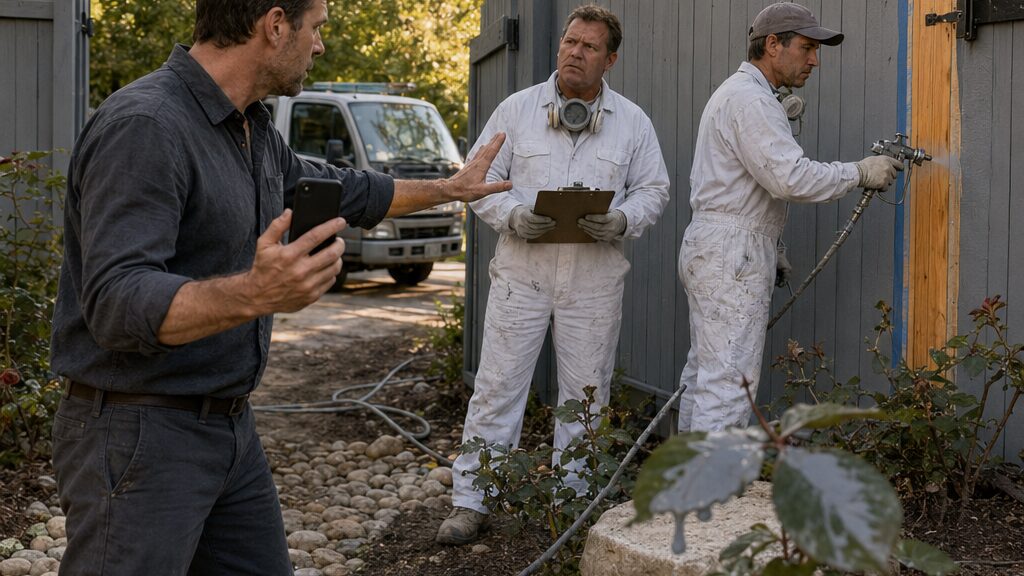
A worker in white coveralls lifted a spray gun and aimed at the final unpainted section.
“Stop.”
The worker hesitated but did not lower the gun. The compressor continued its mechanical pulse.
Richard stepped through the open gate. Blue tape crossed the garden path, and a plastic drop cloth had been spread over only half the stones. Several rose stems protruded beyond it, their leaves freckled gray.
“I said stop.”
The foreman came around the corner of the fence holding a clipboard. He was broad through the shoulders, with a respirator hanging against his chest.
“You the homeowner?”
Richard looked past him. Two paint cans sat on the grass. A hose crossed the flower bed. One crew member had placed a boot on a stepping stone Richard’s father had set by hand.
“Who authorized you to enter my yard?”
“We have a work order from the association.”
“That wasn’t my question.”
The foreman studied him, perhaps deciding whether he was facing an argument about color or money. “We were told this section was association-maintained.”
“It isn’t.”
The foreman glanced toward the remaining bare boards. “We’re almost finished.”
Richard took out his phone and opened the camera.
The worker with the spray gun shifted his weight. “You want us to leave it half done?”
“I want you to lower the gun.”
This time, he did.
Richard photographed the paint cans, the compressor, the van visible through the greenway, and the line where the crew had rolled equipment across the edge of the lawn. He moved slowly, forcing his breathing to match the pace of his work.
At the flower bed, he crouched beside the roses. Gray beads clung to the leaves and thorns. Paint had misted across three stones and the iron border around the bed.
The foreman came closer. “We can clean up the overspray.”
“Don’t touch it.”
“We carry solvent.”
“Which could damage the stone sealant and the plants.”
The man’s expression changed slightly.
Richard stood. “Company name?”
The foreman told him.
“Work-order number?”
The foreman looked at the clipboard but did not answer.
Richard raised his phone. “Hold that where I can read it.”
“I can’t give you a copy.”
“I didn’t ask for one.”
After another pause, the foreman turned the clipboard. Richard photographed the top page. His address was printed beneath the association’s name. The description read: EXTERIOR FENCE COLOR CORRECTION—STANDARD MAINTENANCE.
At the bottom was an approval line.
Anthony Scott.
Richard zoomed in and took a second photograph.
“You need to call the property office,” the foreman said. “We just do what’s assigned.”
Richard looked at the gray fence. “Did anyone test the existing finish?”
“We prepped it.”
“How?”
“Washed it. Light sanding.”
“You sprayed acrylic over an oil-based penetrating stain.”
The foreman’s eyes moved toward the paint cans.
“Did you perform an adhesion test?”
No answer.
“Moisture reading?”
“We had clear weather.”
“That isn’t a reading.”
The worker near the compressor looked away.
Richard walked to the final corner. A narrow strip of honey-colored cedar remained beneath a length of painter’s tape where the crew had masked a metal bracket. The original grain showed through, warm and uneven, the color deepening around each knot.
His father had insisted they stain the boards before installation.
Edges too, he had said. Water finds the part you skip.
Richard photographed the strip from three distances, then placed a tape measure beside it and took another picture.
His phone rang before he could put it away.
The screen showed the HOA office number.
He answered and put the call on speaker. “Richard Walker.”
Anthony Scott’s voice came through crisp and impatient. “Richard, the contractor says you stopped authorized work.”
“I stopped work on my property.”
“The fence was out of compliance.”
“According to what adopted standard?”
“We’ve been moving the neighborhood toward a uniform exterior palette for months.”
“That doesn’t answer the question.”
Anthony exhaled. “The board approved the correction. This is a standard maintenance action.”
Richard looked at the foreman, who was pretending not to listen.
“Did the board send written notice?”
“You received general communications.”
“Did you send notice identifying my fence, the date of entry, and the work to be performed?”
A small silence followed.
Then Anthony said, “Honestly, Richard, just move on. It looks better now anyway.”
The foreman’s eyes dropped to the clipboard.
Richard stared at the last visible strip of cedar.
“Standard maintenance,” he repeated.
“Yes.”
“And that is the board’s official position?”
“That is what I just said.”
Richard ended the call.
For the first time since entering the yard, he felt the anger inside him become useful.
He photographed the gray paint dripping from the rose leaf again. Then he measured the overspray on the stones, noted the time, and asked the foreman to write down when the crew had arrived and which gate they had used.
“You planning to sue us?” the foreman asked.
“I’m planning to know what happened.”
The crew packed without finishing the final corner. The compressor went silent. Its absence made the backyard feel altered in another way, as though the fence itself were holding its breath.
When the van pulled away, Richard stood before the gray boards. In places, the wet coating had settled into the cedar grain. In others, it bridged the fine grooves, hiding them.
He touched nothing.
Inside, he went directly to the small office beside the kitchen. The permit folder should have been in the bottom drawer of the metal filing cabinet, behind the property survey and the original closing papers.
He opened the drawer.
The survey was there. The warranty for the roof was there. The fence photographs from four years earlier were there.
The permit folder was not.
He removed every file and stacked them on the floor. He checked the desk, the cabinet above the printer, and the locked document box in the closet.
Nothing.
Richard stood in the center of the room with gray paint drying beyond the window.
Someone had authorized the HOA to treat his fence as its own.
And the paper that proved otherwise was gone.
Chapter 2: The Invoice Arrived Before Any Apology
The $150 invoice was taped to Richard’s front door before sunrise on Thursday.
He found it when he stepped outside with a travel mug in one hand and his work keys in the other. The paper fluttered beneath two strips of clear tape.
FENCE REPAINTING SERVICE—HOMEOWNER RESPONSIBILITY.
Payment due within thirty days.
Richard read it once, removed it carefully, and carried it inside without tearing the tape.
No apology had arrived for the trespass, the damaged roses, or the paint on the stones. No one had asked whether the crew could return to clean up. But the association had managed to deliver a bill.
He placed it on his desk beside a printed photograph of the surviving cedar strip.
By then, the gray finish had dried into the fence. Close up, the surface looked worse than it had while wet. The paint had pooled in some grain lines and barely covered others. Where the crew had sprayed too heavily, it formed blunt ridges around knots.
Richard had spent Tuesday and Wednesday searching for the missing permit.
He checked every box in the garage and every cloud folder on his laptop. He called the county clerk, who told him archived residential permits could take several business days to retrieve. He searched old email accounts using combinations of “fence,” “inspection,” and his address.
Nothing appeared.
At nine, he drove to the HOA management office.
Jennifer Taylor sat behind a glass partition with a neat row of binders behind her. She was younger than Anthony by at least fifteen years and looked as though she had already answered too many angry calls that morning.
Richard slid the invoice through the opening beneath the glass.
“This charge is disputed.”
Jennifer glanced at it. “I can note the account.”
“Remove it.”
“I don’t have authority to remove a board-approved charge.”
“Then show me the notice authorizing the work.”
“I can request the file.”
“You sent the invoice.”
“Under instruction.”
Richard held her gaze. “Did you send me notice?”
Her fingers rested on the edge of the paper.
“I sent the community exterior update in June.”
“That was a general newsletter.”
“It described the color-standard initiative.”
“It did not authorize entry onto my property.”
Jennifer’s voice lowered. “I told the board the individual notices were not complete.”
The sentence landed so quietly that Richard almost missed it.
“What do you mean, not complete?”
“I mean the project list changed faster than the notices were being prepared.”
“Was my address added later?”
Jennifer glanced toward the closed door behind her. “I can’t discuss internal board communications.”
“You just did.”
“I told you enough to explain why I’m requesting the file.”
Richard leaned closer to the glass. “You knew notice had not been sent, and you billed me anyway.”
Her expression tightened. “The board directed the management office to issue the charges.”
“That doesn’t make it yours less.”
“No,” she said. “It doesn’t.”
The answer was not defensive. That irritated him more than an excuse would have.
Jennifer entered something into her computer. “The account will show the charge as disputed. No late fee will be added while it is reviewed.”
“I’m not asking for time.”
“I understand.”
Richard took the invoice back. “Do you?”
She did not answer.
On the way home, he saw Brenda Johnson standing beside her mailbox with a pair of pruning shears tucked into the pocket of her work apron. Her driveway bordered the narrow greenway where the crew had parked.
She watched his truck slow.
“You went to the office,” she said.
“That obvious?”
“Anthony called two board members before eight.”
Richard got out. “Did you see the crew enter my yard Monday?”
“I saw their van.”
“Did you see who opened the gate?”
“No.”
He waited.
Brenda clipped a dead branch from a shrub beside the driveway. “They discussed your fence before Monday.”
Richard’s grip tightened around the folded invoice. “Who did?”
“The board.”
“You were there?”
“I attended the landscaping committee portion. Your fence came up afterward.”
“And you said nothing to me.”
“I didn’t know they were painting it without notice.”
“You knew they were discussing it.”
“I knew Anthony wanted exterior colors standardized before the assessment vote.”
“What assessment vote?”
Brenda looked toward the clubhouse roof visible beyond the houses. “Retaining wall, roof, parking lot. The reserve fund won’t cover everything. They need homeowners to approve the difference.”
Richard remembered the work order: standard maintenance.
“Did you support repainting my fence?”
“I supported clearer appearance standards after the house at the end of the block sat neglected for two years.”
“That isn’t an answer.”
“No,” she said. “I did not support entering your yard.”
“Will you say that if this goes to the county?”
Brenda’s eyes shifted toward the rear of her property. Beyond the trees, orange safety fencing marked the excavation for the retaining wall.
“I’ll say what I saw. I won’t support shutting down every project in the neighborhood.”
“So you want the board held accountable as long as it costs you nothing.”
Her jaw set. “You think every problem here begins and ends at your fence.”
Richard turned away.
“Check your old inspection account,” she called after him. “The county moved permits online around the time you built it.”
He stopped but did not thank her.
At home, he opened the county portal and tried three passwords before gaining access. The dashboard showed expired contractor licenses, inspection appointments, and archived permit applications.
Near the bottom was a record from four years earlier.
RESIDENTIAL ACCESSORY STRUCTURE—PRIVACY FENCE.
He downloaded every attachment.
The inspection report included photographs of the original cedar boards. The approved plan showed the property line, post depth, gate clearance, and maintenance responsibility.
Richard printed the packet and set it beside the $150 invoice.
For a moment, the sight of the old photographs unsettled him. His father’s hand appeared in the edge of one image, holding a level against a post. Only the hand and the cuff of a faded work shirt were visible.
Richard turned the page facedown.
Then he read the permit description again.
OWNER-CONSTRUCTED. OWNER-MAINTAINED. NO ASSOCIATION OWNERSHIP OR ACCESS RIGHTS ESTABLISHED.
The language was plain enough to fit on one line.
The HOA had not corrected something it maintained.
It had authorized work on something it did not own.
Chapter 3: One Complaint Reached Every Work Crew
John Campbell circled the words owner-maintained structure with a black pen.
“That part helps you,” he said. “It does not do everything you think it does.”
Richard sat across from him in a county office that smelled faintly of paper dust and burnt coffee. Between them lay the permit, the invoice, the work-order photograph, and twelve printed images arranged by time.
“Unauthorized alteration of a permitted structure,” Richard said. “Unlawful access. Property damage.”
“Potentially.”
“They admitted it was board-authorized maintenance.”
“That establishes responsibility. It doesn’t automatically establish every violation.”
Richard leaned back. “You always this encouraging?”
John ignored that. He had inspected Richard’s commercial work twice in the past six years and had failed one job over a stair measurement less than half an inch outside tolerance. Richard had disliked him for three days and respected him ever since.
John tapped the photographs. “You documented well. Wide shot, medium shot, detail, time sequence. Contractor vehicle. Work order. Existing finish.”
“I know how to document a site.”
“Yes. You also know I need jurisdiction, not outrage.”
Richard’s mouth tightened.
John opened a county database and entered the HOA’s project address. Several records appeared: clubhouse roof replacement, retaining-wall reconstruction, parking-lot reseal, drainage modifications.
“Who owns the fence?” John asked.
“I do.”
“Who owns the clubhouse?”
“The association.”
“Parking lot?”
“Association.”
“Retaining wall?”
“Common property, mostly.”
“Then your fence permit doesn’t stop their roof.”
“I didn’t say it did.”
“You filed a complaint alleging a repeated authorization failure across active projects.”
“Because Jennifer Taylor admitted individual notices were incomplete.”
“That may matter where contractors entered private lots. It may not matter on association property.”
John selected the retaining-wall file. “This one requires temporary access through three homeowner easements.”
“Signed access forms?”
“I don’t see them uploaded.”
He opened the roof file. “Contractor license is current. Permit is active. But the staging plan shows equipment crossing a private side yard.”
“Consent?”
“Not here.”
The parking-lot project had a permit application but no final traffic-control approval. The drainage work referenced revised plans that had not been attached.
John stopped writing.
Richard felt the first clean edge of vindication.
“How many deficiencies?” he asked.
“I haven’t inspected anything yet.”
“But enough to inspect.”
John stacked the papers. “Enough to open a review.”
By Monday morning, county vehicles were parked at three locations inside the subdivision.
Richard watched from the sidewalk as an inspector fastened a red notice to the temporary fence surrounding the retaining-wall trench. The subcontractor shut down an excavator and climbed from the cab. Two workers near the clubhouse roof began lowering materials to the ground.
Across the parking lot, a second inspector spoke to a paving supervisor beside a truck loaded with sealing equipment.
Residents came out of their houses in small groups.
Some stared at the notices. Others stared at Richard.
Anthony arrived in a dark sedan and crossed the clubhouse lawn without closing his door.
“What did you file?” he demanded.
Richard held his phone at his side. “A complaint.”
“You represented that all association projects were unauthorized.”
“I reported missing documentation.”
“You knew these projects were scheduled.”
“I knew you painted my fence.”
Anthony’s face reddened. “The roof has been leaking for six months. The wall project is already behind. Every day of delay costs this association money.”
“Then you should have completed the files.”
“This is exactly why boards struggle to get anything done. One homeowner decides procedure matters more than the whole community.”
Richard looked toward the red notice on the retaining-wall fence. “Procedure mattered when you billed me.”
Anthony stepped closer. “You want your $150 removed? Fine. You want the fence reviewed? Fine. But this—” He gestured toward the idle crews. “This is retaliation.”
John approached from the parking lot with a folder under one arm.
“It is an inspection hold,” he said. “Not a judgment.”
Anthony turned. “On whose authority?”
“County building authority.”
“For how long?”
“Until project-specific documents are reviewed and site conditions verified.”
“You shut down everything because of a fence complaint?”
John’s expression did not change. “We stopped work where required documents are missing, inconsistent, or not available on site. The fence complaint identified a possible pattern. The records created the holds.”
Anthony looked at Richard again, but the accusation in his face had changed. It now carried uncertainty.
Richard should have felt satisfied.
For a moment, he did.
The contractor who had sprayed his fence had treated the work order as permission. Jennifer had treated board instruction as protection. Anthony had treated the word maintenance as ownership. Now the same machinery of forms, signatures, and approvals had turned in the opposite direction.
At the clubhouse, a worker folded a tarp over stacked roofing material. In the parking lot, the sealing truck drove away.
Red notices moved slightly in the morning breeze.
Then Richard saw Brenda behind the retaining-wall barrier.
She was crouched near the edge of her yard with her phone held low. Beyond her, the excavation ran along the rear property line, exposing dark soil beneath a row of shrubs.
Richard walked toward her.
“What are you doing inside the barrier?”
“I’m on my property.”
A crack had opened in the ground near the flower bed, thin at one end and wide enough for a finger at the other. Brenda placed a ruler beside it and took another photograph.
“Was that there Friday?” Richard asked.
“It was smaller.”
He looked into the trench. The old wall had been partially removed, leaving temporary bracing along one section.
“The subcontractor should stabilize this before leaving.”
“They did what the inspector ordered. Equipment off, work stopped.”
“That doesn’t remove their safety obligations.”
“No,” Brenda said. “But no one seems eager to decide whose obligation comes first.”
Richard crouched and studied the soil. The slope above the trench was damp beneath the mulch despite three dry days. A drainage outlet protruded from the exposed bank but had not yet been connected.
“When is the next inspection?” he asked.
“Anthony says nobody knows.”
“I’ll call John.”
Brenda stood. “And tell him what? That the shutdown you wanted should stop applying here?”
“I wanted lawful work.”
“You wanted leverage.”
Richard rose slowly.
She did not soften the words. “You were right about your fence. You were right about the notice. But you filed against every project before asking what each one was doing.”
“They used the same broken process.”
“And the consequences aren’t the same.”
From the clubhouse lawn came the sound of Anthony arguing with someone on the phone. Around them, residents photographed red notices and idle machines.
Brenda looked toward the dark line of soil beneath her shrubs.
“The forecast changed this morning,” she said. “Storm front coming in Thursday night.”
Richard looked at the unfinished drainage outlet, the temporary braces, and the widening crack beside her garden.
Thursday was three days away.
The retaining wall could not legally restart before another county review.
His complaint had finally forced the association to stop.
Now he had to decide what the stopping might cost.
Chapter 4: The Board Had Been Racing the Calendar
Jennifer Taylor arrived at Richard’s front door carrying a banker’s box with no lid.
The top folder leaned sideways, exposing a stack of forms with blank signature lines. She held the box against her coat as if someone might try to take it from her.
“You cannot say these came from me,” she said before he invited her inside.
Richard looked past her toward the street. Anthony’s sedan was not visible, but two neighbors were standing near a mailbox across the way.
“Then why bring them?”
“Because tomorrow night Anthony is going to tell everyone the county shutdown happened because you misunderstood one maintenance order.”
Richard stepped aside.
Jennifer entered without thanking him. She set the box on the kitchen table, then remained standing.
Rain had not arrived yet, but the air held the metallic pressure that came before it. Through the rear window, Richard could see the gray fence and, beyond it, the orange barrier surrounding the retaining-wall excavation.
He lifted the first folder.
TEMPORARY PROPERTY ACCESS AUTHORIZATION.
The homeowner line was empty. So was the signature line. A property address had been typed at the top.
Brenda’s.
He opened another. Different address, same blanks.
“How many?” he asked.
“Seven that I know of.”
“For the wall?”
“Three for the wall. Two for roof staging. One for drainage access. One for the fence crew.”
Richard looked up. “Mine.”
Jennifer nodded.
“Anthony authorized all of them without signatures?”
“The board voted to proceed using existing easement language.”
“That language allows utility access. Not construction staging, not painting, not equipment storage.”
“I said that.”
“When?”
Jennifer reached into the box and removed a printed email chain. Several lines were highlighted.
Three weeks before the fence had been painted, she had written that individual consent remained incomplete and that exterior work should not be scheduled until ownership and access rights were verified.
Anthony’s response appeared beneath it.
Proceed where practical. Delays will undermine the assessment presentation.
Richard read the sentence twice.
“The assessment vote,” he said.
Jennifer pulled out a chair but did not sit. “The reserve study was worse than expected. The roof, wall, drainage system, and parking lot all came due within the same year. Anthony wanted visible progress before homeowners saw the special-assessment number.”
“So the board could say the work was already underway.”
“So people would believe the board had control of the situation.”
Richard placed the email beside the unsigned forms. “They didn’t.”
“No.”
“Why didn’t you stop sending work orders?”
Her face changed, not dramatically, but enough.
“I manage the association,” she said. “I don’t govern it.”
“You knew the notices were missing.”
“I did.”
“You sent the invoice anyway.”
“I did.”
The admission was cleaner than any excuse. It left Richard with nowhere easy to place his anger.
Jennifer sat at last. “I told myself the charge would be reversed once the file was reviewed. I told myself the crew would stop if anyone objected. I told myself Anthony was rushing paperwork, not ignoring it.”
“But he was.”
“Yes.”
“And you kept doing what he told you.”
Her eyes moved toward the window. “I have worked for three associations in eight years. Every board says it wants professional advice until professional advice slows something down.”
“That isn’t an answer.”
“It is the answer I have.”
Richard closed the folder.
He had imagined finding proof that Anthony had acted alone, driven by ego and contempt. Instead, the box showed a system of small permissions: a manager who warned but complied, board members who accepted summaries, contractors who trusted work orders, homeowners who assumed notices would come later.
The harm remained. The responsibility had only become less convenient.
He lifted a packet of exterior design standards.
“Where is the gray-fence rule?”
Jennifer turned several pages. The document listed approved roofing materials, mailbox styles, visible storage restrictions, and stain colors for new fence applications.
There was no uniform gray requirement.
“This is the current version?” Richard asked.
“Yes.”
“What about minutes approving a revision?”
“There aren’t any.”
“Anthony told the contractor the board had adopted a uniform palette.”
“He proposed one.”
“That isn’t adoption.”
“I know.”
Richard searched the box until he found photographs attached to earlier architectural-review applications. Cedar fences appeared throughout the neighborhood in honey, walnut, reddish brown, and weathered natural finishes. Each bore an approval stamp.
The gray standard had never existed outside Anthony’s project plan.
A knock sounded at the back door.
Brenda stood beyond the glass, pointing toward the excavation.
Richard opened the door.
“The crack widened another half inch,” she said. Then she noticed Jennifer and the box. “Am I interrupting?”
“No,” Jennifer said quickly. “I should leave.”
Richard held up Brenda’s unsigned access form. “Did you ever see this?”
Brenda took it. Her mouth tightened when she saw her address.
“No.”
“Did you give anyone verbal permission?”
“I allowed the survey crew through once. I did not authorize excavation access.”
Jennifer stood. “The board treated the survey permission as continuing access.”
“For heavy equipment?” Brenda asked.
Jennifer did not answer.
Brenda looked at Richard. “You were right about the pattern.”
He heard the words, but the satisfaction he had expected did not come.
“What’s happening at the wall?” he asked.
“The temporary drain is backing up. The subcontractor left a pump, but no one has authority to operate it under the stop order.”
Richard took his jacket.
At Brenda’s yard, dark water had collected at the bottom of the trench. The exposed outlet pipe ended above the pool, useless until the next connection was installed. Soil along the upper edge had begun to slump.
Richard photographed the crack from the same angle Brenda had used earlier. Her images showed the progression: a hairline, then a narrow opening, then the current split.
Measured intervals. Evidence not of past damage, but approaching damage.
“What would you do?” she asked.
“Shore the upper edge, clear the temporary drain, run the pump, cover the open soil.”
“Can they?”
“Not without county approval.”
“Can Anthony request it?”
“He can request anything. Whether the county trusts his paperwork is another matter.”
Brenda folded her arms. “Then you need to help fix it.”
Richard looked at her.
“I am not asking you to withdraw your complaint,” she said. “I am asking you to stop acting as though every compromise belongs to Anthony.”
Before Richard could answer, his phone vibrated.
An HOA email had arrived.
EMERGENCY COMMUNITY MEETING—PROJECT DELAYS AND FINANCIAL IMPACT.
Anthony’s message stated that residents would be informed of “the individual complaint responsible for the suspension of essential neighborhood improvements.”
The meeting was scheduled for the next evening.
Richard showed the screen to Jennifer when they returned to the kitchen.
She read it and closed her eyes briefly.
“He’s going to make you the cost of the delay,” she said.
“I have the forms.”
“You cannot use those publicly.”
“They prove what happened.”
“They also identify homeowners and internal management failures. If you disclose them without context, Anthony will say you stole confidential records.”
“You brought them here.”
“And I will deny that if my job is on the line.”
Richard stared at her.
Jennifer held his gaze. “I am helping you. I am not agreeing to be destroyed with him.”
The sentence was not brave, but it was honest.
Richard looked down at the box of unsigned forms, the email warnings, and the photographs of approved cedar fences in half a dozen colors.
He could prove the board had been racing the calendar.
He could not yet prove it without exposing the person who had finally shown him how.
Chapter 5: The Meeting Turned His Evidence Against Him
Residents entered the clubhouse carrying white sheets that estimated what Richard had cost them.
The notices listed contractor remobilization fees, equipment standby charges, weather-delay contingencies, and projected increases to the special assessment. The numbers varied, but each page ended with the same sentence:
Delays arose following a homeowner-initiated county complaint.
No name appeared. None was needed.
People looked at Richard as they took their seats.
He chose a chair near the aisle. Brenda sat two rows behind him. Jennifer stood along the side wall with a legal pad pressed against her stomach.
At the front, Anthony arranged papers beside the association attorney. A projector displayed Richard’s fence in close-up—gray paint sunk into cedar grain, magnified until the surface looked rough and diseased.
Anthony called the meeting to order.
“We are here,” he began, “because essential projects have been suspended after one resident escalated a maintenance dispute into a county-wide review of association work.”
A murmur moved through the room.
Richard looked at the photograph. It was one he had submitted with his complaint. The board had turned his evidence into a backdrop for its defense.
Anthony continued. “The association understands that homeowners may disagree with aesthetic decisions. But disagreement does not justify jeopardizing safety work, roof repairs, and shared property.”
A man near the front lifted his delay notice. “Is this estimate real?”
“The figures are preliminary,” Anthony said. “But costs increase each day.”
Another resident asked whether insurance would cover the delays.
The attorney leaned toward the microphone. “That depends on the county’s final determination and the terms of each contract.”
Anthony let the uncertainty sit in the room before looking at Richard.
“Mr. Walker is present. I believe he should explain why he considered a fence-color issue sufficient reason to challenge unrelated projects.”
Richard stood.
“It was not a color issue.”
Someone behind him whispered, “Of course it was.”
“The association entered my property without notice, altered an owner-maintained permitted structure, damaged landscaping, and billed me for the work. When I reviewed the authorization, I found the same missing access documentation in other project files.”
Anthony raised one hand. “That last statement is speculation.”
“It is not.”
“Do you have lawful access to internal association records?”
Jennifer’s pen stopped moving.
Richard saw the trap before he stepped into it. If he mentioned the box, Anthony would ask where it came from. If he protected Jennifer, the claim would sound unsupported.
He chose the narrower path.
“The county records show incomplete attachments.”
“The county portal is not the full association file,” Anthony said. “Our bylaws permit emergency maintenance access where common property or community standards are at risk.”
The attorney opened a binder and read a section granting the association entry to address urgent conditions affecting safety, structural integrity, or common systems.
Anthony gestured toward the projected fence. “The board acted under its maintenance authority.”
“A fence color was not an emergency.”
“The fence forms part of the community exterior.”
“It is listed on the permit as owner-maintained.”
“That does not remove covenant authority.”
“No,” Richard said. “It removes your right to pretend ownership.”
Voices rose around the room.
Anthony waited until they quieted. “This is the tone we have dealt with throughout.”
Richard felt heat climb beneath his collar.
The attorney changed the image. A site photograph showed the halted retaining-wall trench behind Brenda’s yard.
“This is not theoretical,” she said. “The stop order has delayed stabilization work ahead of a major storm.”
Richard turned toward Brenda.
She stood slowly.
“My yard is at risk,” she said. “The crack above the trench has widened since the shutdown.”
Several residents looked at Richard again.
Brenda continued. “Richard filed too broadly before he understood what every project involved.”
The sentence struck harder because it was true.
Anthony leaned back, almost relieved.
Then Brenda lifted her phone.
“But the board entered my property months before Richard’s fence was painted.”
The room changed.
She displayed photographs of survey stakes, equipment tracks, and workers crossing her side yard. The dates appeared at the bottom.
“I allowed one survey visit,” she said. “I did not authorize continuing access. I never received the form the management office says should exist.”
Anthony’s relief disappeared.
A resident across the aisle raised a hand. “They staged roof material in my side yard last week. I thought my husband approved it.”
Another said, “The drainage crew cut through our gate.”
The meeting splintered into overlapping accounts.
Richard should have let it.
Instead, Anthony said, “Individual communication errors do not justify shutting down the entire association.”
Richard turned toward him. “Communication errors?”
“The projects were approved.”
“You did not have consent.”
“We had easement authority.”
“Not for what you used it for.”
Anthony’s voice sharpened. “You are a contractor, Richard. You know projects require judgment. You know schedules change. You know paperwork sometimes catches up.”
“And you know entering private property without permission is wrong.”
“I know allowing one rigid homeowner to hold an entire neighborhood hostage is also wrong.”
The word hostage broke something in Richard.
“You took what wasn’t yours,” he said.
Anthony stared at him.
“You took my fence, Brenda’s access, their yards, their signatures. You put your schedule ahead of everyone’s rights, then hid behind the word maintenance.”
“Richard,” Jennifer said softly from the wall.
He did not stop.
“The whole board signed off on it. Every one of you knew—or chose not to know. That is theft with meeting minutes.”
The room went silent.
The HOA treasurer’s face hardened. The board secretary pushed back from the table.
Anthony spoke with careful control. “You have now accused volunteers serving this community of criminal conduct.”
Richard heard his own breathing.
He had evidence of procedural failure, unauthorized entry, and damage. He did not have evidence of theft in the legal sense. He knew the difference. He had known it before he stood up.
But anger had given him the word, and pride had refused to take it back.
The attorney closed her binder. “We will not continue while defamatory accusations are being made.”
Residents began talking again, but the direction had shifted. Some still questioned the board. Others looked at Richard as though he had confirmed everything Anthony had said about him.
Jennifer would not meet his eyes.
The meeting ended without a vote.
Outside, people gathered beneath the clubhouse awning. Richard walked toward his truck alone.
Brenda caught up near the curb.
“You made it easy for him,” she said.
“He authorized it.”
“That was not what I meant.”
Richard unlocked his truck. “You stood up there and blamed me.”
“I told the truth.”
“So did I.”
“No. You reached past the truth because it did not hurt him enough.”
He turned. “My fence is still gray.”
“And my yard is still moving.”
For a moment, neither spoke.
Brenda lowered her voice. “Jennifer looked terrified when you mentioned the files.”
“I did not mention her.”
“You did not have to.”
Richard opened the truck door.
His phone rang.
John Campbell.
Richard answered.
“I watched the meeting stream,” John said.
“Then you had a good evening.”
“You damaged your credibility.”
“I did not call for advice.”
“No. I am calling because the county review changes at eight tomorrow morning.”
Richard stopped.
John continued. “We have enough to maintain the fence case and several access violations. We do not have enough to keep every project under the same broad hold.”
“You saw Brenda’s photographs.”
“They support her property claim. They do not automatically support the roof, parking lot, and drainage holds.”
“What do you need?”
“Project-specific evidence. Access requirement, missing authorization, permit deficiency, or immediate safety conflict. Separated by project.”
“By eight?”
“Before eight. Otherwise the county narrows the order.”
Richard looked back at the clubhouse. Anthony stood inside the glass doors speaking to the attorney. Jennifer was gathering papers along the wall, her movements quick and precise.
“How narrow?” Richard asked.
“The fence investigation continues. The rest may restart under existing permits.”
“Even with incomplete consent?”
“If no private access is currently required, yes.”
Richard understood. His broad victory was ending. He could spend the night trying to preserve it, using every form Jennifer had brought him, tying every project to the board’s failure.
Or he could decide which work truly needed to remain stopped.
John’s voice came through the phone.
“By morning, Richard. After that, the choice is made for you.”
Chapter 6: He Could Stop Everything or Fix What Mattered
Rain struck the metal roof of Richard’s workshop before midnight.
It began as scattered taps, then tightened into a steady drumming that filled the space between his tools. On the workbench lay four project folders, Brenda’s photographs, county permit printouts, and copies of the unsigned access forms Jennifer had brought.
A small cedar sample rested beside them, its face coated gray.
Richard had cut it from a damaged scrap near the gate after the county documented the fence. He clamped it to the bench and drew a sanding block across the surface.
Gray dust gathered beneath his hand.
After several passes, honey-colored wood appeared. But the paint remained inside the deepest grain, thin dark lines that followed the cedar’s natural pattern.
He sanded harder.
The raised fibers began to fray.
Richard stopped.
His father had taught him that restoration had a limit. Past a certain point, removing the damage became another form of damage.
His phone lit with a message from Brenda.
Water rising in trench. Pump still off.
He set down the sanding block.
At her yard, rainwater ran from the unfinished slope into the excavation. The temporary pump sat beneath a plastic cover, disconnected. Brenda stood under an umbrella near the widening crack while Richard checked the bracing with a flashlight.
“The upper section is holding,” he said. “For now.”
“That phrase is doing a lot of work.”
He followed the temporary drain line. Mud had blocked the inlet grate. Clearing it would help, but operating inside the work zone without authorization could complicate the county order.
Brenda watched him study it.
“Can we clear the grate?”
“We can remove debris from your side without entering the trench.”
They worked with a rake and shovel, pulling leaves and mud from the inlet. Water began moving through the pipe, slowly at first, then with a hollow rush.
It was not enough to finish the wall. It was enough to buy time.
Back in the workshop, Richard separated the documents.
The clubhouse roof did not require private access if materials were moved to the association lot. The parking-lot reseal needed traffic approval but no homeowner consent. The drainage project crossed two private yards and lacked signed access. The retaining wall needed Brenda’s property and emergency stabilization.
He could argue that the repeated failures justified keeping everything stopped. Jennifer’s emails would strengthen that argument.
But the pattern did not make every risk equal.
At two in the morning, headlights swept across the workshop windows.
Anthony entered without waiting for an invitation. His coat was wet at the shoulders.
“You are up,” he said.
“So are you.”
Anthony looked at the folders. “The county gave you a deadline.”
Richard said nothing.
Anthony placed a document on the workbench. “The association will cancel the invoice, pay for the landscaping damage, and hire a restoration contractor of your choice.”
Richard read the first page.
In exchange, he would withdraw all county complaints and acknowledge the repainting as a resolved maintenance dispute.
“All complaints,” Richard said.
“Yes.”
“Including Brenda’s access.”
“The association will address that separately.”
“The drainage yards?”
“We will obtain signatures.”
“After the work?”
Anthony’s jaw tightened. “We need these projects moving.”
Richard set the proposal down. “You need the assessment vote.”
“I need to keep the association solvent.”
“You rushed visible work so homeowners would approve more money.”
“I rushed necessary work because people vote against costs they cannot see.”
Richard looked at him.
For the first time, Anthony’s anger seemed less like superiority than exhaustion.
“The reserve study says we are short almost four hundred thousand dollars over five years,” Anthony said. “The roof leaks. The wall is failing. The drainage system was designed before half these houses added patios. Every meeting, residents demand repairs and reject assessments. Then they accuse the board of doing nothing.”
“So you decided consent was optional.”
“I decided delay had consequences.”
“And now?”
Anthony glanced toward the rain beating on the roof. “Now every choice has consequences.”
Richard picked up the cedar sample and turned it in his hand. “You told me it looked better.”
“It was the approved project color.”
“It was your proposed color.”
Anthony did not answer.
“My father built that fence with me,” Richard said.
The words felt misplaced in the workshop, too personal among permit sheets and clamps. He had not intended to say them.
“He set every third post because my shoulder was bad that summer. He stained the back edges before we installed the boards because he said water finds what you skip. It was the last project we finished together.”
Anthony’s expression shifted, but Richard did not let him speak.
“You saw a color problem. I saw his hand in every uneven brush line.”
The rain filled the silence.
Then Richard slid the settlement proposal back across the bench.
“I will not withdraw everything.”
Anthony’s face closed again. “Then you are choosing the shutdown.”
“No. I am choosing the projects.”
Richard opened the folders.
“The retaining wall gets an emergency stabilization permit. Brenda signs limited access for that work only. County inspection before restart, daily photographs, temporary drainage maintained until completion.”
Anthony looked down at the documents.
“The clubhouse roof can resume if staging moves to association property. The parking lot can resume when traffic control is approved. Drainage stays stopped where private access is unsigned. My fence complaint and the prior access violations continue to hearing.”
“You expect the board to agree to public violations while you release the projects that make you look reasonable.”
“I expect the board to correct what can be corrected.”
Anthony gave a short, humorless laugh. “And if I refuse?”
“Then the county narrows the hold without your input at eight. The wall remains unsafe because no one submitted an emergency plan. You can explain that at the next meeting.”
Anthony’s eyes hardened. “I could resign tonight. Without a project liaison, no board authorization goes out before the storm.”
The threat hung between them.
Richard believed he might do it. Not from indifference, but from the same pride Richard had carried into the clubhouse: if he could not control the terms, he would deny everyone the use of his effort.
Richard took out his phone.
“What are you doing?”
“Calling the treasurer. The bylaws allow another officer to sign emergency project documents.”
Anthony stared at him.
“You checked,” he said.
“I read the rules.”
For several seconds, neither man moved.
Then Anthony pulled out a chair.
“Show me the wall conditions.”
At seven fifteen, Richard, Brenda, Anthony, and the retaining-wall subcontractor met John at the county office. Brenda signed a narrow access authorization specifying equipment path, work hours, restoration requirements, and expiration upon stabilization.
Richard submitted a project-by-project deficiency list.
John read the wall plan first.
“This releases emergency work only,” he said. “It does not cure prior access failures.”
Anthony’s mouth tightened. “Understood.”
“The fence complaint remains open.”
“Understood.”
“The drainage holds remain where signatures are missing.”
Anthony looked at Richard before answering. “Understood.”
John pushed the stipulation across the counter.
Richard signed as the complaining homeowner acknowledging the limited modification. He could have preserved broader pressure for another few hours. He could have forced Anthony to absorb more delay and more public anger.
Instead, he signed the line that allowed the retaining-wall crew back into Brenda’s yard.
The county stamp came down on the page.
Outside, the rain had weakened to a fine mist. A crew truck turned into the subdivision before Richard arrived home.
The wall would be stabilized.
The roof and parking lot would resume under corrected conditions.
And with every urgent excuse removed, Anthony would still have to answer for the gray fence, the unsigned forms, and the authority he had claimed where none existed.
Chapter 7: The Cedar Returned, but Not Untouched
The restoration foreman pressed the edge of his scraper into a gray groove and stopped.
“If we chase every trace,” he said, “we’ll tear up the grain.”
Richard stood beside him in the backyard, arms folded against the morning chill. Three test patches marked the fence. The first had been lightly stripped, leaving thin gray lines in the deepest channels. The second had been sanded until the cedar looked pale and raw. The third had gone farther still, its surface furred with damaged fibers.
“How deep did the paint penetrate?” Richard asked.
“Depends on the board. Your original stain repelled some of it. The areas they sanded took more.”
The foreman ran a gloved finger across the damaged patch. “We can make it look new from ten feet away. We cannot make it untouched.”
Behind them, Brenda photographed each test section with Richard’s measuring rule held against the boards. She had offered to create a restoration record for the county hearing and the association’s insurance claim.
Three weeks earlier, Richard would have told her he could handle it himself.
Now he stepped aside so she could get a clear angle.
“Same distance as the original photographs?” he asked.
“Six feet for the wide shot, two for the grain, twelve inches for damage.”
He nodded. “Good.”
The foreman pointed to the least aggressive test patch. “This is what I recommend. Chemical strip, low-pressure rinse, hand sanding where needed, then a penetrating stain close to the original.”
“Close?”
“Sun changes cedar. So does four years of weather. Even if I had the exact old product, it would not match every board.”
Richard looked at the narrow honey-colored strip that had survived beneath the painter’s tape. It was darker than the exposed wood and smoother around the edges. For weeks, it had been evidence. Now it was also a standard no contractor could perfectly reproduce.
“Use the least destructive process,” he said.
“You understand some gray will remain.”
“Yes.”
The foreman waited, perhaps expecting more resistance.
Richard touched the frayed test patch. “Do not remove the wood to remove the proof.”
At the county hearing that afternoon, the cedar sample sat on the table between Richard and Anthony.
One half remained gray. The other had been sanded until warm wood showed through, crossed by thin dark lines.
John Campbell entered the sample into the record, then reviewed the project files one by one. The urgent retaining-wall stabilization had passed inspection. The clubhouse roof had resumed with staging relocated to association property. The parking-lot work had received its traffic-control approval. The drainage project remained limited until written access was secured.
The fence case was simpler.
The association had no ownership interest in Richard’s fence. No emergency condition existed. No individual notice had been delivered. The work order had authorized entry and alteration anyway.
The association attorney did not dispute those facts.
Anthony sat with both hands clasped before him. He looked older than he had at the clubhouse meeting, though only three weeks had passed.
When John asked why the board had proceeded, Anthony first spoke in the same careful phrases he had used before: consistency, community standards, schedule efficiency, deferred maintenance.
John interrupted him.
“Was the uniform gray fence standard formally adopted?”
“No.”
“Was Mr. Walker’s fence identified as association-maintained in any recorded easement or covenant amendment?”
“No.”
“Did management advise you that individual consent documents were incomplete?”
Anthony looked toward Jennifer.
She sat behind the attorney with a folder on her lap. Her written statement had been submitted through counsel, protecting her employment while confirming the warning emails and work-order timeline.
“Yes,” Anthony said.
“Then why proceed?”
The room went quiet.
Anthony loosened his hands.
“Because we were losing the calendar,” he said.
John waited.
“The reserve vote was coming. Every month we delayed, the estimates increased. Residents had been told for years that the board was planning. I believed if they saw work underway, they would approve what remained.”
“And the fence?”
“It was supposed to demonstrate the exterior program. One color. One contractor. Visible progress.”
Richard looked at the cedar sample.
Anthony continued, his voice lower. “I thought if I paused for every objection, nothing would happen. And once the crew was scheduled, I did not want to admit we had moved before the notices were finished.”
There it was—not a hidden conspiracy or a misunderstood rule, but a choice made from fear and protected by authority.
John asked, “Did you tell Mr. Walker to move on because the fence looked better?”
Anthony’s eyes shifted toward Richard.
“Yes.”
The word did not repair anything. It did, however, leave no place for the insult to hide.
The final agreement took another hour.
The $150 charge would be removed immediately. The association would pay the restoration contractor directly and reimburse Richard $220 for the rose bushes, sealed stones, and damaged edging. Anthony would resign as project liaison but remain on the board until the next election.
The new consent policy caused the longest argument.
Richard had proposed written owner authorization before any contractor entered a privately maintained structure or yard. The board attorney added emergency exceptions, notice timelines, and a requirement that the association retain every access form with the corresponding work order.
Then the attorney added a homeowner obligation.
Residents requesting exterior changes would also have to maintain current permits, ownership records, and emergency contact information. If a homeowner’s undocumented work obstructed common repairs, the owner could be responsible for resulting costs.
Richard read the provision twice.
Anthony watched him. “Consent cannot be one-sided paperwork.”
A month earlier, Richard would have rejected the addition because Anthony wanted it.
Now he considered what it did.
It did not erase the board’s violations. It did not excuse unauthorized entry. It required the same clarity from owners that Richard had demanded from the association.
“Add a thirty-day correction period before penalties,” Richard said. “Except for immediate safety hazards.”
The attorney made the change.
Richard signed.
The board approved the policy four days later. There was no applause. Several residents complained that the new forms were burdensome. Others asked why the requirements had not existed already.
Jennifer created a shared project register showing permits, access authorizations, inspection dates, and responsible contacts. Brenda volunteered to maintain a separate photographic archive for exterior projects affecting private yards.
Anthony voted for both measures.
He did not apologize publicly. In the parking lot after the meeting, he approached Richard while everyone else was leaving.
“I was trying to keep the neighborhood from falling behind,” he said.
Richard locked his truck but did not open the door.
“You decided that gave you the right to choose for everyone.”
Anthony looked toward the clubhouse, where water stains still marked the old section of roof waiting for replacement.
“I did.”
It was not an apology, but it was no longer a defense.
Richard nodded once and left.
The restoration took five days.
The crew stripped the gray coating in sections, rinsed at low pressure, and sanded by hand. Brenda photographed each stage. Jennifer visited once to verify the landscaping inventory, staying near the gate until Richard invited her into the yard.
When the new stain went on, the cedar darkened toward its old honey color. From the kitchen window, the fence appeared almost as it had before.
Up close, gray remained in the deepest grain.
Richard found himself tracing those lines with his eyes rather than resenting them. They showed where the wood had absorbed what was done to it. They also showed where it had endured.
Brenda arrived on the final afternoon with her camera.
“Last set,” she said.
Richard moved a ladder out of the frame. “Start at the rose bed.”
Two bushes had been replaced. The third had survived after damaged leaves were pruned away. New stones bordered the bed, though one original stone remained faintly stained along its underside.
Brenda photographed the fence, the garden, the restored gate, and the work-order area.
“Stand by the corner,” she said.
“I am not part of the project record.”
“You filed the complaint.”
“The fence is the record.”
She lowered the camera. “That sounds like something you would have said before all this.”
Richard considered the accusation, then stepped beside the gate.
Brenda took one photograph.
After she left, he carried the tools into his workshop. One narrow cedar board leaned against the wall, still coated in the original flat gray.
It had come from inside the gate, where replacing it would not weaken the fence or show from the street. The restoration crew had assumed it was waiting to be stripped.
Richard installed it on the interior face, between two restored boards.
From the yard, it looked out of place. A gray line among honey-colored cedar.
He could have hidden it in the workshop. He could have thrown it away.
Instead, he drove the final screw until the head sat flush, then stepped back.
The board did not honor what the association had done. It marked what he had nearly become while fighting it: a man so determined to preserve his rights that he had almost used everyone else’s losses as leverage.
Beyond the fence, the retaining-wall crew packed its equipment. The drainage outlet carried a clean line of water away from Brenda’s yard. At the clubhouse, roofers secured the last row of shingles.
Richard lifted his phone.
He took one wide photograph of the restored fence, one medium shot of the gate, and one close image of the gray board inside it.
Then he sent all three to Brenda for the neighborhood archive.
The story has ended.