The HOA Blocked His Family’s Only Access Road, but the Old Easement Hid a Harder Truth
Chapter 1: The Morning Three Concrete Planters Closed the Only Lane
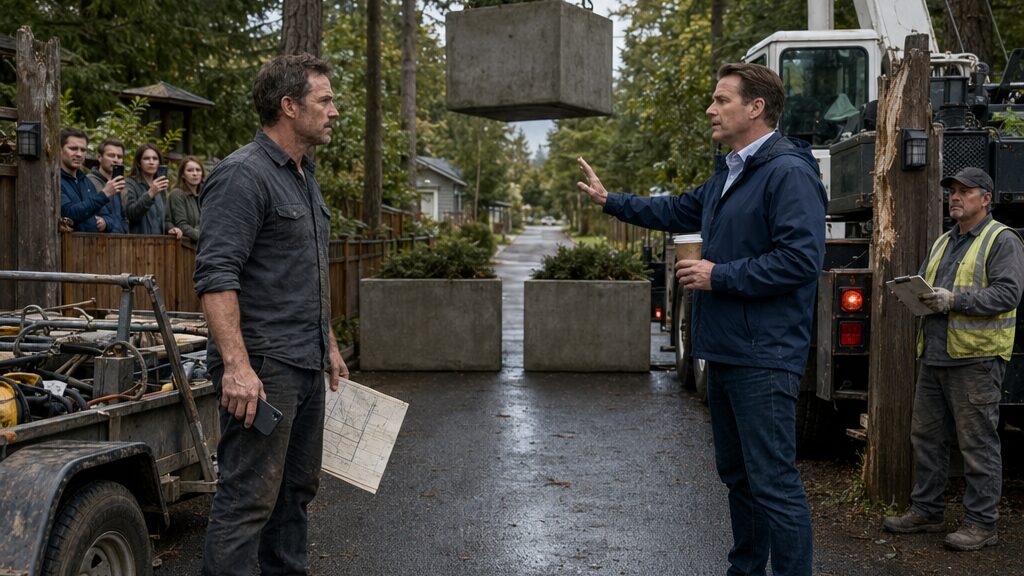
The concrete planter hung six feet above Richard Harris’s only way out.
Its square gray body swayed beneath the crane cable, shedding crumbs of dried soil onto the narrow lane. Behind Richard, his enclosed work trailer sat hitched to his pickup, loaded with restored walnut cabinetry due at a client’s house before noon. Ahead of him, two identical planters already blocked most of the opening between the cedar gateposts.
A man in a reflective vest raised one hand toward the crane operator.
“Hold it there.”
Richard stepped out of the truck.
The lane was barely wide enough for two vehicles to pass without one easing onto the gravel shoulder. On one side stood a row of mature cedars. On the other, a low split-rail fence separated the lane from the first homes in Cedar Ridge Estates. Curtains had already shifted in two front windows.
Scott Wilson stood beside the crane truck holding a paper coffee cup.
He wore dark jeans, polished boots, and a navy rain jacket with the subdivision’s small green emblem stitched over the chest. He looked less like a man supervising heavy equipment than someone waiting for a photographer.
Richard closed his truck door carefully.
“What are you doing?”
Scott looked at the suspended planter, then back at Richard. “Completing the safety project approved by the board.”
“You’re blocking my access.”
“We’re restricting unauthorized commercial traffic.”
“My trailer is behind your barriers.”
“That’s unfortunate.”
Richard felt the old, immediate pressure behind his ribs—the same pressure he had felt as a teenager when his father told him never to let anyone speak as though the workshop were a favor granted by the neighborhood.
He looked at the concrete planter. Then at the crane operator. Then at the two planters already sitting across the lane.
He did not touch anything.
“Lower that and you’ll close the only recorded access to my parcel.”
Several residents had gathered near the fence. A phone rose among them.
Scott noticed it too. His shoulders settled.
“The association has received repeated complaints about truck traffic, noise, and damage to common property. You were notified.”
“I received a notice about a meeting next month.”
“You received notice that the board was reviewing safety measures.”
“That isn’t permission to block an easement.”
Scott took a slow drink of coffee. “The association attorney disagrees.”
Richard glanced toward the crane operator. The man avoided his eyes.
Richard walked back to his pickup, opened the passenger door, and reached beneath a stack of invoices. The map was where he always kept it: folded into quarters inside a cloudy plastic sleeve, the paper yellowed at its creases.
His father had called it the only document that mattered.
Richard returned and unfolded it across the hood.
The drawing showed the original Harris parcel before the subdivision existed—a broad tract of timber and pasture divided by a single access lane. A faded ink line ran from the county road to the rear workshop lot. Beside it, in typewriter lettering, was the recording reference.
Richard held the map up where Scott and the crane operator could see it.
“Easement recorded in Book 311, Page 84. Access for the benefit of the rear parcel and its successors. It predates Cedar Ridge by twenty-seven years.”
One of the residents lowered her phone slightly.
Scott did not.
“The board reviewed your document.”
“Then the board knows this lane isn’t yours to close.”
“The board knows the language doesn’t give you unlimited commercial use.”
Richard’s jaw tightened.
There it was—not denial, but a narrowing. Scott had expected the map. He had prepared an answer.
The suspended planter turned half an inch in the air.
Richard looked at the delivery driver standing near the crane controls. “What’s your name?”
The man hesitated. “I’m just contracted to place these.”
“I’m not asking you to take sides. I’m asking you to note that I told you this placement blocks a recorded access easement.”
Scott stepped closer. “Do not involve the crew in a legal dispute.”
Richard took out his phone and began photographing the lane: the first planter, the second, the trailer behind him, the crane cable, the cedar posts, Scott’s truck parked near the entrance.
A resident called from the fence, “Maybe you should’ve followed the rules before it got to this.”
Richard turned.
It was a man he knew only by sight, someone who had moved in after the old pasture became twelve homes with matching mailboxes. Beside him, a woman kept filming.
“What rule permits blocking somebody’s property?” Richard asked.
The man shrugged. “We’ve all seen your trucks.”
“My trucks use a recorded lane.”
“They’ve cracked the pavement.”
Scott raised a calming hand, though no one had raised their voice except the neighbor. “This is exactly why the board acted. The situation has become unsafe and confrontational.”
Richard stared at him.
Scott had put a crane across his exit before eight in the morning, then called Richard confrontational for standing beside it.
For one dangerous second, Richard imagined climbing into the crane cab and moving the planter himself. He imagined towing the other two into Scott’s front yard. He imagined the satisfying scrape of concrete across fresh asphalt.
Instead, he turned back to the delivery driver.
“Would you record my objection on your work order?”
The man glanced at Scott.
Scott said, “You don’t need to do that.”
The driver looked at the loaded trailer trapped behind the planters. His expression changed—not sympathy exactly, but calculation. He pulled a folded form from the truck’s dashboard.
“I can note site conditions.”
“Write that the property owner presented a recorded easement and stated the placement would block vehicle access.”
Scott’s face hardened. “Richard, you’re obstructing authorized work.”
“I’m standing on my easement.”
“You’re standing in a common lane.”
“Those can be the same piece of ground.”
The driver wrote.
It was a small thing. It did not move the concrete. It did not free the trailer. But when he tore off the carbon copy and handed it to Richard, the residents’ phones shifted toward Scott instead.
The crane operator lowered the final planter.
Its base met the pavement with a dull, final sound.
Only a narrow gap remained—wide enough for a person, perhaps a wheelbarrow, but not Richard’s pickup. Not his trailer. Not the delivery promised for noon.
Scott folded his arms.
“The board will consider your access concerns at the regular meeting.”
“When?”
“Thirty days.”
Richard looked past him at the three planters.
The walnut cabinetry in his trailer had taken six weeks to restore. The client had delayed installation twice already while other contractors waited. Richard had payroll due Friday and less than three weeks of operating cash if invoices stopped moving.
“You expect me to close my business for a month?”
“I expect you to comply while the board reviews appropriate use.”
Scott walked toward his SUV.
Richard refolded the map, pressing each old crease flat with his thumb. Around him, the residents began drifting back toward their houses, still talking quietly, as if they had witnessed a disturbance that had now been contained.
The delivery driver climbed into the crane truck.
Before starting the engine, he leaned out of the window. “You might want to get something filed today.”
Richard looked at the trapped trailer, then at the carbon copy in his hand.
Scott’s SUV paused at the end of the lane. The window lowered.
“Thirty days,” Scott repeated.
Then he drove away.
Chapter 2: Every Blocked Workday Put Another Contract at Risk
At 12:17 p.m., Richard’s client said, “If the cabinets aren’t here by Friday, I cancel the contract.”
Richard stood inside the workshop with his phone pressed to his ear. Through the open bay door he could see the back of his pickup and the white trailer beyond it, both useless behind the concrete planters two hundred yards down the lane.
“I can get them there,” Richard said.
“How?”
He had no answer that would survive being spoken aloud.
The cabinets filled most of the trailer. Each section had been measured for a historic house outside McMinnville, where the kitchen walls were neither square nor level. Unloading the pieces by hand, carrying them through the narrow pedestrian gap, and transferring them to another truck would take half a day and risk damaging finishes that had cured only forty-eight hours earlier.
The client exhaled. “I have installers standing by. The stone contractor is scheduled after them. This isn’t just your delay.”
“I understand.”
“The contract is forty-two thousand dollars, Richard. I can’t let the whole project drift.”
“Friday,” Richard said. “You’ll have them Friday.”
When the call ended, the workshop seemed unnaturally still.
His father’s photograph hung above the small office desk: broad shoulders, work shirt buttoned to the throat, one hand resting on the same walnut workbench Richard still used. Beneath the photograph, a brass plaque read HARRIS RESTORATION—BUILT TO LAST.
Richard turned the plaque facedown.
By two o’clock he had called three tow operators. The first would not attempt to lift the loaded trailer over the planters. The second said the lane was too narrow for a recovery boom. The third suggested dismantling part of the fence, then warned that doing so might violate HOA common-property rules.
Richard called the county code office.
The officer who answered listened, then said, “An easement dispute is generally civil.”
“They’ve blocked emergency and business access.”
“Do you reside on the rear parcel?”
“No. It’s a workshop.”
“Then emergency access may not apply the way you think. You need an attorney.”
Richard looked at the map on his desk.
His father had never needed an attorney to use the lane.
By late afternoon, Richard was in Kevin Anderson’s office above a hardware store near the county courthouse. The reception area smelled faintly of copier toner and old carpet. Kevin read the deed twice, then examined Richard’s photographs and the crane driver’s carbon copy.
“This helps,” he said.
“Helps me get the barriers moved?”
“It helps establish notice and intentional obstruction.”
Richard leaned forward. “The easement is recorded. What else is there?”
Kevin tapped the deed. “Recorded doesn’t mean unlimited. It means enforceable according to its terms.”
“The terms say access.”
“They say ingress and egress for the benefit of the rear parcel.”
“That’s access.”
“Yes. But Scott’s argument will be that the nature and intensity of your use have changed.”
Richard sat back. “The workshop has been there since before the subdivision.”
“Was it operating at the same scale?”
“My father worked there.”
“With enclosed trailers? Employee vehicles? Commercial deliveries?”
Richard did not answer.
Kevin turned to the map. “The HOA cannot vote an easement out of existence. That part is straightforward. But if they claim your present use overburdens it, we need the historical record.”
“The historical record is my family using that lane.”
“Courts prefer paper.”
The next morning Richard went to the county records office.
A clerk brought him a scanned copy of the original deed, then pulled the subdivision plat and displayed it beside the faded map on a wide monitor. The old ink line and the digital parcel boundary aligned almost exactly.
Richard felt his first clean breath since the crane arrived.
“There,” he said. “The lane remained when they created the subdivision.”
The clerk enlarged the plat. A notation near the rear parcel referenced the earlier recording number.
“The subdivision took title subject to the easement,” she said.
“So the HOA can’t block it.”
“I can tell you what the documents show. I can’t give legal advice.”
“But it predates them.”
“Yes.”
Richard photographed the screen, placing his father’s map beside it for scale. Old paper against digital lines. Past and present agreeing.
Then the clerk frowned.
“What?”
She pointed to a small notation beneath the deed reference. “There’s another instrument.”
Richard leaned closer.
The line was faint: Maintenance terms per private memorandum dated June 14, 1998.
“I’ve never seen that.”
“It may not have been recorded.”
“Then why is it referenced?”
“Sometimes surveyors note documents provided during plat preparation.”
“Can you pull it?”
“Not if it was private.”
Richard called Kevin from the hallway.
Kevin was silent for several seconds after Richard read the notation.
“That matters,” he said.
“My father never mentioned it.”
“It may be nothing more than a cost-sharing letter.”
“Or?”
“Or it may define the use everyone assumed when the subdivision was created.”
Richard looked through the glass doors toward the parking lot. Cars moved freely in and out.
“What do we know for certain?”
“That your access right is real,” Kevin said. “The HOA cannot simply erase it. But we still don’t know whether your current traffic exceeds what the parties originally contemplated.”
Relief had lasted less than five minutes.
Richard spent Wednesday arranging a temporary transfer of smaller tools through the gap between the planters. He carried two compressors by hand, then a box of brass fittings, then three lengths of trim wrapped in moving blankets. Each trip took him past the fresh concrete bases.
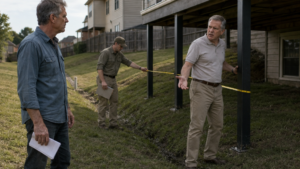
On the fourth trip, he noticed the scrape marks on the cedar gateposts.
One post had a shallow gray streak at bumper height. The other had a deeper gouge with splintered wood exposed beneath old stain. Richard remembered clipping it with the trailer the previous winter while backing out in rain.
He had meant to repair it.
He had forgotten.
His phone rang as he set down the trim.
Emily.
He nearly let it go to voicemail. They had spoken only twice since settling their father’s estate, both times about taxes.
“Richard,” she said when he answered, “Scott Wilson called me.”
His grip tightened on the phone.
“Why?”
“He made an offer for my half of the workshop parcel.”
Richard looked toward the blocked lane.
“How much?”
“Enough that I have to consider it.”
“You don’t sell half an easement to the man blocking it.”
“I own half the property, not half an argument.”
“He’s trying to force us out.”
“He said the HOA would waive claims against the parcel if I cooperated.”
“What claims?”
There was a pause.
“Richard,” Emily said, “before you decide Dad told you everything, you should come to the house tomorrow.”
Chapter 3: His Sister Remembered the Agreement Their Father Never Mentioned
Emily placed Scott Wilson’s purchase offer beside their father’s photograph.
The clean white pages looked almost luminous against the dark oak table. At the top was a number Richard had not expected—high enough to pay off Emily’s mortgage and leave something behind.
He did not sit.
“You invited him to make this?”
“No.”
“But you’re considering it.”
“I’m considering not spending the next two years paying lawyers over a building I don’t use.”
The family house had changed since Richard last came inside. Emily had removed the heavy curtains from the dining room and painted the walls a soft gray. Their father’s photograph remained on the sideboard because neither of them had decided who should take it.
In the picture, he stood beside the workshop in 1999, one hand on the old cedar gate. The posts had been newly stained then, their edges square and unscarred.
Richard tapped the offer.
“He blocked access before contacting you. That tells you what this is.”
“It tells me he knows pressure works.”
“You sound impressed.”
“I sound tired.”
Emily folded her arms. She was four years younger, but when she held herself that way Richard saw their mother—still, precise, unwilling to waste energy on volume.
“Scott said the HOA has records showing Dad agreed to share maintenance costs,” she said.
Richard laughed once. “Scott says a lot.”
“I remember the agreement.”
The room seemed to narrow.
“You were twenty.”
“I was twenty-two.”
“You weren’t involved in the business.”
“No. I was involved in listening through the kitchen wall while Dad argued with Carolyn Wright.”
Richard looked toward the photograph.
“What agreement?”
Emily went to the sideboard and opened the bottom drawer. She removed a flat cardboard file box, the kind their father had used for tax receipts. Dust marked its edges.
“I found this when we cleaned out the den. I didn’t know what mattered, so I kept all of it.”
“You told me there was nothing related to the workshop.”
“I told you there was nothing recorded.”
“That isn’t the same thing.”
“No,” she said. “It isn’t.”
She set the box on the table.
Inside were repair estimates, handwritten notes, copies of old HOA newsletters, and several envelopes addressed to their father. Richard recognized his writing on none of them.
Emily lifted the faded easement map from the top of the pile.
Richard reached for it, then stopped.
It was not his copy. This one had been folded around a yellowed estimate from a paving company. The estimate described grading, drainage correction, and resurfacing of the access lane. At the bottom, someone had divided the projected cost into percentages.
HOA: 70%.
Harris parcel: 30%.
The signature line beneath their father’s name was blank.
“He didn’t sign it,” Richard said.
“Not that version.”
Emily pulled out a carbon copy of a one-page memorandum.
The text was brief. The HOA would maintain the paved portion of the lane. The Harris parcel owner would contribute thirty percent of extraordinary repair costs associated with heavy or commercial use. In exchange, the association acknowledged continued access to the workshop.
At the bottom was their father’s signature.
Richard studied it too long, hoping familiarity would expose a forgery. The long downward stroke of the H, the cramped final s—both were his.
“Why wasn’t this recorded?”
“It was private.”
“Then it doesn’t change the deed.”
“I didn’t say it changed the deed.”
“That’s exactly what Scott wants people to believe.”
Emily sat across from him. “Dad paid for a while.”
Richard looked up.
“How do you know?”
“I deposited the checks when I worked summers at the shop.”
“He never told me.”
“You never asked who paid for anything.”
The words landed harder because she did not sharpen them.
Richard turned through the papers. There were copies of checks from 1999, 2001, 2003. Then nothing. Several letters followed, each requesting payment toward lane repairs. One included photographs of drainage damage near the gateposts.
“What happened?”
Emily looked at their father’s photograph rather than Richard.
“The board replaced the original gravel shoulder with decorative curbing. Dad said it made turning the trailer harder. They said he was damaging landscaping. He refused the next assessment.”
“That sounds like him.”
“He said if they wanted a suburban road, they could pay for it.”
Richard felt an unwilling flicker of recognition. Their father could make fairness sound like surrender whenever another person defined it first.
“How much did they claim he owed?”
“I don’t know. It kept changing.”
“Did he dispute the amount?”
“He stopped opening the letters.”
Richard pushed back from the table. “And you knew this when we settled the estate?”
“I knew there had been an argument. I didn’t know Scott would use it to block the lane.”
“You knew there was an agreement.”
“I knew Dad had signed a paper twenty-five years ago. I also knew what you would do if I showed you.”
“What would I do?”
“You’d say acknowledging it meant calling him a liar.”
Richard looked at her.
Emily’s eyes were wet, but her voice stayed level.
“You made him a promise at the hospital. I heard you. You said you wouldn’t let anyone take the workshop. After that, every question about the property became an accusation.”
“He built that business.”
“He also left us a problem.”
“He left us a livelihood.”
“He left you a livelihood. He left me half the taxes.”
Richard turned away.
Through the dining-room window he could see the slope down toward Cedar Ridge. Roofs showed between the trees, newer houses built where their father’s pasture had once run. The subdivision had arrived in pieces: first three homes, then eight, then paved sidewalks and uniform cedar mailboxes. Their father had complained about each addition and cashed each land-sale check.
Richard had never held those two facts together.
Emily slid Scott’s offer toward him.
“I don’t want to fight the whole neighborhood because Dad decided every repair bill was an insult.”
“Scott didn’t send a repair bill. He brought a crane.”
“I know.”
“Then why are you helping him?”
“I’m trying to protect myself.”
“By selling him the piece he needs?”
Her expression changed.
Richard turned back. “What?”
“He didn’t just offer to buy my share.”
“What else?”
“He showed me a concept plan.”
Scott wanted to merge the workshop parcel with a narrow strip of HOA common land and an adjoining lot he already controlled. The access lane would become a private gated drive for six high-end homes. The workshop would be removed.
Richard felt the old pressure rise again.
“He can’t build over an easement.”
“He thinks he can if the dominant parcel stops using it commercially.”
“So he blocks commercial use, makes the workshop worthless, then buys us out.”
“That’s what it looks like.”
“And you’re still considering the offer?”
Emily pressed her fingertips against the table.
“I’m considering whether you can afford not to.”
The sentence was quieter than anything else she had said.
Richard looked at the repair memorandum again. Thirty percent. His father’s signature. Years of unanswered letters.
For the first time, he could see how Scott would frame the dispute at a board meeting: not as a developer erasing an old right, but as an association protecting residents from a business that used common infrastructure without paying its share.
The argument was incomplete.
That did not make it harmless.
“When do you have to answer?” Richard asked.
“One week.”
He folded the memorandum along its existing crease and placed it inside the map.
Emily watched him.
“You can’t hide that.”
“I’m not hiding it.”
“You put it inside the map.”
“That’s where Dad kept it.”
“That isn’t an answer.”
Richard picked up the file box. “I need copies.”
“Take it.”
He stopped at the doorway.
“Why tell me now?”
Emily looked at the purchase offer beside their father’s photograph.
“Because I don’t want Scott to win by lying,” she said. “And I don’t want you to win by pretending Dad never did.”
Richard drove back to the workshop after dark. The three planters reflected his headlights at the lane entrance, pale and immovable.
He carried the file box through the narrow gap.
Inside the office, his phone was ringing.
Kevin spoke before Richard could say hello.
“Scott filed notice for an emergency HOA vote Monday night.”
“On what?”
“A resolution restricting the lane to residential and emergency access only. No commercial vehicles, no trailers, no customer deliveries.”
Richard looked at the map on his desk, now wrapped around the agreement his father had never mentioned.
“If they pass it?”
“We challenge it,” Kevin said. “But before we do, you need to decide what truth you’re willing to put in front of a judge.”
The line went quiet.
Outside, beyond the workshop wall, the blocked lane waited under the dark cedars.
Chapter 4: The Temporary Victory Exposed the Weakness in His Own Claim
Scott’s first exhibit was a photograph of the cedar gatepost Richard had struck the previous winter.
The image filled the courtroom monitor: splintered wood, a gray scrape at bumper height, and a measuring tape held beside the gouge. The next photograph showed a crack crossing the paved lane. A third showed muddy tire tracks pressed into the shoulder near a resident’s mailbox.
Richard sat beside Kevin at the petitioner’s table and felt every pair of eyes turn toward him.
“This is not a case about preventing lawful access,” Scott’s attorney said. “The association is responding to a pattern of intensified commercial use that has damaged common property and created safety concerns.”
Scott sat behind his attorney in a charcoal jacket, hands folded neatly. He did not look at Richard.
Kevin slid a note across the table.
Do not argue with photographs.
Richard read it twice.
The emergency hearing had been scheduled because the concrete planters prevented any vehicle from reaching the rear parcel. Kevin had filed declarations from the commercial client, the crane operator, and Richard himself. The client confirmed that delay threatened a $42,000 contract. The crane operator’s work order confirmed that Richard had presented a recorded easement before the third planter was lowered.
Richard had expected the hearing to be simple.
The lane existed. The easement existed. The planters blocked it.
Then Scott had brought photographs.
The judge studied the damaged gatepost. “Mr. Harris, did your vehicle cause this?”
Kevin shifted slightly beside him.
Richard could have said he did not remember. He could have pointed out that delivery trucks, landscapers, and residents also used the lane. He could have insisted the question had nothing to do with whether Scott possessed authority to block it.
Instead he said, “My trailer clipped that post last winter.”
Scott finally looked at him.
“And the pavement crack?” the judge asked.
“I don’t know who caused it.”
“Could your trucks have contributed?”
Richard’s father seemed to answer from somewhere behind his thoughts: Never volunteer what they cannot prove.
Richard looked at the photograph again.
“Yes,” he said. “They could have.”
The judge removed her glasses.
“That does not authorize complete obstruction,” she said. “It does, however, bear on the scope and burden of use.”
Scott’s attorney stood. “The association offered pedestrian access.”
“To a commercial workshop,” Kevin said. “My client cannot carry installed cabinetry through a thirty-inch opening.”
“The association’s position is that heavy commercial use was never granted.”
Kevin placed the original deed and subdivision plat before the judge. “The rear parcel was already improved with a workshop when the subdivision plat acknowledged the easement. The association acquired its interest subject to that right. It cannot create leverage by physically extinguishing access first and debating scope later.”
The judge traced the old lane on the copied map with one finger. At the deed language, she drew a small circle in blue ink around the words ingress and egress. Then she circled for the benefit of the rear parcel.
Two circles. One right. One uncertainty.
“The petitioner has shown likely entitlement to meaningful access,” she said. “The association has shown a legitimate dispute concerning intensity, maintenance, and commercial burden. Those questions require evidence beyond what is before me today.”
Richard’s pulse slowed.
The judge ordered the HOA to move one planter far enough to permit a single vehicle and trailer to pass. The remaining two could stay temporarily as traffic-control measures, provided the opening remained unobstructed during agreed delivery hours.
Richard should have felt vindicated.
Instead, all he could see were the two blue circles.
Outside the courthouse, Scott caught up with him near the steps.
“You could have accepted controlled access on Monday,” Scott said.
“You offered a pedestrian gap.”
“We offered time to negotiate.”
“You gave me thirty days with my equipment trapped.”
Scott’s expression tightened. “Because every time the board raises limits, you act as if the neighborhood has declared war on your father.”
Richard stepped closer before he caught himself.
Scott did not move.
“The road is cracking,” Scott continued. “The drainage system is failing. Some of the residents you think are conspiring against you are retired. One special assessment could force them to sell.”
“And your answer is to destroy my business?”
“My answer is to stop pretending your use costs everyone else nothing.”
Kevin appeared at Richard’s shoulder. “This conversation is done.”
Scott glanced at him. “Then tell your client to read the maintenance records before the full hearing.”
Richard watched Scott walk away.
By noon the next day, the crane truck returned.
This time several residents stood outside without phones. The driver recognized Richard and gave him a brief nod. He attached the cable to the center planter and lifted it just high enough for the concrete base to clear the asphalt.
As it swung aside, the lane reopened in a narrow straight line.
Richard drove through slowly, mirrors folded in. The trailer passed the first planter with less than eight inches to spare. Near the cedar posts, he stopped, got out, and checked the clearance before continuing.
A neighbor waited near the fence.
“You admitted the damage,” the man said.
Richard closed the truck door. “Some of it.”
“So you do know why people are upset.”
Richard looked at the gouged cedar.
“I know why they should’ve sent me a bill.”
“They did. For years.”
Richard said nothing.
At the client’s house, the installers helped him unload the cabinetry. The client inspected the finish, then looked at the clock.
“You made Friday.”
“Barely.”
“I heard something about an HOA.”
“It’s being handled.”
The client ran a hand over the walnut panel. “I need the remaining pieces next week.”
Richard had saved the first delivery, not the contract. The order protected only limited passage, and every trip now required coordination with the HOA. His work calendar depended on permission from people who had already tried to close the lane.
On Monday evening, the clubhouse was full before the emergency meeting began.
Scott distributed a proposed resolution restricting the easement to residential access, emergency vehicles, and one scheduled commercial movement per week. Attached was an invoice demanding reimbursement for twelve years of extraordinary maintenance.
The total was $38,640.
Richard stared at the number.
Some charges were recent. Others reached back to years when the association had repaved the entire entrance, replaced drainage grates, and installed curbing he had never requested.
“You can’t assign all of this to us,” he said.
Scott remained seated at the head of the table. “Thirty percent of extraordinary repairs associated with commercial use. That is the agreement your father signed.”
A murmur moved through the room.
Emily sat against the rear wall. She did not look away from Richard.
He could have denied knowing about the memorandum. He could have made Scott produce it first.
Instead he said, “The agreement exists. The amount is disputed.”
The room quieted.
Scott had expected resistance. The admission unsettled him more than a denial would have.
One board member asked, “Then why hasn’t anything been paid?”
Richard looked at his father’s signature on the copy before him.
“I’m still finding that out.”
After the meeting adjourned without a vote, Richard gathered his papers slowly. The temporary order remained in effect, but Scott had transformed the dispute. The neighborhood was no longer asking whether Richard had access. They were asking what access had cost them.
Carolyn Wright waited near the door.
She had served as treasurer longer than Scott had owned property in Cedar Ridge. Richard remembered her bringing casseroles after his mother died and refusing payment when his father repaired her porch railing.
Now she held her purse against her ribs with both hands.
“Richard,” she said quietly, “come to my house tomorrow night.”
“For what?”
“There are records Scott didn’t show tonight.”
“Then bring them to the board.”
Her eyes moved toward Scott, who was speaking with two residents across the room.
“I can’t—not yet.”
“Why not?”
Carolyn lowered her voice.
“Because if I put them in the record before you understand what they mean, Scott won’t be the only person the neighborhood blames.”
Chapter 5: The Treasurer’s Records Showed Why the HOA Needed Him Gone
Carolyn’s budget projected a special assessment of $14,800 per home.
She placed the spreadsheet on her kitchen table between two untouched mugs of coffee. The final column was highlighted in yellow. Roof drainage. Culvert replacement. Lane stabilization. Retaining work near the eastern slope.
Richard read the total twice.
“Eight hundred and eighty-eight thousand dollars?”
“That is the engineer’s upper estimate.”
“For drainage?”
“For twenty years of postponing drainage.”
Carolyn sat opposite him. Her kitchen was small and meticulously ordered, but paper boxes crowded the wall near the pantry. Each was labeled by year in black marker.
“Why wasn’t this discussed at the meeting?”
“It has been discussed. Just never with the full number in one place.”
“Scott said his restrictions were about safety.”
“They are partly about safety.”
“And the rest?”
Carolyn opened another folder.
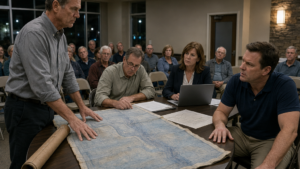
Inside was a glossy concept plan for six gated homes on the combined rear parcels. A shaded private drive ran directly over the existing access lane. At the entrance stood a stone gatehouse where the concrete planters now sat.
Richard unfolded his father’s faded map and laid it over the proposal.
The old access line cut through the center of Scott’s planned gate.
“He needs the easement gone,” Richard said.
“He needs it reduced enough that lenders will treat it as manageable.”
Carolyn tapped the budget. “Scott’s development group offered to fund the drainage work and contribute to the reserve account if the HOA approved the land combination and private-road plan.”
Richard looked at the assessment again.
For a retired resident living on a fixed income, $14,800 was not an inconvenience. It was a loan, a second job, or a sale.
“That’s why the board followed him.”
“That is why some of them did.”
“And you?”
Carolyn turned her mug without drinking from it.
“I spent twelve years telling people we could manage one more winter.”
“You knew the system was failing.”
“I knew the reserve was insufficient. I also knew several owners could not pay what repairs would cost.”
“So Scott offered a solution.”
“He offered money with conditions.”
Richard moved the transparent edge of the old map against the development plan. The lane his father had guarded for decades disappeared beneath landscaping, a wall, and six rectangular homes.
“Did he tell the board he intended to buy Emily’s share?”
“Not at first.”
“But you knew.”
“I saw the purchase option in a financing packet.”
Richard leaned back. “You let him put barriers across the lane.”
Carolyn flinched.
“I voted for temporary traffic controls.”
“Those were not traffic controls.”
“No.”
“You watched them install three concrete planters.”
“I thought one would remain movable.”
“He trapped my trailer.”
“I know.”
Her voice carried no defense, which made Richard’s anger harder to hold cleanly.
“Why call me here?”
“Because you are treating the board as if everyone wanted your workshop gone. Some wanted the road protected. Some wanted to avoid bankruptcy. Some believed Scott when he said the easement could be limited without litigation.”
“And you believed him?”
“I wanted to.”
Carolyn opened a third folder and removed a consultant’s letter.
The top line identified a land-use and insurance firm. The date was six weeks before the barriers were installed.
Richard read the first paragraph.
The consultant warned that complete physical obstruction of the recorded easement could expose the association to injunctive relief, business-loss claims, and attorney fees. It recommended negotiated delivery hours, vehicle-size limits, and a maintenance agreement.
Richard read the sentence again.
“Scott had this?”
“He received it as president.”
“Did the board?”
“A summary.”
“Not the warning?”
Carolyn shook her head.
Richard set the paper down carefully. “He knew.”
“Yes.”
“And he ordered the planters anyway.”
“Yes.”
“Why?”
“Because his lender wanted evidence that the HOA was prepared to control commercial access.”
The answer was smaller and uglier than a conspiracy. Scott had needed a visible act. The planters were not merely an obstruction. They were proof for someone else.
Richard looked at Carolyn. “Give me a copy.”
“I will.”
“Tonight.”
“On one condition.”
He waited.
“You stop saying your family owes nothing.”
The kitchen clock clicked behind him.
Carolyn slid a ledger across the table. Several entries were marked HARRIS SHARE. Some had been paid. Later ones were carried forward. Interest had been added informally, then removed, then added again under a different board.
“The amount Scott presented is inflated,” she said. “It includes improvements that benefited the whole subdivision. But your father did stop paying. Heavy vehicles did contribute to repairs. The fair amount will not be zero.”
Richard closed the ledger.
“You want me to admit debt before you release evidence Scott hid?”
“I want to know I am not helping one man conceal the truth so another man can conceal a different truth.”
“You sat on this letter.”
“I did.”
“For six weeks.”
“Yes.”
“And now you want to measure my honesty?”
Carolyn met his eyes.
“I am measuring whether anything changes after I stop being a coward.”
The words settled between them.
Richard looked down at his father’s map. For years, the faded line had meant one thing: ours. It had never shown cracked asphalt, drainage bills, or the neighbors whose roofs and foundations were tied to the same failing culvert.
“What is the fair amount?” he asked.
“I don’t know yet. We would need to separate ordinary association improvements from damage associated with the workshop.”
“And if I agree to that?”
“I give the full records to the board.”
“Not just to Kevin.”
“To everyone.”
Richard folded the map but left the consultant’s letter exposed.
“Scott will say you’re protecting an old friend.”
“I have not behaved like one.”
“No.”
Carolyn accepted that without protest.
Before Richard left, she showed him one final document: an email Scott had sent to the board that afternoon.
Subject: Permanent Safety Installation Following Vote.
A concrete barrier, longer and heavier than the planters, had been reserved for delivery after Monday’s meeting. Once installed, it would span the remaining opening in the lane.
Scott had written that the barrier would protect residents while legal questions were resolved.
Richard stared at the delivery date.
“He ordered it before the vote.”
“He called it contingency planning.”
Richard photographed the email.
Outside, the neighborhood was quiet. Porch lights shone through cedar branches. The lane curved beyond Carolyn’s house toward the workshop, where the planters sat pale under the entrance lamp.
For the first time, Richard understood why residents had allowed Scott to lead them. He had given fear a budget, then offered himself as the only person willing to solve it.
That did not excuse him.
It made him harder to defeat.
The next morning Richard met Kevin at the workshop. He placed the maintenance memorandum, ledger copies, development plan, consultant’s warning, and Scott’s email across the workbench.
Kevin read in silence.
“This letter changes the board’s exposure,” he said.
“It doesn’t erase the maintenance agreement.”
“No.”
“I’m going to admit that.”
Kevin looked up. “At the hearing?”
“At the vote.”
“That may weaken your negotiating position.”
“It already exists. Hiding it doesn’t make me stronger.”
Kevin studied him for a moment. “What changed?”
Richard glanced at his father’s photograph.
“I finally read the part of the map that wasn’t drawn.”
By Friday, Scott had posted the meeting notice at the clubhouse and emailed every owner. The resolution would terminate commercial vehicle use, authorize permanent safety barriers, and begin negotiations to purchase the rear parcel.
At the bottom, in bold, was the time of the vote.
Monday, 7:00 p.m.
Richard drove through the narrow opening that afternoon and saw fresh orange paint on the pavement where the permanent barrier would be anchored.
Scott had marked the road before anyone had voted.
Chapter 6: He Could Save the Road Only by Telling the Whole Truth
The permanent concrete barrier was already on the delivery truck when Richard arrived at the clubhouse.
It lay strapped to a flatbed beyond the parking lot, long enough to span the entire lane. Two workers stood beside it drinking from paper cups, waiting for instructions. Orange anchor marks remained visible on the pavement near the planters.
Inside, every chair was occupied.
Richard carried a document tube under one arm and the file box under the other. Emily sat near the back. Carolyn was at the treasurer’s table with her hands folded over a closed binder. Kevin took a seat along the wall, present as counsel but not beside Richard.
Scott stood at the front beneath the Cedar Ridge emblem.
“The board will first consider Resolution 24-11,” he said. “This measure addresses repeated commercial overuse, documented property damage, and continuing liability along the common access lane.”
He spoke evenly. No triumph. No anger. He sounded like a man solving an unpleasant problem others had refused to face.
A board member read the proposed restrictions: residential vehicles only, emergency access preserved, no trailers, no commercial deliveries, permanent barrier authorized.
Scott turned toward Richard.
“Mr. Harris will have ten minutes.”
Richard set the file box on the front table.
“Before I speak,” he said, “I want the maintenance memorandum entered into the record.”
A rustle passed through the room.
Scott’s expression did not change, but his fingers tightened around the edge of the lectern.
Richard handed copies to the board.
“My father signed this in 1998. The Harris parcel agreed to contribute thirty percent of extraordinary lane repairs associated with heavy or commercial use.”
A neighbor near the aisle said, “So you knew.”
“I learned the full terms last week.”
“You said the HOA had no claim.”
“I said the HOA had no right to block the easement. That remains true. I was wrong when I said my family owed nothing.”
The room became still.
Richard could feel Emily watching him.
He continued before pride could offer him another route.
“My father made payments for several years. Then he stopped after a dispute about curbing and road design. Some bills were questionable. Some were not. He ignored both.”
Scott stepped forward. “Which demonstrates the association’s position. The commercial operation has burdened residents for years without meeting its obligations.”
“It demonstrates part of your position.”
Richard opened the document tube and removed the faded map.
He unfolded it across the table, then placed the maintenance memorandum beside it.
“This map proves access. The memorandum proves responsibility. They do not cancel each other.”
One of the board members leaned closer.
Richard pointed to the cedar-lined lane.
“My trucks have contributed to wear. I clipped the west gatepost last winter. I did not repair it. I should have. I am willing to pay a fair share of documented extraordinary maintenance, including a reasonable amount from past years.”
A woman in the second row lowered the resolution packet onto her lap.
Scott said, “A fair share according to whom?”
“An independent engineer and accountant, not your development schedule and not my father’s pride.”
Scott’s jaw shifted.
Richard removed the glossy site plan and laid it over the map. The proposed gatehouse covered the easement line.
“This resolution is not only about road damage. Scott’s development financing depends on reducing this access.”
Scott gave a small shake of his head. “The development offers a solution to the drainage crisis this association has postponed for years.”
“That part is true.”
The admission changed the room again.
Richard looked at the residents.
“The drainage estimate is nearly nine hundred thousand dollars. The projected assessment is more than fourteen thousand dollars per home. Scott’s project would help pay for it.”
Several people turned toward Carolyn.
Scott seized the opening.
“Exactly. I am trying to prevent families from receiving bills they cannot afford. Mr. Harris is protecting an expanding commercial operation that benefits one parcel while distributing its costs across sixty.”
Richard saw, with sudden clarity, that Scott believed every word except the parts he had hidden.
Scott was not pretending the drainage problem existed. He had simply decided that controlling the solution entitled him to control the facts.
Richard said, “Then show them the consultant’s letter.”
Silence.
Scott glanced toward Carolyn.
“What letter?” a board member asked.
Carolyn opened the binder.
Scott spoke quickly. “Preliminary correspondence that did not reflect final legal guidance.”
Carolyn removed copies and passed them down the table.
“The consultant warned against complete obstruction,” she said. “It recommended negotiated delivery limits and shared maintenance. The full letter was not circulated.”
Scott’s face lost color.
“I summarized the relevant portions.”
“You omitted the association’s exposure to business-loss damages,” Carolyn said.
A resident asked, “Before the planters were installed?”
“Yes.”
Voices rose around the room.
Scott lifted one hand. “The board was facing an urgent liability issue. Mr. Harris refused informal restrictions.”
Richard felt the accusation strike where it was meant to.
“That is also true,” he said.
The voices stopped.
Scott looked at him.
Richard gripped the edge of the map.
“Scott proposed limited access before the installation. It was inadequate, and it came with no written protection for my business. But I rejected mediation before I knew the full maintenance history. I believed any compromise dishonored my father.”
Emily’s eyes closed briefly.
“He built the workshop,” Richard continued. “He also left bills unanswered because he could not separate being challenged from being wrong. I have been doing the same thing.”
No one applauded. No one needed to.
The board members looked less certain of Scott, but they also looked differently at Richard. Not innocent. Not defeated. Present.
Scott stepped away from the lectern and lowered his voice.
“I can reopen the lane tonight.”
Richard waited.
“Sign a permanent waiver of commercial rights,” Scott said. “You retain personal access. The association withdraws the maintenance claim. Your sister receives the purchase price already offered.”
Emily stood. “You made that offer contingent on his business failing?”
“I made an offer to resolve an unstable property arrangement.”
Richard looked through the clubhouse window at the barrier on the flatbed.
The offer would end the legal bills. Emily could sell. The HOA could fund repairs. Richard could keep the workshop building, at least temporarily, but not the work that gave it purpose.
His father’s promise returned to him: Do not let them take it.
For the first time, Richard understood that keeping the building empty would fulfill the sentence and betray its meaning.
“No,” he said.
Scott’s shoulders settled, as though he had expected stubbornness.
Richard continued. “I will agree to scheduled delivery hours, vehicle-size limits, insurance requirements, repairs to the gateposts, and an independently calculated maintenance share. I will not sign away the use that makes the easement necessary.”
Scott looked toward the board. “Then nothing has changed.”
Carolyn stood.
“One thing has.”
She distributed the remaining records: the consultant’s full warning, Scott’s email reserving the permanent barrier before the vote, and financing documents tying access restrictions to his development approval.
A board member read the email aloud.
“‘Installation to proceed immediately following anticipated authorization.’”
The word anticipated hung in the room.
“You ordered the barrier before this meeting?” another member asked.
Scott faced the table. “I reserved equipment so the association could act promptly.”
“You marked anchor points.”
“Contingency planning.”
“You told the lender we had committed to eliminating commercial use.”
Scott’s control finally cracked.
“Because the association needs the money. Everyone in this room knows it. You can condemn my process, but none of you produced another plan. The culvert fails, the slope moves, and then what? We send retirees a fifteen-thousand-dollar bill because Richard Harris wants to haul trailers whenever he pleases?”
Richard looked at the man across from him.
There was fear beneath the contempt. Fear of losing the project. Fear of being the person who promised rescue and delivered an assessment. Fear that without control he had nothing to offer.
But Scott had chosen to turn that fear into coercion.
The board recessed for twelve minutes.
No one left the room. Outside, the delivery workers remained beside the barrier.
When the board returned, the vice president read the motion.
Scott’s authority to act on behalf of the association was suspended pending review. Installation of permanent barriers was canceled. The commercial-access resolution was tabled. Temporary access under the court order would continue while the parties negotiated traffic and maintenance terms.
The vote was not unanimous.
It was enough.
Through the window, one worker climbed into the flatbed cab. The truck’s brake lights glowed red, then the barrier began moving away from the lane.
Richard’s phone vibrated.
The commercial client had sent a single message.
Final delivery required by Thursday. No further extension.
Richard looked at the date.
Three days.
The lane was still narrowed by two concrete planters, every trip still required coordination, and half the remaining cabinetry was not yet finished.
He had kept the right to reach his business.
Now he had to find out whether there was still a business left to reach.
Chapter 7: The Road Reopened, but It No Longer Belonged to One Family’s Version
The crane returned Wednesday morning, and this time its cable lifted the planters away from the lane.
Richard stood beside his pickup while the first concrete box rose from the pavement. Damp soil spilled over its rim, exposing pale roots from the ornamental grass Scott had chosen. The planter swung above the orange anchor marks, then settled onto the flatbed with a heavy scrape.
No residents held up phones.
The same delivery driver who had recorded Richard’s objection guided the crane operator with two raised fingers. When the second planter cleared the entrance, he looked toward Richard.
“You’ll have room now.”
Richard measured the opening with his eyes. “Enough for the trailer.”
“More than enough.”
He almost thanked the man for being right the first time, but the driver had not chosen where the planters went. He had only written down what happened.
“Appreciate the work-order note,” Richard said.
The driver nodded once. “Figured somebody ought to keep the sequence straight.”
By eight fifteen, the lane was open from the county road to the workshop. The concrete had left clean gray rectangles on the pavement, bordered by dirt and crushed cedar needles. The empty spaces looked temporary, as though something might still be lowered into them.
Richard backed the trailer through slowly.
At the gateposts, he stopped.
The west post still carried the gouge from his trailer. The splintered edge had darkened in the rain. He got out, ran his thumb along the damaged wood, then retrieved a tape measure and notebook from the truck.
The final cabinetry was not yet complete. He had less than thirty hours before the client’s deadline. Still, he wrote down the post dimensions before driving on.
Inside the workshop, sawdust covered the floor around the unfinished pieces. Richard worked until his hands cramped, stopping only to answer calls from Kevin.
The temporary access order remained in place, but the HOA’s insurer wanted immediate terms. No vehicle wider than a specified limit. No commercial movement before seven in the morning or after six in the evening. Heavy deliveries would require advance notice. Both sides would hire an engineer to separate ordinary infrastructure failure from workshop-related wear.
“And past maintenance?” Richard asked.
“Negotiated,” Kevin said. “Carolyn’s records support a lower figure than Scott demanded.”
“How much lower?”
“Probably between eleven and sixteen thousand.”
Richard looked at the open ledger on his desk.
The amount would hurt. It would not destroy him.
“I can put down five.”
“Five thousand?”
“Now.”
Kevin paused. “You do not have to make a payment before the allocation is final.”
“I know.”
“It could be interpreted as admitting the full claim.”
“Mark it as a good-faith contribution subject to final accounting.”
Another pause.
“You’ve been reading my emails,” Kevin said.
“I’ve been paying for them.”
By noon, Richard transferred $5,000 into an escrow account for lane repairs.
The money had been set aside for a new dust-collection system. He watched the confirmation appear on his phone, then returned to the workbench before he could calculate how many months it would take to replace.
Emily arrived shortly after four.
She stepped through the open bay door carrying sandwiches and the cardboard file box from the family house. Her gaze moved across the unfinished cabinet doors, clamps, and stacked trim.
“You look terrible,” she said.
“I’m ahead of schedule.”
“You have glue in your hair.”
“That means I’m working.”
She placed the food on the desk beneath their father’s photograph.
Richard kept sanding.
“Scott withdrew the purchase offer,” she said.
The sander stopped.
“He called you?”
“His attorney sent a notice. The financing contingency failed after the board suspended him.”
Richard set the tool down. “I’m sorry.”
Emily looked at him sharply. “Are you?”
“It was enough to change your life.”
“So is selling half of this place.”
He waited.
She opened the file box and removed a folder.
“I’ll keep my share for now.”
“For now?”
“I’m not making another permanent decision because a man with a development plan gives me seven days.”
Richard wiped dust from his hands.
“What do you need?”
“Quarterly accounts. Insurance statements. Tax records. Actual numbers, not Dad’s system of envelopes and memory.”
“That sounds expensive.”
“It sounds like co-ownership.”
He nodded.
Emily studied him as though waiting for resistance.
“And if the workshop loses money,” she said, “we discuss selling. We don’t turn it into a test of whether I loved him.”
Richard looked at their father’s photograph.
“Agreed.”
The word came out quietly.
Emily opened one of the sandwich wrappers. “That was suspiciously easy.”
“I paid five thousand toward the lane this morning.”
She stared at him.
“Voluntarily?”
“Don’t make it strange.”
“It is strange.”
“It was owed in some amount.”
Emily’s expression softened, but she did not praise him. That helped.
They ate standing at the workbench. Afterward she stayed to label hardware while Richard finished the last cabinet door. Near midnight, he found her asleep in the office chair with the maintenance memorandum resting on her lap.
He covered her with an old moving blanket and returned to work.
At nine the next morning, the client called.
Richard braced himself before answering.
“I heard the access issue was resolved,” the client said.
“Temporarily. I’m loading now.”
“I drove past yesterday.”
Richard glanced toward the open lane. “You came here?”
“I wanted to know whether I needed another contractor.”
“And?”
“I saw you working through the window.”
Richard waited.
“Deliver by three,” the client said. “The installers will stay.”
The loaded trailer cleared the gateposts at eleven forty-eight.
Richard had wrapped the west post in a moving pad, though the trailer never came close to touching it. He drove the lane at walking speed. Two residents waited near the entrance while a landscaper’s truck pulled aside for him. One of them raised a hand.
Richard returned the gesture.
There was no applause when he reached the client’s house. The installers complained about the delay, the stone contractor adjusted the schedule, and one cabinet face required a final correction on site.
By four thirty, the walnut pieces stood fitted against the old walls.
The client examined every seam.
“You saved it,” she said.
Richard looked at the cabinets. “We saved the contract.”
It was not the same as winning. It was better.
The final board session took place twelve days later.
Scott did not sit at the head table. He attended as an owner, three rows back, with no jacket carrying the Cedar Ridge emblem. When residents discussed the drainage deficit, he spoke once to defend the engineering estimates and once to warn that postponement would increase costs.
Both statements were accurate.
The board rejected his development arrangement and appointed an interim president. It also approved an independent drainage review rather than pretending his money had been unnecessary.
Kevin placed the new access agreement on the table.
The revised map showed the same lane as Richard’s father’s copy, but with details the old paper had never carried: delivery windows, turning clearances, drainage responsibilities, vehicle limits, and percentages for extraordinary repairs.
The Harris parcel would pay thirty percent of costs directly attributable to heavy use, plus an agreed settlement for unpaid historical maintenance. The HOA would keep the lane passable and could not install fixed barriers without court authorization or Richard’s written consent.
Richard signed first.
Emily signed beside him.
Carolyn signed for the association after the interim president.
Scott remained seated.
As the papers were gathered, he approached Richard.
“You understand the drainage work still has to be funded.”
“Yes.”
“The assessment may be worse without the development.”
“Yes.”
Scott looked toward the signed map. “You could have taken the waiver. Your sister would have been paid. The association would have had its repairs.”
“And the workshop would have become a building I could visit but not use.”
“That may still happen someday.”
Richard folded his copy of the agreement.
“Someday isn’t the same as forcing it now.”
Scott’s eyes moved toward the residents leaving the room.
“I was trying to solve a problem.”
“You were.”
Scott waited, perhaps expecting the rest.
Richard gave it to him.
“You also decided the solution made the rules optional.”
Scott said nothing more.
The following Saturday, Richard replaced the damaged cedar gatepost.
He could have cut out only the gouged section, but rot had started near the base. He removed the whole post, set a new one, and stained it to match the older cedar on the opposite side. The color was too bright at first. Time would take care of that.
When he finished, he walked to the workshop office carrying two frames.
Their father’s photograph remained above the desk. Richard cleaned the glass, then rehung it slightly to the left.
Beside it, he mounted the original faded easement map.
He did not place the new agreement over the old one.
He hung it in a second frame at the same height.
The first map showed the line his father had preserved.
The second showed what it now required from everyone who used it.
Emily stood in the doorway with a folder of quarterly-account forms.
“You moved his picture.”
“Six inches.”
“He would have complained.”
“He complained when walls were level.”
She stepped into the office and studied the two maps.
“Which one matters now?”
Richard looked through the window toward the open lane. A resident’s car passed the workshop entrance, followed a moment later by his delivery truck returning from a job. Both slowed near the cedar posts. Both had room.
“They both do,” he said.
Then he turned their father’s brass plaque faceup again.
The story has ended.