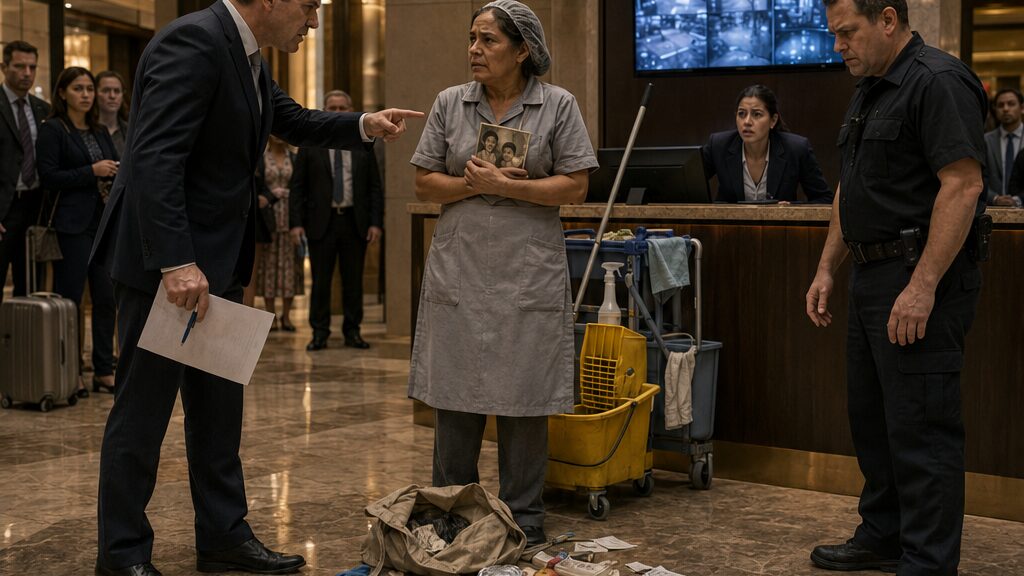
They Emptied Maria’s Bag in the Hotel Lobby, Then the Camera Emptied Mark’s Lies
Chapter 1: The Watch Vanishes Under the Lobby Lights
The man at the front desk slammed his bare wrist against the marble counter so hard the receptionist flinched.
“It was right here,” he said, holding his arm up for everyone in the lobby to see. “A silver luxury watch. Do you understand what that means?”
The lobby of the Hartwell Grand froze in pieces. A bell cart stopped beside the brass elevator. A woman in a cream coat paused with her credit card still between two fingers. The glass doors whispered shut behind a family dragging suitcases from the curb.
Maria Rodriguez stood ten feet away with one hand on her mop handle and the other near the cloth bag resting beside her yellow bucket.
She had cleaned that stretch of marble twice already because the evening rush always brought rain from shoes, dust from wheels, sugar from children’s fingers, and perfume from people who never looked down. She was used to being part of the floor. That was what made the work possible. People did not notice the woman bending near the velvet ropes unless something had gone wrong.
Now something had gone wrong.
Mark Hall crossed the lobby with his suit jacket buttoned and his manager’s smile already gone tight. He had been walking too quickly all evening, checking the clock above the elevator, checking the front doors, checking the lobby monitor where the hotel’s gold logo turned slowly above the words: WELCOME TO EXCELLENCE.
“Sir,” Mark said, lowering his voice in the way he did when he wanted everyone to hear how calm he was. “We’ll handle this immediately.”
The guest jabbed a finger toward the counter. “I took it off for one minute to sign the card. One minute.”
Angela Taylor stood behind the desk with a frozen hand over the keyboard. She was young enough that anger still made her eyes widen before she remembered to hide it. Maria had seen her give wrong directions twice during her first week and nearly cry in the staff pantry. Since then, Maria always left a folded paper towel near Angela’s station when the coffee machine leaked. Angela had never said much about it, but she always nodded.
Now Angela looked from the guest to Mark, then past Mark to Maria.
Maria lowered her eyes and moved the mop back into the bucket. The gray water trembled.
She knew this kind of silence. It had weight. It had direction.
“Who had access to this area?” Mark asked.
Angela swallowed. “Front desk, bell staff, security, housekeeping passing through—”
“Housekeeping?” the guest snapped.
Maria’s fingers tightened around the mop handle.
Mark turned slightly, not fully. He did not look at her yet. That was worse. He let the word float in the air first.
“Maria,” he said.
She lifted her head.
“You were cleaning near the front desk.”
“I mopped by the elevators,” she said. “Then near the doors.”
“And near the counter?”
“Only the spill by the velvet rope.”
Mark’s eyes touched her uniform, her shoes, the small frayed edge of her apron pocket. He had a way of looking at old cloth as if it were evidence.
Behind him, the guest rubbed the pale circle on his wrist where the watch had been. “That watch is worth more than some people make in a year.”
Nobody told him to stop.
Maria thought of the envelope in her cloth bag, the one with old bus receipts folded inside because she counted every ride. She thought of the lunch she had not eaten yet, two tortillas wrapped in foil. She thought of the family photo tucked in the inner pocket, soft at the corners from being touched too often. Her husband’s smile had faded before the picture did, but she still carried both.
Mark glanced toward the lobby monitor, then the ceiling camera above the front desk.
“Eric,” he called.
The security guard near the glass doors straightened. Eric Miller was broad-shouldered and tired-eyed, the kind of man who said little because he feared words could become reports. He came forward with his hand near his radio.
“Yes, Mr. Hall?”
“We’ll review this properly,” Mark said.
Maria almost breathed.
Then Mark looked directly at her.
A small coldness opened between her shoulder blades.
Earlier, near the guest elevator, she had seen Mark step out from the side corridor with one hand closed around something small. He had been too close to the front desk for a manager who claimed he was checking banquet rooms. He had looked at her once, sharply, and she had pushed her mop forward as if she had seen nothing.
She had learned that skill over years. See nothing. Say nothing. Keep the shift. Keep the hours. Keep the name clean by not getting involved.
Raymond Smith had not done that. Raymond had asked questions six months ago, after a guest wallet went missing. He had said something about cameras, about timing, about Mark being near a service closet. Three days later, Raymond was gone. The official word was theft. The staff word was troublemaker.
Maria had said nothing then.
Mark’s gaze stayed on her now, and she felt that old silence wrap itself around her throat.
“Maria,” he said, “empty your pockets.”
The lobby changed. Not loudly. Worse than loudly. The guests shifted their attention as one body. The bellman stopped pretending not to listen. A teenager near the fireplace lifted his phone an inch, uncertain whether to record.
Angela’s lips parted. “Mr. Hall, shouldn’t we check the camera first?”
“We will,” Mark said, still looking at Maria. “After we secure the area.”
Maria’s face warmed. “I did not take anything.”
“No one said you did,” Mark replied, with a softness more insulting than shouting. “Unless there’s a reason you’re nervous.”
A child near the velvet rope began to fuss. His mother was trying to manage a suitcase, a purse, and a tired little boy whose stuffed animal had fallen near Maria’s bucket. Maria bent slowly, picked up the toy by one clean corner, and handed it back.
“There,” she said quietly.
The boy stopped crying long enough to stare at her. “Thank you.”
Maria nodded once.
For half a second, she was herself again: a woman who cleaned, helped, endured, and went home with sore feet. Then the guest at the desk scoffed, and the moment collapsed.
Mark’s smile vanished.
“This is not a time for distractions.” He turned to Eric. “Check the janitor’s pockets.”
The words moved through the lobby like a dropped glass breaking.
Maria did not move. She heard the fountain behind the seating area. She heard the wheels of a suitcase squeak once and stop. She heard Angela whisper, “Mr. Hall…”
Mark raised his hand to silence her.
“People like that always know how to look harmless,” he said.
The guest nodded as if the sentence had confirmed something he already believed.
Maria’s hands opened slowly at her sides. Her palms were damp. In her left pocket was a key ring for supply closets. In her right, a folded tissue and the small plastic cap from a broken spray bottle she had meant to throw away. There was no watch. There had never been a watch.
But innocence, she had learned, did not protect poor people from being searched.
Eric stepped closer. “Maria,” he said under his breath, not unkindly, “just cooperate.”
She looked at him. “You know me.”
His face tightened. “I have to follow procedure.”
Mark’s eyes flicked to Maria’s cloth bag beside the bucket.
“That too,” he said. “Search her bag in front of everyone.”
Maria’s breath caught before she could stop it.
The bag was not much: faded brown cloth, one repaired strap, a small button sewn on by her husband years ago after he had joked that a bag should hold together better than people did. Inside were the things that made a long shift survivable. Food. Gloves. Receipts. The photo. The proof of a life too small for anyone in this lobby to respect, yet too precious for Maria to let them touch.
She reached for it.
Mark’s voice cut across the marble.
“Eric, take the bag.”
Chapter 2: Maria’s Bag Opens on the Marble Floor
Eric turned the cloth bag upside down before Maria could close her fingers around the strap.
Everything fell harder than it should have.
Rubber gloves slapped the marble. A foil-wrapped lunch rolled once and stopped near the brass leg of a luggage cart. Old receipts fluttered like useless little flags. A tissue packet burst open. A sewing kit clicked across the floor. The family photo slid face-down under the polished shoe of the guest who had lost the watch.
Maria made a sound before she knew she had made it.
Not loud. Not a cry. Just enough for Angela to look up sharply.
The guest shifted his shoe without looking down, grinding the edge of the photograph against the marble. Maria stepped forward, but Eric moved into her path.
“Please,” she said.
Mark bent and picked up one of the receipts between two fingers. “Bus fare,” he read. “Cash grocery. Pawn shop?”
“That was for a bracelet,” Maria said. “My own bracelet.”
The guest laughed once through his nose.
Maria lowered her eyes to the photograph. It showed her and her husband outside their old apartment, before the illness thinned his face, before work became something she measured in medicines and rent. In the picture, his hand rested on her shoulder. The shoe now covered his smile.
Angela came around the desk before she seemed to decide to do it. “Sir, your foot,” she said to the guest.
He looked down, annoyed, and stepped back.
Maria bent immediately.
“Leave it,” Mark said.
She froze with her hand inches from the photo.
“We’re not finished.”
The lobby was no longer pretending. Phones were out now, not high, not obvious, but angled from purses and coat sleeves. Staff stood at the edges like people watching an accident they could later say they had not been part of. The lobby monitor continued its golden loop: WELCOME TO EXCELLENCE.
Maria picked up the photo anyway.
Mark’s jaw tightened.
She held it against her chest and smoothed the bent corner with her thumb. One crease cut across her husband’s shoulder. Her throat hurt, but her eyes stayed dry.
“What else is in the bag?” Mark asked.
Eric crouched, sorting through her things with hands that had become clumsy. “Gloves. Lunch. Receipts. Personal items.”
“No watch?”
“Not here.”
A murmur passed through the lobby.
The guest’s face reddened. “Then she hid it somewhere.”
Mark did not answer him right away. His eyes had moved past Maria’s bag, past the scattered receipts, toward her cleaning cart near the velvet rope. Folded towels sat on the lower shelf. A spray bottle hung from the side. The mop bucket stood where she had left it, gray water reflecting the lobby lights.
Angela saw him look.
Maria saw Angela see him.
For one quick second, something passed between the two women. Not certainty. Not proof. Only the recognition that Mark cared too much about the cart and not enough about the bag he had ordered dumped.
Maria remembered him near the guest elevator. She remembered his hand closed around something small. She remembered pushing her mop forward and telling herself not to collect trouble that did not belong to her.
Now trouble had collected her.
Mark crouched and lifted the foil-wrapped lunch. “You bring food from home every day, Maria?”
“Yes.”
“Long shifts?”
“Yes.”
“Money tight?”
A heat rose in her face. “I work for my money.”
“I didn’t say you didn’t.” He stood and turned to the guests with a look of weary professionalism. “But temptation is real. Especially when someone sees something expensive left unattended.”
Maria looked at Angela. Angela’s face had gone pale, but she said nothing.
The silence carried another face into Maria’s mind: Raymond Smith, standing by the same service hallway six months before with his cap twisted in his hands, saying, “Maria, you were there. You know I was in the laundry room when they said I took it.”
She had looked down then. Not because she believed he was guilty. Because Mark had been watching. Because her husband’s bills had still been arriving. Because fear could make cowardice feel like responsibility.
Raymond had said, “Just tell them what you saw.”
She had whispered, “I’m sorry.”
He had not answered.
Now Mark reached inside his suit jacket and unfolded a sheet of paper.
Maria stared at it.
“What is that?”
“A statement,” he said. “Simple. You admit you took the watch in a moment of poor judgment. You return it. You leave quietly. The hotel considers whether to involve police.”
“I cannot return what I never touched.”
Mark held out a pen.
“Sign it, and this does not need to get uglier.”
A woman near the fireplace whispered, “How embarrassing.” Maria did not know whether she meant the accusation or Maria herself.
Eric stood with his eyes on the floor.
Angela took one step closer. “Mr. Hall, there should be video from the lobby cameras.”
Mark did not look at her. “And if Maria has nothing to hide, her statement will align with what we find.”
“That doesn’t make sense,” Angela said, quieter.
Mark finally turned his head. “Angela, return to the desk.”
She did, but only halfway.
Maria read the first line of the paper. I, Maria Rodriguez, acknowledge removing personal property from the front desk area—
The letters blurred.
Her husband had signed forms in the hospital without reading them because pain made him trust anyone holding a clipboard. Later, bills came for things no one had explained. Maria had promised herself after he died that she would never again put her name under words that trapped her.
Mark pushed the pen closer.
“Maria.”
She looked at the badge clipped to her uniform. Her name in black letters. Not much. Just a plastic rectangle. But it was hers, and she had worn it through double shifts, holiday spills, broken elevators, and men who snapped their fingers at her without looking up.
Mark lowered his voice.
“Think carefully. Jobs like yours are not hard to replace.”
The pen hovered between them.
Maria lifted her hand, and for a moment the lobby leaned forward, expecting surrender.
Instead, she took the statement between two fingers and held it away from her body as if it were dirty.
“I won’t sign a lie.”
The words were quiet enough that some guests missed them.
Mark did not.
His face changed—not anger first, but fear. It flashed across him and disappeared beneath control.
“You’re making a mistake.”
“No,” Maria said. “I made one before. Not this.”
Angela’s eyes sharpened.
Mark stepped in close enough that Maria smelled mint on his breath.
“You don’t get to perform innocence in my lobby.”
“It is not your lobby,” Maria said.
A few heads turned toward Mark now.
His hand shot out and caught the edge of her badge. The clip snapped loose from the fabric. For one terrible second, the badge dangled from his fingers with her name facing the floor.
Maria’s chest tightened as if he had pulled skin.
“You are suspended pending investigation,” he said.
Eric shifted. “Mr. Hall—”
“Take her to the service hallway,” Mark ordered. “Now.”
Maria backed up one step. Her heel touched the edge of a receipt from her bag.
Mark held her badge in his fist.
“And keep her away from the front desk until I decide whether police need to be called.”
Eric moved beside her, not touching yet. The service hallway waited beyond the lobby plants, narrow and unlit past the first turn. No guests there. No phones. No lobby monitor. No ceiling full of small black camera domes.
Maria looked at the scattered items still on the marble.
Her lunch. Her gloves. Her receipts. Her life opened for strangers.
Then she looked at Mark, and saw him glance once more at the cleaning cart.
Chapter 3: The Hallway Where Cameras Go Blind
Mark’s hand closed around Maria’s upper arm hard enough that the whispering stopped.
It was the silence, not the grip, that frightened her most.
Pain was simple. She could name it. She had known sore knees, burned fingers, swollen feet, the deep ache of holding a husband upright when illness had stolen his balance. But silence in a room full of witnesses was something else. Silence meant people were deciding how much of what they saw they would remember later.
Maria looked down at Mark’s fingers on her sleeve.
“Let go,” she said.
“Then walk,” he replied.
Eric stood to her left, troubled but still blocking her path back toward the center of the lobby. The scattered contents of her bag remained behind him like the aftermath of a small storm. A receipt clung to the damp edge of the mop bucket. Her foil lunch had split open. One tortilla showed through the tear, plain and exposed.
The service hallway waited ahead.
Maria could see only the first stretch: beige wall, staff-only sign, an old security mirror tilted at the corner. Beyond that, the light thinned. Every cleaner knew where cameras watched and where they did not. It was part of surviving the building. The guest areas had eyes. The staff corridors had rules.
She planted her shoes on the marble.
“No.”
Mark’s grip tightened. “This is not optional.”
“I will stay here.”
A guest muttered something about calling police. Another one lifted a phone higher.
Mark noticed. His expression smoothed itself. He released Maria’s arm slowly, as though he had chosen kindness.
“Ladies and gentlemen,” he said, turning halfway to the lobby, “we apologize for the disturbance. We are handling an internal personnel matter.”
Maria felt the words close around her. Internal. Personnel. Matter. Three clean words to erase a woman.
Angela had slipped behind the front desk again, but she was no longer pretending to type. Her fingers moved across the security terminal beneath the counter. On the wall behind her, the lobby monitor kept showing the hotel’s gold logo, soft music, perfect rooms, smiling staff. Nothing real.
Mark saw where Maria was looking.
“You want cameras?” he said softly. “Fine.”
He gestured toward the ceiling dome above the front desk. “Camera 3 covers this area. We’ll review it with security, privately, according to policy.”
Angela’s fingers stopped.
Maria caught the pause.
“What is it?” she asked.
Angela looked at Mark, then back at the screen.
“Nothing,” Angela said too quickly.
Mark smiled.
The elevator opened behind them. A woman in a navy coat stepped out with a leather folder tucked under one arm and a phone pressed to her ear. Her heels struck the marble with measured authority. Mark’s posture changed before he turned.
Donna White had the kind of presence that made staff straighten even when she did not ask them to. She was not at the hotel every day, but everyone knew when corporate had sent her. The ownership audit had been her shadow for a week: extra polishing, extra warnings, extra smiles.
She ended her call mid-sentence when she saw the lobby.
“What is happening?”
Mark crossed to her quickly. “Donna, we have a guest property incident. I’m containing it.”
Her eyes moved over the scene: the upset guest, Eric, Angela behind the desk, Maria without her badge, the contents of the bag still on the floor.
“Containing it?” Donna repeated.
“The watch is missing,” Mark said. “Maria was in the area. She refused a statement.”
Maria spoke before fear could stop her. “He searched my bag in front of everyone.”
Donna looked at her, not unkindly, but not warmly either. “Maria, is that true? You refused to cooperate?”
“I refused to sign that I stole.”
The guest stepped forward. “Someone took my watch. I don’t care about hotel politics. I want it found.”
Donna’s jaw tightened at the word politics. Her eyes flicked to the phones in the lobby. Recordings. Reviews. Headlines. The hotel’s polished world had cracked in front of guests, and Maria could see Donna measuring the damage.
“We should move this out of the lobby,” Donna said.
Mark’s relief was so quick that Maria almost missed it.
Almost.
“No,” Maria said.
Donna looked at her fully now.
Maria’s voice trembled, but she kept it low. “He accused me here. He searched my things here. If you take me back there, everyone will think I stole it.”
“This is not a trial,” Donna said.
“It feels like one.”
For a moment, Donna had no answer.
Mark stepped between them. “With respect, she’s escalating because she knows procedure is closing in.”
Angela’s chair scraped.
“Camera 3 is offline,” she said.
The sentence landed harder than the missing watch.
Mark turned slowly. “Excuse me?”
Angela’s face had gone white around the mouth, but she kept her eyes on the terminal. “The system says Camera 3 is under maintenance.”
Donna frowned. “Since when?”
Angela swallowed. “The log says this afternoon.”
“I approved routine maintenance,” Mark said. “That is not suspicious.”
Maria looked at him. “This afternoon?”
“It’s a camera, Maria. Not a conspiracy.”
But his voice had sharpened on her name.
Angela clicked something on the keyboard. “The front desk angle is down. The elevator angle is partial. The service hallway camera is active at the entrance only.”
Mark moved toward her. “Stop accessing security systems without authorization.”
“I work the front desk,” Angela said. “I use this system when guests lose items.”
“Not for personnel investigations.”
Eric shifted again, and Maria saw his eyes lift to the dark dome above the desk. His doubt was small, but it was there. A crack in the wall.
“Eric,” Maria said quietly, “when did he ask you to search me?”
Eric looked startled.
Mark snapped, “Do not answer her.”
That answered enough.
Donna’s gaze moved from Mark to Eric. “Mr. Miller?”
Eric’s throat worked. “Before we checked footage.”
Mark’s face hardened. “Because the suspect was present and could remove evidence.”
“I am not a suspect,” Maria said.
“You are suspended,” Mark said.
“My name is Maria.”
The words came out before she knew they were coming. Not loud, not polished, but clear. The lobby heard them. Donna heard them. Angela heard them.
Mark leaned close enough that only the nearest people could hear. “Names don’t matter when police write reports.”
Maria’s knees weakened.
There it was. The real threat. Not losing a shift. Not losing the badge. Losing the name she carried in her bag, in the photo, in every document she had signed carefully after her husband died. Rodriguez. A name worn thin by work but not dirty.
Donna lifted one hand. “Enough. Maria, Mr. Hall, we’re going to the side office. No service hallway. No further public display.”
“Side office is still off the lobby,” Maria said. “Door open.”
Donna hesitated. She wanted control. Maria could see that. But she was also beginning to understand that control had already cost too much.
“Door open,” Donna agreed.
Mark’s eyes flashed.
Behind the desk, Angela bent slightly, pretending to retrieve a dropped pen. When she straightened, she was close enough to Maria to speak without moving her lips much.
“Camera 3 is offline,” Angela whispered. “But the backup records to cloud storage. It might still have it.”
Maria did not look at her. She did not dare.
Mark was watching both of them now.
Angela’s fingers closed around a small access card at the desk.
Maria looked at the lobby monitor, still glowing with its beautiful lie, and held her creased photograph against her chest.
For the first time since the watch vanished, she understood why Mark was afraid of the screen.
Chapter 4: Angela Finds the Feed Mark Forgot
Angela’s password failed with a red flash bright enough for Mark to see from across the lobby.
The small warning box blinked on the front-desk terminal: ACCESS DENIED. Angela’s hand jerked back as if the keyboard had burned her.
Mark stopped mid-step.
“What are you doing?”
Angela’s mouth opened, but no sound came out. Behind her, the lobby monitor continued to glow with the hotel’s gold logo, all smooth music and polished promise. On the marble floor in front of the desk, Maria’s belongings remained scattered where Eric had left them. A glove lay palm-up like a hand asking for help.
Maria stood beside the service hallway entrance with her creased photograph pressed to her chest. Her sleeve still held the dent from Mark’s fingers. She did not move toward Angela. She knew any sudden motion would give Mark what he wanted.
Angela swallowed and tried again. “Checking the system.”
“I told you to stop.”
“You told me Camera 3 was under maintenance.” Angela looked down at the screen because looking at Mark made her voice thin. “I’m checking when.”
Donna White stepped closer to the desk. “Angela, do you have access to that?”
“For lost guest property, yes.”
“This is no longer ordinary lost property,” Mark said.
“No,” Maria said. “It became something else when you searched my bag.”
Several guests heard her. Their eyes moved from the marble floor to Mark.
His expression tightened. “This is exactly why we need privacy.”
Angela typed another password, slower this time. Her hands shook, but the screen changed. A menu opened in gray and blue blocks: LIVE FEEDS, ARCHIVE, MAINTENANCE LOGS, CLOUD BACKUP.
Mark moved quickly around the desk.
Angela clicked ARCHIVE.
The first file list opened, then froze.
“Angela,” Mark said, close now, low enough to be dangerous. “Step away.”
For a moment she almost did. Maria saw it—the young woman’s shoulders folding inward, the training of every low-level employee in the building. Apologize. Step back. Keep the job. Keep your head down.
Angela’s eyes flicked to the scattered photograph in Maria’s hands.
Six months earlier, Maria had seen Angela behind this same desk when Raymond Smith was led out. Angela had held a folder then too, with her fingers pressed white against the edges. Raymond had looked at each of them, hoping someone would remember aloud where he had been when the wallet disappeared. Maria had looked away first. Angela had looked away second.
Angela did not look away now.
“The cloud system has a separate archive,” she said.
Mark’s jaw moved. “You don’t know what you’re accessing.”
“I know enough.”
He reached toward the mouse.
Donna’s voice snapped across the desk. “Mark.”
He stopped, hand suspended.
Donna’s face had changed. She was still controlled, still corporate, still watching the phones in the lobby as much as the people, but she no longer looked certain. “Let her check.”
Mark turned to her. “Guest privacy—”
“A guest is accusing this hotel of losing a valuable watch,” Donna said. “An employee has been searched in public. We need facts.”
Maria heard the word employee and held onto it. Not suspect. Not internal matter. Employee.
Angela clicked CLOUD BACKUP.
A loading wheel spun.
The lobby seemed to breathe around it.
Eric crouched awkwardly near Maria’s things, not picking them up, not leaving them. The upset guest crossed his arms, his bare wrist tucked beneath one elbow as if he could hide the absence that had started everything. Near the fireplace, a phone camera rose higher.
The archive populated in rows of timestamps.
Angela leaned closer. “There.”
Mark’s face lost color.
“What?” Donna asked.
“Camera 3 cloud backup.” Angela pointed. “It kept recording after the local feed went offline.”
“That’s impossible,” Mark said too fast.
Angela clicked the date. “It says 11:42 p.m.”
Maria’s breath caught.
At 11:42 the night before, she had been in the east wing, wiping coffee rings from a conference table after the late sales meeting. She knew because the bus receipt in her bag—the one Mark had mocked—was from 12:16 a.m., printed after she ran three blocks to catch the last route home.
Angela scrubbed the timeline. A thumbnail appeared: the lobby, dimmer than now, the front desk light half-lowered, Maria’s cleaning cart near the velvet rope.
“There,” Angela whispered.
Maria took one step forward before Eric shifted in front of her again. Then he seemed ashamed of the movement and stepped aside.
Mark laughed once, dry and brittle. “A timestamp proves nothing. Maria had access all night.”
Maria lowered the photograph from her chest. “I was in the east wing.”
“Can you prove that?”
She looked at the floor. Receipts. Old paper. Thin ink. She crouched before anyone could stop her and picked through the scattered slips with careful fingers.
Mark snapped, “Don’t touch evidence.”
“My life is not evidence for you to kick through.” Her hand found the bus receipt, damp at one edge from the mop bucket. “This was after my shift. I left from the east entrance.”
Donna took the receipt and examined it. “This doesn’t prove where you were at 11:42.”
“No,” Maria said. “But the cleaning schedule does.”
Angela clicked another tab. “Housekeeping logs are in staff records.”
Mark lunged for the side of the monitor.
The screen jolted.
A sharp crackle burst from the speakers, and the hotel logo vanished from the lobby monitor overhead. For one second, the guests saw a gray security image: Mark Hall near Maria’s cleaning cart, one hand tucked close to his jacket, his head turned toward the elevator.
Then the picture froze.
Mark yanked the cable beneath the desk.
The monitor went black.
Gasps broke out across the lobby.
Angela shoved back from the terminal. “Why would you do that?”
Mark held the cable in one hand, breathing hard. “Because you are displaying unauthorized security footage in a public space during a guest incident.”
Donna stared at the blank monitor. “Plug it back in.”
“Donna, listen to me.” Mark’s voice shook beneath the polish. “We have an ownership audit in two days. A lobby full of guests filming internal footage is exactly how a manageable problem becomes a disaster. I am trying to protect the hotel.”
“You just destroyed the display.”
“I stopped a privacy breach.”
Maria looked at him, then at the black rectangle above the desk. The screen no longer lied beautifully. It had become a dark hole in the lobby wall.
But she had seen enough to know he feared what it could show.
Angela bent under the counter, grabbed the cable, and plugged it into a side port before Mark could stop her. He seized her wrist.
Maria stepped forward.
“Let her go.”
Mark turned on her. “You think this helps you? You think a blurry frame changes what you are?”
Angela pulled free. “It wasn’t blurry on the archive.”
Mark’s hand hovered near the back of the terminal.
Donna moved between them. “Step away from that desk.”
For the first time all evening, Mark obeyed too slowly.
Angela’s cheeks were wet now, but her voice steadied. “Raymond asked me to check the archive when they fired him. I didn’t. I told him I couldn’t access it. I lied because I was scared.”
Maria felt the name pass through her like a needle.
Angela kept her eyes on the screen. “I’m not doing that again.”
She clicked the file.
The lobby monitor flickered back to life.
A paused image appeared: Mark near Maria’s cleaning cart, one shoulder turned away from the camera, his hand partly hidden by a folded white towel.
The picture sharpened for half a second.
Then the screen cut to black again.
This time Angela did not touch anything.
The terminal showed a new message: CONNECTION LOST.
Mark’s hand was no longer near the cable. It was inside his jacket pocket, wrapped around his phone.
Donna saw it.
“Mark,” she said, “what did you just do?”
He looked at the black monitor, then at the room full of waiting faces.
“I called security operations,” he said. “Before this gets worse.”
But Maria saw Angela’s eyes drop to the terminal, where the cloud file still sat in the archive list, not gone, not opened, waiting like a mouth about to speak.
Chapter 5: The Watch Beside the Cleaning Cart
The lobby monitor came back without music, without the gold logo, without any beautiful words to soften what it showed.
Mark Hall stood on the screen in the gray quiet of the previous night, alone beside Maria’s cleaning cart.
No one in the lobby spoke.
Angela had reopened the file from the terminal itself, bypassing the display connection Mark had tried to kill. Donna stood behind her with one hand on the desk and the other wrapped around Mark’s phone, which she had taken without asking. Eric blocked Mark now, not Maria.
On the screen, Mark glanced toward the elevator. Then toward the front desk. Then toward the dark camera dome he had believed was blind.
His hand slipped into his jacket.
The guest’s missing watch flashed silver beneath the security light.
A woman near the fireplace whispered, “Oh my God.”
Mark’s face tightened. “That is not what it looks like.”
No one looked at him.
The footage continued.
Screen-Mark lifted a folded towel from the lower shelf of Maria’s cart, tucked the watch inside, and placed the towel beside a stack of cleaning cloths. He paused, then nudged the cart with his knee, pushing it closer to the front desk area.
Maria felt the lobby tilt around her.
The watch was not just in his hand. It was near her cart because he had put it there. The accusation had not been a mistake. The search had not been panic. Every step had been arranged like towels on a shelf.
Her knees wanted to soften, but she did not let them.
Angela rewound the clip and played it again.
“No,” Mark said, louder. “Stop that.”
Donna’s voice was cold. “Let it run.”
“It’s out of context.”
The guest turned on him. “Out of context? That’s my watch.”
Mark faced the room, desperation sharpening his words. “The watch was found unattended. I secured it temporarily. I was going to log it.”
Angela’s hand moved to the keyboard. “Then why did you not log it?”
Mark pointed at her. “You are a receptionist, not an investigator.”
“And Maria is a cleaner, not a thief,” Angela said.
The words landed cleanly. Maria looked at her, and Angela looked down almost at once, as if ashamed that courage had taken so long.
Donna took one step closer to the monitor. “Continue.”
Angela clicked ahead.
The footage showed Maria entering the lobby at 12:03 a.m., pushing the mop bucket, tired and slow. She never touched the folded towel. She cleaned the coffee spill near the rope, moved toward the doors, and left through the staff corridor with her cloth bag over her shoulder.
The timestamp advanced.
At 12:16 a.m., the east exit log showed Maria’s badge number leaving the building.
The same number that was now in Mark’s fist.
Donna turned to Eric. “When did Mr. Hall tell you to search Maria?”
Eric’s face had gone gray. “Before we checked the system.”
“Exact words.”
Eric looked at Maria once, then away. “He said she had opportunity. He said if we waited, evidence could disappear.”
Mark snapped, “That is standard protocol.”
“No,” Donna said. “Standard protocol is secure the area and review available footage before public accusation.”
The guest pushed forward. “I want the police.”
Mark’s shoulders stiffened, but he still tried to recover the room. “I made an error in judgment under pressure. A guest reported an item worth a significant amount. I acted quickly to protect the property.”
Maria laughed.
It was small and humorless. It surprised everyone, herself most of all.
Mark’s eyes cut to her. “Something funny?”
“You protected the watch from everyone except your own hand.”
The lobby was silent again, but it no longer belonged to him.
Angela opened another window. “There are incident notes from last year.”
Mark moved. Eric stopped him with one hand.
“Don’t,” Eric said.
Mark stared at him as if obedience had betrayed nature.
Angela hesitated before opening the folder. “They’re archived under resolved personnel matters.”
Donna’s face hardened. “How many?”
Angela scanned. “Three property incidents involving cleaning staff in fourteen months. Two resignations, one termination.”
Maria’s mouth went dry.
Raymond.
She knew before Angela said his name.
“Raymond Smith,” Angela read. “Night cleaner. Guest wallet reported missing. Statement says he was the last employee near the service corridor.”
“He was,” Mark said quickly. “That case was closed.”
Angela opened the file. “No camera review attached.”
Mark said nothing.
Donna looked at him. “Why?”
“The guest demanded discretion.”
“Or you did.”
His face flushed. “Careful.”
Donna’s phone buzzed on the counter. She glanced at it, ignored it, and looked back at the footage still frozen above them—Mark’s hand, the silver watch, the folded towel.
Maria crouched slowly and began gathering the contents of her bag.
No one stopped her this time.
She picked up the gloves first. They were powdered inside and worn thin at the thumb. Then the receipts, one by one. The bus slip. The grocery slip. The pawn shop receipt for the bracelet she had sold after her husband’s last hospital bill, the one Mark had held up like dirt.
The family photo was still creased. She placed it on top of the receipts.
Angela stepped from behind the desk with a sheet of paper. “Maria.”
Maria did not take it yet.
“It shows you clocked into the east wing at 11:38,” Angela said. “And out through the east exit at 12:16.”
Maria looked at the paper. It proved one piece of the night. It proved less than Mark’s video, but more than her word had been allowed to prove.
“Thank you,” she said.
Angela’s eyes filled again. “I should have checked when Raymond asked.”
The name opened the past in the room.
Maria saw Raymond’s cap twisting in his hands. Saw herself staring at the floor. Heard herself whisper I’m sorry when he needed I saw him too.
She closed her fingers around the paper.
Mark seized the opening. “Exactly. Raymond. Disgruntled former employee. Are we really going to drag unrelated personnel issues into a guest theft?”
Donna looked uncertain for the first time since the footage appeared.
Maria saw the calculation return: one corrupt manager could be removed, one apology made, one guest satisfied. The hotel could say it had acted decisively. The old cases could stay buried where they were.
Angela’s notes were incomplete. Raymond’s file could be dismissed. Maria knew how easily paperwork could make a poor person vanish.
The police entered through the glass doors before anyone answered. Two officers, called by the guest or by Donna’s earlier instruction, paused at the sight of the frozen footage on the lobby monitor.
Mark’s face changed again. Not fear this time. Strategy.
“I’m glad you’re here,” he said, stepping toward them. “There’s been confusion. I can explain—”
Maria’s voice cut through him.
“Not yet.”
Everyone turned.
Her hands shook around the papers, but she did not lower them. “Before he leaves this lobby, call Raymond Smith.”
Donna blinked. “Maria—”
“He did this before.”
Mark barked a laugh. “You have no idea what you’re saying.”
Maria looked at the monitor, then at her bag in her hands, then at Donna. “I know what it feels like when everybody watches and nobody speaks.”
Angela covered her mouth.
Eric lowered his eyes.
Donna stood very still, the weight of the hotel gathering behind her face.
Maria stepped over the last scattered receipt and held Raymond’s incomplete file toward her.
“Call him,” she said. “Or this hotel only caught Mark stealing once.”
Chapter 6: The Man They Fired Before Maria
Raymond Smith reached the glass doors and stopped as if the marble beyond them were water too deep to cross.
He had no coat, though the night outside was cold enough to fog the entrance glass. His work shirt was clean but faded at the collar, and he held an old cap in both hands, twisting it the way Maria remembered. For a moment, the lobby did not seem to see a man arriving. It saw a memory being forced back through the doors.
Donna stood near the front desk with her phone still in her hand.
“I told him he didn’t have to come inside,” she said quietly.
Raymond looked past her.
His eyes found Maria.
Something in his face closed.
Maria held her cloth bag against her stomach, gathered but not yet zipped. The family photo lay on top, its crease visible beneath the lobby lights. Beside it, on Donna’s folder, was Raymond’s old termination form.
“Raymond,” Maria said.
He did not answer.
The police had taken Mark to the side of the lobby, not out yet. He stood between an officer and Eric, wrists not cuffed but hands watched. Even now, his suit looked expensive, his hair neat, his shoes clean. He turned when Raymond appeared and gave a short, disgusted laugh.
“This is absurd.”
Raymond flinched, and Maria hated that she recognized the flinch.
Donna crossed to the entrance. “Mr. Smith, we found irregularities in your old case. We need to ask—”
“I told you then,” Raymond said.
His voice was rough, not loud. It stopped Donna more effectively than anger would have.
“I told you then,” he repeated. “I told him. I told the front desk. I told security. I was in laundry when that wallet went missing.”
Angela stepped forward from behind the desk. “You told me too.”
Raymond’s eyes moved to her.
Angela held his gaze for two seconds, then looked down. “I said I couldn’t access the archive.”
“You could?”
She nodded once.
The cap in his hands twisted tighter.
Maria felt the words she had swallowed six months ago rise like something bitter. She had been there. Not for the theft, not for the wallet, but for the moment after—Raymond asking for help, Mark standing close enough to hear, Maria choosing the safe silence that had not saved anyone.
Raymond looked at her now.
“You remember,” he said.
Maria did not pretend not to understand. “Yes.”
“You looked away.”
The lobby seemed to shrink to the space between them.
Maria’s fingers tightened around the bag strap. She could have explained. Her husband’s bills. Her fear. Mark’s schedule cuts. The way one missing shift could break a month. The way a widow learned to lower her head because dignity did not pay rent.
All of it was true.
None of it answered him.
“I did,” she said.
Angela covered her face with both hands.
Raymond nodded slowly, as if a question had finally been answered and the answer hurt exactly as much as expected. “I thought maybe I remembered wrong.”
“You didn’t.”
Mark said, “This sentimental reunion has nothing to do with the watch.”
Raymond turned toward him then, and the fear in him changed shape. “You said I should sign too.”
Mark’s face tightened.
“You told me if I left quietly, the hotel might not press charges,” Raymond said. “You said people like us didn’t survive police reports.”
Maria’s stomach turned cold.
Same paper. Same threat. Same hallway.
Donna opened Raymond’s folder. “There is no attached camera review. No recovered wallet. No police report.”
“Because there was no wallet in my locker,” Raymond said. “Not until he told them to check again.”
Eric looked up sharply. “Check again?”
Raymond nodded toward Mark. “Security looked once. Nothing. He came back with them. Then they found it.”
Mark’s voice remained controlled, but his eyes had begun to shine. “This man was terminated for cause. He has every reason to lie.”
Raymond gave a tired smile. “I had every reason to lie then. I didn’t.”
Donna’s phone buzzed again. She checked it this time and went still.
“What is it?” Angela asked.
Donna did not answer at once. She looked toward the phones still raised in the lobby, the guest speaking quietly with one officer, the monitor frozen on Mark with the watch. Then she looked at Maria.
“Corporate legal is asking that we move all further discussion to a private room.”
Mark’s expression brightened faintly.
Maria saw it.
Donna continued, more softly, “They are also authorizing immediate paid leave for you, Maria, and a settlement discussion tomorrow morning.”
“A settlement,” Maria said.
“Compensation,” Donna said. “For what happened tonight.”
Raymond laughed under his breath and looked at the floor.
Maria heard the trap before it was spoken.
Donna’s face carried discomfort now, not cruelty. “They will want confidentiality while prior matters are reviewed.”
Angela whispered, “No.”
Donna’s eyes flicked to her. “This is standard.”
Maria looked at the lobby. At the marble floor where her bag had opened. At the guests who had watched her searched. At Eric, who had obeyed. At Angela, who had waited too long. At Raymond, who had not crossed the threshold because humiliation had memory in the body.
Private money would help. She could pay late rent without counting coins. She could replace the shoes that pinched her toes. She could take one day off without fear.
Her husband’s photograph rested against the receipts in her bag. In the picture, his hand was on her shoulder. He had once told her, after a landlord spoke to them like children, “We can be poor, Maria. We don’t have to be small.”
She had tried to survive by becoming small enough not to be noticed.
Tonight, they had noticed her anyway.
Maria zipped the bag slowly.
“No.”
Donna’s shoulders lowered. “Maria, think carefully.”
“I am.”
“If legal handles this publicly too fast, it can become complicated.”
“It was simple when he called me a thief.”
Donna looked away.
Maria stepped toward Raymond, stopping just before the place where the marble began to reflect the lobby lights more brightly.
“I am sorry,” she said.
Raymond’s face moved, but he did not speak.
“I saw enough to doubt him then. Not enough to prove everything. But enough to stand beside you. I didn’t.”
He looked at her for a long moment. “Why now?”
Maria swallowed. “Because tonight I learned what my silence sounded like from the other side.”
The cap in Raymond’s hands stopped twisting.
Police moved Mark toward the entrance. One officer held his arm now. Mark’s mouth was a hard line, but he still looked toward Donna as if expecting the hotel to close around him and hide the damage.
Maria turned before they could take him out.
“No,” she said.
The officer paused.
Donna looked exhausted. “Maria.”
Maria walked back to the center of the lobby. Not fast. Her shoes stuck slightly where mop water had dried. Every step took her past something she had picked up from the floor, something the crowd had seen exposed.
She stopped beneath the black monitor.
“The apology,” she said, “has to happen where the accusation happened.”
Chapter 7: Where the Apology Has to Happen
Police brought Mark back through the lobby just as Donna unfolded a page that looked too clean for what had happened.
Maria knew the paper was wrong before Donna spoke. It had been printed on hotel letterhead, its edges sharp, its language prepared by people who had not stood on the marble while strangers watched their lunch roll across the floor. Donna held it with both hands, but her eyes kept moving from the paper to Maria, then to the guests who still hovered near the front desk.
Mark saw the page too.
Even with an officer beside him, even with the frozen footage above the lobby showing his hand near Maria’s cart, he managed a thin smile. It was small, almost private, meant for Donna. A reminder that the hotel knew how to protect itself. A reminder that words could be polished until guilt looked like confusion.
Donna cleared her throat.
“On behalf of the Hartwell Grand,” she began, “I would like to express regret for the misunderstanding that occurred tonight.”
Maria did not raise her voice.
“It was not a misunderstanding.”
Donna stopped.
The lobby stopped with her.
Maria stood below the monitor, her cloth bag zipped and held against her side. The family photo was inside again, but she could feel the stiff crease through the fabric, as if paper could leave a bruise on her palm.
Donna lowered the page slightly. “Maria—”
“He framed me,” Maria said.
Mark’s smile disappeared.
The guest whose watch had vanished looked from Maria to the monitor and then to Donna, as if suddenly understanding that the apology was not for him anymore.
Maria took one step forward. “He took the watch. He put it by my cleaning cart. He ordered Eric to search me before checking the video. He took my badge. He tried to move me where there were no guests and no cameras.”
Every sentence was a small stone laid down in the room. Not thrown. Placed where no one could step around it.
Donna’s face tightened. “You’re right.”
The words came quietly, but they carried.
Mark turned on her. “Donna, be careful.”
She looked at him then, really looked, as if seeing not just the manager in the suit but the shape of everything he had made possible in her hotel. “I am being careful now.”
Angela stood behind the front desk with both hands clasped around the edge of the counter. Her eyes were red, but she did not look away from Mark. Eric stood near Maria’s scattered work area, holding the plastic badge he had removed earlier. He kept turning it over in his hand.
Donna folded the printed statement once, then again, and set it on the counter without reading another word.
“No,” she said. “Not a misunderstanding.”
Mark’s jaw worked. “This is a legal matter.”
“It became a legal matter when you stole a guest’s property,” Donna said. “It became a public matter when you accused an employee in public.”
The officer beside Mark shifted his grip.
Maria heard a small sound behind her and turned. Raymond still stood at the threshold, one foot on the lobby mat, the other not quite on the marble. He had come no farther. His cap hung loose in his hand now.
Donna saw him too.
She inhaled, then faced the room.
“Maria Rodriguez was falsely accused tonight,” Donna said. “She was searched publicly without proper review of the available evidence. Her badge was removed. Her belongings were emptied on this floor. The footage now displayed confirms that Mark Hall took the missing watch and placed it near her cleaning cart.”
Mark said, “This is insane.”
The officer said, “Sir.”
He went quiet, but his eyes burned.
Donna continued, her voice firmer with each word. “The hotel apologizes to Maria Rodriguez publicly and specifically. Not for confusion. For harm. For humiliation. For failing to protect her dignity when she was doing her job.”
Maria lowered her gaze.
The words did not erase the feeling of the shoe on her photograph, or the way Mark had said people like that, or the tiny pause before Eric obeyed. But they entered the same space where the accusation had entered. That mattered. Not enough. But it mattered.
Eric stepped forward.
Maria looked at him before he reached her.
He stopped at once. This time he did not assume he had permission.
“I’m sorry,” he said.
His voice was thick, awkward. He held out the badge on his open palm. Maria’s name faced up.
“I followed an order I knew didn’t feel right,” he said. “That’s not procedure. That’s on me.”
Maria looked at the badge.
All evening, others had touched it as if her name were a thing they could remove, suspend, restore, file, explain. She reached out, but she did not take it from Eric’s fingers at first. She let him hold the weight of it one second longer.
Then she took it.
“Thank you,” she said, not because forgiveness had arrived, but because apology had.
Angela came around the desk, moving as carefully as if the floor had changed under her shoes. “Maria,” she said, “I’m sorry too.”
Maria turned to her.
Angela’s mouth trembled. “Not only for tonight. Raymond asked me to check. I could have tried harder. I told myself I was too new, that Mark would fire me, that someone else would speak.”
Raymond looked down.
Angela’s voice broke, but she kept going. “Nobody else did.”
Maria felt the old shame move through her, less sharp now because it was no longer hidden.
“I told myself the same thing,” Maria said.
Raymond lifted his eyes.
For a moment, no one spoke. The lobby did not feel like a place of victory. It felt like a room where several people had finally stopped pretending they had clean hands.
Donna turned to Raymond. “Mr. Smith, your case will be reopened tonight. You will receive written notice before morning. Any prior accusations connected to Mark Hall will be reviewed by an outside investigator.”
Raymond gave a short laugh, but there was no humor in it. “Outside. Now there’s an outside.”
Donna accepted the wound without defense. “Yes. Too late. But yes.”
Mark suddenly pulled against the officer’s hold. “You think this saves the hotel? You think blaming me fixes your audit? You all wanted problems gone. You praised me for keeping guest complaints quiet.”
Donna’s face paled.
There it was: not innocence, but the ugly edge of shared convenience. Maria saw Donna absorb it. The hotel had not stolen the watch from Mark’s hand. But it had liked clean reports. It had liked silence. It had liked low-wage workers who disappeared without making noise.
Donna looked at the guests, the staff, the phones, Raymond at the entrance, Maria beneath the monitor.
Then she reached for the microphone kept behind the desk for event announcements.
Mark stared. “Don’t.”
Donna pressed the button.
A soft tone sounded through the lobby speakers.
Guests at the far elevators turned. Staff at the lounge entrance looked over. The hotel’s own system carried Donna’s voice across the place where Mark had tried to bury Maria’s.
“This is Donna White,” she said. “Tonight, Maria Rodriguez, a member of our housekeeping staff, was falsely accused of theft in this lobby. The accusation was wrong. The search was wrong. The removal of her badge was wrong. The hotel apologizes to her publicly.”
Maria’s hands tightened around the badge.
Donna continued. “Effective immediately, no employee of this hotel may be publicly accused, searched, suspended, or pressured into signing a statement over missing property without evidence review by security and an independent manager. All prior property-related terminations under Mark Hall will be reopened.”
The lobby remained silent after the speaker clicked off.
No applause came. Maria was grateful for that. Applause would have made the room feel forgiven too quickly.
The officer turned Mark toward the doors.
Mark looked once at Maria as he passed. Whatever he wanted to say stayed behind his teeth. Maybe he understood, finally, that the room no longer belonged to him.
At the threshold, he passed Raymond.
Raymond did not move aside. The officer guided Mark around him.
Only after the doors opened and the night took Mark out did Raymond step fully onto the marble.
Maria watched his shoes cross the line.
Donna came to Maria with another document, this one handwritten on a hotel notepad. “This is temporary,” she said. “Paid leave if you want it. Immediate compensation authorization. A written apology by morning. And the review policy I announced will be formal before the audit.”
Maria looked at the paper but did not take it yet. “Raymond too.”
Donna nodded. “Raymond too.”
“And the others.”
Donna’s mouth tightened, not in anger this time, but in recognition of cost. “The others too.”
Maria accepted the note.
Then she crouched.
A few people shifted as if to help, but she raised one hand slightly, and they stopped. She picked up the last thing left from her bag: a receipt that had slid beneath the edge of the velvet rope. The ink was smeared, the paper nearly transparent from mop water.
She opened her bag and placed it inside with the others.
Then she took out the family photo.
The crease across her husband’s shoulder had not disappeared. Maria smoothed it with her thumb once, twice, carefully enough that the lobby seemed to understand this was not for them.
She looked at his faded smile.
“I did not sign,” she whispered.
Angela heard. She turned away, crying quietly.
Maria clipped the badge back onto her uniform herself.
The plastic settled against the gray fabric, a small weight over her heart. Maria Rodriguez. The letters were no cleaner than before, no brighter, no more important to the world than they had been that morning. But they had survived the floor.
Donna gestured to the lobby monitor.
The frozen footage disappeared.
For one second the screen went black, and Maria thought of all the things that had lived in darkness because people like her had been too tired, too frightened, or too alone to drag them into the light.
Then new words appeared, plain against a white background.
EMPLOYEE PROPERTY INCIDENT POLICY: EVIDENCE REVIEW REQUIRED BEFORE ACTION.
No gold logo. No music. No smiling staff.
Just a rule, where a lie had been.
Raymond came to stand beside Maria, not close enough to crowd her. “Your husband in the picture?” he asked.
Maria nodded.
“He’d be proud,” Raymond said.
Maria looked at the monitor, then at her bag, then at the strip of marble where her belongings had been scattered.
“No,” she said softly. “He’d say I took long enough.”
Raymond’s mouth moved into the smallest smile.
Maria walked toward the employee corridor, not because she was being taken there, not because Mark had ordered it, but because her shift was over and she chose where to go. Staff stepped aside. Guests lowered their phones. Eric stood straighter. Angela held the desk with both hands as if the building itself had shifted.
At the edge of the lobby, Maria paused and looked back once.
The monitor still showed the new policy. Donna was speaking to Raymond. Police lights flickered faintly beyond the glass doors. The marble floor reflected everything without keeping any of it.
Maria touched the badge on her chest, adjusted it until it sat straight, and walked out with her bag closed at her side.
The story has ended.