They Threatened Her Over a Halloween Skeleton, Then Their Unpermitted Sunroom Exposed Everything
Chapter 1: The Letter Beside the Smiling Skeleton
The legal envelope had been fastened to the skeleton’s wrist with a silver twist tie.
Virginia Moore noticed it before she noticed the coffee cooling in her hand. The envelope hung against the plastic ribs like something delivered to a corpse, its cream paper too formal for the orange leaves scattered across her lawn.
Her skeleton stood six feet tall beside three pumpkins, one bony hand resting on a small chalkboard.
TRICK OR TREAT, NEIGHBORS.
Virginia had printed the message herself in white chalk, then added a crooked smile beneath it. The display had been up for two days.
She set her mug on the porch rail and worked the wire loose. Her fingers were steady until she saw the attorney’s letterhead.
SCOTT CIVIL PRACTICE.
The first paragraph called her display a “deliberately disturbing visual nuisance.” The second claimed it had caused severe emotional distress to two children living across the street. The third demanded immediate removal.
The fourth threatened a civil claim of $18,000.
Virginia read that figure twice.
A sedan slowed at the curb. The passenger lifted a phone toward her yard, took a picture, and drove on.
Virginia folded the letter along its existing crease and went inside.
Her kitchen looked exactly as it had ten minutes earlier: toast on a plate, the radio murmuring about traffic, a bowl of apples under the window. Yet the room had changed. The familiar objects now seemed like witnesses waiting to see what she would do.
She placed the letter beside her coffee and read it again.
Anthony Scott represented Cynthia and David Campbell, the new owners of the large brick house across the street. He also described himself as counsel to the Maple Ridge Neighborhood Association.
That phrase bothered Virginia more than the dollar amount.
Maple Ridge had an association, but it was voluntary. It arranged landscaping at the entrance, organized the summer picnic, and collected small annual dues for the clubhouse. It did not regulate private holiday decorations.
Virginia knew because she had read the governing documents eleven years earlier, before buying her house.
Anthony’s letter cited “Section 8.4, Offensive Exterior Displays.”
Virginia went to the hall closet and removed a blue folder containing her closing papers. The actual Section 8.4 concerned commercial signs placed on shared property. It said nothing about decorations and did not apply to individual yards.
The fear remained, but it acquired edges.
This was not a misunderstanding drafted in haste. Someone had chosen language that sounded official because they expected her not to check it.
Her phone chimed.
A neighborhood email had arrived from Anna Clark, the volunteer association secretary.
Special meeting Saturday. Resident concerns regarding exterior displays and community well-being.
No address appeared in the message, but everyone knew which display it meant.
Virginia looked through the front window.
Across the street, Cynthia Campbell stood on her porch in a cream sweater, speaking to another neighbor. Cynthia’s posture was relaxed. One hand rested on the porch column while the other made small, careful gestures toward Virginia’s lawn.
The neighbor turned and looked directly at the skeleton.
Virginia stepped away from the window.
She could answer Anthony in writing. She could quote the correct section, attach the association documents, and ask him to withdraw the demand. That would have been clean.
Instead, she heard an older memory in her supervisor’s voice.
Let’s not complicate this unless someone complains.
Years ago, in the planning department, Virginia had accepted that sentence when she knew a drainage approval deserved another review. She had told herself that procedure belonged to someone above her. Months later, water had entered a family’s ground floor during a storm.
She had never forgotten the woman standing at the public counter with ruined photographs in a grocery bag.
Virginia put the blue folder down.
Silence could keep a room calm while allowing something dishonest to become official.
Still, she did not want to begin with a fight.
She carried her coffee across the street.
Cynthia opened the door before Virginia knocked a second time. Behind her, the new sunroom stretched along the back of the house, all pale lumber, tall windows, and unfinished trim.
“Virginia,” Cynthia said. Her smile appeared practiced rather than warm. “I assumed you’d received the letter.”
“I did.”
Cynthia waited.
Virginia held the folded pages at her side. “I thought we might speak without attorneys.”
“We tried that.”
“No one spoke to me.”
“I mentioned the decoration last week.”
“You said it was large.”
“It is large.”
Virginia glanced toward the side yard. A stack of cut boards lay beside the sunroom. No permit card was visible in the front window or near the construction entrance, though she had not come to inspect anything.
She returned her attention to Cynthia.
“The letter says your children are experiencing severe emotional distress.”
“They don’t like looking at it from the breakfast room.”
“Then perhaps we can move it a few feet.”
Cynthia’s mouth tightened. “This is not about a few feet.”
“What is it about?”
For the first time, the polish slipped. Cynthia looked past Virginia toward the street, checking who might be watching.
“We moved here because Maple Ridge has standards,” she said. “People maintain things. They think about how their choices affect everyone else.”
“It’s a Halloween decoration.”
“It is what people see when they look toward our house.”
The answer landed strangely. Not when they looked from their house. When they looked toward it.
Virginia followed Cynthia’s gaze. From the street, the skeleton stood across from the Campbell property, visible in the same frame as their new sunroom.
“Other houses have decorations,” Virginia said.
“Not like yours.”
“There’s a twelve-foot inflatable cat on the corner.”
“That family understands the spirit of the neighborhood.”
Virginia almost laughed, but Cynthia was not joking.
“Why eighteen thousand dollars?”
“That figure came from counsel.”
“You approved it.”
“We approved protecting our family.”
A small face appeared behind the glass door, then disappeared. One of the Campbell children. The child had not looked frightened, only curious.
Virginia unfolded the letter.
“The rule Anthony cited does not regulate private yards.”
Cynthia’s eyes shifted toward the paper and back.
“My husband works in compliance. Anthony advises the association. I think they understand the rules.”
“I understand them too.”
Cynthia studied her then, perhaps trying to decide whether the sentence was confidence or bluff.
Virginia did not explain.
After a moment, Cynthia lowered her voice. “Take the skeleton down before Saturday. It will be easier for everyone.”
“Easier is not the same as right.”
“No,” Cynthia said. “But right becomes expensive once lawyers are involved.”
Virginia felt the warning beneath the courtesy.
She folded the letter again. “I’ll attend the meeting.”
Cynthia’s expression changed—not surprise, exactly, but disappointment that the pressure had failed to produce immediate obedience.
“You should,” she said. “Because the lawsuit is only the beginning.”
Chapter 2: The Meeting Where Three Numbers Changed the Room
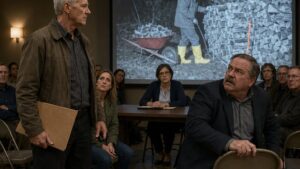
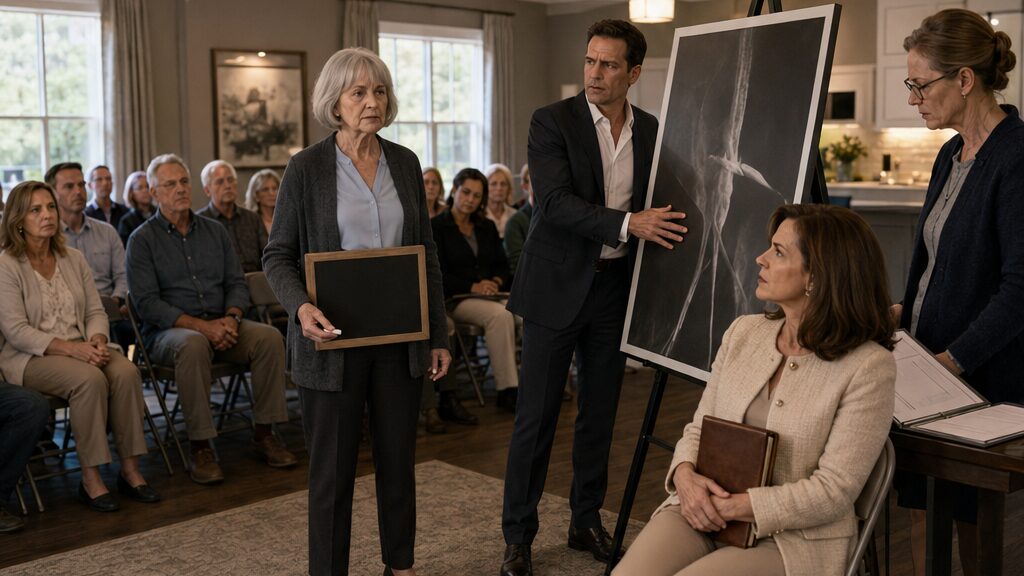
Anthony Scott had enlarged the photograph until Virginia’s skeleton was nearly eight feet tall.
The image stood on an easel at the front of the clubhouse, its plastic grin looming over rows of folding chairs. Someone had circled the chalkboard message in red.
Virginia paused in the doorway.
The real chalkboard was tucked under her arm.
Anna Clark noticed it first. She sat at a small table with a laptop and a stack of printed agendas, her eyes moving from the board to Virginia’s face.
“You brought part of the display,” Anna said quietly.
“I brought the part everyone keeps quoting.”
Anna looked as though she wanted to say something else, but Anthony called the meeting to order.
He wore a dark suit without a tie, an attempt at informality that only made him appear more deliberate. Cynthia and David Campbell sat in the first row. David kept one ankle over his knee and stared at the floor while Cynthia faced forward with both hands folded over a leather notebook.
The board president explained that the association had received a complaint concerning “a potentially harmful exterior installation.”
Virginia counted thirty-two residents. More than attended the annual budget meeting.
Anthony stood beside the enlarged photograph.
“This is not a referendum on Halloween,” he said. “It is a question of reasonableness, foreseeable emotional injury, and a homeowner’s obligation to prevent a known nuisance.”
Virginia heard the skill in his wording. He did not need the claim to be strong. He needed the room to believe it might become expensive.
He read portions of the demand letter aloud, including the $18,000 figure. A murmur moved through the chairs.
Cynthia described her children’s discomfort. She did not say they had nightmares or refused to eat. She said the skeleton was visible from the breakfast room and had made them “uneasy in their own home.”
When the board president invited comments, a neighbor near the aisle raised his hand.
“I don’t care for the thing either,” he said. “But eighteen thousand dollars?”
Anthony smiled faintly. “Damages are not punishment. They reflect disruption, consultation, and potential treatment.”
“Treatment for seeing a skeleton?”
Several people laughed. Cynthia’s shoulders stiffened.
Anthony did not. “The purpose of the letter was to resolve the matter before harm increased.”
Virginia watched David. He still had not looked at her.
Anna read the proposed motion: the board would classify Virginia’s display as offensive under Section 8.4 and request immediate removal.
Virginia raised her hand.
The board president hesitated, then nodded.
She carried the chalkboard to the front and placed it against the leg of Anthony’s easel. Beside the enlarged photograph, the real object looked small enough for a child to hold.
Anthony moved half a step away from it.
Virginia picked up the chalk tied to its frame.
She wrote three numbers.
17-4421.
22-1189.
6.3-B.
The scraping sound was the loudest thing in the room.
“What are those?” the board president asked.
“Public reference numbers,” Virginia said. “One is the parcel file. One is the recorded drainage easement. One is the municipal provision governing additions near that easement.”
Cynthia turned toward David. He finally uncrossed his legs.
Anthony’s face remained composed. “This meeting concerns Mrs. Moore’s display.”
“It concerns whether the association will create an official record using a rule that does not apply.”
“The board has broad authority to address community welfare.”
“Not under Section 8.4.”
Anthony glanced at Anna. “The circulated language is clear.”
Anna opened a binder. Her fingers moved quickly through the pages.
Virginia continued. “Before the board votes, I’m asking whether it wants the complete public record entered into the minutes.”
A woman in the back said, “Are you threatening the Campbells with a code complaint?”
“No.”
“You wrote permit numbers in front of everyone.”
“I wrote references. Anyone can request them.”
Cynthia stood. “This is exactly what we feared. She is retaliating because we asked her to consider our children.”
Virginia felt the room lean toward that explanation. It was simple. An older woman had been embarrassed and had searched for leverage.
She could have ended the doubt in one sentence.
I worked in municipal planning for thirty years.
She did not say it.
The withholding felt safer, but as soon as she chose it, she saw the cost. Several residents looked at her chalkboard as if it were a weapon she did not fully understand.
Anthony stepped closer. “Mrs. Moore, are you alleging an illegal structure on my clients’ property?”
“I’m asking that the association avoid making findings outside its authority.”
“That was not my question.”
“No,” Virginia said. “It was not.”
The board president rubbed his forehead. “Let’s keep this focused.”
Anna had stopped turning pages. She stared at one sheet, then at the proposed motion in front of her.
“May I see the email version?” she asked.
The board president passed it down.
Anna compared the documents line by line.
“This sentence isn’t in the adopted rules,” she said.
The room quieted.
Anthony’s expression sharpened. “Which sentence?”
Anna read from the circulated message. “‘Exterior displays visible from another residence may be restricted where they interfere with peaceful enjoyment.’”
She lifted the binder. “That wording isn’t in Section 8.4.”
Cynthia looked at David again. This time he whispered something Virginia could not hear.
Anthony recovered first. “The language summarizes the board’s enforcement discretion.”
“Who added it?” Anna asked.
“It reflects counsel’s interpretation.”
“Then it should have been labeled as interpretation.”
The board president called for a recess.
Chairs scraped back. Conversations broke into low clusters. No one laughed now.
Virginia remained near the easel. The skeleton in the photograph grinned above her while the real chalkboard showed three numbers and nothing more.
Cynthia approached.
“You knew about our project,” she said.
“I noticed construction.”
“You stood on the sidewalk taking pictures.”
“After I received a legal demand.”
“So it is retaliation.”
Virginia looked at her. Up close, Cynthia appeared less polished. There were small shadows beneath her eyes.
“If the project is permitted,” Virginia said, “the records will show it.”
“You don’t know what this addition means to us.”
“No. You never told me.”
“You never asked.”
“You sent a lawyer.”
Cynthia’s jaw tightened. “You could still take the skeleton down.”
“And you could withdraw a false claim.”
For one second, Cynthia looked exhausted rather than angry.
Then David called her name, and the moment closed.
The board reconvened without Anthony at the easel. The president postponed the vote and directed Anna to compare every circulated rule with the adopted documents. Virginia agreed to submit only public records and written questions concerning the permit references.
It was not a victory. No one apologized. Several residents left avoiding her eyes.
As Virginia packed the chalkboard into a cloth grocery bag, Anna came beside her.
“I sent the email,” Anna said softly. “But I didn’t write that sentence.”
“Who gave it to you?”
Anna looked toward Anthony, who was speaking to David near the windows.
“I received a revised draft from counsel.”
“That answers part of it.”
“Not all of it.” Anna slid a folded set of pages beneath the chalkboard. “These are the original minutes from the planning discussion before the meeting notice went out.”
Virginia looked down.
One handwritten note in the margin had been underlined twice:
Campbells request immediate action before municipal review of rear addition.
Virginia raised her head, but Anna was already walking away.
Chapter 3: The Sunroom Built Over Moving Water
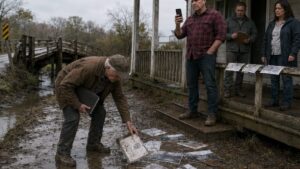
The rain was too light to explain the water pressing against Virginia’s foundation.
It gathered beneath the kitchen window in a shallow brown sheet, carrying mulch from the side yard and dead leaves from the Campbell property. The downpour had lasted less than twenty minutes.
Virginia stood under the porch eave with an umbrella and watched the water arrive from across the property line.
Not rush. Arrive.
That distinction mattered.
Rushing water followed slope and force. This water spread slowly from a blocked path, searching for somewhere else to go.
She turned toward the Campbell sunroom. Its unfinished wall sat over the narrow low strip that had once carried runoff toward a storm inlet at the rear of both properties.
Virginia had noticed the grade before. She had chosen not to study it too closely.
Now the water touched the first course of brick beneath her kitchen wall.
Inside, she placed the chalkboard on the table and erased the three reference numbers from Saturday’s meeting. Chalk dust remained in the grooves.
She replaced the numbers with questions.
Permit issued?
Setback verified?
Drainage path maintained?
The words looked less satisfying than accusations would have. That was why she kept them.
She opened Anna’s copy of the minutes.
The discussion had begun three weeks before the skeleton went up. Cynthia had complained that Virginia’s yard created “an undesirable visual contrast” with the Campbell renovation. David had asked whether association pressure could be applied without waiting for municipal inspection. Anthony had suggested identifying a separate, immediate nuisance issue.
The skeleton had not caused the conflict.
It had provided a usable target.
Virginia read the minutes twice, then set them aside. Motive did not prove a code violation. Resentment did not make her measurements accurate.
By nine o’clock Sunday morning, she was on the public sidewalk with a compact measuring wheel, a notebook, and her phone.
She stayed beyond the Campbell property line. She photographed the curb inlet, the low drainage corridor, the corner of the sunroom, and the distance between the addition and the visible survey pin near the sidewalk.
A curtain moved in Cynthia’s front window.
Virginia kept working.
At home, she opened an old flat-file drawer in the room she still called her office. Most of the contents belonged to another life: training manuals, retired code books, blank drafting paper, and a brass nameplate reading VIRGINIA MOORE—PLANNING TECHNICIAN.
She turned the nameplate facedown.
The parcel map showed a six-foot drainage easement crossing the rear edge of both properties. The Campbell addition appeared to overlap it, but the map alone was not precise enough.
She overlaid her sidewalk measurements on a printed aerial image.
The corner was close. Perhaps too close.
A feeling she had not permitted herself in years returned—not triumph, but the clean concentration of a problem becoming legible.
Then she found the photograph.
It was not one she had taken after receiving the letter. It came from early September, when she had photographed a hawk perched on the Campbell fence. In the background, the sunroom foundation trench was open.
A dark, shallow channel crossed the excavation.
In the next photograph, taken four days later, crushed stone filled the channel beneath the new framing.
Virginia sat very still.
Years earlier, another drainage channel had existed only as a faint line on a plan. Her supervisor had approved a revised grade without requiring field confirmation. Virginia had noticed the discrepancy and said nothing because the decision belonged to someone with a higher title.
After the flood, the homeowner had brought in a grocery bag filled with wet photographs. Virginia had helped separate them on the counter while pretending not to understand that her own silence was part of the damage.
She closed the image on her screen.
Reporting the Campbells now could be responsible. It could also be revenge wearing responsible clothing.
By Monday morning, she had prepared a records request rather than a complaint.
At the municipal counter, the clerk searched the parcel address.
“No building permit under that number,” the clerk said.
“Any pending application?”
The clerk checked again. “Nothing for an addition. There’s an electrical service inquiry, but it was never completed.”
“What about a grading review?”
“No.”
Virginia paid for copies of the parcel record, easement plat, and inspection history.
Before leaving, she asked, “If a structure appears to obstruct recorded drainage, is there a way to request a safety review without alleging a violation?”
The clerk slid a form across the counter. “Field-condition inquiry. Attach photographs. The inspector decides whether it becomes enforcement.”
That distinction gave Virginia room to breathe.
On Tuesday, she returned to the sidewalk with the official easement map clipped to a board. She aligned the rear parcel points with visible landmarks, checked her wheel measurement twice, and marked the likely easement limits in pencil.
The sunroom’s rear corner stood inside the corridor.
Not by inches.
By nearly two feet.
David came down the driveway while she was packing the measuring wheel.
“You’ve made your point,” he said.
“I haven’t made any finding.”
“You went to municipal records.”
“Those records are public.”
“You’re a retired clerk, correct?”
“Planning technician.”
“Then you understand how unreliable surface measurements can be.”
“Yes.”
The answer seemed to unsettle him.
Virginia closed her notebook. “That is why I’m not issuing conclusions.”
“You’re creating suspicion in the neighborhood.”
“Your attorney did that when he circulated language that wasn’t in the rules.”
David looked toward her house. The skeleton remained in place, one arm raised in its permanent wave.
“We borrowed against the house for that room,” he said.
It was the first honest sentence anyone from the Campbell household had offered her.
Virginia waited.
“My firm lost a client this summer,” he continued. “The room was supposed to increase the appraisal before refinancing.”
“So you built before approval.”
“The contractor said the permit could be finalized during construction.”
“Did he say that in writing?”
David’s silence answered.
Virginia felt sympathy, but it did not move the water away from her foundation.
“I’m submitting a field-condition inquiry,” she said. “Photographs, records, and measurements. No request for fines.”
His face hardened again. “That distinction won’t matter once enforcement starts.”
“It matters to me.”
She filed the inquiry that afternoon.
She included the photograph of the open drainage channel, the later image showing it filled, the public easement map, and a note explaining that her sidewalk measurements were approximate. She did not attach Anna’s minutes. Motive belonged to another dispute.
At four thirty, the municipal inspector called.
“I reviewed the images,” the inspector said. “There’s a storm system expected Thursday night. We need to look at that addition before then.”
Virginia glanced at the chalkboard on her kitchen table.
Permit issued?
Setback verified?
Drainage path maintained?
“When?” she asked.
“Thursday morning. We’ll need access to both properties.”
Across the street, Cynthia stood in the unfinished sunroom, reading something on her phone.
A moment later, she looked up directly at Virginia’s window.
The city had already notified her.
Chapter 4: The First Fine Was Not the Real Cost
The municipal inspector pressed the red notice flat against the Campbell front door while Cynthia stood three feet away with her arms locked across her chest.
Virginia watched from the sidewalk.
The paper was ordinary—one sheet, black print, a red border—but it altered the street more effectively than any siren could have. Curtains shifted in three neighboring houses. A garage door paused halfway open. Someone across the cul-de-sac lifted a phone.
The inspector stepped back and photographed the notice.
“Is that necessary?” Cynthia asked.
“It documents service.”
“We are cooperating.”
The inspector looked toward the unfinished sunroom. “Cooperation begins with access.”
David appeared behind Cynthia, buttoning one cuff. “Our counsel advised us not to consent to an intrusive search.”
“This is an exterior inspection based on a drainage complaint and visible construction,” the inspector said. “I can inspect from public property and the adjoining owner’s lot. Entry would let me verify conditions more accurately.”
David’s gaze found Virginia.
She had placed the skeleton’s chalkboard facedown beside her porch before the inspection began. She did not want the words on it appearing in someone’s photograph beside the red notice.
The inspector crossed to Virginia’s side yard. Virginia followed but kept several paces back.
Water stains marked the lower bricks beneath her kitchen window. The inspector crouched, touched the damp soil, then sighted along the grade toward the Campbell addition. He used a laser level from Virginia’s patio and recorded several elevations.
“Your original channel ran there?” he asked.
Virginia pointed toward the shallow depression that disappeared beneath the Campbell wall. “The recorded easement follows approximately that line. My measurements are not survey-grade.”
“Understood.”
Cynthia came to the property line. “That area has always held water.”
“Not against my foundation,” Virginia said.
“You can’t know that.”
“I’ve lived here eleven years.”
“And we have lived here long enough to know when a neighbor is trying to punish us.”
The inspector stood. “I need both of you to stop discussing motive. I’m inspecting physical conditions.”
Cynthia’s face colored, but she stepped back.
The general contractor arrived twenty minutes later in a dust-covered pickup. He moved quickly until he saw the notice, then slowed.
David met him at the driveway.
“You said the permit was in process,” David said.
The contractor glanced at the inspector, then at Cynthia. “I said I would submit once I had the final drawings.”
“You said we could proceed.”
“I said preliminary work could begin at your risk.”
“That is not what you told us.”
The contractor rubbed both hands over his face. “I sent the warning in writing.”
Cynthia’s head turned sharply. “What warning?”
He stared at her.
The pause was too long.
“You answered it,” he said.
Virginia felt the entire street contract around those four words.
Cynthia lowered her voice. “Not here.”
The contractor reached into his truck and brought out a folded packet in a clear plastic sleeve. “You told me the refinancing deadline mattered more than the permit delay. You said David had reviewed the exposure.”
David’s expression changed—not surprise, but recognition that a private arrangement had become public.
Anthony’s black sedan turned onto the street.
He parked in front of the Campbell house and approached with a leather folio under one arm.
“Stop making statements,” he told the contractor.
The inspector looked at him. “He is answering questions about construction sequence.”
“He is not required to speculate.”
“I’m not speculating,” the contractor said. “I told them not to close the wall until drainage was reviewed.”
Anthony placed himself between the contractor and Cynthia. “Anything further can be provided in writing.”
The contractor laughed once, without humor. “You people already have it in writing.”
Virginia looked toward Cynthia. For the first time since the dispute began, Cynthia did not appear controlling. She appeared cornered.
The inspector examined the packet.
The written warning was dated six weeks earlier. It advised that the proposed wall might encroach on the drainage easement and that work should stop until municipal review. Beneath the warning was an email response from Cynthia.
Proceed with framing. We cannot afford another delay.
The inspector read it without comment.
He then walked the full exterior of the addition, checked distances from visible parcel markers, and photographed the buried channel. By noon, he had confirmed three issues: construction without a permit, likely setback noncompliance, and obstruction of a recorded drainage easement.
“The drainage condition requires immediate temporary correction,” he told David. “The addition cannot remain closed over that path.”
“What does immediate mean?” David asked.
“Before tonight’s storm.”
“And the structure?”
“Work stops now. You’ll need engineered plans, a survey, and permit review. Portions may require removal.”
Cynthia gripped the edge of the porch rail. “How much is the penalty?”
“The initial civil assessment is four thousand dollars. Daily penalties can begin if the emergency drainage work is not completed.”
Anthony opened his folio. “We will appeal.”
“You may,” the inspector said. “The stop-work order remains effective.”
A neighbor near Virginia’s mailbox whispered, “Four thousand,” to someone on the phone.
Virginia felt no satisfaction.
She remembered the $18,000 demand on her kitchen table and had imagined, in darker moments, the pleasure of seeing the Campbells confronted by a number of their own. The actual scene contained none. Cynthia looked ill. David seemed smaller inside his expensive shirt. Two children watched through the front window.
The contractor estimated the required demolition and reconstruction at more than $25,000, not including survey and engineering fees.
Cynthia heard the figure and sat down on the porch step.
Virginia turned away before anyone could mistake her presence for celebration.
By afternoon, a temporary trench had been reopened along the property line. Mud covered the Campbell lawn. The sunroom wall remained standing, but its lower siding had been removed, exposing insulation and raw framing.
Neighborhood messages began arriving.
Some blamed the Campbells for building without approval. Others accused Virginia of waiting until a personal dispute to report the problem.
One email asked whether retired municipal employees should be allowed to “weaponize specialized knowledge against ordinary homeowners.”
Virginia did not answer.
Anna came by just before dusk carrying a covered dish Virginia had not requested.
“I thought you might not have eaten,” she said.
Virginia let her inside.
Anna placed the dish on the counter and saw the chalkboard lying facedown near the back door.
“You turned it over.”
“There were enough signs outside today.”
Anna sat at the table. “People are saying you knew about the sunroom for months.”
“I suspected something was wrong. I did not verify it until after the letter.”
“That sounds bad when they shorten it.”
“Most truths do.”
Anna hesitated. “Anthony sent another email to the board. He says your inspection request was retaliatory interference and that the association may need emergency legal relief.”
“Relief from what?”
“He claims your measurements, photographs, and public statements damaged the Campbells’ property rights and reputation.”
“I made no public statements.”
“He says the meeting counts.”
Virginia looked toward the dark window. Across the street, work lights shone through the exposed sunroom wall.
The first drops of the storm tapped against the glass.
Anna lowered her voice. “Anthony says he will seek an emergency order tomorrow morning.”
Virginia turned the chalkboard over.
The three questions remained in white chalk.
Permit issued?
Setback verified?
Drainage path maintained?
She had answers now, but Anthony was preparing to make the questions themselves the offense.
Chapter 5: The Night Someone Moved the Boundary Markers
Virginia’s doorbell camera sent the alert at 11:43 p.m.
Motion detected in front yard.
She was still awake at the kitchen table, reading Anthony’s draft petition on her tablet. The document described her as a former municipal employee conducting unauthorized surveillance and using technical intimidation to interfere with the Campbells’ peaceful enjoyment of their property.
The phrasing was polished enough to make her doubt the shape of her own actions.
Then the alert sounded again.
She opened the live view.
A hooded figure stood beside the skeleton.
The person was bent at the waist, one hand gripping the chalkboard frame and the other working at the wire that attached it to the skeleton’s arm.
Virginia’s first instinct was to open the front door.
Her second was older and more cautious: wait, document, call someone else.
For years, she had mistaken that second instinct for wisdom.
She turned on the porch light.
The figure froze.
Virginia pressed the camera microphone.
“Anthony.”
The hooded head lifted.
Rain shone on the dark fabric. Beneath the open front of the jacket, Virginia saw the sharp line of a suit lapel and a white shirt collar.
Anthony Scott straightened slowly.
“Mrs. Moore,” he said toward the camera. “Stay inside.”
His voice was not calm. It was trying to become calm.
“What are you doing on my property?”
“I’m securing disputed material.”
“You are removing my chalkboard.”
“It has been used to display allegations affecting my clients.”
“The board has possession of the meeting record.”
“This object may be relevant evidence.”
“Then request it.”
Anthony looked toward the street. His sedan was parked several houses away beneath a tree.
Virginia called the police.
She did not announce that she had done so.
On the camera, Anthony moved away from the skeleton and crouched near the narrow side-yard strip where the inspector had placed temporary orange stakes marking the drainage corridor. He pulled one from the soil.
“Leave the markers where they are,” Virginia said.
“They are not official survey monuments.”
“They were placed during a municipal inspection.”
“They are temporary indicators and could mislead the public.”
“There is no public here except you.”
Anthony drove the stake into a different patch of soil, nearly two feet closer to Virginia’s house.
The act was so precise that it frightened her more than random destruction would have. He was not losing control. He was trying to change what the scene would suggest in daylight.
Virginia opened the front door but stayed behind the storm door.
Rain struck the porch roof in hard bursts.
“Put it back,” she said.
Anthony turned.
His face looked pale beneath the hood. “You need to understand that this has gone far beyond a decoration.”
“I understood that when you demanded eighteen thousand dollars.”
“My clients relied on professional advice.”
“Whose?”
He ignored the question.
Virginia could see the chalkboard under his arm now. A crack ran through one corner of the wooden frame.
“Set it down.”
“You created demonstrative evidence and presented it publicly.”
“I wrote public reference numbers on a child’s chalkboard.”
“You implied criminality.”
“I implied records existed.”
Anthony stepped toward the walkway. “You have damaged my clients financially.”
“They built over a drainage path after a written warning.”
“You do not know the full circumstances.”
“Then tell me.”
For a moment, the rain filled the silence.
Anthony’s shoulders lowered.
“David has not paid my last two invoices,” he said. “He says the demand letter was my strategy. He says I overstated the association’s authority. Cynthia says I failed to protect them from municipal exposure.”
Virginia kept one hand against the storm door.
“Did you?”
“I relied on information they provided.”
“You changed the rule language.”
“I summarized counsel’s interpretation.”
“You made it look adopted.”
His face tightened. “The board circulated it.”
“Anna circulated what you sent.”
Anthony glanced again toward the street.
His fear was visible now, stripped of professional polish. If he withdrew, David could blame him. If he continued, every weak choice became harder to defend. He had tied his reputation to people already preparing to cut him loose.
Virginia almost pitied him.
Then she saw the second orange stake protruding from his coat pocket.
“Put everything down,” she said.
“Mrs. Moore, the safest course for all parties is preserving these materials until the hearing.”
“You are not preserving them. You are moving them.”
“I am preventing a false visual record.”
“You are creating one.”
Headlights turned onto the street.
Anthony stepped off the walkway.
Virginia opened the storm door.
“Stay where you are.”
He stopped, perhaps because she said it without raising her voice.
A patrol car pulled to the curb. The officer approached with one hand near the radio on their shoulder.
Anthony held the chalkboard out as if offering proof of innocence.
“I am counsel in an active civil matter,” he said. “This material is evidence.”
“Do you have permission to be on the property?” the officer asked.
Anthony looked at Virginia.
“No,” she said.
“Do you have a court order authorizing removal?”
“No order has been entered,” Anthony said. “But there is a preservation obligation.”
The officer took the chalkboard from him and examined the cracked frame.
“Who removed the orange stakes?”
Anthony’s answer came too slowly. “They were placed inaccurately.”
“That wasn’t the question.”
Virginia remained on the porch while the officer photographed the yard. The camera above the door continued recording.
The officer asked Anthony for identification and directed him to stand beside the patrol car.
No one was handcuffed. No one shouted. The neighborhood remained mostly dark, though a light had appeared in Cynthia’s upstairs window.
A second officer arrived and searched the immediate area around Anthony’s sedan after he consented to retrieve his folio and phone.
When the trunk opened, Virginia saw two more orange stakes lying across a folded raincoat. Mud clung to their lower ends.
The first officer looked at Anthony.
“You said you moved one.”
Anthony’s mouth opened, then closed.
Virginia felt the choice waiting inside her.
She could give the footage to every neighbor before morning. She could send it to the reporter whose card had appeared in her mailbox after the inspection. She could let the image of Anthony in a hooded jacket replace the photograph of her skeleton.
The thought was not entirely unpleasant.
That honesty shamed her more than the thought itself.
The officer returned to the porch. “Would you like to pursue a trespass complaint?”
Virginia looked at Anthony. Rain ran from his hood onto the shoulders of his suit. He no longer looked powerful. He looked like a man who had made one bad decision in defense of several earlier ones.
“Yes,” she said. “I want the incident documented.”
“Do you want to report the damaged property as well?”
She looked at the cracked chalkboard.
“Yes.”
Anthony lifted his head.
Virginia met his eyes. “Documented is not the same as destroyed.”
The officer issued Anthony a citation and instructed him not to return to the property. The stakes and chalkboard remained as evidence for the night.
Before the patrol car left, one officer opened Anthony’s trunk again to inventory the recovered items.
Four altered drainage stakes lay inside.
Not one.
Not two.
Four.
Chapter 6: The Hearing Where Virginia Corrected Herself
Anthony waited for Virginia to repeat the wrong number.
She knew it from the way he arranged his documents before the hearing began: her sidewalk sketch on top, the disputed measurement highlighted in yellow, his pen resting exactly beside it.
The municipal hearing room had no jury box and no audience gallery, only rows of molded chairs, a long table, and a raised desk for the hearing officer. Still, nearly half of Maple Ridge had come.
The skeleton’s chalkboard stood on a small easel beside Virginia.
She had repaired the cracked corner with plain wood glue, but the split remained visible.
On the board she had written three verified findings:
NO BUILDING PERMIT
DRAINAGE EASEMENT OBSTRUCTED
CORRECTIVE PLAN REQUIRED
She had erased every number she could not prove.
Cynthia and David sat with Anthony. Cynthia looked thinner than she had two weeks earlier. David had a file box at his feet and both hands locked around a paper cup.
The hearing officer called the matter to order.
The city presented first. The inspector described the missing permit, the obstructed drainage channel, and the temporary corrective work completed before the storm. Photographs showed water diverted through the reopened trench rather than toward Virginia’s foundation.
The setback issue remained less certain. A licensed survey completed after the inspection placed the sunroom closer to the boundary than permitted, but not as close as Virginia’s original sidewalk measurement suggested.
Anthony rose for questions.
“Your initial enforcement decision relied in part on Mrs. Moore’s measurements, correct?”
“They triggered review. They did not establish the violation.”
“Her submission stated the structure was approximately three feet from the property line.”
“It stated that her measurement was approximate.”
“And the survey shows four feet, two inches.”
“Yes.”
Anthony glanced at Virginia.
There it was.
A small error, but useful. If she defended it too strongly, he could portray her entire inquiry as unreliable. If she minimized it, he could say she had used false precision to damage the Campbells.
The hearing officer invited Virginia to testify.
She took the oath and sat at the witness table.
Anthony approached with her original sketch.
“Mrs. Moore, is this your handwriting?”
“Yes.”
“You wrote three feet.”
“I did.”
“And that was wrong.”
Virginia looked at the highlighted number.
The old instinct rose immediately: explain the slope, the fence alignment, the limitations of surface measurements, the temporary obstruction of the survey pin. Build enough context around the mistake that no one could use it cleanly.
She looked instead at the chalkboard.
Only verified facts.
“Yes,” she said. “It was wrong.”
A murmur moved through the room.
Anthony paused. He had expected resistance.
Virginia continued before he could shape the admission for her.
“My measurement underestimated the distance by fourteen inches. I took it from public property using visible landmarks. I labeled it approximate in the field-condition inquiry, but I should not have repeated the figure at the neighborhood meeting without a survey.”
Anthony’s expression tightened.
“So your public allegation was inaccurate.”
“My public reference was incomplete. The setback concern still required review, but the number I wrote was not reliable enough to present as fact.”
“Yet you displayed it in front of your neighbors.”
“I displayed permit references, not that measurement.”
“You intended to imply illegal conduct.”
“I intended to stop the association from adopting a false rule while an unresolved property issue was being used to pressure me.”
The hearing officer leaned forward. “Mrs. Moore, stay with the municipal issues.”
“Yes.”
Anthony held up the sketch. “If this measurement was wrong, why should the city credit anything else you submitted?”
“Because the permit record came from the city, the easement came from the recorded plat, the construction photographs were dated, and the drainage obstruction was confirmed in the field. My error does not improve or weaken those facts.”
The inspector lowered his eyes, hiding what might have been approval.
Anthony returned to counsel table without asking another question.
Virginia felt no triumph. Correcting herself had cost less than she feared and more than she expected. The admission stripped away the defensive certainty she had carried since the letter arrived. It also left her with something stronger than certainty: a record she did not need to protect from examination.
David testified next.
He described the refinancing plan and the contractor’s assurances. He said the family believed permits could be completed after preliminary construction.
The contractor’s written warning was entered into evidence.
Anthony asked whether David had understood the drainage concern.
“I understood it as a technical issue the contractor would resolve,” David said.
“Did you direct construction to proceed?”
David looked toward Cynthia.
“I did not personally send that instruction.”
The answer settled over the room.
Cynthia closed her eyes.
When her turn came, she walked to the witness table without looking at Anthony.
The hearing officer asked whether she had received the contractor’s written warning.
“Yes.”
“Did you understand that work should stop pending drainage review?”
“Yes.”
Anthony stood. “Cynthia, take a moment.”
She did not look at him.
“I understood,” she repeated. “I also understood that if we delayed again, we would miss the appraisal window.”
David stared at the table.
The hearing officer asked, “Why did the neighborhood complaint against Mrs. Moore begin at that time?”
Cynthia’s hands rested flat on the table. “Because the skeleton was visible in photographs of our house.”
No one moved.
“We were preparing appraisal materials,” she said. “David had lost a client. We had borrowed more than we should have. The sunroom was supposed to make the house appear finished and valuable.”
Virginia remembered Cynthia’s first explanation: the children’s breakfast-room sightline.
“Were your children emotionally harmed by the display?” the hearing officer asked.
“They disliked it.”
“That was not the question.”
Cynthia swallowed. “Not in the way the letter claimed.”
Anthony rose again. “I advised language based on the information provided by my clients.”
Cynthia finally turned toward him. “You advised that people respond to numbers.”
Anthony’s face went still.
“You said eighteen thousand would make her remove it before anyone asked questions about our project,” Cynthia said.
David whispered, “Cynthia.”
She looked at him now. “You let me send it.”
The surprise was not that Cynthia had known. The documents already showed that. The surprise was that she had once considered another course.
“I asked Virginia to move the skeleton before the letter,” Cynthia said. “I thought if she moved it out of the sightline, we could finish the appraisal and then fix the permit issue quietly.”
Virginia remembered the conversation differently—Cynthia saying the skeleton was large, nothing more.
“You did not tell me why,” Virginia said.
“No.” Cynthia’s voice thinned. “Because I was ashamed.”
There was no apology in the sentence, but there was truth.
The hearing officer recessed briefly, then returned with findings.
The stop-work order would remain. The Campbells were required to submit engineered drainage and corrective construction plans. The initial civil penalty stood, but maximum daily penalties would be suspended if compliance deadlines were met. The setback issue would be decided according to the licensed survey, not Virginia’s estimate.
Anthony’s conduct at Virginia’s property would be referred separately for professional review and handled outside the municipal case. His trespass citation remained pending.
Before closing, the hearing officer invited statements on penalties.
The city requested full enforcement authority.
Virginia stood.
She could ask for the maximum. The regulations permitted it. The Campbells had known about the warning, misrepresented their children’s distress, and used Anthony to frighten her into silence.
She thought of the family from years ago carrying wet photographs in a grocery bag. What had harmed them was not mercy. It was concealed risk.
“I want the drainage corrected,” Virginia said. “I want the permit process completed in public. I want the association record corrected.”
The hearing officer waited.
“I do not request maximum penalties if they comply.”
Anthony looked surprised. David looked relieved.
Cynthia looked neither.
“Why?” the hearing officer asked.
“Because the purpose of the rules is to correct the danger. Not to make suffering equal on both sides.”
The words exposed her more than the measurement had.
She sat down.
The hearing officer reviewed the final terms, then looked toward Cynthia.
“Mrs. Campbell,” she said, “you have heard Mrs. Moore request compliance rather than maximum punishment. Do you wish to answer her directly?”
Cynthia turned in her chair.
For the first time since the envelope had appeared on the skeleton’s wrist, no attorney stood between them.
Chapter 7: The Skeleton Returned Without a Victory Sign
Workers began dismantling the Campbell sunroom wall before eight on the first Monday in December.
No one gathered to watch.
The neighborhood had learned what public curiosity could become when given enough photographs, forwarded emails, and incomplete facts. Garage doors opened and closed. Cars backed from driveways. A delivery truck passed without slowing.
Across the street, a circular saw bit through the pale siding. One section came away, exposing studs, insulation, and the narrow drainage corridor beneath the floor.
Virginia stood at her kitchen window with both hands around a mug.
The removal did not look like victory. It looked expensive.
Cynthia had not answered her directly at the hearing.
She had opened her mouth, glanced toward David, and then asked whether she could provide a written statement instead. The hearing officer had allowed it. Three days later, Virginia received a copy.
The statement acknowledged that the emotional-harm claim had been exaggerated and that construction had continued despite the contractor’s warning. It did not contain the word apology.
Anthony had withdrawn from representing the Campbells. His trespass citation remained unresolved, and the professional review would take place privately. The local reporter who had left a card in Virginia’s mailbox called twice.
Virginia did not return the calls.
The doorbell footage stayed on the storage account attached to her camera. She gave it to the police, the hearing officer, and no one else.
That decision disappointed several neighbors.
One woman told Virginia that people deserved to see what Anthony had done. Another said public exposure was the only language professionals understood. Virginia listened, then changed the subject.
She had already spent too many years believing that silence was automatically decent. She would not replace that mistake with the belief that maximum exposure was automatically honest.
The saw stopped across the street.
A worker pulled away the lower framing, revealing damp soil where the drainage channel had been filled. The inspector’s temporary trench had prevented the last storm from reaching Virginia’s foundation, but the engineered plan required a permanent open swale and underground connection to the rear inlet.
David stood near the contractor with a clipboard. He wore an old jacket instead of a suit. When the contractor pointed to a stack of reusable windows and lumber, David nodded.
Virginia had heard that the Campbells were selling the unfinished materials to cover part of the corrective work. The addition would return as a smaller screened porch after the permit process was complete.
The front doorbell rang.
Anna stood outside holding a thick envelope and the skeleton’s chalkboard.
Virginia opened the door wider.
“The police released it this morning,” Anna said.
The crack in the wooden frame had been sanded and filled. A thin brace now crossed the back. The repair was neat enough to be professional, but the break remained visible from the front.
“I didn’t repair it,” Anna said quickly.
Virginia turned the board over.
A folded note had been taped beneath the brace.
Cynthia’s handwriting covered half a page.
Virginia read it while Anna waited on the porch.
I should not have said the children were harmed when they were uncomfortable. I should not have let Anthony turn our financial problem into your legal problem. I knew the permit warning existed, and I was afraid that if anyone looked closely, we would lose money we could not replace.
I am sorry for the claim and for what happened afterward.
I am not sorry that I was frightened. I am sorry that I made my fear your responsibility.
Virginia read the last sentence again.
It was not the apology she might have imagined during the first angry days. It did not offer friendship, affection, or a clean explanation. It asked for no forgiveness.
That made it easier to believe.
“What’s in the envelope?” Virginia asked.
“The complete association record,” Anna said. “Every draft, email, revision, and meeting note.”
“Why bring it to me?”
“I brought copies to every homeowner.”
Virginia looked up.
Anna shifted her weight. “I kept telling myself that sending what counsel gave me was neutral. Then I told myself withholding the original minutes prevented conflict. Neither was true.”
“What happens now?”
“The board president resigned. We’re voting on new procedures next month.”
The proposed rules required counsel’s interpretations to be labeled, prevented board action on private disputes without review of the governing documents, and barred officers from voting on matters involving their own properties. Complaints would be logged in full rather than summarized by whichever resident spoke first.
Virginia read the pages at her kitchen table while the sunroom wall came down across the street.
No rule could make the neighborhood kind. It could only make dishonesty harder to disguise as procedure.
That was enough for a beginning.
Cynthia crossed the street near noon.
She stopped at the edge of Virginia’s walkway, where the orange drainage stakes had once stood.
“I see you received it,” she said.
Virginia held the repaired chalkboard against her hip. “I did.”
Cynthia looked at the filled crack. “The contractor had a carpenter repair the frame.”
“Thank you.”
Neither woman moved closer.
“I meant what I wrote,” Cynthia said.
“I know.”
“I also know an apology does not erase the letter.”
“No.”
Cynthia looked back at the exposed wall of her house. “David thinks we should sell once the repairs are finished.”
“Do you?”
“I don’t know.”
The answer carried none of her former certainty.
Virginia could have offered comfort. She could have said the neighborhood would eventually forget, that houses recovered, that children adapted. Those things might have been true, but reassurance would have created a closeness neither woman had earned.
“I don’t want us to be friends,” Virginia said.
Cynthia’s face tightened, then settled.
“I understand.”
“I do want us to speak directly before we speak through anyone else.”
Cynthia nodded. “I can do that.”
“And if water crosses the line again, I will report it.”
“You should.”
They stood together for another moment, listening to a hammer strike wood across the street.
Then Cynthia returned home.
Virginia did not decorate for Christmas that year. She stored the skeleton in the garage, wrapped the repaired chalkboard in an old towel, and allowed the bare lawn to remain bare.
By spring, grass grew over the temporary trench. The permanent drainage channel curved between the properties, shallow and unremarkable. During heavy rain, Virginia sometimes watched water move through it toward the rear inlet.
It crossed no walls. It needed no one’s permission. It simply followed the path that should have been left open.
The next October, Virginia carried the skeleton from the garage.
She set it beside three pumpkins in the same place it had stood before. Several neighbors noticed while walking dogs or collecting mail, but no one raised a phone.
Virginia attached the repaired chalkboard to its wrist.
For a while, she considered writing the hearing findings on it. She imagined three clean lines:
NO FALSE RULES.
NO HIDDEN PERMITS.
NO MOVED MARKERS.
The message would have been accurate.
It also would have kept Anthony, Cynthia, and the dispute standing in her yard long after the physical evidence had been removed.
Virginia erased the words before anyone saw them.
She printed a simpler message.
HAPPY HALLOWEEN, NEIGHBORS.
Across the street, the Campbells’ smaller screened porch was complete. It sat behind the required setback, with the drainage channel visible beneath its open lattice.
Near their front steps stood one plain orange pumpkin.
No display surrounded it. No sign explained it.
Cynthia came outside to straighten the pumpkin, saw Virginia beside the skeleton, and paused.
Virginia raised one hand.
After a moment, Cynthia did the same.
Children began moving along Maple Ridge as the evening darkened, carrying plastic buckets and calling across the lawns. One small child stopped at Virginia’s skeleton and touched the repaired corner of the chalkboard.
“Did it break?” the child asked.
“Yes,” Virginia said.
“Why didn’t you get a new one?”
Virginia looked at the thin line where the wood had split and been joined.
“Because this one still works.”
The child accepted that answer and ran toward the next porch.
Virginia stepped back from the display.
The skeleton stood smiling beneath the porch light, holding no accusation, warning, permit number, or proof. It no longer needed to explain what had happened.
For the first time, neither did she.
The story has ended.