The Veteran Master Armorer Who Disarmed Her Arrogant Ambition
CHAPTER 1: THE TITANIUM PEN ON THE COLD STEEL
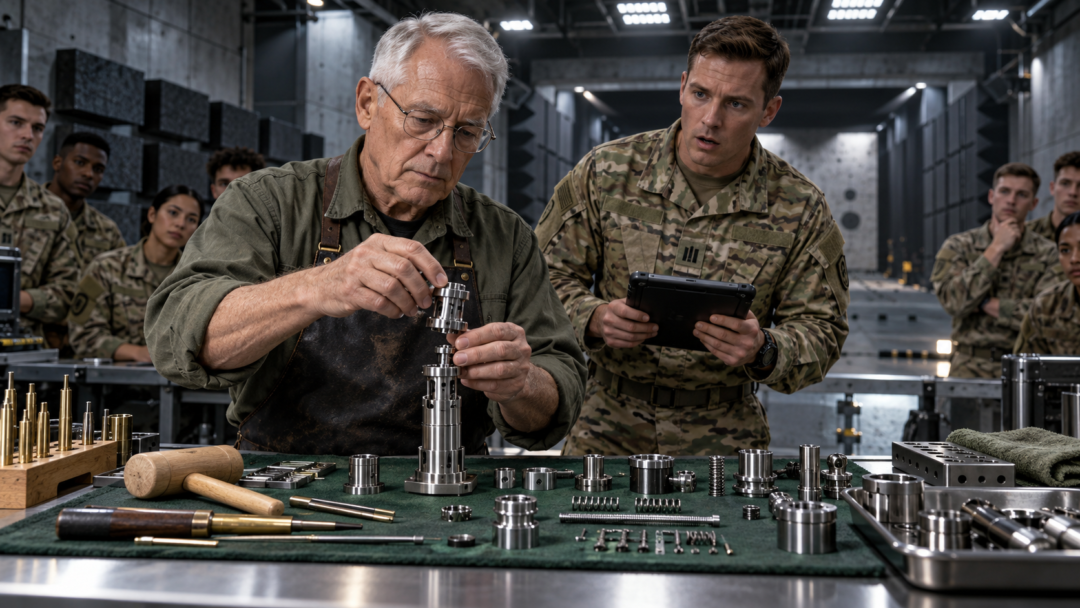
The subterranean weapons proving ground beneath Sub-Level Three of Fort Kessler was a cathedral of brushed steel, thick acoustic baffling, and the unmistakable, lingering perfume of high-grade ordnance. The air inside the enclosed testing tunnel was cool and bone-dry, recirculated through massive industrial HEPA scrubbers that hummed with a deep, floor-vibrating thrum. It carried the sharp, chemical scents of Hoppe’s No. 9 bore-cleaning solvent, aerosolized synthetic CLP lubricant, burnt smokeless powder, and the cold, metallic mineral smell of chilled tool steel. Recessed LED panels embedded into the ceiling cast a stark, shadowless surgical white light across the thirty-foot-long armorer’s workbench.
Standing behind the bench in a faded, oil-stained olive drab flight jacket was Master Sergeant Elias Voss.
Voss was sixty-eight years old, a veteran of four combat deployments across four decades, and the chief small-arms armorer for the installation. His silver hair was cropped in a severe high-and-tight cut, his weathered jaw covered in a light dusting of grey stubble. His skin was lined with the deep creases of a man who had squinted through sandstorms in Kuwait and freezing rain in the Balkans, his pale grey eyes steady, observant, and quiet as deep well water. A pair of wire-rimmed reading glasses was perched high on his forehead. His hands—wide, calloused, with black oil permanently worked into the whorls of his fingerprints—held an antique Arkansas whetstone, gently polishing the sear face of a disassembled combat trigger group.
The Fort Kessler proving grounds had tested small arms for every major American campaign since the First World War. Beneath its heavily reinforced arches, generations of master armorers had filed, headspaced, and tuned the weapons that had carried soldiers through Belleau Wood, the Ardennes, the Chosin Reservoir, and the Ia Drang Valley. To Elias Voss, every mark on a receiver told a human story—a soldier who needed that bolt to cycle when covered in frozen mud or suffocating red dust. The modern push toward disposable, unserviceable synthetic modules felt to him like an abdication of that sacred moral duty.
Lined up against the reinforced blast wall behind him were four young tactical recruits standing at rigid parade rest, their eyes wide as they watched the legendary armorer work.
The heavy motorized blast door slid open with a sharp pneumatic hiss, admitting Captain Evelyn Lumoke.
Lumoke was thirty-two years old, a top graduate of the United States Military Academy at West Point, and the newly appointed director of the garrison’s small-arms modernization program. She wore tailored, brand-new multi-cam duty fatigues with subdued black captain’s bars on her chest, her dark hair pulled back into an immaculate, varnished bun. In her left hand, she carried an ultra-thin carbon-fiber tactical evaluation tablet; in her right hand, she twirled a gleaming machined titanium tactical stylus. Her posture was aggressive, chin tilted high, her gaze sweeping the vintage hand tools on Voss’s bench with undisguised contempt.
She strode up to the workbench, her polished combat boots clicking sharply against the epoxy floor.
Lumoke stopped two feet from Voss. She leaned over the brushed-steel table, her eyes narrowing as she looked at the rows of brass drift punches, wooden mallets, and hand-filed sear jigs spread across the green felt mat.
With a sharp, rhythmic flick of her wrist, Lumoke began tapping the hard titanium tip of her pen directly against the polished steel of Voss’s workbench: tap… tap… tap… tap.
The sharp, metallic clatter echoed harshly off the concrete tunnel walls.
“Master Sergeant Voss,” Lumoke said, her voice crisp, condescending, and rapid as a corporate briefing. “I have just completed the quarterly logistics efficiency audit for this proving bay. Under the Army’s automated readiness directive, hand-tuning triggers and manual file-fitting are officially obsolete. In forty-eight hours, Nexis Defense Systems is delivering twenty automated laser-calibration benches to replace this entire workshop. Your hand tools belong in a museum, Sergeant, not in a modern tactical proving ground.”
Elias Voss did not flinch. He did not look up from the small piece of steel in his palm. His stone continued its smooth, rhythmic circular stroke against the metal sear: shhh… shhh… shhh.
“A machine measures clearance, Captain,” Voss said softly, his voice low, gravelly, and unhurried as gravel sliding down a dry riverbank. “A machine does not know how steel breathes when it gets hot in sixty seconds of continuous automatic fire.”
Lumoke let out a sharp, mocking scoff that rattled the quiet bay.
“Steel doesn’t breathe, Sergeant. Steel adheres to mathematical tolerances. Nexis Defense produces synthetic modular components with tolerances down to three microns. We don’t need sixty-eight-year-old men squinting through magnifying glasses to tell us if a sidearm works. The contract has been signed by the Pentagon board, and your retirement paperwork is on my desk.”
Lumoke reached into her holster, pulled her standard-issue M17 service sidearm, and slapped it down onto the felt mat right in front of Voss’s hands with an insulting, heavy clatter.
“Prove to me that your hands are faster than a digital automated bench, Sergeant,” Lumoke challenged, tapping the stopwatch icon on her tablet. “Field strip and reassemble to combat-ready status. If you take longer than fifteen seconds, you sign your retirement papers before lunch.”
Voss stopped polishing. He set the Arkansas whetstone down with deliberate gentleness.
He looked at the modern polymer-and-steel pistol resting on the table. Then he looked up at Captain Lumoke, his grey eyes piercing straight through her arrogant facade.
“I won’t need fifteen seconds, Captain,” Voss said quietly. “And I won’t need my eyes.”
CHAPTER 2: SEVEN SECONDS IN THE DARK
Captain Evelyn Lumoke’s lips curled into a sneer of utter disbelief. “Blindfolded? On an unfamiliar M17 platform? You’re grandstanding in front of these recruits, Sergeant. Don’t embarrass yourself.”
“Set your timer, Captain,” Voss replied calmly.
Elias Voss reached up to his brow and pushed his wire-rimmed reading glasses further up into his silver hair. He lowered his eyelids, drawing in one long, slow, rhythmic breath through his nose. His shoulders dropped into absolute relaxation, his posture centering over his hips. The four young recruits held their breath, leaning forward against the blast wall in frozen anticipation.
Lumoke tapped the screen: “Timer starts… now.”
The digital stopwatch began its lightning-fast electronic count.
The M17 modular handgun system had been designed with an internal stainless-steel fire control unit removable from its glass-filled polymer grip module. To an inexperienced eye, the intricate stamped-steel linkages, disconnectors, and dual-nested recoil springs looked like a puzzle requiring specialized bench fixtures. But to Voss’s fingertips, every curved millimeter had a tactile voice. He could feel the slight micro-burr along the disconnector track, the tension curve of the sear spring, and the precise friction coefficient between the carbon slide rails and the receiver notches. When his hands moved, they did not fight the tolerances; they slid into them like water into a dry stone channel.
Voss moved.
His eyes remained shut tight. His weathered, grease-stained fingers descended upon the weapon like striking hawks, moving not with frantic haste, but with the terrifying, supernatural fluidity of four decades of muscle memory.
Click-snap-shhh.
In one point eight seconds, his left thumb rotated the takedown lever downward ninety degrees. His right palm swept the steel slide assembly forward off the polymer frame. His fingertips slipped inside the inverted slide, depressing the recoil spring guide rod, releasing the tension with a muted click, and lifting the cold steel barrel from the slide housing. Four major components lay separated on the felt mat in a perfect, equidistant line: frame, slide, barrel, guide assembly.
Elapsed time on Lumoke’s tablet: three point two seconds.
Lumoke’s smirk began to freeze.
Before the timer could tick another second, Voss’s hands reversed the sequence. He didn’t fumble. He didn’t search the felt mat. His fingers knew the exact millimeter coordinates of every piece purely by the tactile resonance of the air and the slight vibration of the workbench.
His left hand dropped the barrel into the slide; his right hand compressed the high-tension recoil spring, seating the guide rod into its crescent notch with an authoritative, metallic CLACK.
With a single, blinding forward sweep, he mated the slide rails to the polymer receiver. His thumb snapped the takedown lever back into its horizontal locking position.
SNICK-CLACK.
His right hand scooped up the empty steel magazine from the bench, driving it upward into the grip magwell with a concussive palm strike that rang out like a hammer on an anvil: THWACK.
Still without opening his eyes, Voss’s right thumb hooked over the serrated rear of the slide, pulling the action rearward to test the locking lugs before flicking the slide release.
CLANK.
The steel slide snapped forward into full battery with bone-jarring authority. Voss squeezed the trigger once: CLICK. The clean, crisp snap of the firing pin striker echoed off the concrete walls like a small-caliber gunshot.
He set the weapon flat on the steel table, directly beside Lumoke’s digital tablet.
He opened his eyes.
Lumoke stared down at her screen in paralyzed, horrified disbelief.
The digital timer on her tablet display read: 00:07.42.
Seven seconds and forty-two hundredths of a second.
The four recruits behind her gasped in unison, exchanging glances of pure, reverent awe.
Lumoke’s throat bobbed. Her face was flushed with hot, stinging embarrassment. She reached out with a trembling hand, picking up the reassembled weapon, desperately checking the safety levers and slide travel to find any flaw that would allow her to salvage her pride.
“Seven seconds is an impressive parlor trick, Sergeant,” Lumoke stammered, her voice defensive and thin. “But mechanical speed does not change the fact that automated laser-machined components are mathematically superior to your manual—”
“Look at the extractor pin, Captain,” Voss interrupted, his voice dropping into an icy, resonant whisper.
Lumoke frowned, holding the pistol under the high-intensity overhead LED lamp.
“What about it?” she snapped.
“The Nexis automated batch you authorized last week,” Voss said, pointing a calloused finger at the microscopic hinge above the ejection port. “They used injection-molded powdered alloy to cut manufacturing costs by eighteen percent. Look at the hairline shadow right behind the claw pivot. That is a thermal stress micro-fracture. After two hundred rounds of sustained combat fire, that claw will shear off. The spent casing will stick in the chamber. And whichever young soldier is carrying this sidearm will have a steel paperweight in the middle of a firefight.”
Lumoke’s fingers jerked as if the gun had burned her. Her face turned chalk-white, but she quickly masked her shock with belligerent fury.
“You’re making baseless accusations against a prime Department of Defense contractor, Sergeant Voss!” she hissed, shoving the weapon back into her holster. “This batch was certified by the Aberdeen automated test center! If you spread these rumors to the garrison commander, I will have you court-martialed for insubordination!”
Lumoke turned on her heel and stormed out through the pneumatic blast door, her boots echoing down the concrete corridor in frantic, uneven steps.
CHAPTER 3: THE GHOST FILES IN THE SERVER VAULT
Elias Voss remained standing at his workbench long after the heavy blast doors had sealed shut.
The four recruits quietly excused themselves, slipping out of the bay with solemn, respectful bows to the old armorer. Voss picked up his Arkansas whetstone, placed it neatly inside his oiled wooden tool chest, and closed the brass latches. He knew Evelyn Lumoke’s type; he had seen dozens of ambitious young officers over forty years who were so blinded by promotions, corporate consulting promises, and PowerPoint metrics that they forgot the only metric that truly mattered: bringing nineteen-year-old soldiers home alive.
At eight o’clock that evening, Voss walked down the subterranean corridor to Bay Nine—the digital ballistics telemetry center.
Sitting in front of a bank of eight glowing multi-colored monitors was Chief Warrant Officer Four Marcus Reed. Reed was forty-six years old, a former infantry sniper turned ballistics telemetry engineer, with dark circles under his tired eyes and a thermos of black coffee sitting on his console.
“Elias,” Reed said, spinning around in his wheeled swivel chair. “I heard about the show you put on in Bay Three this morning. Seven point four seconds blindfolded. The recruits are already calling you the Iron Ghost.”
“Marcus,” Voss said, pulling up a steel stool and sitting beside the console. “I need you to pull the thermal stress telemetry from last Tuesday’s five-thousand-round endurance test on the Nexis prototype rifles.”
Reed’s face tightened. He set his coffee cup down on the console, his fingers hesitating above the illuminated mechanical keyboard.
“Elias… that test was classified under Lumoke’s direct program seal,” Reed whispered, glancing nervously at the security camera above the doorway. “She signed for the raw server logs personally yesterday afternoon.”
“Just pull the raw telemetry curve, Marcus,” Voss urged softly. “The extractors. Look at the chamber pressure curves past round three hundred.”
Reed sighed, entered his administrative master credentials, and navigated to the proving ground server directories: DIRECTORY // KESSLER_ORDNANCE // NEXIS_MOD4_EVAL // THERMAL_TEST_04.
The screen flashed red: ERROR 404 – FILE NOT FOUND OR PURGED UNDER ROUTINE CLEANUP.
Reed’s eyes went wide behind his glasses. “What the hell? The entire forty-gigabyte telemetry folder has been deleted. Purged at zero-two-thirty hours this morning.”
“Purged?” Voss’s jaw hardened into stone. “Military telemetry files are required by federal law to be archived for ten years.”
“Wait,” Reed muttered, his fingers typing furious commands into the command-line interface. “Whoever wiped the partition used a commercial file shredder, but they didn’t clear the shadow backup cache on the auxiliary solid-state drive in Server Rack Nine. Let me run a raw sectors carve.”
For three agonizing minutes, the hard drives in the server bay clattered in the silence. Green progress bars swept across the screens.
Then, a high-resolution data graph reconstructed itself on the central monitor.
Reed leaned forward, his mouth opening in horror.
“God Almighty, Elias,” Reed whispered, his face turning pale in the monitor’s glow. “Look at the thermal failure spike.”
The graph showed that at round one hundred and eighty, when the barrel temperature reached four hundred and fifty degrees Fahrenheit, the Nexis synthetic bolt carrier began expanding outside its design tolerances. By round two hundred and twenty, the extractor claw suffered catastrophic metal fatigue in seven out of ten prototype rifles, resulting in double-feeds, case-head separations, and explosive chamber jams.
Attached to the bottom of the deleted file was a scanned PDF document bearing the corporate logo of Nexis Defense Systems.
It was a private consulting agreement offering Captain Evelyn Lumoke a guaranteed vice president position with an annual salary of two hundred and eighty thousand dollars, plus stock options, contingent upon the successful delivery of the Fort Kessler field certification report by December first.
“Do you remember Fallujah in 2004, Marcus?” Voss asked quietly, his eyes distant as the memory washed over him. “Third Battalion had thirty rifles jam during the breach because a defense contractor supplied unhardened extractor springs that lost tension when the ambient temperature hit one hundred and ten degrees. We lost Corporal Jacobs because his extractor slipped off a steel casing in a stairwell. I swore on his grave that as long as I held this master rating, no contractor would ever put flawed steel into a young private’s hands to save five dollars on an invoice.”
Reed nodded grimly, adjusting his glasses. “And Lumoke was in middle school when Jacobs died. She looks at these casualty figures as acceptable statistical deviations on an Excel spreadsheet. She doesn’t see the blood.”
“She buried the failures,” Reed breathed, looking at Voss with terrified eyes. “She’s certifying rifles she knows are defective so she can cash out into a corporate executive job.”
Before either man could speak, the red alarm beacon above the blast door began flashing in rhythmic, silent pulses.
The electronic lock on the server bay clicked. The heavy steel door swung inward.
Standing in the entryway, accompanied by two armed civilian security contractors wearing dark suits and tactical badges, was Captain Evelyn Lumoke.
CHAPTER 4: THE MIDNIGHT TEST IN BAY THREE
“Back away from the console, Chief Reed,” Captain Lumoke commanded, her voice icy, sharp, and laced with venomous desperation. Her eyes darted from the screen showing the consulting agreement to the grim, unmoving face of Elias Voss.
The two civilian security contractors stepped into the server room, their hands resting menacingly on the grips of their holstered pistols.
“Captain,” Reed said, rising from his chair with his hands raised. “This is an active military server bay. These men are civilian contractors; they have no security clearance to enter this facility—”
“These gentlemen are corporate security liaisons with top-level Department of Defense clearances, Chief,” Lumoke countered smoothly, stepping toward the main console. “And you are currently in breach of Operational Security Directive 12 by accessing proprietary intellectual property belonging to Nexis Defense Systems without program authorization.”
Lumoke pulled a high-speed encrypted flash drive from her pocket, jammed it into the server console, and tapped three commands, initiating an irreversible cryptographic zero-fill across the secondary shadow cache.
The reconstructed graphs flickered, dissolved into lines of garbled binary static, and went black.
“There,” Lumoke said, a cold, triumphant smile returning to her lips. “The proprietary files have been returned to their authorized manufacturer. Chief Reed, you will surrender your administrative security tokens and report to garrison headquarters for disciplinary processing at zero-eight-hundred.”
She turned her gaze upon Elias Voss, who remained seated on his stool, his arms folded across his chest, watching her with the calm, pitiless detachment of a seasoned combat surgeon examining an infected wound.
“And you, Master Sergeant,” Lumoke sneered, stepping into his face. “I gave you the courtesy of offering an honorable retirement. Instead, you chose to dig through corporate files like a common saboteur. At zero-nine-hundred tomorrow, the Department of the Army Weapons Selection Board is convening in the main auditorium. General Sterling and Colonel Vance will be presiding. I am submitting my final certification report, and I have already signed your referral for a general court-martial for espionage and breach of national defense contracts.”
Voss looked at the dark corporate contractors behind her, then into Lumoke’s wide, ambitious eyes.
“You really believe that paper protects you, don’t you, Evelyn?” Voss asked softly. His voice was quiet, devoid of hatred or anger—only a profound, tragic sadness. “You think that because you have a captain’s commission and a contract from a billionaire in Virginia, the laws of physics will bend to your will. When that bolt shears in a dust storm, the bullets don’t care about your corporate stock options. They kill the nineteen-year-old kid from Ohio who trusted that his rifle was built to keep him alive.”
“The Nexis platform is the future of this military!” Lumoke snarled, her composure cracking under his piercing gaze. “And you are nothing but an old man who cleans grease off bolts! Get out of this room before I have these officers cuff you and throw you in the stockade tonight!”
Voss stood up slowly. He didn’t argue. He didn’t reach for a weapon. He straightened the collar of his faded flight jacket, looked Chief Warrant Officer Reed in the eye with a subtle, resolute nod, and walked out into the subterranean corridor.
The subterranean tunnels connecting the proving bays stretched for nearly half a mile beneath the Maryland limestone, cool and echoing with the distant hum of high-voltage transformers. As Voss walked through the shadowed corridor, he could hear the faint, synchronized footsteps of the two armed corporate contractors lingering fifty yards behind him. They were watching him, calculating the angles, wondering if an old master sergeant would break under the threat of a court-martial.
Voss did not look back. He had faced down snipers in the Euphrates and mortar barrages in Kandahar; two men in cheap suits with holstered sidearms did not even register in his pulse. He knew that intimidation was always the final refuge of a bankrupt lie. When an executive or an officer realized their fraud was exposed to the light of day, their only remaining weapon was fear. And Elias Voss had buried his fear thirty years ago in the desert.
He didn’t go to his quarters to pack his bags.
He walked straight down the tunnel to Bay One—the high-temperature environmental testing chamber—and unlocked the reinforced tool locker where he kept his private metallurgy logbooks and three physical samples of the failed Nexis extractor pins.
He would give them their test. But he would make sure it was conducted in the light of day, where no digital delete key could erase the truth.
CHAPTER 5: THE SABOTAGE IN THE THERMAL CHAMBER
At two o’clock in the morning, the subterranean corridors of Fort Kessler were silent, save for the low hum of the ventilation exhaust.
Voss was inside Bay One, carefully securing the three sheared extractor claws inside a heavy, fireproof steel dispatch case. Beside him on the workbench lay two rifles: one was a factory-fresh Nexis Prototype Mod-4 rifle, fitted with its proprietary injection-molded bolt carrier; the other was a standard military M4A1 that Voss had spent forty hours hand-fitting, its bolt polished to a mirror finish, its extractor spring reinforced with chrome-silicon steel.
Suddenly, the overhead ventilation fans stuttered and died.
A faint, bitter smell of burning electrical insulation and aerosolized acetone began to seep through the intake ducts.
Voss froze, his senses instantly tuning to the danger. Through forty years of military service, he had survived fuel fires, burning ammo dumps, and white phosphorus explosions; he knew the smell of an incendiary device within two seconds of ignition.
KABOOM.
A concussive shockwave slammed against the reinforced steel door of Bay One, blowing out the ceiling fluorescent fixtures in a shower of white sparks and blinding smoke. Fire—hot, chemical, fed by pressurized thermite gel—roared through the air-intake vents, splashing across the electronic diagnostic consoles along the north wall.
The sprinkler heads triggered with a high-pitched hiss, spraying mist into the air, but the thermite burned through the aluminum console housings with an intense, violet-white heat that melted copper wires into glowing liquid beads.
Through the heavy smoke, Voss saw a figure in black tactical gear and a respirator backing out of the access hatch, clutching a gallon container of chemical accelerant. It was one of the civilian corporate contractors Lumoke had brought into the facility.
“Fire in Bay One!” Voss’s command voice boomed through the corridor with the concussive volume of a drill field commander. “Activate automated halon suppression! Seal the blast baffles!”
Voss did not run for the exit.
He dove through the billowing chemical smoke toward the workbench. Flames were licking up the legs of the steel table, curling around the fireproof dispatch case and the two test rifles.
Voss grabbed a heavy Nomex fire blanket from the emergency wall rack, threw it over the weapons, and wrapped his arms around the burning bundle.
The heat was blistering. The fabric of his olive drab flight jacket began to singe, the leather crackling under the extreme thermal radiation, but Voss braced his boots against the floor, gritted his teeth, and hauled the sixty-pound bundle backward through the smoke.
He reached the heavy blast door just as the halon fire-suppression gas flooded the bay with a deafening, suffocating hiss.
Voss crashed through the double doors into the outer corridor, tumbling onto the wet concrete floor, coughing violently, gasping for clean air.
Running down the corridor toward him, accompanied by six armed military police officers and base firefighters, were Chief Warrant Officer Reed and Garrison Commander Colonel Harrison Vance.
“Elias!” Reed shouted, falling to his knees beside the coughing armorer. “Medic! Get oxygen down here!”
Colonel Vance knelt down, his steely eyes taking in the charred, smoke-blackened form of the veteran master sergeant, then the burning room behind him.
“Master Sergeant Voss,” Colonel Vance demanded, his voice trembling with controlled fury. “What happened here?”
Voss pulled off his singed work gloves, breathing heavily through his cracked lips. With trembling, soot-stained fingers, he unzipped the scorched Nomex blanket and revealed the steel dispatch case and the two rifles—intact, untouched by the flames.
“They tried to burn the evidence, Colonel,” Voss coughed, holding up the blackened, melted thermite canister he had kicked away from the bench. “Nexis Defense. They knew the test rifles would fail in front of the board this morning. But the rifles are right here.”
The chemical smell of the burning thermite cut through the air scrubbers, filling the subterranean tunnel with a dense, acrid cloud of grey smoke that tasted of sulfur and melted plastics. As the firefighters in heavy bunker gear dragged high-pressure foam hoses into Bay One, Colonel Vance kept his hand firmly on Voss’s trembling, soot-blackened shoulder.
“You could have been killed in that vault, Elias,” Colonel Vance said, his voice thick with emotion. “The halon system alone would have suffocated you in forty seconds.”
“A good armorer doesn’t leave his rifles behind to burn, Colonel,” Voss replied softly, wiping a smear of black grease from his brow with his singed sleeve. “If those rifles burned, Captain Lumoke would have sworn to the Pentagon board that the prototypes were flawless and that an electrical malfunction destroyed the test bay. Now we have the steel. And steel doesn’t lie.”
Colonel Vance looked at the melted canister, then up at the chief of the military police.
“Lock down every gate on this installation,” Colonel Vance commanded with icy finality. “No civilian contractor and no officer leaves Fort Kessler without my personal written authorization. The board convenes in four hours. And Master Sergeant Voss will be my chief technical witness.”
CHAPTER 6: THE TRIAL BEFORE THE SELECTION BOARD
At nine o’clock that morning, the grand auditorium of Fort Kessler was filled to capacity with three hundred officers, non-commissioned officers, and technical evaluators for the Department of the Army Small Arms Selection Board.
Seated behind the long mahogany dais at the front of the hall were five senior officers, headed by Lieutenant General Arthur Sterling—a powerful three-star general from the Pentagon Procurement Directorate—flanked by Garrison Commander Colonel Harrison Vance.
Standing at the petitioner’s podium was Captain Evelyn Lumoke.
She was impeccably groomed in her service dress uniform, her medals straight, her hair flawless, though her pale complexion and dark circles beneath her makeup betrayed a night of sleepless terror. Behind her sat the Chief Executive Officer of Nexis Defense Systems, accompanied by four high-priced corporate defense lawyers with leather briefcases.
“General Sterling, members of the board,” Lumoke began, her voice confident and polished as she clicked her remote, projecting dazzling three-dimensional holographic schematics of the Nexis Mod-4 rifle across the thirty-foot auditorium screen. “The Nexis platform represents a generational leap in automated warfare. By utilizing proprietary injection-molded synthetic bolt carriers and automated manufacturing, we eliminate seventy percent of manual labor costs while delivering a weapon system that meets every Department of Defense threshold. I am proud to present our final certification for immediate procurement.”
General Sterling nodded with warm approval. “Outstanding work, Captain Lumoke. This program will save the Army forty million dollars annually. Do any members of the board have questions before we proceed to the formal vote?”
“I have questions,” Colonel Harrison Vance said, his voice cutting through the room like a cold steel blade.
Colonel Vance stood up from his chair.
“The board will recognize Master Sergeant Elias Voss, Chief Armorer of Fort Kessler.”
A murmur of surprise swept through the assembly.
The double doors at the center aisle opened.
Walking down the carpeted aisle was Elias Voss. He wore a clean, pressed Class A service uniform, five rows of combat ribbons gleaming on his chest, his master armorer badge pinned above his heart. His face bore small, red thermal burns from the night’s fire, but his posture was upright, towering, and filled with the quiet, immovable authority of a veteran who answered only to the truth.
Beside him, Chief Warrant Officer Reed wheeled a portable ballistic test bench into the center of the hall, bearing the two test rifles and twelve hundred rounds of standard-issue 5.56mm combat ammunition.
General Sterling frowned, waving his hand in annoyance. “Colonel Vance, this is an administrative board, not an armory demonstration. Master Sergeant Voss’s opinions have already been noted in the appendix—”
“With all respect, General,” Colonel Vance replied firmly. “Under Army Regulation 70-1, any board member may demand an empirical live-fire thermal endurance test prior to final contract execution. Master Sergeant Voss contends that the Nexis synthetic bolt carrier fails under rapid combat fire. Let us see the truth on this bench.”
Lumoke’s throat tightened into an agonizing knot. Her CEO leaned forward, whispering frantically into her ear: “Stop this! Do not let them fire that prototype!”
“General!” Lumoke cried out, stepping forward with her hands shaking. “The live demonstration was already completed at Aberdeen! A manual test inside an auditorium is a violation of garrison safety protocols—”
“The ballistic capture tank is certified for up to .50 caliber fire, Captain,” Voss said calmly, his voice echoing through the silent auditorium. “If your synthetic carrier is as mathematically superior as your slides claim, it will fire three hundred rounds without a hiccup. Step up to the bench, Captain. Fire your weapon.”
Three hundred pairs of eyes locked onto Captain Evelyn Lumoke.
Her face drained of all color. Her lips parted, but no words came out. She looked at the fresh Nexis rifle resting on the bench, then at the ammunition magazines. She knew what was inside that chamber. She knew that every word she had written in her report was a lie bought with corporate promises.
“I… I am the program evaluator, not the range technician,” Lumoke stammered, backing away from the podium.
“Then I will fire it,” Voss said.
Elias Voss stepped behind the ballistic capture tank. He donned safety glasses and hearing protection. He inserted a thirty-round magazine of match-grade ammunition into the Nexis prototype, racked the slide into battery, and aimed into the acoustic capture port.
He squeezed the trigger.
RAT-TAT-TAT-TAT-TAT.
The weapon fired in rapid, three-round bursts. Empty brass casings flew across the table, spinning through the air.
One magazine. Thirty rounds. Barrel temperature: two hundred degrees.
Voss slammed in a second magazine: RAT-TAT-TAT-TAT-TAT.
Sixty rounds. Barrel temperature: three hundred and twenty degrees. The synthetic polymer coating on the bolt carrier began emitting a faint, foul-smelling chemical vapor.
Third magazine: RAT-TAT-TAT-TAT-TAT.
Ninety rounds.
Fourth magazine. Voss chambered the round. He squeezed the trigger.
RAT-TAT—
BAM-CRACK.
On round one hundred and twelve, a violent, concussive rupture echoed through the auditorium.
The Nexis synthetic bolt carrier shattered inside the upper receiver into three jagged fragments of molten alloy and plastic. The extractor claw sheared completely off its pin. High-pressure gas and black carbon erupted backward through the ejection port, spraying hot shrapnel against the safety glass shield with a deafening rattle. The rifle jammed solid, its charging handle locked in an immovable, mangled wreck.
A collective gasp of sheer horror erupted from the rows of officers and generals.
Voss set the mangled, smoking weapon down on the steel table.
He picked up a pair of tweezers, reached into the smoking chamber, and extracted the sheared extractor claw. He walked up to the dais and placed the broken piece of cheap alloy directly in front of General Sterling.
“One hundred and twelve rounds, General,” Voss said softly, his voice piercing the dead silence of the hall. “In a desert firefight, my squad would have been slaughtered while trying to clear that jam. That is what forty million dollars of corporate modernization bought you.”
CHAPTER 7: THE MASTER’S TOUCH IN THE MORNING SUN
The silence inside the grand auditorium was suffocating, heavy as lead.
General Arthur Sterling stared down at the melted, shattered piece of metal on the mahogany table before him, the color draining from his face until he looked twenty years older. He slowly lifted his eyes, looking past the ruined rifle at Captain Evelyn Lumoke.
Lumoke was trembling so violently that she had to hold onto the podium to keep from falling. Her CEO had already gathered his briefcase and was attempting to slip toward the rear exit, but two armed military police officers stepped across the doorway, blocking his path with crossed rifles.
Colonel Harrison Vance stood up, his face set in lines of righteous, unyielding judgment.
“Captain Evelyn Lumoke,” Colonel Vance announced, his voice ringing like a funeral bell through the cavernous hall. “Under the Uniform Code of Military Justice, you are relieved of your duties effective immediately. You are remanded to the garrison provost marshal on charges of procurement fraud, falsification of official records, reckless endangerment of military personnel, and conspiracy to commit arson.”
Military police officers marched down the aisle, snapped steel handcuffs around Lumoke’s wrists, and escorted the ruined officer out into the corridor as three hundred soldiers watched in stony, unforgiving silence.
Two weeks later, the cold autumn rains had passed, swept away by a clean, crisp northwest wind that washed the Maryland sky into a brilliant, crystalline turquoise.
The Department of the Army had terminated all contracts with Nexis Defense Systems with extreme prejudice, initiating federal grand jury proceedings against its corporate board. More importantly, the automated modernization mandate was officially rescinded across all regional commands, replaced by a new directive mandating traditional hand-fitted technical inspections for every infantry weapon deployed overseas.
Inside Bay Three of the Fort Kessler weapons proving ground, the morning sun poured through the high clerestory windows, cutting bright golden beams through the clean, dry air. The fire damage had been completely repaired; the walls were fresh with clean white paint, smelling of fresh pine shavings and clean machine oil.
Standing in a rigid, immaculate formation before the thirty-foot workbench were sixty young armorers and recruit trainees, all wearing clean service fatigues, their eyes shining with eager pride.
Standing beside the bench, dressed in their finest dress uniforms, were Garrison Commander Colonel Harrison Vance and Chief Warrant Officer Marcus Reed.
Colonel Vance stepped forward, holding an official commission parchment bearing the gold seal of the Department of Defense.
“By executive order of the Secretary of the Army,” Colonel Vance proclaimed, his voice echoing proudly off the clean concrete walls, “Master Sergeant Elias Voss is hereby appointed Lifetime Chief Master Armorer of the United States Armed Forces, with supreme garrison authority over all small-arms quality standards and technical curricula. In recognition of forty years of unyielding devotion to the lives of American soldiers.”
The sixty young armorers snapped into a thunderous, unified hand salute, their boots clicking together like a single rifle shot.
Voss stood before them. He wore no flight jacket today; his service uniform was pristine, his silver hair catching the morning sun. He returned the salute with a steady, weathered hand that had known every spring, pin, and barrel in the inventory.
“At ease, soldiers,” Voss said gently.
The men dropped their hands, their eyes fixed on the master.
Voss turned to his workbench. Laid out across the clean green felt mat was his antique wooden tool chest, open to the sunlight, displaying his rows of brass punches, wooden mallets, and polished Arkansas whetstones. Beside the chest lay a freshly disassembled M4A1 rifle, its components resting in an orderly row.
Voss looked at the young men and women standing before him—the next generation of guardians who would ensure that no soldier ever went into battle with a flawed weapon.
He picked up a small brass punch and handed it to the youngest recruit in the front rank.
A warm, knowing smile touched Voss’s weathered face.
The recruit stepped up to the bench, his young hands trembling slightly as he looked at the intricate arrangement of steel parts spread across the green felt mat. He looked at Master Sergeant Voss with a mixture of reverence and uncertainty.
“Sergeant Voss,” the young private whispered, his throat dry. “How do you know where each spring fits when your eyes are closed? How do you know when it’s right?”
Elias Voss placed his weathered hand gently over the young soldier’s fingers, guiding them down to touch the cold, polished slide of the M4A1.
“You don’t memorize the manual, son,” Voss said softly, his voice carrying the deep, patient wisdom of forty years of craftsmanship. “You listen. Steel has a voice. When a part fits with honor and truth, it doesn’t fight you. It clicks into place with a clean, honest ring that you can feel in your bones. Learn to listen with your hands, and you will never send a brother into danger with a flawed shield.”
The young recruit closed his eyes, took a deep breath, and let his fingers begin to move.
“Step up to the bench, soldier,” Voss said softly, his voice warm and inviting as the morning sun. “Close your eyes. And let me show you how steel breathes.”