The HOA Ordered Benjamin to Shut Down His Garage Business—Then an Old Property Record Changed Who Actually Had the Right
Chapter 1: The Notice Arrived While Benjamin Was Still Working
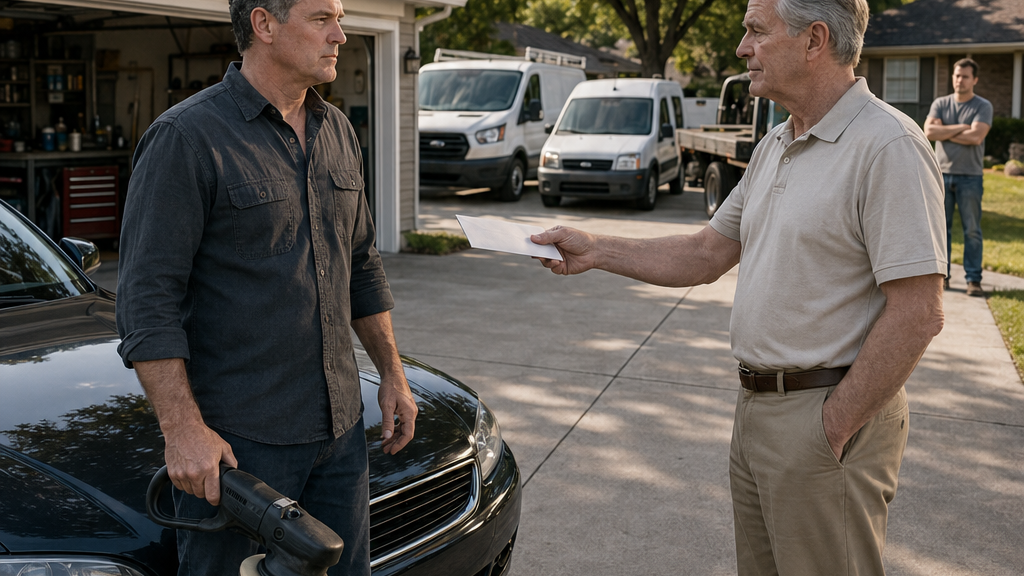
George Carter crossed Benjamin Walker’s driveway carrying a white envelope while Benjamin still had a polishing machine running against the hood of a customer’s sedan.
Benjamin saw him in the reflection first.
Gray polo. Khaki pants. HOA badge clipped to his belt. Envelope held upright between two fingers as if it were something that needed to be witnessed.
Benjamin switched off the polisher.
The sudden silence made the driveway feel larger.
Behind him, two white detailing vans sat side by side on the concrete pad he had poured years earlier. His flatbed truck was parked beyond them, far enough back from the street that a delivery driver could turn in without blocking the curb. Hoses were coiled against the garage wall. A pressure washer clicked as it cooled.
George stopped beside the sedan.
“Afternoon, Benjamin.”
Benjamin wiped compound from his thumb with a shop towel. “George.”
“I need to give you this.”
Benjamin looked at the envelope but did not take it immediately.
“What is it?”
“Formal notice.”
That was when the customer, who had been waiting near the porch steps, glanced toward them.
Benjamin noticed.
George noticed too.
He smiled.
Benjamin took the envelope.
The return address belonged to the homeowners association.
“Can this wait until I’m finished?”
“I’m just delivering it.”
George stayed where he was.
Benjamin opened the flap with his thumb.
The first line contained the phrase CEASE AND DESIST in bold capital letters.
He read further.
Commercial activity.
Commercial vehicles.
Violation of residential-use covenant.
Thirty days to discontinue operations.
Then the number.
Two hundred dollars per day.
Benjamin read that line twice.
“You’re saying two hundred a day?”
“Beginning after the compliance period, yes.”
“For working from my garage.”
“For operating a commercial enterprise from a residential lot.”
Benjamin looked past George toward the vans.
He had been operating the business from that garage for eleven years.
Customers rarely came there. Most mornings he loaded chemicals, towels, hoses, and buffers into the vans and drove to office parks, homes, dealership overflow lots, or fleet yards. The garage was storage, maintenance, scheduling, and occasionally a place to finish a vehicle when weather made outside work impossible.
He had spent years making sure the business caused as little trouble as possible.
No roadside signs.
No loud work at night.
No employees leaving cars along the curb.
The concrete pad had cost him more than he wanted to remember because he had refused to let his trucks spill onto the street.
He folded the notice once.
George’s eyes followed the paper.
“The board has been getting complaints.”
“From who?”
“I’m not going to identify residents.”
“How many?”
“That isn’t really relevant.”
Benjamin looked at him.
George shifted his weight.
“The point is consistency. We’ve had concerns about enforcement being uneven.”
“So this is about my vans.”
“It’s about the covenant.”
Benjamin glanced toward the customer again. The man pretended to look at his phone.
Heat climbed into Benjamin’s face, but he kept his voice low.
“How long have you been looking at my property?”
George hesitated.
“A few months.”
“Looking how?”
“Documenting.”
Benjamin’s fingers tightened around the folded notice.
“Documenting what?”
“Vehicle presence. Frequency. Business activity.”
“You’ve been taking pictures?”
“I didn’t say I personally took them.”
Benjamin gave a short nod.
That was worse somehow.
George continued in the measured tone he probably thought sounded reasonable.
“We have to treat everyone the same. If we allow one obvious commercial operation, then somebody else asks why their trailer is a problem, or why their work truck is a problem, or why their home business is different.”
Benjamin had heard versions of that argument before.
Years earlier, he had received a warning about leaving a flatbed visible overnight. Another time, the board complained about a temporary canopy he had erected while repairing equipment. Once, there had been a letter about a trailer parked three days too long.
He had moved things.
Paid one small administrative fine.
Thrown away the letters.
He had always told himself it was cheaper than arguing.
Now George was holding that history against him.
“The notice references prior violations,” Benjamin said.
“They establish a pattern.”
“I handled those.”
“You complied after notice.”
Benjamin stared at him.
There was something irritatingly clean about the distinction.
George had converted Benjamin’s previous willingness to avoid conflict into evidence that the board had been right all along.
Benjamin unfolded the letter and read the covenant citation.
Then he asked, “Before the board approved this, did anyone review the recorded property documents for my lot?”
George’s expression changed only slightly.
“What do you mean?”
“The deed records. Plat. Easements. Anything attached to the property.”
“The covenants are recorded.”
“That wasn’t my question.”
George glanced down at the notice.
“The association’s documents were reviewed by counsel.”
“My lot’s documents?”
“I’m not sure what distinction you’re trying to make.”
Benjamin refolded the letter.
This time he made the crease carefully.
“I’m asking whether anyone checked what was recorded against this specific property before you told me to shut down a business that’s been here eleven years.”
George’s smile disappeared.
“The board’s position is clear.”
“That still doesn’t answer it.”
“If you think you have an exemption, you’re welcome to submit it.”
Benjamin slid the folded notice into his shirt pocket.
“I might.”
George gave him a tired look, as though Benjamin had chosen to make a simple matter difficult.
“Thirty days, Benjamin. I’d rather this not become expensive.”
Then he turned and walked toward the sidewalk.
Benjamin stood beside the sedan until George reached the corner.
Only after he disappeared behind the hedge did Benjamin realize the customer was watching him.
“Everything okay?” the man asked.
Benjamin looked at the half-polished hood.
“Yeah.”
It came out automatically.
He picked up the machine.
But when he switched it back on, his hand was no longer steady enough to keep the pad flat.
He stopped again.
For the rest of the afternoon, the folded notice felt heavier in his pocket than paper had any right to feel.
By six, the customer was gone and the driveway was quiet.
Benjamin pulled the notice out and laid it on the hood of the sedan’s empty parking space.
The paper looked small beside everything it threatened.
The garage.
The vans.
The flatbed.
Eleven years of invoices.
The concrete pad he had poured because a former board member once told him work vehicles would attract fewer complaints if they were kept well away from the curb.
He nearly laughed at that.
Instead he carried the notice into the garage office.
A metal filing cabinet stood beneath an old wall calendar. Benjamin opened the bottom drawer and started pulling folders.
Insurance.
Vehicle titles.
Business licenses.
Property tax statements.
He kept looking until he found a thick blue folder labeled CLOSING—2013.
He had not opened it in years.
Inside were copies of the purchase contract, title policy, survey, deed, inspection report, and a stack of pages he barely remembered signing.
Benjamin spread them across his desk.
Near the back of the title paperwork, a line had been underlined in yellow by someone from the closing company.
SUBJECT TO EASEMENTS, RESTRICTIONS AND MATTERS SHOWN ON RECORDED PLAT.
Beside it, in faded handwriting, was a reference number.
Benjamin leaned closer.
At the end of the note were four digits.
He pulled the folded violation notice from his pocket and placed it beside the closing file.
For the first time that day, the two pieces of paper did not seem to belong to the same version of his property.
Chapter 2: Eleven Years of Work Became Evidence Overnight
The first document Benjamin found that night proved almost nothing.
It was his original business license.
He had expected the date printed across the top to feel like a weapon.
Instead, it looked disappointingly ordinary.
Benjamin sat at the narrow desk in his garage office while the rest of the house remained dark. The violation notice lay open beside the license, both illuminated by the yellow pool of a desk lamp.
The license showed that he had registered the detailing business before the HOA adopted its current enforcement structure.
That mattered.
But after twenty minutes of searching legal explanations online, Benjamin understood that “older” did not automatically mean “protected.”
A business license gave him permission to operate a business.
It did not necessarily give him the right to operate it from this particular property.
He leaned back.
“Great.”
He rubbed both hands over his face.
This was exactly why he avoided paperwork fights.
Every answer came with three definitions and a footnote.
He turned back to the closing folder.
The survey showed the property boundary, utility easements, setbacks, and the long concrete drive that curved toward the rear garage. The lot was larger than most nearby lots, almost half an acre, sitting on a corner where the subdivision widened before narrowing again.
Benjamin had bought it partly for that reason.
He had never wanted the business to feel as if it were sitting on top of his neighbors.
The parking pad was sixty-two feet from the curb.
He knew because he had measured it himself before pouring it.
At the time, that distance had seemed like common sense.
Now he wondered whether there had been another reason the lot was shaped this way.
He entered the reference number from the closing paperwork into the county’s online records portal.
Nothing.
He tried again without punctuation.
Still nothing.
Then he searched by subdivision name.
A list appeared.
Deeds.
Amendments.
Utility agreements.
Plats.
Most were newer.
He filtered by year.
One result remained.
The image would not load.
Benjamin stared at the blank screen until a message appeared telling him the record had been digitized only as an index reference and that a full image could be requested from the county recorder.
He swore under his breath.
Then he looked at the clock.
11:42 p.m.
The next morning he was at the garage desk before seven.
He cancelled his first nonessential appointment and pushed a fleet-cleaning job to the afternoon.
That cost him money.
Not enough to hurt yet.
But enough that he noticed.
He began reconstructing the history of his own business.
Old tax returns.
Licensing renewals.
Invoices bearing the property address.
Equipment receipts.
Insurance records.
He found photographs from his first year showing one white van parked beside the garage before he had expanded the pad.
A second photograph showed the flatbed arriving three years later.
Another showed him repairing a pressure washer with the garage door open.
For eleven years, none of this had been hidden.
He had not moved into the subdivision and secretly converted a bedroom into a warehouse.
The business had grown in plain sight.
That realization gave him confidence until he read the cease-and-desist letter again.
The covenant language was broad.
No commercial enterprise shall be conducted upon any residential lot except activities conducted entirely within the dwelling and producing no visible evidence of business use.
Benjamin looked through the garage window at two white vans.
Visible evidence.
There was no arguing with that phrase.
The question was whether the rule applied to his lot in the same way it applied to everyone else.
At eight-thirty, he called the county recorder.
A clerk answered.
Benjamin gave the reference number.
There was a pause while keys clicked.
“Yes,” the clerk said. “That’s a recorded subdivision plat.”
“Can you email it?”
“I can send a certified digital copy for a fee.”
“Do that.”
“You also may want the associated declaration listed in the margin.”
Benjamin straightened.
“What declaration?”
“Older notation. Same recording sequence.”
He wrote down another number.
“What does it say?”
“I can’t interpret documents for you.”
“I’m not asking you to interpret it. I’m asking what it’s titled.”
More clicking.
“Declaration of Easements and Reserved Uses.”
Benjamin stopped writing.
“Reserved uses?”
“That’s the title.”
“When was it recorded?”
“Same year. Nineteen eighty-seven.”
He looked at the yellow-highlighted sentence in his closing paperwork.
“Send that too.”
The documents arrived fourteen minutes later.
Benjamin printed them.
The plat came out over several pages because his printer could not handle the original size. He taped sections together on the garage workbench until roads, lot numbers, utility corridors, and handwritten notations formed a crooked map.
His lot sat near the edge.
There was a symbol beside it.
Not on the neighboring lots.
Just his and one other parcel farther down the road.
He found the symbol in the notes.
Then he read the associated declaration.
The language was old and formal, full of phrases that made him slow down.
Utility access.
Drainage.
Ingress and egress.
Reserved rights.
Benjamin followed a numbered section with his finger.
Certain lots identified on the recorded plat could retain limited service, trade, and commercial uses existing under original development approval, subject to nuisance restrictions and access requirements.
He read it again.
Then a third time.
The garage seemed unusually quiet.
His eyes moved from the paper to the folded HOA notice.
The same property.
Two different sets of words.
One said no visible commercial activity.
The older one appeared to say certain marked lots could retain it.
Benjamin did not smile.
He had spent enough of the night learning how dangerous it was to celebrate wording before understanding it.
He looked for termination language.
There was none that he could see.
He searched the later HOA declaration for a reference to the older reserved-use provision.
Nothing obvious.
At nine-fifteen, the first van driver arrived to load supplies for the afternoon fleet job.
Benjamin folded the plat copy and stepped outside.
The vans stood exactly where they had stood the day before.
For the first time, he saw them not just as work vehicles but as a timeline.
Years of mornings.
Years of invoices.
Years of loading towels before sunrise and returning with wet hoses after dark.
He wondered how far back the property’s working history went before him.
The HOA had treated the vans as evidence against him.
Perhaps they were evidence.
Just not of what George thought.
Benjamin went back inside and clipped the violation notice to the printed declaration.
At the bottom of the county record was a reference to the original development approval.
Next to it appeared one sentence that made him stop.
The reserved uses were to remain effective unless specifically released or extinguished by recorded instrument.
Benjamin searched the county index again.
He found amendments.
Transfers.
Updated subdivision restrictions.
Nothing labeled release.
Nothing labeled extinguishment.
By ten, he had enough confidence to make a call he had resisted all morning.
He contacted a real-estate attorney.
When the receptionist asked what the issue involved, Benjamin looked at the old plat spread across his workbench.
“An HOA thinks I’m running a business where I’m not allowed to.”
He paused.
“And I think the county records may say otherwise.”
Chapter 3: The Old Plat Did Not End the Fight
Benjamin read the sentence twice in the county records office because the certified copy looked more serious than the one he had printed at home.
The wording had not changed.
Certain marked lots retained limited commercial and service uses.
His lot was marked.
The provision remained effective unless released or extinguished by recorded instrument.
He felt the first real surge of relief since George had walked into his driveway.
Then the real-estate attorney beside him said, “Don’t get too comfortable yet.”
Benjamin looked over.
The attorney held the plat flat against the counter with one hand.
“What part am I missing?”
“Possibly several.”
“That’s encouraging.”
The attorney ignored the sarcasm.
“This is useful. Very useful. It does not mean you win just because it exists.”
Benjamin folded his arms.
“What else would it mean?”
“It means there was a reserved-use right associated with this lot in 1987. We still have to determine its scope, whether it ran with the land, whether later recorded documents modified it, whether the use was abandoned, whether your current business falls within what was contemplated, and what authority the HOA has under the later declaration.”
Benjamin stared at him.
“So yesterday I was shutting down. This morning I had an easement. Now I have homework.”
“That’s property law.”
The county records clerk slid another certified page across the counter.
Benjamin paid for it.
The attorney arranged the papers in chronological order.
Original plat.
Reserved-use declaration.
Later development amendment.
Transfer document.
HOA declaration.
Benjamin’s deed.
“There’s something else,” the attorney said.
He tapped the oldest declaration.
“This document is sloppy.”
“In my favor?”
“Sloppy is not automatically in anyone’s favor.”
Benjamin exhaled.
The attorney pointed to language describing “service and trade operations compatible with surrounding residential development.”
“That phrase gives everyone something to argue about.”
“My detailing business is service.”
“Yes.”
“And it’s been there eleven years.”
“Yes.”
“And before the HOA.”
“Your current business predates the current enforcement structure. That’s different from proving the property right itself remained continuously active.”
Benjamin understood the distinction now, and disliked it.
“What would prove that?”
“Prior use.”
Benjamin looked at the lot number again.
“The previous owner?”
“Exactly.”
They spent another hour searching indexed documents.
No termination appeared.
No signed release.
No extinguishment instrument.
That was the good news.
The less comforting news was that the HOA declaration recorded years later prohibited visible commercial activity without expressly discussing the older reserved-use lots.
The attorney made copies.
“This is where the fight is,” he said.
“If they didn’t cancel the old right, how can they just pretend it isn’t there?”
“They may argue the later restrictions superseded it.”
“Can they?”
“They can argue it.”
Benjamin gave him a look.
The attorney almost smiled.
“You hired me for the difference between an argument and an answer.”
By early afternoon they were sitting in the attorney’s office with the folded violation notice clipped to the certified plat.
Benjamin had brought his business records.
The attorney went through them more carefully than Benjamin expected.
License.
Insurance.
Photographs.
Tax filings.
Invoices tied to the address.
Vehicle registrations.
“You keep decent records,” the attorney said.
Benjamin looked toward the window.
“Only for things I think matter.”
The attorney glanced at the violation history Benjamin had reluctantly brought.
“And things you don’t think matter?”
Benjamin said nothing.
There were six older HOA notices in the folder.
Two parking warnings.
One temporary-structure violation.
One complaint about equipment visible from the street.
Two administrative fines.
The attorney read them.
“You paid this one.”
“It was fifty dollars.”
“And this.”
“Seventy-five.”
“Why?”
Benjamin shrugged. “Cheaper than missing work to argue about it.”
The attorney leaned back.
“That may become part of their position.”
Benjamin’s jaw tightened.
“How?”
“They’ll say you recognized their enforcement authority before.”
“I recognized that my time was worth more than seventy-five dollars.”
“I understand. They may characterize it differently.”
Benjamin stared at the papers.
For years, avoiding the board had felt like discipline.
He had thought refusing to be drawn into petty arguments made him the reasonable one.
Now every quiet concession sat in a file under his name.
The attorney saw his expression.
“This doesn’t destroy your position.”
“It doesn’t help.”
“No.”
Benjamin gave a humorless laugh.
“At least you don’t soften things.”
“That’s another service people pay for.”
The attorney drafted a short letter that afternoon.
It did not threaten anyone.
Benjamin had expected something sharper.
Instead, it cited the recorded documents, identified the reserved-use language, stated that no extinguishment instrument had yet been located, and requested immediate suspension of enforcement pending legal review.
At the bottom was the exact county recording number.
Benjamin read the letter twice.
“That’s it?”
“For now.”
“No demand?”
“This is the demand.”
“It sounds polite.”
“It’s supposed to.”
Benjamin signed the engagement paperwork.
The retainer was twelve hundred dollars.
That number hurt more than he wanted to admit.
He transferred the money from the business reserve account he used for equipment repairs.
The balance afterward was thin enough that a transmission failure in either van would become a problem.
On the drive home, he kept thinking about that.
George could send a notice for the cost of paper and postage.
Benjamin had to spend twelve hundred dollars just to make the board consider whether the notice was lawful.
By four, the attorney had emailed the letter to the HOA and sent a certified copy.
At four-thirty, Benjamin’s phone rang.
George.
Benjamin almost let it go to voicemail.
Then he answered.
“Benjamin.”
“I saw the attorney letter.”
“That was quick.”
“Our management company forwarded it.”
Benjamin waited.
George continued.
“I want to be clear that the board does not agree with your attorney’s interpretation.”
“My attorney didn’t give you a final interpretation. He asked you to pause enforcement.”
“The covenants apply to all owners.”
“Did your lawyer review the 1987 document?”
“Our counsel is looking at it.”
“Then pause the fines.”
There was a short silence.
“I’m not authorized to suspend an approved enforcement action unilaterally.”
“You’re the president.”
“I’m one vote.”
Benjamin looked through the garage window at the vans.
“So when you came to my driveway, that was the whole board talking. Now that there might be a problem, you’re one vote.”
“That’s not fair.”
Benjamin almost answered sharply.
Instead he stopped himself.
“What would be fair?”
George’s tone hardened.
“Fair would be enforcing the same rules for everyone who bought into this neighborhood expecting residential standards.”
Benjamin leaned against the desk.
“And if my lot has different recorded rights?”
“That is not established.”
“That’s exactly why the attorney asked you to stop while it’s reviewed.”
“We have residents who have been told for years that work trucks, trailers, and commercial activity are restricted. If we simply stop because someone finds an old document, what do you think that tells everybody else?”
Benjamin heard something new in George’s voice.
Not certainty.
Fear.
Not fear of Benjamin.
Fear of precedent.
“What it tells them,” Benjamin said, “is that the board checks before it fines people.”
George went quiet.
Then he said, “The deadline remains in place unless the board changes it.”
The call ended less than a minute later.
Benjamin lowered the phone.
The attorney called him again shortly before six.
“I received the HOA counsel’s response.”
“That fast?”
“They’re disputing scope. They’re also raising abandonment.”
Benjamin straightened.
“Abandonment?”
“They’re suggesting that even if the reserved use existed, it may have lapsed before you purchased.”
“How would they know?”
“They don’t yet. It’s a legal theory.”
Benjamin looked at the old plat.
“What do we need?”
The attorney paused.
“We need to know what happened on that lot before 2013.”
Benjamin thought of the man who had sold him the property.
Richard Wilson.
He remembered a shed behind the garage that Richard had called “the old equipment room.” He remembered shallow scratches in the driveway from heavier trucks. He remembered asking why the electrical service in the detached garage was larger than expected.
Richard had shrugged.
“Used to run a little landscaping outfit out of here.”
At the time, Benjamin had cared more about whether the roof leaked.
“How long does prior use have to be?” Benjamin asked.
“That depends. First, tell me whether there was prior use at all.”
“There was.”
The attorney’s voice sharpened.
“You know that?”
“The previous owner told me he ran a landscaping business here.”
“For how long?”
Benjamin searched his memory.
“I don’t know.”
“Can you reach him?”
Benjamin looked at the certified plat, the folded violation notice clipped to its corner, and the eleven years of business records surrounding them.
“Yes.”
The attorney answered immediately.
“Then before we argue another word about abandonment, find out exactly what Richard Wilson was doing on that property—and for how many years.”
Chapter 4: The Man Who Owned the Lot Before Him
Richard Wilson interrupted Benjamin before he finished describing the 1987 document.
“The commercial-use language?”
Benjamin tightened his grip on the phone.
“You remember it?”
“Sure I remember it.”
Benjamin stood beside his garage workbench with the certified plat spread beneath his hand.
“Why?”
Richard was quiet for a moment.
“Because I used it.”
That answer changed Benjamin’s plans for the day.
An hour later he was driving across town with copies of the plat, the declaration, and the folded HOA notice inside a document envelope on the passenger seat. The attorney had told him not to suggest answers, not to put words in Richard’s mouth, and not to treat memory as proof simply because it was useful.
“Ask what he did,” the attorney had said. “Ask when. Ask what records might still exist. Don’t turn him into your witness before you know what he remembers.”
Richard lived in a one-story house behind a line of mature oaks. He was older than Benjamin remembered, with white hair and the thick forearms of someone who had spent most of his life lifting things that came without handles.
He opened the door before Benjamin knocked.
“You brought paperwork.”
“A lot of it.”
“That means this isn’t a social visit.”
Richard led him to a kitchen table.
Benjamin placed the plat between them and pointed to the marked lot.
Richard did not need time to study it.
“That was mine.”
“You knew about this notation?”
Richard adjusted his reading glasses.
“The developer called it a reserved-use lot.”
“For what?”
“My landscaping business.”
Benjamin felt the answer land but forced himself not to rush.
“What kind of business?”
“Maintenance mostly. Lawn contracts, plantings, irrigation repairs. Later I added small hardscape jobs.”
“You ran it from the property?”
Richard looked up.
“Where else would I have run it?”
Benjamin let that sit.
“How long?”
Richard leaned back and counted silently.
“Started there the year after we moved in. I sold you the place in 2013, right?”
“Right.”
“Nineteen years, give or take a few months.”
Benjamin had expected five.
Maybe eight.
Not nineteen.
“You had employees?”
“Never more than four.”
“Trucks?”
“Two pickups at first. Box truck later. Trailers. Mowers.”
“Customers coming to the house?”
“Rarely. Same way you do it, I imagine. Most work happened somewhere else.”
Richard tapped the plat.
“That’s why that lot worked. Big setback. Side access. Enough room to keep equipment off the street.”
Benjamin looked toward the window.
For eleven years he had thought of the concrete parking pad as something he had added to make his business fit the property.
Richard was describing a property that had been shaped around working use long before Benjamin arrived.
“Did the neighborhood complain?”
“Sometimes.”
“What happened?”
“Usually nothing.”
“Because of this?”
Richard nodded toward the document.
“The original association wasn’t what yours is now. Smaller. Half the neighborhood wasn’t even built. People knew which lots had special conditions.”
Benjamin felt a small lift of satisfaction.
Then Richard ruined it.
“But I didn’t keep much.”
Benjamin looked at him.
“Much what?”
“Paperwork.”
The satisfaction disappeared.
Richard stood and opened a kitchen cabinet, then another.
“I had boxes when we moved. Tax stuff, old bids, receipts. My wife made me keep seven years. After that, most went.”
“You don’t have invoices from the business?”
“Not from the beginning.”
“Vehicle registrations?”
“Maybe some.”
“Photos?”
“Probably family pictures with trucks in the background. I wasn’t photographing the business for court twenty years later.”
Benjamin heard the edge in Richard’s voice and backed off.
“I’m not asking you to have known this was coming.”
Richard looked at him.
“What exactly is coming?”
Benjamin slid the folded violation notice across the table.
Richard opened it.
His eyes moved down the page.
When he reached the daily fine, he made a low sound through his teeth.
“Two hundred?”
“After thirty days.”
“For the vans?”
“And the business.”
Richard read the notice again.
“This is why you called.”
“The HOA says the old use may have been abandoned before I bought the house.”
Richard looked genuinely offended.
“Abandoned?”
“That’s the argument.”
“I ran crews out of that garage until the month before closing.”
Benjamin leaned forward.
“You’re certain?”
“Benjamin, you remember the green trailer.”
A memory surfaced immediately: a dented landscaping trailer parked behind the detached garage during Benjamin’s final walk-through.
“I remember.”
“I sold it after you signed the contract because you didn’t want it.”
Benjamin did remember that too.
He had been more concerned about whether the old trailer would be removed than why it was there.
Richard stood again.
“Come on.”
“Where?”
“Your place.”
Twenty minutes later, they were standing on Benjamin’s concrete pad.
Richard walked slowly along its edge.
“This part’s yours.”
He pointed toward the newer concrete.
“I widened it.”
“I can see that.”
Then Richard moved to the older section closest to the garage.
“This was already here when I bought the house.”
Benjamin crouched.
There was a slight difference in aggregate and color. He had noticed it hundreds of times without considering what it meant.
“My dump trailer sat here,” Richard said. “Mowers over there. Box truck backed along that side.”
He pointed toward the fence.
“Mulch deliveries came through the side gate.”
“How often?”
“In spring? Couple times a week.”
Benjamin stood.
“So trucks were regularly coming onto the property.”
“For years.”
A white detailing van turned into the driveway. One of Benjamin’s workers lifted a hand before parking.
Richard watched the vehicle settle onto the pad.
“Looks about the same as it used to.”
That sentence gave Benjamin more confidence than any of the legal language had.
The property had not gone dormant for a decade and then suddenly become commercial again.
It had worked.
Then it had changed owners.
Then it had kept working.
Benjamin called the attorney from the garage.
Richard repeated the history directly.
The attorney asked precise questions.
Dates.
Vehicles.
Employee count.
Whether the business address had appeared on public filings.
Whether deliveries occurred.
Whether Richard had ever received permission from the association.
“No,” Richard said. “Permission wasn’t the point. The lot already had the use.”
Benjamin looked at him.
The attorney asked, “Do you have anything dated that connects your landscaping business to this address?”
Richard rubbed his chin.
“Probably not enough to make you happy.”
“What might exist outside your own files?”
That stopped him.
Richard looked toward the garage.
“The county.”
Benjamin lifted his head.
“What county record?”
Richard snapped his fingers once, trying to retrieve the memory.
“They made me get something when I expanded the operation. Not a business license. Property-related.”
“A zoning approval?”
“No. The subdivision was already approved.”
“Building permit?”
Richard shook his head.
Then his expression changed.
“Access permit.”
Benjamin waited.
“For what?”
“When I added the larger trailer, the county made me modify the driveway apron. They inspected it because commercial vehicles were using the lot.”
The attorney’s voice came sharply through the phone.
“When?”
Richard thought.
“Late nineties. Maybe 1998.”
“Would the application identify the business?”
“It should.”
“And the property?”
“Absolutely.”
Benjamin looked down at the concrete beneath his boots.
The same driveway George saw as evidence of a violation might have generated a government file proving the opposite history.
Richard gave him a faint smile.
“Funny thing about paperwork.”
Benjamin looked at him.
“You hate it until you need somebody else’s copy.”
Benjamin picked up the folded violation notice from the workbench.
For years, he had treated official paper as something to satisfy, pay, file, or throw away.
Now one missing county folder could decide whether nineteen years of Richard’s work became legally visible.
He called the county recorder again.
The clerk redirected him to archived permitting.
A second clerk took the address.
There was a pause.
Then keys clicked.
“I see an old index entry,” the clerk said.
Benjamin stopped moving.
“Can you pull the file?”
“Not electronically. It’s in off-site archives.”
“How long?”
“Request it today and we’ll see if the box still exists.”
Benjamin stared at Richard.
“Still exists?”
“That’s all I can tell you.”
Benjamin gave the clerk his email address.
Before hanging up, she read the index description aloud.
Commercial access modification.
Property owner: Richard Wilson.
Benjamin wrote the words across the back of George Carter’s violation notice.
The county had not yet found the permit.
But it had just confirmed that someone once filed it.
Chapter 5: Eighty-Three Notices Changed the Size of the Problem
Benjamin had gone looking for one old permit.
Instead, by Friday afternoon, he was staring at a stack of HOA records thick enough to require both hands.
The attorney dropped the last bundle onto the conference table.
“This is what they produced.”
Benjamin looked at it.
“All of that is mine?”
“Not exactly.”
The attorney separated the stack into piles.
Current enforcement.
Prior notices against Benjamin’s property.
Board correspondence referring to the lot.
Vehicle-enforcement records.
Related fines.
Benjamin pulled the newest cease-and-desist from his folder and placed it on top.
Compared with what sat beneath it, George’s letter suddenly looked less like the beginning of anything.
It was simply the latest page.
“How many?”
The attorney checked the spreadsheet beside him.
“Depends what we count.”
“Count everything.”
“Eighty-three recorded enforcement actions or notices touching your property since the current HOA structure began maintaining electronic records.”
Benjamin stared.
“That can’t be right.”
“Most are minor.”
“Eighty-three isn’t minor.”
“I said the individual items are.”
Parking observation.
Trailer warning.
Visible-equipment notice.
Temporary structure.
Commercial vehicle photograph.
Compliance follow-up.
Closed file.
Reopened file.
Administrative charge.
Some had never resulted in fines.
Some Benjamin remembered immediately.
Others he had forgotten entirely.
There were photographs of his vans from angles that told him exactly where the person taking them had been standing.
One image had been taken from across the intersection before sunrise.
Benjamin pushed it away.
“I lived here the whole time.”
The attorney looked at him.
“That’s usually when HOA records accumulate.”
“No. I mean they’ve been building a history of my property while I was treating every letter like an isolated annoyance.”
He picked up an old warning.
He remembered paying the associated fine without attending the hearing.
Seventy-five dollars.
Not worth losing a detailing appointment over, he had decided then.
Another notice had been resolved after he moved the flatbed for one weekend.
Another after he took down a canopy.
Every time, he had considered the matter finished.
The HOA had considered it precedent.
The attorney tapped the stack.
“This is why silence has a cost.”
Benjamin looked at him.
“You could’ve found a gentler way to say that.”
“You didn’t hire me for gentle.”
The county permit had not yet surfaced.
But the archive index, Richard’s statement, business records, and recorded plat had strengthened Benjamin’s position enough that the attorney had started preparing a quiet-title complaint in case the board refused to resolve the matter.
Benjamin disliked the phrase.
It sounded calm.
The potential expense was not.
“What happens if we file?”
“Court filing. Formal service. Discovery. Potential motions. Possibly expert title work.”
“And money.”
“Yes.”
Benjamin rubbed his thumb along the crease of the original violation notice.
The twelve-hundred-dollar retainer had already taken money he normally kept for mechanical trouble.
He could handle more legal fees.
For a while.
Not indefinitely.
The attorney closed one folder.
“There’s another issue.”
Benjamin waited.
“These records aren’t all about you.”
The attorney showed him several entries where the board had discussed commercial visibility as part of broader enforcement policy.
Work vans.
Trailers.
Home occupations.
Accessory structures.
“Your easement does not automatically invalidate restrictions against other lots,” the attorney said. “Be careful with that.”
“I know.”
“But if the board applied fines through a policy built on the assumption that every lot had identical underlying restrictions, we need to see where that assumption mattered.”
Benjamin frowned.
“Meaning?”
“Meaning your case may reveal that the board never distinguished between lots with different recorded conditions.”
That evening, Benjamin carried copies home.
He was closing the garage when Laura Hill appeared at the end of the driveway.
She did not walk directly toward him.
She looked first toward George Carter’s side of the neighborhood.
Then she crossed.
“You got a minute?”
Benjamin set down the box he was holding.
“Sure.”
Laura kept her voice low.
“I heard you have an attorney.”
Benjamin felt irritation before curiosity.
“Who told you?”
“People talk.”
“That doesn’t answer me.”
“Board meeting.”
Benjamin waited.
“I’m not asking for details,” Laura said. “I wanted to ask something about fines.”
She pulled a folded sheet from her purse.
Benjamin almost laughed at the symmetry.
Different paper.
Same crease.
“What kind?”
“Trailer at first. Then they added a home-business issue because my daughter ships things from the house.”
Benjamin did not touch the paper.
“What things?”
“Online orders. Craft supplies. Nothing customers come here for.”
“How much?”
Laura hesitated.
“Six hundred and change.”
“You appealed?”
“I sent an email.”
“That isn’t what I asked.”
“No.”
“Why not?”
She gave him a look that made him regret the question.
“Because I work until five-thirty, the hearings are at six, and the last time my husband went, three board members sat there reading the same section back to him until he gave up.”
Benjamin looked down.
That sounded uncomfortably familiar.
Not the hearing.
The giving up.
He had simply done his giving up privately.
Laura folded the fine notice smaller.
“I figured they were the HOA. They must know what they can do.”
Benjamin looked toward the garage.
On his desk sat eighty-three reasons that assumption bothered him.
“My property may be different from yours,” he said.
“I know.”
“What I found might not help you.”
“I know that too.”
“Then what are you asking?”
Laura took a moment.
“Whether somebody is finally checking.”
The question stayed with him after she left.
Three days later, the attorney called.
“The board wants to offer an interim resolution.”
Benjamin leaned against the side of his van.
“What does that mean?”
“They’ll suspend your current daily fine while counsel reviews the title issue.”
Benjamin closed his eyes briefly.
For the first time since Tuesday, the business had breathing room.
“No fines?”
“Not on the current cease-and-desist.”
“And I keep operating?”
“They won’t pursue further enforcement against the business while review is pending.”
Benjamin let out a breath.
“That sounds like what we asked for.”
“It mostly is.”
The attorney paused.
Benjamin heard the warning in the silence.
“What’s the rest?”
“They want the agreement limited specifically to your current enforcement matter.”
“That makes sense.”
“And confidential.”
Benjamin straightened.
“How confidential?”
“No sharing their preliminary legal position with other owners. No using the suspension as evidence regarding other enforcement actions. No assisting other owners in challenging unrelated fines based on this dispute while the review remains open.”
Benjamin looked across the street.
Laura’s driveway was empty.
“What happens to the older notices against me?”
“Reserved.”
“And everyone else?”
“Not covered.”
Benjamin felt the relief beginning to sour.
“Can they do that?”
“They can offer it.”
“That’s not what I asked.”
“Yes. They can make a private settlement proposal.”
Benjamin went into the garage and opened the file box.
The eighty-three notices sat beneath George’s cease-and-desist.
For years Benjamin had wanted only one thing from the HOA: to be left alone.
Now they were offering exactly that.
Leave him alone, and he would leave everything else alone.
He hated how tempting it was.
“How long do I have to decide?”
“Tomorrow.”
That night he read the proposal three times.
At six the next morning, one of his vans made a grinding sound when he started it.
Benjamin shut the engine off immediately.
Transmission, maybe.
Maybe not.
He sat behind the wheel thinking about the legal reserve account.
A private suspension would save him money.
A wider fight could drain it.
He had employees depending on work, equipment nearing replacement, and no guarantee a judge would agree with his interpretation of an old recorded document.
He understood exactly why the board thought he might sign.
At nine, the county archive emailed him.
The old box had been found.
The 1998 access permit existed.
Attached was a scan of the application.
Richard Wilson’s name.
Benjamin’s property address.
Commercial landscaping operation.
Vehicle access modification.
Approved.
Benjamin stared at the page.
Then his phone buzzed.
Laura.
She had sent no message, only a photograph of another HOA envelope sitting on her kitchen counter.
Benjamin opened the settlement proposal again.
The confidentiality paragraph looked different now.
He called the attorney.
“I’m not signing it.”
The attorney did not react immediately.
“You understand the financial tradeoff?”
“Yes.”
“You understand your case is not guaranteed?”
“Yes.”
“Then tell me why.”
Benjamin looked at the old permit on his screen.
“Because they’re asking me to go back to doing what got me here.”
“What’s that?”
“Handling my own letter and pretending the rest isn’t my problem.”
There was a pause.
“All right,” the attorney said. “What do you want instead?”
Benjamin picked up George’s original folded notice.
“Request the enforcement records tied to the same policy. My property, commercial vehicles, home businesses, whatever category they used.”
“That will make the board less interested in a quiet resolution.”
“I know.”
“And if they withdraw the suspension offer?”
Benjamin looked through the garage door at the vans.
“Then they withdraw it.”
By noon, the request had been sent.
At two-fourteen, the HOA’s management company replied.
The private suspension offer was withdrawn pending further board review.
Benjamin read the email once.
Then again.
His safest exit had disappeared exactly as the attorney warned it might.
Chapter 6: George Knew the Board Was No Longer Certain
“If we stop enforcement every time someone produces an old piece of paper, then every rule in this neighborhood becomes negotiable.”
George Carter said it before Benjamin had even taken his seat.
The HOA meeting room was smaller than Benjamin expected for a place where so many decisions had been made about other people’s property.
A folding table stood at the front.
Metal chairs filled three rows.
George sat in the center with two board members on either side. The HOA treasurer had a binder open. Counsel sat near the end with a laptop and a stack of documents.
On George’s table lay a fresh copy of Benjamin’s cease-and-desist notice.
Flat.
Uncreased.
Benjamin noticed that before anything else.
His own copy sat folded in his jacket pocket.
George continued.
“We have residents who have complied for years. People removed trailers. People moved work vehicles. People paid fines. The board cannot simply tell them those standards no longer matter.”
A few residents nodded.
Benjamin recognized one of them as a man who had complained about contractors parking near the entrance during a roof replacement.
George was not inventing the concern.
That made the room harder.
Benjamin had expected anger to sharpen his position.
Instead, listening to George, he could see the shape of the problem from the other side.
If rules were applied differently without explanation, residents would call it favoritism.
If enforcement stopped suddenly, they would ask why they had paid.
If Benjamin’s property truly carried different rights, then treating it identically had been the mistake.
But admitting that mistake meant admitting uniformity had never been as simple as George claimed.
The attorney beside Benjamin slid a note toward him.
Let counsel answer.
Benjamin kept quiet.
HOA counsel spoke carefully.
“No one is suggesting every rule is negotiable. The issue is whether this specific parcel is subject to an older recorded condition that affects later enforcement.”
George leaned back.
“And our position is that the later declaration controls.”
“Your position is under review.”
George looked at the attorney.
Benjamin caught the difference.
Not established.
Not confirmed.
Under review.
Two weeks earlier, George would have said the matter was clear.
Now every sentence contained an escape hatch.
The board moved into mediation after the public portion ended.
Only Benjamin, his attorney, George, the treasurer, another board member, HOA counsel, and the mediator remained.
The doors closed.
The tone changed immediately.
No audience.
No speeches about neighborhood standards.
The mediator placed a yellow legal pad on the table.
“We are not here to decide who is morally right. We are here to determine whether there is a practical resolution preferable to litigation.”
Benjamin almost smiled.
For the first time, that sounded reasonable.
HOA counsel summarized the board’s position.
Later covenants prohibited visible commercial activity.
Benjamin’s prior compliance supported the board’s understanding that restrictions applied.
The old recorded use might have been limited in scope or abandoned.
Benjamin’s attorney responded with the plat, declaration, Richard’s history, the 1998 county permit, and Benjamin’s uninterrupted business use since purchase.
Then he placed a draft quiet-title complaint on the table.
George’s jaw tightened.
The mediator turned toward HOA counsel.
“What is the current legal assessment of the reserved-use language?”
Counsel hesitated.
“There is litigation risk.”
George shifted in his chair.
“How much?”
The question came too quickly.
Counsel looked at him.
“We’ve discussed this.”
Benjamin noticed his attorney stop writing.
George said, “I’m asking for the mediator.”
Counsel chose his words.
“The absence of a recorded extinguishment instrument is a concern. The county permit complicates abandonment. The continuity evidence is stronger now than when the board initially acted.”
Benjamin looked at George.
George did not look back.
The mediator asked, “When did the board first receive advice that the older document presented material uncertainty?”
Silence.
The treasurer looked down at her binder.
HOA counsel answered.
“Before the second enforcement notice.”
Benjamin felt something cold settle behind his ribs.
His attorney turned slightly toward him but said nothing.
Benjamin replayed the sequence.
George’s driveway visit.
Thirty days.
Two hundred dollars per day.
The attorney letter.
George insisting the deadline remained.
The later communications.
“How long before?” Benjamin asked.
The mediator raised a hand, but HOA counsel answered anyway.
“Several days.”
Benjamin stared at George.
“You knew.”
George finally met his eyes.
“I knew counsel had questions.”
“You told me the board’s position was clear.”
“It was.”
“No. Your lawyer had already told you it might not be.”
George’s face tightened.
“That is not the same thing as saying your interpretation was correct.”
Benjamin felt anger rise fast enough that he almost stood.
Then he remembered the driveway.
George holding the envelope.
The customer watching.
Benjamin folded his hands under the table.
“What did counsel tell you?”
George looked toward his lawyer.
HOA counsel spoke.
“I advised the board not to assume the reserved-use provision was irrelevant until title history was reviewed.”
Benjamin’s attorney slid a printed email across the table.
It had been produced with the recent board records.
Benjamin read the date.
Two days before George’s phone call refusing to pause enforcement.
The email warned that continued fines could create unnecessary exposure if the old use remained valid.
Benjamin read the last paragraph twice.
He expected triumph.
Instead he felt tired.
George had not been ignorant.
He had been afraid of what uncertainty would do to his authority.
George leaned forward.
“You think this was about me wanting to punish you.”
Benjamin did not answer.
“It wasn’t.”
“Then what was it?”
“I had owners in every meeting telling us enforcement was inconsistent. One person gets a trailer warning, another doesn’t. One work van is cited, another stays. People were accusing the board of picking favorites.”
“That explains why you wanted a rule.”
“It explains why rules have to mean something.”
Benjamin tapped the email.
“And this?”
George looked at it.
“I believed suspending enforcement would signal that anyone could delay compliance by challenging the documents.”
“So you kept threatening fines.”
“Until counsel finished reviewing.”
“Against counsel’s warning.”
George’s voice rose for the first time.
“Counsel said there was risk. Counsel did not say you were right.”
The mediator interrupted.
“That distinction matters legally. It may matter differently in terms of judgment.”
George sat back.
The room went quiet.
Benjamin understood him better than he had ten minutes earlier.
That did not make the choice better.
It made it worse.
George had seen uncertainty and chosen public certainty anyway.
The discussion shifted toward settlement.
The board was willing to withdraw the current business-use violation.
It would acknowledge the reserved-use issue for Benjamin’s parcel without conceding broader invalidity.
Selected fines against Benjamin would be reviewed.
Benjamin’s attorney pushed for reimbursement.
The HOA treasurer resisted.
They argued numbers.
Then HOA counsel raised the condition.
“In exchange, Mr. Walker releases all claims against the association arising from prior enforcement and agrees that the resolution is parcel-specific.”
Benjamin nodded slowly.
“That part I understand.”
Counsel continued.
“He also agrees not to sponsor or join claims by other owners based on this matter.”
Benjamin stopped.
His attorney did not.
“What exactly does ‘based on this matter’ mean?”
“Challenges asserting that this title issue undermines unrelated enforcement.”
Benjamin looked across the table.
“So we’re back to the same offer.”
George spoke.
“No. We’re trying to keep one property dispute from turning into an attack on the association.”
Benjamin looked at him.
“Laura Hill’s fines.”
George’s expression hardened.
“This is not about Laura.”
“She got fined under the same commercial-activity policy.”
“Her property does not have your easement.”
“I know.”
“Then why are we discussing her?”
“Because if you used the same assumption—that every lot had the same restrictions—when you built the policy, I want to know where else that mattered.”
George exhaled.
“You’re trying to widen this.”
Benjamin thought about how many years he had done the opposite.
Shrink every problem.
Pay the small fine.
Move the truck.
Take down the canopy.
Keep working.
Go home.
Do not make it bigger.
That habit had protected his time.
It had also helped create eighty-three entries in a file he had never bothered to see.
The mediator asked for a recess.
Benjamin and his attorney stepped into the hallway.
His attorney faced him.
“This is the point where you decide what your objective actually is.”
“My business.”
“If that is the objective, they are offering you most of what you wanted.”
Benjamin looked through the narrow window in the meeting-room door.
George was speaking quietly with HOA counsel.
“And if I refuse?”
“They may settle later. They may not. We file. Costs increase. Nothing is guaranteed.”
Benjamin reached into his jacket and removed the folded violation notice.
The crease was soft now from being opened and closed.
Thirty days.
Two hundred dollars a day.
That letter had once represented the whole problem.
It no longer did.
Benjamin returned to the room.
The mediator resumed.
HOA counsel repeated the proposed release.
Benjamin listened to the end.
Then he pushed the unsigned paper back across the table.
“I won’t agree to that.”
George stared at him.
“You’re turning down resolution.”
“I’m turning down a resolution that requires me not to help anyone else understand how the board made these decisions.”
“This case is about your lot.”
“Then settle my lot without buying my silence about the records.”
The treasurer whispered something to counsel.
The mediator looked at Benjamin.
“You understand that removing this condition may affect whether the board authorizes settlement?”
“Yes.”
George shook his head once.
“You finally have what you wanted.”
Benjamin looked at the fresh, flat copy of the cease-and-desist in front of George.
Then he placed his own folded copy beside it.
“No,” he said. “I finally understand what I should have wanted eleven years ago.”
He stood.
His attorney gathered the files.
Across the table, the board members began speaking quietly among themselves.
No agreement had been signed.
No fine had been erased.
Benjamin walked out knowing he had just rejected the easiest way to protect his own business.
Now the question was whether the board would pay for a broader correction—or force him to prove the problem in court.
Chapter 7: The Check Was Smaller Than the Change It Represented
The settlement check arrived before Benjamin heard that George Carter had resigned.
It came in a plain white envelope from the association’s law firm, tucked between an equipment invoice and a catalog Benjamin usually threw away without opening.
He almost missed it.
The number on the check was not large enough to change his life.
It was not even large enough to replace one of the vans if the transmission problem became real.
But Benjamin stood at the garage workbench holding it longer than he expected.
The check represented reimbursement for fines the association had agreed should not have been collected under the disputed enforcement history. Separate reimbursements were being issued to the other qualifying homeowners.
The settlement did not say the HOA had been powerless.
It did not say every covenant was invalid.
It did not erase every notice in Benjamin’s file.
The language was narrower than that.
The association would withdraw the cease-and-desist against his business. It would recognize the recorded reserved-use issue attached to his parcel. Certain prior fines would be reimbursed. Future enforcement involving older property-specific conditions would require a title-record review before penalties escalated.
It was less dramatic than the version Benjamin sometimes imagined when he was angry.
It was also real.
His attorney had called the night before.
“The board approved the revised settlement.”
Benjamin had been standing in the driveway beside the flatbed.
“With the other reviews?”
“Yes.”
“And the restriction on helping the neighbors?”
“Gone.”
Benjamin had looked toward Laura Hill’s house.
“What about the public apology?”
There was a pause.
“You tell me.”
Benjamin knew what the attorney meant.
The idea had surfaced during negotiations after one board member suggested the association issue a statement acknowledging “errors in enforcement.”
Benjamin had pushed harder.
He wanted George’s name attached to it.
He wanted the person who had stood in his driveway with a smile and threatened two hundred dollars a day to say plainly that he had been wrong.
At least for a few hours, Benjamin had wanted that almost as much as the legal correction.
Then he had pictured the neighborhood email.
People forwarding it.
George’s name becoming the part everyone remembered.
The attorney had asked one question.
“Does that change your property rights?”
No.
“Does it return anyone’s fines?”
No.
“Does it improve the procedure?”
No.
Benjamin had hated the answer.
“I don’t need the apology,” he said finally.
Now, with the check in his hand, he understood that giving it up had not felt generous.
It had felt like discipline.
The same kind of discipline he had once mistaken for silence, except this time he was choosing where to spend his effort.
Later that afternoon, Laura came by carrying her own envelope.
She did not hide it this time.
She held it up before she reached the garage.
“They sent mine.”
Benjamin nodded toward the workbench.
“Mine too.”
Laura looked at his check.
“Feels strange, doesn’t it?”
“A little.”
“I thought it would feel bigger.”
Benjamin smiled faintly.
“That’s because we spent more time thinking about it than the check is worth.”
Laura laughed.
Then she became serious.
“They reversed the home-business fine.”
“All of it?”
“The part tied to the policy review. Trailer fine stayed.”
Benjamin nodded.
“That sound right?”
She considered it.
“Yes.”
That answer mattered to him.
Not everything disappearing.
Only what should.
Laura folded her reimbursement notice once, then stopped.
“I’m going to the next board meeting.”
Benjamin looked at her.
“Voluntarily?”
“I know. I surprised myself too.”
“What changed?”
She glanced toward the street.
“I kept waiting for someone over there to know more than I did.”
Benjamin knew exactly what she meant.
“And now?”
“Now I’m going to read the packet.”
She smiled.
“Apparently that’s what adulthood comes to.”
After she left, Benjamin placed the check beside the original violation notice.
The notice looked worse than he remembered.
Its fold lines were worn white.
One corner had softened from weeks in his pocket.
He opened it flat.
Thirty days.
Cease operations.
Two hundred dollars per day.
The words had once seemed absolute.
Now he could see them for what they had actually been: a position taken by people who had not checked enough before acting.
That did not make every HOA decision wrong.
It made certainty expensive when it was careless.
Two days later, Benjamin attended the board meeting where the settlement procedures were formally entered into the minutes.
George was not at the center of the table.
The treasurer opened the meeting instead.
Before the first agenda item, she announced that George Carter had resigned as president and from the board, effective immediately.
There was no dramatic reaction.
A few people shifted in their chairs.
Someone whispered near the back.
Benjamin simply looked at the empty seat.
After the meeting, George was waiting outside near the parking lot.
Benjamin nearly walked past him.
“Benjamin.”
He stopped.
George had no folder in his hand.
No badge clipped to his belt.
For once, he looked less like the president of anything and more like a retired man from three streets over.
“I assume you’re satisfied,” George said.
Benjamin considered the word.
“I think the settlement is fair.”
George looked toward the building.
“They changed the review policy.”
“They needed to.”
“I still think the neighborhood needed stronger enforcement.”
Benjamin nodded.
“I know.”
George seemed surprised.
“You know?”
“You told me enough times.”
A tired smile crossed George’s face and disappeared.
“People don’t understand what happens when a board stops enforcing. Everyone wants an exception. Then everyone complains that somebody else got one.”
“You weren’t wrong about consistency.”
George looked at him.
“You just skipped the part where you make sure the same rule actually applies.”
George’s jaw tightened slightly.
Benjamin thought he might argue.
Instead he looked toward the parking lot.
“I thought if we hesitated, the whole thing would unravel.”
Benjamin remembered the email from counsel.
The warning George had read and pressed past.
“That’s why you should’ve hesitated.”
George said nothing.
Then he nodded once.
Not an apology.
Benjamin realized he no longer needed one.
George walked toward his car.
Benjamin did not watch him leave.
The following Monday began like most Mondays had before the dispute.
One van left shortly after seven.
The second was loaded with towels, chemicals, and a replacement hose.
The flatbed remained parked at the far edge of the concrete pad.
Benjamin had a customer’s SUV in the driveway by eight-thirty.
He worked on the hood with the same polishing machine he had been using when George first approached him.
For a moment, the scene felt almost identical.
Then Benjamin went into the garage office.
He opened the bottom drawer of the filing cabinet.
The blue 2013 closing folder was no longer buried beneath insurance documents and old receipts.
He had reorganized the drawer.
Recorded plat.
Reserved-use declaration.
County permit.
Settlement.
HOA correspondence.
Benjamin took the original cease-and-desist from the workbench.
He could have thrown it away.
Instead he folded it along the old crease one final time and placed it in the folder directly beside the certified 1987 plat.
Not because the notice still frightened him.
Because he wanted to remember what had happened when he assumed avoiding a small fight was the same as protecting his rights.
His phone buzzed.
An email from the HOA management company.
Next month’s meeting packet.
Benjamin almost deleted it automatically.
His thumb stopped.
He opened the message.
There were seventeen pages.
He downloaded them.
Then he went back outside.
The vans were still there.
The garage was still open.
The concrete pad still carried the faint line where Benjamin’s newer pour met the older section Richard Wilson had used before him.
Nothing about the property looked victorious.
That was what Benjamin liked about it.
A work van rolled slowly down the driveway and stopped beside him.
The driver lowered the window.
“You want me to move the flatbed before I leave?”
Benjamin looked toward the street.
Sixty-two feet of driveway stretched between the pad and the curb.
“No,” he said.
“Leave it where it belongs.”
Then he picked up the polisher and went back to work.
The story has ended.