They Gave His Deeded Parking Space to a Neighbor Because He Rarely Used It
Chapter 1: The Truck Sitting Dead Center in Space Fourteen
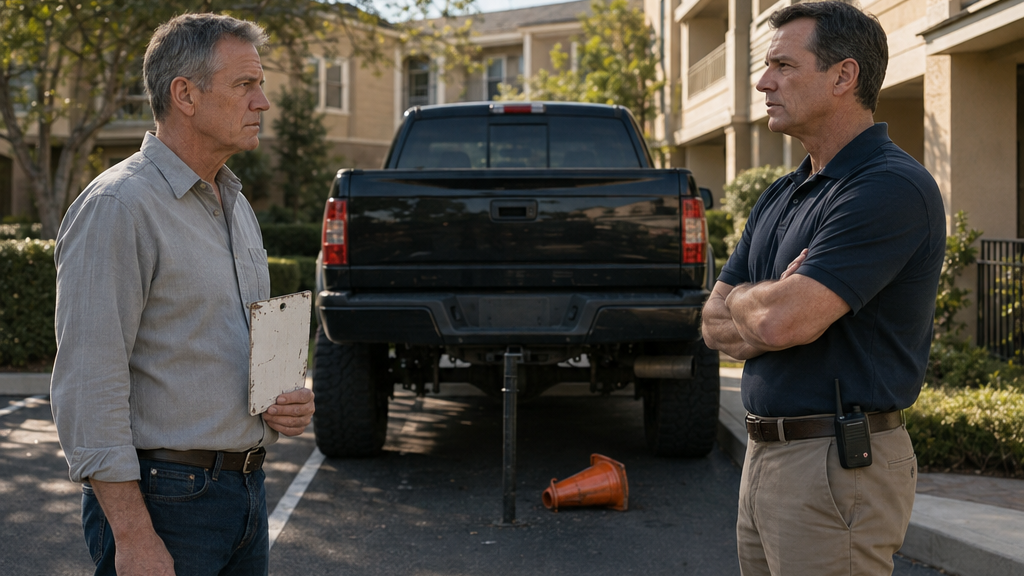
The first thing Andrew Harris noticed was the truck.
Not the broken orange cone near the curb. Not the white plastic placard lying face-down under the rear bumper. The truck itself—a lifted black Ford F-250 sitting squarely between the faded lines of Space 14 as if it had been measured into place.
Andrew stopped halfway across the parking lot.
For fourteen years, he had parked there often enough to stop thinking about it. Space 14 sat beside the narrow strip of landscaping behind his building, close enough that he could carry groceries upstairs without crossing the main drive. When he worked from home for weeks at a time, the space sometimes remained empty. When he traveled for estimating jobs, it could sit unused even longer.
But it had never belonged to anyone else.
He walked closer.
The white placard had once been fixed to the short metal post at the head of the space. It read SPACE 14 in black block letters. Now one corner was scraped and gray from the pavement.
Andrew bent to pick it up.
“Morning.”
Stephen Lewis was standing near the management office entrance with his arms folded.
Andrew straightened, placard in hand.
Stephen wore the same blue polo and khaki pants he wore most weekdays, with a radio clipped at his belt. His expression did not suggest surprise.
Andrew looked at the truck again.
“Do you know whose this is?”
“Yes.”
That answer landed harder than Andrew expected.
He had assumed a visitor had parked in the wrong place. Maybe someone unloading furniture. Maybe a contractor who had ignored the markings.
He turned toward Stephen. “Then can you have them move it?”
Stephen shifted his weight. “Space Fourteen was reassigned.”
Andrew thought he had misheard him.
“Reassigned to who?”
“The resident in Three A. Michael Brown.”
Andrew glanced at the placard in his hand.
“Reassigned by who?”
“Management, with board authority.”
Andrew let the silence stay between them.
He knew himself well enough to recognize the sensation moving up his chest. It was not anger yet. It was the warning before anger—the point where he usually decided a conversation was no longer worth having.
For years, that instinct had saved him from arguments in hallways, angry email chains, and three-hour HOA meetings over landscaping budgets.
It had also taught people not to expect much resistance from him.
“What does reassigned mean?” Andrew asked.
Stephen exhaled through his nose. “It means the space wasn’t being regularly utilized. We have residents with vehicles and no practical parking. Michael just moved in. That truck can’t fit in the compact section, and we’re trying to make better use of the available inventory.”
“Inventory.”
“You know what I mean.”
Andrew looked down at the painted number near his shoes.
“You’re saying because I don’t park here every day, you gave it to someone else.”
“I’m saying we have a parking shortage.”
“That wasn’t my question.”
Stephen uncrossed his arms.
“The board asked us to identify underutilized spaces. Fourteen was one of them.”
Andrew had seen several HOA emails about parking over the past few months. He had skimmed the subject lines and deleted most of them.
PARKING UTILIZATION REVIEW.
GUEST PARKING ENFORCEMENT.
VEHICLE REGISTRATION UPDATE.
None had seemed relevant. His unit came with a parking right. At least that was how he remembered it.
He had bought Unit 4B in 2009, when half the building still smelled of new carpet adhesive and the sales office had offered incentives just to fill units.
Space 14 had been part of the closing package.
Andrew raised the placard slightly. “This was assigned to my unit when I bought it.”
Stephen gave a quick shrug. “Parking assignments have changed over the years.”
“This one hasn’t.”
“According to what?”
Andrew looked at him.
“My closing documents.”
Stephen smiled, but there was no humor in it.
“Andrew, those documents are what—fifteen years old?”
“Something like that.”
“We manage the property as it exists now.”
Andrew felt his irritation sharpen.
He could have argued. He could have told Stephen that age did not erase a contract. Instead, he made himself ask one more question.
“Did you check my closing documents before you reassigned the space?”
Stephen’s face tightened.
“We checked the association records.”
“That’s not what I asked.”
“The current parking map shows Fourteen under association control.”
Andrew looked past him toward the office door.
“So you didn’t.”
Stephen’s voice became firmer. “I’m telling you what the governing parking records show.”
Andrew lowered the placard.
“What happens if those records are wrong?”
“They’re the records we operate from.”
That sentence changed something.
Until then, Andrew had been trying to decide whether Stephen had made a mistake.
Now he wondered whether Stephen had decided that any mistake in the files became reality simply because management relied on it.
Andrew took out his phone and photographed the truck.
Stephen noticed.
“What are you doing?”
“Keeping track.”
“You don’t need to turn this into a thing.”
Andrew almost laughed.
“My parking space has someone else’s truck in it.”
“Your former assigned space.”
Andrew looked at him.
Stephen held his gaze.
For one second, Andrew imagined exactly the argument Stephen expected—raised voices, accusations, a threat to call the police, maybe a scene loud enough for people to watch from balconies.
Andrew did none of it.
He stepped toward the metal post and photographed the empty bracket where the placard had been attached.
Then he photographed the placard itself.
“Where am I supposed to park?”
“There are guest spaces on Mercer.”
“That’s three blocks away.”
“It’s temporary until we settle the parking allocations.”
“You already settled mine.”
Stephen’s jaw moved.
“Andrew, I’m not doing this to you personally. We have twelve complaints from residents who can’t reliably find parking. Some people have two spaces and use one. Some units haven’t registered a vehicle in months. We can’t leave usable space empty while other residents circle the block.”
Andrew understood the logic.
That was what bothered him.
It was not senseless. It was efficient.
And efficiency could be dangerous when the thing being optimized belonged to somebody else.
He looked again at the F-250. Fresh temporary parking decal. Clean wheels. A folded moving blanket visible through the rear window.
The owner might have no idea there was a dispute.
Andrew slipped the damaged placard under his arm.
“I’ll check my closing file.”
Stephen nodded as though the conversation were finished.
“Do that.”
Andrew took three steps toward the building.
“Andrew.”
He turned.
Stephen pointed toward the street.
“If you’re moving your car later, use the Mercer guest lot. Don’t block Fourteen or park behind Michael’s truck. He’s been assigned that space, and I don’t want this escalating between residents.”
Andrew looked at the truck, then at the scraped placard under his arm.
He had spent years avoiding HOA disputes because most of them seemed to be arguments over things that did not matter.
As he walked inside, he found himself wondering something he had not needed to ask since the day he bought Unit 4B.
What, exactly, had he paid for?
Chapter 2: The Closing Folder Nobody Had Opened in Years
The recording number was written in the smallest type on the oldest sheet in the folder.
Andrew almost missed it.
He had pulled the closing documents from a plastic storage bin in the back of his hallway closet just after lunch. The folder smelled faintly of paper and dust, and the elastic around it had gone brittle enough to snap when he stretched it.
He laid everything across the dining table.
Settlement statement.
Purchase agreement.
Condominium declaration.
Title insurance documents.
A glossy sales brochure he had forgotten keeping.
The Space 14 placard sat near his laptop, its scraped corner leaving a faint gray mark against the wood.
Andrew found the parking language on page thirty-one of the purchase agreement.
Unit 4B.
Parking Space 14.
Use rights conveyed in connection with separately recorded easement.
He read it twice.
There it was.
Not a vague memory. Not a sales agent’s promise.
A reference to something recorded elsewhere.
Below the paragraph was a string of numbers.
Andrew entered them into the county’s online records portal.
Nothing appeared.
He tried without spaces.
Then with a dash.
Then he searched by his original purchase date.
Still nothing.
For a moment, the satisfaction he had felt finding the clause disappeared.
This was exactly why he hated disputes.
Facts that looked simple from a distance became complicated the moment somebody needed them to matter.
His phone buzzed.
A management email.
SUBJECT: PARKING REMINDER.
Andrew opened it.
The message was short. Residents were reminded to observe updated space assignments and avoid parking in spaces not shown on the current management map. Unauthorized vehicles could be subject to towing.
Andrew leaned back.
He had received similar notices before. Probably more than once.
He searched his inbox.
There were six parking-related messages over the previous eight months.
He had opened two.
He remembered neither.
That irritated him in a different way.
Stephen had no right to give away property just because Andrew ignored HOA email. But Andrew could no longer pretend he had been paying close attention to what management was doing.
He downloaded the attached parking map.
Space 14 was shaded the same gray as several guest-controlled spaces.
The legend identified gray spaces as ASSOCIATION-CONTROLLED PARKING.
Andrew stared at the screen.
His purchase agreement said one thing.
The current management map said another.
He found an older site plan in the closing folder. The lines were faint, but Space 14 had a small notation beside it.
4B.
No gray shading. No association legend.
Andrew set the two maps side by side.
One dated 2009.
One dated three months ago.
Same pavement.
Same number.
Different owner, at least according to whoever had drawn the newer document.
He called the management office.
Stephen answered.
“I found the closing language.”
A pause.
“All right.”
“It references a separately recorded easement for Fourteen.”
“I told you, Andrew, current records—”
“I’m not calling to argue.”
That stopped him.
Andrew continued. “I want the document your map is based on.”
“The map is based on association parking records.”
“Which document changed Fourteen from a unit-linked space to association-controlled?”
“I’d have to look.”
“Please do.”
Stephen sighed.
“You understand we’ve revised parking several times since 2009.”
“I understand that.”
“Then you understand why a closing packet from fifteen years ago may not reflect current assignments.”
Andrew touched the edge of the placard.
“If it was changed legally, there should be something showing the change.”
Another silence.
“I’ll check the files,” Stephen said.
“Thank you.”
Andrew ended the call before either of them could turn it into another argument.
He went back to the county portal.
This time he searched by Unit 4B’s legal description.
A list of documents appeared.
Deed.
Mortgage.
Release.
Association declaration.
Amendment.
He clicked through them one by one.
Near the bottom was an entry from the same week as his closing.
Its description was abbreviated enough to mean almost nothing.
EASMNT APPURT UNIT 4B/PARK.
Andrew stared at it.
The scan was not available online.
There was only an index entry and a book-and-page reference.
He wrote the numbers on a yellow sticky note.
That should have felt like a victory.
Instead, he looked at the current HOA map again.
If the easement had existed in 2009, two possibilities followed.
Either it had been changed later, in which case Andrew had somehow missed a significant alteration to his property rights.
Or it had never been changed, and the association was now operating from a map that contradicted the county record.
Neither possibility was comforting.
At three fifteen, an email arrived from Stephen.
Andrew opened it immediately.
Attached was a one-page internal parking inventory.
Space 14 was marked:
UNDERUTILIZED—NO REGISTERED VEHICLE ACTIVITY.
A handwritten notation beside it read:
REASSIGN 3A.
Andrew read the line twice.
There was no deed reference. No document number. No indication anyone had checked title.
He replied with the clause from his purchase agreement and the county index reference.
Stephen answered eleven minutes later.
We are reviewing.
That was all.
Andrew picked up the Space 14 placard.
The screw holes had been widened when someone pulled it from the bracket. One edge was bent enough that it would not sit flat anymore.
He imagined taking it downstairs, reinstalling it himself, and parking in front of the truck until management was forced to deal with him.
The thought was satisfying for about ten seconds.
Then he put the placard back on the table.
He had spent most of his adult life estimating costs for projects where a half-inch discrepancy on paper could turn into thousands of dollars on site. He knew what happened when people acted before confirming which drawing controlled.
He also knew that being angry did not make his document the controlling one.
At four thirty, Andrew called the county recorder’s office.
The clerk explained that the original scan could be viewed in person the next morning.
“Do I need an appointment?”
“No, but if you want staff help pulling the archived image, coming early is better.”
Andrew looked toward the window.
From his fourth-floor unit, he could see a slice of the parking lot through the trees.
The top of the F-250 was still visible.
“Eight thirty?”
“We open at eight.”
“I’ll be there.”
He hung up and opened another browser tab.
This time he searched for local attorneys who handled condominium title and easement disputes.
He stopped himself before calling.
First the record.
Then the conclusion.
That night, he moved his car from a short-term loading space to the Mercer guest lot three blocks away.
On the walk back, he passed Space 14.
Michael’s truck was still there.
The management-issued decal hung neatly from the mirror.
Andrew did not touch the truck or leave a note.
He only stood for a moment beside the empty metal post where his placard had been.
By morning, one of two things would be true.
Either somebody had legally changed his rights years ago without him understanding it.
Or the document in the county archive was about to make the association’s new parking map very difficult to explain.
Chapter 3: The Record Attached to Unit Four B
The county clerk turned the monitor toward Andrew and said, “There it is.”
A scanned document filled the screen.
Andrew leaned closer.
The image was crooked and slightly faded, but the heading was clear enough.
PARKING EASEMENT AGREEMENT.
Below it were the legal descriptions for Unit 4B and Space 14.
Andrew felt his shoulders loosen before he caught himself.
Finding the document was not the same as knowing what it meant.
“Can I get a certified copy?”
“Yes.”
The clerk scrolled through the pages.
The agreement described a nine-by-eighteen-foot parking area and granted its use as an easement appurtenant to Unit 4B. There were references to successors, assigns, and the condominium declaration.
Andrew recognized only enough of the language to know he should not interpret the rest himself.
“Is there anything showing it was released?”
The clerk looked at him over the top of the monitor.
“I can search the index, but I can’t give you a legal opinion.”
“I’m not asking for one.”
She typed for several minutes.
Andrew watched entries appear.
Amendments.
Liens.
Releases unrelated to parking.
Nothing referencing termination of the easement.
The clerk finally shook her head.
“I’m not seeing a later release tied to this instrument. That doesn’t mean there’s nothing relevant elsewhere.”
“Understood.”
He meant it.
He had entered the building wanting proof that Stephen was wrong. The clerk’s caution reminded him that documents were rarely as simple as the person holding them wanted them to be.
He paid for the certified copy.
Before leaving, he photographed the first page with his phone.
Then he photographed the recording stamp.
In the parking garage beneath the county building, Andrew called the real-estate attorney whose office he had found the previous evening.
Jessica Perez had a cancellation at eleven.
By eleven twelve, Andrew was sitting across from her in a small conference room with the certified copy between them.
Jessica read without speaking.
She turned one page.
Then another.
Andrew resisted the urge to fill the silence.
Finally she tapped the first page.
“This is more serious than an assigned parking-space dispute.”
“So Stephen can’t reassign it.”
Jessica looked up.
“I didn’t say that yet.”
Andrew sat back.
She pointed to the language.
“This appears to create an easement appurtenant to your unit. That means, generally, it’s tied to the property rather than just to you personally.”
“Which is what I thought.”
“Yes. But I want the declaration, amendments, your deed, and anything the association claims gives it authority to alter parking rights.”
Andrew slid copies across the table.
Jessica smiled faintly.
“You came prepared.”
“I estimate construction projects. Missing documents make me nervous.”
She read the current parking policy.
Then the map.
Her expression changed.
“Where did you get this map?”
“Management emailed it.”
“And Fourteen is gray because?”
“They say association-controlled.”
“Do they have an amendment or recorded instrument supporting that?”
“Stephen said he’d check.”
Jessica set the map down.
“A board can regulate a lot of things. Use, safety, registration, enforcement. But if this easement is still valid, a board vote or management policy does not casually erase a recorded property interest.”
Andrew thought of Stephen standing beside the truck.
We manage the property as it exists now.
“What would erase it?”
“Depends on the instrument and state law. A recorded release. A valid amendment under whatever procedures apply. Merger in some circumstances. Abandonment can become complicated, but merely not parking there every day is not automatically the same thing.”
Andrew’s jaw tightened.
“They called it underutilized.”
“That word may matter administratively. It doesn’t answer the title question.”
She turned the easement toward him.
“Think of it this way. If the association has the legal authority it claims, there should be a path showing how it got from this”—she tapped the recorded agreement—“to that map.”
“And if there isn’t?”
“Then they have a problem.”
The answer was restrained.
That made it more convincing.
Andrew looked at the certified stamp.
“So I send them this, and they move the truck.”
Jessica shook her head.
“Maybe.”
He frowned.
“You just said—”
“I said the document gives you a strong issue. I did not say people become reasonable the moment you show them paper.”
Andrew almost smiled.
Jessica continued.
“Your goal matters. Do you want the space restored? Do you want damages? Do you want a court declaration? Do you want the association to correct its records?”
“I want my parking space.”
“That’s the cheapest answer.”
Something in her tone made him look at her.
“And the other answers?”
“If they refuse, a title dispute can become expensive. Even when the facts favor you. Letters, review, possible filing, discovery if it gets ugly. Being right does not make litigation painless.”
Andrew looked out through the conference-room glass.
This was the part he disliked.
Not the paperwork.
The decision.
He could already imagine what would happen if he pushed. Stephen would become defensive. The board would circle itself. Neighbors would hear about it. Somebody would decide Andrew was the man threatening the HOA over a parking space.
That was precisely the kind of reputation he had avoided for years.
Jessica seemed to read the pause.
“You don’t have to start with a lawsuit.”
“What would you start with?”
“One clean written request. Attach the recorded easement. Ask them to identify the authority they rely on and restore the space by a reasonable deadline. Give them a chance to correct it.”
“And if they don’t?”
“Then you decide whether the principle is worth the cost.”
Andrew looked back at the document.
For the first time since Monday morning, he felt something steadier than anger.
Not triumph.
Ground.
He paid for the consultation, returned home, and placed the certified easement on his dining table.
Beside it lay the damaged Space 14 placard.
Andrew took a photograph of both.
Then he opened a new email.
Stephen,
I obtained the attached certified copy of the recorded parking easement associated with Unit 4B and Space 14. The county index does not appear to show a later release, though I am continuing to verify the record.
Please identify the recorded document or governing authority you believe permits the association to reassign Space 14.
Absent such documentation, I am requesting that the space be restored to Unit 4B and that the current vehicle be relocated through management rather than through any direct dispute between residents.
He read it twice.
His first impulse was to add a paragraph about Stephen dismissing his documents.
He deleted it.
His second impulse was to copy the entire board.
He did not.
Not yet.
He attached the certified easement, the closing-page reference, and the photograph of the fallen placard.
Then he stopped with the cursor over Send.
This was the moment where he usually stepped away.
He had spent years telling himself that refusing to engage was a form of maturity. Most of the time, perhaps it was.
But an empty chair at meetings had no opinion. An unopened email raised no objection. A right written in a county record could still be mishandled by people who assumed no one would insist on reading it.
Andrew clicked Send.
The message left his screen at 3:42 Tuesday afternoon.
At 3:49, Stephen opened it.
Andrew knew because the management portal marked the attachment as viewed.
At 4:16, no reply had come.
At 5:03, still nothing.
When Andrew looked out his window that evening, the black F-250 remained in Space 14.
The question was no longer whether Andrew had an old piece of paper.
Now Stephen had seen the recorded easement too.
What Andrew did not yet know was whether that would make him back down—or make him dig in.
Chapter 4: The Neighbor Who Thought the Space Was His
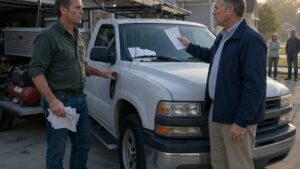
Michael Brown was waiting beside the F-250 when Andrew came down Wednesday morning.
He stood with one hand on the open driver’s door and the other holding a folded sheet of paper. Andrew recognized him from the move-in activity two weeks earlier—a broad-shouldered man in his forties who had spent most of one Saturday carrying boxes between the elevator and Unit 3A.
The moment Michael saw him, he closed the truck door.
“You Andrew?”
Andrew stopped.
“Yes.”
Michael glanced at the damaged Space 14 placard Andrew was carrying under one arm.
“Stephen says you’re trying to get my parking revoked.”
Andrew looked at the truck.
The management decal still hung from the mirror.
“I’m trying to find out why my deeded space was reassigned.”
Michael’s expression hardened.
“Your space?”
“That’s the question.”
“No, management told me this was assigned to Three A.”
“I know.”
Michael looked as though he had expected an argument and was irritated not to get one.
“I paid for this.”
Andrew paused.
“Paid who?”
“The association. Parking fee, move-in fee, all of it.”
That was new.
“How much?”
Michael unfolded the paper.
Andrew did not reach for it until Michael held it out.
The document was printed on association letterhead.
PARKING ASSIGNMENT CONFIRMATION.
Unit 3A.
Space 14.
Below that was an administrative fee and a parking charge.
Michael tapped the page.
“I didn’t just roll in here and take somebody’s spot.”
“I didn’t say you did.”
“You took pictures of my truck.”
“I took pictures of what was in the space.”
“That’s my truck.”
“Yes.”
The distinction did not soothe him.
Andrew could see why.
From Michael’s side, he had bought a unit, registered a vehicle, paid the association, and received a written parking assignment. Now some older resident he barely knew was photographing his truck and claiming ownership of the pavement beneath it.
“I sent management the county record yesterday,” Andrew said.
Michael’s eyes narrowed.
“What county record?”
“A parking easement tied to my unit.”
Michael gave a short, disbelieving laugh.
“Then why did they assign it to me?”
“That’s what I’m trying to find out.”
For the first time, Michael’s anger lost some of its certainty.
He looked toward the management office.
“You’re saying they knew?”
“I’m saying Stephen has the document now.”
Michael folded his assignment sheet more carefully.
“And what am I supposed to do?”
“I’m not asking you to move it this second.”
“You’re not?”
“No. Management put you here. Management needs to fix it.”
Michael looked at Andrew for another moment.
“You planning to tow me?”
“No.”
“Stephen said there could be enforcement issues if anybody interfered with assigned parking.”
Andrew almost smiled at the irony.
“I’m trying very hard not to interfere with anything until someone explains which assignment is legitimate.”
Michael looked down at the placard.
“What happened to that?”
“It was on the ground Monday.”
“I didn’t touch it.”
Andrew believed him.
There was no obvious reason not to.
“I didn’t say you did.”
Michael rubbed a thumb along the edge of his folded paperwork.
“I moved here because my old place had street parking. Somebody clipped my mirror twice in six months. Stephen told me this spot was part of the deal.”
That sentence rearranged the conflict again.
The truck had looked like the problem on Monday morning.
Now it looked more like evidence.
Andrew held out the placard.
“Come with me.”
Michael frowned.
“Where?”
“To Stephen’s office.”
They crossed the lot together.
Stephen was behind the counter when they entered.
His expression changed when he saw them side by side.
“Morning.”
Michael placed his parking confirmation on the counter.
“You told me Fourteen was mine.”
Stephen looked at Andrew.
“Michael, we’re reviewing a historical documentation issue.”
“You charged me for it.”
“The fee covered administrative parking assignment.”
“For a space you might not control?”
Stephen’s shoulders tightened.
“We have current records showing the association controls the space.”
Andrew set the damaged placard beside Michael’s paper.
“And you have the recorded easement I sent yesterday.”
“I have reviewed what you sent.”
“Then what document changed it?”
Stephen’s tone cooled.
“Andrew, this is not the place to conduct a title analysis.”
“I agree.”
Michael looked from one man to the other.
“So where do I park?”
Stephen turned toward him.
“For now, remain in Fourteen.”
Andrew felt his jaw tighten.
Michael blinked.
“Even though he has a county document?”
“We have not determined that it overrides the association’s current authority.”
Andrew spoke before he could stop himself.
“That’s backwards.”
Stephen looked at him.
“What?”
“You reassigned the space first. Now you’re checking whether you had authority afterward.”
The room went quiet.
Stephen’s face reddened slightly.
“We had a real parking problem. We used the records available to us.”
“You told me Monday the issue was settled.”
“Because based on our operational records, it was.”
Michael unfolded his paper again.
“Were those records wrong?”
Stephen hesitated.
It lasted less than a second.
But both men saw it.
“They may be incomplete.”
Andrew stared at him.
That was the first admission that mattered.
“When did you know that?”
Stephen’s mouth tightened.
“I knew some older parking files were inconsistent with the current map.”
“Before you reassigned Fourteen?”
Stephen pushed back from the counter.
“We have been dealing with months of complaints. People parking in fire lanes. Residents using guest spaces as storage. Units with two assigned spaces and one vehicle. The board told me to create a workable system.”
“That doesn’t answer him,” Michael said.
Stephen looked at him sharply.
“No, it doesn’t,” Michael continued. “Did you know the old records were incomplete before you sold me this assignment?”
The word sold hung in the room.
Stephen lowered his voice.
“I knew there were historical gaps. I did not know Andrew had a separately recorded easement.”
Andrew felt the shape of the problem changing.
Stephen had not secretly targeted him.
He had done something more ordinary and, in a way, more troubling.
He had known the records were imperfect and decided the pressure to fix parking justified acting anyway.
Stephen looked at Andrew.
“You haven’t registered a regular vehicle in that space for almost a year.”
“I work from home.”
“You attended none of the parking meetings.”
“I didn’t think my deeded rights were up for discussion.”
“How would I know that if you never participated?”
Andrew felt the accusation land because part of it was true.
He had ignored the notices.
Ignored the meetings.
Ignored the policy changes.
Not because he agreed with them, but because he assumed they could not matter to him.
That did not give Stephen authority.
But Andrew could see how his absence had been interpreted.
Michael broke the silence.
“I want this fixed.”
“So do I,” Andrew said.
Stephen glanced at both of them.
“I’m speaking with the board.”
Andrew picked up the placard.
“When?”
“Today.”
As if summoned by the word, Stephen’s phone buzzed.
He looked down at the screen.
His face changed.
“What?”
Stephen did not answer immediately.
He opened an email, read it, then looked at Andrew.
“Your attorney sent a formal demand.”
Andrew had not known Jessica would send it that morning.
Stephen read another line.
“The board president wants an emergency meeting tomorrow night.”
Michael let out a breath.
Andrew looked at the association letterhead in Michael’s hand, then at his own battered placard.
By tomorrow evening, the question would no longer stay between three men in a management office.
Someone was finally going to have to explain why Space 14 had been reassigned without anyone first determining who had the right to control it.
Chapter 5: The Shortcut Stephen Never Told the Board About
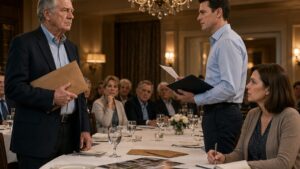
Cynthia Allen began the emergency meeting with one question.
“Stephen, before you reassigned Space Fourteen, did you verify the title record?”
No one shifted in their chair.
Andrew sat at the far end of the rectangular meeting table with the Space 14 placard in front of him. Beside it lay Jessica’s certified copy of the easement, its county recording stamp facing upward.
Michael sat two chairs away.
Stephen was across from them.
Cynthia had the tired expression of someone who had spent the day handling problems she had not expected to own.
“I verified the association’s parking records,” Stephen said.
“That wasn’t my question.”
Andrew looked down.
The phrasing was almost exactly what he had said Monday morning.
Stephen noticed too.
His jaw tightened.
“No,” he said. “I did not run a title verification before the reassignment.”
One of the board members leaned forward.
“Why not?”
Stephen gave a controlled breath.
“Because we’ve never done title searches before changing parking assignments.”
Jessica, seated beside Andrew, said nothing.
Cynthia looked at a stack of printed emails.
“Did you know the older records were incomplete?”
Stephen looked toward Andrew for half a second before answering.
“Yes.”
A murmur moved through the few residents allowed into the room.
Cynthia raised a hand.
“Please.”
The room settled.
“How incomplete?” she asked.
Stephen shifted a folder in front of him.
“There were inconsistencies between old site plans and the management map.”
“And you proceeded anyway.”
“The board told me to solve the parking problem.”
Cynthia’s expression changed.
Not anger.
Recognition.
“We told you to reduce parking conflicts.”
“We had twelve formal complaints in two months.”
“I know.”
“We had guest spaces occupied for weeks. Vehicles without current registration. Residents asking why empty spaces were being protected while they parked off-site.”
One of the board members nodded reluctantly.
Stephen continued.
“You wanted an updated utilization system before the fall registration cycle. I gave you one.”
Cynthia looked down at the papers.
“Yes,” she said quietly. “We asked for speed.”
Andrew had expected Stephen to be cornered.
Instead, the responsibility widened.
That made the room less satisfying and more useful.
Cynthia turned to the board.
“We approved the utilization review without requiring title verification.”
Another board member frowned.
“We assumed management knew which spaces were common-controlled.”
“That was the mistake,” Cynthia said.
Stephen leaned back.
“I wasn’t freelancing. I was operating from the map we’ve used for years.”
Andrew touched the edge of the placard.
Its bent corner lifted slightly from the table.
Jessica finally spoke.
“The problem is that the map does not create the underlying property interest.”
Stephen looked at her.
“I understand your position.”
“It isn’t a position.”
Cynthia raised a hand before the exchange could sharpen.
“Let’s keep this practical.”
She turned to Andrew.
“We’ve reviewed the easement. Our counsel has reviewed the preliminary documents. No one here tonight is prepared to say the association can extinguish that easement through a parking-policy vote.”
Andrew waited.
Cynthia continued.
“So, first, Space Fourteen should be restored to Unit 4B while counsel completes review.”
Michael leaned forward.
“And me?”
“We’ll place you temporarily in another available space and refund any fee if we assigned you something we did not have authority to assign.”
Michael nodded once.
Andrew should have felt relief.
He did, briefly.
The truck would move.
The space would come back.
The problem he had walked into Monday morning could have ended there.
Then Cynthia slid another document across the table.
“We can document this as an exception pending review.”
Andrew looked at the page.
“Exception?”
“For your space.”
“And the others?”
Cynthia hesitated.
“What others?”
Stephen answered.
“There are several older notations that don’t align perfectly with the current map.”
Andrew looked at him.
“How many?”
“I don’t know yet.”
“Two?”
“I said I don’t know.”
“Ten?”
Stephen’s face hardened.
“We’re reviewing.”
Cynthia interjected.
“Andrew, the purpose tonight is to resolve your immediate dispute.”
Andrew looked at the placard.
Monday morning, that was all he had wanted.
Move the truck.
Put the sign back.
Leave him alone.
He thought of all the parking emails he had deleted without reading. The meetings he had skipped because he hated watching neighbors argue. He had treated the association like weather—annoying sometimes, unavoidable, but not something that required his presence.
Now he understood the price of that distance.
Not legal responsibility for Stephen’s decision.
But space.
Empty space where somebody else’s assumption could grow.
“What happens the next time one of those gray spaces has an old recorded right attached to it?” Andrew asked.
Cynthia folded her hands.
“That’s why counsel is reviewing the records.”
“After reassignment?”
“No. We can pause additional changes.”
“Can?”
Cynthia looked at him.
Andrew kept his tone even.
“I’m not trying to turn this into a fight.”
Stephen gave a faint, humorless sound.
Andrew ignored it.
“I’m asking whether you’re fixing Fourteen because I hired an attorney, or whether you’re fixing the process that caused it.”
One of the board members leaned back.
“That could mean reviewing decades of records.”
“Yes.”
“That costs money.”
“Yes.”
“And if there are errors, correcting them could create new disputes.”
Andrew nodded.
“Yes.”
The board member looked frustrated by the lack of argument.
Cynthia looked toward Jessica.
“What is your client asking for?”
Jessica turned to Andrew.
It was deliberate.
His choice.
Andrew placed one hand on the placard.
The scrape along its edge was still dark with pavement grit.
“I want Space Fourteen restored.”
Cynthia nodded.
“And?”
“I want reasonable legal costs reimbursed because I shouldn’t have had to hire counsel to make management read a recorded document.”
Another nod.
“And?”
Andrew looked at Stephen.
For the first time all evening, Stephen looked less defensive than tired.
Andrew could see the months behind his decision now: complaint emails, residents stopping him in hallways, the board asking when parking would be fixed, a map that looked official enough to trust if nobody insisted otherwise.
Andrew understood it.
That did not excuse it.
“I want every space touched by this reassignment program checked against the recorded property documents before you change it again.”
Stephen sat forward.
“That will freeze the entire system.”
“Then freeze it.”
“You don’t understand what that means operationally.”
“No. I understand what happened operationally.”
Stephen looked at Cynthia.
“You wanted a workable parking plan.”
Cynthia’s voice was quiet.
“And we wanted it legally workable.”
Stephen looked away.
The room remained silent for several seconds.
Then Cynthia closed the folder in front of her.
“We’ll suspend new reassignments pending counsel’s review.”
Andrew felt a small release in his chest.
Not victory.
Something heavier.
Responsibility.
Cynthia continued.
“Space Fourteen will be restored immediately. Michael will receive temporary alternative parking. Counsel will determine the scope of historical review.”
Andrew looked down at the placard.
This was the moment he could stop.
He had his answer.
His space was coming back.
Jessica leaned slightly toward him, waiting.
Cynthia said, “If that resolves your demand, we can draft an agreement tonight.”
Andrew looked at the page she had offered him.
A clean exit.
No more meetings.
No more emails.
No reason to become one of the people he had spent years avoiding.
He slid the page back across the table.
“No.”
Cynthia’s eyebrows lifted.
Andrew placed the certified easement beside the Space 14 placard.
“I’ll settle my claim when the association confirms in writing that it will verify recorded rights before reassigning any disputed space—not just mine.”
Stephen stared at him.
“You’re willing to drag this out over spaces that aren’t yours?”
Andrew met his eyes.
“No.”
He touched the placard.
“I’m willing not to pretend the problem ended just because mine came back.”
Chapter 6: Winning the Space Was No Longer Enough
The F-250 was gone before anyone ordered it towed.
Andrew saw the empty pavement Friday morning from his window and went downstairs expecting a management notice on the windshield or a temporary barrier in the space.
Instead, Michael was carrying a cardboard box from the truck, now parked along the loading curb.
“You moved it,” Andrew said.
Michael shut the tailgate.
“Stephen called last night. Said they were going to relocate me anyway.”
“You didn’t have to do it before they gave you another space.”
Michael shrugged.
“I’m not interested in being the truck everybody argues around.”
Andrew looked at Space 14.
The number was fully visible again.
The metal post remained bare.
He still had the placard upstairs.
“Where are they putting you?”
“Compact spot near the east entrance for now.”
“That truck won’t fit.”
“No.”
Michael gave him a look that was almost amused.
“They’re figuring that out.”
Andrew smiled despite himself.
Michael reached into the cab and pulled out an envelope.
“They’re refunding the parking fee.”
“Already?”
“Apparently the lawyer told them charging for something they might not control was not helping.”
“That sounds like a lawyer.”
Michael tucked the envelope into his jacket.
“For what it’s worth, I thought you were trying to get me towed.”
“I thought you might have knocked down my sign.”
Michael looked at him.
“Guess we both started with the truck.”
Andrew nodded.
The visual had been too easy.
Big vehicle. Wrong space. Simple villain.
The truth had taken longer.
By Monday, the association’s attorney had issued a written recommendation suspending every disputed reassignment under the new utilization program.
Andrew read the email twice.
There were seven spaces flagged for historical review.
Three had old notations tied to specific units.
Two had incomplete records.
One appeared to have been renumbered during a resurfacing project years earlier.
Space 14 was not an isolated clerical mistake.
It was simply the first one somebody had forced management to trace all the way backward.
Jessica called that afternoon.
“This changes the settlement posture,” she said.
“How?”
“They’re conceding enough of the process problem that a court fight may not buy you much more than you can get by agreement.”
“Meaning?”
“Meaning you need to decide whether you want correction or punishment.”
Andrew leaned back at his desk.
“Correction.”
“That answer was fast.”
“I’ve had a week.”
Jessica was quiet for a moment.
“The association is willing to reimburse your reasonable fees, restore the easement notation to its internal records, and add a title-verification requirement before disputed spaces are reassigned.”
“That’s what I asked for.”
“Mostly.”
“What’s missing?”
“Stephen.”
Andrew looked toward the window.
“What about him?”
“He offered his resignation this morning.”
Andrew sat up.
“Why?”
“Apparently the board plans to remove his unilateral authority over parking assignments and require board or counsel review where ownership is unclear.”
“That’s not the same as firing him.”
“No.”
“But he’d rather leave.”
“That’s what Cynthia says.”
Andrew did not answer.
He had imagined consequences for Stephen more than once.
Usually late at night, when frustration made clean outcomes attractive.
Stephen admits he was wrong.
Stephen is removed.
Everyone learns a lesson.
But the meeting had spoiled the simplicity.
The board had pressured for speed.
Andrew had ignored the process entirely.
Michael had trusted the association.
Stephen had made the decision that caused the harm.
All of those things could be true at once.
“What happens if he resigns?” Andrew asked.
“Operationally? They hire someone else.”
“And the system?”
“That depends on whether the board changes it.”
There it was.
The difference between replacing a person and correcting the conditions that let the person make the mistake.
That evening, Cynthia called.
Her voice sounded exhausted.
“I assume Jessica told you.”
“She did.”
“I want you to know we didn’t ask Stephen to resign.”
“Does he think you’re blaming him?”
“I think he thinks we’re taking away the authority we hired him to exercise.”
Andrew considered that.
“Are you?”
“In some areas.”
“Parking?”
“Yes.”
“Why?”
Cynthia gave a tired laugh.
“You know why.”
“I want to hear you say it.”
A pause.
“Because we let management operate from records we never verified.”
Andrew said nothing.
“And because Stephen knew there were gaps and moved ahead anyway,” Cynthia added. “Both things matter.”
“That sounds right.”
“Some board members think accepting his resignation is the cleanest solution.”
“Cleanest for who?”
“That is exactly the problem.”
Andrew walked to the dining table.
The Space 14 placard remained there.
He had not reinstalled it, even though the space had been empty since Friday.
Cynthia continued.
“If he stays, residents will say there was no accountability.”
“If he leaves, residents will say the bad manager is gone and everything’s fixed.”
“Yes.”
“And neither is quite true.”
“No.”
Andrew ran his thumb along the bent corner of the placard.
A week earlier, he would have wanted no part of this conversation.
He would have considered it someone else’s job.
Board politics.
Management decisions.
Not his problem.
But that phrase had begun to sound different.
“What does Stephen want?” he asked.
“To do his job without having every routine decision second-guessed.”
“And can he?”
“Routine decisions, yes.”
“Property rights?”
Cynthia exhaled.
“No.”
Andrew looked through the window toward the lot.
Space 14 was empty.
He could have parked there.
Instead his car was still in the Mercer guest lot because he wanted the written correction completed before he treated the dispute as finished.
“Don’t make his resignation the settlement,” Andrew said.
Cynthia was silent.
“I’m not saying keep him,” Andrew continued. “That’s your employment decision. I’m saying don’t write the story so that he leaves and everybody gets to pretend the map fixed itself.”
Cynthia gave a quiet laugh without humor.
“You really have started attending HOA meetings.”
“I attended one.”
“One more than the previous three years.”
Andrew could not argue.
Cynthia said, “Counsel is drafting a revised policy. Verification before reassignment. Written notice to affected owners. Suspension if title is disputed.”
“Good.”
“We’re also reviewing all seven spaces.”
“Good.”
“And your fees will be reimbursed.”
Andrew looked at the placard again.
“Then we’re getting somewhere.”
After they hung up, he opened the folder containing the settlement draft.
A week ago, he had wanted exactly one thing from it:
Space 14 restored.
Now that line seemed almost too small.
The real correction was elsewhere—in the requirement that somebody stop before moving the next placard, check the record, and ask the question Stephen had skipped.
Andrew set the damaged sign beside the draft policy.
For the first time, the empty bracket downstairs did not bother him.
The space could wait a little longer.
What mattered now was whether the association would learn anything before someone simply screwed the same old sign onto a newly corrected post and declared the problem over.
Chapter 7: When the Space Fourteen Placard Went Back Up
The revised parking policy arrived in Andrew’s inbox at 8:07 on a Monday morning, exactly four weeks after he had found Michael’s F-250 sitting in Space 14.
He opened the attachment before he opened anything else.
The first page looked ordinary enough—association letterhead, revision date, approval lines. The important language appeared on page three.
No parking space subject to disputed ownership, easement, exclusive-use right, or unit-specific historical designation could be reassigned until management verified the association’s authority through recorded documents or counsel review.
Andrew read the paragraph again.
Then a second one.
Affected owners had to receive written notice before any reassignment.
If the documentation conflicted, the space would remain in its existing status until the conflict was resolved.
He leaned back from his desk.
There was no dramatic sentence saying what happened to him had been wrong.
The policy did something better.
It made it harder to happen again.
His phone rang.
Cynthia.
“Did you see it?”
“I’m looking at it.”
“And?”
Andrew scrolled back to the verification section.
“It says what it needs to say.”
There was a small pause.
“Counsel insisted on some of that language.”
“Good.”
“And the board insisted on the rest.”
“Also good.”
Cynthia sounded relieved, but not celebratory.
“That’s the version we approved last night.”
Andrew looked toward the dining table.
The Space 14 placard was still there.
Its bent corner had been straightened as much as he could manage by hand, though the scrape along the bottom edge remained.
“What about Stephen?” he asked.
“He stayed.”
Andrew had expected that answer after their last conversation, but hearing it made the outcome feel more concrete.
“Under the new structure?”
“Yes. Parking changes involving ownership questions require board review. Routine registration, enforcement, guest passes—those are still his.”
“And he agreed?”
“Eventually.”
Andrew smiled faintly.
Cynthia added, “He wasn’t happy.”
“He doesn’t have to be.”
“No.”
Another pause.
“He also wasn’t wrong about the parking pressure.”
Andrew glanced at the policy.
“No.”
“That’s the part people don’t like.”
“The part where two things can be true?”
“Exactly.”
Andrew understood.
Stephen had pushed too far. He had relied on incomplete records after knowing they were incomplete. He had dismissed Andrew’s old documents instead of checking them.
But the crowded guest spaces were real.
The complaints were real.
The board’s demand for a quick solution had been real.
Fixing the system did not require pretending those pressures had never existed.
Cynthia continued.
“Your reimbursement check is in the mail. Full amount of the reasonable legal fees Jessica submitted.”
“Thank you.”
“And Michael’s parking fee has been refunded.”
“Good.”
“He has a larger temporary space near the rear service entrance now.”
“His truck fits?”
“Barely.”
Andrew laughed.
It was the first time the entire matter had produced a sound that felt uncomplicated.
Cynthia said, “There’s one more thing.”
Andrew waited.
“We’re forming a temporary records-review committee. Just long enough to compare the seven flagged spaces against county documents and association files.”
He already knew where this was going.
“No.”
Cynthia laughed.
“I haven’t asked yet.”
“You were about to.”
“I was.”
Andrew rubbed his forehead.
“I’m not joining the HOA board.”
“I didn’t ask you to.”
“I’m not becoming the parking guy either.”
“You would not be the parking guy.”
“That sounds exactly like something you’d say before making me the parking guy.”
Cynthia let him finish.
“We need someone who actually reads documents carefully and asks where the numbers came from.”
Andrew looked at the old closing folder stacked beside his laptop.
A month earlier, he had not opened it in fifteen years.
“I have a job.”
“Two meetings. Maybe three.”
“I hate meetings.”
“I’m aware.”
That was difficult to argue with.
Cynthia’s voice softened.
“You asked us not to fix only your space.”
Andrew looked again at the policy.
There it was.
The consequence of his own demand.
He had wanted the association to check the other records.
Somebody had to do the checking.
“When’s the first meeting?”
“Thursday.”
Andrew closed his eyes briefly.
“Send me the material.”
“I’ll take that as a yes.”
“Temporary.”
“Absolutely.”
He did not entirely trust her tone.
That afternoon, Andrew carried the Space 14 placard downstairs.
Michael was crossing the lot at the same time, walking toward the rear section with a grocery bag in each hand.
He slowed when he saw the sign.
“Finally putting it back?”
“Looks that way.”
Michael glanced toward Space 14.
Andrew’s car was parked there for the first time since the dispute began.
It looked almost strangely ordinary.
“No tow truck,” Michael said.
Andrew looked at him.
“What?”
Michael smiled.
“Whole thing started with everybody thinking my truck was going to get hauled away.”
“Your truck started most of the visual drama.”
“I’ve been told that before.”
They stood for a second beside the parking space.
Michael shifted the grocery bags.
“They refunded everything.”
“Cynthia told me.”
“I figured you had something to do with it.”
“The attorney probably had more.”
Michael nodded.
“Well. Thanks anyway.”
Andrew looked at him.
There was no sudden friendship between them. They had not discovered some hidden bond through parking bureaucracy.
They were simply two neighbors who had started on opposite sides of a problem neither had created.
“That rear spot working?”
“It works.”
“Good.”
Michael lifted the bags slightly in farewell.
“See you around, Andrew.”
“See you.”
Andrew walked to the head of Space 14.
A maintenance worker had already replaced the old bracket and left two screws on the curb.
Andrew could have asked someone else to mount the placard.
Instead, he crouched and did it himself.
The first screw went in easily.
The second caught against the bent hole.
Andrew adjusted the sign, pressed the corner flat, and tried again.
This time it held.
He stood.
SPACE 14.
The placard was upright again.
The scrape remained visible at the bottom.
Andrew liked that better than replacing it.
For years, the sign had meant almost nothing to him. It marked a piece of pavement he assumed would remain his whether he paid attention or not.
Now it meant something less comfortable.
A recorded right mattered.
So did the people making decisions around it.
Andrew stepped back and checked that the placard was straight.
His phone buzzed.
An email from Cynthia.
RECORDS REVIEW — THURSDAY 6:00 PM.
Attachments: eleven.
Andrew stared at the screen.
Then he looked toward the building entrance.
His condo was upstairs. His desk was waiting. He could go inside, close the door, and return to the habits that had kept his life pleasantly separate from association business for years.
Instead, he opened the first attachment while walking toward the community meeting room.
The door was already unlocked.
Andrew went in.
The story has ended.