The HOA Kept Fining His Crooked Mailbox Until an Old Deed Changed Who Had Authority
Chapter 1: The Third Fine Arrived Before Breakfast
Carol Roberts was photographing Edward Moore’s mailbox before he had finished his first cup of coffee.
He saw her through the front window, standing at the curb with her phone held horizontally, taking one picture from the street and another from the sidewalk. She stepped back, tilted her head, then photographed the post from the opposite direction.
Edward remained behind the glass.
The mailbox leaned three or four degrees toward the road. Maybe five. The cedar post had been there longer than most of the houses on the block. Rain had darkened its lower half, and the black metal box carried a pale scratch where a delivery truck had clipped it years ago.
It still opened.
It still closed.
The postal carrier had never complained.
Carol lowered her phone and looked toward the house.
Edward lifted his coffee.
She gave him a short nod.
He returned it.
Neither waved.
Ten minutes later, the postal carrier stopped at the curb. Along with two advertisements and an electric bill came a thick white envelope bearing the homeowners association’s return address.
Edward knew the weight of those envelopes now.
He carried everything inside, left the advertisements on the counter, and opened the HOA notice with a butter knife.
NOTICE OF CONTINUING ARCHITECTURAL NONCOMPLIANCE.
He skipped the first paragraph.
Fifty dollars.
Again.
Edward pressed one finger beneath the amount as if it might change.
It was the third notice that month.
The first had accused him of failing to correct the angle of the mailbox post within the required period. The second had assessed another fine because the violation remained visible. This one warned that continued failure could lead to escalating penalties and a formal compliance hearing.
Edward folded the paper along its original crease.
Then he went to the hall closet.
Behind a stack of winter blankets sat an old brown shoebox. He lifted the lid and placed the new notice inside with the others.
They were arranged by date.
Violation letters.
Payment confirmations.
Copies of checks.
Photographs taken by the association.
Edward closed the lid.
“You planning to open a stationery store?”
He turned.
Janet stood in the hallway holding a grocery bag against one hip.
Edward had not heard her come in.
“You still have a key,” he said.
“That’s usually how keys work.”
She set the groceries on the kitchen counter, then looked past him toward the closet.
“What was that?”
“Nothing you need to worry about.”
Janet gave him the look she had perfected sometime around age fifteen and never retired.
Edward walked back to the kitchen.
She followed.
Through the window above the sink, the mailbox was visible at the curb, leaning exactly as it had yesterday.
Janet began putting groceries away.
“You know Carol was out there taking pictures.”
“I saw her.”
“And?”
“And she took pictures.”
Janet stopped with a carton of eggs in her hands.
“Dad.”
Edward opened the refrigerator for her.
She put the eggs inside harder than necessary.
“You could straighten that post in twenty minutes.”
“Probably.”
“Then why don’t you?”
Edward looked outside.
The question sounded simple because Janet believed it was.
The mailbox had not started as a protest. It had shifted slowly after a wet winter. He had meant to reset it when the ground dried.
Then the first notice arrived.
He could have fixed it that afternoon.
Instead, something about the wording—failure to conform, mandatory corrective action, continuing violation—had made him put the letter aside.
A week later, he received another.
Then another.
Eventually the mailbox stopped being a maintenance job and became something else.
He had never explained that part to Janet.
“Got other things to do,” he said.
“You’re eighty-two.”
“So?”
“So you do not have so many urgent appointments that leveling a mailbox is impossible.”
Edward almost smiled.
Janet did not.
She glanced toward the hall.
“How many notices are in that box?”
“Few.”
“That means a lot.”
Edward picked up his coffee.
It had gone cold.
Janet walked past him before he could stop her.
“Janet.”
She opened the closet.
He reached the hallway as she lifted the shoebox.
The bottom sagged under the weight.
Her expression changed.
She carried it to the dining table and took off the lid.
“Leave those alone.”
She removed the first stack.
Then another.
“Dad.”
Edward sat opposite her.
She began arranging the letters by year.
“How long?”
He said nothing.
Janet counted payment receipts.
Her irritation drained into something more serious.
“These are all fines?”
“Mostly.”
“For the mailbox?”
“Mailbox. Grass edge once. Trash can was visible from the street another time.”
“But mostly the mailbox.”
Edward nodded.
She lifted a canceled check.
“You paid them.”
“Yes.”
“All of them?”
“Yes.”
Janet stared at him.
“Why?”
Edward slid the papers back into order.
“Because when someone sends you a bill, you either pay it or dispute it.”
“You didn’t dispute it.”
“No.”
“So you just paid.”
“Yes.”
Her voice sharpened. “That isn’t patience. That’s letting them take advantage of you.”
Edward’s hand stopped on the stack.
He disliked the sentence more than he expected.
Not because Carol’s fines were fair.
Because Janet had spoken to him as though he had failed to understand what was happening.
“I know what I’m doing.”
“Do you?”
He looked at her.
She immediately softened, but the damage remained.
“Dad, I’m not saying you can’t handle things.”
“That sounded remarkably similar.”
“I’m saying this isn’t normal.”
The doorbell rang.
Both looked toward the front hall.
Edward rose before Janet could.
On the porch lay another HOA envelope, hand-delivered.
No one remained outside.
Edward opened it standing by the door.
Janet read over his shoulder.
NOTICE OF COMPLIANCE HEARING.
Thursday, 7:00 p.m.
The letter cited persistent noncompliance and warned that the board could consider enhanced penalties if the violation continued.
Janet read the last paragraph twice.
“They’re escalating it.”
Edward folded the letter.
“Apparently.”
“This is exactly what I’m talking about.”
He returned to the dining room and placed the hearing notice inside the shoebox.
Janet watched him.
For the first time that morning, Edward looked through the window at the mailbox and did not see a crooked wooden post.
He saw a line being drawn.
And he knew, with some irritation toward himself, that he had allowed someone else to draw it.
Chapter 2: The Shoebox Nobody Was Supposed to Open
Janet counted twenty-one months before Edward finally told her to stop.
She had returned that evening with a yellow legal pad and spread the violation notices across his dining table in neat rows.
“January,” she said. “February. March. Two in April.”
Edward stood at the sink washing a plate that was already clean.
“Janet.”
“May, June, July—”
“Enough.”
She looked up.
“This is nearly two years.”
“I’m aware.”
“No, you’re acting like you’re aware. Those are different things.”
Edward dried the plate.
Outside the kitchen window, the mailbox leaned beneath the streetlight.
Janet followed his gaze.
“I’ll fix it tonight.”
“No.”
“I brought a level.”
“No.”
“A post-hole bar is in my car.”
“I said no.”
She dropped the legal pad onto the table.
“Then call a lawyer.”
“No.”
That answer came too quickly.
Janet studied him.
Edward saw the moment she realized the argument was not actually about the mailbox.
“What aren’t you telling me?”
“Nothing.”
“You’ve paid hundreds of dollars rather than straighten one post, and now you won’t let me fix it or call anyone. That isn’t nothing.”
Edward carried the dish towel to the counter.
Janet picked up one of the oldest notices.
“Why save every one?”
“I save records.”
“You threw away the warranty for your refrigerator before they finished installing it.”
“That refrigerator offended me.”
Despite herself, Janet laughed once.
The tension returned just as quickly.
She tapped the stack.
“You saved these on purpose.”
“Yes.”
“Why?”
Edward sat down.
For a while he looked at the dates rather than his daughter.
His father had believed paper should be kept when it concerned land. Not receipts for appliances. Not instruction manuals. Land.
Edward had grown up hearing the same sentence: people remember agreements until remembering becomes inconvenient.
“My family owned this ground before these houses were here,” he said.
Janet frowned.
“I know Grandpa had a farm.”
“More than this lot.”
“How much more?”
“Most of the south side of the subdivision. Some parcels farther west.”
Janet looked around the room as though the walls themselves had shifted.
“You never said most of it.”
“There wasn’t much reason.”
“What happened to it?”
“Your grandfather transferred acreage when the county started planning the development.”
“Sold it?”
“Some. Donated some.”
Janet leaned back.
“You’re telling me Grandpa donated land for this neighborhood?”
“For roads, access, drainage, parts of the residential tract. Different pieces were handled differently.”
“And that matters now because…?”
Edward hesitated.
He could hear his father’s voice with irritating clarity.
Give something because you mean to give it. The minute you use generosity to make people bow, it wasn’t generosity anymore.
Edward had been twenty-seven when he heard it.
His father had been signing papers at the kitchen table.
Edward had complained that developers would make money off land the family was giving up.
His father had looked at him and said, We’re not buying a throne, Eddie.
Edward had carried that sentence for more than fifty years.
“There were conditions,” he said.
Janet went still.
“What conditions?”
“Protections.”
“For the family?”
“For the remaining parcel.”
“Your parcel.”
Edward nodded.
Janet stared at the shoebox.
Then at him.
“You think the HOA can’t fine you.”
“I think their authority may not be as simple as they believe.”
“May not be?”
“I haven’t checked the current chain.”
Janet pushed back her chair and reached for her phone.
Edward put his hand over it.
“No.”
She looked at his hand.
Then at him.
“You just told me there might be a recorded restriction preventing them from doing this.”
“I said there might be.”
“So we call someone who knows.”
“Not yet.”
“Why?”
Because the moment an attorney sent a letter, the story would change.
He would become the old man whose family once owned everything.
The man demanding special treatment.
The man reminding neighbors that their streets had been built across Moore land.
Edward could already hear it.
He had spent decades making sure nobody heard him say those things.
“I want to understand it first.”
Janet pulled her phone free.
“Then understand it with help.”
“I don’t need you turning this into a fight.”
“It already is a fight.”
“No. It’s a disagreement.”
“They’ve fined you for twenty-one months.”
“Twenty-two, counting this week.”
Janet stared at him.
Edward regretted correcting her.
“Twenty-two?”
He nodded.
Her voice dropped.
“And you’ve paid every one.”
“Yes.”
“Why would anyone do that if they thought the fines weren’t valid?”
Edward looked toward the window.
The mailbox stood in the same place his father had once stopped his truck at the edge of the farm road.
There had been no subdivision then.
No clubhouse.
No architectural committee.
Only pasture, a gravel lane, and a cedar fence.
“Because being right about something doesn’t always mean you should use it.”
Janet’s face tightened.
“That may be the most frustrating sentence you’ve ever said.”
The next afternoon, another envelope arrived.
This one contained the agenda for Thursday’s board meeting.
Edward read down the numbered items.
Budget update.
Landscaping contract.
Pool closure schedule.
Then:
Persistent Noncompliance — Moore Property.
Janet read it over his shoulder.
“They put your name on the agenda.”
“Looks that way.”
“They’re going to make an example out of you.”
Edward folded the page.
For the first time, that possibility disturbed him more than the money.
Not because he feared embarrassment.
Because a public finding could become part of the association’s record and justify larger penalties later.
His choice to stay quiet had given Carol room to turn a crooked mailbox into a formal pattern of defiance.
That evening Janet left after making him promise he would attend the meeting.
Edward waited until her car disappeared around the corner.
Then he went to the small office at the back of the house.
The desk had belonged to his father.
Edward knelt carefully and opened the bottom drawer with a brass key he kept behind a row of old books.
Inside were tax maps, survey copies, yellowed correspondence and a blue document envelope.
He rested his hand on it.
For several seconds he did nothing.
Then he lifted the envelope enough to see the date typed across the upper corner.
A car door closed outside.
Janet had forgotten her purse.
Edward lowered the envelope, closed the drawer, and turned the key before she entered the room.
“What are you doing?” she asked.
“Looking for something.”
“Did you find it?”
Edward slipped the key into his pocket.
“Yes.”
But he did not open the drawer again.
Chapter 3: One Question Changed the Board Meeting
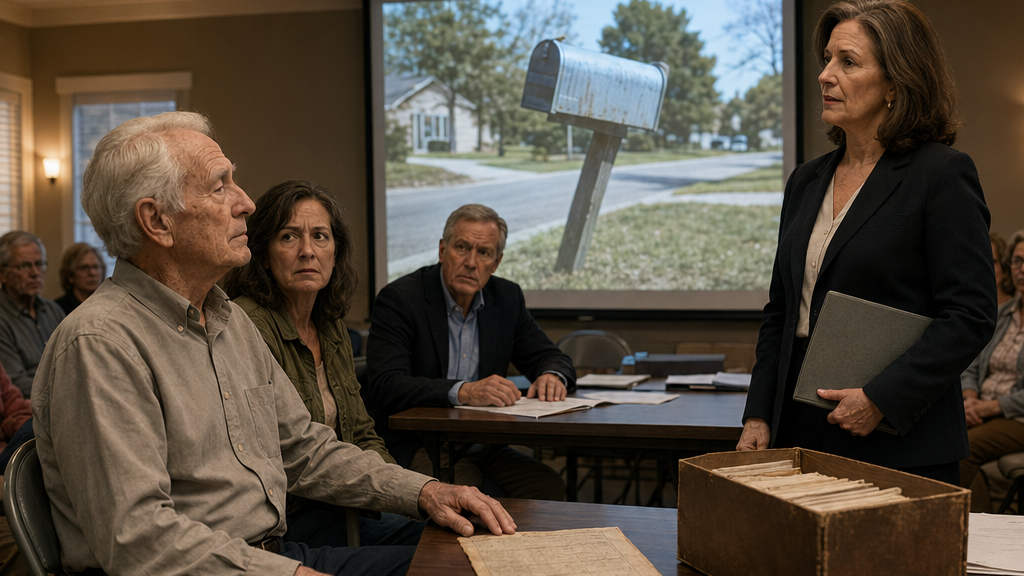
Edward’s mailbox was twelve feet tall on the clubhouse wall.
The projected photograph showed every flaw in merciless detail: peeling stain, scratched metal, a narrow split near the base of the cedar post, and the unmistakable lean toward the street.
Someone behind Edward whispered, “That’s it?”
Janet heard it too.
She shifted beside him.
Edward kept his eyes on the screen.
Carol Roberts stood near the projector with a folder tucked against her ribs.
“We’re not discussing whether any single violation looks catastrophic,” she said. “We’re discussing whether standards apply consistently.”
Edward had brought the shoebox.
It sat on the empty chair beside him.
Janet had offered to carry it.
He had refused.
Nicholas Young, the board president, glanced down the table at the other members.
“This item concerns ongoing architectural noncompliance at the Moore property.”
Carol clicked to the next slide.
Another photograph.
The mailbox from the opposite direction.
The date appeared in the corner.
Three weeks earlier.
Then another.
Two months earlier.
“Mr. Moore has been notified repeatedly,” Carol said. “The required correction is relatively minor.”
Janet leaned close.
“Say something.”
Edward did not.
Carol continued.
“We’ve had several homeowners complain this year that enforcement is inconsistent. Some believe longtime residents receive more flexibility than newer residents.”
That part Edward had not known.
A nearby homeowner raised a hand.
Nicholas recognized him.
“So this is about the mailbox?”
“It’s about compliance,” Carol answered.
The homeowner looked at Edward.
“With respect, the thing delivers mail.”
A few people smiled.
Carol did not.
“If each homeowner decides which standards matter, the association has no standards.”
Edward watched her carefully.
There was conviction in her voice, but not pleasure.
That mattered.
She was not enjoying his discomfort.
She believed she was preventing something.
Carol opened the folder.
“Mr. Moore has paid prior fines, which demonstrates receipt of the notices. Yet the condition remains unchanged.”
A board member frowned.
“If he pays them, why hasn’t he fixed it?”
Edward felt half the room turn toward him.
Janet whispered, “Dad.”
He placed one palm on the shoebox.
The cardboard had softened at the corners from years in the closet.
He stood.
At eighty-two, standing from a folding chair took long enough to make a room wait.
Carol stopped speaking.
Edward lifted the shoebox and placed it on the table in front of the board.
The sound was small.
Still, everyone looked at it.
“What’s that?” Nicholas asked.
“Your correspondence.”
Carol’s expression changed slightly.
“All of it?” Nicholas asked.
“Most.”
Edward removed the lid.
Rows of envelopes and notices filled the box.
He took out one bundle bound with a rubber band and placed it beside the lid.
Then another.
“These go back almost two years.”
Nicholas looked at Carol.
Carol said, “Which demonstrates how long the violation has remained unresolved.”
Janet inhaled sharply.
Edward raised one hand without looking at her.
He had not come to argue.
Not yet.
Nicholas leaned toward him.
“Mr. Moore, do you dispute that the mailbox is outside the architectural standard?”
“No.”
Carol seemed surprised.
“Then what exactly are we deciding?”
Edward looked at her.
“Whether that standard applies to my parcel.”
For the first time that evening, the room became fully quiet.
Nicholas frowned.
“I’m sorry?”
Edward reached inside his jacket and removed a folded photocopy.
Not the entire document.
Only the first recorded page.
He walked to the board table and placed it in front of Nicholas.
The old type was faint beneath the county stamp.
Nicholas adjusted his glasses.
Carol remained standing.
“What is this?” he asked.
“Land record.”
“What land?”
“This land.”
Nicholas read the top lines.
His forehead tightened.
Carol moved closer.
Janet watched Edward from the second row, no longer urging him to speak.
Nicholas looked up.
“This says Moore.”
“Yes.”
“Grantor.”
“Yes.”
“What does that have to do with your mailbox?”
Edward returned to his seat.
“That is the question I think the board should have answered before issuing penalties.”
Carol picked up the photocopy.
“This is from 1971.”
“Yes.”
“The HOA did not exist in 1971.”
“No.”
“So how could a document written before the association existed exempt anyone from rules that hadn’t been written?”
It was a fair question.
Edward knew that.
Several residents nodded.
He also knew the answer was not simple enough to give from memory.
“That page doesn’t say it does.”
Carol looked almost relieved.
Edward continued.
“It says where your authority begins.”
Her relief disappeared.
Nicholas held out his hand for the document.
“What exactly are you claiming?”
“I’m asking one thing.”
Edward looked from Nicholas to the other board members.
“Before these fines were issued, did anyone verify that the association’s architectural authority applies to my parcel?”
Nicholas looked at Carol.
One board member looked at another.
Nobody answered immediately.
Edward felt Janet’s hand close around the back of his chair.
Carol set the page down.
“Our governing documents apply to properties within the association.”
“That wasn’t my question.”
“The Moore property is geographically within the community.”
“I know where I live.”
A small laugh escaped from somewhere in the back.
Edward did not smile.
Nicholas raised a hand.
“Let’s keep this orderly.”
He turned to Carol.
“Was a title or parcel review done?”
Carol’s jaw tightened.
“Not specifically for this violation.”
“Why not?”
“Because we do not conduct a title examination every time someone has a mailbox problem.”
That, too, was reasonable.
Edward could see Nicholas thinking it.
Then Carol added, “And making exceptions based on historical relationships is exactly the kind of inconsistency residents have complained about.”
Edward felt something in him settle.
Not anger.
Clarity.
“This isn’t about a relationship,” he said. “It’s about a record.”
Carol met his eyes.
“And if every homeowner produces some decades-old paper—”
“Then you read it.”
The sentence landed harder than Edward intended.
He lowered his voice.
“If the paper affects what you’re allowed to do, you read it.”
Nicholas picked up the photocopy again.
“What else is in the record?”
Edward hesitated.
Janet looked at him.
This was the point he had avoided for twenty-two months.
He could still step back.
He could straighten the mailbox tomorrow, accept whatever fine came tonight, and return the blue envelope to the drawer.
Instead, he opened the shoebox.
From beneath the violation notices he removed another photocopied page, folded separately.
He did not hand it over.
“Enough that I think someone should check.”
Nicholas rubbed his chin.
Then he turned to one of the board members.
“Contact counsel tomorrow. Ask for a review of the Moore parcel and the recorded chain.”
Carol closed her folder.
“I don’t think we need to delay enforcement over a fifty-year-old deed.”
Nicholas looked at her.
“We’re not deciding the merits tonight.”
“The violation is continuing.”
“So is the question about our authority.”
That was the first moment Edward felt the room shift.
Not toward him.
Away from certainty.
Nicholas announced that further escalation would be suspended pending review.
The existing fines were not canceled.
The mailbox remained officially noncompliant.
But for the first time in nearly two years, another penalty would not automatically arrive simply because Carol had photographed the post.
As residents began gathering their coats, Janet touched Edward’s arm.
“That was all you had to do.”
Edward replaced the notices in the shoebox.
“No.”
She frowned.
“No?”
“That was the easy part.”
Across the room, Carol was still holding the 1971 photocopy.
She turned it over, studying the recording information at the bottom.
Edward watched her face.
There was something there he had not expected.
Recognition.
Carol crossed the room before he could leave.
“Mr. Moore.”
Edward waited.
She held up the document.
“I have seen a reference to this before.”
Janet stopped beside him.
Nicholas, halfway through packing his papers, looked up.
Edward studied Carol.
“How long ago?”
Carol did not answer immediately.
And in that hesitation, the question facing Edward changed completely.
It was no longer whether the HOA had failed to check the old record.
It was whether someone had checked it—and decided to keep going anyway.
Chapter 4: The Old Deed Was Not the Easy Answer
“The deed does not settle this by itself.”
The county records clerk said it gently, but Edward still felt the words land like a dropped tool.
He stood at the counter with the blue document envelope open in front of him. The original 1971 instrument lay beneath a clear protective sleeve. Beside it sat two photocopies and the handwritten parcel number the clerk had pulled from the current tax map.
Edward had arrived just after opening.
He had expected verification.
Instead, he had found a problem.
“The language is here,” Edward said.
“It is.”
The clerk pointed to the paragraph Edward had read so many times over the years that he could nearly recite it.
The wording reserved certain protections for the retained Moore parcel and restricted future mandatory charges and controls inconsistent with the transfer terms.
Edward tapped the line.
“That’s what I’m talking about.”
“I understand.”
“Then what’s missing?”
“The chain.”
Edward looked at her.
She turned one of the photocopies around.
“This document predates the subdivision declaration, the HOA, and several later parcel adjustments. It tells us there was a restriction. It does not, by itself, tell us how every later filing treated that restriction.”
“So it could have disappeared?”
“Not exactly.”
“Could it have been removed?”
“If it was lawfully modified, released, superseded, or incorporated differently, there should be a record.”
Edward stared at the page.
For twenty-two months, he had carried a private certainty that the board was wrong.
Not a legal opinion.
Not researched title work.
Certainty.
He disliked discovering the difference.
The clerk pulled up another document on her monitor.
“Your parcel is still described differently from most of the lots.”
“That’s good?”
“It’s interesting.”
Edward almost laughed.
At his age, he had learned that “interesting” was rarely a word professionals used when they meant “simple.”
The clerk printed a later subdivision filing.
Edward leaned closer.
A paragraph near the bottom referenced “existing exceptions, reservations, and limitations affecting the retained grantor parcel.”
He read it twice.
“There.”
“Yes.”
“That means they carried it forward.”
“It means they referenced something.”
“But something real.”
“Probably.”
Edward straightened.
“Probably.”
The clerk smiled faintly.
“You came here for certainty.”
“I did.”
“Records offices are not famous for providing emotional satisfaction.”
That time he did laugh.
She began tracing filing numbers.
Edward watched her move through decades of records: the original land transfer, subdivision plat, declaration, amendments, parcel descriptions.
The story of the neighborhood appeared less like a clean line than a stack of layers placed on top of one another by people who assumed someone else had understood what came before.
At noon, Janet called.
“Well?”
“Still looking.”
“That sounds bad.”
“It sounds like records.”
“Did Grandpa protect the property or not?”
Edward looked at the original deed.
“Yes.”
“That wasn’t my question.”
He smiled despite himself.
“You sound like Carol.”
“Take that back.”
“The deed protects something. We’re determining exactly what.”
Janet went quiet.
“You thought it was automatic.”
Edward did not answer.
“Dad.”
“Yes.”
“And it isn’t.”
“Not yet.”
There was a pause.
Then Janet said, “Do you want me to come down there?”
“No.”
“You don’t have to do this alone.”
“I know.”
He ended the call and realized the answer had been different from the one he would have given two days earlier.
He did know.
He simply did not know what to do with that knowledge yet.
By late afternoon, the clerk found another reference.
A supplemental subdivision filing from years after the original transfer listed Edward’s parcel separately from the lots subject to standard architectural assessment language.
“That seems important,” Edward said.
“It is.”
“Important enough?”
She shook her head.
“Not without the attachment it references.”
Edward read the notation.
SEE EXHIBIT C — RETAINED PARCEL EXCEPTIONS.
“Where’s Exhibit C?”
She checked the digitized file.
Nothing.
She searched the scanned packet again.
Still nothing.
Edward felt the old certainty thinning further.
“Missing?”
“From this copy.”
“You mean lost?”
“I mean not scanned here.”
“Where would it be?”
“Possibly in the archived microfilm. Possibly under the original instrument series. Possibly indexed separately.”
Edward folded his arms.
“So the whole question is sitting in an attachment nobody has.”
“Maybe.”
He looked at her.
She added, “I know. You don’t like that word either.”
That evening, Janet found him beside the mailbox with a level in one hand.
“You’re fixing it?”
“No.”
He rested the level against the cedar post.
The bubble slid off center.
Janet stood beside him.
“We could straighten it in half an hour.”
“Yes.”
“Then why are we standing here looking at it?”
Edward removed the level.
“Because if I fix it now, I won’t know whether I did it because I wanted to or because they made me.”
Janet studied him.
“That sounds stubborn.”
“It probably is.”
“You know those two things can be true at once.”
Edward looked at her.
She nodded toward the house.
“Did you find the answer?”
“Found a better question.”
“That’s not encouraging.”
He told her about the missing attachment.
Janet listened without interrupting.
When he finished, she said, “So maybe you’re not completely exempt.”
“Maybe.”
“And maybe Carol isn’t completely wrong.”
“Maybe.”
Janet folded her arms.
“You hate this.”
“Yes.”
She smiled.
“Good.”
“Why is that good?”
“Because you were getting too comfortable being the only person in the story who knew better than everyone else.”
Edward gave her a long look.
Then, reluctantly, he smiled.
The following Monday, he returned to the records office.
The clerk had already pulled an older index book.
She ran one finger down a handwritten column.
“Here.”
Edward leaned over.
A reference number had been entered beside the subdivision filing.
Different series.
Different storage designation.
She copied it onto a slip of paper.
“This may be your Exhibit C.”
“May be?”
The clerk looked at him.
Edward sighed.
“All right.”
She passed him the slip.
The instrument number was old enough that it had never been included in the HOA packet Edward had seen.
Maybe never reviewed.
Maybe never noticed.
He folded the paper once and put it in his wallet.
For the first time since the meeting, he was no longer trying to prove that he had always been right.
He only wanted to know what had actually been promised.
Chapter 5: Carol Had Been Warned Before
Nicholas Young arrived at Edward’s house carrying a copy of an email Carol had never shown the board.
Edward recognized the HOA letterhead through the glass before opening the door.
Nicholas looked tired.
“Do you have a minute?”
Edward stepped aside.
Janet was already at the kitchen table with coffee.
She saw the paper in Nicholas’s hand and immediately straightened.
“What happened?”
Nicholas did not sit.
He placed the email on the table.
“I went back through the board archive after the meeting.”
Edward read the date.
Seven months earlier.
The sender was a former board volunteer who had once helped organize historical property files.
The message was brief.
It warned that the Moore parcel appeared to carry “nonstandard recorded limitations” and recommended confirming the association’s enforcement authority before escalating fines.
Edward read the final line twice.
Janet read over his shoulder.
Then she looked up.
“Carol got this?”
Nicholas nodded.
“So she knew.”
“She knew there was a question.”
“That’s knowing.”
“It’s not the same thing.”
Janet pushed the paper across the table.
“She kept fining him.”
Nicholas looked at Edward rather than Janet.
“I’m not here to defend that.”
Edward sat down slowly.
“What did she do with the email?”
“Forwarded it to the compliance folder. No legal review was opened.”
“Why?”
Nicholas exhaled.
“That’s what I asked her.”
The answer came later that afternoon.
Carol requested that Edward meet at the HOA office with Nicholas present.
Janet insisted on coming.
Edward let her.
The association office was small enough that the four of them nearly filled it.
Carol did not waste time.
“I should have sent the parcel question to counsel.”
Janet opened her mouth.
Edward raised one hand.
Carol noticed.
“I didn’t,” she continued. “That was my decision.”
“Why?” Edward asked.
Carol folded her hands.
“Because we were already dealing with complaints about exceptions.”
Nicholas glanced down.
Carol continued.
“Two newer homeowners had been cited for fence and exterior-storage violations. Both complained that longtime owners were allowed more flexibility. One specifically mentioned you.”
“My mailbox.”
“Your mailbox was visible.”
Edward waited.
Carol looked toward the window.
“If I stopped enforcement every time someone claimed an old exception, I believed the board would look selective.”
Janet said, “So instead you ignored a warning.”
Carol turned toward her.
“I decided the warning was probably about outdated paperwork.”
“Without checking.”
“Yes.”
The word came flatly.
No excuse.
No apology either.
Edward found that more unsettling than anger would have been.
“You thought consistency mattered more,” he said.
Carol nodded.
“I thought credibility did.”
“And now?”
“Now I think I should have verified the authority before treating the issue as settled.”
Janet leaned forward.
“That’s a careful way of saying you kept charging him when you knew there might be a problem.”
Carol’s jaw tightened.
“Yes.”
Edward watched her.
For the first time, the person who had become the center of his irritation looked less like an official and more like someone trapped by a decision she had kept defending because admitting uncertainty would have weakened the role she depended on.
It did not make the fines right.
It did make them understandable.
That distinction irritated Janet.
Edward could tell.
“So withdraw them,” she said.
Carol looked at Nicholas.
Nicholas said nothing.
Carol shook her head.
“Not until counsel completes the review.”
Janet stared at her.
“You just admitted you should have stopped.”
“I admitted I should have reviewed the parcel question.”
“And now you’re still not stopping.”
“The future penalties are suspended.”
“The old ones?”
“Remain pending.”
Janet laughed once without humor.
Edward spoke before she could continue.
“That’s fair.”
She turned on him.
“No, it isn’t.”
“It is until they know which rules apply.”
Carol looked surprised.
Janet looked betrayed.
Edward continued.
“I’m not asking them to erase something because I’m angry.”
“You’ve already paid hundreds of dollars.”
“I know.”
“You have an email proving she was warned.”
“That proves she made a bad decision.”
“It proves more than that.”
“Maybe.”
Janet pushed her chair back.
“You keep protecting them.”
Edward felt the accusation land.
“I’m protecting the difference between being wrong and being dishonest.”
Carol looked down at the table.
Nicholas finally spoke.
“Counsel expects the archived filing tomorrow.”
That changed the room.
Edward looked at him.
“They found it?”
“The county provided a reference copy.”
“The attachment?”
Nicholas nodded.
“Apparently.”
Carol’s expression remained unreadable.
Janet sat down again.
Nicholas gathered his papers.
“If it says what the preliminary notes suggest, we’ll have a more specific answer.”
Edward walked outside with Janet afterward.
She waited until they reached his driveway.
“You’re too easy on her.”
“No.”
“Yes.”
“I understand her reason.”
“That isn’t the same as forgiving her.”
“I didn’t say it was.”
Janet stopped beside the mailbox.
A fresh white envelope protruded from the box.
Edward frowned.
He pulled it out.
Another violation statement.
Printed automatically before the suspension had been entered.
The amount remained due.
Janet looked at the shoebox through the front window.
“Add it to the collection.”
Edward did.
But this time he did not hide the box in the closet.
He placed it openly on the dining table.
The next evening, the phone rang.
The HOA attorney introduced himself and asked Edward to attend a closed board review the following Monday.
Edward gripped the receiver.
“Did you read the archived filing?”
“Yes.”
“And?”
There was a short pause.
“I think it materially changes the association’s position.”
Edward looked at the shoebox.
For nearly two years, every envelope inside it had represented something he had chosen not to challenge.
Now the question was no longer whether he had endured too much.
It was how much of what he had endured should never have been demanded at all.
Chapter 6: The Authority Stopped at His Property Line
“The association had authority on one side of your property line,” the attorney said, “but not on the other.”
Edward looked at the map spread across the conference table.
Carol sat opposite him.
Nicholas sat at the head.
Two other board members had joined by speakerphone.
The attorney placed the archived covenant beside the enlarged photograph of Edward’s mailbox.
The contrast was almost absurd.
One document concerned decades of land rights.
The other showed a wooden post leaning toward the road.
The attorney tapped the parcel outline.
“The subdivision declaration subjected most residential lots to mandatory architectural review. But this retained Moore parcel was incorporated with a surviving exception.”
Edward leaned closer.
“What exactly does that exception cover?”
“Mandatory assessments tied to architectural enforcement and certain exterior-property restrictions that conflict with the original retained-parcel covenant.”
“The mailbox?”
“Yes.”
Carol shifted in her chair.
The attorney continued.
“The association can still enforce generally applicable safety obligations where legally authorized. It can also request voluntary compliance with neighborhood standards. But the penalty structure used against Mr. Moore for this architectural issue was not enforceable against this parcel.”
Nicholas closed his eyes briefly.
“All twenty-two months?”
“The mailbox-related penalties, yes.”
“And the grass warning?”
“Different issue. No monetary penalty appears to have been assessed.”
Edward looked at Carol.
She was staring at the covenant.
For twenty-two months he had imagined this moment in flashes.
Carol proven wrong.
The board embarrassed.
Money returned.
He had never imagined how quiet it would be.
Nicholas spoke first.
“We’ll refund every improper fine.”
Edward nodded.
“We’ll also remove the violations from the property record.”
Another nod.
Carol said, “We can issue a private settlement letter and reimbursement immediately.”
Edward looked at her.
“Private?”
“It would resolve the matter without turning this into a larger neighborhood dispute.”
Janet’s voice seemed to appear in his head.
Make them say it.
Edward folded his hands.
“No.”
Carol looked up.
Nicholas watched him carefully.
Edward continued.
“I don’t want a spectacle.”
“Then a private correction—”
“I said I don’t want a spectacle. I didn’t say I want secrecy.”
Carol leaned back.
The attorney said nothing.
Edward pointed to the photograph of the mailbox.
“You used that at a public meeting.”
Carol’s face tightened.
“You discussed my noncompliance in front of residents.”
“Yes.”
“You made it part of the association’s record.”
“Yes.”
“Then the correction belongs in the same record.”
Nicholas nodded slowly.
“I agree.”
Carol looked at him.
Nicholas continued.
“We should issue a written correction to the membership and revise the enforcement file.”
One of the board members on speakerphone said, “We also need a procedure for parcels with nonstandard recorded restrictions.”
Edward looked toward the speaker.
“That matters more.”
Carol frowned.
“More than the refund?”
“Yes.”
She seemed genuinely confused.
Edward touched the edge of the shoebox he had brought with him.
“If someone else gets one of these because nobody checked first, then we learned nothing.”
Nicholas picked up his pen.
“What do you want the procedure to say?”
Edward hesitated.
There it was.
The moment when he could demand everything.
Carol removed from enforcement.
Formal censure.
Attorney fees he had not actually incurred.
Damages he had never claimed.
Janet would have understood.
Maybe even approved.
Instead Edward said, “If an owner raises a recorded exception and provides enough information to identify it, pause escalation until someone qualified reviews it.”
The attorney nodded.
“That’s reasonable.”
“And no public labeling of persistent noncompliance while authority itself is disputed.”
Nicholas wrote that down too.
Carol looked at Edward.
“You’re not asking for me to step down.”
“No.”
Nicholas stopped writing.
Edward looked at her.
“I’m asking the board to stop making one person’s certainty the same thing as authority.”
Carol absorbed the sentence without answering.
The board approved the refund.
They approved removal of the mailbox violations.
Nicholas agreed that the association would publish a correction stating that architectural penalties had been improperly assessed because the Moore parcel carried a recorded exception not identified during enforcement.
The compliance process would also be restructured so unresolved parcel questions went to counsel before escalation.
Carol would no longer have sole discretion over disputed enforcement.
It was not a dramatic punishment.
It was a smaller, more permanent loss of control.
When the meeting ended, Edward carried the shoebox outside.
Carol followed him.
“Mr. Moore.”
He stopped in the parking lot.
She held the old photograph.
His mailbox leaned behind him at the far end of the street.
“You could have brought that deed in the first month.”
Edward said nothing.
“You knew there was something in it.”
“Yes.”
“Then why pay all those fines?”
He looked at her.
It was not accusation in her voice now.
It was confusion.
Maybe even irritation.
“You let this go on for almost two years.”
“Yes.”
“Why?”
Edward looked toward his house.
The answer existed.
He had simply spent decades refusing to say it aloud.
Before he could respond, Nicholas stepped through the clubhouse door.
Carol lowered the photograph.
Edward tightened his grip on the shoebox.
“I’ll answer you,” he said.
“But not here.”
He walked home past the crooked mailbox, now officially free of every fine that had ever been attached to it.
For the first time, the post was no longer the unresolved question.
He was.
Chapter 7: He Fixed the Mailbox After They Stopped Asking
The correction appeared on the clubhouse bulletin board before Edward touched the mailbox.
Janet saw it first.
She pulled into his driveway on Saturday morning, left the engine running, and crossed the lawn holding a printed page in one hand.
“They posted it.”
Edward was on the porch sorting through a small box of hardware.
He looked up.
“Posted what?”
“The correction.”
She handed him the page.
At the top was the association letterhead. Beneath it, in language more careful than warm, the board acknowledged that architectural penalties had been improperly assessed against the Moore parcel because recorded restrictions had not been reviewed before enforcement.
The fines would be refunded.
The violations would be removed.
Future disputes involving documented parcel exceptions would be referred for review before penalties escalated.
Edward read it twice.
“They didn’t mention Carol.”
“No.”
“You sound disappointed.”
“I’m not disappointed.”
“You wanted them to name her.”
Janet folded her arms.
“I wanted somebody to be responsible.”
“Somebody was.”
“Who?”
“The board.”
“That’s convenient.”
Edward handed the paper back.
“It’s also true.”
Janet stared at him for a moment, then looked toward the curb.
The mailbox still leaned.
“You know what everyone is going to say now.”
Edward picked up a wrench.
“What?”
“That after all this, you won, and you still haven’t fixed the thing.”
“I haven’t won anything.”
“They refunded the money.”
“That’s correction.”
“They admitted they were wrong.”
“That’s correction too.”
Janet sighed.
“You have a strange definition of victory.”
Edward stood.
“So did my father.”
That silenced her.
They carried the tools toward the curb together.
Edward had not planned to explain it there.
He had imagined the question from Carol lingering for a few days, maybe weeks.
Why did you wait?
Why pay?
Why let it happen?
But with Janet standing beside the same cedar post that had started the whole dispute, the answer no longer felt like something that belonged in a locked drawer.
“My father made me promise something,” Edward said.
Janet looked at him.
“When?”
“Long time ago. Before most of these houses existed.”
He knelt beside the base of the post and scraped away loose soil.
“When the county and the developers were working out the land transfers, I was angry about some of it.”
“You?”
“I was younger.”
“That doesn’t answer the question.”
Edward smiled.
“I thought people were going to make money from land my family was giving up. I said we should keep more control.”
“What did Grandpa say?”
Edward pushed the shovel into the soil.
“He said if you give something, you give it because you mean to. Not because you expect everybody who comes after to remember your name.”
Janet leaned against the shovel handle.
“That sounds like him.”
“He also told me never to use the family’s part in building this place to act as though we were above anyone living here.”
Janet was quiet.
Edward loosened another section of dirt around the post.
“So when the first notice came,” he continued, “I could have brought out the old papers.”
“But you didn’t.”
“No.”
“Because you thought that would be acting superior.”
“I thought it might.”
Janet shook her head slowly.
“That’s not what he meant.”
“I know that now.”
“You let them fine you for almost two years because you were afraid of looking entitled.”
Edward considered correcting her.
He decided not to.
“Yes.”
Janet looked down the street.
“That is unbelievably stubborn.”
“Yes.”
“And kind of ridiculous.”
“Yes.”
“And you’re going to do it again someday.”
Edward stopped digging.
“No.”
She looked at him.
He meant it.
That seemed to matter more to her than anything he could have added.
Later that afternoon, the HOA held a brief open meeting to approve the new enforcement procedure.
Edward attended because Nicholas had asked him to.
Carol sat near the end of the board table instead of beside the compliance files.
The change was small but visible.
Nicholas read the correction into the minutes.
No one applauded.
A homeowner asked whether old exceptions would now let people ignore every neighborhood rule.
The attorney explained that they would not.
Another asked why the issue had not been caught earlier.
Nicholas answered that the board had relied too heavily on standardized parcel assumptions and had failed to investigate when a specific exception was raised.
Then Carol spoke.
She did not look at Edward immediately.
“I believed consistency was the same thing as fairness.”
The room settled.
Carol continued.
“It isn’t, if the rule is being applied where the authority is different.”
Edward watched her.
There was no performance in the sentence.
No attempt to win sympathy.
She looked at him then.
“I should have checked.”
Edward nodded once.
That was enough.
After the meeting, Nicholas gave Edward an envelope containing confirmation of the refund.
Edward slipped it into his jacket.
Carol approached him near the door.
“You said you would answer me.”
Edward knew what she meant.
He told her about his father’s promise.
Not every detail.
Only enough.
Carol listened.
When he finished, she said, “You thought using the deed would make you look privileged.”
“Yes.”
“And I thought not enforcing against you would make me look weak.”
Edward considered that.
“Seems we both let appearances do too much thinking.”
Carol almost smiled.
“Seems so.”
They did not shake hands.
They did not become friends.
But when Edward left, neither of them looked away first.
The following morning, Janet arrived to find him already at the mailbox.
He had loosened the soil, reset the cedar post, and braced it with two scrap boards.
She held up a level.
“You started without me.”
“You were late.”
“It’s eight fifteen.”
“I’ve been awake since five.”
“That’s not a defense.”
She crouched beside him.
Together they adjusted the post until the bubble centered.
Edward tightened the brace.
Janet stepped into the street and looked back.
“Still a little left.”
Edward checked.
“It’s the box, not the post.”
“You’re sure?”
“No.”
She laughed.
They removed the mailbox, straightened the mounting bracket, and put it back.
Edward sanded the old cedar without erasing every mark.
He brushed on fresh stain but left the narrow scar where the delivery truck had clipped it years ago.
Janet noticed.
“You missed a spot.”
“No.”
“You’re keeping that?”
“Yes.”
“Why?”
Edward ran one thumb over the scar.
“Because straight doesn’t have to mean new.”
Janet nodded as if she understood more than the sentence itself.
By noon, the mailbox stood square to the curb.
No notice required it.
No deadline remained.
No penalty depended on it.
Edward stepped back and looked at the post.
For twenty-two months, its lean had represented resistance he had never quite admitted was resistance.
Now it was simply his mailbox again.
Inside the house, the shoebox sat on the dining table.
The refund confirmation rested on top.
Edward removed the notices one stack at a time.
He kept the official correction, the covenant copies, and the final board letter in a file folder.
The rest went into recycling.
Janet watched from the kitchen.
“You sure?”
Edward looked at the empty box.
“Yes.”
He flattened it with both hands.
The cardboard gave easily.
For years he had treated silence like proof of character.
The box had shown him what silence could accumulate when nobody challenged it.
Edward carried the flattened cardboard outside and placed it in the recycling bin.
Then he returned to the curb.
Janet was standing beside the mailbox with the level pressed against the post.
“Well?”
Edward asked.
She studied the bubble.
“Perfect.”
Edward looked at the old cedar, the fresh stain, and the small scar he had chosen not to erase.
“Close enough.”
The story has ended.