The Elderly Judo Sensei Who Broke The Champion’s Arrogant Fall
CHAPTER 1: THE COLD WATER ON THE WHITE CANVAS
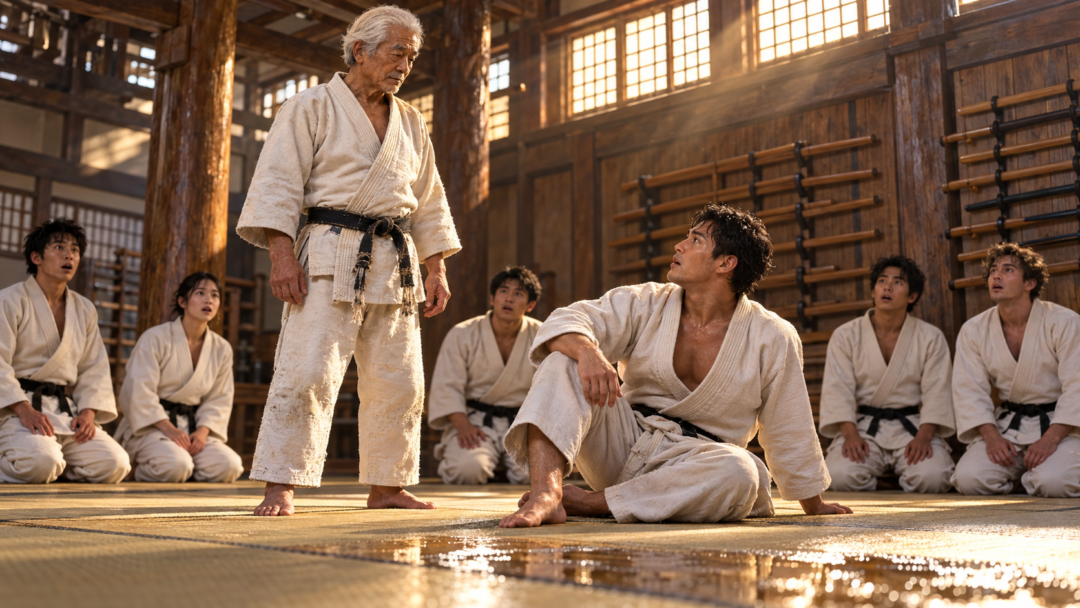
The steady November rain drumming against the high wire-reinforced clerestory windows of the Fort Arden judo dojo had the muffled, hypnotic rhythm of a distant ceremonial drum. Built in the late autumn of 1943 as a specialized hand-to-hand combat pavilion for elite reconnaissance scouts, the timber hall was lined with aromatic white cedar planks that had cured over eight decades to a deep, honey-dark amber. The air inside was cold and sharp, smelling of dried rice-straw tatami canvas, sweet camphor liniment, damp wool utility jackets, and rich hickory smoke curling from the cast-iron potbelly stove in the eastern corner. Along the western wall hung polished racks of Japanese oak training bokken, heavy canvas throwing dummies weighted with river sand, and rows of pristine white cotton judo uniforms hanging from cedar pegs.
For forty years, Hiro Tan had taught thousands of young soldiers how to control their fear through the discipline of the judo mat. He had watched boys from wheat farms in Kansas and steel towns in Ohio arrive at Fort Arden raw, frightened, and insecure, and he had watched them transform into men who understood that true martial power lay not in crushing an opponent, but in mastering one’s own impulses. To Hiro, the dojo was not an athletic club; it was a sanctuary of the human spirit.
Kneeling in the traditional seiza posture on the center tatami mat was Sensei Hiro Tan.
Hiro was seventy-two years old, slender, compact, and possessed of a stillness that felt as immovable as a mountain boulder. He wore a faded, double-weave white cotton judo gi that had softened through thousands of washings to the texture of antique sailcloth, held tightly at the waist by a frayed black belt whose outer cotton had worn away to reveal white silk threads beneath. His hair was pure snow-white, cropped close to his weathered skull, framing a face lined with deep, patient creases around dark eyes that held the quiet, unblinking clarity of an autumn pond. His hands, resting flat against his thighs, were thick-knuckled and scarred, the skin hardened like seasoned leather.
Beside his left knee, an old surgical scar ran diagonally across the joint—a reminder of three machine-gun fragments removed from his patella thirty-one years ago in East Africa, causing a dull ache whenever cold coastal rain set in over New Jersey.
Sitting in a silent, respectful line along the southern edge of the mat were five young recruits in grey physical training sweats. They were nineteen and twenty years old, their breathing hushed, watching the old master demonstrate the subtle mechanical principles of hip off-balance with the reverent focus of acolytes in an ancient temple.
The heavy sliding cedar doors at the back of the hall rattled violently on their brass rollers, sliding open with a concussive bang that shook the high timber rafters.
Striding onto the sacred cedar floor with heavy, bare feet was Private Jace Korr.
Korr was twenty-nine years old, six feet tall, and weighed two hundred and ten pounds of explosive, athletic muscle. He was the reigning inter-service mixed martial arts champion, undefeated across four military tournament circuits, and newly transferred to the base infantry battalion. He wore a modern, customized black training gi with crimson embroidered dragons across the back, his sleeves rolled high to showcase corded forearms laced with vascular veins. His face was sharp, handsome, and set in a permanent sneer of arrogant self-importance. In his left hand, he carried a heavy steel insulated travel mug filled with ice water.
Korr walked straight across the dojo floor, ignoring the traditional bow to the shomen, his bare heels thudding loudly on the tongue-and-groove cedar boards.
He stopped two feet from where Hiro Tan sat in silent seiza. Korr looked down at the old man, his lips curling into a mocking, predatory smirk.
“Class is dismissed, recruits,” Korr announced, his voice booming through the wooden hall with the harsh, grating volume of a street brawler. “The garrison athletic board just reassigned this mat space to my tournament preparation squad. We don’t have time for geriatric bowing lessons and ancient history.”
Hiro Tan did not move. He did not blink. His breathing remained deep, slow, and rhythmic, expanding his diaphragm without disturbing the calm line of his shoulders.
Korr scoffed, shaking his head with dismissive contempt.
“I’m talking to you, old man,” Korr sneered. “Look at your hair. Look at that limp in your knee. You think you’re still relevant? Combatives is an explosive young man’s game. It’s about speed, power, and violence of action. Your soft Japanese parlor tricks belong in an assisted-living recreation center.”
Without warning, Korr tipped his insulated steel mug.
A stream of freezing ice water poured directly down over Hiro Tan’s right shoulder.
The cold water soaked instantly through the heavy cotton fabric of the master’s gi, cascading down his sleeve and pooling onto the woven straw tatami mat in a wide, dark puddle that spread between their feet.
The five recruits flinched in unison, their breath catching in their throats, their eyes wide with shock at the blatant, unforgivable disrespect. Yet Korr was an undefeated tournament champion with powerful friends in base command, and no private dared to speak.
Hiro Tan did not jump. He did not cry out.
He sat motionless on his knees, looking down at the dark puddle of water spreading across the canvas. A single drop clung to the cuff of his sleeve, falling into the puddle with a quiet, clear plink. His right hand, resting flat against his knee, gave one subtle, involuntary tremor—the physical memory of a decades-old wound—and then, as his weathered fingers closed into a loose, relaxed fist, it froze into absolute, granite stillness.
Hiro slowly lifted his dark eyes, meeting Korr’s mocking gaze with an eerie, bottomless calm that seemed to swallow all the aggressive heat in the room.
Hiro looked at the aggressive forward cant of Korr’s shoulders, at the distinctive southpaw grip of his left hand, and at the subtle tattoo of a crossed-anchor guidon barely visible beneath the collar of his black gi.
A quiet, profound sorrow touched the old master’s eyes, quickly hardening into the immovable resolve of an oak tree meeting a gale.
“You have your father’s heavy left grip, Jace,” Hiro said softly. His voice was quiet as falling snow, yet it carried an acoustic weight that made Korr’s smirk falter. “But you have none of his honor. And your father would have wept to see you pour water on an honest man’s mat.”
CHAPTER 2: NINE MOVEMENTS ON THE CEDAR FLOOR
Private Jace Korr’s face transformed from arrogant mockery to a violent, crimson rage. The mention of his father struck him like a jagged shard of ice driven between his ribs. In eight years of competitive fighting across military circuits, he had never allowed anyone to speak of his father—the legendary Sergeant First Class Ken Korr, who had died overseas when Jace was barely six years old, leaving behind a legacy Jace had spent his entire life trying to outrun.
“Shut your mouth!” Korr snarled, his voice trembling with furious indignation. “You don’t say my father’s name! You don’t know anything about him! Stand up and get off this mat, old man, or I’ll throw you through that cedar wall!”
Korr took an aggressive, thumping step forward, his bare feet splashing through the puddle of cold water, his massive left hand lunging forward like an iron hook to grab Hiro’s wet lapel and haul him off the floor.
Hiro Tan rose.
He didn’t use his hands to push against the mat. He didn’t struggle or strain. He rose from the seiza kneeling posture in one unbroken, vertical ascent, his spine uncoiling like a tempered steel cable, his center of gravity anchored so deeply between his hips that his body seemed to float upward. As his feet touched the canvas, his bare soles gripped the woven straw like ancient roots, completely unaffected by the damp floor.
Korr’s reaching hand crossed Hiro’s centerline.
What followed was an unbroken, nine-move sequence of classical Kodokan judo—a masterwork of kinetic redirection, off-balance leverage, and circular geometry executed with surgical perfection.
Move One: Grip. As Korr’s left hand came within an inch of his lapel, Hiro’s right hand moved like rising water, his calloused fingers sliding beneath Korr’s sleeve just above the elbow, securing a firm, living grip on the fabric.
Move Two: Kuzushi (Off-Balance). Hiro did not pull backward; he stepped his right foot slightly to the outside and rotated his core two inches, drawing Korr’s forward momentum upward and forward. Korr’s two-hundred-and-ten-pound mass was pulled completely onto the tips of his toes, his center of gravity floating helplessly outside his base of support.
Move Three: Tsukuri (Entry). Hiro pivoted one hundred and eighty degrees on his good right foot, sliding his hips directly beneath Korr’s beltline like an iron wedge sliding under a falling log. His scarred left knee flexed, absorbing the weight without a tremble.
Move Four: Harai Goshi (The Sweeping Hip Throw). Hiro’s right leg swept backward in a high, punishing crescent arc across both of Korr’s shins. Hiro tilted his head, pulled downward on the sleeve with the rotational torque of his entire body, and bowed from the waist.
The inter-service champion took flight.
Korr’s feet left the tatami with a loud squeak of canvas. His massive, muscular frame arced five feet through the air above the mat, his eyes wide in sheer, disbelieving terror as the high cedar rafters spun violently around his vision. For one suspended heartbeat, he hung weightless in the freezing air of the dojo.
THUD.
Korr slammed flat on his back onto the canvas tatami with a concussive impact that rattled the bokken on their wall racks and sent plumes of dried straw dust puffing from the seams. The air exploded from his lungs in a ragged, whistling wheeze.
Move Five: Ground Pin (Mune-Gatame). Before Korr could even begin to comprehend the fall, Hiro was already on him. The old master dropped his chest across Korr’s sternum with immovable, concentrated weight, pinning his shoulders flat to the canvas.
Move Six: Juji-Gatame (Cross-Body Arm Lock). In one fluid, seamless transition, Hiro swung his right leg across Korr’s throat, trapping the young champion’s left arm between his thighs, his hands locking Korr’s wrist with his thumb pointed directly toward the ceiling.
Move Seven: Shift. Hiro rotated his hips two degrees, tightening the angle of the elbow joint until the ligaments stretched to the absolute, razor-thin threshold of dislocation.
Move Eight: Hold. Hiro held the lock for three full seconds—not to inflict agony, but to allow the total, inescapable reality of his absolute helplessness to burn into Korr’s arrogant spirit.
Korr gasped in blind panic, his free hand frantically slapping the canvas three times in rapid, desperate succession: slap… slap… slap.
“Tap!” Korr choked out, his voice cracking into a high, humiliated whimper. “I tap! Tap!”
Move Nine: Release. Hiro released the tension instantly.
He did not shove Korr away. He did not sneer, and he did not gloat. He stood up with smooth, dignified grace, stepping back two clean paces to give the fallen fighter room to breathe. He smoothed the lapels of his wet white gi, tied his black belt firmly, and bowed toward the mat with quiet reverence.
Korr lay sprawled on his back on the canvas, his chest heaving like a beached fish, staring up at the amber rafters in stunned, paralyzed disbelief. He was completely uninjured—not a bone was broken, not a joint was torn—yet his undefeated champion’s pride had been stripped from his soul in front of five junior recruits.
The five recruits sat along the wall in frozen, holy silence. Not a single man breathed.
Hiro reached down with an open hand, offering to help Korr up from the mat.
Korr flinched away, slapping Hiro’s hand aside in bitter, humiliated fury, scrambling backward on his hands and knees.
Hiro withdrew his hand with quiet dignity. He walked toward the wooden bench beneath the window, stopping beside the wall where a row of faded black-and-white portraits of garrison judo champions was displayed.
He pointed to a rectangular wooden frame that hung empty, leaving an unvarnished pale outline on the cedar wall.
“Your father’s portrait used to hang right there, Jace,” Hiro murmured softly, his voice echoing off the pine timbers. “It was taken down the day Coach Vance Miller took over your training contracts. Do you know why?”
CHAPTER 3: THE GHOST OF MOGADISHU ALLEY
Private Jace Korr pulled himself up from the tatami, his limbs trembling with an exhaustion that was far more psychological than physical. The cold water on the canvas had soaked through his black gi, chilling him to the bone, but the fire burning behind his eyes was toxic with shame and confusion. Without saying a word to the recruits, Korr grabbed his gym bag, shoved open the heavy sliding doors, and stumbled out into the freezing New Jersey rain, his combat boots sloshing through the mud as he ran blindly toward the deserted motor pool.
For twenty-three years, Jace had lived with a poisoned soul.
His father, Sergeant First Class Ken Korr, had been a three-time national judo champion and an Army Ranger who was killed in action in October 1993 during the Battle of Mogadishu. Jace had been six years old when the telegram arrived. Following his father’s death, Jace had been taken under the wing of Vance Miller—a former collegiate wrestler and flamboyant sports agent who ran a commercial fight gym outside the base. Miller had spent two decades telling Jace that his father was a reckless glory-hound who cared more about medals than his own family, a man who had abandoned Jace to die in an unapproved African firefight. Miller had channeled Jace’s childhood rage into a weapon, transforming him into an aggressive, concussive fighter who fought with hatred rather than honor.
Now, sitting in the cold passenger seat of his pickup truck, Jace’s mind roared with Hiro Tan’s words: Your father’s portrait was taken down when Vance Miller took over your contracts. Do you know why?
At seven o’clock that evening, unable to bear the silence, Jace walked into the administrative offices of the Fort Arden Garrison Combatives Division.
Sitting behind the oak desk was Captain Maya Torres. Torres was thirty-eight years old, a former collegiate judo champion at West Point, and the garrison training director. She was reviewing training rosters when the door opened, and she looked up to see Jace standing in the doorway, soaked in rain, his eyes bloodshot and haggard.
“Private Korr,” Captain Torres said, leaning back in her chair. “I heard about what happened in the dojo this morning. Pouring water on Sensei Tan’s gi is an Article 92 violation. If Hiro had pressed charges, you’d be in the stockade tonight.”
“Captain,” Jace whispered, his throat dry and tight as a rusted cable. “Who was Hiro Tan to my father?”
Torres’s expression softened, the disciplinary sternness giving way to a deep, solemn gravity. She pulled open her lower desk drawer, withdrew a thick, red-jacketed file labeled DEPARTMENT OF THE ARMY – CASUALTY AUDIT – TASK FORCE RANGER – 1993, and laid it open on the desk.
“Your father didn’t die alone, Jace,” Torres said gently. “And he didn’t abandon you.”
Jace leaned over the desk, his hands shaking as he read the yellowed combat report.
On October 3, 1993, in the dusty alleys of the Bakaara Market in Mogadishu, a downed Black Hawk helicopter had been surrounded by hundreds of armed militia fighters. Sergeant First Class Ken Korr and Master Sergeant Hiro Tan had fought side-by-side for nine hours, defending eleven wounded soldiers inside a fortified stone courtyard. When an anti-tank rocket collapsed the outer perimeter wall, Ken Korr had been mortally wounded by shrapnel while shielding a nineteen-year-old medic.
Jace’s eyes blurred with tears as he reached the medical evacuation deposition:
RECOMMENDATION: DISTINGUISHED SERVICE CROSS. SPECIAL VALOR COMMENDATION: MASTER SERGEANT HIRO TAN, WHO REFUSED EXTRACTION, BRAVING DIRECT MACHINE-GUN FIRE TO CARRY SFC KORR’S BODY OVER EIGHT HUNDRED METERS OF OPEN GROUND. MSGT TAN SUSTAINED SEVERE CRUSH INJURIES AND SHRAPNEL TO HIS LEFT KNEE WHILE SHIELDING SFC KORR FROM ENEMY FIRE, ENSURING THE REMAINS WERE NOT CAPTURED. SFC KORR’S FINAL WORDS TO MSGT TAN WERE RECORDED: ‘GIVE MY BELT TO JACE. TELL HIM I AM WITH HIM.’
Jace sank onto the wooden chair before the desk, his hands covering his face as a ragged, suffocating sob tore from his chest.
The limp in Hiro Tan’s left knee wasn’t old age. It was three machine-gun bullets taken thirty-one years ago so that his father’s body could be brought home to American soil with honor.
“Why didn’t Vance Miller tell me this?” Jace choked out, looking up at Torres with eyes raw with agony. “Miller told me my father didn’t care about me!”
“Because Vance Miller is a predator, Jace,” Captain Torres said with cold fury. “Miller was your father’s former tournament manager. When Ken died, your father left behind a hundred-thousand-dollar death gratuity and an irrevocable commercial royalty trust for your future judo academy. Miller forged legal guardianship papers, gained control of your trust fund, and drained every dollar to build his private fight promotion company. He kept you angry and isolated so you would fight on his underground pay-per-view circuit without asking questions about where your money went.”
Before Jace could speak, the window glass behind the desk rattled with the low, throaty rumble of a heavy V8 engine.
Parking in the gravel lot outside the headquarters building was a black luxury SUV with heavily tinted windows.
Stepping out into the rain, wearing a tailored Italian leather trench coat and accompanied by two towering bouncers in dark tracksuits, was Coach Vance Miller.
CHAPTER 4: THE BLACK SEDAN IN THE PINE CLEARING
Vance Miller was fifty-four years old, broad-chested, thick-necked, with slicked-back dyed black hair and cold, dead eyes behind gold-rimmed aviator sunglasses that he wore even in the rainy darkness. He walked into the headquarters corridor with the unhurried, menacing swagger of a loan shark who owned everyone in the county.
His two bodyguards—six-foot-four competitive heavyweight brawlers with cauliflower ears and brass-knuckled gloves in their pockets—waited in the hallway, leaning against the doorframe.
Miller strode into Captain Torres’s office, flicking water from his leather collar, ignoring the officer’s presence as his gaze locked onto Jace Korr.
“There you are, kid,” Miller said, his voice a gravelly, cigarettes-and-whiskey rasp that dripped with synthetic affection. “I’ve been looking for you all afternoon. What’s this garbage I hear about you getting tossed on your neck by an old Japanese janitor in the base gym? People on the fight forums are talking. The bookmakers in Atlantic City are getting nervous.”
Jace stood up slowly from his chair. His hands hung at his sides, but his fists were clenched so tightly that his fingernails dug into his palms until they bled.
“Get off this military base, Miller,” Jace said, his voice a low, vibrating growl of suppressed rage. “You lied to me for twenty-three years. You told me my father was a coward who abandoned me. You stole his trust fund, and you hid his final words.”
Miller’s smirk vanished. His jaw set into an ugly, cold sneer of calculation. He stepped forward, leaning his heavy palms on Captain Torres’s desk, completely unfazed by Jace’s accusation.
“Your father was a stubborn fool who threw his life away for a flag that doesn’t care about him,” Miller hissed, leaning into Jace’s face. “I took a fatherless, angry street punk and turned him into a six-figure championship brand. You think you’re an independent soldier, Jace? You signed an exclusive ten-year promotional management contract with Vanguard Combat Sports when you turned eighteen. I own your fight rights, I own your military sponsorship endorsements, and I own your brand.”
Miller pulled a thick manila folder from his leather coat and slapped it onto the desk.
“Next Friday night, you fight in the Atlantic City inter-service exhibition against the Russian champion, Alexei Volkov,” Miller said, his eyes drilling into Jace with cold menace. “And in round three, you take a dive. You let Volkov catch you in an armbar and you tap.”
Jace’s eyes widened in horror. “A dive? You want me to throw a fight?”
“Three million dollars in syndicate betting money is riding on Volkov by submission, kid,” Miller whispered with venomous precision. “You take the fall, we split five hundred grand offshore, and you walk away clean. If you refuse, I enforce the breach-of-contract penalty. I sue you for two million dollars, I call the garrison provost marshal and have you prosecuted for commercial gambling, and I ensure you spend the next ten years breaking rocks in the Leavenworth stockade. You do what you’re told, Jace. You always have.”
Miller turned on his heel, tapping the desk with his heavy signet ring, and walked toward the door.
“You have twenty-four hours to report to my private training camp outside the north gate, Jace,” Miller called out over his shoulder. “Don’t make me have my boys come drag you out of your barracks.”
Miller and his two enforcers strode out into the rain, the heavy exterior doors slamming shut behind them.
Jace stood frozen in the office, his chest heaving, his world shattered into pieces. Every victory he had ever won, every trophy on his shelf, had been built on a foundation of blackmail, lies, and stolen honor.
Miller had built his empire on the broken bodies of young fighters who had returned from war with shattered nerves and empty bank accounts. He had spotted Jace at seventeen in a regional tournament, feeding the boy’s grief, buying him high-end sports cars and luxury apartments while keeping the title deeds in corporate trusts. To Miller, a fighter was merely an appreciating asset—a thoroughbred to be raced until its tendons tore, then discarded into bankruptcy.
As Jace stood alone in the corridor after Miller’s departure, the cold draft from the open entrance chilled his damp uniform. He could see his reflection in the dark glass of the door—a young man with everything a prize fighter could desire on paper, yet completely bankrupt of self-respect. He had traded his father’s honorable name for commercial endorsements and cheap tournament trophies.
Captain Torres stood up from her desk, her hand resting firmly on Jace’s trembling shoulder.
“He doesn’t own you, Jace,” Torres said quietly. “There is one person who has the original 1993 legal trust documents and your father’s true legacy. Go to the dojo. Go see Hiro.”
CHAPTER 5: THE CEDAR BOX BEHIND THE BOKKEN RACK
The rain over Fort Arden had turned to sleet, rattling against the cedar siding of the traditional dojo like a hail of iron shot.
Inside the darkened hall, only the red glow of the cast-iron potbelly stove illuminated the high timber rafters. The dojo was quiet, fragrant with sweet woodsmoke, dry straw, and herbal tea.
Sensei Hiro Tan was kneeling at a low cedar table in his small office behind the bokken rack, his reading glasses on his nose, carefully writing calligraphy with a horsehair brush on a white scroll: Jita-Kyoei—Mutual Welfare and Benefit.
The sliding screen door clicked open.
Jace Korr stood in the doorway, soaked in freezing rain, his head bowed, his hands trembling at his sides. He took off his muddy combat boots at the threshold, stepped onto the cedar floorboards in his bare feet, and walked to the edge of the mat.
He did not shout. He did not swagger.
Jace dropped to his knees, pressed his palms flat against the canvas tatami, and lowered his forehead all the way to the floor in the deepest, most reverent bow of absolute submission and apology: Saikeirei.
“Sensei,” Jace’s voice broke, tears dripping from his face onto the mat where he had poured cold water eight hours earlier. “I was blind. I was arrogant, cruel, and foolish. I dishonored you, I dishonored this dojo, and I dishonored my father’s memory. I don’t deserve to be on your mat. But I beg you… tell me about my father.”
Hiro Tan set his ink brush down with deliberate gentleness. He removed his glasses, rose from the floor with his slight limp, and walked over to where the young champion knelt in the dark.
Hiro did not scold him. He did not lecture him.
He reached down with his calloused, weathered hands, placed them beneath Jace’s shoulders, and gently lifted the weeping young man up from the canvas.
“A man who has never fallen cannot learn how to break his fall, Jace,” Hiro said softly, his dark eyes shining with deep, paternal warmth. “Your father loved you more than his own life. Come.”
Hiro led Jace into the small back room. Beneath the central altar, behind the polished oak bokken rack, sat a heavy, hand-carved cedar trunk bound with black iron hinges.
Hiro unlocked the trunk with an iron key, lifting the heavy fragrant lid.
Inside lay three items preserved in green military parachute silk: a bundle of forty handwritten letters tied with faded blue ribbon, an unredacted official casualty ledger from the 1993 Somalia mission, and a heavy, double-weave cotton judo black belt, faded to a deep charcoal grey, its frayed ends embroidered in gold Japanese kanji: KEN KORR – 6TH DAN – KODOKAN.
Embroidered beneath his father’s name, in small red silk letters, was Jace’s birthdate: OCTOBER 14, 1988.
Hiro lifted the belt with reverent hands and held it before Jace’s tear-filled eyes.
“Your father spent six months hand-sewing your birthdate into this silk before we deployed,” Hiro whispered, his voice trembling with emotion. “He wore it beneath his tactical armor during every combat mission. When he died in my arms in that alleyway, he pressed this belt into my hands and said: ‘Keep it safe, Hiro. When Jace is ready to fight with his soul instead of his fists, give it to my boy.'”
Jace turned to one of the middle letters, dated September 1993—just three weeks before the fateful deployment to East Africa. The handwriting was firm, rhythmic, and clear:
“My beloved Jace, whenever you step onto a tatami mat, remember that your opponent is not your enemy. He is your partner in seeking the truth. When you throw a man, you must guide his fall so that he rises stronger. If you only seek to break people, you will end up broken inside yourself. Listen to Hiro Tan. He is the truest brother I ever had in this life.”
Jace held the letter against his heart, his breath catching in his throat as the words settled into his bones like warm sunlight through winter frost. For the first time in his life, he understood why his father had never spoken of fighting with anger. To Ken Korr, martial arts was not an instrument of dominance; it was an act of sacred guardianship.
Jace took the belt in his trembling hands, pressing the worn, weathered fabric to his face, breathing in the scent of cedar and aged cotton. Thirty years of buried grief, loneliness, and poisonous rage dissolved into a torrent of healing, cleansing tears.
Suddenly, the heavy cedar sliding doors at the front of the dojo shattered inward with a violent, concussive crash.
Through the splintered entryway stepped Vance Miller, flanked by his two heavyweight enforcers and a third armed mercenary carrying a twenty-four-inch steel crowbar and a red plastic container of gasoline.
CHAPTER 6: THE TRIAL ON THE CENTER TATAMI
“Search the office! Burn everything in that trunk!” Vance Miller roared through the freezing sleet blowing through the ruined doorway. “If the old man moves, break his other knee!”
The three hired enforcers charged onto the sacred cedar floor, their boots tracking muddy slush across the polished planks. The largest brawler—a three-hundred-pound underground heavyweight named Bruno—lunged toward the office with his steel crowbar raised high, ready to smash the altar.
Jace Korr moved to step forward, but Hiro Tan’s hand came down gently onto Jace’s shoulder.
“Watch, Jace,” Hiro whispered, his voice calm, clear, and quiet as a winter dawn. “This is judo.”
Hiro stepped out from the office onto the center tatami mat.
Bruno swung the heavy steel crowbar in a savage, diagonal downward smash aimed at Hiro’s skull.
Hiro did not retreat.
He stepped directly into the pocket of the swing, entering inside the radius of the crowbar before the heavy iron could generate downward velocity. His left palm slapped Bruno’s elbow joint; his right hand slipped behind the giant’s neck in a classic De-Ashi-Barai advancing foot sweep.
WHACK-SLAM.
The three-hundred-pound giant’s legs flew out from under him as if yanked by an invisible cable. Bruno crashed onto the canvas mat with an earth-shattering thud that knocked the breath completely from his lungs, the heavy steel crowbar clattering across the floorboards into the corner.
The second enforcer rushed with a wild, looping right hook.
Jace Korr stepped onto the mat beside his master.
For the first time in his life, Jace did not fight with wild, brawling rage. He fought with the calm, circular balance of his father’s blood. He caught the attacker’s wrist, pivoted his hips in a textbook Seoi-Nage shoulder throw, and launched the two-hundred-and-twenty-pound brawler across the dojo. The man crashed through a wooden folding screen, groaning in agony on the floor.
The third attacker, terrified, dropped his gasoline can and turned to flee toward the shattered doors, but Hiro’s hand hooked his collar in an effortless O-Soto-Gari outer reap, planting him flat on his back in the slush.
Total elapsed time: six seconds.
All three enforcers lay incapacitated, groaning on the floor, disarmed without a single strike thrown.
Vance Miller backed toward the shattered doorway, his face pale with horror, fumbling frantically inside his leather trench coat for a snub-nosed revolver.
“Stay back! I’ll kill both of you!” Miller shrieked, his hands shaking violently as he pulled the steel barrel into view.
CLACK-CLACK.
From the rainy shadows outside the doorway, the sharp, authoritative clicks of twenty military police rifles cycling into battery cut through the storm.
Floodlights snapped on, bathing the interior of the dojo in brilliant, blinding white light.
Stepping through the shattered entrance with weapons drawn were six armed military police officers, flanked by Garrison Commander Colonel Harrison Vance and Captain Maya Torres.
“Drop the weapon, Miller!” the lead MP sergeant barked. “Hands behind your head! Down on your knees!”
Miller looked at the leveled rifles, at the stone-faced military police, and at Jace Korr standing tall beside Hiro Tan on the tatami. The revolver slipped from his limp fingers, clattering onto the wet cedar boards. Miller sank to his knees in the mud, weeping in ruined, pathetic terror.
Colonel Vance stepped forward, looking at the groveling promoter, then at the three fallen enforcers.
“Vance Miller,” Colonel Vance announced, his voice ringing with cold military authority. “Federal marshals in Trenton have just executed search warrants on your corporate accounts. The FBI has seized your offshore ledgers, confirming thirty years of wire fraud, illegal sports racketeering, and grand larceny of military casualty trusts. You are under federal arrest.”
The heavy impact of the three fallen enforcers vibrated through the foundation of the historic dojo, stirring the scent of dry straw and sweet cedar into the cold mist. The recruits watching from the doorway let out a collective breath of disbelieving relief. They had witnessed three armed street brawlers neutralized in the span of six heartbeats without a single bruise or bloody strike—a pure demonstration of classical Kodokan principles where maximum efficiency of energy had completely overwhelmed brute criminal violence.
As the military police led the handcuffed men through the rain into the transport vans, Colonel Vance placed his hand on the shattered doorframe, his gaze sweeping the pristine cedar floor. “This dojo has stood for eighty years, Sensei Tan,” Colonel Vance said with solemn respect. “And tonight, it proved that the soul of the American soldier cannot be bought or bullied by corrupt men.”
Federal agents stepped forward, clicking heavy steel handcuffs around Miller’s wrists and marching him out into the freezing rain as the enforcers were cuffed and dragged away into waiting police vans.
CHAPTER 7: THE FADED BELT IN THE MORNING LIGHT
The nor’easter that had smothered the New Jersey coast for days finally blew out toward the Atlantic Ocean, swept away by a clean, crisp northwest wind that left the sky a brilliant, pristine sapphire blue.
Inside the Fort Arden dojo, the morning sun poured through the high clerestory windows, casting warm, golden rectangles of light across the swept canvas tatami mats and the freshly repaired cedar sliding doors. The air was warm, smelling of clean pine shavings, sweet beeswax, and boiling green tea.
Assembled along the edge of the mat were sixty soldiers and recruits from the basic training battalion, all wearing clean white cotton judo gis, their posture straight, their faces shining with eager, respectful pride.
At the front of the dojo, mounted on the central cedar wall beneath the crossed American and Kodokan flags, was the newly restored portrait of Sergeant First Class Ken Korr—smiling proudly in his prime, wearing his championship medals.
Standing before the memorial portrait were Garrison Commander Colonel Harrison Vance and Captain Maya Torres.
Standing in the center of the mat was Sensei Hiro Tan, wearing his immaculate, double-weave white gi, his silver hair catching the golden morning light.
Beside him stood Private Jace Korr.
Jace wore a clean, traditional white cotton gi. His black dragon tournament gi had been burned in the dojo stove two nights earlier. His posture was upright, humble, and centered, his eyes clear, calm, and free from the bitter shadows that had haunted his youth.
Hiro Tan stepped forward, holding the heavy, faded 6th-dan black belt of Ken Korr.
Colonel Vance stepped to the microphone:
“By official commendation of the Department of the Army and the Kodokan Judo Institute,” Colonel Vance proclaimed, his voice echoing through the quiet hall, “the legacy of Sergeant First Class Ken Korr is officially restored to full military honor. And his belt is passed to the son who has proven worthy of his name.”
Hiro Tan turned to face Jace.
The young soldier bowed deeply from the waist.
Hiro wrapped the heavy, faded black belt around Jace’s waist, crossing the thick fabric behind his back and tying the square knot at his center with two sharp, authoritative tugs that echoed like a heartbeat through the silent hall.
Hiro smoothed the embroidered red silk letters bearing Jace’s birthdate.
He looked up into Jace’s tear-filled eyes, his weathered hands resting gently on the young man’s shoulders.
“Your father gave you his blood, Jace,” Hiro said softly, his voice carrying the warmth and depth of a lifetime of devotion. “Now you carry his balance. True strength does not crush the weak; true strength lifts the fallen from the dust and teaches them how to walk. You are ready to lead.”
Jace looked down at his father’s belt, running his calloused fingers over the frayed silk. A warm, quiet tear slipped down his cheek, but his jaw remained steady and strong.
He snapped his heels together, bowed deeply to Hiro Tan from the waist, and then turned to face the sixty young recruits waiting eagerly on the mats.
Jace stepped to the center of the mat, his bare feet sinking into the familiar texture of the woven straw. He looked out at the sixty young recruits kneeling before him in their crisp white gis, their eyes wide with anticipation. Among them were the five privates who had seen him pour water on Hiro’s gi three days earlier.
“Before you learn how to throw,” Jace said, his voice calm, clear, and resonant throughout the timber hall, “you must learn how to fall. In judo, falling is not defeat. Ukemi—the breakfall—is the art of meeting the hard earth with grace, absorbing the impact, and preserving your life so that you can rise again. When life throws you down, you do not curse the floor. You slap the mat, find your breath, and stand back up.”
Jace dropped smoothly onto his back, his right arm striking the canvas with a crisp, thunderous slap that sent a clean ring through the rafters: THWACK. He rolled backward, came up onto his feet in one continuous, fluid arc, and smiled with quiet warmth.
Jace Korr raised his hands, his voice ringing out clear, steady, and full of life across the sunlit dojo:
“Bow to the mat. Let us begin.”