The Vanishing Illusionist Who Defied The Skeptical Journalist’s Trap
CHAPTER 1: THE WHITE SILK ON THE VELVET TABLE
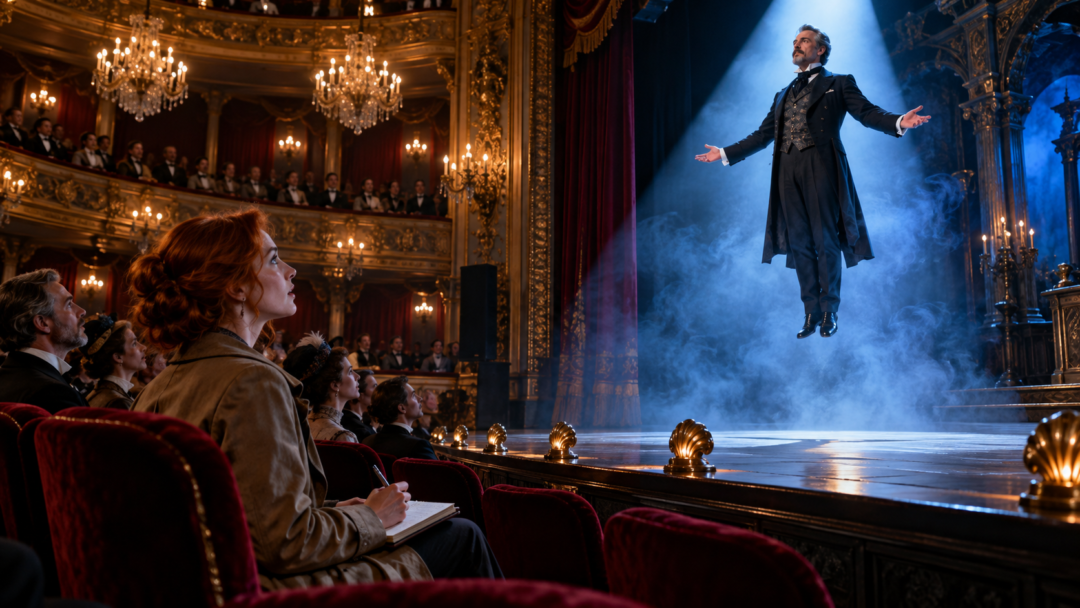
The heavy Atlantic sea fog rolled off Boston Harbor, creeping through the narrow, gas-lit cobblestone alleyways of Beacon Hill before pooling around the ornate limestone facade of the historic Orpheum Theatre on Tremont Street. Built in 1892 during the golden age of American vaudeville, the auditorium was a cavernous temple of gilded Beaux-Arts plaster molding, tarnished bronze sconces, and faded red velvet upholstery that smelled of antique rosewater, theatrical haze, sweet pipe tobacco, and beeswax floor polish. High above the auditorium, three massive crystal chandeliers hung dimmed to a faint, amber ember glow. Two hundred patrons—an eclectic gathering of high-society patrons, theater critics, local dignitaries, and curious onlookers—sat in the darkened orchestra stalls, their whispers echoing into the soaring shadows of the proscenium arch.
Sitting in seat A-14 directly in the center of the front row was Lena Cross.
Lena was twenty-eight years old, an investigative reporter for the Boston Chronicle, with striking auburn hair cut into a sharp, angular bob that framed a pale, fiercely skeptical face. She wore a tailored charcoal wool trench coat with her official press credential clipped to the lapel, an open leather-bound reporter’s notebook resting across her knees, and an expensive silver rollerball pen poised between fingers that gripped the barrel with aggressive, white-knuckled tension. In her breast pocket, resting against her ribs, was a heavy brass pocket watch that had stopped ticking sixteen years earlier—the last tangible keepsake of her older brother, Arthur Cross.
Arthur had been an inventive genius, a master horologist and mechanical stage engineer who had built breathtaking theatrical illusions before vanishing without a trace during a high-stakes escape act in 2008. For sixteen years, Lena had carried the jagged, festering conviction that her brother had been murdered by his former stage partner—the enigmatic illusionist known simply as Julian Voss.
The Orpheum had survived the Great Depression, two world wars, and the relentless demolition of Boston’s historic vaudeville houses by modern commercial developers. Its soaring plaster proscenium was adorned with hand-carved gilded cherubs and neoclassical masks of tragedy and comedy, their gold leaf tarnished to a dignified, antique bronze. For Lena Cross, this theater was hallowed ground—and a crime scene. She still remembered sitting in the third row as a twelve-year-old girl with pigtails, holding her breath while Arthur tinkered with brass pulleys and balanced counterweights in the wings. Arthur had possessed hands like a surgeon and the imagination of an astronomer, capable of turning scrap steel and clockwork springs into living illusions that made grown men weep with wonder. To believe that Arthur had died here was a nightmare she had relived every night for sixteen years.
Tonight was Voss’s first public appearance in over a decade, and Lena had come with a headline already composed in her mind: THE CHARLATAN OF TREMONT STREET: HOW A FAKE MAGICIAN COVERED A TRAGIC MURDER.
Outside the theater, the gas lamps along Tremont Street flickered against the damp brick facades of old Boston, casting long, amber-hued reflections across the rain-slicked cobbles. The patrons filing into the lobby spoke in hushed, expectant tones, debating whether Julian Voss was a true master of the occult arts or merely the last practitioner of an obsolete vaudeville craft. But inside the hall, beneath the vast painted ceiling depicting mythological muses and celestial spheres, every eye remained fixed on the center of the dark stage.
The house lights died completely into absolute, velvet blackness.
A single, razor-sharp follow spotlight—cold, arctic white, and slicing through a drifting blue haze—erupted from the projection booth in the high balcony, locking onto the center of the bare wooden stage.
Stepping into the white beam was Julian Voss.
Voss was fifty-two years old, tall, gaunt, and possessed of a presence so commanding, still, and otherworldly that the whispering audience went instantly, breathlessly silent. He wore a bespoke, midnight-black three-piece suit without a tie, the white collar of his dress shirt unbuttoned at the throat, revealing a long, aristocratic neck. His silver-streaked dark hair was brushed straight back from a high, sculpted forehead. His hollow cheeks, sharp cheekbones, and piercing obsidian eyes gave him the ascetic appearance of a monk who had spent thirty years contemplating the geometry of shadows. He did not smile, he did not bow, and he did not make grand theatrical flourishes with his arms.
In the center of the spotlight stood a small, circular mahogany table supported by a single carved tripod leg, covered with a square cloth of pure white silk.
Voss walked up to the table, his polished black leather boots making no sound against the stage floorboards.
He stopped, his long, slender hands resting motionless at his sides. He did not look up at the balcony or toward the shadows of the box seats. His dark eyes lowered directly into the front row, locking onto Lena Cross with an unblinking, chilling intensity that made the breath catch in her throat.
With a slow, deliberate movement, Voss touched the edge of the white silk.
“The silk is white, Miss Cross,” Voss said softly, his voice a rich, resonant baritone that carried to the furthest rafter without amplification, rich with an acoustic clarity that felt like a quiet confession in an empty church. “A white silk can hide a wound. It can hide an empty hand. But it cannot hide the brother who carved the mahogany table beneath it.”
Lena flinched in her seat, her fingers digging so hard into her pen that the metal casing bruised her knuckle. Before she could speak, Voss’s hands began to move.
CHAPTER 2: FIVE MIRACLES IN THE SINGLE SPOTLIGHT
Julian Voss’s hands moved over the table like two silent, hunting falcons gliding across still water. He did not use distracting theatrical patter; the silence inside the grand theater was absolute, broken only by the muffled hiss of the spotlight beam cutting through the theatrical haze.
Miracle One: The Living Silk.
Voss lifted the white silk handkerchief between his thumb and forefinger, holding it suspended before the audience to show that both sides were completely empty. His sleeves were pushed high on his forearms, revealing bare skin and slender wrists. He passed his right palm across the fabric—not concealing it, not folding it—and the white silk transformed in a single, fluid blink into deep, velvety crimson. A quiet gasp rippled through the front row. Voss passed his hand across the fabric a second time, and the crimson dissolved into spun, radiant gold that shimmered under the white beam like liquid sunlight.
Lena leaned forward in her seat, her sharp green eyes dissecting the motion, looking for hidden chemical reservoirs, thread pulls, or dye capsules. There were none. The silk rested loose and weightless in his bare fingers.
Miracle Two: The Rose from the Flame.
Voss set the golden silk aside. From his vest pocket, he withdrew a single wooden strike-anywhere match. He struck the sulfur tip against his thumbnail. The match flared into a brilliant orange-and-blue flame that illuminated the sharp planes of his gaunt face. Voss held the burning stick in his left hand and passed his right hand directly through the fire.
With a soft, fragrant pop of sparks, a fresh, blooming red rose appeared in his bare palm—its stem thorny, its petals damp with fresh droplets of dew that sparkled in the beam. He walked to the edge of the stage, bent down with graceful dignity, and handed the blooming flower to an elderly woman in the second row, whose hands trembled with childlike wonder as she smelled the rich, sweet perfume.
Miracle Three: The Floating Parlor Table.
Returning to the center mark, Voss placed both of his open palms flat against the mahogany tabletop. He took one slow, measured breath.
Without warning, the solid mahogany table began to rise.
It did not wobble or jerk as if suspended by thin monofilament wire. It rose smoothly, horizontally, floating four feet off the stage floorboards. Voss slowly removed his hands, stepping three paces backward into the shadows. The table remained hovering in mid-air, completely independent of human contact, drifting gently like a ship at anchor on a calm sea. Lena stood halfway up from her seat, squinting through the spotlight beam, searching for carbon-fiber cranes or hidden stage counterweights. The space above and below the table was empty air. With a gentle wave of Voss’s fingers, the table descended, its three wooden legs meeting the stage planks with a solid, resonant thud.
Miracle Four: The Vanishing Heirloom.
Voss stepped to the edge of the proscenium, looking down at Lena.
“Miss Cross,” Voss said softly, his voice melodic and intimate. “May I borrow the pocket watch resting inside your coat?”
Lena’s pulse spiked. “How do you know what’s in my pocket?”
“Because Arthur made it for you when you were twelve,” Voss replied quietly. “Please.”
Reluctantly, driven by a fierce desire to catch him in a clumsy sleight of hand, Lena reached into her trench coat, unclipped the heavy brass pocket watch, and handed it up to the stage.
Voss held the watch high in his right palm, allowing the entire auditorium to see the dull gleam of the antique casing. He closed his fingers into a loose fist.
He snapped his fingers.
Snap.
Voss opened his hand. His palm was completely, utterly empty.
A synchronized gasp echoed across the two hundred spectators. Voss pointed his left hand across the stage toward the far proscenium wing, where a locked, heavy glass bell jar sat on a pedestal under a dedicated pin spot.
Inside the sealed glass jar, suspended by a brass hook, hung Lena’s pocket watch.
And through the crystal glass, clearly audible across the dead silence of the hall, came the crisp, acoustic rhythm: tick… tick… tick… tick.
Lena stood frozen in the aisle, her jaw slightly open. The watch had been broken for sixteen years. Its mainspring had been snapped since 2008.
Miracle Five: The Silent Levitation.
Voss did not wait for the applause. He walked to the center of the stage and stood on an empty square of black floorboards. He closed his eyes, let his arms hang relaxed at his sides, and drew in one deep, expanding breath through his nose.
Slowly, smoothly, defying every law of terrestrial physics, Julian Voss began to rise.
His leather boots cleared the floor by six inches… one foot… three feet… six feet into the open air. His black suit jacket hung perfectly straight, obeying natural gravity, yet his body floated weightless inside the cone of white light like an astronaut drifting in the void. He turned in the air, a full three hundred and sixty degrees, offering every angle of his floating form to the audience.
The silence inside the Orpheum Theatre was terrifying, holy, and absolute. Nobody breathed. Nobody shifted in their seats.
Two hundred people sat in suspended, paralyzed wonder, witnessing an impossible manifestation of grace that shattered the boundaries of their reality.
Voss descended as softly as a falling leaf, his boot soles touching the wood without a sound.
The spotlight snapped off.
For three seconds, darkness enveloped the hall. Then, the house lights flared up.
The theater erupted.
Two hundred people leaped to their feet in a deafening, thunderous standing ovation that rattled the chandeliers. People were shouting, weeping, clapping their hands until their palms were raw.
In the center of the front row, Lena Cross did not clap. She stood frozen, her reporter’s notebook open in her lap, her pen trembling violently in her hand. She looked down at the paper, where she had scribbled three frantic, unfinished words: I can’t… explain…
She rushed up the stage stairs toward the locked glass bell jar. She opened the latch and lifted the brass watch.
The pocket watch Arthur had hand-crafted for Lena was no ordinary timepiece. Its balance wheel had been cut from a solid disk of bimetallic invar and brass, compensating for extreme temperature shifts, with a hairspring coiled by hand under a jeweler’s loupe. In 2008, Arthur had promised her that as long as the watch ticked, their family bond was unbreakable. When the watch had stopped ticking the morning after his disappearance, Lena had felt a vital chamber of her own heart freeze in grief. Now, hearing that crisp, steady tick through the heavy glass bell jar was like feeling a dead heart suddenly surge with warm, living blood.
On the polished inside lid, freshly engraved in microscopic, familiar script that she knew as intimately as her own heartbeat, were the words: FOR LENA – HANG ON – ARTHUR – 2024.
CHAPTER 3: THE GREEN ROOM IN THE SUB-BASEMENT
Lena Cross’s knees buckled. She clutched the ticking watch against her chest, her mind reeling in a storm of vertigo. The engraving was fresh—the edges of the copper lettering were sharp, unoxidized, smelling faintly of cutting oil. Arthur hadn’t died in 2008. Arthur was alive.
She pushed past the heavy velvet curtains, ignoring the stage manager’s protests, and descended the spiral cast-iron staircase that led beneath the stage to the historic dressing rooms in the sub-basement.
The air down here was cold, smelling of ancient brick mortar, damp river stone, machine lubricant, and sweet peppermint tea. At the end of a long, vaulted brick corridor stood Green Room Number One. The heavy oak door was slightly ajar, spilling warm amber light across the damp floor.
Lena pushed the door open.
Julian Voss was sitting in a leather wingback chair in front of a three-way vanity mirror, sipping black tea from a porcelain cup. His stage jacket was draped over a wooden mannequin; he wore only his black waistcoat and a crisp white shirt with rolled sleeves. He looked up, his obsidian eyes calm, reflecting the vanity bulbs with an ancient, patient sorrow.
“You knew he was alive,” Lena whispered, her voice cracking as she held up the ticking watch. “You knew for sixteen years, and you let me believe he drowned in that tank!”
Voss set his teacup down with deliberate care. He did not flinch from her accusation.
“If Charles Thorne had known that Arthur survived that night, Lena,” Voss said quietly, “Arthur would not have lived to see the sunrise. And neither would you.”
Voss rose from the chair, walked over to an antique oak desk in the corner, and unlocked an iron-banded strongbox. From inside, he withdrew an antique, hand-cranked Edison wax-cylinder phonograph and placed a dark, grooved cylinder onto the mandrel.
He cranked the brass handle and lowered the stylus.
A soft mechanical hiss filled the dressing room, followed by the unmistakable, rich voice of Arthur Cross—older, raspy, but vibrating with undeniable vitality:
“Lena… if you are hearing this, it means Julian succeeded in getting the watch to you. I am alive, little sister. I have never stopped loving you, and I have never stopped fighting to come home. Sixteen years ago, Charles Thorne discovered my designs for the automated hydraulic release mechanisms. He wanted the patents to build untraceable, rigged mechanical slot machines and money-laundering terminals for his Atlantic City casinos. When I refused to sell, Thorne sabotaged the water tank. Julian pulled me out through the false drainage tunnel beneath the stage and hid me in the old tunnels beneath the harbor. Thorne thinks he owns the city, but Julian and I have built one final illusion that will tear his empire down. Trust Julian, Lena. He is the truest friend this family ever had.”
The wax cylinder clicked into silence.
Lena stood in the center of the dressing room, tears streaming down her pale cheeks, splashing onto the polished brass of her brother’s watch. Sixteen years of hatred, suspicion, and bitter journalism evaporated into the cold air of the room, leaving behind the raw, incandescent relief of a sister whose brother had returned from the dead.
“Do you know why Arthur called it the Water Chamber of Daedalus, Lena?” Voss asked, his gaze drifting toward the vanity mirror where a black-and-white photograph of Arthur was tucked into the gilded frame. “Because Daedalus did not build a labyrinth to trap people; he built wings to escape the tyrant Minos. Arthur designed that water chamber so that no lock could hold an honest man. But Thorne didn’t want escape; Thorne wanted control. When Thorne discovered that Arthur held the international patents on the magnetic escapement gear, he bribed the fire marshal to weld the emergency bypass shut thirty minutes before curtain call. If I had not cut the water supply line from the basement intake with an axe, Arthur would have drowned before two thousand screaming spectators.”
“Where is he, Julian?” Lena choked out, taking a step toward him. “Where is Arthur now?”
“He is being held in the private security penthouse of Thorne’s casino tower on the waterfront,” Voss explained, his voice dropping into a tense whisper. “Thorne discovered Arthur’s hiding place three weeks ago. He forced Arthur into an underground workshop to finish a master electronic routing program that will funnel fifty million dollars in stolen casino funds out of the country tonight. The transfer goes live at midnight.”
Voss reached into his vest and pulled out a small, encrypted brass keycard.
“Tonight was the distraction, Lena,” Voss continued. “Thorne came to this theater tonight. He sat in Box Three, watching my levitation, believing I was performing an ego trip for an aging audience. But while he was watching the stage, federal marshals were downloading his offshore server logs using an encrypted relay Arthur built into the theater’s electrical grid.”
Suddenly, the heavy exterior steel door at the end of the dressing room corridor slammed open with a concussive boom.
Heavy, synchronized boots pounded down the brick hallway.
The dressing room door was kicked off its hinges.
Three men in dark suits wearing tactical earpieces and carrying silenced pistols burst into the room, led by Charles Thorne’s personal head of security, a ruthless mercenary named Vance Keller.
“Drop your hands! Both of you!” Keller barked, leveling his suppressed weapon directly at Julian Voss’s chest.
CHAPTER 4: THE BLACK LIMOUSINE ON TREMONT STREET
Julian Voss did not move. He stood between Lena and the armed men, his posture upright and serene, his hands resting loose at his sides.
“Good evening, Mr. Keller,” Voss said calmly. “Mr. Thorne has always been very impatient with theatrical curtain calls.”
Keller sneered, gesturing with his pistol barrel. “Shut up, magician. Mr. Thorne wants to have a word with the reporter. Move, girl. Out to the alley.”
Before Voss could react, the two other enforcers seized Lena by the arms, twisting her wrists behind her back and dragging her backward out of the dressing room. Voss moved to step forward, but Keller whipped his pistol across Voss’s temple.
The heavy steel slide caught Voss across the cheekbone, opening a jagged gash that bled dark crimson onto his white collar. Voss stumbled against the vanity table, and Keller slammed the iron-reinforced dressing room door shut, turning a heavy deadbolt from the outside and trapping the illusionist inside the brick vault.
“Try pulling a rabbit out of your hat to get out of that room, old man,” Keller chuckled through the iron grille.
Lena was hauled up the service stairs and shoved violently through the stage door into the freezing night air of Tremont Street. The alley was dark, shrouded in dense Atlantic fog, empty save for a long, black stretch limousine idling with its exhaust pluming into the mist.
The enforcers threw Lena into the rear leather passenger compartment, slamming the tinted door shut.
Sitting on the opposite bench seat, pouring single-malt scotch from a crystal decanter into a heavy tumbler, was Charles Thorne.
Thorne was sixty years old, broad-shouldered, silver-haired, impeccably dressed in a bespoke charcoal pinstripe suit with a diamond stickpin in his silk tie. His face was weathered, handsome, and set in lines of ruthless, sociopathic entitlement. He held an unlit cigar in his gold-ringed fingers, looking at Lena with cold amusement.
“Good evening, Miss Cross,” Thorne said smoothly, his voice cultured and venomous. “I must compliment your reporting. Your articles on municipal corruption have been delightfully aggressive. But tonight, you’ve stumbled into grown-up business.”
Lena sat up on the leather seat, rubbing her bruised wrists, her auburn hair wild around her face, her eyes burning with green fire.
“You kidnapped my brother sixteen years ago, Thorne,” Lena spat, her voice trembling with righteous fury. “You stole his patents, you trapped him in a cage, and you’ve been laundering stolen syndicate money through his inventions!”
Thorne took a slow sip of his scotch, smiling with cold, untroubled amusement.
“Arthur was an artisan who didn’t understand the real world, my dear,” Thorne replied, leaning forward until Lena could smell his expensive cologne. “Inventions don’t belong to the men who dream them; they belong to the men with the capital to protect them. Arthur has been very comfortable. He’s had his tools, his clockwork, and his privacy.”
Thorne had systematically bought every independent theater, cabaret, and gaming venue from Providence to Portland throughout the early 2000s, turning historic cultural landmarks into sanitized, corporate-owned venues rigged with electronic gaming machines. He surrounded himself with former municipal judges, corrupt building inspectors, and private security mercenaries who ensured that no rival developer or whistleblower survived long enough to reach a grand jury. To Thorne, art, wonder, and journalism were merely commodities to be leveraged or destroyed.
Lena looked out the rain-slicked window of the limousine as it crossed the Congress Street bridge over the black waters of Fort Point Channel. The lights of the financial district shimmered like cold diamonds against the storm clouds. She knew that signing the retraction meant sentencing her brother to a slow, suffocating death in an underground cell. She straightened her spine, looking Thorne directly in his dead, calculating eyes with the fierce, unwavering resolve of an investigative reporter who answered only to the truth.
Thorne opened a leather portfolio on the small table between them, sliding a freshly printed three-page document and an expensive gold fountain pen toward Lena.
“This is a signed confession and a front-page retraction for the Boston Chronicle,” Thorne said, his voice dropping into a razor-sharp whisper. “It states that Julian Voss is an unhinged, violent extortionist who murdered your brother in 2008, and that Voss fabricated these insane conspiracy theories about me to salvage his dying stage career. You will sign it, and you will transmit it to your managing editor before midnight.”
“And if I refuse?” Lena asked coldly.
Thorne leaned closer, tapping the glass of his watch against the mahogany armrest.
“At midnight, the final fifty-million-dollar offshore transaction completes,” Thorne whispered. “If that article is not live on the Chronicle wire by eleven-fifty-nine, the ventilation system in Arthur’s workshop will be switched off. Nitrogen gas will flood the room in less than forty seconds. Arthur dies, you go to prison as an accomplice to Voss’s fraud, and I board a private Gulfstream to Zurich. You have twenty minutes, Miss Cross. Choose wisely.”
CHAPTER 5: THE CATWALK ABOVE THE PROSCENIUM
The limousine sped down Tremont Street, heading toward Thorne’s private casino pier on the Boston waterfront. Inside the locked sub-basement dressing room of the Orpheum Theatre, Julian Voss wiped the blood from his cheek with a damp cloth.
He didn’t panic. He looked at the heavy oak door and its steel deadbolt.
To an ordinary man, the room was a prison. To an illusionist who had spent fifty years studying the hidden architecture of theatrical buildings, the room was merely a stage with multiple exits.
Voss walked to the corner behind the costume wardrobe. He pushed aside three vintage Victorian velvet cloaks, reached his long fingers into the seam between the floorboards, and depressed a hidden brass catch.
With a soft, counterweighted click, a three-foot section of the wainscoting swung inward, revealing a dusty brick ventilation shaft that led directly into the counterweight fly system above the stage.
Voss climbed through the opening, scaling the rusted iron rungs in the darkness until he emerged onto the high catwalk suspended eighty feet above the Orpheum proscenium arch.
Waiting on the iron catwalk, wearing dark tactical gear and holding a secure satellite terminal, was FBI Special Agent Marcus Reed—the lead investigator for the federal organized crime task force.
“Julian,” Agent Reed whispered, reaching out to help the bleeding illusionist onto the iron grating. “Our wiretap picked up Thorne’s conversation in the limousine. He’s holding Lena hostage and threatening to gas Arthur at midnight.”
“Is the federal surveillance net active on the casino pier?” Voss asked, his breath steady despite the steep climb.
“The building is surrounded by forty tactical agents,” Reed replied grimly. “The problem is the vault itself. Arthur is locked inside an airtight biometric bunker on the thirty-second floor. If Thorne’s security system detects a breach or an unauthorized electronic probe, the automated nitrogen purge will trigger instantly. We can’t blow the doors without killing him.”
The Orpheum’s fly system was a dizzying labyrinth of five-inch hemp ropes, forged iron pulleys, and two-ton lead counterweight arbors hanging in the shadowy cavern above the stage. For over a century, stagehands known as “the rigging ghosts” had worked these catwalks, dropping hand-painted canvas backdrops and velvet act curtains with millimeter precision.
Julian Voss moved along the narrow iron grating eighty feet above the auditorium floor with the silent, surefooted balance of a mountain cat. He pointed out the fiber-optic nodes concealed inside the decorative plaster molding of the ceiling rosette to Agent Reed.
“Arthur designed this theater’s electrical renovation in 2006,” Voss explained in a low whisper, his fingers adjusting a miniaturized laser prism mounted to an iron stanchion. “He installed a secondary optical data pipeline connecting the proscenium arch to the municipal harbor cable across the bay. When Thorne’s private casino mainframe pings the midnight financial clearinghouse in Zurich, this prism will intercept the unencrypted cryptographic handshake. All your tactical teams need to do is keep the harbor corridor clear of Thorne’s private security cutters for ninety seconds.”
Voss looked out through the high circular window of the catwalk, watching the dense harbor fog swirl around the towering glass spires of the waterfront.
“We don’t blow the doors, Marcus,” Voss said softly, his dark eyes gleaming with absolute, brilliant clarity. “Arthur built that vault using the exact same pneumatic bypass we developed for the 2008 water-tank illusion. He left a mirror line in the ventilation intake. We don’t break in; we make Arthur vanish from the inside.”
Voss turned to Reed, pointing to the encrypted radio headset around the agent’s neck.
“Transmit the optical frequency override code to the harbor grid,” Voss commanded. “And tell your tactical teams to prepare the extraction harness. Tonight, we give Charles Thorne the greatest disappearing act in Boston history.”
CHAPTER 6: THE GRAND LEVITATION ABOVE THE STALLS
At eleven-forty-five, the private penthouse suite on the thirty-second floor of Thorne’s waterfront casino tower was wrapped in the silence of high-altitude luxury.
Through floor-to-ceiling glass windows, the city of Boston was a carpet of shimmering amber and blue lights beneath the swirling harbor mist.
Charles Thorne sat behind an executive desk of black polished granite, watching three digital countdown monitors ticking toward midnight. Lena Cross sat on a leather sofa nearby, guarded by Vance Keller and two armed security mercenaries. Her hands rested flat on the leather, refusing to touch the pen.
“Five minutes, Miss Cross,” Thorne murmured, taking a slow sip of his bourbon. “Your brother’s oxygen is running low. Sign the paper.”
“My brother would rather die than see you walk away clean, Thorne,” Lena replied, her voice steady and venomous.
Suddenly, the lights across the penthouse flickered violently.
The heavy, soundproof glass windows facing the harbor vibrated with a low, bone-deep acoustic hum that rattled the crystal decanters on the bar.
Click.
The high-security biometric blast door leading to the inner research laboratory clicked open with a sharp pneumatic hiss.
Vance Keller spun around, raising his suppressed submachine gun. “Boss! Someone bypassed the master vault latch!”
Out from the shadowed vault corridor stepped Julian Voss.
He was dressed in his full, immaculate black three-piece stage suit, his white collar crisp, the silver streaks in his dark hair gleaming in the emergency illumination. He carried no weapons; his hands hung loose at his sides, radiating the eerie, hypnotic stillness that had held two hundred theatergoers spellbound hours earlier.
“What is this?” Thorne shouted, springing up from his desk, drawing a gold-plated semi-automatic pistol from his drawer. “How did you get into this tower? Keller! Kill him!”
Keller pulled the trigger.
PFFT-PFFT-PFFT.
Three suppressed rounds slammed into Voss’s chest.
The bullets struck, but there was no blood. The black fabric of Voss’s coat shimmered, fractured into a thousand shimmering prismatic reflections, and dissolved into thin air.
It was an optical projection—a high-resolution holographic mirror illusion beamed through the harbor fog by an FBI surveillance drone hovering outside the glass.
Before Thorne could scream, the ceiling ventilation hatch above the desk gave way with a concussive crash.
Dropping through the ceiling onto the black granite desk with the agile grace of an acrobat was a man in grease-stained canvas overalls, carrying a heavy steel wrench: Arthur Cross.
The tactical assault on the thirty-second floor had been timed to the exact millisecond of the optical projection. Arthur Cross had spent sixteen years studying the structural blueprints of the casino tower while forced to build Thorne’s gaming devices, identifying every weakness in the private HVAC ventilation network. Working with secret micro-tools he had machined from scrap titanium watch springs, Arthur had loosened the security bolts on the ceiling plenum over three months of solitary confinement, waiting for Julian’s signal through the harbor drone light.
When the flashbangs detonated against the harbor glass, the concussive pressure wave blew out the remaining ventilation baffles. The FBI operators descended with mechanical precision, securing the perimeter, cuffing the stunned security mercenaries, and isolating the primary server tower before Thorne could enter his panic-room override code.
Arthur swung the heavy wrench in a blinding arc, smashing the pistol from Thorne’s hand with a concussive crack of shattered bone.
In the same second, the floor-to-ceiling harbor windows shattered inward into a million sparkling diamonds of safety glass.
Four FBI tactical assault operators in black body armor swung into the penthouse on rappelling ropes, their assault rifles leveled at the stunned security guards: “FBI! Nobody move! Drop your weapons!”
Keller and the guards threw their rifles onto the carpet, dropping to their knees with their hands behind their heads.
Lena leaped up from the sofa with a breathless cry: “Arthur!”
Arthur turned, dropping the wrench, his weathered face breaking into a radiant, tearful smile as he caught Lena in his arms, lifting her off her feet in a fierce, crushing embrace: “Lena! My little sister… I’m here. I’m here.”
Standing in the shattered window frame, stepping off the tactical hoist cable with his black coat billowing in the Atlantic wind, was the real Julian Voss.
He walked over to the desk, picked up the hard drive containing Thorne’s offshore banking records, and handed it directly to Agent Reed.
“Your midnight transfer has been redirected to the United States Department of Justice, Mr. Thorne,” Voss said softly, his voice cutting through the howl of the ocean wind like an iron bell. “The illusion is over. Reality has arrived.”
CHAPTER 7: THE FINAL BOW IN THE HARBOR FOG
The Atlantic storm that had battered Boston for three days finally broke at dawn, swept out into Massachusetts Bay by a clean, bracing offshore breeze. The sun rose in a blaze of brilliant golden light, reflecting off the red brick townhomes of Beacon Hill and illuminating the deep blue waters of the harbor.
The news broke across the nation before breakfast.
The Boston Chronicle hit the newsstands with a four-column front-page headline written by Lena Cross: THE ESCAPE OF ARTHUR CROSS: HOW MASTER ILLUSIONISTS AND FEDERAL AGENTS BROUGHT DOWN A CORRUPT CASINO EMPIRE.
Charles Thorne and fourteen corporate executives were in federal custody without bail, indicted by a federal grand jury on charges of kidnapping, industrial extortion, money laundering, and racketeering. The stolen patents were officially restored to Arthur Cross, whose revolutionary mechanical designs were hailed across the engineering world.
Across the city of Boston, newsboys and street vendors were selling out of the morning edition of the Chronicle before nine o’clock. Radio broadcasts and national television networks carried the breaking story of the century: an underground criminal empire brought down by a master illusionist, an investigative journalist, and a presumed-dead clockmaker who had weaponized stagecraft to defeat corporate extortion.
Outside the Orpheum Theatre, a crowd of hundreds of citizens had gathered along Tremont Street, leaving bouquets of red roses and handwritten notes of gratitude on the brass box-office railings. For thirty years, Boston had looked upon Julian Voss as an eccentric, shadowy relic of a dying theatrical era. Today, they saw him as a modern guardian who had proven that the human capacity for wonder was the greatest shield against corruption.
At ten o’clock that morning, the Orpheum Theatre was bathed in the warm, natural sunlight streaming through the open stage loading docks.
Inside the quiet hall, standing in the center of the stage beneath the proscenium arch, were Arthur Cross and Lena Cross.
Arthur wore a clean, tailored tweed jacket, his hair neatly trimmed, his face radiant with the peaceful warmth of a man who had finally reclaimed his life. In his hands, he held the antique brass pocket watch, its restored gears ticking with a steady, rhythmic heartbeat that filled the silent auditorium.
Walking onto the stage from the wings was Julian Voss.
He carried a small leather travel bag, his long black coat draped over his arm, looking at the brother and sister with a gentle, paternal smile.
Arthur stepped forward and embraced Voss in a long, silent hug that carried sixteen years of gratitude, brotherhood, and shared sacrifice.
“Thank you, Julian,” Arthur whispered, his voice thick with tears. “You kept your promise.”
“We built a good ending, Arthur,” Voss replied softly. “That is all an illusionist can ever hope for.”
Lena stepped up to Voss. She didn’t have her reporter’s notebook today, and she had no questions. She reached out, took the illusionist’s long, slender hands in hers, and looked into his dark eyes with profound reverence.
“For sixteen years, I wrote stories about darkness because I didn’t believe in wonder,” Lena said softly, a warm tear slipping down her cheek. “You didn’t just save my brother, Julian. You gave me back my belief in miracles.”
Voss smiled—a warm, radiant smile that completely transformed his gaunt, weathered face, banishing the shadows of thirty years of loneliness.
“Magic was never about the tricks, Lena,” Voss murmured gently, tapping the brass pocket watch resting in her hand. “The magic is in the love that refuses to let go in the dark.”
Voss stepped to the center of the stage.
He looked out across the empty red velvet seats of the grand theater that had sheltered his art for decades.
With slow, majestic grace, Julian Voss bowed deeply from the waist—his final, perfect bow to the theater of life.
He turned, walked through the open stage door into the golden sunlight of the Boston morning, and stepped out onto the cobblestones, his long coat catching the harbor wind as he vanished into the city, leaving behind a world made whole at last.
As the late morning sun rose higher over Boston Harbor, Arthur and Lena walked down the wooden planks of Long Wharf, the clean salt air filling their lungs. Seagulls wheeled overhead against the brilliant sapphire sky, their cries mingling with the distant chime of church bells across the North End. Arthur reached into his coat and pulled out the brass watch, holding it between their joined hands. The ticking was steady, unwavering, and clear as a bell.
“Where do we go now, Arthur?” Lena asked softly, leaning her head against her brother’s shoulder.
Arthur looked out across the open blue waters of Massachusetts Bay, a calm, radiant smile warming his face. “Wherever the clock leads us, little sister. For the first time in sixteen years, we have all the time in the world.”