She Handed Him a Dock Repair Bill, Then Called the Sheriff on His Own Lake
Chapter 1: The Bill She Brought to the Dock
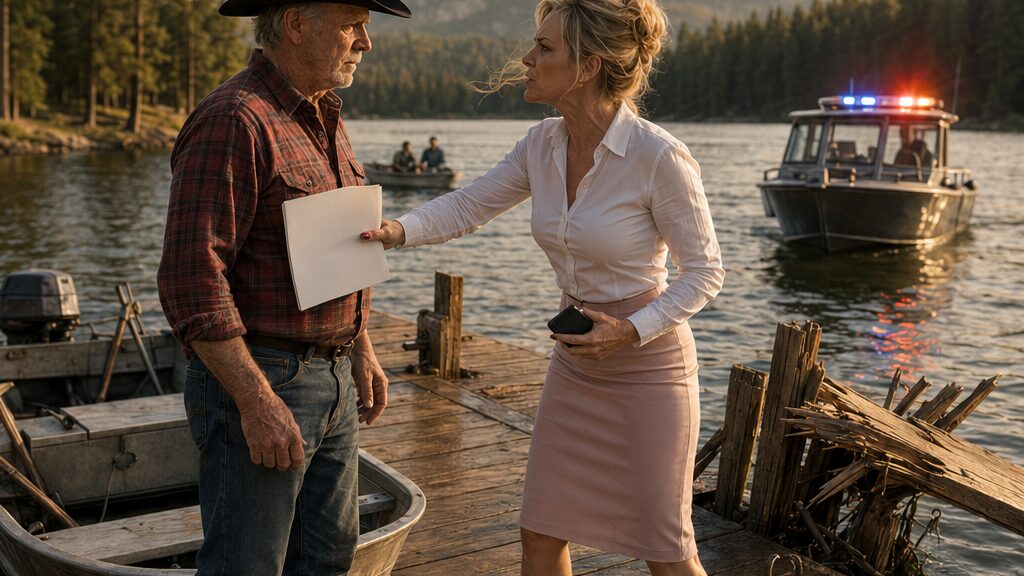
Stephanie Carter came down Patrick Walker’s dock holding a white folder like it was a court order.
“You need to sign this before the sheriff gets here,” she said.
Patrick had one boot on the lower plank and one hand wrapped around the frayed bowline of his old fishing boat. The line was wet from where it had slapped against the cleat in the afternoon wind. Behind Stephanie, the lake lay flat and gold under the late sun, gentle enough to make her voice sound even sharper.
He looked at the folder first, not at her face.
The top page was clipped straight and clean. Dennis Mitchell’s Dock and Shoreline Repair was printed across the header. Beneath it, in bold numbers, was the estimate.
$14,870.
Patrick took the folder because she pushed it toward his chest, not because he wanted it.
“What is this?” he asked.
Stephanie’s mouth tightened. Her blonde hair had been pinned neatly when she started down the path from her cabin, but the lake breeze had pulled strands loose around her temples. She wore a white blouse and a pale pink skirt that looked too careful for uneven dock boards. Her shoes clicked once, then stopped at the gap where Patrick had not replaced a warped plank.
“You know what it is,” she said. “Your boat line ripped my corner piling loose. Dennis says the whole end has to be reset before it takes part of the shared walkway with it.”
Patrick turned slightly and looked past her.
The corner of Stephanie’s dock, across the narrow cove, sagged toward the water. One outer piling had twisted enough to leave the railing slanted. A wedge of broken wood floated against the reeds. From this angle, a person could make a simple story out of it: his dock, his boat, his line, her broken corner.
Simple stories were dangerous when people were in a hurry.
“My boat wasn’t tied to your dock,” Patrick said.
Stephanie laughed once, not because anything was funny. “It didn’t have to be tied to my dock. It pulled from your side. Dennis measured it.”
Patrick opened the folder. The estimate was dated that morning. Beneath the cost breakdown was a second page with a signature line. Neighboring Owner Statement of Responsibility.
His name had been typed under the blank.
He looked up. “Who typed my name?”
“The association needed the form ready.”
“The association didn’t ask me anything.”
“They sent you a notice last month.”
Patrick’s fingers paused on the paper.
Stephanie saw the pause and stepped into it. “You ignored it. That doesn’t make this go away.”
A memory touched the back of his mind: an envelope from the lake association tucked under a grocery ad, then moved to the small basket beside the door. Rachel would have opened it at the table. Rachel would have written the date on the corner. Patrick had seen the logo and thought it was another shoreline reminder, another weed notice, another polite warning about boats left too close to common access.
He had not opened it.
That silence now sat between them like something he had confessed.
“I’m not signing this,” he said.
Stephanie’s face changed. Not surprise exactly. Satisfaction, almost. As if she had expected the refusal and had brought the next step with her.
“You don’t get to just stand here and act calm,” she said. “My insurance needs this statement before the claim moves. If you refuse, this becomes a formal dispute.”
“Then it becomes a formal dispute.”
“You really want that?”
“No,” Patrick said. “But I’m not signing something untrue.”
She looked past him toward his cabin. The old brown siding. The porch chair with one arm patched in a different wood. The boat whose paint had gone dull at the bow. He knew what she saw because he had seen people inventory a person that way before: age, quiet, worn things, no one standing beside him.
Her voice lowered. “Patrick, I don’t think you understand how expensive this can get once insurance starts chasing recovery.”
“I understand bills.”
“Then stop making this harder.”
A pair of boaters had slowed near the mouth of the cove. Patrick saw them pretending not to watch. Sound carried over water better than people remembered.
He looked again at the broken piling, at the way the lower bracket sat crooked against the support. Something small had caught near the split wood below the waterline. A washer, maybe, painted blue around the edge. Not the faded gray hardware he used on his side. Blue. Fresh enough that the paint still held color where the metal showed through.
Stephanie snapped her fingers once, hard enough to pull his eyes back.
“Don’t ignore me.”
“I’m looking at the damage.”
“You should have done that before your boat caused it.”
“My boat didn’t cause it.”
She pulled out her phone.
Patrick folded the estimate closed. “Stephanie.”
“No. I’m done with this.” Her thumb moved over the screen. “You’re refusing to cooperate. You’re standing on shared access, and you’re interfering with an insurance matter.”
“This is my dock.”
“This walkway serves the cove.”
“This section doesn’t.”
She put the phone to her ear and turned her shoulder away from him as if she were already speaking to someone more reasonable.
Patrick felt the old habit rise in him: the steadying of his voice, the straightening of his back, the place near his belt where a badge had once rested. He had spent thirty-one years making people lower their voices beside this lake. He had stopped fights at boat ramps, pulled drunk men out of coves, told wealthy weekenders and local boys the same thing: step back, tell the truth, don’t make it worse.
But the badge was not on his belt now.
His retired identification sat in a drawer beneath old fishing licenses. He could mention it. Stephanie knew, vaguely. Most people did. A few words from him would shift the shape of the scene. The boaters would stop pretending. The deputy who arrived might stand differently.
Patrick kept his hand on the white folder instead.
Stephanie’s voice sharpened into the phone. “Yes, I’m at Cedar Point Cove. I have a property owner refusing to leave shared access and refusing to provide information for damage he caused.”
Patrick watched a ripple move out from the broken dock corner. The blue washer knocked softly against the piling with each small lift of water.
He stepped back from Stephanie, not away from the accusation but away from the performance of it. “Tell them there’s no threat.”
She covered the phone. “Don’t tell me what to say.”
“Then say it because it’s true.”
Her eyes flashed. “You don’t get to decide what’s true just because you say it quietly.”
The line landed harder than she knew.
For a moment, Patrick saw Rachel at the kitchen table, tapping a pen against a folder, telling him that memory was not the same as proof. He had teased her for saving every dock receipt, every association notice, every photograph of repairs that nobody would ever ask about.
Nobody asks until they do, she had said.
A siren did not come. Out here, trouble came with an engine across water.
The sheriff’s marine boat rounded the far pine point six minutes later, lights pulsing red and blue against the gold surface of the lake. The boaters near the cove finally stopped pretending and drifted sideways. A cabin door opened somewhere up the hill. Stephanie stood taller.
Patrick stayed where he was.
The boat came in slow, throwing a clean wake against both docks. Scott Ramirez stood at the console, one hand on the rail, his face unreadable behind sunglasses. A younger deputy sat forward with the bow line ready.
Scott cut the engine and looked first at Stephanie, then at Patrick.
“Evening,” he said. “What’s going on?”
Stephanie stepped forward before the boat touched the dock. “Thank you for coming. He’s refusing to cooperate with a property damage claim, and he’s standing on shared access while I’m trying to resolve it.”
Scott’s gaze moved to the white folder in Patrick’s hand.
Patrick could see the recognition flicker. Not the warm kind. The complicated kind. Scott had been a junior deputy when Patrick retired. He knew Patrick had worn the uniform. He also knew this was not the moment to act as if that settled anything.
“No one’s been threatened?” Scott asked.
“No,” Patrick said.
Stephanie spoke over him. “He’s obstructing the process.”
“That’s civil,” Scott said carefully. “Not criminal.”
“He caused nearly fifteen thousand dollars in damage.”
Patrick held out the folder. Scott did not take it.
“Did you cause the damage?” Scott asked.
“No.”
Stephanie’s laugh came quick and brittle. “Of course he says that.”
Patrick looked at Scott, then at the broken dock, then at the blue washer almost hidden below the split. “I asked for a second inspection.”
“You don’t need one,” Stephanie said.
Scott leaned slightly to see past Patrick toward the damaged corner. “That might be wise.”
Stephanie’s jaw tightened. She had expected the boat lights to press Patrick backward. Instead, they only made the cove brighter.
Her hand went into her purse. She pulled out another sheet, folded in thirds, and shook it open.
“It’s already beyond a neighbor discussion,” she said. “The insurance claim names him. The association has him listed as the responsible neighboring owner.”
Scott looked at Patrick again.
Patrick felt the folder’s edge bend under his thumb.
The lake was calm. The broken washer tapped once against the piling. And the white paper in Stephanie’s hand made his refusal feel, for the first time, late.
Chapter 2: The Photograph Under the Coffee Mug
Angela Rivera read the number twice, then set the estimate down like it might stain the kitchen table.
“Dad,” she said, “this is almost fifteen thousand dollars.”
Patrick stood at the sink with his hands braced against the counter. Through the dark window over the basin, he could see the faint reflection of the white folder lying open beneath the yellow light. It looked bigger indoors. More official. More patient.
Angela had driven up from town after Stephanie’s call had reached half the cove before sunset ended. She still had her work badge clipped to her blouse, and her hair was pulled back in the rushed way she wore it when she had left somewhere without finishing what she came to do.
“How much of your savings would this take?” she asked.
“I’m not paying it.”
“That’s not what I asked.”
Patrick turned from the sink. “More than it should.”
Angela closed her eyes for a second. When she opened them, she was looking at him the way she had looked at him after Rachel died: not like a child seeking an answer, but like an adult measuring how much of the truth he would admit before she had to drag it out.
“Your homeowners insurance?” she asked.
“I haven’t called.”
“Dad.”
“It happened this afternoon.”
“No, Stephanie says there was a notice last month.”
Patrick dried his hands on a dish towel that was already dry. “There was an envelope.”
Angela waited.
“I thought it was about shoreline brush.”
“You didn’t open it?”
“No.”
She leaned back in the chair. The legs scraped against the floor, loud in the small kitchen. On the wall behind her, Rachel’s old calendar still hung beside the phone, though Patrick had stopped turning the pages in March. The picture above the month showed a red canoe on a lake neither of them had visited.
Angela looked at it, then at him. “Mom would have opened it.”
“I know.”
The sentence was so plain that it took some of the anger out of the room.
Patrick picked up the white folder and flipped past the estimate to the statement with his name typed under the signature line. He had seen worse documents. Search warrants with wrong addresses. Incident reports that cleaned up messy scenes into neat paragraphs. Complaints written by people who knew exactly which details to leave out. Paper did not become truth because someone typed it carefully.
But paper, left unanswered, hardened.
Angela pulled the folder toward her. “What if it costs more to fight it than to settle?”
“That’s how they want me to think.”
“Or that’s just how it works.” Her voice cracked, and she pressed her fingers to her mouth, annoyed with herself for letting it show. “You’re alone up here most of the week. Stephanie is treasurer. Jonathan likes everything tidy. Dennis works on half the docks around this lake. If they all decide the story before you answer, you don’t get to just out-stubborn them.”
Patrick wanted to tell her that stubbornness had kept worse things from breaking. Instead, he looked at the basket by the side door.
The unopened association envelope was still there under a seed catalog and a takeout menu from town.
Angela saw his eyes move. She stood, crossed the kitchen, and pulled it free.
The envelope had been opened by humidity at one corner but not by him. She slid the paper out and read quickly. Her expression tightened.
“It says there were concerns about stress at Stephanie’s outer dock corner. It asks neighboring owners to report any recent impact, unusual tie-offs, or repairs affecting shared access.” She looked up. “Dad, this was dated five weeks ago.”
“I didn’t hit her dock.”
“I believe you.”
“Doesn’t sound like it.”
“I believe you didn’t hit it. I don’t believe ignoring letters makes people trust you.”
He took that because it was true.
Angela sat again, softer this time. “Do you have anything? Photos, receipts, anything showing your boat wasn’t involved?”
Patrick almost said no. Then he heard Rachel’s pen tapping inside memory.
He went to the narrow closet beside the pantry. The top shelf held old flashlight batteries, a cracked thermos, three extension cords, and a green metal box where Rachel had kept Christmas stamps. Beneath it was a cardboard file holder with faded marker on the side.
LAKE — DOCK / ASSOCIATION / REPAIRS.
Rachel’s handwriting leaned to the right, firm and clean.
Patrick stood with his hand on the box longer than he meant to.
Angela came up beside him but did not touch it. “Dad?”
“She kept everything.”
“I know.”
“No, I mean everything. Receipts for bolts I returned. Photos of boards before I replaced them. Notes from meetings neither of us wanted to attend.” He let out a breath that was almost a laugh. “I told her once the lake didn’t need a historian.”
Angela smiled a little. “What did she say?”
“She said every place does once money gets involved.”
He carried the holder to the table.
Inside were folders labeled by year. Rachel had clipped photographs to receipts with paper clips that had left rust marks on the edges. Patrick opened one from the previous fall. There were pictures of his dock after he had replaced the third plank from the end. A close-up of the cleat. A shot across the cove, with Stephanie’s dock in the background.
Angela pulled the photo closer.
“Wait,” she said.
Patrick reached for his reading glasses.
The photograph had been taken from their side of the cove. In the background, beyond Patrick’s boat cover and the railing, Stephanie’s outer dock corner leaned slightly. Not broken. Not dangerous yet. But the railing line had a subtle dip, and one support showed a dark vertical streak where water had run down the wood.
Angela slid her coffee mug onto the corner of the picture to hold it flat. “What’s the date?”
Patrick turned the photo over.
Rachel had written in blue ink: October 18 — after replacing bow cleat.
Angela looked from the photograph to the white estimate. “That’s months before Stephanie says your boat damaged it.”
“It shows stress,” Patrick said. “Not the break.”
“But it shows it wasn’t perfect.”
Patrick nodded, but he did not let himself feel relief. A partial truth could be worse than no truth if someone used it to say he had noticed damage and failed to report it.
Angela kept digging. “Here. Another one.”
This photo was from early spring. Rachel had taken it from the porch, probably because a heron stood on Patrick’s dock. Stephanie’s dock corner appeared again in the distance. The railing sag was clearer.
“Dad,” Angela said, “you saw this?”
“I saw the dock. Not like this.”
“Did you ever mention it?”
“To Stephanie? No.”
“Why not?”
“It wasn’t my dock.”
“But now they’re saying your side caused it.”
Patrick took off his glasses and rubbed the bridge of his nose. His answer sounded thin before he gave it. “People don’t like being told their property needs work.”
Angela’s voice lowered. “Or you didn’t want a conversation.”
He looked at her.
She did not back down. “You do this. You wait. You think if you don’t make trouble, trouble won’t count you in.”
Outside, a boat motor moved somewhere beyond the dark trees, then faded. Patrick looked down at Rachel’s handwriting. October 18. After replacing bow cleat. A small note made months before anyone needed it.
He set the photograph beside the repair estimate. The old image made the new paper look less certain, but not harmless.
Angela touched the signature line on the responsibility statement. “Promise me you won’t sign anything until we know what they filed.”
“I wasn’t going to.”
“I mean anything. No recorded statement where they lead you into saying something. No polite ‘maybe.’ No trying to calm everyone down.”
Patrick thought of Scott’s boat lights on the water, of Stephanie telling him the claim already had his name. He thought of all the times he had stayed silent because silence looked steady from the outside.
“I promise,” he said.
At seven the next morning, while Angela was making coffee and Patrick was clipping Rachel’s October photograph behind the estimate, a truck slowed on the gravel road above the cabin.
A delivery driver walked down the porch steps with a stiff white envelope and a small handheld scanner.
Patrick signed for it before he saw the return address.
The envelope came from Katherine Smith, Claims Adjuster.
Chapter 3: The Contractor Measured From the Wrong Side
“The angle points to your side,” Dennis Mitchell said before Patrick had both boots on the dock.
He said it loudly enough for Stephanie to hear from the walkway and calmly enough to sound like he was explaining gravity. A yellow measuring tape stretched from the broken corner of her dock toward the water between the two properties. Dennis held one end against the twisted piling while his assistant, unnamed and silent, stood on Patrick’s lower plank with the other end.
Patrick stopped at the edge of his own dock. “You asked permission to stand there?”
Dennis glanced at the assistant. The man stepped back at once.
Stephanie folded her arms. “We’re measuring the damage, Patrick. Don’t make this about manners.”
“It is about manners when someone comes onto my dock.”
Dennis gave a small smile, the kind men used when they wanted to look reasonable in front of an audience. He was broad-shouldered, sunburned at the neck, with a contractor’s pencil tucked behind one ear and a clipboard against his hip. His work shirt had his company name stitched over the pocket. Everything about him looked prepared to be believed.
“I’m happy to explain what I’m seeing,” Dennis said. “The load line runs from your cleat toward this failed corner. That means repeated tension from this direction.”
Patrick looked at the tape, then at his cleat. The path Dennis had chosen was clean and convincing. Too clean. It ignored the way the cove pulled sideways when the west wind came down the mountain. It ignored the storm surge that had lifted half the floating docks in June. It ignored the old dark streak Patrick had seen in Rachel’s photographs.
And it ignored the blue washer.
The washer sat just below the waterline, wedged where the broken bracket had twisted. From above, it was easy to miss unless you already knew where to look. Dennis had planted one boot close to it without looking down.
Patrick stepped closer.
Dennis moved with him, not blocking exactly, but adjusting his body so the clipboard hung between Patrick and the damaged piling.
“You don’t need to get under there,” Dennis said. “It’s unstable.”
“I’m looking.”
“I already looked.”
“That’s why I’m looking.”
Stephanie made a sharp sound. “Do you hear yourself? This is exactly why I called Scott yesterday. You act like everyone else is incompetent.”
Patrick looked at her then. Her anger today had less heat and more strain. There were faint shadows beneath her eyes. The white folder was tucked under her arm, corners slightly bent now. She had not slept much either.
“I didn’t say incompetent,” Patrick said.
“You implied it.”
Dennis crouched and tapped the piling with the flat of his pencil. “This corner failed because it was pulled out of square. If it had been simple age or water damage, you’d see rot distributed along the support. Instead, the stress is concentrated here.”
He tapped the same spot again. Tap. Tap. Tap.
A few residents had wandered down from the gravel road, pretending to check boats or mailboxes. Jonathan Davis stood near the top of the steps in a pale blue shirt, phone in one hand, lake association authority worn like a pressed collar.
Patrick picked up the estimate from the dock box where Angela had left it sealed in a plastic sleeve. He had brought Rachel’s photographs too, but they stayed in the folder.
“When did Stephanie call you?” he asked Dennis.
Dennis blinked. “After the damage was discovered.”
“That wasn’t my question.”
Stephanie shifted. Jonathan looked up from his phone.
Dennis straightened. “Last week.”
“The estimate is dated yesterday.”
“That’s when I finalized it.”
“When did you first inspect?”
Dennis’s smile thinned. “I don’t keep every conversation in my head.”
“You wrote a fourteen-thousand-dollar estimate without knowing when you inspected?”
“I said I don’t keep every conversation in my head. I have notes at the office.”
Patrick nodded as if that answer settled something. It did not. It only told him where the floor might give.
Jonathan came down the steps then, careful with his loafers on the damp planks. “Patrick, we all want this handled cleanly.”
“Then let’s handle it cleanly. Get a second inspection.”
Stephanie shook her head. “That delays the claim.”
“It checks the claim.”
“It delays it,” she repeated.
Jonathan lifted one hand between them. “The association’s concern is shared access. If this failure spreads to the common walkway, we have liability exposure. Stephanie has submitted a contractor’s assessment. You have disputed it. That’s your right.”
Patrick heard the word before Jonathan reached it.
“But?” he said.
Jonathan’s mouth tightened. “But if you continue refusing to provide documentation or cooperate with the process, the board will have to treat that as non-cooperation.”
Patrick looked at him for a long moment. “You mean silence.”
“I mean failure to respond.”
“I responded yesterday.”
“After emergency services were called.”
Stephanie’s face colored. “Because you refused to sign and wouldn’t leave the area.”
“My area.”
“The area connected to the damage.”
Dennis cleared his throat and flipped a page on his clipboard. “From a repair standpoint, delay isn’t neutral. If we get another wind event, this can tear further. Then everyone pays more.”
The sentence was for Jonathan. Patrick could see it land. Shared cost was the association’s deepest fear.
Patrick crouched slowly, knees stiff, and looked beneath the tilted railing. The blue washer flashed dull in the water. He could see paint rubbed from one edge, but not rust. Newer than the bracket around it. Newer than the dark weathered bolts on Patrick’s dock.
“Dennis,” he said, “what color hardware do you use on shoreline brackets?”
Dennis did not answer at once.
Stephanie looked between them. “What?”
“Hardware,” Patrick said. “Do you paint-code it?”
Dennis let out a short laugh. “Sometimes suppliers coat parts. Depends on what’s in stock.”
“This washer looks blue.”
“Lots of things look blue underwater.”
“Then you won’t mind including it in the inspection photos.”
Dennis’s jaw moved.
He lifted his phone and took a picture, but from above, at an angle that caught broken wood and shadow, not the washer. Patrick watched him do it. He did not correct him. Not yet.
Angela had wanted him to come down here swinging Rachel’s photographs like a shield. He had almost done it. But something about the way Dennis avoided that small circle of metal told Patrick the photographs were only the beginning, not the answer.
Jonathan slipped his phone into his pocket. “Patrick, I need something from you in writing by tomorrow. A statement, photos, whatever you believe contradicts this. Otherwise the board proceeds with what it has.”
“And what does it have?”
Jonathan glanced at Stephanie, then Dennis. “A contractor’s estimate, a reported timeline, and your lack of response to the first notice.”
There it was again. His unopened envelope, standing on their side of the dock like a witness against him.
Patrick picked up the white folder. It had Stephanie’s estimate in one side now and Rachel’s first photograph hidden in the other. Between them was the shape of a truth he had not yet earned.
“I’ll give you something in writing,” he said.
Stephanie exhaled hard, as if she had won a concession.
Patrick turned to leave, but Dennis’s voice stopped him.
“Just make sure it’s accurate.”
Patrick looked back.
Dennis’s face stayed neutral. But his thumb pressed against the metal clip of his board hard enough to whiten.
Patrick walked up the dock without answering.
Halfway to his porch, he stopped near the cedar trunks where sound from the water carried strangely. He did not mean to listen. Then Dennis’s voice came low and quick behind him.
“If he asks for another inspection,” Dennis told Stephanie, “this gets worse for all of us.”
Chapter 4: The Claim That Named Him First
The insurance letter did not ask whether Patrick had damaged Stephanie’s dock.
It said he had been identified as the neighboring party responsible for impact damage.
Patrick read that sentence three times at the kitchen table while Angela stood behind his chair, one hand on the backrest, both of them quiet enough to hear the refrigerator click on. The white envelope lay open beside Rachel’s folder. Katherine Smith’s name appeared at the top of the letter, under the insurance company logo, followed by a claim number and a phrase Patrick did not like: potential recovery action.
Angela reached past him and tapped the second paragraph. “They’re asking for a recorded statement.”
Patrick folded the letter along its original crease. “They can ask.”
“Dad.”
“I’m not giving them a recording they can cut into pieces.”
“You don’t know that’s what they’ll do.”
“I know what happens when a person talks before they know what’s been written about them.”
Angela pulled out the chair across from him and sat. “Then call and ask.”
So he did.
Katherine’s office answered with hold music first, then a receptionist, then another silence long enough for Patrick to watch a squirrel cross the porch rail and disappear into the cedar. When Katherine Smith finally came on the line, her voice was crisp, courteous, and already moving.
“Mr. Walker, thank you for returning the call. I’m hoping we can clarify a few details today and avoid escalation between property owners.”
Patrick put the phone on speaker. Angela opened a notebook.
“What details?” Patrick asked.
“Primarily your vessel’s position, the tie-off point, and your statement at the scene indicating possible responsibility.”
Angela’s pen stopped.
Patrick looked at the phone. “What statement?”
There was a pause so small it might have been mistaken for paperwork shifting. “The claimant noted that you acknowledged you had seen the damage and did not dispute involvement at the time of initial contact.”
“That’s not what happened.”
“I understand you may have additional context.”
“No,” Patrick said. “That is not context. That is false.”
Angela looked at him sharply, but he kept his voice level.
Katherine’s tone cooled by one degree. “Mr. Walker, I’m not making a determination on this call. I’m documenting positions. The claimant provided a contractor estimate, association notice history, and an account that you declined to provide information when approached.”
“I declined to sign a statement saying I caused damage.”
“And did you tell Ms. Carter you had observed deterioration before the reported incident?”
Patrick’s eyes moved to Rachel’s photographs.
Angela mouthed, Careful.
“I saw old stress in photographs afterward,” Patrick said. “I didn’t inspect her dock before.”
“But you were aware of possible preexisting conditions?”
“I became aware when I looked at dated photos my wife kept.”
“I’m going to note that.”
“Note it accurately.”
Another pause.
Katherine said, “That is why a recorded statement would help.”
“No recorded statement today.”
“Then please understand that the claim will proceed based on available documentation unless you submit contrary documentation. Photographs, repair records, weather records, any correspondence. You have five business days.”
Angela wrote five days and underlined it twice.
Patrick said, “The estimate is dated before I was asked to respond.”
“That may or may not be material.”
“It is material if the conclusion came before the inspection.”
“I can review any evidence you provide.”
He almost said what he had said hundreds of times on docks and ramps when someone tried to make a story outrun the facts: slow down. But Katherine was not standing on wet planks where his voice meant anything. She was somewhere behind a file, and the file already had his name typed in the wrong place.
“I’ll send documentation,” he said.
“Please do. And Mr. Walker?”
“Yes.”
“If you choose not to provide a statement, do not assume silence protects you. In claim review, an unanswered assertion often remains the only assertion.”
After the call ended, Angela did not speak right away. She turned the notebook around so he could read what she had written beneath the deadline.
Silence becomes their version.
Patrick leaned back.
“That’s what she said without saying it,” Angela said.
“I heard.”
“Did you?”
He looked at her then, and there was no anger in her face. That was worse. Worry had a way of making adult children look older than their parents.
Angela opened her laptop and began searching through insurance policy language while Patrick spread the papers across the table. The white estimate. The responsibility statement. The association notice he had failed to open. Rachel’s October photograph. The spring heron photograph. Katherine’s letter.
Pieces. Not proof.
Angela clicked through several pages, then went still. “Dad.”
He knew from her voice before she read it.
“If your carrier receives a liability claim and determines you failed to cooperate or gave an inconsistent statement, it can affect coverage. It says they can reserve rights. I don’t know what that means exactly, but it sounds bad.”
Patrick took off his glasses. “It means they keep the option to say no.”
Angela looked at the white folder. “So if Stephanie’s insurance pushes this and yours gets nervous, this can become more than her bill.”
“Yes.”
“How much more?”
“More than fifteen.”
The kitchen seemed to shrink around the table.
Outside, late afternoon light hit the lake through the cedars, broken into narrow strips. Patrick could see the top of Stephanie’s dock from the side window. Dennis had left orange marking tape fluttering from the tilted railing. It had the look of an official wound.
Angela closed the laptop halfway. “I need you to promise me something else.”
“I already promised not to sign.”
“Promise me you won’t just put these papers in Mom’s folder and wait for the truth to make itself obvious.”
Patrick did not answer fast enough.
Her eyes softened, but her voice did not. “That’s what got you here.”
He picked up the unopened association notice. The flap, torn now, hung loose where Angela had opened it. For weeks, the envelope had sat six feet from where he ate breakfast. He had chosen not to know what it said because knowing meant calling someone, objecting, making a record, sounding difficult.
Rachel would have opened it.
Rachel would have written a date on it.
Rachel would not have let silence become somebody else’s evidence.
Patrick reached for a yellow legal pad and wrote the claim number at the top. Beneath it, he wrote: No recorded statement until documents submitted. Request second inspection. Request association file. Request Dennis notes.
His handwriting looked heavier than Rachel’s, less sure.
Angela’s phone buzzed. She glanced at it and frowned. “The association sent an email.”
“To you?”
“No. Neighborhood list.” She turned the screen toward him.
Jonathan Davis had written that there was an unresolved dock damage matter involving shared access and that owners should avoid the affected area until further notice. He did not use Patrick’s name. He did not need to. Everyone in the cove had seen the sheriff boat.
Patrick set the phone down.
The house phone rang before Angela could speak.
Patrick almost let it go. Then he saw the marina number on the caller ID.
He picked up.
For a second, there was only static and a breath.
“Patrick?” Margaret Sanchez said. Her voice was low, as if the marina walls had ears. “I heard what they’re saying. I don’t want to get mixed up in this, but I think I saw Dennis’s truck at Stephanie’s dock before that storm. Early. Before dawn, maybe. I didn’t file anything because it wasn’t my business.”
Patrick straightened.
Margaret lowered her voice further.
“But if he’s saying he only came after the damage, that’s not how I remember it.”
Chapter 5: What the Lake Folder Did Not Explain
Margaret Sanchez would not say Dennis’s name above a whisper until Patrick closed the marina office door.
Even then, she looked through the small window toward the fuel dock before she spoke. “I’m not accusing anybody. I’m telling you what I saw, and what I saw might not mean what you think it means.”
Patrick stood with Rachel’s folder under one arm and Katherine’s letter folded in his shirt pocket. The marina office smelled of coffee, lake gas, and damp rope. Behind Margaret, a bulletin board held fishing contest flyers, association notices, and a faded photograph of Cedar Point Cove from years before the new cabins went up.
“What did you see?” he asked.
Margaret rubbed her thumb along the edge of the counter. “Dennis’s truck. Parked at Stephanie’s place before sunrise. This was before that big rain in June. I remember because the county had sent out the high-water warning the day before, and I came in early to move rental kayaks.”
“Did you see him working?”
“I saw lights. His truck. Maybe another person. I didn’t walk over.”
“Did Stephanie know?”
Margaret gave him a tired look. “It was her dock.”
Patrick let that settle.
Outside, someone dropped a metal fuel nozzle, and the clang made Margaret flinch. She turned toward the window again.
“I need this in writing,” Patrick said.
Her face closed. “Patrick.”
“I’m not asking you to guess. Just what you saw.”
“You know how this lake works. Stephanie is treasurer. Jonathan buys fuel here for association boats. Dennis sends people here for supplies. I start putting my name on statements, I get dragged into every dock fight until Christmas.”
“I know.”
“And you still ask?”
“Yes.”
She looked away.
Patrick did not blame her for the fear. The lake was beautiful from a distance. Up close, it ran on favors, memories, grudges, who plowed whose road in January, who looked the other way when a dock extended six inches too far. Truth did not arrive clean here. It arrived with a cost attached.
He opened Rachel’s folder and placed the October photograph on the counter.
Margaret adjusted her glasses. Her expression changed before she touched the photo.
“That corner was already leaning,” she said.
“That’s what I see.”
“Rachel took this?”
Patrick nodded.
Margaret’s fingers hovered near Rachel’s handwriting on the back, but she did not touch it. “She always dated things.”
“She said places need historians once money gets involved.”
Margaret smiled sadly. “She was right about most things that annoyed people.”
Patrick slipped the photograph back into its sleeve. “The photos show stress. They don’t show what happened before the break. Katherine needs more.”
“The county warning might help.”
“I was going there next.”
Margaret opened a drawer, then shut it without taking anything out. “Ask for the shoreline advisory from June tenth and the lake level report from the eleventh. If they give you trouble, tell them it was posted to public safety notices.”
Patrick studied her. “You remember the dates.”
“I remember moving kayaks in the dark while Dennis Mitchell’s truck was parked where it shouldn’t have needed to be if nothing was wrong yet.”
“Will you write that?”
Margaret’s mouth tightened. “Let me think.”
“Margaret—”
“Let me think, Patrick. That’s all I can give you before lunch.”
It was more than he had when he walked in.
At the county records counter, the clerk made him fill out a request form on a clipboard with a pen attached by a chain. Patrick wrote slowly, resisting the old impatience that came whenever bureaucracy made simple things feel like surrender. He requested shoreline advisories for June tenth and lake level reports for June eleventh. He also asked for any posted storm-related dock warnings for Cedar Point Cove.
The clerk glanced at Rachel’s folder. “Property dispute?”
“Something like that.”
“Everybody wants old records after something breaks.”
Patrick almost said the record was only old because people ignored it when it was new. Instead, he waited.
The clerk returned with printed pages still warm from the machine. The first was a county advisory warning of rapid water rise and wind-driven dock stress along exposed coves. The second listed lake levels by date and time. The third included a note: residents advised to inspect pilings, brackets, and floating connections before additional weekend wind.
June tenth.
Three days before Stephanie’s claim said Patrick’s boat line caused sudden impact damage.
Patrick laid the county pages on the counter and placed Rachel’s spring photograph beside them. The story shifted. Not finished, but shifted. The lake itself had been pulling at every weak corner before his boat ever sat where Stephanie claimed it mattered.
He should have felt relief.
Instead, he saw the gap.
The county warning could explain why an old corner failed. Rachel’s photographs could show it had been failing. Margaret’s memory could place Dennis near Stephanie’s dock before the storm. None of it proved what Dennis did there.
By the time Patrick returned to the marina, Margaret was restocking a shelf of lake maps. She did not look surprised to see him.
“The county record helps,” he said.
“But not enough.”
“No.”
She slid a laminated map into place. “I didn’t see his hands on the dock.”
“I know.”
“I saw his truck. Lights. Early morning. That’s all.”
“That may matter.”
“It may also make Stephanie think I’m calling her a liar.”
Patrick looked through the window toward the cove. From the marina, the cabins appeared harmless, tucked into trees, each with its clean little path to the water. He wondered how many disputes were hiding behind white curtains and fresh stain.
“I’m not asking you to call her a liar,” he said. “I’m asking you not to let them call me one because no one wants discomfort.”
Margaret looked at him then.
For the first time since he entered, she seemed less afraid of Stephanie and more aware of him. Not the old deputy. Not Rachel’s widower. A man standing in a small office with a folder that was still missing one piece.
“I’ll write what I saw,” she said. “Only what I saw.”
“That’s enough.”
“It may not be.”
“Then I’ll keep looking.”
At home, Angela spread the new pages across the kitchen table. The white folder no longer closed flat. It held the repair estimate, Stephanie’s responsibility statement, the association notice, Katherine’s letter, Rachel’s photographs, and the county reports clipped behind them. It looked less like a weapon now and more like a burden with corners.
Angela read the advisory twice. “This is good.”
“It’s incomplete.”
“It shows the timeline they gave insurance is wrong.”
“It shows their timeline is too simple.”
“That matters.”
“Yes.” Patrick tapped the blank space on his legal pad where Dennis’s prior work should have been. “But if I can’t place Dennis on that dock doing repair work, he’ll say he inspected, warned her, and came back after the break.”
Angela looked toward the window. Stephanie’s orange tape still fluttered across the cove.
“Would Stephanie have records?”
“Maybe.”
“Would she give them to you?”
Patrick almost smiled. “No.”
The house phone rang.
Angela reached it first, listened for a moment, and held it out. “Jonathan.”
Patrick took it.
Jonathan’s voice was formal enough to have witnesses nearby. “Patrick, the board is scheduling an emergency meeting Friday evening regarding the Cedar Point dock damage and shared access exposure. Given the documentation submitted by Ms. Carter, your name is on the agenda.”
Patrick looked at the open folder.
“What time?” he asked.
“Six o’clock.”
Jonathan paused, then added, “I suggest you bring anything you want considered. After Friday, the association may have to support the claim as filed.”
Chapter 6: The Meeting Where Silence Became Evidence
Jonathan Davis read Patrick’s name aloud beside the words responsible neighboring owner, and half the room turned to look at him before the sentence was finished.
Patrick sat in the second row of the lake association hall with Rachel’s folder across his knees. Angela sat beside him, hands folded tightly around her phone. The room smelled of coffee, floor polish, and wet jackets. Folding chairs had been set in rows facing a long table where Jonathan sat with Stephanie on one side and Dennis on the other.
The white repair estimate folder lay in front of Stephanie.
Patrick’s folder was older, thicker, and frayed at the spine.
Jonathan adjusted his glasses. “This meeting concerns damage to the Carter dock corner and potential impact on shared access at Cedar Point Cove. Ms. Carter has submitted a contractor assessment, an insurance claim number, and a request that the association recognize neighboring owner responsibility pending resolution.”
“Pending resolution,” Angela muttered.
Patrick placed one hand on the folder to keep her still.
Stephanie did not look back at him. She wore a navy jacket tonight, not pink, and her hair was pinned so tightly it pulled at the corners of her face. Up close, from the side, Patrick could see exhaustion beneath the polish.
Jonathan invited Dennis to explain.
Dennis stood with a rolled diagram in one hand. He spread it across the front table and weighted the corners with a stapler and a coffee mug. The drawing showed the cove from above: Patrick’s dock, Stephanie’s dock, the narrow channel between them. A red line ran from Patrick’s cleat toward Stephanie’s damaged piling.
“Repeated tension from this angle,” Dennis said, tapping the red line, “is consistent with the bracket failure we observed. The damage is not consistent with general aging alone.”
A man in the back row whispered, “That looks pretty clear.”
Dennis heard it and continued with more confidence. “The claimant’s dock did show normal exposure, as all docks do. But the failure point corresponds to external pull. Given the location of Mr. Walker’s boat and the documented lack of response to association concerns, the responsibility is, in my opinion, reasonably assigned.”
Patrick felt Angela turn toward him.
He did not move.
There was a version of himself that could have stood then and changed the air with three sentences. Thirty-one years on marine patrol. Hundreds of dock failures seen. More accident reports than Dennis had estimates. Scott Ramirez would confirm it if asked. The old authority sat under Patrick’s skin like a tool he still knew how to use.
But if he used it now, Stephanie would say he intimidated the room. Dennis would say he was relying on reputation instead of facts. Jonathan would look relieved to turn one kind of mess into another.
Patrick opened Rachel’s folder.
Jonathan looked down at him. “Mr. Walker, you’ll have a chance to respond after—”
“I’m responding to the diagram,” Patrick said.
The room quieted.
He rose slowly, knees stiff from the hard chair, and carried two photographs to the front. He did not look at Stephanie. If he did, he might say too much.
“These were taken by my wife,” he said. “Both dated. October eighteenth last year. April second this year.”
Dennis folded his arms.
Patrick placed the October photograph beside the diagram. “That’s Stephanie’s outer corner in the background. You can see the railing dip and the dark streak along the support.”
Jonathan leaned forward.
Patrick placed the spring photograph beside it. “This one shows the same corner before my boat was tied in the position Dennis drew. The sag is worse.”
Stephanie spoke for the first time. “A sag is not a failure.”
“No,” Patrick said. “It isn’t. But it is not sudden impact damage from last week.”
Dennis stepped closer, smiling too quickly. “Preexisting wear doesn’t exclude external force.”
“I didn’t say it did.”
“Then it doesn’t change my conclusion.”
“It changes the date.”
That moved through the room. Not loudly. Just enough.
Stephanie’s hands tightened around the edge of the table. “The break happened after your boat was tied there.”
“The break was noticed after my boat was tied there.”
“That’s the same thing when the pull line matches.”
Patrick looked at Dennis. “Only if the line is honest.”
Dennis’s smile disappeared.
Jonathan lifted both hands. “Let’s keep this civil.”
Patrick set the county advisory behind the photographs. “June tenth. County warning for high water and wind-driven dock stress. June eleventh lake level report. Advisories to inspect pilings and brackets before the weekend.”
A woman in the front row asked, “Was that before the reported damage?”
“Yes,” Patrick said.
Stephanie’s voice sharpened. “Every dock on the lake got weather. Mine broke after his boat was tied there.”
Dennis nodded. “Exactly. Weather may weaken. External pull finishes.”
It was a good sentence. Simple. Useful. Patrick could feel the room settle around it because people liked explanations that let them stop thinking.
Angela stood halfway. “But Dennis inspected before—”
Patrick touched her arm.
Not yet.
Jonathan looked uncomfortable now. “Mr. Walker, your documentation suggests possible preexisting conditions. That will be noted.”
“Possible?” Angela said.
Jonathan ignored her. “But the question before the association is not full insurance liability. It is whether we support the filed claim enough to protect shared access and avoid association exposure.”
“There it is,” Patrick said quietly.
Jonathan heard him. “Excuse me?”
“This isn’t about what happened. It’s about closing the file before the association worries it might pay.”
Several faces turned away.
Stephanie stood then, and the strain in her face finally broke through the polish. “You think I want this? My family has had that dock for thirty years. My mother sat on that corner every morning with coffee. I have renters canceling because the walkway is taped off. Insurance is already asking whether the dock was maintained. If they decide it wasn’t, I’m stuck with everything.”
For the first time, Patrick saw the fear plainly.
Then Stephanie pointed at him.
“And you knew there was a problem. Your own photos prove it. You saw my dock leaning and said nothing. Now you want to stand here like the careful one?”
The room shifted again.
Patrick had known that turn was coming. It still hit.
He had seen the lean. Not clearly. Not enough, he had told himself. But enough that Rachel had photographed it. Enough that the folder existed. Enough that silence could be made to look like knowledge.
“I should have opened the association notice,” he said.
Angela looked at him sharply.
Patrick kept his eyes on the table. “I should have answered in writing when concerns were raised. I didn’t. That was a mistake.”
Stephanie’s face flickered, surprised by the admission.
“But I did not cause the damage,” Patrick said. “And I will not sign a statement saying I did.”
Dennis rolled the diagram halfway closed. “Then submit that to insurance. But from a repair standpoint, the evidence still supports external force.”
Jonathan exhaled. “Given what we have tonight, the board cannot dismiss Ms. Carter’s claim.”
Angela’s chair scraped behind Patrick.
Jonathan continued, careful and pale. “We can hold final association support until Monday pending Mr. Walker’s additional documentation. But absent that, we proceed with the current record.”
Patrick gathered Rachel’s photographs. His hands were steady, but not because he felt calm. The old badge in his memory had never felt heavier. He almost wished he had brought the retired identification just to watch Dennis’s face change.
Instead, he slid the photographs back into the folder.
A phone rang at the front table.
Stephanie checked hers. Dennis checked his. Then Patrick realized it was Angela’s phone, vibrating hard against the metal chair. She looked at the screen and held it toward him.
Katherine Smith.
Patrick answered on speaker before he could think better of it.
“Mr. Walker,” Katherine said, “I’m following up before the weekend. Unless we receive your signed statement or contrary documentation by Monday morning, the claim will proceed on the current file.”
The room was silent enough for everyone to hear her next sentence.
“And the current file lists you as the responsible neighboring owner.”
Chapter 7: The Washer That Changed the Timeline
Patrick found the same blue paint on a bin of marine washers before the dock supply store clerk finished asking what size he needed.
The bin sat on the lowest shelf, half-hidden beneath stainless brackets and rubber bumpers, but the color caught his eye at once: a dull blue coating around the outer rim, worn pale where metal showed through. Patrick crouched slowly, knees stiff, and picked one up between his thumb and forefinger.
Angela stood beside him with Rachel’s folder hugged to her chest. “That’s it?”
Patrick turned the washer toward the store’s fluorescent light. “Same color.”
“Could be common.”
“Could be.”
The clerk came around the counter wiping his hands on a rag. “Those are three-eighths coated marine washers. Mostly use them with shoreline brackets. They don’t rust as fast around treated lumber.”
Patrick held the washer flat on his palm. “Do you keep sales records?”
The clerk’s eyes moved from Patrick to Angela, then to the folder. “Depends who’s asking.”
“A customer who needs a receipt date.”
“For your own purchase?”
Patrick looked down at the washer. “For a repair I didn’t authorize.”
That made the clerk stop wiping his hands.
Angela stepped in before the moment hardened. “We’re not asking for anyone’s private billing. We need to know whether these were sold before June thirteenth. A contractor may have used them on a dock that’s now part of an insurance claim.”
The clerk looked toward the back office. “Contractors buy a lot of these.”
“Dennis Mitchell?” Patrick asked.
The clerk said nothing, which was almost an answer.
Patrick placed the washer on the counter. “I don’t need you to tell me what he bought for every job. I need a copy of my own receipt if I bought them. And if I didn’t, I need you to say these aren’t hardware I use.”
“You don’t use coated washers?”
“My side is galvanized. Old stock. Bought before your remodel.”
The clerk glanced toward the door as if Dennis might walk in from the parking lot. “I can print product information. Date we got that batch. Public enough. I can’t hand you Dennis Mitchell’s account.”
Patrick nodded. “Product information helps.”
The clerk disappeared into the back.
Angela exhaled. “You handled that better than I expected.”
“I’m learning.”
She gave him a small look. “From Mom?”
“From being wrong yesterday.”
The admission hung between them, not heavy, but real. Patrick had lain awake after the association meeting with Katherine’s voice replaying through the speakerphone. The current file lists you as responsible. He had thought of every time he had told someone on the lake to make a report while the facts were fresh. Then he had thought of the unopened association notice in his own basket.
The clerk returned with a product sheet and a printed inventory receipt showing the store received that batch on May twenty-eighth. Patrick studied the page. It did not prove Dennis bought them. But it proved blue-coated washers had been available before Stephanie’s claimed date.
Angela slid the paper into the folder. “Now Margaret.”
At the marina, Margaret was not behind the counter.
They found her outside by the rental slips, coiling a wet rope with more force than necessary. She saw the folder and looked toward the office window before Patrick spoke.
“I’m sorry,” she said.
Patrick stopped. “For what?”
“I wrote it.” She pulled a folded page from the pocket of her vest. “I wrote exactly what I saw. Dennis’s truck at Stephanie’s dock before sunrise on June eleventh. Work lights on. One person on the dock. I couldn’t identify the person clearly. That’s all I’ll swear to.”
Patrick took the page carefully.
Angela read over his shoulder, then looked up. “Margaret, this matters.”
“I know it does.” Margaret’s voice tightened. “That’s why I’m scared.”
Patrick folded the statement and tucked it behind the county warning. “Thank you.”
Margaret glanced across the marina toward the far cove. “There’s something else. I didn’t put it in there because I can’t prove it.”
Patrick waited.
“The next day, Stephanie came in for coffee. She said Dennis told her the corner would hold if the weather settled. She was upset, not angry. Worried about renters. She said she couldn’t afford a full rebuild before July bookings.”
Angela looked at Patrick.
Margaret shook her head. “I’m not saying she planned any of this then. I’m saying she knew there was trouble before she blamed your boat.”
Patrick felt the old anger try to rise, but it did not find the clean path it wanted. Stephanie had known. Maybe not enough. Maybe too much. Fear could make people arrange facts until they pointed away from themselves.
“Did she say Dennis repaired it?” Patrick asked.
“She said he ‘tightened the bracket.’ Those were her words.”
Patrick closed his eyes for one second.
The washer in the folder seemed heavier.
Back at his dock, he did what he should have done the first day. He took photographs from every angle. The blue washer below the broken piling. His own galvanized hardware. The cleat position. The distance between his boat line and Stephanie’s corner. He included a ruler in each frame because Rachel would have.
Angela knelt near him, holding the folder open against the breeze.
“Dad,” she said suddenly. “Look at the April photo again.”
Patrick wiped his wet hands on his jeans and leaned over the folder.
Angela pointed to the background behind the heron. The image was small, Stephanie’s dock corner only a distant detail. But under the railing, where the bracket met the piling, a dot of pale blue showed through the shadow.
Patrick put on his glasses.
“There,” Angela whispered. “That washer was already installed.”
He took the photograph from her and held it closer. The blue speck was tiny, easy to miss, nearly swallowed by distance and grain. But it was there. In April. Long before the June storm. Long before his boat had been tied near Stephanie’s corner the way Dennis’s diagram showed.
“It doesn’t show who installed it,” Angela said.
“No.”
“But with Margaret’s statement and the inventory date…”
“It shows the repair existed before the claimed incident.”
Patrick sat back on his heels.
The lake moved beneath the dock with soft, indifferent knocks. Across the cove, Stephanie’s orange tape fluttered from the damaged railing. He remembered seeing that corner lean in spring. Not the washer. Not the bracket. But the lean. He had seen enough to make a comment and chosen not to.
Angela watched his face. “What?”
“I should have said something months ago.”
“You didn’t know it would break.”
“I knew it wasn’t right.”
“That doesn’t make you responsible for what they’re doing.”
“No.” Patrick looked across at Stephanie’s dock. “But if I had opened the notice, if I had answered, if I had said the corner was already bad, they couldn’t have written my silence into their story.”
Angela closed the folder gently. “Then include that.”
“What?”
“Include the mistake. Tell Katherine you failed to answer the notice, but you deny causing the damage. It makes the rest harder to twist.”
Patrick looked at his daughter, surprised by the steadiness in her.
Rachel would have said the same thing.
By sunset, the kitchen table had become a claim file. Angela scanned photographs. Patrick labeled each one by date, angle, and source. Rachel’s handwriting was copied but not altered. Margaret’s statement went behind the county warning. The dock supply product sheet went behind the photograph with the blue speck circled in pencil on a copy, never the original. Patrick added his own statement last.
He wrote that he had failed to open the association notice promptly.
He wrote that the failure was his mistake.
He wrote that his mistake did not make Stephanie’s timeline true.
He wrote that he would not sign any statement assigning responsibility for damage he did not cause.
The last page was addressed to Katherine Smith, with copies to Jonathan Davis and Stephanie Carter. Angela read the packet twice before attaching it to the email.
“Ready?” she asked.
Patrick looked at the white folder, now thick enough that its clasp no longer met.
“No,” he said. “Send it.”
Angela pressed the key.
A minute later, Patrick’s phone rang. Katherine’s number appeared on the screen.
He answered.
“Mr. Walker,” she said, “I received your documents. Before I review them, I still need to ask whether you’re willing to provide the signed responsibility statement.”
Patrick looked at Rachel’s folder, at the washer taped in a plastic sleeve, at the sentence where he had admitted his own silence without surrendering the truth.
“No,” he said. “I’m not signing it.”
Chapter 8: The Sheriff Boat Left Without Taking Him
Scott Ramirez’s sheriff boat came back across the lake Monday morning with no siren, no hurry, and no one on Patrick’s dock pretending not to watch.
The red and blue lights were off. That changed everything.
Patrick stood near the broken corner with Rachel’s folder under his arm and the corrected photographs clipped inside. Stephanie waited on her own dock, arms wrapped around herself though the morning was warm. Jonathan stood at the top of the shared walkway with his phone in hand. Dennis was not there.
Scott cut the engine and let the boat drift in slow.
“Morning,” he said.
Patrick nodded. “Morning.”
Stephanie looked at the boat, then at Patrick. “Why is he here?”
Scott tied off before answering. “Association asked for a record of access status. Not enforcement.”
The distinction landed quietly, but Patrick saw Stephanie hear it. This time, the sheriff boat had not arrived because she called it down on him. It had arrived because the first call had made the cove part of a file.
Angela came down the path from Patrick’s cabin carrying her laptop. “Katherine’s on in five.”
Stephanie’s face tightened. “We don’t need an audience.”
Patrick looked at her. “You made one Friday.”
She flinched as if he had raised his voice. He had not.
They gathered at the lake association office because Jonathan insisted the final note had to be entered into board records. The office was a small paneled room beside the mailboxes, with a table too narrow for all the papers now involved. Patrick placed the original white repair estimate on one side and Rachel’s folder on the other.
The laptop chimed.
Katherine Smith appeared on the screen from a bright office with file cabinets behind her. She looked less crisp than her voice had sounded all week. Or maybe Patrick simply saw her differently now that he had given her something she could not reduce to silence.
“Mr. Walker,” she said. “Ms. Carter. Mr. Davis. I’ve reviewed the documentation submitted over the weekend.”
Stephanie kept her eyes on the table.
Katherine continued. “Based on dated photographs, county advisories, product information, witness statement, and timeline inconsistencies, our office cannot support the current attribution of neighboring owner responsibility to Mr. Walker.”
Jonathan’s pen stopped moving.
Angela closed her eyes.
Patrick did not.
Katherine looked down at her notes. “The file will be amended to remove Mr. Walker as the responsible neighboring owner. Any recovery action against him is suspended pending further review. Ms. Carter, we will need additional documentation regarding prior repairs performed at your dock before the June weather event.”
Stephanie’s voice came out flat. “So you’re denying my claim?”
“I did not say that. I said the current liability direction cannot stand as filed.”
“What about the damage?”
“The damage remains under review. The cause and maintenance history require correction.”
“Dennis said—”
“Mr. Mitchell’s estimate does not address the preexisting bracket condition shown in the April photograph. It also does not explain the matching hardware visible before the alleged incident date.”
Stephanie pressed both hands against the table. For one second, Patrick thought she might argue the way she had on the dock, hard and bright and certain. Instead, she looked smaller.
“I relied on what I was told,” she said.
Katherine’s expression did not change. “You submitted the responsibility statement naming Mr. Walker.”
Stephanie looked at Patrick then.
There was apology in her face, but it was tangled with fear and embarrassment and the stubborn wish that she could step back without admitting where she had stood.
Jonathan cleared his throat. “For association purposes, we’ll note that support for the claim against Patrick is withdrawn pending corrected findings.”
Patrick turned to him. “Not pending.”
Jonathan blinked. “Excuse me?”
“My name comes off the association record. Not pending. The claim against me is unsupported. That’s what Katherine said.”
Jonathan glanced at the screen.
Katherine nodded. “That is accurate.”
Stephanie whispered, “Patrick.”
He looked at her.
“I was trying to save my dock,” she said.
“I know.”
“My mother left me that place. The rentals are how I keep it. Dennis told me if insurance saw neglect, they’d deny everything. He said your boat line gave them a clean cause.”
The room went still.
Jonathan looked up sharply. Angela’s eyes moved to Patrick.
Stephanie seemed to realize what she had said only after the words were out. Her face went pale. “I mean—he said the pull line supported it.”
Patrick felt no triumph. Only a tired sadness at how close the truth had been to the surface all along.
“You had doubts,” he said.
Stephanie’s mouth tightened.
“You had enough doubts to ask him. Enough to know the dock had trouble before my boat was tied there.”
She looked down at the original estimate. The folder that had once seemed so white and clean now had a coffee mark near one corner and a crease from being carried too tightly.
“I didn’t think you’d fight it,” she said.
The sentence was barely louder than the air conditioner.
There it was. Not a confession meant for court. Not a dramatic surrender. Something more ordinary, and because of that, worse.
Patrick leaned back in his chair.
Angela’s hand moved as if she wanted to touch his arm, then stopped.
Stephanie swallowed. “I thought you’d turn it over to insurance or settle part of it. I thought…” She shook her head. “I thought you’d want it quiet.”
Patrick looked at Rachel’s folder.
“I did,” he said.
For the first time that morning, Stephanie looked directly at him.
“I wanted it quiet so badly I let your story get ahead of mine,” Patrick said. “That was my mistake. But wanting quiet doesn’t mean I owe you money for something I didn’t do.”
Katherine said she would send written confirmation within the hour. Jonathan promised the association record would be corrected. Angela made him say it twice, once with the laptop still open.
When the call ended, Stephanie stayed seated.
“I’m sorry,” she said.
Jonathan began gathering papers too quickly, as if the apology embarrassed him.
Patrick slipped the corrected notes into the folder but left the original estimate on the table. “I need it in writing.”
Stephanie’s face tightened again, defensive by reflex. “Patrick, I just said—”
“I heard you. I need the written demand withdrawn. I need the association copied. I need insurance copied. No speech. No explanation. Just correction.”
Her eyes shone, but she nodded.
Outside, Scott waited by the dock, hands resting on his belt, looking out at the water instead of toward the office windows. When Patrick stepped onto the walkway, Scott turned.
“Everything settled?”
“Corrected,” Patrick said.
Scott nodded, understanding the difference.
Across the cove, Dennis’s orange tape still fluttered on Stephanie’s damaged railing. The dock was not fixed. The neighbors were not friends. The lake had not chosen sides. It simply moved under every board, testing what had been built well and what had only been tightened enough to last until someone else paid.
By noon, Katherine’s email arrived. By one, Jonathan forwarded the association correction. By three, Stephanie sent a short written withdrawal of her demand for payment.
Patrick printed all three.
That evening, he sat at the kitchen table and opened Rachel’s old lake folder. He added the corrected insurance notice behind the April photograph, the county warning, Margaret’s statement, and his own letter refusing to sign. On top of the stack, in a small plastic sleeve, he placed the blue washer he had pulled from the broken piling after Katherine’s call.
He wrote the date on the folder tab in his own heavier hand.
Then he left the folder on the table, not hidden in the closet, where paper could do what memory alone could not.
The story has ended.