The HOA Secretary Threatened His Father’s Classic Car Until the Gate Came Apart
Chapter 1: The Truck Stopped Beneath the Iron Gate
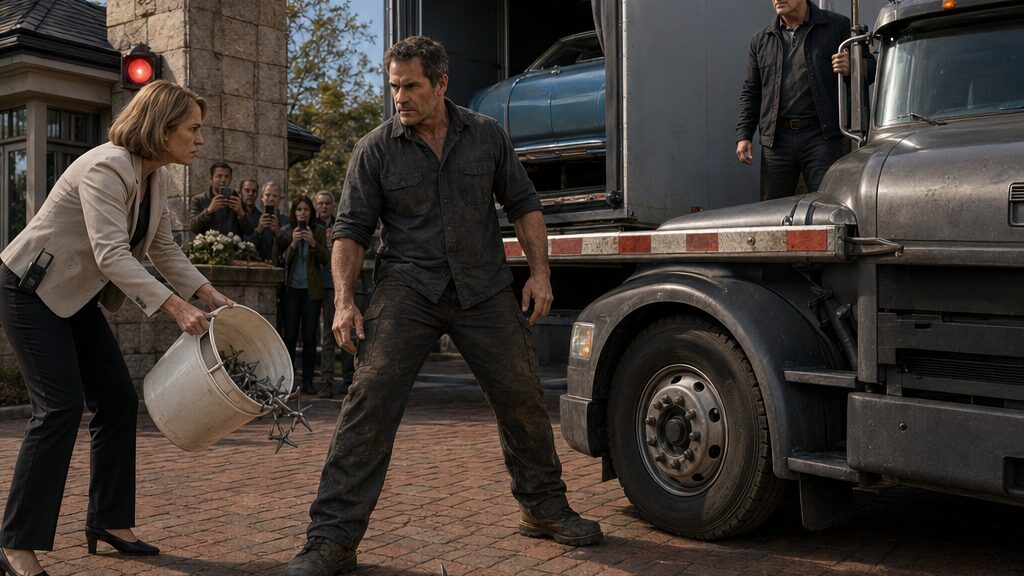
Kathleen Wilson lifted a white plastic bucket beside the transport truck, and a dozen steel points clattered against one another inside it.
“Unload that car,” she shouted, “and I’ll confiscate it.”
Daniel Jackson heard her before he reached the entrance.
He had been waiting in his open garage when the diesel engine first rolled through the neighborhood, its low vibration passing through the concrete beneath his boots. For three years he had imagined that sound. He had expected anticipation, perhaps disbelief.
He had not expected to see Kathleen standing beneath the iron gate with a decibel meter in one hand and a bucket of caltrops in the other.
The truck sat diagonally across the brick-paved entrance lane, its cab trapped between two stone islands. The motorized drop-bar rested inches above its hood. Behind the cab, the enclosed transport trailer stretched almost to the street.
A man in a dark jacket stood on the driver’s step. He was broad-shouldered, gray at the temples, and entirely still while Kathleen screamed up at him.
“The limit is sixty-five decibels,” she said, waving the meter. “You’re reading seventy-eight. Shut it down and reverse.”
“My name is Robert Carter,” the driver replied. “I have an authorized delivery for Daniel Jackson.”
“You have an illegal commercial vehicle inside a private community.”
Daniel stepped into the lane.
“You knew this delivery was coming.”
Kathleen turned. Her face was flushed, but the hand holding the meter remained steady.
“I knew you requested access. Your request was never approved.”
“I received a confirmation.”
“You received an automated receipt.”
“It said the gate would be open from ten until noon.”
“It said your request had been received.”
Daniel stopped six feet from the bucket. The steel inside had been welded into four-pointed shapes, crude but effective. No matter how one landed, a point would face upward.
“You brought those here for a truck?”
Kathleen glanced down as though he had asked about a box of office supplies.
“They are an emergency vehicle deterrent.”
“They’re caltrops.”
“They’re community safety equipment.”
Robert looked from Kathleen to Daniel. “Sir, are you the purchaser?”
Daniel nodded.
Robert climbed down and removed a folded document from a weatherproof envelope.
“I need to verify identification before discussing the cargo.”
Daniel took out his wallet. His fingers felt too large around the license. He had rebuilt transmissions with less trouble than it took to hold that small rectangle steady.
Robert checked the name, address, and photograph.
“Daniel Jackson,” he said. “Confirmed.”
Kathleen stepped between them.
“Nothing is being transferred. HOA regulations prohibit diesel commercial traffic above the posted weight limit.”
“The vehicle entered on a valid access authorization,” Robert said.
“I revoked it.”
“When?”
“When the violation occurred.”
The diesel continued idling. Its rhythm pressed against the stone columns, steady and heavy. Kathleen held up the meter so everyone could see the red digits.
Daniel looked past the cab.
A narrow inspection door on the side of the trailer stood partly open. Through it, under straps and protective cloth, he saw a strip of faded blue paint.
His feet moved before he decided to move them.
Robert shifted into his path. “Please remain clear of the trailer until release.”
Daniel stopped.
There, just behind the front wheel arch, was a shallow crescent-shaped dent.
His father had made it with a floor jack when Daniel was nineteen.
They had argued about repairing it. Daniel had wanted the quarter panel smooth before primer. His father had run his thumb over the mark and said every machine deserved one honest scar.
The dent was still there.
Daniel had searched auction archives, salvage records, private sales, and registration databases for years. The car had passed through four states after he sold it. Then it disappeared into a warehouse connected to a property seizure.
Two months earlier, a grainy federal auction photograph had shown that dent.
He had bid more than he could comfortably afford without telling anyone why.
Kathleen snapped her fingers in front of his line of sight.
“Are you listening?”
Daniel looked at her.
“You are blocking my property.”
“I am protecting community property.”
“From an idling truck?”
“From residents who assume their personal attachments exempt them from rules.”
The words landed more precisely than she knew.
Robert unfolded the document.
“The vehicle identification number is four-six-seven-two-one-nine,” he said. “It matches the transfer order and Mr. Jackson’s purchase certificate.”
Daniel exhaled through his nose. Hearing the number aloud made the car feel real in a way the auction receipt never had.
Kathleen thrust the decibel meter toward Robert.
“I don’t care what number is stamped on the car. This engine violates our noise policy. Your trailer exceeds the weight restriction. And the board has emergency authority to seize prohibited deliveries brought onto association property.”
Daniel turned slowly toward her.
“Seize?”
“Until fines, damages, and removal costs are paid.”
“You think you can take a car I legally bought?”
“I think residents agree to the covenants when they purchase here.”
Robert refolded the transfer document. “I recommend you contact your board counsel before making that claim.”
“I am the board secretary.”
“That is not what I recommended.”
A security guard hovered near the gatehouse, one hand on his radio. Two residents had stopped on the sidewalk. One was filming.
Kathleen noticed the phone and straightened.
“A delivery truck damaged this entrance last year,” she said, louder now. “It struck the south column, cracked imported brick, and left the association with a repair bill because no one enforced the access rules. I will not allow that to happen again.”
Daniel remembered the accident. A landscaping trailer had clipped a planter at walking speed. The crack had been repaired in a week.
Kathleen had spent months afterward installing cameras, issuing vehicle permits, and sending violation notices for everything from moving vans to appliance deliveries.
“You’re not protecting the bricks,” Daniel said. “You’re trapping a truck between them.”
“I am ordering it to leave.”
“The bar is over the hood.”
“It will rise when he agrees to reverse.”
Robert looked at the narrow approach behind the trailer. A line of cars was already forming on the public road.
“I cannot safely reverse while pedestrians and vehicles are entering the approach,” he said.
“Then turn off the engine.”
“The cargo transport system requires power.”
Kathleen raised the bucket slightly.
“Then perhaps the tires need to stay exactly where they are until someone arrives to remove the cargo.”
Daniel moved one step closer.
“Put the bucket down.”
Her eyes sharpened. “Do not threaten me.”
“I said put it down.”
“You have received repeated notices for unauthorized repair work in your garage, excessive tool noise, and improper storage.”
“My garage door was closed.”
“The rules still applied.”
Daniel looked at the iron bar, the meter, the papers clipped beneath Kathleen’s arm. For years he had thrown her notices into a drawer and paid small fines rather than attend board meetings. He had told himself that ignoring her was restraint.
Now her rules stood between him and the only thing his father’s hands had left unfinished.
Robert spoke quietly. “Mr. Jackson, let me handle the access issue.”
Daniel glanced toward the trailer door and the blue paint beyond it.
“How long can you stay?”
“This delivery window ends at noon. If transfer cannot be completed, the vehicle returns to secured storage. Additional custody and transport charges will apply before another release can be scheduled.”
“How much?”
“I do not determine the fees.”
Kathleen gave a small, satisfied nod.
“Then the responsible choice is obvious.”
Daniel faced her.
“No. The obvious choice is opening the gate.”
She reached toward the control clipped to her belt.
Instead of raising the drop-bar, she lowered it until the rubber edge hovered barely an inch above the truck’s hood.
The motor stopped with a metallic thud.
“Any attempt to cross now,” she said, “will constitute damage to association property.”
Something shifted inside the bucket.
A single caltrop climbed the rim, tipped, and fell.
It struck the bricks with a bright steel ring, bounced once, and stopped inches from the truck’s front tire.
Chapter 2: The Rule She Claimed Meant Everything
Kathleen opened the HOA rulebook and covered the bottom half of the page with her clipboard.
“Section twelve, paragraph four,” she read, “prohibits commercial vehicles exceeding eight thousand pounds from using private association roads without prior written board authorization.”
Daniel bent, picked up the fallen caltrop by one blunt welded seam, and placed it on the stone planter instead of returning it to her bucket.
“Read the rest.”
“I have read the controlling language.”
“You covered the rest.”
Kathleen pressed the clipboard harder against the page.
Robert remained beside the truck’s front wheel. His phone was now in his hand, its camera pointed toward the gate.
“Ma’am,” he said, “for the record, are you refusing access based on section twelve?”
“I am enforcing section twelve.”
“Please answer the question.”
“Yes.”
“And are you claiming authority to seize the transported vehicle?”
“The association may hold property introduced during an active violation.”
Daniel extended his hand. “Give me the book.”
Kathleen pulled it against her chest.
“You are not a board officer.”
“I’m a homeowner.”
“You are currently confrontational.”
“You brought tire spikes.”
“Safety equipment.”
“Then you won’t mind saying on camera what they’re for.”
Her gaze flicked toward Robert’s phone.
The security guard shifted uneasily beside the gatehouse. “Ms. Wilson, maybe we should wait for the president.”
“I have already called her.”
Daniel looked toward the neighborhood road. The distant growl of an approaching engine rose behind the idling diesel. A silver sedan rounded the curve and braked sharply near the crowd.
Michelle Lee stepped out before the car had fully settled.
She wore slacks, a pale blouse, and the strained expression of someone who had been told there was a problem but not who had created it.
“What happened?”
Kathleen crossed the lane to meet her.
“An overweight commercial transporter entered without authorization. The driver refuses to leave, and Daniel has threatened me.”
“I told you to put down a bucket of caltrops.”
Michelle stared at the bucket.
“What are those doing here?”
“They were purchased for emergency access control.”
“Purchased by whom?”
Kathleen hesitated for less than a second. “The security committee.”
Michelle looked at the guard. He shook his head.
Daniel pointed to the covered page. “She claims the HOA can seize my car.”
Michelle’s expression changed.
“Kathleen, we cannot confiscate resident property.”
“We can impound prohibited items pending compliance.”
“No, we can’t.”
“The emergency policy—”
“Applies to abandoned objects in common areas. Bicycles. Dumped furniture. Unregistered trailers. Not a car inside a licensed transporter.”
Kathleen’s jaw tightened. “This truck is violating the weight and noise restrictions. Last year’s accident cost us eighteen thousand dollars.”
Michelle rubbed the bridge of her nose.
“We were reimbursed.”
“After six months. And I was the one everyone blamed because the contractor entered without proper review.”
Daniel heard something beneath the anger then. Not innocence, but memory.
After the accident, residents had shouted at a board meeting about insurance, landscaping costs, falling property values. Kathleen had been secretary for only three weeks. She had answered questions until her voice broke.
Michelle stepped toward Robert.
“Do you have the delivery authorization?”
Robert handed her a copy.
Kathleen said, “That proves ownership, not gate approval.”
Daniel took out his phone.
“I sent notice fourteen days ago.”
He opened the email chain and held it toward Michelle.
The message included the carrier, estimated vehicle weight, arrival window, and federal auction reference. Beneath it sat an automated reply from the association account: ACCESS REQUEST RECEIVED. GATE CLEARANCE SCHEDULED: 10:00 A.M.–12:00 P.M.
Michelle read it twice.
“This should have generated a temporary access code.”
“It did,” Robert said. “The code opened the outer gate. The interior bar was lowered manually after I entered.”
Michelle turned to Kathleen. “Did you cancel the clearance?”
“I suspended it when the engine exceeded the permissible reading.”
“You cannot suspend an approved delivery without contacting the board.”
“I am authorized to respond to active violations.”
“You are authorized to document them.”
Kathleen opened the rulebook again.
“Section twelve permits denial of entry.”
“Read the full paragraph,” Daniel said.
Kathleen kept her finger on the page. “The first sentence is sufficient.”
Michelle held out her hand.
For several seconds Kathleen did not move. Then she gave her the book.
Michelle read silently.
Daniel watched the change begin in her eyes.
“What does it say?” he asked.
She looked toward Robert.
“It says the restriction applies to routine commercial vendors and contracted service traffic.”
“And?”
Michelle continued reluctantly. “It excludes emergency vehicles, government-authorized carriers, and one-time property transfers approved through the resident access system.”
Kathleen took the book back.
“This carrier has not identified itself as government authorized.”
Robert’s voice remained even. “I told you the transport was official.”
“You used vague language.”
“I supplied a transfer order.”
“Anyone can print a form.”
Robert glanced at his recording phone. “Are you accusing me of presenting false federal documents?”
Michelle stepped between them before Kathleen answered.
“Enough. Raise the bar. We can review the noise complaint after the delivery.”
Kathleen did not reach for the control.
“The board cannot selectively abandon regulations because Daniel is angry.”
“I’m not abandoning anything.”
“You’re undermining me in front of residents.”
“I’m correcting a situation before it becomes worse.”
Kathleen’s face tightened with something close to panic.
“If this truck damages the entrance, you will blame me again. Everyone will. You told me after the last accident that enforcement had to improve.”
“I told you procedures had to improve.”
“This is procedure.”
“No,” Michelle said. “This is escalation.”
The diesel engine changed pitch as an internal compressor engaged. Kathleen’s meter jumped. She held it up as if the numbers had vindicated her.
“Eighty-one decibels.”
Robert checked his watch.
Daniel looked toward the trailer.
The blue car sat in darkness behind the narrow opening, silent while its arrival was argued over in clauses and measurements.
“Raise the gate,” he said.
Kathleen drew a printed sheet from her clipboard.
“You were issued a temporary suspension notice at nine forty-two this morning.”
She handed it to Michelle.
At the top was the association letterhead. Beneath it, in formal language, the document suspended Daniel’s access authorization because of vehicle-weight concerns. At the bottom appeared Michelle Lee’s electronic signature.
Daniel read it over her shoulder.
For one cold moment, he believed it.
Michelle had always spoken softly when Kathleen fined him. She had said she understood his frustration but refused to reverse the penalties. She had chosen board unity every time.
“So this was decided before the truck arrived,” Daniel said.
Michelle did not answer.
Kathleen folded her arms. “The notice is valid.”
Daniel looked at Michelle. “You signed it?”
Michelle’s face had gone still.
She studied the time stamp, then the signature block. She enlarged the document on Kathleen’s tablet and examined the authorization code beneath her name.
“No,” she said.
Kathleen’s certainty faltered.
Michelle looked up.
“I never signed this.”
Chapter 3: What Daniel Never Told the Board
Gregory Martin arrived holding a faded photograph above his head as if it were evidence in a trial.
“That is the same car,” he called from across the brick lane. “Before any of you decide it’s just another delivery, look at this.”
Daniel’s stomach tightened.
Gregory came through the gathering neighbors with a limp that worsened when he hurried. He wore his old mechanic’s shirt, the name patch removed years ago but its darker outline still visible above the pocket.
Daniel stepped toward him.
“Put that away.”
Gregory ignored him and held the photograph toward Michelle.
The picture had been taken beneath Daniel’s half-raised garage door twenty-three years earlier. His father stood on one side of the stripped blue coupe, younger than Daniel was now, one hand resting on the unfinished roof. Daniel stood on the other side, thin and grease-streaked, pretending not to smile.
The crescent dent behind the wheel arch showed clearly.
Michelle looked from the photograph to the trailer opening.
“That’s really it?”
“Yes,” Gregory said. “Same body. Same numbers. Same dent his father wouldn’t let us hammer out.”
“Gregory.”
The older man looked at Daniel.
“You called me at dawn because you couldn’t sit still. Don’t act like this is private now that half the neighborhood is filming.”
“I called you to help unload it.”
“And I came to help get it through the gate.”
Kathleen stepped closer to Michelle and glanced at the photograph.
“A sentimental history does not create an exemption.”
“No one said it did,” Gregory replied.
“You arrived waving a photograph at the board president.”
“Because you’re threatening to steal a dead man’s car.”
Kathleen’s lips thinned. “The association has threatened no such thing.”
“You said confiscate,” Daniel said.
“I described a compliance remedy.”
Robert remained near the truck, checking his watch and occasionally looking toward the public road. The outer lane had nearly cleared, but the interior bar still held the cab in place.
Michelle handed the photograph back to Gregory.
“Daniel, why didn’t you explain this when you submitted the request?”
“Because it wasn’t relevant.”
“It might have helped us understand the urgency.”
“I gave you the weight, the carrier, the time, and the approval reference. That should have been enough.”
“It should have,” she said. “But Kathleen’s notice—”
“Was forged.”
Kathleen bristled. “That has not been established.”
Michelle held up the tablet. “The authorization code belongs to a meeting packet from last month. My signature was copied from a landscaping approval.”
The security guard took a slow step away from Kathleen.
She noticed.
“The document was prepared under emergency authority,” she said. “The signature was administrative, not fraudulent.”
“You used my name.”
“To prevent another incident while you were unreachable.”
“My phone was on.”
“You did not answer.”
“I was in a medical appointment for forty minutes.”
“And the truck was scheduled to arrive during that period.”
Kathleen said it as if the timing itself proved conspiracy.
Daniel looked at the bucket again. Most of the caltrops remained inside. One rested on the planter where he had placed it. Their steel points caught the late-morning sun.
Gregory lowered his voice.
“Tell them why you bought it back.”
Daniel kept his eyes on Kathleen.
“They don’t need to know.”
“Maybe you need to say it.”
“Not here.”
“You haven’t said it anywhere.”
Daniel turned on him. “This is not the time.”
“It hasn’t been the time for nine years.”
The words cut through the engine noise.
Michelle looked away. Even Kathleen went quiet for a heartbeat.
Gregory held the photograph against his chest.
“Your father sold that car because he was sick.”
Daniel’s shoulders locked.
“I sold it.”
“You signed the papers.”
“I made the call.”
“He couldn’t hold a pen.”
“Stop.”
“We needed the money for treatment.”
“I said stop.”
Gregory’s face softened, which made it worse.
“He never blamed you.”
“You don’t know that.”
“I was there.”
“You were there after. You weren’t in the room when I told him.”
The memory came not as an image but as a sound: the dry scrape of his father’s thumb along the hospital blanket while Daniel explained that the buyer would collect the car on Friday.
His father had looked toward the window instead of at him.
Daniel had carried that silence for nine years.
Kathleen drew in a slow breath.
“So this is what this is really about.”
Daniel turned.
She gestured toward the neighbors, the photograph, the blocked truck.
“An emotional display designed to pressure the board into ignoring regulations.”
Gregory took a step toward her. “Watch yourself.”
“No,” Kathleen said, finding confidence again. “The facts matter. Daniel concealed the personal nature of this delivery, submitted an incomplete request, and is now using a family tragedy to portray routine enforcement as cruelty.”
“I submitted every field on your form,” Daniel said.
“Not the exceptional circumstances.”
“There was no field for grief.”
The sentence left him before he could stop it.
Silence spread outward from him.
Even the diesel seemed distant for a moment.
Michelle’s expression changed—not to pity, which he could not have endured, but to understanding.
Kathleen saw it too.
“That does not alter the rules,” she said quickly.
Daniel faced Gregory.
“You had no right.”
“I was trying to help.”
“You always think saying the thing louder makes it easier.”
“And you think never saying it means no one can touch it.”
Daniel snatched the photograph from his hand.
The paper bent between his fingers.
Gregory’s mouth hardened.
“I spent six years helping you search for that car.”
“I didn’t ask you to tell strangers about my father.”
“You asked me to help bring him home.”
“It’s a car.”
Gregory stared at him.
Daniel heard the lie as clearly as everyone else did.
Kathleen pointed toward him.
“This is precisely the behavior I was concerned about. He is agitated, confrontational, and emotionally compromised.”
Michelle stepped in front of her.
“You forged my authorization.”
“I used delegated authority to stop a foreseeable risk.”
“And brought caltrops.”
“They have not been deployed.”
“One already fell.”
“Accidentally.”
Robert climbed onto the truck’s step and leaned into the cab. A moment later the diesel settled to a lower idle.
Daniel smoothed the bent photograph against his thigh. In it, his father’s hand rested on the roof as if holding the car in place.
Gregory turned away.
“Fine,” he said. “Handle it your way.”
He walked toward the sidewalk.
Daniel almost called him back.
Pride kept his mouth closed.
Robert approached with the transfer papers tucked beneath one arm.
“Mr. Jackson.”
Daniel looked at him.
“I have contacted dispatch. Due to the obstruction and the scheduled chain-of-custody return, I can remain on site for forty more minutes.”
Kathleen folded her arms.
“And then?”
Robert’s eyes stayed on Daniel.
“Then this transport leaves, whether the vehicle has been released to him or not.”
Chapter 4: The Bucket Tipped Toward the Tires
Kathleen tilted the bucket until the steel points slid against the rim.
The sound was small compared with the diesel engine, but everyone near the gate heard it.
Robert stepped away from the truck’s front wheel and raised one hand.
“Do not place anything beneath this vehicle.”
Kathleen’s eyes stayed on Daniel.
“Then reverse it.”
“I have already explained why I cannot do that safely.”
“You can shut it down.”
“The transport systems require power.”
“Convenient.”
Robert glanced at his watch. “Thirty-eight minutes.”
Daniel stood beside the stone planter with the old photograph folded once in his hand. The crease ran through his father’s shoulder. Gregory had stopped at the sidewalk but had not left. He faced away from the gate, arms hanging at his sides.
Michelle moved toward Kathleen.
“Give me the bucket.”
“No.”
“Kathleen.”
“The truck is in violation, Daniel is unstable, and you have abandoned every enforcement standard because people started recording.”
Michelle’s face tightened. “I am asking you as board president.”
“And I am acting as secretary under emergency authority.”
“There is no emergency authority for this.”
“There was no emergency authority when that landscaping truck hit the entrance either. Everyone still wanted to know why I had done nothing.”
No one answered.
Kathleen looked past Michelle at the neighbors holding phones.
“You all complained,” she said. “You demanded stricter access. You said contractors were damaging the roads and lowering values. Now that enforcement is inconvenient, you pretend you never asked for it.”
A woman near the sidewalk lowered her phone slightly.
Daniel understood the fragment of truth in what Kathleen said. People had wanted rules. They had wanted someone else to apply them. Kathleen had learned that fear made residents grateful for barriers—until the barrier stopped something they wanted.
Robert’s voice cut through the silence.
“This vehicle is conducting an authorized transfer under official protection.”
Kathleen turned sharply. “Official for whom?”
“I have provided sufficient documentation.”
“No, you have hidden behind vague phrases.”
“I have advised you to clear the route.”
“Are you law enforcement?”
Robert did not answer.
Kathleen gave a short, humorless laugh. “That is what I thought.”
Daniel looked at him. “Why won’t you just tell her?”
Robert’s expression remained neutral. “Because my responsibility is to complete the transfer safely and document interference. Your responsibility is to remain clear of the vehicle.”
The answer felt colder than Daniel expected.
“You knew what this could become.”
“I knew there might be an access dispute.”
“She has tire spikes.”
“And I have instructed her not to deploy them.”
Daniel looked at the bucket. “Instructions don’t stop steel.”
Robert met his eyes. “Neither does losing control.”
The words struck harder because Gregory was still close enough to hear them.
Kathleen stepped toward the truck.
“Final warning. Reverse immediately or the vehicle will be immobilized until a tow company approved by the association arrives.”
Robert lifted his phone higher.
“For the record, are you threatening to damage the tires?”
“I am preventing unauthorized movement.”
“With tire-puncturing devices?”
“I am using available safety equipment.”
Daniel moved between her and the front wheel.
“Put it down.”
Kathleen swung the bucket behind her hip.
“Stay away from me.”
“I’m not touching you.”
“You are blocking a board officer.”
“You are standing five feet from a tire with a bucket of spikes.”
Robert said, “Mr. Jackson, step back.”
Daniel did not.
The space between Kathleen and the truck had narrowed to less than an arm’s length. The iron gate cast a dark stripe across the bricks and through the spilled shadow of the bucket.
Kathleen raised her voice.
“Security, remove him.”
The guard looked at Michelle.
Michelle shook her head. “No one touches anyone.”
Kathleen stared at her. “You are allowing intimidation.”
“I am preventing this from getting worse.”
“It is already worse.”
She jerked the bucket away as Daniel reached for its handle.
The motion was sudden. Daniel caught the rim with both hands before it overturned.
Kathleen screamed.
“Let go of me!”
“I’m holding the bucket.”
“You grabbed me!”
“I didn’t touch you.”
Several phones lifted higher.
From the sidewalk, someone said, “It looked like he did.”
Daniel released the bucket immediately.
Kathleen stumbled backward, though he had not pulled. The steel pieces shifted inside with a harsh metallic scrape.
Michelle moved between them.
“Everybody stop.”
Kathleen pointed at Daniel with the decibel meter.
“He assaulted me.”
“No,” Daniel said.
“You lunged at me.”
“You tipped the bucket.”
Robert turned his phone toward the gatehouse camera mounted above the entrance lane.
“That camera has a direct view.”
Kathleen glanced up.
For the first time, fear crossed her face without disguise.
Then she recovered.
“Good. It will show him interfering with an officer of the association.”
Michelle looked at the security guard. “Can you access the feed?”
“Not from outside. The monitor is in the gatehouse.”
“Open it.”
The guard reached for his keys.
Kathleen stepped in front of the door.
“No one enters until police arrive.”
“You don’t control the gatehouse alone.”
“I control evidence preservation.”
Michelle’s patience broke.
“You forged my signature, threatened a vehicle with caltrops, and now you’re locking us out of our own security system.”
“I used delegated access.”
“You used fear.”
Kathleen’s face went pale.
For one second Daniel thought she might surrender the bucket.
Instead, she clipped the decibel meter to her belt, reached for the gate control, and pressed the lower button.
The motorized drop-bar descended the final inches.
Its padded underside touched the truck’s hood with a dull scrape.
Robert stepped forward. “Stop.”
Kathleen kept her thumb on the control.
The motor groaned against resistance. The bar pressed harder, flexing slightly where it met the edge of the hood.
“You are damaging the vehicle,” Robert said.
“I am securing the lane.”
The motor cut out.
Kathleen removed a small key from the control box and slipped it into her pocket. Then she entered a sequence on the panel. A red light appeared.
The security guard stared.
“You activated lockout.”
“Yes.”
“That disables manual release.”
“That is the point.”
The truck was now pinned between the stone islands, the lowered bar, and the line of vehicles beyond the outer entrance.
Daniel heard the diesel change pitch again. The vibration traveled through the soles of his boots.
Robert checked the hood. A black mark ran across the paint where the rubber edge had dragged.
He looked at Kathleen.
“You have been warned repeatedly. Do not take another action against this transport.”
Kathleen held the bucket against her leg.
“Then leave.”
“How?”
“Reverse when the road clears.”
“The trailer cannot safely clear the turn from this position.”
“That is not my problem.”
Daniel looked toward the inspection opening.
The old blue paint remained visible inside the dark trailer. The car had survived years of neglect, seizure, storage, and sale. Now it sat twenty yards from his street, held in place by an iron arm and a woman who needed the arm to mean something.
Gregory turned back from the sidewalk.
“Daniel.”
He did not come closer, but he no longer looked angry.
“Don’t do anything you can’t take back.”
Daniel stared at the gate mechanism.
The steel drop-bar was thick but hollow, driven by a gearbox housed inside the stone column. He had repaired similar systems. The locking teeth were designed to resist lifting, not sustained force against the powered direction.
If the emergency release had been available, the bar could have risen in seconds.
Kathleen reached into the bucket.
Her fingers closed around one caltrop.
Michelle saw it.
“Kathleen, don’t.”
“You have all mistaken restraint for weakness.”
“No,” Daniel said. “You mistook control for permission.”
Kathleen pulled the steel piece free.
The drop-bar remained pressed against the truck’s hood.
Robert moved toward her.
She stepped back, caltrop in one hand, bucket in the other.
“Come any closer and I drop all of them.”
Daniel shifted in front of the tire.
The timer on Robert’s watch beeped once.
Thirty minutes remained.
Kathleen reached into the bucket again.
Chapter 5: The Steel Bar That Would Not Stay Down
Kathleen threw the first caltrop toward the truck’s front wheel.
Daniel moved before the steel hit the bricks.
He kicked sideways, catching it with the edge of his boot. The caltrop spun beneath the stone bench and struck the wall behind it.
Robert seized the bucket from Kathleen’s other hand.
She screamed and clawed at the handle, but Michelle pulled her away.
“Enough!”
Kathleen twisted free.
“He attacked me! Both of them did!”
Robert placed the bucket on the roof of the gatehouse, beyond her reach.
“You attempted to deploy a tire-deflation device beneath an occupied transport.”
“It was a warning.”
“It was an action.”
Daniel crouched beside the truck. The front tire was untouched. The bar still pressed against the hood, the gate motor locked and silent.
Kathleen reached into her pocket.
Daniel stood.
“The key.”
She closed her fist around it.
“No.”
Michelle stepped toward her. “Give it to me.”
“You no longer have the authority to direct this incident.”
“I am the board president.”
“And you have failed to protect the association.”
Kathleen’s voice trembled now, not with fear but with fury sharpened by humiliation.
“You will thank me when the lawsuits begin. When the entrance is damaged again. When every contractor claims some exception because you let this one through.”
Daniel looked at the control housing.
“Where is the emergency release?”
The security guard pointed toward the locked gatehouse. “Inside the cabinet.”
Kathleen smiled thinly. “The cabinet key is with the gate key.”
Michelle’s face hardened. “You removed both?”
“I secured them.”
“You trapped a loaded truck and disabled the safety release.”
“I prevented unauthorized entry.”
Daniel walked to the bar and wrapped one hand around its underside.
Robert stepped toward him.
“Do not attempt to lift it.”
“I’m checking the resistance.”
“The mechanism is energized.”
“Not now. She locked it.”
“It may reactivate if the limit switch resets.”
Daniel pressed upward. The bar moved less than half an inch before the gearbox stopped it.
He knew the sound that came from inside the column: a deep, compressed click as the locking pawl took the load.
The system had been installed to keep drivers from raising the arm by hand. It had not been built to withstand someone forcing it in the wrong direction while the gears remained engaged.
He looked toward the public road.
The line of waiting vehicles had grown. A delivery van had turned around. Residents stood on both sides of the entrance, some recording, some arguing quietly about who had asked for stricter rules after the old accident.
Robert checked his watch.
“Twenty-six minutes.”
Daniel stepped away from the bar.
Michelle said, “Police are coming.”
“When?”
“The guard called them.”
“Did they give a time?”
“No.”
Kathleen lifted her chin. “Then we wait.”
Daniel looked at her.
“That is what you want.”
“I want this handled lawfully.”
“You threw steel at a tire.”
“I dropped a deterrent in response to aggressive movement.”
Everyone had seen the throw.
Still she said it with such certainty that Daniel understood she was no longer speaking to them. She was rehearsing the version she intended to survive.
Robert moved close enough that only Daniel could hear.
“If you damage the mechanism, you may be held financially responsible regardless of what she did.”
Daniel glanced at the dark mark on the hood.
“And if we wait?”
“At the deadline, I am instructed to return the cargo.”
“She can’t move the bar.”
“That does not alter my orders.”
“You could identify yourself.”
Robert’s gaze sharpened slightly.
“My identity will not mechanically open that gate.”
“It might make her hand over the key.”
“She has ignored every warning already given.”
Daniel looked toward Kathleen. She had positioned herself beside the gatehouse door with her arms folded, as if guarding a border.
“You’re waiting for her to do enough.”
“I am documenting what she chooses to do.”
“And the car leaves while you document it.”
Robert said nothing.
Daniel’s anger turned toward him for a moment, hot and unfair. Robert had not forged the notice or lowered the gate. He had not thrown the caltrop.
But he had watched each barrier become worse while holding back the one fact that might have stopped it.
Then Daniel looked at the trailer opening and the dent behind the wheel arch.
For nine years he had blamed himself for a decision made in a hospital room with bills spread across his lap. He had told himself that doing nothing now would be patience, discipline, adulthood.
He had used those words before.
He had used them when Kathleen fined the elderly couple across the street for leaving a moving pod overnight. He had used them when she blocked a nurse’s car because the temporary permit was on the wrong side of the dashboard.
Ignoring smaller barriers had helped build this one.
Daniel walked toward the gate.
Gregory left the sidewalk and came after him.
“What are you doing?”
“What I should have done before she put steel in the road.”
Gregory caught his arm.
“Think.”
“I am.”
“You break that gate, they’ll make you pay for it.”
“Probably.”
“They may charge you.”
“Maybe.”
“And the car?”
Daniel looked toward the trailer.
“The car already cost me enough.”
Gregory released him slowly.
Daniel faced the crowd.
“Everybody move away from the gate.”
Kathleen laughed once.
“You touch that bar and you will be arrested.”
Daniel ignored her.
He pointed at the security guard. “Clear the space beside the column. If the housing breaks, metal could come out.”
The guard looked at Michelle.
Michelle hesitated.
This was the moment Daniel saw her choice. She could still preserve the appearance of order by stopping him. She could direct security to restrain the angry resident and wait for police while the truck’s deadline ran down.
Instead she turned to the guard.
“Do as he says.”
Kathleen stared at her.
“You cannot authorize destruction.”
“I am preventing someone from getting hurt.”
“By helping him commit a crime?”
Michelle looked at the caltrop beneath the stone bench.
“No. By finally admitting this stopped being enforcement when you locked out the safety release.”
The guard moved the nearest residents back.
Robert remained beside Daniel.
“I cannot approve this.”
“I didn’t ask you to.”
“I am warning you.”
“You’ve been warning the wrong person all morning.”
Daniel took hold of the bar with both hands.
The rubber edge had left a faint compression line in the truck’s hood. He placed his shoulder beneath the steel several feet from the column, where leverage would work against the locking teeth.
He pushed upward.
Nothing happened.
The bar pressed into his shoulder. His boots slipped slightly on the bricks.
Kathleen called toward the cameras.
“You are all witnessing deliberate destruction of community property.”
Daniel reset his stance.
He thought of his father bracing a transmission jack with one knee, telling him that brute force was what people called leverage when they did not understand it.
Daniel moved farther from the column.
He drove upward again.
The bar lifted an inch.
Inside the stone housing, the motor woke with a sudden electrical hum. The mechanism tried to force the arm back down.
The steel vibrated against his palms.
“Daniel!” Gregory shouted.
Daniel did not release it.
The gearbox whined. The bar pushed downward. He bent his knees, shifted his weight, and forced it back.
A metallic screech tore through the entrance.
Kathleen stopped speaking.
The sound rose until it seemed to come from the bricks themselves. The bar jerked. Daniel’s shoulder burned. His hands began to slide.
Then one gear tooth snapped.
The crack was sharp enough to make the crowd recoil.
The bar jumped upward six inches.
Daniel shoved again.
The motor screamed. Two more teeth broke in quick succession. Something inside the housing spun loose with a grinding rattle.
The bar rose past the truck’s hood.
Daniel shifted his grip and pushed it higher.
The steel tube bent near the column, first slightly, then with a deep groan. He forced it upward until it stood at a steep angle over the lane.
Kathleen rushed toward the control box.
Michelle blocked her.
“Don’t touch it.”
“He is destroying everything!”
The gearbox gave one final shriek.
The internal shaft snapped.
The bar sagged toward the truck.
Daniel caught it before it fell. Gregory stepped beside him without being asked, taking some of the weight.
Together they pushed the broken arm straight upward until the torn metal folded against the side of the column.
Daniel wrapped one hand around the bent section and drove it higher.
The tube crumpled at the joint.
When he released it, the bar remained upright, twisted and useless, no longer able to close across the lane.
For several seconds the only sound was the truck’s diesel engine.
Daniel stepped back.
His hands were shaking. A line of blood crossed one palm where torn paint had cut him.
Kathleen stared at the ruined mechanism.
Then her expression changed.
Not defeat.
Relief.
She pointed at Daniel.
“You did it on camera.”
Her voice had become almost calm.
“You destroyed association property in front of witnesses. You threatened me, attacked the gate, and interfered with enforcement.”
She pulled out her phone.
“I’m calling the police again. This time I have proof.”
Daniel looked at the open lane.
The truck could pass.
That was enough.
Robert opened the driver’s door, but he did not climb inside.
Instead he stepped down onto the bricks, buttoned his dark jacket, and walked toward Kathleen.
She turned to him impatiently.
“You need to remain here as a witness.”
Robert stopped beside the spilled caltrops.
Then he opened his coat.
Chapter 6: The Badge Behind the Driver’s Coat
Robert held the credential where Kathleen, Michelle, and every raised phone could see it.
“Robert Carter. United States Marshals Service.”
Kathleen stared at the badge.
For once, no answer came immediately.
Robert closed the distance between them.
“Step away from the caltrops and place your hands where I can see them.”
Her phone remained pressed to her ear.
“This is a private community.”
“Put the phone down.”
“You cannot ignore our covenants because you work for the federal government.”
“I am not discussing your covenants.”
“The truck violated posted limits.”
“You obstructed a federally controlled transport, threatened to disable it, damaged the vehicle with the gate mechanism, and attempted to deploy tire-puncturing devices after repeated warnings.”
Kathleen looked toward Michelle as if waiting for rescue.
Michelle did not move.
Kathleen lowered the phone slowly.
“I was performing my duty as an officer of the association.”
“You are not a law-enforcement officer.”
“I never said I was.”
“You claimed seizure authority over federally transferred property.”
“I said the association could hold prohibited property.”
“You presented a forged suspension notice.”
“That is an internal administrative issue.”
Michelle stepped forward.
“No. It isn’t.”
Kathleen’s eyes flashed. “Do not make this worse.”
“You used my signature without permission. The board never approved confiscation, caltrops, or emergency lockout of the gate.”
“You told me enforcement needed to improve.”
“I told you to follow procedure.”
“And when procedure failed last year, all of you blamed me.”
Michelle’s expression softened for a moment.
“I should have defended you then.”
Kathleen’s breathing slowed.
The admission seemed to reach her.
Then Michelle continued.
“But what happened to you does not give you permission to do this to someone else.”
Kathleen’s face closed again.
Robert removed a pair of handcuffs from beneath his jacket.
“You are being detained pending investigation for obstruction of federal operations and attempted interference with an official transport.”
Kathleen took one step backward.
Daniel saw Robert’s posture change—not dramatic, not threatening, simply prepared.
“Do not move away from me,” he said.
“This is absurd.”
“Turn around.”
“The federal government is still subject to reasonable community safety standards.”
“Turn around.”
“The engine exceeded eighty decibels.”
Robert guided one of her wrists behind her back.
Kathleen twisted toward the cameras.
“Record this. He is arresting me for enforcing a noise rule.”
“No,” Robert said. “I am arresting you for what you chose to do after the rule was explained.”
The first cuff closed with a clean metallic click.
The sound carried farther than Kathleen’s voice had.
Robert secured her other wrist.
She continued speaking, but the words lost their shape. They became fragments about liability, property values, board authority, and the accident from the year before.
The security guard opened the gatehouse once Robert instructed him to preserve the camera recordings. Michelle entered behind him and removed Kathleen’s forged notice from the printer tray, where a second copy still waited.
Daniel looked at the broken bar.
Its twisted length stood upright beside the column. The shattered housing had spilled black gear teeth and metal fragments onto the bricks.
He had opened the lane.
He had also destroyed several thousand dollars’ worth of equipment in front of half the neighborhood.
Robert handed Kathleen to the arriving local officers and spoke with them quietly. One officer photographed the caltrops. Another examined the mark on the truck’s hood.
Daniel pressed a folded handkerchief against his palm.
Gregory stood beside him.
“You all right?”
“Yes.”
“That isn’t what your hand says.”
“It’s a cut.”
Gregory glanced toward Kathleen.
“You could’ve lost more than skin.”
Daniel looked at him. “You told me not to do anything I couldn’t take back.”
“I did.”
“I can’t take it back.”
“No.”
Gregory nodded toward the open gate.
“But it stayed open.”
Daniel almost smiled.
Michelle returned from the gatehouse holding the forged notice and the rulebook.
“I owe you an apology.”
Daniel looked at the papers.
“You owe more people than me.”
“I know.”
She glanced at the ruined mechanism.
“The board will have to review the cost.”
“I know that too.”
Robert approached them.
Kathleen was seated in the rear of a patrol car, still speaking through the open door to an officer taking notes.
Robert looked at Daniel’s injured palm.
“Medical attention?”
“No.”
“You may want it documented.”
“I’ll clean it.”
Robert nodded once.
“The vehicle can proceed.”
Daniel looked toward the trailer.
The words should have felt like victory. Instead they arrived with a heaviness he had not expected.
“What happens to her?”
“That will depend on the evidence, local charges, federal review, and prosecutorial decisions.”
“And the gate?”
“That is a civil matter unless local authorities determine otherwise.”
“So I can still be charged.”
“You damaged property.”
“To stop her from throwing spikes.”
“That context matters.”
“But it doesn’t erase it.”
“No.”
Robert did not soften the answer, and Daniel respected him more for that than he wanted to.
“I thought you were waiting too long,” Daniel said.
“I was establishing intent and preserving the transfer.”
“You could have shown the badge sooner.”
“Yes.”
Daniel waited.
Robert looked toward the patrol car.
“I expected formal authority to end the dispute if necessary. I underestimated how committed she was to the authority she had invented.”
“That nearly cost me the delivery.”
“Yes.”
The admission was quiet and complete.
Robert glanced at the broken bar.
“You acted before I did.”
“I broke a gate.”
“You prevented an immediate attempt to disable the transport.”
“Those can both be true.”
“They are.”
The local officers finished photographing Daniel’s hands and the damaged mechanism. One told him he would receive information later about statements and possible property claims. There was no dramatic declaration that he had been right. No one erased the bent steel.
Robert returned to the cab.
The diesel engine deepened.
The truck moved forward slowly.
Its front wheels passed beneath the twisted bar. The long trailer followed, clearing the stone islands by inches.
A loose section of the shattered gate housing lay across the lane.
The truck’s rear tire rolled over it.
Metal collapsed with a heavy crunch. Black plastic, gear fragments, and powdered brick spread beneath the tread.
Kathleen watched from the patrol car.
Daniel stood beside the ruined entrance with the handkerchief wrapped around his palm. Through the narrow trailer opening, the faded blue car passed him, the old crescent dent catching a brief line of sunlight.
His mouth tightened into a cold, private smile.
Not for Kathleen.
For the fact that the car had crossed the barrier.
The truck continued toward his street.
Robert stopped beside Daniel’s driveway and climbed down. Before opening the trailer, he carried a sealed brown packet toward Daniel.
“This was recovered from the vehicle’s locked glove compartment during inventory,” he said. “It remained with the property because it appeared personal and had no evidentiary value.”
Daniel stared at the packet.
A faded inventory label crossed the front. Beneath it, written in blue ink, was his surname.
The handwriting was not his.
Robert held it out.
Daniel took it with his uninjured hand.
The sealed paper felt almost weightless.
He knew his father’s writing before he saw the first full letter.
Edit
Chapter 7: The Engine His Father Never Heard
Daniel sat behind the wheel with the ignition key resting against his thumb.
He could not make himself insert it.
The garage door stood halfway open, leaving a hard horizontal line across the evening. Outside, the transport truck was gone. The broken gate was out of sight from here, but every few minutes a vehicle slowed near the entrance, its tires crunching over brick dust and fragments the cleanup crew had not yet removed.
Inside the garage, nothing moved.
The blue coupe filled the space where Daniel had once worked beside his father. It looked smaller than he remembered and more damaged than the auction photographs had shown. Dust dulled the windshield. A shallow scrape ran across the driver’s door. The upholstery smelled of old vinyl, dry foam, and years spent in closed buildings.
The crescent dent remained behind the front wheel.
Daniel had touched it when the car rolled off the trailer.
He had not touched the sealed packet.
It lay on the passenger seat, brown paper beneath a faded federal inventory label. His surname had been written across the front in blue ink.
JACKSON.
The J leaned too far forward. The final N ended with a short upward stroke.
His father’s hand.
Daniel set the key in his lap and unwrapped the handkerchief from his injured palm. The cut had stopped bleeding, leaving a narrow red line beneath dried black paint from the gate.
He had spent the afternoon signing statements.
Michelle had come to the driveway twice. The first time, she carried an incident form. The second time, she carried no papers at all.
She had told him the board would preserve the recordings, suspend Kathleen’s access credentials, and review every enforcement action she had issued under emergency authority.
Daniel had asked about the gate.
Michelle had said, “We will deal with that honestly.”
It was not forgiveness. He had not asked for any.
Gregory stood at the open side door of the garage.
Daniel had heard him arrive ten minutes earlier, but neither of them had spoken.
“You going to sit there all night?” Gregory asked.
“Maybe.”
“Battery won’t improve from watching it.”
“I haven’t tried the battery.”
“I know.”
Daniel looked at the packet.
Gregory followed his gaze but stayed outside the car.
“Robert said it came from the glove box?”
“Locked inside.”
“Your father used to keep receipts in there. Receipts, spark plugs, and half-eaten peppermints.”
Daniel glanced at him.
“Peppermints don’t go in glove compartments.”
“They did in his.”
Gregory stepped closer. His eyes settled on the handwriting.
The color left his face slowly.
“That’s his.”
“I know.”
“You opened it?”
“No.”
Gregory touched the roof near the driver’s door, almost where Daniel’s father’s hand had rested in the old photograph.
“Why not?”
Daniel looked through the windshield at the closed tool cabinet against the wall.
The cabinet had belonged to his father. Daniel had kept it locked for years even though the drawers contained nothing he did not already know was there.
Sockets. Files. A cracked timing light. Three wrenches his father had painted red so they would not disappear into someone else’s toolbox.
“I spent nine years deciding what he thought,” Daniel said.
Gregory waited.
“I don’t know what happens if I was right.”
“And if you were wrong?”
Daniel pressed his injured palm against his thigh.
“That might be worse.”
Gregory nodded as if the answer made sense.
He opened the passenger door, but he did not sit. He lifted the packet, examined the writing, and placed it back exactly where it had been.
“I saw him write your name like that a thousand times,” he said. “Work orders. Lunch bags. Birthday cards when he forgot to buy one until the morning of.”
Daniel’s throat tightened.
Gregory stepped away.
“I’m not reading it for you.”
“I didn’t ask.”
“No. You usually don’t.”
The words were not sharp this time.
Daniel looked at him. “About this morning—”
“You were right. I had no business showing that picture.”
“I shouldn’t have said you weren’t there.”
“I wasn’t in the hospital room.”
“You were there for everything around it.”
Gregory rested both hands on the open passenger door.
“Your father didn’t talk much after you sold the car. But that wasn’t new. He didn’t talk much before either.”
Daniel looked down at the key.
“He turned toward the window.”
“He was sick.”
“He wouldn’t look at me.”
“Maybe he couldn’t.”
Daniel had no answer.
Gregory closed the passenger door gently.
“When you open that, don’t make me part of it.”
Daniel frowned.
“I mean it. Whatever he wrote belongs to you before it belongs to anyone else.”
Gregory walked toward the side door.
At the threshold, he stopped.
“The fuel line was dry when they loaded it. Robert told me.”
“You spoke to him?”
“He asked whether you had the tools to inspect it.”
“I do.”
“He also said the starter turned once at the warehouse.”
Daniel looked at the dashboard.
“Once doesn’t mean anything.”
“No.”
Gregory stepped outside.
“But it means it isn’t completely silent.”
He left without closing the side door.
Daniel sat alone with the packet.
The garage seemed to hold every sound separately: the refrigerator compressor near the back wall, the light buzz above the workbench, a distant hammer from the damaged entrance.
He picked up the packet.
The adhesive gave way with a dry tear.
Inside was a folded sheet of lined paper, yellowed at its edges. A smaller envelope held an old registration receipt and a photograph of the car’s engine bay before the restoration began.
Daniel unfolded the letter.
The handwriting leaned unevenly across the page.
Danny,
If this is still in the car, then either I forgot it or somebody finally found the glove-box key.
Daniel stopped reading.
No one had called him Danny since the funeral.
He pressed the paper flat against the steering wheel.
The next lines were darker, as if his father had gone over them twice.
You made the right choice.
The car was metal. I was still here. Do not ever put those in the wrong order because I was too stubborn to say it clearly.
Daniel’s breath caught.
He read the sentence again.
The hospital room returned—not as the silence he had carried, but as the things around it. His father’s swollen hands. The medication pump. The window reflecting fluorescent light. The effort it had taken him to turn his head at all.
Daniel continued.
I know what the treatment cost. I know whose name went on the sale papers. That does not make it your fault. It makes you the one who did what had to be done when I could not.
The paper trembled against the wheel.
He lowered it and stared through the windshield.
For years he had remembered his father looking away.
He had never allowed for the possibility that the man had been ashamed of needing Daniel to make the choice.
The final paragraph was shorter.
Maybe the car comes back. Maybe it does not. Finish something because you want to finish it, not because you think you owe me. You never owed me for being my son.
Underneath, his father had written:
Leave the dent.
Daniel laughed once, but the sound broke before it fully formed.
He folded forward until his forehead touched the steering wheel.
No audience waited outside. No one applauded. The garage remained half-open, exposing only a narrow band of driveway and evening sky.
Daniel stayed there until his breathing settled.
Then he folded the letter along its old creases and placed it on the passenger seat instead of returning it to the packet.
He inserted the key.
The ignition cylinder resisted. He turned it gently, feeling old tumblers shift.
The dashboard lights flickered.
He stopped.
The oil warning light glowed weakly. The fuel gauge stayed pinned at empty.
He turned the key farther.
The starter clicked once.
Nothing else happened.
Daniel sat back.
For one foolish second, disappointment moved through him as if the letter had promised the engine would wake simply because he understood it now.
Then he noticed the voltage dropping across the faded gauge.
“Of course,” he said.
He climbed out.
The car did not need a miracle. It needed work.
Daniel raised the hood. The hinges complained, then held. Beneath it, the engine carried a layer of storage dust, but the major components remained where he remembered them. Newer hoses had been fitted badly. One battery terminal was loose. The fuel line Gregory mentioned had hardened near the pump.
Daniel opened his father’s tool cabinet.
He did not hesitate before turning the key.
The top drawer slid out with a familiar metallic scrape.
He chose one of the red-painted wrenches.
For the next hour, the garage became a workplace again.
He cleaned the battery posts, replaced the cracked section of fuel line, checked the oil, and turned the engine by hand before attempting the starter. He worked carefully, resisting the urge to rush each step toward the sound he wanted.
The light outside faded.
At some point Gregory returned and stood in the driveway.
He did not enter.
Daniel looked up from the engine.
“He said I made the right choice.”
Gregory nodded.
Daniel wiped his hands on a rag.
“He said the car was metal.”
“Your father always became wise after someone forced him to write things down.”
Daniel almost smiled.
Gregory pointed toward the passenger seat. “Anything else?”
Daniel looked at the visible edge of the letter.
“He said to leave the dent.”
Gregory’s mouth tightened.
“Then we leave the dent.”
We.
Daniel lowered his eyes to the engine and tightened the final clamp.
“Try it?” Gregory asked.
Daniel closed the hood.
He slid behind the wheel again. This time the key entered without resistance.
Gregory remained near the garage opening.
Daniel turned it to the first position.
The dashboard lights brightened.
He pressed the accelerator once, released it, and turned the key.
The starter engaged.
The engine rotated heavily, caught for half a second, and died.
Daniel released the key.
Gregory said nothing.
Daniel waited, listening for the fuel pump and the small clicks of cooling metal.
He tried again.
The starter turned faster.
The engine coughed once, then twice. A rough ignition shuddered through the frame and vanished.
Daniel rested his hand on the steering wheel.
He could hear his father saying not to flood it.
He waited ten seconds.
Then he turned the key a third time.
The engine caught.
A deep, uneven roar filled the garage. Dust shook loose from the hood. The exhaust sent a pale cloud rolling across the driveway before the idle settled into a rough mechanical rhythm.
Daniel held the wheel while the vibration traveled through his hands and up his arms.
The sound was not smooth. It was not finished. One cylinder missed, and a belt squealed near the front pulley.
It was alive anyway.
Gregory stood outside with one hand covering his mouth.
Daniel looked toward the half-lowered garage door.
He reached for the wall control.
The motor engaged, and the door began to rise.
The hard horizontal barrier lifted past the windshield, past the roof, until the entire evening opened in front of the car.
Daniel left the engine running.
On the passenger seat, his father’s letter moved gently in the air coming through the open window.
Daniel looked at the crescent dent reflected in the side mirror.
He did not imagine it repaired.
He did not imagine the years returned.
He listened to the engine his father had never heard run, rough and imperfect beneath the fully opened door, and for the first time the unfinished work in front of him did not feel like a debt.
It felt like permission.
The story has ended.