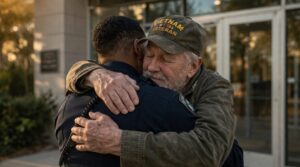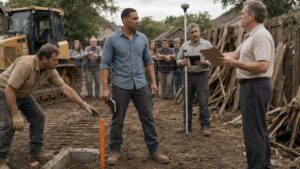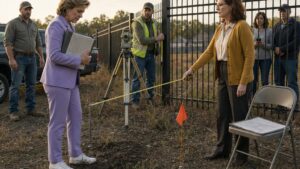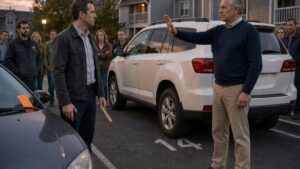
The HOA Tried To Remove George Walker’s Porch Repair Before Learning What His Suitcase Protected
Chapter 1: The Red Tag On A Wet Porch Board
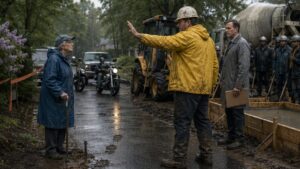
The red tag was already swinging from the porch rail when George Walker opened his front door.
It had been tied there with a strip of white plastic, bright against the damp gray morning, tapping softly against the new board every time wind moved under the eave. The rain had stopped before sunrise, but water still gathered along the edge of the bottom step, beading on the unfinished wood Justin Garcia had set in place two days earlier.
George stood in the doorway with one hand on the jamb and one foot still safely inside the house.
VIOLATION NOTICE, the tag said in block letters large enough for the sidewalk to read.
He did not step out right away.
On the far side of the porch, Christine Smith lifted her phone and took another picture.
“Mrs. Smith,” George said.
She lowered the phone just enough to look over it. She wore a raincoat the color of cream, belted tight, without a drop of mud on the hem. Behind her, Justin crouched beside the lower step with a measuring tape still stretched across the riser. His tool bag sat unopened near the post.
“Mr. Walker,” Christine said, brisk but not unkind. “Please stay inside for now.”
George looked at the wet porch board under the tag. “That’s my porch.”
“That’s exactly why I’m here.”
Justin slowly let the measuring tape retract. The metal strip whispered back into its case.
George hated that sound. It sounded like work being undone.
Christine stepped closer to the rail and photographed the temporary handrail Justin had clamped along the left side of the steps. It was plain pine, sanded but unpainted, held with temporary brackets until the permanent posts could be set. It looked raw beside the white columns and dark shutters Magnolia Ridge required. George knew that. He was not blind to the difference. But raw wood did not bother him as much as a wet step with no place for his hand.
“You didn’t wait for approval,” Christine said.
“I waited three weeks.”
“The architectural committee has a process.”
“The board was loose.”
“The board was reported as altered without authorization.”
George took one careful step forward and stopped at the threshold, where the old brass strip met the porch. The air smelled of wet mulch and sawdust. His right knee had stiffened overnight, the way it did whenever rain came in from the west. He looked past Christine toward the street, where two neighbors had slowed their morning walk just enough to see without admitting they were watching.
Justin stood. “I can show you what I found underneath, Ms. Smith. The old support’s split clear through on the left side. He needs—”
Christine turned to him. “Mr. Garcia, you were told by email not to proceed with exterior work on this property until the application was complete.”
“I was told the final style needed review,” Justin said. “Not that I couldn’t make a temporary brace.”
“Temporary exterior structures are still exterior structures.”
George kept his hand on the doorframe. The wood under his palm was smooth from years of touching the same place. Virginia used to tease him for polishing the house one worry at a time.
He said, “It isn’t a structure. It’s a board and a rail.”
Christine glanced at him again, and this time her eyes softened for half a second before the procedure returned. “Mr. Walker, I understand you may see it that way. But the association has uniform standards for a reason. We also have liability concerns. If that handrail fails, if someone trips, if a contractor performs unapproved work—”
“If the step gives way,” George said, “what do you call that?”
Justin looked down.
Christine’s mouth tightened. “That is why repairs need to be approved and completed correctly.”
“That is why he’s here.”
“The committee has not approved this design.”
“It’s not a design.”
Christine looked toward the rail, toward the raw pine, toward the little metal brackets that made the whole porch look, George knew, like a thing caught halfway through asking permission. “It is visible from the street.”
“So am I,” George said.
The words came out sharper than he meant them to. He regretted them when Justin glanced away and Christine’s expression cooled.
A delivery truck rolled past, tires hissing through shallow water at the curb. From across the street, Amy Lopez stood near the end of her driveway with a paper cup in her hand. She was not pretending not to look. Her eyes moved from the red tag to George’s slippers, then back to the half-finished rail.
George pulled his robe tighter.
Christine took a folded document from a clear plastic sleeve. “This is a formal stop-work notice. No further construction, alteration, painting, installation, or repair activity is permitted on this visible exterior area until the board hears the matter.”
“The board hears it when?”
“Tonight. Emergency agenda, seven o’clock, at the clubhouse.”
George looked at Justin. “You said you could set the post today.”
Justin shifted his weight. “I could’ve.”
Christine held out the stop-work notice.
George did not take it.
The bottom step shone with rain. Before Justin had put the temporary board down, the old plank had dipped under George’s foot with a soft, rotten give that traveled up his leg and into his stomach. He had not told Justin that the dip was worse in the evening. He had not told him about gripping the doorjamb until his fingers cramped. He had not told him that some nights he stood inside the door calculating whether the mailbox could wait until morning.
Christine pinned the notice under the red tag when he did not reach for it.
“Please don’t remove that,” she said. “It needs to remain visible until the hearing.”
George gave a small breath through his nose. “Visible to who?”
“To the association.”
“To the people walking by.”
She did not answer.
Justin bent to pick up his tool bag. “Mr. Walker, I’m sorry. If they’re issuing a stop-work—”
“You leaving?”
“I can’t risk my license on a dispute with an HOA.”
George nodded once, not because he agreed, but because Justin was young and had a truck payment and no reason to make an enemy of Magnolia Ridge for an old man’s porch.
Justin closed the latch on his tool bag. “I’ll come back when they clear it.”
“When,” George repeated.
Christine stepped back onto the walkway, careful to avoid the muddy edge where Justin had lifted two bricks to check the settling. She took one more photo, this time wide enough to include the whole front of the house: the red tag, the damp step, the raw rail, and George in the doorway.
He looked down at his feet. He had meant to change into shoes before anyone arrived.
“I’ll attend tonight,” he said.
Christine lowered her phone. “That would be best. Bring any documents relevant to the application.”
“I have them.”
“Good.”
“They’re in my suitcase.”
Her eyes flicked toward the dark hallway behind him, as if expecting to see clutter piled there. “You don’t need to bring everything. Just the application copies.”
George thought of the brown leather suitcase beside Virginia’s chair, its handle cracked, its brass latches stubborn, its corners darkened from years of closets and car trunks and hospital rooms. Everything that mattered about this porch was inside it because everything that mattered had stopped fitting neatly in folders.
“I’ll bring what I need,” he said.
Christine’s face settled back into professional patience. “As long as you understand that nothing can be touched before then.”
The wind moved under the eave. The red tag tapped the wet board.
George looked at Justin’s measuring marks still penciled across the step, small dark lines that rain had begun to blur.
Christine turned to the contractor. “Mr. Garcia, please pack up completely. No tools, no materials, no further measurements. Mr. Walker is not allowed to alter, repair, stabilize, paint, remove, or touch this area until the board decides tonight.”
George’s fingers tightened against the doorframe.
The porch, with its raw rail and red tag, waited inches from his foot like a question nobody else intended to answer.
Chapter 2: The Suitcase Beside Virginia’s Chair
By noon, the red tag had stopped swinging.
The rain had settled into the wood and the air had gone still, making the porch feel staged, as if the house were holding its breath for every passing car. George closed the front curtains halfway, then opened them again. Closed, they made him feel hidden. Open, they made the red tag visible from the living room.
Virginia would have left them open.
“Let them look,” she used to say, mostly about neighbors, sometimes about doctors, once about the funeral director when he had spoken to George instead of to her. “People who stare too long usually learn something by accident.”
George stood in the center of the living room and looked at her chair.
It remained angled toward the front window, with the faded blue cushion pressed flat where she used to sit. He had moved most of her things in the first year because everyone told him that was healthy. The hairbrush. The pill organizer. The slippers by the bed. But the chair stayed. The small table beside it stayed. And beneath that table, pushed back where visitors would not notice it unless they were looking for dust, sat the old brown suitcase.
George bent slowly, bracing one hand on the chair arm before reaching for the handle.
The leather had cracked in a spiderweb pattern around the grip. One brass latch stuck unless he pressed down and lifted at the same time. Virginia had bought it before they were married, secondhand, from a woman who said it had crossed three states on top of a bus. George had carried it on their honeymoon, then to every motel when the children were small, then to the hospital the last winter Virginia decided she did not want a hospital bag that looked like one.
Now it made a dry, reluctant sound as he dragged it into the light.
He set it on the coffee table. The table dipped under the weight.
For a moment he only rested his hand on the lid.
Outside, a car slowed. He waited for it to pass.
Then he opened the latches.
The smell came first: paper, old leather, a faint trace of cedar from the closet where it had once lived. Inside, George had arranged things in stacks because disorder made people think a thing had no purpose. On the left were HOA letters held with rubber bands. On the right were contractor estimates. In the pocket were photographs. In a white envelope, folded twice though he hated the crease, was the discharge paper from the clinic.
He lifted that one, then put it down.
Not yet.
He took out the first application instead. Magnolia Ridge Architectural Modification Request. Date stamped three weeks earlier. Porch step repair. Handrail installation. Safety-related. Attached photos.
He placed it on the table.
Then the second notice: returned for missing paint specification.
Then his reply: same white as existing trim, pending approval.
Then another message asking for railing profile.
Then Justin’s estimate, with the words temporary stabilization recommended circled in blue ink.
He had circled those words himself after the rainstorm last Thursday, when the old step had sunk under him and his hand had scraped along the brick wall because there had been no rail to catch.
He did not include that in the first email. He had typed, The front step appears unstable. He had deleted, I nearly fell.
Nearly sounded too close to failed.
George gathered the papers into one stack. He could carry only the relevant ones, as Christine had said. But the relevant ones did not explain why he had called Justin before approval came through. They did not explain why the garage entrance was worse, why the side path pooled water, why the back door stuck in damp weather. They did not explain that the front door had become not just a door but the last route into the life he recognized.
He reached into the side pocket and drew out a small brass key on a blue ribbon.
Virginia’s front-door key.
She had tied the ribbon on it when her fingers began dropping things. Blue, because she said it was easier to see against the bottom of her purse. George had told her she could use the garage remote. She had looked at him as if he had suggested they move to another planet.
“I came into this house through the front door,” she had said. “I’ll keep doing it while I can.”
After that, they counted the steps.
One from the walkway. One onto the first board. One onto the porch. Pause. Hand on the column. Laugh if the roses had grown wild enough to brush her sleeve. Then inside.
The first time she could no longer manage it, George had carried her. She had scolded him because his back was bad, then cried into his shoulder because both of them knew that was not the real reason.
He set the key beside the application.
The afternoon light shifted across the rug. Dust showed itself and vanished.
George took out the photographs next. The porch from last month. The gap beneath the step. A close-up of the split support. A picture of the temporary rail Justin had placed, plain and unfinished but firm. And one older photograph, softer at the edges: Virginia standing on the porch years ago, one hand on the white column, her other hand raised against the sun. Behind her, the door was open.
George did not remember taking it. That bothered him. He could remember the dress she wore, the sound of sprinklers ticking across the lawn, the smell of tomato vines near the side yard. But he did not remember lifting the camera.
He tucked that photograph beneath the repair invoices, then pulled it back out and placed it on top.
His phone buzzed on the kitchen counter.
He let it buzz twice before answering.
“Mr. Walker?” Justin’s voice came through low, as if he were speaking from a place where he did not want to be overheard. “Just checking on you.”
“I’m here.”
“I’m sorry about this morning.”
“You didn’t put the tag there.”
“No, sir. But I should’ve waited.”
George looked toward the window. “Would waiting have made the board less rotten?”
Justin was quiet.
George softened his voice. “You have work to protect. I know that.”
“They’ll probably ask for a full drawing tonight. Maybe a painted sample. Maybe a committee vote next week.”
“Next week,” George said.
“You got someone who can come by? Until it’s done?”
George’s eyes moved to the discharge paper in the suitcase. It contained a printed line he hated more than the red tag: Patient advised to avoid stairs or uneven wet surfaces without assistance.
“No,” he said. Then, after a pause, “I have what I need.”
Justin did not argue. “Be careful with that step.”
George ended the call.
The house settled around him. A faint creak came from the front porch, though no one stood on it. Maybe wood cooling. Maybe water shifting. Maybe only the sound of him paying too much attention.
He closed the suitcase halfway, then opened it again and added the discharge paper to the stack.
For an hour, he practiced what he would say.
The repair was temporary.
The approval delay created the emergency.
The handrail could be painted.
The board could be replaced with whatever profile matched their booklet.
He did not practice saying he was afraid. He did not practice saying that if they made him use the garage, he would stand at the threshold each morning and see the slick concrete slope where Virginia had once fallen against the recycling bin, laughing first because embarrassment came before pain. He did not practice saying that every alternative route through his own house felt like someone quietly rearranging his life without asking him.
At four, the sky darkened again.
The television in the kitchen showed a storm warning sliding across the bottom of the screen. Heavy rain expected overnight. Localized flooding possible.
George put the documents into the suitcase in careful order. Application. Returned notice. Reply. Estimate. Photos. Discharge paper. Virginia’s key in the inner pocket, because he could not bear the thought of it loose among board minutes and fine schedules.
Then he carried the suitcase to the front hall.
It was heavier than he remembered.
He opened the door to test the air. Damp wind pressed against his face. The red tag hung still from the temporary rail, its plastic sleeve clouded with moisture. George stepped onto the threshold and put one shoe on the porch board.
Below him, the step gave a small, hollow creak.
Not loud. Not dramatic.
Enough.
George held the suitcase handle until his knuckles paled and waited for the sound to stop.
Chapter 3: The Marble Desk Would Not Let Him In
The Magnolia Ridge clubhouse had a glass canopy that made the rain look expensive.
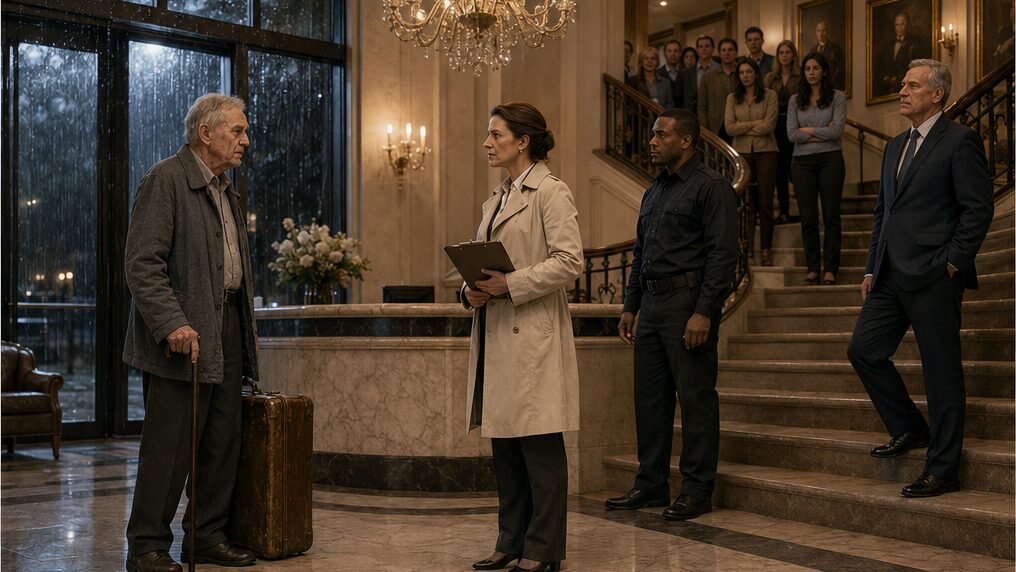
Water slid down its edges in clean silver lines while George stood beneath it, suitcase in one hand, cane in the other, staring through the double doors at the marble lobby beyond. Warm light spilled across polished floors. A chandelier floated above the reception desk. On the far wall, under the curve of the staircase, hung the large portrait of the community’s founder, a man in a dark suit with one hand resting on a model of the subdivision as if he had personally arranged every roofline.
George had lived in Magnolia Ridge before the second fountain worked.
He wiped his shoes twice on the mat and stepped inside.
The desk attendant looked up first. Young, uncertain, already glancing toward Christine Smith, who stood at the side of the marble counter with a clipboard tucked against her ribs.
Christine’s eyes moved immediately to the suitcase.
“Mr. Walker,” she said. “The board is already in session.”
“That’s why I’m here.”
“The emergency agenda is limited tonight.”
“I’m on it.”
“Your property is on it.”
George set the suitcase upright beside his leg. Rainwater dripped from the hem of his coat onto the polished floor. He saw Christine notice.
Behind her, a staircase curved up to the second-floor meeting room. Several residents stood along the landing with paper cups and folded agendas. Amy Lopez was among them, one hand on the railing. Scott Davis stood higher than the others, speaking to two board members, his navy suit crisp, his gray hair combed back in a way that seemed built to survive weather.
At the top of the stairs, a projection screen glowed through open double doors.
George saw his porch on it.
The red tag. The raw handrail. The damp board.
For a second, he forgot to move.
Christine came around the desk. “Mr. Walker, we received your message that you would attend, but residents are not permitted to bring oversized personal items into the meeting room.”
George looked down at the suitcase. “These are documents.”
“You may remove the relevant pages and carry them in.”
“They are already organized.”
“The suitcase itself can stay at the desk.”
“No.”
Her expression tightened. “Mr. Walker.”
“No,” he repeated, quietly enough that the desk attendant looked away.
Christine took one step closer, lowering her voice. “This is not meant to embarrass you. We have a policy. Bags, boxes, large items—anything that could block an aisle or create a trip hazard—remain in the lobby.”
George looked past her at the stairs. Scott had stopped talking. Several faces on the landing had turned.
“A trip hazard,” George said.
Christine did not respond to the edge in it. “You can give me the suitcase, or you can reschedule your comments for the regular meeting.”
“The meeting is about my house tonight.”
“The board can review the matter without personal attendance.”
“That seems to be what they started doing.”
Christine’s cheeks colored faintly. “The photographs were submitted as part of the violation record.”
“By you.”
“As property manager.”
“From my porch.”
“From the association-visible exterior.”
George rested his palm on the suitcase handle. The leather felt worn and warm despite the rain. “I’m taking it upstairs.”
Christine turned slightly and nodded toward the security guard near the entrance.
The guard was not a large man, but his uniform made the lobby rearrange itself around him. He approached with the practiced expression of someone hoping calm would do the work before force had to.
“Sir,” he said, “let’s step to the side.”
“I’m fine here.”
“We’re just going to clear the entrance.”
George looked down. He was not blocking the entrance. There was room enough for three people to pass behind him. Still, the desk attendant had gone still, and the residents on the landing had gone quiet in the way people did when they wanted to hear without admitting it.
Scott started down the stairs.
“George,” he called, using the friendly voice men used when they had already decided against you. “No one is refusing to hear you. We just need to keep this orderly.”
George turned toward him. “Then hear me.”
Scott descended another few steps. “We are reviewing an unapproved exterior alteration. That’s all tonight is.”
“That board was split.”
“We haven’t established that.”
“You didn’t look at it.”
“We have photographs.”
George gave a small laugh, too dry to be humor. “Photographs don’t step on it.”
A murmur moved across the landing.
Christine said, “Mr. Walker, this is exactly why comments need to happen in the meeting room, according to procedure.”
“Then let me in.”
“Without the suitcase.”
“No.”
Scott reached the bottom of the stairs. Behind him, the founder’s portrait looked down from the wall, smooth-faced and certain. Scott adjusted his cuff. “What’s in it that can’t be carried in a folder?”
George felt every eye settle lower, toward the suitcase. The old leather, the dark corners, the brass latches rubbed dull. He heard, without anyone saying it, what it looked like in this lobby. Not evidence. Not memory. Baggage.
“My porch,” George said.
Scott blinked once. “Excuse me?”
“The part of it you didn’t photograph.”
Christine’s voice hardened. “Mr. Walker, you were asked to bring relevant documents, not make a scene.”
“I didn’t bring the scene. You put it on the screen.”
The guard touched George’s elbow.
Not hard. Not yet.
But the contact moved through him like cold water.
George looked at the hand on his sleeve, then at the guard’s face. The man seemed almost apologetic, which somehow made it worse.
“Sir,” the guard said, “please step away from the desk.”
George’s grip closed around the suitcase handle.
Upstairs, Amy took one step down, then stopped.
Scott’s voice lowered. “George, don’t make this more difficult than it needs to be.”
“Difficult for who?”
“For everyone.”
George looked at the projected image glowing above them. His porch enlarged, flattened, judged from one angle. The temporary rail looked rough. The red tag looked official. There was no sound in the picture, no wet give of wood under a bad knee, no midnight hand reaching for a doorframe. Just evidence against him.
He turned back to Christine. “That step is the only safe way through my front door.”
Scott sighed. “That is exactly the kind of claim the board needs documentation for.”
“It’s in the suitcase.”
“Then remove it.”
“No.”
Christine folded her clipboard against her chest. “If you refuse to comply, we’ll have to ask you to leave.”
George heard himself breathe. One breath. Then another.
He thought of Virginia’s key in the inner pocket. He thought of her saying, Let them look. He wondered what she would say now, watching him stand in a lobby bright enough to make his coat look older than it was.
The guard’s hand tightened gently at his arm.
George did not pull away. He did not raise his voice. He simply set the suitcase upright in front of him and placed his cane beside it, as if arranging himself where he meant to remain.
“You’re not looking at a decoration problem,” he said. “You’re looking at the only way I can get through my own front door when it rains.”
No one spoke.
Then Scott said, “The board will not be pressured by emotional statements.”
George nodded once, slowly. That sentence seemed to settle somewhere beyond anger, into a place quieter and more permanent.
Christine gestured toward the entrance. “Please escort him outside.”
The guard guided George by the arm. The suitcase wheels bumped once over the threshold between marble and mat. George kept his hand on the handle and walked because falling in front of them would have given them another reason.
The lobby turned with him. Faces on the staircase. The desk attendant staring at the counter. Amy gripping the rail. Scott standing below the founder’s portrait, looking less satisfied than George expected and no less firm.
Outside, the rain came harder.
Under the glass canopy, the warm light from the lobby ended at George’s shoes. Beyond it, the driveway shone black and silver. The guard released his arm as soon as they were through the doors.
“Sorry, sir,” he said.
George did not answer.
Scott came out a moment later, holding a folder under his suit jacket to protect it from the rain. Christine remained just inside, visible through the glass.
Scott stopped where the canopy kept his shoulders dry. “George, I don’t enjoy this.”
George looked at him.
“But the board has to apply the rules evenly,” Scott continued. “You’ll receive the written order tomorrow morning. Daily fines begin at sunrise unless the unapproved repair is removed.”
Rain struck the pavement in steady white bursts.
George’s suitcase stood beside him, wet at the corners, closed.
“And the step?” George asked.
Scott’s eyes flicked toward the suitcase, then back to George’s face. “Use another entrance until approval is complete.”
George gave a small nod, as if Scott had answered a different question very clearly.
Then he picked up the suitcase, turned from the glass doors, and stepped into the rain.
Chapter 4: The Fine They Called A Safety Measure
The written order arrived folded into George’s mailbox at 8:12 the next morning, sealed in a clear sleeve so the rain could not soften it before he did.
He saw the corner of it from the kitchen window. White paper, black lettering, Magnolia Ridge letterhead. Whoever delivered it had slid it behind the mailbox flag with the same care a person might use to pin a note to a hospital bed.
George watched it for ten minutes.
The storm had not been as bad as the television promised, but enough rain had fallen to leave dark streaks across the walkway and a shallow puddle near the bottom step. The red tag still hung from the temporary rail. Water had collected inside its plastic sleeve, blurring the word VIOLATION until it looked swollen.
He put on shoes, then changed to the pair with better soles. He took his cane from beside the refrigerator. At the front door, he looked at the porch and considered waiting until the mail carrier came. Then he hated himself for considering it.
The first step out was not the dangerous one. The porch board beneath the threshold was old but steady. The danger waited below, where the temporary reinforcement stopped short of being finished. Justin had stabilized the worst of it, but the old support still shifted in the damp. The board needed to be replaced, not admired from the street.
George placed his cane on the porch.
The red tag moved lightly in the wind.
“Not today,” he muttered, though he was not sure whether he meant the step, the board, or his own body.
He eased down, keeping one hand on the raw pine rail despite the tag tied to it. The wood was cool and slightly damp. It held.
At the mailbox, he pulled the sleeve free and tucked it under his arm before turning back. Going up was worse than going down. A body could pretend, on the way down, that gravity was assistance. Going up, there was no pretending. His right knee complained before he lifted it. The wet sole of his shoe found the bottom step, and for one suspended instant the wood dipped just enough to remind him what everyone else was deciding from dry rooms.
He caught the rail.
His breath stopped, then came back in a small hard burst.
Across the street, a curtain moved.
George climbed the rest of the way and closed the door behind him before opening the notice.
At the kitchen table, beneath the weak morning light, the letter arranged his life into numbered paragraphs.
Unauthorized Exterior Alteration.
Stop-Work Order.
Daily Fine Schedule: $100 per day beginning 6:00 a.m. Tuesday.
Failure to Restore Property to Approved Condition May Result in Escalation, Including Legal Review, Lien Assessment, or Forced Compliance Measures Where Permitted.
He read that last line twice, then set the page down and looked toward the front hall, where the suitcase stood upright with rain still darkening one corner.
Forced compliance measures.
It was an impressive phrase for tearing out a board.
George took his checkbook from the drawer. He did not know why. Perhaps because numbers, unlike people, did not change their tone when they wanted something from you.
He wrote the balance on the back of an old envelope. Then the power bill. The prescription refill. The property tax installment already set aside. Groceries. Justin’s deposit, already paid. The estimate balance if work resumed.
Then the fines.
One day, he could absorb. Two, with irritation. A week would hurt. A month would make the house feel less like something he owned and more like something he was being permitted to occupy.
He put the pen down.
The room hummed around him. Refrigerator. Clock. Rainwater ticking from the gutter outside the kitchen window. He remembered Scott under the glass canopy, protected from the rain, saying use another entrance until approval is complete, as if entrances were interchangeable and old habits could be rerouted like sprinkler lines.
George rose and brought the suitcase to the table.
This time he did not hesitate before opening it. He found the first application and laid it beside the violation letter. Then the returned request for paint specification. Then the email asking for railing profile. Then the printed photograph Christine had taken before the repair began, the one where the split support showed clearly under the old step because Justin had shone a flashlight into the gap.
He had submitted that photograph.
They had returned a question about color.
He found the second page of the committee response and traced the line with one finger: Exterior visible components must conform to approved community aesthetic standards prior to commencement of work.
Prior to commencement.
There was nothing in that sentence about a loose board. Nothing about rain. Nothing about the moment a person placed a foot where they had placed it for thirty years and felt the house fail to meet him.
He added the new violation to the suitcase, then removed it again.
It did not belong with the earlier papers yet. It was too fresh. Too sharp.
At eleven, Justin called.
“I got copied on the stop-work,” he said.
“I figured.”
“They’re serious about it.”
“So is the step.”
Justin exhaled. George could hear traffic behind him. “Mr. Walker, I can’t come back until they lift it. But if the board lets me, I’ll prioritize you. I mean that.”
“I know.”
“There’s one thing. The handrail profile they want? I can match it. Costs more, but not crazy. The issue is the emergency part. They don’t like that you started.”
“They didn’t like that I couldn’t wait.”
Justin was quiet. “You want me to send another note saying what I found?”
“You already sent one.”
“I can send it stronger.”
George looked at the violation letter. “No. Not yet.”
“Sir—”
“They’ve had words. They need to look.”
After the call, George warmed soup and forgot it on the stove until the smell changed. He ate crackers instead. At two, he went to the garage entrance and opened the door to the side path.
Water lay across the concrete in a long, dull sheet. The threshold dipped where the slab had settled years ago, a problem he had meant to fix before Virginia got sick and everything else became more urgent. There was no rail there. Only the slick trim of the doorframe and a recycling bin he had moved farther away because of the memory of her shoulder striking it.
He closed the door.
In the front hall, the red tag glowed faintly through the sidelight.
By late afternoon, the sky had cleared enough for the neighborhood to come outside. Lawn crews whined two streets over. A child’s scooter rattled on the sidewalk. George carried an empty mug to the sink and saw Amy Lopez walking toward her mailbox, her phone in one hand, her eyes already on his porch.
He did not blame her for looking. The tag was designed to be seen.
He took the violation letter, folded it once, and slipped it into the suitcase.
Then he opened the front door.
The air smelled of wet grass and warmed pavement. George stepped carefully onto the porch, meaning only to straighten the red tag so it would stop knocking against the rail. He reached for the plastic sleeve, but a gust lifted it away from his hand. He shifted his weight without thinking.
His shoe found the slick edge of the unfinished board.
The step dipped.
His cane skidded against the wet porch.
George grabbed for the temporary rail, fingers closing around raw pine hard enough to splinter skin. Pain flashed through his palm. For a moment, the whole street tilted: mailbox, curb, Amy at the edge of her yard, the red tag swinging between him and the ground.
He did not fall.
That seemed important.
He stood very still until his knee stopped shaking.
Across the street, Amy lowered her phone.
“Mr. Walker?” she called.
George lifted his head, one hand still gripping the rail the HOA had ordered him not to touch.
“I’m all right,” he said.
But Amy did not move away.
Chapter 5: The Neighbor Who Finally Watched His Route
Amy Lopez crossed the street with the careful speed of someone trying not to make help look like rescue.
George saw that and disliked her a little less.
She stopped at the bottom of his walkway, not on the porch, not close enough to make him feel cornered. In one hand she still held the paper cup from earlier. In the other, her phone hung loose, screen dark now.
“I saw you slip,” she said.
“I didn’t slip.”
She looked at his hand on the rail.
George let go slowly. A thin splinter had raised a line of red across his palm. He tucked his hand against his side before she could see it clearly.
Amy’s gaze moved over the porch: the raw pine handrail, the red tag, the damp step, the stop-work notice under plastic. “This looks dangerous.”
“That’s what I told them.”
“I mean the repair.”
He almost smiled. Not from humor. From exhaustion.
“The repair is why I’m standing,” he said.
Amy’s mouth closed.
A car passed behind her, slowing near the curb. The driver looked toward George’s porch, then accelerated. Magnolia Ridge had always been a neighborhood that noticed ladders, paint cans, and moving trucks. Illness, loneliness, unpaid bills, fear—those were private until they changed the view from the street.
Amy stepped closer, stopping where the walkway met the first rise. “I didn’t mean it like that.”
“You said what it looks like.”
“It does look unfinished.”
“It is.”
“And the tag says—”
“I can read the tag.”
She flinched a little, and George regretted that too. He had spent most of his life believing manners were a kind of fence a person maintained even when tired. Lately, boards were loose everywhere.
Amy glanced down at the bottom step. “Can I ask why you don’t use the garage until they approve it?”
Because Scott told you to ask, George thought.
Instead he said, “You can ask.”
She waited.
He looked toward the side of the house. The garage door faced the short driveway, clean and white, with a neat lantern beside it. From the street, it looked easier. Closer to the car. No steps from the porch. No red tag. People liked what looked easy from the street.
“Come here,” George said.
Amy blinked. “What?”
“You want to see the garage route. Come see it.”
He turned before she could answer. Going back into the house required the same step that had nearly taken him down. He took it slowly, letting Amy watch. Not because he wanted pity. Because he wanted accuracy.
Inside, the front hall smelled faintly of old paper from the suitcase standing near the wall. Its lid was closed, but not latched. A corner of the violation letter showed between the edges. Amy’s eyes caught on it as she entered.
George pretended not to notice.
He led her through the living room, past Virginia’s chair, past the small table where a round mark from an old vase had never faded. Amy paused by the chair only a moment, enough to understand the room had been arranged by two people and maintained by one.
The kitchen was clean except for the soup pan soaking in the sink. George opened the door to the garage.
Warm damp air rose from the concrete. The garage smelled of cardboard, motor oil, and rain pushed under the door. The recycling bin stood against the far wall. Beside it, the side threshold dropped onto the sloped walkway.
Amy looked down.
A shallow band of water crossed the concrete just outside. Not deep. Not dramatic. Enough to turn the smooth surface slick. There was no rail, no post, no column to grip. Only the narrow doorframe and a metal weather strip polished by years of use.
“The garage floods?” she asked.
“Not floods. Settles.”
“That’s still water.”
“It dries.”
“When?”
“When the sun wants it to.”
Amy stepped to the threshold and placed one foot out, testing. Her shoe slid a fraction. She caught the doorframe with her hand.
George said nothing.
She looked back at him, something uncomfortable passing across her face.
“I thought you were just being stubborn about the front,” she said.
“I am stubborn about the front.”
“Why?”
George turned from the garage and walked back into the kitchen. For a moment he considered ending the conversation there. Amy had seen enough. The route had made its own argument. But outside, the red tag still hung on his porch, and tonight the board would sleep believing they had been reasonable.
He pointed toward the living room. “Virginia used the front.”
Amy followed him more quietly this time.
At the edge of the living room, George stopped near the chair. He did not touch it. “When she got sick, people kept telling us to make things easier. Move the chair. Use the garage. Park closer. Stop planting roses. Stop taking the long way. Every suggestion was sensible. Every one took a piece of the house away before she was ready.”
Amy looked toward the front window, where the porch rail cut across the view.
“She died here?” Amy asked, then immediately looked ashamed of the question.
George saved her from apologizing. “No. But she lived here as long as she could.”
He moved to the front hall. The suitcase stood between them, worn and square and silent.
“What’s in there?” Amy asked softly.
“Things I don’t want strangers sorting.”
She nodded.
Outside, a dog barked twice. Somewhere down the block, a lawn mower stopped, leaving the neighborhood too quiet.
Amy folded her arms. “I was at the clubhouse last night.”
“I saw you.”
“I didn’t know they wouldn’t let you in.”
“They let my porch in.”
Her face tightened. “Scott said the board couldn’t make exceptions just because someone ignores the process.”
George reached for the front doorknob. “I didn’t ignore it.”
“No,” Amy said. “I’m starting to see that.”
He opened the door. The porch waited, tagged and damp. The air outside had cooled.
Amy stepped onto the porch behind him, then hesitated as the lower board gave a small creak beneath his cane.
“You shouldn’t be using this,” she said.
“No.”
“But you can’t use that garage either.”
“No.”
She looked at the red tag as if it had changed language while she was inside. “What are you going to do?”
George did not answer immediately. He watched a bead of water slide down the plastic sleeve and drop onto the raw pine.
His phone rang inside the house.
He let it ring once, twice, then reached through the open door to pick it up from the hall table. Scott Davis’s name filled the screen.
George answered without greeting.
“George,” Scott said, his voice smoothed into reason. “I’d like to avoid this becoming more expensive for everyone.”
George looked at Amy. She looked away, giving him the dignity of not listening while standing close enough to hear.
Scott continued, “The board is willing to consider a simple compromise. Remove the temporary repair, use your garage entrance for now, and resubmit the handrail proposal with the proper profile. We can probably get it on next month’s agenda.”
George’s eyes moved from the tagged rail to the garage wall visible through the house behind him.
“Next month,” he said.
“It’s the cleanest path.”
George closed his injured hand around the phone. “Clean for who?”
Chapter 6: The Suitcase Opens Without Saving Him
On Wednesday morning, Justin Garcia parked his truck at the curb and did not bring his tool bag up the walk.
That told George the answer before either of them spoke.
Justin stood below the porch with both hands in the pockets of his work jacket, looking at the red tag as if it had become a person he had to negotiate with. The sky behind him was flat and white. More rain threatened without falling.
“I can’t touch it,” Justin said.
“I didn’t ask you to.”
“No, sir. But you were thinking it.”
George stood inside the open doorway, shoes planted on the brass threshold. His right hand was bandaged from the splinter. He had done it himself, badly, with gauze that kept lifting at the edges.
Justin noticed. “That from the rail?”
“From not falling.”
The contractor looked away toward his truck. “That stop-work names me too. If they report it, even if nothing comes from it, I lose weeks dealing with paperwork.”
“You have a business.”
“I also have eyes. That step’s not safe.”
George appreciated that he did not say, You’re not safe. It would have been a small difference to some people. To George, it was the whole argument.
Justin reached into his jacket and took out a folded paper. “I wrote a statement. Not legal. Just what I found. Split support, water damage, temporary stabilization recommended until full replacement. I didn’t send it to them. Figured it should be yours first.”
George took the paper.
The gesture forced him to step onto the porch. He did it slowly. Justin watched the step, not George’s face.
The paper was plain, direct, and signed at the bottom. No drama. No begging. Just facts. George liked it for that reason.
“Thank you,” he said.
Justin nodded. “You want my advice?”
“No.”
“I’m giving it anyway.” Justin looked up at him. “Take the garage for a few weeks if you can. Let them have their forms. I know it’s wrong, but wrong can still cost you.”
George folded the statement once. “You think I’m fighting about the board.”
“I think you’re fighting about something bigger than the board. But the board is what they can fine.”
The words landed more gently than George expected.
He looked through the open doorway. From here he could see the front hall, the suitcase near the wall, Virginia’s chair beyond it. The house held still, waiting for his answer.
“Come in,” George said.
Justin hesitated. “You sure?”
“I’m not asking you to fix anything.”
Inside, Justin removed his cap even though George had not asked. That small respect steadied something in the room.
George carried the suitcase to the kitchen table. It looked out of place there, too large, too old, too full of private years for a surface where he usually sorted coupons and medicine bottles. Justin remained standing until George said, “Sit.”
The stuck latch resisted. George pressed down and lifted. The suitcase opened with a dry crack.
Justin’s eyes went first to the papers, then away, as if he had opened a closet by mistake.
George placed Justin’s new statement on top of the existing stack. Then he removed the application, the returned paint notice, the railing-profile request, the photos of the split support, and the violation letter. He set each one down carefully, not because Justin needed the full history, but because George needed to see that he had not imagined the order of events.
“I filed before you came,” George said.
Justin leaned forward. “I see that.”
“They asked about paint.”
“That tracks.”
“They asked about profile.”
“They love profiles.”
George looked at him.
“Sorry,” Justin said.
“No. They do.”
The faintest smile passed between them, then disappeared.
George reached into the inner pocket and touched Virginia’s key. For a moment, he thought he would leave it there. There were papers enough. Facts enough. The board did not need to see a dead woman’s key to understand wood rot.
But the papers alone made him look organized. They did not make the porch true.
He drew the key out by its faded blue ribbon and laid it beside the violation notice.
Justin did not ask.
George found the old photograph next. Virginia on the porch, hand lifted against sunlight. He placed it near the key, then sat down because standing had become too much.
“She counted those steps,” he said.
Justin kept still.
“Not always. Near the end. One from the walk. One onto the board. One onto the porch. She hated the garage. Said it made her feel like cargo.”
Outside, a branch scraped lightly against the kitchen window.
George looked at the photograph, but the room changed around it. He saw Virginia in a yellow sweater, thinner than she wanted anyone to admit, pausing with one hand on the column while pretending the pause was for roses. He saw himself beside her, carrying too much, offering too many shortcuts, thinking love meant reducing distance.
“She told me not to make the house smaller before life did,” he said.
Justin’s gaze dropped to the table.
George touched the blue ribbon. “After she died, everybody said I could make changes. Move things around. Use the easy entrance. Sell if I wanted. Get somewhere with no stairs.” He closed his hand, not around the key, but near it. “They meant well. Most people do when they start taking choices away.”
Justin said, “Mr. Walker—”
George shook his head once. Not angry. Finished.
“This suitcase went with us to the clinic. To the last specialist. To her sister’s house when she still thought visiting would help. Afterward, I put house papers in it because I didn’t want them scattered. Then repair papers. Then notices. It became the place where things went when people wanted me to explain why staying here mattered.”
He looked at Justin then. “I should not have to empty it for strangers before they look at a step.”
Justin sat back.
“No, sir,” he said. “You shouldn’t.”
George took the discharge paper from the side stack. He unfolded it, saw the printed warning, and felt the old anger rise. Not at the clinic. Not at the words. At the way a sentence could become a handle for other people to grab.
Patient advised to avoid stairs or uneven wet surfaces without assistance.
He folded it again without showing Justin.
“That’s the one they’ll use,” Justin said quietly.
George looked at him.
“If they see it wrong. They’ll say it proves you need supervision.”
George gave a small nod. “That’s why they haven’t seen it.”
The house seemed to settle around the confession.
Justin tapped one finger beside his statement. “Then don’t lead with that. Lead with the delay. Lead with the split support. Make them inspect it. They can argue style from a photo. Harder to argue rot while standing on it.”
George looked toward the front hall.
Make them inspect it.
All Tuesday, Scott’s compromise had sat in his head like an insult dressed as help. Remove the repair. Use the garage. Wait for approval. It sounded reasonable until a person placed it beside water on concrete, beside Virginia’s key, beside the difference between being careful and being managed.
George took the violation notice from the suitcase.
On the front, the printed language was clean and impersonal. He turned it over. The back was blank.
He found a pen in the kitchen drawer, one Virginia had wrapped with tape years earlier so it would not slip from her fingers. The tape had yellowed but still held.
His hand trembled once before steadying.
He wrote slowly, making each word plain enough for a board packet, a photograph, or a courtroom he hoped never to enter.
Inspect the step before you judge the repair.
He set the pen down.
Justin read the sentence and looked at him for a long moment. “You want me there?”
George folded the notice, placed it on top of the suitcase stack, and closed the lid.
“Not to speak for me,” he said.
“No, sir.”
George pressed the brass latches shut. The sound was small, final, and not enough to save him.
But it was enough to carry.
Chapter 7: The Hearing Under The Founder’s Portrait
By Thursday evening, the suitcase felt heavier than it had on Monday.
George carried it through the clubhouse doors anyway.
The rain had stopped an hour before, leaving the glass canopy dripping at its corners and the driveway shining under the lights. His coat was dry this time. His shoes were clean. He had wrapped his injured palm better, with fresh gauze and a strip of tape pulled tight enough to remind him not to reach too quickly.
Inside, the marble lobby smelled faintly of floor polish and coffee.
The desk attendant looked up and froze.
Christine Smith stood near the reception counter with a stack of agendas in her hand. Her eyes went to the suitcase first, then to George’s face. For a moment neither of them spoke.
“I’m here for the hearing,” George said.
“The meeting is already open,” Christine replied.
“I know.”
She looked past him toward the entrance, perhaps expecting the security guard to appear from the side hall. He did, but he stayed near the wall, hands folded in front of him, waiting.
George did not move toward the stairs.
He set the suitcase upright on the marble floor.
“I’ll carry it myself,” he said.
Christine’s expression tightened. “Mr. Walker, we discussed this.”
“No. You told me.”
From the staircase above, voices drifted down. Chairs scraping. Paper shifting. Scott Davis’s measured tone, muffled through the open doors of the meeting room. On the wall behind the stairs, the founder’s portrait watched with the same smooth certainty it had worn on Monday.
Christine lowered the agendas. “The board has agreed to let you speak during resident comment. Five minutes.”
George looked up the stairs. “They gave my porch more than that.”
Her face changed, not softening exactly, but losing some of its polish. “The board is trying to keep the process fair.”
“Then the process can walk slow enough for me to reach it.”
He picked up the suitcase and began climbing.
No one touched his arm.
Halfway up, he paused, not because he wanted to, but because his knee decided the pace. The suitcase pulled at his shoulder. He could feel Christine below him, the security guard behind her, the desk attendant pretending to read something on the counter. Above, the conversation in the meeting room faded as residents noticed him.
Amy Lopez stood at the landing.
She did not offer to take the suitcase. She only stepped aside and held the door open.
George nodded once and passed through.
The meeting room had been arranged to look more official than it was. Folding chairs faced a long table where Scott sat with Christine and three board members. Behind them, the founder’s portrait had a smaller twin in a gilt frame, and beneath it a projector cast a large image onto a screen.
George’s porch filled the wall.
The photograph had been taken from the sidewalk, low enough to make the temporary rail seem crooked and the red tag seem like the most important part of the house. The damp board looked dark and unfinished. The white columns looked embarrassed by it.
Scott stopped mid-sentence.
“Mr. Walker,” he said. “You’ll have a chance to speak shortly.”
George walked to the front row and set the suitcase beside his chair. The brass latches clicked against the metal leg.
Scott watched the suitcase. “For safety reasons, please keep that out of the aisle.”
George moved it six inches.
A few residents shifted. Someone coughed. Amy sat two rows behind him, close enough that he could hear her paper agenda fold in her hands.
Christine resumed reading from a packet. “The property at 114 Magnolia Court has an unapproved exterior alteration consisting of temporary wooden rail installation, visible raw lumber, unfinished step repair, and contractor equipment present after notice.”
“Equipment was gone before the notice was delivered,” George said.
Scott looked at him. “Mr. Walker, please wait your turn.”
George leaned back. Waiting had become a room he was tired of being locked inside.
Christine continued, “The management recommendation is to uphold the stop-work order, impose fines beginning Tuesday as noticed, and require removal of unapproved temporary materials pending submission of a complete architectural package.”
Scott folded his hands. “The issue before us is not whether Mr. Walker may eventually repair his porch. Everyone agrees homeowners can maintain their properties. The issue is process. If every resident begins visible exterior work without approval, we lose the standards that protect all property owners.”
A few heads nodded.
George looked at the projected porch and wondered how many of them had ever noticed the board before Christine put it on the screen.
Scott turned toward him. “Mr. Walker, you may speak.”
George stood carefully. He lifted the suitcase and placed it on the table in front of the board.
Christine sat straighter. “Mr. Walker—”
“It won’t block the aisle there.”
Scott’s mouth pressed into a line. “Five minutes.”
George opened the suitcase.
The sound of the stuck latch was louder in that room than it had ever been in his kitchen.
He did not empty it. He took out only the first application and laid it on the table. Then the returned paint notice. Then the railing-profile request. Then Justin’s statement. Each paper made a small sound against the polished surface.
“I asked before the work started,” George said.
Scott glanced at the documents but did not reach for them. “The application was incomplete.”
“You asked what color. I answered. You asked what profile. I called a contractor. While we waited, the support under the step split more.”
Christine said, “Mr. Walker, no one is disputing that you contacted management.”
“You are fining me as if I didn’t.”
“The problem is commencement before approval.”
George took out the photograph of the split support and slid it forward. “The problem is this.”
Scott looked at the photo. So did the board members nearest him. Christine picked it up, not eagerly.
George reached into the suitcase again. His fingers brushed the folded discharge paper. He left it there.
Instead, he took out the red violation tag.
He had cut it from the temporary rail that morning, wiped the water from the sleeve, and carried it with the papers. A faint muddy streak remained across one corner. Christine noticed at once.
“That tag was required to remain posted,” she said.
“It’s here.”
“You were instructed not to remove it.”
“I was instructed not to touch the repair.” George placed the tag beside the photo. “I touched the tag.”
A murmur passed through the room. Scott raised one hand, and it quieted.
George reached into the inner pocket and took out Virginia’s key by its faded blue ribbon.
He did not hold it up. He did not explain it right away. He laid it beside the violation tag.
The room changed.
Not enough for victory. Enough for attention.
“This key belonged to my wife,” George said. “She used the front door until she couldn’t. She counted the steps when walking got hard. The garage looked easier from outside. It wasn’t easier for her. It isn’t easier for me.”
Scott shifted in his chair. “George, I’m sorry for your loss, but—”
“No.”
The word was not loud, but it stopped Scott cleanly.
George looked at him, then at Christine, then at the projected image of his porch. “Don’t use my wife to make this softer than it is. You put my porch on that screen and called it proof. I’m asking you to inspect it before you judge the repair.”
Christine’s eyes lowered to the key.
George unfolded the back of the violation notice and placed it on the table, the sentence facing the board.
Inspect the step before you judge the repair.
“Mr. Garcia measured it,” George said. “His statement is there. My first request is there. Your delay is there. The split support is there. What is not there is any one of you standing on that step in the rain.”
One of the board members cleared their throat. “Mr. Walker, are you saying the front entrance is medically necessary?”
There it was.
The handle they wanted.
George felt the discharge paper inside the suitcase like heat. He could give it to them and watch the room tilt toward sympathy, or toward control. He could let them decide whether he was safe enough to be believed.
He closed the suitcase halfway.
“I’m saying the step is unsafe,” he said. “I’m saying the repair was started because waiting made it worse. I’m saying I will not remove the only thing keeping me steady until someone from this board stands where I stand.”
Scott leaned back. “You can’t simply refuse compliance.”
“I just did.”
The words came out calm. They surprised even him.
Silence opened around the table.
Christine spoke more quietly. “If the board inspects and determines the step is unsafe, emergency stabilization could be permitted with conditions.”
Scott turned to her.
She kept her eyes on the documents. “The guidelines allow emergency safety work. It still requires review afterward, but fines may be held if the emergency is verified.”
George watched Scott absorb that in front of the room.
No one applauded. No one gasped. The residents only sat with the uncomfortable knowledge that the rulebook had contained a door nobody had offered him.
Scott looked at the photo again. Then at George. “The board will discuss.”
George closed the suitcase. “Discuss at my porch.”
“Mr. Walker—”
“You have the picture. You have the papers. You have the tag.” George lifted the suitcase from the table. “Now come look at the step.”
He turned before anyone could dismiss him.
Amy stood as he passed her row. She did not say anything. Her eyes were bright, but she held whatever she felt behind her teeth.
At the doorway, George stopped beneath the smaller portrait of the founder, then looked back at Scott.
“You can find me at the place you keep photographing,” he said.
Then he walked down the stairs one at a time, carrying the suitcase himself.
Chapter 8: The Handrail That Stayed After The Rain
On Friday morning, Scott Davis stood on George Walker’s bottom step in polished shoes and did not speak.
Rainwater ran along the edge of the board and gathered where the old support dipped. Christine Smith stood beside the walkway with a clipboard held against her coat. One board member waited near the mailbox. Amy Lopez watched from her own driveway, not crossing the street, not making herself part of what George had to do.
Justin Garcia stood by his truck with his tool bag still closed.
George remained on the porch.
The suitcase was just inside the open front door, closed and upright beside the hall table. He had placed it there before anyone arrived, not as evidence this time, not as a shield, but because some things had already been said as far as they needed saying.
Scott shifted his weight on the step.
The board gave under him.
It was not dramatic. It did not crack. It simply sank a fraction, just enough for his hand to reach instinctively toward the raw pine rail.
His fingers closed around it.
George saw the moment Scott understood.
Not all of it. Not Virginia. Not the nights George stood inside deciding whether a letter in the mailbox was worth the step. Not the humiliation of marble floors and a stranger’s hand on his arm. But enough.
Scott released the rail slowly and looked down at the support gap Justin had exposed.
Christine crouched near the side, careful this time not to touch anything. Justin came forward only when she looked at him.
“Show us,” she said.
He opened his tool bag and took out a flashlight. “Here. The left support split along the grain. Water’s been getting in from the front edge. Temporary brace kept it from dropping farther, but it needs full replacement. Rail should be permanent, post-set, code height. I can match the approved community profile.”
“And the current rail?” Scott asked.
“Ugly,” Justin said.
George looked at him.
Justin shrugged lightly. “Temporary ugly. Useful, though.”
The board member near the mailbox made a note.
Christine stood. “The guidelines allow emergency stabilization when delay creates a safety hazard. Final appearance still requires approval.”
George said, “I never objected to paint.”
“No,” Christine said. “You didn’t.”
The acknowledgment was small. It did not undo the red tag or the lobby or the rain under the glass canopy. But it was the first sentence from her that did not make him feel translated into a violation.
Scott stepped off the board onto the walkway. His shoes left wet prints on the concrete.
“George,” he said, then stopped.
George waited.
Scott looked older in morning light. Not weak, not humbled in any grand way. Just less protected by the suit and the room and the portrait over his shoulder.
“The stop-work order will be revised,” Scott said. “Emergency stabilization approved, pending permanent replacement matching the standard rail profile. Daily fines held and withdrawn once the work passes final review.”
“Withdrawn,” George said.
Scott nodded. “Withdrawn.”
“And the lien review?”
“There won’t be one.”
George looked at Christine.
She wrote something on the clipboard, then tore off the top sheet and handed it to him. “Temporary authorization. Justin can resume work today. I’ll email the formal copy.”
George took the page but did not look at it right away.
“What about the tag?” he asked.
Christine glanced toward the porch, where the red plastic sleeve still lay on the small table inside the hall, no longer tied to the rail.
“You can keep it down,” she said.
Justin exhaled through his nose, almost a laugh, but caught himself.
Amy crossed the street then, slowly, as if giving George time to object. He did not. She stopped near the mailbox, outside the circle of officials.
“I saw him almost fall,” she said.
Scott turned to her.
Amy kept her eyes on George first, asking permission without words.
George gave the smallest nod.
She looked back at Scott. “Tuesday. Avoiding the tagged board. And I saw the garage threshold. It holds water. It isn’t a safe substitute.”
Scott’s jaw worked once. “Thank you.”
That was all. No speech. No swelling music. No neighbors gathering in approval. A dog barked two houses down, and the sprinkler system across the street came on despite the wet grass.
Justin set to work.
He moved with the practical rhythm George liked: measure, mark, cut, check. The temporary raw rail came down piece by piece, not removed as punishment but replaced with something that would last. George sat in the porch chair Virginia had once painted white, watching without pretending he did not need to sit.
Christine stayed longer than George expected. She reviewed the profile sample, checked the form against the guideline booklet, and took photos that showed the damaged support clearly this time, not just the ugliness of interruption.
Before leaving, she paused at the bottom of the steps.
“Mr. Walker,” she said.
George looked up.
“I should have looked closer before issuing the tag.”
It was not the apology some people might have wanted. It did not kneel. It did not explain away the lobby. But it named the mistake without asking him to comfort her for making it.
George accepted it with a nod. “Yes.”
Christine’s face tightened, then relaxed. “I’ll send the updated approval.”
Scott had already walked back toward his car. At the driver’s door, he turned once and looked at the porch, then at George. He raised a hand. George did not raise his back. After a moment, Scott got in and drove away.
By afternoon, the permanent posts were set. The rail matched the required profile closely enough that Magnolia Ridge would have nothing to discuss except the exact shade of white, and Christine had already approved the paint by email. Justin replaced the split support and the damaged board. He asked George to test the step before he packed up.
George stood.
His knee objected. His hand brushed the chair arm, then released.
The suitcase watched from inside the open doorway.
He walked to the top of the steps and placed his bandaged hand on the new rail. The wood was smooth, squared, firm beneath his palm. Rain still clung to the edge of the roof and fell in slow drops beyond the porch.
“One,” he said quietly, stepping down to the first board.
Justin, at the walkway, pretended to inspect a screw.
“Two,” George said, reaching the lower step.
The board held.
He stood there longer than necessary, hand on the rail, rainwater running off the step and into the grass.
From across the street, Amy lifted her cup in a small, silent salute. George gave her the faintest nod.
Then he climbed back up.
One. Two. Porch.
At the front door, he paused beside the suitcase. The brass latches were closed. The blue ribbon of Virginia’s key was tucked safely inside. He did not need to open it.
The house smelled of sawdust now, and rain, and coffee he had forgotten to drink.
George stepped through the front door with one hand on the finished rail until the last possible moment. Then he let go, crossed the threshold, and closed the door behind him.
The story has ended.