The Morning Patricia Locked the Gate and Donald Chose Who He Would Let Through
Chapter 1: The Red Light Before Sunrise
The school bus reached the gate at 5:59 a.m.
At six, the steel arm dropped in front of it.
The driver stopped hard enough to throw a row of children against their seat belts. Behind the bus, a sedan braked, then a pickup, then two SUVs, their headlights stacking along the curved entrance road. The driver leaned from his window and entered the access code twice.
The keypad flashed red.
Donald Mitchell watched from the shoulder beside his work truck, one hand around a metal thermos. He had parked there to check a patch of asphalt he had laid the previous afternoon. The repair was already dry, its edges dark against the older road.
The driver tried the code again.
Red.
A woman in the first SUV honked. Another car joined her. Within a minute, the quiet entrance sounded like a loading dock.
Donald set his thermos on the hood.
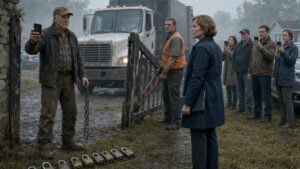
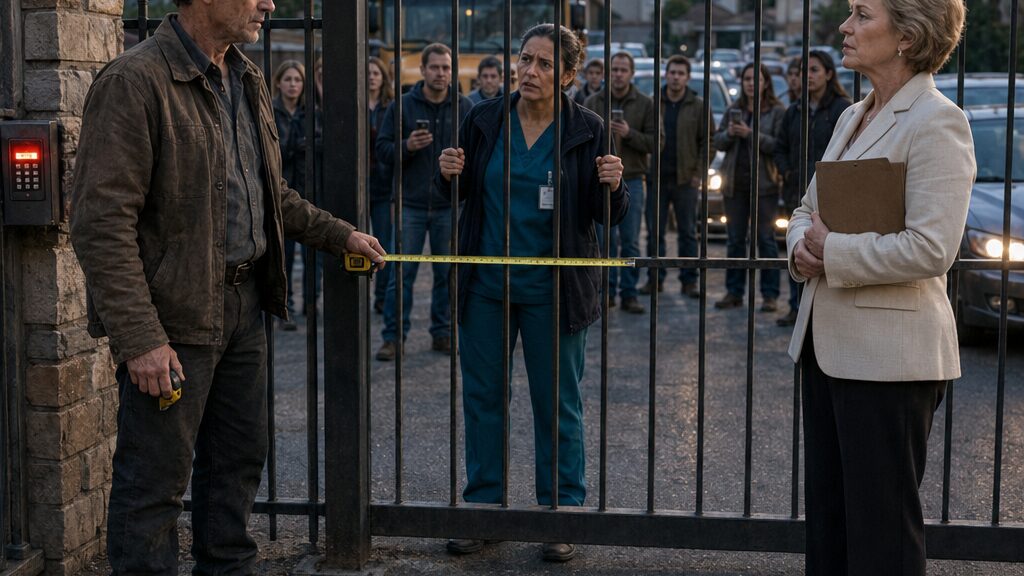
Patricia Carter stood on the outer side of the gate beside the keypad cabinet. Her cream blazer caught the headlights, making her appear brighter and more composed than everyone trapped behind the bars. She held a clipboard against her chest.
“The system is functioning,” she called.
The bus driver pointed toward the children. “Then open it.”
Patricia did not move.
A man stepped from one of the cars. “My code worked last night.”
“Access permissions were updated at six.”
“What does that mean?”
“It means accounts must be verified.”
More doors opened. Parents came forward in work clothes, house slippers, winter coats thrown over pajamas. The gate separated them from Patricia by less than ten feet, but she spoke as if addressing them from the front of a courtroom.
“Residents with outstanding assessments will need to provide proof of payment before access is restored.”
The man stared at her. “You locked us inside?”
“I suspended gate privileges.”
“You cannot suspend people leaving.”
Patricia tapped the clipboard. “The board adopted an enforcement resolution.”
Donald knew the gate had no intelligence of its own. It could not distinguish between entering and leaving if the installer had placed both functions under the same account controls. Someone had instructed the system to reject every disabled code in both directions.
The keypad flashed red again.
He looked beyond the gate arm to the concrete island beneath it. The new black control housing stood where a cedar sign had been only a month earlier. Fresh bolts held it to the pad. A narrow trench crossed the pavement where the electrical line had been buried.
Something pale glinted near the edge of the asphalt.
Donald narrowed his eyes.
The school bus driver climbed down and walked to the pedestrian opening. He pushed the smaller gate, but its magnetic lock held. A child pressed both hands to the glass and peered out.
Patricia lifted her voice over the horns. “There is no reason for this to become disorderly.”
“There are thirty kids on that bus,” the driver said.
“There are procedures.”
“Then use one.”
“The responsible parties had weeks to respond.”
Donald walked closer, stopping outside the painted traffic lane. Patricia noticed him and tightened her mouth.
“Mr. Mitchell, please move your truck. It is obstructing the entrance.”
“My truck’s on the shoulder.”
“It is still visible from the road.”
He glanced at the gate, then back at her. “That the emergency release?”
A small lockbox had been mounted on the control pedestal. The usual pull handle was missing.
Patricia looked down as though she had not heard him.
Donald crouched beside the asphalt. The glint was half-covered with sealing grit. He brushed it with his thumb until the round top of a brass survey cap appeared.
He had last seen that marker seventeen years earlier, before the first brick entrance wall, before the decorative pond, before the neighborhood had renamed the road Cedar Glen Drive. Back then, it marked the northern edge of the access strip his father had refused to sell.
Donald stood and paced three long steps toward the gate post.
Then another half step.
The post was inside the line.
Not close to it. Inside it.
The gate had been built across the old right-of-way.
A horn blared again. The bus driver shouted something Donald did not catch. Patricia raised her clipboard.
“Everyone needs to return to their vehicles.”
“No,” the man at the bars said. “You need to open the gate.”
“Once your account is verified.”
“My account is paid.”
“Then you have nothing to worry about.”
“My daughter has a chemistry exam in forty minutes.”
Patricia’s expression did not change. “Late arrival is not an emergency.”
Donald looked at the survey cap again.
Three weeks earlier, a thick envelope from the HOA had arrived at his workshop. He had opened it between two paving estimates, glanced at a site plan, and recognized the old road line immediately. The association had asked him to acknowledge receipt because his parcel touched the entrance strip.
He had signed the receipt page.
He had not written back.
The HOA had spent years referring to his equipment as a nuisance and his gravel side yard as an architectural violation. Patricia had once mailed him a warning because his father’s old mailbox did not match the approved neighborhood palette. When the gate proposal arrived, Donald had told himself they could learn their own boundaries.
Standing now beside the trapped school bus, that thought felt smaller than it had in his workshop.
A second line of cars was forming outside the gate. Drivers who had not yet entered could not get in; those already inside could not leave. The entrance had become a knot tightening from both sides.
Patricia checked her watch.
“At seven,” she announced, “the management portal will begin accepting payment confirmations. Residents who clear their balances will be reviewed in the order received.”
A woman behind the gate laughed once, without humor. “You planned this.”
Patricia held the clipboard more firmly. “I provided notice.”
Donald looked from the red keypad light to the brass marker under the gate.
He could tell them what the marker meant.
He could open the folder in his truck.
Instead, he picked up his thermos.
He told himself he needed to be certain.
At 6:23, a dark sedan came fast around the inner curve. It stopped behind the line, and Melissa Ramirez jumped out wearing teal scrubs beneath an open coat. Her hair was still damp. A hospital badge swung from her neck as she ran to the keypad.
She punched in her code.
The light flashed red.
She tried again, slower.
Red.
Melissa struck the metal cabinet with the heel of her hand and looked through the bars at Patricia.
“You erased my code.”
Chapter 2: Twenty-Three Families Behind One Gate
Melissa’s phone rang before Patricia answered.
She saw the hospital number and pressed the phone to her ear while keeping her other hand wrapped around the gate.
“I’m here,” she said. “I’m trying to leave.”
Her supervisor’s voice was sharp enough that Donald heard fragments from several yards away: short staffing, morning medications, no replacement.
“I understand,” Melissa said. “The neighborhood gate is locked.”
She closed her eyes.
“No, not broken. Locked.”
Patricia stepped toward her side of the bars. “Ms. Ramirez, striking association equipment may result in a damage charge.”
Melissa lowered the phone. “Open the gate.”
“You received the notices.”
“My dues are paid.”
Patricia consulted the clipboard. “Your account shows a compliance hold.”
“For what?”
“A temporary landscaping assessment.”
“I paid that last Tuesday.”
“It has not posted.”
Melissa shoved her phone through the bars, displaying a banking screen. “There. Posted.”
“I am not authorized to verify personal banking records at the gate.”
“You are the president.”
“I am not the bookkeeper.”
“Then call the bookkeeper.”
Patricia’s mouth tightened. “The management office opens at seven.”
Melissa glanced back at the line of vehicles. Children watched from the bus windows. A man in a dress shirt was pacing between cars, speaking into a headset. Somewhere near the rear, a toddler had begun to cry.
She ended the call and immediately dialed again.
Donald stood near his truck, still holding the thermos.
Melissa looked directly at him. “You work on gates.”
“Roads.”
“You know contractors.”
“Some.”
“Can you open it?”
Patricia answered for him. “He may not touch association property.”
Melissa faced her. “You locked twenty-three families behind a fence.”
“I suspended electronic access for accounts under review.”
“That sentence does not change where we are standing.”
Several residents voiced agreement. One man lifted a printed account statement against the bars. Another held up his phone and said he had paid every assessment through the end of the year.
Patricia raised her hand. “The software applied the enforcement list provided by management.”
“So the software made a mistake?” Melissa asked.
“The list may require reconciliation.”
“Then override it.”
Patricia’s eyes moved briefly toward the control pedestal.
Donald saw it.
He walked closer. “Where’s the manual release?”
The crowd quieted enough for the question to carry.
Patricia turned toward him. “The system has a secure emergency protocol.”
“That isn’t what I asked.”
“The installer certified the gate.”
Donald pointed at the side of the housing. “There should be a mechanical pull under that cover.”
Patricia glanced at the residents, aware that they were listening. “The release was modified to prevent tampering.”
“Modified how?”
“That information is restricted.”
“Who has the override?”
“The board.”
“Which person?”
Patricia did not answer.
A father near the bus said, “You told us last month fire and medical services would always have access.”
“They do.”
Donald looked at the empty bracket beneath the housing where a red-handled cable should have hung.
“Not through that release, they don’t.”
The shift in the crowd was immediate. Until then, Donald had been the man beside the battered work truck, present but peripheral. Now people turned toward him as if he had stepped into better light.
Melissa studied his face. “You knew to look for that.”
“I’ve seen enough gate systems.”
“Can it be opened without power?”
“Usually.”
“Usually?”
“If nobody removed the mechanism.”
Patricia closed her clipboard. “This discussion is becoming speculative.”
Donald looked at her. “Did they remove it?”
“The installer followed board instructions.”
“That’s a yes.”
“It is not.”
A delivery van pulled into the outer queue, stopped, and sounded its horn. Behind it, a small medical supply vehicle turned from the county road. The driver rolled down his window and held up a white parcel marked with an oxygen-service label.
“I’ve got an urgent replacement cylinder for George Lee,” he called. “They said his portable unit is nearly empty.”
Melissa spun toward the vehicle.
“George?” she said.
A resident near the inner turnaround pointed toward a silver sedan several cars behind the bus. “He’s in his daughter’s car.”
Melissa ran.
Donald followed at a slower pace, keeping to the edge of the lane. The line of vehicles made the road too narrow for anyone to turn around. Exhaust hung low between the houses. The silver sedan’s passenger window was cracked.
George Lee sat inside wearing a thin jacket over his pajamas. A clear oxygen tube ran beneath his nose to a portable unit on the floor. His face had lost its usual color.
Melissa opened the passenger door. “How long has it been alarming?”
George looked down. A yellow light pulsed on the machine.
“Just started.”
“That is not what I asked.”
He gave her a weak smile. “Didn’t want to add to the excitement.”
Melissa checked the cylinder gauge. “This is almost empty.”
“My replacement is right there.”
“On the other side of a locked gate.”
She turned toward Patricia, who had followed halfway up the line but remained near the entrance.
“We have a medical emergency,” Melissa shouted. “Open it now.”
Patricia called back, “Emergency services can be contacted.”
“The oxygen is outside.”
“The vehicle can transfer the cylinder through the pedestrian gate.”
“The pedestrian gate is magnetically locked.”
For the first time, Patricia looked uncertain.
Only for a second.
“Then the driver should call management.”
Melissa stared at her. “Management is not going to carry oxygen through steel bars.”
Donald looked toward the medical vehicle. The replacement cylinder was too wide to pass between the gate’s vertical rails. The smaller pedestrian gate had a solid lower panel and no gap beneath it.
He returned to the control pedestal and crouched beside the empty release bracket.
A resident followed. “Can you bypass it?”
“Not without opening the housing.”
“Do it.”
“Once I break that seal, they can claim tampering.”
The man gestured toward George’s car. “Let them claim it.”
Donald looked at the screws, the power conduit, the new welded plate covering the access side. Whoever had modified the system had done more than remove a handle. They had made manual release deliberately difficult.
Melissa came back down the lane.
“How long?” Donald asked.
“Maybe twenty minutes at that flow rate. Less if he panics.”
“Can you reduce it?”
“Not safely.”
Patricia was on her phone now, speaking in a low voice. Donald heard the words liability and unauthorized access.
Melissa stepped close to him. “You know something about this gate.”
“I know it was put in wrong.”
“Wrong how?”
He glanced at the brass cap under the arm.
Melissa followed his eyes.
“What is that?”
“Old survey marker.”
“And?”
Donald did not answer.
Behind them, George’s oxygen unit gave a higher, sharper alarm.
Everyone turned.
George tried to straighten in the passenger seat. His hand slipped from the door frame. His head struck the window, and his body folded sideways against the glass.
Melissa ran.
Chapter 3: The Survey Cap Under the Asphalt
“Do not touch private HOA property.”
Patricia’s voice cut across the road as Donald set his thermos on the pavement and reached for the tape measure behind his truck seat.
George’s car door stood open uphill. Melissa was bent inside, one hand supporting his jaw while another resident held the oxygen unit upright. The alarm continued in short, mechanical bursts.
Donald pulled the tape free.
Patricia stepped between him and the gate. “I am warning you.”
“I heard you.”
“You are not authorized to conduct work here.”
“I’m not conducting work.”
“You are carrying tools.”
Donald looked at the worn tape measure in his hand. “That make it work?”
“This is association property.”
“Some of it.”
The answer drew people closer.
Patricia noticed the attention and lifted her chin. “Your truck is already creating a visual obstruction at the entrance. I will not allow a contractor to exploit an emergency to interfere with a certified installation.”
Donald walked around her.
She caught his sleeve. He stopped and looked down at her hand until she released it.
“The sheriff’s office has been contacted,” she said.
“Good.”
Her expression faltered.
Donald knelt beside the brass cap. He used the edge of a key to clear packed sealant from its rim. Letters appeared beneath the dirt: COUNTY SURVEY, followed by a number he still remembered.
The keypad flashed red above him as another resident tested a code.
Red against brass.
New authority against an older line.
Donald hooked the end of his tape over the cap and extended it toward the western gate post. The tape clicked over the pavement.
“Eleven feet, eight inches,” he said.
A man beside him asked, “What does that mean?”
Donald shifted the tape to the eastern post.
“Means both posts are inside the access strip.”
Patricia laughed once. “A buried marker does not invalidate an approved construction plan.”
“No.”
She folded her arms.
“The recorded easement does.”
The gate area went still except for George’s oxygen alarm.
Patricia’s gaze dropped to the survey cap. “There is no easement across HOA property.”
“There was before there was an HOA.”
“This land belongs to Cedar Glen.”
“The common parcels do. The road under this gate is subject to a shared-access grant.”
“You are making that up.”
Donald reeled in the tape. “Call the county records office.”
“The county does not adjudicate property disputes at seven in the morning.”
“Then call the fire marshal.”
“That is unnecessary.”
“Ask whether you can lock an emergency route without a manual release.”
Patricia stepped closer, lowering her voice. “You think this is your opportunity because people are upset.”
“No.”
“You have challenged every improvement this board has made.”
“I challenged a drainage trench that emptied onto my lot.”
“You threatened legal action.”
“I sent you photographs.”
“You park commercial equipment in view of homeowners who pay to maintain standards.”
Donald looked toward his truck, its side panel streaked with dried tar. “That what this is about?”
“This is about qualified people following adopted procedures. You repave driveways, Mr. Mitchell. You do not interpret association law.”
Donald straightened.
For years, he had let sentences like that pass because correcting them required explaining who had owned the land, who had graded the first road, who had allowed water lines to cross the lower field. His father had told him never to beg newer people to remember older work.
But George was bent inside a car because everyone had treated memory as optional.
Donald opened the passenger door of his truck and took out a weathered expanding folder.
Several residents moved closer.
Patricia’s face changed when she saw it. Not fear yet. Recognition.
Donald set the folder on the hood. Inside were copies of plats, deed pages, tax maps, and the original access agreement. He selected the county plat and unfolded it beneath the windshield.
“This line,” he said, tracing it with one blunt fingernail, “is the northern boundary of the access strip. The marker under the gate is this point here. The second marker is behind the stone wall.”
A resident leaned across the hood. “And the gate?”
Donald laid the tape measure along the scaled drawing. “Built through the middle.”
Patricia looked at the plat but did not approach. “That document could be fifty years old.”
“Forty-six.”
“The subdivision has been replatted.”
“The lots have. The easement was carried forward.”
“For your parcel.”
“For every parcel served by the road.”
Melissa returned from George’s car, breathing hard. “Can it open?”
Donald looked at her. “It should never have been allowed to close like this.”
“That is not an answer.”
“No. It isn’t.”
He pulled out the easement document. The paper was a certified copy, not the original, but his father’s name was visible near the bottom.
Patricia saw it.
“Your family sold that land.”
“Most of it.”
“You have no special ownership claim over Cedar Glen.”
“I didn’t say I did.”
“This is exactly what you are implying.”
Donald shook his head. “An easement isn’t ownership. It is a burden on ownership. Whoever holds the land has to keep the access open.”
A woman behind the gate asked, “So she cannot stop us from leaving?”
Donald hesitated.
A legal answer was not the same as an immediate solution. The document did not cut steel. It did not restore George’s oxygen. It did not protect Donald from a trespass accusation if he opened the housing himself.
“It gives the county and emergency officials a reason to act,” he said.
Patricia seized on the caution. “A reason to review. Not a reason for you to vandalize association equipment.”
Donald took out his phone. “Then make the calls.”
“I already called the sheriff.”
“Call the county clerk. Call the fire marshal. Tell them the gate blocks a recorded access easement and the manual release was removed.”
“I will not repeat your unsupported conclusions.”
Donald held out the phone. “Use mine.”
No one spoke.
Patricia’s polished composure had depended on being the only person naming the rules. Now Donald had placed another rule on the hood between them, older and less convenient.
She opened her clipboard.
“I have something more current than your family papers.”
From the back pocket, she removed a folded site plan stamped by the gate installation company. She spread it over Donald’s plat.
The plan showed the entrance island, control cabinet, gate posts, trench line, and parcel boundaries. In the lower corner was a receipt box containing three signatures.
Patricia tapped the second one.
Donald Mitchell.
A murmur moved through the residents.
Donald felt his stomach tighten.
Patricia looked at Melissa, then at the others. “Mr. Mitchell was sent this plan before installation. He acknowledged it without objection.”
Donald stared at his own handwriting.
He remembered signing the receipt page at the workbench, irritated by the letterhead, by Patricia’s formal language, by the assumption that he would offer free surveying advice after years of citations and complaints.
He had told himself acknowledgment was not approval.
He had also known they might not understand the difference.
Melissa came to the hood and looked down at the signature.
“You saw this before they built it?”
Donald closed the folder halfway.
Patricia’s confidence returned, sharpened now by relief. “Apparently his concern began only after the board began enforcement.”
Melissa did not look at Patricia.
She kept her eyes on Donald.
“Did you know before this morning?”
Chapter 4: The Warning Donald Never Sent
Donald opened the folder all the way.
The paper Patricia had placed on top showed his signature in blue ink, boxed beneath the words ACKNOWLEDGMENT OF RECEIPT. From three feet away, the distinction between receiving a plan and approving it looked thin enough to disappear.
Melissa waited beside the hood.
“Did you know?” she asked again.
Donald took the plan from Patricia and turned it toward the light.
“I knew the line looked wrong.”
A resident behind Melissa said, “Before they poured the posts?”
“Yes.”
The answer moved through the crowd without anyone repeating it. Donald heard it in the silence instead.
Patricia folded her arms. “Thank you.”
He looked at her. “That does not make the gate legal.”
“No, but it makes your performance dishonest.”
George’s oxygen alarm sounded from uphill, a hard electronic chirp that cut through the murmuring. Melissa glanced back but did not leave.
“What did you do when you got the plan?” she asked.
Donald pulled the certified easement copy from the folder. “I checked the record.”
“And then?”
“I put it aside.”
“You called the board?”
“No.”
“Emailed?”
“No.”
Patricia gave a short, disbelieving laugh. “He waited.”
Donald closed his hand over the edge of the hood. He could feel the cold metal through his palm.
Three weeks earlier, the envelope had arrived at his workshop under a pile of aggregate invoices. He remembered the fluorescent light humming above the workbench and the red notification dot on his phone. Patricia’s message had been marked urgent.
Please acknowledge receipt of the attached entrance improvement plan.
He had studied the drawing long enough to see the old access strip beneath the new gate. He had even opened a blank reply.
The warning had begun:
The proposed western post appears to fall within the recorded easement established in—
Then he had stopped.
His father’s old survey tube stood in the corner of the shop. Beside it hung the faded notice the HOA had sent after the funeral, ordering Donald to remove “stored agricultural debris” from behind the house. The debris had been his father’s hand tools.
Donald had deleted three sentences, set down the phone, and told himself the board had engineers.
Now he took the phone from his pocket.
The draft was still there.
He had never sent it, but he had never deleted it either.
Melissa read the first line over his shoulder.
“You wrote the warning.”
“I started it.”
“Why didn’t you finish?”
Donald looked toward Patricia. She was watching him with the controlled satisfaction of someone who had finally found a rule that cut the other way.
“Because I was tired of correcting people who didn’t listen.”
Melissa’s expression hardened. “George cannot breathe because you were tired?”
“That is not what I said.”
“It is what happened.”
Donald slipped the phone back into his pocket.
A siren rose beyond the county road. The crowd turned as an emergency vehicle joined the blocked outer line. Its lights reflected across the bars and flashed against the keypad’s red indicator.
The paramedics could see George’s car through the gate. They could not reach it.
One of them came forward carrying a medical bag.
“Can the pedestrian lock be released?”
Patricia said, “The management company has the emergency protocol.”
The paramedic tested the gate. It did not move.
Donald pointed to the welded plate. “The mechanical pull was taken out.”
The paramedic looked at Patricia. “Who authorized that?”
“The board approved an anti-tampering modification.”
“Do you have a fire department key box?”
Patricia indicated the small lockbox on the pedestal.
The paramedic opened it with a department key. The compartment was empty.
For the first time, Patricia’s composure slipped visibly.
“That should contain an override fob.”
“It doesn’t,” the paramedic said.
“I was told it did.”
Donald looked at her. “By whom?”
“The installer.”
“Or the board?”
She did not answer.
A sheriff’s deputy arrived on foot from the outer road, weaving between trapped vehicles. He examined the gate, spoke briefly with the paramedic, then studied Donald’s documents.
“Can we cut the chain?” Melissa asked.
The deputy looked toward the hinges and motor housing. “Not safely yet. If the arm drops or the drive binds, it could block the whole lane. We need the fire marshal or the installer to identify the release points.”
George’s replacement cylinder remained twenty yards away on the other side of the steel.
The delay changed the crowd. Anger sharpened into blame because blame gave people something to do.
A man near Donald’s truck pointed at the unsigned message on Donald’s phone. “You could have stopped this.”
Donald did not argue.
Patricia said, “The board relied on the absence of objections.”
Donald looked at her. “You relied on an acknowledgment receipt.”
“You understood the proposal.”
“So did you.”
“I understood the plan the professionals approved.”
“You did not ask what the old line meant.”
“You did not tell us.”
That landed because it was true.
The county records clerk called Donald after the deputy transmitted photographs of the plat number. Donald put the call on speaker.
“The easement remains active,” the clerk said. “No release or vacation has been recorded.”
“Does it require continuous access?” the deputy asked.
“It grants ingress and egress to served parcels. Enforcement is a legal question, but blocking the only road raises immediate concerns.”
“Can you send the full instrument?”
“I’m scanning it now.”
Donald heard typing.
The legal ground under Patricia’s gate was shifting, but no one looked relieved. George was still trapped. The gate was still closed. Donald’s papers had proved that he might be right and that he had chosen not to say so.
A paramedic climbed between two parked cars and called through the bars for Melissa.
She ran back uphill.
Donald followed until he reached George’s open door. George’s eyes were half-closed. His breathing came shallow and fast through the nasal tube.
The alarm had become continuous.
George opened his eyes when Donald leaned near.
“You found the line,” he whispered.
“Yes.”
“Your father knew where every one of those stakes sat.”
Donald looked away.
George’s fingers caught weakly at his sleeve.
“He wouldn’t have stood there measuring while a man ran out of air.”
The words were quiet enough that only Donald and Melissa heard them.
Donald stared toward the gate, where the red light continued to blink above the empty emergency box.
Chapter 5: Patricia’s Numbers Did Not Add Up
“The association cannot pay the storm-drain invoice next month.”
Heather Wright stood inside the small HOA office with both hands pressed against Patricia’s desk. A spreadsheet filled the monitor between them. Half the cells in the delinquency column glowed red.
Patricia shut the door against the noise from the gate.
“How short?”
“After insurance and the gate contractor’s final payment? Forty-eight thousand.”
“You told me twenty-six.”
“That was before the carrier increased the deductible.”
Patricia looked at the figures again. Reserve balance. Outstanding assessments. Legal fees. Emergency drainage work. The numbers had been rearranged so many times that she no longer trusted any total that ended in black.
Heather lowered her voice. “Open the gate.”
“If I reverse the enforcement action now, no one will pay.”
“People are trapped.”
“They have ignored six notices.”
“Some of them are current.”
“The software imported compliance holds with delinquency accounts.”
“You knew that last night.”
Patricia looked toward the window. Through the blinds she could see the tops of vehicles and the pulsing lights of the emergency unit beyond the gate.
She had known twelve accounts were disputed. She had not known the software would apply the hold in both directions until the installer’s test at 5:45 that morning.
She had also not stopped it.
If she had delayed again, the drain contractor would walk. The lower cul-de-sac would flood with the next major storm. The insurer had already threatened nonrenewal. Home values would drop. Residents who mocked every assessment would accuse the board of negligence.
Patricia had promised order.
The gate was supposed to make the promise visible.
Heather moved around the desk. “Did counsel review the lockout?”
Patricia kept her eyes on the spreadsheet.
“Patricia.”
“No.”
Heather stared at her. “You told the board it was permitted.”
“I said the bylaws allowed suspension of amenities.”
“A road is not a pool key.”
“The gate is association equipment.”
“The road is emergency access.”
Patricia stood. “And the storm drain is emergency infrastructure. Nobody pays attention until water is in their living room.”
“That does not let us hold them inside.”
“They are not being held. They can use the pedestrian route once the override is restored.”
“The override is not there.”
Patricia’s jaw tightened.
Heather stepped back. “You had it removed.”
“I authorized a security modification.”
“Why?”
“Because residents kept forcing the release after the gate closed.”
“Who removed the fob from the fire box?”
Patricia did not answer quickly enough.
Heather’s face changed. “You did.”
“It was temporary.”
“You took the emergency fob.”
“Because the installer left it active during testing. Anyone with access to the box could have copied the sequence.”
“The fire department has the key.”
“So do contractors. So does management.”
Heather looked at the door as if measuring the distance to the people outside.
“Give me the code.”
Patricia sat and opened the gate-management portal. The emergency override field was buried beneath two administrator menus. A six-digit sequence appeared.
Heather reached for a pen.
Patricia highlighted the sequence.
Then she deleted it.
Heather froze.
“What did you just do?”
“The installer can generate a new one.”
“When?”
“After verification.”
“There is a man running out of oxygen.”
“And there are seventy-three homeowners who will be paying for this association long after today.”
Heather’s voice dropped. “You are not protecting them anymore.”
Patricia closed the portal.
For a moment, neither woman spoke.
Outside, a horn sounded, followed by someone shouting Donald’s name. Patricia imagined him beside his truck with the old papers spread across the hood, becoming more authoritative every time she resisted him.
He had watched the gate go in.
He had known.
Yet the crowd would forgive the man in work boots because he had produced a map at the right moment. They would not forgive the woman who had spent eleven months calling contractors, reading insurance exclusions, and listening to homeowners demand repairs without assessments.
Patricia picked up the printed ledger.
“I will not let Donald Mitchell turn this into a story about one arrogant board president and one heroic contractor.”
Heather looked at her steadily. “Then stop giving him that story.”
The office door opened before Patricia could respond. A board member leaned in.
“The fire marshal is here.”
Patricia gathered the ledger and followed Heather outside.
The fire marshal stood beside the control pedestal with a sheriff’s deputy and one of the paramedics. Donald’s plat lay open on his truck hood. Melissa remained near George’s car.
The marshal pointed to the empty bracket beneath the housing.
“Who removed the manual release?”
Patricia stepped forward. “The installer modified it under board authorization.”
“Who authorized the modification?”
“I did.”
“And the emergency fob?”
She felt Heather standing behind her.
Patricia could have blamed the contractor. She could have said the management company retained it. She could have demanded time to check the file.
Instead, she held the ledger tighter against her ribs.
“I removed it pending a security review.”
The marshal’s expression became flat.
“Then you will provide the override now.”
“The system requires regeneration.”
“You deleted it?”
Patricia said nothing.
The marshal turned to the deputy. “Document that.”
Heather closed her eyes briefly.
The keypad flashed red again, steady and indifferent, while Patricia understood that preserving her authority now required her to keep choosing the action that had already destroyed it.
Chapter 6: The Road Was Never Meant to Close
George’s hand moved before his eyes opened.
His fingers searched the air beside the car seat until Donald placed the folded easement copy beneath them. George touched the paper as though he could recognize it by weight.
“There’s writing on the back page,” he said.
Melissa adjusted the oxygen tube. “Save your breath.”
George ignored her. “Your father added it.”
Donald knew the clause he meant.
He had avoided reading it aloud because it was not part of the formal granting language. It sat beneath the signatures in his father’s uneven block handwriting, witnessed but never typed into the deed’s main body.
Donald unfolded the final page.
The fire marshal stood beside him. The deputy waited near the control box. Patricia and Heather remained several feet away, the HOA ledger between them.
Donald read silently.
This road is given so no family beyond the line is cut off from help, work, school, or home.
The memory came with the words.
Before Cedar Glen, the land had been pasture and two scattered houses. One winter, a neighbor suffered a heart attack while floodwater covered the lower track. The ambulance lost twelve minutes finding a passable route through Donald’s father’s property.
The neighbor survived.
Donald’s father spent the spring grading a permanent road and the summer arguing with the county until the access agreement was recorded.
George’s voice was faint. “He said a gate could keep strangers out, but a road had to let neighbors through.”
Donald folded the page carefully.
The fire marshal asked, “Does the recorded instrument mention emergency access?”
“The handwritten clause explains the purpose. The legal grant covers ingress and egress.”
The marshal looked toward the gate. “Purpose helps. We still need a safe way to defeat the mechanism.”
A gate contractor had joined by phone. His voice came through the deputy’s speaker.
“If they cut the primary chain under tension, the arm may swing inward. Disconnect power first. Then secure the arm and release the secondary restraint inside the housing.”
“The housing is welded,” Donald said.
“Anti-tamper plate.”
“I can cut the plate.”
Patricia stepped closer. “Any unauthorized modification will void the equipment warranty and possibly the association’s insurance coverage.”
Melissa looked at her. “He is dying.”
“He is receiving oxygen.”
“The unit is almost empty.”
Patricia addressed the marshal. “If the gate is damaged, there will be no funds to replace it.”
Donald turned toward her.
Until that moment, he had treated her objections as another wall to push against. Now he saw the ledger pressed to her side, the corners bent under her fingers.
“This is about more than dues,” he said.
Patricia’s face closed.
Heather answered for her. “The reserves are nearly gone.”
Patricia shot her a warning look.
Heather continued. “Storm drains. Insurance. The gate contract. We cannot cover all three.”
A resident nearby heard and repeated it. The news spread in fragments through the crowd.
Donald looked at the gate, then at his folder. The easement could force access. It could not pay an invoice.
The deputy said, “We are not deciding the HOA budget here. We are deciding how to reach a patient.”
Donald nodded.
He stepped onto the pavement where the survey cap sat below the gate arm.
“I knew the line was wrong before installation,” he said.
The surrounding voices quieted.
Patricia watched him carefully.
Donald spoke to the residents rather than to her. “I received the plan three weeks ago. I drafted an objection. I did not send it.”
A man near the bus called, “Why not?”
Donald looked at the rows of vehicles, at the children still waiting inside, at Melissa with one hand on George’s shoulder.
“Because I wanted the board to discover it without me. I thought letting them make their mistake was different from helping them make it.”
No one answered.
“It wasn’t.”
Melissa held his gaze. There was no forgiveness in her face, but the accusation had changed. It no longer needed to be dragged from him.
“What can you do now?” she asked.
Donald looked at the marshal. “My truck has a portable generator, cutting equipment, chains, and two support stands. I can brace the gate before anyone opens the drive housing.”
“Under whose authority?”
“The deputy’s and yours. I do not touch it until you say.”
The marshal studied the posts, then the traffic lane. “If the gate drops, can you keep the road passable?”
“With the truck positioned outside the swing. I can hold the arm against the east post and cut the secondary restraint after power is isolated.”
The contractor’s voice came through the phone. “That is workable if he knows the assembly.”
Donald said, “I paved the base under it.”
Patricia tightened her grip on the ledger. “And when the insurer denies the claim?”
Donald looked at her. “I will document every step. My company will stabilize the entrance at cost until the board can review replacement options.”
“You are volunteering association work now?”
“I am fixing the part I helped leave unfixed.”
The words seemed to strike her more sharply than an accusation.
The marshal nodded toward the deputy. “Prepare an emergency access order. Note the active easement, obstructed medical response, missing manual release, and removed override.”
The deputy began writing.
Melissa moved closer to Donald. “George’s replacement cylinder has to come through first.”
“It will.”
“You do not get to disappear after that.”
Donald glanced at her.
“The residents will want answers,” she said. “About your letter. About the road.”
“I know.”
“And Patricia’s numbers.”
Heather looked down at the ledger.
Donald nodded once. “All of it.”
Melissa returned to George’s car.
The paramedic checked the portable gauge and held up two fingers. Two minutes at the current flow, perhaps less.
Donald walked to his truck. He opened the side compartment and pulled out heavy chains, a cutting saw, gloves, and two steel support stands scarred from years of road work.
Residents moved their vehicles just enough to give him a narrow working lane. No one thanked him. No one insulted him. Their silence was different now—watchful, conditional.
Donald backed the truck toward the gate until the rear hitch aligned with the eastern post. He set the brake and stepped out.
The deputy approached with the written order.
“Once the fire marshal disconnects power, you are authorized to secure the arm and expose the secondary restraint. Nothing beyond that without instruction.”
Donald read the page and signed beneath the authorization.
Patricia stood near the keypad. Its red light reflected faintly on her cream blazer.
“You are going to destroy the entrance,” she said.
Donald fastened the first chain to his truck hitch.
“No,” he replied. “I am going to make sure it cannot close on anyone again.”
Chapter 7: When the Chain Finally Broke
The oxygen alarm became one unbroken tone.
Melissa looked up from George’s car and shouted, “Now.”
The fire marshal reached into the control cabinet and threw the disconnect. The keypad’s red light flickered once, then died.
For the first time that morning, the gate looked powerless.
Donald tightened the chain from his truck hitch to the eastern side of the steel arm. A second chain ran through the support stand he had wedged beneath the gate. He pulled both links by hand, checking for slack.
The deputy stood beside him with the emergency order.
“You are authorized to expose the secondary restraint,” he said. “Nothing else until we can see the mechanism.”
Donald lowered his face shield.
The cutting saw caught against the welded plate, then bit through. Sparks scattered across the asphalt and bounced around the brass survey cap. Residents stepped back. Children watched through the bus windows while their parents shielded them from the glare.
Patricia remained near the stone entrance wall.
“You are destroying association property,” she called.
Donald kept the saw steady.
The fire marshal answered without looking at her. “The association removed required emergency access.”
“That is still under review.”
“No,” he said. “It is being documented.”
The plate gave way with a metallic crack. Donald shut off the saw and pulled the hot section loose with his gloves. Behind it sat the drive assembly and a narrow chain looped through a secondary locking bracket.
The gate contractor’s voice came through the deputy’s phone.
“That chain must be released before the arm is moved. Confirm the support is carrying the load.”
Donald leaned his shoulder against the gate.
The chain to his truck drew tight. The support stand held.
“Load secured.”
The deputy looked toward George’s car. The paramedic had opened the rear doors of the medical vehicle outside the gate. The replacement oxygen cylinder waited less than thirty feet away, useless until the barrier moved.
The deputy nodded.
“Cut it.”
Donald positioned the bolt cutters around the secondary chain.
Before he closed the handles, Heather came running from the HOA office with a contract binder against her chest.
“Wait.”
Melissa turned on her. “We do not have time.”
“This matters.”
Heather opened the binder on the hood of Donald’s truck and pointed to a service entry. The maintenance contractor had recorded a board-requested modification two days earlier.
Remove manual pull assembly. Deactivate external override pending security review.
Below the entry was Patricia’s electronic authorization.
Heather handed the binder to the fire marshal.
“This was not an installation mistake,” she said. “She ordered it.”
Patricia stared at her. “That record is confidential.”
Heather’s voice shook, but she did not lower it. “So were the numbers. Look where that got us.”
The marshal photographed the page.
Donald looked at Patricia. He had expected denial, or another argument about insurance. Instead, she stood with her arms hanging at her sides, as though the contract had taken the last useful thing from her hands.
The oxygen alarm continued.
Donald closed the bolt cutters.
The chain snapped.
It dropped across the asphalt and struck the brass survey cap with a bright, hard ring.
“Release tension slowly,” the contractor said through the phone.
Donald moved to his truck and eased it forward by inches. The gate arm shifted toward the support stand. Metal groaned. The marshal and deputy guided the free end away from the lane.
A gap opened.
At first it was no wider than a person.
Melissa squeezed through before anyone could stop her. The medical driver passed the oxygen cylinder into her arms. She carried it back with both hands, leaning into its weight.
Then the gate moved another foot.
The paramedic slipped through with the medical bag.
The residents did not cheer. They stepped aside.
Donald kept the truck steady while the emergency team ran to George. He watched Melissa kneel beside the open passenger door and connect the new cylinder. The alarm stopped. Oxygen hissed softly through the regulator.
George’s chest rose.
Then rose again.
The silence that followed was deeper than relief.
The fire marshal ordered the gate secured fully open. Donald repositioned the support stands and chained the arm against the stone wall. Only when the marshal checked the lane and waved did the first vehicle move.
The school bus went through slowly.
Children pressed their faces to the windows. One small hand lifted toward Donald, but he could not tell whether it was a wave or simply a palm against the glass.
Cars followed in order. Parents drove past Patricia without speaking. Melissa remained with George until the ambulance crew transferred him to a stretcher.
Donald removed his face shield.
A man from the crowd approached him.
“You knew for three weeks.”
Donald nodded.
“My son missed school because of her,” the man said, pointing at Patricia. “George almost died because of both of you.”
Donald did not tell him that George was breathing now. That was not an answer to what had nearly happened.
“You are right,” he said.
The man seemed almost disappointed that Donald did not resist him.
Another resident came forward. “Are you going to sue the HOA?”
“I have not decided anything.”
“That road belongs to your family.”
“No. It is burdened by an easement. That is different.”
“So who controls it?”
Donald looked at the broken chain beneath his boots.
“That is part of the problem,” he said. “Too many people thought control was the same as responsibility.”
Patricia walked toward him carrying the HOA ledger.
Her cream blazer was streaked with dust where she had leaned against the wall. She no longer looked polished. She looked tired.
“The board will suspend me by noon,” she said.
Donald said nothing.
“They will reverse the access penalties. They will probably reverse every fine I issued this quarter, whether it was justified or not.”
“You removed the emergency release.”
“I know what I did.”
The admission was quiet and without defense.
She held out the ledger.
Donald did not take it.
“What is that?”
“The reason I thought I could not back down.”
Heather stood several yards away, watching.
Patricia pushed the ledger toward him again.
“Forty-eight thousand short by next month. Another assessment will fail. The insurer wants the drains repaired. The lower road floods if we do nothing.”
Donald accepted the book.
It was heavier than it looked.
Patricia glanced at the gate, now chained open beside the exposed survey cap.
“You think the gate was the problem,” she said. “It was only the part everyone could see.”
Chapter 8: The Light That Could Not Lock Anyone Out
Six weeks later, Donald entered the community meeting room knowing that half the chairs had been filled by people who did not want him there.
A printed motion lay on the sign-in table.
Remove Donald Mitchell from the temporary road and access committee.
He read it, signed his name beneath the attendance line, and took a seat near the back.
The room smelled of coffee, copier paper, and damp coats. Residents filled the folding chairs. Some nodded to him. Others looked away. Melissa sat near the front beside George, who had a smaller oxygen unit resting at his feet.
Patricia occupied a chair against the side wall.
She was no longer president. She had declined the board’s request to speak before the meeting, and she had refused to send the apology letter their attorney drafted for her.
Heather stood at the podium with the financial recovery packet.
“The independent review found no missing funds,” she said. “No personal payments, no altered invoices, no theft.”
A few heads turned toward Patricia.
Heather continued. “It also found that the board concealed the severity of the reserve shortage, delayed required disclosure, and adopted an access-enforcement policy without legal review.”
The room stirred.
One resident called, “So we are supposed to feel sorry for her?”
Patricia looked at the floor.
Heather answered, “No. We are supposed to understand what happened accurately.”
The revised plan included a smaller storm-drain contract, an insurance payment schedule, temporary suspension of decorative projects, and a special assessment spread over eighteen months. Every invoice would be published through the resident portal.
Then Heather reached the road proposal.
“The existing gate will remain disabled until the replacement system passes county and fire inspection. The new design includes an unrestricted manual release, a department lockbox, backup power, and separate entry and exit controls.”
A man in the second row raised his hand. “Who controls the easement?”
Heather glanced toward Donald.
“That is why Mr. Mitchell is here.”
The room shifted as he stood.
Donald carried no folder this time. He had brought one sheet of paper, folded once.
“The easement does not give me ownership of the road,” he said. “It gives the people beyond it a right to pass. My family granted it, but that does not make me the gatekeeper.”
A woman near the aisle said, “You had the documents.”
“Yes.”
“You did not warn anyone.”
“No.”
“Why should you stay on the committee?”
Donald looked at the motion on the table.
“You do not have to keep me.”
A few people exchanged glances.
He continued. “But I will not accept permanent control of the easement, either. That would repeat the same mistake with a different person.”
Heather asked, “What do you propose?”
“Shared oversight. One HOA representative, one resident who is not on the board, county access review for any future change, and fire department control of the emergency key. No one person gets to disable both directions.”
Melissa raised her hand.
When Heather recognized her, she stood.
“Donald helped open the gate,” she said. “He also knew there was a problem before that morning and kept quiet.”
Donald met her eyes.
Melissa did not soften the next words.
“Helping later does not erase that.”
“No,” Donald said.
“But admitting it before anyone forced him mattered. So did staying for the repair work after people stopped treating him like the hero of the day.”
Several residents looked toward him.
For six weeks, Donald had documented the temporary supports, met the county inspector, and marked the old easement boundaries in bright paint. He had also answered questions he would once have ignored.
Melissa sat down.
“I support the safety plan,” she said. “Not because I trust any one person. Because it does not require us to.”
The vote passed by eleven.
The motion to remove Donald from the committee failed by two.
Patricia stood before the meeting adjourned.
Everyone turned.
She held no notes.
“I will provide any records the restructuring team requests,” she said. “I accept the suspension.”
Someone asked, “Are you going to apologize?”
Patricia looked toward George, then Melissa, then Donald.
“I removed a safeguard because I believed control would make people take the debt seriously. It made the danger less visible to me, not more.”
She paused.
“I am not going to ask you to make that sound better.”
Then she sat.
There was no applause.
After the meeting, the group walked to the entrance.
The damaged gate arm had been replaced with a lighter barrier. A green indicator glowed above the new manual-release housing. Below it, the fire department lockbox was bolted to the pedestal.
The county inspector asked Donald to perform the final test.
He pulled the manual handle.
The barrier released without resistance.
He reset it, then handed the emergency key to the fire marshal, who sealed it inside the lockbox.
George watched from Melissa’s car.
“Your father would have liked that,” he said.
Donald looked at the green light.
“My father would have asked why it took us this long.”
George smiled. “He usually did.”
Melissa closed George’s car door, then stopped beside Donald.
“You going to speak up next time?”
Donald looked toward the survey cap, now exposed inside a clean circle of new asphalt.
“Before the red light,” he said.
She nodded once.
The green indicator remained steady as the first car approached. The gate opened, the car passed through, and the road stayed clear behind it.
The story has ended.