He Poured Concrete Across My Property, Then the HOA Learned Why I Had Let Him Use It
Chapter 1: The Concrete Was Wet When Thomas Found It
The concrete mixer woke Thomas Miller before seven.
At first he lay still, trying to place the sound. It came in uneven metallic churns from somewhere close enough to rattle faintly through the bedroom window. Then came the scrape of a shovel and the short reverse beep of a truck.
Thomas swung his feet onto the floor.
By the time he reached the kitchen, he could see the top of a concrete truck through the side window.
It was parked beside his house.
He went outside in jeans and an old blue work shirt, coffee forgotten on the counter.
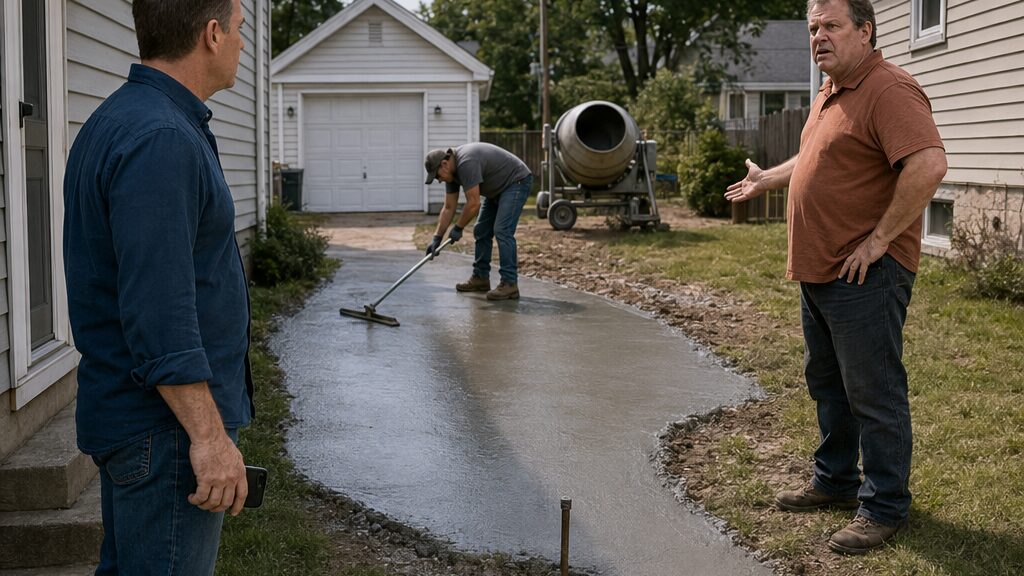
The narrow strip between his house and Ronald Green’s property had never been much to look at. Eighteen feet at its widest point, it ran from the street toward Ronald’s detached garage behind the two houses. Grass grew down the center. Gravel showed through where Ronald’s tires had worn two pale tracks over the years.
That morning, half of it had disappeared beneath wet gray concrete.
A contractor stood ankle-deep in rubber boots, drawing a finishing tool across the surface. Another section had already been smoothed. Wooden forms ran from near the driveway toward Ronald’s garage.
Thomas stopped so abruptly that the screen door snapped shut behind him.
Ronald stood across the fresh slab with one hand on his hip.
“Morning,” Ronald said.
Thomas looked from him to the concrete.
“What is this?”
Ronald’s expression changed only slightly, as if Thomas had asked something whose answer should have been obvious.
“I’m fixing the access.”
Thomas walked closer but stayed on the grass.
The old route had always curved slightly toward Ronald’s side as it approached the garage. The new slab did not. It ran straight, wider than the tire tracks, cutting toward a shallow depression near Thomas’s house.
Thomas knew that depression.
Somewhere beneath the grass beside it was an old metal survey pin.
“Stop,” he said.
The contractor looked up.
Ronald frowned. “They’re almost done.”
“I wasn’t talking to you.” Thomas pointed toward the worker. “Please stop pouring until we establish the property line.”
The finishing tool stopped moving.
The sudden quiet felt almost louder than the mixer.
Ronald stepped closer to the slab’s edge. “Thomas, come on.”
“Do you have written permission from me to pour concrete here?”
Ronald blinked once.
“No, but you’ve let me use this for three years.”
“That wasn’t my question.”
“You’ve never had a problem with it.”
Thomas took out his phone.
Ronald gave a short, irritated laugh. “Seriously?”
Thomas photographed the slab from the street end, then from beside his foundation. He took a picture of the forms, another of the contractor’s truck, and one that showed the distance between the old worn tire track and the new concrete.
He was not yet certain exactly where the line fell.
That uncertainty kept his voice level.
“Nobody pours another foot until I know where my property ends.”
The contractor climbed out of the forms and wiped his hands on his pants.
“I was told this was approved,” he said.
“Approved by whom?”
The contractor looked at Ronald.
Ronald’s jaw tightened.
“We’ve been driving through here for years,” he said. “You know that.”
Thomas did know.
Three summers earlier, Ronald had asked whether he could cut across the strip when backing his pickup into the detached garage. His original route required a tight angle from his own driveway, and Thomas had waved the question away.
Sure. No problem.
After that, the occasional shortcut became normal. Ronald used it after grocery runs, when hauling lumber, whenever snow narrowed the driveway. Thomas had even moved his trash cans once so Ronald could get through.
It had been neighborly.
That was all Thomas had believed it was.
Now the wet concrete reflected the morning sky like something permanent.
“You could drive across it,” Thomas said. “That doesn’t mean you could build on it.”
Ronald rubbed the side of his face. “Build? It’s a driveway.”
“On whose property?”
“Part of it is probably yours. Part of it is mine. We both know I’ve always used it.”
The word probably landed harder than Thomas expected.
“You don’t know where the line is?”
“I know where it roughly is.”
“And you poured anyway?”
The contractor shifted his weight and looked toward his truck.
Ronald pointed toward the garage. “You know what happens back there every time it rains. Mud gets dragged onto the street. The association has been after me for months. I’ve had notices about the ruts, the grass, drainage, appearance—all of it.”
Thomas glanced at the slab again.
A few yards ahead, wet concrete covered ground where grass had been growing the night before.
“So the HOA told you to pour this?”
“They told me to fix the access.”
“That’s not the same thing.”
“They’ve seen the plan.”
Thomas looked at him.
Ronald continued before Thomas could ask.
“I sent them the layout. Nobody objected.”
“Did you show them the property line?”
Ronald’s silence answered first.
Then he said, “They knew the access was shared.”
Thomas felt the first real flare of anger.
“It isn’t shared property.”
“That’s not what I said.”
“No. You said something just slippery enough to sound like it.”
Ronald’s face hardened. “Don’t make me out to be some guy stealing your yard. You’ve watched me use this route for years. You waved to me while I did it.”
“And that gave you permission to pour concrete?”
“I thought I was improving something we were both already living with.”
Thomas nearly answered too quickly.
He could hear his father’s voice in that impulse—the old instinct to establish territory by volume, to turn a disagreement into a permanent record of who had offended whom.
His father had once stopped speaking to a neighbor for nine years over a maple tree that dropped leaves across a fence.
Thomas had spent most of his adult life promising himself he would never become that man.
So he stepped back.
“I am not arguing about this while the concrete is wet.”
Ronald folded his arms.
“What are you going to do?”
“Find the survey.”
“And then?”
“Then we’ll know what belongs to whom.”
The contractor cleared his throat. “For what it’s worth, I’m not putting down another load until this is sorted.”
Ronald turned toward him. “You’re already here.”
“And he’s disputing ownership.”
“You have my authorization.”
The contractor nodded toward Thomas. “If it’s partly his parcel, yours isn’t enough.”
That was the first small shift of the morning.
Not victory. Just friction entering Ronald’s certainty.
The contractor signaled to the driver. The mixer remained running, but no more concrete moved down the chute.
Thomas took one final photograph.
Ronald watched him.
“You know,” Ronald said, “this wouldn’t even be an issue if you’d said something three years ago.”
Thomas lowered the phone.
“About what?”
“About there being conditions.”
Thomas stared at him.
“There were conditions?”
Ronald gestured at the ground. “Apparently.”
“You asked if you could drive across. I said yes.”
“Every day for three years.”
“Permission doesn’t become ownership because I didn’t renew it every morning.”
Ronald shook his head. “That’s your interpretation.”
Thomas almost laughed, but nothing about the scene felt funny anymore.
He turned toward his house.
Behind him, Ronald called, “Before you start making this bigger than it is, you should talk to Barbara.”
Thomas stopped.
“Barbara Clark?”
“Yes.”
“The HOA president?”
Ronald nodded.
“They already knew about the project.”
Chapter 2: Three Years of Permission Became Something Else
Thomas found the note tucked under his windshield wiper.
He had walked around the front of his truck looking for an unobstructed angle to photograph the slab when the folded paper caught his eye. It was plain white printer paper, creased once through the middle.
Ronald’s handwriting filled half the page.
Thomas read it twice.
The wording was friendly enough to be infuriating.
Ronald explained that he was finally “cleaning up” the muddy garage access and hoped Thomas would appreciate having a permanent, low-maintenance surface along the side yard.
There was no request.
No apology for not asking.
The note sounded as though Ronald had replaced a broken porch light.
Thomas folded it again and slipped it into his pocket.
Inside the house, he pulled a plastic storage box from the shelf in the spare-room closet. The closing documents from 2019 were still arranged in thick paper folders because Thomas had never trusted himself to remember which documents were important enough to keep.
He carried the box to the kitchen.
Deed. Mortgage papers. Tax disclosures. Insurance. Inspection report.
The survey was near the bottom, folded into a rectangle with softened edges.
When he opened it across the table, the property suddenly looked different.
On paper, there was nothing vague about the side strip.
His parcel line ran straight behind the house before angling slightly toward the rear corner. Ronald’s property narrowed near the detached garage. The worn driving route Thomas had tolerated crossed onto Thomas’s parcel for much of that distance before curving back.
Thomas traced the line with his finger.
Then he looked through the window.
He could see the concrete.
Even without measurements, the problem was obvious.
The slab had been centered on the route Ronald preferred, not on the property Ronald owned.
Thomas found his deed next.
Nothing in the legal description mentioned an easement benefiting Ronald’s lot. He checked the title documents. Then he checked again, slower.
No recorded driveway easement.
No permanent access right.
No shared-lane notation.
For several minutes, that felt like vindication.
Then Thomas sat back.
Three years.
He thought about the first winter Ronald had used the shortcut after a heavy snow. Thomas had shoveled a wider opening near the street so Ronald’s pickup would not slide into the landscaping.
The following spring, Ronald had driven through with bags of mulch.
Later there had been lumber, a lawn mower, a refrigerator tied into a trailer.
Thomas had never once stopped him.
A favor, repeated often enough, had started to resemble a routine.
That did not make the concrete acceptable.
But it made Ronald’s confidence easier to understand.
Thomas disliked that distinction.
He took the survey outside and stood at the edge of the slab.
The contractor had moved his equipment off the forms. Ronald was no longer there.
Thomas used the survey measurements and fixed landmarks to estimate where the old pin should be. After several minutes of checking distances from the house corner, he found a small patch where the grass had been scraped away.
A rust-colored metal cap sat nearly level with the soil.
The concrete extended past it.
Not by inches.
By feet.
Thomas crouched and photographed the pin with the slab behind it.
For the first time that morning, his uncertainty disappeared.
He could insist on the boundary.
What he could not do was pretend the history between them had been equally clear.
Back inside, Thomas searched his phone for old messages from Ronald.
Most were ordinary.
Package on your porch.
Your trash can blew over.
Can you move your car Thursday?
Then he found one from almost two years earlier.
Ronald had written: We should probably put something in writing about the garage access sometime, just so nobody gets confused later.
Thomas remembered reading it.
He remembered his answer too.
We’re neighbors. We don’t need paperwork for everything.
At the time, he had been proud of the sentence.
Now it looked foolish.
A few messages later, Ronald had made a joke about lawyers turning a driveway into a federal case. Thomas had responded with a thumbs-up.
He put the phone down.
His father had made boundaries into walls.
Thomas had tried to do the opposite.
He had believed that refusing formality made him easier to live beside.
Instead, he had left both men with different versions of the same agreement.
Ronald’s version was still wrong. Thomas was certain of that.
But certainty no longer felt as clean.
His phone buzzed.
A message from Ronald.
Contractor wants to know if he can finish my side.
Thomas typed: Nothing else until the boundary is verified.
Three dots appeared.
Disappeared.
Returned.
Finally Ronald answered: Fine.
A minute later another message came.
You know the HOA is the reason I’m dealing with this in the first place.
Thomas searched further back.
This time he used the word HOA.
Several results appeared.
One was from the previous fall.
Ronald: Another notice about the side access. Mud on the sidewalk again. Barbara says they’re going to start fines if I don’t come up with a permanent fix.
Thomas remembered the complaint vaguely. He had assumed it concerned Ronald’s driveway.
Another message appeared three weeks later.
Ronald: Sent them a sketch. They want cleaner access to the garage. I’ll show you when I figure out what makes sense.
Thomas stared at the screen.
He could not remember Ronald ever showing him a sketch.
Maybe Ronald had forgotten.
Maybe Thomas had brushed him off.
Neither possibility helped.
He opened his email and searched Barbara Clark’s name. Nothing recent.
Then he searched the association name.
Routine notices filled the screen—annual meetings, landscaping reminders, pool rules, budget summaries.
One email from months earlier caught his attention because Ronald had forwarded it.
The original message referred to “continued deterioration of the rear garage access area” and asked the homeowner to submit a corrective plan.
Thomas read the phrase twice.
Corrective plan.
Not permission to build on neighboring land.
He forwarded the email to himself along with photographs of the slab and the survey.
Then he called the county zoning office.
The office was closed for normal weekend service, but the automated message directed property-related complaints to an online portal. Thomas uploaded the photographs, legal description, and his contact information.
When he finished, he sat at the kitchen table with the old survey still spread before him.
The black boundary line seemed almost absurdly thin.
Years of greetings, borrowed tools, moved trash cans and easy yeses had all existed without touching it.
Until now.
Thomas picked up his phone again and reread Ronald’s old message.
Another notice about the side access. Barbara says they’re going to start fines if I don’t come up with a permanent fix.
Thomas had been concentrating so hard on Ronald’s concrete that he had missed the more uncomfortable question.
If Barbara Clark had been pressuring Ronald to make the access permanent, what exactly had Ronald told the HOA about who owned the ground beneath it?
Chapter 3: The HOA Had Pushed for a Permanent Fix
Barbara Clark did not sound surprised when Thomas told her concrete had been poured across his property.
That bothered him more than if she had denied everything.
“I’m aware Ronald had work scheduled,” she said over the phone Saturday afternoon. “The board believed the access arrangement between you two had already been settled.”
Thomas stood at his kitchen window looking toward the stopped construction.
“Settled how?”
“As shared access.”
“Shared use is not shared ownership.”
There was a pause.
“I understand that distinction.”
“Did you understand it yesterday?”
Barbara’s tone cooled. “Thomas, I’m trying to tell you what information we had.”
“Then tell me.”
She exhaled softly.
Ronald had received several association notices over the previous year. His repeated use of the grassy route created muddy ruts after rain. Tires sometimes tracked soil onto the sidewalk. One board member had complained that the area looked unfinished from the street.
Ronald had been told to propose a durable correction.
“He submitted a sketch,” Barbara said.
“Showing concrete?”
“A paved access surface.”
“Across my parcel?”
“We do not verify private survey boundaries for every exterior submission.”
Thomas gripped the edge of the counter.
“Then what did you verify?”
“Architectural consistency. Drainage concerns. Appearance.”
“And ownership?”
“That remains the homeowner’s responsibility.”
Thomas looked at the wet slab.
“So you pressured him to fix something, reviewed a sketch, never checked whether the land belonged to him, and now you’re telling me ownership was his responsibility.”
“That is not an inaccurate summary, but you’re making it sound more careless than it was.”
“It sounds exactly as careful as it was.”
Barbara was silent.
Thomas immediately regretted the edge in his voice.
Anger was beginning to offer him the same kind of certainty his father had always enjoyed: someone else had to be entirely wrong so that he could be entirely right.
He forced himself back to the question.
“Did the HOA approve concrete construction?”
“We acknowledged his proposed corrective plan as acceptable under association appearance standards. That is not a building permit or a property-rights determination.”
That answer mattered.
Not enough to solve the problem, but enough to narrow it.
The HOA had not formally authorized Ronald to build on Thomas’s land.
It had simply acted as though the underlying access arrangement was somebody else’s settled business.
“Send me the submission,” Thomas said.
“I’ll have Emily pull the file Monday.”
“Why Monday?”
“The management office is closed.”
“My yard isn’t.”
Barbara’s voice softened by a degree.
“I understand you’re upset.”
“No. You understand I’m calling you on a Saturday.”
Thomas stopped himself again.
“Please have Emily send me everything related to Ronald’s garage access.”
“I will.”
By Monday morning, the concrete had hardened into a pale gray strip that looked more established than it had any right to.
Thomas hated that.
Something wet and obviously temporary on Saturday had become a feature of the landscape by Monday.
At nine fifteen, Emily Anderson called.
Her voice was efficient, almost cautious.
“I reviewed the Green property file.”
Thomas sat at his kitchen table with the survey open again.
“And?”
“I think you need to see something in person.”
The HOA office occupied two rooms beside the community clubhouse. By ten, Thomas was sitting across from Emily while Barbara stood beside a filing cabinet with her arms loosely folded.
Emily placed a printed site sketch on the desk.
Ronald’s garage appeared as a rectangle at the rear of his lot. A shaded path ran from the street to it.
The path crossed the same narrow strip now covered by concrete.
There was no property boundary drawn beneath it.
“That’s what you reviewed?” Thomas asked.
Barbara nodded. “For appearance and drainage.”
Emily slid a second sheet forward.
“This is the problem.”
It was an email thread from months earlier.
Ronald had asked whether the board required proof of ownership before approving improvements to the access area.
Emily’s response at the time said the association did not maintain a reliable survey for the two lots and that ownership of the access strip should be confirmed before permanent work.
Thomas looked at her.
“You told him that.”
“I did.”
Barbara took the page.
Her expression changed as she read it.
“I don’t remember seeing this.”
“You were copied,” Emily said.
Barbara looked again.
The room became very quiet.
Thomas expected satisfaction.
Instead he felt tired.
There it was: the kind of document people imagined would make everything simple. A warning. A date. Names attached.
But it did not tell him why Ronald had proceeded anyway.
Nor did it erase the fact that Thomas himself had spent years treating the arrangement as too friendly to deserve paperwork.
Barbara lowered the sheet.
“This should have been flagged when the sketch came in.”
Emily nodded. “Yes.”
It was the first direct admission Thomas had heard from the association.
Barbara looked at him. “But I want to be precise. We did not authorize Ronald to use your property. We pushed him to correct the condition. We should have required confirmation that he had the right to make the proposed improvement.”
Thomas tapped the sketch.
“What did Ronald tell you?”
Barbara hesitated.
“That you had allowed the access for years.”
“That’s true.”
“And that you had no objection to continued access.”
Thomas said nothing.
Also true, until Saturday.
Barbara continued. “From the board’s perspective, the dispute appeared to be about maintenance, not whether he could pass through at all.”
“The difference between passing through and pouring a slab is the entire dispute.”
“I agree now.”
Now.
Thomas looked at Emily.
“Did Ronald ever give you anything signed by me?”
“No.”
“Any easement?”
“No.”
“Any survey?”
“No.”
Each answer made the institutional side smaller and Ronald’s decision larger.
But not cleanly.
Barbara sat down across from him.
“He was frustrated, Thomas. I’m not defending what he did. But the board had cited him repeatedly. He’d repaired the garage. He’d paid for drainage work. Then every rain created another complaint about mud. He believed a permanent surface would finally close the file.”
“And he decided my property was the cheapest place to solve his problem.”
Barbara did not answer.
Thomas gathered the copies.
His phone rang before he reached the door.
It was the county zoning office.
The clerk had reviewed the weekend submission and needed photographs, contractor information, and access to the site. An inspector could come Monday afternoon.
Thomas gave permission.
Outside the clubhouse, Ronald was waiting beside his pickup.
Thomas slowed.
Ronald looked toward the papers in his hand.
“So you found the emails.”
“Some of them.”
Ronald’s face tightened.
“Barbara told you they were on me constantly?”
“She told me they cited you.”
“And?”
“And that doesn’t make my land yours.”
Ronald rubbed his thumb along the edge of his key fob.
“I never said it did.”
“You poured concrete on it.”
“I fixed the route I’ve been using for three years.”
“You keep saying that like repetition changes the deed.”
Ronald looked past Thomas toward the clubhouse.
“They wanted it fixed. You never objected to the access. I thought once it was done, you’d see it was better.”
Thomas stared at him.
That sentence was more revealing than Ronald seemed to realize.
Not that he believed he owned the strip.
That he believed Thomas’s permission could be obtained afterward.
Thomas folded the papers once.
“The county is coming this afternoon.”
Ronald’s eyes snapped back to him.
“For what?”
“To inspect the work.”
“You called zoning?”
“Yes.”
Ronald gave a disbelieving shake of his head.
“Thomas, this is a driveway between two neighbors.”
“No. It was a path between two neighbors.”
Thomas walked toward his truck.
Behind him Ronald said, “You’re going to get it torn out over a line in the grass?”
Thomas turned.
“The line isn’t in the grass.”
He held up the survey.
“It’s on the deed.”
At two forty, the county inspector called to confirm the appointment.
The contractor had been contacted as well.
He could provide an invoice, measurements, and the sketch Ronald had given him.
What he could not provide, the inspector said, was written authorization from the owner of every parcel beneath the new concrete.
The inspection was set for Monday afternoon.
For the first time since the mixer had awakened him, Thomas knew the dispute was no longer waiting on anyone’s assumption.
Someone was finally coming to put a marker in the ground.
Chapter 4: The Boundary Line Was Easier Than the Friendship
The county inspector drove the first orange marker into the ground less than six inches from the hardened concrete.
The plastic flag shook once and settled.
Ronald Green stared at it as if the man had planted it there to insult him.
Thomas stood a few feet away with the old survey tucked beneath his arm. The inspector had arrived in a county pickup just after two, walked the perimeter twice, checked the deed description Thomas had supplied, then asked both homeowners to remain off the disputed strip while he worked.
Now he crouched beside the marker and stretched a measuring tape toward the rear corner.
Ronald broke the silence.
“That’s not where we’ve been treating the line.”
The inspector looked up. “I’m not measuring where you’ve been treating it.”
Thomas almost smiled.
He stopped himself.
The inspector moved farther back, comparing the survey dimensions to permanent reference points on the houses. The contractor had returned as requested and stood near his truck holding a folder of invoices and sketches.
Barbara Clark had come too.
So had Emily Anderson.
Nobody seemed comfortable standing near anybody else.
The slab looked different with people gathered around it. On Saturday it had felt like an invasion. Now it looked almost clinical: gray concrete, wooden forms, measurements, photographs, lines.
The inspector called Thomas over.
“This survey is from your closing?”
“Yes.”
“Any later boundary adjustment?”
“No.”
“Recorded easement?”
“None that I’ve found.”
The inspector nodded toward Ronald. “You have anything different?”
Ronald held out his hands. “I have three years of actual use.”
“That’s not what I’m asking.”
“I understand.”
His voice suggested he did not appreciate understanding.
The inspector walked toward the garage. “The concrete crosses the parcel boundary. That’s the first issue. The second is whether the work itself required approval that wasn’t obtained.”
The contractor opened his folder.
“I was hired for a residential access pad,” he said. “I was given this drawing.”
He produced the same site sketch Thomas had seen at the HOA office.
No parcel line.
No signature from Thomas.
The inspector studied it.
“Who told you the whole work area was under the customer’s control?”
“Mr. Green.”
Ronald looked away.
Thomas felt the anger returning, but now it had somewhere specific to land.
“You told him it was yours?”
“I told him I had access.”
The contractor frowned. “You told me you had authority to install it.”
“I believed I did.”
Thomas stepped forward.
“Why?”
Ronald turned on him.
“Because you spent three years acting like this was no problem.”
“Driving across it was no problem.”
“You never once said, ‘You can use this but don’t improve it.'”
Thomas stared at him.
Ronald saw the reaction and pressed harder.
“In fact, when I asked you whether we should put the arrangement in writing, what did you say?”
Thomas already knew.
He wished Ronald had not remembered the exact words.
Ronald did.
“‘We don’t need lawyers for a driveway.'”
Barbara glanced toward Thomas.
Emily lowered her eyes.
Even the inspector paused.
Thomas felt heat climb his neck.
“I said that.”
Ronald gave a humorless laugh. “Exactly.”
“I said we didn’t need a legal agreement for you to drive across.”
“That’s how you remember it now.”
“No. That’s what I meant.”
“And I was supposed to know the difference?”
Thomas opened his mouth, then stopped.
There was a difference.
A large one.
But he could also hear how convenient it sounded after the fact.
The inspector stood and brushed soil from one knee.
“Whatever informal understanding you had about use, this inspection is about permanent construction. The concrete physically extends onto Mr. Miller’s parcel. I don’t have written permission from him for that work.”
Ronald pointed toward Thomas.
“So he gets to spend years saying yes and one morning decide the entire thing was never allowed?”
“No,” the inspector said. “He can say the concrete wasn’t allowed. That’s different.”
That ended the argument more effectively than anything Thomas had managed.
The inspector continued toward the street, checking drainage slope and the relationship between the slab and sidewalk.
Thomas remained beside the orange marker.
Ronald moved closer.
“You could’ve told me.”
Thomas looked at him.
“So could you.”
“I did tell you I needed to fix the access.”
“You told me you were getting notices.”
“I sent you messages.”
“You never said, ‘I’m pouring concrete on your land Saturday morning.'”
Ronald’s jaw tightened.
Thomas lowered his voice.
“If you’d asked me directly, we wouldn’t be standing here.”
Ronald looked toward the garage.
“If I’d asked you directly, you would’ve made it complicated.”
That answer stayed with Thomas.
Not because it was fair.
Because it was probably true.
Before Saturday, Thomas might have delayed. He might have said they should think about it. He might have avoided an attorney because he hated what legal documents seemed to imply between neighbors.
But avoidance was not permission.
The inspector returned with a clipboard.
“The encroaching portion has to be removed.”
Ronald’s head came up.
“All of it?”
“The portion installed across the boundary, plus whatever additional removal is needed to leave the remaining work stable and compliant. Your contractor can coordinate.”
Ronald looked at Barbara.
“You’re the ones who told me to fix it.”
Barbara answered carefully.
“We told you to correct the condition. We did not give you authority over Thomas’s property.”
“You reviewed the plan.”
“We reviewed appearance.”
Ronald laughed once under his breath.
“Everybody reviews just enough to tell me what to do, and then when it costs money, suddenly nobody approved anything.”
Barbara’s face changed.
For the first time, Thomas saw something other than administrative caution there.
Embarrassment.
“That’s fair criticism,” she said.
Ronald stared at her.
Barbara continued. “We should have stopped the review until ownership was verified.”
Ronald looked briefly surprised.
It did not soften him.
The inspector handed him a written notice.
“The county’s concern is the physical encroachment and the unverified work. The access arrangement afterward is not something I decide.”
Thomas frowned. “Meaning?”
“Meaning once the concrete is removed, whether Mr. Green can continue driving across your property is a private matter between you two. I’m not creating or canceling access rights today.”
The neatness of the official answer vanished immediately.
Thomas had wanted someone to settle the problem.
Instead, the inspector had only settled the easiest part.
The boundary.
The friendship remained exactly where it had been.
Ronald unfolded the notice.
“When does this have to happen?”
The inspector gave him the compliance deadline and explained the contractor could begin removal sooner.
Ronald barely listened.
His eyes moved down the page until he found the section concerning restoration.
Then he looked at Thomas.
“So who’s paying for this?”
Thomas said nothing.
Ronald stepped closer.
“The concrete. The demolition. The crew twice. Who pays?”
The orange marker stood between them.
For the first time, Thomas understood that winning the property line had not answered the question that mattered next.
Chapter 5: By Sunrise the New Slab Was Rubble
The jackhammer started at 5:47 Tuesday morning.
Thomas knew the exact time because the vibration woke him before the noise did. His bedside clock glowed red in the darkened room.
5:47.
Then came the hard mechanical pounding from the side yard.
He dressed and went downstairs.
Outside, work lights threw white patches across the concrete. The contractor had arrived with two workers, a compact loader, and a trailer for debris.
Ronald stood beside his garage wearing a sweatshirt over yesterday’s clothes.
He did not look at Thomas.
The first section of concrete had already cracked into an uneven web.
Thomas watched the jackhammer bite into it.
On Saturday, the slab had seemed impossibly permanent.
Now each strike turned permanence into fragments.
The contractor approached Thomas before the crew moved farther along the strip.
“We’re cutting just inside the confirmed line first,” he said. “Then we’ll remove enough from Mr. Green’s side to leave a usable edge. County wants the ground restored where we pull it.”
Thomas nodded.
“Don’t take anything you don’t need to.”
The contractor studied him, perhaps expecting the opposite.
“We won’t.”
Thomas went back inside for coffee.
He told himself he had no reason to stand there watching.
Ten minutes later, he was back outside.
The orange survey markers were still in place. The crew worked around them carefully, breaking the encroaching slab into pieces small enough for the loader.
Ronald finally spoke.
“You enjoying this?”
Thomas looked at him.
“No.”
Ronald gave him a flat stare.
“Could’ve fooled me.”
Thomas watched a worker lift a broken section.
“What do you want me to say?”
“I don’t know. Maybe that tearing out something I paid for isn’t some great moral victory.”
“I never called it one.”
“You called the county.”
“After you poured on my property.”
Ronald looked toward the machine.
“I spent almost eight thousand dollars on the whole project.”
Thomas turned.
The number was higher than he had expected.
Ronald saw it.
“Yeah. Garage drainage, prep work, forms, concrete, labor. Now I get to pay them again to destroy part of it.”
Thomas said nothing.
“You think that’s funny?”
“No.”
“Then stop looking like you won.”
The accusation landed because Thomas had, in fact, felt something close to satisfaction when the first cracks appeared.
He had imagined this moment Saturday morning.
Concrete removed. Boundary restored. Problem over.
The reality sounded like a machine breaking expensive stone before breakfast.
Around seven, Ronald’s adult daughter arrived in a small car and parked at the curb. She walked directly to her father, spoke quietly, then glanced once toward Thomas.
He could not hear their words.
He did not need to.
Ronald gestured toward the work crew with one hand and shook his head.
His daughter placed a hand briefly on his arm.
That simple gesture made Ronald look older.
Thomas turned away.
The contractor called him over twenty minutes later.
“We’re at the last section across your line.”
Thomas walked to the rear of the strip.
A rectangular piece of concrete remained near the old rusted survey pin. The slab edge lay several feet beyond it.
The worker cut a straight line, then slid the loader bucket under the broken piece.
It lifted.
For one second, the chunk hung in the air with dark soil clinging beneath it.
Then it dropped into the trailer.
The ground underneath was raw and compressed.
The physical encroachment was gone.
Thomas had expected relief.
What he felt was something quieter.
The old strip looked wounded.
Grass had been scraped away. Gravel was displaced. Tire tracks from the machinery crossed the soil. Nothing about it resembled the easy, forgettable route it had been the week before.
The contractor began grading the exposed section.
Ronald walked toward Thomas.
He had an invoice in his hand.
“Here’s where we are.”
Thomas did not take it.
Ronald held it out farther.
“Removal charge. Disposal. Regrading. Additional labor.”
“That’s between you and your contractor.”
“The removal happened because you complained.”
“The installation happened because you ordered it.”
Ronald’s voice sharpened.
“After your HOA spent a year threatening fines.”
“It’s my HOA too.”
“Then maybe act like it.”
Thomas looked at him.
Ronald tapped the invoice.
“You benefited from that access being improved. You wouldn’t have had to maintain mud. You wouldn’t have had ruts. You would’ve had a clean surface next to your house.”
“I didn’t ask for it.”
“That’s convenient now.”
Thomas felt his patience thinning.
“No, Ronald. Convenient would’ve been asking before you spent eight thousand dollars.”
Ronald stared at him.
Then, very quietly, he said, “I want half.”
Thomas almost thought he had misheard.
“Half of what?”
“Removal. Maybe not the original pour. But the removal. You demanded it.”
“I demanded my property back.”
“And you’re getting it.”
“That doesn’t make me responsible for your decision.”
Ronald folded the invoice.
“Then we’re done.”
The words sounded larger than the money.
Thomas looked at the strip.
“What does that mean?”
“It means don’t expect me to pretend we’re still neighbors who do favors for each other.”
Thomas could have answered sharply.
Instead he asked, “Do you still need the route?”
Ronald’s expression shifted.
“Obviously.”
Without Thomas’s strip, reaching the detached garage required a difficult angle through Ronald’s own narrow driveway. During dry weather it was possible. With a trailer or snow piled along the edge, it became worse.
Thomas knew that.
He had always known it.
Ronald said, “You going to block it now too?”
Thomas looked toward the raw ground where the slab had been.
He had spent the weekend insisting that permission had always been his to give.
Now that meant he also had to decide whether to keep giving it.
The easy answer was no.
Close the route. Put up posts. Let Ronald solve his own problem on his own property.
For a few seconds, Thomas could almost hear his father’s approval.
Draw the line once. Make sure nobody forgets it.
The thought made him uncomfortable.
“I haven’t decided,” Thomas said.
Ronald laughed bitterly. “Of course you haven’t.”
“I’m not deciding it while we’re angry.”
“You mean while I’m angry.”
“No. I mean both of us.”
The contractor drove the loader past them carrying the last broken section of concrete.
By eight fifteen, the trailer was nearly full.
By eight thirty, the narrow strip was gravel, compacted soil, and the beginnings of restored grade.
The slab was gone.
Thomas should have felt finished.
Instead, as Ronald walked back toward his garage, Thomas realized the demolition had done something the concrete itself never could.
It had forced the old informal arrangement to end.
What replaced it would depend entirely on what Thomas chose next.
Chapter 6: Ronald Finally Said What He Knew
Ronald came to Thomas’s door Tuesday evening without an invoice.
That was how Thomas knew the conversation would be different.
Ronald stood on the porch with both hands empty.
“No bill?” Thomas asked.
Ronald’s mouth tightened.
“I already tried that.”
Thomas stepped aside.
“Coffee?”
“No.”
“Water?”
Ronald shook his head.
Thomas let him into the kitchen anyway.
The survey was still folded on the counter. Thomas had almost put it away twice that afternoon and stopped each time.
Ronald noticed it immediately.
“That thing’s getting more use this week than it got in six years.”
Thomas opened it across the table.
“Probably the problem.”
Ronald remained standing.
For several seconds neither man spoke.
Then Ronald said, “I knew.”
Thomas looked up.
“Knew what?”
“That I should’ve asked you about the concrete.”
The admission was so direct Thomas almost distrusted it.
Ronald pulled out a chair.
“I knew the HOA wasn’t giving me permission to use your land. Barbara wasn’t that stupid. Neither was Emily.”
Thomas sat opposite him.
“Then why did you tell the contractor you had authority?”
Ronald looked at the survey rather than at Thomas.
“Because I thought you’d say yes if I forced the issue.”
Thomas said nothing.
Ronald continued.
“I’d been dealing with those notices for months. Garage repair. Drainage. Mud. Every time I fixed one thing, somebody found another thing. I was spending money anyway. The concrete crew gave me a date. I thought if I asked you, we’d spend six months talking about lawyers and easements and insurance.”
Thomas almost interrupted.
Ronald raised one hand.
“I know. That’s the part where I was wrong.”
“That’s a large part.”
“Yes.”
The word came without resistance.
That mattered more than Thomas expected.
Ronald leaned back.
“But you need to understand something too. Every time I used that strip, you acted like it was normal. When I asked about putting it in writing, you laughed it off.”
“I didn’t laugh.”
“You said we didn’t need lawyers for a driveway.”
Thomas looked down at the map.
“I remember.”
“I took that to mean you didn’t care about formal permission.”
“I meant I trusted you.”
Ronald’s face hardened slightly.
“You trusted me as long as I understood rules you never actually said.”
That one hurt because Thomas could not dismiss it.
He traced the boundary line with one finger.
“My father would’ve put a fence there the first day.”
Ronald looked toward the window.
“I remember your father.”
“He spent years fighting with people over stupid things. Branches. Parking. Fence posts. He could turn six inches of dirt into a family war.”
Ronald said nothing.
“I spent a lot of time making sure I wasn’t like him,” Thomas continued. “Apparently I went too far the other direction.”
Ronald gave a short breath that was not quite a laugh.
“Apparently.”
Thomas looked at him.
“That still doesn’t excuse what you did.”
“I know.”
There it was again.
No argument attached.
No qualifying sentence.
Thomas folded the survey once, then opened it again.
The black line remained in exactly the same place.
But for the first time it did not feel like evidence he needed to hold against Ronald.
It was simply information both men should have respected earlier.
Ronald rubbed his hands together.
“I shouldn’t have poured it without asking.”
“No.”
“I shouldn’t have told the contractor I had authority I didn’t have.”
“No.”
“And I shouldn’t have let Barbara think your permission to drive through meant you agreed to permanent improvements.”
Thomas waited.
Ronald finally met his eyes.
“I figured once it was done, you’d be annoyed for a week and then decide it was better.”
“That’s the part I can’t get past.”
“I know.”
“You planned around my reluctance to argue.”
Ronald’s expression changed.
That was the deepest truth of it.
Not ownership.
Not the HOA.
Not even the concrete.
Ronald had counted on Thomas being Thomas.
A man who disliked confrontation enough to absorb a decision after someone else made it.
“I did,” Ronald said.
Thomas leaned back.
Anger rose again, but it was cleaner now.
“I need you to understand that doesn’t happen again.”
Ronald nodded.
“I do.”
Two evenings later they sat in the HOA meeting room with Barbara and Emily.
The board had added the dispute to the agenda because the association’s own process needed correction.
Barbara did not defend the old review.
“Going forward, any exterior improvement that appears to cross or rely upon adjoining property will require documented owner authorization before the association evaluates the project.”
Emily placed the updated procedure in front of them.
Ronald read it and said, “Would’ve been useful six months ago.”
Barbara accepted the remark without flinching.
“Yes.”
Thomas glanced at her.
The simplicity of that answer reduced some of his resentment.
No excuse.
No speech about volunteers doing their best.
Just yes.
When the meeting moved to Ronald’s access problem, Barbara turned toward Thomas.
“The association has no position on whether you continue allowing him through your property.”
Thomas had expected that.
“I do.”
Ronald looked at him.
Thomas placed a single sheet of paper on the table.
It was not a contract yet.
Only terms.
Access limited to the existing gravel route.
Passenger vehicles and ordinary household trailers only unless Thomas agreed otherwise.
No paving or permanent structures.
Ronald responsible for repairing rutting or damage caused by his use.
Reasonable notice before either party terminated the arrangement.
Everything in writing.
Ronald read the page slowly.
“This is your answer?”
“It’s my proposal.”
“So I’m allowed to keep using it.”
“If we agree on boundaries.”
Ronald tapped the paper.
“And if we don’t?”
Thomas held his gaze.
“Then you don’t use my property.”
Nobody spoke.
Thomas could feel the old instinct trying to push him toward softness.
Add a joke.
Say it casually.
Make the condition sound less like a condition.
That was how they had arrived here.
So he let the sentence remain exactly as he had said it.
Ronald looked down again.
“You putting a fee on this?”
“I haven’t decided.”
Ronald’s jaw shifted.
Thomas continued before the argument could start.
“I’m speaking with a real-estate attorney tomorrow. I don’t want another handshake arrangement. Whatever we do needs to say exactly what it is—and what it isn’t.”
Ronald slid the sheet back toward him.
“I want to see the actual agreement.”
“You will.”
“And I want notice before you can just shut the route down.”
“That’s reasonable.”
Barbara looked from one man to the other.
The meeting had begun with four people discussing an HOA mistake.
It ended with the only two people who could actually solve the access problem negotiating directly.
Outside, Ronald stopped beside Thomas’s truck.
“You really would close it?”
Thomas thought before answering.
“If you treat permission like ownership again, yes.”
Ronald nodded once.
Then he said, “Write something I can live with.”
Thomas watched him cross the parking lot.
For the first time all week, the next move was neither the county’s nor the HOA’s nor Ronald’s.
It was his.
And this time Thomas intended to put every boundary into words.
Chapter 7: The Shortcut Stayed, but the Assumption Did Not
Ronald rejected the first draft in less than five minutes.
He sat across from Thomas in the real-estate attorney’s conference room with the agreement open in front of him and tapped one paragraph with his index finger.
“This says you can terminate access whenever you want.”
Thomas leaned toward the page.
“It says I can terminate for violation of the agreement.”
“It also says for any material interference with your use of the property.”
“Yes.”
Ronald looked at the attorney, then back at Thomas.
“That’s whatever he decides it means.”
The attorney remained quiet.
Thomas had expected objections to the maintenance language or restrictions on oversized trailers. He had not expected Ronald to focus first on termination.
“You’re the one who asked for notice,” Thomas said.
“Notice doesn’t help if the basic deal is that I use the lane until you get irritated.”
Thomas felt his shoulders tighten.
“We wouldn’t be here if you’d respected the arrangement in the first place.”
Ronald leaned back.
“And we won’t fix it by replacing one vague arrangement with another.”
Thomas almost answered immediately.
Then he stopped.
The sentence was irritating because it was correct.
The attorney slid the draft slightly toward the center of the table.
“There are a few ways to handle termination,” the attorney said. “Specific violations. Cure periods. Advance notice without cause. Emergency suspension for damage. The important thing is that neither side has to guess.”
Thomas looked at the document.
There it was again.
Guessing.
For years, he had treated formality as evidence that trust had failed.
Now the opposite seemed true.
Words on paper were not replacing trust.
They were giving it edges.
“What would you accept?” Thomas asked.
Ronald looked surprised by the question.
“Thirty days’ notice if you want to end it for reasons that aren’t a violation.”
Thomas considered it.
“And if you damage the property?”
“I repair it.”
“If you don’t?”
“Then I lose access.”
“How long to repair?”
Ronald looked at the attorney.
“Reasonable time.”
Thomas shook his head.
“No. That’s how we got here.”
Ronald’s mouth tightened.
The attorney suggested ten business days for ordinary damage and immediate cessation for conduct that threatened safety or caused substantial property damage.
Ronald agreed.
Thomas did too.
They moved through the document paragraph by paragraph.
Passenger vehicles.
Ordinary household trailers.
No commercial use.
No widening.
No paving.
No drainage work.
No structures.
No transfer of the right to a future owner without a new written agreement.
Ronald objected to the trailer restriction until Thomas reminded him about a rented equipment trailer that had torn up the edge of the strip two summers earlier.
“You told me that was fine,” Ronald said.
“I told you it was fine once.”
Ronald stared at him.
Then both men recognized the familiar shape of the argument.
Ronald rubbed his forehead.
“Fine. Written approval for anything bigger.”
The attorney made a note.
By the time they reached maintenance, the tension had changed.
It had not disappeared.
But it no longer felt like a fight over who owned the past.
It felt like an uncomfortable attempt to prevent the future from repeating it.
Then the attorney reached the compensation clause.
Thomas had included a monthly access fee.
Not large.
Enough, he had thought, to make the arrangement unmistakably formal.
Ronald read the number and immediately pushed the paper away.
“No.”
Thomas looked at him.
“It’s not unreasonable.”
“I’m not paying you every month to drive twenty yards across a strip I’ve maintained for years.”
“You haven’t maintained it. You’ve used it.”
“I put gravel down twice.”
“Without asking me.”
Ronald laughed once.
“There it is.”
“What?”
“Every decent thing I did back there is now evidence against me.”
Thomas felt the room tighten again.
The attorney looked from one man to the other.
Ronald continued.
“I’ll maintain it. I’ll repair damage. I’ll pay legal fees for the agreement. I’ll sign every restriction you want. But I’m not turning this into rent.”
Thomas had expected the fee to be the easiest part.
The original idea had felt almost satisfying.
Ronald wanted reliable access. Fine. Reliable access had value.
But sitting across from him now, Thomas heard something different in the objection.
Not entitlement.
Humiliation.
A monthly payment would transform every trip to the garage into a reminder that Ronald had lost something he once experienced as neighborly trust.
Thomas could have insisted.
Legally, he had leverage.
Emotionally, part of him still wanted Ronald to feel consequences every single month.
That recognition made him uncomfortable.
“What exactly do I want the fee to accomplish?” Thomas asked.
Ronald frowned.
“You tell me.”
Thomas looked at the attorney.
Then at the agreement.
Then at the photocopied survey lying beside it.
The black line did not care about punishment.
It only showed where one parcel ended and another began.
“I thought it would make the arrangement clear,” Thomas said.
Ronald nodded toward the document.
“This makes it clear.”
Thomas was quiet.
He imagined his father at the same table.
His father would have charged more.
Not because he needed the money.
Because winning was never complete until the other person had to feel it.
Thomas picked up his pen.
“Remove the monthly fee.”
Ronald looked at him carefully.
“You’re serious?”
“Yes.”
The attorney crossed out the clause.
Thomas continued.
“You cover any damage caused by your use. You cover your share of the agreement costs. No permanent improvements without separate written permission. If either of us wants to end ordinary access, thirty days’ notice.”
Ronald read the changes.
“And if I violate it?”
“You get the cure period we discussed unless there’s immediate property damage.”
Ronald nodded.
“That I can sign.”
Thomas leaned back.
For the first time since the concrete truck arrived, he did not feel as if he had surrendered something by being reasonable.
The difference was that this time reasonable did not mean vague.
Two days later, the HOA board met briefly to approve its own procedural correction.
Emily distributed the updated exterior-improvement policy.
Any project relying on adjoining property would require documentary proof of the applicant’s right to use that property before association review.
Barbara looked across the table at Thomas.
“We should have had this rule before.”
Thomas nodded.
“Probably.”
Ronald sat beside him.
Not with him exactly.
But no longer across from him either.
The board approved the change without ceremony.
No speeches.
No public apology.
No dramatic reversal.
Just a revised procedure placed into the association record.
That suited Thomas better than he expected.
The following Saturday, a gravel delivery arrived.
Not concrete.
Plain crushed stone.
The contractor spread only enough to repair the disturbed surface where the slab had been removed. Thomas and Ronald stood with the survey measurements and marked a narrow travel path that remained fully understood as Thomas’s property.
No posts.
No gate.
No fence.
Just a simple gravel edge and two small boundary markers kept low enough not to interfere with the route.
Ronald looked down at one of them.
“Those staying?”
“Yes.”
“Not exactly pretty.”
“They’re not decorative.”
Ronald gave the smallest hint of a smile.
Thomas did too.
It was not reconciliation in the easy sense.
Ronald still owed money on wasted concrete.
Thomas still remembered waking to the mixer.
Barbara still spoke more carefully around both men.
But something essential had changed.
Nobody was relying on assumptions anymore.
Late that afternoon, Thomas was bringing his trash cans back from the curb when Ronald’s pickup turned into the neighborhood.
Ronald slowed near the mouth of the side strip.
For years, he had entered it almost automatically.
This time he stopped.
Thomas watched from the driveway.
Ronald looked toward him.
Thomas gave a small nod.
Only then did Ronald turn onto the gravel.
He drove slowly between the markers, keeping his tires inside the agreed path.
Near the garage, one wheel drifted toward the edge.
Ronald corrected it before crossing the boundary.
Thomas stood with one hand on the trash-can handle.
The gesture was so small nobody else would have noticed it.
That was why it mattered.
The shortcut was still there.
So was the friendship, though altered and narrower than before.
But the assumption was gone.
And for Thomas, that finally felt like enough.
The story has ended.