The Woodworker Who Let the Water Follow the Map Back to the Eighteenth Green
Chapter 1: The Laugh Above the Waterline
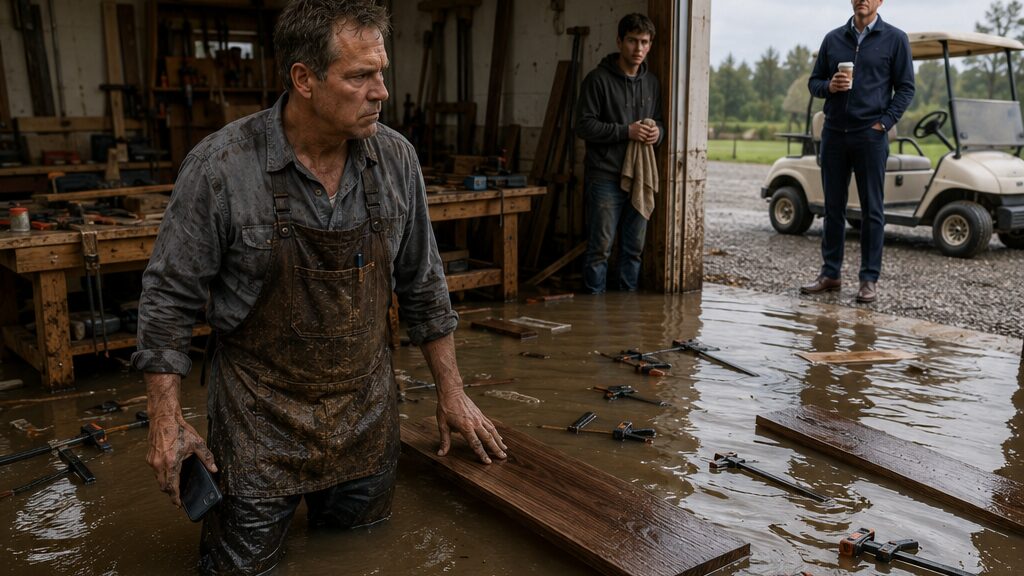
Brown water lifted the walnut boards before Robert Harris could reach them.
They rose slowly from the bottom shelf of the lumber rack, not floating free yet, but rocking there in the muddy current as if the shop itself had taken a breath and decided to let go. One twelve-foot plank bumped against the leg of his assembly table. Another had already drifted halfway across the room and wedged under the planer stand.
Robert stood in water up to the middle of his shins, one hand on the door frame, the other holding a flashlight he no longer needed. Morning had come gray and raw through the high windows. It showed him everything.
The floor was gone beneath the water. The cords to two sanders hung useless from hooks. The clamps on the west wall were streaked with mud. His father’s old workbench, too heavy to move in any season, stood like an island with brown water licking at its lower drawers.
He stepped forward and felt something soft roll under his boot.
A chisel handle.
He bent, reached down, and pulled it out of the water. The steel had already picked up a smear of rust-colored grit. He wiped it on his apron without thinking, then stopped, because the apron was soaked too.
Behind him, outside the open shop door, a golf cart whined to a stop on the gravel path above the swale.
Robert did not turn at first. He watched a pale curl of sawdust spin in the water near his foot. Yesterday that sawdust had been dry and fragrant, walnut and maple and white oak mixed into the smell he had known since he was a boy. Now the shop smelled like ditch water.
“Well,” a man’s voice called from outside, “that’s a mess.”
Robert turned.
Brandon Wright sat in the golf cart on the higher gravel strip that ran along the property line. He had one hand on the steering wheel and the other around a lidded coffee cup. His jacket was clean. His shoes were clean. Even the tires of the cart had only a neat rim of wet grass on them. Behind him, the eighteenth green of Ridgeview Club lay bright and guarded beyond a low line of trimmed shrubs, raised above Robert’s land like a stage.
Brandon looked from the doorway to the floating boards and gave a short laugh.
Not loud. Not wild. Worse than that.
Easy.
Robert felt the sound settle in his chest before anger could rise to meet it.
“You seeing this?” Robert asked.
“I’m seeing a drainage problem,” Brandon said. “On your side.”
Robert stepped toward the doorway. Water pushed against his boots, heavy with silt. “This came off your course.”
Brandon glanced uphill as if the slope were a boring subject. “Robert, we had three inches of rain. Water runs downhill. That’s not exactly a club policy.”
A walnut plank knocked against the table again, dull and hollow. Robert looked at it. It belonged to the stack he had been saving for Anna Rodriguez’s cabinet, the memorial piece for the school lobby. Thirty-inch doors. Bookmatched front. He had spent six months gathering boards with the right color and figure, turning down cheaper stock because Anna had wanted something that would last longer than a plaque.
Now the bottom layer of that stack sat underwater.
“You regraded behind the green last month,” Robert said.
Brandon’s smile thinned. “We repaired a maintenance slope.”
“You cut a channel toward my shop.”
“No,” Brandon said. “Rain found its level.”
Robert stared at him.
Brandon lifted his cup a little, not quite a toast. “You built a cabinet shop in low ground. I’m sorry, but that’s not something I can control.”
The words “cabinet shop” landed wrong. Robert’s father had called it the barn even after they put in dust collection and three-phase power. Customers called it Robert Harris Woodworks. The county forms called it an accessory commercial structure. Brandon called it a cabinet shop as if it were a hobby shed that had wandered into the wrong hollow.
Robert stepped out into the doorway. The water sucked at his boots.
“I didn’t build it in a swamp.”
Brandon looked down at the muddy water sliding over the threshold. “Today says different.”
For one dangerous second, Robert imagined walking up the gravel slope and putting both hands on the front of that clean jacket. He imagined the coffee flying, Brandon’s polished calm cracking, the cart rolling back against the shrubs. He imagined saying every word that had gathered in his throat since dawn, when he had first opened the shop door and watched his lumber move.
Instead, he heard his father’s voice as clearly as the drip from the rafters.
Cut once angry, cut twice wrong.
Robert lowered his hand.
“Do you know how much walnut is in here?” he asked.
Brandon sighed. “You’ll have to talk to your insurance.”
“About sixty thousand dollars in stock, counting the custom pieces.”
That number made Brandon’s face pause. Not soften. Pause.
Then he looked away toward the green.
“I can’t verify your inventory,” he said.
Robert almost laughed then, but it would have come out wrong. “You don’t need to verify my inventory to see where the water came from.”
“It came from the sky.”
“It came from your slope.”
“It came from a storm,” Brandon said, and now his voice carried the careful patience of a man practicing for witnesses. “A natural storm event. You can’t turn weather into liability because you had material stored too low.”
Robert looked back into the shop. On the far wall, where the water was still moving, the brown line showed a direction. Not a pool. Not a random spread. It had entered along the back corner, pushed beneath the lumber rack, crossed the open floor, and curled toward the roll-up door. Mud had pasted itself high on the east wall in one narrow fan.
It looked less like flooding than a path.
Robert stepped back inside, reached up to the pegboard beside the door, and took down a roll of blue painter’s tape. The cardboard center was damp, but the tape still pulled loose. He tore a strip with his teeth and stuck it to the door frame at the top of the water stain.
Brandon watched him. “What are you doing?”
“Marking the line.”
“Robert.”
He tore another strip and placed it where the mud had struck the side of the workbench.
“You’re not going to make this better by getting dramatic.”
Robert took his phone from the chest pocket of his apron. The screen was smudged, but it worked. He photographed the waterline on the door frame, the walnut rack, the shifted plank beneath the planer, the fan of mud near the back corner. Then he turned and took a picture through the open door: brown water in the foreground, Brandon clean and dry above it, the golf cart behind him, the eighteenth green higher still.
Brandon’s face changed. Not much. Enough.
“You don’t have permission to photograph club property.”
“I’m standing in my doorway.”
“You’re pointing at our course.”
“I’m photographing the water that came into my shop.”
Brandon set his coffee in the cup holder and climbed halfway out of the cart, one foot on the gravel. “I’d be careful with accusations.”
Robert took one more picture.
The shutter sound was small, almost polite.
Brandon straightened. “You know, the board has been patient about this place. Deliveries blocking the lane. Noise. Sawdust complaints.”
“The lane is on my deed.”
“I’m saying relationships matter out here.”
Robert slid the phone back into his apron. His fingers were stiff. The water was cold enough now that his toes had begun to ache inside his boots.
“Then tell me the date of the grading work behind the green.”
Brandon looked at him as if he had asked for something indecent. “That’s internal maintenance.”
“Who did it?”
“Robert, you need to call your insurance company.”
“I will.”
“And maybe your landlord.”
“I own the land.”
Brandon gave a tight smile. “Then you understand land has consequences.”
The plank under the planer shifted free and began floating toward the door. Robert turned, caught it with one hand, and saw the black streak where muddy water had already entered the grain. Walnut was patient wood. It could forgive a lot. It could not forgive dirty water soaked deep through the end.
He leaned it against the table and looked again toward the back corner.
There, just above the water, a narrow stream still poured through the gap under the rear wall. It did not seep. It ran. The flow carried small pieces of clipped grass, pale sand, and one torn little flag of white fertilizer bag.
Golf course debris.
Robert walked to the back corner, each step slow against the drag of water. He crouched and filmed the stream pushing under the sill. Then he lifted the phone higher and filmed the slope outside through the small rear window: the trimmed bank descending from the club, the fresh strip of disturbed earth behind the eighteenth green, the pale new gravel near the drainage swale that had not been there in spring.
Behind him, Brandon called, “This is not going to help you.”
Robert stopped filming.
For the first time since he had opened the door, the anger inside him went quiet enough to become useful.
He looked at the muddy water, the walnut, the door frame tape, the slope, the golf cart, the clean manager, the green beyond him.
Then he said, “Maybe not today.”
Brandon said nothing.
Robert stepped back to the doorway and took a final photograph before the water could fall, before the mud could dry, before anyone could call it a misunderstanding. In the picture, the brown stain crossed his floor like an unread map.
Chapter 2: The Map Nobody Wanted Opened
Robert laid wet photographs beside dry inventory sheets, and for the first time that morning, the damage looked less like chaos than evidence.
The folding table in the front corner of the shop had survived because its legs were tall and uneven. He dragged it closer to the door, wiped the top with an old towel, and spread everything out in rows. Photographs on the left. Inventory in the middle. Customer orders on the right. He used paint cans to hold down the curling paper, then wrote the time and date beneath each image before memory could turn soft around the edges.
Water still moved across the floor behind him, but the worst of the flow had slowed. It left behind a skin of silt on everything it touched. The walnut boards leaned against the assembly table, darker at their ends, bleeding brown down the concrete.
His phone buzzed twice.
Anna Rodriguez.
Robert watched her name glow on the screen until it went dark. Then he turned the phone face down.
He could not tell her yet. Not while the shop still looked like this. Not while he did not know whether the wood could be saved or replaced. Anna had trusted him with more than a job; the cabinet was supposed to hold the attendance ledgers and photographs from the old school building before it was torn down. She had said she wanted something warm enough that children would touch it without being told not to.
Robert picked up a pencil and wrote beside the walnut line item: water exposure, full assessment pending.
The pencil point broke.
He stood there with the broken pencil in his hand, staring at those words. Pending. Assessment. Exposure. Clean words for ruined wood.
Outside, a truck slowed on the road, then continued. No one came down the drive.
That suited him for about ten minutes.
Then the insurance adjuster’s recorded greeting asked him to leave a claim number he did not yet have, and the county public works office transferred him twice before a woman told him drainage complaints had to begin with a written form.
“Can I send photographs?” Robert asked.
“You can attach supporting documentation.”
“Can someone come out today?”
“That depends on the classification after review.”
“There’s water still entering the building.”
A pause. Keyboard sounds. “Sir, if it is an active emergency, you may need to contact emergency management.”
“It’s a drainage violation.”
“Then you’ll need the form.”
Robert thanked her because he had been raised to thank people who gave him the wrong door politely. Then he printed the form on paper that curled from the damp air.
By noon, he had tagged the damaged stacks, shut off the breakers, moved what tools he could to the loft, and written four pages of notes. He changed into dry jeans but kept the same stained gray shirt because the clean ones seemed dishonest. When he drove to the county building, he could still smell ditch water on his sleeves.
The county records office sat behind the courthouse in a low brick addition with fluorescent lights and a glass counter scratched by years of elbows and folders. A sign taped to the window read: PROPERTY SEARCHES MAY REQUIRE WAIT TIME.
A clerk looked up from a monitor. “Can I help you?”
“I need drainage records for Ridgeview Club and the parcel below it.”
She slid a form toward him. “Parcel number?”
Robert gave her his deed copy. He had folded it into his back pocket before leaving, not because he expected to need it, but because Brandon’s landlord remark had stayed under his skin like a splinter.
The clerk typed, frowned, typed again.
“Ridgeview has a lot of filings,” she said.
“I’m looking for drainage easements. Older surveys, if they’re there.”
“How old?”
“Before the current golf course layout.”
She looked over the top of her glasses. “That could take a while.”
“I can wait.”
She gestured toward a row of chairs. Robert sat beneath a framed map of the county roads and tried not to look like a man counting money he no longer had. Contractors came and went. A woman argued about a septic permit. A surveyor picked up a tube of plans and left whistling. Robert’s phone buzzed again in his pocket, then again fifteen minutes later.
Anna.
He did not take it out.
When the clerk finally called him back, she had a stack of copied pages and one flat archival box. “Some of this is scanned. Some isn’t. The older plat references a drainage feature, but I don’t know if it’s what you need.”
She placed the first copy on the counter.
Robert leaned over it.
The paper showed property lines in thin black strokes, a road alignment, the original pasture parcel, and, cutting diagonally across the land above what was now his shop, a broken line labeled DRAINAGE SWALE / EASEMENT. The line came from the upper ridge, crossed what would later become Ridgeview’s eighteenth fairway approach, and continued down through a low natural channel west of his building.
Not into it.
Past it.
“Can I get this enlarged?” Robert asked.
The clerk nodded. “There’s a fee.”
“I’ll pay it.”
She took the page back toward the copier. Robert stood at the counter, hands flat on the cool laminate, and felt something in him shift. Not relief. Relief was too clean. This was sharper. The first clear edge of a shape he had been feeling in the dark.
When the clerk returned with the enlargement, the old survey stamp was visible in the corner.
Before the redesigned green. Before the ornamental berm. Before the shrubs and cart path and the raised back slope that now sent water toward his wall.
The clerk tapped the page. “This references a recorded drainage easement, but I don’t see a release attached.”
“Meaning?”
“Meaning I don’t see where it was abandoned. Doesn’t mean it wasn’t. Just means I don’t have that page here.”
“What would change it?”
“Board action, court order, revised plat, sometimes a drainage plan tied to development.” She looked at him more carefully now. “You have flooding?”
“My shop is underwater.”
“From Ridgeview?”
“That’s what I’m trying to prove.”
The clerk’s mouth tightened, not in surprise exactly. More like recognition she could not put on paper.
She gave him another form. “Ask for engineering review. Attach this. And your photos.”
Robert carried the copies to a side table and arranged them beside his prints. There it was: the brown water path across his floor, and beside it, the old black line on the county map. Two versions of the same thing, one made of mud and one made of ink.
His phone buzzed again.
This time he answered.
“Robert?” Anna’s voice was careful. “I’m sorry to bother you. I was just checking on the cabinet. The dedication committee moved the program up a week, and I wanted to see if that changes anything.”
He closed his eyes.
In the silence, he heard paper moving somewhere behind the counter, a printer starting, a clerk saying next.
“Robert?”
“There was a flood at the shop,” he said.
“Oh.”
“I’m still assessing the walnut.”
“The walnut for our piece?”
“Yes.”
Another silence, smaller but heavier.
“Is it ruined?” she asked.
“I don’t know yet.”
It was not a lie, but it felt like one because he knew enough. He could already see which boards had wicked water too deeply. He could already imagine the warped panels, the staining, the swollen ends.
Anna breathed out slowly. “Why didn’t you call me?”
Robert looked down at the old survey map. “I wanted to know what I was dealing with first.”
“That’s not the same as telling me.”
“No,” he said. “It isn’t.”
She did not scold him. That made it worse.
After he hung up, he stood with the phone in his hand and the enlarged map spread before him. He had spent the morning proving Brandon wrong, and in doing so had proved something uncomfortable about himself too. He would rather carry a bad thing alone for six hours than let someone see the failure while it was still wet.
The clerk returned with one more sheet. “This was cross-referenced under Ridgeview’s 2008 course improvement filing.”
Robert took it.
It was not the whole plan, only an index page, but it named the eighteenth green renovation and referenced grading near the drainage corridor. Three boxes were checked. One was not.
Stormwater alteration approval.
Blank.
Robert looked from that blank box to the old black line.
“Can I request the full file?”
“You can,” the clerk said. “Some may be in engineering.”
He folded nothing. He kept the map flat between two pieces of cardboard, paid for every copy, and walked out through the courthouse hallway holding it like a door that had been taken off its hinges.
Outside, the afternoon sun had broken through. The county lawn shone wet and harmless.
Robert sat in his truck and laid the 1990 survey across the steering wheel. His shop parcel sat at the bottom of the page. Ridgeview’s land rose above it. The old drainage channel ran clean and deliberate across the slope, then bent exactly where the eighteenth green now sat bright and perfect.
The line did not disappear at the green.
It ran straight under it.
Chapter 3: The Club Blames the Man Downhill
Brandon Wright entered the county meeting room smiling because the folder in his left hand was already tabbed, and because the first rule of a room like that was never to look worried before anyone gave you a reason.
The room smelled of old coffee, floor wax, and damp coats. A dozen folding chairs faced a long table where two county staff members were arranging files. Robert Harris sat on the left side of the room with a cardboard tube across his knees and a stack of photographs in a plain manila folder. He wore a clean shirt this time, but his boots still had mud dried into the seams.
Brandon noticed that immediately.
Good, he thought, then disliked himself for thinking it.
Ridgeview Club could not afford a drainage fight. Not this week. The invitational started in nine days. Sponsors had already paid for signage. The board had already approved extra landscaping around the eighteenth green. Michael Baker had called twice that morning to remind Brandon that television crews from the regional sports channel would be filming the final groups coming in on Sunday.
“No surprises,” Michael had said.
He had not said please.
Brandon took a seat near the front and set his coffee on the floor beside his chair. No cup holder in here. No cart path. No trimmed grass. Just fluorescent light and county walls where influence had to wear ordinary clothes.
Robert did not look over.
That irritated Brandon more than if he had glared.
The county clerk called the matter by parcel number, then by property names. “Drainage complaint filed by Robert Harris regarding runoff from Ridgeview Club property.”
A few heads turned toward Brandon. He gave them a modest nod, the kind meant to say that reasonable people had been dragged into something unfortunate.
One staff member asked Robert to summarize.
Robert stood and unrolled the map with both hands. He did not speak right away. He placed the photographs below it: mud on the shop floor, the waterline marked in blue tape, the rear sill with brown water entering, the slope behind the green.
Brandon leaned back.
Robert’s voice was level. “The water entered my building from the northeast corner after recent grading behind Ridgeview’s eighteenth green. This 1990 drainage survey shows an established swale that used to carry that water west of my shop. I’m asking the county to review whether that drainage was blocked or redirected.”
Not bad, Brandon thought. Too neat, maybe. Someone had coached him, or he had stayed up long enough to sound coached.
The staff member turned to Brandon. “Mr. Wright?”
Brandon stood with his folder. “First, I want to say Ridgeview takes neighbor concerns seriously. We all had an unusual rainfall event. Several low areas across the county saw standing water. We’re sympathetic to Mr. Harris’s situation.”
Robert looked at him then.
Only once.
Brandon continued. “But sympathy doesn’t create causation. Our maintenance work was routine. No drainage outlet was directed toward his structure. The reality is Mr. Harris operates a workshop in a low-lying area. We also have concerns that the structure itself may interfere with historic drainage.”
Robert’s eyes narrowed slightly.
There it was. The turn Brandon had not wanted to use first but had been told to keep ready.
The staff member asked, “You’re saying the workshop obstructs the drainage?”
“I’m saying we need to determine whether the building and associated storage were properly permitted and whether they altered the low ground,” Brandon said. “It would be premature to blame the club when the complainant’s own improvements may be part of the issue.”
Robert’s hand moved toward his folder, then stopped.
Brandon saw the restraint and, for a moment, felt the unease of pushing a door that might not be locked.
A county attendee in the back whispered to someone. The word permit carried weight in a room like this. It changed a man from damaged to suspect.
The staff member turned to Robert. “Do you have permit documentation for the workshop?”
Robert opened his folder slowly. “The original barn predates zoning. The commercial use permit was issued when I converted the building. I have the certificate here.”
Brandon had expected uncertainty. A missing paper. An old farmer’s handshake. Instead, Robert placed a copy on the table.
Still, the damage was done. The room had heard the question. Robert would now have to defend his own footing while accusing the club of moving water.
Brandon glanced toward the side door. Catherine Green had not yet arrived. The county engineer was supposed to review the technical files, but if she was delayed, this meeting might end with a request for further documentation. Delay was not victory, but it could be useful. Nine days. That was all he needed. Nine days to get through the invitational, then the board could decide how much money made this go away.
The staff member studied the permit. “This appears valid.”
“Use and structure, yes,” Brandon said. “Drainage impact may be separate.”
Robert turned his head fully now. “The shop didn’t move uphill, Mr. Wright.”
Brandon kept his face calm. “No one said it did.”
“You’re saying my building caused water to run from your green into my wall.”
“I’m saying water seeks the lowest point.”
“You told me it was nature.”
“It is nature.”
“Then why did your file skip stormwater approval?”
The room went quiet.
Brandon looked at the map on the table, then at Robert. “I don’t know what you’re referring to.”
Robert slid the index sheet forward. “Your 2008 course improvement filing. Eighteenth green renovation. Grading near drainage corridor. Stormwater alteration approval not checked.”
Brandon had not seen that sheet.
He had seen summaries. Board packets. Maintenance notes. He had heard the old language: routine improvement, course beautification, surface correction. He had not asked for the full 2008 file because asking would imply doubt, and doubt was not a quality the board rewarded in managers.
“That was long before my time,” he said.
“Was the channel abandoned?”
“I’m not an engineer.”
“You were sure it was my fault a minute ago.”
A staff member lifted a hand. “Gentlemen.”
Brandon felt heat rise beneath his collar. Robert had not raised his voice, which somehow made him harder to interrupt. He stood there with his old map and muddy photographs, not polished, not impressive, but difficult to dismiss.
The side door opened.
Catherine Green entered carrying a rolled plan tube and a county file thick enough that the rubber band around it had begun to bend the corners. She had no expression that Brandon could read. That was never good.
“Sorry for the delay,” she said. “Engineering had to pull the Ridgeview grading records from storage.”
Brandon’s mouth went dry, but he reached for his coffee as if he had merely been waiting.
Catherine set the file on the table, removed the rubber band, and began sorting pages. She paused at one tab, then another.
The staff member asked, “Do you have an initial finding?”
“Not a final one.” Catherine looked at Robert’s map, then at Brandon’s folder. “But I have a question before we go further.”
Brandon kept his smile in place. “Of course.”
Catherine lifted two pages from the file and set them side by side. “The 2008 index references a grading exhibit, a drainage note, and a field revision. The drainage note is here. The grading exhibit is here.” She tapped the empty space between the pages. “But the field revision sheet is missing from the club copy and the county scan.”
The word missing seemed to hang longer than it should have.
Brandon looked at the file as if paper might rearrange itself out of courtesy.
Robert said nothing.
Catherine turned one page toward the room. “So before anyone blames the downhill structure, I need to know why the club’s grading file has missing pages.”
Chapter 4: The Fill Beneath the Perfect Green
Catherine Green found the first mismatch in a grading note that should have been boring.
The note said existing swale preserved.
The aerial photograph on her screen said otherwise.
She sat alone in the county engineering office with Ridgeview’s old file spread across two desks, a cold cup of coffee beside her keyboard, and a yellow sticky note marking the missing field revision sheet. Outside her window, a mower moved along the courthouse lawn in straight, indifferent lines. Inside, every line on the old plan seemed to lead toward a problem someone had decided not to name.
She pulled Robert Harris’s 1990 drainage survey closer. The swale line crossed the upper parcel cleanly, then bent west, away from the low ground where his shop sat. On the 2008 grading plan, the same area was softened into contour curves around the eighteenth green. The swale did not vanish. It was simply not labeled anymore.
That bothered her more than if someone had drawn a bold X through it.
People hid things loudly when they were afraid of getting caught. They hid them quietly when they expected everyone else to look away.
Catherine zoomed in on the scanned plan until the contour labels blurred. There, behind the green, a new berm had been shaped like a protective shoulder. It would make the finishing hole look cleaner from the clubhouse patio. It would also block the old shallow run of water and force runoff toward the lower corner of the Harris parcel.
She clicked back to Robert’s photographs.
Blue tape on a door frame. Mud fan at the rear sill. Waterline along the east wall. A torn scrap of fertilizer bag near the shop floor drain.
She opened the rainfall report for the storm. Heavy, yes. Unusual, no. Not the kind of rain that should have floated a man’s lumber if the historic drainage still had a place to go.
Her office phone rang.
She looked at the caller ID and let it ring once more before answering. “Engineering.”
“This is the club office at Ridgeview. Mr. Wright wanted to confirm whether there’s any need for site access today.”
Catherine looked down at the file. “Yes.”
A pause. “He’s in a board call. The course is being prepped for the invitational.”
“Then someone from maintenance can meet me.”
Another pause, tighter this time. “May I ask what specifically you need to inspect?”
“The drainage corridor behind the eighteenth green.”
“That area is sensitive right now.”
“I imagine it is,” Catherine said.
By midafternoon she was standing at the edge of the course with a clipboard, steel probe, and county vest. The eighteenth green was as perfect as reputation could make grass: close-cut surface, white cup, trimmed collar, shallow bunkers raked smooth even after rain. Beyond it, a line of ornamental shrubs separated the course from the rougher slope dropping toward Robert’s shop.
A golf-course worker met her near the cart path. He kept glancing toward the clubhouse as if every answer might travel there faster than sound.
“Mr. Wright said routine inspection,” he said.
“I said drainage inspection.”
“Yes, ma’am.”
She walked the back edge of the green first. The grass gave slightly under her boots, wetter than the surface color admitted. Behind the shrubs, the land dipped, then rose into the berm shown on the 2008 plan. The berm was old enough to have settled and grown in, but not old enough to be natural.
Catherine pushed the steel probe into the soil along the low point. Six inches of topsoil. Then resistance. Compacted fill. Not creek gravel. Not native silt. She moved five feet west and tried again. Same layer. Ten feet. Same.
She crouched, took a soil plug, and rubbed it between her fingers. Bits of pale crushed stone and construction sand. Fill material.
From the slope below, Robert’s shop roof was visible through bare branches. Its rear wall sat in the path where water would go once the berm shed it.
The golf-course worker shifted behind her. “We get standing water here sometimes.”
“Before the renovation?”
“I wasn’t here then.”
“Who would know?”
He looked toward the clubhouse again. “Old maintenance guys, maybe. Some retired.”
Catherine marked the coordinates, photographed the probe holes, then walked downslope to Robert’s property. He was outside the shop, carrying a box of water-damaged hardware to the bed of his truck. His sleeves were rolled above his elbows. Mud had dried in crescent shapes across his forearms.
He stopped when he saw her vest.
“Am I in the way?” he asked.
“No. I need to match your photos to the entry point.”
He nodded and opened the rear shop door.
Inside, the water had receded, leaving the place worse in some ways. Floodwater in motion had been a crisis. Mud after water was evidence of what the crisis had touched. It coated the concrete in a thin brown film. It marked every tool leg, every crate, every board that had rested too low.
Robert had set up box fans, though the air still held damp wood and old earth.
Catherine stepped carefully around stacked lumber. “These are the walnut boards?”
“What’s left of them.”
He said it flatly, but his hand went to one plank as he passed, fingers resting on the stained end like he was checking for a pulse.
She compared the photograph on her tablet to the wall in front of her. “This one was taken before the water dropped?”
“Yes.”
“What time?”
“Seven forty-three.”
“And the rain had stopped?”
“Mostly. Water was still coming from that corner.”
He pointed to the rear sill. Catherine crouched and studied the gap. The mud fan spread exactly as his picture showed. It had carried clipped grass, light sand, and fertilizer-bag plastic from above. She stepped back and looked through the rear window toward the green.
The line was obvious once you stopped pretending not to see it.
“You marked the waterline before cleanup,” she said.
Robert gave a small shrug. “It was going to dry.”
“Most people wait too long.”
“Most people aren’t standing in it.”
She glanced at him. There was no self-pity in the answer. That made it more difficult to keep the careful distance county work required.
He took a folder from the bench. “I also found delivery tickets from the week they reworked the back of the green. Gravel and sand. I don’t know if they matter.”
“They may.”
He handed them over. His fingers paused before releasing the folder, not because he did not trust her, Catherine thought, but because handing over proof felt like handing over control.
She understood that.
At the office, evidence stayed clean. Out here, evidence smelled like mud and ruined work.
Back at the course boundary, Brandon Wright arrived in a cart with a club board member beside him. He stepped out before the cart fully settled.
“Catherine,” he said, using her first name too quickly. “I wish someone had told me you were coming onto active play areas.”
“I informed your office.”
“We have tournament preparation underway.”
“I’m aware.”
The board member remained seated, arms crossed.
Brandon looked toward the probe marks. “I hope we’re not making assumptions based on a storm and a few old documents.”
“No assumptions,” Catherine said. “Measurements.”
“The club has maintained this course responsibly for years.”
“Then the records should show that.”
His jaw tightened. He lowered his voice. “You understand what an order against that green would mean this week.”
“Yes.”
“For the club, for local vendors, for the charity sponsors—”
“I understand consequences,” she said. “I also understand water.”
For the first time, Brandon had no immediate answer.
Catherine turned back to the slope. The old survey line, Robert’s photographs, the soil probe, the missing field revision, the unchecked stormwater box—all of it had formed a pattern too strong to leave as a request for more information.
In her truck, she wrote the preliminary finding before she could be talked out of its shape.
Historic drainage corridor obstructed by placed fill behind eighteenth green. Runoff redirected toward lower adjoining parcel. Removal or corrective restoration required pending final notice.
She stopped there, pen hovering.
County staff preferred soft verbs. Review. Consider. Coordinate. Words that let powerful property owners feel invited instead of ordered.
But Robert’s shop had not been invited to flood.
She added one more line.
Unauthorized fill must be removed from the drainage path.
When Catherine returned to the office, the missing field revision was still missing. But now it mattered less as a mystery and more as an absence that pointed directly to the earth itself.
She placed Robert’s waterline photos beside the old map and the soil notes, then began drafting the enforcement order that would require Ridgeview Club to open the buried channel behind the perfect eighteenth green.
Chapter 5: The Price of Staying Quiet
Brandon Wright brought the settlement envelope to Robert’s shop two days before the tournament, and he held it carefully away from the mud.
The shop floor was mostly dry by then, but dry did not mean clean. Pale silt still sat in hairline cracks in the concrete. Tool legs wore brown rings where the water had reached them. The walnut stack near the assembly table had been sorted into three groups: usable, questionable, and lost. The lost pile was the largest.
Robert saw Brandon stop at the threshold and look down before stepping in, as if damage might get on his shoes.
“You don’t need to come inside,” Robert said.
Brandon came in anyway.
He wore a navy jacket with the Ridgeview crest stitched small over the chest. No coffee today. No laugh. He looked thinner around the eyes, or maybe just less certain without dry ground above him.
“I’m here to resolve this,” Brandon said.
Robert set down the hand plane he had been cleaning. “County already drafted an order.”
“Drafted isn’t final.”
“It will be.”
“That depends.” Brandon placed the envelope on the edge of the workbench, choosing the one dry corner Robert had cleared for invoices. “The board authorized me to make a good-faith offer.”
Robert did not touch it.
Brandon glanced around the shop. “Repairs. Material loss. Business interruption. We can save everyone months of trouble.”
“Everyone?”
“You. Us. The county.”
“The water?”
Brandon looked at him.
Robert wiped oil from his fingers with a rag. “What does Ridgeview want in return?”
“A cooperative statement that the matter has been privately resolved pending further review.”
“Further review.”
“It’s standard language.”
“Does the channel get opened?”
Brandon’s expression tightened. “Not before the invitational.”
There it was, plain enough to respect, if not forgive.
Robert picked up the envelope. It was heavier than he expected. Inside were papers, not cash, but the weight still moved through his hand like a temptation. Material loss. Business interruption. Repairs. He had bills stacked on the front table, a deductible he did not like thinking about, and a custom order he might not be able to finish without buying more walnut at prices that had gone mean in the last two years.
“How much?” he asked.
Brandon named a number.
Robert kept his face still.
It was not everything. It was enough to breathe.
Brandon saw that. “You’re a practical man. I respect that. This keeps you whole without turning the course into a construction site in front of half the county.”
Robert let the envelope rest against his palm. “Catherine said the fill redirects water.”
“Catherine said preliminary.”
“She said other lower parcels could be affected if the next storm hits harder.”
Brandon’s eyes flickered. “That’s speculation.”
“Water runs downhill. You told me that.”
For a second, Brandon looked tired enough that the manager mask slipped. “I have forty seasonal workers scheduled. Vendors. Sponsors. A board that thinks grass is easier to manage than people. If that green gets torn up this week, I’m the one standing in front of them.”
“You laughed at my shop.”
Brandon looked away.
Robert expected denial. Instead, Brandon said, “I shouldn’t have.”
The apology was too small for the room, but it was there. Robert hated that it made the envelope feel heavier.
Brandon continued, quieter now. “I didn’t build that berm. I didn’t approve the old work. I inherited a course people expect to look perfect every day, and if I tell them a drainage easement under the eighteenth green is going to ruin the invitational, they won’t blame a file from 2008. They’ll blame me.”
Robert studied him. “So you blamed me first.”
Brandon’s mouth closed.
From the front drive came the crunch of tires. Robert looked through the open door and saw Anna Rodriguez stepping out of her car with a folder held against her chest. She hesitated when she saw Brandon inside.
Robert put the envelope back on the bench.
Anna came to the threshold, her eyes moving from Brandon to the sorted walnut. “I can come back.”
“No,” Robert said. “You should see it.”
The words surprised him. They surprised Anna too.
Brandon shifted. “Maybe this is a private customer matter.”
“It is,” Robert said. “Mine.”
Anna stepped in carefully. She was dressed for work, dark slacks and a school badge clipped to her cardigan. She had probably come between meetings. Her gaze fell on the walnut boards marked with blue chalk.
Usable.
Questionable.
Lost.
She walked to the lost pile and touched one board with two fingers. The end had swollen and split along the grain. A dark water stain climbed nearly a foot into the wood.
“This was for the cabinet?” she asked.
“Some of it.”
“How much?”
“Enough.”
She looked at him then, hurt in a way that did not accuse loudly. “You should have called sooner.”
“I know.”
“You said you were still assessing.”
“I was trying to find a way to tell you after I had a solution.”
“Robert.”
He looked at the floor.
In the pause, the fans hummed against the damp walls. Somewhere near the back, a drop of water fell from a clamp and tapped the concrete.
Anna opened her folder and took out a printed program proof. At the top was the dedication date, now circled in red. “This cabinet isn’t just furniture to us. The old school records have been in cardboard boxes for three years. The families are coming. Some of them donated the wood money because they wanted something made here, by somebody local.”
“I know.”
“I don’t need perfect,” she said. “I need honest.”
Robert felt that go through him more cleanly than Brandon’s offer.
He had been thinking about the shop as his father’s place, his loss, his bill, his fight. He had not wanted Anna to see warped boards because warped boards looked like failure. But the failure had already reached her. Silence had not protected anything. It had only left her waiting outside the truth.
He picked up one of the stained boards from the questionable pile. The figure was still beautiful above the waterline, dark ribbons curling through brown heartwood. Below it, the stain cut across the grain in an uneven tide mark.
“I might be able to salvage panels from the upper section,” he said. “Not the original design. Smaller door faces. Maybe a visible join.”
Anna took the board from him. “Can the stain stay?”
Robert blinked. “You’d want that?”
“If the story is part of it.”
Brandon made a small impatient movement. “The story does not need to get larger than it is.”
Anna turned toward him. “It got large when water came through his wall.”
Brandon stiffened, but said nothing.
Robert looked at the envelope. Then at the old drainage map, folded on the bench beside Anna’s damaged board. He had folded it along the swale line without meaning to. The crease ran like a scar through the paper.
“What happens after the tournament?” Robert asked.
Brandon said, “We continue discussions.”
“No. What happens to the fill?”
“The board will review long-term drainage options.”
“Meaning leave it.”
“Meaning review.”
Robert nodded once. He could imagine it: the offer signed, the hearing delayed, the green preserved through Sunday, the county softened by lawyers and schedules, the next storm carrying water toward someone else’s low wall. Maybe his again. Maybe the neighboring landowners downhill. Maybe a place with no photographs and no old map found in time.
He slid the envelope back toward Brandon.
Brandon did not pick it up. “Think carefully.”
“I am.”
“This could get expensive.”
“It already is.”
“For you too.”
Robert looked at Anna, still holding the stained walnut. Then he looked at the blue tape marks on the wall, left there even after the water had dropped.
“I wanted my shop fixed,” he said. “That was all.”
Brandon’s voice softened in one last attempt. “Then take the offer.”
Robert picked up the old map and unfolded it carefully across the workbench. The paper crackled under his hands. Anna stepped closer. Brandon stayed where he was.
“The map doesn’t stop at my property,” Robert said.
No one answered.
He rolled the map into its tube, selected one stained walnut board from the questionable pile, and wrapped it in a moving blanket. When he lifted it, damp weight pulled at his shoulder.
Brandon said, “Where are you going?”
Robert tucked the settlement envelope under Brandon’s hand and took the board instead.
“To the meeting,” he said.
Chapter 6: When the Water Followed the Record
Robert placed the stained walnut board on the hearing table, and the room stopped treating the flood like paperwork.
The board was only three feet long, cut from a longer plank he could not save. Above the stain, the walnut still held its deep brown figure, clean ribbons running through the grain. Below it, the wood turned dull and bruised, the waterline jagged across its face. Mud had settled into one open pore and would not sand out.
Robert laid the old drainage map beside it.
Then he stood back and waited.
The county hearing room was fuller than it had been the first time. Club representatives sat together on one side. A few neighboring landowners had come after hearing the words drainage order. Anna Rodriguez sat in the second row, hands folded over the program folder in her lap. Brandon Wright sat near the front with his jaw set and no coffee in sight.
At the county table, Catherine Green arranged her technical report with the care of someone building a bridge one measured piece at a time.
A county official called the matter to order.
Before anyone asked, Robert spoke.
“I brought the wood because photographs make water look temporary.”
The room quieted.
He touched the stained board. “This isn’t temporary.”
Brandon leaned toward his own microphone. “We all sympathize with Mr. Harris, but this hearing is about whether an emergency order before a major community event is justified. Ridgeview is asking for a short delay to allow independent review.”
“Delay until after Sunday?” the official asked.
“Yes. The invitational supports local vendors and scholarship funding. Tearing into the eighteenth green now would cause unnecessary harm when the engineering findings are still preliminary.”
Catherine’s pen stopped.
Robert looked at the word preliminary in Brandon’s mouth and remembered the first laugh above the waterline.
The official turned to Catherine. “Ms. Green?”
Catherine opened her report. “The findings are sufficient for enforcement. The historic drainage corridor is documented in the 1990 survey. The 2008 course renovation altered grade behind the eighteenth green. Field inspection shows placed fill obstructing that corridor. Recent stormwater followed the redirected slope to the Harris structure.”
Brandon lifted a hand. “With respect, there is still a missing field revision sheet. We don’t know what that sheet allowed.”
“No,” Catherine said. “We know it’s missing. We don’t know that it allowed anything.”
That distinction moved through the room like a draft.
Brandon’s attorney murmured to him. A board member shifted in his chair.
Robert unrolled his timeline. He had written it by hand the night before because typed words looked too clean for what he needed to say. Rainfall times. Photos. Water entry points. Delivery tickets from the club’s grading work. The old survey. The unchecked stormwater alteration box. Catherine’s soil probe notes. Each item numbered. Each number matched to a photograph or copy.
His hands shook once as he placed the pages in order.
Anna saw it. She did not look away.
The official asked, “Mr. Harris, are you asking for compensation today?”
Robert glanced at Brandon. The settlement envelope was not in the room. That felt important.
“I’m asking for the water to stop being sent through my building.”
“And compensation?”
“My insurance and their board can argue money. I’m not here to bargain with the drainage.”
A neighboring landowner in the back gave a low murmur of approval before catching herself.
Brandon’s face tightened. “No one sent water through your building.”
Robert lifted the first photograph. “This is my rear wall at seven forty-three. This is the slope behind your green at seven fifty-one. This is the mud fan inside. This is the old drainage path.” He placed each image down, one after another, not fast, not dramatic. “If the swale was open, the water had somewhere else to go.”
Brandon leaned into the microphone. “Again, the club did not create that condition under my management.”
The sentence was meant to protect him. Instead, it opened the next door.
Catherine looked toward the county official. “There is an additional record matter.”
The official nodded.
Catherine removed one page from the back of her report. “Yesterday afternoon, the archived board packet for the 2008 course improvement was located in off-site storage. It includes a memo referencing the field revision. The memo does not include a stormwater approval, but it does include a recommendation to allow temporary fill near the drainage corridor during green reconstruction.”
Brandon stared at the page.
The official asked, “Temporary?”
“Yes.”
Robert felt the room lean forward without moving.
Catherine continued. “The memo was signed by a club board representative acknowledging responsibility for removal after construction.”
“Who?” someone in the back asked.
Catherine did not look at the audience. She looked at the official. “Michael Baker.”
A sound went through the club side of the room. Not loud. Paper against paper. Breath caught. A chair leg shifting.
Michael Baker sat two seats behind Brandon. Until that moment, he had been very still. Now his face changed in a way Robert could not immediately read: anger first, then calculation, then the tired look of a man realizing an old decision had survived longer than his memory of it.
Brandon turned halfway toward him. “Michael?”
Michael did not answer.
The official studied the memo. “Was the fill removed?”
Catherine said, “Field inspection indicates it was not.”
The club attorney stood. “We would object to characterizing a fifteen-year-old maintenance condition as an emergency created by the present club management.”
Robert picked up the stained walnut board before he knew he was going to move it. The weight steadied him.
“It became present when it came through my wall,” he said.
No one interrupted.
He set the board down again, but this time he turned it so the stain faced the club’s side of the room.
“I don’t know who forgot what,” he said. “I don’t know who thought temporary meant forever. I know I stood in water up to my shins while Mr. Wright told me it was nature. If that’s true, then let it follow the natural route on the map.”
Brandon’s eyes moved from the board to the map.
For a moment, Robert saw the man beneath the manager: trapped between an old board decision, a public event, a course he had been hired to keep flawless, and his own choice to laugh when he should have listened. That did not excuse him. It made the harm less simple and more human, which somehow made Robert’s next words harder.
“I’m not asking you to ruin a tournament,” Robert said. “I’m asking the county not to protect a green by flooding everyone below it.”
The official called a brief recess.
No one moved much at first. Then the room broke into low conversations. Anna came to Robert’s side and touched the edge of the walnut board.
“That was honest,” she said.
“It didn’t feel clean.”
“It wasn’t supposed to.”
Across the room, Brandon stood with Michael near the wall. Their voices were low, but Robert caught enough.
“You told me it was handled,” Brandon said.
“It was fifteen years ago,” Michael replied.
“You signed removal responsibility.”
“I signed a construction acknowledgment. Don’t turn this into something it wasn’t.”
“It’s already something.”
Michael looked toward Robert then, and there was resentment in his face, but not surprise. That was the detail Robert noticed. Not surprise.
The recess ended.
The county official read the order in a steady voice. Unauthorized fill in the historic drainage corridor was to be removed. Temporary stabilization measures were to be installed the same day. Permanent restoration design would follow. Ridgeview Club could continue play elsewhere, but the affected area near the eighteenth green would be closed until the channel function was restored and inspected.
Brandon closed his eyes for half a second.
The official added, “Compensation and private damages are separate matters. This order concerns drainage correction.”
Robert sat down because his legs had gone unsteady.
By late afternoon, county crews and contracted equipment had gathered behind the eighteenth green. Orange cones blocked the cart path. A small excavator sat where spectators were supposed to stand on Sunday. Club workers watched with the helpless attention of people seeing a perfect surface become worksite dirt.
Robert stood behind the temporary barrier with Anna a few feet away and Catherine near the crew chief.
Brandon arrived after the first cut.
The excavator bucket peeled back sod behind the green, then dug into the berm. At first the soil came up dark and grassy. Then pale fill appeared, compacted and wrong. The bucket scraped through crushed stone and sand packed where a shallow channel should have been.
Catherine watched the grade rod. “Lower there,” she called.
The crew cut deeper.
For a few minutes, nothing happened except the ordinary violence of repair: engine noise, torn roots, men signaling with gloved hands. Then water began to move.
It came first as a shine along the trench bottom. Then a thread. Then a narrow brown run slipping into the reopened swale, away from Robert’s property and along the old route marked on the 1990 map.
Robert felt no joy.
What he felt was stranger. A loosening, maybe. A hard knot inside him giving up one loop.
The water had known where to go. Men had buried the way and called the result nature.
Behind them, a practice ball rolled from the edge of the green where someone had abandoned it earlier. It traveled slowly down the damp collar, dropped over the raw cut, and landed in the new mud with a soft, final plop.
No one laughed.
Brandon stared at the ball, then at the water running through the channel.
Robert folded the map under his arm and looked past the torn green toward the low roof of his shop. For the first time since the flood, the distance between the two places looked like a line that had been drawn honestly.
Chapter 7: The Cabinet Made From What Survived
The shop floor was dry, but one walnut board still carried a brown tide mark that no blade in Robert Harris’s shop could erase.
He held it under the window light and turned it slightly, watching the stain darken, then soften, then darken again as the grain caught the morning. Three weeks earlier, he would have cut around that mark without thinking. A damaged section had no place in finished work. It belonged in the scrap bin, the stove pile, or the quiet corner where a craftsman put mistakes he did not want customers to see.
Now the board lay across his bench like a question that had survived the flood.
The rest of the shop had changed faster than he had. New gravel had been packed along the rear wall. The foundation had been sealed and graded. A shallow stone swale now curved behind the building and carried ordinary runoff away before it could gather at the sill. The fans were gone. The mud smell had faded. The blue tape waterline marks still clung to the wall because Robert had not been able to pull them off yet.
The insurance adjuster had come with a tablet and cautious sympathy. Ridgeview’s board had sent a letter without warmth but with numbers. The county order had moved from emergency correction to permanent restoration planning. The eighteenth green was still fenced off, its torn back edge covered in straw and erosion cloth. The invitational had gone on with a temporary hole and a great deal of strained politeness.
People had begun stopping by the shop.
Some wanted furniture. Some wanted details. A few wanted a version of the story where Brandon Wright got shouted down and Michael Baker fled the county meeting red-faced. Robert disappointed them without meaning to. He told them the channel had been reopened, the records were being reviewed, and the shop was back to work.
“What about the club?” one neighbor had asked.
“They’ve got their own repairs,” Robert said.
It was not as satisfying as gossip, but it was true.
The walnut for Anna Rodriguez’s cabinet had taken the longest. Robert had resawn, trimmed, tested, rejected, and reworked. Some boards twisted beyond use as they dried. Some looked sound until a pass through the planer revealed gray water shadow deep in the grain. He bought replacement walnut for the structural pieces, then returned to the stained board again and again, not ready to use it and not willing to throw it away.
Anna came by on a Thursday afternoon with two students carrying a box of old school photographs. She stopped just inside the door, as if remembering the water that had been there.
“It looks different,” she said.
“It is different.”
Her eyes went to the wall. “You kept the tape.”
“For now.”
The students set the photograph box on a side table and wandered toward the front, whispering over the tools with the careful awe of children warned not to touch anything expensive.
Anna approached the bench. “Is that the piece?”
Robert nodded.
The cabinet stood behind him, assembled but unfinished. Smaller than the original plan, but better for it in a way he would not have admitted early on. The doors were framed with clean walnut, the panels bookmatched from salvaged upper sections. The base was new stock. The back held a hidden reinforcement because Robert no longer trusted any piece of wood only because it looked strong.
Across the center of the right door, set deliberately into the panel, the water-stained walnut formed a dark uneven line like a low horizon.
Anna saw it and did not speak.
Robert picked up a sanding block, then set it down again. “I can still change it. I made another panel.”
“Show me.”
He lifted the spare from beneath the bench. It was beautiful. Clean. Balanced. No stain, no scar, no interruption in the figure. The kind of panel customers usually chose because it made life look orderly.
Anna looked at it for a long moment, then back at the cabinet.
“No,” she said. “Use the first one.”
“It will draw the eye.”
“It should.”
He waited.
Anna touched the stained panel lightly. “The old school flooded twice before they closed the basement. My grandmother used to talk about carrying attendance books upstairs during storms. We were going to pretend all of that history was neat because the dedication program is neat.” She smiled faintly, without much humor. “Maybe this is more honest.”
Robert looked at the old photographs in the box. Children lined on steps. Teachers in front of chalkboards. A basketball team from the seventies. Faces that had no idea someone would one day worry over where to store their names.
“I should have told you sooner,” he said.
“You did eventually.”
“That’s generous.”
“It’s practical.” Anna looked at him. “You were trying not to look like you had failed.”
He did not answer.
She understood anyway.
After she left, Robert finished sanding the cabinet with the stained panel in place. He worked more slowly than usual near the waterline. The grain there felt different under his fingers, slightly raised in places where the flood had changed the board before he could save it. He did not try to make it disappear. He eased the edge, sealed the pores, and let the mark remain visible beneath the first coat of oil.
The color deepened at once.
The stain did not look like damage anymore. Not exactly. It looked like something the wood had gone through and kept.
Two days later, Brandon Wright came to the shop.
Robert saw him through the front window before the bell over the door gave its small, dry ring. Brandon wore work clothes instead of club clothes: plain jacket, jeans, boots with mud on them. He looked toward the rear wall first, then at the tape line, then at the cabinet near the finishing table.
“I’m not here about the settlement,” Brandon said.
Robert closed the lid on the oil can. “All right.”
Brandon took a folded paper from his jacket pocket. “The board accepted the permanent drainage plan this morning. Catherine Green’s office gets final review, but the corridor stays open. Not just a temporary cut.”
Robert took the paper. It was a copy, not an original. Still, the line was there in county language: restored historic drainage alignment to remain unobstructed.
“Why bring this to me?” Robert asked.
Brandon looked at the cabinet. “Because I told you water finding its level was nature.”
Robert waited.
“And because I knew by the time I brought that envelope that leaving the fill there was wrong.” Brandon’s voice stayed controlled, but not smooth. “I told myself I was protecting jobs and a tournament and people who had nothing to do with 2008. Some of that was true. It just wasn’t the whole truth.”
Robert folded the paper once.
“Michael?”
“Stepped down from the facilities committee. Not from the board.” Brandon gave a tired half-smile. “People around here rarely fall as far as stories want them to.”
“No.”
“I may be gone by fall.”
Robert looked at him then. There was no triumph in the news. Only consequence, moving with the same patience as water.
Brandon nodded toward the cabinet. “That the school piece?”
“Yes.”
“It’s good.”
Robert almost said thank you by reflex, then stopped. “It will be.”
Brandon put his hand on the door frame as if to leave, then noticed the blue tape mark near his shoulder. His eyes stayed on it.
“I laughed,” he said.
Robert did not help him past it.
Brandon swallowed. “I’m sorry for that.”
This apology was not bigger in words than the first one. But it stood in a drier room, with no envelope between them and no tournament to save that day.
Robert nodded once. “I heard you.”
Brandon left quietly.
The school dedication was held the following Friday in a room that smelled of floor polish and coffee from a silver urn. Robert delivered the cabinet himself, wrapped in moving blankets and strapped upright in the truck. Two maintenance workers helped carry it inside, but he guided the weight at every turn.
When the blankets came off, conversation thinned.
The cabinet stood against a brick wall below framed photographs of graduating classes. The walnut caught the overhead light warmly. The stained panel drew the eye exactly as Robert had warned. People moved closer, first to admire, then to understand.
Anna stood beside it while the school administrator spoke. She did not make the flood into a performance. She said the cabinet had been built from local walnut, some of it salvaged after damage, and that the visible mark had been kept because history was not only what survived untouched.
Robert stood in the back, hands folded in front of him, uncomfortable with how many people turned to look.
A child near the front raised a hand and asked if the line was supposed to be there.
Anna smiled. “Yes.”
The child nodded, satisfied by certainty.
Afterward, families placed old photographs and ledgers inside the cabinet. Anna opened and closed the doors once, carefully. The hinges moved cleanly. The stained line crossed the right panel without apology.
Robert ran his thumb over the top edge when no one was watching and felt no swelling, no roughness, no weakness under the finish.
Back at the shop that evening, he took down the blue tape from the wall. It came away in short stubborn strips, leaving pale rectangles on the wood trim. He threw the tape in the trash, then stood for a moment facing the blank marks it left behind.
On the wall near the front counter, he had hung a framed copy of the 1990 drainage map beside the new county agreement. He had not enlarged it for drama. He had not circled the green in red. The old swale line was simply there, thin and black, crossing the land the way it always had.
Below it, on a narrow shelf, he placed a small offcut from the stained walnut board.
The shop was quiet except for the settling tick of cooling machines and the distant sound of water moving where it belonged.
Robert turned off the front light, then paused with his hand on the switch by the door. In the dimness, the framed map still caught a little evening light from the window. It did not look like revenge. It looked like a record.
That was enough.
The story has ended.