The HOA Sent Police Over a WiFi Password While a Medical Ramp Was Being Torn Down
Chapter 1: The Crew Was Already Taking The Ramp Apart
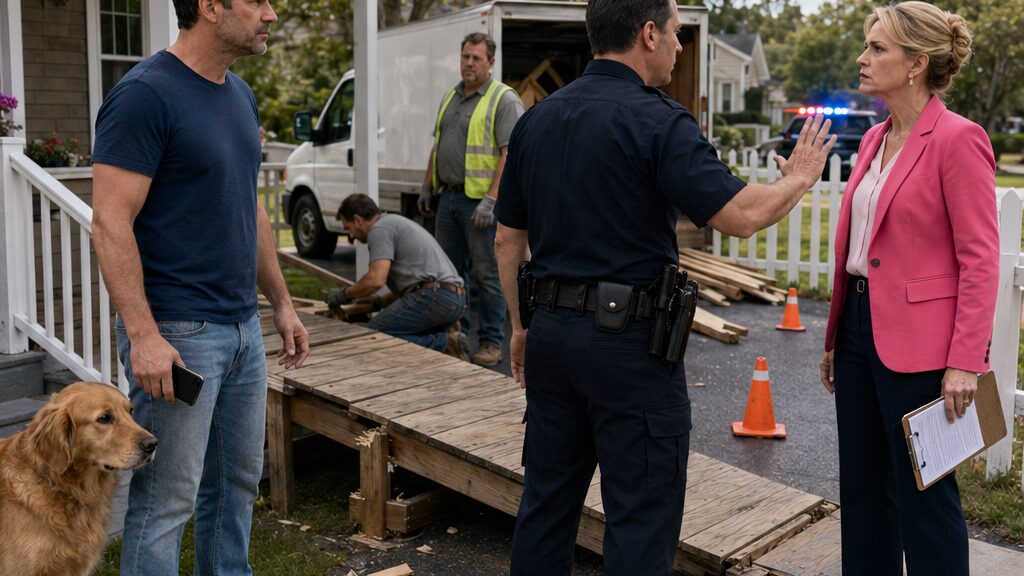
The saw was already biting into the ramp support when Michael Adams opened his front door.
For half a second, the sound did not make sense. It was too loud, too close, too wrong for his quiet street of clipped lawns and white fences. Then he saw the worker kneeling beside the temporary ramp, yellow cord stretched across the driveway, blade spitting pale dust from the pressure-treated board Brian Hall had installed three days earlier.
“Stop,” Michael said.
No one did.
His golden retriever, Cooper, pressed against his leg and gave one low bark. Beyond the porch, a white box truck sat half in the driveway, rear doors open. Two orange cones had been placed with the neat arrogance of people who believed they belonged there. One worker was stacking loosened railing pieces against the truck. Another had a drill in his hand.
Near the white fence, Donna Williams stood in a bright pink blazer, one arm crossed over a clipboard, the other holding her phone as if it were a badge.
Michael stepped down onto the top platform of the ramp, close enough that the worker with the saw finally looked up.
“Kill the saw,” Michael said, evenly.
The worker hesitated.
Donna’s heels clicked on the driveway. “You were notified, Mr. Adams.”
“No,” Michael said. “I was not.”
“A notice was placed on your door.”
“When?”
“This morning.”
Michael looked at the worker, then at the cut in the support beam. “This morning when the crew was already here?”
Donna’s jaw tightened. “The modification is unauthorized. The board has the right to remove non-compliant exterior structures.”
“It’s a temporary medical access ramp.”
“That has not been approved.”
“It was submitted.”
“It was incomplete.”
Michael took his phone from his pocket and began recording. He kept the camera low, pointed at the saw, the half-removed railing, Donna’s clipboard, and the front door behind him. He did not raise his voice. That seemed to bother Donna more than anger would have.
“Please state your name and the authority you’re using to remove my property,” he said.
Donna looked past him at the worker. “Continue.”
The worker did not move.
Michael turned the phone toward the cut support. “I am asking for the written removal order before anyone touches the ramp again.”
“You can film all you want,” Donna said. “You created this situation when you refused to comply.”
“I changed a WiFi password.”
Her eyes flashed. “You disabled a community safety feed.”
The words landed strangely, louder than the saw had been. Michael’s fingers tightened around the phone, but his face stayed still.
A neighbor across the street had come out onto the sidewalk. Another stood near a mailbox with a coffee cup forgotten in one hand. Curtains shifted in the front window of the house next door. Michael became aware, in pieces, of how this looked from the street: a man in a navy shirt standing barefoot in his doorway, a golden retriever beside him, an HOA compliance chair in a pink blazer, and a crew taking apart a ramp like it was a shed built over a property line.
Behind him, from inside the house, came the soft electronic chime of Betty’s medical alert hub reconnecting after its morning test. Michael glanced back despite himself.
Donna saw the movement. “You need to give us the updated network credentials.”
“No.”
“This neighborhood has had three package thefts in six weeks.”
“My router is not a neighborhood utility.”
“The white-fence camera lost connection after you changed your password last night. You were instructed months ago that shared safety systems are part of community security.”
Michael stared at her. “No one instructed me that my private internet was part of anything.”
“You knew exactly what you were doing.”
“I knew I was removing devices I didn’t recognize from my network.”
Donna lifted her phone. “Then you admit you interfered.”
“I admit I changed my password.”
“You cut off the security feed.”
“And you sent a crew to tear down a medical accommodation because of that?”
For a moment, her face changed—not softened, exactly, but tightened around something like fear. Then the procedural mask snapped back into place.
“The ramp violates exterior standards. The WiFi issue is separate.”
“You brought it up.”
“Because it speaks to your pattern of obstruction.”
A siren chirped once at the end of the street.
Everyone turned.
Two police cars rolled toward the driveway, lights flashing red and blue against the white fence. Cooper stepped backward, then sat against Michael’s calf. The saw worker unplugged the cord without being asked. The neighbor with the coffee cup raised his phone.
Michael felt heat climb into his neck. Not fear. Not yet. Something more humiliating. His mother was inside, three rooms away, because he had promised her this move would not make her an object of neighborhood pity. Now police lights were washing over the front windows.
The first officer approached with both hands slightly raised, taking in the ramp, the crew, Donna, Michael, and the dog.
“Who called?” the officer asked.
“I did,” Donna said. “Donna Williams, HOA compliance chair.”
“What’s the emergency?”
“This resident has disabled a neighborhood safety system and is obstructing authorized removal of an unapproved structure.”
Michael let the sentence sit in the air. Then he said, “They are on my property, cutting apart a medical access ramp. I asked for the order in writing.”
The officer looked at the ramp. “Is anyone injured?”
“No,” Donna said quickly.
“Is anyone threatening anyone?”
Donna’s mouth opened, then closed. “He refused to provide the password.”
The officer turned to Michael. “Password?”
“My home WiFi password,” Michael said.
The officer blinked once, slow.
Donna stepped forward. “Officer, this is not about internet convenience. The community security camera went offline because he changed it. That camera covers the shared frontage.”
Michael angled his phone toward her. “Please repeat that the HOA security camera was using my private router.”
“That is not what I said.”
“It is what you just said.”
The officer lifted a palm between them. “All right. One at a time.”
Donna’s voice rose. “He is interfering with neighborhood safety.”
Michael looked toward the open front door. Inside, just beyond the hall, he could see Betty’s walker parked near the wall where she always left it when she wanted to prove she had not needed it all morning. He had been so careful not to say too much. So careful not to make her condition part of any public record that neighbors could whisper over.
But the ramp was already cut.
He faced the officer again. “That ramp is not decorative. It is not a deck. It is temporary access for a medical need inside this home. I have the HOA submission receipt. I have contractor messages. I have asked them to stop until they produce written authority.”
Donna gave a sharp laugh. “He keeps saying medical as if that cancels every rule in the association.”
“No,” Michael said. “I’m saying you don’t get to send a crew before the appeal window and then call 911 because I changed the password on my own router.”
The officer looked from Michael to Donna. “Ma’am, did you tell dispatch there was a threat?”
“I said there was a safety issue.”
“What kind?”
Donna’s grip on the clipboard shifted. “A resident disabled community equipment and refused to cooperate.”
“And the structure removal?”
“Authorized.”
“Do you have that authorization with you?”
Donna pulled a paper from the clipboard and handed it over. Michael watched the officer scan it. It was a violation notice, not a removal order. Michael knew the format. He had read enough HOA documents in the past month to recognize the difference from ten feet away.
The officer lowered the page. “This says notice of violation.”
“Yes.”
“It does not say court order. It does not say emergency removal.”
Donna’s cheeks colored. “Our bylaws allow corrective action.”
“Then I need to see the section authorizing a crew to be on his property today.”
Michael did not smile. He did not even let out the breath he was holding.
The crew supervisor shifted by the truck. “We were told it was cleared.”
“By who?” the officer asked.
The supervisor pointed vaguely at Donna.
Michael kept recording.
Donna’s voice hardened. “The board cannot function if residents simply refuse access, modify exteriors, and then sabotage shared systems.”
Michael looked at the half-removed railing lying in the truck bed. Each board still had the clean screw marks from Brian’s work. Three days ago, Betty had touched that rail with two fingers and said, almost grudgingly, “That will do.” It was the closest she had come to saying she was relieved.
The officer handed the paper back to Donna. “No more cutting until this is sorted.”
Donna turned to Michael, not the officer. “You understand that by withholding the password, you are interfering with neighborhood safety.”
Michael felt the trap then. Not legal, maybe. Not even logical. Social. She wanted him to look selfish in front of the neighbors, like a man who cared more about control than community.
He lowered his phone just enough that she could see his face clearly.
“I changed my WiFi password because unknown devices were connected to my home network,” he said. “I will not give my private password to the HOA. I will provide documents about the ramp. I will not provide access to my mother’s medical system.”
Donna’s eyes flicked toward the open door.
The officer noticed.
The street seemed to quiet around them, even with the police lights still pulsing across the fence.
Donna turned back to the officer and said, carefully, “He changed the password to interfere with neighborhood safety.”
Michael looked at the cut in the ramp, then at the white fence camera angled toward his porch, and realized this was no longer only about what they were taking apart.
It was about what had been connected to his house without his permission.
Chapter 2: The Password Was Not About Free Internet
“Michael?” Betty called from the kitchen. “Is the ramp still there?”
The police officer was still on the porch when she asked it, and Michael saw the question land on him before he could answer. Not the words. The voice. Thin, controlled, trying to sound casual and failing.
He stepped inside far enough to block the hallway view from the open door. “It’s still there,” he said. “Part of it.”
Betty sat at the kitchen table in the same pale cardigan she wore whenever she wanted visitors to believe she had been up and dressed for hours. Her walker stood beside her chair. A folded setup card lay on the table near her tea, the old WiFi password written in Michael’s blocky handwriting and crossed out twice.
Cooper padded in and rested his chin on her knee.
Betty looked past Michael toward the porch. “Why are there police lights in my window?”
Michael closed the door halfway. “Because Donna called them.”
“Over the ramp?”
“Over the password.”
Betty stared at him. Then she gave a dry little laugh that did not last. “That woman needs a hobby.”
The officer cleared his throat gently from behind Michael. “Ma’am, we’re just making sure no one gets hurt.”
Betty’s chin lifted. “Then you might ask them not to cut up the thing that keeps me from falling.”
Michael closed his eyes for one second.
So much for keeping her out of it.
He opened them and set his phone on the counter, still recording audio. “Officer, I can show you what I’m talking about without sharing private medical details.”
The officer nodded. “That would help.”
Michael opened the router app on his laptop. His hands moved with practiced speed, but his stomach had begun to knot. He showed the list of current devices first: his laptop, his phone, Betty’s alert hub, the door sensor, the porch camera he had installed to see whether she made it down the ramp safely when he was in his office, and the tablet she used for video calls with her doctor.
“These are ours,” he said. “The medical alert hub connects through WiFi. The door sensor logs when the front door opens. The porch camera is mine. It points at my ramp, not the street.”
The officer leaned closer. “And the password change?”
“Last night I found unknown devices connected. I changed the password and reconnected our equipment.”
Betty’s fingers tightened around her mug.
Michael noticed. “What?”
She looked away. “Nothing.”
“Mom.”
“It beeped in the night.”
The kitchen seemed to shrink.
Michael turned from the laptop. “What beeped?”
“The little box.” She nodded toward the alert hub on the hallway shelf. “Only once. Maybe twice.”
“When?”
“I don’t know. Late.”
“Why didn’t you call me?”
“Because you were asleep, and because it stopped.”
Michael crossed to the alert hub. The green light was steady now. He opened the app on his phone and searched the connection history. The officer stayed by the counter, saying nothing. Betty watched Michael’s thumb move faster.
There it was.
Disconnected: 11:42 p.m.
Reconnected: 11:57 p.m.
Missed status check: 11:50 p.m.
Fifteen minutes.
Michael felt the blood drain from his face.
He had changed the password quickly, angrily, after seeing unfamiliar device names on his network. He had gone room to room reconnecting the obvious devices, but the alert hub had not taken the new password the first time. He remembered telling himself he would check it again after dinner. Then Donna’s first email had come in. Then the contractor receipt. Then Betty had insisted she was fine. Then the night had folded over the mistake.
“It came back,” Betty said quietly.
Michael did not answer.
The officer looked at the alert hub. “That system is for medical emergencies?”
“Yes,” Michael said.
Donna’s voice cut from the porch through the half-open door. “The HOA does not dispute private medical devices inside the home. The violation concerns exterior modifications and disabled shared security infrastructure.”
Michael turned slowly.
Donna was standing close enough to hear everything. Her clipboard was tucked under her arm, and her phone was pointed toward the porch floor, not quite hidden.
Michael walked to the door and opened it fully. “Do not record inside my house.”
“I am documenting compliance issues.”
“You are standing on my porch recording my mother’s kitchen.”
“I am standing outside.”
“You’re done.”
The officer stepped between them before Donna could answer. “Ma’am, back down to the driveway.”
Donna’s lips pressed thin, but she moved.
Michael returned to the counter and opened the folder of contractor messages. He showed the officer the photos Brian had sent after installing the ramp: the angle, the handrail height, the temporary anchors that could be removed without damaging the walkway.
“Brian Hall installed it because the porch steps were unsafe for her,” Michael said. “I submitted the HOA request. No response for weeks. Then yesterday a violation notice. Today a crew.”
The officer looked at the screen. “I can’t decide HOA rules for you.”
“I’m not asking you to.”
“I also can’t make you give them a WiFi password.”
Michael felt Betty exhale behind him.
The officer continued, “But if this is a civil property dispute, and there’s no immediate danger from you, they need proper authority to continue removal while contested.”
Michael nodded once. It was not victory. It was a pause. But a pause mattered when boards were already cut.
Outside, Donna was speaking sharply to the crew supervisor. Michael could not hear every word, only fragments: emergency violation, obstruction, non-compliant, liability.
The officer took down Michael’s email, looked again at the cut ramp support, and told the crew not to resume while he was present. The crew supervisor looked relieved. He had the face of a man who had expected a simple job and found himself standing in someone else’s family crisis.
When the officer left the kitchen, Betty reached for the crossed-out password card.
“I told you not to make me part of this,” she said.
“I didn’t.”
Her eyes moved toward the door. “You did when you built a ramp.”
Michael sat across from her. “You nearly fell on those steps.”
“I stumbled.”
“You grabbed the porch column with both hands and couldn’t move.”
“I don’t want them talking about me at meetings.”
“They’re already talking about us.”
“About you,” she said. “Not about why I came here.”
There it was, the old boundary. Betty had moved into his house after the fall with two suitcases, one box of books, and a promise extracted before he could even clear the guest room: no announcements, no sympathy parade, no neighbors bringing casseroles with pity baked into them. Michael had agreed because she was proud and frightened and still his mother.
He had thought silence was kindness.
Now there was a saw mark through the support beam outside.
His phone buzzed.
An email from the HOA appeared at the top of the screen.
EMERGENCY VIOLATION NOTICE: OBSTRUCTION OF CORRECTIVE ACTION / UNAPPROVED EXTERIOR MODIFICATION / INTERFERENCE WITH COMMUNITY SECURITY INFRASTRUCTURE.
Donna had sent it while the police car was still parked at the curb.
Michael opened it. The language was clean and bloodless. The association reserved the right to assess removal costs. Daily fines might apply. Failure to restore network access to impacted shared safety equipment would be considered continuing interference pending board review.
Betty read his face. “What now?”
He almost told her not to worry. The words came automatically, useless and insulting.
Instead, he turned the phone so she could see the subject line but not the whole message.
“Now they’re putting it in writing,” he said.
The alert app chimed again, a soft notification from the hallway shelf.
Michael looked down.
The missed overnight connection warning had expanded into a red status note: Emergency hub failed scheduled check during password transition.
Betty reached for her tea with a hand that did not quite stay steady.
Michael stared at the warning and understood, with a cold pressure behind his ribs, that Donna was wrong about almost everything.
But not everything.
Chapter 3: Four Weeks Of Forms Vanished Into A Board Inbox
The HOA portal had changed Michael’s ramp request to incomplete at 12:06 p.m., three minutes after Donna’s emergency violation email arrived.
He sat in his home office with the door half open, one ear tuned to the hallway in case Betty called. The cut ramp support was visible through the window, a pale wound beneath the handrail. Cooper lay under the desk, chin on Michael’s foot, as if the dog had decided that pressure could be treated with weight.
Michael clicked the application history.
Submitted: May 3, 8:14 a.m.
Status: Under Review.
Status: Under Review.
Status: Under Review.
Status: Incomplete.
No note. No missing-document list. No request for correction until after the crew had already taken tools to the ramp.
He downloaded the page as a PDF. Then he took a screenshot. Then he photographed the screen with his phone because he had learned, somewhere between caregiving and HOA emails, that one kind of proof was never enough when someone else controlled the portal.
His inbox had four weeks of messages.
The first was polite.
Good morning,
I am requesting approval for a temporary accessibility ramp and handrail at the front entrance of my home due to a household medical access need. The ramp will be removable and installed by a licensed contractor. Materials and color are selected to minimize exterior impact. Please confirm receipt.
Donna had not answered.
Debra White had, two days later: Received for architectural review. Please allow standard review period.
Michael opened the attachment he had sent: contractor sketch, material sample, front elevation photo, insurance certificate, temporary-installation statement. Then he opened the medical-accommodation page he had not completed.
He had stared at that field for twenty minutes the first time.
Nature of disability or medical need.
Betty had stood behind him then, one hand braced on the back of the chair, reading over his shoulder.
“Absolutely not,” she had said.
“It doesn’t ask for diagnosis.”
“It asks enough.”
“They may need something on file.”
“They need to know it’s temporary and neat. They don’t need my body turned into a committee item.”
So Michael had left the field brief: Mobility-related household access need. Documentation available upon appropriate confidential request.
He had told himself that was enough. He had wanted it to be enough because fighting Betty while she was still learning how to cross a room with a walker felt like betrayal.
Now Donna had used the blank space as a doorway.
His phone rang. Brian Hall.
Michael answered on speaker. “Tell me you didn’t know they were coming.”
Brian’s exhale rasped through the phone. “I didn’t know they were coming today.”
“That’s not the same answer.”
A pause.
Michael looked at the ramp through the window.
Brian said, “Donna called me yesterday afternoon.”
Michael’s hand stilled over the keyboard. “And?”
“She told me to pause all work on your property. Said the ramp was under enforcement review.”
“You didn’t tell me.”
“I was going to this morning.”
“They were cutting it apart this morning.”
“I know.” Brian sounded tired. “One of the guys texted me when he realized it was my install. I told him not to damage the anchors.”
Michael laughed once, without humor. “That was your concern?”
“My concern is that if I cross the HOA, I lose half my local work. My other concern is that your mother needs that ramp. I’m not proud of the order they came in.”
“Did Donna send you anything in writing?”
“No.”
“Did she say removal was authorized?”
“She said the association would handle corrective action.”
“Those words exactly?”
“Pretty much.”
Michael wrote them down. “Brian, I need you to send me a statement.”
“That puts me in the middle.”
“You installed a medical access ramp. They cut it without a removal order. You’re already in the middle.”
Silence.
Then Brian said, “I can send you the invoice, photos, and the message where I told her I needed written confirmation before touching anything else.”
Michael closed his eyes. A small piece of ground returned under his feet. “Send it.”
“Michael?”
“Yeah.”
“I should’ve called you last night.”
Michael looked toward the hallway. “I should’ve finished the medical packet four weeks ago.”
After the call, he printed everything: the original submission, the receipt, Debra’s confirmation, material specs, Brian’s invoice, before-and-after photos, the emergency violation. The printer clicked and hummed until the pages stacked like a paper version of his failure.
Betty appeared in the office doorway while he was clipping the contractor receipt to the incomplete packet.
“You’re making that face,” she said.
“What face?”
“The one your father made when a salesman tried to overcharge him.”
Michael slid the medical page under the other documents. “The HOA says the application was incomplete.”
“It was.”
He looked up.
Betty’s mouth tightened, but she did not retreat. “You’re angry because they’re using it. That doesn’t make it untrue.”
“They never requested anything else.”
“Would you have given it?”
Michael had no quick answer.
She nodded as if he had spoken. “That’s what I thought.”
He stood and softened his voice. “Mom, they tried to remove the ramp before the appeal. They called the police because I wouldn’t give them my password. That is not normal procedure.”
“No. It is not.”
“I need to show necessity.”
“You need to show enough.”
“What does that mean?”
“It means I am not writing a letter for Donna Williams to pass around with muffins and meeting minutes.”
“She already tried to record into the kitchen.”
Betty’s eyes sharpened. “She did what?”
“She was on the porch. The officer made her step back.”
Betty gripped the doorframe. Not from weakness this time. Anger gave her spine a straighter line than the walker did.
“She thinks because I moved in here, I became public property?”
“No.”
“Then don’t help her make me that.”
Michael looked at the packet. Four weeks ago he had believed he was honoring that exact demand. Now the ramp outside was half dismantled, the router logs were suddenly important, and Donna had turned his silence into noncompliance.
His email pinged.
Brian had sent the photos. In the first, the ramp looked almost modest against the house—plain, safe, temporary, with a handrail Betty could reach without stretching. In the second, taken that morning by one of the workers, the same rail lay in the truck bed.
Another message arrived before he could download them.
From Debra White.
Mr. Adams,
The board will review emergency enforcement costs and continuing violations at tonight’s meeting. You may attend during homeowner comment. Please be advised that removal expenses may be assessed to your account pending final determination.
Michael read it twice.
Betty crossed the room slowly and stood beside him. She did not ask him to hide the screen.
On the desk, Brian’s receipt was clipped to the HOA packet that now called itself incomplete. Through the window, the cut ramp waited in the late afternoon light like a question no one on the board wanted to answer.
“They’re going to charge us,” Betty said.
Michael folded Debra’s email into the packet.
“They’re going to try.”
Chapter 4: Donna Called It Community Safety
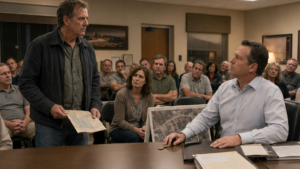
“Before homeowner comment begins,” Donna Williams said, “the board needs to understand that this is not merely about one unapproved ramp.”
Michael stood at the back of the HOA meeting room with his packet under one arm and Brian’s photographs clipped to the front. The room smelled faintly of carpet cleaner and burnt coffee. Folding chairs faced a long table where three board members sat beneath framed pictures of the neighborhood pool, clubhouse, and entry monument.
Donna stood at the center of the table in the same bright pink blazer, her clipboard squared in front of her like a shield.
“This morning,” she continued, “police were called because a resident disabled a safety feed serving the front corridor of the community.”
A few heads turned toward Michael.
He did not sit.
Debra White, seated two chairs from Donna, looked down at her laptop. She had a pen tucked behind one ear and the expression of someone trying not to become part of a fight before she had read the whole file.
Michael waited until Donna finished. He had promised himself he would not interrupt. He had made that promise in the truck outside, while staring at the half-empty space where the ramp rail should have been. Anger had a way of making him sound less careful than he was.
Donna clicked a remote. A photo appeared on the screen: Michael’s front entrance before the ramp. Then another: the ramp installed. Then a third: the ramp after that morning’s cut, its railing missing, one board scarred by the saw.
“Exterior structure installed without completed approval,” Donna said. “Non-standard materials. Potential liability exposure. Interference with association corrective action. And, separately, disruption of community security equipment.”
Michael raised his hand.
Donna looked past him. “Homeowner comment will come after board review.”
Debra glanced at the screen. “Donna, do we have the completed enforcement packet?”
“You have the violation notice.”
“I asked for the enforcement packet.”
Donna’s mouth flattened. “The relevant items are in the shared drive.”
Debra typed. “I’m not seeing authorization for physical removal.”
The room shifted. Not dramatically. Just enough. A chair leg scraped. Someone coughed.
Donna kept her eyes on the screen. “Emergency corrective action falls under compliance discretion when an unapproved structure presents an exposure.”
Michael spoke before he could stop himself. “The exposure is my mother falling because you cut her handrail off.”
Donna turned. “Mr. Adams, this is exactly why we have procedure.”
“You sent a crew before procedure.”
The board president, a tired-looking man with reading glasses, lifted a hand. “Mr. Adams, you’ll have your time.”
Michael swallowed the rest of what he wanted to say and opened his packet instead. The top page was the submission receipt. He had highlighted the date in yellow, then regretted it because it looked too much like pleading.
Donna advanced to another slide: a still image from the white-fence camera near the entrance lane. The view showed Michael’s sidewalk, his driveway, and the edge of his porch.
Michael stared at it.
The camera had been watching more of his house than he had realized.
“As of last night,” Donna said, “this feed went offline. That outage coincides with Mr. Adams changing his wireless password.”
Debra stopped typing.
Michael felt it before he understood it: the small silence of a room noticing the wrong thing.
Debra looked up. “What network was that camera on?”
Donna’s answer came half a beat late. “It’s part of the community security system.”
“That isn’t what I asked.”
“The vendor configured it.”
“Do we have board approval for placing association equipment on or through a homeowner’s private network?”
Donna looked toward the board president. “This is not a technical hearing.”
Michael stepped forward, packet in hand. “I can answer the technical part.”
Donna snapped, “You are not recognized.”
The board president sighed. “Let him speak. Briefly.”
Michael walked to the front table and set down three pages: his router log, the unknown-device screenshot, and the crossed-out password card copied from Betty’s kitchen table. He did not include the medical alert status page. Not yet.
“My router showed unknown devices connected last night,” he said. “I changed the password. I reconnected my household devices. If an HOA camera went offline at that moment, then the HOA camera was using my private router without my knowledge.”
Donna said, “That is speculation.”
“It’s your timeline.”
“It is also possible your equipment interfered with ours.”
“My equipment is inside my house except for a porch camera pointed at my ramp.”
“Which is also unapproved.”
Michael looked at her. “A camera to make sure my mother gets down a temporary medical ramp safely is not the same thing as your association camera using my internet.”
The word mother did what he feared it would do. It moved through the room faster than any document. A woman in the second row turned to whisper. Michael heard Betty’s voice in his head: I am not writing a letter for Donna Williams to pass around with muffins and meeting minutes.
He had already given them something.
Donna noticed it too. “Again,” she said, softer now but sharper, “Mr. Adams introduces personal circumstances after the fact. The association cannot be expected to approve undocumented exterior changes retroactively because a resident refuses to follow the process.”
Michael’s thumb pressed against the edge of the packet. “I submitted May third. Debra confirmed receipt May fifth. No one requested additional documentation until after the crew arrived.”
Debra looked at her laptop again. “I did confirm receipt.”
Donna turned to her. “Receipt is not approval.”
“No,” Debra said. “But there should have been a deficiency notice before enforcement.”
The board president took off his glasses and rubbed his forehead. “Let’s keep to the agenda.”
The agenda was worse than the argument.
Donna moved that emergency removal costs be assessed to Michael’s account pending final determination. She moved that daily fines be authorized if the structure remained non-compliant. She moved that Michael be required to cooperate with restoration of impacted community safety equipment.
Michael listened to each phrase land in the minutes. They were clean phrases. Reasonable phrases. Phrases that made a cut ramp sound like a paperwork inconvenience and a private password sound like public sabotage.
When homeowner comment finally opened, he spoke for three minutes because that was all they allowed.
He did not tell them Betty’s diagnosis. He did not describe the night she fell in the hallway of her old apartment, or the way she had laughed at the paramedics as if politeness could cancel fear. He did not say how long it had taken her to agree to move in.
He said, “The ramp is temporary, removable, and medically necessary. The password is private. I will cooperate with lawful review. I will not provide access to my home network. I am asking the board to pause removal and review the submission already on file.”
The board president thanked him.
Then, by a narrow vote with Debra abstaining, the board approved temporary removal fees pending investigation.
Michael stood still as the motion passed. He felt the same strange humiliation he had felt when the police lights hit his windows, except now it had a ledger attached.
After the meeting, he walked out into the parking lot with the packet under his arm and a pressure behind his eyes he refused to call panic. A neighbor from two streets over followed him out. Michael recognized him vaguely from mailbox conversations and package mix-ups.
“Mr. Adams,” the neighbor said.
Michael turned.
The neighbor held out his phone. “I don’t know if this helps, but I took this a couple weeks ago when they were working near the fence. I thought the setup looked weird.”
On the screen was a photo of the white fence beside Michael’s property line. The HOA camera was visible, but below it, partly hidden behind a slat, was a small gray repeater box facing Michael’s porch.
Michael zoomed in.
A black cable ran from the camera housing into the box. The box had no HOA label, no vendor tag, no warning sticker. It pointed directly toward his house like it had been waiting for his router to answer.
“When was this?” Michael asked.
“About three weeks ago. Donna was there with the vendor.”
Michael looked back at the clubhouse door. Through the glass, Donna was gathering her papers, pink blazer bright under fluorescent lights.
The neighbor lowered his voice. “I figured you should know. That camera wasn’t just watching the street.”
Michael sent the photo to himself before his hand could start shaking.
Chapter 5: The White Fence Had Been Listening To His Router
The archived router log had a name Michael had not created.
FenceCam-03.
He found it at 6:12 the next morning, sitting at his kitchen table while Betty slept and Cooper watched the hallway as if the house itself had become fragile. The device had connected eighteen days earlier. It had disconnected at 11:42 p.m. the night Michael changed the password. Same minute as the alert hub. Same minute as the outage Donna had called a community safety issue.
Michael stared at the screen until the letters stopped looking like a name and started looking like a hand inside his wall.
FenceCam-03.
Signal strength: strong.
Data usage: low but consistent.
Connection history: daily.
He took screenshots, exported the logs, then photographed the router screen with his phone. The habit had become almost mechanical now. Screenshot, export, photograph, print. Proof in layers. Proof because the HOA portal could change. Proof because Donna could rename a removal order as corrective action. Proof because Michael had learned that what was obvious at a kitchen table became “unclear” in a meeting room.
Outside, the half-ramp waited.
He stepped onto the porch with his phone and followed the line of the white fence. The morning was too clean for what he was doing. Sprinklers ticked across a neighbor’s lawn. A delivery truck rolled past without slowing. At the fence corner, the HOA camera sat in its white housing, angled toward the shared frontage. Beneath it, partly hidden behind a slat, was the gray repeater box from the neighbor’s photo.
Up close, it looked cheap. Two zip ties held it in place. A tiny green light blinked behind a cloudy plastic cover.
Michael photographed it from three angles without touching it.
“Careful,” Betty called from the doorway.
He turned. She stood behind the storm door with both hands on the walker, dressed already, her hair combed with the stubborn neatness she wore into every indignity.
“I’m not touching it,” he said.
“That isn’t what I meant.”
He came back to the porch. “You shouldn’t be standing there.”
“I shouldn’t be trapped behind a door either, but here we are.”
The words were dry, but he heard the edge under them. He opened the door and looked down at the damaged ramp. The missing rail made the slope seem steeper. The cut support had been temporarily braced with a block the officer told the crew to leave in place. It was enough to keep the structure from shifting. It was not enough for Betty.
“I’ll help you,” Michael said.
“I’m not going down it.”
“Good.”
“I want to. That’s the problem.”
She looked past him at the fence camera. “Is that the thing?”
“One of them.”
“One of what?”
He hesitated.
Betty’s eyes narrowed. “Michael.”
He showed her the router log. Not the whole file. Just the device name and the connection times.
She read it slowly. “FenceCam.”
“It connected to our router.”
“How?”
“I don’t know yet. Maybe the old guest network. Maybe WPS before I turned it off. Maybe a vendor guessed the old password from the setup card when I gave it to the installer for the porch camera. I don’t know.”
“You think Donna knew?”
“I think she knew the camera went offline when I changed the password. She knew enough to call the police over it.”
Betty looked at the little gray box. “So she was angry because you locked your own door.”
“That’s one way to put it.”
“And in doing it, you locked our little box too.”
The sentence landed more gently than accusation would have, which made it worse.
Michael looked down at his phone. “For fifteen minutes.”
“I heard it.”
“I know.”
“No, you don’t.” Betty’s hands tightened on the walker. “I heard it beep, and I lay there waiting to see if it would fix itself because I didn’t want to call you. That was foolish. I know it was. But I was tired of needing things.”
Michael looked at her through the screen door, and all his anger at Donna had nowhere to go. It turned back on him, finding every corner where he had been careful instead of honest, efficient instead of patient.
“I should’ve checked it before bed.”
“Yes,” Betty said.
He nodded.
“And I should’ve told you when it beeped.”
He looked up.
Her mouth trembled once, then steadied. “We can both be wrong without Donna Williams being right.”
Michael almost laughed. It came out as a breath.
His phone buzzed before he could answer. A new email from the HOA.
NOTICE OF CONTINUING VIOLATION AND EQUIPMENT INTERFERENCE.
He opened it on the porch.
Mr. Adams,
Association equipment near your property line appears to have been tampered with this morning. You are instructed not to touch, obstruct, disable, photograph for harassment purposes, or interfere with HOA safety infrastructure. The remaining non-compliant ramp section is scheduled for removal tomorrow at 8:00 a.m. Continued refusal to restore impacted safety access may result in daily fines.
Michael read the line twice: photograph for harassment purposes.
He looked across the street. Donna stood beside her car in front of another house, phone in hand, watching him from the curb. She had changed blazers—navy today—but even from a distance her posture was unmistakable. Upright. Certain. Already recording.
Michael held up his own phone, not in threat, just enough for her to see that he saw her.
Donna got into her car.
Betty made a small sound behind him. He turned quickly, but she was still standing. Just tired now. The kind of tired she tried to hide by rearranging her face.
“Inside,” he said.
“For both of us,” she answered.
In the kitchen, Michael printed the HOA email and placed it beside the router log. The stack was growing too thick for the clip. He found a larger binder in his office and began sorting tabs: Ramp Request, Contractor, Police, Router, HOA Notices.
Betty sat at the table with Cooper’s head on her foot.
“You’re building a case,” she said.
“I’m building a record.”
“That’s what people say when they’re building a case.”
He slid the medical-accommodation form from the front pocket of the binder. The blank field stared back at him.
Nature of disability or medical need.
Betty saw it.
“No,” she said.
“I don’t need everything. But I need something stronger than ‘available upon request.’”
“No.”
“They’re coming back tomorrow.”
“I said no.”
“They are going to take the rest of it.”
“Then let them fine me.”
“It’s my house.”
“It’s my body.”
That stopped him.
The kitchen clock ticked into the silence. Outside, a mower started somewhere down the block, absurdly normal.
Michael sat down across from her. “I changed the password because unknown devices were connected. I was right to do that. But I did it too fast, and your hub dropped. I didn’t tell you because I didn’t want you scared. You didn’t tell me because you didn’t want to need help. We keep protecting each other by leaving things out.”
Betty looked away.
He pushed the form toward the middle of the table, not toward her. “Donna is using every blank space we leave.”
Her eyes came back to the paper.
“I won’t give them your diagnosis,” he said. “I won’t let them discuss details in open meeting. But I need a letter saying the ramp and handrail are medically necessary for safe entry and exit. That’s it.”
Betty’s jaw worked. “And if they ask for more?”
“Then I ask where the confidentiality policy is. In writing.”
She looked toward the porch. From where she sat, she could see only the top edge of the ramp rail that remained. A thing halfway there. A promise cut short.
The next email came before she answered.
This one had an attachment: SCHEDULED CORRECTIVE ACTION CONFIRMATION.
Michael opened it.
The removal crew was confirmed for 8:00 a.m. the next morning.
Betty read over his shoulder, one hand at the back of his chair.
For the first time since the saw started, she did not tell him to keep her out of it.
Chapter 6: Betty Refused To Be Evidence
Betty made it three steps down the hallway before the empty space where the handrail should have been stopped her cold.
Michael was behind her, one hand hovering near her elbow, not touching because she hated that unless she asked. The front door was open. Evening light stretched across the damaged ramp, catching the raw cut in the support board and the screw holes where the rail had been. Cooper waited on the porch, tail still, watching Betty with a seriousness that made Michael’s throat tighten.
“I can do it,” Betty said.
“You don’t have to prove that.”
“I said I can.”
She moved the walker forward another inch. Its front legs tapped the threshold. Then her body remembered the missing rail before her pride could overrule it. Her shoulders lifted. Her breath went shallow. One hand left the walker and reached toward air.
There was nothing there.
Michael caught the walker before it angled.
Betty froze.
Neither of them spoke.
The porch steps were only feet away. The ramp was still physically present, still sloping toward the driveway, still something a person might call usable if they had never needed to trust it with their weight. Without the rail, it had become a suggestion of access, not access itself.
Betty slowly pulled the walker back.
“Inside,” she said.
Michael closed the door after them.
In her bedroom, she sat on the edge of the bed and stared at her hands. The room was half hers, half the guest room it had been before she moved in. Her books were stacked on Michael’s old nightstand. Her framed photos leaned against the wall because she had not decided where they belonged. The medical alert pendant sat beside the lamp, charging.
Michael stood by the door with the binder under his arm.
“I’m sorry,” he said.
“For which part?”
He looked at her.
Betty’s eyes were dry. That made it harder.
“For the password,” he said. “For not checking the hub before bed. For thinking I could keep all of this quiet and still fight them properly.”
“You promised me.”
“I know.”
“I asked for one thing when I moved here.”
“I know.”
“I did not want to become the woman everyone lowers their voice around.”
Michael sat in the chair by the window. “You’re not.”
“Don’t be kind. Be honest.”
He looked down at the binder. The tabs stuck out in neat little colors, as if order could make the facts less painful.
“Donna already made it public,” he said. “Not your details. But the ramp. The police. The fees. The accusation. She filled the silence with her version.”
Betty touched the pendant on the nightstand. “And you want me to fill it with mine.”
“With only what’s necessary.”
She gave him a look. “That is what every form says before it asks for too much.”
He could not argue with that.
From the hallway, the alert hub gave a soft test chirp. Both of them turned toward the sound. Michael felt the shame move through him again, smaller than before but sharper. Betty heard it too; he could tell by the way her mouth changed.
“You should have told me when you changed the password,” she said.
“I thought I had everything reconnected.”
“You thought.”
“Yes.”
“And I should have told you when it beeped.”
“Yes.”
Betty leaned back against the pillows, suddenly looking older than she allowed herself to look in daylight. “I lay there counting. Did you know that? When it made that sound, I counted because I thought if I got to sixty and it beeped again, I would call you.”
Michael’s fingers tightened on the binder.
“I got to sixty,” she said. “Then to one hundred. Then I decided I was being dramatic.”
“You weren’t.”
“No. I was being proud. There’s a difference.”
He leaned forward. “Mom.”
She lifted a hand. “Let me finish before I lose the nerve.”
He closed his mouth.
“When I fell at the apartment, I was on the floor for forty minutes before I pressed the button. Not because I couldn’t. Because I kept thinking I could get up if I tried one more time.” She looked toward the hallway. “That is the part I didn’t want in your HOA packet. Not the injury. The foolishness.”
Michael had known the facts of the fall. The time. The bruise. The hospital discharge instructions. He had not known about the forty minutes.
His voice came out low. “Why didn’t you tell me?”
“Because you would have looked exactly like that.”
He looked away, but there was nowhere useful to put his eyes. The dresser held her folded scarves. The wall held no pictures. The binder on his lap held everything except the truth she had just given him.
Betty reached to the nightstand and picked up a sealed envelope. “The clinic wrote this after the last appointment.”
Michael stared at it.
“I asked for it,” she said. “Then I put it in the drawer because I hated that it existed.”
She held it out.
He did not take it immediately.
“What does it say?”
“That I need a stable handrail and ramp access for safe entry and exit. That stairs increase fall risk. That’s all.”
“No diagnosis?”
“No.”
“No details?”
“No.”
He took the envelope carefully, as if it were something breakable.
“And Michael?”
He looked at her.
“If Donna Williams reads that out loud in a meeting, I will haunt you while I’m still alive.”
Despite everything, he smiled. So did she, barely.
“I won’t let that happen,” he said.
“You don’t control everything.”
The smile faded because it was true.
His phone buzzed. Brian Hall’s name filled the screen.
Michael answered. “Brian?”
“I got your message about reinstalling the rail.”
“Can you do it tonight?”
“I can’t.”
Michael closed his eyes.
Brian spoke quickly. “Not won’t. Can’t. Donna sent notice to contractors. Any work on your ramp before the board clears it could be treated as non-compliant work. I’ve got crews who need permits in this neighborhood next month.”
“So you’re out.”
“I’m saying I can come measure, document, and be ready the minute this clears. But if I reinstall tonight, they’ll hit you harder and blacklist me.”
Michael wanted to be angry at him. Part of him was. Another part heard the fear under Brian’s practical voice.
“They’re coming at eight,” Michael said.
“I know. One of my guys heard.”
“Of course he did.”
“I’m sorry.”
Michael ended the call without making Brian say it again.
Betty watched him. “He won’t come?”
“Not until the fees are cleared.”
“Because people have to keep working.”
“Yes.”
“And because Donna knows that.”
Michael slid the clinic letter into the binder’s front pocket. Then he took out his laptop and began typing.
Betty adjusted her cardigan. “What are you writing?”
“A formal demand.”
“To Donna?”
“To Donna, Debra, the board, and the management office. No crew touches the ramp without written authority, medical accommodation review, and confirmation of appeal status.”
Betty was quiet while he typed. He kept the wording exact. Not emotional. Not pleading. He attached the clinic letter but marked it confidential. He attached the original submission receipt, Brian’s invoice, the police incident number, the router log excerpt showing the unknown device disconnecting, and the photo of the white-fence repeater.
Before sending, he paused over the line about medical necessity.
Betty said, “Put it in.”
He did.
His finger hovered over send.
For weeks, he had believed restraint meant keeping the truth inside the house. Now the house itself had become unsafe because of what he had kept out of the record.
He clicked send.
The email left with a quiet whoosh.
A minute later, an automated reply came from the management office. Then Debra’s out-of-office message. Then nothing from Donna.
Michael stood, walked to the front door, and looked through the glass at the half-removed ramp under the porch light.
At 9:17 p.m., his phone buzzed once more.
A read receipt.
Donna Williams had opened the demand.
Chapter 7: The Second Crew Found Him Waiting With The Letter
The truck backed into Michael’s driveway at 7:58 a.m., and this time Michael was already standing beside the broken ramp with the clinic letter in his hand.
He had placed two orange cones of his own at the edge of the driveway, not to block anyone, only to mark where private property began. The binder rested on the hood of his truck, open to the email he had sent the night before. His phone was recording from a small tripod on the porch rail. Cooper sat inside behind the storm door, whining softly whenever one of the workers stepped too close.
The crew supervisor climbed out first. He looked at Michael, then at the ramp, then at the phone.
“Morning,” he said, without much confidence.
“Morning,” Michael said. “Before anyone unloads tools, I need the written removal order.”
The supervisor rubbed the back of his neck. “We were told the HOA cleared it.”
“You were told wrong.”
A second vehicle pulled up at the curb. Donna Williams stepped out in a cream blouse and dark slacks, her blazer folded over one arm this time, as if arriving without the pink made the morning less public.
“You are obstructing corrective action again,” she said.
Michael held up the envelope. “This is a medical accommodation letter. It was sent to you last night. You opened it.”
Donna’s eyes flicked to the paper. “A letter does not automatically authorize exterior construction.”
“No. It requires review before you remove access.”
“It requires a completed process.”
“Then complete it.”
The crew supervisor shifted toward the truck. “Should we wait?”
“Yes,” Michael said.
“No,” Donna said at the same time.
The supervisor froze.
Michael turned to him. “If you remove one more board after receiving notice of a medical accommodation dispute, I will include your company in the complaint. I don’t want to do that. I know you’re following instructions. But I am telling you now, clearly, on video, that the authorization is contested.”
Donna’s mouth tightened. “That is intimidation.”
“That is notice.”
A police car turned onto the street.
Michael had not called them. For one sharp second, he wondered if Donna had done it again. Then he saw the same officer from the first day behind the wheel, moving slowly, lights off until he pulled near the curb. He stepped out with a notebook already in hand.
“Same address,” he said.
Donna lifted her chin. “We requested standby to prevent interference.”
The officer looked at Michael. “Did you request police?”
“No. I requested written authority.”
The officer’s eyes moved to the ramp. The cut board. The remaining rail. The workers. The phone recording from the porch.
“Has anyone started work today?”
“No,” Michael said.
“Not yet,” the supervisor added.
Donna gave him a look.
Michael took the clinic letter from its envelope. He did not hand it to Donna. He held it so the officer could see the header and the single paragraph below.
“This states that a stable ramp and handrail are medically necessary for safe entry and exit for a household resident,” Michael said. “No diagnosis. No private details. The HOA received it last night.”
The officer read it without touching it. “Ma’am?”
Donna’s voice stayed controlled. “The association has a right to verify accommodation requests. We also have a duty to prevent unapproved structures from creating liability.”
“You can verify it,” Michael said. “You cannot destroy the access point before review and call the damage my expense.”
A small gray car stopped across the street. Debra White stepped out carrying a laptop bag and a folder pressed to her chest. She looked as if she had dressed in a hurry; her hair was clipped back unevenly, and her shoes did not match the careful polish of her usual meeting-room self.
“Donna,” Debra called.
Donna turned. “This is not a board meeting.”
“No,” Debra said, walking up the driveway. “But it is board action, and the record matters.”
Michael watched Donna’s expression change. Not anger first. Alarm.
Debra opened the folder. “I reviewed the minutes after Michael’s email. The vote to assess removal costs happened last night. But the initial removal began yesterday morning.”
Donna said, “Emergency compliance discretion—”
“Was not documented before the crew arrived,” Debra said.
The officer stopped writing.
The crew supervisor looked at his workers and made a small downward motion with his hand. They stepped away from the truck.
Donna’s voice sharpened. “Debra, you are the secretary. You do not determine enforcement.”
“I record it,” Debra said. “And I cannot record authority that did not exist at the time it was used.”
Michael stayed still, but something in him shifted. Not relief. Relief was too clean. This was more like the first sound of a locked door not quite holding.
Donna drew herself up. “The security feed was down. We had residents asking why the front corridor camera had gone dark. Mr. Adams refused to restore access.”
Michael reached into the binder and removed the router log. “Because the device was on my private network.”
Donna pointed toward the fence. “That equipment covers shared space.”
“Then it should be connected to shared infrastructure.”
“That is a vendor configuration issue.”
“It became my issue when you called 911 and sent a crew to take out my mother’s ramp.”
The word mother again. This time he let it stand. Not as spectacle. Not as confession. As fact.
Donna looked toward the house. Betty was not visible, but the curtain beside the front window had shifted. Michael knew she was there. He hoped she had heard the way he said it: enough, and no more.
The officer asked, “Do you have documentation that the homeowner agreed to provide network access?”
Donna did not answer immediately.
Debra looked at her. “That’s what I couldn’t find.”
Donna’s grip on her folder tightened. “The camera vendor handled initial setup during the entry-fence update. Residents were informed there would be security improvements.”
“Informed,” Michael said. “Not asked to connect devices to private routers.”
“It may have connected to an available network.”
“My network was password-protected.”
Donna looked at the officer. “This is exactly the obstruction I warned about. He is withholding cooperation and now attempting to turn a safety failure into an accusation against the board.”
The officer closed his notebook halfway. “Right now, I’m concerned with whether this crew has clear authority to continue removal today.”
Donna produced a paper. “The continuing violation notice.”
The officer glanced at it. “This is not a court order.”
“It is an HOA enforcement notice.”
“Different thing.”
The crew supervisor cleared his throat. “I’m not comfortable proceeding.”
Donna turned on him. “Your company accepted the work order.”
“And I’m telling you I need clearer authorization before my guys remove medical access after being handed that letter.”
For the first time since Michael had met her, Donna looked outnumbered not by people, but by facts that would not stay in the order she wanted.
She faced Michael. “Daily fines will continue. The board can still require modification, removal, or restoration. And until the security issue is resolved, you are holding the neighborhood system hostage.”
Michael picked up the password card from the binder. The old password was crossed out. The new one was not written anywhere.
“No,” he said. “I changed the lock on my own door.”
“That is not a door.”
“It is when the thing behind it is my mother’s medical alert system.”
Silence moved across the driveway. A neighbor on the sidewalk lowered his phone slightly. The officer looked toward the gray repeater box on the fence, then back to Donna.
Debra stepped closer to the fence and squinted at the box. “Donna,” she said, very quietly, “when did the vendor install that?”
Donna’s face went blank in the careful way of someone choosing between bad answers.
Michael opened the printed photo from the neighbor and set it on the hood beside the router log. “Three weeks ago, according to the timestamp. Same week my ramp request sat under review.”
Debra looked at the photo, then at the real box on the fence.
“Why,” she asked, in front of the officer, the crew, and the neighbors gathered behind their mailboxes, “was an HOA camera using his router?”
Donna did not answer.
Chapter 8: The New Password Was Not For Them
Donna read the withdrawn violation without looking at Michael.
The meeting room was quieter than it had been a week earlier. No one had brought coffee. The folding chairs were only half full, but every person there seemed to understand that the empty ones mattered too. The board president sat with a packet in front of him. Debra’s laptop was open, and this time her folder was thick with printed emails, router logs, work orders, and the police incident note.
Donna stood at the end of the table.
“The compliance notice regarding the temporary access ramp at the Adams property is withdrawn pending accommodation approval,” she read. Her voice did not shake, but it had lost the bright edge it carried in driveways. “Removal fees assessed to the owner account will be reversed. Daily fines will not proceed.”
Michael sat in the second row with Betty’s clinic letter sealed in a plain folder on his lap. He had not brought Betty. She had asked whether he wanted her there, and he had told her the truth: no, not unless she wanted to be. She had nodded once, satisfied, and told him not to come home with a speech.
Donna continued, “The board acknowledges that the removal action began before all documentation and appeal procedures were complete.”
Debra looked up. “And before written authorization was recorded.”
Donna’s eyes moved to her, then back to the paper. “Before written authorization was recorded.”
No one clapped. Michael was grateful for that. Applause would have made it smaller somehow, turned a week of fear into a performance. He wanted the words in the minutes. He wanted the ramp rebuilt. He wanted his mother able to reach the porch without negotiating with pride and plywood.
The board president cleared his throat. “The architectural committee has reviewed the temporary ramp proposal with the medical accommodation letter. Approval is granted with minor finish adjustments: matching stain where feasible, capped rail ends, and a thirty-day review only if the temporary structure becomes permanent.”
Michael stood. “I can accept that.”
Donna’s gaze dropped to the table.
The president looked relieved. “Mr. Adams, regarding the security equipment—”
Michael did not sit.
The room seemed to brace.
The president continued, “The association’s vendor has confirmed that the fence camera near your property was improperly configured during installation. It connected through a homeowner network instead of the association’s service line.”
“Improperly configured,” Michael repeated.
Debra looked at him, not unkindly. “That is the language in the vendor report.”
“And the HOA knew it went offline when I changed my password.”
Donna’s hand tightened around the page she held.
The president said, “Some board members were aware the camera feed was unstable. The exact network configuration was not properly documented.”
Michael let the soft phrase sit there. Not properly documented. It was doing a lot of work. Still, the next page in Debra’s folder mattered more than the phrase.
“The association will move that camera to a dedicated line,” the president said. “No homeowner network will be used for community equipment without written consent. The camera angle will also be adjusted so it does not capture private porch activity beyond the common frontage.”
Michael thought of the still image Donna had shown on the screen: his porch, his driveway, the edge of his front door. Betty’s walker could have been in that frame. Cooper. The clinic letter, if the door had been open at the wrong time.
“I want that in writing,” he said.
Debra lifted a page. “It is in the revised policy draft.”
The president slid a copy across the table. Michael walked forward and took it. His fingers found the lines quickly: dedicated association infrastructure, written consent, privacy adjustment, emergency enforcement limitations, accommodation review before corrective removal.
It was not an apology.
It was better than one.
Donna said, “I want the minutes to reflect that my concern was resident safety. We had theft complaints. We had pressure to restore coverage. I acted under the belief that the equipment served the community.”
Michael looked at her for a long moment.
A week ago, he might have wanted to empty the binder on the table until every page bruised her. He might have wanted to say she had used safety as a weapon, that she had recorded toward his mother’s kitchen, that she had made police lights bloom across his windows over a password she had no right to demand.
All of that was true.
But Betty had said, Don’t come home with a speech.
So he said, “Then the policy should make sure no one else confuses control with safety.”
Donna’s face colored, but she did not answer.
The vote passed without drama. The ramp approval. The fee reversal. The network policy. The requirement that future emergency removals involving access or medical accommodation receive documented review before physical action unless there was immediate danger.
Outside, the neighbor who had given Michael the photo nodded to him in the parking lot but did not stop him. Michael appreciated that too.
Brian Hall came the next morning with two workers and a truck that carried lumber instead of threat. He stood at the foot of the ramp, hands on his hips, studying the cut board.
“I can save most of it,” he said.
Michael stood beside him with Cooper’s leash looped around his wrist. “Do what’s safe, not what’s cheapest.”
Brian glanced at him. “That’s what I should’ve said the first time.”
Michael did not make him apologize again.
By noon, the new support was in. By two, the handrail was back, capped and sanded. By late afternoon, Brian brushed the first coat of stain along the rail, close enough to the house trim that even Donna would have had to work to hate it.
The fence camera was gone for two days. When it returned, it had a new conduit line running away from Michael’s property and a narrower angle pointed at the entrance lane. The gray repeater box disappeared. In its place, the fence slat showed two pale marks where the zip ties had rubbed the paint.
Michael left the marks there.
On Friday evening, Betty stood at the open door with both hands on her walker. Cooper waited at the bottom of the ramp, tail moving in slow, hopeful sweeps.
“You’re hovering,” she said.
“I’m standing on my own porch.”
“You’re hovering on your own porch.”
Michael stepped back two inches.
Betty looked at the new rail. She put one hand on it, then the other on the walker, and moved forward. The first step onto the ramp was slow. The second was steadier. Halfway down, she stopped and looked toward the white fence.
“No camera pointed at me?”
“No.”
“No pink blazer?”
“Not today.”
She made a sound that was almost a laugh and continued to the bottom.
Cooper pressed against her leg when she reached the walkway. Betty put her hand on his head and looked back at the house. Not at the ramp. At the door she had reached from the outside.
Michael felt something loosen in him then, not triumph, not even relief exactly. More like the return of a room to its proper size.
That night, he opened the router settings at the kitchen table. Betty sat across from him with tea. The new password field blinked on the screen.
“Don’t use my birthday,” she said.
“I wasn’t going to.”
“Or the dog’s name.”
“I know how passwords work.”
“You also know how to disconnect medical equipment, apparently.”
He looked up.
Her mouth twitched.
He laughed first. Then she did, lightly, carefully, but enough.
Michael typed the new password. Long. Private. Written nowhere except in the password manager he had finally set up properly. He reconnected the alert hub, waited for the green light, then ran the test twice while Betty watched.
Connected.
Scheduled check complete.
No unknown devices.
He turned the laptop so she could see.
Betty nodded once. “Good.”
Outside, the white fence faded into evening. The ramp rail held steady under Betty’s hand when she rose to take her cup to the sink. Cooper followed her, close but not crowding.
Michael looked at the router screen one last time before closing it.
The new password was not for the HOA, not for the camera, not for the board, not for anyone who thought community meant access to whatever private thing kept someone else safe.
It was for the house.
And this time, everything that needed it was connected.
The story has ended.