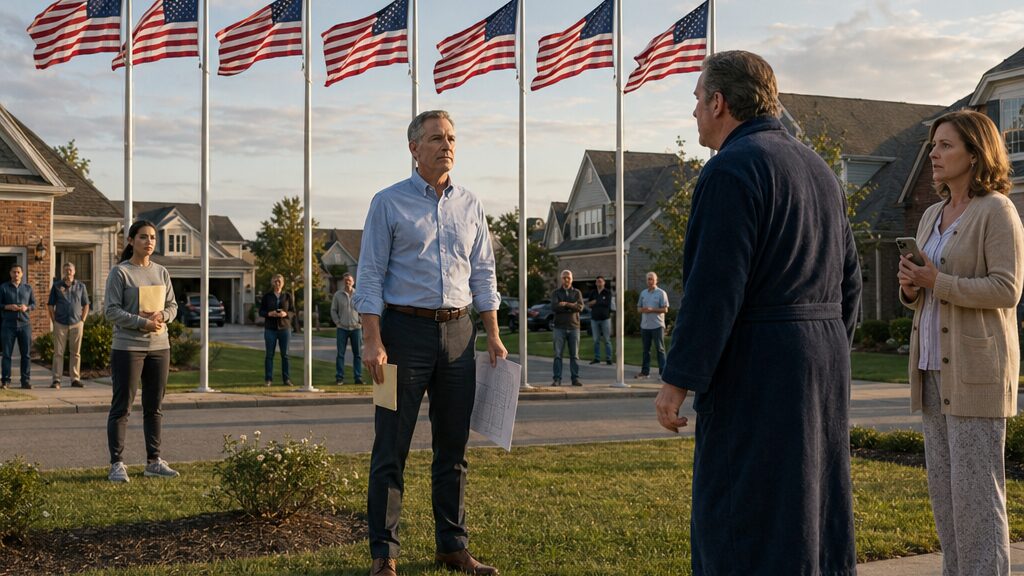
They Ordered Michael to Lower One Flag by Sunset, but Six Flags Exposed What the HOA Had Been Hiding
Chapter 1: The Notice Folded Before the Sun Went Down
The violation notice had been taped directly beneath the flag, where the afternoon wind made its lower corner strike the front door like a fingernail.
Michael Clark stood on the brick step with his work bag still over one shoulder. Above him, the flag shifted against its angled pole, the fabric catching the last hard light of the day. Its shadow moved across the cream-colored paper and over the stamped gold seal at the top.
He did not remove the notice immediately.
He read it where it hung.
PINEWOOD ESTATES HOMEOWNERS ASSOCIATION.
NOTICE OF ARCHITECTURAL NONCOMPLIANCE.
The language beneath was polished enough to sound official without saying much. His flagpole, the notice claimed, created “an excessive vertical feature inconsistent with the harmonious visual character of the community.” Removal was required by sunset. Failure to comply would result in daily fines and an emergency enforcement hearing.
Michael read it twice.
Then he peeled the tape from the door without tearing the paper.
The gold seal was decorative. The management company’s address was printed in small type at the bottom. There was no covenant section, no architectural guideline number, no date of board authorization. Most tellingly, there was no reference to a recorded vote.
He had spent twenty-two years reading letters designed to frighten property owners before they noticed what was missing.
A car door closed behind him.
Patrick Wright crossed the driveway as if he had been waiting for the moment. He wore a pale pink polo embroidered with the Pinewood Estates emblem, pressed khaki shorts, and loafers that had never met a lawn mower. His wife, Jennifer, followed several steps behind with her phone already in her hand.
“Afternoon, Michael.”
Michael folded the notice once.
“Patrick.”
“I’m glad you found it before dark.”
Michael folded it again.
Patrick stopped at the edge of the walkway. “We tried to handle this informally.”
“No one spoke to me.”
“There were emails.”
“There was one community newsletter about seasonal decorations.”
Jennifer raised her phone. The small red light on the screen reflected in her sunglasses.
Patrick glanced up at the flag. “This isn’t about patriotism.”
Michael said nothing.
“It’s about scale. Proportion. The neighborhood has a visual standard.”
“The pole has been there fourteen months.”
“That doesn’t make it approved.”
“The architectural committee acknowledged the installation request.”
“Acknowledgment isn’t approval.”
Michael looked down at the notice. “What meeting authorized enforcement?”
Patrick’s smile tightened without disappearing. “The board has broad authority under the declaration.”
“That wasn’t my question.”
Jennifer shifted her stance. Her phone remained pointed at them.
Patrick stepped closer. “The simple fact is that the display is excessive. Too prominent. Some residents feel it changes the atmosphere of the street.”
“Some residents?”
“I’m not going to identify complainants.”
Michael glanced toward the neighboring houses. Curtains had moved in two front windows. Across the street, a garage door stopped halfway down before continuing.
Patrick lowered his voice. “You know how these things work. One person puts up a large flag. Then someone else wants banners. Then political signs. Then lighting. Pretty soon every property is making its own statement.”
“This is an American flag.”
“And the neighborhood is not a parade ground.”
Jennifer’s phone tilted slightly higher.
Patrick heard himself and paused. Then he tried again. “It’s simply too patriotic for the visual balance we’re trying to maintain.”
The words seemed to hang between them longer than the flag did.
Michael felt heat rise along the back of his neck. He could have answered easily. He could have explained that the pole had been measured before installation, that the county did not require a permit at its height, that federal law limited the association’s ability to prohibit a reasonable display. He could have named cases. He could have pointed out every weakness in the notice while Jennifer recorded.
Instead, he pressed his thumb along the second fold until the paper lay flat.
“Thank you for stopping by,” he said.
Patrick blinked. “So you’ll remove it?”
“I heard what you said.”
“That’s not the same thing.”
“No.”
Patrick looked toward Jennifer, then back at Michael. “The first fine posts at sunset. The board can increase it daily. We can also schedule an emergency hearing.”
“Send me the hearing notice.”
“You may want to think about how expensive principle can become.”
Michael put the folded paper into his shirt pocket.
Patrick’s expression relaxed. He mistook restraint for retreat.
“We don’t enjoy doing this,” he said. “But standards only matter if they’re enforced.”
Michael looked at Jennifer’s phone. “Will that recording be included in the association file?”
Her hand lowered an inch. “I’m documenting a community interaction.”
“Then preserve the full recording.”
Patrick’s smile vanished.
Michael stepped past them and opened his front door.
Inside, the house held the stillness of a place occupied by one person who worked late. His legal files were stacked in exact rows on the dining table. A framed photograph sat on the bookcase: Michael and Jason at a retirement ceremony five years earlier, Jason in dress blues, Michael holding the triangular display case that had contained another flag.
The flag outside had been flown that day.
Jason had handed it to him afterward and said, Keep it up until I figure out where I belong next.
Michael had promised.
In the years since, they had spoken mostly on holidays and when one of them needed practical information. Michael had missed the worst week of Jason’s life because a federal filing deadline had seemed impossible to move. He had never found a way to apologize that did not sound late.
He set his work bag down and opened his laptop.
The Pinewood Estates declaration filled the screen. He searched for flags, poles, vertical structures, patriotic displays, exterior modifications. The architectural rules contained height restrictions for freestanding structures but no outright prohibition. Enforcement required written committee findings and board ratification entered into the minutes.
Michael opened the resident portal.
The most recent board minutes were from six weeks earlier. Landscaping contract. Pool repairs. Delinquency report. No flag discussion.
The previous month showed nothing.
Neither did the month before that.
He checked the notice again. The management company had used language broad enough to appear grounded in the declaration, but the letter lacked the one fact that mattered: who had actually authorized it.
At 6:41, an email arrived.
SUBJECT: FINAL COURTESY REMINDER.
Patrick had copied the full board and the community manager.
Michael read the first sentence, then looked through the front window. The sun had dropped behind the roofline, but the flag was still visible in the dimming sky.
The email stated that noncompliance would be recorded at 7:03 p.m.
Not sunset. A chosen time.
Michael opened the county property map. The survey lines appeared over an aerial image of his lot. He enlarged the front boundary, measured the setbacks, and printed three copies.
At 6:52, he called the county zoning clerk he had worked with on several matters. She confirmed what he already believed: poles below the local height threshold required no separate permit if they remained within the lot and outside the sight triangle.
“Why?” she asked.
“Neighborhood disagreement.”
“Those are usually worse than permits.”
“Can you email me the current standard?”
“You’ll have it in five minutes.”
At 6:58, Michael stood at the front window.
Patrick and Jennifer were visible at the end of the block, walking slowly as though they had chosen an evening route that happened to pass his house. Jennifer looked down at her phone.
The flag remained in place.
At 7:03, Michael heard the soft chime of another email.
VIOLATION ACTIVE.
He did not open it.
He called his brother.
Jason answered on the fourth ring. “This better not be about your printer again.”
“I need a favor.”
A pause followed. “How big?”
Michael watched Patrick stop beneath the streetlamp and look toward the house.
“How many regulation-compliant flagpoles can you bring me before midnight?”
Chapter 2: Six Flagpoles Before the Neighborhood Woke
Jason’s truck arrived at 9:17 with six aluminum poles strapped to the roof and no intention of unloading any of them.
He parked at the curb, switched off the engine, and stayed behind the wheel.
Michael walked down the driveway carrying the county map, a tape measure, and two flashlights.
Jason lowered the window. “Tell me first.”
“You drove forty miles to ask for an explanation?”
“I drove forty miles because you never ask for anything.”
“That should simplify matters.”
“It doesn’t.”
Jason looked toward the flag above the porch. In the darkness, it moved as a pale shape beneath the security light.
“What happened?”
Michael handed him the cream notice.
Jason read it slowly. “By sunset?”
“They activated fines at seven-oh-three.”
“That sounds specific.”
“It’s arbitrary.”
“And your answer is six poles?”
“Five additional poles. The existing one stays.”
Jason passed the notice back. “You planning a protest or a legal defense?”
“Both can occupy the same property.”
“That wasn’t the question.”
Michael turned toward the truck and loosened the first strap.
Jason opened his door but blocked the ladder with one hand. At fifty-four, he was broader than Michael and moved with the careful economy of someone who had spent years protecting an old knee.
“You remember who gave you that flag?”
“Yes.”
“You remember why?”
“Yes.”
“Say it.”
Michael stared at him.
Jason’s voice stayed level. “You call me after two years of birthday texts and ask me to help turn that flag into a neighborhood stunt. So say why it matters.”
“It was flown at your retirement ceremony.”
“And?”
“You gave it to me.”
“And?”
Michael pulled the folded notice from his pocket. Its edges had softened.
“You said to keep it up until you figured out where you belonged.”
Jason looked at the house. “I said that because I didn’t know whether I could stand being in my own place after Susan died.”
Michael’s grip tightened around the paper.
Jason’s wife had died after a short illness three years earlier. Michael had been in Richmond preparing exhibits for a property-rights trial. He had called every night and arrived two days after the funeral.
There had always been reasons.
“I know,” Michael said.
“No, you know the sentence. That isn’t the same thing.”
From across the street came the click of a porch light.
Jason released the ladder. “Show me the setbacks.”
They worked under portable lights, measuring twice before disturbing the soil. Michael had marked five locations along the inner edge of the front property line, each beyond the sight triangle and separated evenly enough to look deliberate.
Jason examined the map. “You had this planned before you called.”
“I had locations.”
“You had a victory picture in your head.”
Michael drove a marking stake into the lawn. “They expected compliance.”
“Maybe. But everyone else is going to wake up inside your argument.”
They began with a manual post-hole digger to keep the noise down. The ground was hard beneath the topsoil. By ten-thirty, Michael’s palms had blistered despite his gloves.
At the third hole, a woman’s voice came from the sidewalk.
“You know those legal bills come out of our dues.”
Emma Garcia stood beyond the low hedge in running shoes and a gray sweatshirt. She held a white envelope against her side. Her porch was three houses down, where the paint beneath one upstairs window had begun to peel.
Michael rested the digger against his shoulder. “The HOA issued an unauthorized notice.”
“That doesn’t answer what I said.”
Jason looked between them and continued leveling the first sleeve.
Emma stepped closer. “Patrick sent a community email. He said you’re forcing the board to retain counsel.”
“Patrick chose to retain counsel.”
“And we pay.”
“If the board acts outside its authority, it should correct the action.”
“You work in law. Correction sounds cheap when you say it.”
Michael noticed the envelope in her hand. The same cream stock. The same gold seal.
“What did they cite you for?”
Emma moved the envelope behind her leg. “My house isn’t your business.”
“No. But that paper may be.”
She gave a humorless laugh. “That’s convenient.”
“I can look at it without charging you.”
“That isn’t what I’m worried about.”
She looked at the holes, the poles on the grass, the tools spread beneath the flag. “You get to make a point. People like me get a special assessment when the board fights back.”
Michael wanted to tell her the law was on his side. Instead, he heard Jason’s earlier question inside hers.
Who else wakes up inside your argument?
“The poles are legal,” Michael said.
Emma’s expression closed. “That still isn’t an answer.”
She walked away.
Jason waited until her door shut. “She’s right.”
“She’s afraid.”
“She can be afraid and right.”
By midnight, four poles stood upright. At 1:20, they set the fifth. Jason opened the truck bed and removed five boxed flags.
Michael held one package beneath the work light. “You keep these on hand?”
“Veterans’ events. School ceremonies. Funerals.”
The last word settled heavily.
Jason unfastened the original flag from the angled porch pole and brought it down with both hands. Michael reached for it, but Jason did not release the folded fabric.
“This one goes in the center.”
Michael nodded.
“And this does not fix anything between us.”
“I didn’t say it did.”
“You usually don’t say anything.”
Jason handed him the flag.
They raised it on the central pole at 4:48. Five new flags rose around it. In the darkness they hung nearly still, six separate shapes waiting for wind.
Michael printed a one-page objection and clipped it to a portable easel near the walkway. It requested the board resolution, architectural findings, enforcement history, and hearing procedures. No threats. No grand language.
At 6:11, dawn thinned the sky.
A breeze moved down the street.
The six flags opened almost together.
For several seconds, Michael felt exactly what he had expected: satisfaction clean enough to resemble justice. The poles were straight. The setbacks were correct. The display was lawful under county rules and defensible under the association’s own documents.
Then garage doors began to rise.
Phones appeared.
A car slowed almost to a stop.
Patrick came through his front door in a navy bathrobe and slippers, moving faster than Michael had ever seen him move. Jennifer followed in a long cardigan, already recording.
Patrick stopped at the end of Michael’s driveway.
His face went pale, then red.
“What have you done?”
Michael stood beside the easel with the folded cream notice in one hand and the county map in the other.
“Pole one is nine feet inside the boundary,” he said. “Pole two is nine feet, four inches. All six are outside the county sight triangle and under the permit threshold.”
“You were ordered to remove the structure.”
“I was ordered to remove one structure under a notice that cites no adopted rule and no board vote.”
Patrick looked from flag to flag. “This is retaliation.”
“This is compliance with the rules as written.”
“You think this is funny?”
“No.”
Patrick stepped onto the driveway. “Take them down.”
Michael handed him the written objection.
Patrick did not accept it.
Jennifer’s phone remained between them.
Michael held the paper steady. “Please preserve this exchange as part of the enforcement record.”
Patrick snatched the page. “There will be an emergency meeting.”
“Send proper notice.”
“There will be fines for every pole.”
“Identify the authority.”
Patrick lowered his voice. “You have no idea what you’re doing to this community.”
Behind him, neighbors stood in driveways and watched.
Michael could feel their attention pressing against the scene. He had imagined Patrick’s confusion. He had imagined the measurements, the written objection, the sunrise. He had not imagined Emma standing on her porch with her arms folded, not smiling.
Patrick turned toward Jennifer. “Post the meeting notice.”
She hesitated. “The board hasn’t voted.”
“I am directing management to schedule it.”
“That’s different.”
Patrick looked at her sharply. “Post it.”
She lowered the phone.
For the first time that morning, Michael’s triumph shifted into something less certain.
At 7:02, the community portal sent an alert to every resident.
EMERGENCY BOARD MEETING—MANDATORY ENFORCEMENT RESPONSE.
At 7:09, a second alert arrived.
Management had opened six separate violation entries against Michael’s property, each carrying a daily fine.
Chapter 3: The Board Meeting With Missing Minutes
Patrick began the emergency meeting by placing a legal-cost estimate on the screen behind him.
$18,500–$27,000.
A murmur moved through the Pinewood Estates clubhouse.
Michael sat in the second row with the cream notice folded beside his legal pad. On the projection screen, behind the cost estimate, was a photograph of his house at sunrise. Six flags filled the upper half of the image.
Patrick stood at the front table with three board members and the community association manager. Jennifer sat along the wall with a laptop open but did not look at Michael.
“This is not a debate about patriotism,” Patrick said. “It is about whether one homeowner can force one hundred and twelve other households to absorb legal costs because he refuses to follow a uniform architectural process.”
Several residents turned toward Michael.
Patrick changed the slide. A red column showed projected increases to monthly dues if litigation continued.
Michael recognized the technique. Begin with the largest frightening number. Present it before anyone can ask whether the expense was necessary.
Patrick continued. “The association attempted informal resolution. Mr. Clark responded by multiplying the violation.”
A man near the back said, “Six times.”
A few people laughed, but the sound died quickly.
Michael waited until Patrick invited questions.
Then he stood.
“What board action authorized the original notice?”
Patrick folded his hands. “The board acts through its management authority.”
“Please identify the date of the vote.”
“The board does not need to conduct a recorded vote for every enforcement communication.”
“The declaration requires board ratification when a disputed architectural condition results in fines.”
The community manager leaned toward her microphone. “Our office relied on direction from the board president.”
“Was that direction supported by an architectural committee finding?”
She looked at Patrick.
Michael waited.
Patrick said, “The committee had discussed the flagpole previously.”
“Where is that discussion recorded?”
“We are not trying a case here.”
“No,” Michael said. “We are deciding whether to create one.”
The room went quiet.
Patrick clicked to another slide. “The association’s counsel has advised that the board possesses broad discretion.”
“May residents see the written opinion?”
“It is privileged.”
“Then residents are being asked to approve the cost of advice they cannot examine, based on a vote no one can identify, enforcing a standard no one has cited.”
One of the board members shifted in his chair. The other stared at the table.
Patrick’s face remained composed, but his fingers tightened around the remote.
“We will not allow professional intimidation,” he said.
Michael sat down.
The words bothered him more than he expected. He had not raised his voice. He had not threatened anyone. Yet he understood what Patrick was doing: turning Michael’s knowledge into another form of unfair advantage.
Emma rose from the last row.
She carried the cream envelope Michael had seen the night of the installation.
“I have a question,” she said.
Patrick glanced at the clock. “Please keep it brief.”
Emma walked toward the front instead.
“My violation says I have ten days to repair exterior trim or the association may accelerate enforcement and refer the balance for lien review.”
Patrick’s posture changed. “That is a separate matter.”
“Maybe.”
She placed her letter on the front table.
Then she looked toward Michael. “Can I see yours?”
He brought the folded notice forward and set it beside hers.
The paper stock matched. So did the gold seal, margin spacing, and opening paragraph. Emma unfolded her letter. Michael opened his.
The sentences were almost identical.
Where Michael’s notice referred to an excessive vertical feature, Emma’s referred to deteriorated exterior surfaces. Both claimed the condition threatened the harmonious visual character of the community. Both imposed a sunset-style deadline framed as a final courtesy. Both omitted a board vote.
Michael looked at the signature blocks.
The digital signatures were different, but the document metadata line at the bottom carried the same generation code.
“Template,” someone whispered.
Emma faced Patrick. “Was there a board vote on mine?”
“The management company handles routine violations.”
“Mine isn’t routine. You moved from warning to lien review in one letter.”
“You have received prior notices.”
“Not about the trim.”
Patrick looked toward the community manager.
She adjusted her microphone. “The file indicates exterior noncompliance.”
“Who inspected it?” Emma asked.
No one answered.
The room changed. Michael could feel it happen—not support for him, exactly, but a crack in Patrick’s framing. The six flags were no longer the only problem in the room.
A resident near the aisle raised a hand. “I got one about my shed last month.”
Another voice followed. “Mine was for a satellite dish that had been there since 2016.”
Patrick lifted both hands. “This is precisely why consistent enforcement is necessary. Previous boards allowed conditions to accumulate. We are correcting years of neglect.”
There was conviction in his voice now, not merely performance.
Michael watched him more carefully.
Patrick believed at least part of what he was saying. He believed disorder had spread because no one before him had been willing to impose consequences. He believed property values depended on a visible demonstration of control.
That belief did not authorize false procedure.
But it explained why he had chosen it.
The board moved to executive discussion for fifteen minutes. Residents remained in the clubhouse, speaking in low clusters.
Emma stood beside Michael.
“I didn’t bring that letter to help you,” she said.
“I know.”
“You made this worse.”
“I may have.”
She looked surprised by the admission.
Michael touched the folded crease in his notice. “But your lien process should stop until they produce authority.”
“And if it doesn’t?”
“I’ll help you request the file.”
“Help me how?”
“Without billing you.”
Emma studied his face as if searching for the condition hidden inside the offer.
“You lawyers always say that before the paperwork starts.”
“I’m not a lawyer.”
“That supposed to make me feel better?”
“No.”
The board returned.
Patrick took his seat and read from a prepared motion. The association would affirm the six violation entries against Michael, authorize escalating fines, and accelerate enforcement on any unresolved exterior violations already marked for legal review.
Michael heard the second part clearly.
Emma did too.
A board member hesitated before seconding the motion. Patrick looked at him until he did.
The vote passed three to one.
Residents began speaking over one another.
Patrick struck the table with the wooden gavel kept for annual meetings. “Order.”
Michael stood again. “You just combined unrelated enforcement files into an emergency motion.”
“The board is addressing widespread noncompliance.”
“You have not established authority for the original notices.”
“The motion establishes it now.”
“Not retroactively.”
Patrick leaned toward the microphone. “Mr. Clark, your actions created this emergency.”
Michael looked at the projected photograph of the six flags.
For the first time, he saw it as Patrick wanted the room to see it: not as a precise answer to an improper notice, but as an image large enough to blame for everything that followed.
The meeting adjourned without resolving who had drafted the notices.
As residents filed out, Emma remained near the front table collecting copies of her documents. Jennifer closed her laptop quickly and left through the side door with Patrick.
Michael placed his folded notice back in his pocket.
“Mr. Clark.”
The voice came from behind him.
Sharon Williams stood near the empty refreshment table. She was a small woman with silver hair cut straight at the jaw and the cautious posture of someone accustomed to checking a room before speaking.
“I used to be treasurer,” she said.
Michael knew the name. She had resigned eight months earlier without explanation.
“You asked about legal costs,” Sharon continued.
“Yes.”
She glanced toward the board table, where the community manager was packing the minute book into a canvas case.
“There are no minutes authorizing that notice because there was no vote.”
Michael held her gaze.
Sharon lowered her voice.
“And if Patrick really retained another law firm, the association cannot afford the invoice.”
Chapter 4: Three Homeowners and One Empty Reserve Account
Sharon Williams placed the reserve statement on her kitchen table and covered the bottom half with her palm.
“Before you read this,” she said, “you need to agree to something.”
Michael remained standing. Through the window over her sink, the six flags appeared in reverse against the glass, their colors muted by reflection.
“I don’t make agreements before seeing the subject.”
“That answer is why I almost didn’t call you.”
Sharon’s house was smaller than his and kept with severe neatness. Every envelope on the table had been squared to the edge. A calculator sat beside a yellow legal pad filled with narrow columns of figures.
She lifted her hand just enough to reveal one line.
OPERATING TRANSFER: $42,000.
The destination field had been abbreviated.
Michael pulled out the chair across from her. “What do you want?”
“I don’t want Patrick telling everyone I stole money.”
“Did you?”
“No.”
“Did you authorize the transfer?”
“I processed it.”
“That isn’t the same answer.”
Her mouth tightened. “The board approved moving funds to cover urgent obligations.”
“Which obligations?”
“That is what I am trying to show you.”
Michael sat.
Sharon slid the statement across the table. Three transfers had moved money from the association’s reserve account into operating funds over nine months. The first was marked for drainage repairs. The second had no useful description. The third carried the name of a law firm Michael knew by reputation.
He traced the date with one finger.
“This was three weeks before you resigned.”
“Yes.”
“What did the firm do?”
“Patrick said it was reviewing delinquency procedures and enforcement authority.”
“Was there a board vote?”
“There was a discussion.”
“That means no.”
“There was pressure.” Sharon leaned back. “The retaining wall inspection came in worse than expected. Insurance costs jumped. Two owners were more than a year behind on dues. Patrick said we had to show the carrier that the board was actively enforcing the documents.”
“So he hired counsel to create evidence of control.”
“He hired counsel because the management company warned that our governance file was weak.”
Michael looked again at the transfer. “And the board approved payment from reserves?”
“The board approved necessary legal review. Not that amount. Not in one transfer.”
“How much?”
“Eight thousand initially.”
The statement showed nearly twenty-nine thousand.
Sharon turned her calculator around. “There were follow-up invoices. Demand letters. Research. Phone calls. Every time someone challenged a notice, the firm billed another hour.”
Michael thought of Patrick’s projected estimate at the clubhouse. He had presented Michael’s dispute as the beginning of the legal expense. It had already been growing for months.
“Why resign instead of telling the residents?”
Sharon looked toward the reflected flags.
“Because I thought I could force the board to slow down privately. Then I thought resigning would make them take the accounts seriously. Then enough time passed that admitting what I knew made me look complicit.”
“You were complicit.”
Her eyes returned to him. “That is why I asked for an agreement.”
Michael folded his hands. “I won’t falsely accuse you of theft. I won’t promise to protect you from accurate questions.”
She held his gaze for several seconds, then opened a gray accordion folder.
Inside were copies of invoices, draft budgets, and enforcement summaries. Michael did not reach for them until Sharon pushed the folder across the table.
Three addresses had been highlighted.
Emma Garcia’s house was one.
The other two belonged to residents Michael knew only by sight: a widower with a detached shed and a family whose satellite dish had been installed years earlier.
Each file followed the same sequence. Minor condition. Accelerated deadline. Legal referral. Lien warning.
The dates clustered around the reserve transfers.
“Why these three?” Michael asked.
“Patrick called them visible examples.”
“Visible from where?”
“The main loop road. The insurer’s inspection route. He said if the association looked orderly, the carrier might overlook the weak reserves.”
Michael felt the shape of the conflict change.
The notices were not random, but neither were they part of a scheme to seize homes. They were demonstrations. Patrick had chosen properties that could be corrected, photographed, and presented as proof that the board maintained control.
The owners themselves had become evidence.
Sharon tapped the folder. “There is more.”
The second law-firm invoice included a line for preparing a board-consent resolution. The billed date came after Michael’s original notice.
“Consent resolution,” Michael said.
“Something boards sign when they act without a meeting.”
“Did the board sign one?”
“I never saw it.”
Michael photographed the invoice pages with Sharon’s permission, then copied the three enforcement timelines onto his legal pad.
At the county offices that afternoon, the zoning clerk pulled archived exterior records for the three properties. The shed had a permit. The satellite dish fell under federal protections. Emma’s peeling trim required maintenance, but the county had never cited it as unsafe.
None of that automatically defeated the HOA’s authority.
But it made the accelerated lien language harder to justify.
When Michael left the building, Emma was waiting near the steps with her arms crossed.
“You called me here without saying why.”
“I needed to verify the county file first.”
“That is not an apology.”
“No.”
He handed her a copy of the enforcement timeline.
She read it while standing.
“They had my case open before the inspection date,” she said.
“The management entry was created six days earlier.”
Her thumb pressed into the page. “So they had already decided.”
“They had already selected the property. We still need to know who instructed management.”
Emma looked up. “You keep saying we.”
“I can ask the attorney at my firm to review all three files together.”
“I cannot afford your firm.”
“I’m not asking you to.”
“What are you asking?”
“Permission to include your documents in a collective request for records and a motion to suspend enforcement.”
Emma’s suspicion did not disappear. “And what do you get?”
“A stronger record.”
“That sounds more honest.”
They walked the neighborhood loop before dusk. The owner of the shed provided his notices but refused to attend a meeting. The family with the satellite dish agreed to share their file if their names remained out of public emails.
By the time Michael returned home, the flags were pulling sharply in the evening wind.
Jason’s truck was parked in the driveway.
He stood beneath the center pole, looking up.
“You’ve been busy,” Jason said.
“So have you, apparently.”
Jason held out his phone. The neighborhood page showed dozens of comments beneath Jennifer’s sunrise video. Some praised Michael. Others accused him of using veterans as cover for a personal feud. One resident had posted the projected legal-cost estimate.
“You wanted a public reversal,” Jason said. “You have one.”
Michael locked the phone and handed it back. “There are three other enforcement files.”
Jason studied him. “So the flags worked.”
“No. Emma worked. Sharon worked. Records worked.”
“That isn’t what you thought yesterday.”
Michael looked toward Emma’s house. “No.”
His own phone vibrated.
An email from the association’s insurer had been forwarded anonymously to three residents. The subject line read: NOTICE OF CONDITIONAL NONRENEWAL.
The carrier cited reserve weakness, unresolved governance disputes, and inconsistent enforcement records. Unless the association produced a corrective plan within thirty days, coverage would end.
Without coverage, the HOA could breach its lending requirements and face emergency assessments.
Michael read the last paragraph twice.
The flags snapped overhead, loud enough to make Jason glance up.
“This isn’t just Patrick anymore,” Michael said.
His phone vibrated again.
This time it was a text from Jennifer.
Patrick changed the date on the meeting minutes.
A second message followed before Michael could respond.
I can prove it.
Chapter 5: Jennifer’s Recording Was Not the Evidence Michael Expected
Jennifer did not bring the recording into the café.
She brought a printed email and kept it face down beneath her coffee cup.
“The video everyone is sharing is useless,” she said.
Michael sat across from her in a rear booth, away from the counter. Outside, headlights passed over the wet pavement and briefly lit the window.
“It establishes Patrick’s wording.”
“It establishes that my husband said something stupid while angry.”
“He said it before the fines began.”
“That still does not prove what you think it proves.”
“What do I think?”
“That Patrick targeted you because of the flag.”
Michael watched her hand around the cup. Her wedding ring clicked softly against the ceramic.
“Didn’t he?”
“At first? No.”
She turned the email over.
It was from the community association manager to Patrick, copied to Jennifer in her communications role. The timestamp was from the morning after the six flags went up.
The manager warned that the original notice might not satisfy the declaration’s ratification requirement. She recommended suspending fines until the board could formally review the matter.
Below that, Patrick had replied:
Prepare minutes reflecting prior board concurrence. Effective date should precede notice.
Michael read the sentence again.
“Where are the minutes?”
“In the draft packet for the emergency meeting.”
“They weren’t in the resident copy.”
“I removed them.”
“You altered the packet?”
“I stopped them from being distributed.”
“That is not the same thing as preserving evidence.”
Jennifer’s eyes hardened. “I did not ask to be cross-examined.”
“You asked to meet.”
“I asked because Patrick is trying to fix a financial problem with more enforcement, and it is making everything worse.”
“Then sign an affidavit.”
“No.”
Michael slid the paper back toward her. “Why show me this?”
“Because you keep acting as if exposing him will leave everyone else untouched.”
“He filed unauthorized fines and accelerated liens.”
“I know what he did.”
“Then say it where it matters.”
Jennifer lowered her voice. “Our mortgage requires continuous association insurance. So do most of the newer loans in Pinewood. If the carrier leaves and the HOA cannot replace coverage, people will not just pay higher dues. Sales can collapse. Refinancing can stop. Some residents may not be able to stay.”
Michael had read the insurer’s notice. Hearing the consequences spoken aloud made them feel less abstract.
“Patrick knew about the insurance problem before my notice,” he said.
Jennifer looked at the rain-streaked window.
“He knew the reserves were below the recommended level. The insurer wanted proof of active maintenance, consistent rule enforcement, updated minutes, all the things the board had neglected for years.”
“So he manufactured consistency.”
“He thought he was correcting it.”
“By backdating records.”
“He told himself the board members had agreed informally.”
“Did they?”
“Some of them agreed with stricter enforcement. Not with every notice. Not with altering dates.”
Michael leaned back. “Why did he choose my flag?”
Jennifer’s answer came slowly. “Because it was visible from the entrance road. Because residents would notice if he made you comply. Because he knew you worked in property law and thought you would prefer a quiet compromise to public conflict.”
“He thought my profession made me easier to intimidate.”
“He thought it made you practical.”
That landed differently.
Jennifer pushed her phone across the table.
“The important part happened after I stopped recording.”
An audio file was open. No image, only a timestamp.
Patrick’s voice came first, sharper than in the driveway video.
He knows enough to be dangerous.
Then Jennifer’s own voice: Then why give him a deadline tonight?
Because if we let him challenge this publicly, every owner with a violation will demand a hearing. We need the files resolved before the insurance review.
What if the board asks about the vote?
I’ll make the record complete.
The recording ended.
Michael kept his hands away from the phone.
“You recorded that?”
“The camera was off. The microphone was not.”
“And you kept it for two days.”
“I kept it because I did not know whether protecting Patrick meant protecting the neighborhood.”
“What changed?”
Jennifer looked directly at him. “He filed the lien motions after the manager told him not to.”
There was no sudden loyalty in her face. No relief at choosing the right side. Only exhaustion and fear.
“I will give this to an independent attorney,” she said. “I will confirm the email is authentic. But I will not sign anything supporting punitive damages against Patrick personally.”
“You don’t get to set the remedy.”
“I get to decide whether I cooperate.”
“He may have exposed three families to improper liens.”
“And you may expose one hundred and twelve families to insolvency because you want to see him lose.”
Michael felt the accusation before he found an answer.
Jennifer touched the screen and replayed the first seconds of the driveway video. Michael appeared beneath the flag, the cream notice in his hand. Patrick spoke. Jennifer zoomed slightly.
Michael watched himself press his thumb along the fold before answering.
“You knew in that moment,” she said.
“I knew the notice was defective.”
“And instead of telling anyone, you planned the biggest possible humiliation.”
“I submitted a written objection.”
“After six poles were in the ground.”
Her voice never rose.
That made it harder to dismiss.
Michael thought of Emma standing in the dark while he said the poles were legal. He thought of Jason asking whether he had imagined the victory picture.
“I won’t agree to hide what Patrick did,” Michael said.
“I’m not asking that.”
“You are asking me to limit consequences before we know the damage.”
“I am asking whether you want correction or destruction.”
The café door opened, bringing in a gust of damp air. Both of them looked toward it, but the customer was a delivery driver.
Jennifer gathered the email but left the phone between them.
“You may copy the audio,” she said. “Not release it publicly.”
“I can’t guarantee a court will seal it.”
“I know.”
“Then why now?”
She looked down at her wedding ring.
“Because Patrick has started believing that every step he takes to hide the last one is leadership.”
Michael copied the file to an encrypted folder. When he returned the phone, Jennifer slipped it into her bag.
At home, he placed the cream notice beside the printed email on his desk. The six flags outside were lit from below by the landscape lights, their shadows moving across the ceiling.
He called the property-rights attorney from his firm and summarized the evidence.
“We can seek an injunction,” the attorney said. “Records inspection, suspension of liens, possibly personal claims if the alteration is authenticated.”
“What about association solvency?”
“That is the problem. Win too broadly and the residents fund the judgment.”
Michael looked at Jennifer’s email.
“What would a narrow approach look like?”
“Void the enforcement, freeze the liens, compel accounting, seek governance supervision. Personal damages later, if necessary.”
“Would Patrick remain in control?”
“Not if the board removes him or the court limits his authority.”
After the call, Michael opened a blank memorandum. He typed three headings: Enforcement Defects. Financial Exposure. Proposed Corrective Relief.
Before he could begin, the doorbell rang.
A process server stood on the porch holding a white envelope.
Michael signed for it.
Inside was a settlement offer from the HOA’s counsel.
All six fines against Michael would be withdrawn. His legal expenses would be reimbursed up to a stated amount. The association would recognize one flagpole as grandfathered.
In exchange, Michael would remove the other five poles, release all claims, keep the financial records confidential, and withdraw from any challenge involving other homeowners.
The offer expired at noon the next day.
Michael read the final clause again.
Patrick was offering to save one house.
His.
Chapter 6: The Settlement That Would Save Only One House
The settlement clock began at 10:02 in the morning.
The email from HOA counsel stated that Michael’s signed acceptance had to be returned by noon. No extensions. No revisions.
At the property-rights firm, the attorney placed the document between them and tapped the confidentiality paragraph.
“This is not a good settlement for the community,” she said. “It is a very good settlement for you.”
Michael looked through the conference-room glass toward rows of offices where ordinary disputes were being turned into organized facts.
“They withdraw every fine.”
“Yes.”
“They reimburse costs.”
“Some.”
“They recognize the original pole.”
“Yes.”
“And Emma’s lien?”
“Untouched.”
“The other owners?”
“Untouched.”
“The records?”
“You agree not to pursue them.”
Michael checked the time. 10:19.
“What happens if I reject it?”
“We file for emergency relief. The association spends more money. If the insurer leaves, replacement coverage may require a large assessment. If the court finds record alteration, Patrick could face personal exposure, but the HOA will still pay to defend the board.”
“How large an assessment?”
“Based on the documents we have? Possibly several thousand dollars per household, depending on the coverage gap and reserve requirements.”
Michael pictured Emma at the county steps.
“Patrick can afford that,” he said.
“Some residents cannot.”
The attorney leaned back. “You asked for an honest answer. Here it is: your legal position is stronger than your moral position is simple.”
Michael signed nothing.
At 10:47, he left the office with the settlement in his briefcase and drove home.
Jason was already in the yard.
A ladder leaned against the first pole. Five empty flag cases lay in the grass.
“What are you doing?” Michael asked.
“Taking down the extras.”
“You don’t make that decision.”
“No. You do. That’s the problem.”
Jason climbed two rungs before Michael caught the ladder.
“The settlement requires five poles removed.”
“So accept it.”
“It leaves everyone else exposed.”
Jason came down. “Then reject it.”
“You think this is simple?”
“I think you like things complicated when complicated lets you avoid saying what you want.”
Michael stepped away from the ladder.
Jason pointed toward the center flag. “You told yourself this was about protecting that. Then you put five more around it so nobody could see which one mattered.”
“The extra poles created leverage.”
“They created a picture.”
“They forced Patrick to reveal what he was doing.”
“Emma’s letter did that. Sharon’s records did that. Jennifer did that.”
Michael looked toward the houses across the street. Two residents were standing near a mailbox, pretending not to watch.
Jason lowered his voice. “You want him punished.”
“He altered records.”
“Yes.”
“He threatened liens.”
“Yes.”
“He used residents’ money to cover his decisions.”
“Yes.”
“And you think I should walk away?”
“I think you should stop pretending the flag answers every question.”
The wind shifted. The six flags pulled in different directions for a moment before aligning again.
Jason looked up at the center pole.
“When Susan got sick, I called you from the hospital.”
Michael said nothing.
“You told me you had a filing the next morning.”
“I came as soon as I could.”
“You came after the funeral.”
“I know.”
“No. You keep saying that.”
Michael’s jaw tightened. “What do you want me to say?”
“That the work was easier.”
The words struck without force and left nowhere to hide.
Jason continued. “The filing had rules. Dates. Pages. Someone could tell you whether you had done it correctly. Sitting with me had no instructions.”
Michael looked at the folded settlement in his hand.
“I thought calling every night was helping.”
“It was something.”
“I should have come.”
“Yes.”
The admission did not repair anything. It did, however, end the argument they had repeated without words for three years.
Michael walked to the first pole.
“Help me lower five,” he said.
Jason studied him. “You accepting?”
“No.”
“Then why?”
“Because the case cannot stay attached to the spectacle.”
Together they lowered the first flag.
Michael caught the fabric before it touched the grass. They folded it in silence, Jason holding the striped edge while Michael brought the blue field inward. They repeated the process four more times.
The center flag remained.
By 11:31, five bare poles stood around it.
Emma crossed the lawn carrying her lien letter.
“I heard there is a settlement,” she said.
“There is.”
“For you.”
“Yes.”
“Are you taking it?”
Michael looked at his watch.
“No.”
Her shoulders loosened, but only slightly. “What happens now?”
“I’m proposing narrower relief. Freeze the liens. Void the defective fines. Independent accounting. Temporary court supervision if the board will not cooperate.”
“And damages?”
“Reserved. Not pursued first.”
“Why?”
“Because the association would pay before Patrick does.”
Emma looked at the empty poles. “You finally figured that out?”
“Yes.”
She accepted the answer without rewarding it.
At 11:44, Michael called the HOA attorney.
“I reject the settlement as written,” he said.
“Then the offer expires.”
“I will send a counterproposal.”
“We are not accepting revisions.”
“You should read it before saying that.”
He emailed the three-page proposal at 11:51. It requested immediate suspension of all disputed enforcement, withdrawal of pending liens, preservation of records, an independent financial review, and a temporary governance plan. Michael waived any immediate claim for punitive personal damages while the corrective process remained active.
At noon, the original settlement expired.
At 12:07, Jennifer called.
“Patrick received your proposal.”
“What did he say?”
“He said you are trying to take over the association.”
“I specifically excluded myself from any supervisory role.”
“He is not reading carefully anymore.”
A truck stopped outside.
A process server walked toward Emma’s house.
Michael saw the envelope in his hand.
“Jennifer,” Michael said, “what did Patrick authorize this morning?”
Her silence lasted too long.
“He called an emergency board consent vote,” she said. “Two members refused.”
“And?”
“He claimed the bylaws allowed action by the president to protect association assets.”
The process server reached Emma’s porch.
Michael was already moving.
Emma opened her door before the bell rang. She accepted the envelope, signed, and tore it open while Michael crossed the lawn.
Her face changed as she read.
“Lien recorded,” she said.
Another process server stepped from the truck carrying two more envelopes.
One for the shed owner.
One for the family with the satellite dish.
Michael took out his phone and called the attorney.
“We need emergency relief now.”
Behind him, the center flag lifted above five empty poles while the process server continued down the street.
Chapter 7: The Hearing Where the Flag Was Not the Main Issue
The judge looked over the top of her glasses and asked Michael whether he wanted Pinewood Estates dissolved.
The question entered the courtroom without drama, but it changed the room.
Patrick sat at the opposite table beside the HOA’s attorney. His shoulders remained square, though the knot of his tie had shifted slightly off center. Jennifer sat behind him, not beside him. Sharon occupied the end of the first bench with both hands resting on a banker’s box of copied records. Emma sat between the other two affected homeowners, her recorded lien notice folded inside a clear plastic sleeve.
Michael felt the cream violation notice in his inside jacket pocket.
The paper had grown soft along the folds.
“No, Your Honor,” he said.
The HOA attorney turned toward him.
The judge glanced down at the emergency petition. “Your filing alleges unauthorized liens, altered meeting records, selective enforcement, misuse of reserve funds, and ongoing governance failures. Dissolution is among the remedies discussed.”
“It is among the possible consequences,” Michael said. “It is not the relief we are requesting today.”
“What are you requesting?”
Michael looked at Emma before answering.
“An immediate freeze on disputed enforcement. Release of the three recorded liens. Preservation of all association records. Independent accounting. Temporary limits on the board’s authority until residents can vote.”
“And damages?”
“Reserved.”
Patrick leaned toward his attorney, but the attorney lifted one hand without looking at him.
The judge turned to the HOA’s side. “Counsel?”
The attorney rose. “The association acted under emergency authority to protect community assets and ensure consistent compliance during an insurance review. The petitioners are presenting ordinary board discretion as misconduct.”
“Ordinary discretion includes backdating minutes?”
The attorney paused.
“That allegation is disputed.”
The hearing had begun twenty minutes earlier with technical arguments about notice, jurisdiction, and irreparable harm. Now the altered minutes sat at the center of the case.
The community manager testified first.
She confirmed that the original flag notice had been issued at Patrick’s direction. She had warned him the next morning that the fines should be suspended until formal board action. She had later received a draft consent resolution with a date preceding the notice.
“Who supplied that date?” Michael’s attorney asked.
The manager glanced at Patrick.
“The board president.”
“Did you believe it reflected an actual vote?”
“I believed he was documenting prior concurrence.”
“Did you verify concurrence with each director?”
“No.”
“Why not?”
Her voice grew quieter. “Because the insurance deadline was approaching, and the board president said delay would worsen the association’s position.”
The testimony did not make Patrick innocent.
It made the system around him visible.
Each person had accepted one shortcut because another deadline seemed more urgent.
Sharon testified next.
She described the reserve transfers, the legal invoices, and her own resignation.
“Why did you not inform the homeowners?” the HOA attorney asked.
Sharon looked toward the judge rather than the lawyer.
“I believed the board could correct the problem privately.”
“And when it did not?”
“I resigned.”
“So you abandoned your duty?”
“Yes.”
The answer left no room for the attorney to make it sharper.
Sharon opened the banker’s box and identified the invoices one by one. The association had spent money preparing enforcement demands, responding to challenges those demands created, and obtaining advice on how to strengthen records after action had already been taken.
The legal costs had not begun with Michael.
His flags had merely made them impossible to hide.
At midday, Jennifer was called.
Patrick watched her walk to the witness stand.
She authenticated the email directing management to prepare minutes reflecting prior concurrence. She authenticated the audio recorded after the driveway confrontation. She explained why she had withheld both.
“I thought disclosure would destroy my husband,” she said.
Michael’s attorney waited.
“What changed?”
Jennifer looked at Patrick.
“He began filing liens after he knew the notices were procedurally defective.”
“Did he explain why?”
“He said the insurer needed evidence that enforcement was effective.”
“Did he believe he was protecting the association?”
“Yes.”
“Did you?”
“For a while.”
Patrick’s expression shifted then—not anger, but something closer to injury.
The HOA attorney stood for cross-examination.
“Mrs. Wright, your husband did not personally receive the reserve funds, correct?”
“Correct.”
“He did not profit from the law-firm payments?”
“Not financially.”
“He inherited years of weak records and deferred maintenance?”
“Yes.”
“And the association’s insurance coverage was genuinely at risk?”
“Yes.”
The attorney turned slightly so the judge could see Patrick behind him.
“Then this was not a scheme for personal gain.”
Jennifer looked down at her hands.
“No,” she said. “It was a decision to make the records look better than the decisions were.”
Patrick closed his eyes.
The hearing resumed after a short recess.
When Patrick took the stand, his attorney began with the association’s condition when he became president: neglected maintenance, incomplete files, delinquent assessments, rising premiums, and residents who demanded low dues while opposing every increase.
Patrick’s answers were controlled at first.
He had believed stronger enforcement would demonstrate responsible governance. He had believed visible compliance would support the insurance renewal. He had believed the board’s informal agreement was enough to ratify action already discussed.
Then Michael’s attorney placed the altered minutes before him.
“You changed the date.”
“I corrected the record.”
“To show a vote that had not occurred.”
“To reflect agreement.”
“Two directors later refused to sign.”
“After the controversy became public.”
“You continued fines after management advised suspension.”
“I could not allow one challenge to unravel every enforcement file.”
“And the liens?”
“Necessary to protect association receivables.”
Emma made a small sound behind Michael. Not a word. Only breath forced through her nose.
The attorney approached the witness box.
“Mr. Wright, did you ever inspect Mrs. Garcia’s trim before authorizing lien review?”
Patrick looked toward Emma for the first time.
“No.”
“The shed?”
“No.”
“The satellite dish?”
“No.”
“What made those properties appropriate examples of consistent enforcement?”
Patrick’s answer came after a long silence.
“They were visible.”
The courtroom remained still.
Visible.
The same word Sharon had used at her kitchen table.
Michael thought of the flags at sunrise. He had also chosen visibility. He had also believed a public image could force the truth into the open.
The difference mattered.
So did the resemblance.
Patrick’s attorney asked for permission to clarify.
Patrick leaned toward the microphone before counsel reached him.
“I was trying to keep the association from collapsing,” he said. “Every year residents voted against higher dues. Every year something else failed. Drainage. Roofs. Insurance. Nobody wanted the numbers. They wanted the neighborhood to look stable.”
“And when it was not stable?” the judge asked.
“I made it look stable.”
The admission settled more heavily than denial would have.
The judge called counsel forward. They spoke quietly for several minutes. Michael could hear only fragments: immediate harm, authority, preservation, special master, bond.
When they returned, the judge addressed Michael.
“You understand that if I freeze enforcement and order independent review, the association will incur additional expense.”
“Yes.”
“You also understand that a finding of insolvency may result in receivership or special assessments.”
“Yes.”
“And you still decline to seek dissolution?”
Michael felt the folded notice through his jacket.
Three weeks earlier, he had wanted Patrick to stand beneath six flags and understand that he had chosen the wrong homeowner.
Now Emma’s home, the other two properties, and one hundred and nine uninvolved households sat behind the question.
“I want the association prevented from doing more harm,” Michael said. “I do not want its failure used as another weapon against the residents.”
The judge nodded once.
Her temporary order froze all disputed fines and enforcement actions. The three liens were suspended pending review. The board was barred from altering or destroying records and from retaining additional counsel without court approval. An independent accountant would examine the reserves, invoices, and management files.
Patrick could remain president only in a ministerial capacity until a resident vote held within fourteen days.
No new fines.
No new liens.
No private records correction.
The gavel did not fall. The judge simply signed the order.
Outside the courthouse, reporters were absent. There was no crowd waiting to cheer. Only residents gathered beneath the concrete overhang while a cold wind moved paper across the plaza.
Patrick came down the steps last.
He stopped near Michael.
“You think you saved them,” he said.
“I stopped the liens.”
“You froze the only enforcement system we had.”
“You falsified the system you had.”
Patrick’s face tightened. “When the assessment comes, they will blame you.”
“Some will.”
“And you can live with that?”
Michael looked toward Emma, who was reading the suspension order with both hands.
“I’ll have to.”
Patrick glanced at Jennifer. She stood near the curb, separate from him.
For a moment, his anger seemed to leave him with nothing else to stand on.
“I did not steal from them,” he said.
“I know.”
“I was trying to keep the place together.”
“I know that too.”
Patrick stared at him, perhaps waiting for forgiveness, perhaps for accusation.
Michael offered neither.
That evening, residents filled the clubhouse again. This time Patrick did not sit at the front table. The court order lay beside the association’s empty minute book.
A board member read the motion for removal.
The vote would take place by secret ballot over the next seven days.
As Michael left, the community manager posted the official notice on the glass doors.
SPECIAL MEMBERSHIP VOTE: REMOVAL AND REPLACEMENT OF BOARD.
Residents gathered around it, arguing in low voices about assessments, insurance, blame, and who might be willing to serve.
The liens had been stopped.
Now the neighborhood had to decide whether it wanted repair badly enough to participate in it.
Chapter 8: One Flag After the Board Signs Came Down
The old Pinewood Estates sign came down while residents argued about thirty-eight dollars a month.
A maintenance worker loosened the final bolt at the entrance as the special meeting continued inside the clubhouse. The painted wooden panel tilted forward, revealing a darker rectangle on the brick where it had blocked years of sun.
Through the open doors, Michael heard a resident say, “Thirty-eight becomes seventy-six next year. That is how this starts.”
Another answered, “Receivership starts higher.”
The independent accountant had finished the first review two months after the hearing. The association was not bankrupt, but it was close enough that pretending otherwise would finish the job. The reserve account had been partially restored after the law firm refunded unauthorized advance fees. The insurer had granted a conditional renewal. The retaining-wall project could be delayed but not canceled.
The rescue plan required higher dues, a smaller one-time assessment, open monthly financial reports, and a resident oversight committee.
No one applauded when it passed.
The margin was eleven votes.
Michael stood near the back wall beside Jason. Five folded flags rested in cases at their feet. Outside, the bare poles remained in his lawn, waiting to be removed.
At the front table, Emma reviewed the final vote count.
The old board had been removed three weeks earlier. Patrick had resigned before the ballots were certified. Two other directors stepped down. Jennifer withdrew from all association communications roles.
A resident nominated Michael for permanent president.
He declined before anyone could second it.
“You know the documents better than anyone,” the resident said.
“That is not the same as being entitled to control them.”
“Then who?”
Michael looked toward Emma.
She was staring at him with the expression she usually reserved for offers that concealed obligations.
“Emma Garcia,” he said.
A few heads turned.
Emma shook hers once.
Michael continued. “Interim committee only. Six months. Shared authority. Published agendas. Recorded votes.”
“You did not ask me,” she said.
“No.”
“That seems to be a habit with you.”
A quiet ripple of laughter moved through the room.
Michael accepted it.
Emma looked down at the rescue plan. Her own lien had been formally released that morning. The fines against all three targeted homeowners had been voided. Residents who had paid improper penalties would receive credits rather than cash refunds so the association could preserve operating funds.
“What do I get if I say yes?” she asked.
“Complaints.”
“Accurate.”
“And access to every record.”
Her eyes moved to the empty minute book.
“Six months,” she said.
The motion passed.
Sharon agreed to serve as financial adviser under the independent accountant’s supervision. She would not control funds alone. Every transfer above a set amount required two signatures and public reporting.
Jennifer sat in the final row. When the vote ended, she closed her notebook and approached Michael.
“Patrick listed the house,” she said.
“I saw the sign.”
“He says there is no reason to stay.”
Michael looked through the clubhouse window. The Wright house stood across the loop road, its front shrubs trimmed into exact shapes. A white For Sale sign had appeared that week.
“I’m sorry,” he said.
Jennifer studied him. “Are you?”
“For what it cost.”
“Not for what happened.”
“No.”
She nodded as though the distinction was the only honest thing he could have offered.
“Neither am I,” she said.
She left before Patrick arrived.
He never did.
By late afternoon, the old entrance sign had been loaded onto the maintenance truck. A temporary panel displayed only the neighborhood name and the date of the next open meeting. No emblem. No slogan about excellence. No gold seal.
Michael and Jason returned to the front yard.
The five empty poles cast thin shadows across the grass.
Jason handed Michael a wrench. “You sure?”
“Yes.”
They loosened the base of the first pole and lifted it from the sleeve. The aluminum was lighter without a flag but more awkward to carry. They laid it beside the driveway and moved to the next.
Neighbors passed without stopping. Some waved. Some did not.
At the fourth pole, Emma walked over carrying a binder.
“Management delivered the enforcement archive,” she said. “It is incomplete.”
“Of course it is.”
“There are seventeen notices with no inspection photographs.”
“Add them to the review list.”
She held out the binder. “You add them. You agreed to serve on records.”
“I agreed to advise.”
“You corrected me at the first committee meeting. That made you records.”
Jason smiled without looking up.
Michael took the binder.
Emma glanced at the remaining poles. “Only one staying?”
“One.”
“Good.”
She walked back toward her house.
Jason braced the fifth pole while Michael loosened the bolts. When it came free, the yard changed. The center pole no longer looked like one element in a demonstration. It stood alone.
Jason opened the triangular case he had brought from his truck.
Inside was the original flag.
They had lowered it during the restructuring review to inspect the rope and replace the worn clips. Michael lifted the folded fabric with both hands.
“You remember the promise?” Jason asked.
Michael looked at him.
“To keep it up until you figured out where you belonged.”
Jason nodded.
“I treated it like the promise was about the pole,” Michael said.
“It was partly about the pole.”
“I should have come to the hospital.”
“Yes.”
“I thought if I admitted that, it would become something I could not fix.”
Jason took one side of the flag. “You cannot fix it.”
“I know.”
This time the words meant more than the sentence.
They attached the flag together.
Jason raised it while Michael managed the line. The fabric climbed slowly, gathered for a moment, then opened above them in the evening wind.
There were no phones pointed at the yard.
No emergency notices.
No one in a bathrobe demanding removal.
Only one flag over one house, visible from the street but no longer arranged as a challenge.
Jason tied off the rope.
“So where do I belong?” he asked.
Michael looked toward the clubhouse, where Emma and Sharon were carrying boxes of records through the open door.
“Apparently on a committee.”
Jason laughed.
Michael smiled, then picked up the binder Emma had left him.
Inside the house, he opened his desk drawer and removed the original cream notice. The gold seal had cracked along one edge. The folds were nearly white from handling.
At the bottom of the first page, beneath the formal language and arbitrary deadline, the absence remained exactly where he had first noticed it.
No cited vote.
No authority identified.
He unfolded the paper completely.
The new public records binder was thick, with labeled dividers for minutes, contracts, insurance, enforcement, and resident requests. Michael opened the enforcement section and placed the cream notice at the beginning.
Behind it, he added Emma’s letter, the other two notices, the corrected minutes, the court order, and the final lien releases.
The next morning, he carried the binder to the clubhouse.
The doors were unlocked for the first open-records hour.
Michael placed the binder on the front table and opened it to the first page.
Residents entered slowly. Some came with questions. Some came only to look. Emma took a seat beside the sign-in sheet. Sharon arranged the current financial report where anyone could reach it.
Outside the window, the single flag moved above Michael’s house.
He left the binder open.
The story has ended.