They Fined Her for Using the HOA Pool, So She Built the Community They Could Not Control
Chapter 1: The Morning They Called Her Routine Excessive
Rebecca Walker stood at the end of Anna Ramirez’s lane before sunrise, one hand gripping a clipboard and the other holding a white envelope above the water.
Anna stopped halfway through removing her warm-up jacket.
Behind Rebecca, only one underwater light was on. It cast a pale blue strip along Lane Three, the lane Anna had used every Monday, Wednesday, and Friday for nearly twelve years. The rest of the pool lay dark and still.
“You can’t enter the water yet,” Rebecca said.
Anna glanced toward the wall clock. It read 5:58.
“The pool opens at six.”
“This isn’t about the opening time.”
Rebecca extended the envelope.
Anna took it without asking what it was. The paper inside had the Willow Creek Community Association logo at the top, followed by three bold words:
EXCESSIVE AMENITY USE.
Below them was a charge of $340, due within thirty days.
Anna read the page twice. The amount did not change.
“What does excessive mean?”
Rebecca drew a neat check mark on the clipboard. “Repeated use beyond what the amenities committee considers reasonable.”
“I swim three mornings a week.”
“I know.”
“There’s no one here.”
“The issue isn’t how many people are here at this exact moment.”
Anna looked across the water. The pool attendant was unlocking the equipment cabinet. He kept his attention on the key ring, though he had clearly heard every word.
“What burden am I creating?”
Rebecca shifted the clipboard against her hip. She wore the navy polo used by committee volunteers, though hers had been pressed so sharply that the sleeves held their shape. A whistle hung at her collar.
“Water treatment, heating, filtration, cleaning, staff access. Frequent use has costs.”
“The pumps run whether I swim or not.”
“That isn’t your determination to make.”
Anna folded the notice along its existing crease. Her instinct was to keep asking until the language became precise. At work, vague billing codes could not survive an audit. Either a service met the criteria or it did not.
But the pool was where she came to avoid explanations.
For six years she had arrived before dawn, when the neighborhood streets were empty and no one asked how her mother was doing. After her mother died, Anna kept the same schedule because changing it felt like admitting there was no longer anyone waiting for her at home.
Rebecca tapped the clipboard.
“I need your acknowledgment.”
“My acknowledgment of what?”
“That you received the notice.”
Anna signed on the narrow line Rebecca indicated.
Rebecca checked the time beside her name: 6:03 a.m.
“You may appeal at Thursday’s board meeting,” she said. “The charge remains due unless the board overturns it.”
“You’ve already placed it on the agenda?”
“The committee has.”
Anna looked at the empty lanes again.
Rebecca followed her gaze. “You can swim now.”
Anna did not move.
“Was anyone else charged?”
Rebecca’s expression changed by less than a degree. “Individual account matters are confidential.”
“That isn’t what I asked.”
“And I answered as much as I’m permitted to.”
She turned toward the clubhouse corridor, clipboard tucked tightly beneath her arm.
Anna waited until the door closed before entering the water.
Her first lap was uneven. She struck the lane rope with her right hand and swallowed a mouthful of chlorinated water on the turn. By the fifth lap, her breathing had returned to its count of three strokes. By the tenth, anger had settled into something colder.
At 6:17, the side door opened.
A man from the neighboring block entered carrying fins and a kickboard. Anna had seen him every weekday for months. He swam longer than she did and often stayed through the beginning of the children’s lessons.
He waved to the attendant, scanned his access card, and walked directly to Lane Five.
No envelope waited for him.
Two women arrived fifteen minutes later for water walking. One used the pool six mornings a week. The other sometimes returned in the afternoon with her grandchildren.
Neither was stopped.
Anna finished her planned forty laps. She did not shorten the session, though she considered it after every turn.
In the locker room, a laminated sign had appeared beside the towel shelves.
PLEASE LIMIT LINEN USE TO ONE LARGE TOWEL PER MEMBER.
Rebecca’s handwriting had been added below in black marker:
COMPLIANCE WILL BE MONITORED.
Anna dried herself with the towel she had brought from home.
At work, the notice remained in her bag beneath a stack of insurance appeals. She tried to process a denied imaging claim, but the phrase repeated amenity burden kept drawing her attention.
At lunch, she logged into the HOA portal.
The account ledger already showed the charge.
AMENITY SURCHARGE: $340.00.
No usage calculation appeared. No dates were listed. No gallons, hours, staffing costs, or maintenance events supported the amount.
She opened the association bylaws and searched for “excessive.”
The word appeared once, in a paragraph granting the board authority to assess fees for “excessive, damaging, commercial, or otherwise unreasonable use of common facilities.”
There was no definition.
Anna downloaded the document anyway.
At 4:42 that afternoon, an email arrived from the management office.
The subject line read: THURSDAY BOARD AGENDA—REVISED.
She opened the attachment.
Landscaping contracts. Roof reserve study. Pool chemical vendor renewal.
Then Item Seven:
AMENITY ABUSE REVIEW—ANNA RAMIREZ, LOT 118.
Her full name and address were visible to every resident on the distribution list.
Anna stared at the words until the screen dimmed.
The $340 charge was no longer only a bill.
Rebecca had made it a public accusation.
Chapter 2: The Rule Nobody Could Define Out Loud
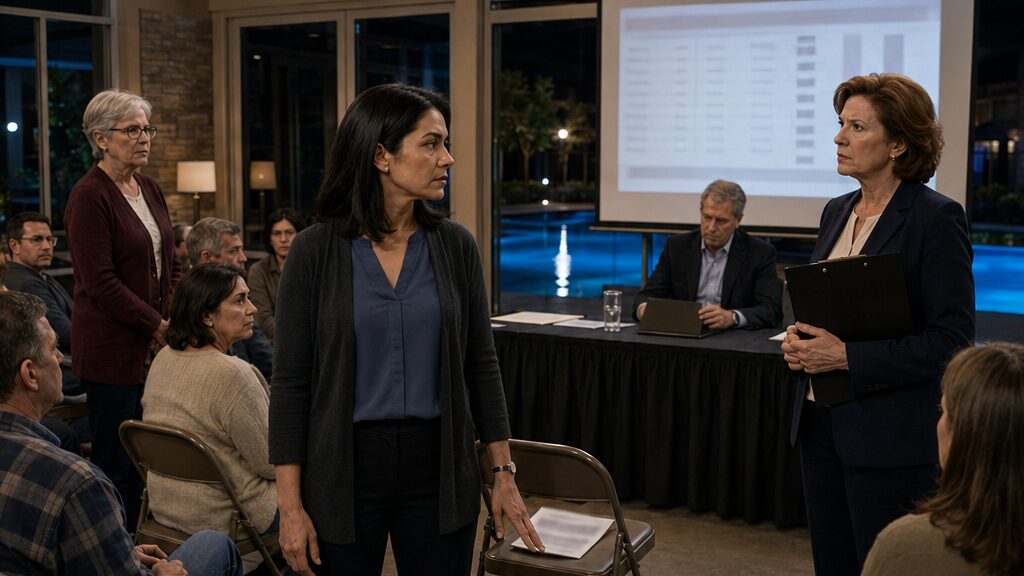
Anna’s swimming history was already on the projector when she entered the clubhouse Thursday evening.
A table filled the screen.
MONDAY—5:57 A.M.
WEDNESDAY—5:59 A.M.
FRIDAY—5:56 A.M.
Rows continued for six months, each one showing her entry and exit times. Above the table, in large red letters, Rebecca had typed:
EXCESSIVE AMENITY USE PATTERN.
Residents sat in folding chairs facing the screen. Through the glass doors behind the board table, the pool glowed under its evening lights. All six lanes were empty.
Anna stopped just inside the doorway.
Rebecca was arranging papers beside her clipboard. George Baker, the board president, leaned toward her and said something Anna could not hear. He noticed Anna, straightened, and gave her the tight smile people used when they wanted credit for being civil.
Betty Allen raised a hand from the second row.
“I saved you a seat.”
Anna sat beside her.
Betty had taught middle school for thirty-two years and still carried herself as though every room contained at least one person about to test a rule. She looked at the projected table, then at Anna.
“They publish everyone’s bathroom schedule too?”
“Apparently only mine.”
“That is not reassuring.”
George tapped the microphone.
The first agenda items passed quickly. A landscaping renewal was approved. A board member asked whether replacing two pool heaters could be delayed until winter. Rebecca said the matter would be addressed under the amenities report.
When Item Seven appeared, several residents shifted in their chairs.
Rebecca stood.
“The amenities committee has identified a pattern of disproportionate facility use,” she began. “Our common resources must remain financially sustainable and reasonably available to all members.”
She clicked the remote. The screen changed to a chart with Anna’s visits represented by blue bars.
Anna watched the bars rise across the months. They looked alarming only because no one else’s usage appeared beside them.
Rebecca continued. “Ms. Ramirez entered the pool facility an average of three times per week during the reviewed period. This frequency substantially exceeds the median household use.”
Betty leaned toward Anna. “Median includes people who never swim.”
Anna nodded.
“The committee therefore imposed a surcharge authorized under Section Nine,” Rebecca said. “We are asking the board to ratify that decision.”
George looked down the table. “Any questions from directors?”
One board member asked whether the charge had been calculated using actual costs.
Rebecca answered, “It reflects a reasonable allocation of amenity burden.”
Anna felt Betty’s shoulder move beside hers.
Betty raised her hand.
George hesitated before recognizing her.
“Is the pool crowded at six in the morning?” Betty asked.
Rebecca’s mouth tightened. “Crowding is not the sole cost factor.”
“How many lanes are being denied to other residents?”
“The issue is cumulative burden.”
“What burden?”
“Heating. Chemicals. Cleaning. Wear.”
Betty pointed through the glass. “The lights are on right now. The pumps are running. Nobody is in there. Are we charging the empty pool?”
A few residents laughed.
Rebecca did not.
“This is a financial governance matter, not a comedy routine.”
Betty lowered her hand. “Then provide financial numbers.”
George cleared his throat. “Let’s allow Ms. Ramirez to respond.”
Anna had prepared three pages of notes. She carried them to the lectern but did not open them.
The projected chart remained behind her.
She could feel the room studying the history of a routine she had never considered anyone else’s business.
“I’m not going to argue that I swim less than the report says,” she began. “The entry records are accurate.”
Rebecca folded her hands on top of the clipboard.
Anna looked at her.
“I’m asking you to read the exact standard I exceeded.”
Rebecca glanced toward George.
Anna waited.
“Section Nine authorizes the board to impose fees for excessive use,” Rebecca said.
“What number of visits becomes excessive?”
“The bylaws do not specify a fixed number.”
“How many minutes?”
“It is not based solely on minutes.”
“What percentage above the median?”
“The committee considers multiple factors.”
“Which factors, and how are they weighted?”
Rebecca’s fingers tightened around the clipboard’s metal clip.
“The board must retain discretion. We cannot anticipate every form of misuse.”
Anna turned slightly so the residents could hear her without raising her voice.
“Then there is no published standard.”
“There is a reasonableness standard.”
“Defined by whom?”
“The amenities committee.”
“After the person has already used the facility?”
Rebecca stopped.
No one laughed this time.
Through the glass, the pool lights shimmered against the ceiling. The empty Lane Three was directly behind Rebecca’s chair.
Anna asked, “Was any resident notified in advance that three visits per week could result in a surcharge?”
George answered before Rebecca could. “The board cannot issue hypothetical notices for every possible situation.”
“Was anyone notified?”
“No,” he said.
Anna looked down at her unopened notes.
The shame she had carried into the room began to separate from her. It did not disappear. It changed ownership.
Rebecca had expected her to defend the morality of swimming. Anna no longer intended to.
“This charge may be permitted by broad language,” Anna said. “But no one in this room could have known the rule before breaking it.”
George leaned back.
Rebecca said, “Ignorance of governing documents does not invalidate them.”
“That isn’t what I said.”
“What are you asking the board to do?”
“Define the rule before enforcing it.”
Rebecca turned to the directors. “The committee cannot manage shared resources if every operational decision requires a referendum.”
There it was—not an answer, but a fear.
For the first time, Anna wondered whether the charge was less about her laps than something Rebecca was trying to control before anyone noticed it.
George called for a vote.
Two directors supported overturning the fee. Three voted to uphold it. George cast the final vote in favor of ratification.
“The surcharge stands,” he said. “The board will review the policy language at a future meeting.”
A future meeting. After the money was due.
Residents began gathering their coats. A few avoided Anna’s eyes. One woman touched her arm and said she thought the process had been unfair, then hurried away before Rebecca could see them talking.
Anna returned to her chair.
Betty remained seated.
“You handled that better than I would have,” she said.
“It didn’t change the vote.”
“No. But now they have to live with what they admitted.”
Betty opened a canvas tote and removed a folded packet.
“I served on the finance committee eight years ago. I keep things.”
She passed the packet to Anna.
It was an old annual budget summary. The pool fund showed a surplus of nearly forty thousand dollars.
Anna looked toward the board table. Rebecca was collecting papers while George spoke quietly to her.
“The heaters were older then,” Anna said.
“They were. But this place collected reserve contributions every year after that.”
“Do you know what happened to the money?”
Betty shook her head.
On the front page, beside the pool reserve total, someone had written in pencil:
TRANSFER APPROVED—AMENITIES.
No destination was listed.
Anna folded the summary around her $340 notice.
The board had finally defined one thing for her.
They were protecting more than a rule.
Chapter 3: Section Fourteen Opened a Different Door
At 12:43 Saturday morning, Anna found the number that made her sit upright at the kitchen table.
0.0 miles.
She enlarged the document until Section Fourteen filled the screen.
The section governed resignation, member solicitation, and competition involving association-operated amenities. Its language was dense enough to discourage casual reading, but the final subsection was plain:
Any restricted competitive radius applicable after voluntary withdrawal: 0.0 miles.
Anna read it four times.
Then she printed the page and placed it beside Rebecca’s signed surcharge notice.
The printer hummed again as she copied the resignation provisions. A member who paid all outstanding assessments could terminate amenity access without an additional withdrawal penalty. The HOA could suspend access. It could charge broadly authorized fees. It could not require a departing resident to continue buying optional recreation services, and it had chosen to impose no competitive radius at all.
The discovery did not erase the $340.
It opened a door beside it.
By nine that morning, Anna had listed every public and private pool within fifteen miles. Municipal facilities had limited lap hours. Two gyms required annual contracts. The nearest independent indoor pool had closed after its owner retired.
One listing appeared under commercial leases.
FORMER THERAPY AND AQUATICS CENTER.
WAREHOUSE DISTRICT.
POOL EQUIPMENT INCLUDED.
The photographs showed stained ceiling tiles, a drained therapy pool, and six narrow lap lanes beneath industrial lights.
Anna closed the listing.
Ten minutes later, she opened it again.
On Monday afternoon, she carried the bylaws to Michael Harris’s office.
Michael read Section Fourteen, then returned to Section Nine. He marked three passages with yellow tabs.
“The surcharge language is broad,” he said. “I don’t like how they used it, but challenging it could cost more than the fee.”
“I’m not asking about the fee.”
“I know.”
He looked at the commercial listing Anna had printed.
“You’re serious.”
“I’m gathering information.”
“You scheduled a property tour.”
“That is information.”
Michael leaned back. “The zero-mile clause means exactly what it says. They did not create a post-withdrawal restriction. Even if they had, enforcing one against a resident opening a general public facility would raise other questions.”
“So they can’t stop me.”
“I said the clause doesn’t stop you. County zoning can stop you. Insurance can stop you. Occupancy rules can stop you. A failed pump can stop you.”
Anna kept her hands folded.
“What would I need?”
“A business entity. Lease review. Licensing. Liability coverage. Health inspections. Probably accessibility improvements. Working capital.”
“How much?”
“That is the wrong first question.”
“It’s the question I asked.”
Michael removed his glasses.
“The first question is why you’re doing it.”
“Because there’s a gap in the market.”
“You found the listing two days after they embarrassed you in public.”
Anna looked toward the window.
Michael had once lived in a different planned community and left after a three-year dispute over drainage responsibility. His caution came from experience, but it often sounded like surrender dressed in professional language.
“I’m not filing a lawsuit,” she said.
“No. You’re considering a business that could consume your savings.”
“I know how to read a balance sheet.”
“You know how to review medical billing.”
“I managed my mother’s home care for six years. I negotiated providers, schedules, insurance denials, payroll taxes, equipment rentals, and emergency coverage.”
“And when did you sleep?”
The question landed more sharply than she expected.
Anna gathered the papers into alignment.
Michael softened his voice. “Competence isn’t the same as capacity.”
“I didn’t ask you to decide whether I’m capable.”
“No. You asked whether the HOA can stop you. Based on this document, not through a non-compete. But legality is the easiest part of what you’re proposing.”
Anna left with a list of county offices and a warning written across the top:
DO NOT SIGN A LEASE BEFORE OCCUPANCY REVIEW.
That afternoon, she paid the $340 through the HOA portal.
The confirmation page asked whether she wanted to save the payment method. She selected no.
Then she drafted a resignation from the community pool program.
She did not mention Rebecca, the meeting, or the undefined standard. She stated that her account was current and requested termination of optional amenity access effective immediately.
At the management office, the clerk stamped the letter.
Rebecca emerged from the back room before Anna could leave.
“I heard you paid,” she said.
“Yes.”
“I’m glad you decided not to prolong this.”
Anna placed the stamped copy in her folder.
“I resigned from the pool program.”
Rebecca’s smile disappeared. “That seems unnecessary.”
“It’s permitted.”
“Of course it’s permitted. But the board said it would review the language.”
“At a future meeting.”
“We were trying to manage a difficult financial year.”
It was the first time Rebecca had said anything about finances directly.
Anna studied her face. There were faint shadows beneath her eyes that the clubhouse lighting had hidden.
“What happened to the pool reserve?” Anna asked.
Rebecca’s expression closed.
“I’m not discussing association finances in a hallway.”
“You discussed my access history in a room full of residents.”
“That was an enforcement matter.”
“And the reserve?”
“Submit a records request.”
Rebecca turned away, then stopped.
“If you think resigning proves a point, it doesn’t. The pool will continue without you.”
Anna answered quietly. “That’s what I’m counting on.”
The warehouse stood behind an auto-parts distributor and a row of storage units. Its faded sign still read HARBOR THERAPY AQUATICS, though the nearest harbor was hundreds of miles away.
The owner unlocked a metal side door.
A smell of mineral deposits and old chlorine drifted from the dark interior.
When the lights came on, Anna saw the pool from the photographs. It had not been drained after all. Cloudy water sat several inches below the tile line. Dust covered the lane ropes. A rust-colored stain ran down one wall beneath a ventilation duct.
“It needs work,” the owner said.
Anna walked along the deck.
The building had two locker rooms, a small office, and a wide therapy ramp leading into the shallow end. Some ceiling panels needed replacement. The pump room sounded rough but functional.
“Why did it close?”
“The operator retired. Then a lease fell through during permitting.”
“What permitting?”
The owner named several issues: emergency lighting, a fire-door upgrade, accessible restroom clearances, updated chemical storage.
Anna heard Michael’s warning in each item.
“What’s the shortest lease you’ll take?”
The owner studied her. “One year, with six months prepaid.”
“No.”
“Then three months prepaid and a larger security deposit.”
Anna calculated silently. The amount would take most of the savings she had set aside after selling her mother’s house. That money had remained untouched for two years because spending it felt like spending the final evidence of everything they had survived together.
She walked to Lane Three.
A single fixture above it flickered, then steadied.
In the quiet, Anna could almost hear the community pool at six in the morning: the ventilation fan, the lane rope tapping the wall, Rebecca’s pen marking down the time.
The warehouse owner waited near the office.
“I’ll need an answer this week,” he said. “Another group asked about storage conversion.”
Anna looked at the cloudy water.
She knew better than to sign before the county review. Michael had written the warning in capital letters.
She also knew that if she called Betty, Michael, or anyone else, they might tell her to wait until anger stopped feeling like certainty.
Anna had spent years becoming the person who never needed help deciding.
“Bring me the short-term lease,” she said.
The owner returned with the document.
Anna read every page.
Then, before telling anyone what she had found or what it might cost, she signed her name beneath the line for tenant.
Chapter 4: A New Pool Cannot Run on Anger
The county inspector placed a red sticker on the warehouse door before Anna had finished celebrating the water test.
OCCUPANCY APPROVAL WITHHELD.
The words were printed in block letters large enough to read from the parking lot.
“The pool chemistry is acceptable,” the inspector said, closing a metal case of testing equipment. “That does not make the building ready for the public.”
Anna stood beside the shallow-end ramp with her own clipboard pressed against her ribs. Three weeks had passed since she signed the lease. The cloudy water was now clear. The rust stain beneath the duct had been scrubbed away. Two of the six lane ropes had been replaced.
“What remains?” she asked.
The inspector counted with one gloved finger at a time.
“Emergency lighting. Panic hardware on the rear exit. Chemical-room ventilation. Restroom clearance. The fire door does not close completely. And the accessible route from the parking lot has a lip at the threshold.”
“The ramp into the pool is compliant.”
“The route to the ramp is not.”
Anna wrote each item down.
The warehouse owner had described the same problems as minor improvements. On Anna’s clipboard, they became columns: requirement, estimate, deadline, paid.
The inspector watched her write.
“You should confirm costs before scheduling a second inspection.”
“I will.”
“And do not admit swimmers before approval.”
“I understand.”
He left the red sticker on the door.
By noon, the contractor had doubled his first estimate.
“The ventilation has to discharge through the roof,” he said. “That means permits, curb flashing, electrical work. The fire door may need a new frame.”
“You told me last week the frame was usable.”
“Last week I had not removed the trim.”
Anna looked through the office window toward the pool. Sunlight from the high warehouse windows broke across the lanes, making the building appear more finished than it was.
“How much to begin?”
He named a deposit that would leave less than a quarter of her reserve untouched.
Anna calculated what remained after rent, insurance, legal filing fees, and the first delivery of chemicals.
“When can you finish?”
“If the county moves quickly, ten days.”
“If it does not?”
He lifted one shoulder. “Three weeks. Maybe four.”
Anna signed the deposit authorization.
The contractor left with a check that represented most of the money she had promised herself she would not spend.
At four that afternoon, Betty Allen arrived carrying a paper grocery bag.
Anna had not told her about the lease. Betty had learned from the warehouse owner’s application posted in the county permit database.
“You could have called,” Betty said.
“I was going to.”
“When? After opening day?”
Anna set the clipboard on the office desk. “There is no opening day yet.”
Betty looked at the red sticker on the door, then at the exposed framing around the rear exit.
“I brought sandwiches. I assumed you had forgotten lunch.”
“I ate.”
Betty removed two wrapped sandwiches from the bag. “Coffee is not lunch.”
They sat on folding chairs near the drained therapy pool. Anna explained the inspection problems, the contractor timeline, and her proposed pricing.
“Sixty dollars a month,” she said. “One hundred fifty to join. That covers the first equipment purchases.”
Betty stopped unwrapping her sandwich.
“One hundred fifty?”
“It is less than most private facilities.”
“It is still two hundred ten dollars before anyone swims.”
“The warehouse needs repairs.”
“I can see that.”
“The initiation fees make the numbers possible.”
“For whom?”
Anna looked at her.
Betty folded the wrapper into a small square. “The neighbor on my street who walks in the pool because her knees cannot handle pavement—can she pay that?”
“I can create hardship exceptions.”
“Decided by you?”
“Someone has to verify them.”
“And who approves prices?”
“I own the business.”
Betty nodded slowly.
The nod was worse than disagreement.
“What?” Anna asked.
“You did not leave Willow Creek because private ownership offended you.”
“No.”
“You left because one person could create a rule, decide who broke it, and keep the reasoning private.”
“This is different.”
“Is it?”
Anna’s hand tightened around the edge of the clipboard.
“I am risking my money. Rebecca was risking everyone else’s.”
“That is different,” Betty said. “But it does not answer my question.”
Anna rose and carried the clipboard to the office.
Betty followed.
“I thought you wanted another pool.”
“I do.”
“Then why are you trying to stop me?”
“I am trying to stop you from building a cleaner version of the same room.”
Anna turned.
The office was small enough that neither woman could create distance without leaving it.
Betty’s voice softened. “You never asked whether anyone wanted to help.”
“I did not ask because I was not asking anyone to risk their savings.”
“Money is not the only thing people can risk.”
Anna looked past her toward the unfinished deck.
For years, asking had meant creating a task for someone already tired. When her mother could no longer stand without assistance, Anna had learned to schedule every need before it became an emergency. Each favor had required explanation, gratitude, and the possibility of refusal. It had been easier to carry too much than to wait for someone else to decide whether they could help.
“I can manage it,” Anna said.
Betty’s face tightened. “That is not the same as saying you should.”
She picked up her bag.
Anna expected her to leave.
Instead, Betty took a sheet of paper from the bag and placed it beside the clipboard. It contained twelve names and phone numbers.
“People who asked me whether the new pool was real,” she said. “A retired electrician. Two parents willing to paint. Someone who writes grants for a living. The neighbor with the bad knees used to manage a recreation center.”
Anna stared at the list.
“They are not investors,” Betty continued. “They are people who want a voice if they help.”
“What kind of voice?”
“Pricing. Hours. Hardship access. Basic rules.”
“That requires a structure.”
“Yes.”
“And meetings.”
“Yes.”
“And people disagreeing about things they do not understand.”
Betty almost smiled. “That is generally what meetings are.”
Anna picked up the list.
The next ten days changed the warehouse faster than the contractor did.
Residents scraped old adhesive from the locker-room floors. The retired electrician replaced damaged fixtures under the contractor’s permit. Parents painted the office and assembled benches. The neighbor with mobility limitations walked the entrance with a measuring tape and identified a cheaper threshold solution that still met county requirements.
Anna coordinated every shift.
She also corrected people too quickly, reorganized donated supplies after volunteers went home, and rewrote Betty’s draft membership survey without asking.
On the ninth evening, Betty found the revised survey on the office printer.
“You removed the question about shared governance.”
“It was premature.”
“You mean you did not like the possible answer.”
“We are not open.”
“That did not stop you from setting the initiation fee.”
Anna took the paper from her. “I reduced it to seventy-five.”
“For now.”
“I am trying to keep this place alive.”
“So am I.”
They stood in silence beneath the new emergency light.
Anna looked at the clipboard in her hand. It held contractor invoices, volunteer schedules, membership deposits, inspection notes, and a list of decisions only she could approve.
For the first time, it felt heavy for a reason unrelated to paper.
“I will put the question back,” she said.
Betty studied her, deciding whether that was enough.
Then she nodded. “Good.”
The contractor finished the rear exit the following afternoon. When Anna transferred the final deposit, her account balance fell below the amount required for one additional month of full operating expenses.
That evening, forty-three residents received an email from Rebecca Walker.
Anna knew because Betty forwarded it with no comment.
The subject line read:
IMPORTANT NOTICE REGARDING UNAUTHORIZED COMPETING AMENITY.
Rebecca warned that residents who joined or promoted Anna’s facility might violate association obligations concerning solicitation, proprietary member information, and competition with HOA services. She advised residents not to sign contracts until the board completed a legal review.
At the bottom, beneath Rebecca’s title, was an image of the HOA seal.
Anna opened Section Fourteen again.
She had read every line before signing the lease.
Now, with most of her savings committed and dozens of neighbors watching, she read it as someone who might have missed the one sentence capable of ending everything.
Chapter 5: The Budget Shortfall Changed the Villain
Betty found Anna’s name in Rebecca’s handwriting beside three words that made the $340 charge feel smaller and worse.
WILL PROBABLY PAY.
They were written in the margin of a photocopied access report inside the HOA records room.
Anna stood behind Betty, one hand braced against a gray filing cabinet. The room smelled of toner and cardboard. A bookkeeper sat at the far desk, watching them with the nervous attention of someone who had been instructed to provide records but not conversation.
Below Anna’s name were five other residents.
LOW CHALLENGE.
UNLIKELY TO APPEAL.
FIXED INCOME—SMALL FEE ONLY.
Betty turned the page sideways, as though the angle might change the handwriting.
“It is hers,” she said.
Anna recognized the narrow capital letters from the towel notice.
The records request had taken twelve business days and two written reminders. What arrived was not a complete accounting. It was a set of vendor invoices, reserve summaries, committee notes, and usage reports, some duplicated and some missing attachments.
But the deficit was real.
A cracked heat exchanger had required emergency replacement. A chemical feeder had failed six months later. Insurance premiums had risen after a child slipped near the shallow end. The pool fund, once healthy, had been drained by repairs and by a transfer to cover clubhouse roof damage.
Anna traced the totals on a yellow legal pad.
The amount missing from the current year was not $340.
It was nearly sixty thousand dollars.
Betty lowered her voice. “So she was not inventing the problem.”
“No.”
The answer felt unsatisfying, but numbers did not become false because the person presenting them had behaved badly.
The bookkeeper cleared her throat.
“We warned the board last fall that the amenity allocation was not enough.”
Anna looked up. “Who is we?”
“The management accounting team.”
“What did the board decide?”
The bookkeeper glanced at the open door. “You will need to ask the board.”
Betty tapped the handwritten list. “Did the accounting team prepare this?”
“No.”
“Did you know surcharges were being assigned by likelihood of appeal?”
“I did not participate in enforcement decisions.”
It was not a denial.
Anna photographed every page permitted under the records policy.
Outside, the afternoon heat had settled over the sidewalks. Sprinklers clicked along the common lawn, sending water across already wet grass.
Betty walked beside Anna toward the parking lot.
“I wanted Rebecca to be lying about everything,” she said.
“That would have been easier.”
“She hid the deficit.”
“Yes.”
“But the deficit still exists.”
Anna placed the records box in her trunk.
At the warehouse, volunteers were installing lockers donated by a closed fitness studio. The sight should have felt encouraging. Instead, Anna saw each person as another promise attached to an account that had almost no margin left.
She posted a summary of the HOA records on the office wall.
Not the handwritten list. Not yet.
The summary included repair costs, reserve transfers, and missing board disclosures. She removed residents’ identifying information and cited each invoice.
A parent reading it asked, “Does this mean our HOA dues are going up?”
“Possibly.”
“How much?”
“I do not know.”
“Then what exactly are we fighting?”
Anna had no clean answer.
They were fighting arbitrary enforcement. They were also confronting a pool that cost more to operate than residents had been told. Removing Rebecca would not repair a heater or lower an insurance premium.
That evening, George Baker arrived alone.
He waited until the last volunteer left, then closed the office door behind him.
“I would prefer this conversation remain private,” he said.
Anna remained standing.
George set an envelope on the desk.
Inside was a check from the HOA for $340.
“Refund of the surcharge,” he said. “No admission of fault.”
Anna did not touch it.
“Why now?”
“The board recognizes that the policy language could have been clearer.”
“Rebecca sent residents a legal warning three days ago.”
“Rebecca is under pressure.”
“So am I.”
George looked through the office window at the pool. The water was clear now, and four lanes had new ropes.
“You have made your point.”
Anna waited.
“If you withdraw the records complaint and agree not to solicit Willow Creek residents directly, we can close the matter.”
“Is that a board offer?”
“It is a practical resolution.”
“Was it voted on?”
His hesitation answered.
“George.”
He lowered his voice. “If the full membership sees these costs without context, they will panic. Some residents cannot absorb a special assessment.”
“So you charged selected people privately.”
“I did not design the list.”
“You approved the program.”
“We approved revenue measures. Rebecca handled implementation.”
Anna took the check from the envelope and examined the signature. George had signed it.
“Did you know how she selected residents?”
“Not in those terms.”
“What terms did you know?”
George rubbed his thumb along the edge of the desk.
“She said the committee would prioritize high-frequency accounts with a low history of violations.”
“Low history of violations.”
“The thinking was that responsible members would understand the need.”
Anna looked at him.
For a moment, George seemed to hear the sentence as she did.
People who followed rules had been chosen because they were less likely to challenge an undefined one.
“Why did you not tell residents about the deficit?” she asked.
“We were negotiating vendor credits. We believed the gap might narrow.”
“And when it did not?”
“A special assessment before the election would have divided the neighborhood.”
“There it is.”
“What?”
“The election.”
George’s face hardened. “It is easy to condemn caution when you do not have to answer to four hundred households.”
“And it is easy to call concealment caution when someone else receives the bill.”
He pushed the check closer.
“This protects you. It gives you the result you originally requested.”
Anna thought of Michael’s warnings, the nearly empty business account, the red sticker still folded in her office drawer, and the contractor invoice due in five days.
Three hundred forty dollars would not save the warehouse.
But accepting it would let her say she had won something.
George read the uncertainty in her face.
“You do not have to destroy the association to prove Rebecca was wrong.”
“I am not trying to destroy it.”
“Eighty residents leaving the amenity program would remove close to a hundred thousand dollars a year.”
“There are not eighty members here.”
“Not yet.”
The words revealed what the board feared.
The warehouse did not need to succeed fully to expose the fragility of Willow Creek’s finances. It only needed to offer residents a choice.
Anna placed the check back in the envelope.
“The deficit needs to be disclosed.”
“We can phase the information.”
“No.”
“Anna, people will demand someone to blame.”
“They already chose someone.”
George followed her gaze to the photocopy of the handwritten list, which lay facedown beside the records box.
His expression changed.
“You found internal committee notes.”
“I found criteria.”
He exhaled slowly. “Rebecca was trying to avoid a larger assessment.”
“She chose residents she thought would stay quiet.”
“She believed frequent users had a greater obligation.”
“She wrote ‘will probably pay’ beside my name.”
George looked away.
That was the moment Anna’s anger narrowed.
Rebecca was not a woman inventing a crisis for pleasure. She was frightened of telling residents that years of low dues, deferred repairs, and optimistic budgets had consequences. She had convinced herself that quiet people could be charged privately for the stability of everyone else.
Understanding the fear did not reduce the betrayal.
It made the choice more precise.
Anna slid the refund across the desk.
“I will not accept a private correction to a public policy.”
“What do you want?”
“A full membership vote on the surcharge authority. Complete financial disclosure. The selection criteria entered into the meeting record.”
George stared at her. “You know what that could do.”
“Yes.”
“And if members refuse an assessment?”
“Then they will finally be refusing the actual cost, not a story you chose for them.”
After he left, Anna scanned the refund check and the unsigned settlement terms he had brought.
Then she drafted a formal petition for a special membership meeting.
Betty read it at the office door.
“You are asking people to vote for transparency that may increase their own dues.”
“Yes.”
“They may hate you for that.”
“I know.”
Betty signed the petition first.
By the next evening, Anna had enough signatures under the bylaws to force the meeting.
She submitted the petition to management and copied every board member.
Her final line requested that all pool reserve records, emergency repair invoices, and amenity surcharge criteria be distributed before any vote.
At 8:16 p.m., the portal confirmed receipt.
At 8:19, George called.
Anna let it ring once before answering.
“You have forced the board’s hand,” he said.
“No. I forced a vote.”
“If residents see the full number, they may shut the pool entirely.”
Anna looked through the warehouse office window. Volunteers were lowering the new lane ropes into the water.
“Then they should know that is the choice.”
She ended the call.
The next decision would belong to the same residents Rebecca had tried to protect from the truth.
Anna did not know whether they would choose honesty once they learned what honesty cost.
Chapter 6: Show Me the Clause, Then Show Them the Books
Rebecca arrived at the warehouse carrying a cease-and-desist letter in one hand and her old clipboard in the other.
Anna was in the parking lot marking the accessible route for the county’s final inspection. Betty stood near the entrance with a roll of blue tape.
Rebecca parked across two spaces, stepped out, and walked directly toward them.
“You need to stop enrolling Willow Creek residents,” she said.
Anna straightened.
The warehouse door stood open behind her. Inside, volunteers were finishing the locker-room benches. The pool was not yet operating, but more than fifty residents had submitted membership interest forms.
“On what basis?” Anna asked.
Rebecca held out the letter.
The heading named the HOA’s general counsel, but the signature block contained no attorney’s name. The letter demanded that Anna cease solicitation, stop using “association-derived member relationships,” and abandon any business activity that interfered with HOA amenities.
Anna read it once.
“Did counsel write this?”
“It reflects the board’s legal position.”
“That is not what I asked.”
Rebecca’s grip tightened on the clipboard. “You are taking members from a facility funded by their own community.”
“They are choosing another option.”
“After you used private association information to target them.”
“I did not use a member list.”
“You knew them through Willow Creek.”
“I have lived there twelve years.”
“That does not give you the right to undermine shared property.”
Betty stepped closer, but Anna raised one hand.
She looked at the letter again.
“Show me the clause.”
Rebecca’s jaw set.
“The governing documents prohibit harmful competition and solicitation.”
“Show me where.”
Rebecca opened the binder clipped beneath her board.
She turned past the amenities section, the member conduct section, and the provision Anna had copied at her kitchen table. Her thumb stopped at Section Fourteen.
Anna waited.
Cars slowed along the commercial strip. Two residents inside the warehouse had come to the doorway.
Rebecca read silently.
“Subsection C,” she said.
“That covers the use of confidential association data.”
“You obtained records.”
“After the warehouse lease was signed. Through a formal records request. I did not use them to recruit anyone.”
Rebecca flipped another page.
“The board has broad authority to protect association assets.”
“From what radius?”
The question landed between them.
Rebecca looked down.
Anna said, “Read the competitive radius.”
Betty did not smile. Neither did anyone at the door.
Rebecca’s face changed not with surprise, but recognition. She had known the number. She had counted on the threat being more powerful than the text.
“This is not a courtroom,” she said.
“No. It is a parking lot where you brought me a legal demand. Show me the clause that supports it.”
A county vehicle turned into the lot.
Elizabeth Roberts stepped out carrying an inspection folder. She paused when she saw the group.
“I appear to have arrived during something private,” she said.
Rebecca moved toward her. “Are you the county official overseeing this facility?”
“I am conducting the occupancy follow-up.”
“This operation may violate residential association restrictions.”
Elizabeth did not take the cease-and-desist letter Rebecca offered.
“I do not enforce private HOA covenants.”
“It may be an unauthorized competing amenity.”
“My review concerns land use, fire clearance, accessibility, sanitation, and occupancy.”
“So you are approving it?”
“I have not inspected it yet.”
Rebecca glanced toward Anna. “The county should be aware that its applicant is involved in active litigation.”
“There is no litigation,” Anna said.
Rebecca lifted the letter. “There will be if she continues.”
Elizabeth looked at Anna. “Does any court order prohibit operation?”
“No.”
“Then it is not part of today’s inspection.”
She entered the building.
Rebecca remained in the parking lot, suddenly holding papers no one official wanted.
Anna folded the letter and handed it back.
“The emergency membership meeting is tonight,” she said. “Bring the clause there.”
Rebecca’s expression hardened. “You think the board concealed money.”
“I think you concealed choices.”
“You have no idea what residents say when dues rise. You have no idea how many people call and explain that fifty dollars means a prescription, a utility bill, groceries.”
“I know exactly what impossible bills sound like.”
“Then you should understand.”
“I understand the deficit.”
Rebecca blinked.
“I also understand the list.”
For the first time, fear passed openly across Rebecca’s face.
Anna continued. “You did not charge the people creating the highest costs. You charged the people least likely to challenge you.”
Rebecca lowered her voice. “I charged people who used the pool regularly because closing it would hurt them most.”
“You wrote ‘will probably pay’ beside my name.”
“I was trying to keep the facility open.”
“You decided some residents deserved the truth and others only deserved invoices.”
Rebecca looked toward the warehouse, where Elizabeth was testing the panic hardware on the rear door.
“You will discover that ideals cost money,” she said.
“I already have.”
Elizabeth completed the inspection forty minutes later.
The emergency lighting passed. The rear door closed properly. The threshold repair met accessibility requirements. The chemical ventilation still needed a final electrical certification, but Elizabeth signed a conditional approval allowing operation once that document was filed.
“You are one piece of paper away,” she told Anna.
It was not rescue. The county did not settle the HOA dispute, erase the warehouse debt, or guarantee members.
But when Anna pinned the conditional approval beside the office door, the volunteers understood what it meant.
Rebecca could threaten.
She could not stop the opening by pretending the county had already agreed with her.
That evening, the Willow Creek clubhouse filled beyond its chair capacity.
Residents stood along the walls and outside the glass doors. The pool lights were on, although no one was swimming.
Rebecca sat at the board table with the clipboard in front of her.
Anna arrived carrying two boxes of financial packets.
Betty helped distribute them row by row.
Each packet contained the repair invoices, reserve transfers, budget summaries, selection notes with names redacted, the zero-mile clause, and Anna’s proposed resolution revoking the surcharge policy.
George called the meeting to order.
Before he finished reading the agenda, residents began asking about the sixty-thousand-dollar deficit.
George tried to slow the questions.
Rebecca requested time to explain.
Anna listened from the front row as Rebecca described the failed heat exchanger, insurance increase, chemical equipment, and clubhouse roof transfer. Her voice remained controlled until someone asked why those costs had not appeared in the annual report.
“We believed vendor credits and operating adjustments could resolve the shortfall,” Rebecca said.
“By charging six people?” a resident called.
“The surcharge program was a pilot revenue measure.”
Betty stood. “What were the selection criteria?”
Rebecca looked at George.
George stared at the microphone.
Anna rose and walked to the lectern.
She did not display the handwritten list on the projector. She had considered it. Public humiliation would have been easy now.
Instead, she read the categories without identifying the residents attached to them.
“Low challenge. Unlikely to appeal. Fixed income—small fee only. Will probably pay.”
The room became still.
Rebecca’s chair moved against the floor.
Anna looked at her. “Are those your notes?”
Rebecca could have denied them.
She did not.
“Yes.”
A sound moved through the room—not outrage exactly, but recognition.
Rebecca stood.
“The board faced an immediate shortfall. A general assessment would have affected every household, including residents already behind on dues. We attempted to allocate costs to high-frequency amenity users.”
“Then why include likelihood of appeal?” Anna asked.
Rebecca’s eyes flashed. “Because enforcement costs money. Every dispute consumes management hours and legal fees.”
“So compliance became a billing criterion.”
“It became one factor in collecting funds efficiently.”
The honesty damaged her more than a denial would have.
George called for order.
Anna opened the final packet page.
“The pool needs money,” she said. “That part is true. Revoking this policy will not repair the budget.”
Several residents looked down at the projected estimates.
“The board should publish the full cost and let members decide whether to raise dues, reduce hours, close lanes, or defer other work. Those choices will hurt. But the cost cannot be hidden inside charges assigned to people selected for being quiet.”
A resident near the back asked whether Anna’s warehouse pool would remain sixty dollars per month.
“For now,” Anna said. “It may need to change after final operating costs are known.”
Murmurs followed.
She let them.
“I am not offering a pool that costs less because costs disappear. I am offering one where prices, hardship rates, and rules are visible before people agree to them.”
George called the votes.
The surcharge policy was revoked by a wide margin.
A second motion required quarterly publication of amenity finances.
A third removed Rebecca from her acting treasurer duties pending review, though she remained an elected board member until the annual meeting.
Rebecca gathered her papers after the votes. Her hand rested on the clipboard for several seconds before she picked it up.
There was no applause.
Some residents looked angry. Others looked frightened by the proposed dues increase. A few approached Rebecca with questions about whether the pool might close.
The truth had not united them.
It had only made the real argument possible.
As the room emptied, George agreed to publish the full repair budget and schedule a formal assessment vote.
Anna packed the remaining financial sheets into a box.
Betty stood beside the glass doors, watching the empty lanes.
“You were right not to take the refund,” she said.
Anna closed the box. “That does not mean the warehouse survives.”
“No.”
“The electrical certification is still pending. We need at least sixty committed members. The hardship fund does not exist yet.”
“No.”
Anna looked at her. “You are very encouraging.”
“I am saving the encouragement for after you answer a question.”
Betty held out a folder.
Michael had drafted two possible structures. The first kept Anna as sole owner with an advisory committee. The second converted the facility into a member cooperative over a staged period, limiting Anna’s authority and returning part of her investment through future revenue.
Anna read the first page.
“You asked Michael to prepare this?”
“I asked what shared control would actually require.”
“You did that without telling me.”
Betty raised an eyebrow. “Annoying, isn’t it?”
Anna almost laughed, but the figures stopped her.
Under the cooperative plan, she could no longer set prices alone, approve exceptions privately, or sell the business without member consent. The money she had risked would not give her permanent control.
Betty touched the folder.
“You wanted them to show you the clause,” she said. “Now I am asking you to write one that applies to you.”
Anna looked through the glass at the single lane light burning over the dark water.
She had escaped Rebecca’s authority by building something of her own.
Now survival required deciding whether it could remain hers.
Chapter 7: The First Lane Light Belonged to Everyone
At 6:00 a.m., Anna unlocked the warehouse and found someone already swimming in Lane One.
She stopped with the key still in the lock.
The first lane light was on, throwing a white path across the water. A woman moved slowly through it, one hand trailing along the lane rope between strokes. Her cane rested beside the shallow-end ramp.
The neighbor with the bad knees lifted her head.
“I used the side entrance,” she said. “Betty gave me the volunteer code.”
Anna looked toward the wall-mounted keypad.
The code had been issued for opening-week setup, not unsupervised access.
“That code was supposed to expire yesterday.”
“It did not.”
Anna set her bag on the office counter. Her first impulse was to disable it immediately, make a note, and remind everyone that insurance required controlled access.
Then she noticed the dry-erase board beside the entrance.
6:00–6:45 — LANE ONE — MOBILITY SESSION.
The woman had written her name beneath it in careful block letters, along with the time she entered.
No one had hidden the use. No one had asked Anna privately for an exception.
They had used the system Betty’s volunteer committee had installed three days earlier.
Anna walked to the edge of the pool.
“You should not swim alone.”
“I am not alone now.”
“That is not how the rule works.”
The woman rested both arms on the deck. “Then write the rule clearly.”
Anna heard Rebecca in the sentence, then realized the voice belonged only to the person in front of her.
“Finish this lap,” Anna said. “I’ll stay on deck.”
The woman nodded and pushed away from the wall.
Anna turned on Lane Two.
For twelve years, she had guarded the first quiet hour of the morning as if silence were something that could be owned by arriving before everyone else. Now the slap of another swimmer’s hand against the water disturbed her count.
It also made the building sound alive.
By seven, four people had entered. Each wrote a name and lane time on the board. One changed an entry after deciding to walk in the shallow area instead. Another erased a reservation when a child woke sick at home.
The system was imperfect. The handwriting varied. Someone had left the cap off the marker.
It worked without Anna approving each line.
At eight-thirty, Michael arrived with two folders and a portable printer.
“The cooperative documents are ready,” he said. “If you are still doing this.”
Anna glanced through the office window.
Betty was explaining the hardship-rate application to a resident. The explanation was taking longer than Anna would have taken, but Betty was also listening to the answer instead of merely collecting information.
“What happens if I do not sign?” Anna asked.
“You remain sole owner. You can appoint an advisory group and keep final authority.”
“And if I sign?”
“The cooperative purchases the operating business over time. Your initial contribution becomes a secured member loan. You receive repayment before surplus distributions, subject to minimum reserves.”
Anna opened the thicker folder.
Michael pointed to the marked sections.
“Membership elects the board. Pricing changes require notice and a recorded vote. Hardship rates follow published criteria. You retain day-to-day management for the first year, but not unilateral authority over fees, access, or dissolution.”
“And if they vote to remove me as manager?”
“They can, under the stated conditions.”
Anna read the clause twice.
She had signed the warehouse lease alone. She had paid the first contractor deposit alone. Every repair invoice still carried her name.
The risk had been hers before anyone believed the pool could open.
Michael watched her expression.
“You asked for a structure that prevents one person from controlling the rules.”
“I know what I asked for.”
“It applies even when the one person is you.”
Betty appeared in the doorway carrying three paper cups.
“Coffee,” she said. “Not lunch.”
She set one beside Anna and looked at the folders.
“You do not have to sign today.”
“The county certification expires if the operating entity changes after opening,” Michael said. “It is cleaner before the first paid membership cycle.”
Betty frowned at him. “That sounded like pressure.”
“It was information.”
“It can be both.”
Anna turned to the signature page.
“What do members vote on first?”
Betty sat across from her. “The opening budget. Then hardship rates. Then whether children’s lessons begin this quarter or wait until we build more reserve.”
“The lesson program loses money at the proposed rate.”
“It also brings families in.”
“That does not make it affordable.”
“No. That is why people need to see the numbers.”
Anna looked through the glass again.
The first lane was empty now. The woman who had used it was drying her hair near the lockers, speaking with a parent who had arrived for the volunteer orientation.
Nothing in the room moved according to Anna’s private schedule anymore.
For years, control had meant preventing the next emergency. Medication alarms. Home-care shifts. Insurance calls. A walker placed exactly where her mother could reach it in the night.
After the funeral, control had remained even when the emergency was gone.
It had kept Anna functioning.
It had also made every offer of help feel like a threat to the system that had survived.
She picked up the pen.
Betty did not smile or urge her forward.
Anna signed the conversion agreement, the member-loan terms, and the temporary management contract.
On the final page, beside the clause allowing member removal of the manager, her hand paused.
Then she signed that too.
Michael gathered the documents for filing.
“That limits your authority effective when the cooperative accepts the transfer,” he said.
“When is that?”
Betty checked the wall clock. “The organizational meeting starts in twenty minutes.”
Anna looked at her. “You scheduled it before I agreed.”
“I reserved the time. There is a difference.”
The meeting took place on the pool deck because the office could not hold everyone.
Fifty-seven members attended. Twelve joined remotely from a laptop balanced on a folding table. The first budget projected narrow survival, not profit. Chemical costs were higher than Anna had estimated. Insurance required a reserve increase. The initiation fee could be reduced to forty dollars only if members performed a fixed number of volunteer hours or accepted a slightly higher monthly rate.
The debate lasted nearly two hours.
No one applauded when the budget passed.
A father objected to delaying children’s lessons. A retired resident worried that hardship rates would shift costs unfairly. Betty insisted the eligibility criteria be simple enough to explain without private judgment. Anna answered questions, corrected one arithmetic error, and stopped herself twice from telling the group what they should choose.
The final votes established published rates, a hardship fund, quarterly financial reports, and a five-member elected board.
Anna was elected to one seat.
Not all five.
That afternoon, Willow Creek held its annual meeting.
The clubhouse was as crowded as it had been on the night of the surcharge vote, but the projector now displayed the full pool budget.
George stood beside a table stacked with printed reports.
Rebecca sat in the second row rather than at the board table. She no longer carried the clipboard.
The proposed plan raised general dues by fourteen dollars per month, reduced heated morning hours during winter, and delayed cosmetic deck work. A separate hardship process would be administered through management rather than the amenities committee.
Residents argued over every line.
Some accused the board of incompetence. Others said they would rather pay fourteen dollars than lose the pool. One homeowner proposed closing it permanently. The proposal failed, but not by much.
The final budget passed.
Then George read the motion revoking the excessive-use surcharge policy and requiring objective, published standards for any future amenity fee.
It passed without debate.
Rebecca remained seated after the meeting ended.
Anna was carrying unused reports toward the recycling bin when Rebecca spoke.
“Your warehouse rates will rise.”
Anna stopped.
“Yes.”
“People will blame you when they do.”
“Some will.”
Rebecca looked toward the pool through the glass doors.
“I should have brought the deficit to a vote.”
“Yes.”
“I thought if I could bridge one year, the next reserve cycle would correct it.”
“You chose who would pay for the bridge.”
Rebecca’s hands rested empty in her lap.
“They would have voted the assessment down.”
“Maybe.”
“And then the pool might have closed.”
“Maybe.”
Rebecca looked at her. “You can say that calmly because you built another one.”
Anna considered the accusation.
“No,” she said. “I can say it because the choice belonged to them even when the answer might have been wrong.”
Rebecca looked away.
There was no apology. Anna no longer needed one to know what had changed.
The next Monday, she reached the warehouse at 5:56 a.m.
The volunteer code had been replaced by individual member access. The dry-erase board showed three reservations beginning at six.
Lane One was already claimed.
Anna stood beneath the entrance light, feeling the old irritation rise before it gave way to something less familiar.
She wrote her name beside Lane Three.
At six, Betty entered carrying a towel over one shoulder.
“You are sharing your morning,” she said.
“I noticed.”
“Painful?”
“Moderately.”
Betty smiled and moved toward the shallow end.
Anna switched on Lane Two, then Lane Three, then the remaining lights one at a time.
The water brightened across the width of the building.
A parent entered with a sleepy child. The neighbor with the cane followed. Two former Willow Creek swimmers came through the door arguing quietly about whether the sign-in board needed fifteen-minute intervals.
No one waited for Anna to assign them a place.
They read the rules, wrote their names, and made room.
Anna lowered herself into Lane Three.
For the first few strokes, she tried to recover the silence she remembered.
Then another swimmer turned beside her, sending a small wave across the rope.
Anna adjusted her breath and kept moving.
Above the pool, every lane light was on.
The story has ended.