The HOA Towed All Eleven of His Service Trucks—Then the Board Finally Read the Agreement
Chapter 1: The Eleven Empty Spaces Before Sunrise
Raymond Harris knew something was wrong before he finished turning through the maintenance gate.
The lot looked too wide.
At 5:43 on Wednesday morning, the security lights were still burning above the screened service yard beside the clubhouse. Usually their yellow glare landed on eleven white trucks parked nose-in along the eastern fence, each one lined up over a faded number painted on the asphalt.
That morning, the light fell on nothing.
Raymond stopped his pickup halfway through the gate.
Spaces 1 through 11 were empty.
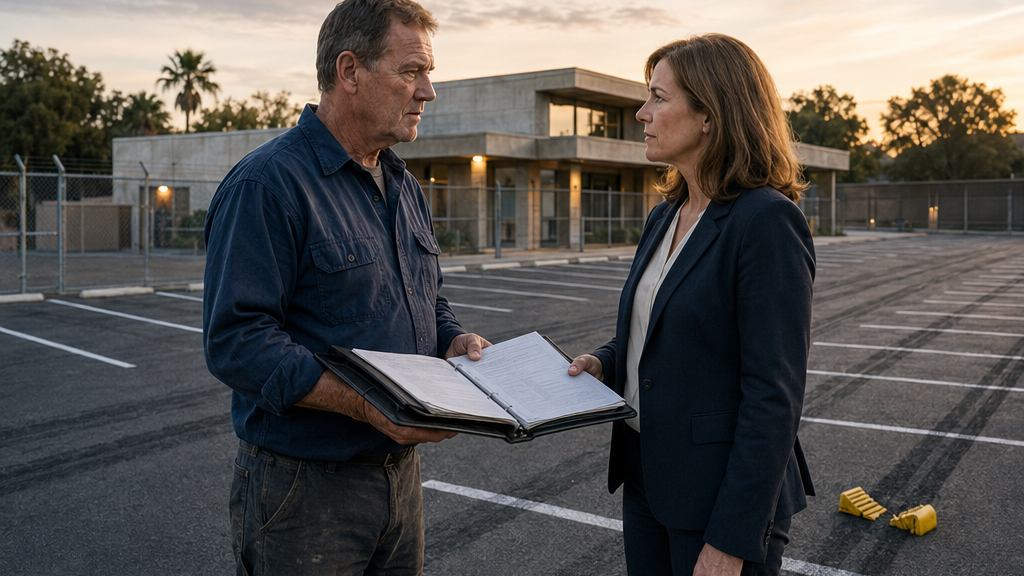
For several seconds he stayed behind the wheel, one hand still on the shifter. He could see dark tire marks where the trucks had been dragged out. A plastic wheel chock lay split near Space 7.
He got out.
He did not call Heather Roberts.
He did not call the police.
He walked the row.
One.
Two.
Three.
All the way to eleven.
Then he pulled out his phone and photographed every empty space.
Brandon King arrived six minutes later in his own truck. He got out so fast he left the driver’s door open.
“They took all of them?”
Raymond kept photographing.
“What time?”
Brandon rubbed the back of his neck. “Towing company showed up a little after ten. Last truck left around one-thirty.”
“You were here?”
“For the first two.”
Raymond lowered the phone. “Why didn’t you call me?”
“I did.”
Raymond checked the screen.
Three missed calls between 10:17 and 10:32. His phone had been charging in the kitchen while he slept upstairs.
Brandon looked at the empty spaces. “I figured you knew they were actually going through with it.”
“I knew Heather threatened it.”
“She didn’t threaten it.”
Brandon reached into his cab and brought out a folded sheet of paper.
“She gave me this Friday.”
Raymond already knew what it was before he opened it.
NOTICE TO REMOVE COMMERCIAL VEHICLES.
Seventy-two hours.
He had seen a copy by email.
What bothered him now was the name at the bottom of the hand-delivered notice.
Brandon King.
Not Raymond Harris.
Not Harris Mobile Maintenance.
Brandon.
“She gave this to you personally?”
“Outside the clubhouse.”
“And told you?”
“That all eleven trucks had to be gone permanently.”
Raymond folded the notice once.
“She knew who owned them.”
“I told her to call you.”
Raymond looked at him.
Brandon held his gaze. “She said she already had.”
The first crews began arriving at six.
Men who normally picked up trucks and scattered across the neighborhood stood along the fence carrying coffee and tool bags. One crew had an irrigation controller scheduled for replacement near the south entrance. Another had three monument lights out on the main boulevard. A third was supposed to repair a bent arm on the west gate before morning traffic built.
All their equipment was inside the towed trucks.
Brandon’s phone started ringing.
He answered, listened, then covered the microphone.
“Gate’s stuck open again.”
“Tell security to chain it until we get a truck.”
“They’re asking when.”
Raymond looked at the empty row.
“I don’t know.”
That answer tasted worse than he expected.
For fourteen years, the subdivision had called him when something failed before sunrise. Gates. Pumps. Lighting. Storm debris. Irrigation valves. The work was rarely dramatic. Most homeowners never saw it happen.
That had always been fine with Raymond.
He had never needed them to know.
Now eleven empty rectangles of asphalt made all that invisible work seem strangely temporary.
At 6:18, Brandon finally reached the towing company.
He put the call on speaker.
The supervisor confirmed the vehicles had been removed under authorization from the association’s community-management office.
“Who specifically authorized it?” Raymond asked.
There was a pause.
“Heather Roberts is the name on our work order.”
“And the release charges?”
The supervisor read the amount for the first truck.
Then the second.
By the time he reached the eleventh, Raymond had stopped writing individual numbers and simply totaled them.
More than eight thousand dollars before storage charges.
Brandon let out a low whistle.
Raymond did not.
“Send the invoices by email,” he said.
After the call ended, Brandon said, “You want me to call a lawyer?”
“Not yet.”
“You want me to call Heather?”
“No.”
That surprised him more.
Raymond looked toward the clubhouse. Her office windows were still dark.
He could picture the conversation too easily.
She would say she had given notice.
He would say she did not have the right.
She would say the lot belonged to the association.
He would say the trucks had been there longer than she had.
That last sentence was the one he did not want to hear himself say.
Because it sounded like exactly what Heather believed he was relying on.
History.
Habit.
Everybody knowing.
At 7:04 the clubhouse office lights came on.
Heather arrived carrying a laptop bag and a stainless travel mug. She saw Raymond in the lot, slowed, then continued toward the side entrance.
Raymond crossed the asphalt.
“Heather.”
She stopped.
Her expression was tired but controlled.
“I assume you’re here about the vehicles.”
“You authorized the tow?”
“Yes.”
“After receiving my written objection?”
“Your objection did not change the deadline.”
“Did the board vote to remove my staging rights?”
Heather’s jaw tightened slightly.
“The association controls common property.”
“That wasn’t my question.”
“The arrangement was revocable.”
Raymond studied her.
“You’ve read the agreement?”
“I’ve reviewed the relevant section.”
“Then you know it grants designated staging.”
“And you know it says revocable.”
Neither of them raised their voice.
Behind Raymond, one of his employees carried a box of hand tools from a personal vehicle because there was nothing else to use.
Heather glanced at him.
“The board cannot keep accepting liability because something has been done the same way for years.”
Raymond felt the first sharp movement of anger.
He pressed it down.
“Which board decision authorized last night?”
Heather looked toward the clubhouse door.
“You received notice.”
“That still isn’t an answer.”
“I have a meeting in five minutes.”
She stepped around him.
Raymond could have followed her.
Instead, he walked back through the empty spaces.
At Space 7, he picked up the broken yellow wheel chock.
Then he called Brandon.
“Cancel anything we can’t safely do without the trucks. Document every missed job. Every labor hour. Every customer call.”
“Okay.”
“And don’t send Heather anything else.”
Brandon nodded toward the clubhouse. “What are you going to do?”
Raymond looked at the folded notice in his hand.
“Find out what we actually agreed to.”
His original copy of the HOA maintenance contract was not at the shop.
It was at home, on the lowest shelf of a cabinet in his den, inside a battered black binder he had not opened in years.
By 7:52 he had it spread across his dining table.
The pages smelled faintly of dust and machine oil.
Most were familiar—rates, emergency response, equipment responsibilities, termination language.
Then he reached the amendment.
Service Yard and Equipment Staging.
Raymond stopped.
There it was.
Eleven designated spaces.
He ran his finger down the paragraph until he reached the word Heather had used.
Revocable.
For the first time that morning, he leaned closer.
Chapter 2: The New Manager and the Seventy-Two Hours
Six months earlier, Heather Roberts had stood in the maintenance lot taking pictures of Raymond’s trucks as if she had found something no one else had noticed.
Raymond saw her from the back of the service building.
She moved slowly down the row, photographing windshields, license plates and the painted numbers beneath each bumper.
When she reached Space 11, Raymond walked over.
“You collecting truck pictures?”
Heather lowered her phone.
“Documenting association property.”
She had been community manager for eleven days.
Raymond knew because Virginia Adams had introduced her at the previous board meeting with the careful enthusiasm people used for someone hired to fix problems without offending anyone who had helped create them.
Heather was probably in her forties. Professional. Organized. Almost aggressively punctual.
Raymond disliked her within a week, which he knew was not entirely fair.
She asked for things.
Copies of things.
Updated things.
Things previous managers had stopped asking him for because everybody knew where they were.
Heather glanced across the fleet.
“These are all yours?”
“Harris Mobile.”
“And they stay here overnight?”
“For fourteen years.”
“That wasn’t what I asked.”
Raymond looked at her.
“Yes.”
She nodded and entered something on her phone.
“What?”
“I’m reviewing commercial use of common property.”
“It’s the maintenance yard.”
“I know what it’s called.”
“We maintain the property.”
“I know that too.”
Something in her voice irritated him.
Not disrespect exactly.
More like she was refusing to be impressed by facts he considered self-explanatory.
A week later she emailed requesting an updated certificate of insurance, vehicle list, current employee roster and copy of his site-use authorization.
Raymond forwarded the request to his office and forgot about it.
Two weeks after that, another email came.
Then another.
He answered the third one himself.
The site-use authorization is already in the HOA files. Same arrangement we’ve had for years.
Heather replied within nine minutes.
I would still like to reconcile the existing documentation with current insurance requirements. Please let me know when you are available to meet.
Raymond did not answer.
When Brandon asked about it the following Monday, Raymond waved him off.
“She’ll find it.”
“She seems pretty serious.”
“They’re always serious the first month.”
That was the sort of sentence Raymond had earned the right to say.
Or so he believed.
He had worked with four community managers, three board presidents and enough committee chairs to stop counting.
Managers came in promising consistency.
Boards changed priorities.
Homeowners complained about landscaping in spring and holiday lights in December.
Raymond kept the gates opening, pumps running and streets lit.
That felt more permanent than management.
By Heather’s third month, however, the fleet had become a regular agenda item.
Not formally.
Not yet.
She asked why eleven vehicles needed overnight storage.
Raymond explained that crews lived throughout the area and staged equipment centrally for emergency response.
She asked why the trucks could not remain at his commercial yard five miles away.
“Because five miles becomes twenty minutes when the east gate locks shut at six-thirty in the morning.”
“You’re compensated for emergency response.”
“I am.”
“So location is operational convenience.”
“It’s part of the agreement.”
Heather looked up.
That was the first time he saw her expression change.
“What agreement?”
Raymond almost laughed.
“Our maintenance agreement.”
“I’ve seen the maintenance agreement.”
“Then you’ve seen the amendment.”
“What amendment?”
That afternoon he brought the binder to the clubhouse.
Heather placed it beside a neat stack of photographs she had printed from her inspection.
Eleven trucks.
Eleven spaces.
She read the amendment silently.
Raymond sat across the desk.
He expected the conversation to end there.
Instead Heather tapped one line.
“This says the site license is revocable.”
Raymond leaned back.
“It also says eleven designated spaces.”
“I see that.”
“So we agree they’re authorized.”
“I agree they were authorized when this amendment was executed.”
Raymond stared at her.
Heather turned the page.
“The association has changed insurers twice since then. There are no current operating procedures attached to this. No annual review. No current vehicle schedule.”
“The trucks are insured.”
“I haven’t received the certificate I requested.”
“My office will send it.”
“You said that three weeks ago.”
That irritated him because she was right.
Raymond closed the binder.
“If you have a compliance issue, send it to me.”
“I have.”
“Then I’ll deal with it.”
Heather slid the binder back.
“I’m trying to deal with it before it becomes something larger.”
He stood.
“What exactly is larger?”
“Commercial vehicles occupying HOA property under documentation that predates nearly everyone currently responsible for the association.”
Raymond picked up the binder.
“The fact that something is old doesn’t make it invalid.”
“No. But old arrangements still have to meet current requirements.”
That conversation should have changed something.
Instead Raymond left believing Heather had finally seen the paperwork, and Heather apparently left believing Raymond had finally understood the warning.
Neither belief survived.
Over the next two months, residents submitted complaints about the service lot.
Not many.
Enough.
A truck sometimes left before six in the morning. Reverse alarms carried over the privacy fence. One homeowner objected to seeing utility racks above the screen wall from an upstairs bedroom.
Heather added the complaints to her file.
Raymond considered them ordinary friction.
Then, on a Friday afternoon, Brandon found Heather waiting beside Space 1.
She handed him a notice.
Seventy-two hours.
Remove all commercial vehicles from the association-owned service area.
When Brandon called Raymond, Raymond drove straight to the clubhouse.
Heather was still there.
“You gave my supervisor an eviction notice for the trucks?”
“It’s not an eviction notice.”
“Then what do you call permanent removal?”
“A termination of the staging arrangement.”
Raymond put the paper on her desk.
“Under what authority?”
“The association owns the lot.”
“You’ve seen the amendment.”
“I have.”
“Then you know the arrangement is written.”
“And revocable.”
Raymond stared at her.
“That word doesn’t mean you can wake up Friday and erase fourteen years.”
Heather’s voice remained even.
“This has been under review for months.”
“By you.”
“By management, with the board’s direction to clean up undocumented risk.”
“It isn’t undocumented.”
“The insurance documentation is incomplete.”
“That’s not the same thing.”
“No. It isn’t.”
For a moment the distinction hung between them.
Then Heather said, “The vehicles need to be removed by Monday evening.”
Raymond left with the notice.
By Tuesday morning, he had still not moved a truck.
Part of him believed Heather would recognize the problem before the deadline.
Part of him believed Virginia would intervene.
Most of him simply could not imagine eleven trucks being hauled away from a lot where they had parked almost every night for fourteen years.
At 4:16 Tuesday afternoon, he finally emailed Heather.
He attached the service-yard amendment.
He wrote only four sentences.
I dispute that management has unilateral authority to terminate the staging rights contained in the attached agreement. The vehicles remain authorized under the current contract. Please suspend any enforcement action until the board and counsel review the governing language. I am available to discuss this immediately.
He copied Virginia.
Then he waited.
At 5:03, the message showed as delivered.
At 6:12, there was still no reply.
At 9:47, Raymond put his phone on the charger downstairs and went to bed.
The first tow truck entered the maintenance lot thirty-one minutes later.
Chapter 3: The Clause Heather Read Too Quickly
Raymond read the sentence Heather had quoted three times.
The site license granted herein shall be revocable.
On its own, it looked bad.
He could almost hear her saying the word across the desk.
Revocable.
Raymond turned the page slightly toward the dining-room light and kept reading.
The sentence did not end there.
The site license granted herein shall be revocable upon written determination by the Association’s Board of Directors, subject to notice to Contractor and mutual written acknowledgment of revised staging arrangements where continued service obligations remain in effect.
He sat back.
Then leaned in again.
There was more.
Until such acknowledgment, designated staging rights shall remain in effect except where immediate suspension is required by law, casualty, or documented insurance cancellation materially affecting the licensed use.
Raymond took out his phone.
He photographed the paragraph.
Then he called his attorney.
By nine-thirty they were sitting in a small conference room with the binder open between them.
The attorney read the amendment without speaking.
Raymond waited.
“Well?”
“You want the answer you came here for or the answer this actually gives you?”
Raymond frowned. “Both.”
“The good answer is Heather probably did not have unilateral authority to do what she did.”
“Probably?”
“The board makes the written determination. You get notice. And because your maintenance agreement is still active, the staging arrangement gets addressed in writing.”
“She skipped all of that.”
“Looks like it.”
Raymond felt his shoulders loosen.
The attorney held up one finger.
“But.”
“There’s always a but.”
“There should be. That’s why people pay me.”
Raymond did not smile.
The attorney pointed to the second paragraph.
“There are exceptions.”
“Law, casualty, insurance cancellation.”
“Correct.”
“My insurance isn’t canceled.”
“Good.”
“So we send them a letter.”
“Eventually.”
“Eventually?”
“First we find out whether the board acted.”
Raymond thought of Virginia.
“She would’ve called me.”
“Maybe. Maybe not.”
By late morning, the attorney had requested recent board minutes, management authorization records and any written decision concerning Raymond’s staging rights.
Raymond returned to the shop.
The effect of losing the trucks had become worse with daylight.
Employees were stripping tools from personal vehicles and combining crews. Brandon had rented two temporary vans, neither equipped for heavy repair work.
A gate motor was sitting on the shop floor instead of being installed.
Three irrigation work orders had been rescheduled.
Brandon handed Raymond a legal pad.
“Lost labor so far.”
Raymond looked at the total.
“That doesn’t include rentals?”
“No.”
“Towing?”
“No.”
“Start separate columns.”
Brandon watched him.
“You find something?”
“Maybe.”
Raymond showed him the photographed clause.
Brandon read it.
“So she couldn’t tow us.”
“Looks that way.”
A grin started at the corner of Brandon’s mouth.
Raymond stopped it with a look.
“Don’t celebrate.”
“Why not?”
“Because I haven’t seen what they’re relying on yet.”
The board minutes arrived shortly after lunch.
Raymond and his attorney reviewed them by video call.
There had been discussion of commercial-vehicle exposure.
Discussion of insurance.
Discussion of vendor documentation.
Discussion of management standardization.
But no motion terminating Raymond’s staging rights.
No vote authorizing revocation.
No written determination directed to Harris Mobile Maintenance.
Raymond scrolled backward.
“Check the executive-session reference.”
His attorney did.
Nothing.
“So there’s no vote.”
“Not in what they produced.”
Raymond stood from his desk.
For the first time since seeing the empty lot, satisfaction pushed through the anger.
Not triumph.
Something quieter.
Confirmation.
Heather had acted as if years of work disappeared because she interpreted one word broadly enough.
Now the paper was beginning to say otherwise.
His attorney was less excited.
“If these records are complete, the towing looks difficult for them to defend under the contract.”
“Difficult?”
“Raymond.”
“What?”
“You keep wanting me to say you won.”
“Didn’t I?”
“We know the board apparently did not follow the revocation procedure.”
“That’s the whole issue.”
“No. That’s one issue.”
The attorney looked down at something offscreen.
“Send me your current certificate of insurance.”
Raymond paused.
“My what?”
“Certificate. The one covering the vehicles and the licensed staging area.”
“It’s current.”
“Good. Send it.”
Raymond opened the folder where his office kept insurance PDFs.
The most recent certificate was easy to find.
He opened it.
The expiration date sat in the upper right corner.
Raymond stared at it.
His attorney said, “You there?”
“Yes.”
“When does it expire?”
Raymond did not answer.
He checked the date again.
Then the calendar on the corner of his monitor.
Nine days.
The certificate had expired nine days earlier.
He remembered Heather’s emails.
First request.
Second request.
Final reminder.
He had assumed his insurer had issued the renewal automatically.
Maybe they had.
Maybe the office had never forwarded it.
Maybe he had ignored something else.
It did not matter yet.
What mattered was that the document in front of him showed expired coverage.
His attorney’s voice changed.
“Raymond?”
“Nine days ago.”
Silence.
Then: “Do not send anything to the HOA until I call you back.”
Raymond closed his eyes.
Ten minutes earlier, he had been preparing to demand reimbursement for eleven tows.
Now Heather’s warning no longer looked invented.
He looked across the shop through the open office door.
Brandon was helping two men transfer equipment into a rented van.
Raymond thought of the sentence he had said every time someone asked why the old arrangement needed updating.
They know us.
He opened his email.
Heather’s three unanswered insurance requests were still there.
Chapter 4: The Paperwork Raymond Kept Putting Off
The first email Heather had sent about the insurance certificate was dated twenty-seven days earlier.
Raymond read it at 7:14 Wednesday night, alone in his office with the lights off everywhere except above his desk.
The second email was dated sixteen days earlier.
The third had arrived ten days earlier.
He remembered seeing all three.
That was the part he could not excuse.
Nothing had gone missing. No assistant had misplaced anything. No software had filtered Heather into spam.
Raymond had read the subject lines, thought, I’ll handle that, and gone back to work.
Now the eleven trucks were sitting behind a towing-company fence, and the certificate on his screen had expired nine days ago.
His attorney called at 7:22.
“Did you find a renewal?”
“Not yet.”
“Call your carrier first thing.”
“I’m calling tonight.”
“Good.”
Raymond rubbed his forehead.
“Does this kill the contract argument?”
“No.”
“But?”
“It gives them an argument.”
Raymond leaned back.
“What kind?”
“That management had a legitimate compliance concern.”
“That doesn’t authorize towing.”
“I didn’t say it did.”
“Then why does it matter?”
“Because if this turns into a dispute over reasonableness, you don’t want to pretend their concern came from nowhere.”
Raymond looked at Heather’s third email.
Please provide updated evidence of coverage no later than Friday so we can complete review of all commercial activity on association property.
He had never replied.
His attorney continued.
“You can be right about the remedy and wrong about the underlying problem.”
Raymond did not answer.
The sentence stayed with him after the call ended.
At eight, he reached the emergency number for his insurance broker.
The broker sounded irritated until Raymond explained why he was calling.
Then the tone changed.
“Your policy is active.”
Raymond sat forward. “Active?”
“Yes. Renewal processed before expiration.”
“Then why does my certificate show the old date?”
“You never requested the updated certificate.”
Raymond closed his eyes.
“So I was covered.”
“Yes.”
“Can you send proof tonight?”
“I can send a temporary verification. Formal certificate in the morning.”
A few minutes later, the document appeared in his inbox.
Coverage active.
No lapse.
Raymond should have felt vindicated.
Instead, he felt something closer to embarrassment.
Heather had not known the policy remained active because he had not given her proof.
He forwarded the verification to his attorney.
Then he stared at Heather’s unanswered emails again.
At 6:35 Thursday morning, Brandon was already at the shop when Raymond arrived.
He had two rental vans parked outside.
Neither had ladder racks. One smelled like old carpet shampoo.
“We can get the lighting crew moving,” Brandon said. “Maybe one irrigation crew if we load light.”
Raymond handed him a printed copy of the new insurance verification.
Brandon scanned it.
“So we were covered.”
“Yes.”
“Good.”
Raymond waited.
Brandon looked up.
“What?”
“You told me she was serious.”
Brandon’s expression changed.
“I told you three times.”
“I remember.”
“You said she’d find the paperwork.”
“I remember that too.”
Brandon folded the page.
“I wasn’t trying to be right.”
“I know.”
That made it worse.
Raymond walked toward the service bay.
Behind him, Brandon said, “She still shouldn’t have towed the trucks.”
Raymond stopped.
“No.”
“But you made it easier for her to think she could.”
Raymond turned.
Brandon looked uncomfortable now, as if he had gone farther than he intended.
Raymond could have shut the conversation down.
Instead he said, “Yeah.”
It was the first time he had said it aloud.
By nine-thirty, the formal certificate was issued.
Raymond’s attorney sent it with a notice disputing the towing action, preserving claims for reimbursement and demanding immediate restoration of staging access.
Heather replied less than an hour later.
Her answer was brief.
The association acknowledges receipt of updated insurance documentation. The vehicles will not be authorized to return pending further legal and board review.
Raymond read the sentence twice.
Then a third time.
Brandon stood across the desk.
“Well?”
“She’s not letting them back.”
“Even with coverage?”
“Apparently not.”
“So what now?”
Raymond picked up his phone.
“Now she has to explain why.”
At the clubhouse that afternoon, Heather sat at the end of the conference table with Virginia Adams and two board members.
Raymond was not invited.
His attorney was.
The HOA attorney joined by speakerphone.
Heather had prepared a packet.
Insurance requests.
Resident complaints.
Vehicle photographs.
The 72-hour notice.
Raymond’s written objection.
Virginia turned each page slowly.
When she reached the insurance certificate, she stopped.
“This says active coverage.”
“It was provided after the deadline,” Heather said.
“But the policy itself never lapsed?”
“Apparently not.”
Virginia looked at her.
“So the risk was lack of documentation, not lack of insurance.”
Heather’s hands remained folded.
“We had no verified evidence of coverage when enforcement occurred.”
The HOA attorney spoke through the speaker.
“That distinction matters.”
Heather glanced toward the phone.
“I acted on the information available.”
“And on what revocation authority?” the attorney asked.
There was a pause.
“The service arrangement was identified as revocable.”
“By whom?”
“The agreement.”
“That isn’t what I asked.”
Virginia looked up now.
The attorney continued.
“What board resolution did you rely on?”
Heather straightened.
“The board directed management to resolve undocumented commercial-use issues.”
“Generally?”
“Yes.”
“Did the board specifically determine that Harris Mobile’s staging rights were revoked?”
Heather did not answer immediately.
Virginia looked from Heather to the packet.
“I don’t remember that vote.”
One of the board members said, “Neither do I.”
Heather’s voice tightened.
“The broader directive was clear.”
“Clear enough to tow eleven vehicles?” Virginia asked.
Heather looked at her.
“You hired me to stop carrying informal liability from one administration to the next.”
Virginia’s expression changed.
Not anger.
Recognition.
Heather had been told to clean up a problem.
The question was whether everyone had been careful not to ask exactly how she would do it.
The HOA attorney broke the silence.
“Virginia, I need the resolution or minutes that authorized termination of the Harris staging arrangement.”
“I’ll find them.”
“If they exist.”
The room went quiet.
At 4:51, Raymond’s attorney called him.
“Don’t celebrate yet.”
Raymond almost laughed.
“You say that a lot.”
“For good reason.”
“What happened?”
“They’re looking for the board authorization.”
“And?”
“They haven’t found it.”
Raymond looked through the shop window at the two rental vans.
For the first time, the empty spaces at the clubhouse no longer looked like Heather’s decision alone.
They looked like a decision an entire institution might have allowed because nobody had bothered to define where her authority stopped.
Chapter 5: The Vote That Never Happened
Virginia called Raymond at 8:06 Friday morning.
“I need to ask you something directly.”
Raymond was standing beside the open hood of one of the rental vans.
“Go ahead.”
“Do you have any record of the board voting to terminate your staging rights?”
“No.”
“Any written consent from you agreeing to different staging?”
“No.”
“Any notice citing a board determination?”
“No.”
Virginia was silent long enough that Raymond heard the clubhouse copier running in the background.
Finally she said, “Neither do we.”
Raymond closed the van hood.
“You checked everything?”
“Three years of minutes. Executive-session summaries. Written resolutions.”
“And nothing.”
“No.”
He should have felt satisfaction.
Instead, Virginia sounded tired.
That mattered more than he expected.
“What did Heather have?”
“A general directive from us to clean up insurance and vendor-compliance problems.”
Raymond leaned against the van.
“That’s not revocation.”
“I know.”
“You know now.”
Virginia did not argue.
“Yes.”
They had known each other for nearly twenty years.
Not closely.
But long enough that Raymond had replaced a gate motor outside her section after midnight once, and Virginia had brought coffee to his crew after a hurricane dropped limbs across two common roads.
She was not someone he had ever considered an enemy.
That made his next question harder.
“How much did you know about the old amendment?”
Another pause.
“Enough to know it needed review.”
Raymond straightened.
“When?”
“Months ago.”
“How many months?”
“Four.”
His grip tightened around the phone.
“You knew.”
“I knew it was old. I knew Heather wanted it cleaned up.”
“And you didn’t call me.”
“I thought management was handling it.”
Raymond looked toward Brandon, who was loading tools.
“Management handled it.”
Virginia exhaled.
“That’s fair.”
“No, it isn’t.”
“I meant your point.”
Raymond rubbed his jaw.
“What happens now?”
“We’re meeting with counsel.”
“When?”
“Today.”
“And the trucks?”
“I can’t promise anything until we do.”
The old Raymond would have treated that as evasion.
Instead, he heard the strain beneath it.
Virginia had delegated the problem because she did not want another argument about old exceptions.
Heather had pushed because she believed that was her mandate.
Raymond had ignored paperwork because he believed years of service made the arrangement obvious.
Three different kinds of avoidance had met in one parking lot.
By noon, the damage had spread beyond Raymond’s balance sheet.
The west gate remained on temporary chain control because the proper lift and welding equipment were still in a towed truck.
Two decorative-light repairs had been postponed.
An irrigation leak near the clubhouse had been marked but not excavated.
Brandon brought Raymond a list.
“We can keep emergency response going,” he said. “But routine work’s stacking up.”
Raymond scanned the page.
“Which ones are safety-critical?”
“Gate. One walkway light near the pond. Maybe the irrigation break if it starts undermining the sidewalk.”
“Do those.”
Brandon frowned.
“And the rest?”
“Hold them.”
“Contract allows that?”
“Yes. Non-emergency service can be suspended after interference with access.”
Brandon studied him.
“You sure you want to?”
“No.”
“That’s not what I asked.”
Raymond folded the list.
“We keep emergency coverage. Nothing else.”
Brandon gave a short nod.
“Okay.”
That afternoon, the neighborhood began noticing.
Not the contract.
Not the towing.
The consequences.
A gate stayed open longer than usual.
A patch of turf yellowed near the clubhouse.
Three decorative lights remained dark along the entrance boulevard.
A homeowner stopped Raymond outside the south gate and asked when a broken irrigation head would be fixed.
“As soon as the access issue is resolved.”
“What access issue?”
Raymond could have told the entire story.
He did not.
“Management and I are working through it.”
The homeowner looked dissatisfied.
That was fine.
Raymond had no interest in turning the neighborhood into a jury.
At four, Heather called.
It was the first time she had contacted him directly since the towing.
“I understand you’ve suspended scheduled service.”
“Non-emergency service.”
“You know residents are going to feel that.”
“I know.”
“Then why do it?”
“Because my company can’t operate normally without the equipment you had removed.”
“You have rentals.”
“Two vans.”
“You could rent more.”
Raymond almost smiled.
“And send you the bill?”
Silence.
Then Heather said, “You’re using the neighborhood as leverage.”
“No. If I wanted leverage, I’d suspend emergency response too.”
“You could?”
“Contractually, under certain conditions.”
“And you’re not.”
“No.”
Heather was quiet.
When she spoke again, some of the hard edge was gone.
“Why?”
Raymond looked through the office window toward one of his crews loading a portable generator.
“Because people didn’t tow my trucks. The association did.”
Heather said nothing.
“And because I live here too.”
Another pause.
Then she said, “Virginia told me there’s no specific board vote.”
“So I hear.”
“I believed the management directive covered it.”
“It didn’t.”
“I know what counsel thinks.”
“What do you think?”
Heather did not answer immediately.
“When I started here, your file was a mess.”
Raymond almost interrupted.
He stopped himself.
“No current vehicle schedule. No current certificate. An amendment older than some of the homes in the final phase. Residents complaining about commercial use. Insurance asking whether we allowed contractors to store equipment on common property.”
“That still didn’t give you authority.”
“No.”
The word came quickly.
Raymond had not expected it.
Heather continued.
“But you acted like every request I made was an insult.”
Raymond looked down.
“That doesn’t excuse the towing.”
“No.”
“So why say it?”
“Because you asked what I think.”
He let the silence remain.
Finally Raymond said, “Fair enough.”
Heather seemed as surprised as he was.
By Monday morning, the empty spaces had become impossible to ignore.
Eleven white numbers.
No trucks.
The HOA attorney sent a preliminary assessment to the board.
Raymond did not see the document, but his attorney summarized it.
No evidence of a specific board determination.
No executed revised staging arrangement.
No documented insurance cancellation.
Serious question whether management exceeded delegated authority.
Potential exposure for towing charges and operational losses.
Raymond listened without interrupting.
Then his attorney said, “They want to talk settlement.”
“Already?”
“They want the trucks back in service.”
Raymond looked at Brandon’s growing list of deferred jobs.
“What are they offering?”
“Not formally yet.”
“And Heather?”
“Still employed.”
Raymond frowned.
“You expected otherwise?”
“I don’t know what I expected.”
“Think about what you actually want before the meeting.”
That afternoon, Virginia came to the shop herself.
She did not bring a lawyer.
She carried a folder.
“I should’ve called you four months ago,” she said.
Raymond looked at her.
“Yes.”
“I kept putting the contract review off because every time old vendor exceptions come up, half the board wants to preserve them and half wants to eliminate them.”
“So you handed it to Heather.”
“I handed her a general cleanup problem.”
“And she made it specific.”
“Yes.”
Virginia placed the folder on his desk.
“We’re calling a special board meeting Thursday.”
Raymond opened it.
Inside was a notice, a proposed agenda and a blank section titled Resolution of Harris Mobile Maintenance Dispute.
Virginia tapped the blank page.
“Counsel wants proposals from both sides.”
“Both?”
“You and management.”
Raymond looked up.
“What are you asking me to do?”
“Tell us what resolution looks like.”
He leaned back.
The easiest answer came immediately.
Money.
Every towing charge.
Every rental.
Every lost labor hour.
Every missed service call.
And something for the breach itself.
He could make it painful enough that no manager would try this again.
Virginia seemed to read the thought on his face.
“You have leverage, Raymond.”
“I know.”
“What you do with it is up to you.”
She left the blank page on his desk.
For the rest of the afternoon, Raymond kept glancing at it.
By six, he had written three figures at the top.
Then crossed out two.
By seven, he was no longer asking himself how much he could make the HOA pay.
He was asking what had to change so eleven trucks could never disappear overnight again.
Chapter 6: What Raymond Asked For Instead of Revenge
Raymond began the special board meeting by admitting he had ignored Heather’s emails.
That silenced the room more effectively than any accusation could have.
The clubhouse meeting room held Virginia, Heather, two board members, both attorneys and a handful of homeowners seated along the rear wall.
Raymond placed the worn black binder on the table.
Beside it he set a photograph of the maintenance lot taken the morning after the tow.
Eleven empty spaces.
“I was late providing updated insurance documentation,” he said. “The policy itself was active, but management did not have the certificate because I did not send it when requested.”
Heather looked at him.
Raymond continued.
“That was my mistake.”
One of the board members shifted in his chair.
Raymond opened the binder.
“It was not permission to tow eleven trucks.”
The room tightened again.
His attorney had advised him not to overstate the case.
Raymond did not need to.
The paper did enough.
He walked through the amendment.
Designated spaces.
Written board determination.
Notice.
Revised staging arrangements.
Exceptions for genuine emergency circumstances.
No board vote.
No insurance cancellation.
No written replacement arrangement.
When he finished, Virginia asked, “What are you seeking?”
Raymond slid a page across the table.
“Towing and storage. Rental vehicles. Documented lost labor. Direct costs from interrupted service.”
Heather looked at the figures.
They were substantial.
Less than they could have been.
The HOA attorney asked, “And your contractual breach claim?”
“Reserved.”
The attorney raised his eyes.
“For what purpose?”
Raymond looked at Virginia.
“To make sure we finish the rest of this.”
He handed over a second page.
This one had no dollar signs.
It listed procedures.
No contractor vehicle could be towed from an authorized staging area without documented notice, board authority when required by contract, and counsel review unless immediate safety conditions existed.
Annual insurance verification.
Annual vehicle list.
Written assignment of all designated spaces.
A contact escalation procedure.
Emergency exceptions.
A requirement that future management transitions include review of active vendor-access agreements.
Heather read the page carefully.
“You want the board to adopt this?”
“I want something like it adopted.”
Virginia said, “And if we do?”
“We settle the breach component.”
The HOA attorney leaned forward.
“How much?”
“That depends on whether the correction is real.”
A few people in the rear seats shifted.
Raymond could feel them waiting for the dramatic number.
He had one.
He chose not to say it.
Virginia folded her hands.
“We’ve discussed reimbursing your direct losses.”
“That’s necessary.”
“And restoring the staging agreement pending formal amendment.”
“Also necessary.”
“What else?”
Raymond tapped the photograph.
“I don’t want the next contractor depending on whether somebody remembers what was agreed ten years earlier.”
Heather’s expression changed slightly.
Neither defensive nor grateful.
Just attentive.
The HOA attorney opened another folder.
“We prepared a settlement proposal.”
He passed copies around.
Raymond read the first page.
Full reimbursement of towing and storage.
Partial reimbursement of documented rentals and labor.
Temporary restoration of staging rights.
Confidential resolution of remaining claims.
No admission of liability.
He stopped there.
“Where’s the procedure?”
Virginia said, “That would be handled separately.”
“When?”
“After settlement.”
Raymond closed the packet.
“No.”
The HOA attorney looked up.
“No to which part?”
“The sequence.”
“Explain.”
“You want me to sign away the dispute first and trust the board to fix the process later.”
Virginia’s face tightened.
“That isn’t what we’re asking.”
“It’s exactly what this says.”
One board member spoke.
“We can’t rewrite every policy as part of one vendor dispute.”
“I’m not asking you to.”
Raymond pushed his second page forward.
“I’m asking you to fix the authority problem that caused this one.”
Heather looked toward Virginia.
The room became still.
Raymond’s attorney had warned him that this was the point where he could lose people.
Money was easy to understand.
Procedure sounded like principle.
Principle made boards nervous.
Virginia said, “If we reimburse you fully, restore the lot and agree to a policy review within sixty days—”
“No.”
Heather looked at Raymond now.
Virginia’s tone sharpened.
“You haven’t even heard the rest.”
“I heard the part where the trucks come back before the rules change.”
“What difference does that make if your access is restored?”
Raymond turned the photograph around so the board could see it.
“This difference.”
Eleven empty spaces.
“If Heather leaves tomorrow and another manager comes in next year, what exactly stops this happening again?”
Heather sat back.
For the first time all evening, she spoke.
“Nothing.”
Virginia turned toward her.
Heather kept her eyes on the photograph.
“Not if the delegation language stays as broad as it is.”
One of the board members frowned.
“Heather.”
“She’s right,” the HOA attorney said quietly.
Heather looked at Raymond.
“I exceeded my authority.”
No one moved.
She continued before anyone could interrupt.
“I believed the board’s directive to eliminate undocumented risk gave me enough authority to terminate the staging arrangement.”
Raymond said, “You had my written objection.”
“Yes.”
“And the amendment.”
“Yes.”
“Then why didn’t you stop?”
Heather’s mouth tightened.
“When I arrived, every old exception came with the same explanation.”
She looked at Virginia.
“We’ve always done it this way.”
Then back at Raymond.
“Your trucks. Storage sheds. Landscape access. Pool-vendor keys. Everybody had history. Nobody had current files.”
“That made you responsible for reviewing them.”
“Yes.”
“Not erasing them.”
“No.”
The admission was quiet.
It landed harder than an argument.
Heather glanced toward the homeowners sitting behind Raymond.
“Our insurance broker asked whether commercial vehicles stored on common property were authorized and currently documented. I couldn’t answer cleanly. The board told me to resolve those gaps. I thought if I started making exceptions to the cleanup, I’d lose control of it.”
Raymond understood the logic.
That did not make the decision acceptable.
Heather continued.
“When your certificate still wasn’t in the file, I decided the risk of leaving the trucks there was greater than the risk of removing them.”
“And you were wrong.”
“Yes.”
Virginia looked down at the table.
Then she said, “So was I.”
Raymond turned.
Virginia did not look at him.
“I knew the amendment needed review. Heather asked twice for the board to clarify legacy vendor arrangements. I postponed it.”
One board member said, “We had other priorities.”
Virginia shook her head.
“That’s the excuse. Not the answer.”
The room seemed smaller now.
The dispute had begun with a simple shape.
Raymond right.
Heather wrong.
The shape no longer held.
Raymond had ignored legitimate requests.
Heather had overreached.
Virginia had delayed the vote that might have prevented both.
His attorney leaned toward him.
“You can ask for a recess.”
Raymond shook his head.
He looked at the proposed settlement again.
Then at his own page.
“All right,” he said.
Virginia raised her eyes.
“Full direct reimbursement. Restoration of all eleven spaces. Annual documentation from me, with deadlines I don’t get to ignore.”
Heather almost smiled.
Raymond continued.
“And no authorized contractor gets removed from designated common-area space without the required board action, notice and legal review, except a genuine emergency.”
The HOA attorney wrote something down.
“What about your breach claim?”
“Set a fixed negotiated amount. Enough to make the failure real. Not enough to turn this into punishment for homeowners who had nothing to do with it.”
A homeowner in the back shifted forward.
Virginia studied Raymond for several seconds.
“And Heather?”
That question stopped him.
He had imagined answering it many times.
Fire her.
Make an example.
Let the consequence match the arrogance.
Now Heather was sitting six feet away, no longer looking like the person who had stood in the maintenance lot and said revocable as though it ended everything.
She looked tired.
Responsible.
Still wrong.
But not simple.
“That isn’t my decision,” Raymond said.
Virginia nodded slowly.
“It’s ours.”
“Yes.”
The board moved into executive discussion.
Raymond waited in the hallway with Brandon, who had arrived near the end of the meeting and leaned against the wall with his arms crossed.
“You could’ve asked for more.”
“I did.”
Brandon frowned.
“You didn’t.”
Raymond looked through the glass doors toward the empty service lot.
“I asked for something harder.”
After forty-three minutes, Virginia opened the meeting-room door.
“We’re ready to vote.”
Raymond and Brandon went back inside.
Three motions had been placed on the table.
Full reimbursement of towing, storage, rentals and documented lost labor.
Immediate restoration of the eleven designated spaces under temporary operating conditions.
Adoption of a formal vendor-access and towing protocol, with counsel to finalize language within thirty days.
The breach payment would be negotiated separately but included in the settlement.
Virginia called the first vote.
Approved.
The second.
Approved.
Then the third.
Heather sat perfectly still.
Raymond looked at the photograph of the empty spaces as Virginia called for votes one by one.
The final hand went up.
The motion passed.
Chapter 7: Eleven Trucks Back Inside the Lines
The first truck came through the service gate at 6:12 on a Thursday morning.
Raymond stood beside Space 1 with a paper cup of coffee cooling in his hand as Brandon guided the driver forward.
The white utility truck rolled across the fresh asphalt markings, its ladder rack clearing the screen wall by inches. New black numbers had been painted at the head of each space the afternoon before.
1 through 11.
The driver stopped exactly where Brandon signaled.
For a moment, nobody said anything.
Then Brandon slapped the side of the truck twice.
“One.”
Raymond looked down the empty row.
“Ten to go.”
The second truck arrived four minutes later.
Then the third.
By seven, the maintenance lot no longer looked abandoned.
Toolboxes rattled. Diesel engines idled briefly and shut down. Crew members checked inventory that had been scattered between rentals and temporary storage for nearly three weeks.
The broken yellow wheel chock from the morning of the towing was gone. Raymond had kept it in the shop for several days, then finally thrown it away.
He had not wanted a souvenir.
By 7:18, all eleven trucks were back.
The sight should have felt like victory.
Instead, Raymond noticed how carefully everyone parked.
No one crossed the painted lines.
No one left a trailer outside its assigned area.
Brandon stood beside Space 11 holding a clipboard.
“They want the vehicle list signed before anything leaves.”
Raymond looked at him.
“You enjoying this?”
“A little.”
Brandon handed him the clipboard.
Every truck was listed by unit number, plate, assigned space and insurance status.
Three weeks earlier, Raymond would have called the form unnecessary.
Now he checked every line.
“Unit six plate is wrong.”
Brandon looked down.
“You sure?”
Raymond pointed.
“Last digit is eight.”
Brandon corrected it.
Raymond signed.
The new operating agreement was waiting in the clubhouse conference room.
Virginia sat at the table with the HOA attorney. Heather was already there.
Raymond took the chair across from her.
No one mentioned the towing first.
The attorney slid a settlement packet toward Raymond.
“The association has processed reimbursement for towing and storage, rental costs and the documented lost labor we agreed upon.”
Raymond glanced at the payment statement.
It covered the direct losses.
The negotiated breach amount was on a separate line.
Large enough to matter.
Not large enough to become a story homeowners would resent for years.
He looked at Virginia.
“When does it clear?”
“Already funded.”
Raymond nodded.
The attorney placed another document beside it.
“This is the revised vendor-access agreement.”
Raymond read the first page carefully.
Annual certificate of insurance.
Updated vehicle roster.
Designated parking assignments.
Emergency contact chain.
Written notice requirements.
Board approval for termination where the underlying contract required it.
Counsel review before non-emergency towing of an authorized contractor.
Clear exceptions for immediate threats to safety, legal orders or actual cancellation of required coverage.
Raymond stopped at the annual documentation section.
Heather noticed.
“That part applies to you too.”
“I noticed.”
“Thirty days before renewal.”
“I noticed that too.”
Her expression almost shifted into a smile.
Almost.
Raymond turned the page.
“What happens if I miss it?”
“Written deficiency notice,” Heather said. “Then cure period.”
“And if I ignore that?”
“Then the board has a documented process.”
He nodded.
“That’s better.”
Heather looked at him for a second.
“Better than what?”
Raymond closed the agreement.
“Better than either one of us deciding the other one should already know.”
Virginia leaned back slightly.
That was as close as anyone came to naming what had actually happened.
The board had also narrowed management’s authority over established vendor agreements. Heather could administer them, enforce documentation requirements and respond to immediate hazards.
She could not unilaterally terminate a contractual property right simply because she believed the broader board mandate allowed it.
Raymond read that section twice.
Heather did not object.
He wondered whether that bothered her.
He decided not to ask.
The question of her employment had been handled privately by the board.
She remained community manager.
There had been a formal corrective action and a change to her delegated authority. Raymond knew that much because the settlement referenced it.
Some homeowners thought she should have been fired.
Some thought Raymond had pushed the matter too far.
Most would probably forget the entire dispute once the gates worked and the irrigation stopped leaking.
That seemed about right.
Virginia pushed a final signature page toward him.
“Any objection?”
Raymond looked at the documents spread across the table.
Three weeks earlier, he would have viewed the stack as evidence that something simple had been made needlessly complicated.
Now the absence of those pages seemed more dangerous than their presence.
“One.”
Virginia waited.
“The contract-transition review.”
The attorney looked down.
“It’s included.”
“Not just for me.”
“No. All active vendor-access arrangements.”
Raymond nodded.
“Then I’m good.”
He signed.
Heather signed for management.
Virginia signed for the association.
The documents moved around the table without ceremony.
No applause.
No speeches.
Just three signatures where assumptions had once been.
At 8:03, Brandon called.
“West gate motor is installed.”
“That fast?”
“We had the right truck.”
Raymond looked through the clubhouse window toward the service lot.
“What’s next?”
“Walkway light by the pond, then irrigation line.”
“Do the irrigation first. Ground’s been wet too long.”
“Already told them.”
Raymond smiled.
“Then why’d you ask?”
“To see if you’d changed.”
“Not that much.”
Brandon laughed and hung up.
When Raymond stepped outside, Heather followed him.
He heard the door close behind them.
“Raymond.”
He turned.
She held a folder.
“Your copy.”
He took it.
“Thanks.”
For a moment they stood beside the row of trucks.
Heather looked toward Space 1.
“I did think they were an eyesore at first.”
Raymond raised an eyebrow.
“You probably shouldn’t tell me that now.”
“I’m not saying I was right.”
“They’re work trucks.”
“I know.”
“They get dirty.”
“I know that too.”
He waited.
Heather adjusted the folder under her arm.
“The complaints made more sense to me than the history did.”
Raymond looked down the row.
“And the history made more sense to me than the paperwork.”
“Yes.”
Neither of them needed to add anything.
A crew truck pulled out of Space 4 and stopped at the gate.
Raymond stepped aside.
Heather did too.
The driver waved.
They both waved back.
Later that afternoon, Raymond returned to his shop carrying the old black binder.
He set it on his desk beside the new agreement.
The old binder was thicker.
Its cover was cracked at the corners. Several pages had grease stains. A handwritten note from a former board president was clipped behind an amendment nobody had reviewed in years.
Raymond ran his thumb over the worn edge.
For a long time, he had considered that binder proof of something permanent.
Fourteen years of service.
Promises made.
Work completed.
Trust earned.
It was proof.
But it was not maintenance.
Not by itself.
He placed the new agreement in the front drawer where current contracts were kept.
Then he opened his calendar.
Thirty days before the next insurance renewal, he added a reminder.
Send certificate to HOA.
Brandon appeared in the doorway.
“You really setting a reminder?”
Raymond looked at him.
“You want to say something?”
“No.”
“You look like you do.”
Brandon smiled.
“I was going to ask if I should frame it.”
Raymond pointed toward the shop.
“Go find something useful to do.”
Brandon disappeared laughing.
Raymond closed the calendar.
Before leaving, he picked up the old binder.
For a second he considered putting it back in the front drawer.
Instead he walked to the cabinet along the wall and placed it on the lower shelf.
Not discarded.
Not forgotten.
Just no longer expected to carry more weight than paper should.
The next morning, he drove through the HOA service gate before sunrise.
The overhead lights were still on.
This time, their glow landed on eleven white trucks parked neatly inside eleven painted spaces.
Raymond slowed but did not stop.
Space 1.
Space 2.
Space 3.
All the way to 11.
Then he continued toward the gate repair waiting on the other side of the neighborhood.
The trucks were back where they belonged.
More importantly, this time everyone knew why.
And it was written down.
The story has ended.