My Neighbor Took Nine Feet of My Yard—Then His Attorney Found the One Record I Had Tried to Forget
Chapter 1: Nine Feet Disappeared Before Steven Finished His Coffee
The first fence post was already in the ground when Steven Hill stepped onto his back patio with his coffee.
He stopped with the mug halfway to his mouth.
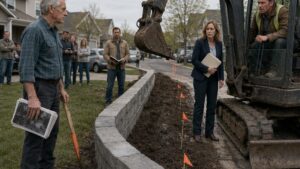
A contractor stood beside the narrow strip between Steven’s house and Kevin Carter’s property, one boot braced against a pressure-treated post while another worker checked it with a level. Behind them, an auger sat over a fresh hole in the lawn.
Steven looked past the post to the flower bed.
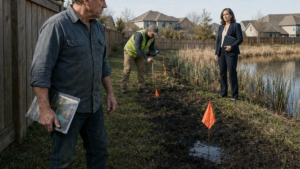
Then to the rust-dark iron survey stake barely visible near the edge of the mulch.
Then back to the post.
“No,” he said.
The contractor glanced over.
Steven set the coffee on the patio rail and walked across the grass.
“Hold up a minute.”
The drill operator killed the machine. The sudden quiet made the distance between the wooden post and the iron stake look even worse.
Steven crouched beside the stake and brushed away a mat of grass with two fingers.
“This line is wrong.”
The contractor gave him the polite look of a man who had already been warned a neighbor might complain.
“We’re on the approved layout.”
“Approved by who?”
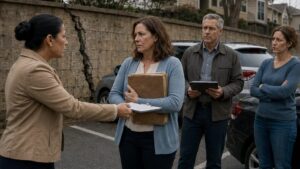
Before the man could answer, Kevin came through his side gate holding a rolled sheet of paper.
He wore work clothes but no coat, as if he had come outside expecting the conversation.
“Morning, Steven.”
Steven pointed at the post.
“You’re inside my property.”
Kevin glanced at it, then at the paper in his hand.
“We went over this.”
“No. You told me you were putting up a fence. You didn’t tell me you were putting it here.”
Kevin unrolled the sheet against the top of a sawhorse. It showed the outlines of the houses, yards, and a line running between them.
“This is what the HOA gave me.”
Steven did not touch it.
“That’s not a boundary survey.”
“It’s the neighborhood site plan.”
“It’s a drawing.”
Kevin exhaled through his nose.
“The contractor measured it.”
Steven looked toward the house and then crossed to the garage. He returned with a steel tape.
Kevin gave a small shake of his head.
“You really want to do this?”
“I want to know where you think my property ends.”
Steven hooked the tape near the iron stake and pulled it straight toward the newly set post.
The contractor watched.
So did Kevin.
Steven stopped.
He did not need to bend close to the markings.
The number was too large for that.
“You’re more than nine feet in.”
Kevin frowned.
“That’s not possible.”
Steven held the tape steady.
“You can read it yourself.”
Kevin stepped forward, looked down, and then looked at the iron stake.
“That thing could be fifty years old.”
“It could be a hundred and still matter.”
“You don’t even know if it’s the right marker.”
Steven looked at him.
“I know exactly what it is.”
Kevin’s mouth tightened.
For one moment Steven thought the work might stop.
Then Kevin rolled the site plan back up.
“You’re measuring from an old stake. We’re measuring from the plan the association uses.”
“That plan does not change a recorded property line.”
Kevin looked toward the contractor.
“How far off are we talking?”
Steven stared at him.
“I just showed you.”
Kevin lifted a hand.
“Nine feet sounds dramatic. With old markers and neighborhood plans, there can be rounding differences.”
“Rounding differences?”
“That’s not what I meant.”
“You’re not off by three inches, Kevin.”
The contractor shifted his weight.
“Do you want us to hold?”
Kevin looked at the row of marked holes running toward the front of the properties. Lumber had already been delivered. Concrete bags were stacked by his garage. An enclosed trailer blocked half his driveway.
Steven could see the calculation happening before Kevin spoke.
“No. Keep going.”
The auger engine started again.
Steven stood beside the old stake as the drill bit turned.
He felt something rise in him that he had learned, over decades of work, not to trust.
Anger made people hurry.
Hurrying made people miss things.
So Steven walked back inside instead.
He took his phone from the kitchen counter, returned to the yard, and began taking photographs.
The post.
The stake.
The tape.
The trench marks.
The contractor.
The rolled HOA plan in Kevin’s hand.
Kevin watched him.
“What are you doing?”
“Documenting.”
“Come on, Steven.”
Steven took another picture.
“Tell your crew not to disturb that stake.”
Kevin’s face changed slightly.
“You’re treating this like a lawsuit.”
“I’m treating it like nine feet of my yard.”
The dog-run plan had been simple.
Steven had adopted the first dog seven months after his wife died and the second almost a year later. Both were rescues, both too energetic for the small fenced section behind the patio, and both had discovered exactly how much trouble two determined animals could create with a flowerpot and twenty unsupervised seconds.
The strip along the side yard was supposed to solve that.
A long enclosed run from the patio toward the front gate, shaded in the afternoon, wide enough for them to move without tearing up the backyard.
Now Kevin’s line would cut through almost the entire width of it.
By ten-thirty, four posts were standing.
By eleven, the crew had begun a trench for the lower support and drainage around part of the fence line.
Steven kept photographing.
He did not shout.
That seemed to bother Kevin more than shouting would have.
“You can call the HOA if you want,” Kevin said at one point.
“I will.”
“They already approved it.”
“That isn’t the same thing.”
“You keep saying that.”
“Because you keep pretending it is.”
Kevin walked away.
At noon, Steven tried his side gate.
The new fence crossed behind it at an angle that left barely enough room for the gate to open a foot.
His hose reel sat on the other side.
So did the outdoor spigot.
He stood there with his hand on the gate latch, looking through the fresh boards at equipment that had been accessible from his yard that morning.
A contractor called from farther down the line.
“Watch the bed.”
Steven turned.
The trenching machine had reached the flowers.
He moved quickly.
“Stop.”
The operator looked toward Kevin.
“Stop the machine.”
Kevin came around the fence line.
“What now?”
Steven pointed.
The flower bed curved around the side of the house in an uneven crescent. It was not professionally landscaped. Some plants sat too close together. Others had spread beyond where they had originally been planted.
That was how she had liked it.
Kevin looked at the flowers, then at Steven.
“We have to run the line straight.”
“Move it.”
“Steven—”
“Move it.”
“The approved line comes through here.”
“There is no approved property line through my flower bed.”
The contractor looked between them.
Kevin rubbed a hand across his jaw.
“We can replace flowers.”
Steven did not answer.
The machine rolled forward.
Its narrow blade entered the bed.
Dark soil folded up behind it.
Roots appeared in the dirt.
Then one of the pale clusters near the edge tipped sideways and disappeared beneath the disturbed earth.
Steven had spent forty-two years learning the difference between what could be measured and what could not.
Distance could be measured.
Elevation could be measured.
Bearing, area, slope, setback, frontage.
Even error could be measured.
His wife had planted those flowers the spring before her first surgery.
He had held the paper nursery tray while she knelt in the soil and told him not to arrange everything in straight lines just because straight lines made sense to him.
The trenching machine moved another foot.
Steven lowered his phone.
For the first time that morning, he was no longer angry because Kevin had taken nine feet of land.
He was angry because something that could never be surveyed, replatted, or replaced was being dug out of it.
Chapter 2: The Flowers Made the Boundary More Than a Measurement
Steven discovered the lock at four-twenty that afternoon.
The fence crew had finished the gate on Kevin’s side and looped a new latch through it. Steven stood on his own property staring through the boards at his hose reel less than six feet away.
He pulled his side gate again.
It struck Kevin’s new fence and stopped.
The opening was too narrow even to squeeze through comfortably.
One of the dogs pushed its nose against Steven’s leg.
“Not today.”
He guided both animals back toward the patio and closed the door behind them.
On the kitchen table, he arranged the morning’s evidence in a way that felt almost embarrassingly familiar: photographs, rough measurements, timestamps, notes.
He had spent years telling younger survey technicians that if a dispute ever reached a hearing, memory was the weakest witness in the room.
Write it down.
Photograph it.
Date it.
Never assume the obvious will remain obvious once money is involved.
He opened one photograph of the flower bed.
The trench cut through it like a brown seam.
Steven closed the image.
His phone rang before he could call the association.
“Mr. Hill?”
“Yes.”
“This is Pamela Lewis, community manager.”
He looked through the kitchen window at the top of Kevin’s new fence.
“I was about to call you.”
“I’ve already spoken with Mr. Carter.”
“I assumed you had.”
“He says you’re disputing the approved fence location.”
“I’m disputing a fence that is on my land.”
There was a pause.
“The architectural request was reviewed against the association’s site plan.”
“That plan is not a boundary survey.”
“It is the plan we’ve used for years.”
“That does not make it a deed.”
Pamela’s voice stayed calm, but Steven recognized the tone. He had heard versions of it in county offices for half his career.
The tone of someone who believed consistency could substitute for accuracy.
“Mr. Hill, I’m not trying to argue property law with you.”
“That’s good.”
Another pause.
“I’m trying to explain why the project was approved.”
“You approved a structure location using a diagram that was never intended to establish title boundaries.”
“We have no record of any previous dispute at those lots.”
“That doesn’t mean the line moved.”
Pamela sighed softly.
“Kevin provided the dimensions from the association file.”
“And I showed him the monument.”
“The old metal stake?”
Steven looked outside.
The iron top was still visible beside the ruined flowers.
“Yes.”
“We don’t know what that stake represents.”
“I do.”
Pamela waited.
Steven had not told Kevin. He had not wanted to turn a neighbor disagreement into a résumé contest.
Now the omission felt pointless.
“I worked land records and field survey for the county for twenty-two years.”
Silence.
“Before that, private survey work. Boundary reconstruction, subdivision plats, easements, residential disputes. I’ve worked hundreds of properties in this county.”
Pamela’s tone changed, though only slightly.
“I wasn’t aware of that.”
“You didn’t need to be. The line is the line whether I spent my life surveying or selling shoes.”
“I understand.”
“No, you understand now that I might know what I’m talking about.”
“That’s not fair.”
Steven leaned back in the chair.
She was right.
It was not fair.
His irritation did not make it less true.
He lowered his voice.
“Fine. Then forget my background. Send someone out and verify the line.”
“The association doesn’t conduct private boundary surveys.”
“Then tell Kevin to stop work until one is done.”
“The fence is already substantially complete.”
“That was his choice.”
“I can ask both parties to provide documentation.”
“I provided a monument and a measurement this morning.”
“A measurement you took yourself.”
Steven closed his eyes briefly.
There it was.
A fact he could not reasonably argue with.
However qualified he had once been, he was one of the disputing owners now.
His own measurement was evidence, not independence.
“What would you accept?” he asked.
“A current survey by a licensed professional.”
Steven glanced toward a cabinet beside the refrigerator.
His old field notebooks were in there.
Most of them had no relevance to this property. Some dated back decades, covers softened by rain, mud, truck dashboards, and his own hands.
He opened the cabinet anyway.
“What if the new survey confirms I’m right?”
“Then we address it.”
“Address it how?”
“That would depend on the result.”
Which meant she would not commit.
Steven understood that too.
“Send me the plan you relied on.”
“I can email it.”
“And Kevin’s fence approval.”
“I’ll send what I can.”
When the call ended, Steven took out one of his old field notebooks.
It was not an official county record. It was his own personal book from the period when he had done occasional side measurements around his house after buying it.
He flipped through dates.
Landscaping.
Drainage.
A note about replacing the rear corner marker after utility work.
Then he found a small sketch of the side boundary.
The iron stake was marked.
He ran his thumb along the faded pencil line.
The two dogs were waiting by the back door.
“All right.”
He took them outside.
The younger dog ran toward the side yard and stopped at the new obstruction. It sniffed the boards, paced back, then looked at Steven as if expecting him to fix whatever foolish thing humans had done.
Steven walked to the flower bed.
He knelt beside the old stake.
Fresh dirt had been thrown over half of it.
He cleared the soil away carefully with his hands.
The iron was stained orange-brown and rough with age. It did not look impressive. Most boundary monuments did not. People imagined polished markers and neat plaques. Real property lines were often held by bent pipe, old rebar, stones, nails, and records nobody looked at until someone wanted to build something.
Behind him, Kevin’s voice came through the fence.
“You’re still messing with that?”
Steven rose.
“I’m protecting it.”
Kevin appeared near the unfinished front section.
“Pamela called me.”
“Good.”
“She said you used to be a surveyor.”
“I did.”
Kevin stared at him.
“You could’ve mentioned that this morning.”
“Would it have changed your decision?”
Kevin opened his mouth, then stopped.
Steven nodded once.
“That’s what I thought.”
Kevin looked toward the stake.
“My contractor followed the dimensions I gave him.”
“You gave him the wrong dimensions.”
“I gave him the HOA dimensions.”
“You were standing there when I showed you the tape.”
Kevin’s jaw shifted.
“Nine feet from an old marker.”
“Then you should be eager for a new survey.”
“I am.”
“Good.”
Kevin stepped closer.
“But until there is one, this fence stays.”
Steven looked at the boards between them.
“That part was already obvious.”
That evening, the email from Pamela arrived.
The attached site plan was exactly what Steven expected: a simplified development drawing, useful for landscaping relationships and general layouts, not enough by itself to establish a disputed deed line.
But something about one of the dashed lines bothered him.
He enlarged it.
The property boundary and another corridor nearly overlapped along the side of his lot.
The scan was poor. Labels were faint.
Steven stared at it longer than he meant to.
Then he closed the file.
He told himself the same thing he had told Kevin.
A site plan was not a boundary survey.
At eight the next morning, Steven began calling licensed survey companies.
The first could not come for three weeks.
The second wanted a month.
The third had a cancellation Thursday morning.
Steven booked it.
“Boundary reconstruction,” the scheduler said. “Any active construction dispute?”
Steven looked through the window at nine feet of yard now hidden behind fresh boards.
“Yes.”
“Existing monuments?”
“At least one I trust.”
“Any recorded easements we should know about?”
Steven’s hand tightened slightly around the phone.
He looked toward the laptop containing Pamela’s plan.
“Nothing that changes the ownership line,” he said.
The answer was technically true.
For the moment, that was enough for him.
Chapter 3: The Tape Stopped at Nine Feet Three Inches
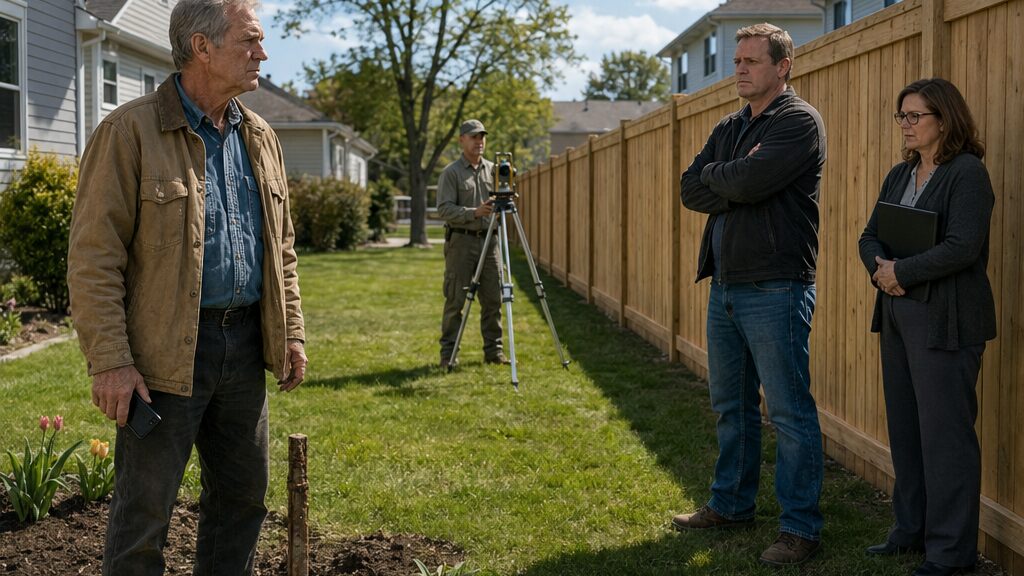
The survey truck arrived Thursday at 7:12 in the morning, before Kevin had backed his SUV out of the garage.
Steven was already outside.
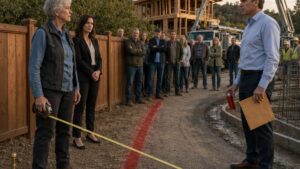
The crew unloaded a tripod, receiver, rods, paint, stakes, and a case of instruments. One surveyor walked toward the rear corner while another began checking control points near the street.
Kevin came out holding his travel mug.
He stopped when he saw them.
“You actually hired a crew.”
Steven kept his hands in his jacket pockets.
“You said you wanted a current survey.”
“I said the HOA did.”
“You’re both getting one.”
Kevin looked at the equipment.
“How much is this costing you?”
“Enough that I’d prefer your fence not be nine feet over.”
Kevin gave him a thin smile.
“That still assumes you’re right.”
Steven almost answered.
Instead he watched the crew work.
That was harder than he expected.
For more than two decades, this had been his world: backsights, control, field notes, monument calls, the quiet discipline of refusing to make the ground agree with what someone hoped the paperwork said.
Now he was standing outside the process.
That mattered.
A homeowner could be right and still interfere.
So Steven said nothing when the surveyor passed within three feet of the old iron stake without using it.
Kevin noticed.
“Thought that was your proof.”
“It’s evidence.”
“You spent all week acting like it was the Ten Commandments.”
Steven looked at him.
“I spent all week asking you not to build over it.”
The surveyor returned from the rear of the properties.
“We’ve got the subdivision control.”
Steven nodded.
Kevin asked, “Does that mean anything yet?”
“It means we can start reconstructing the lot.”
Pamela arrived around eight-thirty.
She parked at the curb rather than in either driveway and walked over carrying a folder.
“I thought it made sense to observe.”
Kevin gestured toward her.
“Tell him about the plan.”
Pamela looked at Steven before answering.
“The surveyors have the association materials.”
“And the recorded plat,” Steven said.
“Yes.”
The crew worked for another forty minutes.
No one argued.
That silence created more pressure than Tuesday’s phone call had.
One surveyor located a rear monument. Another checked a point near the front walk. Measurements went into the data collector. Bearings were compared. Then the crew chief walked toward Steven’s flower bed.
He crouched.
Using a small hand tool, he cleared soil around the iron.
Steven watched his expression.
Not excitement.
Surveyors rarely looked excited when the evidence agreed.
They looked relieved.
The crew chief stood.
“This one fits.”
Kevin frowned.
“Fits what?”
“The record position.”
Pamela stepped closer.
“So that is a boundary marker?”
“It appears consistent with the called line, yes. We’re still checking.”
Kevin looked at Steven.
Steven said nothing.
The crew continued.
A second monument changed the mood completely.
It was farther toward the front, mostly buried near the edge of the lawn. Once exposed and tied into the same control, the line between the two monuments became difficult to argue with.
The new fence sat well inside it.
Kevin began pacing.
“The association plan doesn’t show that.”
The crew chief shrugged.
“I’m not here to interpret the association’s approval process.”
“How far?”
“We haven’t finished.”
“How far is my fence off?”
The man looked at his data collector.
“We’ll measure the offset.”
Steven felt his pulse in his throat.
This was the moment he had imagined since Monday morning.
He had also imagined what he might say.
Something about rounding errors.
Something about old stakes.
Something precise enough to sting without sounding childish.
As the surveyor stretched a steel tape perpendicular from the reconstructed boundary toward the fence, every one of those lines disappeared.
The tape crossed grass that Steven had mowed for years.
It crossed the torn edge of the flower bed.
It ended against the lowest rail of Kevin’s new fence.
The crew chief bent to read it.
Kevin stood on one side.
Pamela stood near the other.
Steven took out his phone.
“Can you read it once?” he asked.
The surveyor looked up.
“For the photograph?”
“Yes.”
He checked the tape again.
“Nine feet, three inches.”
No one spoke.
Steven took the picture.
The number sat cleanly in the frame.
Nine feet.
Three inches.
Kevin stared at the tape as if the markings might rearrange themselves if he waited.
Pamela opened her folder.
“That can’t correspond with our plan.”
The surveyor began retracting the tape.
“I can only tell you where the recorded boundary reconstructs from the monument evidence and plat.”
Kevin looked at Steven.
“You knew.”
“I told you.”
“You knew exactly.”
“I told you more than once.”
Kevin glanced at the contractor-built fence, then toward his backyard.
For the first time since Monday, he did not look irritated.
He looked trapped.
Steven understood the difference.
Removing the fence would cost money.
There would be labor, damaged materials, possible landscaping changes, and whatever Kevin had planned behind it.
Steven almost felt sympathy.
Then he looked at the flower bed.
The feeling passed, though not completely.
Pamela asked the surveyor, “Will you issue a stamped drawing?”
“Yes.”
“How soon?”
“Likely tomorrow.”
Kevin pulled out his phone.
“You’re calling the contractor?” Steven asked.
“No.”
“Pamela?”
“No.”
Kevin walked toward his driveway.
“An attorney.”
Steven watched him go.
Pamela stayed behind.
“I need to review the association records.”
“You should.”
“If our plan is wrong—”
“It is.”
She looked at him.
Steven softened the sentence only slightly.
“If this survey holds, your plan is not showing the ownership boundary correctly.”
Pamela closed her folder.
“I’m not going to make a conclusion before I compare everything.”
“That’s sensible.”
It sounded more generous than he felt.
By noon, Steven had already contacted his own contractor.
He wanted the dog run put where it had always been intended: on his land, along the true line, with enough clearance to use the side gate and hose again.
The survey was not yet in final stamped form, but Steven had seen enough.
So had Kevin.
Steven ordered materials.
The next morning, the formal survey arrived electronically.
The reconstructed boundary matched what Steven had expected.
The old iron stake was accepted as consistent monument evidence.
The new fence sat roughly nine feet three inches inside Steven’s parcel at its most obvious section.
Steven printed two copies.
One went into a folder.
The other remained on the kitchen table.
For the first time all week, he felt the dispute become simple.
Kevin had built in the wrong place.
The HOA had relied on the wrong plan.
Steven owned the strip.
Now the fence would move.
That afternoon, his contractor marked the proposed dog-run enclosure.
Steven placed a temporary sign near the side yard where Kevin could see it from his kitchen.
PRIVATE PROPERTY.
LEGALLY SURVEYED.
He stood back.
The sign satisfied something in him that the stamped drawing had not.
That should have bothered him.
It did not.
Not yet.
At five-thirty, a dark sedan stopped in front of Kevin’s house.
A man carrying a leather portfolio walked to Kevin’s door.
Steven watched from the kitchen window.
Twenty minutes later, the man came outside with Kevin and Pamela.
They did not look toward Steven.
They stood beside Kevin’s driveway while the man pointed at several pages.
Steven recognized the posture before he recognized the man.
Attorney.
At 6:14, Steven’s phone rang.
“Mr. Hill?”
“Yes.”
“My name is David Clark. I represent Kevin Carter regarding the boundary matter.”
Steven looked at his new survey on the table.
“If you’re calling to dispute the line, I suggest you speak with the surveyor.”
“I’m not calling to dispute the ownership line.”
Steven paused.
David continued.
“I’m calling because I pulled the older county filings associated with your lot.”
The words changed the room.
Steven’s eyes moved toward Pamela’s faded HOA site plan beside his notebook.
“What filings?”
“There’s a recorded drainage and maintenance instrument affecting the side strip.”
Steven did not answer.
David’s voice stayed measured.
“Before you complete your new enclosure, I’m asking you to stop construction.”
“It’s my property.”
“I believe it is.”
“Then why would I stop?”
“Because ownership may not be the only recorded right attached to those nine feet.”
Steven looked through the window toward the old iron stake.
For the first time since Monday morning, being right about where the line stood did not tell him what came next.
Chapter 4: The Record That Made Both Neighbors Partly Wrong
David Clark placed two sheets of paper beside Steven’s fresh survey and turned one ninety degrees.
“Your boundary is here,” he said.
Steven did not sit down.
The three of them were at Steven’s patio table Friday morning: Steven, David, and Kevin. Pamela had said she would join them after reviewing the association file.
David tapped the second document.
“But this is also here.”
A shaded strip ran along Steven’s side yard.
Steven knew what it was before David said the word.
“Easement.”
“Drainage and maintenance,” David replied. “Recorded with the county.”
Kevin leaned forward.
“So the fence is legal.”
“No,” Steven said.
David raised a hand before Kevin could answer.
“Mr. Hill is right. The easement does not move the ownership boundary.”
Kevin’s expression changed.
“Then what are we doing?”
“We’re separating two questions you’ve both been treating as one.”
David pointed to Steven’s survey.
“Who owns the land?”
Then to the older filing.
“What uses are allowed across it?”
Steven looked at the legal description.
The language was familiar in the way an old smell could be familiar before a memory attached itself to it.
A maintenance corridor.
Access for drainage inspection, repair, grading, and related work.
No permanent obstruction that would materially interfere with access.
Steven’s eyes stopped on the recording number.
His stomach tightened.
He had seen it before.
Not recently.
Years ago.
David noticed.
“You recognize that?”
“I recognize the format.”
It was an answer designed to be true without being complete.
Kevin sat back.
“So he can’t build the dog fence.”
David chose his words carefully.
“He may be able to build portions of it. But a continuous enclosure across the access corridor could create a problem unless there is adequate access.”
Kevin laughed once.
Not because anything was funny.
“You were putting up a sign yesterday about legally surveyed property.”
Steven looked toward the yard.
The sign was still there.
PRIVATE PROPERTY.
LEGALLY SURVEYED.
The words that had felt satisfying twenty-four hours earlier now looked narrower than they had when he hammered the post into the soil.
“My property is legally surveyed.”
David nodded.
“Yes.”
“And Kevin’s fence is on my property.”
“Yes.”
Kevin turned toward his attorney.
“Then why do I have to move mine if he can’t build his?”
“Because your fence does more than cross the easement. It crosses the ownership boundary.”
David pulled the survey closer.
“You built on land you don’t own. The easement does not transfer ownership to you or the HOA.”
Kevin looked down.
For the first time, Steven saw the distinction settle over him.
Kevin had not won.
Steven had not lost.
That almost made the situation worse.
Pamela arrived ten minutes later carrying a thick binder and two loose folders.
“I found three versions of the site plan.”
David looked up.
“Three?”
“Different dates. Same development, but the side corridors aren’t drawn consistently.”
Steven finally sat.
Pamela opened the oldest plan first.
On that version, the property boundary and easement were separate lines.
The next version simplified them.
The newest copy—the one Kevin had received—showed only one dominant line in the disputed area.
Pamela pressed her lips together.
“I think someone treated the easement edge as the lot division when this was redrawn.”
“When?” Steven asked.
“Years ago.”
“How many fence approvals have used this version?”
“I don’t know yet.”
Kevin rubbed both hands over his face.
“You told me it was the line.”
“I told you it was the association plan.”
“You approved my fence with it.”
“Yes.”
“That sounds like telling me it was the line.”
Pamela did not defend herself immediately.
Steven noticed that.
It was the first thing she had done all week that increased his trust in her.
Finally she said, “I should have required a boundary survey when the lots didn’t match cleanly. I didn’t.”
Kevin stared at the table.
Steven expected satisfaction.
Instead he felt tired.
He picked up the old easement filing again.
The recording number sat near the upper corner.
The digits pulled at something he had been avoiding since David’s phone call.
Later that afternoon, Steven drove to the county records office.
He could have searched most of it online, but he wanted the original chain.
He told himself it was professional habit.
At the counter, the clerk pulled the subdivision filings and gave him access to the older scanned instruments.
Steven worked backward.
Current plat.
Earlier amendment.
Drainage exhibit.
Original easement.
Then a reference to a maintenance clarification recorded years later.
That was the number he remembered.
He sat very still.
He had looked at this before.
Not as a county employee handling somebody else’s property.
As a homeowner.
His own address appeared in the index.
Steven opened the document.
The corridor had always been there.
The HOA drawing had been wrong about the ownership line, but the easement was real.
He remembered standing in this same office years earlier with a folded copy tucked beneath his arm.
He remembered going home.
He remembered his wife in the yard.
He shut the file.
On Saturday morning, Steven’s contractor arrived to begin setting the new dog-run posts.
Steven walked outside before the first hole was dug.
“Hold off.”
The contractor lowered his drill.
“Survey problem?”
“No. Survey is right.”
“Then what changed?”
Steven looked at the flags marking the proposed enclosure.
Several crossed directly through the maintenance corridor.
“I missed something.”
The admission tasted worse than he expected.
The contractor shrugged.
“Happens.”
Steven almost corrected him.
Not to me.
That had been the belief, hadn’t it?
Instead he said, “Give me a couple days.”
The crew packed up.
Kevin watched from his driveway but did not say anything.
That restraint irritated Steven more than an argument might have.
By Monday, Pamela had confirmed the problem.
The easement had been valid for decades.
Kevin’s fence remained an encroachment.
The HOA’s approval process had been flawed.
And Steven’s planned enclosure, as currently marked, could obstruct the association’s maintenance access.
Three mistakes.
Three different kinds.
Only one of them had involved digging through his wife’s flowers, and Steven was not prepared to let anyone flatten that distinction.
But the clean victory he had imagined was gone.
That evening Jennifer came over after work.
She found him at the kitchen table with the easement copy open beside his old field notebook.
She read the first page, then looked at him.
“You knew about this.”
Steven did not answer quickly enough.
Jennifer’s eyes moved to his face.
“Dad.”
“I knew there was an easement.”
“Before Kevin moved in?”
“Yes.”
“How long before?”
Steven closed the notebook.
Jennifer stared at him.
“Mom knew too, didn’t she?”
He looked toward the side yard.
Through the window, the old iron stake sat beside the damaged flower bed.
Jennifer followed his gaze.
Her voice changed.
“Why didn’t you ever tell anyone?”
Chapter 5: What Steven’s Wife Had Asked Him Not to Turn Into War
“Your mother didn’t want me to turn it into a war.”
Jennifer stood on the other side of the kitchen table, one hand resting on the back of a chair.
Steven had not planned to say it that plainly.
Once the sentence was out, there was nowhere useful to hide.
Jennifer pulled the chair back and sat.
“What does that mean?”
Steven looked at the old field notebook.
Years earlier, before Kevin owned the neighboring house, a drainage contractor had come through after three days of hard rain.
The association had wanted access along the side strip.
Steven had questioned where their rights ended because the old neighborhood plan appeared to show the corridor differently from the recorded plat.
He had done what came naturally.
He pulled records.
Measured.
Compared.
Found the inconsistency.
His wife had been kneeling in the flower bed when he came outside carrying the documents.
He remembered the scene more clearly than he wanted.
She wore gardening gloves with dirt worked into the fingertips.
A tray of flowering plants sat near her knee.
Steven had explained the difference between the recorded boundary and the easement as if she were another surveyor.
She listened until he finished.
Then she said, “Do they need to get through?”
“Sometimes.”
“Can they?”
“For now.”
“Then why are you angry?”
“Because the drawing is wrong.”
She smiled at him.
“Those are different questions.”
At the time, Steven had found that mildly irritating.
He told Jennifer this.
She almost smiled.
“That sounds like Mom.”
“It does.”
“What happened?”
“I told her the association should correct its plan. She agreed.”
“But?”
“She asked me not to turn it into a fight with the neighbors.”
Jennifer looked toward the window.
“Why would it have been a fight?”
“The previous owner next door had landscaping near the corridor. I was ready to push the issue formally. Notices, revised exhibits, the whole thing.”
“And Mom?”
“She said the drain worked, nobody was claiming our land, and she wanted to finish planting flowers.”
Jennifer was quiet.
Steven remembered the rest.
His wife had held up one of the plants.
“Everything doesn’t have to become a line you win.”
He had told her property depended on lines.
She had laughed.
“Flowers don’t.”
Steven looked at the damaged bed outside.
“She wanted me to fix the paperwork eventually,” he said. “Just not turn the neighborhood upside down over it.”
“So you didn’t.”
“I put it off.”
“How long?”
Steven’s eyes dropped to the notebook.
“Too long.”
Jennifer understood.
Her mother’s illness had changed calendars.
Things that seemed important in spring became irrelevant by fall.
Appointments replaced projects.
Then treatments replaced appointments.
By the time Steven thought about the easement again, he had already stopped thinking about most things that did not fit inside hospital rooms and medication schedules.
After her death, he left the issue untouched.
The old stake remained.
The flowers grew around it.
The next owner came and went.
Then Kevin bought the house.
Jennifer reached for the survey.
“You knew the HOA drawing didn’t match the county records.”
“Yes.”
“And when Pamela sent you that plan Tuesday?”
Steven said nothing.
“You recognized it.”
“I recognized the possibility.”
“That isn’t what I asked.”
Steven looked at his daughter.
“Yes.”
Jennifer leaned back.
“Why didn’t you say that?”
“Because it didn’t change where the boundary was.”
“No. But it changed the problem.”
He disliked how closely that matched David’s language.
“I was dealing with Kevin’s fence.”
“You were dealing with Mom’s garden.”
Steven’s chair scraped against the floor as he stood.
“Don’t do that.”
Jennifer’s face tightened.
“Do what?”
“Turn this into grief because that makes everything simpler.”
“I’m not simplifying it.”
“He put a fence on my land after I warned him. He destroyed plants she put there. Those facts do not disappear because an easement exists.”
“I didn’t say they did.”
“Then what are you saying?”
Jennifer waited until his anger had nowhere to go.
“I’m saying you put that sign up because you wanted him to look at it every morning.”
Steven glanced outside.
The sign faced Kevin’s kitchen.
He had positioned it deliberately.
He could not pretend otherwise.
Jennifer continued.
“You ordered your own fence before you reviewed the easement. You, of all people.”
Steven said nothing.
That was the part that hurt.
He had spent years telling clients that a boundary survey answered one category of question.
Ownership.
It did not automatically answer zoning.
Setbacks.
Easements.
Covenants.
Access.
Use restrictions.
He knew better.
Yet the instant the survey vindicated him, he stopped asking questions.
Because Kevin had been wrong.
Because Steven had been right.
Because nine feet three inches had felt like permission to stop thinking.
Jennifer rose and walked to the back door.
“Show me the flowers.”
They went outside.
Much of the bed remained intact, but the trench had damaged the side closest to Kevin’s fence. Dirt lay rough over crushed stems. A few plants had survived where the machine passed shallowly.
Jennifer crouched beside one.
“I thought these were the ones Mom planted later.”
“They are.”
“She hated straight rows.”
Steven looked at the uneven curve.
“Yes.”
Jennifer touched a leaf.
“I used to think this garden was about her wanting pretty things everywhere.”
“She did.”
“No. I mean I thought that was all.”
Steven waited.
Jennifer looked toward the old iron stake.
“Maybe she liked that it didn’t care where your line was.”
He almost objected.
Then he remembered his wife’s voice.
Flowers don’t.
Steven laughed once, quietly.
It surprised both of them.
Jennifer stood.
“Are you going to sue Kevin?”
“I haven’t decided.”
“You wanted to yesterday.”
“I still want his fence removed.”
“That isn’t the same question.”
Again.
Different questions.
Steven looked at Kevin’s boards.
“He knew I objected.”
“I know.”
“He chose to keep going.”
“I know.”
“The HOA being wrong doesn’t excuse that.”
“I know.”
Jennifer stepped closer.
“But you being right doesn’t excuse everything you do next either.”
That night Steven opened the folder of photographs.
For the first time, he looked at them without searching for proof.
Kevin beside the contractor.
The tape.
The old stake.
The trench.
The flowers.
Then the photograph from the resurvey: nine feet three inches.
It was the image he had wanted most.
Now it looked incomplete.
On Sunday morning, the dogs followed him into the side yard.
The temporary sign stood where he had placed it.
PRIVATE PROPERTY.
LEGALLY SURVEYED.
Steven stared at it.
Every word was true.
That was precisely why removing it felt difficult.
He wrapped one hand around the post.
The soil was firm.
He rocked it back and forth until it loosened.
Kevin appeared through his kitchen window.
Their eyes met.
Steven pulled the sign free.
Kevin watched him carry it toward the garage.
He did not wave.
Steven did not explain.
Later, he called David.
“I want a meeting.”
“With Kevin?”
“Kevin, Pamela, you, me.”
“What do you want to discuss?”
Steven looked at the survey and easement lying side by side.
“Three things separately.”
“Which three?”
“Where the property line is. What the easement actually allows. And who is responsible for what happened after I told Kevin to stop.”
David was silent for a moment.
“That sounds more productive.”
“Don’t mistake it for me dropping the issue.”
“I didn’t.”
Steven looked outside.
The old stake remained where it had always been, surrounded now by torn soil and the few flowers that had survived.
“Monday evening,” he said.
Chapter 6: Kevin Finally Admitted Why He Ordered the Crew to Keep Digging
“I knew there might be a problem before they finished.”
Kevin said it before anyone had fully settled into their chairs.
They were meeting outside because Steven refused to sit in the HOA office and Kevin refused to sit in Steven’s kitchen.
So they stood around a folding table placed close to the disputed strip.
Steven.
Kevin.
Pamela.
David.
The survey lay on one side of the table.
The easement filing lay on the other.
Steven looked at Kevin.
“How early?”
Kevin rubbed his thumb along the edge of the table.
“After you showed me the tape.”
Steven felt his jaw tighten.
Pamela turned toward Kevin.
“You told me you believed the marker was wrong.”
“I did believe it might be.”
“That isn’t what you just said.”
Kevin looked at her.
“I said I knew there might be a problem. I didn’t say I knew Steven was right.”
Steven kept his voice level.
“You had enough doubt to stop.”
“Yes.”
The word landed harder than any excuse could have.
Steven had wanted it.
An admission.
A clean sentence confirming that Kevin had been warned and chose to proceed.
Now that he had it, satisfaction failed to arrive.
“Why?” Steven asked.
Kevin looked toward his backyard.
“You want the ugly answer?”
“I want the true one.”
“The contractor had already rescheduled twice. I had materials delivered. I had money down that I wasn’t getting back if I delayed again.”
“That’s money.”
“Yes.”
“You dug through my yard over money.”
Kevin flinched.
“No. I kept a project moving because I had an HOA approval telling me where the line was.”
“After I showed you nine feet.”
Kevin’s voice sharpened.
“And after you showed me an old rusty stake and told everybody I was wrong in front of my crew.”
There it was.
Not just money.
Steven recognized pride when it belonged to someone else.
Kevin continued.
“I’d spent weeks getting that project approved. Pamela’s office gave me the layout. The contractor had already told me changes would cost extra. Then you walked out and acted like I was an idiot.”
“I told you the fence was on my land.”
“You told me like there was no possibility you could be mistaken.”
Steven almost said there wasn’t.
The easement document sat inches from his hand.
He stopped.
Kevin noticed.
“That’s what I mean.”
Pamela opened her binder.
“Before this becomes another argument about tone, there’s something else.”
She pulled out several photocopies.
“I reviewed other files using the same site-plan version.”
David leaned over them.
“How many?”
“More than I expected.”
Steven looked up.
“Define more.”
“Eleven approvals reference the simplified plan. Not all involve fences. Some are sheds, landscaping, drainage improvements.”
“Do they all have boundary problems?”
“I don’t know.”
Kevin stared at her.
“So this wasn’t just my file.”
“No.”
“Did you know that plan was different from the recorded plat?”
Pamela closed the binder halfway.
“I knew there were inconsistencies in some older exhibits.”
Steven’s eyes narrowed.
“You knew before Monday?”
“I knew some plans didn’t align perfectly.”
“And you kept issuing approvals from them.”
“We used them for architectural review, not title determinations.”
Kevin gave a humorless laugh.
“You approved my fence location.”
Pamela looked at him.
“Yes.”
The admission changed the balance around the table.
No one person owned the entire mistake anymore.
But responsibility had not vanished.
It had multiplied.
David separated the papers into three stacks.
“Steven owns the strip. That part is now well supported.”
Kevin said nothing.
“The easement allows association access through a defined corridor. That means Steven’s enclosure needs modification.”
Steven nodded once.
“And Kevin’s fence?”
“Encroaches across Steven’s boundary and cannot remain in its current location without Steven’s agreement.”
“There won’t be one,” Steven said.
Kevin glanced at him.
David continued.
“Damage to landscaping is separate. So are survey costs, removal costs, reconstruction costs, and potential association responsibility for the approval.”
Pamela’s expression tightened.
“We need board review before discussing payment.”
“Of course.”
Steven looked at the flower bed.
The old stake stood between them.
For days he had imagined Kevin on the wrong side of it.
Now Kevin stepped around the table to look more closely at the survey.
Without noticing, he crossed onto Steven’s side.
He stopped beside the iron stake.
It was the first time since the fight began that Steven saw him standing there without a fence between them.
Kevin pointed at the easement corridor.
“If my fence moves to the actual boundary, this access still runs on Steven’s property.”
“Yes,” David said.
“And if his dog run keeps a gate wide enough for maintenance?”
“Potentially workable, depending on final design.”
Kevin looked at Steven.
“So we both rebuild.”
“Not equally.”
“No.”
Steven appreciated the answer.
Pamela said, “The HOA may have some responsibility for costs.”
“Some?” Kevin asked.
“I cannot commit the board tonight.”
Steven looked at the four people, the documents, the broken bed.
The obvious path was litigation.
He could demand removal.
Seek damages.
Recover survey fees.
Push the association to defend its approval.
Kevin could argue reliance.
The HOA could argue the plan had never been intended as a legal survey.
Lawyers could turn each distinction into months.
Maybe years.
Steven knew enough property disputes to know that being right did not make them cheap.
He also knew something he had refused to admit until Jennifer forced it from him.
His wife would have hated every minute of that.
Not because she believed boundaries did not matter.
Because she believed people sometimes used them to avoid deciding what mattered more.
David asked, “Steven, what outcome are you seeking?”
A week ago Steven would have answered immediately.
Move the fence.
Pay for everything.
Correct the records.
Admit I was right.
Now he took longer.
“The fence comes off my property.”
Kevin nodded reluctantly.
“The flower bed gets repaired.”
“I can pay for what the contractor damaged.”
“Not replace,” Steven said. “Repair.”
Kevin looked at the torn plants.
“I understand the difference.”
Steven believed that he did.
“The HOA corrects the site plan and its approval process.”
Pamela said, “That will require board action, but I’ll recommend it.”
“And my survey costs?”
David glanced toward Pamela.
“That can be negotiated between Kevin and the association.”
Kevin frowned.
“You’re not asking me to cover all of it?”
Steven looked at him.
“I’m asking you to cover the decision you made after I warned you. I’m not asking you to pay for Pamela’s map.”
Pamela accepted that without protest.
Steven pointed toward the easement.
“I’ll redesign my dog run so maintenance can get through without dismantling anything.”
David leaned back slightly.
“That’s a significant concession.”
“It’s not a concession. It’s an easement.”
For the first time, David smiled.
“Fair distinction.”
Kevin was still studying Steven.
“What about legal fees?”
“Your lawyer, your bill.”
“I figured.”
“And one more thing.”
Kevin waited.
“When the fence is moved, you help restore the damaged section of the flower bed.”
Kevin’s brows rose.
“You mean pay for it?”
“I mean help.”
“With a shovel?”
“If necessary.”
Kevin looked toward the flowers.
Then at Steven.
Steven expected resistance.
Instead Kevin nodded.
“All right.”
Pamela blinked.
David closed his portfolio partway.
“We should put these terms into a written settlement before anyone begins work.”
“Yes,” Steven said.
Kevin looked again at the property line.
“So that’s it?”
“No.”
Steven’s answer made everyone pause.
He placed a finger on the survey.
“This line stays exactly where it is.”
Then he moved his finger to the easement document.
“And this right stays exactly where it is.”
Finally he pointed toward the damaged garden.
“And responsibility stays where it belongs too. We don’t use one mistake to erase another.”
Kevin held his gaze.
Then he nodded again.
Steven had spent the entire week wanting Kevin to admit he had been wrong.
Kevin finally had.
What surprised Steven was how little he wanted to stand over him afterward.
David began gathering the papers.
“I’ll circulate draft terms tomorrow.”
“Make the fence relocation deadline specific,” Steven said.
“I will.”
Pamela closed her binder.
“I’ll request an emergency board review of the mapping issue.”
Kevin pushed his chair back.
“So when can we start?”
Steven looked at the crooked fence, the blocked side access, and the flower bed beside the old iron stake.
“After the agreement is signed.”
Kevin nodded.
He started toward his house, then stopped.
“What are you doing with the dog run?”
Steven looked toward the dogs watching from behind the patio door.
“I’ll move one section and put a full-width maintenance gate across the corridor.”
Kevin considered it.
“That’ll cost you.”
“Yes.”
“You’re okay with that?”
Steven thought of the sign he had pulled from the ground.
“No,” he said. “I’m responsible for it.”
Kevin stood there another second, then walked home.
Steven remained by the table with David and Pamela.
David tapped the proposed settlement notes.
“You realize you could demand more.”
“Yes.”
“You may have a viable claim for additional damages.”
“I know.”
“Then why not?”
Steven looked at the old stake.
For years it had meant certainty to him.
A fixed point.
Something the ground could not argue with.
Now it meant something else.
The stake could tell him where ownership changed.
It could not tell him what kind of neighbor to become after learning it.
“I spent my career figuring out where lines were,” Steven said. “I’m trying not to spend my retirement pretending they answer every question.”
David said nothing.
Pamela looked toward Kevin’s house.
Steven gathered the survey and easement into the same folder for the first time.
“Write the agreement so Kevin moves the fence, the HOA corrects the records, the access stays open, and nobody waives responsibility for the garden.”
David nodded.
“And if Kevin signs?”
Steven looked at the strip of yard that had started all of it.
“Then we rebuild it correctly.”
Chapter 7: The New Fence Left Room for Dogs, Drainage, and Memory
The first misplaced fence post came out with a wet crack of soil and concrete.
Steven stood ten feet away with his hands in the pockets of his work jacket while the contractor rocked the post free and lowered it onto the grass.
Three weeks earlier, that same post had looked permanent.
Now it lay on its side.
Kevin watched from the opposite end of the yard.
Neither man said anything.
The settlement had been signed four days before.
Kevin would pay for relocating the portions of fence installed on Steven’s property and contribute to restoring the damaged garden. The HOA would cover Steven’s survey expense, revise the outdated site-plan system, and require formal boundary documentation when future architectural applications conflicted with recorded plats or easements.
Steven would redesign the dog enclosure.
Not because Kevin had won anything.
Because the easement existed.
The distinction mattered to him.
The crew removed the next post.
Steven looked toward the old iron stake.
It remained untouched.
He had asked everyone working on the site to stay clear of it.
Kevin finally walked over.
“They’re going to reuse most of the panels.”
“Good.”
“Saves some money.”
Steven nodded.
Kevin looked toward the flower bed.
A row of temporary nursery pots sat beside it. Some held replacements similar to what had been damaged. Others were plants Jennifer had chosen after studying old photographs of the garden.
Kevin shifted his weight.
“I found the receipt from the contractor.”
Steven looked at him.
“For the original job.”
“All right.”
“He charged me extra for finishing Monday instead of stopping.”
Steven understood what Kevin was saying.
The extra cost that had helped push him into making the wrong decision.
Kevin gave a short, embarrassed laugh.
“Not exactly a bargain in hindsight.”
“No.”
“I keep thinking if I’d stopped for one day…”
Steven looked at the fence panel being carried away.
“You didn’t.”
Kevin nodded.
“I know.”
There was no argument in it.
That was new.
By late morning, the true ownership line was open again.
It looked strangely wide without the fence.
Nine feet three inches had been easy to imagine when it was measured with steel tape.
It was harder to appreciate until the boards disappeared.
Steven walked the strip with his contractor.
The redesigned dog run would follow the actual property line for most of its length, then open into a broad double gate across the drainage-maintenance corridor.
“No center post in the easement,” Steven said.
The contractor pointed at the plan.
“We can span it here. Two swing panels. Maintenance crew gets full width when both are open.”
“And no fixed footing in the corridor.”
“Right.”
Steven studied the drawing.
A week earlier he would have found the compromise irritating.
Now it looked clean.
Not emotionally clean.
Practically clean.
There was a difference.
Jennifer arrived around noon carrying a tray of plants and two bags of soil amendment.
She looked across the open strip.
“Well.”
Steven turned.
“What?”
“You got your nine feet back.”
He glanced toward the easement flags.
“Most days.”
Jennifer smiled.
“Progress.”
The dogs exploded through the patio door as soon as she opened it.
Steven caught the younger one by the collar before it reached the work area.
“Not yet.”
Kevin laughed from several yards away.
“That one’s going to test every gate you build.”
“He tests gravity.”
The laugh surprised Steven.
Not because Kevin had made a joke.
Because Steven laughed too.
For a few seconds, the yard felt like a yard again.
Then Pamela arrived.
She carried a folder, but this time she did not hold it like a shield.
“The board approved the mapping changes last night,” she said.
Steven released the dog to Jennifer.
“All of them?”
“The existing architectural map will be marked as non-boundary reference material. New fence applications near recorded corridors have to include a survey or documented monument verification.”
Kevin looked at her.
“That would’ve been useful a month ago.”
Pamela accepted the remark.
“Yes.”
She handed both men copies.
“We’re also reviewing the other eleven approvals.”
Steven opened the folder.
The language was careful.
Administrative.
Not an apology.
But the process had changed.
That mattered more.
Pamela looked toward the flower bed.
“The reimbursement check for the survey should go out this week.”
“Thank you.”
“And the board approved a contribution toward landscape restoration.”
Kevin raised an eyebrow.
“I thought that was partly mine.”
“It still is.”
Steven looked between them.
For the first time, the costs seemed divided according to choices rather than according to whoever had the strongest lawyer.
The HOA had relied on bad records.
Kevin had kept building after being warned.
Steven had rushed his own construction after the survey.
No one got to erase his part by pointing at someone else’s.
That afternoon, the new fence line began taking shape.
The posts stood where Steven had known they belonged from the beginning.
He expected the sight to give him something larger.
Vindication.
Relief.
Maybe even triumph.
Instead, what he noticed most was the open space left for the easement.
The gap would have bothered him once.
Now he watched the contractor hang the wide paired gates and thought about how much trouble had come from treating every line as if only one kind of truth could cross it.
By Friday, the dog run was finished.
Steven opened the patio door.
Both dogs rushed into the new enclosure, stopped for half a second as if confused by the extra distance, then sprinted from one end to the other.
Jennifer stood beside Steven.
The younger dog slid around the turn near the maintenance gate and almost collided with the older one.
Jennifer laughed.
Steven did too.
“They approve,” she said.
“They approve anything with dirt.”
The enclosure did what Steven had wanted from the beginning.
The dogs had space.
The side gate worked.
The hose reel was accessible.
The easement remained clear.
Nothing about it looked like defeat.
Later that afternoon, Kevin came over in work gloves.
He carried a shovel.
Steven looked at it.
“You serious?”
“I agreed to help.”
“You could’ve written a check.”
“I already did that.”
Kevin nodded toward the garden.
“This part seemed different.”
Steven did not answer.
They worked without much conversation.
Jennifer arranged plants.
Kevin loosened compacted soil where the trench had passed.
Steven reset the edge of the bed.
Some of the damaged plants could be replaced with the same varieties.
Some could not.
A few had come from divisions his wife had traded with neighbors years ago. One pale flowering plant had never been labeled, and Steven had no idea where she had bought it.
Kevin held up a nursery pot.
“This one go here?”
Steven looked.
“No. She would’ve hated that.”
Kevin froze.
Steven realized how it sounded.
Then he pointed two feet farther left.
“She never planted anything in straight rows.”
Kevin moved it.
“Here?”
“Better.”
Jennifer looked down so neither man would see her smiling.
They continued.
By the time the last bag of soil was spread, the garden did not look the way it had before.
Steven had known it wouldn’t.
That was the final thing he had resisted.
Repair was not restoration to some untouched past.
The original roots had been cut.
The soil had been disturbed.
His wife was not coming through the back door to tell him he had put the flowers too evenly apart.
The most he could do was care for what remained and make room for what came next.
Kevin leaned on the shovel.
“I’m sorry.”
Steven looked at him.
Kevin did not add conditions.
No mention of the HOA.
No contractor.
No money.
“I should’ve stopped.”
Steven nodded once.
“Yes.”
Kevin looked toward the repaired bed.
“I can’t fix all of it.”
“No.”
“I know.”
That was enough.
Not forgiveness in the simple sense.
Not friendship.
Recognition.
Steven could live with that.
Near sunset, after Kevin had gone home and Jennifer had left, Steven walked the length of the new dog run alone.
The dogs trotted behind him.
At the maintenance gate, he opened both panels.
The corridor stretched clear from front to back.
Nothing blocked it.
He closed the gates again and latched them.
Then he walked to the flower bed.
The old iron stake stood beside the new plants.
The contractor had asked earlier whether Steven wanted a small cover box over it so the dogs would not scrape themselves against the metal.
Steven had considered sinking a protective sleeve around it.
Instead, he set a low stone a few inches away to keep the dogs from running directly over it.
The stake itself stayed visible.
Rusty.
Uneven.
Unimpressive.
For most of Steven’s life, markers like that had meant certainty.
A place where argument ended.
Now he understood their limit more clearly.
The stake could tell Kevin where his fence could not go.
It could tell Pamela where the association’s drawing had failed.
It could tell Steven which nine feet belonged to him.
But it could not tell him what to do with the anger inside those nine feet.
It could not tell him whether being right justified every next step.
It could not tell him how to remember his wife without turning memory into territory nobody else was allowed to touch.
One of the dogs lowered its nose to a newly planted flower.
“Leave it.”
The dog backed away.
Steven crouched and brushed a little dirt from the iron stake.
From Kevin’s kitchen window, the new fence was visible.
So was the open maintenance gate.
So was the repaired bed.
There was no sign facing the house anymore.
Steven did not miss it.
He stood and looked over the yard.
The boundary had not moved.
Neither had the easement.
What changed was what he expected those lines to do for him.
The dogs ran back toward the patio.
Steven followed more slowly.
Behind him, the old stake remained exposed beside the flowers, exactly where it had always been.
The story has ended.