After the HOA Crushed His Grandmother’s Orchids, One Old Water Valve Divided the Entire Neighborhood
Chapter 1: The Invoice Among the Broken Orchids
The front loader came through the east wall while Paul Nelson was still inside.
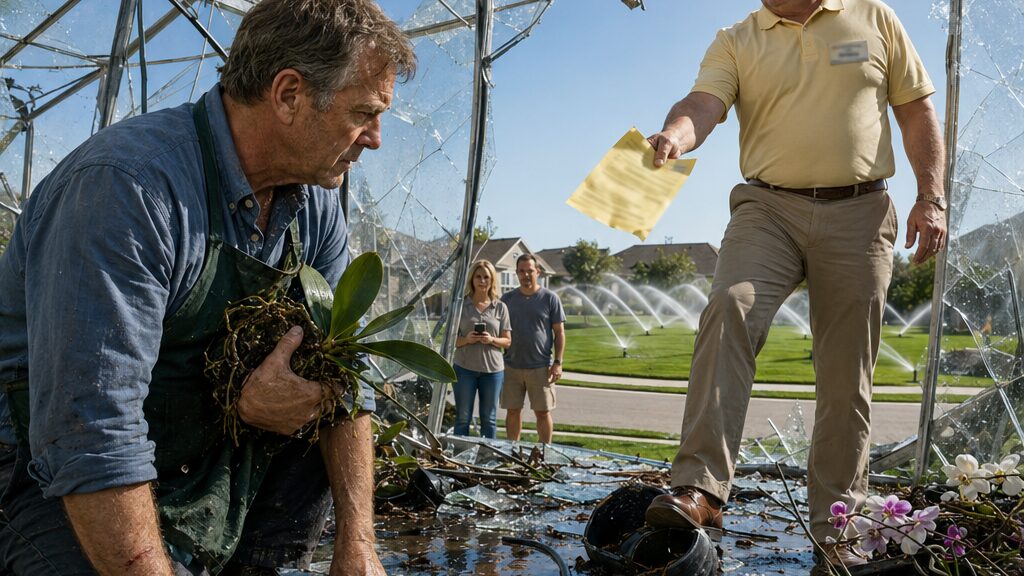
One moment he was reaching beneath a bench for a tray of newly divided orchids. The next, the greenhouse frame shrieked above him, glass burst inward, and the yellow bucket of the machine shoved through a cloud of silver fragments.
Paul dropped flat.
A steel bench folded where his chest had been. Clay pots struck the concrete and split open. Damp bark, roots, and pieces of colored plant tags scattered across the aisle.
“Stop!” he shouted.
The machine kept moving.
Through the ruined wall, Paul saw the operator’s face behind dusty glass. The man looked frightened, but his hands remained on the controls. Someone outside pointed toward the rear section of the greenhouse.
The bucket pushed again.
Paul crawled behind a concrete propagation table as another roof panel collapsed. A shard cut through his sleeve and scored his forearm. He scarcely felt it. His attention fixed on the benches ahead—his grandmother’s orchids, some older than he was, lifted and thrown as if they were weeds scraped from a vacant lot.
He reached for one pot, but a falling aluminum brace struck the floor between his fingers and the plant.
“Get out of there!” the operator yelled through the cab.
Paul backed toward the side door. It had twisted in its frame. He kicked once, twice, then forced it open far enough to squeeze outside.
The July heat felt cool after the trapped air beneath the glass.
Three people stood beyond the gravel apron. Two neighbors held their phones at their sides, uncertain whether they were witnesses or participants. Between them stood Eric Moore in a pale yellow polo, khaki pants, and clean brown shoes that had not touched the mud.
Eric watched the machine withdraw from the greenhouse.
Paul turned on him. “There were people inside.”
“We were told the structure was vacant.”
“You were told by whom?”
Eric’s jaw tightened. “The compliance file says the commercial operation was discontinued.”
Paul looked back at the wreckage. Half the roof sagged inward. Water hissed from a broken irrigation line. A misting nozzle spun uselessly on the floor.
“I was working,” he said.
“You were notified.”
“About an inspection.”
“About removal.”
“No.”
Eric took a folded packet from beneath his arm. “The board has been trying to address this for eighteen months.”
Paul stared at him, then stepped past without taking the packet.
Inside, the greenhouse had become a maze of leaning metal and shattered glass. He picked his way toward the central benches. The air smelled of wet wood, fertilizer, and the bitter green scent of crushed leaves.
His grandmother had taught him to handle damaged orchids by the crown, never by the leaves. Leaves could tear. Roots could be cut and regrown. The crown decided whether the plant still had a future.
He found a white ceramic pot crushed beneath a rail. The brass tag beside it read NELSON 1972, though the last two digits were scratched almost smooth.
Paul knelt and moved glass one piece at a time.
The plant’s leaves had been severed. Two roots remained attached to a mud-darkened crown. He cupped it in both hands.
Alive, perhaps.
Not safe. Not whole. But alive.
A shadow crossed the broken roof.
Eric had entered the greenhouse.
“Careful,” Paul said without looking up.
Eric stepped around a collapsed bench. “Our contractor will handle debris removal.”
“You mean the contractor who did this?”
“The structure was in violation.”
Paul set the orchid crown in an intact plastic tray. “You destroyed forty-two panels of greenhouse glass.”
“The board classified the building as a deteriorated accessory structure.”
“You crushed the irrigation header.”
“That can be included in your claim.”
“My claim against whom?”
Eric extended the packet again. “This explains the process.”
Paul took it this time.
The first page carried the association’s letterhead and the words EMERGENCY ABATEMENT. The second listed demolition, hauling, and administrative costs.
At the bottom, boxed in bold type, was an amount due.
$3,000.
Paul read it twice.
Eric pointed toward the wreckage. “That’s the preliminary cleanup assessment. If the remaining structure isn’t removed by Monday, enforcement fines begin at five hundred dollars per day.”
Paul looked up. “You’re billing me for cleaning what you destroyed.”
“The board is recovering costs associated with a long-standing violation.”
“My property isn’t in your association.”
“The greenhouse affects association property.”
“That is not the same thing.”
Eric’s voice dropped. “The old compliance agreement gives the board enforcement access along this boundary.”
“Show me.”
“It’s in the file.”
“Show me now.”
Eric glanced toward the neighbors outside. Paul saw the calculation in that glance. Eric did not want uncertainty to become visible.
“The management office can provide copies,” he said. “But you should understand something. People who fight the board usually spend more than people who cooperate.”
Paul folded the notice once.
The broken irrigation tube beside his boot pulsed water into the soil. Every few seconds, pressure surged through it, then weakened. Beyond the greenhouse wall, twelve sprinklers rose from twelve lawns almost at once.
Their arcs shone white in the sun.
Paul watched them rotate.
The timing was too exact to be separate household systems. Each head reached the end of its sweep, clicked, and returned. The leaking line at Paul’s feet throbbed with the same rhythm.
Eric mistook his silence for surrender.
“We can reduce the daily penalties if you sign the removal consent today,” he said.
Paul stepped through the opening in the greenhouse wall.
From the property edge, the whole cul-de-sac was visible. Bright lawns curved around pale houses with matched mailboxes and clipped shrubs. Water moved over them in synchronized fans.
Paul crouched beside the damaged tube. It was old black polyethylene, sun-faded where it emerged from the soil. Newer fittings had been added downstream, but the line itself ran toward the small pump house behind his orchard.
His grandfather had laid that pipe before there was a cul-de-sac.
Before there was a board.
Before Eric Moore had a yellow polo embroidered with the association seal.
Paul stood.
“Who authorized the demolition?” he asked.
“The board.”
“By recorded vote?”
Eric hesitated. “By executive action under the safety provision.”
“Based on whose survey?”
“The association’s records.”
“That wasn’t my question.”
One of the neighbors shifted her weight. Eric’s expression hardened.
“You’re in shock,” he said. “Take the weekend. Read the notice. Smart people don’t fight the board when the documents are already settled.”
Paul looked at the crushed orchids behind him, then at the water crossing twelve lawns.
“Documents settle a lot of things,” he said.
Eric walked away without replying.
Paul spent the next hour recovering what he could. He carried trays into the shade of the equipment shed. He covered exposed roots with damp cloth. He placed the surviving crown alone in a shallow container and wrote the date on a fresh tag because the old brass one had bent.
Only when the greenhouse stopped creaking did he go to the pump house.
The padlock resisted before opening with a dry metallic snap. Inside, dust covered the stone well cap and the heavy iron pipes. Spiders had webbed the pressure gauge. A red valve wheel sat at shoulder height on the main line.
Paul wiped it with his sleeve.
A narrow copper tag hung beneath it on green wire.
The letters had been stamped by hand.
SAMUEL NELSON — MAIN IRRIGATION — 1961.
Paul held the tag until it stopped swinging.
Outside, the sprinklers clicked in unison.
Chapter 2: The Agreement No One Had Read
The county deed index contained no active easement under the association’s current name.
Paul checked the screen again, then typed the former developer’s name. Three older entries appeared: a utility corridor, a temporary construction access license, and an irrigation agreement recorded in 1987.
The county records clerk leaned toward the monitor. “That last one may not have been transferred cleanly when the developer dissolved.”
“Can I see the full document?”
“You can see anything recorded. Whether it still controls is another question.”
She directed him to a terminal near the rear wall. Paul opened the scanned agreement and enlarged the faded pages until the letters blurred.
The first section described his grandfather’s well and a buried line serving twelve planned lots. The developer had agreed to maintain the pipe, pay annual access fees, and carry liability insurance. The arrangement was not permanent. It had a thirty-year term with an optional four-year extension.
Paul scrolled to the final page.
The original term had ended eight years earlier. A recorded extension covered four more.
That extension had expired four years ago.
There was no renewal attached.
For several seconds, Paul heard only the printer feeding paper somewhere behind him.
He printed the agreement, the extension, and the parcel map. Then he called Joseph Robinson from the courthouse steps.
Joseph listened without interrupting.
“Don’t touch the valve,” he said when Paul finished.
“I didn’t say I would.”
“You called me before breakfast and opened with the expiration date. You were thinking about it.”
“They drove a machine through my greenhouse.”
“That may give you an excellent claim. It does not make every response excellent.”
“Does the agreement still exist?”
“The recorded term may have ended. The neighborhood’s continued use could create other arguments. Reliance, implied consent, emergency access, unjust enrichment. I need the documents.”
“So it’s not theirs.”
“I didn’t say that.”
“You didn’t say it was.”
Joseph exhaled. “Bring everything to my office tomorrow.”
At home, Paul spread the records across the kitchen table. The $3,000 notice lay beside them, weighted by his coffee mug. Through the window, sunlight flashed from the remaining greenhouse glass.
Catherine Adams arrived just after six with a laptop bag and two bags of groceries.
She stopped when she saw his bandaged arm.
“You said a contractor damaged the greenhouse.”
“He did.”
“You left out the part where you were inside.”
“I’m fine.”
“That isn’t an answer.”
She set the groceries down and walked to the window. Her face changed when she saw the collapsed roof.
“Oh, Dad.”
Paul began stacking the papers.
“What are those?”
“County records.”
“About the demolition?”
“About the irrigation line.”
Catherine turned. “Why are you researching water while half the greenhouse is open to the sky?”
“Because they’re using our well.”
“They’ve always used it.”
“Not legally, maybe.”
He showed her the expired extension.
Catherine read the dates, then looked at him with the guarded expression she used when reconciling accounts that did not agree.
“What happens if this is right?”
“They negotiate.”
“And if they don’t?”
Paul did not answer.
She opened his laptop bag instead of hers and began looking for the insurance policy. “We need photographs, repair estimates, the equipment schedule, and the last structural inspection.”
“The inspection is in the desk.”
Catherine crossed to the rolltop desk near the pantry. Paul moved before he meant to.
“I’ll get it.”
She looked at his hand on the desk lid.
“What’s in there?”
“Paperwork.”
“That is generally what desks contain.”
“I know where the inspection is.”
He opened the top compartment and removed a folder. When he did, three envelopes slid from behind it.
All three bore certified-mail labels.
Catherine picked up the first.
It was addressed to Paul from the original developer’s successor company. The return date was nearly five years old.
She opened it.
Paul watched her read.
“This asks to renew the irrigation agreement.”
“I know.”
The second letter offered revised annual payments. The third warned that the developer intended to transfer system administration to the HOA and needed Paul’s signature.
None had been opened.
“You knew they were trying to renew it,” Catherine said.
“I knew they sent letters.”
“That means the same thing.”
“No. They sent numbers that didn’t cover the pumping cost, and they expected me to sign away access for another thirty years.”
“Did you answer?”
“No.”
“Did you counter?”
“No.”
“Did you tell me?”
“It was my decision.”
Her mouth tightened. “I do the greenhouse books.”
“You do invoices twice a month.”
“I do them because you said everything else was under control.”
“It was.”
“Was it?”
She pulled open a lower drawer before he could stop her. Inside were past-due supplier statements, a notice from the electric company, and an insurance premium reminder stamped FINAL.
Catherine placed them beside the unopened letters.
“You told me the spring orders covered the repair fund.”
“They would have.”
“If the greenhouse hadn’t been demolished?”
“If the wholesaler hadn’t canceled.”
“When did that happen?”
“May.”
It was July.
Catherine closed her eyes briefly. “You let me keep entering numbers into books you knew were wrong.”
“I was handling it.”
“You were hiding it.”
The words landed harder because she did not raise her voice.
Paul gathered the legal papers. “Joseph will review the agreement tomorrow.”
“And then what? You turn off twelve houses because you didn’t like the price in a letter?”
“It’s irrigation, not household water.”
“That distinction will look very clean from inside this kitchen.”
He looked toward the greenhouse.
Catherine followed his gaze. “I know what they destroyed. I loved her too.”
His mother. Catherine’s grandmother. The woman who had made Paul promise that the last orchid line would never leave the family.
“You think I forgot?” Catherine asked.
“No.”
“I think you use that promise whenever anyone asks whether keeping this place exactly as it was is still possible.”
The next afternoon, Joseph examined the records in his office. He confirmed that the written easement had expired and that the HOA’s current legal position was weak.
“Legally significant,” he said. “Not magical.”
Paul sat forward. “Can I close the line?”
“You control the valve physically. Ownership and termination rights are arguable. But they have relied on that supply for decades with your knowledge.”
“They destroyed my property.”
“That strengthens one dispute. It does not erase another.”
Joseph tapped the unopened letters. “Your failure to respond matters. Their failure to renew matters more. We send notice. We demand that they stop using the line unless they sign a temporary license. We also demand preservation of every demolition authorization, survey, vote, and insurance record.”
Paul looked at the expired agreement.
For the first time since the greenhouse fell, vindication did not feel clean.
That evening, a management employee taped another notice to his gate.
Paul removed it after the car left.
The $3,000 assessment remained. Beneath it, a new paragraph stated that daily enforcement penalties of $500 would begin Monday unless Paul signed the removal consent and granted access to the remaining structure.
Monday was three days away.
Chapter 3: Twelve Lawns Under One Board
“Mr. Nelson has threatened to interrupt irrigation service to every home in this association.”
Eric Moore delivered the sentence before Paul had taken his seat.
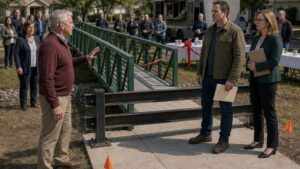
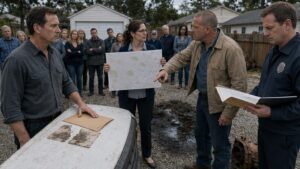
The HOA meeting room had once been the development’s sales office. Twelve folding chairs faced a long table beneath framed photographs of the cul-de-sac when its trees were young and every roof looked identical. Nearly every chair was occupied.
Heads turned toward Paul.
“I haven’t threatened anyone,” he said.
Eric lifted a copy of Joseph’s certified notice. “Your attorney states that continued use of the irrigation line is unauthorized.”
“That is not a threat. It is a legal position.”
A homeowner near the door asked, “Can you shut it off or not?”
Paul saw fear beneath the irritation. The lawns were decorative, but the residents had paid for them through dues, mortgages, and years of assessments. The question was not really about grass. It was about whether something they believed stable had suddenly become dependent on a man they barely knew.
Eric answered for him. “The association will not permit one property owner to hold twelve families hostage.”
Paul placed the expired agreement on the table. “Your board drove a front loader through my greenhouse while I was inside.”
“The contractor was informed the building was vacant.”
“By whom?”
Eric ignored that. “The structure had been cited repeatedly.”
“My property is outside the association.”
“The greenhouse occupies a disputed setback corridor and creates a safety and appearance impact on common property.”
“Then why didn’t you obtain an injunction?”
A murmur moved through the room.
Eric pressed a button on a laptop. A parcel diagram appeared on the wall. A red line crossed Paul’s property from the pump house toward the cul-de-sac. At its source, someone had marked a single circular symbol.
MAIN SHUTOFF.
The valve.
Paul felt every eye move from the diagram to him.
Eric said, “This line has served the community for nearly forty years. The board has a duty to preserve essential services.”
“It serves landscaping.”
“It also feeds common-area reserves.”
“That was never disclosed to me.”
“It was part of the original development plan.”
Mary Hill, seated at the end of the board table, adjusted her glasses. She had a calculator beside her and three folders arranged by color.
“Eric,” she said, “where is the current title opinion?”
He did not look at her. “Management reviewed the recorded documents.”
“I asked for the attorney’s title opinion.”
“The board relied on the compliance file.”
Mary opened a folder. “The file contains a survey from 1994 and the original irrigation agreement. It does not contain the extension Paul’s attorney attached.”
Another board member leaned toward her. “You’re saying we didn’t verify whether it was still active?”
“I’m saying I can’t find verification.”
The room changed. Not dramatically. No one stood or shouted. But several homeowners stopped looking at Paul as if he had carried a weapon into the meeting.
Eric folded his hands. “The absence of one memorandum does not invalidate decades of established use.”
“No,” Paul said. “The expiration date does.”
Eric turned to him. “You ignored renewal correspondence.”
Catherine had warned Paul that this would surface. He had still hoped it would not happen in a room full of strangers.
“I did.”
The sympathy that had begun to move toward him paused.
Eric seized it. “Three certified attempts. No response. No counterproposal. Then, after an enforcement action, Mr. Nelson suddenly discovers he owns the neighborhood’s water.”
“I always knew where the line ran.”
“But you let people rely on it.”
Paul’s jaw tightened. “You want to discuss reliance after demolishing my greenhouse without a current survey?”
A woman in the second row said, “Can both things be wrong?”
No one answered immediately.
Mary looked down at her folders. “We need to discuss exposure.”
Eric’s expression sharpened. “The board is already addressing it.”
“With what money?” Mary asked.
The question was quiet enough that several people leaned forward.
Eric said, “That is a separate budget matter.”
“It isn’t separate if the association is liable for structural damage.”
Mary removed a spreadsheet. “Our insurance carrier has reserved rights because the demolition may have exceeded the policy’s authorized-abatement provision. If coverage is denied, repairs could require a special assessment.”
“How much?” someone asked.
Mary hesitated.
Eric said, “No figure has been established.”
“How much, Mary?”
“Depending on the greenhouse estimate, between four and seven thousand dollars per home.”
The room broke into overlapping voices.
Eric raised both hands. “This is exactly why the board acted. We have had two years of complaints about the structure, drainage, broken panes, and appearance. Buyers have asked whether it is a commercial operation. Owners have demanded enforcement. Delaying further would have signaled that rules mean nothing.”
Paul studied him.
For the first time, Eric did not sound smug. He sounded cornered. He had promised the residents that order could be maintained without costing them more. The greenhouse had become the test of that promise.
But pressure did not explain sending a machine into an occupied building.
“You could have gone to court,” Paul said.
“And spent association funds for another year while the property deteriorated?”
“You could have called me.”
“We did.”
“You sent forms.”
“We sent offers.”
“Offers to take thirty years of access for less than the pumping cost.”
“Offers you never answered.”
Mary placed a hand on the spreadsheet. “We need temporary arrangements now. Paul, would you allow continued irrigation for thirty days while we investigate, if the board suspends enforcement?”
Paul looked at Eric.
“Withdraw the fines,” he said. “Pay for emergency stabilization of the greenhouse. No one enters my property without written permission.”
Eric shook his head. “We cannot concede liability before the insurer completes review.”
“You conceded enough when you sent the machine.”
“We can suspend new fines,” Mary offered.
“Withdraw all of them.”
“Paul,” Catherine said from the back row.
He did not turn.
Mary lowered her voice. “A temporary license protects everyone while we sort out what happened.”
Paul saw again the steel bench folding where he had been standing. He saw the brass plant tag beneath glass. He heard Eric saying people who fought the board spent more than people who cooperated.
“No access,” Paul said, “until the fines are withdrawn and the greenhouse is secured.”
The homeowners began speaking over one another again.
Eric waited until the noise weakened.
“Then the association will protect its system without entering your greenhouse.”
Paul looked at the diagram on the wall.
Eric clicked to the next slide. A proposed bypass line appeared in blue, curving around the damaged structure and crossing the lower orchard.
“Emergency contractors will begin at seven tomorrow morning,” Eric said. “The new connection will remove Mr. Nelson’s ability to interfere with community service.”
Paul stood slowly.
“That route crosses my land.”
Eric closed the laptop.
“The association’s records say otherwise.”
Chapter 4: The Morning the Sprinklers Stopped
The orange survey paint appeared across Paul’s orchard before sunrise.
It began at the county road, crossed the gravel shoulder, and continued in a bright line between two rows of old apple trees. Someone had marked arrows every twenty feet. At the far end, beside the pump house, a wooden stake carried a strip of blue ribbon and the words PROPOSED BYPASS.
Paul stood over it in work boots and yesterday’s shirt.
Headlights turned into the drive.
Two white utility trucks stopped at the property edge. A compact excavator arrived behind them on a trailer. Three workers climbed out, followed by a civil engineer holding a rolled plan beneath one arm.
Eric stepped from his own vehicle last.
“You were told seven,” Paul said.
“It is seven.”
Paul looked at his watch. “It’s six forty-three.”
“We’re staging equipment.”
“On my land.”
Eric pointed toward the orange line. “The association’s survey places this corridor within its utility rights.”
“Which survey?”
“The one you challenged last night.”
“The one from 1994?”
The engineer unrolled the plan over a truck hood. “Mr. Nelson, we’re not here to argue ownership. We have a work order for a temporary irrigation bypass.”
“Show me the permit.”
He hesitated. “We have authorization from the association.”
“That isn’t a county permit.”
Eric stepped closer. “The board has emergency authority to preserve community infrastructure.”
Paul pulled a folded parcel map from his back pocket. Joseph had emailed the certified copy before dawn. Paul opened it and laid it over the engineer’s plan.
The boundary line followed an old stone wall thirty feet east of the painted route.
The engineer traced it with one finger.
“This map has a newer recording number,” he said.
Eric’s face remained still. “Our surveyor confirmed the corridor.”
“Your surveyor confirmed a line from before the orchard parcel was corrected,” Paul said. “The county adjusted it in 2006.”
The engineer looked at Eric. “I wasn’t given this.”
“You have it now,” Paul said.
One of the workers had already unloaded marking flags. Paul watched him stop and wait.
Eric lowered his voice. “You are obstructing essential maintenance.”
“You are attempting to excavate without a permit across land you do not own.”
“The association will seek damages for every day service is interrupted.”
“Service hasn’t been interrupted.”
“Yet.”
The word settled between them.
Paul looked past Eric toward the cul-de-sac. Sprinklers turned over the nearest lawns, bright in the early light. The line beneath his orchard carried the pressure. He could feel its faint vibration through the sole of his boot.
The engineer rolled up his plan.
“Until this boundary discrepancy is resolved, I’m not putting a machine in the ground.”
Eric stared at him. “You have a contract.”
“I also have insurance.”
The workers began loading the flags.
For one brief moment, Paul felt the pressure leave his chest. The trucks would go. The orchard would remain uncut. Eric’s bypass would fail before it began.
Then Eric said, “This changes nothing. We’ll return with an order.”
Paul bent, pulled the blue-ribbon stake from the soil, and handed it to him.
“Bring the order.”
The trucks left one by one. Eric remained at the road until the excavator disappeared, then climbed into his vehicle without another word.
Paul watched him drive toward the cul-de-sac.
The sprinklers were still running.
He went to the pump house.
Inside, the air smelled of rust and damp stone. Morning light slipped through the wall vents and touched the red valve wheel. The copper tag bearing his grandfather’s name hung motionless beneath it.
Paul placed both hands on the wheel.
It did not move.
He braced one boot against the concrete base and pulled. Rust grated inside the stem. The wheel shifted less than an inch.
He found a can of penetrating oil on the shelf, worked it into the threads, and tried again.
This time the wheel turned.
A deep vibration traveled through the pipe. Outside, water continued rushing toward the neighborhood.
Paul stopped after a quarter turn.
His phone rang.
Joseph.
“Tell me the contractors are gone,” the attorney said.
“They’re gone.”
“Good. Then do nothing else.”
“They’ll come back.”
“Maybe. But now we have evidence they attempted entry under an outdated survey. That helps.”
“They’ll get another paper.”
“And we challenge it.”
“While the fines climb.”
“Fines can be reversed.”
“The orchids can’t.”
Joseph was silent for a moment. “Paul, listen carefully. The written easement expired. That gives you leverage. But the association has relied on this supply for decades. If you shut it down completely and damage results, they may argue implied rights, estoppel, emergency necessity, even negligence depending on what the line serves.”
“It serves sprinklers.”
“You heard Eric mention reserves.”
“He uses words when he wants people afraid.”
“Maybe. Verify before you act.”
Paul looked at the wheel beneath his hands.
“They brought an excavator into my orchard.”
“And the contractors left because you used the map. That was the right move.”
“The right move didn’t stop the demolition.”
“No. But the wrong move could make you responsible for what happens next.”
After the call, Paul stood in the pump house for several minutes.
He remembered the sound of the greenhouse frame collapsing. He remembered Eric placing the cleanup invoice over a broken bench as if it were a restaurant check. He remembered the roomful of homeowners listening while Eric described him as a threat.
The valve waited.
Paul turned it.
The wheel moved slowly at first, then more freely as the stem descended. Water hammered once inside the pipe. The pressure gauge trembled.
Outside, the nearest sprinkler completed half an arc.
It clicked.
Instead of returning, it shuddered in place. The spray narrowed to a weak white rope, then fell against the grass.
Across the cul-de-sac, other heads began to cough.
One dropped into the ground. Another spat twice. A third continued turning without water, its gears ticking in the sudden quiet.
Paul kept turning until the valve seated.
The pipeline went still beneath his feet.
He looked down at his hands. Rust had marked both palms.
There was no triumph in the pump house, only silence and the metallic smell of old water.
By noon, the first residents had gathered near the common green. Eric stood beside the irrigation controller, opening and closing the same panel as if repetition might restore pressure.
Paul watched from his property.
Catherine arrived carrying tarps for the greenhouse. She heard the dry clicking before she reached him.
“You did it,” she said.
“They entered the orchard.”
“They left.”
“They’ll come back.”
“So you shut off twelve homes?”
“Their landscaping.”
“You don’t know what else.”
Paul lifted one end of the tarp. “Joseph is checking.”
“He told you not to close it, didn’t he?”
Paul did not answer.
Together they pulled the tarp over the greenhouse roof. Wind caught it, snapping the plastic above them.
By the third day, the lawns had begun to change. Not dramatically. A gray cast appeared at the edges where the grass was shortest. Flower beds curled inward. The common green lost its polished shine.
Residents left handwritten notices on Paul’s gate.
RESTORE OUR WATER.
CHILDREN LIVE HERE.
THIS IS NOT JUST ERIC’S PROBLEM.
He collected them without replying.
Late that afternoon, Mary Hill walked up the drive. She did not carry a board folder. Her hair was loose, and dust marked the knees of her slacks.
“The contractors shouldn’t have crossed your orchard,” she said.
Paul waited.
“I told Eric the route needed another review.”
“But you came about the valve.”
“Yes.”
“Then say it.”
Mary looked toward the dry common green. “The reserve tank beside the clubhouse is supplied from the irrigation main.”
“For sprinklers.”
“For the landscaped areas, yes.”
“You said reserve.”
“There’s a common-area fire line connected to it.”
Paul’s grip tightened on the gate.
“The hydrants?”
“No. Municipal hydrants are separate. But the clubhouse, storage building, and common green have a supplemental line. The tank is nearly empty.”
“Why wasn’t that in the agreement?”
“I don’t know.”
“Why wasn’t I told?”
“I don’t know that either.”
Mary looked at the locked pump house.
“If there’s a brush fire along the dry green,” she said, “the system may not pressurize.”
The notices in Paul’s hand stirred in the hot wind.
Chapter 5: What Eric Told the Board
The child stood outside Paul’s gate holding a dead strip of sod.
He was perhaps nine, barefoot on the warm pavement, with dirt across one cheek. The rectangle of grass hung from his hands like an old rug.
“Are you killing everyone’s yards?” he asked.
An adult called from a nearby driveway, but the child did not move.
Paul looked at the brittle roots.
“No.”
“My dad says you turned off the water.”
“I did.”
“Then you are.”
The child dropped the sod beside the gate and ran back toward the cul-de-sac.
Paul remained where he was.
Behind him, the locked pump house sat beneath the orchard trees. Someone had tied a red ribbon to the chain overnight. The ribbon carried one word in black marker.
SELFISH.
By the fourth day, the valve had become the neighborhood’s only subject. Residents argued beside mailboxes and beneath the dry clubhouse awning. Some blamed Paul. Some blamed Eric. Most blamed whichever man was not standing near enough to hear them.
Mary called just before noon.
“I have something you need to see.”
Her house was the third on the right, one of the few with curtains still open. The lawn had faded from green to a dull yellow-brown. A hose lay coiled beside the garage, useless under the HOA’s outdoor watering restrictions.
Mary led Paul to her dining table. Board binders covered the surface.
“I voted for enforcement,” she said before he sat down.
“I know.”
“I need you to know why.”
She opened a printed email chain.
The first message was from Paul, dated nearly eight months earlier. He remembered writing it after a winter storm loosened two greenhouse panels.
It proposed replacing the damaged glass, repainting the exterior frame, installing privacy screening along the HOA side, and negotiating a new irrigation fee after the work was complete.
Paul read his own final line.
I am not agreeing to removal, but I am willing to meet about repairs and access.
The next email was Eric’s response to the board. It did not include Paul’s proposal.
It said only:
Mr. Nelson has again rejected voluntary compliance and refuses meaningful discussion.
Paul looked up.
Mary folded her hands. “That was the version we received.”
“There were attachments.”
“We didn’t receive them.”
She showed him another chain. An insurance representative had asked whether the board possessed current authority to enter Paul’s property. Eric answered that the compliance agreement and survey had been reviewed.
A board member then asked whether association counsel had confirmed that.
Eric replied:
Legal review is unnecessary for emergency abatement within the established corridor.
Mary turned another page.
Two days later, Eric authorized the contractor.
“There was no emergency inspection,” she said. “No engineer’s finding. Just photographs of cracked glass and complaints about appearance.”
Paul read the sentence twice.
“Why are you showing me?”
“Because I kept telling myself the process had been followed. I didn’t want another special assessment. My husband’s work hours were cut last winter. We can’t absorb five thousand dollars because the board made a mistake.”
“That explains your vote.”
“It doesn’t excuse it.”
“No.”
Mary accepted the word without flinching.
She pushed a second folder toward him. “Two board members will support withdrawing the fines and paying for stabilization. They’ll also support a thirty-day water license while mediation happens.”
“Eric?”
“He says restoring service without a release would expose the association.”
Paul almost laughed. “He wants me to release them before they repair anything.”
“He wants control of the sequence.”
“He’s had control of the sequence.”
Mary’s expression tightened. “And you have control of the valve.”
The red ribbon outside the pump house came back to him.
“Is the fire reserve truly at risk?” he asked.
“The tank is low. The municipal system still covers the homes. But the dry common green increases the risk every day.”
Paul closed the folder. “The board withdraws the fines. Written repair funding. Temporary license at an actual operating rate.”
“I can bring that to them.”
“No entry onto my land without notice.”
“Yes.”
“And Eric doesn’t speak for me again.”
Mary gave a tired nod. “That may be the hardest condition.”
When Paul returned to the greenhouse, Catherine was standing beneath the temporary tarp with a clipboard. She had arranged the surviving plants by condition: stable, salvageable, unlikely.
The old orchid crown rested beneath shade cloth in a shallow tray.
“You went to Mary’s,” she said.
“She had the board emails.”
“And?”
“Eric lied about my repair proposal.”
Catherine checked moisture in a tray without looking at him. “That matters.”
“Two board members may support a settlement.”
“That matters too.”
Paul waited for relief to appear in her face. It did not.
“What?” he asked.
She set down the clipboard.
“I met with a real-estate attorney in May.”
The tarp snapped above them.
“For what?”
“To understand partition.”
Paul stared at her.
“You don’t own enough to force a sale.”
“I inherited one-third of the property when Grandma died.”
“You said you didn’t want it.”
“I said I didn’t want to operate the greenhouse.”
“That isn’t the same as selling.”
“It became the same when you stopped telling me the truth.”
Paul glanced toward the house, as though the hidden bills might be visible through the wall.
Catherine continued. “The unpaid supplier account. The electric notice. The insurance premium. You knew the operation was failing and let me believe the books were current.”
“I was waiting on the summer orders.”
“You were waiting for something to rescue you so you wouldn’t have to ask.”
“I didn’t ask you to carry this place.”
“No. You made sure I couldn’t choose.”
The words cut more cleanly than Eric’s accusations.
Paul stepped toward the damaged bench and adjusted a tray that did not need adjusting.
“My mother asked me to keep the orchid line here.”
“She asked you to protect it.”
“That is what I’m doing.”
“Is it?” Catherine pointed toward the temporary shade cloth. “That plant survived because you moved it. Not because the old glass stayed standing.”
He looked at the crown. A single firm root curved against the damp bark.
“You want to sell the land to them,” he said.
“I want options.”
“To the HOA?”
“To anyone who can keep us from losing it to debt.”
Paul felt the old refusal rise in him—the instinct to close every door before anyone could step through it.
Catherine saw it.
“If you refuse mediation,” she said, “I will file for a partition sale.”
“You would break up your grandmother’s property.”
“You already broke up the family part. You just did it quietly.”
She picked up her clipboard and walked out beneath the torn edge of the tarp.
Paul remained among the rows of damaged plants.
Outside, a sprinkler head clicked dry in the heat.
Chapter 6: The Orchid That Refused to Die
A green point had emerged from the damaged orchid crown.
It was no longer than a grain of rice, tucked between two scarred tissues where the oldest leaves had been torn away. Paul bent close enough that his breath moved the shade cloth.
Catherine stood across the temporary bench.
“New growth,” she said.
Paul touched the edge of the tray, not the plant. “It may not hold.”
“It may.”
The crown had lost most of its roots, but one remained firm. New tissue had formed beside it. The plant would never look as it had beneath his grandmother’s glass, yet it had begun again without asking permission from memory.
Catherine set a notebook on the bench.
“I made a list of every debt,” she said. “All of them. Not only the ones I knew about.”
Paul straightened.
She opened the notebook. Supplier balance. Electricity. Insurance. Equipment lease. Back taxes on the unused parcel. The total sat at the bottom of the page.
He did not dispute it.
“If the settlement covers only restoration,” she said, “we still have a failing business.”
“I know.”
“That is the first time you’ve said that.”
Paul looked at the green point on the orchid.
“I thought if I got through one more season, I could fix it without changing anything.”
“That was never possible.”
“No.”
Catherine turned the page. “I will help rebuild. But the accounts stay open to both of us. We reduce the greenhouse footprint. We stop pretending every plant must remain here forever. We propagate the old lines and sell divisions.”
“You want to cut them.”
“I want them to survive.”
The sentence sounded like something his grandmother might have said with a knife in one hand and a root mass in the other.
Paul closed the notebook.
“All accounts,” he said. “No separate drawer.”
Catherine nodded. “And mediation.”
“Yes.”
Joseph’s office smelled of paper and burned coffee. He had arranged three possible paths on a legal pad.
“First,” he said, “you reopen without conditions and preserve your claims separately.”
“No.”
“Second, you maintain the closure and seek a declaratory judgment. That could take months. The HOA will seek emergency relief, and the fire-reserve issue gives them a stronger argument than they had last week.”
“Third?”
“A temporary paid license tied to specific conditions. Repair escrow. Withdrawal of fines. No admission that the expired easement continues. Independent survey. Insurance disclosure. Governance safeguards for future access.”
Paul studied the list.
“What rate?”
“Enough to cover electricity, pump maintenance, testing, and reserve replacement. Not a punishment rate.”
“They’ll call any rate punishment.”
“Then let them explain why free use became an entitlement.”
Joseph turned the pad around.
“The strongest settlement does not come from demanding everything. It comes from demanding terms you can defend when everyone is angry.”
Paul read the proposed conditions.
“What happens to Eric?”
“That is the board’s decision.”
“He authorized the demolition.”
“And you can require acknowledgment of that in the settlement. You cannot write his resignation into a water license.”
Paul leaned back.
Joseph watched him. “You want the sequence reversed. You want him powerless before you restore service.”
“He stood over crushed plants and handed me a bill.”
“I know.”
“No, you know the sentence. You weren’t there.”
“You’re right.”
Joseph capped his pen.
“But if you make restoration depend on humiliation, then the valve is no longer protecting your property. It is serving your anger.”
Paul looked toward the window.
Across the street, a city sprinkler watered a strip of grass beside the courthouse. The spray drifted over the sidewalk and darkened the concrete.
That afternoon, Paul carried oil and a wrench to the pump house.
He unlocked the chain. The red SELFISH ribbon had been removed, though a faded mark remained where it had rubbed against the metal.
The valve wheel resisted when he tried to turn it back.
He worked oil into the stem, waited, then moved it a fraction.
Water struck the pipe with a low thud.
He stopped before pressure reached the neighborhood main. A smaller branch line fed the reserve tank. He opened that line enough to begin a slow refill, then photographed the gauge and sent the reading to Joseph and Mary.
Emergency reserve only, he wrote. No landscape irrigation until written terms.
Mary replied within minutes.
Understood. I will notify the board.
Catherine arrived carrying a tray of salvaged orchid divisions.
“You opened it?”
“Part of it.”
“For the fire line?”
“Yes.”
She set the tray down. “That was the right thing.”
Paul wiped the wrench on a cloth. “It doesn’t feel like winning.”
“Maybe that helps.”
By the ninth day, the common green had turned the color of straw. Several homeowners had placed hand-lettered signs near the clubhouse demanding an open meeting. One read REMOVE ERIC. Another read OPEN THE WATER. A third said BOTH MEN NEED TO STOP.
Paul stood at the edge of the green with Mary.
“The board will accept mediation,” she said. “Two members are ready to vote for repair escrow.”
“And Eric?”
“He says your partial opening proves you always had the ability to restore service and chose not to.”
“That is exactly what I chose.”
Mary looked at him. “He plans to say that publicly.”
“Let him.”
“He also plans to argue that property values are falling because of you.”
A real-estate sign had appeared outside one of the houses that morning. The lawn beneath it was brown.
Paul watched the sign shift in the heat.
“Will he attend mediation?” he asked.
“He rejected it.”
“Then there won’t be private mediation.”
Mary waited.
Paul turned toward the pump house. “Call an emergency open meeting.”
“Where?”
“Here.”
“On the common green?”
“At the valve.”
Mary’s eyebrows rose.
Paul took out his phone and called Joseph.
“I want the terms drafted tonight,” he said when the attorney answered. “Repair escrow. Paid temporary license. Independent survey. Full insurance file. No fines. No entry without notice.”
“And if they refuse?”
“They refuse in front of everyone.”
“And the water?”
Paul looked at the brown lawns, the old pump house, and the greenhouse tarp beyond the orchard.
“I’ll put my hand on the valve,” he said. “Then the board can decide what happens when I turn it.”
Chapter 7: The Terms Attached to the Water
The emergency meeting gathered on dead grass.
Folding chairs had been arranged beside the pump house because the clubhouse lawn no longer supported stakes. The ground cracked beneath shoes. Brown blades broke loose and collected against the chair legs.
Paul stood beside the red valve wheel with Joseph on one side and Catherine on the other.
Across from them, Eric Moore placed a thick folder on a portable table.
“You do not get to conduct association business from private property,” Eric said.
Mary Hill looked toward the line of residents stretching along the gravel drive. “The board voted to hold an open emergency session here.”
“Two members voted without proper notice.”
“The bylaws permit emergency notice when essential service is affected.”
Eric’s eyes moved to the valve. “Essential service. At least we agree on that now.”
The municipal hydrants still worked. Household taps still ran. But eleven days without irrigation had changed the neighborhood enough that no one needed a diagram. Shrubs had browned at their edges. Flower beds had collapsed. The common green resembled cut straw.
A real-estate sign stood beyond the chairs.
Paul had noticed homeowners looking at it whenever the discussion became quiet.
Mary called the meeting to order.
Eric spoke first.
He described the shutoff as intentional interference with community infrastructure. He listed landscaping losses, emergency engineering fees, and the decline in buyer interest. He said Paul had possessed the physical ability to restore service every day and had refused.
Several residents nodded.
Eric opened his folder. “The association is prepared to pursue injunctive relief and personal damages unless full service is restored immediately and without condition.”
Joseph leaned toward Paul. “Do not answer the threat. Read the statement.”
Paul had written three pages the night before. He had crossed out every line that sounded like an argument.
He unfolded the first page.
“The recorded irrigation agreement expired four years ago,” he said. “The HOA continued using my family’s well and line without a renewed written agreement.”
Eric started to interrupt.
Mary raised a hand. “Let him finish.”
Paul continued. “The board then relied on an outdated survey and an expired agreement when it authorized demolition work on my property. That work destroyed part of my greenhouse while I was inside.”
No one moved.
“The board’s actions were wrong,” Paul said. “But I left out something when I first raised the easement issue.”
Catherine looked at him.
Paul held up copies of the certified letters.
“I received renewal requests. I did not open them. I did not respond. I believed the proposed terms were unfair, and instead of saying that, I ignored them.”
A man in the second row muttered, “So you knew.”
“I knew they wanted a renewal. I did not know the association believed the old agreement still controlled. I should have answered. I should also have told my daughter the greenhouse was carrying debt it could not sustain.”
His voice nearly caught on the final sentence. He let the pause remain.
“I am not accepting responsibility for the demolition,” he said. “I am accepting responsibility for silence that made the dispute easier to misunderstand and harder to resolve.”
The residents did not applaud. Paul was grateful for that.
Eric folded his arms. “A useful admission.”
“It is,” Joseph said. “Because it distinguishes negligence in communication from deliberate entry and destruction.”
Eric turned toward him. “This is not a courtroom.”
“No,” Mary said. “Which means we can still choose not to become one.”
She opened her own folder.
“I need to read an email into the record.”
Eric’s posture changed.
Mary read the date first. It was two days before the demolition.
Then she read Eric’s message to the contractor:
Proceed with emergency abatement within the established corridor. Legal review can follow. The owner has rejected cooperation, and further delay will undermine board authority.
A low murmur passed through the chairs.
Mary lifted a second page.
“This was written after the insurer asked whether counsel had confirmed the association’s right of entry. No confirmation had been obtained.”
Eric reached for the paper. “That message is being taken out of context.”
Mary drew it back.
“What context changes ‘legal review can follow’?”
“The structure was dangerous.”
“Where is the engineer’s report?”
“The board had photographs.”
“Where is the occupancy verification?”
“The contractor was told the building was inactive.”
“By you?”
Eric’s face reddened. “I acted because owners had demanded action for two years. The board was losing credibility. Our reserves were already strained, and every additional legal delay would have meant another assessment.”
His voice had lost its polished calm.
“You all wanted it handled,” he said, looking at the residents. “You complained about broken panes, runoff, commercial traffic, resale questions. Do not stand there now and pretend I invented the pressure.”
A woman near the aisle looked down.
Another homeowner said, “We wanted enforcement. We didn’t authorize a bulldozer while he was inside.”
“I was told it was empty.”
“You chose not to check,” Mary said.
Eric turned back to Paul. “And he chose to punish every family here.”
Paul looked at the valve.
“That is why I called this meeting.”
Joseph distributed copies of the proposed agreement.
Paul spoke each term aloud.
The HOA would withdraw all fines and the cleanup assessment. It would place repair funds in escrow before entering the greenhouse property. An independent survey would establish the corridor. The association would provide its insurance and authorization records. Future access would require written notice except in a documented emergency.
The old easement would not be revived.
Instead, Paul would grant a temporary paid water license covering electricity, pump maintenance, testing, and reserve replacement. The license would contain an annual review, emergency access procedures, and a clear termination process.
A homeowner asked the amount.
Paul stated it.
The figure was higher than the old developer’s offer but lower than the cost of a municipal connection.
Eric shook his head. “This is extortion under pressure.”
“No,” Joseph said. “It is a proposed license after the prior written right expired.”
“The board cannot agree tonight.”
Mary looked toward the other two board members.
“We can authorize the temporary terms and escrow subject to final drafting.”
One member raised her hand. The second followed.
Mary added her own.
Eric stared at them. “You are exposing every homeowner here.”
“We are already exposed,” Mary said. “The question is whether we continue.”
He pushed away from the table.
“I will sue him personally. I will challenge this vote. And I am not resigning because three people lost their nerve.”
No one answered him.
Mary turned to Paul. “The temporary terms are approved.”
Joseph touched Paul’s arm. “Wait for signatures.”
Paul rested his hand on the valve wheel.
Eric gave a short, bitter laugh. “There it is. He still needs everyone to watch.”
Paul looked at the dead grass and the real-estate sign beyond it. He thought of the child holding the strip of sod. He thought of his grandmother cutting a healthy orchid apart because keeping it whole would have killed it.
Then he turned the wheel.
Water struck the pipe with a deep, traveling thud.
The pressure gauge lifted.
Far across the cul-de-sac, one sprinkler rose from the ground and released a weak burst. Another followed. The lines filled slowly, coughing air before water reached them.
Eric’s unsigned folder still lay on the table.
Paul opened the valve fully.
Chapter 8: New Glass Above the Old Well
The first replacement glass panel reflected the old pump house and the HOA rooftops in the same bright rectangle.
Paul noticed it before the installer secured the final clip.
For years, the greenhouse glass had reflected only sky, orchard branches, and the weathered side of the equipment shed. The new structure was smaller. Its western wall ended twenty feet before the old foundation did, leaving a strip of cracked concrete exposed between the frame and the property line.
From that angle, the cul-de-sac could no longer be excluded from the view.
“Hold it steady,” the installer said.
Paul pressed one gloved palm against the panel while the metal fastener tightened.
Three months had passed since the valve meeting.
The settlement had not restored everything.
The HOA’s insurer accepted part of the demolition claim but disputed the value of several mature plants. The board funded emergency cleanup and structural replacement, yet the final amount covered only a reduced greenhouse footprint. Paul and Catherine used supplier credit and the first water-license payment to complete the shade system and propagation benches.
The remaining old foundation would become outdoor growing space.
Catherine called it practical.
Paul had needed several weeks to stop hearing the word as an insult.
Inside, new aluminum benches stood in two clean rows. Surviving orchids occupied the shaded eastern side. Empty trays waited beneath the misting lines.
Catherine sat at the potting table with the recovered orchid crown in front of her.
The plant had produced two new roots and a narrow leaf. Its damaged tissue remained visible beneath the fresh growth.
She tied a white label to the container.
NELSON LINE
ORIGINAL DIVISION — 1972
RECOVERED — JULY
Paul read it over her shoulder.
“You left out her name,” he said.
“I’m putting it on the propagation ledger.”
“She wrote names on everything.”
“She also reused labels until there wasn’t room.”
Paul picked up the bent brass tag from the table. The original stamped date was still barely readable.
Catherine held out her hand.
He gave it to her.
She fixed the brass tag beside the new label instead of replacing it.
“That better?” she asked.
“Yes.”
They had divided the surviving crown the previous week. One section remained in the greenhouse. The second would be grown under controlled conditions and sold only after it established enough roots to divide again.
Paul had resisted the plan until Catherine showed him the numbers.
One plant preserved in one building was a risk.
A living line spread carefully among several growers was a future.
Outside, a truck stopped near the pump house.
Mary Hill climbed out carrying an envelope.
She no longer served as treasurer alone. After the board’s internal review, she had been elected acting president until the next annual meeting. Eric remained a homeowner and had filed formal objections to the settlement vote, but the association’s attorney declined to support his attempt to invalidate it.
He had not resigned voluntarily.
The board removed him from executive authority after reviewing the contractor communications.
Mary crossed the gravel and handed Paul the envelope.
“The first license payment,” she said. “I thought mailing it would seem strange.”
Paul opened it enough to see the association check.
“You could have left it with Catherine.”
“I could have.”
They stood beside the pump house.
The red valve wheel had been cleaned but not repainted. Rust remained in the grooves. Beneath it, Joseph’s final agreement hung in a sealed document sleeve alongside a laminated operating protocol.
Two locks had been installed on the outer access box. Paul held one key. The association’s emergency manager held the other under written restrictions.
A yellow inspection tag carried the date of the next annual test.
Mary looked toward the cul-de-sac. “The north lawn may not come back.”
Several properties had recovered after irrigation resumed. Others still showed broad brown patches where roots had died. The common green had been reseeded but remained thin.
The house with the real-estate sign was under contract.
“Did they sell because of this?” Paul asked.
“They were considering it before. This made the decision easier.”
Paul folded the envelope.
Mary rubbed one thumb over the edge of her folder. “Some residents still think the board gave you too much.”
“Some think I kept the valve closed too long.”
“Yes.”
“They may be right.”
Mary looked at him, surprised by the absence of argument.
“Some think I should have opened it without terms,” he added. “They may be wrong.”
“That sounds inconvenient.”
“It is.”
She glanced through the greenhouse door. “It looks good.”
“It looks smaller.”
“It is smaller.”
Paul almost smiled.
Mary had brought another document: the independent survey. The corrected boundary followed the old stone wall, as Paul had said. The disputed utility corridor did not include the orchard route Eric had marked.
The greenhouse itself had never stood within HOA property.
But two inches of its former gutter had crossed an old drainage setback.
That minor violation had existed for years. It would have justified a repair notice, not demolition.
The truth did not clear Paul completely or condemn him completely. It merely reduced the space available for convenient stories.
Mary left after signing the payment receipt.
Paul carried the check into the greenhouse and placed it beside Catherine’s ledger.
“We can pay the electric balance,” she said.
“And the supplier.”
“Half the supplier.”
“Electric first.”
She entered the amount without asking whether he was certain.
That quiet trust felt less dramatic than winning the board vote and more valuable.
In the weeks that followed, the greenhouse resumed work slowly.
Paul no longer tried to replace every lost plant. He selected lines that could support a smaller operation: heirloom orchids, hardy divisions, and a limited number of specialty orders. Catherine built a waiting list and insisted on deposits.
They held weekly account reviews at the kitchen table.
The first time Paul reached for a drawer to store an unpaid statement, he stopped and placed it in the shared folder instead.
Catherine saw him do it.
She said nothing.
By early fall, the first propagated division from the recovered orchid produced a new root tip. Catherine photographed it for the sales ledger, not for the neighborhood or social media.
Paul printed the image and set it beside the old brass tag.
On the annual valve-test morning, the sky was clear and the restored lawns were wet with dew rather than irrigation.
Catherine met Paul at the pump house.
She carried the new access key on a plain steel ring.
The association’s emergency manager waited outside with the testing sheet. Mary stood near the road, giving them space.
Paul unlocked the first box.
Catherine opened the second.
Inside, the red wheel sat above the pressure gauges. The copper tag beneath it still read SAMUEL NELSON — MAIN IRRIGATION — 1961.
Paul touched the tag.
His grandfather had installed the valve to send water beyond the property, not to hold it back. Over time, the agreement had become neglected, then assumed, then weaponized by both sides.
The metal itself had done nothing.
Hands gave it meaning.
Catherine read the procedure.
“Close to seventy-five percent. Hold for thirty seconds. Reopen gradually while they confirm pressure.”
Paul stepped aside.
“You turn it.”
She looked at him. “You always do the annual test.”
“Not anymore.”
He placed the key ring in her palm.
For a moment, she held both the old pump-house key and the new access key together.
Then she gripped the wheel.
It resisted at the first pull. Paul nearly reached forward, but Catherine shifted her stance and tried again.
The valve moved.
Water slowed inside the pipe. The gauge descended in a controlled arc. Outside, the emergency manager called out the pressure reading.
Catherine held the wheel steady.
Paul looked through the open pump-house door.
Beyond the orchard, the HOA roofs rose above the trees. Behind him, new greenhouse glass caught the morning light. On the nearest bench, the recovered orchid stood beneath its old brass tag and its new white label.
“Thirty seconds,” the emergency manager called.
Catherine began reopening the valve.
This time, Paul did not place his hand over hers.
The water returned gradually, passing beneath the orchard toward the neighborhood.
The gauge settled.
Catherine removed the key and gave one back to Paul.
He closed her fingers around it.
“Keep it,” he said.
She looked at the worn key, then at him.
“All right.”
They locked the pump house together and walked toward the greenhouse, leaving the valve open behind them.
The story has ended.