The HOA Threatened His Garage Until an Old Survey Put Their Clubhouse on His Land
Chapter 1: The Orange Mark Beside Michael’s Garage
The orange paint had not been there when Michael Thomas left for work.
Now it ran in a bright, crooked line across the gray concrete at the base of his detached garage, stopping beneath the corner post as if someone had marked the place for a saw.
Michael remained behind the steering wheel with the engine running. His lunch cooler sat on the passenger seat. The digital clock on the dashboard read 7:12 a.m. He had come home because a container shipment had been delayed and his supervisor had moved the morning conference call back an hour. Nothing about his schedule explained the three people standing beside his garage.
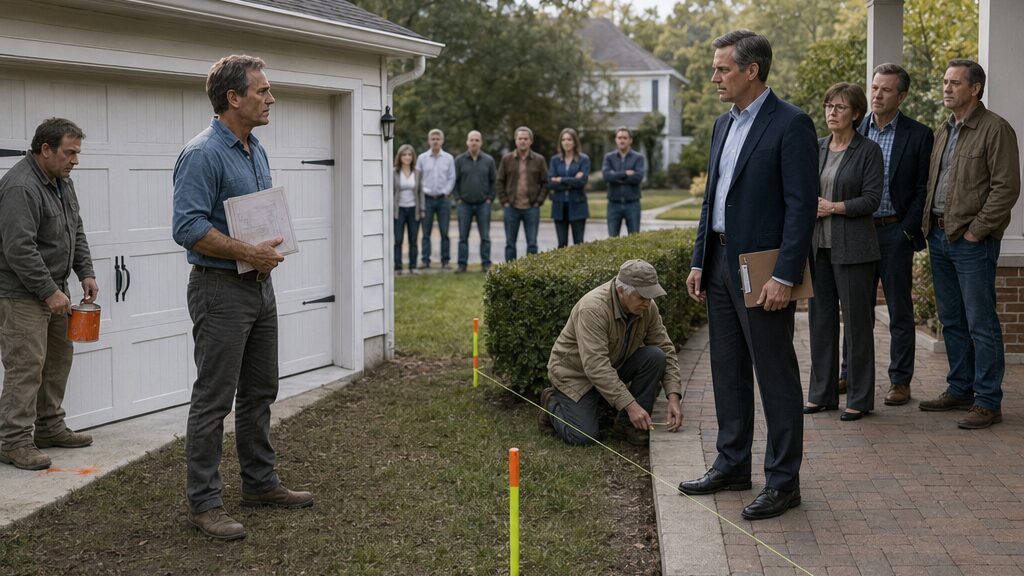
Patrick Miller held a clipboard against his chest. Two HOA board members stood near the hedge separating Michael’s driveway from the clubhouse grounds. A yellow measuring tape lay stretched across the grass.
Michael switched off the engine.
Patrick noticed him and lifted one hand, not quite a wave.
“Good timing,” he said.
Michael closed the truck door carefully. Across the street, an adjacent homeowner had paused beside a recycling bin.
“What is that?” Michael asked, pointing to the paint.
Patrick looked down as though he had forgotten it was there. “A preliminary reference mark.”
“For what?”
“The boundary review.”
Michael had lived in Maple Ridge for twelve years. He had replaced the garage roof, repainted the siding twice, and installed shelves along the back wall. No one had ever called it a boundary issue.
Patrick opened the clipboard. “The new board is reviewing exterior structures that may not match the recorded subdivision map. Sheds, fences, additions. Detached garages.”
“Mine was permitted.”
“A permit doesn’t establish ownership.”
The sentence had the smoothness of something Patrick had practiced.
Michael stepped toward the measuring tape. One end had been hooked around a wooden stake near the clubhouse hedge. The other disappeared beneath the garage eave.
“Who gave you permission to paint my foundation?”
“It’s marking paint. It washes off.”
“That wasn’t my question.”
One of the board members shifted her weight. Patrick’s expression tightened, then settled again.
“We’re trying to handle this informally,” he said. “The line appears to run about two feet inside the structure.”
Michael looked at the garage wall. He tried to imagine two feet removed from it—the tool cabinet cut in half, the shelving torn down, the roof unsupported.
“Which line?”
Patrick tapped the clipboard.
“Which survey?” Michael asked.
“The subdivision plat.”
“What recording number?”
Patrick glanced at the top page. “The map is maintained by the association.”
“That’s not a recording number.”
“It’s the governing map.”
Michael held out his hand. “Let me see it.”
Patrick hesitated before turning the clipboard around. The page showed a clean aerial diagram of Maple Ridge: narrow lots, pale property lines, the clubhouse rendered as a neat gray rectangle. Michael’s garage appeared as a smaller box near one edge of his parcel. There was no county stamp, surveyor’s seal, book number, or page reference.
At work, Michael coordinated freight transfers across six states. A wrong container number could send forty thousand pounds of equipment to the wrong terminal. Documents mattered because people made mistakes. The more confident someone sounded without a reference number, the less Michael trusted the page in front of them.
“Where did this come from?” he asked.
“Our management files.”
“That isn’t an answer.”
Patrick drew the clipboard back. “Michael, this doesn’t have to become adversarial.”
“It became adversarial when you painted my garage.”
The adjacent homeowner had stopped pretending to sort recycling. A delivery van slowed near the clubhouse entrance. Michael felt the attention gathering around him, small and silent.
Patrick lowered his voice.
“The board has a duty to protect community standards. If one owner is allowed to occupy association land, it creates problems for everyone.”
“Association land?”
“That’s what the map indicates.”
Michael looked toward the clubhouse. Its brick patio sat beyond the hedge, furnished with metal tables and faded umbrellas. The property had hosted graduation parties, board elections, holiday toy drives. The association treated the ground around it as unquestionably theirs.
“How long has the board known about this supposed problem?”
“The review began after the election.”
Patrick had won the presidency in March after campaigning on better recordkeeping and stronger enforcement. At the time, Michael had thought those promises sounded harmless.
“And you decided my garage was the first emergency?”
“We’re reviewing several properties.”
“Are you painting all of them?”
Patrick’s jaw moved once.
The board member nearest the hedge spoke for the first time. “The mark was supposed to help the contractor estimate the affected section.”
Michael turned to her. “What contractor?”
Patrick answered before she could.
“No work has been authorized.”
“That’s not what she said.”
“It is an estimate,” Patrick replied. “If the violation is confirmed, the board will explain your options.”
“My options.”
“Modification, removal, or a formal appeal.”
Michael looked again at the orange line. Irritation drained away, leaving something colder. Patrick was not asking whether the garage crossed a boundary. He was preparing for what came after.
“When is this being discussed?” Michael asked.
“At the next compliance session.”
“Which is?”
“Thursday.”
Three days away.
“And when were you planning to tell me?”
Patrick closed the clipboard. “You’ll receive formal notice.”
Michael took out his phone.
Patrick watched him photograph the orange mark.
Michael photographed the hook point of the measuring tape, the wooden stake, the clipboard page before Patrick turned it away, the distance from the hedge, the corner of the garage, and the three people standing beside it.
“You don’t need pictures of board volunteers,” Patrick said.
“I’m documenting what happened on my property.”
Patrick’s face reddened slightly. “The status of that strip is exactly what we’re trying to determine.”
“Then don’t call it association land until you determine it.”
For a moment neither man spoke.
A sprinkler clicked on near the clubhouse. Water struck the hedge and darkened the soil around the wooden stake.
Patrick rolled up the measuring tape.
“You should understand something,” he said. “If the structure is over the line, delay will not improve your position.”
Michael slipped the phone into his pocket. “And confidence won’t improve yours.”
One of the board members looked down. The other studied the clubhouse roof.
Patrick tucked the clipboard beneath his arm. “You’ll get the notice.”
He walked toward the clubhouse with the board members behind him. The adjacent homeowner finally lifted the recycling bin lid, though it was already empty.
Michael stayed beside the garage.
He crouched and rubbed the orange paint with his thumb. A thin smear came away, staining his skin. The line itself remained bright.
Inside the garage, everything was where he had left it: the workbench Catherine had bought him for his fiftieth birthday, labeled storage bins, a row of hand tools inherited from his father. The building smelled faintly of sawdust and motor oil.
He measured two feet from the wall and placed the end of the tape against the floor.
The imaginary cut passed directly through the workbench.
His phone vibrated. Catherine had sent a message asking why his truck was home.
He typed, HOA is looking at the garage. Nothing decided.
He read the words twice before sending them. They were technically true and carefully incomplete.
Michael took another photograph of the orange line, then opened the HOA website on his phone. The compliance session agenda had been posted the previous evening. Item six read: Exterior Encroachment Review—Lot 38.
His address was not listed, but Lot 38 was theirs.
Below the agenda was a note: Board may authorize legal enforcement measures following owner notification.
Michael checked the time. He had twenty-two minutes before the rescheduled conference call.
He went inside the house, opened his laptop at the kitchen table, and searched the county property database. The parcel image loaded slowly. When it appeared, the online map showed a pale line near the garage, but the resolution was too poor to tell whether it touched the wall.
The conference call began. Michael listened to two terminal managers argue about a damaged shipment while he enlarged the parcel image until the lines broke into squares.
At 8:46, the doorbell rang.
A postal carrier stood outside holding a stiff white envelope.
“Certified mail for Michael Thomas.”
Michael signed on the handheld screen.
The return address belonged to the Maple Ridge Homeowners Association.
He carried the envelope into the kitchen. His name and address were printed with machine-perfect alignment. In the lower corner, beneath the association logo, someone had stamped FINAL COMPLIANCE NOTICE in red.
The board meeting was still three days away.
Chapter 2: The Fine That Entered Their Kitchen
“They can require removal of the noncompliant structure,” Catherine read, “and assess all legal, inspection, and contractor costs to the owner.”
Her voice stayed level until the last word.
The certified envelope lay open between them on the kitchen table. Michael had placed the pages in order, smoothing each one with the side of his hand. The top sheet imposed a two-thousand-dollar fine. The second warned that daily penalties could begin after ten business days. The third contained the same clean map Patrick had carried on his clipboard.
Catherine looked up.
“Can they actually make us tear it down?”
Michael studied the notice instead of her face. “They can threaten it.”
“That isn’t what I asked.”
“No. It isn’t.”
The kitchen had gone dark around them except for the light above the table. Outside, the detached garage stood beyond the window, its white siding visible beneath the porch lamp.
Catherine pulled the fine notice closer. “We need an attorney.”
“We need the actual survey.”
“We need both.”
“An attorney will charge us to tell us to find the survey.”
“And if the deadline matters?”
“I know how to read a deadline.”
Her expression changed at that, not dramatically. Catherine rarely raised her voice. She simply became still.
Michael turned the page.
She said, “You don’t have to talk to me like I’m on the board.”
“I’m not.”
“You are talking like you already have a plan and I’m slowing it down.”
He exhaled through his nose. “Give me one week.”
“For what?”
“To find out what they’re using.”
“And if they’re right?”
The question landed harder than Patrick’s accusation had.
Michael looked toward the window. He had reviewed the online county map three times since morning. At one zoom level, the line appeared to clear the garage. At another, it seemed to run through the corner.
“If they’re right,” he said, “then we deal with it.”
Catherine folded her arms. “Together?”
He looked back at her.
“Yes.”
The answer came too late to sound natural.
The next morning, Michael went to the HOA management office before work. It occupied one room at the rear of the clubhouse, past the patio and a hallway lined with photographs from neighborhood events. Patrick was not there. A part-time manager sat behind a counter beneath a wall clock.
Michael requested the governing plat, all records concerning Lot 38, and the authority for the fine.
The manager printed a form.
“Records requests can take up to ten business days.”
“My compliance deadline is ten business days.”
She gave a small, apologetic shrug. “That’s the policy.”
“Who prepared the map attached to the notice?”
“It’s in the property-management system.”
“That tells me where it is, not where it came from.”
“I can include that question.”
Michael filled out the request in block letters. At the bottom, beside Purpose, he wrote: Defense of alleged encroachment.
Before leaving, he photographed the date stamp on his copy.
At work, he made two routing errors he caught before submitting them. Neither caused damage, but both left a sour taste in his mouth.
Years earlier, Michael had entered the wrong destination code on a transfer sheet. The shipment had been recovered within hours, yet his supervisor had corrected him in front of the entire dispatch team. No one else remembered it. Michael did. He remembered the silence after the supervisor asked whether he had verified the number.
Since then, he verified everything.
That evening, he opened the county assessor’s website on the kitchen laptop. Catherine sat across from him with a legal pad.
The digital parcel map displayed a thin blue rectangle around their lot. The garage corner appeared to cross the eastern boundary.
Catherine leaned closer. “That looks bad.”
“It’s an assessor map.”
“What does that mean?”
“It’s for taxation. It says right on the site it isn’t a boundary survey.”
“But Patrick’s line matches it.”
Michael enlarged the image. The blue boundary widened until it covered nearly a foot of ground on the screen.
“It matches approximately,” he said.
Catherine watched him.
“Approximately can still cost us money.”
Michael opened the scanned building permit from eleven years earlier. The permit approved a detached accessory structure with required setbacks. A handwritten note near the bottom referred to Parcel Description, Book 214, Page 67.
He circled it.
“That isn’t on the HOA map.”
“What is it?”
“An older property description.”
“Good?”
“I don’t know yet.”
The admission seemed to ease something between them, but only briefly.
On Wednesday morning, Michael called the county recorder’s office. The clerk explained that subdivision plats, deeds, and surveys were indexed separately. Older materials might not appear online.
“You can come in,” she said. “But if you want staff research beyond basic retrieval, there’s a fee.”
“How much?”
She told him.
Michael looked at the calendar on his desk. He had accumulated six vacation days.
“I’ll be there tomorrow.”
After the call, he submitted a request for three days off. Then he paid the records-search fee with his personal credit card.
He did not mention either decision to Catherine.
That night, she found him at the table after midnight. A mug of coffee had gone cold beside three printed maps.
“You’re going to work tomorrow?” she asked.
“No.”
“You took the day off?”
“I’m going to the county.”
“When did you decide that?”
“This morning.”
She glanced at the papers. “You might have told me.”
“I’m telling you now.”
“That is not the same thing.”
Michael rubbed his eyes. “Catherine, I’m trying to fix this.”
“I know. You always try to fix things before anyone sees they might be broken.”
He lowered his hand.
She picked up the certified notice. “I suggested we call someone because this is our house. You heard that as me doubting you.”
“That’s not what I heard.”
“It is exactly what you heard.”
He wanted to deny it. Instead, he straightened the stack of maps until their corners aligned.
Catherine set the notice back down.
“What if the county map proves Patrick is right?”
“Then at least we’ll know.”
“And what if it doesn’t?”
“Then the fine goes away.”
“You say that as if people always admit mistakes when you hand them proof.”
She left the kitchen before he answered.
Michael stayed at the table. At 1:17 a.m., he found the county’s scanned grantor-grantee index. The garage permit reference led to an older deed. The deed led to a subdivision entry.
Maple Ridge did not appear under its current name. It had been recorded decades earlier as Greenfield Terrace, Section Two.
Michael searched that title.
A line appeared in the index:
Original Subdivision Plat—1948—Plat Cabinet C, Sleeve 19.
He opened the digital records list again. Cabinet C, Sleeve 19 was not attached. The online packet jumped from a 1947 road dedication to a 1956 utility easement.
The original plat was missing.
Michael printed the index page. The printer sounded unusually loud in the quiet kitchen.
At the bottom of the entry, in faded type, was a handwritten cross-reference to a surveyor’s field book.
He looked toward the dark garage and the line Patrick had painted against it.
The modern map was not the first map.
Chapter 3: Fourteen Feet Missing From the Modern Map
The county clerk placed the survey sleeve on the counter as if it contained something that might crumble under breath.
The plastic cover was cloudy with age. A paper label on one corner read GREENFIELD TERRACE—SECTION TWO. Beneath it, in smaller handwriting, appeared the same cabinet and sleeve numbers Michael had found after midnight.
“You’ll need to keep it flat,” the clerk said. “No pens near the document.”
Michael had arrived ten minutes before the records office opened. Now he stood at a waist-high viewing table beneath fluorescent lights, his phone, notebook, and mechanical pencil arranged beside him.
The clerk eased the paper from the sleeve.
The plat was larger than Michael expected, nearly covering the table. Its edges had darkened to the color of weak tea. Lot lines were drawn in black ink. Measurements had been written by hand. A county stamp sat near the lower right corner beside the surveyor’s signature and the date: June 18, 1948.
Michael found the road first, then the curve that would later become Maple Ridge Drive. The clubhouse did not exist. Neither did his house. Only numbered parcels, drainage marks, and a narrow common tract appeared.
He located Lot 38.
The eastern boundary did not match the modern map.
He checked the measurement once, then again.
The line extended fourteen feet farther east.
Michael rested both hands on the edge of the table.
The clerk watched from a respectful distance. “Did you find what you needed?”
“I found something.”
He laid a transparent copy of the modern parcel map over the old plat. The scales were different. He adjusted the sheets using the road centerline and two corner monuments as reference points.
The garage sat safely inside the 1948 boundary.
Relief came so quickly that he felt unsteady.
For three days, he had imagined the garage stripped to framing, Catherine calculating what they could afford, Patrick standing beside a contractor while Michael signed papers admitting the building had never belonged there.
The old plat did not merely move the line a few inches. It placed the entire garage within the parcel, with several feet to spare.
Michael let out a breath that became a quiet laugh.
Then he noticed where the line went next.
He shifted the modern map farther across the old survey.
The eastern boundary passed through the landscaped hedge and entered the footprint of the HOA clubhouse patio. Depending on the exact modern placement, part of the patio and possibly the building’s outer wall occupied land inside Lot 38.
The laugh stopped.
“Can I get a certified copy of this?” he asked.
“Yes.”
“And the field book referenced in the index?”
The clerk checked the notation. “That may be in archived survey records. Give me a few minutes.”
While she was gone, Michael photographed the plat in sections, including the stamp, the surveyor’s signature, the scale, and every measurement surrounding Lot 38. He wrote fourteen feet in his notebook and boxed it.
When the clerk returned, she carried a bound volume with a cracked brown cover. The field notes described an iron pin at the northeast corner of Lot 38, measured from a stone monument near the road.
“Does anything show that this plat was amended?” Michael asked.
“I can’t give a legal opinion,” she said. “But I can search for later plats affecting the parcel.”
She found none.
There were later deeds, however, and they did not all use the same description. One referred to the original plat. Another used distances copied from a later tax map. A clubhouse expansion filing referred only to the association’s common tract without listing precise boundary measurements.
Michael felt his early certainty begin to narrow.
“So which one controls?” he asked.
“That’s a question for a surveyor or attorney.”
The clerk stamped the certified copy and slid it across the counter.
A document could prove that a line had once been drawn. It could not, by itself, tell him what forty years of later paperwork had done to it.
In the parking lot, Michael called three licensed surveyors. The first could not visit for six weeks. The second declined HOA disputes. The third was Jerry Brown.
Jerry listened without interrupting.
“You have the original plat?” he asked.
“A certified copy.”
“Field notes?”
“Yes.”
“Any visible monument?”
“I don’t know.”
“I can take a preliminary look this afternoon. No promises.”
Michael agreed before Jerry finished stating his hourly rate.
Back home, he spread the certified plat across the garage workbench. The orange paint remained outside, visible through the open side door.
He aligned the old plat with an aerial printout. The boundary crossed beneath a row of shrubs beside the clubhouse. If the original iron pin remained, it would likely be buried near the hedge.
Catherine came home while he was tracing the line with a ruler.
“You found it,” she said.
He looked up.
She had seen his face before she saw the paper.
“I found the original plat.”
“And?”
“The garage is inside the line.”
Her shoulders dropped. She closed her eyes for a moment.
“Are you sure?”
“About what the plat shows, yes.”
She walked to the workbench. “Then why do you look like that?”
Michael moved the ruler east.
“Because this is the old boundary.”
Her gaze followed it across the aerial image.
The line entered the clubhouse patio.
Catherine looked at him. “That can’t be right.”
“It may not be. The later deeds aren’t consistent.”
“But if it is?”
Michael stared at the building outline.
“If it is, Patrick picked the wrong garage.”
Jerry arrived in a mud-spattered pickup shortly after four. He was a lean man with silver hair beneath a canvas cap. He examined the plat, field notes, modern deeds, and aerial photograph without reacting to Michael’s conclusions.
Finally, he said, “Paper is one part. Monuments are another.”
They walked the property.
Jerry set up a tripod near the driveway and used a measuring instrument to establish the road reference. He located one modern rebar marker near the rear corner, then worked toward the clubhouse hedge.
Patrick’s wooden stake was still in the soil. Jerry looked at it once and ignored it.
Michael stood beside the garage while the surveyor measured angles, recorded numbers, and paced through the shrubs. Catherine watched from the back step.
After nearly an hour, Jerry knelt near the clubhouse hedge with a metal detector. The device emitted a low pulse, then a sharper tone.
He scraped away mulch.
Beneath two inches of soil lay a rusted metal cap. Jerry cleared around it with a narrow hand shovel. The top of an old iron pin emerged, dark with age.
Michael stepped closer.
“Is that it?”
“It is an old monument,” Jerry said. “I need to compare its position to the field notes before I call it anything more.”
He measured from the road monument, checked the bearing, and returned to the pin.
The numbers matched closely enough that Jerry removed his cap and rubbed the back of his wrist across his forehead.
“This is consistent with the 1948 corner.”
Michael looked from the pin to the garage.
Then to the clubhouse patio less than ten feet away.
Jerry stood and pointed through the hedge.
“If the opposite monument supports this alignment, your garage clears the boundary.”
“And the clubhouse?”
Jerry’s eyes followed the invisible line.
“The patio does not.”
Michael felt the old surge of relief, but it had changed. It was no longer simple. The line that protected him now ran toward a building used by every household in Maple Ridge.
Jerry packed the detector into his truck.
“I’ll come back at seven tomorrow,” he said. “I can finish the field work and set temporary stakes.”
Michael nodded.
Jerry opened the driver’s door, then paused.
“One more thing. Don’t tell anyone I’ve completed a survey. I haven’t.”
“I understand.”
“And don’t assume finding the original line means the remedy is simple.”
Michael looked at the clubhouse.
“No,” he said. “I don’t think anything about this is simple anymore.”
Jerry climbed into the truck.
Before pulling away, he lowered the window.
“That iron pin is four inches inside the hedge,” he said. “The hedge is association landscaping. Someone planted it directly over the old corner.”
The truck rolled down the driveway.
Michael remained beside the exposed pin while Catherine stood behind him.
Across the narrow strip of grass, the clubhouse patio lights came on automatically, illuminating the tables built over land that might not belong to the association at all.
Chapter 4: The Line Ran Beneath Their Clubhouse Patio
The contractor arrived before Jerry finished setting the second stake.
His pickup stopped beside the clubhouse, and he began unloading cans of orange marking paint, a chalk reel, and a folding measuring rod. Patrick stepped out of another vehicle with the same clipboard he had carried on Monday. Two board members followed him across the patio.
Michael stood beside Jerry near the hedge. A fluorescent stake rose from the exposed iron pin, bright enough to be seen from the street. Mason’s line ran from it toward the rear of the lot, held taut a few inches above the grass.
Patrick took in the equipment, then looked at Michael.
“What is this?”
“A boundary survey,” Michael said.
“You scheduled work on association property without notice?”
Jerry did not look up from his instrument. “I’m working for the owner of Lot 38.”
Patrick’s eyes moved to the line. “That stake is inside our landscaping.”
“It marks a recovered monument,” Jerry said.
The contractor set a can of paint on the patio. “Where do you want me to start?”
Patrick held up a hand.
Michael heard a screen door open across the street. The adjacent homeowner stepped onto a porch with a coffee mug. A second neighbor slowed while walking a dog.
Patrick lowered his voice. “This is not the place to stage some kind of confrontation.”
“I didn’t bring a contractor,” Michael said.
“The board is entitled to inspect the alleged encroachment.”
“Then inspect it.”
Jerry adjusted the tripod and sighted toward the road monument. He wrote a number in his field book, then moved to the second fluorescent stake near the back corner of Michael’s lot.
Patrick approached him. “Are you prepared to certify that this is the legal boundary?”
“I’m prepared to state what my field work supports,” Jerry said. “Nothing more.”
“And what does it support?”
Jerry glanced at Michael.
“Tell him exactly what you can confirm,” Michael said.
Jerry closed the field book.
“The original 1948 plat describes the northeast corner of Lot 38 at the iron pin under that hedge. The field notes reference the road monument and the rear corner. Both have been recovered. Their positions are consistent with the recorded plat within acceptable tolerance.”
Patrick looked from one stake to the other.
Jerry continued. “The line between them is here.”
He took the mason’s line and pulled it taut.
It ran several feet beyond the eastern wall of Michael’s garage.
The contractor stared at the orange paint in his hand.
Patrick stepped closer to the line. “Your interpretation conflicts with the association map.”
“The association map is not a sealed survey.”
“You don’t know the governing history of this community.”
“No,” Jerry said. “I know where these monuments are.”
Michael felt his pulse in his throat. For days he had imagined this moment as a release. Instead, he watched every face around him, aware that one careless sentence could turn proof into performance.
He removed a certified copy of the old plat from a document sleeve.
“This is the recorded survey,” he said. “And this is Jerry’s preliminary field alignment.”
Patrick did not take it.
One board member did. She bent over the county stamp.
The contractor pointed toward the garage. “So the cut line isn’t at the wall?”
“No,” Jerry said.
“Then where is it?”
Jerry followed the fluorescent cord with his hand.
The line crossed the hedge, continued through a strip of mulch, and disappeared beneath the outer edge of the clubhouse patio.
No one spoke.
The contractor set the paint can down.
Patrick walked to the patio and stood over the place where the cord met the concrete. “This line is wrong.”
Jerry crouched and checked the tension. “The line is where the monuments place it.”
“You’re suggesting the clubhouse was built on a private lot.”
“I’m not suggesting anything about construction history. I’m identifying the recorded boundary.”
The board member holding the plat moved toward the patio. She aligned the old drawing with the buildings around them.
“How far?” she asked.
Jerry looked at his measurements. “At this point, approximately nine feet into Lot 38. Farther south, the patio angle increases the overlap.”
The answer changed the air around them.
On Monday, Patrick had stood beside Michael’s garage and described a two-foot violation as if it were beyond dispute. Now the association’s own patio sat across a verified line by more than four times that distance.
Patrick turned on the contractor. “Pack up.”
The contractor did not argue. He returned the paint and measuring tools to his truck.
Michael watched Patrick’s hand close around the clipboard.
“Michael,” Patrick said, “we need to discuss this privately.”
“You discussed my garage in front of my neighbors.”
“That was a preliminary inspection.”
“With a demolition contractor.”
“No demolition had been approved.”
“The notice says removal.”
“The notice lists potential remedies.”
Michael took the certified envelope from his pocket. He had brought it folded inside his jacket, though he had not expected to use it.
“It also says the board already found the structure noncompliant.”
Patrick’s face hardened. “You’re treating a complicated records issue like a victory.”
Michael almost answered that Patrick had treated it like one first. The sentence rose quickly, sharp and satisfying.
He let it pass.
“This isn’t a victory,” he said. “It is a reason to stop threatening my house until the records are resolved.”
Jerry began photographing the stakes and the clubhouse edge. The camera shutter sounded small but final.
Patrick turned to the two board members. “The compliance action is suspended pending legal review.”
“Suspended?” Michael asked.
Patrick looked back at him. “That is the responsible step.”
“The responsible step was checking the survey before issuing the fine.”
A neighbor across the street lifted a phone, perhaps taking a picture. Michael wished they would all go inside. He had wanted evidence, not an audience.
Jerry removed a signed preliminary field report from his truck.
“This states only that the recovered monuments align with the 1948 plat,” he told Michael. “My sealed survey will take several days.”
Patrick finally accepted the copy Michael offered. His eyes moved over the county stamp and the handwritten dimensions.
“Later deeds may control,” he said.
“They may complicate things,” Jerry replied. “That isn’t the same as moving an iron pin.”
Patrick folded the copy once.
“Don’t fold that,” Michael said.
Patrick stopped, then flattened it against the clipboard.
The contractor’s truck pulled away. The orange paint intended for Michael’s garage left with it.
For the first time since Monday, the bright mark on the garage foundation looked temporary.
Jerry waited until the board members had returned to the clubhouse before speaking quietly.
“You need an attorney now.”
“I thought the survey settled the line.”
“The physical line, likely. Not necessarily the remedy.”
Jerry nodded toward the clubhouse. “That patio has been there a long time. The association may raise easement claims, adverse use, deed ambiguity, reliance. I’m not saying they win. I’m saying this will not end because everyone saw a string on the grass.”
Michael looked at the cord crossing the mulch.
It had seemed so clean when Jerry pulled it tight. One point to another. A fact made visible.
Now it looked like the beginning of another problem.
Jerry packed his instrument. “I’ll send the draft this afternoon. Don’t disturb the stakes.”
After he left, Michael remained near the hedge. Catherine came out carrying two mugs of coffee. She handed him one.
“You were quiet,” she said.
“I didn’t trust what I wanted to say.”
“That may be new.”
He glanced at her. There was the faintest trace of a smile, but it disappeared when she looked at the clubhouse.
“What happens now?”
“I find out what this actually gives us.”
“And what it costs.”
“Yes.”
Catherine touched the fluorescent line with the toe of her shoe, careful not to move it.
A clubhouse door opened behind the hedge.
Melissa Green stepped outside alone. She waited until she saw that Patrick had gone into the office, then crossed the patio toward them.
Her face was pale.
“Michael,” she said, “there’s something you need to know before Patrick talks to the attorney.”
He set down his coffee.
Melissa looked at the bright line running beneath the patio.
“He saw a warning about the old boundary months ago.”
Chapter 5: The Board Minutes Patrick Never Mentioned
Melissa arrived at Michael’s garage on Saturday morning carrying a manila envelope pressed flat against her coat.
Catherine stood at the workbench beside the certified survey copy. Michael had spent half the night drafting a notice of encroachment, its language gathered from county forms and an attorney’s website. The document lay beside the unopened envelope that had brought the HOA’s fine into their kitchen.
Melissa closed the side door behind her.
“I shouldn’t have copied these,” she said.
She handed Michael the envelope.
Inside were minutes from three executive board sessions, a lender checklist, and an email chain with several lines highlighted in yellow. One phrase appeared twice:
Unresolved legacy boundary references affecting clubhouse parcel.
Michael read it again.
The first mention was dated four months before Patrick painted the garage.
“Who wrote this?” he asked.
“The association attorney.”
“And Patrick saw it?”
“He was in the meeting.”
Melissa removed her glasses and cleaned them with the edge of her sleeve. “We were applying to refinance the clubhouse improvement loan. The roof work went over budget. The lender wanted confirmation that the common parcel had clear boundaries.”
Catherine looked at her. “So the board knew there was a problem with the clubhouse land.”
“We knew there might be inconsistencies. Not that the clubhouse crossed Michael’s lot.”
“But you knew the map was uncertain,” Michael said.
Melissa nodded.
“And you fined me using it anyway.”
“I voted for the compliance review.”
“The fine.”
Her mouth tightened. “Yes.”
Michael set the minutes down too hard. The sound made Melissa flinch.
“Why?”
“Because Patrick said the old references were probably clerical. He believed the detached structures were causing the mismatch on the modern map.”
“So he decided my garage was the error.”
“He said clearing the obvious encroachments would help the lender accept the current parcel diagram.”
Michael looked toward the clubhouse through the open window. “He needed my building to be wrong.”
Melissa did not answer.
Catherine picked up the lender checklist. “What happens if the refinancing fails?”
“The association has to cover the roof balance from reserves. There isn’t enough. The remaining amount would likely become a special assessment.”
“How much?”
Melissa gave a range.
Catherine sat down.
Michael knew several residents living on fixed incomes. He also knew exactly how Patrick had used that vulnerability—not by explaining it, but by hiding it behind authority.
“You could have told everyone,” Michael said.
“We should have.”
“But you didn’t.”
“No.”
Melissa put her glasses back on. “Patrick was afraid that once residents heard there was a title issue, the lender would walk away and the board would be blamed for creating panic. I was afraid of the same thing.”
“That doesn’t explain threatening my garage.”
“No,” she said. “It explains why I let him convince me it was necessary.”
The distinction did not soften Michael’s anger. It made it harder to place.
He had expected corruption to look selfish and simple. Melissa looked exhausted.
She pointed to the last page. “Patrick asked the attorney whether enforcement against Lot 38 could establish the association map as the working boundary. The attorney said no. He said we needed a survey.”
Michael read the line.
The reply was unmistakable: Do not initiate permanent enforcement based solely on GIS or management mapping.
Patrick had done exactly that.
Catherine turned toward Michael. “What are you going to do?”
“I’m filing the notice.”
“Today?”
“Yes.”
Melissa looked at the draft on the workbench. “Once you file, the lender will probably find out.”
“They should.”
“I know.”
Michael slid the old certified envelope aside and reached for his draft. Catherine placed her hand over it.
“Have you talked to an attorney?”
The question was quiet.
Michael did not answer quickly enough.
Catherine removed her hand. “You already have.”
“I made a call.”
“When?”
“Yesterday afternoon.”
“And you were going to tell me when?”
“When I knew what the options were.”
Melissa looked toward the door. “I should go.”
“No,” Catherine said. “Stay. This is apparently how I find out what is happening with my own property.”
Michael felt heat rise behind his collar.
“I was gathering information.”
“You took vacation days without telling me. You paid for the records search without telling me. You hired Jerry before we discussed the cost. Now you have an attorney.”
“I spoke to one.”
“That correction is not helping.”
Melissa moved toward the door anyway.
Michael said, “The attorney thinks we can seek removal of the patio addition.”
Catherine stared at him.
“Removal?”
“He said it is leverage.”
“Is that what you want?”
“I want them to stop acting as if they can erase our rights.”
“That was not my question.”
Michael looked down at the board minutes. His anger had felt clean when it was directed at Patrick. Under Catherine’s gaze, it became mixed with something less defensible.
“I don’t know what I want yet.”
“You know enough to threaten demolition back.”
“I haven’t threatened anyone.”
“You called an attorney who did it for you.”
Melissa paused with her hand on the door.
Catherine’s voice lowered. “Were you afraid we would lose the garage, or were you afraid you might have been wrong in front of Patrick?”
Michael opened his mouth.
The old workplace memory came without warning: the wrong code on the transfer sheet, the supervisor asking whether he had checked it, the silent faces around the dispatch table.
He sat on the edge of the workbench.
“I was afraid I had missed something,” he said.
Catherine waited.
“And if I had,” he continued, “I didn’t want you watching me figure it out.”
Her expression shifted, but not toward forgiveness.
“I was already watching,” she said. “You just made me watch from outside.”
Melissa left without another word.
For several minutes, only the hum of the garage refrigerator filled the room.
Michael picked up the draft notice. Its paragraphs sounded firm, precise, and strangely eager.
“What do you think we should do?” he asked.
Catherine folded the lender checklist.
“I think the fine gets canceled. I think the board admits the map was unreliable. I think our title gets protected.”
“And the clubhouse?”
“I think we learn what removing it would actually do before we use it as a threat.”
Michael looked at the line of legal language demanding cessation of encroachment.
“That may weaken our position.”
“It may,” Catherine said. “But I need to know whether you want a remedy or revenge.”
His phone rang on the workbench.
Patrick’s name appeared on the screen.
Michael answered and put the call on speaker.
Patrick’s voice was unusually warm. “Michael, I’ve been thinking we may have allowed this to become more complicated than necessary.”
Catherine looked at the phone.
Patrick continued. “The board is prepared to rescind the fine and close the garage matter immediately.”
“In exchange for what?” Michael asked.
A pause.
“We would need a simple boundary acknowledgment so everyone can rely on the existing maintained line going forward.”
“The existing maintained line.”
“A permanent waiver of any claim arising from older mapping discrepancies.”
Michael looked at the 1948 plat spread across his bench.
“You want me to sign away the fourteen feet.”
“I want both sides to avoid needless legal expense.”
“And the clubhouse loan?”
The silence lasted less than two seconds, but it was enough.
Patrick said, “I’m not discussing confidential board finances.”
“You discussed my garage with a contractor in my driveway.”
“That issue is resolved if you sign.”
Michael glanced at Catherine. She did not shake her head or nod. She simply waited for him to answer as if the answer belonged to both of them.
“Send the proposal,” Michael said.
Patrick exhaled. “Good. I think you’ll find it fair.”
“I said send it. I didn’t say I would sign.”
The warmth left Patrick’s voice.
“You should consider what prolonged litigation would mean for everyone in Maple Ridge.”
“I am considering everyone,” Michael said. “That is why I won’t sign anything hidden.”
Patrick ended the call without saying goodbye.
A minute later, an email arrived.
Attached was a three-page waiver. The first paragraph canceled the fine. The second recognized the garage as an approved exception. The third transferred any disputed land claim to the association without payment or public disclosure.
Two board members had already signed it.
At the bottom, beneath Michael’s blank signature line, the document stated that the parties acknowledged no error by the HOA.
Chapter 6: The Offer That Erased More Than a Fine
Patrick slid the waiver across the clubhouse conference table with the signature page facing Michael.
The two board members had signed in blue ink. Patrick’s signature appeared beneath theirs. A narrow exhibit attached to the back showed the association’s modern boundary in solid black and the 1948 line in faint gray, labeled historical reference only.
Catherine sat beside Michael. Across from them, Melissa kept both hands around a paper cup she had not touched.
Patrick leaned back.
“This resolves the violation, confirms your garage can remain, and protects the association from an unnecessary title dispute.”
Michael turned to the exhibit. “It protects the association by giving it our land.”
“It confirms the boundary everyone has treated as valid for decades.”
“Except the recorded monuments.”
“The legal history is not as simple as a pair of stakes.”
“That is the first accurate thing you have said about it.”
Patrick’s jaw tightened. “The association attorney has reviewed possible adverse-use and easement defenses. If you force this into litigation, there is no guarantee you prevail.”
Michael knew that. His own attorney had said much the same thing. Long occupation, maintenance, conflicting deeds, and public use could turn a visible line into years of argument.
Catherine asked, “Why does the waiver require confidentiality?”
“To prevent misinformation while the refinancing is pending.”
“Meaning residents cannot know why Michael’s fine disappeared.”
“They don’t need the details of a private settlement.”
Melissa looked down.
Michael tapped the paragraph canceling the fine. “This says the garage becomes an approved exception.”
“Yes.”
“It is not an exception. It is on our property.”
Patrick spread his hands. “That remains disputed.”
“Not when you threatened to cut it apart.”
“Michael, we are offering you certainty.”
“No. You are offering me silence.”
Patrick glanced at Catherine as though she might be more reasonable. “Mrs. Thomas, litigation could place substantial costs on both households and the entire association.”
“Then why did the board begin enforcement before ordering a survey?” she asked.
Patrick’s gaze shifted to Melissa.
Melissa finally lifted her head. “Because we were afraid.”
Patrick’s face changed. “That is not a fair summary.”
“It is mine.”
She set the untouched cup down.
“The roof loan is due for conversion next month. If the lender refuses the refinance, we may need a special assessment. Some residents can pay it. Some cannot.”
Michael watched Patrick, but Patrick did not deny it.
Melissa continued. “I supported the fine because I believed clearing the detached structures would make the current map easier to defend. I told myself we were protecting the community.”
“You were protecting the loan,” Michael said.
“I was protecting people from a bill they might not survive financially.”
“And you decided my property was the cheapest place to hide it.”
Melissa accepted the words without looking away.
“Yes.”
The admission entered the room differently from the minutes. It did not excuse her. It made the choice human enough to hurt.
Patrick straightened the waiver. “This is precisely why public speculation would be destructive. Residents will hear ‘title problem’ and assume the clubhouse is being demolished.”
“Are you planning to tell them it isn’t?” Catherine asked.
“There is no demolition plan.”
“Then tell them the truth.”
Patrick’s fingers flattened against the paper.
“The board has a fiduciary duty to manage information responsibly.”
Michael looked at the competing lines on the exhibit. The solid black one was clean and authoritative. The gray historical line looked like a mistake someone had tried to fade.
“What would responsible look like?” he asked.
Patrick mistook the question for movement.
“We sign today. The fine is removed. Your garage remains untouched. The association completes the refinancing. Later, we can commission a broader records review without creating unnecessary alarm.”
“Behind closed doors.”
“In an orderly process.”
Michael slid the waiver back.
“No.”
Patrick did not reach for it.
Michael continued. “Cancel the fine because it was unsupported. Separate that from the land claim. Hire an independent surveyor for the common parcel. Disclose the title conflict to the residents and lender. Then negotiate an easement or purchase based on an appraisal.”
Melissa’s lips parted slightly.
Patrick said, “You are not in a position to dictate board policy.”
“I am in a position to refuse your waiver.”
“You could file suit. We would defend it. Legal fees would come from association funds.”
“Then do not force a lawsuit.”
“You are the one threatening the clubhouse.”
“I have not demanded removal.”
“Your attorney did.”
“My attorney described an option.”
Patrick leaned forward. “Options have consequences.”
Michael felt the old anger sharpen. He imagined the clubhouse patio sawed back to the line, the board explaining the damage, Patrick watching the contractor arrive for his own building.
The image gave him a brief, ugly satisfaction.
Catherine’s hand rested on the table between them, not touching his. He remembered her question in the garage: remedy or revenge.
He placed his hand beside hers.
“I am offering a negotiation,” Michael said. “Not a secret.”
Patrick stood.
“Once this becomes public, the lender may freeze the application. Residents may face an assessment. Property values may be affected. You should be clear about who causes that.”
Michael remained seated.
“The person who reveals a problem is not always the person who caused it.”
“The board inherited inconsistent records.”
“And then you used them against us after your attorney warned you not to.”
Patrick looked at Melissa.
She said, “He has the minutes.”
Patrick’s face lost color.
For a moment, Michael saw what had driven him: not only pride, but panic. Patrick had built his presidency around competent control. An inherited title defect threatened the loan, the clubhouse, and every promise he had made. Admitting uncertainty would have meant admitting he could not fix the community by sounding certain.
Then Patrick made his choice again.
“If those confidential minutes are circulated,” he said, “the association will pursue every available remedy.”
Melissa stared at him. “Against whom?”
“Anyone responsible.”
The room went quiet.
Michael gathered the waiver and pushed it toward Patrick.
“You threatened my garage with a map you knew was unresolved. Now you are threatening your own treasurer for showing me the warning.”
“I am protecting privileged board material.”
“No,” Melissa said. “You are protecting yourself.”
Patrick turned away from her.
The meeting ended without signatures.
On Tuesday, Michael and Catherine met with the association attorney and their own counsel by conference call. The attorneys disagreed about title, easements, and potential damages. They agreed on one thing: no quick result was guaranteed.
Michael listened while dollar figures accumulated.
After the call, Catherine closed the laptop.
“Still want the patio removed?”
He looked through the window toward the clubhouse.
“I want them unable to do this to someone else.”
“That is different.”
“Yes.”
It was the first time he had said it without needing to sound certain.
On Wednesday morning, Michael drove to the county filing office with Catherine beside him. The notice of encroachment rested between them in a rigid document envelope. Both had signed it.
At the counter, the filing clerk checked the parcel numbers and accepted the fee.
“Once recorded, this becomes part of the public chain,” she said.
Michael looked at Catherine.
She nodded.
He signed the final line.
The clerk stamped the notice with the date and recording number.
From the parking lot, Michael emailed copies to the board, the association attorney, the lender contact listed in the minutes, and every homeowner address available through the association directory. He attached a request for an open special meeting.
He did not include accusations. He included the 1948 plat, Jerry’s preliminary survey, the canceled contractor visit photographs, and the exact wording of the board attorney’s warning.
The subject line read: Recorded Boundary Dispute and Request for Resident Review.
Before he could start the truck, replies began arriving.
Some residents demanded explanations. Others asked whether the clubhouse would close. One wrote that a special assessment would force her to sell. Another thanked Michael for refusing a private waiver.
Then Patrick’s email appeared.
You have chosen escalation. The board will respond accordingly.
Michael read it once and handed the phone to Catherine.
She placed it face down on the console.
“What are you going to ask for at the meeting?” she said.
Michael looked at the stamped recording envelope between them.
For the first time, the answer could not be only what he wanted to stop.
Chapter 7: A Boundary Redrawn Without Demolishing Everything
Michael stood at the front of the clubhouse with both certified envelopes unopened on the table before him.
One had carried the HOA’s fine into his kitchen. The other contained the recorded notice of encroachment he and Catherine had filed with the county. He had brought the originals because copies had begun to feel too easy to dismiss.
Every folding chair was occupied. Residents lined the back wall and stood in the hallway. The clubhouse roof loan, the disputed land, and the possibility of a special assessment had reached the neighborhood in fragments, each version sharper than the last.
Patrick sat at the center of the board table. Melissa occupied the chair to his right. The association attorney had arranged three binders in front of him.
Catherine sat in the first row, close enough that Michael could see her hands folded over the notebook they had prepared together.
Patrick called the special meeting to order.
He began with procedure. He described the title conflict as a legacy-record discrepancy. He warned against speculation. He stated that the clubhouse remained open and no demolition had been ordered.
A resident near the aisle raised her hand.
“Is any part of this building on the Thomases’ land?”
Patrick looked toward the attorney.
The attorney adjusted his glasses. “A licensed field survey has identified a conflict between the physical monuments associated with the 1948 plat and later property descriptions.”
“That was not my question.”
A murmur moved through the room.
Melissa leaned toward the microphone.
“The current survey places part of the patio and a narrow section of the clubhouse addition across the line claimed by Lot 38.”
The room went silent.
Patrick turned to her. “The legal status remains disputed.”
Melissa nodded. “But the survey result is not.”
Michael watched the distinction settle over the residents. For weeks, Patrick had treated uncertainty as something authority could flatten. Melissa had finally allowed it to remain visible.
The association attorney presented the legal options. Litigation could take years. The HOA might argue long-standing use or an implied easement. Michael might seek removal, damages, rent, or a declaration of title. None of those outcomes was guaranteed. Every one would cost money.
Then the attorney introduced a negotiated alternative.
The association could purchase a permanent easement over the occupied portion, compensate the Thomases, correct the recorded plat, and preserve the clubhouse. The lender had indicated that transparent resolution, rather than denial of the conflict, would allow the refinancing review to continue.
A resident in the back asked, “How much will this cost us?”
The attorney named the appraisal range, survey expenses, recording costs, and legal fees. The amount was significant, but smaller than the emergency assessment residents had feared.
Patrick said, “The board believes a confidential settlement remains the most efficient path.”
Michael looked at Catherine.
She did not move, but the phrase they had discussed the night before returned to him: Nothing affecting every owner should be repaired in secret.
Patrick invited Michael to speak.
Michael carried the two envelopes to the lectern.
He did not open them.
“The first time this association contacted me formally,” he said, “it had already decided my garage violated a boundary no licensed surveyor had confirmed.”
He kept his voice even. The room did not need anger from him. It had documents, dates, and an orange mark still faintly visible on his foundation.
“The board fined us two thousand dollars. It threatened daily penalties and removal. A contractor came to my property before the appeal period had ended.”
Patrick shifted in his chair.
Michael continued. “Then the survey showed the garage was not the structure across the recorded line.”
Several residents looked toward the patio windows.
“I have been advised that I could demand removal of the encroaching addition. I am not demanding that.”
The room changed at once. Shoulders lowered. Someone near the back released a breath.
Patrick spoke before Michael could continue.
“Then we may be closer to resolution than—”
“I am not finished.”
Patrick stopped.
Michael placed one hand on the unopened fine notice.
“I will accept an easement settlement if it protects our title, compensates us fairly, and corrects the county record. Catherine and I will accept less than the highest appraisal figure if the association agrees to five conditions.”
Catherine met his eyes. They had written each condition together.
“First, the fine and every related violation entry must be voided, not converted into an exception.”
Melissa wrote something on the page before her.
“Second, any future structural or boundary enforcement must rely on a licensed survey or a clearly recorded instrument—not a management map.”
A few residents nodded.
“Third, the association must complete an independent review of all common-property boundaries and disclose any conflicts to affected owners.”
Patrick’s expression tightened.
“Fourth, executive board minutes involving property rights, loans, or potential assessments must be summarized for residents unless an attorney identifies a specific legal reason they cannot be.”
The association attorney looked toward Patrick but said nothing.
“Fifth, no board member who approved enforcement after receiving contrary legal advice may oversee boundary compliance during the corrective process.”
The meaning was clear without Michael saying Patrick’s name.
A voice from the second row asked, “Does that mean he has to resign?”
Michael looked at Patrick.
“That is a board governance decision,” he said. “I am asking that he step away from boundary enforcement. I am not asking this room to pretend one person created every bad record that led here.”
Patrick’s face showed surprise, then suspicion.
Michael had imagined this meeting many times. In some versions, he read every humiliating line Patrick had written. In others, he demanded the patio be removed. Those versions had made him feel powerful when he was alone.
Standing before his neighbors, they felt small.
Melissa spoke into the microphone.
“I move that the board rescind the violation against Lot 38, accept the five conditions as the basis for settlement, and appoint an independent survey and records committee.”
One board member seconded the motion.
Patrick stared at the papers before him. “The chair has concerns about binding the association before final terms are drafted.”
The attorney said quietly, “The motion can authorize negotiation subject to final legal review.”
Patrick looked around the room.
No one applauded. No one jeered. Residents waited with the exhausted attention of people who understood that the cost would belong to all of them.
Patrick’s voice was lower when he spoke again.
“I will abstain.”
The remaining board members voted. The motion passed.
Melissa then introduced a second motion removing Patrick from the boundary compliance committee until the records review was complete.
This time Patrick voted against it.
It passed anyway.
After the meeting, residents approached Michael in small groups. Some thanked him. One asked whether he understood how frightening the assessment rumors had been. Another said the board had been careless but that sending the lender notice had endangered everyone.
Michael listened without defending every choice.
Catherine joined him near the patio doors.
“You did not tell them about the waiver signatures,” she said.
“They are in the record.”
“You could have made Patrick look worse.”
“He managed that himself.”
She looked through the glass at the fluorescent survey line still crossing the landscaped strip.
“You also gave up money.”
“We gave up money.”
The correction made her smile.
Three months later, Michael and Catherine met Jerry at the county filing office. The corrected plat showed the original Lot 38 boundary, the association’s purchased easement, and the exact footprint of the clubhouse encroachment. No line had been erased. Each had been named for what it was.
The settlement payment covered Michael’s survey and legal costs, restored the household savings he had spent without asking, and left a modest remainder. The clubhouse refinancing closed under revised disclosures. Residents received the first independent boundary report at the following quarterly meeting.
Patrick remained HOA president until the next election, but he no longer chaired compliance matters. He never apologized to Michael. At the final settlement signing, he said only, “This should not have reached this point.”
Michael answered, “No. It should not have.”
That was as close to reconciliation as either man could manage.
On a Saturday morning, Jerry returned to remove the temporary fluorescent stakes. The mason’s line had faded from sun and rain. When Jerry pulled the first stake from the hedge, the narrow strip of grass seemed wider without it.
The orange paint on Michael’s garage foundation had nearly washed away.
Catherine brought a flat garden stone from the wheelbarrow. They had chosen it together—not as a marker of ownership, but to protect the recovered iron pin from being buried beneath mulch again.
“Here?” she asked.
Michael crouched beside her with the recorded plat.
He checked the measurement, then stopped.
“You hold the tape,” he said.
Catherine hooked its end over the patio reference point. Michael guided the stone until its edge sat beside the legal boundary without covering the monument.
They lowered it together.
From the clubhouse patio came the soft scrape of chairs being arranged for a resident meeting. From the garage, the open door revealed Michael’s workbench exactly where it had always stood.
Catherine brushed soil from her palms.
“Straight?”
Michael looked at the stone, the iron pin, and the narrow line of ground that had once seemed capable of dividing the entire neighborhood.
“Straight enough to be checked,” he said.
She laughed, and this time he laughed with her.
The story has ended.