The Day Kenneth Lewis Crashed His Pickup to Save His Daughter’s Treehouse
Chapter 1: The Handprints on the Treehouse Wall
The red notice was tied to the treehouse ladder with a plastic zip tie, right at the height where Melissa’s hand would reach first.
Kenneth Lewis saw it before the sun had fully cleared the roofs across the street. He had come outside with a mug of coffee in one hand and a socket wrench in the other, ready to tighten the loose hinge on his pickup’s tailgate before the day’s repair calls began. Instead, he stopped at the edge of the driveway, looking across the damp grass at the square of paper swinging from the ladder.
The paper was bright enough to look like a warning flare.
He set the coffee on the hood of the pickup and crossed the lawn.
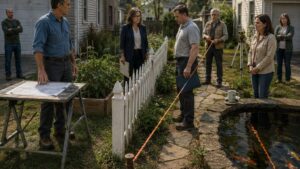
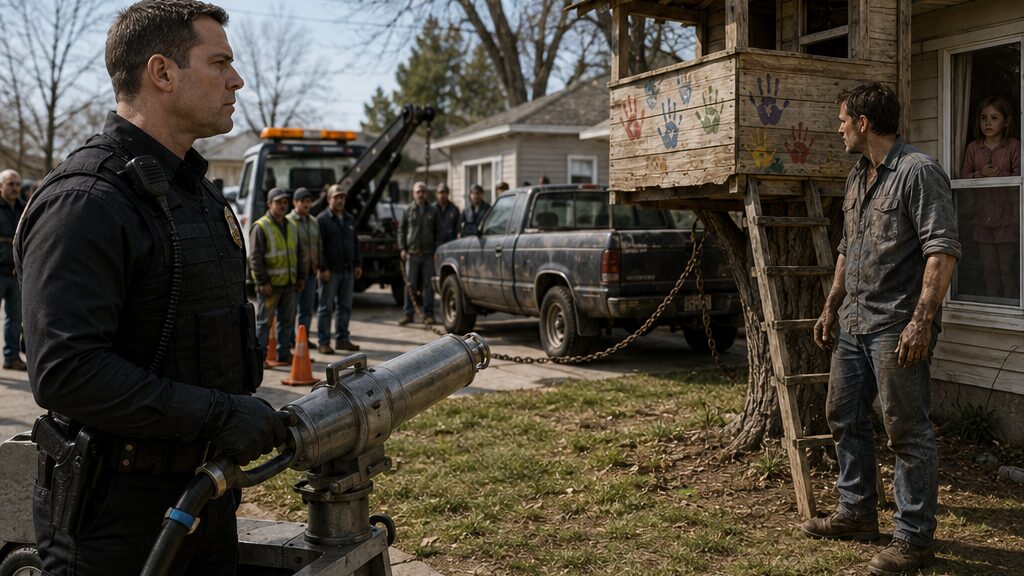
The treehouse stood beneath the old oak near the front corner of the house, small enough that Kenneth could touch the roofline without stretching. He had built it from sanded cedar boards, leftover fence posts, and three weekends he had not really had to spare. The floor was no higher than his chest. The ladder had six rungs. The roof was crooked in a way Melissa called “storybook crooked,” and one wall was covered in overlapping handprints from the afternoon they had painted it together.
Blue, yellow, green.
Melissa had pressed her palms into the paint and then onto the wood, laughing each time one print came out blurrier than the last.
Kenneth took the notice between two fingers and read the first line.
UNAPPROVED STRUCTURE VIOLATION.
His jaw tightened.
He read the rest without moving.
The structure on the front lawn violated HOA exterior improvement rules. No approved application was on file. Failure to remove the structure or submit proof of authorization by noon would result in corrective action by approved contractors. Costs, penalties, and administrative enforcement fees would be assessed to the property owner.
Noon.
Kenneth checked his watch even though he knew the hour. It was not yet seven.
He looked back at the house. Melissa’s bedroom curtain was still closed. Her backpack sat on the kitchen chair inside, half-zipped, one pink sock sticking out of it because she had insisted the backpack “needed a spare.” In another hour, she would come outside with cereal on her shirt and climb the treehouse ladder before school, just to make sure the toy flashlight was still in the corner.
He pulled at the zip tie, but it held.
From his pocket, he took the small folding knife he used for stripping wire and cut the plastic cleanly. The notice came loose with a dry snap.
“Morning.”
Kenneth turned.
Stephanie Moore stood at the low hedge between their lawns, holding a watering can she clearly had not used yet. She was still in house slippers, her hair clipped up badly, one shoulder of her cardigan slipping down. Her eyes were not on Kenneth. They were on the notice in his hand.
“Morning,” Kenneth said.
Stephanie glanced toward the street before speaking again. “Is it about the treehouse?”
Kenneth folded the paper once. “Looks that way.”
“He came by twice last night.”
Kenneth looked up.
“Christopher,” Stephanie said. “In that black security vehicle. Once around eight. Then again after ten. He slowed down in front of your place both times.”
Kenneth looked toward the curb as if tire marks might still be there. “You sure it was him?”
Stephanie gave him a tired look. “Who else drives through here like he’s clearing a building?”
A sound came from inside Kenneth’s house: a cupboard door bumping shut. Melissa was awake.
Kenneth slid the folded notice into the back pocket of his jeans. “It’s just a notice.”
Stephanie’s mouth pulled tight, like she wanted to agree and could not make herself do it. “They sent one to the Torrez place last month for a birdbath. Christopher stood on their porch until they took it out.”
“A birdbath isn’t a treehouse.”
“No,” she said. “That’s why I’m telling you.”
Kenneth looked at the little structure. The morning light caught the paint on the handprints, making them look almost wet again. He had built the treehouse after Melissa spent three months refusing to sleep alone. Every bump in the walls had made her sit up in bed. Every raised voice on television, every slammed car door from the street, every unexpected knock had made her ask if someone was going to take their house away.
He had not known what to say, so he had built something.
A place small enough for her to believe it belonged only to her.
“I’ll handle it,” Kenneth said.
Stephanie did not look convinced. “Handle it before noon.”
The front door creaked open.
“Dad?” Melissa called. “Did you fix the tailgate?”
Kenneth turned quickly, slipping the notice deeper into his pocket. “Working on it.”
Melissa came out barefoot, her hair bent on one side from sleep. She was holding a piece of toast in one hand and the small plastic dinosaur she had been carrying around all week in the other. She headed straight for the treehouse, then paused when she saw Stephanie.
“Hi, Mrs. Moore.”
“Hi, sweetheart,” Stephanie said, forcing warmth into her voice.
Melissa climbed the first two rungs, then stopped. Her eyes narrowed at the ladder. “Something was tied here.”
Kenneth felt the folded paper against his leg like heat.
“Yeah,” he said. “Just a flyer.”
“For what?”
“Neighborhood stuff.”
Melissa wrinkled her nose. “Boring stuff?”
“The most boring.”
She accepted that and climbed into the treehouse. Kenneth stood below while she checked her toy flashlight, her blanket square, and the row of bottle caps she had declared treasure. He watched her small hand pass over the painted handprints on the wall.
“Dad,” she said through the open window, “can we paint more flowers on it after school?”
Kenneth looked at the tailgate, then at the house, then at the place in the grass where a notice had swung like a threat.
“After work,” he said. “We’ll see.”
She smiled like that was enough.
By eight, Kenneth had packed Melissa’s lunch, tightened the pickup tailgate, and walked her to the bus stop. By eight-thirty, he had called the HOA office twice and reached only the recorded menu. By nine, he had the first repair customer of the day texting him about a dead alternator, and by nine-fifteen he was standing in his kitchen with the notice spread flat on the table.
He knew there was a file box in the hall closet.
He also knew what was inside it.
Old records. Deeds. Survey maps. His father’s careful notes in block handwriting. Copies of agreements that had made his family’s name more important to the neighborhood than Kenneth ever wanted it to be.
He stood in front of the closet for nearly a full minute, hand on the knob.
Then he let go.
It was just a treehouse notice. A ridiculous one, but still a notice. He would call. He would explain. He would not drag old family business into another argument with another person who thought history was useful only when it gave them power.
At ten-thirty, a second paper appeared under his windshield wiper.
Kenneth had been lying halfway under the pickup, checking a leak near the oil pan, when the engine sound rolled slowly past his house. By the time he slid out, the vehicle was already turning the corner.
He stood, wiping his hands on a rag, and pulled the paper loose.
FINAL CORRECTIVE ACTION NOTICE.
The words seemed heavier than the first notice, even though the paper was thinner.
Corrective action authorized after 12:00 p.m. Approved contractors may enter exterior property areas necessary to remedy visible violations. Additional noncompliant exterior surfaces may be corrected at owner expense.
Additional surfaces.
Kenneth looked at the front of his house, at the faded warm yellow door Melissa had helped choose because she said it looked “like pancakes with sunshine on them.” He looked at the small blue flower shapes she had painted along the bottom edge of the treehouse wall.
He folded the second notice slowly.
Across the hedge, Stephanie’s curtain moved and fell still.
Kenneth went inside and dialed the HOA number again. This time a woman answered, put him on hold, returned, asked for his address, and went silent long enough for him to hear papers shifting.
“Mr. Lewis,” she said carefully, “your property has been referred to field enforcement.”
“Over a child’s treehouse?”
“The exterior improvement is not approved.”
“It’s four feet off the ground.”
“I understand.”
“No,” Kenneth said. “You don’t.”
The line went quiet.
When she spoke again, her voice was lower. “I can note that you called.”
“Can you stop it?”
Another pause. “The enforcement team has already been dispatched.”
Kenneth hung up before he said something he would regret.
He went to the treehouse and stood under it with both notices in his hand. The cedar still smelled faintly of sawdust when the day warmed. He remembered Melissa handing him screws one at a time, asking if the boards were strong enough to keep out monsters.
“Strong enough,” he had told her.
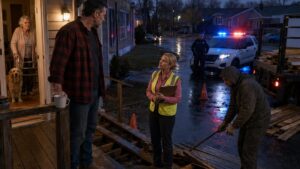
A low engine growled at the far end of the street.
Kenneth turned.
A black private security vehicle rolled around the corner, slow and deliberate. Behind it came a white work truck pulling a trailer with coiled hoses, metal tanks, and a dull grey industrial paint sprayer mounted like equipment at a job site. The nozzle caught the sun as the trailer bounced over the curb cut.
Kenneth stood in the grass, notices crushed in his fist.
The security vehicle stopped in front of his house.
Chapter 2: The Captain at the Curb
Christopher King stepped out before the engine had fully died.
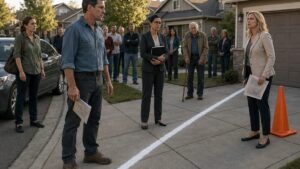
He did not walk up Kenneth’s driveway so much as occupy it. Dark uniform shirt. Black gloves. Radio clipped high on his shoulder. Sunglasses he did not remove, though the sun was behind him. Two security workers got out behind him and began setting orange cones along the curb as if Kenneth’s front lawn had become a restricted zone.
Christopher glanced at the treehouse and smiled without warmth.
“Your kid’s treehouse doesn’t have an HOA building permit.”
Kenneth stood between him and the ladder. “Good morning to you too.”
Christopher ignored that. He lifted a clipboard and tapped it with one gloved finger. “Unapproved elevated structure. Visible from street. Noncompliant exterior paint markings. Unauthorized lawn installation.”
“It’s a playhouse.”
“It’s a violation.”
“It’s on my lawn.”
“That’s the problem with people like you,” Christopher said. “You think ownership means exemption.”
Something in the word made Kenneth’s shoulders stiffen.
A window opened across the street. Then another. Stephanie stood on her porch with her arms folded tight, not crossing the hedge.
Kenneth kept his voice even. “I called the office.”
“And they dispatched me.”
“For this?” Kenneth pointed to the treehouse. “You brought cones?”
Christopher looked pleased that someone had noticed. “We follow procedure.”
Behind him, one of the workers unlatched the trailer. Metal knocked against metal. A hose dropped to the street with a slap.
Kenneth looked past Christopher. “What is that?”
“Corrective equipment.”
“For a treehouse?”
“For visible violations.”
Kenneth laughed once, not because anything was funny. “You’re going to paint my house?”
Christopher finally removed his sunglasses. His eyes were pale and flat, but tired at the edges. “Your front door color is not approved. The decorative markings on the structure are not approved. Your mailbox trim is not approved. You’ve had years of special treatment, Mr. Lewis. That ends today.”
Kenneth felt the neighbors listening.
He heard a phone camera beep somewhere.
“My door’s been that color six years,” Kenneth said.
“And for six years, enforcement has been soft.”
A sedan pulled up behind the security vehicle. Angela Brown got out holding a folder against her chest. She wore office clothes, not field clothes, and the expression of someone who had expected to arrive before trouble but had arrived after it.
Kenneth looked at her. “Angela. Did the board approve machinery on my lawn?”
She opened her mouth, then looked at Christopher.
Christopher answered for her. “The board authorized corrective action.”
“That’s not what I asked.”
Angela shifted the folder from one arm to the other. “Kenneth, the file shows repeated notices.”
“I got one this morning and one under my wiper.”
Christopher held up the clipboard. “Notices were issued according to schedule.”
Kenneth took a step toward him. “Issued to who?”
The security workers stopped moving.
Christopher’s jaw flexed. “Careful.”
That one word reached every porch.
Kenneth felt heat crawl up his neck. He looked at Angela again. She would not hold his eyes.
“Show me where the treehouse is unsafe,” Kenneth said.
Christopher blinked. “Safety is not the only issue.”
“Show me.”
Kenneth turned, climbed two rungs, and shook the ladder hard. It barely moved. He slapped the support post with an open palm. Solid. He pointed to the bolts, the rubber caps on the corners, the low platform height, the padded edge near the window where Melissa liked to lean.
“I built it myself,” he said. “It’s four feet high. No wiring. No plumbing. No foundation. It doesn’t block the sidewalk, doesn’t touch anyone else’s property, and doesn’t hurt a soul.”
Christopher looked at the treehouse as if none of that mattered. “You done?”
Kenneth stepped down. “Are you?”
A few neighbors murmured.
Christopher’s gaze flicked toward them. The attention did something to him. Kenneth saw it: the small tightening, the need to take the scene back before the watching faces decided he was only a man in a uniform.
Christopher raised his radio. “Begin exterior correction.”
One of the workers on the trailer pulled the hose forward. The industrial sprayer came alive with a hydraulic hiss that crawled over Kenneth’s skin. The dull grey nozzle lifted, not toward the treehouse at first, but toward the front of Kenneth’s house.
“Stop,” Kenneth said.
Christopher did not look at him. “Door and facade first.”
Angela stepped closer. “Christopher, maybe we should wait until—”
“Until what?” he snapped.
She lowered her voice. “Until the records review is complete.”
Kenneth heard it.
Christopher heard him hear it.
“What records review?” Kenneth asked.
Angela pressed the folder tighter to her ribs. “There were some older parcel documents flagged for—”
Christopher cut in. “Irrelevant. This is an active violation.”
The sprayer worker looked between them. “Captain?”
Captain. That was what his people called him, though he wore no badge from any city, no shield from any county, only a private patch and the confidence of a man who had learned that people often obeyed tone before law.
Christopher pointed at Kenneth’s house. “Aim.”
The worker raised the nozzle.
A sharp, chemical smell mixed with the warm cedar scent from the treehouse. Kenneth saw the hose snake across the grass, lying near the ladder like something alive.
The school bus brakes sighed at the corner.
Kenneth turned just as Melissa came down the sidewalk with two other children. Her backpack bounced against her shoulders. She slowed when she saw the cones, the men, the machine, her father standing rigid in the grass.
“Dad?”
Kenneth moved toward her at once. “Stay by the porch.”
“What are they doing?”
Christopher answered before Kenneth could. “Removing violations.”
Melissa’s eyes went to the treehouse. “Removing?”
Kenneth felt something inside him pull tight.
“No,” he said. “Nobody’s removing anything.”
Christopher gave a short laugh, meant for the neighbors. “That’s the attitude that got us here.”
Melissa stepped behind Kenneth’s arm. “Did I do something wrong?”
The question cut through him.
“No,” Kenneth said, too quickly. “No, sweetheart.”
Christopher looked at the handprints on the wall. “Children learn rules from adults.”
Kenneth turned on him. “Do not talk to her.”
The street went quiet except for the sprayer’s pulsing motor.
For a second, Christopher’s face showed irritation, not triumph. He looked less like a commander and more like a man whose script had been interrupted. Then he raised his chin and spoke louder.
“This community has standards. People think because they’ve been here a long time, because they know somebody, because they have a sad little story attached to every board and nail, the rules don’t apply.”
Kenneth took Melissa’s hand and guided her onto the porch. “Go inside.”
“I don’t want them to break it.”
“They won’t.”
She searched his face, needing more than his voice had given her.
Kenneth touched the top of her head. “Inside.”
She went, but only as far as the screen door.
Christopher watched the exchange and then turned to one of his workers. “Bring the tow in.”
Kenneth looked back. “What did you say?”
Christopher’s mouth tightened with satisfaction. “The pickup is blocking contractor access.”
“It’s in my driveway.”
“It is obstructing corrective work.”
“My tools are in that truck.”
“Then you should have complied.”
Down the street, a yellow tow truck turned the corner, its lights flashing without siren. It rolled toward Kenneth’s driveway like a verdict.
Christopher lifted his gloved hand, palm forward, directing it in.
“Take his truck too,” he said. “He learns today.”
Chapter 3: The Truck That Kept the Lights On
The tow chain hit the pavement with a clank before Kenneth reached the driver’s door.
He shoved past one of the cones, boots slipping on the edge of the grass, and planted himself between the yellow tow truck and his pickup. The tow operator, a broad-shouldered man in a faded work shirt, stepped down from the cab with both hands half-raised.
“Easy,” the man said. “I’m just here on a call.”
“That’s my truck.”
The man looked past him to Christopher. “They said it was abandoned equipment obstructing work.”
Kenneth stared at him. “Does it look abandoned?”
The man’s eyes moved over the pickup: dented tailgate, magnetic sign on the door with Kenneth’s repair number, toolbox bolted behind the cab, invoices clipped under the visor. His expression changed by a fraction.
Christopher strode over. “Jacob, hook it and move it.”
Jacob Walker hesitated. “Captain, it’s got business markings.”
“It’s obstructing authorized contractors.”
“It’s in his driveway.”
Christopher stepped close enough that Jacob straightened without seeming to mean to. “Do you want the HOA tow rotation or not?”
Jacob looked away first.
Kenneth felt the old, familiar disgust of watching a man choose his paycheck over what his eyes could plainly see. Then he caught himself. He knew that choice. He had made smaller versions of it for years: swallowing words to keep work, letting insults pass because the mortgage did not care about pride, telling Melissa everything was fine because fear cost too much time.
Jacob pulled the hook from the tow assembly.
“No,” Kenneth said.
Christopher raised his voice. “Mr. Lewis is interfering with corrective enforcement.”
Neighbors had gathered now in pieces. A man at the mailbox. A woman pretending to sweep the porch. Stephanie at the hedge, phone in hand but not raised. Angela stood near the security vehicle, flipping through her folder with fingers that did not seem to find what they were looking for.
Kenneth pointed at her. “Tell him he can’t do this.”
Angela looked at Christopher, then at the truck, then at the people watching. “The vehicle removal clause applies to common access obstruction.”
“My driveway is not common access.”
Christopher snapped, “It is when contractors require entry.”
“Entry to do what?” Kenneth said. “Spray over a door? Tear down a child’s treehouse?”
“Correct noncompliance.”
“That word doesn’t make this legal.”
Christopher’s face colored. “You don’t get to lecture me about legal. You’ve ignored every warning sent to this property.”
“I got them today.”
“You ignored the culture of the community for years.”
Kenneth almost laughed again, but Melissa was standing behind the screen door, small fingers hooked through the mesh. The laugh died.
Jacob crouched near the pickup’s front end with the chain. Kenneth moved toward him, but one of Christopher’s security workers stepped in his path.
“Don’t touch me,” Kenneth said.
The worker glanced at Christopher for permission he should not have needed.
“Keep him clear,” Christopher ordered.
Kenneth’s hands curled into fists, greasy rag still trapped in one of them. His body knew exactly how to break the hold before anyone touched him. He had spent half his life wrestling rusted parts loose, pushing dead vehicles into position, catching falling transmissions before they crushed fingers. But this was his lawn. His daughter was watching. Every phone in the street could make him into whatever Christopher said he was.
So he stood there.
The chain slid under the pickup with a hard metallic scrape.
Christopher turned toward the neighbors, voice carrying. “This is what happens when residents confuse sentiment with compliance. If we let one person build whatever he wants, paint whatever he wants, park whatever he wants, there is no community left.”
Kenneth felt every face turn toward his house.
His old pickup suddenly looked uglier to him through their eyes. The mismatched fender. The cracked windshield corner he had not had time to replace. The cooler in the bed. The grease stains on the driver’s seat. The stack of repair manuals that should have been inside a cabinet instead of riding around with him everywhere.
Christopher was not just taking the truck. He was displaying it.
Displaying Kenneth.
“This truck keeps the lights on,” Kenneth said, quieter than he intended.
Christopher heard him anyway. “Then you should have protected your livelihood by following rules.”
Jacob paused at that.
Kenneth looked at him. “I’ve got a transmission job at one. Alternator after that. Furnace blower tonight if the parts come in. You take this, you take all of that.”
Jacob’s mouth moved once before any words came. “I didn’t know.”
“Hook it,” Christopher said.
Jacob swallowed and attached the chain.
The sprayer motor coughed behind them. The worker holding the nozzle tested the trigger by mistake or impatience. A thin burst of dull grey paint spat onto the grass, then misted toward the treehouse wall.
Kenneth turned fast.
The spray did not fully hit the handprints, but a grey freckling landed close enough to the blue palm shape that Melissa gasped from the doorway.
“Dad!”
Kenneth crossed the lawn in three strides. He grabbed an old drop cloth from beside the porch and threw it over the painted wall before the mist could drift farther.
Christopher laughed under his breath. Not loud, not for the crowd this time. Just enough for Kenneth to hear.
“That’s what this is?” Christopher said. “Handprints? You’re making the whole neighborhood stop for finger paint?”
Kenneth turned slowly.
For a moment, he did not see the uniform, the cones, the clipboard, the neighbors. He saw Melissa at six years old, refusing to come out from under the kitchen table while grown-up papers and phone calls and unpaid bills turned the house into a place full of whispers. He saw her holding a paintbrush too big for her hand. He heard her ask if the treehouse would belong to them forever.
Christopher stepped closer, voice rising again. “You keep hiding behind your kid. You built an illegal structure, ignored the notices, blocked correction, and now you want everyone to feel sorry because you put little hands on the wall.”
Kenneth’s shame went hot, then cold.
He looked at Stephanie. She glanced down.
He looked at Angela. She closed the folder.
The tow truck engine revved.
Kenneth turned as the chain tightened. His pickup lurched backward an inch, then another. The front tires dragged, resisting, squealing faintly against the driveway.
“No,” Kenneth said.
Jacob leaned from the tow cab window, uneasy. “Mr. Lewis, step clear.”
Christopher raised his gloved hand like a commander ordering a breach. “Move it.”
The pickup rolled another foot.
Kenneth saw the toolbox shift in the bed. He saw the magnet sign on the door ripple loose at one corner. He saw his whole week’s work being pulled toward the street because a man with a radio had decided humiliation was procedure.
Melissa cried out from the porch, “Dad, don’t let them!”
That broke the last careful thing in him.
Kenneth ran.
Christopher shouted something behind him, but Kenneth was already at the driver’s door. The truck was moving, slow but real, the tow chain stretched tight from its undercarriage. Kenneth yanked the door open, grabbed the steering wheel, and hauled himself inside as the pickup jolted backward another foot.
The keys were still in the cup holder where he always dropped them when working under the hood.
His hand closed around them.
Outside, Christopher’s voice sharpened. “Get him out of there!”
Kenneth shoved the key into the ignition.
The pickup coughed once.
The tow truck pulled again.
Kenneth’s boot found the clutch.
The engine caught.
And as the chain strained hard enough to sing, Kenneth slammed the door and reached for the gearshift.
Chapter 4: The Crash Beside the Treehouse
Kenneth turned the key while Christopher shouted for the crew not to stop.
The pickup coughed once, twice, then roared awake with the rough, uneven anger of an engine he had kept alive through will and spare parts. The tow chain snapped taut beneath the front axle. The whole truck jerked forward, trapped between its own power and the tow truck dragging it out of the driveway.
Through the windshield, Kenneth saw Melissa at the front door with both palms flat against the glass.
He should have stopped there.
That thought came clear and sharp, almost calm. He should have killed the engine, stepped out, waited for the police Christopher kept threatening to call, trusted paper and patience and the old deed he had refused to mention.
Then the tow truck lurched again, pulling his pickup hard enough that the toolbox in the bed slammed against the cab.
Kenneth looked left.
The tow truck’s side panel was broad and yellow, angled across the driveway. Jacob was in the cab, glancing between mirrors, face tight. Christopher stood near the cones with one hand raised, barking into the radio. The sprayer hose lay across the grass like a black vein, its nozzle still pointed too close to the treehouse.
Melissa’s blue handprint on the wall was smeared white at the edge.
Kenneth shifted into gear.
“Kenneth!” Stephanie screamed from somewhere outside.
He did not floor it forward. He could not. The chain held the front of the pickup hostage. He cranked the wheel hard, felt the rear tires bite, and pressed the gas.
The truck surged sideways.
Christopher’s mouth opened.
Jacob’s eyes widened in the tow mirror.
The pickup slammed into the side of the tow truck with a deafening metal crash that shook the driveway and sent a wrench flying from the floorboard into Kenneth’s ankle. The impact punched the tow truck sideways half a foot. The chain went slack with a violent snap. The sprayer hose whipped across the lawn, the nozzle bucking and spitting pale paint into the air before striking the grass inches from the treehouse ladder.
For one long second, there was no sound but ringing.
Then everything arrived at once.
Melissa crying behind the door. Neighbors shouting. The sprayer machine sputtering and choking. Jacob cursing as he stumbled down from the cab. Christopher yelling, “Do not move! Nobody move!”
Kenneth’s hands were locked around the steering wheel.
His pickup’s hood had crumpled against the tow truck’s side rail. Steam hissed from somewhere near the radiator. The old engine knocked twice, then died. Kenneth sat inside the cab, chest heaving, the smell of hot metal and coolant filling the air.
He had stopped it.
The pickup was still in his driveway.
The thought brought no victory. Only a cold drop through his stomach as he saw the phones now lifted openly along the street.
He had given them the picture they wanted.
Christopher strode toward the driver’s window, face red, radio in one fist. “Get out of the vehicle.”
Kenneth opened the door slowly. It groaned against warped metal.
The moment his boots touched concrete, Christopher stepped into his space. “You just committed assault with a vehicle.”
“No one was in the path.”
“You rammed authorized equipment.”
“You were stealing my truck.”
“You are done talking.” Christopher lifted the radio. “Requesting police response to Cedar Hollow, active resident aggression, property damage, attempted vehicular assault—”
“Attempted what?” Jacob snapped.
Christopher turned on him. “You will let me make the report.”
Jacob stood by the tow truck, one hand on the dented side panel. His face had gone pale under the cap. “I was clear. He hit the truck. He didn’t hit me.”
Christopher’s eyes sharpened. “Do you want this contract or not?”
The street went quieter.
Jacob looked at Kenneth, then at the truck he had nearly dragged away. He did not answer.
Kenneth saw the cost of that silence. He knew it too well. Men like Jacob lived inside narrow margins. The wrong refusal could follow a person for months.
Angela came forward, folder clutched so tightly the edges bent. “Christopher, we need to slow this down.”
Christopher laughed once. “Now you want to slow down?”
“Yes,” she said, but her voice lacked force. “There has been significant property damage.”
“To my authorized equipment operation.”
“To a contractor’s vehicle on private property,” Angela said. “With unclear authorization.”
His head turned slowly toward her. “Choose your words carefully.”
Angela’s throat moved.
Kenneth wiped one hand across his mouth and found paint there, white and blue from the treehouse. His palm left a smear on his cheek.
Behind the glass, Melissa was sobbing now. Not loud. Trying not to be loud.
That broke him more than the crash.
He turned toward the house.
Christopher stepped after him. “You are not leaving the scene.”
“I’m getting my daughter away from the window.”
“You move, I will tell responding officers you fled.”
Kenneth stopped at the porch step.
For years, that was where men like Christopher had won. Not because they were stronger, but because they knew how to make every ordinary choice look like guilt. Comfort your child? Fleeing. Stop a tow? Assault. Build a treehouse? Violation. Work from your driveway? Blight.
Kenneth looked back at him. “You want paperwork?”
Christopher’s mouth tightened.
“I’ve got paperwork.”
He went inside before anyone could stop him.
Melissa stood in the entryway with the rabbit pressed under her chin, eyes red and wet. “Daddy, did you break your truck?”
Kenneth knelt in front of her. His knee ached where it hit the dash. “I stopped them from taking it.”
“Are you in trouble?”
He wanted to say no. He wanted to be the kind of father who could make a word true by saying it gently enough.
Instead he brushed her hair back from her forehead. “Maybe.”
Her face crumpled.
“But I’m going to fix what I should’ve fixed a long time ago.” He looked toward the hall, toward the bedroom at the back of the house. “Stay in the kitchen. Don’t come outside unless I call you.”
“What are you getting?”
Kenneth stood.
The lockbox was under his bed behind two old boots and a folded drop cloth. He had not opened it in nearly four years. Dust coated the lid. The key was taped beneath the bottom drawer of his dresser, where his father had kept it when the papers were his.
His fingers hesitated on the tape.
He saw his father at the kitchen table years ago, older than he should have looked, tapping the deed packet with two fingers. Don’t wave this around unless they make you. People hate being reminded what they owe.
Kenneth had believed that. Or maybe he had used it as permission to stay quiet.
Outside, Christopher’s radio crackled. A neighbor said something about police. The sprayer machine coughed again, then shut off.
Kenneth peeled the key free.
Inside the lockbox lay a folded packet wrapped in waxed paper, yellowed at the creases, sealed long ago with a stamped mark his grandfather had insisted mattered. Kenneth lifted it with hands that suddenly felt too rough for paper.
Under it was a photograph: his grandfather standing beside a bare field, one boot on a survey stake, smiling as if giving land away could not possibly become a wound.
Kenneth did not take the photograph.
He took the deed.
When he came back through the hall, Melissa stood where he had left her. Her eyes dropped to the packet.
“Is that important?” she whispered.
“Yes.”
“Will it save the treehouse?”
Kenneth looked at the blue-white paint drying on his palm. “It should’ve saved it before they ever touched it.”
He opened the front door.
Every face turned.
Christopher stood near the damaged tow truck, phone now in hand, speaking too loudly to someone on the other end. “Resident has become physically destructive. We have witnesses. We need immediate—”
He stopped when he saw the packet.
Not because he knew what it was. Not fully.
But something in the old seal, the way Angela’s eyes fixed on it, the way Kenneth carried it without looking down, changed the air on the lawn.
Kenneth stepped off the porch.
The sprayer hose lay twisted between him and the treehouse. Pale paint flecked the grass. His pickup hissed in the driveway, wounded but still there.
Christopher lowered the phone slightly. “What is that?”
Kenneth held up the folded deed packet with the family seal facing the street.
“The reason you should’ve stayed off my lawn.”
Chapter 5: The Clause No One Wanted Read
Christopher read the first line and went pale before he remembered everyone was watching him.
It was quick. A flicker under the tan, a slackening at the corners of his mouth as his eyes moved across the old deed heading. Then his jaw locked, his shoulders squared, and he thrust the packet back toward Kenneth as if the paper itself had stepped too close.
“This is not a court,” Christopher said.
Kenneth did not take it back. “No. It’s my front lawn. You brought the court-looking performance.”
Angela had gone still beside them. “Let me see that.”
Christopher’s hand closed tighter on the packet. “This is outdated.”
“You haven’t read it,” Kenneth said.
“I can see the date.”
“Dates don’t expire signatures.”
A murmur moved along the sidewalk.
Christopher heard it and raised his voice. “Residents should return to their homes. This is now a police matter involving property damage.”
No one moved.
Stephanie stood at the edge of Kenneth’s grass, not on it yet, one hand pressed to her chest. Jacob stayed near the tow truck, arms folded, eyes fixed on the deed. The security men had stopped looking like a team and started looking like employees wondering who would sign their timesheets if this went badly.
Angela stepped closer. “Christopher. Give me the document.”
He looked at her, and Kenneth saw the calculation. If he refused, he looked afraid of paper. If he handed it over, he lost control of what it said.
Angela held out her hand.
After a long second, Christopher slapped the packet into it.
She opened it carefully, too carefully for someone who wanted to pretend it was nothing. The old paper made a dry sound in the silence. Her eyes moved down the page, then back up, then to the second sheet.
Kenneth watched her face, not the deed.
He already knew the words. He had read them at nineteen after his grandfather’s funeral, at twenty-seven after his father died, at thirty-nine when the first HOA warning arrived about his truck and he had almost, almost walked to a board meeting with the packet in hand. Each time he had folded it away.
Angela swallowed. “Kenneth.”
“Read it.”
She glanced at Christopher.
“Don’t,” he said.
Kenneth turned on him. “You were fine reading violations out loud.”
Angela held the paper higher, but her voice stayed low at first. “This deed records the donation of surrounding acreage by the Lewis family trust for the establishment of the Cedar Hollow residential development.”
Several neighbors looked at Kenneth as if he had become someone else while standing in the same boots.
Kenneth hated that look. Surprise mixed with appraisal. So that’s who he is. So that’s why the lot is bigger. So that’s why he never moved.
Angela continued. “It reserves the original Lewis parcel, including dwelling and immediate grounds, as privately retained property.”
Christopher cut in. “Retained property still exists within the association boundaries.”
Angela’s eyes dropped again.
Kenneth said, “Keep reading.”
She did.
“The retained parcel shall be permanently exempt from any and all architectural, aesthetic, use, maintenance, and improvement restrictions imposed by future neighborhood associations, boards, committees, or successor governing bodies.”
The words seemed to strike the lawn one by one.
Permanently.
Exempt.
Any and all.
Christopher gave a sharp laugh. “That is absurdly broad.”
“My grandfather was careful.”
“It’s unenforceable.”
“You sure?”
Christopher looked toward Angela. “Tell him.”
Angela did not.
That silence was the first clean thing that had happened all day.
Kenneth felt something loosen in his chest, but it did not feel like relief. It felt like grief being moved from one shelf to another.
His grandfather had donated the land because he thought the neighborhood would be a place families could start. His father had called it the most generous mistake in the county. Roads, utilities, entrances, sidewalks—Cedar Hollow had risen around the old Lewis house until the family name became a footnote in files no one opened. Kenneth had grown up listening to his father say, They’ll take the story if you let them. Kenneth had thought not talking about it meant they could not take it.
He had been wrong. Silence had given them room to invent a different one.
Christopher pointed toward the pickup. “Even if that language means what you think it means, it does not authorize him to ram a contractor’s vehicle.”
Kenneth looked at the crumpled hood. “No. It explains why the contractor was never supposed to be here.”
“You don’t get to create danger and then hide behind antique paper.”
“You created the danger.”
“I enforced a board directive.”
Angela’s voice tightened. “The board directive was to issue final notice and review the record.”
Christopher turned slowly. “Excuse me?”
Angela’s fingers had gone white around the folder. “We had a records review scheduled for tomorrow morning because the Lewis parcel came up in archived boundary notes.”
Kenneth stared at her.
Tomorrow.
The word landed with more force than he expected. One more day, and someone might have opened the file. One more day, and the sprayer might not have touched Melissa’s handprint. One more day, and his pickup might not be bleeding coolant onto the driveway.
Christopher’s face changed again, but this time he could not hide it fast enough. Fear flashed through the anger.
“You are mischaracterizing the timeline,” he said.
Angela opened her folder with shaking hands. “The enforcement action was advanced.”
“Because he ignored notices.”
“Because you requested immediate contractor availability this morning.”
“I was preventing further deterioration of standards.”
“On a parcel under review.”
The neighbors heard that. Kenneth saw the sentence move through them. Not as triumph, not yet, but as a shift. A board secretary had said it aloud. Christopher had rushed.
Christopher sensed the ground changing and turned back to the strongest image he still had: the damaged tow truck. He lifted one arm toward it.
“Everyone here saw Mr. Lewis weaponize his vehicle. That is not a misunderstanding. That is not history. That is a deliberate act causing damage to contracted equipment.”
Jacob’s head snapped up. “You told my dispatcher it was abandoned.”
Christopher’s face hardened. “I gave a compliance classification.”
“You said no owner would be present.”
“I said the resident had failed to respond.”
Jacob looked at Kenneth’s pickup, then the treehouse. “That’s not the same thing.”
Christopher stepped close to him. “Be careful.”
Kenneth moved before he meant to, not aggressively, just enough to stand where Jacob was no longer alone under that warning.
Christopher smiled thinly. “There it is. More intimidation.”
Kenneth almost answered with anger. Instead he looked at the deed in Angela’s hands.
“I should’ve brought that out years ago,” he said.
No one seemed to know whether he was talking to them.
His voice was rougher when he continued. “I didn’t because every time I opened that box, I heard my dad telling me this place forgot us. I didn’t want to prove him right. I didn’t want my daughter growing up as the kid in the house that got special treatment.”
Christopher seized on it. “So you admit you concealed relevant property information.”
Kenneth looked at him. “I admit I mistook quiet for peace.”
That shut Christopher up for half a breath.
Not long.
He lifted his phone again. “Officers are on the way. We will let them determine whether ramming a truck is peaceful.”
Angela folded the deed carefully. “Christopher, if this exemption is recorded as written, continuing enforcement could expose the association.”
“Then the association can discuss that after the police report.”
“You mean after you make him look criminal.”
Christopher’s eyes cut to her. “I mean after the man who damaged contracted equipment faces consequences.”
From the sidewalk, Stephanie’s voice came small but clear.
“He asked me about it.”
Everyone turned.
Stephanie had crossed half the distance from her porch without anyone noticing. She held her own HOA warning letter in one hand, folded into a nervous square.
Christopher’s expression went blank. “What?”
Stephanie looked at Kenneth, apology already wet in her eyes, then at Angela. “Last week. Christopher stopped me by my mailbox and asked whether Kenneth ever talked about old land rights.”
Kenneth felt the entire day tilt.
Christopher’s hand lowered from his phone.
Stephanie unfolded the paper she had been crushing. “He asked if Kenneth kept documents. If he ever mentioned his grandfather. If he ever said the HOA couldn’t touch his property.”
Christopher took one step toward her.
Stephanie stepped back, but she did not stop.
“And then two days later, I got this warning for my hydrangeas.”
Chapter 6: The Neighbor Behind the Curtains
Stephanie crossed fully onto Kenneth’s grass carrying the warning letter like it might burn her fingers.
The street seemed to hold its breath for her. All morning she had been half-hidden: behind glass, behind her porch rail, behind the practical fear of a woman who had already lost flowers to a letterhead. Now she stood between Christopher’s cones and Kenneth’s damaged pickup, with her slippers damp from the lawn and her face pale but set.
Christopher gave a short, humorless laugh. “This is irrelevant.”
Stephanie looked down at the letter in her hand. “It felt relevant when I pulled the hydrangeas out.”
“That notice concerned landscaping standards.”
“It came after you asked me questions about Kenneth.”
“I ask questions because residents talk. That is part of community enforcement.”
Kenneth watched Stephanie’s hands tremble. He had repaired her porch light last winter and refused money. She had brought Melissa soup when a fever kept her home from school. Yet that morning, when Christopher arrived, she had stood behind the curtain. Kenneth had resented her for it. Now he saw the folded warning, the empty flower bed across the way, and understood resentment had been too easy.
Christopher did not need everyone to agree with him. He only needed everyone afraid separately.
Stephanie held the notice toward Angela. “He said if people wanted special treatment, the board needed to know who encouraged them.”
Angela took the paper.
Christopher’s radio crackled against his shoulder, a burst of static followed by a voice asking for status. He slapped the button. “Stand by.”
The command sounded smaller than it had earlier.
Kenneth noticed the phones along the street lowering. Not disappearing—lowering, as if neighbors no longer wanted to be only witnesses through glass. A man across the street stepped from his driveway onto the curb. A woman near the corner opened her front door and stayed there.
Jacob moved to the tow chain.
Christopher saw him. “What are you doing?”
“Unhooking until somebody shows me a signed legal order.”
“You will not touch that chain.”
Jacob straightened slowly. “I already touched it when you told me the truck was abandoned.”
“It is under removal.”
“It’s under dispute.”
“You work for the company I called.”
“I work for myself first.” Jacob’s face tightened as if the sentence cost him. “Then my company. Then whoever pays the invoice. In that order.”
Christopher walked toward him. “You think one dramatic afternoon is worth losing Cedar Hollow contracts?”
Jacob glanced at the pickup. The front end was crumpled, but the cab was intact. Tools had spilled in the bed. “I think towing a man’s work truck off his own exempt parcel without proper authorization might cost more than a contract.”
A low murmur traveled through the neighbors.
Kenneth had not expected gratitude to hurt, but it did. Every small act of help made his own delay sharper. If he had spoken sooner, maybe no one would have needed courage in pieces.
Angela looked from Stephanie’s warning letter to the deed packet. “Kenneth, the board is going to want this handled quietly.”
Christopher turned. “The board will handle this through counsel.”
Angela ignored him, speaking directly to Kenneth now. “They’ll say there was confusion about archived records. They’ll offer to repair the paint spots, maybe waive any fines. They’ll ask you not to pursue it publicly until they review.”
Christopher’s eyes narrowed. “Angela.”
She kept going, but her voice dropped. “If you accept that, they may protect themselves by calling it a miscommunication.”
Kenneth stared at her. “And him?”
Angela’s silence answered first.
Christopher smiled faintly. “Careful, Kenneth. Private settlement is more generous than what happens when police arrive and see that tow truck.”
The damaged truck sat between them, yellow side panel dented deep where Kenneth’s pickup had hit it. Steam no longer rose, but coolant streaked the driveway like greenish glass. The sight made Kenneth’s stomach pull tight. He had done that. He had chosen the gas pedal. He could dress it in every word he wanted—defense, panic, necessity—but the crash had been his.
Melissa had seen it.
He looked at the front window. She was no longer there. For one terrible second he thought she had come outside, but then he saw her small shape sitting on the hallway floor through the open door, rabbit in her lap, head bowed.
He could still end this privately. Take the apology they would wrap in legal language. Fix the truck somehow. Sand the white flecks off the treehouse. Tell Melissa the grown-ups had made a mistake and mistakes got repaired.
Then tomorrow Christopher would still have his radio.
Maybe not here. Maybe at Stephanie’s. Maybe at the next house with flowers too bright or a door too blue or a car too old. Christopher would keep choosing people he believed would fold before they explained why something mattered.
Kenneth rubbed his thumb across the dried paint on his palm. Blue under white. Melissa’s handprint under primer.
Stephanie stood beside him now, still scared. Jacob stood by the chain, still calculating what refusal would cost. Angela held two documents that made her look older than when she arrived.
None of them looked certain.
That, more than anything, steadied him. They were not heroes. They were people tired of standing alone.
Kenneth turned to Angela. “If I file a formal challenge, does it have to be entered into the record?”
Angela hesitated. “Yes.”
“Public record?”
“Yes.”
Christopher’s expression shifted. “You don’t want that.”
Kenneth looked at him.
Christopher lowered his voice, but everyone nearby could still hear. “You think this makes you look strong? It makes you look like a man who sat on special rights while everyone else followed rules. You’ll be the exception you pretended not to be.”
There it was. The old fear, spoken cleanly.
Kenneth felt it hit and did not step back.
“My family gave this neighborhood the ground it stands on,” he said. “That’s not special treatment.”
“Then why hide it?”
Because my father died angry. Because I didn’t want Melissa inheriting a fight. Because every time I opened that box, I felt like the house was less home than proof.
He did not say all of that.
He said, “Because I was tired.”
The answer seemed to surprise Christopher more than a denial would have.
Kenneth stepped toward Angela and held out his hand for the deed. She gave it back gently.
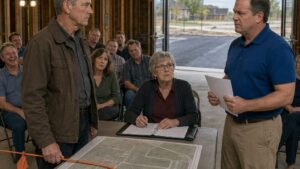
He unfolded it himself this time. The paper shook, not from fear alone but from the weight of being seen. He turned so the neighbors, the crew, Jacob, Stephanie, Angela, and Christopher all stood inside the same moment.
“I’m done being quiet so other people can call it compliance.”
Angela’s eyes softened, then sharpened with decision. “Kenneth, if I read it aloud, there’s no private version of this after.”
“I know.”
Christopher moved quickly. “Angela, you do not have authority to make legal declarations in the street.”
“No,” she said. “But I can read recorded language from a document presented during an enforcement action I am documenting.”
“You will regret this.”
She looked at him then, really looked, and some part of her fear gave way to anger. “I already regret waiting.”
The radio at Christopher’s shoulder crackled again. He did not answer.
Kenneth held the deed out to Angela, but did not let go immediately.
For one breath, old paper rested between both their hands.
Then Kenneth turned toward the watching houses, toward the empty flower bed next door, toward his daughter’s smeared handprint, toward the pickup that had kept the lights on and the treehouse that had kept a promise.
“Read the exemption,” he said, loud enough for the whole block. “Read it where everyone can hear.”
Chapter 7: The Exemption on the Front Lawn
Angela read the exemption with the damaged tow truck still blocking half the driveway.
Her voice shook on the first sentence, steadied on the second, and carried by the time she reached the words everyone had already heard but not yet fully understood.
“Permanently exempt from any and all architectural, aesthetic, use, maintenance, and improvement restrictions imposed by future neighborhood associations, boards, committees, or successor governing bodies.”
The street stayed silent afterward.
Not peaceful silent. Not finished silent. It was the kind of silence that came after machinery stopped and people realized they could hear themselves breathing again.
Kenneth stood beside the treehouse with his hands loose at his sides. The old deed packet trembled slightly in Angela’s grip, not because of wind. Behind him, the little wall still showed Melissa’s handprints, one blue palm smeared at the edge by pale primer. His pickup sat crooked against the tow truck, hood buckled, radiator ticking as it cooled. The sprayer hose lay dead in the grass.
Christopher looked from Angela to the neighbors to the paper, searching for the weak point.
“This does not mean what you think it means,” he said.
No one answered.
He turned toward his crew. “Retrieve the equipment.”
The worker by the sprayer did not move.
Christopher’s voice sharpened. “I said retrieve the equipment.”
The worker looked at the nozzle lying near the treehouse ladder, then at Angela. “Are we still authorized to be here?”
Christopher’s face tightened. “You are authorized by me.”
Angela folded the deed down just enough to meet the worker’s eyes. “Do not spray anything else.”
The worker stepped away from the hose.
Christopher’s radio crackled. A voice asked again for status. This time Christopher snatched it from his shoulder and pressed the button so hard his thumb whitened.
“Stand by,” he said.
The radio hissed back at him.
Kenneth watched the man’s hand. Earlier that radio had made Christopher bigger. A voice at his shoulder, a small machine that turned his opinions into orders. Now it looked like a plastic box he did not know where to put.
Angela opened her folder and removed a second sheet. “The archive note references county recording information. I’ll verify formally, but the language is specific.”
“Archive note,” Christopher repeated, pouncing on the phrase. “Not final confirmation.”
“It is enough to suspend enforcement.”
“You do not have unilateral authority.”
“I have authority to document risk.” Angela’s voice tightened. “And the association is at risk.”
Christopher laughed again, but this time it had no weight. “Because of him. He rammed a tow truck.”
Kenneth felt the eyes swing back to him.
He had known this was coming. The dent in the tow truck was too large to ignore, too loud to explain away with old paper. He looked at Jacob, who stood beside the slack chain. Then at Melissa, who had come to the open doorway again despite what he had told her. Her rabbit hung at her side now, one ear brushing the threshold.
Kenneth stepped away from the treehouse.
“I hit the truck,” he said.
Christopher’s expression flashed with satisfaction. “Finally.”
Kenneth kept his eyes on Angela, not on him. “I did. I should’ve brought the deed out before it got there. I should’ve answered the first letter instead of stuffing it in a drawer. I let it get that far because I thought not talking was the same as staying out of trouble.”
A neighbor across the street lowered their phone.
Kenneth looked at the pickup. “But I won’t apologize for stopping my truck from being taken off my driveway under a false order.”
Christopher pointed at him. “You hear that? He admits it and still justifies it.”
“I’m saying what I did.” Kenneth turned to him. “You should try it.”
The words were quiet. They landed harder because of that.
Christopher’s face darkened. For a second Kenneth saw the man underneath the uniform again: not powerful, not certain, but cornered. A hired security captain whose contract was being watched, whose usefulness depended on making people fear notices more than they trusted their own judgment. If Kenneth’s exemption stood, every cone, every warning, every public lecture Christopher had staged could become evidence of overreach.
Christopher knew it too.
“You think this ends with one old deed?” he said. His voice dropped, but the street was listening too closely for it to become private. “If he is exempt, every resident who has ignored a notice will claim special circumstances. Every door color, every shed, every dead car in every driveway. This neighborhood becomes chaos because one man gets to say his memories matter more than everybody else’s investment.”
Kenneth studied him.
There it was: fear dressed as standards. Not a good reason. Not a clean one. But a reason.
“My daughter’s treehouse isn’t chaos,” Kenneth said. “My truck isn’t chaos. Stephanie’s flowers weren’t chaos.”
Stephanie’s eyes filled when he said it.
Christopher spun toward her. “This has nothing to do with hydrangeas.”
“It does now,” she said.
Jacob crouched by the pickup.
Christopher saw him too late. “Do not touch that chain.”
Jacob kept working. The metal links scraped loose from under Kenneth’s axle, one by one. The sound was rough, ordinary, beautiful. Work restored to work.
“Jacob,” Christopher warned.
Jacob pulled the hook free and dropped it onto the driveway. “No signed legal order, no tow.”
“You will never receive another call from this association.”
Jacob stood, breathing hard through his nose. “Then send that in writing.”
A few neighbors laughed softly, not because it was funny, but because tension needed somewhere to go.
The pickup settled fully onto its own tires.
Kenneth had not realized he was holding his breath until the suspension creaked and he exhaled. The truck was damaged, maybe badly. It would need parts he could not afford easily. But it was there. Not on a hook. Not disappearing down the street while Melissa watched.
Angela took out her phone. “I’m calling the board president.”
Christopher moved toward her. “You will not.”
She stepped back. “I will.”
“I am the authorized enforcement lead on site.”
“And I am the board secretary documenting an enforcement action that appears to have exceeded board authority on exempt property.” Her thumb hovered over the screen. “Christopher, stand down.”
The words seemed to stun him more than the deed had.
His security men looked at each other.
“Stand down?” he repeated.
Angela made the call.
For several minutes, the street existed in fragments. Angela speaking in clipped sentences. The sprayer worker shutting off pressure and coiling the hose with guilty speed. Jacob photographing the tow truck damage from three angles. Christopher pacing between the cones, his radio spitting static unanswered. Kenneth standing close enough to the treehouse that Melissa could see he had not abandoned it, but far enough from her that she could not run into the mess.
At one point, she came to the porch.
“Daddy?”
He turned immediately.
“Is the treehouse still mine?”
The question hollowed him.
Before he could answer, Christopher said, “That depends on legal review.”
Kenneth moved faster than anger but stopped himself before he reached him. His hands curled, then opened.
He had already used the truck. He would not give Christopher another picture.
He walked to the porch instead and knelt in front of Melissa. “Yes,” he said. “It’s still yours.”
She looked past him at the smeared handprint. “They got paint on it.”
“I’ll clean what I can.”
“What if it doesn’t come off?”
“Then we paint around it.”
She considered that with wet eyes. “Like a cloud?”
Kenneth’s throat tightened. “Like a cloud.”
Behind him, Angela ended the call.
Her face had changed. Not relieved. Resolved.
“The enforcement action is suspended immediately,” she said.
Christopher stopped pacing.
Angela looked at the security men first, then the sprayer worker, then Jacob. “All contractors are to cease work and leave equipment inactive until further notice. No additional contact with the structure, house facade, or vehicle.”
Christopher stepped toward her. “You had no right to make that call without me.”
“The board president made the call.”
“After your biased report.”
“After I read the recorded exemption.”
He looked around, searching for someone still under his command. His crew avoided his eyes.
Angela held out her hand.
Christopher stared at it. “What?”
“Your radio.”
The street seemed to lean in.
“This is ridiculous,” he said.
“Your on-site authority is suspended pending review.”
“My authority?”
“Yes.”
His mouth moved once without sound.
Kenneth rose from the porch step. Melissa stayed behind him, one hand gripping the doorframe. Stephanie stood with her warning letter lowered now. Jacob leaned against the tow truck, cap in hand. The neighbors watched not with celebration, but with a quiet hunger Kenneth recognized. People who had been told no so often they almost did not trust the sound of it being said to someone else.
Christopher unclipped the radio from his shoulder.
For a moment, Kenneth thought he might throw it. Instead Christopher placed it in Angela’s palm with exaggerated care.
“This neighborhood will regret choosing disorder,” he said.
Angela closed her fingers around the radio. “No, Christopher. I think we’re starting to regret choosing fear.”
Christopher looked at Kenneth then, pure hatred under the polished uniform.
Kenneth expected to feel triumph.
Instead he felt tired, and bruised, and strangely clear.
The tow chain lay loose on the concrete. The sprayer nozzle pointed at nothing. His pickup was damaged but free. His daughter’s treehouse stood with one smeared handprint catching the low evening light.
For the first time all day, no machine on his lawn was louder than a human voice.
Chapter 8: The Illegal Color of Morning
Kenneth opened his front door the next morning expecting a citation taped to it.
Instead, across the street, Stephanie Moore’s door was blue-gray.
Not close to blue-gray. Not HOA slate, not storm-approved neutral, not whatever muted compromise the board had once mailed out in a laminated palette. It was the exact shade Melissa had chosen for Kenneth’s door, the color she said looked like the sky before rain.
Kenneth stood barefoot on the porch with one hand still on the knob.
For a moment he thought the light was tricking him. The morning was too bright, his head too heavy from a night of barely sleeping. His pickup sat in the driveway with its hood still crumpled and a pan beneath the radiator. The tow truck was gone. The cones were gone. The sprayer was gone. But the tire marks and paint flecks remained, proof the day had not been some ugly dream.
Then a second door opened three houses down.
Same color.
A fourth across the corner.
Then another.
Kenneth stepped onto the porch.
Down the block, doors that had been beige, cream, regulation green, and one tired brown now carried the same illegal blue-gray, some smooth and careful, some streaked from hurried brushwork before sunrise. On several porches sat fresh hydrangeas in pots, their blooms too bright and too various to ever pass a consistency inspection.
His throat closed before he could name what he felt.
The house behind him creaked. Melissa appeared at his side in socks, hair tangled, rabbit tucked under one arm.
“Daddy?”
He pointed because words were not ready.
She followed his gaze.
Her eyes widened. “They painted their doors like ours.”
“Yes.”
“Are they all in trouble?”
Kenneth looked at the street. A neighbor at the corner lifted a paintbrush in silent greeting. Another knelt beside a flower bed, patting soil around new hydrangeas with hands still stained blue.
“Maybe,” he said.
Melissa frowned up at him. “Why are you smiling then?”
He touched his face, surprised to find it true.
Stephanie came down her porch steps carrying two potted hydrangeas. Her door behind her was still wet in places; a drip had run crookedly beneath the handle. She wore old jeans smeared with paint and looked like she had not slept either.
She crossed the lawn without stopping at the property line this time.
“I know it doesn’t fix yesterday,” she said.
Kenneth looked at the flowers. “No.”
“I should’ve come out sooner.”
He did not let her apology hang there alone. “I should’ve spoken sooner.”
Stephanie’s mouth trembled, then steadied. “Maybe we both start now.”
She set one hydrangea near the porch steps and handed the other to Melissa. “For wherever you think it belongs.”
Melissa accepted the pot with both hands. “Is it allowed?”
Stephanie glanced at Kenneth, then back at the child. “Not even a little.”
Melissa smiled then, fully, for the first time since the red tag had appeared on her ladder.
Kenneth looked toward the treehouse.
The primer flecks had dried hard on the wood. The blue handprint still showed the white smear at the edge, an ugly mark in the shape of yesterday. He had tried to rub it off after Melissa went to bed and stopped when the blue beneath began to lift with it. Some damage, he had realized, could not be scrubbed clean without taking more of the thing you were trying to save.
“Can I go up?” Melissa asked.
Kenneth followed her gaze to the ladder. The lower rung had taken a scrape when the hose whipped across the grass, but it held firm when he tested it with one hand.
“Slow,” he said.
She climbed like the treehouse might vanish if she waited too long. Halfway up, she paused at the smeared handprint and touched the edge with one finger.
“It does look like a cloud,” she said.
Kenneth stood below her. “We can make it one.”
“With yellow around it?”
“If you want.”
“And maybe a flower.”
Stephanie laughed softly.
Melissa disappeared through the little doorway. A second later her face appeared in the square window, framed by wood Kenneth had measured, cut, sanded, and raised beam by beam during the year when she had woken from bad dreams asking whether houses could leave people.
From the treehouse window, she could see the whole street changing color.
A car slowed at the curb. Kenneth’s body tightened before he recognized Angela Brown behind the wheel.
She parked without blocking the driveway and got out carrying no folder this time. Just a phone, a tired face, and shoes that sank a little into the lawn where the sprayer hose had dragged.
Kenneth stepped down from the porch. “If you’re here about the board—”
“I am.” Angela looked past him at the doors, then at the hydrangeas, then at Stephanie’s paint-streaked hands. Something like a smile almost reached her mouth. “They want a meeting.”
Stephanie’s shoulders stiffened.
Kenneth asked, “For what?”
“Official review. Damage claims. Contractor liability. Christopher’s suspension. The exemption record.” Angela slid the phone into her pocket. “They also want to request that residents refrain from coordinated architectural changes until the matter is resolved.”
A laugh came from somewhere across the street. Someone had been listening.
Kenneth did not laugh. He looked at the doors, at the flowers, at his daughter in the treehouse window. “And if we don’t?”
Angela exhaled through her nose. “Then they’re going to have a very full meeting.”
Stephanie folded her arms. “Is Christopher coming?”
“No.” Angela’s answer came quickly. “Not in an enforcement capacity. Not for now.”
Not forever would have sounded better. Kenneth did not need anyone to pretend the world cleaned itself overnight.
Angela looked at him directly. “Kenneth, the board may try to settle the property damage privately. They may also ask you to acknowledge the crash separately.”
“I did acknowledge it.”
“I know.”
“I’ll pay what I actually owe,” he said. “But I’m not signing anything that says he had a right to be here.”
Angela nodded once, as if she had expected that and respected it. “Then don’t come alone.”
Kenneth looked at Stephanie.
She lifted her chin. “I’m going.”
From the sidewalk, the neighbor with the paintbrush called, “So are we.”
Another voice followed. “Bring the deed.”
Melissa leaned out the treehouse window. “And the hydrangeas!”
That broke the street open, not into applause, not into some perfect movie cheer, but into laughter that sounded startled and human. People looked at each other as if embarrassed to be caught hoping. Someone waved a blue-stained hand. Someone else set another pot of flowers beside a mailbox.
Kenneth walked to the pickup and rested his palm on the dented hood. It would take work. Maybe a radiator, maybe more. He would lose the morning jobs. He would have to make calls, explain some of it, not all. The damage was real.
So was the truck under his hand.
So was the deed inside his house.
So was Melissa above him, alive with plans for clouds and yellow paint.
He went to the garage and came back with a small can of leftover blue-gray and a brush Melissa had once used too heavily, leaving bristles stiff near the base. He carried them to the treehouse ladder.
Melissa climbed down two rungs. “Are we painting now?”
“Just this scrape.”
Stephanie knelt nearby and began digging a small hole for the hydrangea. Across the street, another neighbor opened a fresh can of paint. Farther down, someone dragged a bag of soil from a trunk.
Kenneth dipped the brush and handed it to Melissa.
She painted slowly, covering the scrape on the ladder with the same color as the doors, her tongue pressed to the corner of her mouth in concentration. Kenneth steadied the rung beneath her hand.
When she finished, she looked at him for approval.
“It belongs,” he said.
She nodded seriously, then added one small stroke beside the smeared handprint, turning the white mark into the edge of a cloud.
Kenneth watched the color settle into the wood.
For years, he had thought dignity meant needing nothing from anyone. No explanations. No favors. No witnesses. Just keep the lawn cut, the truck running, the child safe, the papers hidden.
But a safe place was not weaker because people could see it.
Down the block, blue-gray doors caught the morning light one by one. Hydrangeas brightened the foot of porches where fear had kept soil bare. The neighborhood did not look uniform anymore.
It looked awake.
Kenneth stood beneath the treehouse while Melissa painted a yellow rim around the cloud, and when Angela asked what time he wanted to walk into the board meeting, he looked at Stephanie, then at the neighbors gathering with paint on their hands and flowers at their feet.
“After lunch,” he said. “We’ll all go.”
Above him, Melissa pressed her palm gently beside the old handprints, adding one fresh mark to the wall.
This time, Kenneth did not hide it.
The story has ended.