The Single Mother Who Refused To Leave After The Manager Took Her Baby Formula
Chapter 1: The Can He Held Above Her Head
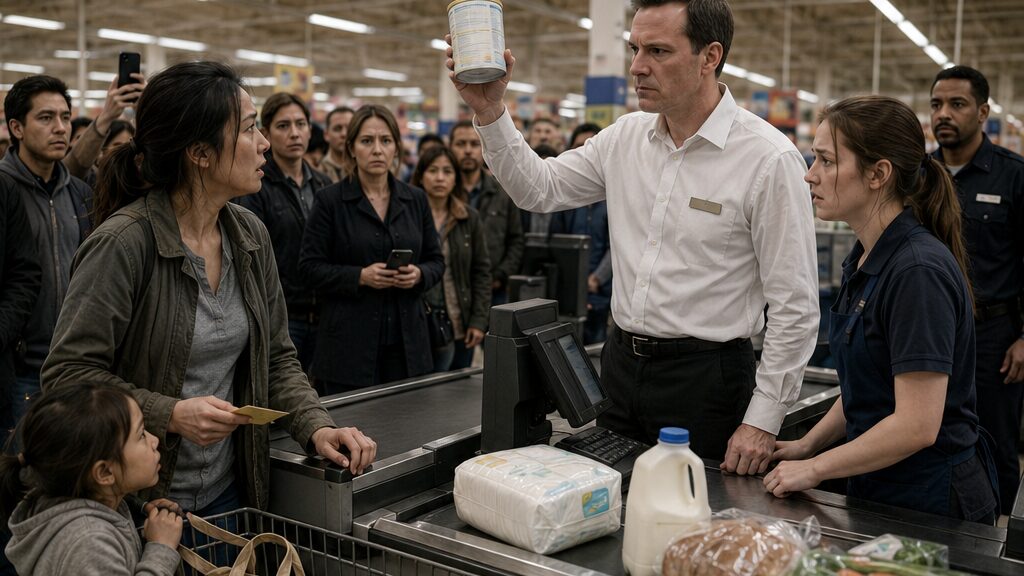
Kenneth Ward snatched the can of baby formula off the belt before Michelle Lee could finish saying the voucher had already been approved.
For one second, the whole checkout lane kept moving around it. The scanner blinked red. A plastic bag sagged from its holder. Someone’s cart bumped softly against the metal rail behind her. Then Kenneth lifted the can higher, as if it were something stolen from a locked case instead of something Michelle had placed carefully beside milk, diapers, oatmeal, apples, and the cheapest chicken thighs she could find.
Her child stood pressed against her leg, one hand curled into the hem of her work shirt.
Michelle reached out without thinking. “Please don’t—”
Kenneth pulled the formula back.
He wore a white dress shirt tucked too tightly into dark trousers, with a manager badge clipped flat against his chest. The badge had no readable name from where Michelle stood, but everyone in the store seemed to know him. A woman two lanes over glanced up, saw his face, and immediately looked down again.
“If you can’t afford baby formula,” Kenneth said, loud enough for the self-checkout attendant to turn, “maybe you shouldn’t have had a kid.”
The last scanner beep died.
Michelle felt the words hit the checkout lane before they hit her. They spread across the people behind her, over the candy shelf, past the cart of an older couple and the teenager holding a phone, into every bright fluorescent corner where strangers now knew she was buying food with help.
Her first instinct was to lower her face.
Do not react. Do not give him anything to use.
She had learned that in small offices, in waiting rooms, at front desks where people spoke slower when they saw a benefits card. She had learned it while explaining that yes, she worked, yes, she had a pay stub, yes, the voucher belonged to her, yes, the child was hers. Calm made people less likely to call security. Quiet made them move on faster.
So Michelle swallowed the heat climbing her throat and kept her hand on the cart.
“My voucher is valid,” she said. Her voice came out low, steadier than she felt. “Please check the system.”
Behind the register, Anna Scott’s face had lost color. She was young, maybe early twenties, with tired eyes and one hand still hovering over the keypad. She had scanned everything without making Michelle feel watched. Formula first, then diapers, then milk, then the food. When Michelle handed her the family-assistance voucher, Anna had nodded as if it were no different from cash.
The screen had flashed.
Anna had frowned.
Then she had tried again.
“It said approved before,” Michelle said, because that detail mattered. “It showed approved.”
Anna looked at the screen, then at Kenneth. “It did show—”
“Anna,” Kenneth cut in, not loudly this time. That made it worse. “Don’t.”
Anna’s mouth closed.
Michelle’s fingers tightened around the cart handle. The metal felt sticky beneath her palm. She had come straight from her second job, where a child had spilled orange juice over the break-room floor and the manager had asked if she could stay fifteen extra minutes to mop because “you’re already here.” She had done it. Fifteen minutes meant missing the earlier bus. Missing the earlier bus meant getting to the store when it was already packed. The voucher deadline was midnight. The baby formula shelf had only three cans left.
She had counted everything twice before getting in line.
The diapers were store brand. The milk was one gallon, not two. The apples had a bruise she had hidden in the bag because bruised ones cost the same. She had put back the laundry detergent.
Kenneth turned the formula can slowly so the plain label faced the line. “This is what happens,” he said, “when people try to run the same benefits through twice and hope the cashier is too busy to notice.”
“I didn’t run anything twice.”
“You tried once. It failed.”
“It didn’t fail. It approved, then the screen changed.”
A few heads tilted. Someone behind her muttered something too low to catch.
Kenneth heard the shift and smiled without warmth. “The system doesn’t lie.”
Anna’s eyes flicked to the register screen again.
Michelle saw it. A small, sharp movement. Not confusion. Recognition.
“What does it say?” Michelle asked her.
Anna’s fingers hovered over the keys. “It says transaction interrupted.”
Kenneth stepped closer to the register. “It says the payment didn’t go through.”
“That’s not what she said,” Michelle replied.
The manager turned his whole body toward her then, blocking her view of the screen. He still held the formula. It looked smaller in his hand now, almost absurd, but Michelle could not stop staring at it. That can was tonight’s feeding, tomorrow morning’s, the thing she had built the whole trip around. It was not an argument. It was not a symbol. It was powder in a tin, measured scoop by scoop, because children did not understand system errors.
Her child leaned harder against her leg.
Michelle lowered one hand to the small shoulder beside her. “It’s okay,” she whispered.
Kenneth gave a short laugh. “No, it isn’t. Not when people think bringing a child makes the rules optional.”
The teenager with the phone lifted it a little. Not fully, not yet. Just enough for Michelle to notice the black glass catching the overhead light.
She hated that too. She hated Kenneth’s voice, Anna’s silence, the strangers’ stares, but the phone made her stomach turn in a different way. By tonight, this could be a clip with a caption. A woman at checkout. A poor mother. A can of formula. People in comments deciding who she was.
She almost said, Fine. Take it off. I’ll go.
Her child’s hand tightened on her shirt.
Michelle thought of the empty space on the kitchen counter where the formula should have been. She thought of the bus schedule. She thought of the fifteen extra minutes she had given away at work because saying no would make her “difficult.”
Not here too.
“My voucher is valid,” she repeated. “Please check the system.”
Kenneth lowered the formula just enough to set it behind the register, out of her reach. “I already know what happened.”
“You haven’t checked.”
“I don’t need to check what I’ve seen a hundred times.”
Anna looked down.
Michelle caught that too.
The phrase opened something under the moment. A hundred times. Not a glitch, not an accident. A category he had already put her in before she reached the counter. She was not Michelle Lee, who had slept five hours and worked two shifts and counted groceries by price. She was one of those people. A line item. A problem he had been waiting to catch.
The register spat out a thin strip of receipt paper.
Anna reached for it, but Kenneth took it first. He glanced at the strip, then held it between two fingers as if it were dirty.
“Declined,” he said.
Michelle saw only a flash of print, too fast to read. “May I see it?”
Kenneth did not hand it to her. “There’s nothing here that helps you.”
“It’s my transaction.”
“It’s a failed transaction.”
“My groceries are still on the belt.”
“And they’ll stay there until real payment shows up.”
The older woman behind Michelle shifted, impatient or uncomfortable. A cart wheel squeaked. Somewhere near the front doors, an announcement crackled through the loudspeaker and dissolved into static.
Michelle did not move.
Kenneth’s expression hardened. The performance had not pushed her out. That seemed to irritate him more than anything.
He turned his head toward the front of the store. “Security.”
The word snapped through Michelle’s body.
A security guard near the entrance looked over. Eric Robinson was broad-shouldered, wearing a dark uniform shirt and a radio clipped to one side. He had been watching with the blank, careful face of someone trying not to become part of a scene. When Kenneth lifted his hand, Eric started toward them.
Michelle’s first thought was her bag.
Not because there was anything in it. There was half a pack of wipes, a bus card, her keys, a cracked phone, two folded pay stubs she had meant to put in a drawer at home. But a bag search did not need to find something to change how people looked at you. The search itself was enough.
“Why are you calling security?” she asked.
Kenneth’s voice rose again. “Because I’m not letting you walk out with unpaid merchandise.”
“I haven’t tried to walk out.”
“You’re arguing over formula you can’t pay for.”
“I’m asking you to check the transaction.”
Anna swallowed. “Mr. Ward, the screen—”
“Not another word.”
The cashier flinched.
That flinch did something to Michelle. It did not make her less afraid. It made her understand that Kenneth’s certainty was not the same as truth. Anna knew something. Maybe not enough. Maybe she was scared. But she had seen the screen before he took over, and Kenneth had stopped her twice.
Eric reached the end of the checkout lane.
Kenneth pointed at Michelle’s canvas shopping bag in the child seat of the cart. “Check it before she leaves.”
Michelle moved before Eric did.
She placed one hand on the bag, not grabbing, not jerking, just covering the zipper with her palm. Her child pressed closer. The line behind her went completely still.
“Do not touch my bag,” Michelle said.
Her voice was not loud. It was not angry. But it carried.
Kenneth’s eyes narrowed, and Eric took one more step toward the cart.
Chapter 2: The Receipt On The Floor
The receipt hit the floor beside Michelle’s shoe like Kenneth had dropped a verdict.
It fluttered once, thin and pale, then settled print-side down on the scuffed tile. For a moment Michelle stared at it instead of Eric’s hand, because the strip of paper was the first thing in the whole scene that Kenneth had let go of.
Her child bent slightly, curious.
“No,” Michelle said softly, guiding the small shoulder back against her leg. “Stay with me.”
Kenneth heard the softness and mistook it for weakness. “See? She knows. People don’t get defensive like that unless there’s something to hide.”
Michelle looked at Eric. “I have not left the store. I have not refused to pay. I have asked for the transaction to be checked.”
Eric’s face tightened. Up close, he looked younger than she had first thought, maybe early thirties, with a tired crease between his brows. His hand paused above the cart, not touching the bag yet. He glanced at Kenneth.
Kenneth’s jaw moved. “Do your job.”
A phone rose fully behind Michelle now. Then another, two lanes away. She could feel them without looking, small black rectangles pointed at her tired shirt, her cheap shoes, the diapers half bagged near the scanner. She wanted to turn and tell them to stop. She wanted to hide her child’s face against her body. She wanted to walk out and never return.
Instead she kept her palm on the bag.
“If he searches me,” she said, still looking at Eric, “before anyone checks the record, I want that on the report.”
Eric blinked.
Kenneth laughed. “There is no report unless I make one.”
From behind the register, Anna made a small sound. Not a word, almost a breath caught wrong.
Michelle turned toward her. “Anna, right?”
Anna looked startled to hear her name.
“What did the screen say before he came over?”
Kenneth stepped between them. “You don’t question my cashier.”
“I’m questioning my transaction.”
The line murmured. Someone said, “Just check it.” Another voice answered, “She’s holding up everyone.” A child cried somewhere near the cereal aisle, and the sound pulled at Michelle’s nerves because it sounded too much like the kind of cry that started hungry and turned desperate.
Anna’s hands were clenched near the scanner.
“I’m sorry,” she whispered.
Kenneth pointed at her. “You are not part of this.”
Michelle saw the cashier’s eyes shine. Fear, not guilt. Or maybe both.
Eric lowered his hand slowly, still not touching the bag. “Ma’am, maybe if you step to the side, we can clear the lane.”
“No,” Michelle said.
It came out before she had time to make it polite.
Eric stiffened.
Michelle forced herself to breathe. “No. I’ll stand right here until someone checks the system.”
Kenneth’s face reddened around the collar. “You hear that? She refuses to cooperate.”
“I refuse to be searched for asking you to read a screen.”
At the next lane, a register gave a sharp, ugly beep.
Everyone turned.
A man in a work cap held up both hands while another cashier stared at her screen. “It says error,” the cashier called toward the front. “It won’t take the card.”
The sound moved through the checkout lanes faster than any announcement. Error. Another one. Not Michelle’s voice. Not Michelle’s problem. A different customer, different register, same harsh red flash.
Anna looked at Kenneth, and this time she spoke before he could stop her.
“Sir,” she said, voice trembling, “the registers have been failing all day.”
Kenneth turned on her so quickly she stepped back from the counter.
Michelle felt the shame in her chest shift shape. It did not disappear. It loosened, just enough for anger to move inside it.
“All day?” Michelle asked.
Anna’s eyes flicked from Kenneth to Michelle. “Some cards. Some vouchers. Not all. It started before lunch.”
“That’s enough,” Kenneth said.
But Anna had opened the door, and now even Eric was looking at the red error on the other register.
Michelle bent and picked up the receipt.
Kenneth reached as if to stop her, but she already had it between her fingers. The paper was warm from the machine. She turned it over.
There was no clean DECLINED printed in bold. There were numbers, a time, an authorization line that began and cut off, and beneath it a phrase she did not understand: TRANSACTION INTERRUPTED — FRONT END REVIEW.
“What does front end review mean?” Michelle asked.
Kenneth’s hand shot out. “Give that back.”
She folded the receipt once and held it against her chest. “It’s mine.”
“It’s store property.”
“It has my transaction on it.”
The teenager’s phone shifted closer. Laura Harris, the woman standing behind the older couple, stepped sideways to see. Michelle noticed her for the first time clearly: composed, mid-forties perhaps, hair pulled back, basket on one arm, phone already unlocked but held low. She did not look excited by the scene. She looked like she was counting details.
Kenneth noticed her too and adjusted his voice.
“Ma’am,” he said to Michelle, suddenly calmer, “you need to understand how often we deal with assistance fraud. People try things. Maybe you made a mistake. Maybe someone told you it would work. But standing here and making a scene will not change the facts.”
The words almost worked.
That was the dangerous part. He had softened them enough to sound reasonable. The people who had not seen him lift the formula might only hear a manager handling a difficult customer. Michelle felt the old instinct rising again: make yourself small, make yourself harmless, show them you are not like whatever story they have in their heads.
She looked down at her child.
The small hand still clutched her shirt. The child was not crying. That made it worse somehow. The silence felt learned.
Michelle turned back to Kenneth. “The fact is your cashier says the system has been failing all day.”
Anna’s lips parted.
Kenneth slammed his palm on the counter. “Anna, step away from the register.”
Anna froze.
“Now.”
She moved one step back.
Kenneth pointed at Eric without looking away from Michelle. “Move her to customer service. If she won’t cooperate, escort her to the side exit.”
Eric shifted his weight. “Mr. Ward—”
“Do it.”
Michelle pulled her child closer and tightened her grip on the folded receipt. She had been standing in the same place for only a few minutes, but her body felt as if it had held up a wall for hours. The milk waited on the belt. The diapers sagged in a half-filled bag. The formula sat behind Kenneth, close enough to see, too far to reach.
Laura stepped out of line.
“Don’t touch her bag,” she said.
Her voice was not loud, but it cut through the checkout lane more cleanly than Kenneth’s shouting had.
Kenneth turned. “Excuse me?”
Laura raised her phone. The screen was recording now.
“I’m a consumer-rights attorney,” she said. “Do not touch her bag. Do not move her away from witnesses. Check the logs.”
The crowd went quiet again, but this time the silence did not belong to Kenneth.
Chapter 3: The Woman Who Asked For The Logs
Kenneth’s face changed so quickly Michelle almost missed it.
The anger did not vanish. It tucked itself behind a manager’s smile, the kind used for refund disputes and corporate walk-throughs. His shoulders loosened. His voice dropped. He turned slightly, giving the recording phone his best angle.
“Of course,” he said. “No one is touching anything. We’re simply trying to handle this privately so this customer can stop being embarrassed.”
Michelle felt the trap in the word privately.
Five minutes ago, she would have taken it. She would have pushed the cart to some side office under buzzing lights, away from the raised phones, away from the older woman’s stare and the man in the work cap watching from the next lane. She would have explained in a small voice. She would have said please too many times. Kenneth would have closed the door, taken the receipt, and told her there was nothing else to do.
Laura Harris did not move her phone. “She did not create the embarrassment. You did.”
A few people murmured. Kenneth’s smile thinned.
Michelle looked at the formula behind the register. Kenneth had set it near the bagging area, close to Anna’s scanner, not back with the rest of the groceries. It sat alone, separated from the milk and diapers like something under custody.
Her child looked at it too.
“We can go to customer service,” Kenneth said, “where we can review store policy without blocking paying customers.”
“Will the original transaction remain open?” Laura asked.
Kenneth blinked. “That’s an internal matter.”
“It became less internal when you publicly accused her of theft.”
“I did not use that word.”
“You called security to check her bag.”
Kenneth glanced toward Eric, who looked suddenly interested in the floor.
Laura turned to Michelle. “Do you still have the receipt?”
Michelle nodded.
“Keep it.”
Kenneth’s eyes sharpened. “That paper doesn’t prove anything.”
“Then you won’t mind if she keeps it.”
Anna shifted behind the counter. She looked smaller away from the register, hands clasped in front of her apron. Michelle saw her glance toward Kenneth, then toward the folded paper in Michelle’s hand.
The checkout lane had become a bottleneck. Customers were being redirected, but no one close to the scene had really left. They moved just enough to pretend they were not watching.
Kenneth gestured toward the customer-service desk near the front windows. “Fine. We’ll review it there.”
Michelle did not move.
Laura lowered her voice. “You don’t have to go anywhere private. A service desk is visible. An office is not.”
“I just want this checked,” Michelle said.
“I know.”
The simplicity of it almost broke something in her. I know. Not prove it. Not calm down. Not maybe he has a reason. Just I know.
Michelle swallowed and pushed the cart forward with one hand, keeping her child on the inside, away from Eric and the crowd. Anna started to follow.
“Anna,” Kenneth said.
She stopped.
“You stay on register.”
Anna looked at the dead screen. “It’s locked.”
“Then stand there.”
Laura’s phone tilted slightly toward him. “The cashier who saw the original screen should remain available.”
Kenneth gave her a flat look. “Are you representing this customer?”
“I’m preserving a public incident I witnessed.”
Michelle felt the receipt dampening in her grip. She wanted to ask Laura not to record her child. She wanted to ask Kenneth for the formula. She wanted to ask Anna what the screen had shown before he silenced her. Too many wants crowded her throat, and the old habit chose the safest one: say nothing.
At the service desk, the lighting was harsher. Fluorescent tubes reflected off the scratched counter. A row of return bins sat behind it with generic stickers and loose merchandise piled in them: dented cereal boxes, a cracked plastic pitcher, a package of socks, two cans of something turned label-down.
Kenneth placed the formula on the counter behind him, not with Michelle’s groceries.
“First,” Laura said, “pull up the transaction.”
Kenneth reached for a tablet docked beside the register. “First, I need to document the disruption.”
Michelle’s heart kicked.
“What disruption?” she asked.
“You refusing to follow store instructions.”
“I refused a bag search before my transaction was checked.”
“That’s not how I’ll describe it.”
The words were quiet. Only Michelle, Laura, Anna, and Eric were close enough to hear.
For the first time, Anna stepped nearer to Michelle instead of away from Kenneth. “The receipt may disappear if it gets voided,” she said, barely moving her lips.
Michelle looked at her.
Anna’s face was pale. “If he closes it as customer canceled, it won’t show the same way.”
Kenneth’s head snapped up. “What did you say?”
Anna stepped back.
Michelle unfolded the receipt and looked at it again. The print blurred for a moment because her hands were shaking. She pressed the paper flat against the cart handle.
“I want the original transaction reviewed,” she said.
Kenneth’s smile vanished. “You don’t get to dictate store operations.”
“I want the original transaction reviewed before anything is voided.”
“You are one step from being banned from this store.”
The threat landed exactly where he aimed it. This was the store closest to the bus line. The store with the clinic pharmacy. The store that stocked the formula her child tolerated. Being banned would not be a dramatic punishment to strangers. It would be three more bus transfers, more missed shifts, more days built around distance.
Michelle felt herself bend toward fear.
Laura watched her, but did not speak for her.
That mattered. It left the choice with Michelle, which made it harder and cleaner at once.
Michelle looked at her child, at the small fingers now tracing the cart’s plastic handle, at the milk warming slowly on the belt behind them, at the formula kept apart behind Kenneth like a hostage.
“No,” she said.
Kenneth tilted his head. “No?”
“No, I’m not going to an office. No, I’m not leaving through the side exit. No, I’m not signing anything that says I disrupted the store. And no, you are not voiding that transaction until someone checks why it changed after my voucher approved.”
The words left her one at a time, each more frightening than the last.
A woman near the desk whispered, “Good.”
Kenneth heard it. His ears flushed red.
He grabbed the tablet from its dock. “Fine. You want the record? Let’s look at the record.”
Laura moved closer. “Keep the screen visible.”
Kenneth turned his shoulder, blocking her view.
“Mr. Ward,” Laura said.
But his thumb was already moving. He entered a manager code fast, too fast for Michelle to follow, and tapped the screen before anyone else could see what he had opened.
The tablet gave a soft confirmation chime.
Anna inhaled sharply.
Michelle stared at Kenneth’s hand on the screen, the folded receipt trapped under her own palm, and understood that the question had changed.
Not whether the system had failed.
Whether Kenneth had just changed the proof.
Chapter 4: The Override No One Mentioned
“Manager override,” Laura read aloud.
The words were small on the tablet screen, but they changed the air around the service desk.
Kenneth’s thumb stopped moving.
Michelle saw it clearly because everyone else had gone still. The tablet was angled halfway toward Laura now, not willingly, but because Kenneth had shifted after the chime and Laura had stepped closer before he could lock the screen. The line on the display was buried under transaction codes and timestamps, but Laura’s finger hovered just above it without touching.
Manager override.
Not declined. Not insufficient. Not invalid.
Interrupted.
Michelle felt the receipt under her palm as if it had warmed again. The same time. The same transaction. The same moment Anna had frowned before Kenneth arrived.
Kenneth pulled the tablet toward his chest. “That’s routine.”
Laura kept her phone steady. “Then explain it.”
“I don’t explain internal systems to customers.”
“You publicly accused her based on that system.”
“I accused her based on behavior.”
Michelle looked at him. “What behavior?”
Kenneth’s nostrils flared. “Arguing. Refusing to step aside. Refusing security.”
“I refused to let my bag be searched before you checked the transaction.”
“And now you’re coaching my cashier to undermine store procedure.”
Anna flinched so slightly Michelle might have missed it before. Now she noticed everything: Anna’s hands twisting at the hem of her apron, Eric’s radio crackling once and going silent, the red line at Kenneth’s neck where his collar pressed too tight.
Laura’s voice stayed level. “An override is not a payment failure.”
Kenneth snapped the tablet down on the service counter. “It can be used during payment failure. It can be used during suspected duplicate attempts. It can be used when a cashier needs manager review. That is why managers exist.”
He had found his ground again. Rules. Systems. Authority. Words arranged to sound like walls.
Michelle wanted to ask Anna if that was true, but Anna looked trapped between them, pale and shrinking under Kenneth’s glare.
The child tugged Michelle’s shirt.
“Can we go home?” the child whispered.
Michelle’s throat tightened. She almost said yes. The sound was already forming in her mouth, soft and automatic. Yes, baby. We’ll go. We’ll leave the milk, the diapers, the formula, the receipt, the whole bright watching store. We’ll disappear so people can finish checking out and Kenneth can stand straight behind his counter again.
She looked at the formula can.
It still sat behind Kenneth, no longer held high, but still not hers.
“Soon,” Michelle whispered. Then she looked back at Kenneth. “Show the screen.”
Kenneth stared at her as if she had spoken out of turn in his house.
Laura glanced at Michelle, and something like approval moved through her face before disappearing. “Yes,” she said. “Show the transaction history without altering it.”
Kenneth let out a breath through his nose. “I have already told you, the transaction is under review because the system flagged possible misuse.”
“What misuse?” Michelle asked.
“You attempted to use the same voucher twice.”
“No.”
“That is what the system indicates.”
Anna’s head lifted.
Michelle saw it before Kenneth did. A flash of disbelief stronger than fear.
Laura saw it too. “Anna?”
Kenneth turned. “Do not answer that.”
Anna’s mouth trembled. “It didn’t say duplicate.”
“Anna.”
“It said front end review.”
Kenneth stepped closer to her. “You are confusing screens because you’re nervous.”
“I saw it.”
“You saw a failed payment during a rush while this customer was pressuring you.”
Michelle’s face burned. “I never pressured her.”
“You stood there with a line behind you insisting the rules didn’t apply.”
“No,” Michelle said, each word forced through clenched teeth. “I stood there because I knew the voucher was valid.”
Kenneth’s eyes shifted toward the phone in Laura’s hand. He lowered his voice again, but this time the calm looked strained. “Let me tell you what happens from this side of the counter. We get audited for shrink. We get blamed for missing formula, missing meat, missing high-demand items. We get people trying every trick because they know employees are afraid of scenes. I stop those losses. That is my job.”
For a second, Michelle heard the pressure behind his cruelty. Not regret. Not kindness. Just fear wearing a uniform. He needed to be the man who caught people. He needed her to be one of them.
But pressure did not put the words in his mouth. Pressure did not make him lift the formula like a trophy.
“Then do your job,” Michelle said. “Check what happened.”
The tablet chimed again.
Kenneth glanced down too quickly.
Laura leaned in. “What did you open?”
“Inventory support.”
“Why?”
“Because this involves controlled product.”
“Baby formula is not evidence because you say so.”
Kenneth turned the tablet, finally, but not enough for Michelle to see everything. A screen showed a list of recent front-end incidents. Several lines were grayed out. One line near the top carried the time of Michelle’s checkout. Beside it were two words: REVIEW HOLD.
Below that, smaller: MANAGER ACTION.
Michelle’s folded receipt showed the same minute.
Laura pointed. “Open that line.”
Kenneth did not move.
“Open it,” Michelle said.
His eyes cut to her again. “You really want to keep pushing this?”
Michelle’s fingers tightened around the receipt until the paper creased. Her anger was becoming harder to hold quietly. It pressed behind her eyes, in her jaw, in the hand resting on the cart. She could feel how easily it could become the kind of anger Kenneth wanted: loud, shaking, ugly enough to replay without context.
She forced her voice down. “Yes.”
Kenneth tapped the line.
A detail window opened.
Anna took one step forward despite herself.
Laura read before Kenneth could close it. “Voucher authorization pending… cashier scan accepted… manager override initiated…” She paused. Her eyes narrowed. “Manual interruption.”
The service desk seemed to tilt.
Michelle looked at Anna. Anna looked back with the stunned, guilty face of someone seeing her own memory confirmed.
“It was not declined,” Michelle said.
Kenneth’s hand came down flat beside the tablet. “Manual interruption is a protective step. It does not mean she was approved.”
“It means you interrupted it,” Laura said.
“It means I reviewed it.”
“You reviewed it after taking the formula from her?”
Kenneth’s jaw hardened. “I came over because Anna signaled there was an issue.”
Anna shook her head once. Small. Terrified.
Kenneth saw.
“Careful,” he said.
Michelle felt the word hit Anna like a slap.
That was when Michelle understood her own silence had not protected anyone. Not herself. Not her child. Not Anna. It had only made room for Kenneth’s voice.
“You told her not to speak,” Michelle said.
Kenneth turned slowly. “Excuse me?”
“You told her not to speak because she saw the screen.”
“I told my employee not to spread misinformation.”
“You told her not to speak because the voucher didn’t fail the way you said.”
The muscles in Kenneth’s face tightened. “You want to talk about failure? Fine. You tried to use the same voucher twice. That is why high-demand items like formula go missing. That is why my department gets questioned. That is why honest customers pay the price.”
“I did not use it twice.”
Kenneth tapped another part of the tablet and turned it toward Laura with sudden confidence. “Inventory record. Same product category. Assistance payment. Repeat attempt.”
Laura scanned it without taking the bait. “This does not show her name.”
“It shows a pattern.”
“It shows categories.”
“It shows abuse.”
Michelle looked at the screen. Numbers, item codes, return flags, abbreviations she did not understand. Kenneth had moved the argument somewhere harder to fight. Not the voucher in her hand. Not the receipt with the timestamp. A fog of store records he could interpret any way he wanted.
“You’re saying I abused the system because someone else returned formula?” she asked.
“I’m saying we know how this works.”
Anna whispered, “Mr. Ward…”
He snapped, “What now?”
Anna’s eyes filled. “There were two others.”
The service desk went silent.
Kenneth stared at her.
Anna seemed to realize she had spoken aloud only after the words were out. She looked at Michelle, then at Laura, then down at the floor. “Last month. Two mothers. Same double-use accusation.”
Kenneth took one step toward her, and Eric, without seeming to plan it, took one step between them.
Michelle saw the movement. So did Kenneth.
For the first time since he had snatched the formula, Kenneth looked less angry than exposed.
Chapter 5: The Complaints That Were Deleted
Anna found the complaint note in a folder labeled so blandly that Michelle almost missed the tremor in her hand.
It was tucked behind the customer-service counter, in a gray plastic file box between return slips and damaged-item forms. Anna had asked for the log book, and Kenneth had said there was no need. Laura had said, “Then there is no harm in looking.” Eric had opened the half door to the service area without waiting for Kenneth’s permission, and now Anna stood with a thin sheet of paper held close to her chest.
“This one,” she said.
Kenneth’s voice turned cold. “Put that back.”
Anna did not.
The paper was not dramatic. No bold heading. No signature line full of outrage. Just a printed customer-contact form with handwritten notes in rushed blue ink. Michelle could only see pieces from where she stood: assistance voucher, formula item, customer upset, resolved.
Anna’s face had gone gray.
“She came back twice,” Anna said. “She said nobody called her.”
Kenneth reached for the paper. Laura moved her phone slightly. He stopped.
Michelle’s child leaned against the cart, tired now, cheek pressed to the side of the plastic seat. Michelle rubbed slow circles between the child’s shoulders while staring at the word resolved.
That word bothered her more than Kenneth’s shouting.
Resolved sounded clean. It sounded like someone had listened, checked, corrected. It sounded like a door gently closed.
“How many?” Laura asked.
Anna swallowed. “I don’t know.”
Kenneth laughed once. “Exactly. She doesn’t know.”
“But I remember two,” Anna said, voice shaking. “One had a baby carrier. One was buying the same brand of formula. Both times the voucher looked like it went through first, then changed.”
“Because scammers repeat methods,” Kenneth said. “That is what patterns are.”
Michelle looked up. “Or because you repeat yours.”
The words surprised her. They surprised everyone.
Kenneth’s eyes flashed. “You should be very careful.”
“I have been careful all day,” Michelle said. “Careful at work. Careful with money. Careful with every item in that cart. Careful with how I spoke when you insulted me in front of my child.” Her voice shook, and she hated that, but she did not stop. “You mistook careful for easy to scare.”
Anna looked at her then, really looked, and something shifted between them. Not trust exactly. Something more fragile. Recognition.
Laura took the complaint note from Anna with permission, holding it by the edge so the phone could record it without blocking the text. “This says resolved by manager review. Is that you, Mr. Ward?”
Kenneth folded his arms. “All front-end complaints route through management.”
“Did you contact this customer?”
“I don’t discuss customer history with random shoppers.”
“I am asking whether the complaint was actually resolved.”
He looked toward Eric. “Clear this area.”
Eric did not move.
“Eric,” Kenneth said.
The guard’s jaw flexed. “There are still customers watching.”
“That’s exactly why you clear it.”
“On what grounds?”
Kenneth stared at him as if the question itself were betrayal.
Eric looked uncomfortable, but he held his place. “I mean, are we saying she’s detained? Banned? What’s the reason?”
Michelle felt the question ripple through the scene. Eric was not saving her. He was not suddenly fearless. His hands were tense, and he kept glancing toward the front doors like he wished he were anywhere else. But he had asked for a reason. In Kenneth’s store, that was not small.
Kenneth lowered his voice. “You want me to write you up too?”
Eric looked down, then at Michelle’s bag, then at the formula on the counter. “I’ve checked bags before you looked at transaction histories.”
Anna’s head turned sharply.
Kenneth said nothing.
Eric’s face reddened. “I didn’t know. I thought you had already checked. You’d say, ‘failed voucher, possible concealment,’ and tell me to keep them from leaving.”
Michelle’s stomach tightened. Them.
Laura seized the word. “How many times?”
“I don’t know. A few.”
“A few formula disputes?”
Eric hesitated.
Kenneth’s voice cracked like a whip. “Robinson.”
Eric swallowed. “Mostly formula. Sometimes diapers.”
The child stirred against Michelle’s side.
Michelle glanced down, and for one terrible second she imagined another mother standing where she stood, another child too quiet, another bag opened under bright lights while strangers watched. She had wanted this to be a mistake because a mistake could be fixed and left behind. A pattern meant the floor under her was larger than her own fear.
Anna reached into the file box again.
“Stop,” Kenneth said.
She froze.
He pointed toward the employee hallway. “You. Break room. Now.”
Anna’s eyes widened. “I’m still clocked on register.”
“You’re suspended pending review.”
The word hit her hard enough that she looked physically unsteady.
Michelle saw the old reflex take Anna: apologize, obey, disappear. It was the same reflex Michelle had almost followed in the checkout lane. Anna took one step toward the hallway.
“Wait,” Michelle said.
Anna stopped.
Kenneth rounded on her. “This does not concern you.”
“It does if you’re punishing her for saying what happened during my transaction.”
“She is my employee.”
“She is a witness.”
Laura nodded once. “And retaliation during an active complaint is a very poor choice.”
Kenneth’s face darkened, but his eyes shifted to the phone again.
Michelle did not know employment rules. She did not know corporate complaint language. She knew only the way Anna stood with her shoulders pulled inward, already carrying blame she had not earned. And Michelle knew that if Anna left now, Kenneth would close the space around the truth.
“Please stay,” Michelle said to Anna.
Anna’s eyes filled again.
For a moment, no one spoke. The store continued around them in broken pieces: a scanner beep, cart wheels, a customer-service bell nobody answered, the dull hum of refrigerators from the back wall. Across the front aisle, the formula shelf was visible beyond the endcap of cleaning supplies. The section looked half-empty, the few remaining cans lined up with gaps between them like missing teeth.
Michelle looked at that shelf and then at the can on the counter.
The can Kenneth had taken was not an isolated object anymore. It belonged to a row of empty spaces. It belonged to complaint notes marked resolved. It belonged to Eric’s bag checks and Anna’s fear.
Laura shifted the folded receipt in her hand. “There’s a case number here.”
Kenneth’s head snapped toward her.
“It printed on the interrupted transaction,” Laura said. “That means corporate support can pull the record.”
Kenneth forced a laugh. “Corporate support will tell you the same thing I did.”
“Good,” Laura said. “Then you won’t mind.”
“I do mind wasting resources during a rush because a customer doesn’t like store policy.”
Michelle spoke before Laura could. “Call them.”
Kenneth looked at her with open contempt. “You have no idea what you’re doing.”
Michelle thought of the groceries still not paid for, her child’s tired weight against her, the bus she had probably already missed. He was partly right. She had no idea what corporate would say, how long it would take, whether she would get banned anyway, whether the phones recording her would make everything worse.
But she knew what leaving would do.
It would make the receipt meaningless. It would leave the formula on the counter. It would teach her child that being quiet was more important than being true.
“Call them,” Michelle repeated.
Laura tapped the number printed beneath the case code and put the phone on speaker only after a recorded menu confirmed the corporate compliance line. Kenneth stood motionless, arms folded, but the color had drained from his face in a way Michelle had not seen before.
Laura gave the case number. Then she said, “This concerns a voucher override, a public accusation, and baby formula return records.”
At the words formula return records, Kenneth’s expression changed.
It was small. A blink held too long. A pull at one corner of his mouth. But Michelle saw it, Anna saw it, and Laura’s phone was still recording.
Chapter 6: The Return Shelf Behind The Office
“Why is the formula already listed as a customer return?” the compliance reviewer asked through Laura’s phone.
Nobody at the service desk moved.
The voice was tinny, professional, and far too calm for the way the question landed. Laura had identified herself, then Michelle, then Anna as the cashier on the transaction. The reviewer had asked for the case number, the register number, and the time stamp from the receipt Michelle still held. There had been clicking on the other end, a pause, a request not to alter the transaction further.
Then that question.
Why is the formula already listed as a customer return?
Michelle looked at the can on the counter.
It had not left the store. It had not left Kenneth’s reach. It had not been returned by anyone because it had never been purchased.
Kenneth recovered first. “That’s a temporary classification.”
Laura’s eyes narrowed. “Who are you speaking to?”
Kenneth leaned toward the phone. “Kenneth Ward, store manager. Formula is a controlled inventory category. During disputes, items may be moved into return status while payment validity is reviewed.”
The reviewer paused. “Our system shows the item entered as customer return with manager authorization.”
“Yes,” Kenneth said. “As I said.”
“The customer is still present?”
Kenneth’s jaw tightened. “Unfortunately, yes.”
Michelle flinched at the word before she could stop herself.
Laura glanced at her, then spoke toward the phone. “The customer is present because she requested review before any item was voided, returned, or removed from the transaction.”
More clicking.
Anna stood beside the counter now, not behind it. She had not gone to the break room. Her hands shook, but she held herself in place.
The reviewer asked, “Is the original item physically available?”
Laura looked at the can. “Yes.”
“Do not move it. Do not scan it again. Do not process any return.”
Kenneth laughed under his breath. “This is getting absurd.”
“Mr. Ward,” the reviewer said, “please provide access to the return record screen.”
Kenneth’s posture changed. The smallest retreat, but Michelle saw it. He looked toward the manager’s office doorway behind the service desk, then toward the stockroom corridor.
“The front-end tablet has limited functionality,” he said.
“Then use the office terminal.”
“I can’t leave the front unattended during a rush.”
Eric spoke quietly. “I can stand here.”
Kenneth turned on him. “You have already done enough.”
The reviewer’s voice cut through. “Mr. Ward, please do not delay record access.”
Kenneth took the tablet, then seemed to think better of it. “Fine. We’ll go to the office terminal.”
“Visible area,” Laura said immediately.
“The office is not a public viewing space.”
“The customer does not need to enter,” Laura replied. “But Anna can access the return screen from the service terminal if she has permission, correct?”
Anna’s eyes widened.
Kenneth said, “She does not.”
The reviewer asked, “Is Anna Scott the cashier of record?”
Anna leaned toward the phone. “Yes.”
“Anna, do you still have front-end return lookup access?”
Anna looked at Kenneth.
He stared back at her with such flat warning that Michelle felt it across the counter.
Anna swallowed. “I think so.”
“Do not,” Kenneth said.
Laura’s phone captured it.
The reviewer paused. “Anna, please open return lookup for the case item. Do not modify anything.”
Anna moved to the service terminal like someone stepping onto thin ice. Her fingers missed the first key. She whispered an apology to no one and tried again.
Kenneth stood too close behind her.
Michelle saw Anna’s shoulders tighten.
“Step back,” Michelle said.
Kenneth looked over. “You don’t give orders here.”
“No,” Michelle said, surprised by how steady she sounded. “But you’ve been standing over her every time she tries to tell the truth.”
For a second, Kenneth looked as though he might shout. Then he remembered the phone.
He stepped back half a pace.
Anna opened the return lookup. The screen loaded slowly, a spinning circle turning while the store noise pulsed around them. Michelle’s child had grown heavy against her hip. She lifted the child into the cart’s seat, tucked the small legs away from the metal edge, and kept one hand on the cart while watching the screen.
A list appeared.
The top line matched the formula item. Time stamp: two minutes after Kenneth had taken the receipt. Status: customer return. Authorization: K. Ward.
Anna covered her mouth.
Michelle looked at the receipt in her hand. The interrupted transaction time came first. Kenneth’s return entry came after. During the argument. During the public accusation. While the can sat behind him.
Laura read the times aloud.
The reviewer’s voice lost some of its polish. “Mr. Ward, why was this item entered as returned before the dispute was resolved?”
Kenneth’s face hardened. “Because the cashier mishandled the transaction.”
Anna dropped her hand. “No.”
Everyone looked at her.
Her voice shook, but she did not stop. “No, I didn’t. I scanned it. The voucher showed pending approval. Then it changed. You came over and told me to let you handle it.”
Kenneth pointed at her. “You are making statements you cannot support.”
“The screen supports it,” Laura said.
“The screen shows she got confused.”
Anna’s eyes filled with tears, but her mouth set. “You told me last month not to write down the other one either.”
Kenneth went still.
Michelle felt the name of the missing mother hover in the air before anyone said it. Other one. Maybe one of the complaint notes. Maybe someone who had stood here and folded herself small.
The reviewer asked, “Other what?”
Anna did not answer right away. She looked at Michelle first, and Michelle realized Anna was asking permission without words. Not legal permission. Human permission. Is this worth the cost?
Michelle thought of taking the offered groceries and leaving. If corporate fixed her purchase now, she could go home. The child could eat. She could stop being recorded. Anna could deal with whatever came after. Brenda, whoever she was, could remain a faded complaint in a box.
Michelle heard herself say, “Tell them.”
Anna nodded once. “Other voucher disputes. Formula and diapers. He said if we wrote every sob story up, we’d never get through a shift.”
Kenneth slammed his hand on the counter. “Enough.”
The child startled.
Michelle pulled the cart closer, anger flashing hot enough to clear the fatigue from her body. “Don’t slam things near my child.”
Kenneth opened his mouth, then closed it.
The reviewer said, “Mr. Ward, I’m escalating this call. Do not alter records. Do not process returns. Do not remove involved employees or the customer from the premises unless there is an immediate safety concern.”
Laura looked at Eric. Eric gave a small nod, as if memorizing the line.
For several minutes, everything became procedure. The reviewer asked for screenshots from Laura, a verbal statement from Michelle, confirmation from Anna, and the current location of the physical formula can. Kenneth answered only when directly addressed. His words were clipped, defensive, full of phrases like inventory integrity and known abuse patterns.
Then the reviewer said, “There is also a return shelf behind the front office, correct?”
Kenneth’s head lifted.
Anna whispered, “Yes.”
“Please visually confirm whether additional formula items are staged there.”
Kenneth stepped in front of the office doorway. “That area is employees only.”
Laura did not move. “Anna?”
Anna looked terrified again, but Eric had already turned toward the short hallway. “I can see the shelf from here.”
Kenneth snapped, “Robinson.”
Eric stopped at the doorway but did not enter. He looked past Kenneth’s shoulder. His face changed slowly.
“There are cans,” he said.
“How many?” the reviewer asked.
Eric swallowed. “Several.”
Michelle stepped just far enough to see through the open angle of the doorway. Behind the office, on a metal return shelf, sat a row of baby formula cans with generic return stickers crooked across their lids.
For a moment, all Michelle could see was the first can Kenneth had held above her head, multiplied.
The reviewer asked for the return identification numbers. Kenneth refused twice. Anna read them anyway from the service terminal, voice shaking but clear.
The numbers did not settle the whole matter. They did not explain where every item had gone or who had suffered each time a voucher failed. But they made one truth impossible to fold back into silence: formula had been marked as returned in disputes that had not been resolved.
A new voice came onto the call, firmer than the first. “Ms. Lee, we can immediately comp your current grocery purchase while this is reviewed. There is a short incident resolution statement we can send to the service desk. Once signed, your items can be released today.”
The word immediately weakened Michelle’s knees.
She looked at the milk, the diapers, the formula. She looked at her child’s tired face. Immediate meant home. Food. Quiet. The bus stop before dark.
Laura did not speak.
Anna watched her with wet eyes.
Kenneth’s mouth curved, barely. Not a smile. A prediction.
Michelle asked, “What does the statement say?”
The voice said, “It confirms a customer-service inconvenience during checkout and acceptance of compensation.”
Customer-service inconvenience.
Michelle almost laughed. It came out as a breath.
Kenneth had held formula over her head and questioned whether she should have had a child. Security had been ordered to check her bag. Her voucher had been overridden. A return had been entered while she stood there defending herself.
Inconvenience.
Michelle unfolded the receipt and placed it on the counter beside the voucher. The paper no longer looked humiliating. It looked small and stubborn.
“No,” she said.
The voice on the phone paused. “Ms. Lee?”
“I’m not signing that.”
Kenneth’s expression tightened.
Michelle put one hand on the cart and one hand on the receipt. “If you want my statement, it includes the words public accusation, voucher override, and formula return record. All three. Or I don’t sign.”
Chapter 7: The Mothers Who Left Quietly
Brenda Allen arrived holding a receipt so worn at the folds that it looked like it might split apart if anyone breathed on it.
Anna saw her first.
She had been standing near the customer-service counter with her phone clutched in both hands, the screen dimming and waking as if she kept checking whether the message she had sent was real. When the front doors slid open and a woman in a faded cardigan stepped inside, Anna’s whole body went still.
Michelle turned.
Brenda did not look like someone ready to fight. She looked like someone who had almost changed her mind in the parking lot and might still run if anyone spoke too sharply. Her hair was pulled back, her eyes fixed on the floor ahead of her, and in one hand she held the folded receipt between two fingers as if it had once burned her.
Kenneth saw her and gave a low, humorless laugh.
“So now we’re bringing in friends.”
Brenda stopped.
The receipt trembled in her hand.
Anna stepped forward. “She isn’t my friend. She was a customer.”
Kenneth turned on her. “You texted someone from store property during an active investigation after being told you were suspended from front-end duties.”
Anna’s face drained, but she did not retreat. “You told me she never came back.”
Brenda looked up at that.
For a moment, Michelle forgot the phones, the compliance call, even the formula on the counter. The look on Brenda’s face was not surprise. It was the pain of hearing a door unlock years too late.
“I came back twice,” Brenda said.
Her voice was quiet. The store swallowed half of it.
Laura moved nearer, not with her phone raised high now, but held low enough to record without feeling like she was trapping Brenda under a spotlight. “You don’t have to speak if you don’t want to.”
Brenda’s eyes moved to Michelle’s cart. The diapers. The milk. The can of formula still held out of place on the counter beside the receipt and voucher.
“I saw the video,” Brenda said.
Michelle’s stomach tightened. “It’s already online?”
“Someone sent it to me.” Brenda’s mouth tightened. “I wasn’t going to come.”
Kenneth folded his arms. “Then you should have trusted that instinct.”
Brenda took one step backward.
Michelle saw it happen in her body before the motion finished: shame pulling her toward the exit, the old training that said leaving hurt less than being looked at. She knew that movement. She had felt it in her own knees when Kenneth offered the private office. She had nearly obeyed it.
The child in Michelle’s cart stirred, half asleep, one cheek pressed against the plastic seat. Michelle looked from the child to Brenda’s folded receipt.
“You can stand by me,” Michelle said.
Brenda blinked.
Kenneth scoffed. “Touching.”
Michelle ignored him. “You don’t have to prove you deserved food.”
The words made Brenda’s face crumple in one quick motion before she steadied it. She came forward slowly and stood on the other side of Michelle’s cart, not close enough to touch, close enough not to be alone.
Laura asked, “Can you tell us what happened?”
Brenda unfolded the receipt with careful fingers. The ink had faded to a ghost, but the printed time and a few item codes remained. “Formula. Diapers. Two jars of baby food. The voucher went through at first. The cashier said it was accepted. Then the screen changed.” She looked at Anna. “You were there.”
Anna nodded. “I remember.”
Kenneth raised his voice. “You remember a busy day and an upset customer. That is not evidence.”
Brenda’s shoulders curled inward, but she kept speaking. “You came over and said I had tried the voucher earlier. I said I hadn’t. You said people like me always forget what they’ve already used.”
Michelle’s hand tightened around the cart.
Brenda stared at the receipt. “You told security to check my diaper bag.”
Eric, standing near the service desk, lowered his eyes.
Kenneth did not. “If there was reasonable suspicion—”
“There wasn’t,” Brenda said. The sharpness surprised even her. She looked up. “There wasn’t anything in my bag except bottles and burp cloths. But everyone watched while he opened it.”
Eric swallowed. “I’m sorry.”
Brenda looked at him for a long second. “You didn’t look at me once after.”
Eric’s face colored.
The apology had not fixed anything. Michelle was glad it did not. Some things needed to sit in the room unchanged long enough to be understood.
Laura took a picture of Brenda’s receipt beside Michelle’s, with Brenda’s permission. “Did you file a complaint?”
“I tried.” Brenda nodded toward the gray file box. “They said it was handled.”
Anna reached into the box again and pulled the complaint note she had found earlier. Her fingers traced the bottom line. “Resolved by manager review.”
Brenda gave a small, bitter breath. “No one called me.”
Kenneth stepped toward the counter. “This is absurd. You have two customers who failed voucher transactions, one cashier trying to protect herself, and a stranger with a phone turning a policy issue into a public attack on my career.”
Laura looked up. “Your career is not the item under review.”
“It is when people coordinate false complaints to destroy it.”
Michelle felt the accusation turn toward her before Kenneth finished speaking. He needed a new story. Not a thief now. A liar. A woman using embarrassment for advantage. A mother recruiting others to punish a manager who had only done his job.
“You think I wanted this?” Michelle asked.
Kenneth’s eyes were flat. “I think you saw an opportunity.”
Michelle laughed once, too tired to soften it. “An opportunity to miss my bus, scare my child, and have strangers record me holding a benefits voucher?”
“An opportunity to get free groceries and compensation.”
The word compensation landed strangely. A few customers still watching shifted. Michelle felt their attention change, not against her exactly, but curious now, measuring. Money could sour sympathy fast. Kenneth knew that too.
Her first instinct was to explain she had not asked for anything. That she had only wanted the transaction checked. That she was not trying to profit. The words lined up, pleading and careful.
Then she saw Brenda fold around her receipt again.
Michelle stopped.
Kenneth would always find another word to make them smaller. Fraud. Disruption. Opportunity. Coordinated. The word changed; the shape stayed the same.
“I want the record corrected,” Michelle said.
Kenneth smiled thinly. “Of course you do.”
“And I want them to look at hers.”
Brenda’s head lifted.
“And the two Anna remembers. And any complaint marked resolved by you that involved formula, diapers, vouchers, or bag checks.”
Kenneth’s face darkened. “You don’t tell this company what to review.”
A new voice answered from behind him.
“Actually, right now, neither do you.”
Two people in dark business-casual jackets had entered through the front doors without Michelle noticing. One carried a slim laptop bag. The other had a store visitor badge already clipped to her jacket and a phone pressed to her ear. They did not look dramatic. They looked tired, focused, and inconvenient.
Laura turned her phone slightly toward them.
The woman with the badge ended her call. “Kenneth Ward?”
Kenneth straightened by reflex. “Yes.”
“I’m with corporate audit and compliance. We’re going to secure the front-end records and return logs while this review is active.”
Kenneth’s manager smile returned, but it was stiff now. “Of course. I’ve been trying to manage an escalating customer disturbance until you arrived.”
The auditor looked at Michelle’s cart, Brenda’s receipt, Anna’s tear-streaked face, Eric’s rigid posture, the formula can on the counter, and Laura’s phone.
Then she looked back at Kenneth.
“Please surrender your manager keys and access card during the review.”
For the first time, Kenneth did not have a ready answer.
Chapter 8: The Formula She Carried Out
Kenneth stood at the same counter where he had held the formula above Michelle’s head, but now his hands were empty and he was not allowed to touch the register.
That was the first thing Michelle noticed.
Not the auditors opening screens. Not Laura speaking quietly into her phone. Not Anna wiping her face with the back of her hand and pretending she had only allergies. Kenneth’s hands. Empty at his sides, fingers flexing as if they still expected keys, a tablet, a receipt, something he could control.
The auditor placed his access card into a clear plastic sleeve.
Kenneth watched it disappear.
“This is unnecessary,” he said. “I have followed loss-prevention procedure in a difficult branch with repeated assistance fraud.”
The auditor did not argue. She simply said, “We’ll let the records speak.”
Records did not speak quickly. That was the hardest part.
Michelle wanted truth to arrive like a door opening. Instead, it came in small, dry pieces. A transaction history on one screen. A return report on another. A list of manager overrides. Complaint numbers matched against customer contacts. Formula item codes repeated across dates. Entries marked customer return with no matching customer refund. Notes closed by manager review without follow-up calls.
No single line made Kenneth guilty of everything.
Together, they made his story too heavy to stand.
Anna sat on a stool near the service desk and answered questions with both hands wrapped around a cup of water someone had brought her. Eric gave a statement with his eyes mostly on the floor. Brenda sat beside Michelle’s cart, the old receipt open on her lap now, no longer hidden in her fist.
Michelle stayed standing.
Every time someone offered her a chair, she shook her head. If she sat, she was afraid she would feel how tired she really was. Her legs trembled. Her child dozed in the cart, head tipped against the side, one small hand resting near the diapers.
The formula can remained on the counter until the auditor finally lifted it with both hands, as if careful not to let its meaning spill.
“This item will be rescanned through the original customer transaction,” she said. “The voucher authorization has been confirmed as valid.”
Michelle closed her eyes for half a breath.
Valid.
The word should not have felt like mercy. It was only a fact. But after hours of being treated like a lie, a fact could feel like water.
Kenneth made a sound. “You’re rewarding this.”
The auditor turned to him. “Mr. Ward, do not address the customer.”
“She created a scene.”
“You created a return record for an item she had not purchased or returned.”
“I was preserving inventory.”
“You also overrode her voucher transaction manually after cashier scan acceptance.”
“Because of known patterns.”
The auditor glanced at the laptop. “Patterns created under your manager code.”
Kenneth’s mouth closed.
Michelle watched him absorb the sentence. Not guilt. Not apology. Calculation. A man trying to find which door was still open.
The auditor stepped away to take a call near the office doorway. The second auditor printed documents from the service terminal. The printer made a soft grinding sound, slower than the checkout receipt machine, each page sliding out with unbearable calm.
When the auditor returned, her voice changed. It became the voice used to contain damage.
“Ms. Lee, on behalf of the store, I apologize for the delay and mishandling of your transaction. We can provide your groceries at no cost today, issue a compensation card, and document the incident internally.”
Michelle looked at Laura.
Laura’s face gave nothing away, but her phone was lowered now. She was letting Michelle hear the offer without interference.
The auditor continued, “We’ll also be reviewing related records.”
“Will the apology say what happened?” Michelle asked.
“It will state there was an error in handling your transaction.”
Michelle felt Kenneth listening.
“What kind of error?”
The auditor hesitated. “A front-end processing error.”
Michelle looked at the formula can.
Hours earlier, Kenneth had held it high enough for strangers to judge her motherhood. The store was willing to call that processing. It was willing to make the words smooth enough that no one would cut themselves on them.
Her child shifted in the cart and opened sleepy eyes. “Can we go now?”
Michelle touched the child’s cheek. “Almost.”
She looked back at the auditor. “I want it written that my child was present.”
The auditor’s expression flickered.
Michelle kept going before the old fear could pull her back. “I want it written that I had a valid family-assistance voucher. I want it written that the manager ordered security to check my bag before the transaction was reviewed. I want it written that there was a manual voucher override and a formula return record entered before I left the store.”
Kenneth said, “This is ridiculous.”
The auditor said, “Mr. Ward.”
Michelle did not look at him. “And I want the other complaints reopened. Not just mine.”
Brenda’s breath caught beside her.
Anna looked up.
The auditor folded her hands. “Those reviews may take time.”
“Then write that they are being reopened.”
“We can’t disclose other customers’ details in your letter.”
“I’m not asking for names. I’m asking you to write that related voucher complaints involving formula and public bag-check requests will be reviewed.”
The auditor studied her.
Michelle felt the weight of everyone’s attention again, but it was different now. Earlier, it had pressed her down. Now it held the space open. Laura’s stillness. Anna’s wet-eyed stare. Brenda’s receipt on her lap. Eric standing with his hands clasped in front of him like a man waiting to be judged by more than a supervisor.
The auditor nodded once. “We can include that.”
Kenneth looked away.
The second auditor printed a revised statement. It took several tries. The first version said inconvenience. Michelle refused it. The second said confusion at checkout. Michelle refused that too. The third named the voucher, the override, the bag-search order, the return record, and the child’s presence.
When Michelle signed her statement, her hand shook so hard that the first letter of her name came out jagged.
She did not apologize for it.
Anna rescanned the groceries herself.
The scanner beeped differently now. Ordinary. Formula. Milk. Diapers. Apples. Oatmeal. Chicken. Each sound placed something back where it belonged. The voucher processed with a clean approval tone, and Anna froze for a second when it appeared.
Then she turned the screen toward Michelle.
APPROVED.
Michelle stared at it until the letters blurred.
Anna picked up the formula can. For a heartbeat, Michelle’s body tensed, remembering Kenneth’s hand around it. But Anna did not lift it high. She did not make it evidence. She placed it gently into the cart beside the diapers.
“I’m sorry,” Anna whispered.
Michelle looked at her.
There were too many things Anna had not done soon enough. Too many silences. Too much fear that had helped Kenneth fill the room. Michelle could have said that. She could have made Anna hold it.
Instead, she said, “Next time, speak sooner.”
Anna nodded, tears slipping over despite her effort. “I will.”
Eric approached only after Michelle saw him coming. He stopped with space between them.
“I’m sorry,” he said. “For reaching toward your bag. For the others too.”
Michelle studied him. His apology did not undo Brenda’s memory or her child’s silence or the way her own heart had slammed when he stepped forward. But he had given a statement. He had stopped following orders blindly when it mattered.
“Remember this feeling,” she said.
He nodded.
Brenda stood near the exit with her old receipt unfolded now. The auditor had taken a copy. Not the original. Brenda kept that, but she no longer folded it into a tiny square. She held it flat.
“They’re going to call me,” Brenda said, like she was trying to believe it.
Michelle nodded. “Answer.”
Brenda gave a small laugh that almost broke. “I will.”
At the service desk, Kenneth was being escorted toward the office by the auditors, not out of the store, not yet. Grounded consequences took paperwork. Michelle understood that now. Real correction was slower than humiliation. Humiliation needed only a loud voice and a raised can. Correction needed records, names, timestamps, and people willing to stay.
Kenneth paused near the counter and looked at Michelle one last time.
There was no apology in his face. Only resentment, cornered and bitter.
Michelle waited for the old flinch. It did not come.
The front doors opened with a soft mechanical sigh. Evening light waited beyond the glass. Michelle pushed the cart forward, one wheel wobbling, the diapers rustling, the milk cold against the bag, the formula settled low and safe where her child could see it.
People moved aside.
No one cheered. No one needed to. A few watched quietly. One woman gave Michelle a nod that felt less like pity than respect. Laura walked with her to the door, then stopped.
“You did the hard part,” Laura said.
Michelle looked back at the checkout lane, at the fluorescent lights that had made the whole store feel like a courtroom. The belt was moving again. The scanner was beeping. The world was trying to become ordinary.
Her child reached toward the formula can.
Michelle touched the small hand and guided it back gently. “We’re taking it home.”
As the doors opened, Michelle stepped out with the cart in front of her and the corrected statement folded beside the receipt in her bag.
The same lights shone behind her, but they no longer felt like judgment.
The story has ended.