The HOA Sent An Excavator Before Reading Why The Ramp Had To Stay
Chapter 1: The Bucket Was Already Against The Ramp
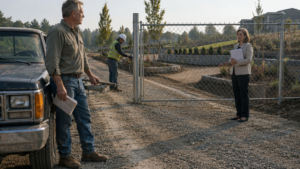
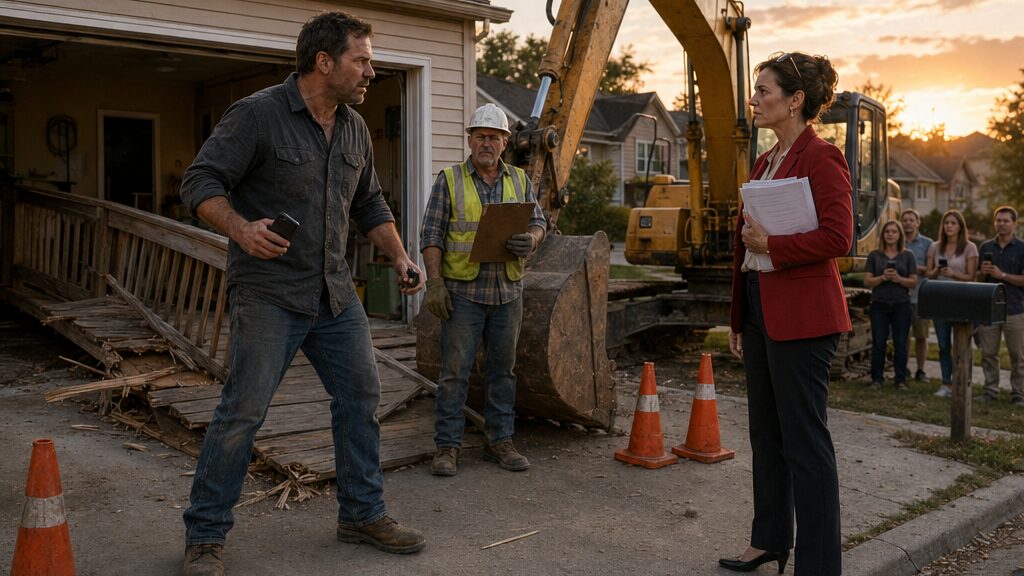
The excavator teeth were already under the ramp landing when James Harris reached the driveway.
For one impossible second, he did not move. He stood at the garage door with his keys still in his hand, watching the yellow bucket tilt up beneath the wooden platform Paul Green had bolted into place three days earlier. The machine growled. The ramp groaned. One of the side rails twisted loose with a snap that sounded too much like bone.
“Stop!” James shouted.
The operator did not hear him, or pretended not to. The engine swallowed every human sound on the street. Dust jumped from the concrete. Two orange cones lay tipped near the garage threshold, and one of the ramp boards was already split down the middle, pale raw wood showing through the stain James had brushed on after midnight.
Neighbors had begun to gather across the street. A delivery driver slowed, stared, then kept going. James saw curtains twitching in front windows, phones rising in hands.
He stepped off the garage lip and into the path of the bucket.
The crew supervisor threw up one arm. “Back up, sir.”
James did not back up. The bucket hung five feet from him, loaded with the torn edge of the ramp. His phone was in his pocket. His pulse was in his throat. His mother’s walker measurements were still taped to the wall just inside the garage.
“Shut it down,” he said.
The operator lowered the bucket a few inches, then cut the engine. The sudden quiet made everything worse. The torn boards creaked. Somewhere across the street, a woman whispered, “Is that his house?”
A woman in a red blazer walked from the curb with a flat packet of papers tucked against her side. Her sunglasses were large enough to hide her eyes, but her mouth had the settled line of someone already tired of explaining herself.
“Mr. Harris,” she said. “You were notified.”
James stared at the ramp, then at her. “Who are you?”
“Cynthia King. Compliance chair for the Lakeside Commons Homeowners Association.”
“I know who you are. I’m asking who gave you permission to bring a machine onto my property.”
She held out the packet. “The association issued a removal order for an unauthorized exterior structure attached to the garage entry.”
“That is a ramp.”
“It is an unapproved structure.”
“It is a ramp,” he said again, lower this time. “For my mother.”
The crew supervisor looked from James to Cynthia. He had a clipboard in one hand and the discomfort of a man who had expected rotten fencing or abandoned debris, not a homeowner standing ten feet from an excavator with his face gone white.
Cynthia did not look at the ramp. She looked at the paper. “The board has standards for exterior modifications. Homeowners cannot install additions and then ask for approval after the fact.”
James pulled his phone from his pocket and opened the camera. His thumb shook once before he steadied it.
“I want you to say that again while I record.”
Cynthia’s mouth tightened. “You may record from your property, but it doesn’t change the violation.”
“This is my property. That’s the point.”
The supervisor shifted. “Ma’am, do you want us to continue?”
James turned the camera toward the torn ramp, the bucket, the cones, the splintered landing. Then he pointed it at Cynthia. “No one touches another board until I see the order.”
Cynthia slid a page free and held it out. “You already received notice.”
“When?”
“This morning.”
James gave a short laugh that had no humor in it. “This morning when the crew was already here?”
A murmur moved through the neighbors. Across the street, Emily Scott stood near her mailbox in scrubs, one hand over her mouth, the other holding her phone at her side. James noticed her, then looked away. He could not afford to think about who was watching.
Cynthia glanced toward the crowd. “Notice was placed at the front entry according to procedure.”
“My front entry is over there,” James said, pointing to the porch. “This ramp is at the garage because my mother can’t manage the porch steps.”
“That information was not included in the approved application.”
“There was no approved application because you didn’t answer it.”
Cynthia’s chin lifted slightly. “The application received was incomplete.”
James almost said Mary’s name then. Almost said stroke, rehab, discharge, walker, wheelchair on bad days, the way his mother kept pretending her left foot was stronger than it was. Instead, he swallowed it. Mary had asked him not to make her condition neighborhood business. She had said, I want to come home as myself, not as everyone’s project.
He turned the camera back to the ramp. “Paul Green built this to code as a temporary access ramp. I emailed the HOA. I called twice. Nobody answered.”
Cynthia looked at the supervisor, not James. “The contractor was informed unauthorized work could be removed.”
James took one step closer. Not toward Cynthia. Toward the bucket. “That’s not a court order. That’s not a permit. That’s not a medical accommodation review.”
The supervisor lowered his clipboard. “Sir, I’ve got a signed authorization from the HOA. We were told the owner had been notified.”
“I am the owner.”
Cynthia pulled another page from the packet. “The owner of record is listed as Harris, James. The notice was issued to the address on file.”
James held up his keys, the black fob dangling from his fingers. “Then you knew exactly whose house this was.”
A police cruiser turned the corner at the end of the street. Red and blue light flickered against the beige siding, the broken boards, Cynthia’s blazer. Nobody spoke until it stopped at the curb.
The responding officer stepped out and approached with one hand low on his belt, eyes moving from the excavator to James to the torn ramp. “What’s going on here?”
Cynthia answered first. “This is an HOA enforcement action. The homeowner is obstructing authorized removal.”
James kept his phone recording. “They brought an excavator onto my property and started tearing out my mother’s access ramp before giving me notice.”
The officer looked at the ramp. For the first time since James had run outside, someone in authority seemed to see the object itself and not just the paperwork around it.
“Access ramp?” the officer asked.
James nodded once. “My mother is in rehab. She’s supposed to come home through this garage.”
Cynthia handed the officer the order. “The structure was not approved and was attached to the exterior in violation of community standards.”
The officer read silently. James watched his eyes move down the page. Cynthia’s posture remained straight, but her hand tightened around the rest of the packet.
The excavator bucket creaked as it settled. A board dropped from its teeth and hit the driveway.
The officer looked at the first page, then the second. “This file number,” he said.
Cynthia leaned closer. “Yes?”
The officer frowned and turned the paper slightly toward the fading light.
James saw it then—not the words, not yet, but the pause. The tiny break in official certainty.
The officer looked from the page to James’s garage, then back down again. “Mrs. King, can you explain why this removal sheet references a garage addition on Hall Court?”
Chapter 2: The Form That Came Back Blank
“Can I come home tomorrow?” Mary Harris asked while James stared at the photo of the broken ramp on his kitchen table.
Her voice came through the phone thin and bright, carrying the practiced cheer she used with nurses, therapists, and anyone she thought might worry about her. James had heard that tone when his father died, when she sold the old car, when the doctor first said stroke and she looked at James before looking at the doctor.
He turned the phone away from the table, as if she could see through it.
“They’re still checking a few things,” he said.
There was a pause. Not long. Just long enough for him to know she had heard the lie inside the careful words.
“James.”
He closed his eyes.
On the table in front of him were the pictures he had taken after the police left: the ramp landing ripped open, one handrail lying across the driveway, anchor bolts sticking out of the concrete like snapped roots. Beside the photos sat his key fob, the HOA packet, and the original application he had printed at dawn.
Temporary access improvement at garage entry.
That was what he had written.
Not medical accommodation. Not post-stroke access. Not necessary for safe discharge.
He had written it that way because Mary had asked him not to make it official unless he had to. Because she hated forms that turned people into conditions. Because James had believed the HOA would see a neat wooden ramp, temporary, measured, safe, and understand.
“I’m working on it,” he said.
“Working on what?”
He rubbed the heel of his hand over his forehead. “There was a problem with the ramp.”
“What kind of problem?”
He looked toward the garage door. Through the small window, he could see daylight where the landing used to soften the drop. “The HOA sent a crew.”
Mary did not speak.
“They damaged part of it,” James said. “I stopped them before they took all of it.”
“Damaged,” she repeated.
“I’ll get it fixed.”
“James, did you tell them why it was there?”
He looked down at the application again. The blank line for medical accommodation documentation seemed larger than it had the first time.
“I told them it was for access.”
“That is not what I asked.”
He stood too fast, the chair legs scraping hard against the floor. “You asked me not to parade your medical records around the neighborhood.”
“I asked you not to make me sound helpless.”
The words landed quietly, but he felt them. He turned toward the sink, where the coffee had gone cold in the pot.
“I was trying to protect your privacy.”
“I know,” Mary said, softer. “But if you hide the reason, people like that will invent one.”
A knock hit the side door before James could answer. He looked through the glass and saw Paul Green on the steps, cap in hand, face drawn.
“I have to call you back.”
“James.”
He stopped with his hand on the door.
“Do not fight them so hard that you forget what we are fighting for.”
He opened the door after she hung up.
Paul stepped inside only far enough to clear the threshold. He smelled faintly of sawdust and truck cab coffee. “I saw the pictures.”
“They had no right.”
“I know.”
“Then rebuild it.”
Paul looked at the floor.
James stared at him. “You built it. You know it’s safe.”
“It was safe when I built it. That’s not the problem.”
“Then what is?”
Paul took a folded paper from his back pocket. “The HOA sent notice to my licensing board contact. Not formal yet, but enough to make trouble. If I reinstall without written clearance and they call it unauthorized work, I could get dragged into it.”
James’s jaw tightened. “So they scare you and my mother stays in rehab.”
“I didn’t say I won’t help.” Paul kept his voice even. “I’m saying if I touch that ramp today, Cynthia King gets to turn this into reckless contractor work. You need them on paper first.”
“Paper is what got it torn apart.”
“No,” Paul said. “Bad paper did. Get better paper.”
James almost snapped back, but Paul reached over and tapped the application on the table.
“You submitted this?”
“Yes.”
“When?”
“Four weeks ago.”
“Do you have proof?”
James opened his laptop with more force than necessary. The email search felt clumsy under his fingers. Ramp. Access. Temporary. HOA. His inbox filled with old messages, auto-replies, newsletters about pool hours and lawn edging reminders.
Then he found it.
Sent four weeks and two days earlier. Attached: application form, sketch from Paul, material list, photo of garage entry. The reply beneath it was automatic.
Received by Lakeside Commons Architectural Review.
James clicked it, printed it, and let the page slide warm into his hand.
Paul leaned over his shoulder. “That matters.”
“It doesn’t say approved.”
“It says received.”
James found the follow-up email from two weeks later. Then the one from six days ago: Please advise whether temporary access ramp may remain pending review due to family medical discharge timeline. No response.
The printer pushed out each page with a small mechanical whine.
For the first time since the bucket lifted the ramp, James felt the situation narrow into something he could hold. Not win. Not yet. But hold.
Then his phone buzzed.
The subject line filled the screen before he opened it.
Notice of Continuing Violation and Daily Assessment.
He read it once. Then again.
Unauthorized exterior structure. Removal incomplete due to homeowner obstruction. Daily fine to begin immediately if non-compliant materials remained on property. Additional review required before any future reconstruction.
Paul cursed under his breath.
James scrolled down. Cynthia King’s name sat at the bottom, clean and centered.
Attached to the notice was a photograph of the ramp before demolition. It had been taken from across the street, at an angle that made it look larger than it was, the rail shadow falling across the driveway like a frame for an addition.
James recognized the angle.
Emily Scott’s side of the street.
His phone buzzed again before he could decide what to do with that.
Emergency Compliance Hearing Scheduled.
The meeting would be held the next evening at the HOA clubhouse. Attendance strongly recommended. Failure to appear could result in further enforcement.
James looked through the kitchen doorway toward the garage. The gap where the ramp had been seemed to pull cold air into the house.
Paul picked up the printed email proof and set it beside the fine notice. “Bring everything.”
James picked up the key fob from the table and closed his fist around it until the plastic edge pressed into his palm.
“They’re going to talk about boards and paint and sections,” he said.
Paul nodded.
James looked at the blank medical line on the original form.
“And I’m going to have to talk about my mother.”
Chapter 3: Cynthia King Calls It A Structure
Cynthia King saw the two addresses in the same folder and kept reading.
That was the first thing she would remember later, though not the way everyone else would describe it. They would say she ignored it. They would say she knew. They would say the whole thing was obvious from the beginning because people always believed paperwork was clearer after damage had been done.
But at 2:14 that afternoon, in the HOA records room with the insurance audit binder open beside her elbow, it looked like clutter.
Harris, James. Garage entry access improvement. Pending.
Hall Court. Unauthorized garage enclosure. Removal approved.
Someone had clipped the photographs together. One showed James Harris’s wooden ramp near the garage. The other, older and darker, showed a half-framed side structure on another property, plywood leaning against beige siding, a tarp sagging from the gutter. Both had garage doors in frame. Both had temporary lumber. Both had the word garage in the notes.
Cynthia pushed her sunglasses onto her head and rubbed the bridge of her nose.
Outside the small records room, someone’s copier jammed and beeped in a steady complaint. She had been at the office since seven, sorting violation files before the insurance representative arrived the following week. Roof tarps. Unapproved sheds. Dead trees near sidewalks. Broken fences. Half the neighborhood wanted rules enforced until the rule touched their own driveway.
Her phone showed three missed calls from board members, two from the crew supervisor, and one voicemail from a homeowner complaining that the excavator had blocked the street.
She opened the Harris application again.
Temporary access improvement at garage entry.
No physician letter. No accommodation box checked. No request for emergency status. No statement that the structure was medically necessary. The sketch was neat, she would give him that. Better than most. But neat did not equal approved.
A knock sounded on the doorframe.
Betty Nelson stood there with a folder against her chest. She was smaller than Cynthia, gray-haired, and slow to interrupt, which made her interruptions harder to dismiss.
“Do you have a minute?”
“Not really.”
Betty stepped in anyway. “The officer called the management office. He asked about the file number.”
Cynthia closed the folder. “The police don’t enforce HOA covenants.”
“No, but they do notice when paperwork references one street and the crew is standing on another.”
“It’s an administrative cross-reference.”
“Is it?”
Cynthia looked at her.
Betty did not flinch. She came to the table and set down a copy of James’s application. A yellow sticky note marked the second page.
“Why is a medical-access request attached to a garage-expansion complaint?”
“It is not a medical-access request,” Cynthia said. “It is a temporary access improvement. Those are his words.”
“He mentioned his mother last night at the site.”
“After the fact.”
“Maybe because no one asked before sending a crew.”
Cynthia’s shoulders tightened. “The structure was installed without approval.”
“The application was received.”
“Received is not approved.”
Betty looked toward the clipped photographs. “And removal is not review.”
For a moment, the records room seemed to shrink around them. Cynthia heard again the sound of her father falling twelve years ago, the crack of his knee against the concrete, the awful silence before he began insisting he was fine. Her brother had built that ramp in a weekend. No permit. No drawings. No handrail on the lower side because the hardware store was out of brackets and he said he would add it later.
Later never arrived before the ambulance.
After that, Cynthia learned to distrust anything described as temporary.
“People think ramps are simple,” she said. “They are not. Slopes, load, rail height, surface grip. If someone falls on a structure we allowed without review, the association is liable.”
Betty’s expression softened, but only briefly. “Then review it. Don’t tear it out first.”
Cynthia picked up the red blazer from the back of the chair and slipped it on, though she was not cold. The blazer helped. It made people listen. It made uncertainty look like policy.
“We have an audit in six days,” she said. “The insurer asked specifically about unapproved exterior structures. If we show inconsistent enforcement, premiums go up for everyone.”
“If James Harris’s mother cannot come home, premiums are not the first problem.”
“That is an emotional argument.”
“It is a human one.”
Cynthia opened the folder again. “The hearing is tomorrow. He can present complete documentation then.”
“After the ramp has been damaged.”
“The crew was instructed to remove non-compliant materials.”
Betty reached past her and lifted the work order copy. “This says remove unauthorized garage addition.”
Cynthia took it back. “Work order language is often broad.”
“It also says Hall file.”
The room went quiet except for the copier beeping outside.
Cynthia looked down. There it was, in the lower corner, where the management software printed category references in small gray type.
Hall file.
Not Hall as in a person. Hall as in Hall Court. The property with the garage enclosure that had been on the violation list for months.
She could stop it there. Call the crew. Admit the wrong category. Tell James Harris the ramp would remain pending review. Let the board deal with the audit question.
Instead, she saw the street from the day before: neighbors with phones, James recording her, the officer pausing over the order. She saw the board election notice folded in her purse and the email from the insurer asking whether exterior violations were being “actively addressed.” She saw herself standing in front of the board, explaining that she had sent a crew to the wrong enforcement category because a homeowner had written access improvement instead of accommodation.
“It does not change the underlying violation,” she said.
Betty stared at her. “Cynthia.”
“The structure was unapproved. The category can be corrected. The removal remains justified until the board determines otherwise.”
Chapter 4: The Meeting Where Safety Became A Violation
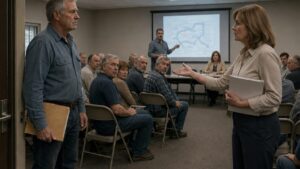
The first thing James saw on the clubhouse screen was his own ramp, enlarged until every board looked like an accusation.
Cynthia had chosen a photograph taken from across the street. From that angle, the ramp seemed to jut from the garage like a half-built deck. The handrails threw long shadows across the driveway, and the temporary plywood Mary’s walker would have rolled over looked, under the fluorescent lights, like evidence of something sneaky.
James stood at the back of the room with a folder under his arm and felt heat crawl up his neck.
“Unauthorized exterior modification,” Cynthia said from the front table. “Installed without written approval. Attached to the garage entry. Visible from the street.”
Three board members sat beside her. Betty Nelson had her hands folded on top of a yellow legal pad, but she was not looking at the screen. She was looking at James.
There were fifteen folding chairs set out for residents; almost all were filled. Emily Scott sat near the aisle in her scrubs, arms tight across her chest. Paul Green stood against the wall because he had refused to sit where anyone could pretend he was only a contractor waiting to be paid.
James walked down the aisle before Cynthia could continue.
“That photo was taken before your crew tore it apart,” he said.
Cynthia lifted her chin. “Mr. Harris, you will have a chance to speak.”
“I’m speaking because that is my garage and my mother’s ramp on your screen.”
A few heads turned. Cynthia tapped the packet in front of her, keeping her voice level.
“The board is here to determine whether enforcement should continue and whether fines apply. We are not here to debate emotional characterizations of an unapproved structure.”
James stopped at the first row. “Then call it what it is.”
Cynthia’s eyes narrowed. “It is a structure.”
“It is a temporary access ramp.”
“Temporary structures also require approval.”
“I asked for approval.”
“You submitted an incomplete request.”
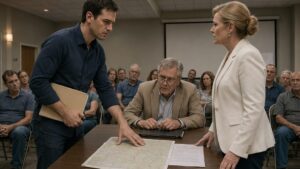
James opened his folder and took out the printed email chain. His fingers were too stiff, and one page slid onto the floor. Paul stepped forward, picked it up, and handed it back without a word.
James placed the emails on the front table. “Four weeks ago. Then a follow-up two weeks ago. Then another six days ago when the rehab discharge date moved up.”
Cynthia did not touch them. “Received does not mean approved.”
“No one said it did. But received should mean you look at it before sending a machine.”
The room quieted at the word machine.
Betty reached for the emails. Cynthia’s hand moved as if to stop her, then lowered.
“Mr. Harris,” Betty said, “did your original application state this was a medical accommodation?”
James felt the room change. Not loudly. Not visibly. But he felt it in the way people waited.
He looked at the screen again. The ramp filled the wall, stripped of context, stripped of Mary. He had done that. Not Cynthia alone. He had sent a form that spoke in safe, bloodless language because he thought dignity meant not naming what had happened to his mother.
“It said temporary access improvement,” he answered.
Cynthia exhaled once, as if that settled it. “Exactly.”
James turned to her. “Because my mother asked me not to put her medical history into an HOA portal unless it was necessary.”
“And yet you expected the association to treat it as medical necessity.”
“I expected someone to call me before tearing it out.”
A man in the second row muttered, “That seems fair,” before his wife touched his sleeve.
Cynthia clicked to the next slide. It showed the rule section: exterior alterations, approval required, community appearance standards, liability language. Her laser pointer circled the word attached.
“The problem,” she said, “is not whether Mr. Harris cares for his mother. The problem is whether residents may attach unapproved structures to homes in a managed community. The association has obligations to every owner.”
Emily shifted in her chair.
James noticed. Cynthia did too.
“Mrs. Scott,” Cynthia said, “you were the reporting resident?”
Emily’s face tightened. “I submitted a concern.”
“About construction at the Harris property?”
“Yes.”
James looked at her. Emily avoided his eyes.
“What did you observe?” Cynthia asked.
Emily swallowed. “Noise. Lumber. A contractor’s truck. I thought the garage was being enclosed or extended. From my house, I couldn’t tell.”
“You photographed it?”
“One picture. I sent it through the app because the notice said residents should report unapproved exterior work.”
James’s folder bent under his grip.
Emily finally looked at him. “I didn’t know it was for your mother.”
He wanted to ask why she had not crossed the street. Why the app had been easier than a knock. But then he remembered all the mornings he had waved at her and said nothing about Mary, nothing about rehab, nothing about the walker measurements taped inside the garage.
Cynthia pressed the advantage. “The association can only act on what is submitted and observed.”
James opened the folder again and pulled out Paul’s sketch. “Then observe this. The ramp doesn’t enclose the garage. It doesn’t expand the house. It isn’t permanent. The posts are removable. The landing sits at the garage threshold because the front steps are too steep. Paul measured the slope, rail height, landing width. It was built so my mother could come home without being carried.”
The word carried moved through the room harder than James expected. He had not planned to say it.
Cynthia’s expression changed only slightly. “The proper process for a medical accommodation requires a separate form, sealed documentation, and review of safety compliance.”
“Where is that form?”
“In the association portal.”
“It’s not under ramps. It’s not under exterior access. It’s under legal requests, three menus down.” James took out a printed screenshot. “I found it this morning.”
Betty looked at the screenshot, then at Cynthia.
Cynthia kept her hands flat on the table. “That does not change the fact that Mr. Harris began work before written approval.”
“Because his mother’s discharge date moved,” Paul said from the wall.
Cynthia turned. “Mr. Green, you are not a party to this hearing unless asked.”
Paul shut his mouth, but his face flushed.
James felt his own anger rising and forced it down. He had already seen what anger let them call him: obstructive, emotional, non-compliant.
He placed one more page on the table. “This is the rehab discharge note. It says home access must be safe before release.”
Cynthia looked at the page but did not pick it up. “Is that sealed medical documentation?”
“It is from the discharge coordinator.”
“It does not satisfy the accommodation form requirement.”
A sound came from the room—not applause, not outrage, just a low, collective disbelief.
Betty spoke before James could. “Cynthia, we can accept supplemental documentation pending formal review.”
“We can,” Cynthia said, “if the structure remains unaltered and no enforcement action is already in progress.”
“You made enforcement in progress.”
The words came from Emily.
Everyone turned.
Emily’s hands were clenched in her lap now. “I reported it because I thought it was an addition. If I had known it was a ramp, I would have asked first.”
Cynthia’s gaze hardened. “Residents are not expected to investigate violations.”
“No,” Emily said. “Apparently they are expected to start them.”
James looked away. He did not want gratitude to soften him yet.
His phone vibrated in his pocket. He ignored it. It buzzed again. Then again.
Mary.
He stepped toward the back of the room and answered in a low voice, but it was not Mary. It was the rehab discharge coordinator, speaking fast, professionally apologetic.
“Mr. Harris, I’m sorry to call during your meeting, but I need to confirm the home access issue. If safe entry cannot be restored within seventy-two hours, we’ll have to delay the discharge plan and reassess placement.”
James looked through the clubhouse window. Across the parking lot, beyond the trees, he could almost see the direction of his house, the garage, the torn boards.
“How long a delay?” he asked.
“It depends on bed availability and reassessment. I can’t promise the same timeline.”
When James turned back, the whole room was watching him.
He lowered the phone.
“My mother has seventy-two hours,” he said. “Then your violation becomes the reason she can’t come home.”
Chapter 5: The Empty Space At The Garage Door
Mary’s walker stopped at the garage threshold because there was nowhere safe for its front legs to land.
James stood below her on the driveway with both hands raised, as if he could catch her from six feet away and still preserve the lie that this was only a house problem, only an HOA problem, only boards and forms and a damaged ramp.
Mary looked down at the exposed concrete anchors, the broken edge of the landing, the strip of bare driveway where the ramp had begun. Her left hand tightened around the walker grip.
“Well,” she said, “that is inconvenient.”
The rehab aide beside her did not laugh. Neither did James.
He had brought Mary home for the access assessment because the coordinator said they needed to see the entry in person. Not use it, just evaluate. James had told himself he could manage that. He would guide her to the garage door, show the measurements, explain how the ramp would be rebuilt.
But Mary had insisted on standing.
“I want to see what I am being kept from,” she had said at the rehab entrance.
Now she saw it.
The garage smelled of sawdust and machine oil. The tape marks Paul had left on the wall still showed the height of the landing. A blue strip marked where the handrail had met the frame. James had not removed the orange cones because removing them felt too much like admitting the emptiness was permanent.
Mary nudged the walker forward an inch. The aide reached for her elbow.
“No,” James said, sharper than he meant. “Don’t.”
Mary looked at him.
He softened his voice. “Please. Just don’t.”
Her mouth pressed together. Pride and fear moved across her face so quickly that anyone else might have missed it. James did not.
The coordinator, watching from near the driveway, made a note on her tablet. That tiny movement—the stylus touching glass—felt louder to James than the excavator.
“Can you approve discharge if it’s rebuilt in three days?” he asked.
“If safe access is restored and documented,” she said. “But as it stands, this entry is not usable.”
“It was usable before they tore it out.”
“I understand.”
No, he thought, and hated himself for thinking it. You get to leave after writing that down.
A white utility truck rolled slowly past the house, then stopped near the curb. James recognized the logo from the day before: the removal crew.
The supervisor stepped out and looked at the garage, then at James. “We’re here for the remaining materials.”
James walked down the driveway before anyone could stop him. “You’re not taking anything.”
The supervisor held up both hands. “I’m just doing what the order says.”
“Then get a better order.”
The truck’s hazard lights blinked. Across the street, blinds shifted. Emily Scott came out onto her porch but did not cross yet.
The supervisor looked past James toward Mary, who still stood at the threshold with the walker. His face changed. Not enough to become courage, but enough to become discomfort.
“Sir,” he said quietly, “I didn’t know.”
James stepped close enough that the man lowered his clipboard. “You knew there was a ramp.”
“We were told garage addition.”
“It has handrails.”
“I don’t write the orders.”
“No,” James said. “You just tear out what they call the thing.”
The supervisor glanced toward the truck. One worker had opened the back and was reaching for straps.
James moved without thinking. He got into his pickup, reversed it hard enough that gravel snapped under the tires, and stopped it behind the utility truck at an angle.
The worker froze.
The supervisor’s face went pale. “Sir, don’t do that.”
James kept both hands on the wheel. His breath came fast. In the side mirror, he saw Mary in the garage doorway, watching him with the expression she had used when he was seventeen and too angry to listen.
He saw, in the same mirror, Cynthia’s words waiting for him: obstruction. Unsafe conduct. Threatening behavior. Homeowner interference.
He shut off the truck.
For five seconds, no one moved.
Then James opened the door and stepped out slowly. “I’ll move it.”
The supervisor nodded once, relieved but wary.
James moved the pickup to the side of the driveway, parked, and got out with his phone already recording. His voice sounded strange to him when he spoke.
“No materials leave this property until I receive a written inventory and a copy of the order describing exactly what you were sent to remove.”
The supervisor hesitated.
“Call whoever sent you,” James said.
The man did.
While he waited, Emily crossed the street.
She had changed out of her scrubs but still wore the same tired posture, shoulders forward, hair pulled back, face pinched with something that might have been guilt or defensiveness. She stopped at the edge of the driveway.
“James.”
He did not answer.
“I have something,” she said.
“If it’s another photo, send it to Cynthia.”
“It’s video.”
That made him look at her.
Emily held out her phone but did not step closer. “From yesterday. I started recording when the machine came around the corner because I thought it was odd. The crew was already unloading before anyone went to your front door.”
James stared at the phone.
“I didn’t understand what I was filming,” she said. “Not then.”
He took the phone. The video shook slightly, filmed through her front window at first. The excavator rolled into view. The crew supervisor spoke to the operator. Cynthia’s red blazer appeared beside the truck. A worker walked toward James’s front porch with paper in hand only after the bucket had been lowered from the trailer.
James replayed the first twenty seconds.
The timestamp sat in the corner.
The supervisor came back from his call, face tight. “Mrs. King says the remaining lumber is still non-compliant and subject to removal.”
James handed him his own phone. “Say that on video.”
The man looked miserable. “I’m not authorized to make statements.”
“Then you’re not authorized to take anything.”
The supervisor did not argue. He returned to the truck, spoke to the workers, and they closed the rear doors.
For a moment James thought he had won something.
Then his phone buzzed with an email.
Notice of Additional Violation: Interference With Authorized Enforcement Activity.
Cynthia had copied the HOA attorney.
Mary’s walker scraped behind him. James turned and saw her lowering herself back into the wheelchair the aide had brought to the garage. She was pale now, exhausted from standing, but her eyes were clear.
“James,” she said.
He went to her.
“I’m sorry,” he whispered.
She looked at the torn threshold, then at Emily still standing in the driveway with her phone in both hands.
“Don’t be sorry,” Mary said. “Be accurate.”
Later, after the coordinator left with careful sympathy and no approval, James took Emily’s video, the new obstruction notice, and photographs of the anchor holes to Paul Green’s small contractor office behind a lumberyard.
Paul watched the video twice. Then he opened his own records, jaw working silently.
“They didn’t send me the full work order yesterday,” he said. “Only the removal authorization.”
He clicked through a vendor portal and stopped.
James leaned over the desk.
The description line read: remove unauthorized garage addition — Hall file.
Paul sat back. “James.”
The room seemed to tilt around the words.
Hall file.
James looked at the screen, then at the photo of his mother’s walker facing empty air.
“Print that,” he said.
Chapter 6: The Invoice Dated Before The Hearing
“They hired the crew before they denied you,” Paul said, laying the invoice on the table between them.
James did not touch it at first. He stood in Paul’s contractor office with sawdust under his shoes and the smell of cut pine in the air, looking at the printed date as if it might shift if he waited long enough.
It did not.
The invoice request had been created two days before the emergency compliance hearing, before Cynthia told the room his documentation was incomplete, before the board pretended the question was still open.
Paul tapped the top corner. “This isn’t a final bill. It’s the scheduling invoice. Equipment reservation, operator hold, removal crew.”
“For my address?”
Paul pointed lower. “Your address in the location field. Hall file in the description. That’s the problem.”
James picked up the page. His thumb left a faint mark where the printer ink had not fully dried.
“So they mixed the file.”
“Maybe.”
James looked at him.
Paul exhaled. “Or they used the file that let them act faster.”
The words hung between them.
Paul turned his monitor so James could see the vendor portal. “For a ramp, they’d need review notes, safety concern, maybe an engineer if they wanted to argue hazard. For an unauthorized garage addition already on the violation list? Easier. Bigger category. Removal already approved in the system.”
James folded the invoice once, then forced himself to unfold it. No creases. No drama. Better paper.
“Where do I go?”
“City permit desk first,” Paul said. “Ask whether any demolition or removal permit exists for your property. Then ask about emergency access accommodations. Don’t let them send you back to the HOA without answering.”
The city clerk behind the permit desk looked tired before James finished the first sentence. She took the HOA order, the work description, and the photo of the torn ramp, then disappeared through a side door.
James stood under a ceiling fan that clicked every third rotation. Contractors came and went with rolls of plans and coffee cups. A man argued softly about a fence height. Somewhere behind the counter, a printer jammed.
When the clerk returned, a city inspector came with her. He was older, with glasses low on his nose and a tape measure clipped to his belt.
“This was removed already?” the inspector asked.
“Partially.”
“By the HOA?”
“By a crew they hired.”
The inspector looked again at the photo. “HOA authorization is not a demolition permit. It does not give them city authority to remove structural or access-related work on private property.”
James felt something loosen, then tightened himself against it. “So they violated city code?”
“I didn’t say that. I’m saying I see no city permit for demolition or removal at your address. If they believed it was unsafe, they could report it. They don’t get to become the building department.”
James held out Paul’s sketch. “The ramp was temporary. My mother is being discharged from rehab. Is there emergency accommodation for access?”
The inspector read the sketch longer than James expected. “Slope looks reasonable from the drawing. Handrails noted. Landing width noted. I’d need to see the site.”
“Today?”
The inspector checked the clock. “I can stop by late afternoon.”
It was the first official sentence in four days that did not close a door.
Back home, James placed the invoice, the city note, Paul’s sketch, the printed emails, the rehab discharge letter, and Emily’s video transcript across the kitchen table. The key fob sat beside them, black plastic worn smooth where his thumb always found it.
Mary called while he was arranging the papers in order.
“Did you eat?” she asked.
“No.”
“That means coffee.”
“It means progress.”
“Progress does not have caffeine as a food group.”
He almost smiled. Almost.
“The city inspector is coming,” he said. “They didn’t have a demolition permit for the ramp.”
“Does that fix it?”
“No.”
“Then say what it does.”
He looked at the papers. “It means the HOA order wasn’t what Cynthia made it sound like.”
Mary was quiet. “And the other thing?”
“What other thing?”
“The thing you do when you are scared.”
He leaned against the counter.
“Mom.”
“You make a wall out of being right.”
He closed his eyes.
“I know you are trying to bring me home,” she said. “But if you turn this into winning against that woman, you might lose the part that matters.”
“She kept going after she knew the file was wrong.”
“Then be accurate,” Mary said again. “Not cruel.”
By the time the inspector arrived, James had put the papers in a folder and the anger somewhere he could reach but not lead with.
The inspector measured the garage threshold, examined the anchor holes, photographed the torn landing, and looked at the remaining rail section stacked against the wall.
“This was not a garage addition,” he said.
James let out a breath.
“But,” the inspector continued, “I can’t order the HOA to approve it. What I can do is note that the removed work appears access-related and that no city removal permit was found. I can also note that rebuilding a temporary compliant ramp may qualify for expedited review if tied to medical access.”
“That helps?”
“It gives you something better than shouting.”
James thought of his pickup behind the crew truck and said nothing.
At 5:18, an email arrived from the HOA attorney.
The subject line was careful: Proposed Interim Resolution.
James read it standing at the kitchen table.
The association would suspend daily fines for seven days. It would permit temporary portable access equipment pending formal review. It would not admit fault. James would agree to remove social media posts, withdraw complaints to the city, refrain from further public statements, and release the association from claims related to enforcement activity.
There was no mention of the torn boards.
No repair.
No correction of the file.
No Mary.
James forwarded it to Paul, then to the city inspector, then stopped before sending it to anyone else.
He could take it. A portable ramp might get Mary through the garage in time. He could swallow the damage. He could tell himself practical dignity meant not fighting longer than necessary.
Then he looked at the sentence requiring him to withdraw complaints.
The key fob lay beside the medical letter. He picked it up, closed his hand around it, and thought of Mary’s walker stopping at empty air.
He opened a new email to Betty Nelson and copied Cynthia, the management office, the HOA attorney, Paul, Emily, and the board’s general address.
I am requesting a special public meeting at the damaged access site, not the clubhouse.
He paused, then added one more line.
The board needs to view the ramp location, the removal damage, the file number, and the medical-access documentation in the same place before any further vote.
He attached the invoice, the city inspector’s note, Emily’s timestamped video, and the rehab letter.
For the first time, he did not hide what the ramp was for.
When he pressed send, the house was quiet except for the garage door shifting slightly in the wind, over the empty space where Mary was supposed to come home.
Chapter 7: The Address Read Aloud In Public
“Read the address out loud,” James said.
He stood in the driveway with the torn ramp board at his feet, the key fob pressed into his palm, and half the street gathered beyond the curb like people waiting for a storm to choose a house. The garage door was open behind him. The empty threshold looked darker in the late sun, the anchor holes still visible in the concrete where the landing had been.
Betty Nelson held the printed removal order. The responding officer stood beside her, not there to run the meeting, only to keep it from becoming something else. Cynthia King arrived last, red blazer buttoned, hair smoothed back, a folder tucked under one arm as if the color and the paper could still make the scene belong to her.
James did not raise his voice. That seemed to bother her more.
“Mr. Harris,” Cynthia said, “this is not a formal board setting.”
“No,” James said. “This is where the machine was.”
The neighbors quieted.
Paul Green stood near the garage with a measuring tape clipped to his belt. Emily Scott held her phone in both hands but kept it low. The city inspector had sent his note but not attended; the printed copy sat in James’s folder along with the invoice, the rehab letter, and the screenshots.
Betty looked at the order. “Property address: James Harris, Lakeside Commons, garage entry.”
James pointed to the bottom corner. “Now the file category.”
Betty hesitated.
Cynthia stepped forward. “The category label is an internal reference. It does not control the board’s enforcement authority.”
“Then reading it shouldn’t matter,” James said.
Betty looked at Cynthia, then back down. “Removal category: unauthorized garage addition. Hall file.”
A murmur passed through the crowd.
James picked up the torn ramp board and held it upright. One end was split where the excavator bucket had caught it. The stain he had brushed on still showed along the rail line; under it, raw wood had been exposed.
“This is not a garage addition,” he said.
Cynthia’s mouth tightened. “The application described a temporary access improvement, not a medical accommodation. The board had no complete documentation at the time enforcement began.”
“At the time enforcement began,” Betty said, “or at the time the crew was scheduled?”
Cynthia turned toward her. “Betty.”
Betty unfolded another page. “The scheduling invoice is dated before the emergency hearing notice and before final review of Mr. Harris’s submission.”
The officer glanced at the invoice but said nothing. His silence was worse for Cynthia than interruption would have been.
Cynthia opened her folder. “The association was under obligation to address open violations before the insurance audit. A miscategorized file does not erase the fact that the work was installed before written approval.”
James lowered the board. “You keep saying that like it answers the part where my mother couldn’t get through her own door.”
For the first time, Cynthia looked toward the garage threshold instead of the papers.
“Your mother’s condition was not properly submitted.”
“No,” James said. “It wasn’t.”
Several neighbors shifted, surprised by the admission.
He felt the old urge to protect Mary by closing the door around her name, around the rehab exercises, around the mornings she had cried because a spoon felt heavy in her hand. But the empty space behind him had already exposed her. Silence had not kept her dignity safe. It had only made her need easier to classify as lumber.
“I wrote temporary access improvement because my mother asked me not to turn her stroke into neighborhood paperwork,” he said. “That was my mistake. But I sent the request. I sent drawings. I followed up. No one answered before you sent a crew.”
Cynthia’s face changed at the word stroke. Not much. Enough.
Emily stepped forward, phone ready. “I have the video from my house.”
Cynthia looked at her sharply. “Mrs. Scott—”
“I reported the ramp because I thought it was something else,” Emily said. “That’s on me. But the notice was not on his door before the crew unloaded.”
She played the video. The small speaker made the excavator sound thin and insect-like, but the image was clear enough: the truck rolling in, the bucket lowering, Cynthia in red near the curb, a worker heading toward the porch only after the machine was already off the trailer.
Neighbors leaned closer. James did not watch the screen. He watched Cynthia.
She saw the timing. There was no way not to.
Betty folded her arms. “Cynthia, why was removal scheduled before the board had reviewed the medical-access issue?”
“There was no medical-access issue formally before the board.”
“There was a homeowner request with access in the title and a follow-up mentioning discharge timeline.”
“That is not the same as complete documentation.”
“No,” Betty said. “But it is enough to stop a machine.”
The words landed harder than anyone expected. Even Cynthia looked briefly away.
The HOA attorney, standing near the curb with a leather portfolio, cleared his throat. “The board should avoid making determinations in an informal setting.”
James turned to him. “Then make it formal. You’ve got board members here. You’ve got the damaged site. You’ve got the documents. You’ve got the person your order harmed.”
Cynthia’s eyes flashed. “The association did not harm your mother.”
James stepped back instead of forward. It kept him from saying the wrong thing.
“No,” he said. “The stroke did that. The rehab did some of the fixing. This ramp was supposed to do the rest. Your order didn’t harm her body. It harmed her way home.”
For a moment, nobody spoke.
Then Cynthia looked at the torn board in his hand and said, quieter, “My father fell on a ramp my brother built without review.”
James had not expected that. Neither had Betty; her face softened with recognition and regret.
Cynthia’s voice stayed controlled, but it lost some of its polish. “No handrail on one side. Wrong slope. He said it was temporary. He said it would be fine for one weekend. It was not fine.”
James felt his anger shift shape. It did not disappear. It became harder to use carelessly.
“I’m sorry,” he said.
Cynthia blinked.
“But that wasn’t my ramp,” he continued. “And my mother shouldn’t lose her home access because your fear filled in the blanks before you read the file.”
The street went still around them.
Cynthia looked down at the order. For one second James thought she might take responsibility. Instead, she said, “There were procedural failures on more than one side.”
Betty’s face closed. “And the side with the excavator carried more power.”
The attorney murmured something, but Betty lifted one hand.
“I am calling an emergency vote of present board members to suspend enforcement, withdraw the daily fine pending full review, and authorize temporary reconstruction of the access ramp under city-noted safety conditions.”
Cynthia turned. “You cannot do that here.”
“We can call an emergency action for safety and liability containment. You taught us that section.”
A low roll of thunder moved beyond the roofs. The open garage behind James darkened as clouds covered the sun.
Betty looked at the other board members. “All in favor of emergency temporary accommodation and suspension of enforcement?”
One hand rose. Then another.
Cynthia did not raise hers.
Betty looked at James. “That is enough to start. Written approval still has to be issued tonight.”
James held the torn board until his fingers hurt.
“Tonight,” he said.
The first drops of rain hit the driveway, darkening the concrete around the anchor holes. Betty turned to the attorney.
“Draft it now,” she said. “Before this becomes another document that arrives too late.”
Chapter 8: The Ramp That Stayed After Sunset
Paul arrived before sunrise with lumber in the back of his truck, but he would not unload a single board until James read the approval twice.
The email had come at 5:42 a.m., marked Emergency Temporary Accommodation Authorization. James stood in the driveway under the gray morning light, phone in one hand, key fob in the other, while Paul waited beside the truck with his arms folded.
“Say the part you don’t like,” Paul said.
James scrolled down. “Rails must be painted to match approved exterior trim within seven days.”
Paul stared at him. “That’s it?”
“That’s it.”
“No removal clause?”
“No.”
“No daily fine?”
“Suspended pending final review.”
“No release of claims?”
James looked up. “No.”
Paul opened the tailgate. “Then I can build.”
The sound of lumber sliding from the truck did not erase the sound of the excavator. Nothing did. When Paul set the first board across sawhorses, James still saw the bucket teeth under the old landing. When the drill bit bit into new wood, he still saw splintered rail in the driveway.
But this sound had rhythm. It measured, checked, fastened. It did not tear.
James worked beside Paul, holding boards, marking cuts, sweeping dust from the threshold. The city inspector stopped by midmorning, reviewed the slope, and nodded without ceremony. Betty came at noon with printed copies of the vote and the temporary approval, each signed and dated. She did not make a speech. She simply handed James the papers in a clear plastic sleeve.
“Keep these near the door,” she said.
“I will.”
She looked at the anchor scars in the concrete. “I should have pushed harder sooner.”
James wanted to say yes. He wanted to make someone hold every hour Mary had spent waiting. But Betty’s regret was not the thing blocking the garage anymore.
“You pushed when it counted,” he said.
She nodded once, not forgiving herself too quickly, and left.
Cynthia did not come until the first rail was up.
She parked at the curb and stayed there long enough that Paul noticed. James kept working. The red blazer was gone. She wore a dark coat instead, and without the bright color she looked less like an office and more like a tired woman who had not slept enough.
She approached with a folder, because of course she did.
Paul’s jaw tightened. James shook his head slightly, and Paul went back to fastening the lower rail.
Cynthia stopped near the edge of the driveway. “Mr. Harris.”
“Mrs. King.”
“I have the final signed suspension of the violation.” She held it out.
James took it. He read every line while she stood there. The unauthorized exterior structure violation was withdrawn pending reclassification as a medical-access accommodation. Fines suspended. Enforcement removal halted. Emergency review procedure to be drafted for future cases involving access, safety, or medical discharge timelines.
“It says withdrawn pending reclassification,” he said.
“The board attorney insisted on that wording.”
“Is that going to become another trap?”
“No.” She said it quickly, then more carefully. “No. Betty is chairing the policy review. I will not oppose it.”
James folded the paper once and put it in the plastic sleeve with the others.
Cynthia looked at the ramp. “The rail color condition was mine.”
“I figured.”
“It matches the standards and allows the accommodation to remain.”
James studied her face. “That’s the first sentence you’ve said that put remain at the end.”
She accepted that without defense.
Paul set the drill down and went into the garage for another bracket, leaving them with the half-built ramp between them.
“My father,” Cynthia said, then stopped.
James waited.
“He refused a nursing facility after his fall. He said if the house needed to change for him, it wasn’t his house anymore.” She looked at the new boards. “I thought I was preventing unsafe shortcuts. Then I became one.”
James did not give her absolution. He did not want it in his hands.
“My mother thought if people knew too much, they would see only what happened to her,” he said. “I helped hide the one thing that would have made the ramp harder to dismiss.”
Cynthia looked toward the garage threshold. “She is coming home today?”
“If this passes.”
“It will pass.”
James almost asked how she could know, then saw she was not promising him mercy. She was reading the work. Slope. rails. landing. bolts. The things she had claimed to care about before the file became more important than the person.
By late afternoon, the ramp was finished.
The rails were unpainted, the new boards brighter than the old trim, and the concrete scars were still visible where the excavator had torn out the first anchors. Paul brushed sawdust from the landing and stepped back.
“It’ll hold,” he said.
The rehab van arrived at sunset.
James stood at the garage with the key fob in his hand, pressing unlock even though the door was already open. Old habit. Proof of home. Proof of entry. Proof that no paper on someone else’s desk could change whose threshold this was.
Mary came out of the van in her wheelchair first, then insisted on standing at the foot of the ramp.
“Mom,” James said.
“I know my limits,” she said.
The aide set the walker in front of her. Mary gripped it, tested her left foot, and looked up the ramp toward the garage. Her mouth trembled once, then steadied.
No neighbors clapped. James was grateful. A few stood quietly on porches or beside mailboxes, watching without pretending the moment belonged to them.
Emily stood across the street. When Mary reached the landing, Emily lifted one hand. Mary saw and gave a small nod—not forgiveness exactly, but acknowledgment. Sometimes that was the first usable board.
Halfway up, Mary stopped.
James stepped closer. “You okay?”
She looked at the rail under her right hand. “Paint this something nicer than beige.”
A laugh broke out of him before he could stop it.
Paul, standing near the truck, said, “Approved trim only, ma’am.”
Mary looked at him. “Then approved trim needs better taste.”
She took the last steps slowly. The walker crossed the threshold without catching. The front legs landed on the garage floor. Then the back legs. Then Mary Harris stood inside her own home.
James turned away for a second, pretending to check the rail bracket.
Mary touched his sleeve. “You did not bring me home because you beat them.”
He looked at her.
“You brought me home because you finally told them what the door was for.”
Behind them, the ramp caught the last light of the day. The new boards did not match yet. The anchor scars showed at the edges. The orange cones were stacked beside the garage wall, no longer warning anyone away.
A week later, the rails were painted the required trim color. The HOA sent notice of the new emergency medical-access review rule, written in the same dry language that had once threatened fines. James filed it in the plastic sleeve near the garage door.
He did not frame it. He did not post it. He did not need it to be beautiful.
That evening, Mary walked the ramp twice with the aide beside her and James waiting at the bottom, hands open but not reaching unless asked. At the top, she turned and looked down at the driveway where the excavator tracks had faded but not vanished.
“Leave that little mark,” she said, pointing with her walker to a pale scar in the concrete.
James followed her gaze. “I was going to patch it.”
“Patch the dangerous parts,” she said. “Leave one mark.”
“Why?”
“So next time someone stands here with a form, they remember the house is not the paper.”
James looked at the ramp, the scar, the key fob in his hand, and the open garage behind her.
The sun dropped behind the roofs of Lakeside Commons. The ramp stayed where it was.
The story has ended.