They Built a Road to Steal Pamela Ward’s Farm, Then Her Tractor Blocked Everything
Chapter 1: The Road That Ended at Pamela’s Gate
Pamela Ward smelled asphalt before she saw it.
It came through the cracked kitchen window before sunrise, sharp and oily, wrong enough to pull her from sleep without the alarm. For fifty-nine years she had woken to damp grass, cattle fence, mud, rust, honeysuckle along the ditch. That morning the air smelled like a highway crew had poured hot tar across her pillow.
She stood barefoot in the kitchen for a moment, listening.
No birds.
No gravel crunch from her own drive.
Only the faint tick of cooling machinery somewhere beyond the sycamores.
Pamela put on her boots without socks, took the flashlight from beside the door, and stepped onto the porch. The beam cut across the yard, over the tractor shed, past the low stone wall her grandfather had stacked by hand. At the far end of the lane, where her old farm track met the county easement, the darkness looked too flat.
She walked faster.
The first thing she saw was the yellow survey ribbon tied to her gatepost.
The second was the road.
It had not been there yesterday.
Fresh black pavement ran straight and narrow across what had been a grassy shoulder, a strip of scrub, and a shallow drainage bend. It ended exactly at Pamela’s locked farm gate as if the whole county had poured a tongue of asphalt just to lick at her land. Steam still lifted from it in ghostly bands. Along both sides, orange spray marks cut through dirt and weeds in hard little symbols, no words, no explanation, only color and intention.
Pamela stopped with one boot on gravel and one on the new road.
The asphalt was warm through the sole.
She lowered her flashlight and looked at the gate. No damage. Chain still looped twice through the iron bars. Padlock still closed. Her father’s old warning plate hung crooked from one bolt, its lettering long since faded by rain. It did not need words. Everyone nearby knew where Ward land began.
Someone had decided to pretend they did not.
A pair of wide tire tracks marked the soft shoulder beyond the pavement. Not pickup tires. Heavier. Something broad and ribbed had turned there, reversed, and gone back the way it came.
Pamela crouched, pressed two fingers into the mud at the edge, and rubbed the grit between her thumb and forefinger. Her jaw tightened.
“Planning to come back,” she said.
Her voice sounded small against the empty road.
Behind her, a porch light flicked on at the Johnson place across the bend. A minute later, Sarah Johnson appeared in a quilted jacket, arms folded tight, her gray hair pinned like she had slept badly and given up pretending otherwise.
“I wondered when you’d see it,” Sarah called.
Pamela stayed crouched. “When did they do this?”
“Started after midnight. Finished before four.”
“You watched them?”
“I watched enough.”
Pamela stood. “Enough for what?”
Sarah stepped closer but stopped before her shoes touched the fresh asphalt. That was Sarah all over, Pamela thought. Careful where she stood. Careful what she joined.
“There were council trucks,” Sarah said. “Two white pickups. No markings I could read in the dark. Men with measuring wheels came first. Then the paving crew.”
“No one called me.”
Sarah glanced toward the gate. “I thought maybe you knew.”
Pamela’s laugh had no humor in it. “You thought I ordered a road to nowhere while I was asleep?”
“I thought maybe you’d made some arrangement,” Sarah said, defensive now. “People do things when money gets tight.”
Pamela looked at her.
Sarah’s eyes dropped first.
Money had been tight on Ward land since before either of them could remember. Fences patched with mismatched wire. Tractor parts salvaged instead of bought new. Kitchen cabinets repainted three times instead of replaced. But the land itself had never been for sale. Not one acre. Not one bend of creek. Not the strip of pasture so poor even the goats looked disappointed in it.
“You saw them measuring before last night,” Pamela said.
Sarah rubbed one hand over the sleeve of her jacket. “Two weeks ago.”
The words hung there.
Pamela turned slowly back toward the road. “Two weeks.”
“I didn’t know what it meant.”
“You didn’t ask?”
“I asked one of them,” Sarah said. “He told me it was drainage improvement.”
“At my gate.”
“He said property access would be clarified.”
Pamela absorbed that. Clarified. A word people used when they meant erased.
The sun had begun to thin the dark beyond the fields. In that gray light the new road looked even more obscene, glossy and smooth beside Pamela’s rutted farm lane. It did not curve naturally with the ditch. It did not widen for neighbors or continue toward any public crossing. It came directly to the narrowest point of her entrance, the only place large machinery could be forced through without sinking in pasture mud.
Sarah’s voice softened. “Pamela, there were men with maps. Not county road maps. Site maps.”
Pamela walked to the gatepost and touched the survey ribbon. Its plastic fluttered against her knuckles. She pulled it loose in one hard motion.
“Did you take pictures?”
Sarah hesitated.
Pamela turned.
“I took one,” Sarah said. “Maybe two. From the porch.”
“Keep them.”
“You think this is more than a road.”
“I know it is.”
Sarah looked past Pamela toward the farmhouse, its white paint aging into gray, its porch sagging slightly on the west corner. “You should call somebody.”
Pamela almost answered. The names rose and died behind her teeth. County clerk. Land office. David Miller at the sheriff’s station. The attorney she had paid quietly three towns over. The corporate number buried in the file she had not shown a soul.
Instead she said, “I’ll handle it.”
Sarah’s mouth tightened. “That’s what you always say.”
Pamela did not look at her. “And yet the place is still standing.”
“That’s not the same as being safe.”
The words found a soft spot and pressed. Pamela turned the loose ribbon around her finger until the plastic bit. She remembered her father at this same gate thirty years earlier, hat in hand while two men in pressed shirts told him a boundary mistake was his fault because he could not produce the right paper fast enough. She remembered his silence afterward, the way shame made him repair fence until dark with hands that shook from anger he had nowhere to put.
On the day he died, he had made her promise only one thing.
Don’t let them walk in smiling.
A van appeared at the far end of the new road.
Pamela and Sarah both turned.
It was not a council truck. It was a courier van, plain white, clean enough to look lost among the ditches. It rolled slowly down the fresh asphalt, tires whispering where gravel should have snapped and spat. The driver stopped several feet from Pamela’s gate and stepped out holding a flat envelope.
“Pamela Ward?” he asked.
She did not move toward him. “Who sent it?”
“I just deliver.”
“Who sent it?”
He checked his handheld device. “Property services office. Signature required.”
Sarah drew in a breath behind her.
Pamela walked forward and signed with one finger on the courier’s screen. He handed her the envelope quickly, as if relieved to be free of it, then backed the van down the road rather than trying to turn around.
The envelope was thin. That made it worse. Real trouble often came heavy, with copies and seals and explanations. This had only her name, her address, and a red strip across the top that read URGENT PROPERTY ACTION.
She opened it at the gate.
The first page used words meant to look final: clearance, transfer, execution, access, compliance. The second page had a diagram of her land with a hard black line drawn where no boundary had ever existed. The third gave her forty-eight hours to vacate the residence and surrender entry.
Forty-eight hours.
Pamela read it twice. Then she folded the pages along their original creases with careful hands.
Sarah whispered, “Pamela?”
Pamela looked down at the new road touching her gate like a loaded weapon.
“They didn’t build it to reach my land,” she said.
She slid the notice back into its envelope.
“They built it to take it.”
Chapter 2: The Paper Order with the Wrong Boundaries
Pamela’s kitchen table held three versions of her farm, and none of them agreed with each other.
The oldest was the deed, soft at the folds and yellowed where her father’s thumb had worried the same corner for years. The second was a stack of tax receipts, every one paid, every one stamped, each parcel number written in county ink. The third was the urgent property action notice, smooth and white and new enough to smell faintly of toner.
According to the deed, the farmhouse sat eighty-seven feet inside the original Ward boundary.
According to the tax map, it sat deeper.
According to the seizure order, Pamela’s front porch was somehow touching a corporate access easement she had never signed.
She placed a ruler across the map. The black survey line cut through the porch steps, through her mother’s rose bed, and straight across the kitchen where she stood.
“Well,” she said to the empty room, “that’s ambitious.”
The tractor key lay beside her coffee cup, dull steel against paper. She reached for it once, then stopped. Iron could block a gate. It could not explain a forged line to a clerk who only wanted a file number.
By eight-thirty, she was at the county records office with the deed rolled in a tube under her arm.
The clerk behind the glass knew her by sight but not well enough to be kind without checking who might hear. Pamela gave the parcel number. The clerk typed. Her face changed in the small, controlled way office faces changed when a screen showed something inconvenient.
“There’s a pending action,” the clerk said.
“I know. I’m asking who filed the easement transfer.”
The clerk tapped again. “It’s attached to a development holding. I can print the index.”
“I didn’t ask for the index. I asked who filed the easement.”
“I can’t provide legal interpretation.”
“I’m not asking you to interpret. I’m asking you to read.”
The woman glanced toward the back office. “Mrs. Ward—”
“Pamela.”
“Pamela. The filing package came through expedited review.”
“By whom?”
Another glance. “Council infrastructure request. Private enforcement attached.”
Pamela leaned a fraction closer to the glass. “The road was paved last night.”
The clerk stopped typing.
“The notice says the easement was active before service,” Pamela continued. “But no one served me before yesterday. And the road crew measured my entrance two weeks ago.”
The clerk’s voice lowered. “You need an attorney.”
“I have one.”
It was the first time Pamela had said it aloud to anyone local, and even then she gave nothing more.
The clerk printed three pages. The top sheet contained more codes than language. At the bottom, in the requestor field, was a name Pamela did not recognize and a corporate entity she did: a subsidiary under a subsidiary, under a holding structure she had spent six months learning to read.
She folded the printout and left before the clerk could ask what her expression meant.
At home, Pamela spread the new pages beside the old ones. She marked the dates in pencil. Road survey before notice. Expedited review before acknowledgment. Enforcement scheduled before appeal window. It was not just wrong; it was hurried in a way that assumed she would be too frightened to slow it down.
Near noon, a sheriff’s cruiser rolled onto the edge of the new asphalt and stopped short of her gate.
David Miller got out with his hat in one hand. He was younger than Pamela by twenty years and looked older whenever he had to deliver bad news. His father had bought hay from the Wards. David had once broken his wrist falling out of Pamela’s pecan tree at age ten and had cried more from embarrassment than pain.
Now he stood on the legal side of her locked gate and would not meet her eyes.
“Pamela,” he said, “I wanted to come by before tomorrow.”
“Tomorrow.”
He nodded. “There’s an enforcement visit scheduled for morning. Private security, legal representative, equipment crew.”
“Equipment.”
“I don’t know the full details.”
“You know enough to come warn me.”
His face tightened. “I know enough to tell you not to make this worse.”
She almost laughed. Instead she opened the gate just wide enough to step through and closed it behind her.
David looked toward the farmhouse. “I don’t like this.”
“That’s not the same as stopping it.”
“No. It isn’t.”
She watched him struggle with the next words. Good man, she thought, but good men could still hide inside procedure when the wrong paper was waved hard enough.
“They have an order,” David said. “If you block access, they may demand arrest for obstruction.”
“Will you arrest me?”
“I don’t want to.”
“That’s not what I asked.”
He shifted his hat from one hand to the other. “If the order is valid and you refuse a lawful instruction, I may have no choice.”
Pamela looked at the new road. “And if the order isn’t valid?”
“Then bring proof. Clean proof. Something I can stand on.”
The file box in her bedroom seemed to pulse through the walls behind her. She could have told him then. Could have said the holding company’s own board had changed hands quietly last week. Could have said Daniel Scott might arrive tomorrow not knowing the woman at the gate had signed papers above his head.
But David’s cruiser camera was pointed at the gate. Sarah’s porch faced the road. The county had ears, and Pamela had learned long ago that early truth gave dishonest people time to rearrange lies.
“I’ll have what I need,” she said.
David searched her face. “You always say less than you should.”
“So do men with badges.”
That landed harder than she intended. He looked away.
“I’m trying to keep you from getting hurt,” he said.
“I’m trying to keep them from walking in smiling.”
His eyes flicked back to hers then, puzzled by the old phrase, but she did not explain.
After he left, Pamela called the number printed at the bottom of the notice.
A bright corporate voice answered on the third ring. “Property transition services.”
“This is Pamela Ward. I received an urgent property action.”
“One moment.” Keyboard clicks. “Yes, Parcel Clearance Site B.”
Pamela’s hand tightened around the receiver.
Not Ward Farm. Not a disputed residence. Not even an address.
Site B.
The voice continued, “A representative will be present during access transfer. Please remove personal effects prior to field execution.”
“Who is the representative?”
“Daniel Scott is listed as counsel of record.”
“Tell Daniel Scott I’ll be here.”
“Ma’am, cooperation will make the process easier.”
“For whom?”
The line went quiet, then professional again. “Have a good day.”
Pamela hung up.
She sat at the table until the kitchen clock ticked through five full minutes. Then she gathered the seizure order, the county printout, the tax receipts, and the deed into separate piles. Paper against paper. Lie against record. Somewhere beyond the window, her tractor sat in the shed with its hood mottled red-brown from age, its engine maintained better than most new machines in town.
At dusk she went to her bedroom closet and pulled down the old metal file box from the top shelf.
Her father’s handwriting was still taped across the lid.
WARD LAND — NEVER AGAIN.
For a moment she did not open it. Her thumb rested over the words. She saw him at the gate, younger than she was now, humiliated by men who had not needed to steal much to leave a wound. A strip of creek bank. A corner of pasture. A public correction he had been forced to accept because no one would wait for his proof.
Pamela unlocked the box.
Inside, beneath brittle surveys and mineral-lease records, lay a sealed folder from a law office three towns over. She removed it and set it on the bed.
The top page bore the name of the holding company behind the seizure.
Below it was her signature.
Chapter 3: The Men Who Brought a Crowbar
The bulldozer came first.
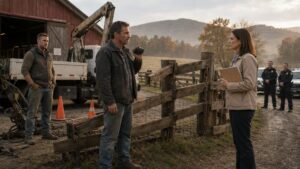
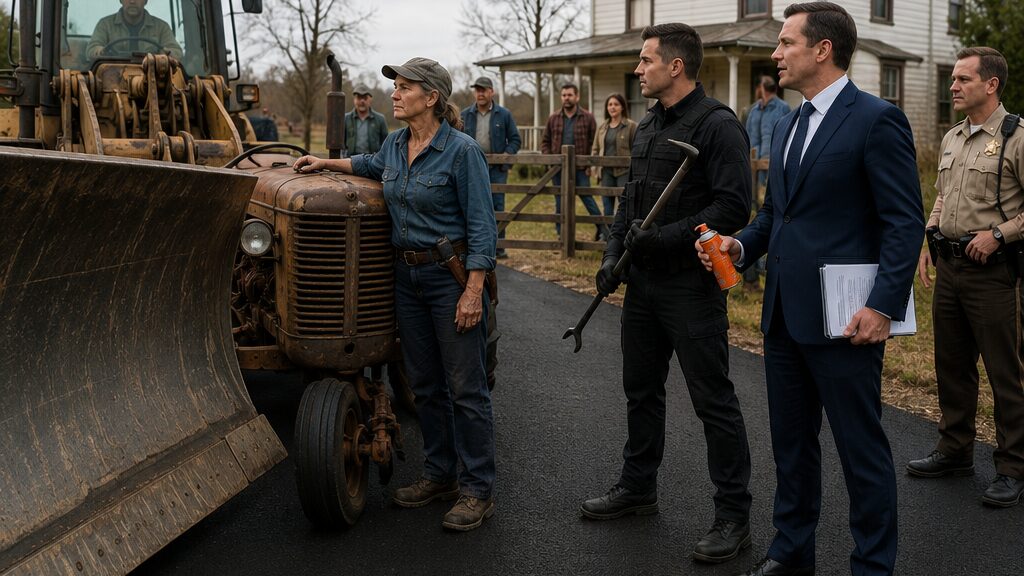
It rolled down the new road at 8:12 in the morning, wide blade lifted just high enough to show it had not come for repairs. The engine growled low, making the gate chain tremble against the iron bars before the machine even stopped. Behind it came two black pickup trucks, a white SUV, and a security van with tinted windows.
Daniel Scott had not unfolded a single piece of paper when the blade reached Pamela’s gate.
She stood inside the entrance with her boots planted in the gravel, one gloved hand resting on the chain. The antique tractor waited thirty yards behind her near the shed, angled toward the lane, its dull red hood catching the morning light.
David Miller arrived seconds later in his cruiser and parked at the shoulder, leaving his lights off. Sarah Johnson stood on her own porch across the bend with her phone in both hands.
Pamela noticed that and said nothing.
The bulldozer door opened. George Harris climbed down slowly, wiping his palms on his jeans. He was broad-shouldered and tired-looking, a man who had spent enough years around machines to know exactly what they could do. He looked at Pamela once, then away.
The SUV door opened next.
Daniel Scott stepped out in a navy suit too fine for a farm road. His shoes shone even on asphalt still dusty from its own making. He carried a leather folder under one arm and a neon orange spray-paint can in the other hand as if it were just another office tool.
Larry Nelson came from the security van last.
He wore dark tactical gear without a visible agency badge, only straps, radio, gloves, and the expression of a man who had already decided everyone else was slow. In one hand he carried a solid-steel crowbar. He did not hide it. He let it hang where Pamela could see its hooked end.
“Pamela Ward?” Daniel called.
“You’re standing at my gate,” she said. “You know who I am.”
Daniel smiled like that amused him. “I’m Daniel Scott, counsel for the controlling property interest. This is a scheduled access transfer pursuant to court-authorized clearance.”
Pamela looked at the unopened folder. “You practiced that.”
Larry stepped forward. “Ma’am, unlock the gate.”
“No.”
The word was quiet enough that the bulldozer engine nearly swallowed it.
Larry glanced toward David. “Deputy, you hear that?”
David walked closer, face drawn. “Let’s keep this orderly.”
“That’s why we’re here,” Daniel said. He finally opened the folder and removed several pages clipped together. “Mrs. Ward has been served. The order is active. We are authorized to enter, secure, mark, and prepare the residence for transfer.”
Pamela held out her hand. “Let me see the original.”
Daniel looked at her hand, then at her face. “A copy is sufficient in field execution.”
“Then field-execute your copy from the road.”
Larry’s mouth tightened. Behind him, two security men exchanged looks. Pamela watched Larry see it happen. His jaw flexed. He needed them watching him, not each other.
“Ma’am,” Larry said, louder now, “this can go clean or it can go difficult.”
“Clean for whom?”
“For everyone who complies.”
Pamela’s eyes moved to the crowbar. “You bring that to all clean jobs?”
Larry lifted it slightly, not quite a threat, not quite not one. “For locked structures.”
“My farmhouse is not a structure to you.”
“It’s an asset under transfer,” Daniel said.
The phrase touched something hot in Pamela, but she kept her voice level. “Call the county clerk. Ask her to read the service timestamp.”
Daniel’s smile thinned. “We’re beyond clerk calls.”
“No, you’re beyond wanting them.”
David shifted. “Mr. Scott, it wouldn’t hurt to verify—”
Daniel turned on him smoothly. “Deputy Miller, with respect, your department was notified. The order is active. Delay exposes the county to liability.”
There it was, Pamela thought. Paper used like a whip. Not even the right paper, maybe not even clean paper, but enough to make a decent man step back.
David did not step back, but he stopped speaking.
Larry pointed toward the gate. “Cut it.”
One of the security men moved toward the chain with bolt cutters from the van.
Pamela raised one hand.
“Touch that chain,” she said, “and you’ll explain why you damaged private property before verifying entry.”
The man paused and looked at Larry.
Larry saw the hesitation and hated it. “George,” he snapped, “keep the dozer running.”
George had already left it running. Still, he climbed back up, hand on the rail, and avoided Pamela’s eyes as he settled into the cab.
Pamela watched him through the glass.
“You know this entrance floods after rain,” she called.
George’s face changed slightly. He did know. Anyone local who had ever moved equipment near Ward land knew. That was why the new road stopped where it did. They had built their way to the only reliable throat in the property.
Daniel checked his watch. “Mrs. Ward, you are wasting what little discretion remains.”
Pamela looked at the bulldozer, the crowbar, the spray paint, the men waiting to be told which part of her life to touch first. The scene had been arranged to make her seem small: one woman at a gate, surrounded by engines and orders.
But arrangements could be read.
Larry paced because stillness weakened him. Daniel kept his suit jacket buttoned because appearance mattered. George stayed in the cab because he did not want his boots on her gravel. David watched the folder more than the men. Sarah kept filming from her porch and pretending she was not.
Pamela let the silence lengthen until Larry filled it.
“Last warning,” he said. “Open the gate or we open the farmhouse without your cooperation.”
He walked past the chain toward the side gap in the fence where a person could squeeze through. The crowbar scraped against the new asphalt with a clean metallic shriek.
Pamela stepped into his path.
Larry stopped close enough that she could smell coffee on his breath. “Move.”
“No.”
“I’m not here to debate property emotion.”
“That crowbar comes one foot farther onto my yard, and this stops being paperwork.”
Daniel laughed once. “Listen to yourself. You’re threatening authorized personnel.”
Pamela turned her head slowly toward him. “No. I’m measuring them.”
Larry’s radio crackled. One of his men muttered something about time. Larry’s face darkened. He lifted the crowbar toward the farmhouse, pointing with it now.
“Open the doors,” he said, “or I open them.”
For a heartbeat, Pamela saw her father again at the gate, holding folded paper while men smiled past him. She had spent years believing the answer was to gather better paper. Cleaner records. Stronger signatures. Higher authority. She had all that now, hidden close enough to reach.
But Daniel was not walking toward a courthouse.
Larry was walking toward her door.
Pamela stepped back.
Larry mistook it for surrender. His shoulders squared. Daniel’s smile returned.
Pamela turned, crossed the gravel, and walked to the tractor shed.
No one stopped her. That was their mistake. They thought retreat and preparation looked the same.
She climbed onto the antique tractor, settled into the cracked seat, and pressed the key into the ignition. The engine took one hard cough, then another, then roared awake with a deep iron rattle that rolled across the yard and pushed the bulldozer’s growl aside.
Larry spun around. “What is she doing?”
Pamela eased the tractor forward.
The machine moved slowly, heavily, with no shine and no hurry. Its front tires bumped over the yard stones, its hood vibrating, its exhaust coughing black for two seconds before clearing. She drove straight toward the gate, not fast enough to panic them, not slow enough to be stopped.
David lifted a hand. “Pamela—”
She did not look at him.
The security men backed away from the chain. Daniel stepped off the road to protect his shoes from gravel. Larry stood his ground until the tractor’s grill filled the space in front of him, then moved with a curse.
Pamela drove through the open inner gap, angled hard, and wedged the tractor across the only narrow entrance between the stone wall and the ditch. The rear wheel nearly kissed the gatepost. The front weight block stopped inches from the opposite fence.
No pickup could pass.
No bulldozer could enter without hitting iron.
Pamela shut off the engine.
The sudden silence was bigger than the noise had been.
She climbed down, removed the key, and slipped it into the front pocket of her jeans.
Larry stared at the blocked entrance. Daniel stared at Pamela. David stared at the tractor as if it had become a legal question too heavy to lift.
Pamela rested one hand on the rusted hood.
“Now,” she said, “show me which paper moves this.”
Chapter 4: The Tractor That Turned Paper Useless
Larry Nelson sent three men at the tractor as if muscle could shame iron into moving.
They leaned into the rear wheel, boots sliding on gravel, gloved hands pressed against rusted fender and frame. The tractor did not shift enough to loosen one pebble. Its weight sat across the entrance with the stubborn patience of a buried thing, the front weight block nearly touching the fence, the rear tire filling the space where the gate should have swung.
One of the men grunted, slipped, and caught himself against the hood.
Pamela’s head turned.
He removed his hand.
Larry saw it. His face sharpened, not because the man had touched the tractor, but because everyone else had watched him fail. He walked to the front tire and gave it a short, angry kick. The old rubber absorbed the blow without drama.
“Get a chain,” he said.
“No,” David Miller said.
The word came out before he seemed ready for it. Larry turned on him.
David cleared his throat and made his voice official. “No one hooks anything to that tractor while I’m standing here. Not until the order is verified.”
Daniel Scott closed his folder slowly. A faint orange can rattled in his other hand whenever he moved. “Deputy, we have already verified the order.”
“You’ve shown me a copy.”
“A court-authorized copy.”
“I don’t see a matching service timestamp.”
Daniel’s expression did not change much, but Pamela saw the pause. Tiny. Less than a blink. Enough.
Larry missed it. “This is obstruction. She blocked a lawful access transfer with farm equipment.”
Pamela rested one hand on the tractor hood. The metal was still warm from the engine. “Farm equipment on a farm. Imagine that.”
Daniel stepped forward, keeping his polished shoes clear of loose gravel. “Mrs. Ward, this performance may feel satisfying, but it has no legal effect. The controlling access has transferred. Your presence here is now trespass on corporate-controlled entry.”
Pamela looked past him to the new asphalt. “That road ends at my gate.”
“It ends at authorized access.”
“It ends where you needed it to.”
Larry pointed toward David. “Deputy, are you going to let her keep talking in circles, or are you going to remove her?”
David held Daniel’s paperwork in both hands. The wind lifted one corner. He looked younger than he had that morning, trapped between law and the men using its costume. “I’m asking a simple question,” he said. “When was she served?”
Daniel opened his mouth.
Pamela answered first. “Yesterday.”
Daniel’s eyes flicked toward her.
David looked down at the pages. “This says service acknowledged four days ago.”
“I didn’t acknowledge anything four days ago.”
“Maybe you ignored delivery,” Daniel said.
Pamela reached into her back pocket and pulled out the courier receipt she had folded there after signing. “The courier came yesterday morning. At my gate. On your new road.”
David took it. His thumb paused on the date.
Larry exhaled hard through his nose. “This is paperwork noise.”
“It’s your paperwork,” Pamela said.
For the first time, one of Larry’s men looked uncomfortable.
That bothered Larry more than the tractor. He squared his shoulders and walked along the blockade, measuring the narrow strip between the front axle and the ditch. There was no path for a vehicle, but a man could squeeze around if he risked the mud. Larry’s eyes moved to the farmhouse. The crowbar still hung from his right hand.
Pamela saw his calculation.
So did David. “Mr. Nelson,” he said, “stay on the road side of the barrier.”
Larry stopped. “You giving me orders now?”
“I’m keeping the peace.”
“You’re protecting an obstructionist.”
“I’m keeping the peace,” David repeated, though his voice tightened.
Daniel sighed in a way meant to show patience giving way. “This is precisely why private contractors are necessary. Rural attachment creates volatility.”
Pamela’s fingers closed against the tractor hood.
Rural attachment.
Not ownership. Not memory. Not work. Attachment, like she was a child refusing to let go of a toy.
“My father kept every tax receipt from 1968 to the year he died,” she said. “He kept boundary stakes in the barn rafters after men like you moved them at night. He kept creek maps hand-drawn because the county lost the originals twice.”
Daniel gave a small, polished shrug. “Sentimental clutter does not defeat active transfer.”
The words hit harder than Pamela expected.
For one second she was not standing at the gate. She was twelve years old in the courthouse hallway, watching her father hold a folder so tight the paper bent in his hands while two men in suits laughed softly near the water fountain. Sentimental clutter. Different words, same knife.
Pamela’s hand slid from the hood.
David saw her face and said quietly, “Pamela.”
She ignored him and turned toward the bulldozer.
George Harris sat in the cab with both hands on the controls, eyes forward, engine idling beneath him. He looked like a man trying to become part of his machine so he would not have to become part of the choice.
Pamela walked to the front of the tractor, close enough to the bulldozer that she had to raise her voice.
“George.”
He looked at her then.
“You remember the oak that came down across this entrance after the flood?” she asked.
His eyes moved to the tractor grill. “I remember.”
“This grill took half that tree and still started before noon.”
Larry barked, “Don’t talk to my operator.”
Pamela kept looking at George. “You want your blade on record doing worse?”
George’s jaw worked once. His right boot eased backward. The bulldozer’s growl softened, not off, but less hungry.
It was a small thing. A man easing pressure from a pedal. But the whole road felt it.
Pamela let herself breathe.
Larry did not miss that either. He strode to the bulldozer cab and slapped the side with his palm. “Keep it steady.”
George stared through the windshield.
“I said steady,” Larry snapped.
Daniel moved closer to David, lowering his voice but not enough. “Deputy, if you cannot assist enforcement, I need your refusal documented. The company will pursue every delay cost against the county.”
David’s face tightened. “You can document whatever you like. I want the clerk on the line.”
“There is no time for that.”
“That sounds like your problem.”
Larry turned, anger now loose on his face. “Time is exactly the problem. Every minute this woman blocks us, my crew sits exposed, my equipment sits exposed, and you let the scene get out of hand.”
“The scene got out of hand when you brought a crowbar to a farmhouse,” Pamela said.
Larry’s eyes cut to her. “You keep saying that like locked doors open themselves.”
“My doors weren’t yours to open.”
Daniel lifted the spray can slightly, as if reminding everyone of procedure. “The residence is to be marked for clearance after entry denial. That is standard.”
“Mark my house,” Pamela said, “and you’ll wish paper was the only thing you brought.”
David stepped between them. “Enough. Everyone lower the temperature.”
But the temperature had already changed. The tractor had turned the road into a stage, and nobody could pretend the old woman at the gate was simply being processed. Sarah was still filming from her porch. A pickup had slowed at the far end of the road. One of Larry’s men kept glancing toward the phone in Sarah’s hands.
Larry noticed the audience growing.
His authority needed motion. Without it, it curdled into embarrassment.
He stepped close to Pamela again. “You think that machine makes you untouchable?”
Pamela looked at him calmly, though her pulse beat hard in her throat. “No. I think it makes you think before lying about what happened.”
“You’ve got a lot of faith in rust.”
“I maintain what matters.”
Daniel laughed under his breath. “Including fantasies of ownership.”
Pamela turned toward him, and this time she let him see some of what his words had opened.
Daniel’s smile faded a fraction.
“Mrs. Ward,” David said, low, “if you have something else, now would be a good time.”
She almost reached for it.
The sealed folder was not on her. She had left the controlling documents in the tractor’s tool compartment, wrapped in oilcloth beneath a wrench, close but not visible. She could end part of this now. Maybe all of it. Put the right paper into David’s hands and watch Daniel start explaining.
But Larry still held the crowbar. Daniel still held the paint. George still sat in a running bulldozer. The order’s defects were not yet fully visible, and Pamela had learned that truth shown too early could be called confusion.
She shook her head once.
David’s mouth pressed flat. Hurt, anger, fear — all of it flashed and disappeared behind the badge.
Daniel seized on the silence. “You see? She has nothing but theatrics.”
Larry looked at George, then at the tractor, then at the narrow entrance. A decision settled over him like armor.
“Fine,” he said. “We show her what equipment authority looks like.”
David took one step toward him. “Don’t.”
Larry raised his hand to George and pointed two fingers forward.
“Ease the blade up,” he ordered. “Bring it to the grill. Inches. Not contact.”
George froze.
Larry’s voice hardened. “Now.”
The bulldozer engine deepened. Its tracks creaked. The blade lifted a little, just enough to align with the antique tractor’s front grill.
Pamela stood beside the tractor as the huge machine began crawling forward.
Chapter 5: Orange Paint on a Pristine Suit
The bulldozer blade stopped so close to the tractor that Pamela could see its vibration trembling in the old grill bolts.
Not touching. Not yet. But close enough that every person on the road understood the message. One wrong command, one slip of George Harris’s boot, one decision by Larry Nelson to call fear a tactic, and the tractor that had survived fallen oak, flood mud, and five decades of work could buckle like a tin sign.
Pamela stood with her left hand on the hood.
The metal under her palm carried the faint shiver of the bulldozer’s engine. It felt like another heartbeat arguing with her own.
David’s voice cut across the road. “Back it off.”
Larry did not look at him. “It’s not touching.”
“I said back it off.”
“It is maintaining position during a lawful clearance.”
“You are using that machine to intimidate her.”
Larry turned then, sharp and offended. “I am preventing escalation from an unpredictable property occupant who placed heavy machinery in an access point.”
Pamela looked up at George in the cab. His eyes were fixed somewhere above her head, not on her, not on the tractor, not on the blade. A man could hide in plain sight if he stared hard enough at nothing.
“George,” she said.
His gaze flickered down.
“My hand is on this hood.”
His lips parted, but no sound came.
Larry slapped the bulldozer’s side. “Operator follows my command.”
“That makes two of you pretending command is the same as responsibility,” Pamela said.
Daniel Scott had retreated to the cleanest patch of asphalt, one hand smoothing the front of his suit as if the confrontation might wrinkle him. The orange spray-paint can hung loosely from his fingers now. He shook it once, impatiently, and the rattle came bright and hollow through the diesel growl.
“Deputy Miller,” Daniel said, “this has crossed into active refusal. The residence will be marked for clearance.”
Pamela turned slowly.
Daniel held up the can with a practiced gesture. “Visible designation. Standard process.”
“My house already has a name.”
“It has a parcel designation.”
“No,” Pamela said. “It has a porch my mother painted blue because she said flies hated it. It has a kitchen table with burn marks from my father setting down a skillet. It has a bedroom wall where I measured my height until I was sixteen.”
Daniel’s face remained smooth, but a flush had begun creeping above his collar. He did not like being made to stand inside details. Details made property human.
He shook the can again.
“The land isn’t yours anymore.”
Pamela heard Sarah gasp from across the road. She heard David say Daniel’s name in warning. She heard Larry mutter something to one of his men. But mostly she heard the tiny metal ball inside the spray can rattling, rattling, rattling, like a nail in a coffin not yet closed.
Daniel stepped toward the gate, extending the can toward the nearest post.
Pamela moved before anyone expected it.
She crossed the few feet between them, reached out, and took the can from his hand.
For one clean second, Daniel simply stared at his empty fingers. He seemed more shocked by the rudeness than the risk.
“Give that back,” he said.
Pamela turned the can over in her palm. Neon orange. No label she cared about. A tool to mark doors, walls, windows, anything men like Daniel wanted others to stop seeing as home.
Larry started forward. “That’s company property.”
Pamela laughed once. It surprised even her. “Of all the things on this road, that’s the one you recognize?”
David stepped closer, one hand low near his cuffs. “Pamela. Don’t.”
There was real plea in his voice, not command. She heard it. It almost stopped her.
Almost.
Because Daniel was watching her now with the first honest emotion he had shown all morning: disgust. Not fear. Not uncertainty. Disgust that she had touched something his office had sent.
“You’re proving everything in our risk memo,” Daniel said. “Noncompliant. Volatile. Emotionally attached. Unable to separate personal sentiment from legal reality.”
Pamela looked at him over the orange can.
“What company wrote that memo?”
His eyes sharpened. “Excuse me?”
“The risk memo. Was it under Eastline Holdings? Or one of the little shells under it? Maybe Clearwell Rural Transition?”
The color in Daniel’s face changed.
Not much. But enough.
Pamela saw it. So did David. Daniel recovered quickly, too quickly.
“You’ve been reading names you don’t understand,” Daniel said.
“I understand who signs checks.”
Larry frowned, thrown by the turn. “What is she talking about?”
“Nothing relevant,” Daniel snapped.
That was his mistake.
Pamela felt the morning align around that one word. Relevant. The new road, the wrong timestamp, Sarah’s porch photos, George’s averted eyes, the crowbar, the blade, the can in her hand. Daniel knew there was a line above him. He knew enough to fear a name.
He simply did not yet know where Pamela stood on it.
Larry pointed at David. “Arrest her. She has interfered with equipment, seized company material, blocked access, and threatened counsel.”
David’s hand moved to his cuffs, not fully drawing them, but touching them. Procedure again. Reflex again. The old habit of iron worn on a belt serving paper before truth.
Pamela looked at him.
David’s expression asked her to give him something. Anything. A clean reason not to do what the men with documents wanted.
She could still have reached for the oilcloth packet in the tractor. She could still have unfolded the company papers dry and neat, preserved the dignity of law, kept her hands clean.
Daniel held out his hand.
“Return the can, Mrs. Ward. Last chance to behave like a rational adult.”
Something in Pamela went quiet.
It was not rage, not exactly. Rage was messy. This felt colder. A line reached back through her father’s bent papers, through the stolen creek strip, through the road poured in the night, through every polite word used to dress up theft.
She lowered the can.
With her other hand, she pulled the heavy pocket knife from the sheath at her belt.
Larry barked, “Knife!”
David moved. “Pamela!”
She did not raise it toward anyone. She turned the blade inward, angled the spray can away from her body, and drove the knife tip into the thin aluminum side.
The sound was small at first.
A sharp puncture.
Then the can screamed.
Orange paint burst out in a violent pressurized fan, striking Daniel across the chest before he could step back. It splashed over his lapels, up his white shirt, across his jaw, and onto one polished cheek. He stumbled with a strangled sound, arms lifting too late, leather folder clamped under one elbow as if paperwork could shield him from color.
The road went silent except for the hiss.
Pamela held the can low until it spent itself across his suit and the asphalt between them. The orange spread bright and obscene, the same color he had meant to put on her farmhouse.
Daniel stared down at himself.
His mouth opened, closed, opened again.
Larry’s face had gone blank with disbelief.
Sarah’s phone remained raised.
George’s bulldozer idled inches from the tractor grill, but even that engine seemed farther away.
Pamela folded the knife closed and slipped it back into its sheath.
Daniel touched his ruined jacket with shaking fingers. Orange paint dripped from his cuff onto his shoe.
“You—” he began.
Pamela stepped close enough that he could hear her without anyone else missing a word.
“You came to mark what wasn’t yours,” she said. “Now everybody can see you.”
Larry recovered first. “That’s assault. Deputy, now. Arrest her now.”
David’s cuffs came halfway out.
Pamela turned from Daniel to the tractor, reached beneath the left side of the seat, and pulled free the oilcloth-wrapped folder she had hidden there before dawn.
The cuffs stopped in David’s hand.
Daniel, still dripping orange, stared at the folder as if it were more dangerous than the knife had ever been.
Pamela peeled back the oilcloth and removed the top document.
Then she held it out to him.
Chapter 6: The Company Name Daniel Forgot to Fear
Orange paint ran from Daniel Scott’s eyebrow to his collar while Pamela placed the folded document into his stained hands.
For a moment he did not take it. His fingers hovered, curled and useless, as if accepting paper from her would reverse the whole morning’s order of things. Paint dripped from his sleeve onto the new asphalt. One bright drop landed beside his polished shoe and spread like a warning mark.
“Read it,” Pamela said.
Larry stepped toward them. “Don’t touch anything she gives you.”
Daniel ignored him.
That was the first sign.
He took the document by its clean edges, trying not to smear it. His eyes moved across the first page with visible irritation. Then his gaze stopped. His jaw tightened. He blinked once, then reread the line.
Pamela knew exactly which line.
Controlling interest transfer.
His eyes dropped to the next page.
Authorized representative: Pamela Ward.
The orange on his face made his sudden paleness more obvious.
“This is incomplete,” he said.
His voice had lost its polish.
Pamela drew a second page from the oilcloth and handed it to David. “Board acknowledgment. Dated last week. Recorded yesterday morning before the courier came.”
David took it slowly. His eyes moved between Daniel and Pamela, no longer looking only for a reason to stop her, but for the shape of what he had almost missed.
Larry’s voice came louder, forced into command. “What is that?”
Daniel did not answer.
“What is that?” Larry repeated.
Pamela looked at him. “Your employer’s employer.”
One of the security men muttered under his breath. Larry’s head snapped toward him, and the man went silent.
Daniel wiped paint from the corner of his mouth with the back of his hand. It only made the smear worse. “Even assuming this reflects some recent ownership movement, field execution was authorized before—”
“Before you checked who owned the company authorizing it?” Pamela asked.
Daniel’s eyes flashed. “You don’t understand the timing.”
“I understand you called my home Parcel Clearance Site B.”
David looked up sharply.
Daniel’s face tightened again.
Pamela continued, “I understand the road crew measured my gate two weeks before notice. I understand your order says I acknowledged service four days ago when the courier receipt says yesterday. I understand your survey line puts my porch in an easement I never signed.”
She reached into the oilcloth and removed the county printout.
“And I understand the subsidiary name you’re trying not to say out loud.”
Daniel’s throat moved.
Larry pointed at the spray paint on Daniel’s suit as if the color itself could restore him. “She attacked counsel. You all saw it.”
Pamela did not deny it. “I punctured a can he was about to use to mark my house.”
“That’s damage. That’s assault. That’s—”
“Evidence,” David said.
The word cut through Larry’s voice.
David had the board acknowledgment in one hand and Daniel’s original order in the other. His face had changed. Not relaxed. Not satisfied. More troubled than before, but differently. He was no longer afraid the paperwork might force him to act. He was afraid it had almost made him act wrongly.
“Deputy,” Daniel said, reaching for authority by habit, “you are outside your lane.”
David’s eyes stayed on the pages. “Maybe. But these dates don’t match.”
Daniel tried to square his shoulders, but the paint had ruined the gesture. His suit clung damply to his chest. “A recent corporate purchase does not automatically void an existing court action.”
“No,” Pamela said. “It exposes who pushed it.”
“That’s your interpretation.”
“It’s my signature.”
For the first time, Sarah stepped off her porch and crossed toward the road. She came slowly, phone still in hand, as if afraid any sudden movement would make all the men remember she was there.
“Pamela,” she said, “you bought them?”
Pamela looked at her neighbor.
There it was: not admiration, not relief. Hurt. Sarah had watched, worried, filmed, maybe even prepared to help, and Pamela had let her stand outside the truth.
“I bought controlling interest in Eastline’s parent holding company,” Pamela said. “Not because I wanted them. Because I needed their records.”
Sarah stared at her. “And you told nobody?”
Pamela felt the sting and deserved it.
“No.”
“Not even when the road crew came?”
“I didn’t know who in town was feeding them schedules.”
Sarah’s mouth closed. That answer hurt too, but in a different direction. Pamela saw Sarah understand it: silence had not been only pride. It had been distrust. And distrust spread like thistle seed once planted.
David held up Daniel’s order. “Mr. Scott, I need the chain of authorization for this field execution. Who directed your presence here today?”
Daniel’s eyes darted toward Larry, then back to David. “Counsel is not required to disclose privileged communications roadside.”
“You’re required to show lawful authority if you want me to arrest a resident on her own property.”
Larry laughed once, harsh. “Resident? She blocked corporate access with a tractor and sprayed him with paint.”
David turned to him. “And you ordered a bulldozer blade within inches of occupied farm equipment.”
“It never made contact.”
“It was intended to intimidate.”
Larry’s nostrils flared. “It was intended to secure compliance without physical force. That’s safer for everyone.”
Pamela looked at George in the bulldozer cab. He had one hand on the control and one hand flat against the window frame, his face drawn tight. Safer, Larry had said, with a steel blade breathing on a tractor older than half the men present.
Daniel tried to hand Pamela’s document back. She did not take it.
“Keep reading,” she said.
His fingers tightened. “This is a corporate governance matter.”
“It became a farm matter when you brought it to my gate.”
David stepped closer to Daniel. “Did you know there were unresolved ownership changes before this execution?”
Daniel’s eyes narrowed. “I knew there were filings. Filings happen. They don’t halt active orders unless properly served through channels.”
“And were you told to proceed quickly before those filings updated?” David asked.
Daniel said nothing.
That silence did what Pamela’s anger could not. It made every person on the road lean toward the same conclusion.
Larry sensed the shift and fought it the only way he knew. He grabbed the crowbar from where he had hooked it against the security van and jabbed it toward the farmhouse.
“This is still a secured site under our contract until counsel cancels. My crew maintains perimeter.”
“No one crosses that tractor,” Pamela said.
Larry smiled without warmth. “You don’t get to command my crew.”
“No,” David said. “I do, right now.”
Larry turned on him, disbelief opening into open contempt. “You’re going to take her side because she waved a surprise stock paper?”
David lifted the two documents. “I’m taking the side of mismatched dates, defective service, and a representative whose authority is now in question.”
Daniel looked at the order in David’s hand. “Deputy, be careful.”
David’s face went hard. “I am being careful. That’s what you’re not liking.”
Pamela should have felt triumph. Instead, she felt Sarah’s question still lodged under her ribs. You told nobody? The road was full of people now, but the loneliest part of the morning had not been standing against Larry. It had been realizing she had chosen to make even possible allies prove themselves from a distance.
Sarah moved closer and held out her phone toward David. “I have pictures from two weeks ago. Men measuring at the entrance. I didn’t know what it meant then.”
Pamela looked at her.
Sarah did not smile.
David nodded. “Don’t delete anything.”
Daniel’s paint-stained hand trembled around the document. He noticed and lowered it quickly.
“This can be corrected,” he said to Pamela, quieter now. “There are channels for internal review.”
Pamela’s eyes met his. “You found your channels after the paint.”
He swallowed.
Larry saw the weakness and stepped away from him, as if embarrassment might spread. “We are not done here.”
David compared Daniel’s order to Pamela’s board acknowledgment one more time. He looked at the courier receipt. Then the county printout. Then the new road, the bulldozer, the crowbar, the orange paint drying on Daniel’s suit.
When he spoke, his voice carried all the way to Sarah’s porch.
“This seizure file is not lawful as presented.”
Chapter 7: When the Bulldozer Finally Went Silent
Larry Nelson grabbed the crowbar again after David Miller said the seizure file was not lawful.
No one moved for half a second.
The crowbar had been leaning against the security van, forgotten while Daniel Scott stood dripping orange paint and pretending the document in his hand had not changed the morning. Larry’s glove closed around the steel shaft with a sound Pamela could hear over the bulldozer’s idle.
David turned first. “Put it down.”
Larry did not. His face had gone flat in the way of men who had run out of clean authority and were deciding whether dirty authority would do.
“My contract is active until counsel cancels,” Larry said. “We maintain perimeter.”
Daniel lifted his stained hands. “Larry—”
“Do you cancel?” Larry snapped.
Daniel looked at the document again, as if it might rearrange itself into mercy. Orange paint had dried in streaks along his jaw. He seemed smaller with color on him, less like a messenger from a higher world and more like a man who had worn the wrong suit to the wrong lie.
“This requires review,” Daniel said.
Larry’s mouth twisted. “That is not a cancellation.”
He turned toward his men and jabbed the crowbar toward the farmhouse. “Two at the porch. No entry. Secure position.”
Pamela stepped in front of the tractor’s hood.
The bulldozer blade still hovered inches from the grill. The old tractor and the newer machine faced each other like two animals too tired to lunge. Pamela could feel the heat of both through the road.
“No one crosses,” she said.
Larry laughed under his breath. “You still think this is your decision.”
David moved between Larry and the tractor. “It is mine now. Your crew stays back.”
“My crew follows my operational lead.”
“Not on a defective order.”
Larry’s eyes cut to Daniel. “Say something useful.”
Daniel wiped his cheek again. “Deputy, my position is that no final determination has been made.”
“That’s not useful,” Larry said.
“It’s accurate,” Daniel hissed.
The crack between them opened in public. Pamela saw Larry’s men see it. She saw George Harris in the bulldozer cab lift his chin slightly, listening. Men who followed commands listened differently when the commanders started blaming each other.
Sarah Johnson stepped nearer, phone still raised but her hand trembling. “Deputy Miller.”
David did not take his eyes off Larry. “Not now, Sarah.”
“I have the pictures.”
That made Daniel look up.
Sarah held out the phone. “Two weeks ago. The measuring crew. One of the trucks. Date stamp’s on it.”
Daniel’s stained face tightened. “Private citizen photographs do not establish—”
“They establish timing,” David said.
Sarah came to Pamela’s side, not close enough to touch her, but close enough that their shoulders almost lined up. On the phone screen, Pamela saw her own gate from Sarah’s porch, dim in early morning light. Two men stood at the entrance with a measuring wheel. A white pickup waited with its driver door open. The next photo showed a roll of survey ribbon on the gatepost.
The timestamp sat in the corner.
Two weeks before service.
Pamela looked at Sarah.
Sarah did not smile. “I should have shown you sooner.”
Pamela’s throat worked once. “You were afraid.”
“So were you,” Sarah said.
The words hit clean because they were true.
Pamela had told herself secrecy was discipline. Some of it was. Some of it had also been fear wearing a better coat. Fear that anyone told too early might warn the wrong person. Fear that asking for help would give someone the chance to refuse. Fear that her father’s humiliation would repeat itself if she showed her papers before they were strong enough to stand alone.
David took the phone and looked at the dates. “Do not delete these.”
“I won’t,” Sarah said.
Larry pointed the crowbar at the phone. “This is turning into a sideshow.”
“No,” Pamela said. “This is what witnesses look like.”
Larry’s face flushed. “Lady, you don’t know the first thing about a controlled site.”
“I know when men come at night and measure what they plan to steal.”
George moved inside the bulldozer cab. A hydraulic lever clicked. The blade lowered an inch, then stopped.
Everyone looked.
George opened the cab door but did not climb down yet. The engine idled beneath him, a deep, steady sound that had become part of the standoff. He gripped the door frame.
“Larry told me to crowd her,” he said.
Larry wheeled toward him. “Shut that cab.”
George swallowed. “He told me not to hit the tractor. Just get close enough she’d move.”
Larry strode toward the bulldozer. “You want to keep working anywhere in this county?”
George’s face tightened. “I wanted to work today. That’s all.”
“Then work.”
George looked at Pamela through the dirty windshield. “I’m sorry.”
It was not enough. It did not fix the blade inches from her tractor or the way his machine had breathed against her hand. But it was a choice, late and trembling, made in front of witnesses.
He reached down and turned the key.
The bulldozer engine shuddered, coughed, and died.
The silence that followed was not empty. It was full of insects in the ditch, Sarah’s uneven breathing, Daniel’s wet sleeve sticking to his wrist, Larry’s crowbar creaking in his glove.
Pamela looked at the tractor. Its grill had not moved. Its old bolts still held.
David took one step toward Larry. “Set the crowbar down.”
Larry did not.
His men had stopped moving. The two nearest the porch looked back at him, waiting for the command that would decide whether they were security or trespassers. Larry saw their hesitation and his hand tightened around the crowbar as if the steel could lend him belief.
“I am not losing a site because a farmer bought herself confusion,” he said.
Pamela felt the insult pass over her and land nowhere. He was not speaking to her anymore. He was speaking to his men, to Daniel, to the version of himself that needed this morning to end with obedience.
Daniel stepped toward Pamela, lowering his voice. “Mrs. Ward, perhaps we can resolve this without further damage.”
Pamela looked at his ruined suit. “Further damage to what?”
“To careers,” he said before he could stop himself.
There it was, clean and naked.
Sarah made a small sound.
Daniel’s eyes flicked around, realizing he had said the honest thing in front of too many people. He tried to recover. “To all involved parties. I mean unnecessary escalation benefits no one.”
“You came with a bulldozer,” Pamela said. “You came with a crowbar. You came with paint for my house. And now damage bothers you because some of it reached your suit.”
Daniel’s mouth tightened. “I can initiate internal correction. Quietly.”
“Quietly is how you got this far.”
David turned to him. “I need the full authorization file. Names, dates, work orders, service logs.”
Daniel looked at him. “That is not something I carry roadside.”
Pamela held out her hand. “Then call someone who does.”
“Mrs. Ward—”
“Not Mrs. Ward. The controlling representative of the company whose name you forgot to fear.”
The phrase landed visibly. Daniel’s shoulders sank by a fraction. He looked down at the papers in his hand again, and for the first time that morning, his expression was not arrogance. It was calculation turning into dread.
Larry spat onto the asphalt. “This is ridiculous.”
David faced him fully. “Crowbar. Ground. Now.”
Larry stared at him.
David’s hand rested near his sidearm, not on it, but near enough to change the air. “Do not make me ask again.”
Larry looked at his men. No one moved to support him. George remained in the silent bulldozer. Daniel looked at the road. Sarah’s phone was still recording. Pamela stood beside the tractor as if she had grown there.
The crowbar hit the asphalt with a hard metallic ring.
David picked it up using a cloth from his pocket and carried it to the hood of his cruiser.
“That is evidence,” he said.
Larry’s face went rigid. “Evidence of what?”
“For now?” David looked at the farmhouse, the tractor, the bulldozer, the stained lawyer, the phone in Sarah’s hand. “Of how close this got to forced entry.”
He turned toward the security men.
“Step away from the farmhouse. All of you. Back to the road side of the tractor.”
One by one, with the reluctance of men whose paychecks depended on not understanding too much, they obeyed.
Pamela stayed where she was until the last one crossed back over the narrow line the tractor had made.
Only then did she let herself look at Sarah.
The neighbor lowered her phone. “What now?”
Pamela looked at the orange paint drying on the asphalt, at the road that had been poured to take her gate, at the folded papers in Daniel’s trembling hand.
The answer she wanted was simple: now they leave.
But power, once revealed, asked what kind of person held it.
Pamela looked at Daniel. “Now he gives us the names.”
Chapter 8: The Engine That Drowned Out His Apology
Daniel Scott followed Pamela through the orange-spattered dust, apologizing louder each time she did not turn around.
“Mrs. Ward, I want to be very clear that my firm acted on information provided through established channels.”
Pamela walked past the silent bulldozer.
“I personally had no intention of disrespecting your family’s history.”
She stepped around the spray-painted patch on the asphalt.
“This situation can be corrected internally.”
She stopped at the tractor.
Daniel nearly walked into the rear tire before catching himself. He stood there with orange paint drying stiff across his jacket, one hand holding Pamela’s document, the other hovering helplessly near his ruined lapel. Without the bulldozer running and Larry giving orders, Daniel’s voice seemed too thin for the open air.
Pamela turned.
“Corrected internally,” she said. “Like the road?”
His mouth opened.
“Like the service date?”
He closed it.
“Like my house becoming Parcel Clearance Site B?”
Sarah stood a few feet behind Pamela now. David was at his cruiser photographing the crowbar and the folder pages. Larry remained near the security van, stripped of command but not anger, arms folded tight while his men avoided his eyes. George sat on the bulldozer step with his head down, both hands hanging between his knees.
Daniel lowered his voice. “I can recommend suspension of action pending review.”
Pamela looked at him for a long moment. “You still think you’re offering me something.”
The words seemed to unsettle him more than the paint had.
“I’m trying to help,” he said.
“No. You’re trying to survive the record.”
His eyes flicked to Sarah’s phone, then David’s camera.
Pamela placed one hand on the tractor’s rear fender. The old metal was rough under her palm, flaking red paint and rust, sun-warmed now. When she was a girl, she had stood on this axle to watch her father repair fence. Later, after he died, she had rebuilt the fuel line herself, knuckles split, hands black with grease, refusing every neighbor who offered to haul it away for parts.
It had never been pretty.
It had never failed her when she treated it right.
Sarah came closer. “Pamela.”
Pamela did not look away from Daniel. “What?”
Sarah hesitated. “Why didn’t you tell me? Not the whole thing. Just enough.”
The question was quieter than accusation, and that made it harder.
Pamela looked toward Sarah’s porch. From there, Sarah had watched the road crew measure the gate. From there, she had filmed the morning because she was afraid to step into it. Pamela had judged that fear. She had also built her whole defense around her own.
“I thought if I told anyone, it would leak,” Pamela said.
Sarah absorbed that. “You thought I would tell them?”
“I thought everyone might tell someone.”
Sarah’s face tightened, but she nodded once, as if accepting the wound without pretending it was nothing. “Maybe you had reason.”
“That doesn’t make it right.”
The admission cost Pamela more than she expected. It sat between them, small but solid.
Sarah looked at the new road. “When they measured my ditch last year, I told myself it was drainage too. I didn’t want trouble. I didn’t want to be next.”
Pamela’s hand tightened on the fender.
“They measured your place?”
Sarah nodded. “And the Miller pasture beyond mine. I have emails. Notices about improvement corridors. I thought if I stayed polite, they’d move on.”
Pamela looked at Daniel.
His expression betrayed him before he could smooth it. Not surprise. Recognition.
The holding company records had hinted at multiple rural clearance targets, but Pamela had not known how close the map came to her neighbors. She had bought the company to get above the men who hid behind subsidiaries. She had told herself she was defending the Ward gate first because it was the one being attacked first.
Now Sarah’s words widened the fight.
Pamela turned to Daniel. “How many sites?”
He glanced toward David. “I can’t answer that without review.”
“You can answer whether mine was the only one.”
Daniel said nothing.
That silence was enough.
David approached with a notebook in hand. “Pamela, the farm is safe today. I’m not allowing entry on this file. But if this goes where it looks like it goes, it won’t stay quiet. Council records. Contract bids. Road approvals. People in town signed things.”
Pamela nodded.
He watched her carefully. “Some of them may be people you know.”
“I know.”
“Some may claim they didn’t understand what they were approving.”
Pamela looked at Larry, then Daniel, then the road. “Some won’t be lying.”
David’s expression softened at that, just slightly. “And some will.”
“Yes.”
Daniel stepped closer, desperation overtaking polish. “This is exactly why a private settlement makes sense. You can halt action on your parcel, recover damages, and avoid dragging the whole county through months of ugly process.”
Pamela almost laughed. “You still think ugly started when people saw it.”
His shoulders sagged. “What do you want?”
She looked at the farmhouse.
The porch still stood. The rose bed was trampled only at the edge. No orange paint marked the siding. The gate chain still hung from the iron bars, though the tractor now guarded the entrance better than any lock. Her father’s old warning plate swung faintly in the breeze, unreadable and understood.
What did she want?
At sunrise, she would have said she wanted them off her land.
At the gate, she would have said she wanted the order broken.
When Daniel shook the can, she would have said she wanted him stained.
But under all that, older than anger, was the promise at her father’s bedside. Not just don’t let them take it. Don’t let them walk in smiling. Don’t let shame do the work of thieves.
She reached for the document in Daniel’s hand and took it back.
“I want the full file,” she said. “Every authorization. Every site. Every road request. Every lawyer who touched the service dates. Every contractor who knew equipment was staged before notice.”
Daniel’s eyes closed briefly.
“And I want it preserved,” Pamela said. “Not cleaned. Not corrected. Preserved.”
David nodded. “I can start a report from here.”
Sarah lifted her phone. “I can send you the pictures. And the emails.”
Pamela looked at her, really looked this time. “Not just to me. To David. To the clerk. To whoever investigates.”
Sarah nodded. “All right.”
The words settled differently than Pamela expected. Not relief exactly. A loosening. For years she had carried the land like something that could survive only if held tight against her chest. But land was not protected by loneliness. Records needed witnesses. Gates needed neighbors who knew when road crews came at night. Truth needed more than one person guarding it in a metal file box.
Larry barked from beside the van, “Are we free to leave, or are we being detained for losing a paperwork argument?”
David turned. “Your crew stays available for statements. Your equipment does not move until I document its position.”
Larry’s face flushed, but he said nothing.
George rose from the bulldozer step. “Deputy, I’ll give mine now.”
Larry stared at him. “You’re done working for me.”
George looked at the blade, then at Pamela’s tractor. “Maybe that’s overdue.”
Pamela watched him walk toward David. It did not make him brave in the past. It made him useful now. Sometimes that was the first honest step a person could manage.
Daniel approached again, slower this time. “Pamela.”
She hated the way he used her first name now, as though paint and fear had made them intimate.
“I apologize,” he said. “For the language. For the process. For the distress.”
She climbed onto the tractor’s step.
He followed the movement, panic rising again. “I can personally make sure your farm is removed from any active clearance list.”
Pamela settled into the cracked seat.
“Pamela, please. We should talk before you make decisions that affect everyone.”
Her hand closed around the key in her pocket.
She paused.
For one breath she thought of her father’s hands on bent paper. Of Sarah filming from a porch because fear had trained her to stay back. Of David almost drawing cuffs because a false date had worn the face of law. Of George easing his foot off the pedal too late but not never. Of Daniel believing apology was another tool to pry open a door.
Pamela slid the key into the ignition.
Daniel stepped closer, voice breaking its smooth edges. “I said I was sorry.”
Pamela looked down at him from the tractor seat.
“No,” she said. “You said it after you read the company name.”
She turned the key.
The antique tractor coughed once, hard and deep, then roared to life. The diesel engine filled the road, the ditch, the farmhouse yard, the space where Daniel’s apology had been trying to stand. Its iron rattle rolled over the new asphalt and pushed every polished word flat.
Daniel kept talking.
No one heard him.
Pamela rested both hands on the wheel while the machine shook beneath her, alive and stubborn and hers. Sarah stood at the gate with her phone lowered now, not hiding. David wrote in his notebook beside the crowbar on the cruiser hood. George gave his statement near the silent bulldozer. Larry Nelson stood apart, commandless beside the equipment he had brought to frighten her.
Pamela looked down the road they had built to steal her land.
Then she looked at the people now standing on it as witnesses.
The tractor kept roaring until Daniel finally stopped apologizing.
The story has ended.