The HOA President Sent A Front-End Loader Over A Trash Can And Learned What John’s Fence Was Really Protecting
Chapter 1: Twenty Centimeters From Trouble
Christopher Ramsey was kneeling beside John Brown’s trash can before sunrise with a measuring tape stretched across the driveway like he was marking a crime scene.
John stopped halfway down the porch steps.
The morning was still dim enough that the garden behind him looked black and silver, dew caught on the leaves of the tomato plants and the narrow bed of flowers along the reclaimed-wood fence. His coffee sat forgotten in one hand. In the other, he held a pair of pruning shears he had meant to use on the roses before the heat came in.
Christopher did not look embarrassed to be found crouching beside another man’s garbage.
He pinched the tape between two fingers, leaned close to the concrete, and made a small mark in his black notebook. His shirt was tucked too sharply for the hour. A leather folder lay open beside his knee. The familiar penalty citation book rested on top of it, pale yellow pages fluttering in the faint breeze.
“Morning, John,” Christopher said, without looking up. “You’re out of compliance.”
John looked at the trash can. It was the same gray bin he placed by the curb every Tuesday night and hauled back every Wednesday before noon. Its wheels were just off the driveway seam. One handle was turned slightly toward the street.
“It’s six-thirty,” John said.
“Violations don’t keep office hours.”
Christopher snapped the tape back into its case. The sound cracked through the quiet street. Two porch lights blinked on across the way.
John came down the last step slowly. His work boots were still unlaced. He set the coffee on the porch rail and kept the shears pointed at the ground.
“What violation?”
Christopher stood, brushed one knee, and lifted the citation book. “Your refuse container is twenty centimeters outside approved placement.”
John stared at him, waiting for the rest.
Christopher clicked his pen.
“That’s it?” John asked.
“That is not it.” Christopher wrote before John had answered anything, the pen moving in tight, satisfied strokes. “That is the current violation. The history is what matters.”
“There’s no history.”
Christopher’s mouth tightened. “Three prior warnings for exterior irregularity. One notice regarding visible salvaged material. Two informal board discussions about your backyard presentation.”
“My backyard presentation?”
“The fence, John.”
John turned his head before he could stop himself.
The fence ran along the rear boundary, uneven by design, built from old cedar, pine, barn planks, and stripped pallet boards he had sanded down over evenings and weekends. No two pieces were the same width. Some were sun-gray, some honey-brown, and some newly brushed with a deep red stain from the bucket he kept under the lean-to. In the morning half-light, it looked less like a fence than a row of old stories standing shoulder to shoulder.
Behind it, the garden was waking. Beans on string. Lavender. Soil dark from last night’s watering. A low trellis patched from scrap rail. Nothing spilled into the common strip. Nothing blocked the alley. Nothing belonged to Christopher.
John turned back.
“You came here before sunrise for a trash can?”
“I came here,” Christopher said, tearing the citation free with a crisp tug, “because standards collapse one centimeter at a time.”
He held out the paper.
John did not take it at first. He looked at Christopher’s hand, then the yellow page. The words near the top were familiar from the other notices: violation code, date, address, correction deadline. But farther down, in block letters, he saw phrases that did not belong beside a trash can.
CONFISCATION ELIGIBLE.
TEMPORARY LAWN BARRICADE AUTHORIZED.
NONCOMPLIANT MATERIAL REMOVAL PENDING.
John took the paper.
The page felt damp from the air.
“What is this?” he asked.
“A formal escalation notice.”
“For a trash can?”
“For repeated defiance.” Christopher slipped the pen into his shirt pocket. “You’ve been informed more than once that your property line area creates a visual inconsistency.”
“My property line area is my yard.”
“Your yard exists within an association community.”
John folded the citation once, then stopped himself before crushing it. He had learned that about paper. Paper mattered to people like Christopher only if it stayed flat, clean, and useful. A wrinkled sheet became attitude. A torn one became proof.
He lowered his voice. “Move the can then. It’s twenty centimeters. I’ll move it.”
“That would have been acceptable during the informal notice period.”
“You didn’t give me an informal notice for this.”
Christopher smiled in the thin way he did at meetings when someone misquoted a rule and he enjoyed correcting them. “Every resident is responsible for knowing the standards.”
A garage door rumbled open two houses down. John saw a neighbor pause in the square of yellow light, pretending to sort recycling while watching.
Christopher noticed too. His shoulders lifted half an inch.
“John,” he said, louder now, “this community has been patient with your personal expression.”
The words personal expression landed harder than the citation.
John could feel the porch rail behind him without touching it. He could feel the garden beyond the house as if the fence were pressed against his back.
“You mean the fence.”
“I mean the accumulation of nonconforming visual elements.”
“I built that fence inside my line.”
“From discarded material.”
“From reclaimed wood.”
Christopher tilted his head. “That’s a nicer word.”
John looked down at the citation again. The stamped fine was not large. Not yet. But the bottom half of the form carried another line, checked in blue ink.
BOARD ENFORCEMENT ACTION MAY PROCEED WITHOUT OWNER PRESENCE.
John’s thumb paused over it.
“You checked this before you spoke to me,” he said.
“I documented the condition before speaking to you.”
“You wrote the ticket before I opened my door.”
“I observed the violation.”
“You measured my trash can in the dark.”
Christopher’s smile vanished. “Be careful with your tone.”
For a moment John saw himself through Christopher’s eyes: gray T-shirt, unlaced boots, old jeans, pruning shears in one hand, standing beside a trash can while neighbors watched. It was exactly the picture Christopher wanted. The difficult resident. The angry man with tools. The one who did not understand rules.
John closed the shears and set them on the porch step.
Christopher watched the movement.
“Good,” he said softly.
That made John’s jaw tighten.
He moved the trash can with one hand. Its plastic wheels bumped over the driveway seam, scraping loudly in the early quiet. He set it flush against the side gate, exactly where the HOA diagram showed it should be.
“There,” he said.
Christopher glanced at it, then at the citation. “Today’s correction does not erase accumulated action.”
“What action?”
“John, I’m not here to debate. You’ll receive a formal notice.”
“This is a formal notice.”
“A more formal one.”
Across the street, the neighbor with the recycling bin had stopped pretending. Another curtain shifted in the house beside Amy Wilson’s.
John held Christopher’s gaze and said nothing.
That was what he usually did. It had worked in workplaces, at counters, in offices with people who wore badges or carried clipboards or spoke in policies. Let them say their piece. Don’t give them a scene. Don’t hand them the thing they came looking for.
But Christopher’s eyes drifted past him, over the side yard, toward the top edge of the reclaimed-wood fence visible beyond the house.
“You could avoid all this,” Christopher said, “by making the property look like it belongs here.”
The garden seemed very quiet behind John.
“It does belong here,” John said.
Christopher tucked the citation book under his arm. “That will be determined.”
He turned to leave, shoes clean against the driveway, measuring tape clipped like a badge at his belt. At the curb, an HOA maintenance truck idled with its lights off. John had not noticed it at first. The truck was white, unmarked except for a small association decal on the door.
In the bed of the truck were orange barricades.
Not cones. Not a folded sign. Barricades.
Six of them, stacked together, bright and plastic and official-looking in the blue-gray morning.
Christopher opened the passenger door, then paused as if remembering one last courtesy.
“Have a productive day, John.”
The truck pulled away slowly.
John stood in the driveway with the citation in his hand, watching the orange barricades vanish around the curve of the street.
The trash can sat exactly where the rulebook wanted it.
For the first time since moving into the house, John was not sure that mattered at all.
Chapter 2: The Fence They Called Junk
“This is exactly what happens when people think personal taste outranks rules.”
Christopher’s measuring tape slapped against the reclaimed-wood fence hard enough to make one of the looser cedar boards tremble.
John stood inside his own backyard with a paintbrush in his hand and felt every window on the row of houses behind him looking down.
It was afternoon now. The citation from the morning lay folded on the potting bench beneath a flat stone. He had tried to work anyway. That was what he did when anger got too close to the surface. He sanded. He trimmed. He fixed. He had opened the red paint, stirred it with a scrap of lath, and begun touching up the inner side of the fence where sun had bleached the older boards.
Then Christopher had appeared on the common strip beyond the fence, not alone this time.
Andrew Smith stood behind him in a pale button-down, arms folded, looking like a man who had agreed to attend but regretted arriving. Two other board members lingered farther back without speaking. Christopher had the tape in one hand and his citation book in the other.
John wiped the brush along the rim of the paint bucket.
“You’re on the common strip,” John said.
“Association property,” Christopher said.
“My fence is not.”
“That depends on setback, sightline, height variation, material grade, and community impact.”
“Community impact,” John repeated.
Christopher stretched the tape vertically against a tall board. “This one exceeds the neighboring section by nearly four inches.”
“Because the ground slopes.”
“Then the installation should have accounted for slope.”
John looked at Andrew. “Is this why you’re here?”
Andrew shifted his weight. He was younger than Christopher by maybe ten years, with a tired politeness that always seemed to arrive late. “There have been complaints.”
“From who?”
“It’s not useful to personalize the process,” Christopher said.
John almost laughed. Christopher had measured his trash can before sunrise, called his fence discarded material, and now stood outside his yard with an audience, but personalizing the process was apparently the danger.
The fence ran between them, uneven and warm in the light. John had built it one board at a time over three years. Some pieces came from torn-down porch steps. Some from a closed workshop where he had once loaded trucks. One red-brown panel near the gate still had a shallow gouge where an old nail had split it. He had kept that board because the crack looked like a river on a map.
He had not explained any of that to the HOA.
Explaining invited judgment. Judgment invited advice. Advice invited pity if people guessed too much.
Christopher tapped the fence with the tape case. “This is not an art installation.”
“No,” John said. “It’s a fence.”
“It reads as junk storage.”
John’s hand tightened around the brush.
Behind Christopher, Andrew looked at the ground.
A gate clicked next door. Amy Wilson stepped out with a paper bag of yard clippings held against her hip. She stopped when she saw the group. Her eyes met John’s through the gap between two boards.
Christopher turned, smiling now because another witness had arrived.
“Amy,” he said. “We’re just reviewing an exterior standards matter.”
“I can see that,” she said.
Her voice was careful. Amy was careful about everything in the neighborhood. She waved at meetings, paid dues early, kept her bins washed, and never left holiday lights up past the first weekend of January. She had once told John, while returning a misdelivered package, that Christopher had fined her for a welcome mat that curled at one corner.
She had laughed when she said it, but not like it was funny.
John dipped the brush into the red paint because he needed something to do with his hand.
Christopher saw it. “Are you applying more non-approved coating?”
“It’s wood stain.”
“Was the color submitted?”
“It’s red.”
“Red is not a submission.”
Amy’s mouth moved as if she might say something. She didn’t.
Christopher made another note.
John set the brush down harder than he meant to. A drop of paint struck the inside of the fence and ran like a thin red tear.
“What do you want, Christopher?”
“I want the property brought into compliance.”
“The trash can is in place.”
“This is beyond the trash can.”
“There it is.”
Christopher’s face sharpened. “Excuse me?”
John stepped closer to the fence. “This was never about the trash can.”
The common strip went quiet. Even one of the board members looked up from his phone.
Christopher closed the citation book slowly. “It is about a pattern. When one resident decides the rules are optional, others follow. Then standards become suggestions. Then values drop. Then the people who invested properly pay for the indulgence of people who didn’t.”
There it was, dressed as concern. John had heard versions of it all his life. Proper people. Proper places. Proper ways to build, speak, grieve, live. Proper wood came from stores, all the same size. Proper fences looked like they had never belonged to anything else.
Andrew cleared his throat. “Christopher, maybe we should keep this to the actual notice.”
Christopher did not look back. “The actual notice is part of a broader matter.”
John caught the phrase. Broader matter. It explained the barricades. It explained the checked box.
Amy moved closer along her side of the fence, lowering her voice. “John.”
He turned slightly.
She glanced at Christopher, then at the board members. “He’s been saying the garden attracts storage. That the fence makes it hard to tell what’s yard and what’s abandoned material.”
John stared at her.
“How long?”
Amy looked ashamed. “A couple meetings.”
“You were there?”
“I didn’t know he meant—” She stopped. Her fingers tightened around the paper bag. “I thought it was board talk. I didn’t think he’d come out here.”
Christopher snapped his tape closed again. “Private side conversations won’t change the measurements.”
Andrew finally stepped closer to him. “We did not vote on removal.”
Christopher’s head turned just enough.
John caught it. Not anger. Warning.
Andrew lowered his voice, but John still heard. “We voted to authorize fines and corrective notices. That’s all.”
“The board authorized enforcement.”
“Not equipment.”
The word hung there.
John’s eyes moved to Christopher.
Christopher smiled, but it had gone stiff around the edges. “Andrew, don’t confuse procedural categories in front of a resident.”
“Equipment?” John asked.
No one answered.
The phone in John’s pocket rang.
The sound startled him because almost no one called him in the middle of the day. He pulled it out, still watching Christopher. Unknown number. Local.
He almost declined it. Then something in Andrew’s face made him answer.
“John Brown,” he said.
A bright office voice came through. “Mr. Brown, this is the rental desk confirming access for tomorrow’s loader work behind Brown property. We were given your number as the site contact.”
John did not move.
The red paint dripped from the brush onto the dirt by his boot.
“What loader work?” he asked.
The voice hesitated. Paper shuffled on the other end.
“Front-end loader delivery. Residential-adjacent clearing. Access through the rear common strip. Scheduled arrival window is between seven and eight tomorrow morning.”
Christopher was watching him now.
John looked at the fence, the garden beds, the bucket of red paint, the flowers he had planted close to the boards because they liked the afternoon shade.
Then he looked through the fence at Christopher.
“What exactly,” John said into the phone, “have they told you they’re clearing?”
Chapter 3: The Work Order With No Garden On It
The front-end loader backed down John’s street the next morning with its warning beep bouncing off every garage door like an alarm nobody could pretend not to hear.
John opened the side gate before the machine reached his driveway.
He had been awake since four. The citation, the folded notes from his old property survey, and the number from the rental company lay on his kitchen table under a mug he had not drunk from. He had called the rental desk twice after the first mistake, but they would tell him only that the customer of record was the association and the work order had been filed as “common strip maintenance.”
Common strip maintenance did not require a steel bucket taller than his kitchen window.
The loader rolled into view, yellow paint dulled by dust, tires thick with dried mud from some other job. Behind it came a pickup with three crew members in work shirts and reflective vests. The driver of the loader leaned out of the cab window, one gloved hand raised in apology to a neighbor whose sprinkler head he nearly crushed.
John stepped into the driveway.
The loader stopped with a sigh of hydraulics.
A man climbed down from the cab, broad-shouldered and already sweating despite the morning cool. His hard hat had no company name visible on it. He carried a clipboard folded against his thigh.
“You Brown?” he asked.
“John Brown.”
The man glanced at the house number. “Matthew Clark. We’ve got a clearing job.”
“No,” John said.
Matthew blinked once. “No?”
“No clearing job.”
One of the crew members near the pickup muttered something John didn’t catch. Across the street, curtains had already started shifting. Amy Wilson stood on her porch with both hands wrapped around a coffee mug, not drinking.
Matthew looked down at his clipboard. “Work order says rear access, common maintenance strip, removal of abandoned material obstructing association line.”
“Show me.”
Matthew hesitated.
John held out his hand.
“I’m not trying to make your morning hard,” John said. “But if that order mentions my property, I need to see it before you move that machine another foot.”
Matthew studied him for a second, then handed over the top sheet.
John read it once too fast, then again slowly.
DISCARDED WOOD.
OBSTRUCTIVE VEGETATION.
NONCOMPLIANT WASTE CONTAINER.
AUTHORIZED BARRICADE PLACEMENT.
No garden. No fence. No private property. No mention of the flowers along the boundary or the boards he had sanded by hand. No note that the “discarded wood” stood upright, sealed, braced, and permitted as a fence inside his lot.
“This is my fence,” John said.
Matthew frowned. “Where?”
John pointed through the side gate.
Matthew walked two steps, then stopped where he could see the backyard. The reclaimed-wood fence caught the morning light in uneven strips: gray, gold, red-brown, old white paint sanded thin as bone. The garden beds ran along the inside edge, tidy and watered. A red paint bucket sat near the bench where John had left it capped overnight.
Matthew looked back at the paper.
“That’s what they’re calling discarded wood?”
“That’s what I’m asking.”
Matthew rubbed his forehead with the back of his wrist. “We were told abandoned material on association edge. Maybe some overgrowth. Trash container removal.”
“My trash can is by the gate where they require it.”
Matthew looked toward the gray bin, standing obediently in its little square of concrete.
A smaller truck turned the corner.
Christopher Ramsey arrived behind it like a man entering a meeting already in progress. He stepped out in a pressed shirt, measuring tape clipped to his belt, citation book in hand. Andrew Smith got out of the passenger side more slowly, his face pale in the morning light.
Christopher’s eyes moved from John to Matthew to the work order in John’s hand.
“That document is not for resident handling,” Christopher said.
Matthew took the sheet back, but not quickly. “He says that’s his fence.”
“It is an unauthorized accumulation affecting the common boundary.”
“It’s attached.”
“Improperly.”
“It’s in his yard,” Matthew said.
Christopher’s smile hardened. “Mr. Clark, you were contracted for removal support, not legal interpretation.”
John stepped forward. “Do you have a permit to bring that loader into a residential zone?”
Matthew looked at Christopher.
Christopher opened his folder. “The association has enforcement authority.”
“That’s not a permit,” John said.
A few neighbors had come out now. A man stood at the end of his driveway pretending to water the same patch of lawn. Amy had crossed to the sidewalk, phone in hand but down at her side. John saw her thumb hovering near the screen.
Andrew moved closer to Christopher and spoke low. “Maybe we should pause until we verify the scope.”
Christopher did not turn toward him. “The scope is verified.”
“By who?”
“The board authorized corrective action.”
“Corrective notices,” Andrew said, louder this time.
Christopher’s cheek twitched.
Matthew heard it. So did John.
One of the crew members leaned against the pickup and folded his arms. The loader idled in the middle of the street, its engine growling low, a large animal waiting for a command.
Christopher lifted his voice so the neighbors could hear. “John Brown has repeatedly refused to maintain the visual standards required by this community. Today’s action concerns a noncompliant waste container, obstructive material, and a boundary condition that has remained unresolved despite notice.”
“My trash can was twenty centimeters off,” John said.
A murmur moved through the watchers.
Christopher pointed the citation book at him. “And instead of correcting the broader pattern, you have chosen hostility.”
John felt heat rise in his neck. He imagined how it looked. He was standing in his driveway blocking workers. Christopher had papers. Matthew had machinery. The neighbors had phones. Facts did not stand by themselves in a street. They needed someone brave enough to speak them in the right order, and John had never trusted himself to do that under eyes.
He held up the citation. “This says confiscation and barricade. Nothing about destroying a fence.”
“Removing obstruction,” Christopher said. “You may dramatize it however you wish.”
Matthew exhaled. “I’m not putting a bucket into a private yard without something clearer than that.”
Christopher turned on him. “Your company accepted the job.”
“We accepted common strip clearing.”
“And you will be paid for completing it.”
“If it’s legal.”
Christopher stepped closer, lowering his voice, but not enough. “Mr. Clark, if your crew refuses a contracted enforcement action after delivery, I will document breach, nonperformance, and damages. I will also inform your office that your hesitation caused escalation with a noncompliant resident.”
Matthew looked toward the pickup. His crew watched him now. So did the neighbors. His face tightened with the private calculation of a man who needed the day’s pay but did not like the smell of the job.
John saw it and almost felt sorry for him.
Then Christopher walked past them both and pointed toward the side yard.
“Position the loader at the rear boundary,” he ordered. “Bucket facing the garden edge. We’ll begin with barricade placement and removal of the waste container.”
John stepped into his path.
“No.”
Christopher stopped so close John could smell his mint gum.
“You don’t get to say no to enforcement,” Christopher said.
“This isn’t enforcement.”
“It is now.”
Matthew did not move for a moment. Then, slowly, he climbed back into the cab.
The warning beep began again.
Neighbors drew closer. Amy raised her phone.
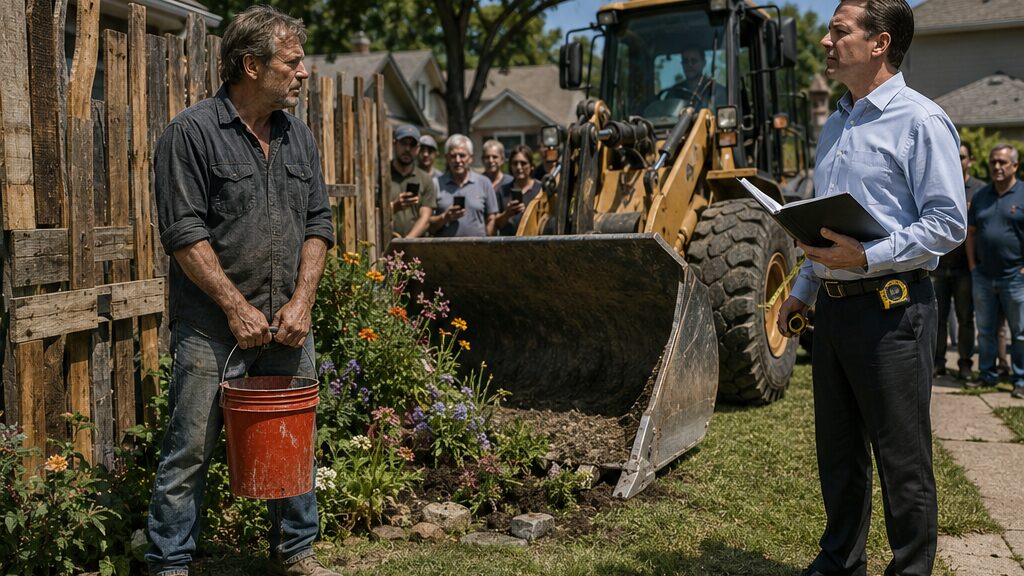
The loader rolled forward, turning its steel bucket toward the narrow opening beside John’s house, toward the reclaimed boards and damp soil beyond.
Christopher opened his citation book and, without looking at John, said, “Proceed to the garden edge.”
Chapter 4: Not One Inch Past The Line
The loader bucket dropped low enough to scrape loose soil from the first garden bed.
John heard it before he saw the damage—the dull steel whisper of the bucket teeth dragging across the edge of the earth he had turned by hand. One small ridge of damp soil folded over itself. A marigold leaned sideways, roots exposed like pale threads.
“Stop,” John said.
The loader idled at the mouth of the side yard, too large for the narrow space, its steel bucket angled toward the garden as if the machine had lowered its head to feed. Matthew Clark sat inside the cab with both hands on the controls, jaw tight beneath the rim of his hard hat.
Christopher stood just behind the bucket’s reach, citation book open against his palm.
“Continue positioning,” he called.
John stepped in front of the garden.
The machine was so close he could feel heat coming off its engine. Diesel fumes pushed over the fence, thick and bitter. The reclaimed boards trembled faintly with the vibration, a row of mismatched wood trying to hold steady against something built to crush and scoop and shove.
“John,” Matthew called from the cab, raising his voice over the engine, “move back.”
“No.”
“You’re in the work area.”
“This is my yard.”
Christopher walked closer, keeping safely to the side. “You are obstructing authorized enforcement.”
John pointed at the gouged soil. “You already crossed the bed.”
“The bed is within the affected boundary condition.”
“You don’t even know where the boundary is.”
Christopher lifted the measuring tape from his belt, but the engine noise swallowed the soft scrape of it extending. “The association has authority to protect shared visual standards.”
Andrew Smith stood near the driveway, pale and rigid. He kept glancing toward the street, where neighbors had collected in small clusters. Some held phones low, pretending not to film. Amy Wilson stood at the edge of John’s lawn with hers in both hands.
Christopher noticed the phones. His posture changed, shoulders square, chin lifted.
“Amy,” he said, loud enough for half the street to hear, “please keep recording. It’s important to document when a resident becomes unstable during enforcement.”
John looked at her.
Her phone lens was pointed toward him.
Something sank in his chest—not anger, not exactly. A tired recognition. There he was, framed by a machine and a citation book, standing in old work boots with dirt on his knees. Christopher had built the picture well.
John almost stepped back.
The old instinct rose before thought did: let the man with papers speak, let the machine finish, argue later, file something later, don’t become the story people tell at meetings. He had survived years by not giving men like Christopher a clean sentence to use against him.
Then the loader bucket tilted.
A second marigold bent.
John’s hand found the top rail of the fence beside him. The wood was warm, rough where he had not finished sanding. One board still carried a faded strip of white from its first life as someone’s porch trim. He had set that board on the anniversary of a day he never mentioned. He remembered pressing it into place, alone, the screw gun shaking slightly in his hand because he had not eaten.
He had promised nothing aloud. But the promise had been there anyway.
Make something that stays.
The bucket crept another inch.
John turned his head toward Matthew. “You don’t have the permit.”
Matthew did not answer immediately.
Christopher did. “The contractor has what he needs.”
Matthew looked down through the smeared glass of the cab. “Mr. Ramsey, I asked for residential equipment clearance before we started.”
“And I told you the association authorization covers access.”
“That’s not the same thing.”
Christopher’s face hardened. “Your office accepted the purchase order. If you abandon the job now, I will report nonperformance and pursue damages. You can explain to your boss why a simple clearing operation became a breach.”
Matthew’s fingers flexed on the controls.
John saw the conflict in him. Not cruelty. Calculation. A man standing at the edge of trouble he had not priced into the job.
“Matthew,” John said, “look at the work order. Look at my fence. This isn’t abandoned material.”
Matthew swallowed.
Christopher stepped into his line of sight. “What you are looking at is a resident weaponizing confusion. Move the bucket to the garden edge and hold. That is all I am asking.”
“That isn’t all,” John said.
Christopher turned on him. “You had months to prevent this.”
“You measured my trash can yesterday.”
“I have monitored this property for months.”
The words hit harder than they should have.
John saw, suddenly, all the small moments he had dismissed. Christopher slowing when he drove past. The folded notices appearing after board meetings where John had not gone. The neighbor who once mentioned that his fence was “popular conversation” and then changed the subject. The way people looked at the garden like they liked it, then looked away when Christopher was nearby.
John had thought staying quiet kept the conflict small.
Silence had only given Christopher room to make it bigger without him.
“John,” Amy said.
Her voice was soft but urgent.
He turned. Her phone was still up, but her eyes were not on the screen now. They were on the loader bucket.
“It’s moving,” she said.
Matthew had eased the machine forward.
Only a foot. Maybe less. Enough for the tire to compress the edge of the lawn. Enough for the bucket teeth to hover over the first row of flowers. Enough for John to feel the air shift.
Christopher raised one hand like a conductor.
John stepped back, but not away. He moved toward the potting bench by the fence.
The red paint bucket sat there, lid loose from yesterday’s work. A brush rested across the rim. A red drop had dried on the handle, glossy and dark.
“Mr. Brown,” Christopher called, his tone sharpened by satisfaction, “do not touch anything that could be construed as a weapon.”
John stopped with his hand above the bucket.
The word weapon hung between them.
He looked at the loader. At Matthew’s tense face behind the windshield. At the bucket teeth over the marigolds. At Christopher, clean shoes planted outside the dirt, citation book open, ready to write John into whatever version of the morning suited him.
John picked up the paint bucket.
Christopher’s eyes widened just enough.
“John,” Andrew said from the driveway. “Don’t.”
The warning beep pulsed. The engine growled. A neighbor whispered something. Amy’s phone stayed raised, trembling slightly.
John held the bucket in both hands. It was heavier than he expected because it was nearly full. The metal handle bit into his fingers.
He had filed a complaint three nights earlier after seeing the loader parked near the far maintenance entrance under a tarp, the rental tag still hanging from its frame. He had taken photos in the dark. He had written the email twice, deleted the angry parts, and sent only the facts to the labor safety office because facts were safer than feelings.
He had told no one.
Not Amy. Not Andrew. Not even the rental desk when they called by mistake. He had thought the proper channel would handle it if there was truly something wrong. He had thought he could stay quiet and still be protected.
The bucket dipped lower.
A flower snapped.
John stepped over the line of disturbed soil and planted himself between the garden and the machine.
“Not one inch,” he said.
Matthew’s mouth moved in the cab, but the engine swallowed the words.
Christopher sliced one hand forward. “Proceed.”
The loader lurched.
John did not think of the law then. He did not think of fines, phones, board votes, or how he would look in a recording.
He thought of the first board he had set into that fence, the evening light on the empty yard, the old ache in his hands, and the silence he had mistaken for peace.
Then he swung the bucket with everything he had.
Bright red paint burst across the loader’s windshield.
It struck with a wet, violent slap, spreading over the glass in a thick sheet. Red flooded the cab window, drowning Matthew’s view, streaking down in heavy ropes over the wipers and metal frame.
Matthew shouted.
The loader jerked.
“Brake!” someone screamed.
The machine bucked forward half a foot, then stopped with a shriek that tore through the whole street. Its bucket teeth dropped and froze inches above the flower bed.
Inside the cab, Matthew’s voice cracked through the engine noise.
“I can’t see!”
Christopher’s citation book slipped from his hand and landed open in the mud.
Chapter 5: The Red Windshield And The Citation Book
One steel tooth from the loader bucket hung over John’s first row of flowers like a hooked finger.
The machine had stopped so close that the nearest marigold shivered in the hot breath of the engine. Red paint slid down the windshield in slow, thick streams, turning Matthew Clark into a blurred shape behind the glass. He was still shouting from inside the cab, one hand braced against the window, the other fumbling for controls he could no longer see.
“Shut it down!” John yelled.
Matthew found the switch. The engine coughed, rattled, and died.
The sudden quiet did not feel like peace. It felt like everyone had heard the same dangerous thing at once and did not know who would speak first.
Christopher spoke first.
“Assault,” he said.
John turned toward him.
Christopher’s face was pale except for two hard spots of color high in his cheeks. His citation book lay open in the mud near the loader tire, one yellow page pressed into the wet dirt. His measuring tape had fallen beside it, half extended, its metal strip bent across a footprint.
“That was assault and vandalism,” Christopher said, louder now, finding the audience again. “Everyone here saw it.”
Matthew shoved the cab door open and climbed down blindly, wiping paint from the outer handle with his sleeve. He stepped onto the loader tread, then dropped to the ground with a jolt.
“You told me to move forward,” he snapped.
Christopher pointed at John. “After he obstructed authorized work.”
“You told me permits were covered.”
“They are.”
“Then show me the residential equipment clearance.”
Christopher’s eyes flicked toward the neighbors.
John noticed it. So did Matthew.
The crew had moved away from the pickup now, no longer bored, no longer pretending this was a routine job. One of them stared at the red windshield. Another looked at the work order in Matthew’s hand as though it might bite him.
Amy Wilson stood near the curb, phone still up.
Christopher saw her recording and lunged toward a new target.
“Amy, stop filming. This is now an enforcement and liability matter.”
She lowered the phone halfway.
John saw the hesitation and understood it too well. Christopher did not need to own a person to make them feel trapped. He only needed a rulebook, a future meeting, a fine no one wanted to fight.
“Keep it,” John said.
Christopher turned on him. “You don’t get to instruct residents after committing a destructive act.”
John’s hands were red to the wrists. Paint dripped from his fingers onto the soil. His breath came hard, but his voice stayed lower than he expected.
“I stopped the bucket.”
“You blinded an operator.”
“You ordered him toward my garden.”
“To secure noncompliant material.”
Matthew stepped between them, not to protect John, but to put himself inside the argument he had been dragged into. “That work order says abandoned material. There is a fence attached to posts and a planted garden. That is not what we were told.”
Christopher picked up the citation book from the mud. He shook it once, ruining the pages further. “Mr. Clark, I suggest you stop making statements until your employer is present.”
“I am the operator on site. My name is on the equipment delivery.”
“Then you should have maintained control of your machine.”
Matthew stared at him. “I couldn’t see because the resident threw paint after you pushed me to move without the clearance I asked for.”
Christopher smiled sharply. “Excellent. You agree he created the hazard.”
For a second Matthew looked trapped by his own words.
John felt it happen: the old turning of language, the way a sentence could be pulled apart and reassembled into a weapon. He had seen supervisors do it. Clerks. Managers. Men at counters who asked you to confirm one small thing, then used your yes to cover the lie around it.
He should have spoken sooner. He should have shown the complaint. He should have taken his own photos out before the machine came through the gate. Instead his best evidence was red paint on glass and his own hands shaking.
Christopher pulled out his phone. “I’m calling the police.”
“Call whoever you need,” Matthew said. “But I want that permit in my hand before this machine moves again.”
A murmur ran through the neighbors.
Andrew Smith moved closer, face drawn. “Christopher, stop escalating. Let’s contact the office and verify.”
Christopher’s head snapped toward him. “Do not undermine the association in public.”
“The association?” Andrew said quietly. “Or you?”
That shifted the air.
Christopher looked at him as if Andrew had stepped across a line more sacred than any property boundary.
“Careful,” Christopher said.
John saw Andrew’s courage falter. The man looked toward the gathered neighbors, then down at the mud. But he did not take the words back.
Amy’s phone remained raised.
Christopher noticed again and strode toward her.
“I said stop filming.”
Amy backed up one step. “I’m on the sidewalk.”
“You are recording an active liability incident involving association enforcement.”
“I recorded you telling him to move the loader.”
Christopher reached for the phone.
Amy pulled it against her chest.
John moved without thinking, stepping between them with red paint still wet on his hands. “Don’t touch her.”
Christopher stopped inches away. His eyes dropped to John’s stained fingers, then lifted with cold satisfaction.
“Threatening a board officer now?”
“I said don’t touch her.”
“John,” Amy whispered.
Her voice was full of fear, but not only for herself. For him too. He could hear it.
Christopher raised his phone. “This is Christopher Ramsey, HOA board president, reporting a resident who has vandalized contracted equipment and is threatening witnesses during lawful enforcement.”
“Lawful?” Matthew said behind him. “You keep saying that.”
Christopher ignored him.
John turned to Amy. “Did you get him telling Matthew to proceed?”
She swallowed. “Yes.”
“Did you get Matthew asking about clearance?”
“I think so.”
Christopher stopped speaking into his phone for half a second.
Amy looked at the screen as if only now understanding what she held. Her thumb moved. The video thumbnail showed the loader bucket, Christopher’s raised hand, John at the line.
Christopher’s voice sharpened. “Amy, if you distribute unauthorized recordings of HOA operations, your own property status will be reviewed. I remember the side-yard storage issue.”
Her face went white.
John knew about the side yard. A kids’ bicycle, a folded chair, two bags of mulch. Nothing worth a warning. Everything worth a threat if Christopher needed leverage.
Amy’s hand trembled.
For a moment John thought she would delete it.
Then she stepped back behind him and said, barely loud enough to carry, “I’m not deleting it.”
Christopher’s expression changed. The first true crack.
A low engine approached from the end of the street.
Not a large engine. Not the loader. A smaller vehicle, steady and official in a different way. Heads turned.
A white inspection vehicle rolled around the corner and slowed behind the loader, blocked now by the pickup, the machine, the crowd, and the red windshield that looked worse from the street than it had from the yard.
The vehicle stopped.
Its door opened.
A woman stepped out holding a permit folder against her side, her eyes moving from the loader to the garden, then to John’s red hands.
Christopher lowered his phone.
The woman looked past him and asked, “Who is responsible for this equipment being operated here?”
Chapter 6: Who Authorized This Machine Here
Sandra Hill stepped out of the white inspection vehicle holding a copy of John’s complaint and looked straight at the red-blinded loader.
“Is this the equipment you reported?” she asked.
For a moment, no one answered.
John stood with paint drying on his wrists, soil stuck to one boot, and the loader bucket still hanging inches above the flower bed. He had imagined an inspector reading his complaint at a desk, maybe filing it, maybe sending a polite response days too late. He had not imagined the paper returning in a woman’s hand while the machine still trembled from its panic stop.
“Yes,” he said. “That’s it.”
Christopher moved in front of him immediately. “Inspector, I’m Christopher Ramsey, president of the homeowners association. We have an active enforcement issue with a hostile resident who has vandalized contracted equipment.”
Sandra looked at him, then at the red windshield, then at the bucket over the garden. “I’ll need everyone to step away from the machine.”
Her voice had no drama in it. That made people obey faster.
Matthew signaled his crew back. John stepped away from the bucket but stayed inside the garden line. Christopher remained planted where he was until Sandra looked at his shoes.
“Sir,” she said, “away from the equipment.”
Christopher moved two steps.
Sandra opened the folder. “Operator?”
Matthew raised a hand. “Matthew Clark.”
“Is the machine shut down and secured?”
“Yes.”
“Do not restart it.”
“I wasn’t planning to.”
Christopher tried a short laugh. No one joined it.
Sandra walked around the loader, studying the tires, bucket, access angle, and the narrow side yard. She paused at the gouged soil and the bent marigolds. Then she looked toward the street, where the crew’s pickup sat half-blocking the lane.
“Who authorized operation of a front-end loader in this residential section?” she asked.
“The association authorized corrective action,” Christopher said.
“That is not what I asked.”
His jaw tightened. “The HOA contracted the work through proper channels.”
“Who obtained the equipment permit and residential-zone clearance?”
Christopher opened his folder with a controlled flourish. “I have board authorization.”
Sandra accepted the papers, scanned the top page, and did not change expression. “This is an internal enforcement approval.”
“It establishes authority.”
“It establishes that your board discussed fines and corrective action.” She turned a page. “It does not authorize heavy machinery operation on a residential street, nor does it define private garden removal as approved scope.”
Christopher’s face darkened. “The garden is part of the noncompliant boundary condition.”
Sandra looked at the fence. “Is the fence on his property?”
Christopher did not answer quickly enough.
John did. “Yes.”
Sandra turned to him. “Do you have a survey?”
“In the house.”
“Bring it.”
John hesitated. He did not like leaving the yard with Christopher there, but Sandra saw the hesitation and added, “The machine does not move.”
He went inside through the side door, leaving red fingerprints on the handle.
The house felt unnaturally still after the street. On the kitchen table sat the folder he had built in secret: property survey, old fence material receipts, photos of the loader staged near the maintenance entrance, printed copy of the complaint email. He had been too embarrassed to show anyone. Too afraid that pulling out a folder would make him seem like a man who had been waiting for a fight.
He grabbed it anyway.
When he returned, Andrew Smith was speaking in a low voice to Sandra.
“I need to be accurate,” Andrew said. “The board voted on fines. Notices. Possible temporary barricades for waste-container violations. We did not vote to bring in a loader.”
Christopher spun toward him. “Andrew.”
Andrew swallowed but kept going. “We did not approve removal of a private fence. We did not review permits for heavy machinery.”
“You are mischaracterizing the minutes.”
“I’m trying to keep us from lying in front of an inspector.”
The crew members exchanged looks.
Sandra took John’s survey and compared it to the fence line. John pointed to the markers, to the side gate, to the common strip beyond. His voice shook once, early, but steadied when Sandra asked for dates.
“You filed this complaint three nights ago?” she asked.
“Yes.”
“Why didn’t you tell the crew when they arrived?”
John felt Christopher’s eyes on him. Amy’s too. Matthew’s.
“I did,” he said, then stopped because that was not fully true. “I told them I didn’t authorize the work. I asked about the permit.”
Sandra waited.
John looked at the red loader windshield. “I didn’t tell the neighbors. I didn’t tell Mr. Clark I had already filed the complaint. I thought if I kept it to the proper channels, it wouldn’t turn into this.”
Christopher made a soft sound of contempt. “So you concealed relevant information and then attacked equipment.”
John looked at him. “I stayed quiet too long. That isn’t the same as lying.”
Sandra wrote something down.
The sentence sat in John’s chest after he said it. It felt dangerous because it was true in more than one direction.
Matthew stepped forward with his work order. “Inspector, this is what we were given.”
Sandra read it.
Her brow tightened slightly at “discarded wood” and “obstructive vegetation.” She looked at the standing fence. Then at the planted beds. Then at Christopher.
“Did you inspect this site with the contractor before work began?”
Christopher lifted his chin. “I provided sufficient description.”
“To describe an attached fence as discarded wood?”
“It is constructed from discarded wood.”
“Reclaimed,” John said.
Sandra did not look away from Christopher. “The distinction matters when you hire a crew to remove it.”
Christopher’s fingers tapped against his ruined citation book. The yellow pages were red-streaked and mud-stained now, soft at the edges.
Sandra closed the folder.
“This equipment is not cleared for the operation described in this zone,” she said. “It is not to be moved under its own power except as directed for removal by authorized transport. I am issuing an impound order pending review.”
The words did not land loudly. They landed completely.
Matthew exhaled through his teeth. One of his crew members cursed under his breath.
Christopher stepped toward Sandra. “That is unnecessary. We can resolve any paperwork deficiency.”
“This is not a paperwork deficiency.”
“I am telling you, the association—”
“I am telling you,” Sandra said, “that an internal HOA enforcement document does not override equipment restrictions, work-site safety requirements, or private property boundaries.”
The street went very still.
Amy lowered her phone slowly. John saw her face, not triumphant, not relieved exactly. Shocked at the size of what they had almost let happen.
Sandra turned to the gathered neighbors. “Anyone with video, photographs, or direct knowledge of who ordered the machine forward will need to provide a statement.”
Amy’s hand closed around her phone.
Christopher saw it and looked suddenly smaller, not because he was less angry but because his anger no longer organized the scene.
Andrew stepped away from him.
Matthew walked to the front of the loader and stared at the red windshield, then at the garden behind the bucket.
“You told us this was authorized common strip clearing,” he said to Christopher.
“It was.”
“No.” Matthew’s voice hardened. “You told us there was no private property issue. You told us the resident had abandoned material beyond compliance. You put my name on that machine.”
Christopher’s eyes narrowed. “Careful, Mr. Clark.”
Matthew laughed once, without humor. “That word seems popular today.”
His crew moved closer behind him.
“You’re paying us triple,” Matthew said, “for reputational damage, lost time, and whatever this does to our company. Or every one of us tells exactly what you said when you booked the job.”
Christopher looked from Matthew to Andrew, from Andrew to Amy, from Amy to John.
John stood beside the fence with dried red paint on his hands and did not say a word.
For once, he did not need silence to protect him.
Matthew took one step closer to Christopher and lowered his voice enough that everyone leaned in to hear it anyway.
“And if this goes to court,” he said, “we testify first.”
Chapter 7: What The Fence Was Really For
John found one broken flower stem under the loader tooth mark and knelt as if the whole garden had gone silent.
The inspectors had pushed everyone back to the street while the tow crew prepared the impound. Yellow warning tape ran from the loader’s rear step to the fence post, fluttering against the reclaimed boards. The machine sat dead in the side yard, red paint drying across its windshield in dull, ugly streaks. The bucket still hovered over the bed, raised and locked now, but close enough to cast a shadow over the flowers it had almost crushed.
John reached under it carefully and lifted the broken stem.
It was only a marigold. He knew that. He had planted dozens. They were hardy, practical flowers, not delicate enough to deserve ceremony. But the snapped green in his palm made his throat close.
He pressed soil back around the exposed roots of the plant beside it. His hands were still stained red, the paint dried into every crease, mixed now with dirt until he could not tell which mark came from defense and which came from repair.
Behind him, Matthew Clark’s crew was arguing in low voices near the pickup. Christopher Ramsey stood beside Sandra Hill’s inspection vehicle, trying to make a phone call with the posture of a man who wanted everyone to know he still had people to call. Andrew Smith sat on the curb, both elbows on his knees, staring at the ground.
The neighborhood watched from a safer distance now.
They had watched the machine arrive. They had watched John throw the paint. They had watched the inspector take control. But none of them knew what it meant to kneel in that soil.
John preferred it that way.
A footstep came softly from the driveway.
“John?”
Amy Wilson stood just outside the side gate. Her phone was in both hands, no longer raised. She looked smaller than she had in the recording, like the act of holding still had taken something out of her.
He wiped his palms on his jeans, though it did no good. “You okay?”
She gave a short, embarrassed laugh. “I was coming to ask you that.”
He looked back at the marigold. “Garden’s mostly fine.”
“I don’t mean the garden.”
John did not answer.
Amy stepped through the gate and stopped before crossing into the bed. She held the phone out, screen facing down. “I saved the video in two places. Sent one to myself. One to my sister.”
John looked at it.
“That was smart,” he said.
“I almost deleted it.”
The words came out quickly, like she needed to confess them before she lost courage.
John straightened slowly.
Amy’s eyes filled, though her voice stayed controlled. “When Christopher said he’d review my property status, I thought of every notice. The mat. The mulch. The chair by the side fence. I thought, if I just delete it, he’ll leave me alone.” She swallowed. “And then I saw the bucket over your flowers.”
John looked toward the street. Christopher had turned away from Sandra now and was speaking into his phone, one hand cutting the air in sharp little movements. Even without the measuring tape in his hand, he looked like he was trying to divide the world into pieces he could control.
“You don’t owe me an explanation,” John said.
“I think I do.”
“No.” He picked up the broken marigold stem and set it on the potting bench beside the red paint lid. “That’s how he keeps everyone scared. Makes us explain being scared like it’s another violation.”
Amy’s mouth tightened.
For a moment they stood with the fence between the garden and the common strip, and beyond it the loader marked in red like a warning sign no one had designed.
Amy looked along the reclaimed boards. “I always liked it.”
John glanced at her.
“The fence,” she said. “I should’ve said that before.”
He nodded once, but the kindness hit him in a place he had kept carefully boarded over.
“It was just scrap,” he said.
“No, it wasn’t.”
The answer came too quickly, and that was the problem. It opened a seam in him.
John turned away and reached for the hose. The nozzle clicked in his hand. He aimed water at the inside of the fence where red paint had splashed during the throw. Thin pink streams ran down the wood and into the soil. He scrubbed one board with his thumb.
“This piece was from a porch,” he said before he knew he had decided to speak. “House got torn down on the east side. I worked cleanup after. They were going to dump all of it.”
Amy said nothing.
He moved the water to another board, darker than the rest. “This one was from a workshop where I loaded trucks for nine years. Place closed. I kept three planks because I didn’t want the whole thing to end in a dumpster.”
The hose hissed.
He stopped at the red-brown panel with the crack like a river.
“My wife used to say I could make anything useful except my own grief.”
Amy’s face changed softly.
John kept his eyes on the board. “After she died, I didn’t talk much. People tried. I hated it. Hated the way they watched my face to see if they were helping.” He rubbed at a fleck of paint that would not lift. “So I started bringing wood home. One board, then another. Built the fence. Dug the beds. Planted things I didn’t know how to keep alive.”
The street noise faded behind the sound of water.
“I wasn’t trying to make a statement,” he said. “I was trying to have somewhere to put my hands.”
Amy wiped her cheek quickly, almost angrily, as if annoyed at herself for crying.
John shut off the hose.
On the street, Andrew Smith approached the gate with a folded paper in his hand.
He looked from Amy to John and seemed to understand he had interrupted something, though not what. “John. Can we talk?”
John rested the hose on the bench. “If it’s about Christopher, talk to the inspector.”
“It’s about the board.”
Amy stiffened.
Andrew unfolded the paper halfway. “This is not from Christopher. It’s from me. Preliminary settlement language. No admission yet. But I think I can get emergency approval.”
John stared at him.
Andrew rushed on. “Repair reimbursement, fine removal, written clarification that the board won’t pursue the paint damage if you agree to resolve the matter internally. No public statement beyond what the inspectors require.”
Amy’s eyes sharpened. “You’re asking him to keep quiet.”
“I’m trying to prevent the whole association from getting dragged into litigation.”
“Christopher dragged it,” she said.
Andrew’s face flushed. “I know.”
“Do you?”
He looked at John then, and the practiced board politeness fell away. What remained was a tired man who had waited too long and knew it. “I should have stopped him sooner.”
John said nothing.
Andrew held the paper lower. “But if this becomes public record, fees go up. Insurance gets involved. People who had nothing to do with Christopher’s decision will pay for it.”
John almost understood him. That was the trouble. Andrew was not wrong about costs. He was not wrong that consequences spread unevenly. He had probably spent years telling himself that keeping Christopher manageable was better than open conflict.
John knew something about that kind of silence.
He looked at the loader windshield, red and opaque. Then at the citation book Sandra had bagged as part of the file. Then at the fence, where water still clung to the old boards.
“No,” John said.
Andrew’s shoulders sank. “At least read it.”
“I know what it says.”
“It protects you.”
“It protects the board.”
“It can do both.”
John picked up Christopher’s mud-stained citation from the bench. Sandra had photographed it and let him keep the loose duplicate, red-smeared at one corner from his hand. The words TEMPORARY LAWN BARRICADE AUTHORIZED were still readable through the stain.
He set it upright against the inside of the fence, wedged between two boards where the red paint had not washed fully away.
“I stayed quiet because I thought quiet was safer,” he said. “He brought a machine.”
Andrew closed the paper.
John looked at Amy. Then at the street, where Sandra Hill was taking statements, and where Matthew’s crew stood ready to speak because their own names had been put at risk.
“I’ll give a formal statement,” John said.
Andrew shut his eyes briefly.
Amy lowered her phone to her side, but did not hide it.
John kept his hand on the fence until the old wood steadied him.
“Not to ruin anybody,” he said. “To stop this from being called a misunderstanding.”
Chapter 8: A Handmade Boundary Still Standing
Christopher Ramsey came to the HOA meeting without his measuring tape for the first time anyone could remember.
The absence made him look unfinished.
He sat at the end of the folding table in the community room with his hands clasped too tightly in front of him, citation book nowhere in sight. A stack of printed agendas lay beside the microphone, but no one touched them. The room smelled faintly of floor cleaner and burnt coffee. The usual framed notices about landscaping standards and pool hours seemed smaller than they had at any meeting John had ever avoided.
John stood near the back wall until Amy Wilson touched his elbow.
“There’s a seat,” she said.
He saw it in the front row, beside Andrew Smith, who had not looked directly at Christopher since John arrived. John considered staying where he was. The back wall felt safe. It offered an exit. It let other people speak first.
Then he looked at the evidence table.
Sandra Hill’s report lay in a blue folder. Amy’s recording had been logged and copied. Matthew Clark’s written statement sat with a demand letter from the crew’s company. Christopher’s ruined citation book, sealed in a clear evidence bag, rested on top of a box like an object recovered from weather.
The sight of it moved John forward.
He sat.
Christopher watched him with a face arranged into weary restraint, as if he were the one enduring spectacle.
The board chair, a role-only officer who had said almost nothing during earlier disputes, opened the meeting with a voice that shook around the edges. “This emergency session concerns the unauthorized use of contracted equipment during an enforcement action at the Brown property.”
Christopher leaned toward his microphone. “I object to the word unauthorized.”
Andrew looked up. “Noted.”
That one word carried more weight than it should have. Christopher heard it. His lips pressed flat.
Sandra did not attend in person, but her report did. The chair read from it in careful sections: residential-zone restriction, equipment not cleared for the described operation, misleading site description, private property boundary concern, unsafe advancement after operator uncertainty. The words were dry, procedural, almost bloodless.
That made them harder to dismiss.
Christopher tried anyway.
“The board must consider the context,” he said when allowed to speak. “We were dealing with a resident who had repeatedly resisted standards. My responsibility is to protect community value. If every owner decides discarded materials can become fences and gardens can encroach visually on common space, we lose coherence. We lose order.”
John looked at his hands.
The red paint had faded after days of scrubbing, but traces remained beneath two fingernails. He had thought about cleaning them more thoroughly before coming. Then he had stopped.
Matthew Clark stood from the second row. He wore a clean work shirt and no hard hat. Without the cab around him, he seemed less like a threat and more like a man who had spent too many hours explaining one bad morning to too many people.
“With respect,” Matthew said, though his tone held little, “we were not told we’d be operating against a resident’s planted garden. We were not told the equipment clearance was unresolved. We were told the association had full authority and that the material was abandoned.”
Christopher turned. “Your company accepted the job.”
“Based on your description.”
The chair lifted the demand letter. “The crew’s company has submitted a claim for reputational damage, lost time, and potential exposure resulting from misrepresented scope.”
A murmur passed through the room.
Fees. Insurance. Liability. Those words moved people who had stayed unmoved by flowers.
Christopher heard the shift and leaned harder into his only remaining ground. “This is exactly why enforcement must remain firm. Sentiment cannot govern standards. Mr. Brown’s reaction—throwing paint onto heavy equipment—created the most visible hazard that morning.”
John felt several eyes turn toward him.
The old pressure rose: explain less, shrink more, let them think what they wanted if it meant leaving sooner.
Amy’s video began playing on the room monitor before he could decide whether to speak.
No one had added commentary. No one needed to.
The image shook at first. The loader bucket hovered over the garden. John stood in front of it. Matthew’s voice came through faintly, asking about clearance. Christopher’s voice followed, crisp and unmistakable: “Proceed.”
Then the red paint flew.
A few people flinched even though they knew it was coming. The windshield vanished under red. The machine jerked. Matthew shouted that he could not see. The bucket stopped inches above the bed.
The video ended.
The room stayed silent.
Amy lowered her phone in her lap, both hands around it.
Andrew stood. He looked pale, but his voice did not break. “The board did not authorize heavy machinery. We did not authorize private fence removal. We did not review permits. I should have challenged the escalation earlier, and I did not. That failure belongs in the minutes.”
Christopher stared at him as if betrayal were a rule violation no one had yet written down.
The chair asked John if he wanted to speak.
He did not, not in the way people meant. He wanted to be in his backyard with the hose running, pressing soil back around wounded roots. He wanted the room to understand without making him unwrap the private thing in public.
But silence had already had its chance.
John stood.
He did not take the microphone at first. He looked at the blue folder, the video screen, the citation book in its clear bag.
“My trash can was twenty centimeters out of place,” he said.
A few people shifted. Someone looked down.
“I moved it when he told me. That should have been the end.”
Christopher’s jaw worked, but he said nothing.
John kept his voice even. “The fence is inside my line. The garden is inside my line. The wood is reclaimed, not abandoned. I built it because I needed something useful to do with things other people had thrown away.”
Amy looked at him then.
He did not look back or he might stop.
“I threw the paint because the machine was moving toward the bed and the operator couldn’t see what Christopher was calling debris. I’m not proud that it came to that. But I’m not going to let it be written as vandalism while the order that made it necessary is called enforcement.”
The room was very still.
John sat before anyone could soften the moment into applause.
The vote took less time than he expected. Christopher’s enforcement authority was suspended pending review. All citations connected to the machinery order would be examined. The HOA would cooperate with Sandra Hill’s office and the crew’s claim. Repair costs for John’s garden and fence would be covered without requiring a confidentiality agreement.
Christopher gathered his papers with small, furious movements.
As he stood, his hand went to his belt.
For half a second, John saw his fingers search for the missing measuring tape.
They found nothing.
Days later, a worker came by with clean boards and a can of matching stain, sent by the HOA’s insurer. He offered to replace every panel touched by red paint.
John thanked him and sent him away with most of the boards still in the truck.
He repaired the loosened post himself. He reset the marigolds that could be saved and pulled the ones that could not. He rinsed the inside of the fence again, slowly, until the water ran clear beneath the boards.
One red stain remained near the inside edge of the cracked panel, tucked where passersby would not see it unless John opened the gate and showed them.
He left it there.
Not as a trophy. Not as anger.
As a mark of the morning the machine stopped, the morning silence stopped with it, and the handmade boundary still stood.
The story has ended.