They Locked the Only Road Across His Farm, Then Learned Who Actually Owned the Ground Beneath It
Chapter 1: The Gate That Wasn’t There Yesterday
The gate had not been there Sunday night.
William Carter stopped his pickup twenty feet short of it Monday morning and left the engine running while he stared through the windshield.
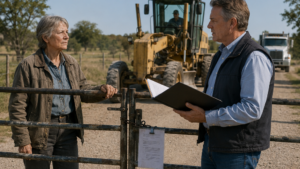
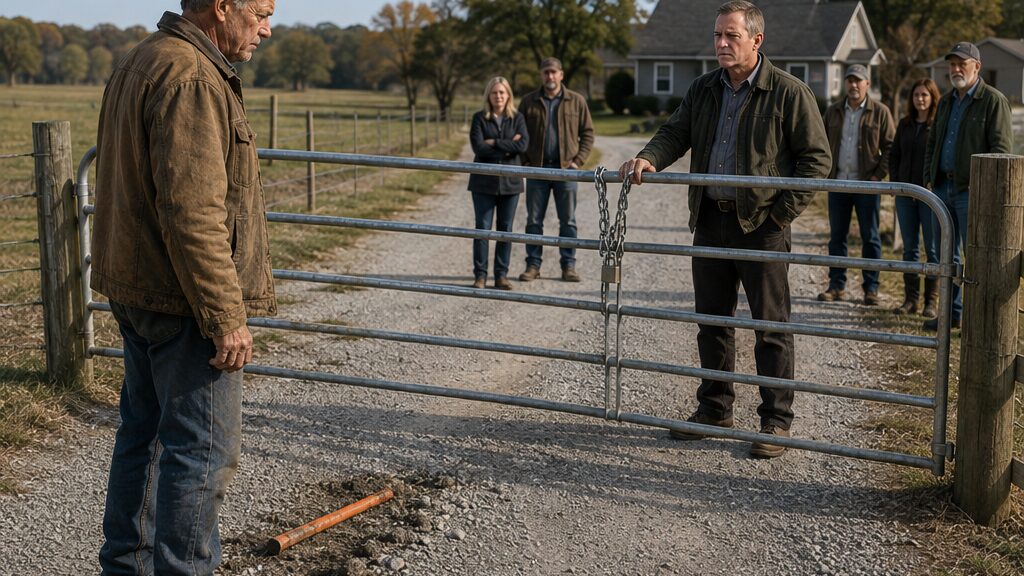
Fresh galvanized steel crossed the gravel road from ditch to ditch. A new chain looped around the post on the far side, and a brass-colored padlock hung where William had driven through for more than forty years without asking anyone’s permission.
Beyond it, the road climbed past his south pasture toward the twelve newer houses scattered along the ridge.
William shut off the truck.
The sudden silence made the gate seem even more ridiculous.
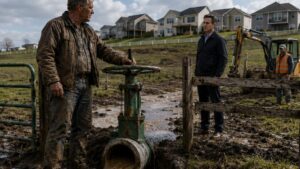
He got out slowly, more irritated by the assumption behind it than by the obstacle itself. The gravel beneath his boots had been recently spread and rolled. Tire tracks from heavy equipment cut across the shoulder. Someone had trimmed brush back along his fence and shoved the branches into a low pile near the ditch.
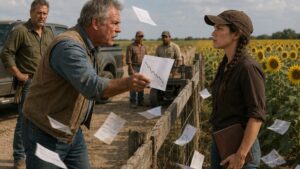
Three men stood beyond the gate.
Anthony Wright was in front.
William knew him well enough to recognize the posture before he heard the words: feet planted wide, one hand resting on the new steel as if he had personally built the thing.
“Morning, William.”
William walked to the chain.
“What is this?”
Anthony glanced toward the other men. One of them held a phone chest-high.
“The road association finally handled access.”
William looked at the padlock, then at Anthony.
“Access to whose road?”
Anthony smiled without much humor.
“Twelve families live up there. We paid for grading. We paid for drainage. We paid for the gate. We can’t keep running this place on handshakes.”
William curled his fingers once and released them.
“You put a lock across my entrance.”
“It’s the association entrance now.”
Behind Anthony, the man with the phone raised it slightly.
William noticed.
Anthony noticed him noticing.
That seemed to please him.
“We sent notices.”
“You sent a letter saying you wanted to discuss a gate.”
“And you didn’t respond.”
“That isn’t permission.”
Anthony sighed as though William were delaying a meeting.
“We have keys for residents and service access. You’ll get one.”
William stared at him.
“I need a key to cross my own ground?”
Anthony’s smile disappeared.
“You’ve let people use this road for years.”
“Use it.”
“Yes.”
“That isn’t the same as owning it.”
One of the men behind Anthony laughed under his breath.
William turned his head just enough to see him lower the phone.
Anthony stepped closer to the gate.
“Look, nobody’s trying to steal your farm. We’re trying to manage a road everybody depends on.”
“You bolted a gate across it before the boundary was settled.”
“The boundary has been settled for decades.”
“Then you won’t mind showing me where.”
Anthony looked toward the shoulder.
“So that’s what this is about?”
William followed his glance.
Something orange lay half buried near the fresh gravel.
He walked along the gate until the fence post ended, then stepped into the ditch.
“William,” Anthony called, “you can’t just walk around the barrier.”
William ignored him.
He crouched carefully, knees stiff, and pulled the orange object free.
It was a survey stake, splintered at the top and scraped along one side. A small metal cap remained attached near its base.
William brushed damp gravel from it with his thumb.
The stake had not fallen there by itself.
The hole where it had once stood was still visible three feet back from the new shoulder.
His irritation cooled into something more precise.
Anthony came nearer.
“That old marker?”
William looked at him.
“Who pulled it?”
“No idea.”
“It sat there last week.”
Anthony shrugged.
“The contractor cleared the shoulder. Probably junk.”
William stood.
“That wasn’t junk.”
“Then call the contractor.”
“You hired him.”
“The association did.”
“And who told him where the road ended?”
Anthony’s jaw tightened.
“We used the existing road.”
William pointed at the new gravel.
“That isn’t the existing road.”
The phone behind Anthony lifted again.
William felt the familiar temptation to say everything at once—to remind Anthony who had maintained that lane before the first ridge house had foundations, who had hauled gravel through spring mud, who had pulled delivery trucks free when drivers missed the turn.
Instead he looked at the torn ground where the stake had been.
Anthony stepped closer until only the gate separated them.
“You know what the real problem is?” he said. “You still think this whole stretch belongs to you because your father ran cattle here.”
William raised his eyes.
“My father has nothing to do with it.”
“Then prove it.”
Anthony tapped the steel gate.
“Until then, this is how access works.”
One of the men behind him chuckled.
William saw himself in the phone’s black screen: gray hair, work shirt, old brown vest, one hand holding a dirty orange stake like some relic nobody else valued.
Anthony lowered his voice.
“You’ve had forty years to complain.”
William looked at the new lock.
Then at the houses beyond.
Then at the stake.
“Maybe I didn’t need to complain until this morning.”
Anthony gave a short laugh.
“You going to sue twelve families over four feet of gravel?”
William slipped the stake under his arm.
“No.”
“That’s what I thought.”
William turned away.
Anthony called after him.
“You want the access code, ask Deborah. She’s got the list.”
William kept walking.
At his truck, he paused long enough to look back.
Anthony still stood with one hand on the gate.
The others had stopped laughing.
William got in, drove backward until he reached the pasture turnout, and turned around without touching the chain.
He did not go to the feed store.
He did not go home.
He drove instead to the machinery shed, found an old coffee can filled with bolts, fence staples, gate pins, and other things too useful to throw away, and emptied it onto the workbench.
The orange stake had a stamped number on its cap.
William copied it onto the back of an envelope.
Then he went inside and found a business card he had not used in years.
Joseph White answered on the fourth ring.
“White Surveying.”
William looked through the kitchen window toward the road he could no longer cross without permission.
“Joseph, this is William Carter.”
A pause.
“Been a while.”
“It has.”
“What can I do for you?”
William turned the orange stake in his hand.
“I need you to tell me where my road actually is.”
Chapter 2: The Road Everyone Used but Nobody Owned
The county clerk read the easement description twice before looking up.
“You said the current road is how wide?”
“Depends where you measure,” William said.
They sat beneath hard fluorescent lights at a counter crowded with plat books, photocopies, and a computer monitor that looked newer than everything else in the room.
“Twenty-two feet in places. Maybe more.”
The clerk tapped the photocopy.
“This says sixteen.”
William leaned closer.
The language was old but clear enough: a right of passage across a defined strip running from the county road to the parcels uphill.
A right of passage.
Not ownership.
The clerk turned to another page.
“The underlying parcel stayed with the Carter tract when the easement was recorded.”
William felt a small tightening in his chest.
“So the roadbed is mine.”
“In this section, according to this deed chain, yes.”
“What about the people beyond it?”
“They have access rights. I can’t tell you the exact legal scope. That’s attorney territory.”
“I’m not asking what they can do.”
He touched the copied plat.
“I’m asking what they own.”
The clerk gave him the careful expression of someone who had learned not to turn records into legal advice.
“The recorded documents show the land underneath remained part of your parcel.”
That should have felt like victory.
For half a minute, it did.
William folded the copy and slid it into the folder he had brought from home.
Then the clerk said, “There’s one thing you should probably see.”
She pulled older aerial photographs on the computer.
The first was grainy enough that William could barely distinguish pasture from timber. The road appeared as a pale narrow line.
The next image was clearer.
Then another.
The road widened by degrees.
A shoulder appeared near the first ridge house.
A drainage ditch was cut.
A wider turn developed where delivery trucks swung toward the newer homes.
William leaned forward.
“What year is that?”
The clerk told him.
He remembered it.
A contractor had brought in two loads of crushed limestone that summer. William had been busy with hay and hospital trips. The road had been the least important problem in his life.
The clerk clicked forward.
The pale line widened again.
William sat back.
Nobody had stolen twenty feet of road in a single night.
It had happened two feet at a time.
At home that afternoon, he spread the copies across his kitchen table.
The new steel gate was visible through the window beyond the lower field, catching sunlight whenever a car passed through.
William laid the old plat beside a recent photograph he had taken with his phone.
Sixteen feet on paper.
More than twenty on the ground.
He could already hear Anthony’s answer.
You watched us use it.
You watched us improve it.
You never objected.
A pickup entered the driveway.
Joseph White stepped out carrying a tripod case and two long equipment bags.
He was younger than William remembered, which meant William was older than he liked to admit.
Joseph shook his hand and looked toward the ridge.
“You still running cattle?”
“Enough to complain about them.”
“That sounds about right.”
William handed him the orange stake.
Joseph rotated it until he found the cap number.
“Where did you get this?”
“Beside the new gate.”
“Loose?”
“Pulled.”
“You saw somebody pull it?”
“No.”
“Then it was loose when you found it.”
William gave him a look.
Joseph smiled faintly.
“You hired a surveyor, William. We are professionally boring.”
They walked the road.
Joseph stopped several times to study old fence posts, drainage cuts, and the relationship between the gravel and the farm boundary.
At the new gate, Anthony was not there.
William was grateful for that.
Joseph set up his equipment.
For the next hour he worked without offering conclusions.
Finally he placed a flag at one point on the shoulder, then walked ten paces and placed another.
William stood with his hands in his vest pockets.
“Well?”
“I’m not done.”
“Doesn’t look like sixteen feet.”
“No.”
“That gate on me?”
“I’m not done.”
William exhaled through his nose.
Joseph looked over.
“You want a fast answer or a defensible one?”
“Defensible.”
“Then let me be boring.”
They continued toward the ridge.
Near the sharpest curve, Joseph stopped.
The gravel there had been widened for larger vehicles. William remembered when a moving truck had nearly buried its rear axle in the ditch years ago. Afterward, someone had spread stone along the inside edge.
Nobody had asked him.
But he had not stopped them either.
Joseph studied the line.
“This part is well outside the original easement corridor.”
William folded his arms.
“How far?”
“Potentially several feet.”
“Potentially?”
“I need the full workup.”
William looked at the widened bend.
“Then they’re outside it.”
Joseph lowered the equipment.
“You knew the road was getting wider.”
It was not phrased as an accusation.
William answered anyway.
“I knew people were using it.”
“That isn’t what I asked.”
William looked toward the houses.
“They had moving trucks. School buses. Fuel deliveries.”
“And you let them widen it.”
“I didn’t give them land.”
“No.”
Joseph packed the tripod.
“But if we’re talking about why everyone thinks the road is where it is, your silence matters.”
William’s mouth hardened.
“My deed matters.”
“It does.”
“My boundary matters.”
“Yes.”
“Then mark it.”
Joseph met his eyes.
“I will.”
That evening William drove the long way around by county roads and entered the ridge development from the opposite side, a route that added nearly half an hour and ended at a narrow temporary connection unsuitable for farm equipment.
He stopped where the gravel lane looked down toward his fields.
From up there, the road seemed harmless.
A shared strip of pale stone.
Cars traveled it because they always had.
Children waited for buses beside it.
Delivery vans used the wider corner because no one wanted them in a ditch.
William remembered the first family who had built beyond the pasture. They had asked if a concrete truck could use the lane.
He had said yes.
The second family had asked where to place a culvert.
He had pointed.
Somewhere after that, people had stopped asking.
And somewhere before that, William had stopped expecting them to.
Two days later Joseph returned with a rolled survey sheet.
They spread it across William’s workbench.
The old easement was marked clearly.
The current gravel was marked separately.
They did not match.
William traced the original boundary with one finger.
“So that settles it.”
Joseph did not answer.
William looked up.
“What?”
Joseph tapped the wider road line.
“This settles where the recorded corridor is.”
“And the land outside it?”
“Your parcel, according to the survey.”
William felt the satisfaction return.
Then Joseph pointed at several dates noted along the aerial comparison.
“The problem is this expansion happened over years.”
“I know.”
“While you owned it.”
“Yes.”
“And, as far as anyone can document, while you objected to none of it.”
William straightened.
Joseph rolled the sheet halfway closed.
“I’m not saying they own it.”
“Sounds like you’re getting close.”
“I’m saying a clean survey doesn’t make the history clean.”
He tapped the paper again.
“You’ve got a boundary question, William. But you’ve also got a permission question.”
William stared at the two lines.
One was where the road had been recorded.
The other was where everyone had learned to believe it belonged.
Chapter 3: What Silence Had Allowed to Grow
Joseph’s first new pin landed five feet inside what everyone had been treating as the road shoulder.
William stood beside it and said nothing.
The small orange flag snapped above the grass while Joseph checked the instrument again.
Across the gravel, a drainage swale cut through soil that, according to the measurements, was still William’s.
Farther uphill, another section of road pushed even deeper beyond the recorded corridor.
Joseph walked back.
“That one is good.”
William looked at the pin.
“So the shoulder is mine.”
“The ground is part of your parcel.”
“Same thing.”
“No,” Joseph said. “Not automatically.”
William disliked that answer enough to remember it.
By noon, three more markers had gone in.
Each one made the dispute more visible.
The old boundary had been abstract when it lived in a deed book. Now orange flags stood beside gravel tires crossed every day.
A pickup slowed as it passed.
The driver stared.
William stared back.
At the curve, Joseph stopped beside a broad section of stone.
“This is the worst one.”
“How bad?”
“Just over six feet beyond the recorded corridor at the widest point.”
William let out a dry laugh.
“And Anthony says I’m confused.”
Joseph crouched near a shallow depression.
“Here’s something else.”
He scraped loose soil aside.
A rust stain ringed a small cavity.
“Old marker?”
“Could be where one sat.”
William handed him the stake he had recovered from the gate.
Joseph compared the cap.
“Same survey series.”
William felt something settle inside him.
Not anger.
Confirmation.
He could almost hear Anthony again.
Prove it.
Now he could.
That evening Anna Hernandez arrived carrying groceries William had not asked for.
She set the bags on his kitchen counter, opened the refrigerator, frowned, and started throwing away things he claimed were still good.
“You know sour cream is not improved by age.”
“It says best by.”
“It says a date from last month.”
“Marketing.”
She closed the refrigerator.
“You sound very certain for a man who has mustard older than my marriage.”
William sat at the table with Joseph’s survey spread in front of him.
Anna noticed it.
Her humor faded.
“So it’s true?”
“What?”
“The road.”
He pointed to the lines.
“Original easement here. Present gravel here.”
Anna studied the map.
“That’s a lot wider.”
“Six feet in one spot.”
She sat.
“And the gate?”
“Partly on my ground.”
“Partly?”
“Enough.”
Anna looked toward the window.
“You going to make them move it?”
“If they’ve got sense.”
“That wasn’t what I asked.”
William folded the survey.
“I’m not letting Anthony decide what belongs to me.”
“I didn’t say you should.”
“You sound like you’re about to.”
Anna rested both forearms on the table.
“I’m trying to understand how the road got six feet wider without you noticing.”
William’s jaw tightened.
“I noticed.”
The answer came too quickly.
Anna leaned back.
“You noticed.”
“I had other things going on.”
“When?”
William said nothing.
She looked again at the survey.
Then at him.
“Was this when Mom was sick?”
He pushed his chair back slightly.
“It was around then.”
Anna’s face changed.
Not softer.
More careful.
“I remember a truck getting stuck near that bend.”
William glanced at her.
She continued.
“Big moving truck. It tore up the shoulder.”
“Probably.”
“You told the contractor to widen the turn.”
“I told him not to leave a mud hole.”
Anna stared at him.
“You said, ‘Leave it wide enough so they don’t tear it up again.’”
William remembered the day with unpleasant clarity.
His wife had been inside sleeping after treatment. A contractor had come to the porch asking whether he wanted the road restored exactly as it had been.
William had barely listened.
Make it wide enough.
He had wanted the man gone.
“I didn’t give them six feet.”
“No.”
“I didn’t sign anything.”
“No.”
“I didn’t tell them they owned it.”
Anna nodded.
“But you told them to make it wider.”
“For one turn.”
“And after that?”
William looked down at his hands.
After that came another house.
Another culvert.
Another truck.
Someone put gravel where mud formed. Someone trimmed brush where mirrors hit branches. Someone added stone beside the ditch.
Each change had seemed too small to fight while his wife was alive.
After she died, each change seemed too old to reopen.
Until Anthony put up the gate.
Anna touched the survey.
“I’m not saying they were right.”
“They weren’t.”
“I know.”
“You weren’t standing there Monday.”
“No.”
“You didn’t hear him tell me I needed permission.”
“I know.”
“You didn’t see those men filming.”
Anna’s eyes lifted.
“No. But I know you.”
William gave a humorless laugh.
“That supposed to help?”
“Sometimes.”
The screen door banged in the wind.
For several seconds neither spoke.
Then Anna said, “You let this get muddy because you didn’t want another argument in your life.”
William looked away.
“That’s not what happened.”
“It’s exactly what happened.”
“My wife was dying.”
“I know.”
The words stopped him.
Anna lowered her voice.
“I was there too.”
William’s anger collapsed before it could find a target.
She continued.
“You chose which problems mattered. I’m not blaming you for that. But you don’t get to pretend the road changed behind your back.”
He folded the survey tighter than necessary.
Outside, tires crunched on gravel.
A car stopped near the mailbox.
The driver pushed an envelope through and left.
William waited until the taillights disappeared.
The return label named the road association.
Inside was a formal notice.
The language was restrained but unmistakable. The association asserted longstanding access and use of the existing roadway and warned William not to obstruct passage while ownership and easement rights were being reviewed.
Anna read over his shoulder.
“Anthony?”
“Association.”
“That means Deborah signed it too?”
William checked.
The printed signature line carried Anthony’s name as spokesperson.
He set the paper down.
“Now he wants history to matter.”
Anna looked at the widened road on Joseph’s map.
“So do you.”
William gave her a hard look.
She did not look away.
The next morning Joseph finished setting the remaining pins.
The orange markers ran along the road in a line nobody could pretend not to see.
At the new steel gate, Joseph measured twice before marking a point just inside the structure.
William stood beside him.
“Say it.”
Joseph packed the prism pole.
“Part of the installation crosses your parcel outside the recorded easement.”
William looked at the chain.
For the first time since Monday, the gate seemed smaller.
Anthony had wanted proof.
William had it.
Yet the victory felt less clean than he had imagined.
Behind him, tires approached.
A sedan stopped on the county side of the gate.
Deborah Flores stepped out.
William had spoken with her only a handful of times. She usually handled road-maintenance checks and sent polite notices about gravel bills.
She glanced at Joseph’s orange flags.
Then at the gate.
Then at William.
“I was hoping I’d catch you.”
William waited.
Deborah lowered her voice.
“Anthony doesn’t know I’m here.”
“That supposed to make me feel better?”
“No.”
She looked toward the ridge as if expecting someone.
“The association hasn’t filed anything yet.”
William held the formal notice between two fingers.
“Could’ve fooled me.”
“That was Anthony’s idea.”
“You’re treasurer.”
“I know.”
“You paid for the gate.”
Her mouth tightened.
“We paid for a gate. We did not vote to move survey markers.”
William’s attention sharpened.
Deborah glanced at the broken orange stake resting on his truck seat.
“And some of us didn’t know the boundary had never been verified.”
William said nothing.
She took a breath.
“If you want to know why Anthony pushed this through so hard, meet me Saturday morning at the café beside the feed store.”
“Why not tell me now?”
“Because if he sees me standing here, the next conversation gets harder.”
William looked at the new pins, the widened gravel, and the gate Anthony had treated as the end of the argument.
Deborah opened her car door.
Before getting in, she faced him again.
“There’s a part of this he hasn’t told you.”
Then she drove away.
Chapter 4: The Reason Anthony Wanted the Lock
Deborah Flores was already seated when William entered the café beside the feed store Saturday morning.
She had chosen the back table, away from the window.
That alone told him she was not there to defend Anthony.
William slid into the chair across from her.
“You said there was something he hadn’t told me.”
Deborah wrapped both hands around a paper coffee cup.
“There is.”
“Then tell me.”
She glanced toward the counter before answering.
“The board never voted to move any survey markers.”
William’s expression did not change.
“Somebody moved them.”
“I know.”
“You paid the contractor.”
“The association paid the contractor to grade the entrance and install a controlled gate.”
“On my land.”
“We didn’t know that then.”
“You could’ve checked.”
“Yes.”
The quick agreement caught him off guard.
Deborah looked tired rather than defensive.
“That’s one of the reasons I’m here.”
William leaned back.
“Anthony told everybody the boundary was settled.”
“He told us the existing road was the easement.”
“It isn’t.”
“I know that now.”
William studied her.
“How many others know?”
“Two board members. Maybe three homeowners.”
“And the rest?”
“They think this is an old farmer angry about a new gate.”
William almost laughed.
“That convenient?”
“No. It’s dangerous.”
Her answer was sharper than he expected.
She set the cup down.
“Do you remember an ambulance getting turned around up there last winter?”
William frowned.
He remembered flashing lights on the ridge one evening. By the time he had gone outside, the vehicle had already disappeared.
“They went to the wrong entrance,” Deborah said. “The mapping system sent them down the county road, then toward an old service track that hasn’t been usable in years.”
“What’s that got to do with my road?”
“They lost time.”
“How much?”
“Enough that people noticed.”
William waited.
Deborah lowered her voice.
“The person they were responding to survived. This isn’t some tragedy Anthony is using as an excuse. But the family was furious. So were half the homeowners.”
William looked out toward the feed-store parking lot.
Pickup doors slammed. Someone rolled a cart of mineral blocks toward a trailer.
Everything outside continued as if the road were just gravel.
Deborah continued.
“The fire department asked us to make the entrance easier to identify and make sure emergency access couldn’t be blocked by parked trailers or farm equipment.”
“Was it blocked?”
“Not then.”
“So Anthony decided to fix something that hadn’t happened.”
“He decided he didn’t want to be the person explaining it if it did.”
That sounded more like Anthony.
William turned back.
“Still doesn’t explain a lock.”
“We had people dumping trash up there. Contractors cutting through. A couple of kids using the road at night. Homeowners wanted controlled access.”
“And they wanted me controlled with it.”
Deborah did not answer.
That was answer enough.
William said, “Who authorized the location?”
“Anthony.”
“Survey?”
“He said the road itself established it.”
William’s jaw tightened.
“That isn’t a survey.”
“I know.”
“Did you know then?”
“No.”
She pushed a folded sheet across the table.
It was not a legal record. It was an association expense summary.
Gravel.
Culvert work.
Drainage.
Tree trimming.
Gate installation.
The total was high enough to make William pause.
“Twelve households paid this?”
“Some more than others. We’ve spent years patching that road because nobody ever had a clear maintenance agreement.”
“You could’ve asked me.”
“We did.”
William looked up.
“When?”
Deborah held his gaze.
“Three years ago.”
He remembered an envelope he had left unopened for almost a week before dropping it into a drawer. Something about shared maintenance.
“I didn’t agree to anything.”
“You didn’t answer.”
There it was again.
His silence arriving before him.
Deborah did not press it.
“Anthony took that as proof you would never participate. Other people took it as permission to keep doing what they were already doing.”
“They don’t get land because I didn’t attend a meeting.”
“No.”
Her voice softened.
“But you keep saying this happened to you all at once.”
William’s hand flattened against the table.
“It happened when they locked me out.”
“Yes.”
“And somebody moved my markers.”
“Yes.”
“And Anthony stood there laughing.”
Deborah looked down.
“I saw the video.”
William felt heat rise along his neck.
“So everybody has it now.”
“Not everybody.”
“Enough.”
“I told him to delete it.”
“Did he?”
“No.”
William stared at her.
Deborah looked genuinely ashamed.
“That’s where he lost me.”
Not the gate.
Not the money.
Not the boundary.
The humiliation.
William had expected her to offer an excuse for it.
Instead she said, “Anthony thinks if he gives an inch now, the whole association falls apart. He promised people he would make the road predictable. He made himself responsible for fixing every complaint, and now he treats anyone who questions him like they’re threatening all twelve houses.”
“That supposed to make him right?”
“No.”
“What does it make him?”
“Scared of looking wrong.”
William considered that.
It was not forgiveness.
But it was recognizable.
He finished his coffee.
“What happens next?”
Deborah hesitated.
“If you block the road, Anthony wants the association to ask for emergency court access.”
“I haven’t blocked anything.”
“Not yet.”
William stood.
Deborah remained seated.
“William.”
He stopped.
“We’re not all Anthony.”
William looked at the expense sheet.
“No,” he said. “But you all paid for his gate.”
Outside, he drove straight to the road entrance.
Anthony was there with one of the board members, examining the newly placed orange survey flags.
He saw William and straightened.
“So Deborah talked to you.”
William stopped several feet away.
“She tell you that?”
“She didn’t have to.”
Anthony pointed toward the flags.
“You planning to fence this off?”
“They mark the property line.”
“They mark one surveyor’s opinion.”
“He’s licensed.”
“And we have decades of use.”
William’s eyes went to the gate.
“You had decades of access.”
“We maintained it.”
“On land you didn’t own.”
Anthony stepped closer.
“And you let us.”
William did not answer.
Anthony took the silence as momentum.
“We’re filing Monday if you interfere with passage. Emergency access, school access, service access. We’ll ask the court to keep everything open while this gets sorted out.”
“You might want to sort out your gate first.”
Anthony’s face hardened.
“You put anything across this road and you’ll be explaining it to a judge.”
William looked past him toward the ridge houses.
For the first time, he could see the argument from both ends of the road.
Anthony had no right to claim his ground.
But twelve families had built daily life around being able to cross it.
William touched one of Joseph’s new orange flags.
Anthony waited.
William finally said, “Then I suppose we’re both about to find out what we can actually prove.”
Chapter 5: William Locks What He Can Prove
The green gate arrived on a flatbed Monday morning.
Anthony was standing beside the association’s steel barrier before the fence contractor had finished backing into position.
“You cannot be serious.”
William closed the door of his pickup.
The green gate was plain farm equipment, twelve feet wide, heavier than it looked and scratched near one hinge from years in storage behind William’s machinery shed.
The contractor climbed out.
“Where do you want it?”
William pointed to two stakes Joseph had set beyond the association’s installation.
“Post here. Other side there.”
Anthony stared at the marks.
“That’s directly behind ours.”
“No,” William said. “It’s directly inside mine.”
Anthony stepped between the contractor and the first post hole.
“You’re blocking the easement.”
William held out a copy of Joseph’s survey.
“I’m outside the recorded corridor.”
“You think a line on paper cancels fifty years of use?”
“I think it tells me where my ground starts.”
Anthony did not take the survey.
“You do this, every homeowner up there is affected.”
“You should’ve thought about that before you installed yours.”
There it was.
The sentence William had been carrying since the first morning.
It felt good for less than a second.
Anthony looked toward the contractor.
“If you install that, you’re participating in an active property dispute.”
The contractor stopped unloading tools.
William said, “The post locations are on my parcel. Joseph marked them. You’ve got his contact information.”
Anthony pulled out his phone.
William waited.
The contractor did too.
After a minute Anthony lowered the phone without calling anyone.
He looked at the orange stakes again.
William saw the moment the measurements stopped being abstract to him.
Anthony finally understood the geometry.
The association gate had been placed where the widened road appeared to begin. But the old easement did not follow the widened shoulder. William’s confirmed parcel narrowed the usable space before vehicles even reached Anthony’s barrier.
The association’s gate could not control that road without relying on William’s ground.
Anthony looked at William.
“You planned this.”
“No.”
“You went digging through forty-year-old records because you wanted leverage.”
“I went digging because you put a lock across my farm.”
The contractor cleared his throat.
“Gentlemen, I need to know whether I’m working.”
William nodded.
“You’re working.”
The auger bit into the soil.
Anthony stepped back.
By noon, two heavy wooden posts stood solidly in concrete.
The green gate swung between them.
William tested it once.
It cleared the recorded easement exactly as Joseph had instructed.
A vehicle could still pass through the lawful corridor when the gate was open.
When closed, it prevented anyone from using the wider portion across William’s parcel to maneuver around Anthony’s barrier.
William looped a chain through the latch.
Anthony watched him snap the padlock shut.
Neither man spoke.
Beyond both gates, a delivery van approached.
The driver stopped.
Anthony opened the association gate using his keypad.
The van moved forward, then stopped at William’s.
The driver lowered the window.
“I’ve got three deliveries up the hill.”
William walked over.
“Not today.”
The driver looked from him to Anthony.
“I came through here Friday.”
“I know.”
“Is there another way?”
“Not for that van.”
The driver sighed, backed carefully, and left.
Anthony said nothing until the vehicle disappeared.
Then he gave William a thin smile.
“You feel better?”
William looked at the two gates.
“Yes.”
It was the truth.
At least then.
For forty-eight hours, the situation worked exactly as William had imagined.
Homeowners called the road association.
The road association called Anthony.
Anthony called William twice.
William did not answer.
A certified letter arrived warning him that legal action was being prepared.
He placed it beside the first notice.
Then on Wednesday morning, William heard a school bus braking near the county entrance.
He went outside.
The bus sat fifty yards from the gate with hazard lights flashing.
Several children waited on the far side with a parent.
The bus could not turn safely through the reduced opening between the road shoulder and the locked barriers, so the driver had stopped short rather than risk backing onto William’s field.
William stood beside his fence.
Anthony came down the ridge in his pickup.
He got out and walked toward the bus.
The driver spoke to him through the window.
William could not hear the words.
He did not need to.
The bus backed away.
The parent gathered the children into a car.
One small boy looked toward William’s green gate as if it had personally inconvenienced him.
William went back to the barn.
By afternoon a grocery delivery was left at the county entrance.
That evening an older homeowner walked down with a folding wagon to collect it.
William watched from his porch.
The next morning Deborah pulled up beside the green gate.
She did not honk.
She got out and waited until William came down.
“You proved your point.”
“Did I?”
“Anthony knows.”
“Does he?”
“Yes.”
“Then why hasn’t he agreed the land is mine?”
“Because now he thinks admitting that makes him personally responsible for the gate cost.”
“That sounds like his problem.”
“It is.”
Deborah looked toward the ridge.
“But the school bus isn’t.”
William’s face tightened.
“They can pick the kids up down here.”
“You know that road shoulder isn’t safe for six children every morning.”
“They managed today.”
“You also know that isn’t the same thing.”
William took out his keys.
Deborah watched him.
“You opening it?”
“No.”
He unlocked the padlock only long enough to reposition the chain tighter.
Her disappointment irritated him more than an argument would have.
“They laughed at me,” he said.
Deborah nodded.
“I know.”
“They put me on a phone like I was some old fool who didn’t know where his own land ended.”
“I know.”
“They moved a survey marker.”
“I know.”
“And now that I’ve done the one thing that makes them pay attention, everybody wants me to be reasonable.”
Deborah was quiet.
Then she said, “Yes.”
The answer stopped him.
“Because being right about what Anthony did doesn’t make every consequence his.”
William looked at her.
She went back to her car without asking him to unlock the gate again.
That afternoon Anthony arrived alone.
He did not pound on the door.
He stood outside the screen until William came from the kitchen.
“You’re locking families out of their homes.”
“They’re not locked out.”
“Delivery trucks can’t turn. The bus won’t enter. Emergency vehicles may not either.”
“The easement is open.”
“You know the old width isn’t enough for modern traffic.”
William held the screen door.
“Then maybe you should’ve discussed widening it instead of claiming it.”
Anthony’s voice rose.
“You’re going to bury yourself doing this.”
“That your professional opinion?”
“I’ll bury you in court if I have to.”
William almost smiled.
Anthony saw it.
“That funny?”
“No.”
“It should worry you.”
William looked across the yard.
“I spent half my life worrying about things that never asked permission before they arrived.”
Anthony’s anger faltered for a moment.
Then hardened again.
“This isn’t over.”
“I know.”
Anthony left.
William remained behind the screen.
That evening Anna arrived while he was repairing a hinge on the hay shed.
She did not mention the gate until after she had handed him the correct wrench twice.
Then she said, “The school bus stopped at the county road.”
“So I heard.”
“You heard?”
“I saw it.”
Anna nodded slowly.
“And?”
“And what?”
“You still keeping the gate locked?”
William set the wrench down.
“The association can sign an agreement.”
“That fast?”
“They put theirs up overnight.”
Anna studied him.
“This isn’t about how fast paperwork moves.”
“It’s about them learning they can’t take something because I didn’t stop them soon enough.”
“I agree.”
William looked at her sharply.
She continued.
“I also think you wanted Anthony to feel what you felt Monday morning.”
He picked the wrench up again.
“You came out here to psychoanalyze a gate?”
“No.”
Anna touched the metal hinge.
“I came because I remember Mom talking about this road.”
William’s hand stopped.
“She talked about everything.”
“She made you promise something.”
He looked at his daughter.
Anna did not soften the question.
“Would Mom call this protecting the road?”
William’s grip tightened around the wrench.
For the first time since he locked the green gate, he had no answer ready.
Chapter 6: The Promise He Had Remembered Wrong
Anna put the notebook on William’s kitchen table before he could ask where she had found it.
The cover was faded blue cloth, warped slightly at one corner.
William recognized it immediately.
His wife had kept household expenses in notebooks for years—feed purchases, diesel, electric bills, fence wire, medical co-pays, anything she thought they might someday need to remember.
He had not opened one since her death.
“Where was it?”
“Bottom drawer in the old desk.”
“You went through her desk?”
“You told me last year I could sort it.”
“I didn’t mean today.”
Anna pulled out a chair.
“I remembered something she wrote.”
William did not sit.
Anna opened the notebook.
Several pages held columns of small, careful handwriting.
Road gravel.
Culvert pipe.
Tractor hours.
Cash from ridge house.
Check received.
No payment.
William touched the edge of one page.
“She kept road bills?”
“For years.”
He turned another page.
His wife had recorded which families contributed after heavy rains. Some paid promptly. Some paid late. A few never paid at all.
Beside one entry she had written a short note:
Ask again. Access stays open. Ownership stays Carter.
William read it twice.
Another year:
Need written maintenance share before more houses.
Then later:
Do not close road on families. Do not give road away either.
William sat down.
Anna watched him.
“You remember that?”
“Yes.”
But what he remembered was not the notebook.
He remembered his wife sitting at the same table, thinner than she had been the year before, arguing with him because he wanted to put a chain across the entrance after somebody dumped construction debris near the pasture.
She had told him they could not punish every family for one person’s carelessness.
He had said if they kept letting people take liberties, eventually there would be nothing left to defend.
She had reached across the table and touched his wrist.
Then make the rules clear.
That was the part he had forgotten.
He had remembered only the second half.
Don’t give the road away.
William closed the notebook.
Anna said, “You weren’t wrong about the land.”
“I know.”
“You were wrong about what keeping it meant.”
He looked toward the window.
The green gate stood closed below the field.
“What would you have me do?”
“Don’t ask me.”
“You came here with the notebook.”
“Yes.”
“You have an opinion.”
“I always have an opinion.”
Despite himself, William smiled faintly.
Anna continued.
“But if I tell you what to do, you’ll spend the next ten years telling yourself I made you do it.”
“Probably.”
“So decide.”
That afternoon William walked the old fence line alone.
Joseph’s orange stakes appeared at intervals beside the gravel. They were small enough that passing drivers barely noticed them.
Yet they marked something William had spent weeks insisting mattered.
A line did not need to block anyone to be real.
Near the lower gate, he stopped where the original sixteen-foot easement narrowed.
Modern vehicles needed more room.
That fact did not erase his ownership.
His ownership did not erase that fact.
At six that evening the road association met in a borrowed community room near the ridge.
William attended for the first time.
Anthony sat at the center of a folding table with two board members. Deborah sat near the end with a stack of expense records.
Several homeowners occupied metal chairs.
Conversation died when William entered.
Anthony gestured toward an empty seat.
William remained standing.
“I brought terms.”
Anthony gave a short laugh.
“Of course you did.”
William placed one page on the table.
“No tolls. No payment for past use.”
That changed the room.
Anthony picked up the paper.
“What’s the catch?”
“The road stays wide enough for emergency and service vehicles where we agree it needs to.”
Anthony looked suspicious.
“Go on.”
“The easement gets updated and recorded.”
A homeowner shifted forward.
“Permanent access?”
“Yes.”
“Guaranteed?”
“For every parcel covered by the agreement.”
Deborah asked, “Maintenance?”
“Shared.”
Anthony’s eyes moved down the page.
Then stopped.
His expression closed.
“No.”
Deborah looked toward him.
“What?”
Anthony tapped the paper.
“This.”
William knew which line he meant.
The underlying land remains part of the Carter parcel except where specifically conveyed.
Anthony pushed the paper away.
“You want us to sign that we’ve been trespassing.”
“No.”
“That’s what it says.”
“It says the road crossing my parcel is still my land.”
“We have long-standing rights.”
“Then the agreement protects them.”
“You’re trying to make me admit the gate was illegal.”
William’s voice stayed level.
“I didn’t put that in there.”
“You don’t need to.”
Anthony stood.
“For weeks you’ve been telling everyone I stole your road. Now you want my signature under a statement saying you owned it all along.”
“You told me to prove it.”
Anthony’s face colored.
“And now we’ll let a judge decide what your proof means.”
Deborah spoke before William could.
“Anthony, people want access.”
“They have access rights.”
“Not usable access.”
“Because he locked another gate.”
William looked around the room.
Several homeowners would not meet his eyes.
One older woman did.
She said, “Will you keep it open if we sign something like this?”
William thought of his wife’s notebook.
“Yes.”
Anthony shook his head.
“Until the next disagreement.”
William looked at him.
“No.”
“How do we know?”
“Because it’ll be written.”
The room went quiet.
The irony was not lost on anyone.
For years William had resisted formal agreements because he thought his ownership was obvious.
Now he was the one demanding everything be written.
Deborah picked up the page.
“We can have this reviewed.”
Anthony stared at her.
“You’re taking his side?”
“I’m taking the side that lets people get home.”
“We already paid for the road.”
“And we’ll keep paying for the part we use.”
Anthony pointed toward William.
“He gets exactly what he wants.”
William shook his head.
“No.”
Anthony stopped.
William continued.
“I wanted that gate gone and every inch put back where it was forty years ago.”
Several homeowners shifted uneasily.
“I’m not asking for that.”
Anthony said nothing.
William folded the copy of his wife’s road notebook entry and placed it beside the proposed terms.
“I should’ve put rules in writing years ago. I didn’t. That helped make this mess.”
The admission cost him more than he expected.
Anthony’s expression changed slightly.
Not forgiveness.
Recognition, perhaps.
William continued.
“But silence isn’t a deed. Paying for gravel isn’t ownership. And being frustrated with me didn’t give you the right to move markers or lock me out.”
Anthony’s eyes dropped.
William noticed.
“You pulled that stake?”
Anthony looked up.
Nobody moved.
Finally Anthony said, “The contractor asked whether the old markers were still relevant.”
“And?”
“I told him to clear the shoulder.”
Deborah closed her eyes briefly.
William waited for anger to come.
Instead he felt tired.
Anthony had not confessed to some conspiracy.
He had done something simpler.
He had decided a small marker did not matter because it stood in the way of the result he wanted.
William understood that impulse better now than he wished to.
He gathered his papers.
“The green gate opens for emergency access starting tonight.”
Anthony frowned.
“Only emergency?”
“For now.”
William looked around the room.
“You have until Friday afternoon to agree on language worth sending for legal review. If we have something real, I keep emergency access open while it’s completed.”
“And if we don’t?” Anthony asked.
William met his eyes.
“Then you can file whatever you’ve been threatening to file.”
He left before anyone could turn the meeting into another argument.
At the road entrance, darkness had settled across the pasture.
William parked beside the green gate.
He unlocked the chain.
For a moment he held the padlock in his hand.
The gate swung inward with almost no sound.
He fastened it in the open position, then installed a smaller emergency lock that could be accessed under the temporary arrangement.
His phone rang before he reached the truck.
Anthony.
William answered.
“You’ve got until Friday,” he said.
Anthony was silent for a moment.
Then: “I’m not signing away the road.”
William looked at Joseph’s nearest orange marker.
“I’m not asking you to.”
“You’re asking me to admit you own it.”
“Yes.”
Another silence.
William could hear Anthony breathing.
“That’s not going to happen.”
William closed the truck door.
“Then Friday should be an interesting day.”
Chapter 7: The Road Opens Under New Terms
Anthony arrived at the roadside meeting with a legal pad, a folder thick enough to suggest trouble, and the expression of a man expecting to be charged for every tire that had ever crossed William’s farm.
The folding table had been set beside the gravel road, just uphill from the two gates.
Deborah was already there with two board members and several homeowners. Joseph White had brought a clean survey map showing the recorded easement, the widened road, and the agreed points where modern vehicles needed additional clearance.
William arrived last.
He carried one folder.
Anthony looked at it.
“That all?”
“That’s all I need.”
A few people shifted in their chairs.
The green gate stood open behind William. The association’s steel gate was open too, though its chain hung from the post as if nobody quite knew what it meant anymore.
Anthony sat.
“I assume you’ve calculated what you want from each property.”
William remained standing.
“No.”
Anthony looked up.
“No?”
“No back charges.”
“For maintenance?”
“No.”
“For use?”
“No.”
Anthony’s face narrowed with suspicion.
“You expect me to believe you locked a road for two weeks and now you don’t want money?”
“I wanted you to stop calling my land yours.”
Deborah opened her folder.
“Can we start with the proposed terms?”
William sat.
They worked through the first pages slowly.
The road association would receive permanent recorded access for the twelve existing parcels.
The usable width would expand beyond the old sixteen-foot easement in specific marked locations where school buses, emergency vehicles, and larger service trucks required room.
Drainage work would be allowed only within defined limits.
Future widening would require written agreement.
Maintenance costs would be shared by the road users according to a schedule Deborah had prepared, with William contributing only where his own farm traffic benefited from the improvement.
Anthony listened without interruption until Deborah reached the ownership clause.
“The underlying land within the Carter parcel remains property of William Carter except where a future written conveyance expressly states otherwise.”
Anthony set his pen down.
“There it is.”
One homeowner across the table sighed.
Deborah said, “Anthony.”
“No. This is the entire fight reduced to one sentence.”
William looked at him.
“That’s usually what contracts are for.”
Anthony ignored the remark.
“If we sign that, we admit the association never owned the road.”
“You never did,” William said.
“We paid for it.”
“You paid to maintain and improve a road you used.”
“We paid thousands.”
“So did families before your association existed.”
“That doesn’t answer the question.”
“It answers the one you keep changing.”
Anthony leaned back.
“What question am I changing?”
“First you said the existing road belonged to the association because people used it. Then because you maintained it. Then because I didn’t object. Now because admitting otherwise embarrasses you.”
The table became very quiet.
Anthony looked toward the other homeowners.
“I’m trying to protect what all of you paid for.”
A man near the end said, “I paid for access, Anthony. I don’t care whose pasture is underneath it.”
Anthony stared at him.
The man shrugged.
“I need the school bus to get through.”
Another homeowner said, “And the propane truck.”
A woman beside Deborah added, “And emergency vehicles.”
Anthony turned toward Deborah.
“You’ve already decided.”
“I’ve decided I don’t want to spend association money arguing ownership when the survey and deed chain are sitting in front of us.”
“It isn’t that simple.”
“No,” Deborah said. “It isn’t. That’s why the agreement protects the access too.”
Anthony looked at William.
“You get everything.”
William opened his folder.
“No.”
He removed a copy of the survey and placed it in the center of the table.
“If I got everything, this line would be the road.”
He pointed to the original sixteen-foot corridor.
“Your turn would be narrower. Delivery trucks would have less room. The bus driver would still be stopping at the county entrance.”
Then he pointed to the wider proposed corridor.
“This gives you more usable road than the original easement.”
Anthony said nothing.
William continued.
“You get guaranteed access whether I’m alive or dead. The next owner of my farm can’t wake up angry one morning and chain you out. Emergency services get a permanent right through. The maintenance rules are written. Nobody has to remember who said what twenty years ago.”
One of the board members asked, “And the gates?”
William looked toward them.
“The association can keep theirs if emergency access is guaranteed and every resident has a reliable way through.”
Anthony asked, “Yours?”
William paused.
“The green one stays.”
Several homeowners exchanged looks.
Anthony almost smiled.
“There it is.”
William raised a hand.
“It stays as a farm gate. Not as a second checkpoint.”
He slid another page across the table.
“It remains normally open. I can close it temporarily for cattle movement, road repair, or an actual farm need. If I close it, access arrangements have to remain available.”
Deborah read the clause.
“And emergency access overrides all of that.”
“Yes.”
Anthony said, “So you still control it.”
“I still own the ground.”
“That isn’t the same thing?”
“No.”
William looked directly at him.
“That is the lesson I should’ve learned before you put up your gate.”
Anthony’s expression hardened, but he did not answer.
A pickup rolled slowly toward the meeting from the ridge.
The driver passed through both open gates and continued toward the county road without stopping.
Everyone watched it.
It was an ordinary movement.
That made the silence afterward feel heavier.
Deborah turned a page.
“The attorney reviewing this suggested language protecting existing use while clearly stating that access rights do not transfer ownership of the underlying land.”
Anthony gave a short laugh.
“So everyone had an attorney except me?”
“We used association counsel,” Deborah said.
“Our counsel?”
“Yes.”
Anthony stared at her.
“And they’re comfortable with this?”
“They said litigation could cost substantially more and still leave us needing an agreement about maintenance and usable width.”
Anthony rubbed one hand across his jaw.
William could see the calculation happening.
Not just pride now.
Money.
Reputation.
The possibility that Anthony could drag twelve households into a dispute and lose the practical outcome even if he won some technical argument.
Anthony asked, “What happens if I don’t sign?”
Deborah did not answer immediately.
One of the board members did.
“We vote.”
Anthony looked down the table.
William felt no pleasure in the moment.
Two weeks earlier, he would have wanted it.
He would have wanted Anthony cornered in front of the same people who had watched him mocked at the gate.
Now the scene felt smaller than he had imagined.
Anthony turned to William.
“You’re enjoying this.”
William considered lying.
“No.”
Anthony’s eyebrows lifted.
William looked toward the road.
“I thought I would.”
That answer unsettled Anthony more than anger might have.
William continued.
“I wanted you to stand where I stood. Needing permission from somebody who thought the lock proved ownership.”
Anthony’s eyes dropped briefly toward the gates.
“I got close.”
Several people shifted.
William closed his folder.
“But those families weren’t the ones standing behind the gate laughing.”
Anthony looked back at him.
William said, “I’m not giving you my land. I’m also not making children walk the shoulder because I’m angry at you.”
For a long moment nobody spoke.
Then Deborah slid the signature page toward Anthony.
“This is the version the board can approve.”
Anthony did not touch the pen.
“What about the old gate expense?”
“The association absorbs it,” Deborah said.
“You mean I absorb the blame.”
“You approved the location.”
“You all wanted controlled access.”
“Yes,” Deborah said. “We did. We did not tell you to skip the survey.”
Anthony looked around the table.
No one rescued him.
But no one mocked him either.
William noticed that difference.
At last Anthony picked up the pen.
He read the ownership clause again.
Then he signed.
The pen made almost no sound.
Deborah signed next.
The board members followed.
William was last.
He held the pen above the paper for a moment.
His wife’s notebook came back to him: Access stays open. Ownership stays Carter.
He signed his name.
Anthony pushed his chair back.
“That it?”
“For today.”
Anthony gave him a tired look.
“Still have to record it.”
“Yes.”
“Still have to finalize the maintenance schedule.”
“Yes.”
“You’re going to argue about drainage someday.”
“Probably.”
For the first time, Anthony’s mouth almost formed a real smile.
“Good to know nothing’s fixed.”
William stood.
“Something is.”
He walked to the green gate.
Nobody followed immediately.
He removed the temporary chain, swung the gate fully open, and secured it to the fence post.
A school bus appeared at the county road several minutes later.
The driver slowed as if expecting trouble.
William stepped well off the gravel.
The bus turned cleanly through the widened section.
Its tires passed within two feet of one of Joseph’s orange markers.
Then it continued toward the houses on the ridge.
No one clapped.
No one said anything.
The homeowners began gathering papers and folding chairs.
Anthony carried his folder toward his truck.
At the gate he stopped beside William.
“You could’ve told us years ago where the line was.”
William looked at him.
“You could’ve asked before you put in a lock.”
Anthony nodded once.
Neither apology was complete.
It was enough for the moment.
Later, after everyone left, William brought a small steel guard from the machinery shed.
He drove it into the ground around the orange survey stake nearest the entrance, leaving the marker visible but protected from tires, graders, and careless boots.
The green gate stood open behind him.
Beyond it, the gravel road climbed toward twelve homes.
William pressed the soil firm around the steel guard with his heel.
The line was still there.
So was the road.
This time, everyone knew the difference.
The story has ended.