The HOA Fined Benjamin for Parking in His Own Space, So He Read Every Rule They Ignored
Chapter 1: The Orange Notice Waiting in Space Fourteen
The orange notice was tucked beneath Benjamin Green’s windshield wiper like someone had taken care to make sure he could not miss it.
He saw the fluorescent paper before he noticed the white SUV filling his assigned parking space.
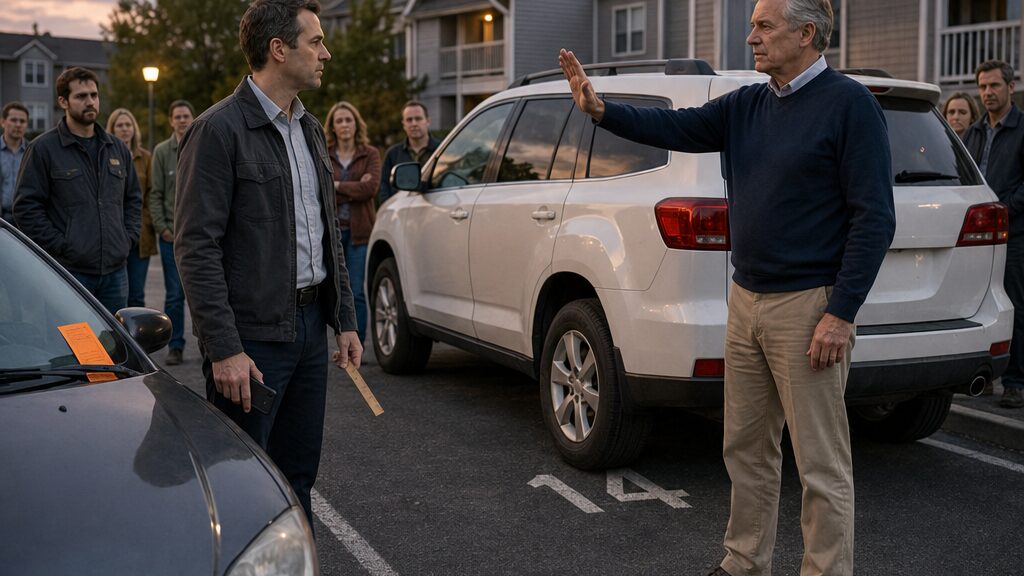
Benjamin stopped beside his car, one hand still holding his work bag. The vehicle sat crookedly in space 14, its rear tire covering part of the painted number. He recognized it immediately. Donald Hall, the HOA president, drove it to every board meeting and parked it near the clubhouse even when closer spaces were open.
Benjamin’s own car stood along the opposite curb, where he had left it after returning from work and finding his space occupied.
He pulled the notice free.
UNAUTHORIZED PARKING.
A second line warned of a possible fine for continued violations. The time recorded at the bottom was 6:12 p.m. Benjamin checked his phone. It was 6:29.
Across the lot, Donald was speaking with one of the board members near the clubhouse steps. He wore pressed khakis and a navy sweater despite the evening heat. When Benjamin raised the orange paper, Donald looked at it, then at Benjamin, as though both belonged to a problem already assigned to someone else.
Benjamin crossed the lot.
“Donald.”
Donald finished his sentence before turning. “Evening, Benjamin.”
“This was on my car.”
Donald glanced at the notice. “Then management must have observed a violation.”
“My space is occupied.”
Donald’s gaze moved briefly toward the SUV. “Board business.”
“Space fourteen is assigned to my unit.”
“I know which space it is.”
Benjamin waited for the rest. None came.
“Then you know why I parked along the curb.”
Donald folded his arms. “Temporary board parking exemptions are permitted when association business requires immediate access to the clubhouse.”
“Permitted by what?”
The other board member looked away.
Donald’s expression tightened, not with anger but with impatience. “We’re reviewing several parking issues right now. You’ll receive information when the policy is finalized.”
Benjamin looked back at the SUV. No permit sticker showed in the lower corner of its windshield. Residents had been told months earlier that every vehicle required one.
“My assignment is in the deed package,” Benjamin said.
“Then submit it through the appeal process.”
“You could move the car.”
Donald gave him a restrained smile. “And you could avoid restricted areas until your appeal is reviewed.”
The curb beside Benjamin’s car was gray, not red. No fire-lane sign stood nearby. It was not a marked space, but residents routinely stopped there while unloading groceries or waiting for an assigned spot to clear.
Benjamin felt several windows behind him become occupied. Curtains shifted in the nearest building. A man carrying takeout slowed as he passed.
Donald had not raised his voice. That made the exchange worse. He spoke with the calm of someone who believed procedure had already decided which person would appear unreasonable.
Benjamin folded the orange notice along its original crease.
“When was this exemption adopted?”
Donald picked up a folder from the clubhouse railing. “File your appeal.”
“Was it voted on?”
“Benjamin.”
The single word contained a warning: do not turn this into a scene.
Benjamin had spent most of his working life retrieving documents for people who swore records did not exist. He knew the difference between uncertainty and refusal. Donald was not unsure where the exemption came from. He simply did not intend to explain it in the parking lot.
Benjamin stepped back.
“All right,” he said. “I’ll file it.”
Donald nodded, satisfied by the apparent retreat, and returned to his conversation.
Upstairs, Benjamin set the notice on the kitchen counter and opened the metal document box he kept in the hall closet. Catherine had once called it his paper bunker. Tax returns, appliance warranties, insurance declarations, closing documents—everything remained in labeled folders, arranged by year.
He found the condominium purchase file beneath the mortgage statements.
His name appeared beside Catherine Lewis’s on the first page. They still owned the unit together, though Catherine had moved into a rental across town eight months earlier. Their signatures had survived the relationship more neatly than the relationship itself.
Benjamin turned through the exhibits until he reached the parking allocation.
UNIT 3B: SPACE 14.
The page carried the developer’s seal and the signatures from closing. A small site diagram showed the exact rectangle outside his building.
For several seconds, the document gave him the clean relief he expected facts to provide. The space was his. The record was clear. Donald could not reasonably dispute it.
Then his phone rang.
Catherine’s name appeared on the screen.
“I got an email from the management company,” she said when he answered. No greeting. “Something about a parking violation.”
“They copied you?”
“We’re both on the deed, Benjamin.”
“The board president parked in fourteen. I had to leave my car by the curb.”
A pause.
“Did you argue with him?”
“I asked what rule authorized it.”
“That isn’t what I asked.”
Benjamin looked at the orange notice beside the deed exhibit. “I didn’t make a scene.”
“You don’t have to make a scene to start something.”
“He fined us for using a temporary stopping area because he took our assigned space.”
“And I agree that’s unfair. But the unit is supposed to go on the market this fall. Another dispute with the association can delay disclosures, resale certificates, everything.”
“So I should pay for his violation?”
“I’m saying resolve it without turning it into a campaign.”
Benjamin heard traffic behind her, then a car door closing. Catherine was always moving now when they spoke, as though remaining still might allow the past to catch up.
“I have the signed allocation,” he said.
“Then send it. Calmly.”
“I am calm.”
Another pause, longer this time.
“That was always the problem,” she said. “You sounded calm even when you were shutting everyone out.”
The line went quiet before Benjamin found an answer that did not sound like a defense. Catherine sighed.
“Just don’t make the property harder to sell.”
She ended the call.
Benjamin scanned the parking allocation, attached the orange notice, and drafted a short appeal. He removed three sentences that accused the board of selective enforcement. He replaced them with dates, locations, and a request for the written authority behind the temporary exemption.
At 9:14 p.m., he sent the email.
The next afternoon, a white envelope appeared beneath his door.
The hearing was scheduled for Friday. Attendance was strongly recommended. Failure to appear could result in the fine being sustained without further review.
Benjamin read the page twice.
At the top, under CASE STATUS, the management company had checked a box he had not expected.
REPEAT OFFENDER.
He had never received a parking citation before Monday.
Chapter 2: Three Board Members and One Predetermined Fine
Donald slid the $150 fine across the polished table before Benjamin had finished explaining the parking assignment.
The paper stopped against the edge of Benjamin’s folder.
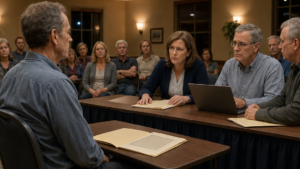
He looked down at the amount, then at the three board members seated opposite him. Donald occupied the center chair. Jennifer Rivera, the treasurer, sat to his right with a yellow legal pad. The third board member held the hearing packet closed beneath both hands.
Behind them, the property-management representative stood near a side table with a laptop open.
“I haven’t completed my statement,” Benjamin said.
Donald rested his palms on the table. “The violation itself is not disputed.”
“I dispute it.”
“You admit your vehicle was outside a designated space.”
“Because your vehicle was inside mine.”
Donald’s eyes narrowed slightly. “We are not here to discuss my vehicle.”
“That is the reason my car was there.”
Jennifer glanced at Donald, then lowered her pen.
Benjamin opened his folder and placed the signed allocation on the table. He had prepared three copies, one for each board member. The site plan showed unit 3B connected to space 14 by a clean printed line.
“This is part of the recorded purchase package,” he said. “The space is assigned to my unit. I notified the board as soon as I found it occupied.”
Donald did not pick up the document.
“The association maintains authority over common-area parking.”
“Not over an exclusive-use space assigned in the governing documents.”
“The board may adopt temporary measures to address operational needs.”
“Where is that measure?”
Donald leaned back. “A temporary parking policy was implemented during the current compliance review.”
“Implemented when?”
“Recently.”
“By a board vote?”
The third board member shifted in his chair.
Donald said, “The board has delegated authority to respond to urgent parking and access issues.”
Benjamin turned toward Jennifer. “Does the temporary policy exempt board vehicles from permit requirements?”
Her pen stopped.
Donald answered for her. “Board vehicles conducting association business may require flexibility.”
“That isn’t what I asked.”
Jennifer’s eyes met Benjamin’s for less than a second. “Permit administration is handled by management.”
“So board vehicles do need permits?”
The property-management representative stepped forward. “This hearing concerns the vehicle registered to unit 3B.”
Benjamin looked from one face to another. The room had been arranged to resemble a process, but every path led back to the same conclusion.
He tapped the photograph he had printed of space 14. Donald’s SUV filled most of the frame. The painted number remained visible beneath the rear bumper.
“This is why I could not use my assigned space.”
Donald glanced at the photograph and pushed it back with two fingers. “It does not change where you chose to leave your vehicle.”
Benjamin felt heat rise along his collar.
He had expected resistance. He had not expected the evidence to be treated as contamination.
“Then what should I have done?”
“Contacted management.”
“It was after office hours.”
“Used visitor parking.”
“The visitor spaces were full.”
“Then parked off-site temporarily.”
“At seven o’clock at night, carrying work equipment, because the board president was in my space?”
Donald’s voice hardened. “Mr. Green, your frustration does not create an exception.”
The sentence hung between them.
Benjamin looked at the fine again. The amount had been printed before the meeting began. So had the case number and payment deadline. The hearing was not deciding whether he had violated a rule. It was giving the decision a room, a table, and witnesses.
He closed the folder.
“Please include my parking assignment and photograph in the official minutes.”
The management representative typed something.
Donald nodded. “Your submission will be noted.”
“Not noted. Included.”
“We understand your request.”
“That is not the same thing.”
The third board member exhaled through his nose. Jennifer wrote a short line on her legal pad, then tore the page loose and folded it beneath the remaining sheets.
Donald pushed the fine another inch toward Benjamin.
“You may pay through the resident portal. If you choose not to, late fees will apply.”
Benjamin left the paper where it was until Donald finally withdrew his hand.
Outside the meeting room, Catherine waited near the bulletin board. She had arrived after Benjamin told her both owners were entitled to attend, though she had declined to sit beside him.
“Well?” she asked.
“They fined us.”
Her jaw tightened. “Did you give them the assignment?”
“They refused to consider it relevant.”
“Then appeal to management.”
“Management was in the room.”
Catherine looked through the glass panel in the door. Donald was already speaking to the next resident.
“Pay it,” she said.
Benjamin stared at her.
“We can dispute it afterward,” she continued. “At least stop the late fees.”
“That makes it look valid.”
“It makes it paid.”
“He presented the fine before I finished speaking.”
“And you’re surprised?”
“Yes.”
Catherine gave a humorless laugh. “That is exactly what I mean. You believe the right document placed in the right order forces people to behave correctly.”
“It should.”
“But it doesn’t.”
Benjamin tucked the parking allocation back into his folder. “So we accept it?”
“I’m asking you to choose which fight matters.”
“This one affects our property.”
“This one affects your pride.”
He flinched, and Catherine saw it.
Her voice softened. “I’m not saying they’re right. I’m saying I don’t want every conversation about selling the unit to become another argument you need to win perfectly.”
Benjamin looked toward the meeting room again. Jennifer stood behind Donald, listening as he spoke. She appeared uneasy, but uneasiness had not changed her vote.
“I asked whether their cars needed permits,” he said.
“And?”
“She wouldn’t answer.”
Catherine rubbed her forehead. “Pay the $150. Then handle the rest through the normal process.”
“That was the normal process.”
She had no response to that.
The official meeting minutes arrived by email the following Tuesday.
Benjamin opened them at his desk during lunch. Under his hearing item, the summary contained four lines. It stated that his vehicle had been observed outside a marked space, that he acknowledged parking there, and that the board unanimously sustained the fine.
There was no reference to space 14.
No reference to Donald’s SUV.
No reference to the deed exhibit or photograph.
Benjamin compared the minutes with the notes he had taken immediately after the meeting. The omission was too precise to be accidental.
He drafted a correction request and attached the evidence again.
Before he could send it, an alert from the resident portal appeared on his screen.
NEW PARKING VIOLATION.
He opened the notice.
The attached photograph showed his car near the same gray curb. The image had been taken at an angle that excluded space 14 entirely.
VIOLATION: OBSTRUCTING DESIGNATED FIRE LANE.
Benjamin enlarged the photograph. There was no red curb, no sign, no painted warning. His vehicle stood several feet from the corner, with enough room for two cars to pass.
The date at the bottom was the previous night.
At that exact time, Donald’s SUV had again been parked in space 14.
Chapter 3: He Measured the Curb Instead of Raising His Voice
Donald held the new orange notice above Benjamin’s windshield while his own SUV sat in space 14 behind him.
Several residents had gathered along the sidewalk for the board’s evening parking walk-through. A property-management representative carried a clipboard. One board member pointed toward visitor spaces as Donald explained the importance of emergency access.
Benjamin approached without speaking.
Donald saw him and lowered the notice onto the glass.
“This vehicle was observed in the same restricted area cited last week,” he said.
“My assigned space is occupied again.”
Donald did not turn around. “We’ve already addressed that issue.”
“No. You fined me.”
A woman near the mailboxes folded her arms. Someone farther back whispered Benjamin’s name.
Donald gestured toward the gray curb. “This lane must remain clear for emergency vehicles.”
Benjamin set his work bag on the hood of his car and removed a small ruler, a measuring tape, and his phone.
Donald frowned. “What are you doing?”
“Checking the clearance.”
“This is not a debate about inches.”
“It is if you are claiming obstruction.”
Benjamin extended the measuring tape from the side of his car to the curb, then photographed the result. He measured the distance from his rear bumper to the corner. A moving truck had passed through the lane that morning without difficulty. The fire hydrant stood on the opposite side of the building, more than sixty feet away.
Donald’s voice grew tighter. “The board is entitled to designate emergency-access areas.”
“Where is the designation marked?”
“It is part of the temporary policy.”
“Where is the policy?”
Residents shifted closer.
Benjamin crouched beside the curb. No red paint. No stencil. No signpost hole. Only a pale scrape where maintenance equipment had struck the concrete years earlier.
He photographed it.
Then he turned toward space 14.
Donald’s SUV sat with one rear tire covering the lower half of the painted number. Benjamin stepped to the front windshield and looked at the lower corners.
No permit sticker.
He moved back far enough to include the SUV, the painted 14, his own car, and the orange notice in a single frame.
Donald stepped between him and the SUV.
“You do not have permission to photograph my vehicle.”
“It is parked in my assigned space.”
“You are creating an unnecessary confrontation.”
Benjamin lowered the phone. “Then state the rule in writing.”
“What?”
“Write down the section that allows your unpermitted vehicle to occupy fourteen while mine is cited as a fire-lane obstruction.”
The property-management representative looked at Donald.
Donald’s cheeks darkened. “Board members conducting official business are allowed reasonable accommodation.”
“Which section?”
“I am not going to conduct a legal seminar in a parking lot.”
“I’m not asking for a seminar.”
Benjamin placed the ruler on the hood beside the orange notice. Four inches of plain wood against fluorescent paper. The objects looked almost childish compared with Donald’s authority, but the measurements were real and the accusation was not.
A younger man in a delivery uniform stepped away from the sidewalk.
“You should tell him,” the man said.
Donald turned. “Excuse me?”
The man pointed toward the curb. “You should tell him what rule it is.”
Benjamin recognized him as Tyler Robinson from building five. He often returned after ten at night in a delivery van and carried insulated bags upstairs two at a time.
Donald’s tone became formal. “This matter does not concern you.”
“It does if you’re calling that a fire lane.”
“Please do not interfere with an official inspection.”
Tyler laughed once. “You put two notices on my van for the same thing.”
The residents began speaking at once.
One said her daughter had been warned while unloading groceries. Another said visitor parking had been reduced without notice. A man near the mailboxes asked whether the board vehicles had permits.
Donald raised one hand. “This is exactly why consistent enforcement is necessary. Congestion has become a serious safety issue.”
The explanation was reasonable enough to quiet some of them. Benjamin saw the advantage Donald had protected from the beginning: once the conflict became safety against inconvenience, anyone questioning the policy could be made to sound reckless.
Benjamin also saw the fear beneath Donald’s anger. It was not fear of Benjamin. It was fear of losing control of the group.
“I’m not arguing against clear access,” Benjamin said.
Donald faced him. “Then move your car.”
“Move yours first.”
The sentence landed harder than Benjamin intended.
Several residents looked toward the SUV. Donald did not.
Instead, he pointed at Benjamin’s phone. “You’ve been photographing vehicles for days. People have complained.”
Benjamin’s grip tightened.
“I photographed violations involving my space.”
“You photographed residents without informing them.”
“Vehicles in a common lot.”
“That distinction may matter to you. It does not necessarily matter to your neighbors.”
A woman near the sidewalk nodded. “I saw you taking pictures outside my building.”
Benjamin remembered the photograph. Donald’s SUV had been in the background. The woman’s license plate had appeared at the edge of the frame.
“I wasn’t documenting you,” he said.
“You didn’t ask.”
The group’s attention shifted. A moment earlier, Donald had been defending an unmarked rule. Now Benjamin was the man walking through the lot with a camera.
He had believed facts would protect him from interpretation. Instead, the same act could look like evidence gathering to him and surveillance to everyone else.
Tyler studied him. “Are you doing this just for your space?”
Benjamin looked at the painted number beneath Donald’s tire.
“That’s where it started,” he said.
It was not enough of an answer.
Donald removed the orange notice from Benjamin’s windshield and handed it to the management representative. “Document refusal to comply.”
“I did not refuse,” Benjamin said.
“You were directed to move.”
“After you occupied my assigned space.”
Donald opened his SUV door. “The board will review further action.”
He drove away without displaying a permit.
Space 14 remained empty behind him.
Benjamin moved his car into it while the residents dispersed. No one congratulated him. The woman near the sidewalk turned her back. Tyler stayed for a moment, then approached.
“They’ve been doing this to renters since spring,” he said quietly.
Benjamin looked at him.
“Not always fines. Warnings. Tow threats. They say owners got notices about the new rules, but my landlord never sent anything.” Tyler glanced toward the clubhouse. “People won’t complain if they think it’ll get their lease renewal blocked.”
“Do you have the notices?”
“A few.”
“I’d need copies.”
Tyler’s expression hardened. “You always talk like you’re building a file.”
“I am building a file.”
“That’s not the same as helping people.”
He walked away before Benjamin could answer.
Inside his unit, Benjamin set the second orange notice beside the first. He opened the condominium’s forty-seven-page CC&Rs on his laptop and began searching for every use of the words parking, permit, emergency, and board.
At 11:38 p.m., he found Section 8, Paragraph 3.
Any vehicle parked on association property without a valid permit displayed in the prescribed location was subject to a $200 fine for each documented occurrence.
Benjamin read it again.
Then he searched for exemptions.
There were none for board members.
Near the end of the document, Section 11 stated that directors remained subject to the same use restrictions and enforcement provisions as all other members unless a specific exception had been adopted in writing.
Benjamin looked through the window toward space 14.
Donald’s SUV was gone, but the tire mark remained across the painted number.
For the first time, Benjamin stopped calculating what the board had charged him.
He began calculating what its own rules said about them.
Chapter 4: Twelve Photographs Proved Less Than Benjamin Expected
The first photograph in Benjamin’s new evidence log showed three board vehicles without permits.
Donald’s white SUV occupied space 14. A dark sedan registered to another board member sat in visitor parking. A silver crossover stood beside the clubhouse entrance. Benjamin had taken the image from his kitchen window at 7:06 on Wednesday morning, before any of the vehicles moved.
He entered the date, time, location, plate number, and visible permit status into a spreadsheet.
The first row began with a number.
He had considered naming the file DONALD HALL VIOLATIONS, then deleted the title. Instead, he called it PARKING ENFORCEMENT COMPARISON. The neutral wording felt important, though he could not have said to whom.
Over the next ten days, Benjamin documented only what he could see from common walkways or his own windows. He avoided photographing faces. He cropped unrelated vehicles when possible. Each image received a timestamp and a reference to Section 8, Paragraph 3.
By Friday night, he had six violations.
By Monday, nine.
On the following Wednesday, Donald’s SUV appeared in space 14 for the fourth time without a permit sticker. The other two vehicles had repeated twice each. A board member’s visiting relative added two more instances by parking near the clubhouse overnight without authorization.
Twelve documented occurrences.
At $200 each, the written schedule produced a total of $2,400.
Benjamin placed the number at the bottom of the spreadsheet and stared at it.
The calculation carried a clean symmetry. The board had treated $150 as small enough for him to absorb without resistance. Its own rules now described violations sixteen times that amount.
He printed the photographs in color and arranged them by date. Beside each one, he included the relevant clause and a brief description. The orange notices issued to him went into a separate section.
For the first time since the hearing, the work felt like progress.
Then someone knocked on his door.
Tyler stood in the hallway wearing his delivery uniform. He held a creased grocery bag against his side.
“I brought what you asked for,” he said.
Inside the bag were four orange warnings and two towing notices.
Benjamin spread them across the kitchen table. The dates extended back almost five months. Two accused Tyler’s van of occupying visitor parking beyond the permitted limit. One cited him for stopping near the same gray curb Benjamin had been accused of blocking. Another warned that any further violation could result in towing at the owner’s expense.
“Did your landlord receive the temporary policy?” Benjamin asked.
“Not that he sent me.”
“Did management ever provide you a copy?”
Tyler shook his head. “I asked at the office. They told me owners got everything.”
Benjamin compared the notices. The language changed slightly from month to month. One referred to a “revised emergency-access plan.” Another called it an “interim parking protocol.” None cited a board vote or section of the CC&Rs.
“Do you know anyone else who received these?”
“Renters mostly.”
“How many?”
Tyler leaned against the counter. “See, this is what I meant.”
Benjamin looked up.
“You ask like you’re taking a statement.”
“I need to know the pattern.”
“You need to know people.”
“I’m trying to establish whether the policy was distributed.”
Tyler gave him a tired look. “I work until eleven. I carry food up three flights because the closest legal space is on the other side of the property. When I stop for six minutes, I get threatened with a tow. That’s the pattern.”
Benjamin lowered his pen.
Tyler tapped one of the notices. “My landlord told me not to make trouble. Said the board can make renewals difficult even if they don’t admit it.”
“They cannot legally retaliate against you for raising a parking concern.”
“Maybe not on paper.”
The words settled harder than Benjamin expected.
He had spent days proving that paper said one thing while people did another. Yet he had still answered Tyler as though the existence of a rule guaranteed protection.
“Would you be willing to write down what happened?” Benjamin asked.
Tyler hesitated.
“Not for me,” Benjamin added. “For the complaint.”
“That’s still for you.”
Benjamin had no quick answer.
Tyler gathered the grocery bag but left the notices on the table. “Use copies. I want the originals back.”
“I will.”
“And blur my unit number.”
Benjamin nodded. “I should have asked before photographing near your building.”
Tyler studied him, surprised by the admission.
“Yeah,” he said. “You should have.”
The next afternoon, Benjamin delivered the complaint packet to the management office. The property-management representative met him at the front counter.
“I am requesting formal enforcement review,” Benjamin said. “These are twelve documented violations under Section 8, Paragraph 3.”
The representative flipped through the photographs.
“You took these yourself?”
“Yes.”
“And you calculated proposed fines?”
“I applied the schedule printed in the governing documents.”
The representative closed the packet.
“Residents do not have authority to issue citations.”
“I’m not issuing them. I’m reporting violations.”
“Only management observations generate enforceable parking actions.”
“Then inspect the vehicles.”
“We cannot retroactively verify whether permits were displayed.”
“The photographs show the windshields.”
“They show portions of windshields.”
“They show the required display locations.”
The representative pushed the packet back. “You may submit a general complaint to the board, but these are not valid citations.”
Benjamin felt the false certainty of the $2,400 total collapse.
The rule existed. The violations existed. The photographs existed. Yet management had inserted a gate nowhere stated in the document: evidence counted only when gathered by the same people who had ignored it.
“Where does it say only management can document a violation?”
“That is the enforcement procedure.”
“Written where?”
“I’m explaining it to you now.”
Benjamin did not move.
The representative’s expression softened by a degree. “Mr. Green, you are making this more adversarial than it needs to be.”
“My first appeal omitted the central evidence from the minutes.”
“That was a board decision.”
“The fire-lane notice cites no approved designation.”
“That is a separate matter.”
“Then I want the record authorizing it.”
“You may submit a records request.”
Benjamin took the packet back.
As he turned toward the door, a voice behind him said, “There is no written exemption.”
Jennifer stood near the mailboxes inside the office lobby. She held a stack of assessment statements against her chest.
The representative looked at her sharply.
Jennifer kept her eyes on Benjamin. “You asked at the hearing whether board vehicles were exempt from permit requirements. They are not. Not in the CC&Rs, and not in any resolution I have signed.”
“Jennifer,” the representative said, “this is not an appropriate place—”
“I’m answering a direct question.”
Benjamin waited.
“Then why did you say nothing at the hearing?” he asked.
Jennifer’s grip tightened around the statements. “Because silence was easier than challenging Donald in front of management.”
“That silence cost me $150.”
“I know.”
“Did you vote for the fine?”
“Yes.”
The honesty stopped him more effectively than an excuse would have.
Jennifer glanced toward the office door. “Your photographs still may not produce fines. Management is correct about the internal process.”
“Then what are they worth?”
“They establish unequal treatment.” She lowered her voice. “That may matter more.”
Before Benjamin could ask what she meant, the representative opened the inner office door and called her name.
Jennifer walked away without looking back.
That evening, Benjamin submitted a records request for the temporary parking policy, the board vote authorizing it, and the fire-lane designation. The board acknowledged the request but extended the response deadline.
He did not wait.
The next morning, he visited the county fire-marshal’s records counter with the citation photograph, the condominium site address, and a copy of the original development map.
The clerk searched the property file, then a separate database of approved emergency-access plans. She returned to the counter holding nothing.
“I can find the original fire-department access review from construction,” she said, “but no amendment covering that curb.”
“Could it have been approved under another description?”
She searched again.
“There is a proposed access marking in an old site-plan revision,” she said. “It was never finalized.”
Benjamin pointed to the photograph of his car. “So this is not a designated fire lane?”
The clerk angled the image toward the light.
“Not in any county record I can find.”
Chapter 5: The Rule Was Wrong, but the Fear Behind It Was Real
The county file contained no authorization for the curb restriction, but it did contain a warning Benjamin had not expected.
The clerk unfolded an older site map across the counter. A dashed line ran beside building three, passing within several feet of space 14. In the margin, someone had written PROPOSED EMERGENCY ACCESS—PENDING REVIEW.
Attached behind it was a recent letter from the condominium’s insurer.
Benjamin read the first paragraph twice.
The insurer had identified parking congestion as a potential obstacle to emergency access. Unless the association adopted a corrective plan, its master-policy renewal could require a substantial premium increase or additional conditions.
“This arrived last year?” Benjamin asked.
The clerk checked the date. “The county received a courtesy copy eight months ago.”
“But no revised fire lane was approved.”
“No. The association would have needed a site plan, measurements, signage, pavement markings, and final inspection.”
“Could they restrict parking temporarily?”
“They can manage private common areas,” she said. “But calling something a designated fire lane is different from deciding residents shouldn’t park there.”
Benjamin photographed the file index and requested certified copies.
Outside, he sat in his car without starting it.
Until that morning, Donald’s conduct had fit a simple shape: authority protecting itself. The insurer’s letter changed the outline. Congestion was real. Emergency access mattered. A failed renewal could raise costs for every owner, including Catherine.
Donald had not invented the risk.
He had invented the process used to address it.
Benjamin called Jennifer.
She did not answer, but ten minutes later a message appeared.
Records room. Six tonight. Come alone.
The HOA records room was barely larger than a walk-in closet. Metal shelves held tax returns, meeting binders, vendor contracts, and boxes labeled by year. Jennifer stood beside a folding table with two binders already open.
“You went to the county,” she said.
“Yes.”
“I assumed you would.”
“You knew the curb wasn’t approved.”
“I knew the permanent plan wasn’t.”
“That’s not the same answer.”
Jennifer closed the door.
“The insurer sent the warning after a fire engine had difficulty turning through the east lot during a medical call,” she said. “No one was injured. But the report was serious.”
“Why wasn’t it given to residents?”
“Donald said distributing it before we had a solution would create panic about assessments.”
“So he created a fire lane.”
“He called it an interim access zone.”
“The notices call it a designated fire lane.”
“I didn’t write the notices.”
“You voted to sustain one.”
Jennifer absorbed that without defending herself.
She turned one binder toward him. Inside were meeting notes from a closed board workshop. Donald had proposed immediate enforcement around three buildings while the association obtained estimates for striping and signage. The notes contained no formal motion, no recorded vote, and no reference to permit exemptions.
“Why did management enforce it?”
“Donald told them the board had reached consensus.”
“Had it?”
“We agreed something had to be done.”
“That is not the same thing.”
“No.” Jennifer’s voice was quiet. “It isn’t.”
Benjamin turned another page. A handwritten note beside the permit discussion read BOARD ACCESS—USE DISCRETION.
“What does this mean?”
“Donald wanted board members to park near the clubhouse during inspections and contractor meetings.”
“So he exempted you.”
“He exempted himself and anyone he considered to be performing association business.”
“Did you use the exemption?”
“No. I have a permit.”
“Then why protect it?”
Jennifer looked toward the shelves.
“Because the insurance certification went out with the annual budget package,” she said. “I signed it.”
Benjamin waited.
“The certification stated that the board had adopted corrective parking controls. At the time, I believed we would approve the formal plan at the next meeting. We never did.”
“And admitting the policy was unauthorized exposes your certification.”
“It exposes the association. The insurer could question whether we misrepresented compliance.”
“You did.”
“I relied on Donald’s assurance that implementation was enough while the plan was pending.”
“You are the treasurer.”
“I know what my title is.”
The sharpness in her voice faded almost immediately.
Jennifer pressed both hands against the table. “My husband was out of work for six months. I was handling the budget, insurance renewal, delinquent accounts, and a roof contract. Donald had managed facilities for thirty years. He said the paperwork would catch up.”
“And when it didn’t?”
“I told myself the restrictions were temporary.”
“While people were fined.”
“Yes.”
The word carried no escape route.
Benjamin looked again at the insurer’s letter. The estimated premium increase was large enough to affect monthly assessments. Catherine would see it immediately in the resale documents. Every owner would.
“Would my complaint invalidate the certification?” he asked.
“It could trigger a review.”
“Could the policy be corrected without that?”
“Possibly. Proper markings, an approved access plan, neutral enforcement. But the board would have to admit the notices were issued under a policy that was never formally adopted.”
“And withdraw them.”
“Yes.”
“Donald won’t.”
Jennifer closed the binder. “Donald believes admitting the mistake will make every rule unenforceable.”
“That makes no sense.”
“To him, authority is cumulative. Once residents see one weakness, they challenge everything.”
Benjamin thought of the hearing, the fine waiting before he spoke, the omitted minutes. Donald had not been protecting a single parking rule. He had been protecting the appearance that the board never moved without one.
“Why are you telling me this?”
“Because your complaint is no longer just about your space.”
“That sounds like a warning.”
“It is.”
Jennifer gathered the binders. “If you file externally and the insurer freezes renewal, the association may need emergency coverage. Owners could face a special assessment.”
“Then the board should correct the record before that happens.”
“I agree.”
“But you won’t say that publicly.”
She looked at him. “I haven’t decided.”
Benjamin gave a small, bitter laugh. “Silence again.”
Jennifer’s face tightened. “You think documentation makes courage unnecessary. It doesn’t.”
He stopped.
She opened the door. “Neither does being right.”
At Catherine’s rental that night, Benjamin placed the certified county copies on her dining table. She read the insurer’s warning first.
“How much could assessments increase?” she asked.
“I don’t know.”
“You went looking for a parking authorization and found an insurance problem.”
“The problem already existed.”
“But now you can force it into the open.”
“I can force the board to address it.”
Catherine set the paper down. “Those are not always the same thing.”
Benjamin told her about the unapproved policy, Jennifer’s certification, and Donald’s exemptions. Catherine listened without interruption, which made him increasingly aware of how much information he had brought and how little he had said about what he intended to do.
“Are you filing the complaint?” she asked.
“I haven’t decided.”
“That’s new.”
“What is?”
“You usually decide before you explain anything to me.”
Benjamin looked at the county map. The dashed proposed lane passed beside the rectangle labeled 14.
“I wanted the rule to be wrong,” he said. “It is wrong. But the risk behind it isn’t.”
Catherine sat opposite him. “That doesn’t excuse what they did.”
“No.”
“It also doesn’t mean everyone should pay for Donald’s pride.”
“No.”
She watched him struggle with the answer.
“You can ask me what I think,” she said.
Benjamin almost replied that he already knew. Catherine wanted the unit sold, the fine paid, and the dispute contained. But assuming her answer was another form of refusing to hear it.
“What do you think?” he asked.
She leaned back.
“I think they counted on people being too tired or too scared to challenge them,” she said. “I also think you enjoy building a case because documents don’t interrupt you, misunderstand you, or ask what this is costing.”
Benjamin said nothing.
Catherine touched the insurer’s letter. “Decide what outcome you want. Not what proof you have.”
His phone vibrated before he could answer.
An email from Donald had arrived with the subject CONFIDENTIAL RESOLUTION OFFER.
The attached letter withdrew Benjamin’s $150 fine, canceled both fire-lane notices, and guaranteed his exclusive use of space 14.
In exchange, Benjamin would withdraw all records requests, complaints, and claims regarding parking enforcement. He would also agree not to distribute the photographs or challenge prior board actions.
The offer expired in forty-eight hours.
Catherine read the final page over his shoulder.
“They’re giving you everything you originally asked for,” she said.
Benjamin looked at the signature line waiting beneath his name.
Everything for him, perhaps.
Nothing for Tyler.
Chapter 6: The Settlement That Would Leave Everyone Else Exposed
The revised settlement reduced Benjamin’s deadline to twenty-four hours.
Donald’s second email arrived Saturday morning with a note stating that the board needed finality before its emergency insurance session on Sunday. If Benjamin did not sign by noon, the offer would be withdrawn.
Benjamin printed the letter and placed it beside the two orange notices.
Catherine arrived before nine. Tyler came ten minutes later, still wearing work shoes from his overnight shift. Neither seemed pleased to find the other there.
“You invited him?” Catherine asked.
“I asked both of you to review the offer.”
Tyler picked up the first page. “They erase yours and keep everybody else’s.”
“That’s the effect,” Benjamin said.
“The effect?” Tyler dropped the page. “That’s the point.”
Catherine remained standing. “The offer protects the unit. We have to consider that.”
Tyler looked at her. “You own it?”
“Half.”
“Then you’re not the one getting tow warnings.”
“No. I’m the one whose equity could be hit by an insurance problem.”
Benjamin watched the argument form along the same fault line as the dispute: owner against renter, private risk against shared fairness.
“The board says a failed certification could lead to a special assessment,” he said.
Tyler folded his arms. “Of course they do.”
“The insurer’s warning is real.”
“So fix the access problem.”
“That may require money.”
“Then tell people what it costs. Don’t make up a fire lane and punish whoever can’t fight back.”
Catherine turned to Benjamin. “What exactly are you asking us to decide?”
He looked at the documents covering the table.
“I don’t know yet.”
Tyler stared at him. Catherine closed her eyes briefly.
“You brought us here without knowing what you want?” she asked.
“I know the private settlement is incomplete.”
“That’s not an answer.”
Benjamin began arranging the papers into piles: county records, CC&R sections, photographs, renter notices, board minutes.
Catherine reached across and placed her palm on the top page.
“Stop.”
He looked at her hand.
“You do this every time,” she said. “You organize instead of answering.”
“I’m trying to separate the issues.”
“No. You’re trying to make the answer appear once the pages are in the correct order.”
Tyler shifted near the doorway but did not leave.
Catherine’s voice remained low. “When we were deciding whether to sell, you made spreadsheets. When I asked whether you still wanted the marriage, you explained interest rates. When I said I felt alone, you showed me how much money we could save by refinancing.”
“That isn’t fair.”
“It is exactly fair.”
Benjamin felt the old instinct rise: retrieve dates, correct wording, identify what she had omitted. He could have told her he had been afraid of losing the home, afraid of admitting the mortgage strained them, afraid that saying he did not know how to fix things would make everything collapse faster.
He had never said any of that.
Catherine withdrew her hand.
“Your need to be unquestionably right didn’t cause every problem between us,” she said. “But it gave you somewhere to hide from them.”
The room went still.
Tyler looked down at the settlement.
Benjamin sat slowly.
“I don’t want this to be revenge,” he said.
“Then don’t make it revenge,” Catherine replied.
“I also don’t want the insurer to punish everyone.”
“Then propose something that fixes the access issue.”
Tyler pulled a chair away from the table. “And cancels the fake notices.”
“And applies the permit rule to the board,” Benjamin said.
“And stops towing threats until residents actually receive the policy,” Tyler added.
For the first time, Benjamin did not immediately write. He asked Tyler to explain what renters needed. He asked Catherine which disclosures mattered for resale. He listened when both answers became less orderly than he wanted.
By noon, the complaint looked different.
Space 14 no longer appeared in the opening paragraph. Benjamin moved its photograph to an appendix and replaced the first page with three requested actions: suspend enforcement under the unadopted policy, withdraw unsupported citations for all residents, and approve a marked emergency-access plan with equal permit requirements.
He removed the demand that the board assess $2,400 in fines against its own members. Instead, he requested an independent audit of enforcement records and reimbursement where unequal treatment was confirmed.
Tyler read the revision twice.
“You took your number out.”
“It’s still evidence.”
“But it isn’t the point anymore.”
“No.”
Catherine looked at Benjamin. Something in her expression softened without becoming forgiveness.
A message from the management company interrupted them.
NOTICE OF POTENTIAL SPECIAL ASSESSMENT.
The board warned that any challenge to the insurance certification could lead to emergency premiums, legal expenses, and an assessment charged to all owners.
Catherine read the notice and went pale.
“They sent this to everyone?”
Benjamin checked the resident portal. “Yes.”
Tyler’s phone began buzzing. “People are already blaming whoever filed the complaint.”
Within minutes, comments appeared beneath the notice. Some residents demanded that the “parking crusade” stop. Others asked why they had never been told about the insurer’s warning. One accused Benjamin by name of threatening property values over a personal grudge.
Donald had turned private pressure into community pressure without mentioning the unauthorized policy.
Benjamin’s hand hovered above the keyboard.
He could sign the settlement, end the blame, protect the sale, and reclaim space 14 by noon.
Instead, he opened a blank email.
Before writing, he looked at Tyler. “Will you ask the other renters whether they want their names included or kept confidential?”
Tyler nodded.
Benjamin turned to Catherine. “Will you check whether the corrective proposal creates a disclosure problem worse than the current one?”
“I’ll check.”
He began the message with a sentence he would not have written a week earlier.
I am asking affected residents to review the proposed remedy before I submit it.
By evening, seven residents had responded. Three provided copies of notices. Two wanted no identifying information used. One owner admitted receiving a permit warning while a board vehicle remained untouched. Another opposed Benjamin’s complaint but supported formal curb markings.
The proposal became narrower and stronger.
At the emergency board session Sunday morning, Donald placed the unsigned settlement in front of Benjamin.
“This is your final opportunity to resolve your individual matter,” he said.
Benjamin set the revised complaint beside it.
“My individual matter is in the appendix.”
Donald’s eyes moved to the first page.
“You are escalating this.”
“I am asking the board to suspend a policy it never adopted and replace it with one the insurer can accept.”
“You are not qualified to determine what the insurer will accept.”
“No. That is why the proposal requests written confirmation.”
Donald glanced toward Catherine, then Tyler, then the residents seated along the wall.
“This process could result in significant costs.”
“So could defending citations based on an unofficial fire lane.”
The community-association attorney shifted in her chair. “Mr. Hall, has the board produced a recorded motion adopting the interim policy?”
Donald’s jaw tightened. “The board reached operational consensus.”
“That was not my question.”
The silence resembled Benjamin’s hearing, but the direction of it had changed.
Donald turned to him. “You could have settled this privately.”
“Yes.”
“And you chose not to.”
“Yes.”
“Why?”
Benjamin looked at the painted number 14 in the photograph attached at the back of the complaint. For weeks, it had represented the thing taken from him. Now it seemed too small to carry the whole dispute.
“Because the next person may not keep records,” he said.
A chair scraped at the far end of the table.
Jennifer stood.
Donald looked at her. “Sit down.”
She held a thick binder against her side.
“No,” she said.
The attorney straightened.
Jennifer placed the binder on the table. “I voted to sustain citations issued under a policy that was never formally adopted. I also signed a certification before the corrective plan was complete.”
Donald’s face lost color.
“What are you doing?” he asked.
“What I should have done at the first hearing.”
She turned toward the residents.
“I will vote against enforcing the interim policy,” she said. “And I am releasing the complete parking and insurance records for independent review.”
Chapter 7: Space Fourteen Was Returned Without Anyone Calling It Victory
Donald began the open board meeting by admitting the temporary parking policy had never been formally adopted.
He did not look at Benjamin when he said it.
The clubhouse was fuller than Benjamin had ever seen it. Folding chairs filled the room and continued into the hallway. Owners sat beside renters who usually remained outside association business. The community-association attorney occupied one end of the board table with three binders open in front of her. Jennifer sat at the other end, a stack of released records beside her.
Donald remained in the center chair.
“The board acted in response to a legitimate emergency-access concern,” he said, reading from a prepared page. “However, the interim controls were implemented before completion of the required approval process.”
A resident near the back said, “So the fines were illegal?”
The attorney lifted a hand. “The association is not making that legal conclusion tonight.”
“Then what are you saying?” someone else asked.
Donald’s fingers tightened around the paper.
“We are saying the policy was procedurally incomplete.”
Benjamin heard the familiar instinct to reduce harm through language. Not false. Not unauthorized. Incomplete.
Three weeks had passed since Jennifer released the records. During that time, the insurer had reviewed the original site plan, the county file, and a proposal prepared by an independent parking consultant. The board had suspended all enforcement connected to the disputed curb. Management had stopped placing orange notices, though faded adhesive still marked several windshields around the property.
The insurer’s response had arrived that morning.
The attorney turned to the second binder.
“The carrier will renew the master policy without an emergency premium increase if the association completes three corrective actions,” she said. “Clearly marked access zones, consistent permit administration through management, and written notice to every owner and tenant before enforcement resumes.”
A quiet movement passed through the room. It was not relief exactly. Relief would have required knowing sooner how much danger had been real and how much had been used to keep people obedient.
Donald continued reading.
“The board will therefore rescind the interim parking controls. All citations issued solely under those controls will be reviewed and, where unsupported by another valid rule, withdrawn.”
Tyler sat two rows behind Benjamin. He leaned forward.
“All of them?” he asked.
The attorney answered. “All affected notices, including renter notices supplied during the review.”
Tyler did not smile. He only nodded once, as though accepting a delivery after checking the address.
Donald moved to the next item. “The $150 fine assessed against unit 3B is withdrawn. The two fire-lane notices issued to the same unit are void.”
Benjamin had imagined hearing those words many times. In some versions, Donald’s voice broke. In others, residents turned to look at Benjamin with recognition.
What happened instead was quieter.
The property-management representative crossed out three entries on a printed ledger.
Catherine, seated beside Benjamin, exhaled through her nose.
“That part is done,” she whispered.
Benjamin nodded.
Donald placed his prepared statement aside. “We must still address the reported board-vehicle violations.”
Several residents shifted. The number $2,400 had circulated after Jennifer released Benjamin’s comparison log. It had become larger in conversation than it had ever been on his spreadsheet. Some residents wanted every board member charged. Others wanted Donald personally responsible for legal costs. One message on the resident portal demanded repayment with interest.
The attorney looked toward Benjamin. “Mr. Green requested time to address that matter.”
Benjamin rose with a folder in his hand.
The room turned toward him.
Months earlier, he would have welcomed the silence because it meant no one could interrupt before he presented the full record. Now he felt its weight differently. Every person in the chairs carried a version of the conflict that did not fit neatly inside his pages.
He set the folder on the lectern but did not open it.
“The governing documents assign a $200 fine for each vehicle parked without a required permit,” he said. “My log records twelve board-related occurrences.”
Donald stared at the table.
“The total under that schedule is $2,400.”
A murmur moved through the room.
Benjamin looked at Tyler, then at Jennifer. Catherine sat very still.
“I am not asking the board to impose those fines based on photographs collected by me.”
The murmur stopped.
Donald looked up.
Benjamin continued. “I am asking for an independent audit of parking enforcement during the interim-policy period. If management records show unequal treatment, the association should correct it consistently. That includes refunds, withdrawn notices, and any action required by the same written procedures used for residents.”
A man near the aisle raised his hand without waiting to be recognized. “Why let them off?”
“I’m not.”
“They fined you.”
“Yes.”
“They threatened renters.”
“Yes.”
“Then make them pay.”
Benjamin looked at the orange notice he had brought inside the folder. Its color had faded along the fold.
“If I demand punishment that cannot be supported by the association’s own process,” he said, “I would be asking the board to do the same thing it did to us.”
The answer did not satisfy everyone. He could see that. A woman in the front row shook her head. Another resident whispered that Donald deserved worse.
Benjamin had wanted this story to end with a calculation. Twelve times two hundred. A number clean enough to reverse humiliation.
But the deeper correction was harder to display.
“The audit should be public to residents,” he said. “The permit rules should apply equally. And no future policy should be enforced before it is adopted, distributed, and physically marked where required.”
Tyler spoke from behind him. “Including renters.”
“Including renters.”
Jennifer made the motion.
The third board member seconded it after a long hesitation.
Donald did not vote at first.
The attorney reminded him that abstention would be recorded. He glanced around the room, perhaps searching for the authority he had once drawn from being the only person who understood the procedures.
Then he said, “Yes.”
The motion passed unanimously.
The next motion withdrew the unsupported citations. Another approved the independent audit. A final motion authorized the marked access plan and neutral permit enforcement through management rather than individual board members.
Donald waited until the last vote was recorded.
“I am resigning as president effective tonight,” he said.
No one applauded.
Jennifer looked at him with something close to grief. They had served together for years. Whatever else Donald had done, he had negotiated roof repairs, answered weekend calls, chased contractors, and handled work most residents noticed only when it failed.
He closed his binder.
“I believed delay would put the association at risk,” he said. “I made decisions intended to move the process forward.”
Benjamin watched him.
Donald’s statement contained truth. It also stopped short of naming the people harmed.
After the meeting, residents crowded around the released records and refund forms. Tyler helped two renters locate their citation numbers. Catherine spoke with the attorney about resale disclosures. Jennifer remained at the table, answering questions she could no longer hide behind silence to avoid.
Benjamin stepped outside.
Fresh paint shone under the parking-lot lights.
The approved emergency-access zone now ran along the curb in a clearly marked strip, narrower than Donald’s unofficial restriction and several feet away from space 14. New signs identified the access area without swallowing half the parking lane.
A contractor had repainted the assigned numbers as well.
Fourteen appeared bright and complete on the asphalt.
Donald stood beside his SUV at the edge of the lot. He held a plastic scraper against the inside of the windshield.
Benjamin approached.
Donald peeled away an old temporary exemption sticker that had never been authorized. The adhesive resisted, stretching before it released.
“I should have moved the car that first night,” Donald said.
Benjamin waited.
Donald folded the sticker onto itself. “It seemed minor.”
“It was minor.”
Donald looked at him then.
“That was the point,” Benjamin said. “It was small enough that you thought I would absorb it.”
Donald glanced toward the clubhouse windows, where residents still moved behind the glass.
“I was trying to keep the insurer from raising everyone’s costs.”
“I know.”
“You did not know then.”
“No.”
“And if I had explained it?”
Benjamin considered the question.
“I might have helped.”
Donald looked away. “You might have challenged every part of the plan.”
“I would have challenged the parts that were not real.”
A faint, tired expression crossed Donald’s face. “That is what I expected.”
It was not an apology. Benjamin no longer needed to force it into one.
Donald opened his SUV door.
“For what it’s worth,” he said, “your revised proposal was better than the one we were using.”
Then he drove to a legal visitor space near the far building.
Catherine joined Benjamin beside space 14. She held the resale disclosure packet under one arm.
“The attorney says the correction has to be disclosed,” she said. “But the insurer’s renewal letter can be attached. It should not block a sale.”
“That’s good.”
“Yes.”
He reached for the folder in her arm, then stopped.
Catherine noticed.
“What?” she asked.
Benjamin looked at the bright number on the ground.
“When you said I hid in paperwork,” he began, “I wanted to prove you wrong.”
“I know.”
“I still think paperwork matters.”
“It does.”
“But I was scared to tell you I didn’t know how to keep the unit, the mortgage, and us from failing at the same time.”
Catherine’s expression changed, not dramatically. Her shoulders lowered.
“You could have said that then.”
“I know.”
The words did not repair what had already ended. They did not need to.
Catherine touched his arm once. “I’m glad you said it now.”
Across the lot, Tyler approached in his delivery van. He slowed near building three, looked toward space 14, and continued past it. A new permit sticker showed in his windshield. He parked in a marked resident overflow space closer to his building than the old temporary policy had allowed.
Benjamin watched him carry two insulated bags toward the stairs.
Space 14 remained empty.
For months, Benjamin had treated the painted number as proof of possession. Then it had become proof of humiliation, half-hidden beneath Donald’s tire. Later it became the first line in an evidence log and the photograph everyone associated with the dispute.
Now it was simply a space waiting for the person assigned to it.
Benjamin walked to his car, circled through the lot, and parked between the freshly painted lines.
He turned off the engine but did not immediately go inside.
The orange notices remained in his folder. He would keep them, though not as trophies. They belonged with the audit records, the corrected minutes, and the policy every resident would receive before enforcement began again.
Documents still mattered.
They simply could not speak until someone was willing to stand beside them.
The story has ended.